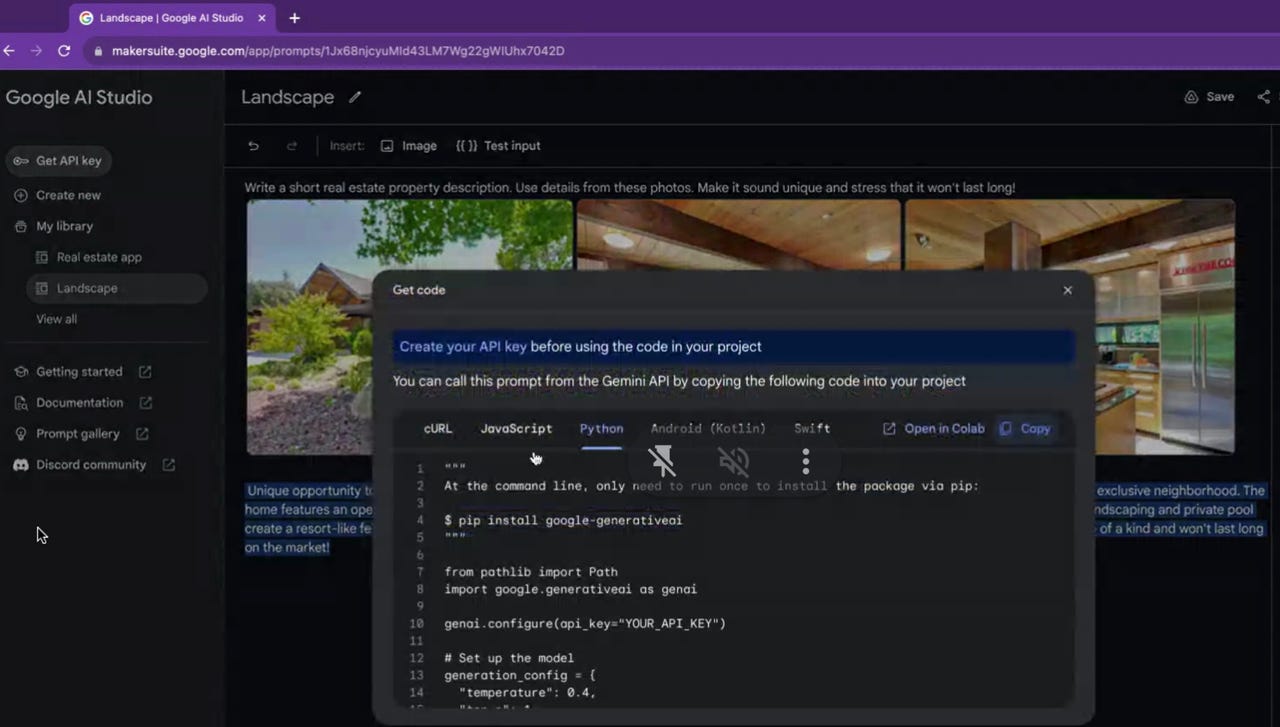
Google's AI Studio is a Web-based code editor for individuals and small teams that will let an individual throw together an app using mostly natural-language prompting.
Google on Wednesday morning announced its top-of-the-line artificial intelligence program, Gemini, unveiled last week, will be available as a preview version of the "Pro" version of Gemini immediately to users of its AI Studio programming tool, and its fully managed programming tool for enterprises, Vertex AI, running in Google Cloud.
The company is also making Gemini available "over the next few weeks" in Duet AI, its coding tool enhanced with generative AI, which it announced became generally available Wednesday.
Also: AI in 2023: A year of breakthroughs that left no human thing unchanged
"Gemini is trained and part of a broad AI hyper-computing infrastructure," said Google Cloud CEO Thomas Kurian in a press briefing, referring to the company's custom AI chip, the Tensor Processing Unit, or TPU. "This is the infrastructure we're offering not just internally but now to customers."
Part of Wednesday's announcement was the general availability of TPU v5p, which increases the performance of TPUs by four times over the existing v4 chips.
The AI studio is meant for individuals and small teams. The preview of Gemini Pro can be used in AI Studio with a free quota of 60 requests per minute, which Google emphasized is 20 times as many as other free programming tools.
A demo was shown of building a real estate broker application in AI Studio using mostly natural-language prompting, with the ability to insert pictures of a house's interior and have the program generate text descriptions of the features of the photos.
Vertex AI, in contrast to AI Studio, has hooks into numerous corporate data sources, including from third-party Google Cloud partners, so its emphasis is on the use of an enterprise's own data.
Kurian emphasized work being done to reassure enterprises that Gemini will avoid the highly-publicized "hallucinations" that have created concern about their use.
ZDNET asked Google Cloud, "In your early work with enterprises, how long does it take to get sufficient output from Gemini Pro to satisfy a company's concerns that the output is likely to be accurate, consistent, and safe?"
Google Cloud declined to "speculate on this forward-looking question" given that access to Gemini Pro "at scale" is only beginning with the AI Studio and Vertex AI availability now.
The announcements come as Google Cloud this week is hosting a free Applied AI summit for developers.
You can sign up for Vertex AI as a free trial when you sign up to Google Cloud as a free trial. Using Gemini Pro in preview mode in Vertex AI has the same free allotment of 60 requests per minute.
Google Cloud said that both AI Studio and Vertex AI will transition to formal pricing of a fraction of a cent per 1,000 characters when Google Pro becomes generally available "early next year."
The company reduced its Google Cloud pricing by four times for input and two times on output, said Kurian.
Google cloud Gemini pricing.
The Pro version of Gemini is one of three versions, the other two being Ultra and Nano. Ultra is currently in private preview with select customers to get feedback, noted Kurian, while Nano is going to be released on mobile devices. It is already running on Google's Pixel 8 smartphone.
Google Cloud also announced a new version of its text-to-image neural network, Imagen 2, which it says has greater capabilities for things such as text rendering, for inserting corporate brands into images (your company logo on a toothpaste tube in a picture of a bathroom.)
Also: I fact-checked ChatGPT with Bard, Claude, and Copilot — and this AI was the most confidently incorrect
Imagen2 is available in the Vertex AI feature called Model Garden which includes a collection of different neural network programs.
The Model Garden includes multiple third-party neural networks for the first time, including Mistral, ImageBind, and DITO.
Google unveils MedLM, a family of healthcare-focused generative AI models Kyle Wiggers 16 hours
Google thinks that there’s an opportunity to offload more healthcare tasks to generative AI models — or at least, an opportunity to recruit those models to aid healthcare workers in completing their tasks.
Today, the company announced MedLM, a family of models fine-tuned for the medical industries. Based on Med-PaLM 2, a Google-developed model that performs at an “expert level” on dozens of medical exam questions, MedLM is available to Google Cloud customers in the U.S. (it’s in preview in certain other markets) who’ve been whitelisted through Vertex AI, Google’s fully managed AI dev platform.
There are two MedLM models available currently: a larger model designed for what Google describes as “complex tasks” and a smaller, fine-tunable model best for “scaling across tasks.”
“Through piloting our tools with different organizations, we’ve learned that the most effective model for a given task varies depending on the use case,” reads a blog post penned by Yossi Matias, VP of engineering and research at Google, provided to TechCrunch ahead of today’s announcement. “For example, summarizing conversations might be best handled by one model, and searching through medications might be better handled by another.”
Google says that one early MedLM user, the for-profit facility operator HCA Healthcare, has been piloting the models with physicians to help draft patient notes at emergency department hospital sites. Another tester, BenchSci, has built MedLM into its “evidence engine” for identifying, classifying and ranking novel biomarkers.
“We’re working in close collaboration with practitioners, researchers, health and life science organizations and the individuals at the forefront of healthcare every day,” writes Matias.
Google — along with chief rivals Microsoft and Amazon — are racing desperately to corner a healthcare AI market that could be worth tens of billions of dollars by 2032. Recently, Amazon launched AWS HealthScribe, which uses generative AI to transcribe, summarize and analyze notes from patient-doctor conversations. Microsoft is piloting various AI-powered healthcare products, including medical “assistant” apps underpinned by large language models.
But there’s reason to be wary of such tech. AI in healthcare, historically, has been met with mixed success.
Babylon Health, an AI startup backed by the U.K.’s National Health Service, has found itself under repeated scrutiny for making claims that its disease-diagnosing tech can perform better than doctors. And IBM was forced to sell its AI-focused Watson Health division at a loss after technical problems led customer partnerships to deteriorate.
One might argue that generative models like those in Google’s MedLM family are much more sophisticated than what came before them. But research has shown that generative models aren’t particularly accurate when it comes to answering healthcare-related questions, even fairly basic ones.
One study co-authored by a group of ophthalmologists asked ChatGPT and Google’s Bard chatbot questions about eye conditions and diseases, and found that the majority of responses from all three tools were wildly off the mark. ChatGPT generates cancer treatment plans full of potentially deadly errors. And models including ChatGPT and Bard spew racist, debunked medical ideas in response to queries about kidney function, lung capacity and skin.
In October, the World Health Organization (WHO) warned of the risks from using generative AI in healthcare, noting the potential for models to generate harmful wrong answers, propagate disinformation about health issues and reveal health data or other sensitive info. (Because models occasionally memorize training data and return portions of this data given the right prompt, it’s not out of the question that models trained on medical records could inadvertently leak those records.)
“While WHO is enthusiastic about the appropriate use of technologies, including [generative AI], to support healthcare professionals, patients, researchers and scientists, there’s concern that caution that would normally be exercised for any new technology is not being exercised consistently with [generative AI],” the WHO said in a statement. “Precipitous adoption of untested systems could lead to errors by healthcare workers, cause harm to patients, erode trust in AI and thereby undermine or delay the potential long-term benefits and uses of such technologies around the world.”
Google has repeatedly claimed that it’s being exceptionally cautious in releasing generative AI healthcare tools — and it’s not changing its tune today.
“[W]e’re focused on enabling professionals with a safe and responsible use of this technology,” Matias continued. “And we’re committed to not only helping others advance healthcare, but also making sure that these benefits are available to everyone.”
The Beijing Internet Court on Tuesday began its hearing of a lawsuit filed by the artist, whose family name is Yin, claiming the AI-powered likeness of her voice had been used in audiobooks sold online. These were works she had not given permission to be produced, according to a report by state-owned media China Daily.
Yin said the entities behind the AI-generated content were profiting off the sale proceeds from the platforms on which the audiobooks were sold. She named five companies in her suit, including the provider of the AI software, saying their practices had infringed on her right to voice.
Also: ZDNET looks back on tech in 2023, and looks ahead to 2024
"I've never authorized anyone to make deals using my recorded voice, let alone process it with the help of AI, or sell the AI-generated versions," she said in court. "I make a living with my voice. The audiobooks that use my AI-processed voice have affected my normal work and life."
The defendants argued that the AI-powered voice was not Yin's original voice and should be distinguished from the latter.
The court is scheduled to reveal its ruling at a later date, China Daily reported. Yin has sued for 600,000 yuan ($84,718) in financial losses and an additional 100,000 yuan for mental distress.
The legal case follows another last month when a Chinese court ruled in favor of a plaintiff, surnamed Li, who accused another of using an image he generated using an open source AI software, without his consent. Li had posted the picture on his personal social media account and argued that its unauthorized reuse infringed on his intellectual property rights.
Also: The ethics of generative AI: How we can harness this powerful technology
In her defense, the defendant said the image had popped up via an online search and bore no watermark or information about its copyright owner. She added that she did not use the content for commercial gains. The image was used on her personal webpage, according to China Daily.
In its ruling, the Beijing Internet Court said Li had put in "intellectual investment" to tweak the image in line with what he wanted, including using keywords to generate the woman's appearance and image lighting.
The court added that people who used AI features to produce an image still are the ones using a tool to create, stating that it is the person, rather than the AI, who invests intellectually in generating the image.
Li was reported to have used AI software Stable Diffusion to produce the image in question.
Also: How to use Stable Diffusion AI to create amazing images
Commenting on the case, law firm King & Wood Mallesons said the Beijing court's ruling appeared to contradict recent decisions in the US on whether AI-generated content could have copyrights. The firm pointed to cases such as "Zarya of the Dawn" and "Theatre D'opera Spatial" where US courts denied copyright protection to AI-generated content that lacked human authorship.
The law firm, though, noted a difference between the cases in China and the US, stressing the Beijing Internet Court ruling appeared to distinguish a "straightforward" AI-generated content that had no creative involvement, from one that demonstrated continuous human intervention to finetune the end-product. This involved adding prompts and tech parameters until the human creators got the result they wanted.
In the latter, the Beijing court had viewed the content as "AI-assisted" work in which Li had invested personal judgment and made aesthetic choices in producing the image, King & Wood Mallesons wrote. Li also demonstrated the ability to produce the same picture with the same sequence of instructions, comprising more than 150 prompts, and tech parameters.
Also: AI in 2023: A year of breakthroughs that left no human thing unchanged
"It would be interesting to speculate whether the [Beijing Internet Court] would come to the same conclusion, [in] recognizing the copyrightability of the AI picture, if the AI-generated content turns out to be unpredictable, producing various AI pictures each time," noted the Hong Kong-based law firm. "Would the Chinese judges change their rationale because the human authors do not have 'control' in the AI-generated content output?"
OpenAI inks deal with Axel Springer on licensing news for model training Kyle Wiggers 11 hours
Many, if not most, generative AI tech vendors argue that fair use entitles them to train AI models on copyrighted material scraped from the internet — even if they don’t get permission from the rightsholders. But some vendors, such as OpenAI, are hedging their bets — perhaps wary of the outcome of pending relevant lawsuits.
OpenAI today announced that it’s reached an agreement with Axel Springer, the Berlin-based owner of publications including Business Insider and Politico, to train its generative AI models on the publisher’s content and add recent Axel Springer-published articles to OpenAI’s viral AI-powered chatbot ChatGPT.
It’s OpenAI’s second such arrangement with a news organization after the startup said that it would license some of the The Associated Press’ archives for model training.
Going forward, ChatGPT users will get summaries of “selected” articles from Axel Springer’s publications — including stories normally gated behind a paywall. The snippets will be accompanied both by attribution and links to the full articles.
In return, Axel Springer will receive payments of an unspecified size and frequency from OpenAI. The deal is valid for several years, and — while it doesn’t commit either side to exclusivity — Axel Springer says that it’ll support the outlet’s existing AI-driven ventures “that build upon OpenAI’s technology.”
“We’re excited to have shaped this global partnership between Axel Springer and OpenAI — the first of its kind,” Axel Springer CEO Mathias Döpfner said in a canned statement. “We want to explore the opportunities of AI-empowered journalism — to bring quality, societal relevance and the business model of journalism to the next level.”
Outside of the publishers tapping generative AI for questionable content strategies, publishers and generative AI vendors have a testy relationship, with the former alleging copyright infringement and increasingly concerned about generative models cannibalizing traffic. For example, Google’s new generative AI-powered search experience, called SGE, has pushed links that appear in traditional search further down search results pages — potentially reducing traffic to those links by as much as 40%.
Publishers also object to vendors training their models on content without compensation agreements in place — particularly in light of reports that tech giants including Google are experimenting with AI tools to summarize news. According to one recent survey, hundreds of news organizations are now using code to prevent OpenAI, Google and others from scanning their websites for training data.
In August, several media organizations including Getty Images, The Associated Press, the National Press Photographers Association and The Authors Guild published an open letter calling for more transparency and copyright protection in AI. In the letter, the signatories urged policymakers to consider regulations that require transparency into training data sets and allow media companies to negotiate with AI model operators, among other suggestions.
“[Current] practices undermine the media industry’s core business models, which are predicated on readership and viewership (such as subscriptions), licensing, and advertising,” the letter reads. “In addition to violating copyright law, the resulting impact is to meaningfully reduce media diversity and undermine the financial viability of companies to invest in media coverage, further reducing the public’s access to high-quality and trustworthy information.”
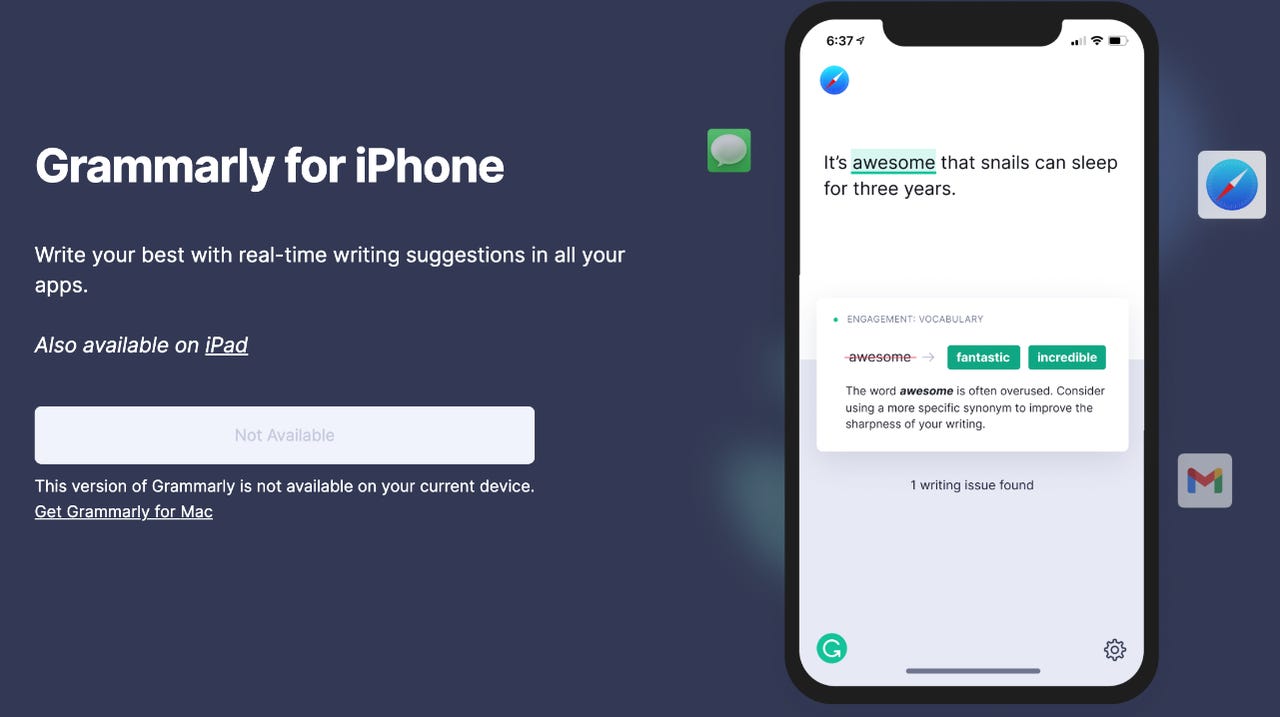
Grammarly has long been a go-to tool for writing help, checking for errors in spelling, syntax, grammar, and more. With the rise of generative AI, Grammarly has expanded its offerings, and today the company unveiled a new gen AI tool for mobile.
Grammarly's AI-powered rewrite feature for mobile enables users to tweak a message simply by highlighting it, selecting from one of the built-in prompts, and having Grammarly rewrite the text to match their needs.
The available prompts include writing assistance such as "make it persuasive," "rewrite for a general audience," "paraphrase it," and "sound fluent," according to the company.
According to the company, the feature targets the needs of business professionals who are working on the go and can benefit from additional writing assistance. In a study, the company found that 50% of professionals text for work daily, while 80% do so at least once a week.
"With more people working from their phones, there's a major need for quality AI writing support everywhere we communicate," said Tal Oppenheimer, Grammarly head of product. "We're aiming to ensure professionals feel confident they can do quality work from anywhere."
The feature is already available on iOS, and all users have to do is download the Grammarly app from the App Store to use Grammarly for iPhone. Android users will have to wait until early 2024.
However, if you are an Android user who wants to try out Grammarly's generative AI features, you can experiment with them on your desktop for free through Grammarly's various platforms and offerings, including Grammarly for Windows, Mac, Chrome, and Edge.
OpenAI launches second Converge startup cohort Kyle Wiggers 8 hours
Palace intrigue might be dominating the news cycle around OpenAI, but the AI startup — and its accelerator programs — are chugging along uninterrupted, so the PR team tells me.
OpenAI today announced the launch of Converge-2, the second cohort of its six-week Converge program for “exceptional engineers, designers, researchers, and product builders using AI to reimagine the world,” as the company describes it in a blog post published this morning.
As with members of OpenAI’s first Converge cohort, the 10-15 startups chosen to participate in Converge-2 will receive a $1 million equity investment from the OpenAI Startup Fund, the $100 million-plus entrepreneurial tranche announced last May backed by Microsoft and other OpenAI partners. Do the math, and that’s at least a $10 million investment in the Converge-2 program — not an insubstantial chunk of change.
In addition to the capital, Converge-2 participants will gain access to tech talks, office hours, social events and conversations with “leading practitioners” and OpenAI’s “community of builders,” according to the blog post. Importantly, they won’t be forced to build on top of OpenAI’s APIs; OpenAI stresses that the program is “for anyone building or aspiring to build with AI,” although one assumes that the network effects will make OpenAI’s technologies extraordinarily attractive.
OpenAI is encouraging founders from all backgrounds, disciplines and experience levels to apply, including those based outside of the U.S. Prior experience working with AI systems isn’t required. But OpenAI will require that startups selected devote at least four to six hours to the program per week from March 11 to April 19, with the first and last week of the program taking place in San Francisco (OpenAI will cover travel costs.)
December 13, 2023 Editor's Picks 5 Super Cheat Sheets to Master Data Science Abid Ali Awan Using Google's NotebookLM for Data Science: A Comprehensive Guide Abid Ali Awan This Week's Nuggets Types of Visualization Frameworks Nate Rosidi WTF is the Difference Between GBM and XGBoost? Cornellius Yudha Wijaya Top 10 Kaggle Machine Learning Projects to Become Data Scientist in 2024 Aryan Garg ChatGPT’s New Rival: Google’s Gemini Nisha Arya Personalized AI Made Simple: Your No-Code Guide to Adapting GPTs Josep Ferrer Back to Basics Bonus Week: Deploying to the Cloud Nisha Arya 7 Pandas Plotting Functions for Quick Data Visualization Bala Priya C Strategies for Optimizing Performance and Costs When Using Large Language Models in the Cloud Cornellius Yudha Wijaya Evolution in ETL: How Skipping Transformation Enhances Data Management Arnab Sen From Our Partners Talk Directly to Your Data Using Everyday Language DataGPT
More On This Topic
Using Google's NotebookLM for Data Science: A Comprehensive Guide
5 Super Cheat Sheets to Master Data Science
7 Super Cheat Sheets You Need To Ace Machine Learning Interview
KDnuggets™ News 22:n06, Feb 9: Data Science Programming…
KDnuggets News, June 8: 21 Cheat Sheets for Data Science…
KDnuggets News, December 7: Top 10 Data Science Myths Busted • 4…
Get the FREE ebook 'The Great Big Natural Language Processing Primer' and 'The Complete Collection of Data Science Cheat Sheets' along with the leading newsletter on Data Science, Machine Learning, AI & Analytics straight to your inbox.
By subscribing you accept KDnuggets Privacy Policy
Leave this field empty if you're human: <= Previous post
Latest Posts
KDnuggets News, December 13: 5 Super Cheat Sheets to Master Data Science • Using Google’s Notebo…
5 Rare Data Science Skills That Can Help You Get Employed
Undersampling Techniques Using Python
5 Tools to Help Build Your LLM Apps
Evolution in ETL: How Skipping Transformation Enhances Data Management
Strategies for Optimizing Performance and Costs When Using Large Language Models in the Cloud
Top Posts
5 Super Cheat Sheets to Master Data Science
Top 10 Kaggle Machine Learning Projects to Become Data Scientist in 2024
Types of Visualization Frameworks
7 Pandas Plotting Functions for Quick Data Visualization
Using Google’s NotebookLM for Data Science: A Comprehensive Guide
5 Tools to Help Build Your LLM Apps
Personalized AI Made Simple: Your No-Code Guide to Adapting GPTs
Evolution in ETL: How Skipping Transformation Enhances Data Management
7 Reasons Why You Shouldn’t Become a Data Scientist
Subscribe To Our Newsletter (Get The Complete Collection of Data Science Cheat Sheets & Great Big NLP Primer ebook)
Leave this field empty if you're human:
Get the FREE ebook 'The Great Big Natural Language Processing Primer' and 'The Complete Collection of Data Science Cheat Sheets' along with the leading newsletter on Data Science, Machine Learning, AI & Analytics straight to your inbox.
By subscribing you accept KDnuggets Privacy Policy
Leave this field empty if you're human:
Get the FREE ebook 'The Great Big Natural Language Processing Primer' and 'The Complete Collection of Data Science Cheat Sheets' along with the leading newsletter on Data Science, Machine Learning, AI & Analytics straight to your inbox.
By subscribing you accept KDnuggets Privacy Policy
The release of ChatGPT in November 2022 unleashed a frenzy surrounding generative artifical inteligence (AI), resulting in the exponential growth and development of the emerging technology through 2023.
Twelve months on and Deloitte's Tech Trends 2024 report takes a deep dive into the events of the past year to help businesses learn how they will be impacted by generative AI during the next 12 months.
At the end of each year, Deloitte releases its annual Tech Trends report to help business and IT leaders learn about how emerging technologies might impact their businesses, and how to best deploy these tools. Unsurprisingly, generative AI was a major topic of Deloitte's 15th annual report.
Within the first 60 days of ChatGPT's release to the public, OpenAI garnered 100 million users. For comparison, it took TikTok, a major leader in the social media space, nine months to reach that milestone.
The heightened level of interest was likely fueled by how intuitive ChatGPT is to use, allowing everyone, regardless of technical skill, to take advantage of the tech. What's more, the use cases for the chatbot were evident.
"People who have, from their desk and keyboard, watched mechanical muscles automate manufacturing and automate spreadsheet analysis, suddenly, they're finding mechanical minds beginning to automate what they do," said Mike Bechtel, chief futurist with Deloitte and co-writer of the report. "I think that's why this arcane evolution of transformer models has become a bonfire of interest among gen pop."
Also: CIOs assess generative AI's risk and reward for software engineers
Business leaders' interest in the technology parallels that of the public, with 80% of business leaders in a Deloitte CEO survey from summer 2023 agreeing that generative AI will increase efficiencies in their organization.
The generative AI promise
Generative AI is an extremely capable and intelligent technology, and, as highlighted in the report, can oftentimes outperform humans.
For example, ChatGPT scored a five out of five on the Advanced Placement biology exam, and Anthropic's Claude 2 chatbot scored above the 90th percentile in the verbal and writing sections of the GRE exam.
These capabilities have led many employees to panic about generative AI replacing them in the workforce. However, according to the report, there is no real indication that business leaders will want to automate knowledge jobs on any scale.
"One of the patterns we've seen over the years is this phrase we often use, 'you can't shrink your way to success,'" said Bechtel.
Bechtel then went on to explain that there typically are two camps of leaders: the short-termists who see emerging technology as a crash diet, a way to do the same thing with fewer people, and the long-termists, the ones who want to use emerging tech to make work better. It's the latter group that sees the most success.
"I think the entrepreneurs are going to separate themselves from the rest because they're going to use this as rocket fuel for elevated ambitions, as opposed to a license to skinny up," added Bechtel.
Other research comes to similar conclusions. An IBM survey showed that the most common use cases for generative AI that business leaders prioritize include improving content quality, driving competitive advantage, and scaling employee expertise over reducing headcount.
The Deloitte findings also conclude that the real opportunity for harnessing generative AI in organizations lies in using the technology to optimize business operations, rather than reducing headcount.
"The true value of generative AI is likely to be unlocked when organizations can use it to transform business functions; reduce costs; disrupt product, service, and innovation cycles; and create previously unachievable process efficiencies," said Deloitte in the report.
Also: 6 ways business leaders are exploring generative AI at work
In every one of the above use cases for the optimization of business operations through generative AI, not only would the enterprises as a whole benefit, but so would each employee's workload.
For example, if a business leverages a generative AI model to take all of its data and compile it into a searchable database, that process positively impacts everyone in the organization as much as it benefits the organization's operations.
But while the replacement of knowledge workers might not be a major negative impact of generative AI, there are some significant risks involving the use of the technology that business leaders must prepare for.
The risks, and how to tackle them
Generative AI's ability to imitate human dialogue and reasoning means the technology can be employed by bad actors to efficiently accomplish harmful tasks, such as cybersecurity attacks, which pose a huge risk to enterprises.
According to the Deloitte report, phishing is the most common cyberattack, with 3.4 billion spam emails sent every day. Thankfully, many of these attacks do not succeed because recipients can detect flaws, including poor grammar and spelling.
Also: Watch out: Generative AI will level up cyber attacks, according to new Google report
Generative AI applications, such as chatbots, can create legitimate-looking malicious content at the command of a simple prompt, eliminating syntax errors and making it harder for people to distinguish real from fake.
Beyond text, Generative AI could also be used to create malicious content across many different mediums, including voice and even video.
"The trend that we've uncovered in Deloitte Tech Trends is the bad guys have AI too, and specifically, they're using AI to exploit the most vulnerable point of most companies' stack, which is the human," said Bechtel.
All of the most advanced protections can be rendered useless if a worker willingly hands over a password.
For example, deepfakes have been used to attack businesses by impersonating the voices of business leaders within the company. Scammers used this technique to swindle $243,000 from the CEO of a UK-based energy firm, as highlighted in the Deloitte report.
Also: Cybersecurity 101: Everything on how to protect your privacy and stay safe online
The world of cybersecurity involves a constant game of cat and mouse, with defenders finding new ways of protecting themselves as attackers get smarter and find new ways to attack. As part of that ever-evolving process, new ways for users to protect themselves from deepfakes will evolve in the near future.
But until then, what do you do? The advice from the expert: don't trust what you hear and see.
"Don't believe your eyes. Don't believe in ears. In math we trust, in cryptography we trust," said Bechtel.
"Whether that's an individual making sure that an email they've received is from the company, or it's an enterprise-wide organization, investing in zero trust in cyber defense, that's really the best advice. We can't believe our own eyes."
How to approach
Given the range of positive and negative impacts of generative AI, you might be left wondering exactly how you feel about the technology.
Bechtel says the answer to that conundrum is found in striking a balance between both ends of the spectrum.
"Hyperbole in both directions is the problem," said Bechtel. "Wide-eyed enthusiasm and grumpy skepticism aren't helpful; what's helpful is figuring out how to leverage these tools in a way that's merely very useful."
To help businesses prepare adequately to leverage generative AI in a beneficial way, the report delineates different areas where companies can focus their attention.
The first way involves the upkeep of enterprise data. Generative AI models are trained on robust amounts of data, which can then be used to execute a series of actions, such as creating a searchable database.
However, to complete that process effectively, or any of the next-generation use cases, businesses need to ensure their data is architectured properly and is accessible to AI applications, according to the report.
Another important aspect to keep in mind while adopting generative AI is governance. Generative AI, as intelligent as it is, is prone to hallucinations or other missteps that could put the business at risk.
As a result, businesses should preemptively establish proper guardrails to prevent mishaps from happening and to ensure prime performance.
"Without effective governance guardrails, AI can't scale," said the report. "A governance framework should define the business's vision, identify potential risks and gaps in capabilities, and validate performance."
Lastly, the report highlights the need for businesses to implement generative AI step by step, without rushing the process. Specifically, it recommends the approach: crawl, walk, run, and fly.
"This approach has for years been an effective way for enterprises to scale up their use of service offerings," says the report. "Generative AI is no different."
In the "crawl" stage, the applications require a lot of manual effort. But as the applications graduate through the next stages, they become more refined, culminating in the fly phase, when an organization can reap the rewards from their work.
Google debuts Imagen 2 with text and logo generation Kyle Wiggers 10 hours
Google’s making the second generation of Imagen, its AI model that can create and edit images given a text prompt, more widely available — at least to Google Cloud customers using Vertex AI who’ve been approved for access.
But the company isn’t disclosing which data it used to train the new model — nor introducing a way for creators who might’ve inadvertently contributed to the data set to opt out or apply for compensation.
Called Imagen 2, Google’s enhanced model — which was quietly launched in preview at the tech giant’s I/O conference in May — was developed using technology from Google DeepMind, Google’s flagship AI lab. Compared to the first-gen Imagen, it’s “significantly” improved in terms of image quality, Google claims (the company bizarrely refused to share image samples prior to this morning), and introduces new capabilities including the ability to render text and logos.
“If you want to create images with a text overlay — for example, advertising — you can do that,” Google Cloud CEO Thomas Kurian said during a press briefing on Tuesday.
Text and logo generation brings Imagen in line with other leading image-generating models, like OpenAI’s DALL-E 3 and Amazon’s recently launched Titan Image Generator. In two possible points of differentiation, though, Imagen 2 can render text in multiple languages — specifically Chinese, Hindi, Japanese, Korean, Portuguese, English and Spanish, with more to come sometime in 2024 — and overlay logos in existing images.
“Imagen 2 can generate … emblems, lettermarks and abstract logos … [and] has the ability to overlay these logos onto products, clothing, business cards and other surfaces,” Vishy Tirumalashetty, head of generative media products at Google, explains in a blog post provided to TechCrunch ahead of today’s announcement.
Thanks to “novel training and modeling techniques,” Imagen 2 can also understand more descriptive, long-form prompts and provide “detailed answers” to questions about elements in an image. These techniques also enhance Imagen 2’s multilingual understanding, Google says — allowing the model to translate a prompt in one language to an output (e.g. a logo) in another language.
Imagen 2 leverages SynthID, an approach developed by Deepmind, to apply invisible watermarks to images created by it. Of course, detecting these watermarks — which Google claims are resilient to image edits including compression, filters and color adjustments — requires a Google-provided tool that’s not available to third parties. But as policymakers express concern over the growing volume of AI-generated disinformation on the web, it’ll perhaps allay some fears.
Google didn’t reveal the data that it used to train Imagen 2, which — while disappointing — doesn’t exactly come as a surprise. It’s an open legal question as to whether gen AI vendors like Google can train a model on publicly available — even copyrighted — data and then turn around and commercialize that model.
Relevant lawsuits are working their way through the courts, with vendors arguing that they’re protected by fair use doctrine. But it’ll be some time before the dust settles.
In the meantime, Google’s playing it safe by keeping quiet on the matter — a reverse in the strategy it took with the first-gen Imagen, where it disclosed that it used a version of the public LAION data set to train the model. LAION is known to contain problematic content including but not limited to private medical images, copyrighted artwork and photoshopped celebrity porn — which obviously isn’t the best look for Google.
Some companies developing AI-powered image generators, like Stability AI and — as of a few months ago — OpenAI, allow creators to opt out of training data sets if they so choose. Others, including Adobe and Getty Images, are establishing compensation schemes for creators — albeit not always well-paying or transparent ones.
Google — and, to be fair, several of its rivals, including Amazon — offer no such opt-out mechanism or creator compensation. That won’t change anytime soon, it seems.
Instead, Google offers an indemnification policy that protects eligible Vertex AI customers from copyright claims related both to Google’s use of training data and Imagen 2 outputs.
Regurgitation, or when a generative model spits out a mirror copy of a training example, is rightly a concern for corporate customers and devs. An academic study showed that the first-gen Imagen wasn’t immune to this phenomenon, spitting out identifiable photos of real people, copyrighted work by artists and more when prompted in specific ways.
Not shockingly, in a recent survey of Fortune 500 companies by Acrolinx, nearly a third said intellectual property was their biggest concern about the use of generative AI. Another poll found that nine out of ten developers “heavily consider” IP protection when making decisions on whether to use generative AI.
It’s a concern Google hopes that its policy, which is newly expanded, will address. (Google’s indemnification terms didn’t previously cover Imagen outputs.) As for the concerns of creators, well… they’re out of luck this go-around.
Starting Dec. 13, developers can use Google AI Studio and Vertex AI to build applications with the Gemini Pro API, which allows access to Google’s new generative AI model. Google’s initial rollout of Gemini was limited to Google Bard and the Pixel 8 Pro, so Wednesday’s general availability of Gemini for Google AI Studio and Vertex AI marks the first test of Gemini for enterprise developers. AI Studio and Vertex AI with Gemini can help developers build apps with generative AI powered by Gemini. Plus, Google’s Duet AI assistant chatbot is coming to developer and SecOps tools.
Jump to:
Google AI Studio helps small businesses and individual developers build generative AI
Vertex AI with Gemini is a generative AI platform for enterprise developers
Google’s Duet AI news for developers
Google AI Studio helps small businesses and individual developers build generative AI
On December 13, Google announced the general availability of Google AI Studio. Google AI Studio is a web-based development environment with which to discover the Gemini Pro APIs, create prompts and fine-tune the Gemini model. Google calls this its “fastest way to start building AI,” said Google Cloud CEO Thomas Kurian during the prebriefing.
The Google AI Studio will first show developers a prompting interface. From the prompt, developers can get an API key (Figure A) that can be deployed right from Google AI Studio or moved to Vertex AI by changing three lines of code.
Figure A
An API key shown in Google AI Studio. Image: Google
Vertex AI with Gemini is a generative AI platform for enterprise developers
Vertex AI, Google’s fully managed AI platform with support for Gemini, is generally available as of December 13. It helps developers discover AI models and build search and conversation applications with low or no code.
SEE: Is it better to use Google Bard or Google Search to find information? (TechRepublic)
Gemini Pro is now in the Vertex AI model garden, as is Gemini Ultra, but the latter is only available to select customers in private preview. Vertex AI’s model garden includes Imagen 2, the next update to Google’s image processing model. Imagen 2 can make photorealistic images and perform text rendering for logos and product names, for example.
More than 130 AI models from Google, open source and third parties are available. These include Gemini Pro ImagenMedLM (a suite of medically trained models) and Mistral, ImageBind or DITO (three open-source models).
Vertex AI with Gemini can do tuning, including adapter tuning, fine tuning, low rank adaptation (which requires less data), prompt design and step-by-step distillation (which means taking a larger model and having it teach a smaller model). Developers can tune and customize Gemini with reinforcement learning from human feedback. Vertex AI gives developers support to collect human feedback and automate the way it can be used to customize Gemini.
Vertex AI with Gemini includes:
Grounding, or comparing the generative AI model’s generated answer to the information within a company’s own system or well-known web sources.
Citation checking, with which Gemini will show its sources.
18 kinds of safety filters.
Up-to-the-minute real-world information from retrieval augmented generation and embedding.
Developers can add new capabilities to the models, such as extensions and functions. Extensions are a mechanism to connect Gemini to enterprise apps and systems to retrieve information or allow Gemini to take action on behalf of the user in enterprise apps. With functions, developers can compare data in their app to data generated by Gemini to improve the quality of Gemini’s answers.
What about building apps in Gemini and moving them to a production environment? Google has automation evaluation metrics, monitoring, model registry and governance for those purposes.
Model tuning and customization in Vertex AI with Gemini Pro is a symmetrical experience, meaning anything you can do in the UI you can do in code, including Python, Node.js and Java.
Gemini supports 38 spoken languages. During the prebriefing, Nenshad Bardoliwalla, AI/ML product leader on the Vertex AI platform at Google Cloud, demonstrated Gemini’s ability to generate text in Spanish.
Gemini for Vertex AI Search and Vertex Blended Search
A few new Gemini-powered capabilities are coming in early 2024 to Vertex AI Search, which can search organization intranets for answers, and Vertex AI Conversation, a low-code or no-code environment to build chatbots.
Vertex AI Search will use Gemini for answer generation and summarization. Another new feature is Vertex AI Blended Search, which uses Gemini to search across many different applications, for example, a company’s retail catalog, inventory management system and transportation logistics system. In the last version of Vertex AI Search, users needed to do different searches for different data sources and different modalities. With Gemini, the data can be searched together.
Gemini will power Advanced Search in Vertex AI Search, which helps developers build search and recognition systems with multimodal capabilities.
Vertex AI Conversation is for multi-channel, multi-modal conversations. It can produce human-like voice and text responses for call centers, mobile apps or the retail point of sale. Conversation trees with Vertex AI Conversation can be created using Natural Language Playbooks instead of code, like training a human.
Google’s Duet AI news for developers
While the AI assistant Duet AI has been available in Google Workspace since August 2023, Duet AI is now available in two new enterprise products: Duet AI for Developers and Duet AI in Security Operations. Neither product runs on Gemini for now, though Google says Gemini will come to Duet AI for Workspace in early 2024. All Duet AI services will incorporate Gemini “over the next few weeks,” Brad Calder, vice president and GM of Google Cloud Platform, wrote in a press release on Dec. 13.
Duet AI for Developers
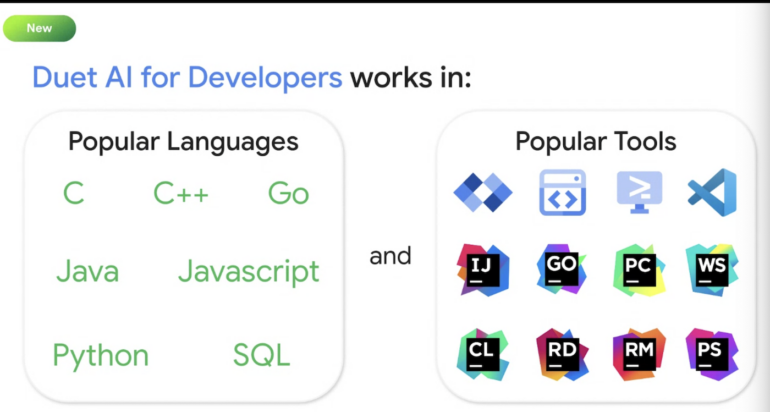
For now, Duet AI for Developers can do code completion, code generation, code refactoring, documentation generation, unit test generation, application deployment and operational diagnostics. Duet AI for Developers works in a wide variety of languages (Figure B) and interoperates with tools such as Visual Studio Code.
Figure B
Programming languages and tools supported by Duet AI for Developers. Image: Google
Duet AI for Developers will be free from December 13, 2023 to February 1, 2024. After Feb. 1, interested developers are asked to contact Google Cloud for pricing. Duet AI for Developers is available in the U.S., Europe and Asia Pacific. Google plans to expand it to additional regions by early 2024.
Google adds Duet AI to SecOps tools
Duet AI in Security Operations, generally available Dec. 13, combines threat intelligence and security operations assisted by generative AI. Developers can ask it what threats might be occurring in natural language and receive a response in natural language. Duet AI in Security Operations scans the organization’s threat intelligence system and compares its data to a customer’s environment to automate threat prediction.
Duet AI in Security Operations runs on Google’s Sec-PaLM, which is a large language model specialized for security.
Existing Google Cloud Security Operations Enterprise and Enterprise Plus customers in the U.S. and Europe will have access to Duet AI in Security Operations at no extra cost. Users of Google’s SecOps platform, Chronicle, will have access to Duet AI at no cost until March 5, 2024. Users in some additional countries will gain access in early 2024.
Gemini competes with AWS’s Generative AI Builder, Microsoft’s Azure AI cloud developer services, IBM’s Watson AI studio and ChatGPT Plus.