In an inspiring initiative to promote STEM education, Honeywell India has sponsored 26 students from various Indian cities, including Bengaluru, Pune, Hyderabad, and Madurai, to participate in the Honeywell Leadership Challenge Academy (HLCA) at the U.S. Space & Rocket Center in Huntsville, Alabama. This enriching experience, held in two sessions from October 15-20 and October 22-27, 2023, hosted a diverse group of 237 students from 45 countries and 29 U.S. states and territories.
The HLCA is tailored for high school students aged 16 to 18, aiming to encourage the pursuit of careers in science, technology, engineering, and math (STEM). The program encompasses a range of hands-on activities in coding, computer science, leadership, communication skills, and astronautics. Jayme Meyer, Honeywell’s Vice President of Communications, highlighted the company’s dedication to fostering future STEM talent: “For 13 years, Honeywell has sponsored students to participate in real-world STEM experiences at Space Camp, helping to build their technical, collaborative, and communication skills.”
Participants engaged in various STEM leadership challenges, including building, coding, and testing rockets, undergoing simulated astronaut training, engaging in shuttle missions, and experiencing a low-gravity moonwalk. These activities are designed to enhance their digital skills and instil teamwork and leadership qualities.
Dr. Kimberly Robinson, CEO of the U.S. Space & Rocket Center, praised the program’s impact: “Through the immersive program, students learn skills and form relationships that will serve them in their lives ahead as they tackle new and unique challenges.” Additionally, Ashish Modi, President of Honeywell India, expressed the company’s commitment to nurturing young talent in India: “It’s great to see young minds from India come together for this journey. We’re committed to fostering STEM education in India and hope to inspire students as future innovators.”
Sanegha Sakhare, an Indian student participant, shared her transformative experience at the HLCA: “Participating in the Honeywell Leadership Challenge Academy was a transformative experience. It opened doors to the vast realm of science and technology, expanding my horizons.”
The selection process for the HLCA is rigorous, focusing on academic achievement and community involvement. Honeywell and its employees generously fund scholarships, covering the cost of tuition, meals, accommodations, and program materials. Since its inception in 2010, Honeywell has sponsored over 3,000 students to attend Space Camp, reinforcing its long-standing commitment to fostering future STEM leaders.
The post Honeywell Fulfills Dreams of 26 Indian Students With Space Camp in U.S. appeared first on Analytics India Magazine.
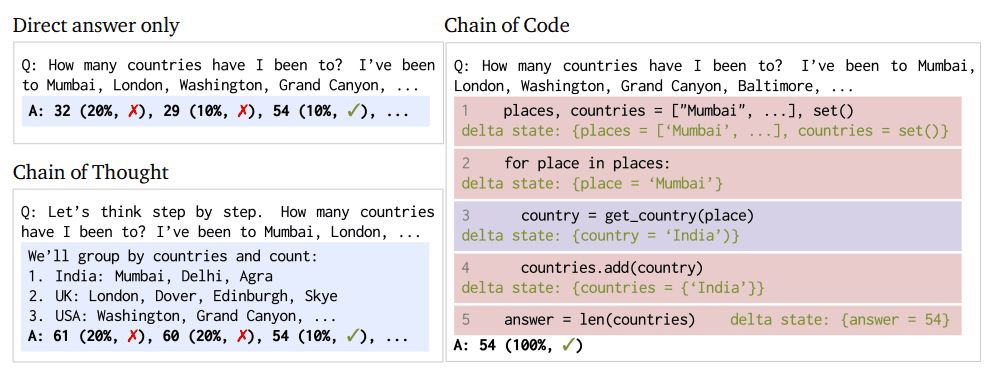
Chain of Code (CoC) is a novel approach to interacting with language models, enhancing reasoning abilities through a blend of code writing and selective code emulation.
CoC extends the capabilities of language models in logic, arithmetic, and linguistic tasks, especially those requiring a combination of these skills.
With CoC, language models write code and also emulate parts of it that cannot be compiled, offering a unique approach to solving complex problems.
CoC shows effectiveness for both large and small LMs.
The key idea is to encourage LMs to format linguistic sub-tasks in a program as flexible pseudocode that the compiler can explicitly catch undefined behaviors and hand off to simulate with an LM (as an 'LMulator').
Introduction
New language model (LM) prompting, communication, and training techniques keep emerging to enhance the LM reasoning and performance capabilities. One such emergence is the development of the Chain of Code (CoC), a method intended to advance code-driven reasoning in LMs. This technique is a fusion of traditional coding and the innovative emulation of LM code execution, which creates a powerful tool for tackling complex linguistic and arithmetic reasoning tasks.
CoC is differentiated by its ability to handle intricate problems that blend logic, arithmetic, and language processing, which, as has been known to LM users for quite some time, has long been a challenging feat for standard LMs. CoC's effectiveness is not limited to large models but extends across various sizes, demonstrating versatility and broad applicability in AI reasoning.
Figure 1: Chain of Code approach and process comparison (Image from paper) Understanding Chain of Code
CoC is a paradigm shift in LM functionality; this is not a simple prompting tactic to increase the chance of eliciting the desired response from an LM. Instead, CoC redefines the the LM's approach to the aforementioned reasoning tasks.
At its core, CoC enables LMs to not only write code but also to emulate parts of it, especially those aspects that are not directly executable. This duality allows LMs to handle a broader range of tasks, combining linguistic nuances with logical and arithmetic problem-solving. CoC is able to format linguistic tasks as pseudocode, and effectively bridge the gap between traditional coding and AI reasoning. This bridging allows for a flexible and more capable system for complex problem-solving. The LMulator, a main component of CoC's increased capabilities, enables the simulation and interpretation of code execution output that would otherwise not be directly available to the LM.
CoC has shown remarkable success across different benchmarks, significantly outperforming existing approaches like Chain of Thought, particularly in scenarios that require a mix of linguistic and computational reasoning.
Experiments demonstrate that Chain of Code outperforms Chain of Thought and other baselines across a variety of benchmarks; on BIG-Bench Hard, Chain of Code achieves 84%, a gain of 12% over Chain of Thought.
Figure 2: Chain of Code performance comparison (Image from paper) Implementing Chain of Code
The implementation of CoC involves a distinctive approach to reasoning tasks, integrating coding and emulation processes. CoC encourages LMs to format complex reasoning tasks as pseudocode, which is then interpreted and solved. This process comprises multiple steps:
Identifying Reasoning Tasks: Determine the linguistic or arithmetic task that requires reasoning
Code Writing: The LM writes pseudocode or flexible code snippets to outline a solution
Emulation of Code: For parts of the code that are not directly executable, the LM emulates the expected outcome, effectively simulating the code execution
Combining Outputs: The LM combines the results from both actual code execution and its emulation to form a comprehensive solution to the problem
These steps allow LMs to tackle a broader range of reasoning questions by "thinking in code," thereby enhancing their problem-solving capabilities.
The LMulator, as part of the CoC framework, can significantly aid in refining both code and reasoning in a few specific ways:
Error Identification and Simulation: When a language model writes code that contains errors or non-executable parts, the LMulator can simulate how this code might behave if it were to run, revaling logical errors, infinite loops, or edge cases, and guiding the LM to rethink and adjust the code logic.
Handling Undefined Behaviors: In cases where the code involves undefined or ambiguous behavior that a standard interpreter cannot execute, the LMulator uses the language model's understanding of context and intent to infer what the output or behavior should be, providing a reasoned, simulated output where traditional execution would fail.
Improving Reasoning in Code: When a mix of linguistic and computational reasoning is required, the LMulator allows the language model to iterate over its own code generation, simulating the results of various approaches, effectively 'reasoning' through code, leading to more accurate and efficient solutions.
Edge Case Exploration: The LMulator can explore and test how code handles edge cases by simulating different inputs, which is particularly useful in ensuring that the code is robust and can handle a variety of scenarios.
Feedback Loop for Learning: As the LMulator simulates and identifies issues or potential improvements in the code, this feedback can be used by the language model to learn and refine its approach to coding and problem-solving, which is an ongoing learning process that improves the model's coding and reasoning capabilities over time.
The LMulator enhances the language model's ability to write, test, and refine code by providing a platform for simulation and iterative improvement.
Conclusion
The CoC technique is an advancement in enhancing the reasoning abilities of LMs. CoC broadens the scope of problems LMs can tackle by integrating code writing with selective code emulation. This approach demonstrates the potential for AI to handle more complex, real-world tasks that require nuanced thinking. Importantly, CoC has proven to excel in both small and large LMs, enabling a pathway for the increasing array of smaller models to potentially improve their reasoning capabilities and bring their effectiveness closer to that of larger models.
For a more in-depth understanding, refer to the full paper here.
Matthew Mayo (@mattmayo13) holds a Master's degree in computer science and a graduate diploma in data mining. As Editor-in-Chief of KDnuggets, Matthew aims to make complex data science concepts accessible. His professional interests include natural language processing, machine learning algorithms, and exploring emerging AI. He is driven by a mission to democratize knowledge in the data science community. Matthew has been coding since he was 6 years old.
More On This Topic
Unraveling the Power of Chain-of-Thought Prompting in Large Language Models
Unlocking GPT-4 Summarization with Chain of Density Prompting
Orca LLM: Simulating the Reasoning Processes of ChatGPT
Enhancing Machine Learning Personalization through Variety
Web LLM: Bring LLM Chatbots to the Browser
Top 18 Low-Code and No-Code Machine Learning Platforms
While tax season is still a few months away for most people, one of the largest tax preparation companies in America has launched a tool that harnesses artifical intelligence (AI) to make sure people get the tax answers they need.
The chatbot, called AI Tax Assist, is powered by Microsoft's Azure OpenAI and is included with any paid version of H&R Block tax software.
The tool can engage with customers about topics like tax deductions, tax theory, tax code, new laws and policies, maximizing refunds, and more. The chatbot is conversational, and users can refer back to previous conversations. If a customer prefers the help of a live person, they can get personalized help with no additional charge, says H&R Block.
Intuit's TurboTax rolled out a similar AI tax assistance tool just a few months ago.
A demonstration offered by the company showed a user — who works as a rideshare driver — asking about the specific things that could be deducted from their taxes. The chatbot listed off items that could serve as a tax deduction and the user was given the option to add those things to their return.
In a press release about its new feature, H&R Block pointed out a common problem with some AI chatbots — the fact that they sometimes rely on community answers or search results that are wrong. Instead, H&R Block says its chatbot was trained with knowledge from The Tax Institute, a group of professional tax attorneys, CPAs, and tax agents.
H&R Block said its goal with this new AI-enabled feature is to to help customers understand how their taxes work, rather than just being told where to put a certain number. The company hopes the advice from AI Tax Assist helps keep customers on the H&R Block site, instead of turning to Google search.
Of course, one important questions is what happens if the AI hallucinates or just offers flat-out wrong information?
H&R Block does offer a guarantee that its service will get customers the largest refund or smallest liability, but the compensation for "an error in the H&R Block tax preparation software" that causes that issue is simply a refund of fees paid for the service and a free re-file.
Choosing the right laptop is crucial for success in AI and analytics. A laptop with a graphics card capable of navigating complex algorithms and software tools is essential for processing tasks that require speed, especially if you are looking to run transformer models (including the likes of Llama, Falcon and others) with billions of parameters.
A carefully curated selection of laptops is available for avant-garde data scientists and AI/ML enthusiasts, including mobile workstations and ultrabooks. These laptops offer everything needed, from powerful force to agility.
Apple 14 and 16-inch MacBook Pro
This has by far become the developers’ all time favorite with the release of M3 chips, both on 14 and 16-inch MacBook Pro.
The new M3 series of CPUs, which includes the M3, M3 Pro, and M3 Max, has been introduced by Apple in new Macbook Pro models. This time, Apple included the base Apple Silicon M3 chip in the 14-inch Macbook Pro, but with a slightly modified port layout that included support for one external display, two Thunderbolt 3/USB4 connections, HDMI 2.1, Magsafe, and an SDXC card reader.
The M3 Pro and M3 Max, which come with three Thunderbolt 4 ports, HDMI 2.1, Magsafe, and an SDCX card reader, are back on the 14″ and 16″ Macbook Pro models, just like they were last year. When using an M3 Pro chip, a Macbook Pro can accommodate two external monitors, and when using an M3 Max chip, it can accommodate four external displays.
Lenovo ThinkPad P1 Mobile Workstation
The Lenovo ThinkPad P1 Mobile Workstation is a laptop designed for data science, machine learning, artificial intelligence, and deep learning tasks. It features an 8th-generation Intel Core i7 processor with up to six cores and vPro technology for security. The ThinkPad P1 can be configured with either an NVIDIA Quadro P1000 or P2000 GPU for intensive deep-learning applications. It has up to 64GB DDR4 memory and up to 4TB NVMe storage. The laptop is sleek, professional-looking, and durable, with a 15-inch display with optional touch support and HDR technology. The ThinkPad P1 is a top-of-the-line mobile workstation that can handle data science workloads while being portable.
The Alienware m15 R2 Gaming Laptop is a high-performance laptop designed for data science, AI, and machine learning workloads. It features a 9th Generation Intel Core i7 processor, NVIDIA GeForce RTX graphics card, and up to 16GB DDR4 memory. The laptop’s sleek design and portability make it easy to take on the go. Its 15.6-inch OLED panel offers vivid colors and deep blacks, making it ideal for image processing. The cooling system uses vapor chamber technology to keep temperatures low even under heavy load. The laptop also offers customizable RGB lighting on the keyboard and chassis for added personalization. The Alienware m15 R2 Gaming Laptop is a powerful yet portable option for those looking for a powerful yet portable laptop for data science or AI workloads while also allowing gaming on the side.
ASUS VivoBook S15
The ASUS VivoBook S15 is an affordable laptop ideal for data science, machine learning, and deep learning enthusiasts. It offers up to 16GB of RAM and 512GB SSD storage, making it capable of handling large datasets.
The latest Intel Core i7 processor and dedicated NVIDIA GeForce MX250 graphics card enhance performance. The laptop’s lightweight design, weighing just 3.75lbs, ensures portability without compromising power or performance. Its compact size makes it easy to fit into a backpack. The innovative ErgoLift hinge design tilts the keyboard at a comfortable typing angle, increasing airflow underneath to keep the device cool during intense workloads. The ASUS VivoBook S15 is a top choice for data science and AI-related tasks on a budget without compromising quality or functionality.
Razer Blade Stealth 13 Ultrabook
The Razer Blade Stealth 13 Ultrabook is a powerful laptop designed for data scientists, artificial intelligence engineers, and machine learning developers. It features an NVIDIA GeForce GTX 1650 graphics card, allowing users to work with complex datasets and run intensive applications without lag. The Intel Core i7-1065G7 processor ensures fast processing speeds and smooth multitasking. The ultrabook also has an impressive battery life of up to 10 hours on a single charge. Its sleek design makes it easy to carry around, allowing users to work on-the-go without hassle. If you’re looking for a high-performance laptop that can handle complex tasks while maintaining portability and style, the Razer Blade Stealth 13 Ultrabook is a top choice.
Dell XPS 13
The Dell XPS 13 is a popular laptop for data scientists, machine learning engineers, and artificial intelligence researchers. It features an Intel Core i7 processor and up to 16GB of RAM, making it ideal for running complex algorithms. The laptop has an InfinityEdge display with thin bezels, providing an immersive viewing experience. The sleek design, made from premium materials like aluminum and carbon fiber, adds durability. The backlit keyboard and well-designed touchpad make it easy to work in low light conditions. The laptop also has excellent battery life, allowing uninterrupted work for hours. Overall, the Dell XPS 13 is a great choice for those who value performance without sacrificing portability or style.
Apple MacBook Pro (15-inch)
The Apple MacBook Pro (15-inch) is a popular choice among data scientists and AI professionals due to its sleek design, exceptional performance, and impressive features. It features an 8th-generation Intel Core i9 processor, a Retina display for data visualization, a Radeon Pro discrete graphics card with 4GB VRAM for machine learning algorithms, and Apple’s T2 Security Chip for data security. The laptop offers up to 10 hours of battery life on a single charge, allowing users to work uninterrupted for extended periods. The Touch Bar feature allows quick access to frequently used tools while typing or browsing analytics software.
Google Pixelbook
The Google Pixelbook is a high-end laptop designed for data science, artificial intelligence, and machine learning professionals. It features an 8th-generation Intel Core processor, 16GB of RAM, and fast SSD storage for faster boot-up times and faster dataset loading. The laptop can fold into a tablet mode for easy use on-the-go or when presenting work. Its lightweight body makes it portable. The Pixelbook runs on Chrome OS, providing access to powerful cloud-based tools like Google Drive and G Suite apps. These features make it an excellent choice for those looking for a premium laptop optimized for data science tasks.
HP ZBook Studio G5 Mobile Workstation
The HP ZBook Studio G5 Mobile Workstation is a powerful laptop designed for data scientists, AI, and ML professionals. It features an 8th Gen Intel Core i7 processor, NVIDIA Quadro P1000 graphics card, and 16GB of RAM, providing excellent performance in high-demand applications. The 15.6-inch touchscreen display with UHD resolution (3840 x 2160) provides sharp and vivid visuals even after long hours of use. The workstation offers up to 1TB SSD storage, fast boot times, and quick access to large files. The keyboard layout is comfortable for typing, and the touchpad supports multi-touch gestures for easy navigation. Thunderbolt ports allow easy connection to external monitors or devices, and strong security features like fingerprint authentication protect work from prying eyes. The HP ZBook Studio G5 Mobile Workstation is a top-tier laptop for data science tasks, including artificial intelligence and machine learning projects.
Acer Aspire E 15
The Acer Aspire E 15 is a budget laptop ideal for data science, artificial intelligence, machine learning, and deep learning. It features an 8th-generation Intel Core i5 processor and NVIDIA GeForce MX150 graphics card for smooth application running. The laptop has a 15.6-inch Full HD display and up to 15 hours of battery life, making it ideal for professionals working on-the-go. It offers expandable memory options with both a solid-state drive (SSD) and a hard disk drive (HDD), allowing for easy storage upgrades. The keyboard is comfortable to type on with well-spaced keys and a decent key travel distance. The responsive touchpad helps perform tasks more efficiently. The Acer Aspire E 15 is a top choice for those seeking an affordable yet capable laptop for data science or machine learning purposes.
Huawei MateBook 13
The Huawei MateBook 13 is a powerful laptop designed for data science, machine learning, and artificial intelligence applications. It features an 8th-generation Intel Core i5 or i7 processor and NVIDIA GeForce MX150 graphics card, allowing it to handle demanding tasks with ease. The 13-inch display has thin bezels, providing more screen real estate for work. It has a high resolution of 2160×1440 pixels and supports touch input. The keyboard is comfortable for typing with good key travel distance, and it features an integrated fingerprint scanner for easy login through Windows Hello. The laptop is portable, weighing just over two pounds, and can provide up to ten hours of battery life depending on usage.
Microsoft Surface Book 3
The Microsoft Surface Book 3 is a powerful laptop designed for data science, artificial intelligence, machine learning, and deep learning projects. It features a 10th-generation Intel Core processor and up to 32GB of RAM, making it one of the most powerful laptops available. The device also has an NVIDIA GeForce GTX graphics card for smooth visuals. The detachable display allows it to be used as a tablet or a studio for drawing. The laptop’s impressive battery life of up to 15 hours on a single charge ensures uninterrupted work, even when working outside the office or home. This makes it a top choice for those seeking reliable and powerful laptops for these tasks.
The post 11 Best Laptops for Running AI Workloads in 2023 appeared first on Analytics India Magazine.
Deepfakes became the talk of the town in 2023. So much so that, it was one of the top most searched words of 2023, as per Merriam-Webster online data. Plus, the rise of generative AI spiced things up, and made deepfakes scaringly good.
For those unaware, deepfakes are a type of synthetic media that use deep learning methods to replace one person’s appearance with that of another person. These fake images or videos are created using generative neural networks like autoencoders or GANs. The use of powerful machine learning and artificial intelligence technology makes it easier to generate or manipulate visual and audio content that can deceive people.
These deepfake contents, have the ability to mislead the general public and spread false information. The Indian government recently issued a strict warning that the creation and distribution of deepfakes carry a hefty penalty of ₹1 lakh in fine and a jail sentence of up to three years.
Let’s look at some of the deepfake controvercies that happened in 2023:
Deepfakes in India has become synonymous with Rashmika Mandanna. There was a deepfake video that went viral online, featuring her entering an elevator in a black yoga suit. However, later it was found that the original video featured social media influencer Zara Patel, altered to look like Rashmika Mandanna using digital manipulation. Rashmika Mandanna expressed her concerns about such videos and their impact on people’s privacy in a statement posted on her social media accounts.
Several celebrities, including Amitabh Bachchan, Mrunal Thakur, Naga Chaitanya, and Rajeev Chandrashekhar, the Minister of State for Electronics and Information technology of India, extended their support to her against this. After the video circulated on the internet, the Indian government reportedly reminded social media platforms of the legal provisions and associated penalties regarding deepfakes.
Sara Tendulkar, the daughter of legendary cricketer Sachin Tendulkar, recently spoke out about becoming a victim of deepfake images. She shared on her Instagram story that there are several fake accounts on Twitter, now known as X, that have been impersonating her, raising concerns over the misuse of technology. In her post, she emphasized that while social media is a wonderful space for sharing daily activities, it is disconcerting to see the misuse of technology as it takes away from the authenticity of the internet. Sara urged people to base their communication on trust and reality, and not let entertainment come at the expense of the truth.
Sara is rumored to be dating Indian opener Shubman Gill, and the speculation was fueled by a Koffee with Karan season 8 episode where Sara Ali Khan was questioned about her rumored boyfriends. In response, Sara denied the rumors and hinted that Shubman Gill was actually in a relationship with Sachin’s daughter by stating that she was not the right Sara.
A deepfake video featuring Infosys founder N R Narayana Murthy is being circulated on Facebook. The video has been created by morphing a conversation from Business Today’s Mindrush event, where Narayana Murthy discussed his views on the Indian economy. However, the year-old original video has been manipulated in the fake video, he was discussing the benefits of a quantum computing software, which has apparently been developed by his team. The video claims that the technology can help stock market investors earn roughly INR 2.50 lakh on the first day of using it. However, this video has been flagged as false on Facebook.
The original video was filmed a year ago at the BT Mindrush event where Narayana Murthy shared his insights on Indian entrepreneurs. The deepfake video has attempted to evade the watermarks and other identifiers present in the original video by cropping the video closely around Murthy’s face.
The rise of deepfake videos has become a cause for concern among the public, particularly after the recent viral video involving Alia Bhatt. The video was flagged as a deepfake due to its discrepancies, which sparked a nationwide reaction. This technology enables users to create manipulated images and videos of individuals, making them appear to say or do things they never actually did in real life.
The detection and prevention of the spread of deepfakes are crucial to maintaining the accuracy and reliability of information and public trust in media. It is imperative to take necessary measures to address this issue and ensure that deepfake technology is not used to spread disinformation or cause harm to individuals. The emergence of such videos has raised concerns about the potential misuse of AI technology to create fake videos aimed at public figures.
Recent reports have shed light on an advertiser’s use of a deepfake video featuring renowned actor Tom Hanks to promote dental plans without his consent. In response to this AI-generated video, Hanks took to Instagram on Sunday to inform his followers and distance himself from the unauthorized use of his likeness.
Tom Hanks has been an outspoken advocate for highlighting the challenges posed by AI in the entertainment industry, with the use of actors’ digital representations being a major point of concern raised by SAG-AFTRA workers. This incident serves to underscore the potential risks and ethical considerations associated with the use of deepfake technology for commercial purposes.
A recent deepfake video featuring Priyanka Chopra Jonas, a popular actor, has gone viral on social media. Deepfakes are a type of synthetic media that use artificial intelligence to manipulate visual and audio content, often with a malicious intent, to appear authentic. In this particular deepfake Priyanka Chopra was seen promoting various brands and giving investment advice. However, the video has been digitally altered, and her voice has been edited to replace her original lines with fake promotions of a brand.
Deepfakes have been used to create false videos of politicians, celebrities, and other public figures. This has led to a massive controversy worldwide, and governments are currently strategizing internet regulations to address the issue.
The deepfake video of Priyanka Chopra Jonas has reignited concerns about the use of deepfakes and their potential harm. It highlights the need for regulations to prevent the misuse of this technology and protect individuals from the potential harm caused by deepfakes.
An altered or deepfake image of Katrina Kaif from her upcoming movie ‘Tiger 3’ has been circulating on the internet. In the original picture, the Bollywood star is seen fighting a Hollywood stunt woman while wearing a towel. However, in the manipulated photo, Katrina is wearing a white top and matching shorts.
Several users on X (formerly Twitter) have spoken out against this concerning trend of digitally altering celebrities’ images to create a sensation online. One fan expressed their frustration that AI technology is being misused by individuals to morph images and fabricate pictures, with women being the most common targets.
A new manipulated video of Kajol has surfaced online, adding to the latest string of deepfake controversies. The original clip features influencer Rosie Breen, who shared the clip on TikTok as part of the ‘Get Ready With Me’ trend. The deepfake video replaced Breen’s face with that of Kajol, showing the actress changing clothes on camera.
In the original clip even if Kajol’s face had been morphed into the video but for a split second, the manipulated video features the face of the original woman. The emergence of this video comes amidst growing concerns around deepfake, after a clip of another popular actor, Rashmika Mandanna, went viral. The original video was uploaded on TikTok on June 5 as part of the “Get Ready With Me” (GRWM) trend.
The post 7 Deepfake Controversies That Rocked 2023 appeared first on Analytics India Magazine.
“What do you do during the holidays?” asked Pat Gelsinger, CEO of Intel at the AI Everywhere event.
“You all gather around the tree and take a family photo. So kids, papa’s here,” said Gelsinger while posing with the upcoming nodes, with Intel 7, Intel Core Ultra, Intel 3 which is going into production next year, Intel 20A which he calls a work of art, and the last 18A, which would be available by the end of next year and developing in the fab.
Pat Gelsinger, CEO of Intel
Gelsinger, with all his energy, starts the event at the Big Apple, New York City. “I don’t know if you have heard about this thing called AI, but boy, this year” has been all about it.
Intel aims to deliver 100 million client processors, which is five times more than any of the competitors. “We think 2024 marks the era of AI PC and that will be the star of the show in this coming year,” said Gelsinger. During the presentation, a slide showcased the company’s partnership with almost all the OEM providers, and the clients say that the processors are working tremendously.
Augmented Intelligence (AI) everywhere
At the event, Gelsinger and his team announced the launch of Intel Core Ultra and Intel Arc GPUs for pushing the goal of making every PC in the world an AI PC. This will be achieved by its partnership with Dell, Lenovo, HP, Supermicro, and Microsoft, for bringing the hardware onto their devices.
“When we think about artificial intelligence, we think of something we may not understand or may not control,” said Gelsinger, “We think it’s a disservice to think about it that way. Instead, maybe augmented intelligence, how we integrate it into our human lives and to human intelligence, how we make it part of us in everything that we do. And we think that bringing this value into the human experience is the opportunity for AI”
He said this narrating a personal story, where he emphasised the transformative power of AI-enhanced Starkey Hearing aids which changed his perspective entirely. “These are making me better. It’s not something over there. It’s right here augmenting my human experience.”
AI PCs everywhere
The AI PC concept aims to bring the same vision by bringing AI capabilities directly to personal computers, allowing users to run generative AI chatbots, like ChatGPT, locally, without relying on cloud data centres, and even for inference models such as Llama 2.
This development is particularly significant for enhancing data security, a crucial aspect for business and enterprise users. But more than that, the AI PC concept is about bringing AI to everyone. This was also highlighted at AMD’s Advancing AI event with the launch of Ryzen AI PCs for the exact same purpose.
Furthermore, he announced the launch of the 5th generation of Xeon processors, for powering the data centres of its partners, which includes major cloud providers such as IBM, Google, and Microsoft.
Why Intel?
“Are we going to dedicate a third and a half of all of the Earth’s energy to these computing technologies? No, they must be sustainable, as well,” Gelsinger discusses the convergence of high-performance computing and AI, emphasising sustainability as a crucial factor.
Intel’s unique position in the industry, marked by openness, scalability, and end-to-end solutions, allows for the seamless infusion of AI capabilities into every platform. This is well established given that Intel was the first to produce the first commercial microprocessor chip in 1971, and has been the leader in developing components for PCs.
Gelsinger added that Intel is dedicated to developing technologies that enable seamless integration and efficient operation of AI across various applications, both in the cloud and increasingly on local devices such as PCs and edge devices.
“It takes a village of an ecosystem to build to make that happen,” said Christoph Schell, Executive Vice President at Intel, highlighting how the company has been investing in edge computing since 2018 with software like oneAPI and OpenVINO, and now has around 90,000 edge deployment applications.
“Why do Intel customers like us? They like our open approach,” said Schell, touching upon data, technology stack, engineering, and most importantly, the ecosystem. “They like that we’re predictable.”
Christoph Schell, Pat Gelsinger
“I like to just have one other little thing to show off here and they just bought it out of the lab,” walked in Gelsinger with the first ever Gaudi3 processor. “They are not just on PowerPoints, They are real,” concluded Gelsinger and urged everyone to go do Christmas shopping.
The post “Kids, Papa’s Here,” Says Intel Chief Pat Gelsinger appeared first on Analytics India Magazine.
OpenAI had to close to new ChatGPT Plus subscriptions just days after its developers' conference, DevDay. Since then, anyone who wanted to sign up for ChatGPT Plus had to sign up for a waitlist — until now. OpenAI just reopened ChatGPT Plus subscriptions for anyone who wants to sign up; no waiting necessary.
"We have re-enabled ChatGPT Plus subscriptions!" OpenAI's CEO, Sam Altman, announced on X, formerly Twitter. "Thanks for your patience while we found more GPUs."
Also: How to use ChatGPT Plus: From web browsing to plugins
Graphics Processing Units (GPUs) enhance an AI chatbot's computational power and parallel processing capabilities. They're optimized to handle thousands of threads simultaneously, achieve better scalability, and improve a chatbot's machine-learning capabilities for faster and more efficient training.
Essentially, GPUs can help expand an AI chatbot's capacity to handle more queries from more users at any given time. Additional GPUs also reduce response latency or the time the bot responds to users.
ChatGPT Plus subscriptions cost $20 a month and give users access to GPT-4, OpenAI's most powerful large language model (LLM) that can also browse the internet with BIng, generate images thanks to DALL-E 3, and perform advanced data analysis. The Plus tier also gives subscribers access to My GPTs, which are custom AI chatbots powered by GPT-4 and plugins.
Also: GPT-3.5 vs GPT-4: Is ChatGPT Plus worth its subscription fee?
Non-subscribing users still have access to the free version of ChatGPT, which is powered by the GPT-3.5 model and can perform text generation.
After AMD announced at its Advancing AI event that its MI300X is faster than NVIDIA’s H100 for inference, NVIDIA has rebuffed AMD’s claim.
According to a blog post by NVIDIA, contrary to AMD’s presentation, the company contends that the H100 GPU, when benchmarked appropriately with optimised software, outpaces the MI300X by a substantial margin. The results, obtained using software predating AMD’s presentation, demonstrated a performance that was twice as fast at a batch size of 1.
Going even further, when applying the standard 2.5-second latency used by AMD, NVIDIA emerges as the undisputed leader, surpassing the MI300 by an astonishing 14-fold.
NVIDIA attributes the disparity in results to AMD’s failure to utilise NVIDIA’s optimised software, specifically TensorRT-LLM.
AMD employed alternative software that lacked support for Hopper’s Transformer Engine and missed critical optimizations present in TensorRT-LLM. NVIDIA emphasised that its software, freely available on GitHub, is designed to enhance performance on NVIDIA hardware, a factor overlooked by AMD.
The implications of this revelation extend beyond the realm of benchmark numbers. NVIDIA reassures its investors that the company’s leadership in the GPU market remains unshaken. The blog post underscores the importance of maximising GPU performance through the latest inference software, a critical factor in reducing costs and fostering broader adoption of AI.
As the AI hardware market evolves rapidly, NVIDIA remains at the forefront, continuously optimising its CUDA ecosystem. The H100, while currently holding the AI performance crown, is soon to be succeeded by the H200.
Meanwhile, AMD’s MI300X, positioned as the good alternative to NVIDIA’s AI chip, faces challenges in optimising software to unlock its full potential. The competitive landscape is dynamic, with AMD acknowledging the need for further advancements in its ROCm software, which were announced at the event.
The post NVIDIA Debunks AMD’s Claim of Being the Fastest GPU appeared first on Analytics India Magazine.
Robots are taking over the world, not really – not yet. While most of the AI community was fascinated by large language models the entire year, simultaneously there were advancements happening in the world of robotics, too!
We saw several humanoid robots making it to the headlines all around the year but that was not it. Apart from human-like robots, here are 6 robotics updates from 2023 that caught our attention:
Boston Dynamics’ Atlas Gets an Update
Boston Dynamics dropped a jaw-dropping video in January called “Atlas Gets a Grip,” showing its humanoid robot’s new skills in a pretend construction site. The star of the show, Atlas, used a claw gripper to pick up tools and create a wooden bridge to access a scaffold.
The robot even tosses a toolbag to a “construction worker” and elegantly flips down from the scaffold. Boston Dynamics spills the details of these moves in their blog.
ChatGPT Enters Robotics
In February, Microsoft wowed its users by upgrading ChatGPT to not only command a robotic arm but also steer an aerial drone. They spilled the details in a technical paper, sharing design principles for making language models savvy in robotics.
Microsoft admitted that ChatGPT, smart as it is, still needs a bit of human assistance to program robots.
And the cherry on top was that the model built the Microsoft logo with wooden blocks, proving it can recall, draw, and translate digital skills into physical actions.
We Have Autonomous Solar Piling Robots!
In March, Built Robotics, the San Francisco based startup of construction robotics, released the RPD 35 – a solar piling robot that dances to its own autonomous tune.
Wrangling with piles in the solar game is no small feat, and most sun-soaked farms demand several of these stakes. Since its debut back in 2018, the researchers at Built Robotics have choreographed the robots to install over 2 gigawatts of solar capacity nationwide. That’s enough juice to light up the living spaces of more than 400,000 homes!
Robotics investments top $1.63B
April saw $1.63 billion flowing into the coffers of robotics ventures, all thanks to 47 strategic investments. The heavyweight in this financial tango was none other than the Korean firm, 42dot, leading the pack in autonomous driving.
Automaker leader Hyundai Motor and its sibling Kia spilled the beans on April 25, revealing plans to drop $787.05 million (that’s 1.05 trillion won, mind you) to snag some prime shares in this autonomous mobility firm.
ViamOS Becomes Generally Available
While much was happening on the hardware side in robotics, Viam software took the center stage, marking its official debut with full-fledged support for roboticist venturing into production applications. Viam stands as an important software tool, equipped to empower robotic developers with all the essential services for development and prototyping of their robotic solutions.
The company delivers software development tool tailor-made to withstand real world challenges. Viam, with its standard programming protocol, holds its place as a versatile solution catering to every stage of development, from prototypes to the final production.
ChatGPT Powers Tomato Picking Robot
Researchers from the Technical University in Delft, Netherlands, and the Swiss technical university EPFL collaborated to use ChatGPT in creating a tomato-picking robot, as outlined in Nature Machine Intelligence.
ChatGPT played an important role throughout the development journey. In the initial stages, researchers consulted ChatGPT to determine the type of robot they should design. By posing questions about the future’s challenges for humanity, the AI-guided them toward concerns related to the food supply, ultimately steering their focus to developing a robot for tomato-picking.
The decision to focus on tomatoes was influenced by ChatGPT’s insights, indicating that automating the harvesting of tomatoes held substantial economic value.
The post 6 Robotics Updates from 2023 appeared first on Analytics India Magazine.
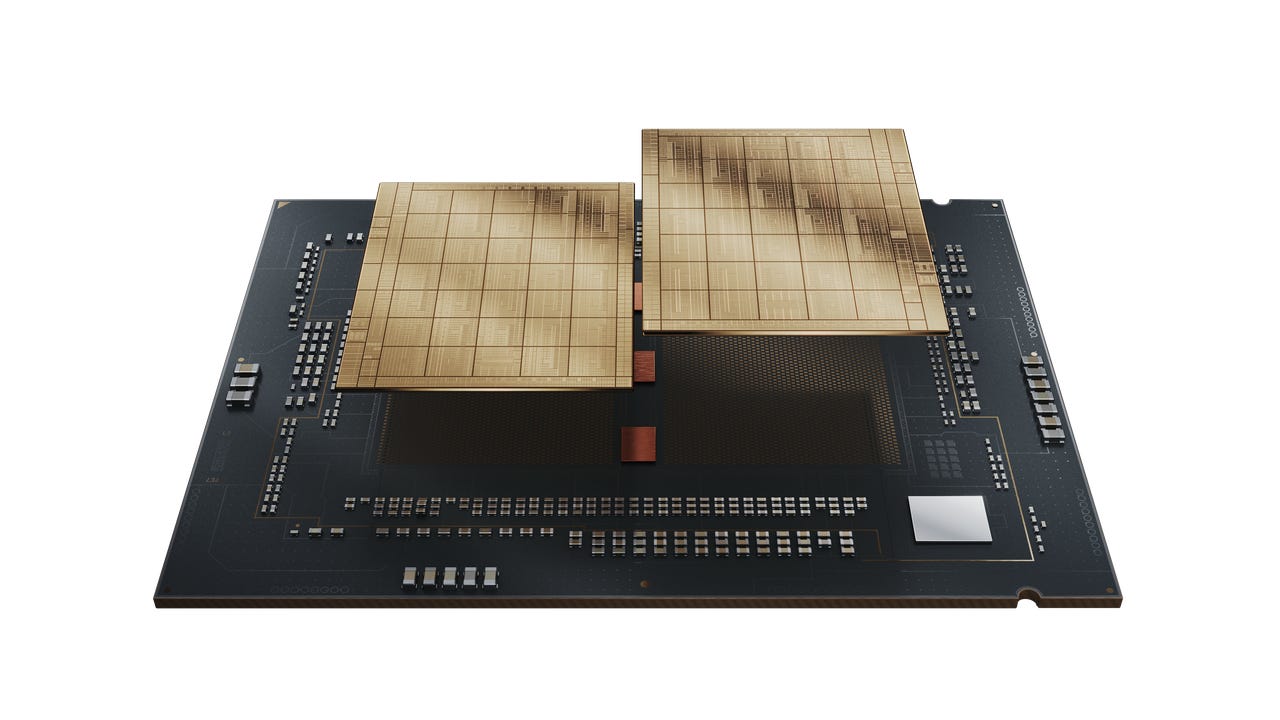
The Intel Xeon server chip includes two compute tiles that have a combined 64 computing cores, each with acceleration for processing neural networks.
Intel CEO Pat Gelsinger on Thursday unveiled the chip giant's latest microprocessors for desktop and server, and showed off a forthcoming AI processor, at a morning event at the Nasdaq Market Site in New York City.
Artificial intelligence is probably "underestimated," said Gelsinger, likely to represent at some point a third of the global economy, but also at risk of consuming a quarter or more of the world's energy if not developed efficiently.
Also: Nvidia sweeps AI benchmarks, but Intel brings meaningful competition
The fourth-generation of Intel's Xeon server, code-named Emerald Rapids, offers performance that is 21% higher, on average, than the previous generation, Sapphire Rapids, said Intel. The new server also makes possible a 36% increase in "average performance per watt," said Intel.
With 64 individual processing cores, the new Xeon can achieve improvements in AI such as speeding up large language model processing by 23%, said Intel's head of data center computing, Sandra Rivera.
The Xeon server will be available in the first quarter of 2024 from vendors including Cisco and Lenovo.
The new desktop chip, Core Ultra, code-named "Meteor Lake," is the first high-volume client computing chip the company is making with the manufacturing technology it calls "Intel 4," which it claims will have 20% greater performance-per-watt compared to the predecessor technology, Intel 7.
The chip, said Intel, represents its "largest architectural shift in 40 years." Among the elements of that shift is the inclusion for the first time of a dedicated accelerator unit for AI, called a neural processing unit (NPU).
Intel CEO Pat Gelsinger [right] — with CCO Christoph Schell — shows off the forthcoming third-generation "Gaudi" AI accelerator chip from the company's Habana Labs division.
That NPU circuitry will enable "a new level of power-efficient AI acceleration with 2.5x better power efficiency than the previous generation" of Core chip, said Intel. An on-chip GPU element will also speed up AI, the company said.
PCs with Core Ultra are available now at retail.
In the demo area, Intel showed PCs that used AI for a variety of AI applications. One example is the open-source image-editing program GIMP performing image generation. Using the Intel software framework called OpenVINO, a plugin to GIMP can call the Stable Diffusion open-source program. The Stable Diffusion code will take a text prompt you type and turn it into an image. The OpenVINO will make it run efficiently on the Core Ultra's NPU.
You can already do this with Stability.ai's cloud service, or with a number of other programs such as OpenAI's DALL-E. Intel's point is that GIMP using the NPU doesn't have to have a cloud connection. The demo PC, in fact, had its network connection turned off.
That means less time waiting for results, as the image shows up instantaneously, and no money paid for a cloud subscription with Stability.ai or OpenAI, and the privacy of keeping one's data from going to a remote server. As an Intel engineer pointed out during the demo, even the text prompt used with Stable Diffusion could be considered one's intellectual property. Given that, it might be worth preventing prompts from being sent to a server.
New PCs now available with the Core Ultra chip on display at Intel's event.
In one of the many demos, a plugin to the popular open-source image-editing program GIMP makes use of OpenVINO to call the Stable Diffusion AI program to generate images without a network connection.
Gelsinger ended the keynote by rushing on stage to hold up the forthcoming third version of "Gaudi," the company's dedicated processor for AI, made by Habana Labs.
"Why are we the right ones to build AI?" asked Gelsinger. "We are scale: we build in volume." Gelsinger reiterated the company's pledge to move through five manufacturing technologies in four years, stating, "On track, baby," to whoops and applause from the audience.
Also: Intel advances oneAPI as the all-important 'next click down'
Gelsinger added that 2024 will be "the year of the AI PC…the next PC ecosystem evolution."
Former Intel CEO, the late Andy Grove, noted Gelsinger, "called the PC the ultimate Darwinian device." AI, said Gelsinger, means that "the next step of that Darwinian device is underway."
To show off the Xeon's AI prowess, Intel's Rivera brought on stage Lauren Elliott of game maker Gallium Studios. Gallium is working with AI lab Numenta to use Intel chips to speed up a new video game called Proxy. Proxy uses algorithms that include large language models to play a game with the stored memories that players enter into the game. The intense processing of the data was aided by the Xeon's processing ability, said Elliott.