Could Samsung Alter Market Dynamics with its 2 nm Chips?

After failing to attract top customers with its 3 nm chips, Samsung now turns its attention to 2 nm chips to gain significant market share. Samsung Foundry, the second biggest semiconductor chip manufacturer in the world, announced earlier this year that it will fabricate 2nm semiconductor chips in 2025, which will be the most advanced semiconductor technology to date.

Samsung claims its 2nm chips provide a 25% increase in power efficiency at the same clock speeds and complexity. Additionally, they boast a 12% performance improvement and a 5% reduction in die area compared to the second-generation 3nm chips introduced earlier this year.

Samsung has also outlined a detailed roadmap, indicating its commencement of mass production for the 2-nanometer process in mobile applications by 2025. Subsequently, the company plans to extend its use to high-performance computing in 2026 and automotive applications in 2027.

“Samsung is never satisfied with No. 2 as a business, as a company. We’re very aggressive,” Jon Taylor, Samsung’s corporate vice president of fab engineering, said earlier in an interview.

The 2 nm chips will possibly power most upcoming consumer devices such as laptops, PCs, tablets and mobile phones, as well as AI hardware such as Graphic Processing Units ( GPU).

Tough competition from TSMC

However, Samsung is not the only one making the 2 nm chips. Taiwan Semiconductor Manufacturing Company ( TSMC) will mass produce its 2 nm chips during the same period. Interestingly, there is another player in the mix- Intel, which reportedly is planning to launch its 2 nm technology next year.

TSMC currently leads the global advanced foundry market with over 60% market share, according to consultancy firm TrendForce. Samsung, which holds around 25% market share, would want to attract more customers with its 2 nm technology and change the market dynamics.

Given it wants to gain significantly from its 2 nm chips, some speculate that Samsung is contemplating the possibility of bypassing extensive 3-nanometer production and directly advancing into the fabrication processes of 2-nanometer technology.

The South Korean company also revealed that it aims to achieve mass production of 1.4 nm chips by 2027, a goal that underscores its ambitious roadmap in semiconductor technology.

Moreover, to keep up with the global demand, Samsung has confirmed its commitment to expanding chip manufacturing capacity by establishing new manufacturing lines in Pyeongtaek, South Korea, and Taylor, Texas.

Luring customers with 2 nm tech

Both Samsung and TSMC have already shown their 2 nm technology to potential clients, according to reports. The Financial Times reported that TSMC has already shown its N2 technology to NVIDIA and Apple. Samsung, on the other hand, is trying to lure customers like NVIDIA by providing the 2 nm chips at a relatively low cost.

Very recently, FT also reported that Qualcomm could replace TSMC with Samsung’s 2 nm chips in its next-generation smartphone processors. Qualcomm’s Snapdragon processors power a significant number of flagship Android phones on the market.

Currently, Snapdragon 8 Gen 2 is Qualcomm’s most advanced mobile phone processor and is powered by TSMC’s 3 nm chips. Interestingly, Samsung was earlier involved in the development of the previous generation of Snapdragon processors.

Even though unconfirmed, landing Qualcomm again would be significant for Samsung. Nonetheless, it’s noteworthy that while Samsung was the first to announce 3 nm chips, TSMC secured the majority of orders from companies like Qualcomm, NVIDIA, AMD, and major tech giants such as Microsoft, AWS, and Google, all engaged in developing their own AI chips.

For Samsung, staying on course on its roadmap would be crucial for Samsung. Reports from China in September this year suggested that TSMC could delay its mass production of 2 nm chips till 2026, which could potentially give Samsung a head-start.

‘Multi-vendor strategy’ the best bet for Samsung

Earlier this year, South Korean media Chosun Biz, citing industry sources, reported that NVIDIA is considering subcontracting a part of its AI GPUs to Samsung for manufacturing due to growing constraints in capacity supply from TSMC.

Anticipating NVIDIA replacing TSMC with Samsung might be a stretch, but adopting a multi-vendor strategy seems to be the most prudent path for Samsung. NVIDIA buying chips from both TSMC and Samsung is the most favourable situation for the South Korean company.

Many analysts also predict companies opting for a multi-vendor strategy to mitigate supply chain constraints similar to those experienced by NVIDIA with TSMC.

Banking on Gate-All-Around technology

Samsung, utilising its proprietary gate-all-around (GAA) transistor architecture, succeeded in producing 3 nm chips ahead of TSMC. Despite this achievement, the company faced challenges in securing major customers and received criticism for its efforts.

However, Samsung Foundry CTO Jeong Ki-tae believes the GAA process is a technology that will last in the future and it will be very difficult to find any further improvements in FinFET technology.

TSMC plans to leverage the GAA architecture for its 2 nm chips. Samsung Electronics President Kyung Kye-hyeon, in a lecture at KAIST in Daejeon, said that once TSMC switches to GAA technology, Samsung will be on par with them.

The post Could Samsung Alter Market Dynamics with its 2 nm Chips? appeared first on Analytics India Magazine.


Salesforce’s Einstein Copilot AI Will Soon Analyze Unstructured Data

Salesforce announced expanded capabilities of its generative AI assistant Einstein Copilot, enhanced integrations with Apple offerings and more today at the Salesforce World Tour New York 2023 event. The addition of the Data Cloud Vector Database to the Salesforce Data Cloud will allow both the Salesforce Data Cloud and Einstein Copilot to handle unstructured data.

Salesforce announced several other enhancements to its business software, particularly within Data Cloud for Advertisers. These products could be useful for a wide variety of teams, including IT, sales, customer service, marketing and commerce.

Jump to:

  • AI enhancements to Salesforce Data Cloud
  • Expanded Salesforce and Apple partnership
  • AWS partnership and more Salesforce news

AI enhancements to Salesforce Data Cloud

Einstein Copilot

A major enhancement to Salesforce Data Cloud is Data Cloud Vector Database, coming in a pilot program in February 2024. Data Cloud Vector Database is integrated vector database support that allows for the use of a wide variety of data types. Unstructured data — e.g., PDFs, email, audio and social media content — will be combined with structured data — e.g., purchase history, customer support cases and product inventory.

Einstein Copilot, Salesforce’s generative AI assistant, will be able to use unstructured data to respond to questions or perform analysis; it will access this data through Salesforce Data Cloud. Einstein Copilot will be generally available in February 2024.

“This transforms every piece of data — from emails to social media posts to audio — into actionable insights using AI, CRM, automation, AI, Einstein Copilot, and analytics,” said Rahul Auradkar, executive vice president and general manager of Unified Data Services and Einstein at Salesforce, in a press release.

Possible use cases of Einstein Copilot include:

  • Customer service: Einstein Copilot’s unstructured data will be able to be used for customer service. The example Salesforce gave is of a chatbot pulling answers from articles for a customer visiting a self-service page.
  • IT teams: Einstein Copilot can be used to help IT teams uncover problems in unstructured content produced in machine operations, such as logs, sensor readings or image and audio records.
  • Sales reps: Einstein Copilot can help sales reps get more information about a potential client company before meeting with that company’s representatives.

Einstein Copilot Search

Another enhancement for Salesforce Data Cloud will be Einstein Copilot Search, which will be in pilot in February 2024. Einstein Copilot Search draws from data across Data Cloud to provide smart suggestions for searches. It will be useful for problem-solving tasks performed by sales, customer service, marketing, commerce and IT teams. For example, Einstein Copilot search will be able to link a customer’s emails and phone calls to their formal support ticket history to assist a customer service representative.

Expanded Salesforce and Apple partnership

Apple Messaging, Apple Pay and augmented reality will be accessible directly in certain Salesforce products. Salesforce and Apple have had a strategic partnership since 2018.

Specifically, Apple Messages for Business in Service Cloud, generally available today with Salesforce’s Service Cloud Digital Engagement, will let businesses set up live chat experiences with customers for customer service, product recommendations, tracking shipments or setting up appointments. Customers can pay for services and products with Apple Pay within the Messenger app.

Augmented reality with Apple’s ARKit will be available within the Salesforce Field Service mobile app in the summer of 2024. With it, field technicians can capture 3D renderings of real locations to make planning and installations easier.

The Salesforce Field Service iOS widget will be available for iPhones in the summer of 2024. It provides a quick view of key account information in Salesforce Field Service.

AWS partnership and more Salesforce news

At Salesforce World Tour New York 2023, Salesforce’s AWS partnership was highlighted and other news was announced.

Details about Salesforce’s partnership with AWS

Salesforce reiterated the company’s partnership with AWS announced in November 2023, in which Salesforce expanded its use of AWS in multiple ways:

  • Salesforce began offering products on AWS Marketplace.
  • Some Einstein Studio Copilot capabilities will be able to be integrated with Amazon SageMaker and Amazon Bedrock.
  • Amazon Connect Chat came to Salesforce’s Service Cloud Digital Engagement.
  • Amazon Connect forecasting was added to Salesforce Service Cloud Omnichannel.
  • Salesforce’s app builder Heroku will receive powerful new capabilities from AWS services that allow it to become a factory for generative AI-first apps.

News about Trailblazer Career Marketplace, Unlimited Edition+, Data Cloud for Advertisers

Salesforce opened a new jobs site for careers within the Salesforce ecosystem called Trailblazer Career Marketplace, which is open today to Salesforce partners.

Salesforce announced Unlimited Edition+, a package of Salesforce technologies for companies interested in getting into generative AI, data and CRM. UE+ is now in general availability.

New integrations are coming to Data Cloud for Advertisers. Data Cloud for Advertisers will be able to connect to Google Display & Video 360 for personalized ads across channels. Data Cloud for Advertisers will be able to connect to LinkedIn, letting advertisers target specific groups of professionals using Marketing Cloud, Sales Cloud and Service Cloud product usage data from their own apps and LinkedIn.

Note: TechRepublic is covering the Salesforce World Tour New York 2023 event virtually.

Surprise! AI chatbots don’t increase student cheating afterall, new research finds

handcheat-gettyimages-181866634

The rise of generative AI tools has many worried about the future integrity of the educational system. After all, if you can get math, writing, and coding help from one free tool like ChatGPT, what's stopping students from using it to cheat on every assignment? Stanford researchers tackle the question in a Q+A published by the university.

Also: Generative AI can easily be made malicious despite guardrails, say scholars

Stanford education scholars Victor Lee and Denise Pope found that student cheating has little to do with the technology they can access, including AI.

"There's been a ton of media coverage about AI making it easier and more likely for students to cheat," said Pope. "But we haven't seen that bear out in our data so far."

High cheating rates have plagued school systems long before ChatGPT and similar AI technology entered the scene, with 60- to 70 percent of students reporting engaging in at least one "cheating" behavior during the previous month, according to Pope.

That number has remained the same or even decreased slightly in 2023 surveys despite adding questions that specifically address ChatGPT and students' easy access to the technology, added Pope.

Also: Grammarly's AI writing help comes to your iPhone. Here's how to use it today

To address the skepticism that people may have about the students even addressing those surveys truthfully, the researchers share that students are typically honest since the surveys are anonymous and don't directly ask, "Do you cheat?" but rather ask specific questions classified as cheating.

"The most prudent thing to say right now is that the data suggest, perhaps to the surprise of many people, that AI is not increasing the frequency of cheating," said Lee.

Also: Generative AI can be the academic assistant an underserved student needs

The question remains, however: What exactly leads students to cheat? Pope cited a variety of factors, such as struggling with the material; being unable to get the help they need; having too much homework and not enough time to do it; and being overwhelmed by the pressure to achieve.

"We know from our research that cheating is generally a symptom of a deeper, systemic problem," said Pope.

In advising school leaders on how to proceed, the researchers encouraged educators to incorporate AI in the classroom in ways that make the technology helpful to students without compromising ethics — since AI is ultimately not going away.

Also: Google Workspace's AI assistant Duet AI is about to get a whole lot smarter

"I think of AI literacy as being akin to driver's ed. We've got a powerful tool that can be a great asset, but it can also be dangerous," said Lee. "We want students to learn how to use it responsibly."

ZDNET has previously covered AI tools that students, teachers, and parents can take advantage of and specific ways to leverage AI ethically and help with student coursework, such as using it for essay writing, making charts and tables, and summarizing a book, article, or research paper.

Artificial Intelligence

Later, Discord! Midjourney AI tool is moving to dedicated website

elephant

Midjourney AI offers a robust text-to-image generator that can cook up virtually any image you want. But access has been available only through Discord, which isn't the most user-friendly platform. Now Midjourney has launched its own website that promises an easier and quicker method of creating images.

Launching in alpha mode, the website will initially be available only to people who've racked up more than 10,000 images via Midjourney on Discord, says Midjourney CEO David Holz. To find out how many images you've generated if you have used the AI, head to your Midjourney channel on Discord and type /info.

Also: The best AI art generators: DALL-E 2 and fun alternatives to try

Alas, unless you've used Midjourney a couple of dozen times each day since its debut in July 2022, you're not on the invite list just yet. But Holz said that access would become available to more people over the coming months.

AI-powered image generators have become trendy among professionals and other folks looking to create everything from logos to anime to photorealistic graphics. Though many AIs offer this capability, Midjourney has become an especially popular tool. However, access has been available only through a Discord account and channel, which can be cumbersome to set up and use. Ditching Discord in favor of a dedicated website should prove much more effective and convenient.

If you do qualify, browse over to the new Midjourney website. Click the button to join the beta and then sign in. One person who does have access and has tweeted about it is a creative director and Midjourney aficionado named Nick St. Pierre. In his post on X, aka Twitter, he shared a video and running commentary on his use of the new site.

Remarking that the new website makes it much easier to work with images, St. Pierre showed how people can use a generated image in a prompt to create new images. He also pointed out how someone could tweak an image by moving different sliders left and right, including ones for Stylization, Weirdness, and Variety. Another slider lets you adjust the format and size of the image.

Also: How to get a perfect face swap using Midjourney AI

Further, St. Pierre demoed how you could add URLs for images simply by dragging and dropping them. That's a contrast from using Midjourney on Discord where you have to type the full URL for an image you want to incorporate. This also points to the website's greater ease of use. On Discord, you have to type out every parameter and option you want to include in your image, whereas the new site provides handy GUI controls and menus.

For those of you who use Midjourney but don't qualify for early access to the website, be patient. The site should be more widely available sometime in early 2024 so that generating an image will become smoother, faster, and more fun — for all.

Artificial Intelligence

Have 10 hours? IBM will train you in AI fundamentals — for free

cleanshot-2023-12-13-at-23-50-262x

Long before ChatGPT blasted onto the scene and sucked all the air out of the room, there was IBM Watson. Watson itself blasted to fame when, in 2011, it beat reigning champion Ken Jennings on the TV game show Jeopardy.

Fun fact: ZDNET's own Steven J. Vaughn-Nichols was once a clue on Jeopardy.

Anyway, back to our story. My point is that IBM has a long history with AI and has not been sitting still. Its generative AI solution is called Watsonx. It focuses on enabling businesses to deploy and manage both traditional machine learning and generative AI, tailored to their unique needs.

Also: AI in 2023: A year of breakthroughs that left no human thing unchanged

I'm telling you this because if any company has the cred to offer a credential on AI fundamentals, it's IBM.

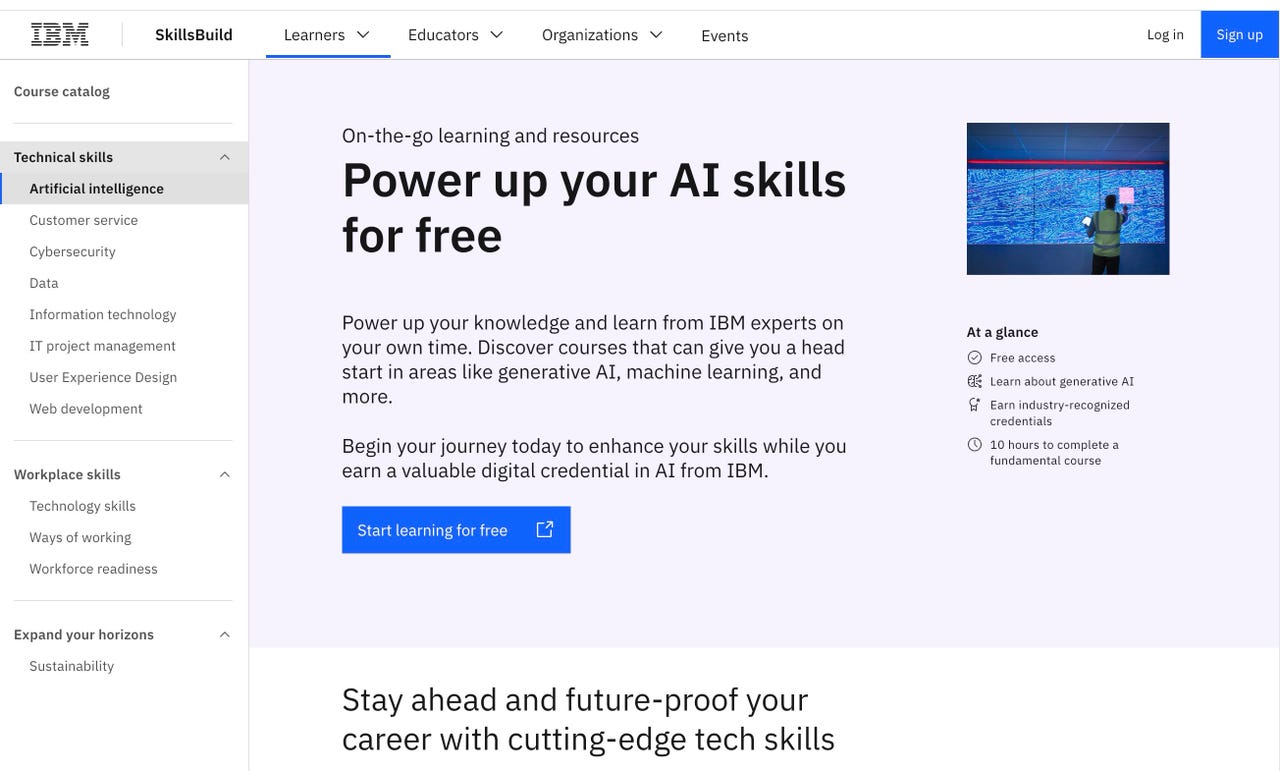
IBM's AI Fundamentals program is built inside of its SkillsBuild learning portal. The credential takes about ten hours to complete, across six courses.

Because I have had a long interest in AI ethics (I did a thesis on AI ethics way back in the day), I took the AI ethics class. It was good.

Also: I fact-checked ChatGPT with Bard, Claude, and Copilot — and this AI was the most confidently incorrect

It discussed the challenge of balancing technology with ethical responsibility. Key topics included the five pillars of AI ethics, the importance of fairness and avoiding bias, and the need for AI systems to be transparent, explainable, and robust against attacks. The session also emphasized governance, the protection of personal data, and the significance of privacy through data minimization and differential privacy.

I'll probably take the rest of the courses over the holiday break.

To get started, create a free account on IBM's SkillsBuild learning portal. All of the following links to IBM's free AI courses require you to have created that account and logged in before you'll be able to use them.

Artificial Intelligence Fundamentals Learning Plan: In this learning plan, you'll explore AI's history, and then see how it can change the world. Along the way, you'll deep dive into ways that AI makes predictions, understands language and images, and learns using circuits inspired by the human brain. After a hands-on simulation in which you build and test a machine-learning model, you'll finish with tips on how to find your career in AI.

Introduction to Artificial Intelligence (1 hour 15 mins): Less than a century old, AI has already undergone three waves of transformative development. Today it gives humanity the most powerful tools for analyzing complex data, not only to find meaning but also to learn without human intervention. In this course, you'll survey AI's history and explore ways that it can shed light on unstructured data.

Natural Language Processing and Computer Vision (1 hour 30 mins): You might already know that some AI systems can understand human language, identify visual images, and even create original art. But do you know how these systems do it? In this course, you'll explore the theory of natural language and vision processing and learn how these technologies drive real-world mechanisms such as chatbots and photo analysis.

Machine Learning and Deep Learning (2 hours): In this course, you'll see how machines can learn and make amazing, evidence-based predictions. Explore the logic behind computers' ability to learn, then investigate new ways that AI systems inspired by neurons in the human brain can solve difficult problems.

Run AI Models with IBM Watson Studio (1 hour and 45 mins): In this course, you'll practice creating an AI machine learning model in a series of simulations, using IBM Watson Studio. This is hands-on time that can help you do actual work with AI.

AI Ethics (1 hour and 45 mins): You might have heard about problems that arise when AI systems misinterpret data or propose solutions that reflect human prejudice. This is the course I talked about above. Through real-world examples you'll learn about AI ethics, how they are implemented, and why AI ethics are so important in building trustworthy AI systems.

Your Future in AI: The Job Landscape (1 hour): Are you considering a career in AI? In this course, learn about the AI job market's rapid growth and the skills needed for success in this exciting field. You'll hear how real professionals got their start, and find resources and learning opportunities that could help you work alongside them.

More resources

This is the third article in our series of free learning resources for those interested in exploring AI or building a career around this amazing technology. I also explored Amazon's free AI courses and free AI courses from OpenAI and DeepLearning.

So there you go. Sign up now and use your holiday time to get a new credential. If you take any of these courses, please report back below in the comments and let us know what you think. And stay tuned. I expect to provide more resources early in 2024 for you to continue your free AI learning journey.

You can follow my day-to-day project updates on social media. Be sure to subscribe to my weekly update newsletter on Substack, and follow me on Twitter at @DavidGewirtz, on Facebook at Facebook.com/DavidGewirtz, on Instagram at Instagram.com/DavidGewirtz, and on YouTube at YouTube.com/DavidGewirtzTV.

Featured

AI is growing into its role as a development and testing assistant

Code on screen

Will "TuringBots" — or AI-powered development and testing assistants — make programming more pleasurable for professional and citizen developers alike? These generative AI bots are already recasting and injecting more productivity into development processes, industry observers agree. At the same time, developers can't rely 100% on AI — there needs to be human skills in the process.

Examples of such AI dev/test assistants include GitHub Copilot for coding and Test Rigor for intelligent automated testing. These assistants, based on generative AI and large language models, "have made natural language a key authoring mechanism for tools across the entire software development lifecycle," state Forrester analysts John Bratincevic and Diego Lo Giudice in a recent post.

Also: AI in 2023: A year of breakthroughs that left no human thing unchanged

The use of these dev/test assistants "will dramatically increase low-code adoption," they predict. "This is especially true for citizen development," they add. These assistants "will make onboarding nontechnical workers as citizen developers better, faster, and easier."

With this ease of writing code comes incredible speed in writing code. "One of our platform engineers who had no experience writing front-end web apps was able to feed a spreadsheet with data and create a simple-to-use internal web app in a matter of minutes by leveraging generative AI," recounts Mike Lempner, head of engineering and technology at Mission Lane, a fintech company. "Even the most experienced front-end engineer would have taken several hours to be able to write the code, test, and deploy something of this nature."

As an added bonus, "automating the writing of code can free up engineers' ability to focus more time on design and architecture," Lempner says. "Good design and architecture will still be needed to enable generative AI to build the right solutions for your environment."

Also: ZDNET looks back on tech in 2023, and looks ahead to 2024

Generative AI represents a massive step forward in this journey "because almost anyone can ask an AI to produce a functioning program," says Patrick Stokes, executive VP of product and industries marketing with Salesforce. "The result is orders of magnitude faster than if they tried to write the code themselves. Instead of spending hours writing that code, they can spend that time testing it, securing it, and tweaking its interfaces to satisfy its users best. The outcome is higher quality apps in much less time produced by people who will inevitably be even closer to the end-user experience."

Generative AI-based development reverses the dynamic of human-machine interfaces, Stokes adds. Rather than "requiring humans to think like a computer," it enables "humans to write code like a human, empowering more people to build things more quickly."

We're only beginning "to realize how AI can improve the developer experience and software as a whole," agrees Dana Lawson, senior VP of engineering at Netlify. "AI can automate the tedious but necessary tasks of software development so the actual human developers can have more time to focus on impactful, creative work."

Also: These 5 major tech advances of 2023 were the biggest game-changers

Developers "are already experimenting with adding AI to their workflows to do things like review pull requests, clean up documents, and create project outlines," Lawson adds. "AI is fun to experiment with, and when applied in the right way, offers tangible benefits to the developer experience."

Natural language processing is evolving into a key enabler of low-code capabilities, starting with an initial prompt and seeing the result, Bratincevic and Lo Giudice observe. Low-code vendors are building natural language prompts into their offerings, they add. "Natural language prompts will become a normal, complementary method to interact with the required visual tools."

Generative AI-based coding also helps reduce redundancy. "It can be an assistant to a developer, and it can extend their own human abilities," says Leon Kallikkadan, vice president of technology at Atrium. "For instance, if a developer doesn't want to actually write the code themselves, they can, in a straightforward, natural human language, tell AI to write the code, state what its function is, and what it needs to do. AI can go line by line and create that. You can use AI to write the code, run it, find errors, fix the code, do more fixes, and develop acceptable code."

Also: How to use ChatGPT to write code

As an assistant, generative AI "can suggest alternative ways, alternative codes to use," Kallikkadan continues. "One of the major benefits from a business standpoint is that unified, best practices for coding might be developed as a result of AI. Depending on the developer or development shop you use, they might produce different coding principles. With AI, you may now be able to get a standardized AI-generated code if these best practices are foundational to the way code is written."

Artificial Intelligence

Distributional wants to develop software to reduce AI risk

Distributional wants to develop software to reduce AI risk Kyle Wiggers 16 hours

Companies are increasingly curious about AI and the ways in which it can be used to (potentially) boost productivity. But they’re also wary of the risks. In a recent Workday survey, enterprises cite the timeliness and reliability of the underlying data, potential bias and security and privacy as the top barriers to AI implementation.

Sensing a business opportunity, Scott Clark, who previously co-founded the AI training and experimentation platform SigOpt (which was acquired by Intel in 2020), set out to build what he describes as “software that makes AI safe, reliable and secure.” Clark launched a company, Distributional, to get the initial version of this software off the ground, with the goal of scaling and standardizing tests to different AI use cases.

“Distributional is building the modern enterprise platform for AI testing and evaluation,” Clark told TechCrunch in an email interview. “As the power of AI applications grows, so does the risk of harm. Our platform is built for AI product teams to proactively and continuously identify, understand and address AI risk before it harms their customers in production.”

Clark was inspired to launch Distributional after encountering tech-related AI challenges at Intel post-SigOpt acquisition. While overseeing a team as Intel’s VP and GM of AI and high-performance compute, he found it nearly impossible to ensure that high-quality AI testing was taking place on a regular cadence.

“The lessons I drew from my convergence of experiences pointed to the need for AI testing and evaluation,” Clark continued. “Whether from hallucinations, instability, inaccuracy, integration or dozens of other potential challenges, teams often struggle to identify, understand and address AI risk through testing. Proper AI testing requires depth and distributional understanding, which is a hard problem to solve.”

Distributional’s core product aims to detect and diagnose AI “harm” from large language models (à la OpenAI’s ChatGPT) and other types of AI models, attempting to semi-automatically suss out what, how and where to test models. The software offers organizations a “complete” view of AI risk, Clark says, in a pre-production environment that’s akin to a sandbox.

“Most teams choose to assume model behavior risk, and accept that models will have issues.” Clark said. “Some may try ad-hoc manual testing to find these issues, which is resource-intensive, disorganized, and inherently incomplete. Others may try to passively catch these issues with passive monitoring tools after AI is in production … [That’s why] our platform includes an extensible testing framework to continuously test and analyze stability and robustness, a configurable testing dashboard to visualize and understand test results, and an intelligent test suite to design, prioritize and generate the right combination of tests.”

Now, Clark was vague on the details of how this all works — and the broad outlines of Distributional’s platform for that matter. It’s very early days, he said in his defense; Distributional is still in the process of co-designing the product with enterprise partners.

So given that Distributional is pre-revenue, pre-launch and without paying customers to speak of, how can it hope to compete against the AI testing and evaluation platforms already on the market? There’s lots after all, including Kolena, Prolific, Giskard and Patronus — many of which are well-funded. And if the competition weren’t intense enough, tech giants like Google Cloud, AWS and Azure offer model evaluation tools as well.

Clark says that he believes that Distributional is differentiated in its software’s enterprise bent. “From day one, we’re building software capable of meeting the data privacy, scalability and complexity requirements of large enterprises in both unregulated and highly regulated industries,” he said. “The types of enterprises with whom we are designing our product have requirements that extend beyond existing offerings available in the market, which tend to be individual developer focused tools.”

If all goes according to plan, Distributional will start generating revenue sometime next year once its platform launches in general availability and a few of its design partners convert to paid customers. In the meantime, the startup’s raising capital from VCs; Distributional today announced that it closed an $11 million seed round led by Andreessen Horowitz’s Martin Casado with participation from Operator Stack, Point72 Ventures, SV Angel, Two Sigma and angel investors.

“We hope to usher in a virtuous cycle for our customers,” Clark said. “With better testing, teams will have more confidence deploying AI in their applications. As they deploy more AI, they will see its impact grow exponentially. And as they see this impact scale, they will apply it to more complex and meaningful problems, which in turn will need even more testing to ensure it is safe, reliable, and secure.”

Intel Puts Artificial Intelligence First With Processor Announcements

Today at the Intel AI Everywhere event in New York City, Intel announced the general availability of the Intel Core Ultra mobile processor family, delivering faster AI performance for graphic designers, smart factories and more. The 5th Gen Intel Xeon processor family, coming next year to OEMs and cloud service providers, has AI acceleration in all of its cores. Plus, Intel is making progress with manufacturing its Gaudi3 AI accelerator.

Intel’s overall goal is to proliferate what Intel is calling AI PCs, meaning on-chip AI for laptops and data centers, allowing more hardware to run generative AI more efficiently. Acer, Asus, Lenovo, LG, Dell, HP, MSI, Samsung and more laptop makers include Intel chips in their devices.

“Intel is on a mission to bring AI everywhere through exceptionally engineered platforms, secure solutions and support for open ecosystems,” Intel CEO Pat Gelsinger said in a press release.

Jump to:

  • Intel Core Ultra mobile processor family is generally available
  • 5th Gen Intel Xeon processor family is coming next year
  • Intel Gaudi3 AI accelerator is revealed
  • Intel’s philosophy on tech and the advantages of AI

Intel Core Ultra mobile processor family is generally available

The key differentiator of the Intel Core Ultra mobile processor family (Figure A) is the on-chip AI accelerator, or neural processing unit; this makes these products especially suitable for running generative AI locally, Intel said.

According to Intel, the Intel Core Ultra mobile processor family has 2.5x better power efficiency than the previous generation. Its world-class Intel Arc GPU and CPU are each capable of speeding up AI solutions; this required a massive change in how Intel assembles its microchips. The Intel Core Ultra family is manufactured using the new Intel 4 process with extreme ultraviolet.

Figure A

Processors from the Intel Core Ultra mobile processor family during manufacturing. Image: Intel

Intel worked with more than 100 software vendors to bring AI-boosted applications to the market that run well on Intel Core Ultra, including Adobe Premiere Pro.

Intel Core Ultra-based AI PCs are generally available today from Acer, ASUS, Dell, Dynabook, Gigabyte, Google Chromebook, HP, Lenovo, LG, Microsoft Surface, MSI and Samsung in the U.S.

5th Gen Intel Xeon processor family is coming next year

The 5th Gen Intel Xeon processor family (Figure B) is a data center processor with built-in AI acceleration, optimized to run large language models like GPT-4 or Llama 2. The 5th Gen Intel Xeon processor, offers up to 42% higher inference and fine-tuning on models as large as 20 billion parameters, Intel said.

Figure B

A 5th Gen Xeon processor during manufacturing. Image: Intel 
A 5th Gen Xeon processor during manufacturing. Image: Intel

5th Gen Intel Xeon processors achieved up to 2.7x better query throughput on the IBM watsonx.data platform compared to previous-generation Xeon processors during testing, Intel said. Google Cloud plans to deploy 5th Gen Xeon next year. 5th Gen Intel Xeon processors will be generally available in Q1 2024 from certain OEMs including Cisco, Dell, HPE, IEIT Systems, Lenovo, Super Micro Computer and others. Major cloud service providers are expected to launch 5th Gen Xeon processor-based instances throughout 2024.

SEE: 5th Gen Xeon processors and the AI PC concept were first announced by Intel in September. (TechRepublic)

Intel Gaudi3 AI accelerator is revealed

The Intel Gaudi3 is an accelerator for deep learning and large-scale generative AI models. At the AI Everywhere event, Gelsinger showed a Gaudi3 AI accelerator for the first time in public and said the Gaudi3 is now out of fab.

The company is on track to release the Intel Gaudi3 AI accelerator next year.

Intel’s philosophy on tech and the advantages of AI

“When we think about technology, is it good or bad?” said Gelsinger at the AI Everywhere event. “It’s mostly neutral. It’s our job to shape it into a force for good.”

Gelsinger predicts more AI inference will happen at the edge in the future. A small number of companies will train AI, but many more will perform inferencing on models that need to run locally and as close as possible to devices. That’s the world Intel wants to release its AI PCs into, putting large language models into every PC.

Note: TechRepublic is covering the Intel AI Everywhere event virtually.

Microsoft unveils Phi-2, a small language model that packs power

Phi-2 Microsoft Ignite

When you think of language models in relation to generative artificial intelligence (AI), the first term that probably comes to mind is large language model (LLM). These LLMs power most popular chatbots, such as ChatGPT, Bard, and Copilot. However, Microsoft's new language model is here to show that small language models (SLMs) have great promise in the generative AI space, too.

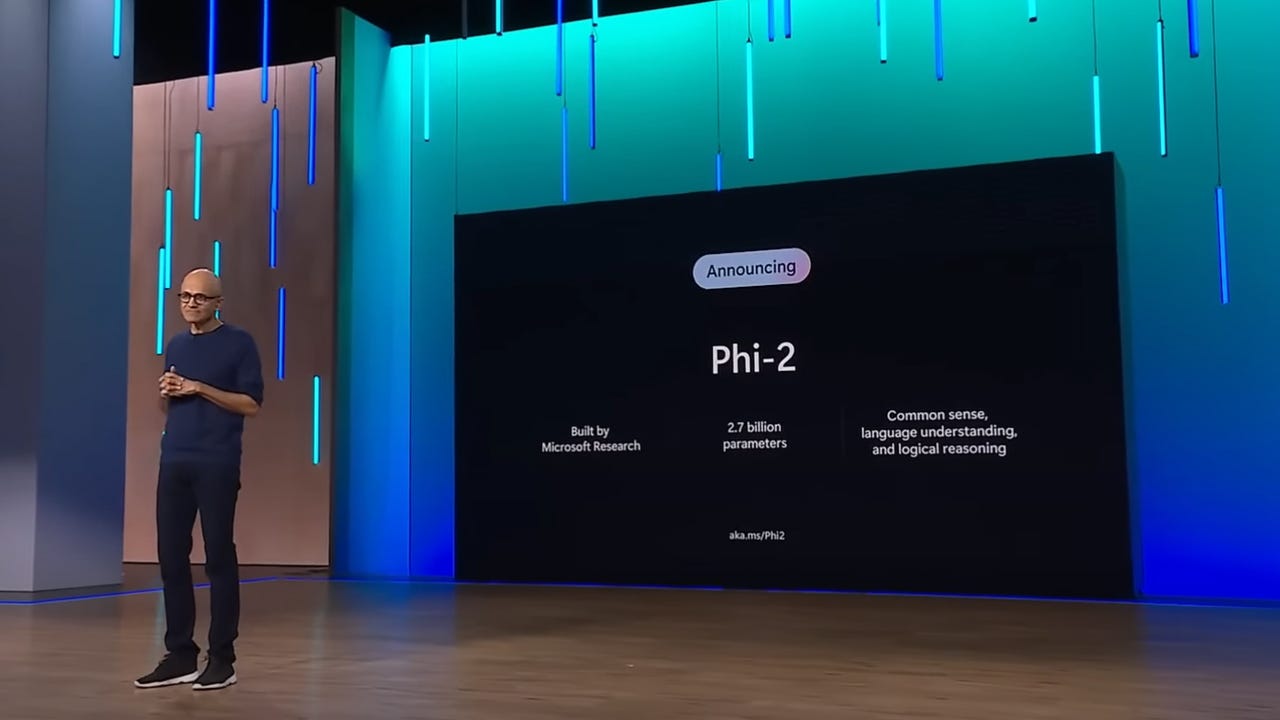
On Wednesday, Microsoft released Phi-2, a small language model capable of common-sense reasoning and language understanding, and it's now available in the Azure AI Studio model catalog.

Also: AI in 2023: A year of breakthroughs that left no human thing unchanged

Don't let the word small fool you, though. Phi-2 packs 2.7 billion parameters in its model, which is a big jump from Phi-1.5, which had 1.3 billion parameters.

Despite its compactness, Phi-2 showcased "state-of-the-art performance" among language models with less than 13 billion parameters, and it even outperformed models up to 25 times larger on complex benchmarks, according to Microsoft.

Also: Two breakthroughs made 2023 tech's most innovative year in over a decade

Phi-2 outperformed models — including Meta's Llama-2, Mistral, and even Google's Gemini Nano 2, which is the smallest version of Google's most capable LLM, Gemini — on several different benchmarks, as seen below.

Phi-2's performance results are congruent with Microsoft's goal with Phi of developing an SLM with emergent capabilities and performance comparable to models on a much larger scale.

Also: ChatGPT vs. Bing Chat vs. Google Bard: Which is the best AI chatbot?

"A question remains whether such emergent abilities can be achieved at a smaller scale using strategic choices for training, e.g., data selection," said Microsoft.

"Our line of work with the Phi models aims to answer this question by training SLMs that achieve performance on par with models of much larger scale (yet still far from the frontier models)."

When training Phi-2, Microsoft was very selective about the data used. The company first used what it calls "text-book quality" data. Microsoft then augmented the language model database by adding carefully selected web data, which was filtered on educational value and content quality.

So, why is Microsoft focused on SLMs?

Also: These 5 major tech advances of 2023 were the biggest game-changers

SLMs are a cost-effective alternative to LLMs. Smaller models are also useful when they are being used for for a task that isn't demanding enough to require the power of an LLM.

Furthermore, the computational power required to run SLMs is much less than LLMs. This reduced requirement means users don't necessarily have to invest in expensive GPUs to power their data-processing requirements.

Artificial Intelligence

Spotify confirms test of prompt-based AI playlists feature

Spotify confirms test of prompt-based AI playlists feature Sarah Perez @sarahintampa / 11 hours

Earlier this fall, Spotify was found to be developing a new feature that would allow its streaming app users to create playlists using AI technology and prompts. Now, that “AI playlists” feature has been spotted in the wild, as part of a test that to see how users will respond to AI-driven playlist creation. The company confirmed the test to TechCrunch, but didn’t share further details about the technology and how it works, nor did it commit to a launch timeframe.

The feature was shown off in a TikTok video by user @robdad_ who wrote, “I just randomly discovered Spotify’s ChatGPT?” According to the screenshots he shared, the AI playlists feature is accessed from the “Your Library” tab in Spotify’s app by tapping on the plus (+) button at the top right of the screen. Here, a pop-up menu appears and the AI playlist feature is a new option underneath the existing “Playlist” and “Blend” options.

The feature’s description reads “Turn your ideas into playlists using AI” and notes that it’s currently only available in English.

@robdad_ Since when did they have this update on spotify. Now they got chatGPT making our playlists… also wtf is Which House Exploration😭😭 #spotify #update #ai ♬ Heavy Metal Lover overlapped – jinxknsaudios

After selecting the option, users are presented with a screen where they can type their prompt into an AI chatbot-style box, or browse through a list of suggested prompts to get started. The video showed off prompt ideas like “get focused at work with instrumental electronica,” “fill in the silence with background café music,” “get pumped up with fun, upbeat, and positive songs,” and “explore a niche genre like Witch House.”

The user selected the latter prompt and the AI chatbot responded “Processing your request…” and then presented a sample playlist. From this screen, you can swipe left to remove any songs you don’t want to refine the playlist further.

TechCrunch had reported in October that references to this new AI feature were discovered in the Spotify mobile by tech veteran Chris Messina, who shared screenshots of a feature that would create “playlists based on your prompts.” However, Spotify at the time declined to confirm its plans around AI playlists, saying it wouldn’t comment on speculation about new features.

The company today is still trying to downplay user expectations and excitement around the AI playlists feature, only confirming that it was a test for the time being.

“We routinely conduct a number of tests. Some of those tests end up paving the path for our broader experience and others serve only as an important learning,” a Spotify spokesperson said. “We don’t have anything further to share at this time,” they added.

Though the company isn’t yet ready to commit to the launch of AI playlists, the streamer has been heaving investing in AI across its app, including with the launch of an AI DJ at the beginning of the year, which offers personalized playlists and commentary in an AI voice that’s based on Spotify’s head of cultural partnerships Xavier ‘X’ Jernigan. That feature became globally available in August.

Speaking about DJ’s launch, Spotify’s head of Personalization, Ziad Sultan noted the company has “a large research team that is understanding all the possibilities across Large Language Models, across generative voice, [and] across personalization.” He told TechCrunch that Spotify wants to be known for its “AI expertise.”

Spotify CEO Daniel Ek also teased other ways the company has been putting AI to use at the company, saying Spotify may look to use generative AI to summarize podcasts and automatically create audio ads. He’s also touted AI’s role in music creation, saying he could envision artists using AI tools as they create new songs. Spotify has additionally looked into using AI to create host-read podcast ads that sound like the real person, and uses AI to power its personalization technologies. That it would turn AI to one of the more popular use cases for its app — playlist creation — then, is not a stretch.

It remains to be seen if and when the new AI feature goes live to the public. In the meantime, let us know if you have the feature in your app and how well you think it works.

Sarah Perez is available at sarahp@techcrunch.com and (415) 234-3994 on Signal.

Spotify spotted developing AI-generated playlists created with prompts