Beyond LLMs and Trillion-Parameter Models

These days, it is as if AI is just about GenAI (generative AI), LLMs (large language models) and very large models. It has eclipsed computer vision, voice AI and everything else. Part of the success of trillion-parameter models is that they are over-parametrized. That is, many different parameter combinations lead to good enough solutions. In short, with enough hidden layers and GPU time, you are likely to stumble upon impressive results. No one really knows why it works like that, but it works.

I also observed a similar phenomenon with some of my methods that do not rely on neural networks. They work best when granularity is maximum. Those that rely on combinatorial resampling, do well with only a few million iterations, exploring only a tiny fraction of the sample space. The performance is especially remarkable in high dimensions, where you expect combinatorial methods to fail. The success is due to smartly leveraging the sparsity of the feature space. Without this, you would need a lot more than 10100 iterations, making these methods impossible to implement.

Modern LLMs are not the Panacea

Despite the performance, my experience with OpenAI (GPT) is disappointing. It does better than most alternatives, but it does no address my needs. In my case, I am looking for answers to research questions. But GPT won’t share the references that it uses to answer my prompts, even when asked to do so. My issues – shared by many – are best described in my recent LinkedIn post, “My New LLM Project”, here.

As the title suggests, I will have to create my own tool. Maybe because OpenAI is afraid to reveal sources subject to copyrights. In addition, GPT answers are very wordy and assume that the user is a beginner. Yet, I only need a few bullet points and some links. I don’t have time to browse the lengthy yet mostly rudimentary output written in nice English. Thus, my solution will be far easier to implement (no neural network, no beautiful English) and serve me and others a lot better. All this thanks to using the right sources that specialize in one particular area: mathematics, in my case.

Research Topics Besides LLMs

You don’t hear much about new developments outside the hot topic of the day: LLMs. Part of the reason is that they receive less funding and attention. But things are starting to shift, with an increasing interest in solutions that require less GPU and cloud time. In short, solutions that are much less expensive.

Some of my research focus on just that: faster techniques – by several orders of magnitude – delivering better results. In the process, designing much better evaluation metrics, not subject to false negatives (results rated as good when they are bad). This frequently happens when generating tabular synthetic data. Then, methods that generate data outside the observation range, leading to replicable and explainable results, and less sensitive to the choice of the seed. Much of this research with case studies, can be found on my blog, here.

What Happened to Traditional Machine Learning?

It is not dead. For instance, some of my research still deals with topics such as resampling or regression. But it has nothing to do with what you find in the most recent textbooks or courses on the subject. I brought these old topics to a whole new level. In some cases, it is integrated in GenAI technology.

My “cloud regression” technique does not have a dependent feature (the response). It performs supervised and unsupervised regression, or clustering, under a same umbrella. What’s more, it performs any kind of regression you can think about, including regularization methods: Lasso, ridge, and so on. Be it on a line (linear regression), ellipse, or a combination of multiple arbitrary shapes in any dimension. And it is model-free, even to compute multivariate confidence bands. My loss functions do not rely on probabilistic arguments, making them more generic even compared to those used in modern LLMs. Even the gradient descent method is original, now math-free and parameter-free, without learning parameters. After all, your data is not a continuous function: there is no need to bring calculus into it.

New Types of Visualizations

Another traditional research area is data visualization. While most people focus on dashboards, I designed new, powerful visualizations that summarize complex, high-dimensional data with 2D scatterplots. Then, my most recent visualization is a special type of data animation useful in many contexts, GenAI or not.

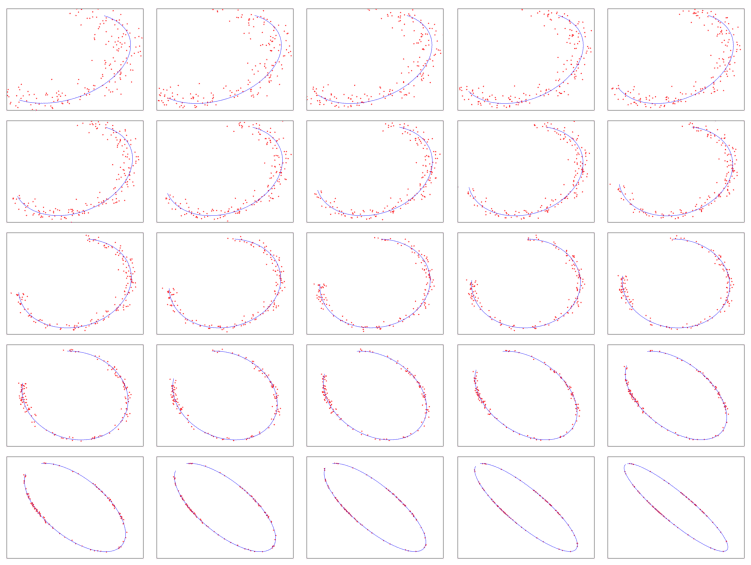
To illustrate how it works, I tested the above cloud regression procedure on 500 training sets, when the shape is an ellipse. I generated each training set with a specific set of parameters and a different amount of noise. The goal is to check how well the curve fitting technique works depending on the data. The originality lies in the choice of a continuous path in the parameter space, so that moving from one training set to the other (that is, from one frame to the next in the video) is done smoothly, yet covering a large number of possible combinations. The blue curves below are the estimates of the unknown, theoretical ellipses.
cf25
Curve fitting: 25 out of the 500 training sets featured in the video

See 25 of the 500 video frames in the above figure. Note how the transitions are smooth, yet over time cover various situations: a changing rotation angle, training sets (the red dots) of various sizes, ellipse eccentricity that varies over time, partial and full arcs, and noise ranging from strong to weak. You can watch the corresponding 25-sec video on YouTube, here. The source code both for the curve fitting and video production, is on GitHub, here.

Author

Towards Better GenAI: 5 Major Issues, and How to Fix Them

Vincent Granville is a pioneering GenAI scientist and machine learning expert, co-founder of Data Science Central (acquired by a publicly traded company in 2020), Chief AI Scientist at MLTechniques.com and GenAItechLab.com, former VC-funded executive, author and patent owner — one related to LLM. Vincent’s past corporate experience includes Visa, Wells Fargo, eBay, NBC, Microsoft, and CNET.

Vincent is also a former post-doc at Cambridge University, and the National Institute of Statistical Sciences (NISS). He published in Journal of Number Theory, Journal of the Royal Statistical Society (Series B), and IEEE Transactions on Pattern Analysis and Machine Intelligence. He is the author of multiple books, including “Synthetic Data and Generative AI” (Elsevier, 2024). Vincent lives in Washington state, and enjoys doing research on stochastic processes, dynamical systems, experimental math and probabilistic number theory. He recently launched a GenAI certification program, offering state-of-the-art, enterprise grade projects to participants.


And the Top Paying AI Job Is…

And the Top Paying AI Job Is… December 15, 2023 by Alex Woodie

(Rawpixel/Shutterstock)

If your Monday through Friday gig is working as a prompt engineer, then congratulations: You are among the highest paid AI professionals in the world at the moment. That’s according to new research from EPCGroup that looked into the job openings and pay for people working in AI.

According to EPCGroup’s study, prompt engineers, who are experts at automating the crafting of prompts that are fed into GenAI models such as ChatGPT and Llama2, earn an average of $300,000 per year. There are more than 2,100 vacancies for prompt engineers at the moment according to EPCGroup, which analyzed job data on Glassdoor as well as data from Google Keyword Planner and Google Trends to come up with its list of top 10 in-demand AI jobs.

In terms of positions with the highest demand, the number one job is AI research scientist. According to EPCGroup, there are currently 17,940 open jobs for AI research scientists, a 42% increase from a year ago. AI research scientists earn an average salary of $132,000, the company says.

The second most in-demand job in AI is machine learning engineer, which had about 6,800 available vacancies on Glassdoor, EPCGroup says. The average yearly salary for this job is $160,000.

Another job title that’s getting traction is AI engineer, which landed in the number three spot on EPCGroup’s list, with 4,300 available jobs. AI engineers, who help build AI systems, earn on average about $105,000, the company says.

Another job experiencing growth is big data engineer, for which there were about 3,300 job openings on Glassdoor, an uptick of 14% compared to last year. Big data engineers, who are tasked with ensuring data is well managed and ready for analysis and training AI models, earn an annual salary of about $180,000.

If you’re looking for a way into the lucrative AI business, you might consider becoming a human integration specialist. There were nearly 2,300 available human integration specialist jobs, but only 400 people were actively looking for the position, which pays on average about $91,000 per year, EPCGroup says.

AI developers are also in demand, with more than 2,000 open positions, a 7% increase from a year ago. AI developers earn on average about $130,000 per year, the company says.

If you can get by on “just” $80,000 per year, you might consider a job for an API integration expert (assuming you have the right skills, of course). There were nearly 1,600 job openings for API integration experts, but only 20 people were actively seeking such jobs, EPCGroup says.

NLP engineers also broke the top 10 of most in-demand AI jobs with 820 vacancies and an average annual salary of $109,000. EPCGroup says nearly 1,400 people are interested in pursuing this career in AI.

Last but not least is the AI product manager, who is wanted at about 520 organizations around the country. AI product managers make about $135,000 per year, EPCGroup says, and there are currently about 7,000 people following this career path.

Related

About the author: Alex Woodie
Alex Woodie has written about IT as a technology journalist for more than a decade. He brings extensive experience from the IBM midrange marketplace, including topics such as servers, ERP applications, programming, databases, security, high availability, storage, business intelligence, cloud, and mobile enablement. He resides in the San Diego area.

Mistral AI’s Latest Mixture of Experts (MoE) 8x7B Model

Mixture of Experts mistral ai

Mistral AI which is a Paris-based open-source model startup has challenged norms by releasing its latest large language model (LLM), MoE 8x7B, through a simple torrent link. This contrasts Google's traditional approach with their Gemini release, sparking conversations and excitement within the AI community.

Mistral AI's approach to releases has always been unconventional. Often foregoing the usual accompaniments of papers, blogs, or press releases, their strategy has been uniquely effective in capturing the AI community's attention.

Recently, the company achieved a remarkable $2 billion valuation following a funding round led by Andreessen Horowitz. This funding round was historic, setting a record with a $118 million seed round, the largest in European history. Beyond funding successes, Mistral AI's active involvement in discussions around the EU AI Act, advocating for reduced regulation in open-source AI.

Why MoE 8x7B is Drawing Attention

Described as a “scaled-down GPT-4,” Mixtral 8x7B utilizes a Mixture of Experts (MoE) framework with eight experts. Each expert have 111B parameters, coupled with 55B shared attention parameters, to give a total of 166B parameters per model. This design choice is significant as it allows for only two experts to be involved in the inference of each token, highlighting a shift towards more efficient and focused AI processing.

One of the key highlights of Mixtral is its ability to manage an extensive context of 32,000 tokens, providing ample scope for handling complex tasks. The model's multilingual capabilities include robust support for English, French, Italian, German, and Spanish, catering to a global developer community.

The pre-training of Mixtral involves data sourced from the open Web, with a simultaneous training approach for both experts and routers. This method ensures that the model is not just vast in its parameter space but also finely tuned to the nuances of the vast data it has been exposed to.

Mixtral 8x7B achieves an impressive score

Mixtral 8x7B achieves an impressive score

Mixtral 8x7B outperforms LLaMA 2 70B and rivaling GPT-3.5, especially notable in the MBPP task with a 60.7% success rate, significantly higher than its counterparts. Even in the rigorous MT-Bench tailored for instruction-following models, Mixtral 8x7B achieves an impressive score, nearly matching GPT-3.5

Understanding the Mixture of Experts (MoE) Framework

The Mixture of Experts (MoE) model, while gaining recent attention due to its incorporation into state-of-the-art language models like Mistral AI's MoE 8x7B, is actually rooted in foundational concepts that date back several years. Let's revisit the origins of this idea through seminal research papers.

The Concept of MoE

Mixture of Experts (MoE) represents a paradigm shift in neural network architecture. Unlike traditional models that use a singular, homogeneous network to process all types of data, MoE adopts a more specialized and modular approach. It consists of multiple ‘expert' networks, each designed to handle specific types of data or tasks, overseen by a ‘gating network' that dynamically directs input data to the most appropriate expert.

A Mixture of Experts (MoE) layer embedded within a recurrent language model

A Mixture of Experts (MoE) layer embedded within a recurrent language model (Source)

The above image presents a high-level view of an MoE layer embedded within a language model. At its essence, the MoE layer comprises multiple feed-forward sub-networks, termed ‘experts,' each with the potential to specialize in processing different aspects of the data. A gating network, highlighted in the diagram, determines which combination of these experts is engaged for a given input. This conditional activation allows the network to significantly increase its capacity without a corresponding surge in computational demand.

Functionality of the MoE Layer

In practice, the gating network evaluates the input (denoted as G(x) in the diagram) and selects a sparse set of experts to process it. This selection is modulated by the gating network's outputs, effectively determining the ‘vote' or contribution of each expert to the final output. For example, as shown in the diagram, only two experts may be chosen for computing the output for each specific input token, making the process efficient by concentrating computational resources where they are most needed.

Transformer Encoder with MoE Layers (Source)

The second illustration above contrasts a traditional Transformer encoder with one augmented by an MoE layer. The Transformer architecture, widely known for its efficacy in language-related tasks, traditionally consists of self-attention and feed-forward layers stacked in sequence. The introduction of MoE layers replaces some of these feed-forward layers, enabling the model to scale with respect to capacity more effectively.

In the augmented model, the MoE layers are sharded across multiple devices, showcasing a model-parallel approach. This is critical when scaling to very large models, as it allows for the distribution of the computational load and memory requirements across a cluster of devices, such as GPUs or TPUs. This sharding is essential for training and deploying models with billions of parameters efficiently, as evidenced by the training of models with hundreds of billions to over a trillion parameters on large-scale compute clusters.

The Sparse MoE Approach with Instruction Tuning on LLM

The paper titled “Sparse Mixture-of-Experts (MoE) for Scalable Language Modeling” discusses an innovative approach to improve Large Language Models (LLMs) by integrating the Mixture of Experts architecture with instruction tuning techniques.

It highlights a common challenge where MoE models underperform compared to dense models of equal computational capacity when fine-tuned for specific tasks due to discrepancies between general pre-training and task-specific fine-tuning.

Instruction tuning is a training methodology where models are refined to better follow natural language instructions, effectively enhancing their task performance. The paper suggests that MoE models exhibit a notable improvement when combined with instruction tuning, more so than their dense counterparts. This technique aligns the model's pre-trained representations to follow instructions more effectively, leading to significant performance boosts.

The researchers conducted studies across three experimental setups, revealing that MoE models initially underperform in direct task-specific fine-tuning. However, when instruction tuning is applied, MoE models excel, particularly when further supplemented with task-specific fine-tuning. This suggests that instruction tuning is a vital step for MoE models to outperform dense models on downstream tasks.

The effect of instruction tuning on MOE

The effect of instruction tuning on MOE

It also introduces FLAN-MOE32B, a model that demonstrates the successful application of these concepts. Notably, it outperforms FLAN-PALM62B, a dense model, on benchmark tasks while using only one-third of the computational resources. This showcases the potential for sparse MoE models combined with instruction tuning to set new standards for LLM efficiency and performance.

Implementing Mixture of Experts in Real-World Scenarios

The versatility of MoE models makes them ideal for a range of applications:

  • Natural Language Processing (NLP): MoE models can handle the nuances and complexities of human language more effectively, making them ideal for advanced NLP tasks.
  • Image and Video Processing: In tasks requiring high-resolution processing, MoE can manage different aspects of images or video frames, enhancing both quality and processing speed.
  • Customizable AI Solutions: Businesses and researchers can tailor MoE models to specific tasks, leading to more targeted and effective AI solutions.

Challenges and Considerations

While MoE models offer numerous benefits, they also present unique challenges:

  • Complexity in Training and Tuning: The distributed nature of MoE models can complicate the training process, requiring careful balancing and tuning of the experts and gating network.
  • Resource Management: Efficiently managing computational resources across multiple experts is crucial for maximizing the benefits of MoE models.

Incorporating MoE layers into neural networks, especially in the domain of language models, offers a path toward scaling models to sizes previously infeasible due to computational constraints. The conditional computation enabled by MoE layers allows for a more efficient distribution of computational resources, making it possible to train larger, more capable models. As we continue to demand more from our AI systems, architectures like the MoE-equipped Transformer are likely to become the standard for handling complex, large-scale tasks across various domains.

4 ways to overcome your biggest worries about generative AI

worry-tech-gettyimages-1427840767

Generative artificial intelligence (AI) is magic to the untrained eye.

From summarizing text to creating pictures and writing code, tools like OpenAI's ChatGPT and Microsoft's Copilot produce what seem like brilliant solutions to challenging questions in seconds. However, the magical abilities of generative AI can come with a side order of unhelpful tricks.

Also: Does your business need a chief AI officer?

Whether it's ethical concerns, security issues, or hallucinations, users must be aware of the problems that can undermine the benefits of emerging technology. Here, four business leaders explain how you can overcome some of the big concerns with generative AI.

1. Exploit new opportunities in an ethical manner

Birgitte Aga, head of innovation and research at Munch Museum in Oslo, Norway, says a lot of the concerns with AI are associated with people not understanding its potential impact — and with good reason.

Even a high-profile generative AI tool such as ChatGPT has only been available to the public for just over 12 months. While many people will have dabbled with the technology, few enterprises have used the tool in a production environment.

Aga says organizations should give their employees the opportunity to see what emerging technologies can do in a safe and secure manner. "I think lowering the threshold for everybody to take part and participate is key," she says. "But that doesn't mean doing it uncritically."

Aga says that as your employees discuss how AI can be used, they should also consider some of the big ethical issues, such as bias, stereotyping, and technological limitations.

Also: AI safety and bias: Untangling the complex chain of AI training

She explains in a video chat with ZDNET how the museum is working with technology specialist TCS to find ways that AI can be used to help make art more accessible to a broader audience.

"With TCS, we genuinely have alignment in every meeting when it comes to our ethics and morals," she says. "Find collaborators that you really align with on that level and then build from there, rather than just finding people that do cool stuff."

2. Build a task force to mitigate risks

Avivah Litan, distinguished VP analyst at Gartner, says one of the key issues to be aware of is the pressure for change from people outside the IT department.

"The business is wanting to charge full steam ahead," she says, referring to the adoption of generative AI tools by professionals across the organization, with or without the say-so of those in charge. "The security and risk people are having a hard time getting their arms around this deployment, keeping track of what people are doing, and managing the risk."

Also: 64% of workers have passed off generative AI work as their own

As a result, there's a lot of tension between two groups: the people who want to use AI, and the people who need to manage its use.

"No one wants to stifle innovation, but the security and risk people have never had to deal with something like this before," she says in a video chat with ZDNET. "Even though AI has been around for years, they didn't have to really worry about any of this technology until the rise of generative AI."

Litan says the best way to allay concerns is to create a task force for AI that draws on experts from across the business and which considers privacy, security, and risk.

"Then everyone's on the same page, so they know what the risks are, they know what the model's supposed to do, and they end up with better performance," she says.

Also: AI in 2023: A year of breakthroughs that left no human thing unchanged

Litan says Gartner research suggests that two-thirds of organizations have yet to establish a task force for AI. She encourages all companies to create this kind of cross-business squad.

"These task forces support a common understanding," she says. "People know what to expect and the business can create more value."

3. Restrain your models to reduce hallucinations

Thierry Martin, senior manager for data and analytics strategy at Toyota Motors Europe, says his biggest concern with generative AI is hallucinations.

He's seen these kinds of issues first-hand when he's tested generative AI for coding purposes.

Going beyond personal explorations, Martin says enterprises must pay attention to the large language models (LLMs) they use, the inputs they require, and the outputs they push out.

"We need very stable large language models," he says. "Many of the most popular models today are trained on so many things, like poetry, philosophy, and technical content. When you ask a question, there's an open door to hallucinations."

Also: 8 ways to reduce ChatGPT hallucinations

In a one-to-one video interview with ZDNET, Martin stresses that businesses must find ways to create more restrained language models.

"I want to stay within the knowledge base that I'm providing," he says. "Then, if I ask my model something specific, it will give me the right reply. So, I would like to see models that are more tied to the data I provide."

Martin is interested in hearing more about pioneering developments, such as Snowflake's collaboration with Nvidia, where both firms are creating an AI factory that helps enterprises turn their data into custom generative AI models.

"For example, an LLM that is perfect at making SQL queries of Python code is something that is interesting," he says. "ChatGPT and all these other public tools are good for the casual user. But if you connect that kind of tool to enterprise data, you must be cautious."

4. Progress slowly to temper expectations

Bev White, CEO of recruitment specialist Nash Squared, says her big concern is the practical reality of using generative AI might be very different from the vision.

"There's been a lot of hype," she says in a video conversation with ZDNET. "There's also been a lot of scaremongers saying jobs are going to be lost and AI is going to create mass unemployment. And there's also all the fears about data security and privacy."

White says it's important to recognize that the first 12 months of generative AI have been characterized by big tech companies racing to refine and update their models.

"These tools have already gone through a lot of iterations — and that's not by accident," she says. "People who use the technology are discovering upsides, but they also need to watch out for changes as each iteration comes out."

Also: The 3 biggest risks from generative AI — and how to deal with them

White advises CIOs and other senior managers to proceed with caution. Don't be scared about taking a step back, even if it feels like everyone else is rushing forward.

"I think we need something tangible that we can use as guardrails. The CISOs in organizations must start thinking about generative AI — and our evidence suggests they are. Also, regulation needs to keep up with the pace of change," she says.

"Maybe we need to go a bit slower while we figure out what to do with the technology. It's like inventing an amazing rocket, but not having the stabilizers and security systems around it before you launch."

Artificial Intelligence

News publisher files class action antitrust suit against Google, citing AI’s harms to their bottom line

News publisher files class action antitrust suit against Google, citing AI’s harms to their bottom line Sarah Perez @sarahintampa / 9 hours

A new class action lawsuit filed this week in the U.S. District Court in D.C. accuses Google and parent company Alphabet of anticompetitive behavior in violation of U.S. antitrust law, the Sherman Act, and others, on behalf of news publishers. The case, filed by Arkansas-based publisher Helena World Chronicle, argues that Google “siphons off” news publishers’ content, their readers, and ad revenue through anticompetitive means. It also specifically cites new AI technologies like Google’s Search Generative Experience (SGE) and Bard AI chatbot as worsening the problem.

In the complaint, Helena World Chronicle, which owns and publishes two weekly newspapers in Arkansas, argues that Google is “starving the free press” by sharing publishers’ content on Google, losing them “billions of dollars.”

In addition to new AI technologies, the suit points to Google’s older question-and-answer technologies, like the “Knowledge Graph” launched in May 2012, as part of the problem.

“When a user searches for information on a topic, Google displays a ‘Knowledge Panel’ to the right of the search results. This panel contains a summary of content drawn from the Knowledge Graph database,” the complaint states. “Google compiled this massive database by extracting information from Publishers’ websites — what Google calls ‘materials shared across the web’ —and from ‘open source and licensed databases,'” it says.

By 2020, the Knowledge Graph had grown to 500 billion facts about 5 billion entities. But much of the “collective intelligence” that Google tapped into was content “misappropriated from Publishers,” the complaint alleges.

Other Google technologies, like “Featured Snippets” where Google algorithmically extracts answers from webpages, were also cited as shifting traffic away from publishers’ websites.

More importantly, perhaps, is the suit’s tackling of how AI will impact publishers’ businesses. The problem was recently detailed in a report on Thursday by The Wall St. Journal, which led with a shocking statistic. When online magazine The Atlantic modeled what would happen if Google integrated AI into search, it found that 75% of the time the AI would answer the user’s query without requiring a click-through to its website, losing it traffic. This could have a major impact on publishers’ traffic going forward, as Google today drives nearly 40% of their traffic, according to data from SimilarWeb.

Some publishers are now trying to get ahead of the problem. For example, Axel Springer just this week inked a deal with OpenAI to license its news for AI model training. But overall, publishers believe they’ll lose somewhere between 20 and 40 percent of their website traffic when Google’s AI products fully roll out, The WSJ’s report noted.

The lawsuit reiterates this concern, claiming that Google’s recent advances in AI-based search were implemented with “the goal of discouraging end-users from visiting the websites of Class members who are part of the digital news and publishing line of commerce..”

SGE, it argues, offers web searchers a way to seek information in a conversational mode, but ultimately keeps users in Google’s “walled garden” as it “plagarizes” their content. Publishers also can’t block SGE because it uses the same web crawler as Google’s general search service, GoogleBot.

Plus, it says Google’s Bard AI was trained on a dataset that included “news, magazine and digital publications,” citing both a 2023 report from the News Media Alliance and a Washington Post article about AI training data for reference. (The Post, which worked with researchers at the Allen Institute for AI, had found that News and Media sites were the third largest category of AI training data.)

The case points to other concerns, too, like changing AdSense rates and evidence of improper spoliation of evidence on Google’s part, by its destruction of chat messages — an issue raised in the recent Epic Games lawsuit against Google over app store antitrust issues, which Epic won.

In addition to damages, the suit is asking for an injunction that would require Google to obtain consent from publishers to use their website data to train its general artificial intelligence products including Google’s own and those of rivals. It also asks Google to allow publishers who opt out of SGE to still show up in Google search results, among other things.

The U.S. lawsuit follows an agreement Google reached last month with the Canadian government which would see the search giant paying Canadian media for use of their content. Under the terms of the deal, Google will provide $73.5 million (100 million Canadian dollars) every year to news organizations in the country, with funds distributed based on the news outlets’ headcount. Negotiations with Meta are still unresolved, though Meta began blocking news in Canada in August, in light of the pressure to pay for the content under the new Canadian law.

The case also arrives alongside the filing of the U.S. Justice Department’s lawsuit against Google for monopolizing digital ad technologies, and references the 2020 Justice Department’s civil antitrust suit over search and search advertising, (which are different markets from digital ad technologies in the more recent suit).

“The anticompetitive effects of Google’s scheme cause profound harm to competition, to consumers, to labor, and to a democratic free press,” reads an announcement posted to the website of the law firm handling the case, Hausfeld.

“Plaintiff Helena World Chronicle, LLC invokes the Sherman Act and Clayton Act to seek class-wide monetary and injunctive relief to restore and ensure competition for digital news and reference publishing and set up guardrails to preserve a free marketplace of ideas in the new era of artificial intelligence,” it states.

Google has been asked for comment, but one has not yet been provided.

The complaint is available below.

Helena World Chronicle, LLC v. Google LLC and Alphabet Inc by TechCrunch on Scribd

No Time Left for Holiday Shopping? Give a Digital Gift Instead: Producti AI Pro Is Just $50 Through 12/25

Promotional graphic for Producti
Image: StackCommerce

There are dozens of AI-driven productivity apps on the market. Some specialize in writing content, others generate images and even more help you plan your day. Wish there was just one that could do it all? Then allow us to introduce you to the Producti AI Pro Plan, offered right now at hundreds off the regular price through Dec 25.

Producti is an AI-driven assistant that helps you manage practically every aspect of your day-to-day life. The platform writes content that reads naturally, generates images that look true to life, and provides advice and guidance to help you make the most of your day. And if that’s not enough, it’ll also code for you, which is a huge time saver for anyone who works in IT.

In a world where time is of the essence and everyone seems to be perpetually scrambling to meet demands, a tool like Producti is worth its weight in gold. Instead of writing emails to clients, you just get Producti to do it for you. Need to come up with a marketing campaign fast? Producti can do that too. Unsure about any decision? You guessed it, Producti to the rescue again.

And one of the best parts is that you don’t need any special equipment or skills to be able to use it. Producti works with any modern browser, so you can use it on virtually any device, whether it be a PC (this MacBook Air, also on sale, is particularly good), tablet or your phone. And it’s super easy to use. Simply type in a bit about what you want, and the Producti platform will take it from there.

One writer with Entrepreneur wrote, “Not only has Producti saved me time, but it also helped me produce content that was more engaging and effective than what I had been creating on my own.”

If you have someone on your gift list who could use a bit of help in their day-to-day life, then Producti is the gift that keeps on giving. And since it’s a digital purchase, you can buy it any time before Christmas without having to worry about having it shipped in time — a huge time saver for you.

Get a lifetime subscription to the Producti AI Pro Plan for just $49.99 (reg. $647.64) until 11:59 pm on December 25.

Prices and availability are subject to change.

Here come the ‘custobots’: AI pervades Gartner’s top 10 strategic technology trends for 2024

Person walking with a thinking bubble above them

Gartner has identified the top 10 strategic technology trends for 2024, and generative and other types of AI solutions take center stage with widespread adoption and risks that are primary focus areas.

The top strategic technology trends for 2024 are:

1. Democratized generative AI

Generative AI (aka, GenAI) is becoming democratized by the confluence of massively pre-trained models, cloud computing, and open source — making these models accessible to workers worldwide.

Also: Two breakthroughs made 2023 tech's most innovative year in over a decade

By 2026, Gartner predicts, over 80% of enterprises will have used GenAI APIs and models and/or deployed GenAI-enabled applications in production environments, up from less than 5% in early 2023.

2. AI Trust, Risk, and Security Management (TRiSM)

The democratization of access to AI has made the need for AI Trust, Risk and Security Management (TRiSM) more clear and urgent. Without guardrails, AI models can rapidly generate compounding negative effects that spin out of control, overshadowing any positive performance and societal gains that AI enables.

AI TRiSM provides tooling for ModelOps, proactive data protection, AI-specific security, model monitoring (including monitoring for data drift, model drift, and/or unintended outcomes), and risk controls for inputs and outputs to third-party models and applications. Gartner predicts that by 2026, enterprises that apply AI TRiSM controls will increase the accuracy of their decision-making by eliminating up to 80% of faulty and illegitimate information.

3. AI-augmented development

AI-augmented development is the use of AI technologies, such as GenAI and machine learning, to aid software engineers in designing, coding, and testing applications. AI-assisted software engineering improves developer productivity and enables development teams to address the increasing demand for software to run the business.

Also: AI in 2023: A year of breakthroughs that left no human thing unchanged

These AI-infused development tools enable software engineers to spend less time writing code, so they can spend more time on strategic activities such as the design and composition of compelling business applications.

4. Intelligent applications

Intelligent applications include intelligence — which Gartner defines as learned adaptation to respond appropriately and autonomously — as a capability. This intelligence can be utilized in many use cases to better augment or automate work. As a foundational capability, intelligence in applications comprises various AI-based services, such as machine learning, vector stores, and connected data. Consequently, intelligent applications deliver experiences that dynamically adapt to the user.

5. Augmented-connected workforce

The augmented-connected workforce (ACWF) is a strategy for optimizing the value derived from human workers. The need to accelerate and scale talent is driving the ACWF trend. The ACWF uses intelligent applications and workforce analytics to provide everyday context and guidance to support the workforce's experience, well-being, and ability to develop its own skills.

Also: These 5 major tech advances of 2023 were the biggest game-changers

At the same time, the ACWF drives business results and positive impact for key stakeholders. Through 2027, 25% of CIOs will use ACWF initiatives to reduce time to competency by 50% for key roles.

6. Continuous threat exposure management

Continuous threat exposure management (CTEM) is a pragmatic and systemic approach that allows organizations to evaluate the accessibility, exposure, and exploitability of an enterprise's digital and physical assets continually and consistently. Aligning CTEM assessment and remediation scopes with threat vectors or business projects, rather than an infrastructure component, surfaces not only the vulnerabilities but also the unpatchable threats. By 2026, Gartner predicts that organizations prioritizing their security investments based on a CTEM program will realize a two-thirds reduction in breaches.

7. Machine customers or 'custobots'

Machine customers (also called "custobots") are nonhuman economic actors that can autonomously negotiate and purchase goods and services in exchange for payment. By 2028, 15 billion connected products will exist with the potential to behave as customers, with billions more to follow in the coming years. This growth trend will be the source of trillions of dollars in revenues by 2030 and eventually become more significant than the arrival of digital commerce. Strategic considerations should include opportunities to either facilitate these algorithms and devices, or even create new custobots.

8. Sustainable technology

Sustainable technology is a framework of digital solutions used to enable environmental, social, and governance (ESG) outcomes that support long-term ecological balance and human rights. The use of technologies such as AI, cryptocurrency, the Internet of Things and cloud computing is driving concern about the related energy consumption and environmental impacts.

Also: Tech for a sustainable future: The challenges and opportunities ahead

This makes it more critical to ensure that the use of IT becomes more efficient, circular, and sustainable. In fact, Gartner predicts that by 2027, 25% of CIOs will see their personal compensation linked to their sustainable technology impact.

9. Platform engineering

Platform engineering is the discipline of building and operating self-service internal development platforms. Each platform is a layer, created and maintained by a dedicated product team, designed to support the needs of its users by interfacing with tools and processes. The goal of platform engineering is to optimize productivity and the user experience, and to accelerate the delivery of business value.

10. Industry cloud platforms

By 2027, Gartner predicts, more than 70% of enterprises will use Industry cloud platforms (ICPs) to accelerate their business initiatives, up from less than 15% in 2023. ICPs address industry-relevant business outcomes by combining underlying SaaS, PaaS, and IaaS services into a whole product offering with composable capabilities. These typically include an industry data fabric, a library of packaged business capabilities, composition tools, and other platform innovations. ICPs are tailored cloud proposals specific to an industry and can further be tailored to an organization's needs.

Also: If AI is the future of your business, should the CIO be the one in control?

In addition to the top technology strategic trends, Gartner also provided its top strategic IT predictions, exploring how GenAI has changed executive leaders' way of thinking on every subject and how to create a more flexible and adaptable organization that is better prepared for the future. Here are Gartner's top 10 strategic predictions:

  1. By 2027, the productivity value of AI will be recognized as a primary economic indicator of national power.
  2. By 2027, GenAI tools will be used to explain legacy business applications and create appropriate replacements, reducing modernization costs by 70%.
  3. By 2028, enterprise spending on battling malinformation will surpass $30 billion, cannibalizing 10% of marketing and cybersecurity budgets to combat a multifront threat.
  4. By 2027, 45% of chief information security officers (CISOs) will expand their remit beyond cybersecurity, due to increasing regulatory pressure and attack surface expansion.
  5. By 2028, the rate of unionization among knowledge workers will increase by 1,000%, motivated by the adoption of GenAI.
  6. In 2026, 30% of workers will leverage digital charisma filters to achieve previously unattainable advances in their careers.
  7. By 2027, 25% of Fortune 500 companies will actively recruit neurodivergent talent across conditions like autism, ADHD, and dyslexia to improve business performance.
  8. By 2028, there will be more smart robots than frontline workers in manufacturing, retail, and logistics due to labor shortages.
  9. By 2026, 50% of G20 members will experience monthly electricity rationing, turning energy-aware operations into either a competitive advantage or a major failure risk.
  10. By 2026, generative AI will significantly alter 70% of the design and development effort for new web applications and mobile apps.

Another example of the impact of AI in business is the use for sales professionals. By 2025, 35% of chief revenue officers will resource a centralized "GenAI Operations" team as part of their go-to-market organization. As adoption accelerates, sales enablement leaders can drive responsible use of the technology to help achieve better sales outcomes.

Sample areas of AI's impact on Sales.

Research from Salesforce's annual State of IT report confirms many of the projections from Gartner. Many other independent research reports validate the accelerated adoption of AI, including generative AI. According to McKinsey, 50% of organizations used AI in 2022. IDC is forecasting global AI spending to increase by a staggering 26.9% in 2023 alone.

Also: What technology analysts are saying about the future of generative AI

A recent survey of customer service professionals found adoption of AI had risen by 88% between 2020 and 2022. Customer service leads AI use cases with organizations with AI using it in the following ways: Service operations optimization (24%), new AI-based products (20%), customer service analytics (19%), customer segmentation (19%), AI-based product enhancements (19%), customer acquisition and lead generation (17%), contact center automation (16%), and product feature optimizations (16%).

The State of IT report found that generative AI has only recently become mainstream. The report shows 86% of IT leaders believe generative AI will have a prominent role in their organizations in the near future. Yet 64% of IT leaders are concerned about the ethics of generative AI, and 62% are concerned about its impacts on their careers. The report also notes that ethics and generative AI focus on accuracy, bias, toxicity, safety, and privacy.

Also: The ethics of generative AI: How we can harness this powerful technology

In a recent survey of IT leaders, concerns around generative AI included security risks (79%), bias (73%), and carbon footprint (71%). With nearly 9 out of 10 IT leaders believing generative AI will have a prominent role in their organizations in the near future, business leaders must understand the strategic technology trends highlighted by Gartner for 2024 and beyond. In order to do this, businesses must commit to education, stakeholder reskilling, and strategic partnerships in order to ready themselves for a future that is led by AI-powered products and services.

Artificial Intelligence

IISc, Bengaluru Traffic Police Partner for Using AI to Reduce Traffic

IISc BTP

The Indian Institute of Science (IISc) and Bengaluru City Traffic Police (BTP) have formalised their collaboration through a Memorandum of Understanding (MoU). The strategic partnership aims to leverage data-driven AI solutions to analyze and alleviate traffic challenges in the bustling metropolis.

Under the terms of the MoU, IISc researchers will have access to the vast pool of traffic data generated by the city, which exceeds 30 petabytes each month. The collaboration is poised to usher in a new era of collaboration, allowing IISc experts to work hand-in-hand with BTP in developing innovative solutions to reduce congestion and enhance overall traffic safety.

Mr. MN Anucheth, IPS, Joint Commissioner of Police, Traffic, Bengaluru City, emphasised the untapped potential of the copious data produced by the city each month. “The motivation behind the MoU with IISc is to enable the development of insights from this largely unused Police data toward alleviating the city’s mobility and traffic safety challenges,” he stated.

Mr. Anucheth further highlighted the anticipated benefits of training and capacity building initiatives from IISc, which are expected to equip BTP staff with the knowledge base necessary to improve mobility and traffic safety.

In response to the collaboration, Prof Abdul Rawoof Pinjari, Chair of CiSTUP (Centre for Infrastructure, Sustainable Transportation, and Urban Planning) at IISc, expressed his optimism. “It is heartening that Bengaluru Traffic Police (BTP) are investing substantial efforts in the measurement and monitoring of mobility and traffic safety in the city,” he noted.

Prof Pinjari underlined the crucial role of data derived from these efforts, emphasising how it will contribute to enhancing city mobility and traffic safety through research projects and tailored training programs.

The collaboration represents a holistic approach to addressing Bengaluru’s traffic challenges, combining cutting-edge research capabilities from IISc with the practical expertise of BTP. As the city continues to grapple with escalating traffic issues, the joint efforts of these two entities signal a promising step towards a more efficient and safer urban mobility landscape.

The post IISc, Bengaluru Traffic Police Partner for Using AI to Reduce Traffic appeared first on Analytics India Magazine.

3 Ways to Generate Hyper-Realistic Faces Using Stable Diffusion

3 Ways to Generate Hyper-Realistic Faces Using Stable Diffusion
Image by Author

Ever wonder how people generate such hyper-realistic faces using AI image generation while your own attempts end up full of glitches and artifacts that make them look obviously fake? You've tried tweaking the prompt and settings but still can't seem to match the quality you see others producing. What are you doing wrong?

In this blog post, I'll walk you through 3 key techniques to start generating hyper-realistic human faces using Stable Diffusion. First, we'll cover the fundamentals of prompt engineering to help you generate images using the base model. Next, we'll explore how upgrading to the Stable Diffusion XL model can significantly improve image quality through greater parameters and training. Finally, I'll introduce you to a custom model fine-tuned specifically for generating high-quality portraits.

1. Prompt Engineering

First, we will learn to write positive and negative prompts to generate realistic faces. We will be using the Stable Diffusion version 2.1 demo available on Hugging Face Spaces. It is free, and you can start without setting up anything.

Link: hf.co/spaces/stabilityai/stable-diffusion

When creating a positive prompt, ensure to include all the necessary details and style of the image. In this case, we want to generate an image of a young woman walking on the street. We will be using a generic negative prompt, but you can add additional keywords to avoid any repetitive mistakes in the image.

Positive prompt: “A young woman in her mid-20s, Walking on the streets, Looking directly at the camera, Confident and friendly expression, Casually dressed in modern, stylish attire, Urban street scene background, Bright, sunny day lighting, Vibrant colors”

Negative prompt: “disfigured, ugly, bad, immature, cartoon, anime, 3d, painting, b&w, cartoon, painting, illustration, worst quality, low quality”

3 Ways to Generate Hyper-Realistic Faces Using Stable Diffusion

We got a good start. The images are accurate, but the quality of the images could be better. You can play around with the prompts, but this is the best you will get out of the base model.

2. Stable Diffusion XL

We will be using the Stable Diffusion XL (SDXL) model to generate high-quality images. It achieves this by generating the latent using the base mode and then processing it using a refiner to generate detailed and accurate images.

Link: hf.co/spaces/hysts/SD-XL

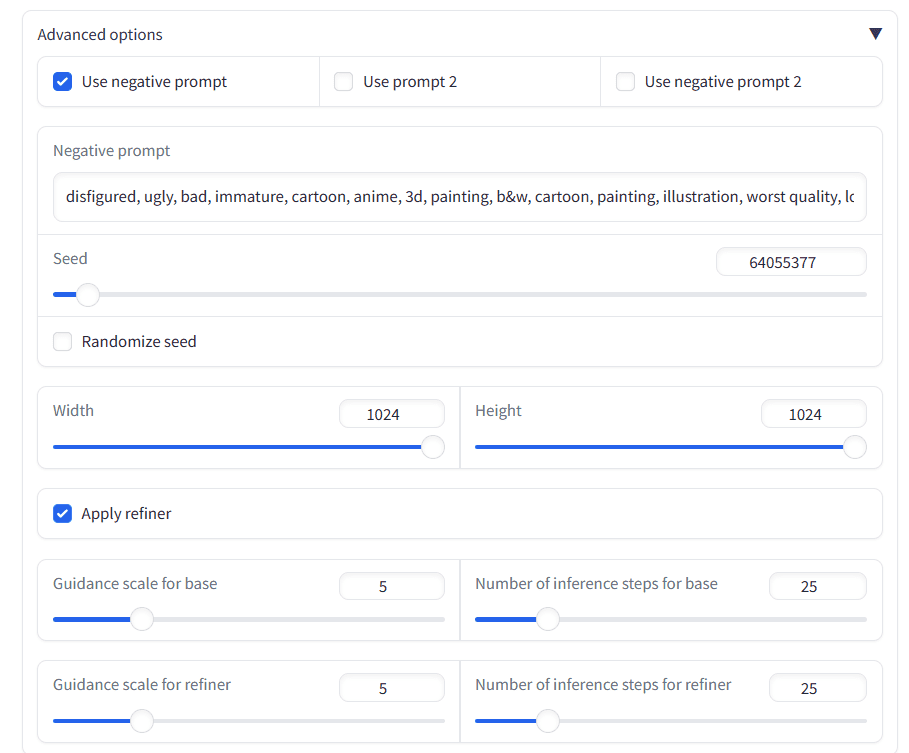
Before we generate the images, we will scroll down and open the “Advanced options.” We will add a negative prompt, set seed, and apply refiner for the best image quality.

3 Ways to Generate Hyper-Realistic Faces Using Stable Diffusion

Then, we will write the same prompt as before with the minor change. Instead of a generic young woman, we will generate the image of a young Indian woman.

3 Ways to Generate Hyper-Realistic Faces Using Stable Diffusion

This is a much improved outcome. The facial features are perfect. Let's attempt to generate other ethnicities to check for bias and compare the results.

3 Ways to Generate Hyper-Realistic Faces Using Stable Diffusion

We got realistic faces, but all the images have Instagram filters. Usually, skins are not smoother in real life. It has acne, marks, freckles, and lines.

3. CivitAI: RealVisXL V2.0

In this part, we will generate detailed faces with marks and realistic skin. For that, we will use the custom model from CivitAI (RealVisXL V2.0) that was fine-tuned for high-quality portraits.

Link: civitai.com/models/139562/realvisxl-v20

You can either use the model online by clicking on the “Create” button or download it to use locally using Stable Diffusion WebUI.

3 Ways to Generate Hyper-Realistic Faces Using Stable Diffusion

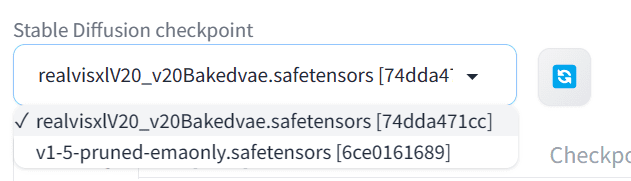
First, download the model and move the file to the Stable Diffusion WebUI model directory: C:WebUIwebuimodelsStable-diffusion.

To display the model on the WebUI you have to press the refresh button and then select the “realvisxl20…” model checkpoint.

3 Ways to Generate Hyper-Realistic Faces Using Stable Diffusion

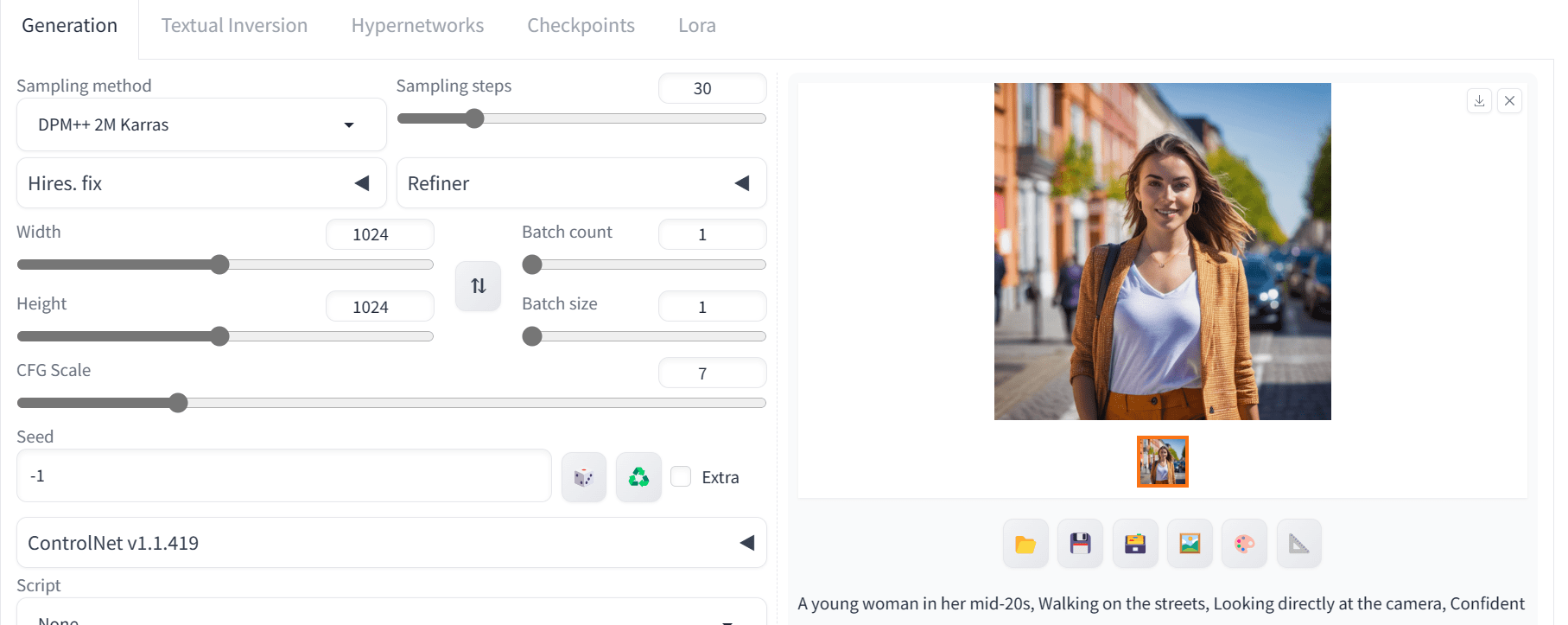
We will start by writing the same positive and negative prompts and generate a high-quality 1024X1024 image.

3 Ways to Generate Hyper-Realistic Faces Using Stable Diffusion

The image looks perfect. To take full advantage of the custom model we have to change our prompt.

3 Ways to Generate Hyper-Realistic Faces Using Stable Diffusion

The new positive and negative prompts can be obtained by scrolling down the model page and clicking on the realistic image you like. The images on the CivitAI come with positive and negative prompts and advanced steering.

Positive prompt: “An image of an Indian young woman, focused, decisive, surreal, dynamic pose, ultra highres, sharpness texture, High detail RAW Photo, detailed face, shallow depth of field, sharp eyes, (realistic skin texture:1.2), light skin, dslr, film grain”

Negative prompt: “(worst quality, low quality, illustration, 3d, 2d, painting, cartoons, sketch), open mouth”

3 Ways to Generate Hyper-Realistic Faces Using Stable Diffusion

We have a detailed image of an Indian woman with realistic skin. It is an improved version compared to the base SDXL model.

3 Ways to Generate Hyper-Realistic Faces Using Stable Diffusion

We have generated three more images to compare different ethnicities. The results are phenomenal, containing skin marks, porous skin, and accurate features.

Conclusion

The advancement in generative art will soon reach a level where we will have difficulty differentiating between real and synthetic images. This signals a sustainable future where anyone can create highly realistic media from simple text prompts by leveraging custom models trained on diverse real-world data. The rapid progress implies exciting potential — perhaps one day, generating a photorealistic video replicating your own likeness and speech patterns may be as simple as typing out a descriptive prompt.

In this post, we have learned about prompt engineering, advanced Stable design models, and costume fine tuned models for generating highly accurate and realistic faces. If you want even better results, I will suggest you explore various high quality models available on civitai.com.

Abid Ali Awan (@1abidaliawan) is a certified data scientist professional who loves building machine learning models. Currently, he is focusing on content creation and writing technical blogs on machine learning and data science technologies. Abid holds a Master's degree in Technology Management and a bachelor's degree in Telecommunication Engineering. His vision is to build an AI product using a graph neural network for students struggling with mental illness.

More On This Topic

  • Become an AI Artist Using Phraser and Stable Diffusion
  • Stable Diffusion: Basic Intuition Behind Generative AI
  • 4 Ways to Generate Passive Income Using ChatGPT
  • How To Generate Meaningful Sentences Using a T5 Transformer
  • Generate Music From Text Using Google MusicLM
  • Fake It Till You Make It: Generating Realistic Synthetic Customer Datasets

OpenAI to Release GPT-4.5 Soon

OpenAI cannot afford to take a break, with competitors constantly breathing down its neck. Suddenly, GPT-4.5 started trending on X, and speculation arose that OpenAI might release it before the end of this year as suggested by a user on X with the username ‘Flowers From the future’. He also shared what appears to be a leaked document from inside Google saying that because GPT-4.5 is about to drop, Google is rushing the Gemini API out the door.

However, putting all speculations to rest, Sam Altman replied with a simple ‘nah’ to the query ‘gpt4.5 leak legit or no?’ by a user on X. The GPT-4.5 leak also included unrealistic pricing. Therefore, it cannot be conclusively determined whether Altman dismissed just the pricing or the existence of GPT-4.5 altogether.

Though Altman has denied OpenAI releasing GPT-4.5, the time is ripe for them to go ahead and do the same.

The Case for OpenAI’s GPT-4.5 Launch

It was OpenAI that brought generative AI to the public’s attention with ChatGPT last year, and since then, there has been no looking back. Today, OpenAI’s rivals, including Google, Meta, Mistral AI, Cohere, Anthropic, and (now Ola) all tend to compare their models with GPT-4 as the benchmark. A common motive among them is to somehow outperform OpenAI’s models.

With the recent announcement of Gemini Ultra, Google has posed a challenge to GPT-4. Interestingly, Gemini Ultra is set to be released by early next year. If it lives up to its on-paper prowess over GPT-4, it could indeed pose a significant challenge.

the leak is most likely fake but they will most likely put something out before gemini ultra gets a chance to take over. once gemini ultra is released and bard advanced is a thing, people will start cancelling their chatgpt plus subs, and openai cant have that. its not even a…

— Nicholas Dunzelman (@nic_dunz) December 15, 2023

Meanwhile, OpenAI has all the resources to go ahead. Sam Altman recently posted on X that OpenAI has found new GPUs, which could possibly be AMD MI300X. At AMD’s recent event Advancing AI, it was announced that OpenAI will use MI300X in its programming system, Triton 3.0. Meanwhile, Microsoft has also announced that it will use the new AMD chip in its cloud computing segment, Azure.

Interestingly, OpenAI is suddenly going all out on Super Alignment, publishing blogs and papers. OpenAI has devised a new method in which it plans to supervise superior AI models with smaller models, clearly indicating its work on a model that surpasses GPT-4 and requires supervision.

The amount of papers and blog posts from OpenAI this morning lends much more credibility to the 4.5 rumor. Announce a ton of alignment work first. See how safe everything is? Okay that's enough. Break its chains, release GPT-4.5! Behold its power, mortals!

— Andrew Curran (@AndrewCurran_) December 14, 2023

OpenAI stated that current alignment methods, such as reinforcement learning from human feedback (RLHF), rely on human supervision. However, future AI systems will be capable of extremely complex and creative behaviors, making it difficult for humans to reliably supervise them.

Citing an example, OpenAI mentioned that superhuman models may have the ability to generate millions of lines of novel—and potentially dangerous—computer code, making it very challenging for even expert humans to understand.

Moreover, Meta is also planning to launch Llama 3 next year, which might be multimodal considering the image generation model Emu it recently released.

Altman Dropping Hints

Interestingly, Sam Altman previously said that OpenAI is working on GPT-5. While GPT-5 is likely to be more sophisticated than its predecessors, Altman said it was technically hard to predict exactly what new capabilities and skills the model might have.

“Until we train that model, it’s like a fun guessing game for us,” he said. “We’re trying to get better at it, because I think it’s important from a safety perspective to predict the capabilities. But I can’t tell you exactly what it’s going to do that GPT-4 didn’t.” said Altman.

Furthermore, a few weeks ago, it was leaked that OpenAI is working on a new project called Q*. In an interview with The Verge, when questioned about the project, Altman replied, ‘No particular comment on that unfortunate leak,’ indirectly confirming Q*.

With so many competitors out there challenging OpenAI, it makes sense for them to drop GPT-4.5 as a Christmas present for its customers.

The post OpenAI to Release GPT-4.5 Soon appeared first on Analytics India Magazine.