Mumbai-based Indian pharmaceutical MNC IPCA Laboratories has been leveraging Nutanix’s hybrid multi-cloud for a while now in the production and marketing of drugs, formulations, drug intermediates, and active pharmaceutical ingredients (APIs).
Known for its global presence, IPCA is a leading API exporter from India, recognised for its reliable supply chain and cost competitiveness in the pharmaceutical market.
“We witnessed a significant increase in application speed, approximately60 to 70%, compared to the previous standalone setup,” Ashok Nayak, chief information officer, IPCA, told AIM during Nutanix’s flagship conference .NEXT held in Mumbai last week.
During the infrastructure transition from legacy systems, the primary goal for IPCA was to identify high-performance systems to ensure uninterrupted 24/7 operation, crucial for maintaining data integrity and security, especially in the pharmaceutical industry. The company sought an infrastructure that could scale up rapidly and efficiently to meet demands as applications were frequently added during their digitalisation journey.
“And that is when Nutanix solved our challenges as it provides the necessary functionality to handle large datasets and offered benefits in terms of performance, scalability, and visibility of both centralised and decentralised setups,” Nayak added.
High-performance resources were essential to prevent downtime. Key factors making this happen included low latency, application speed, and the management of extensive databases related to various functions such as manufacturing, supply chain, R&D, events, medical services, and clinical trials.
How Nutanix is Helping Indian Pharma
“Considering the diversity of our customer needs, we ensure assistance regardless of where they choose to deploy their applications,” Andrew Brinded, chief revenue officer at Nutanix told AIM during the event.
Customers have varied preferences for handling data in these deployments, with some choosing local analysis and storage, while others opting for centralising information.
“What we provide is that common experience wherever it is, you have the same management plane, whether you’re moving workloads, the public cloud wherever you keep your on-premise or whether you’re having an edge and then you have the same data plane across everything,” explained Faiz Shakir, VP and managing director – sales, Nutanix India and SAARC.
This approach contrasts with traditional architectures, where managing diverse environments with separate teams for servers, storage, and networking can be complex.
In a traditional setup (presumably not using Nutanix), it would typically require a team of five to ten individuals to manage various aspects of the infrastructure, including servers, storage, and networking.
However, with Nutanix’s technology and consolidation approach, the need for personnel significantly decreases. “We have seen that under Nutanix, the same tasks can typically be handled by one or two individuals. This reduction in manpower indicates a streamlined and more efficient management process, contributing to overall operational efficiency and cost-effectiveness,” Mike Phelan, SVP of global solution sales at Nutanix told AIM.
This consolidation also extends to the data centre, with Nutanix’s hyper-converged infrastructure (HCI) approach leading to savings in floor space and energy consumption.
Another important feature which has helped IPCA is the data security solutions provided by Nutanix. Its data storage fabric, along with encryption and compression enhances the security of the company’s data.
“In the pharmaceutical industry, traceability of data and proving the source to regulators is crucial, making data security our top priority. Nutanix’s functionality in providing secure data storage has helped us in securing sensitive pharmaceutical data,” said Nayak.
Not just IPCA, Apollo Hospitals also leverages the Nutanix cloud platform. By running hospital information system (HIS), electronic medical records (EMR), and Picture Archiving and Communication System (PACS) applications on Nutanix, Apollo witnessed quick hospital admissions, ensured highly available patient records and diagnostic-quality imaging, and freed up IT resources for strategic projects.
Managing Generative AI Workloads
Back in August, Nutanix came up with Nutanix’s GPT-in-a-Box for its customer base of 25000, offering a unified, scalable AI solution, built on the Nutanix cloud platform that supports GPU-enabled servers for diverse compute, storage, and networking needs.
It aims to simplify the deployment and management of AI workloads with open-source collaborations with the PyTorch and Kubeflow MLOps platform and supports a range of LLMs, including Llama2, Falcon, and MPT. Nutanix also partnered with NVIDIA to enhance enterprise AI so that customers can leverage NVIDIA’s GPUs for scalable, efficient AI workloads in modernised data centres and diverse cloud applications.
“Our early investments in AI, coupled with the integration of ML for capacity planning, provided a dynamic platform capable of auto-size and auto-scaling,” said Phelan.
India as a Market
“We have chosen to make significant investments in the Indian market, with approximately a third of our workforce based here,” said Shakir.
Nutanix is significantly scaling up its operations in India with several key initiatives including opening a large new facility in Pune in 2022, serving as a crucial hub for their global service and support, and providing round-the-clock assistance. Bengaluru serves as the India headquarters for the company.
“India’s market is particularly exciting for us due to its size, economic growth, and the rapid adoption of technology. The enthusiasm for technology in India is substantial, given the country’s strong orientation toward software,” concluded Brinded.
The post How Nutanix is Handling Healthcare Challenges in India appeared first on Analytics India Magazine.
The recent developments and the progress in the capabilities of large language models have played a crucial role in the advancements of LLM-based frameworks for audio generation and speech synthesis tasks especially in the zero-shot setting. Traditional speech synthesis frameworks have witnessed significant advancements as a result of integrating additional features like neural audio codecs for discreet audio and speech units. Even though these speech and audio synthesis frameworks deliver satisfactory results, there is still room for improvement as the current LLM-based audio frameworks have the following three major limitations
They tend to auto-generate audio output that ultimately causes a lack of robustness and slow interference speeds and results in mispronunciation, skipping, or repeating.
They tend to over-rely on discrete speech units or pre-trained neural audio codec.
They often require a large amount of training data.
To tackle the issues mentioned above, and improve the capabilities of LLM-based audio and speech synthesis models, developers have come up with HierSpeech++, a robust and efficient zero-shot speech synthesizer for voice and text to speech or TTS conversions. The HierSpeech++ framework builds upon the learnings of hierarchical speech synthesis frameworks that not only boosts the robustness, but also adds to the expressiveness of synthetic speech output while also boosting the naturalness and speaker similarity of artificially generated speech even in a zero-shot setting.
In this article, we will be talking about the HierSpeech++ framework in detail, and have a look at the model’s architecture, working, and results when compared against state of the art text and audio generation models. So let’s get started.
HierSpeech++ : Hierarchical Variational Inference for Zero-shot Speech Synthesis
The HierSpeech++ is a fast, robust, and efficient zero-shot speech synthesis framework that uses a hierarchical speech synthesis pipeline, and by adopting this end to end speech synthesis framework, the HierSpeech++ model is able to maximize the potential of high-quality waveform generation to hierarchically bridge the gap between semantic and acoustic representations by adopting a self-supervised speech representation as a semantic speech representation, and thus attempts to solve the current limitations of style adaptations. The end to end speech synthesis framework was first introduced by the VITS model, and it adopts a VAE or Variational Auto-Encoder augmented with adversarial training and normalizing flow. Furthermore, VAE-based frameworks with an end to end training pipeline have the capability to generate high-quality waveform audio with the perceptual speech synthesis quality being significantly better than the ones generated by other speech synthesis frameworks.
The audio reconstruction quality of these frameworks can be enhanced further by using a hierarchical conditional Variational AutoEncoder as used in the HierSpeech framework. Despite their potential, end to end training pipeline based models have certain limitations especially in a zero-shot setting as even though they can synthesize speech samples with high-quality audio, the speaker similarity in zero-shot voice cloning tasks is still riddled with high computational complexity. On the other hand, diffusion-based speech synthesis models perform well in terms of speaker adaptations but they are still far from perfect as they make use of an interactive generation process that slows down its inference speed, they are often vulnerable to noisy data, and as a result of the mismatch between training and inference of the two-stage generation process between the Mel-spectrogram and generated ground-truth the audio quality is not up to the mark.
To tackle the issues faced by its predecessors, the HierSpeech++ model employs a hierarchical speech synthesizer, a speech super-resolution, and a text to vec component, and introduces an improved hierarchical speech synthesizer built on the hierarchical conditional VAE or Variational AutoEncoder. In an attempt to enhance the audio quality beyond the perceptual quality, the HierSpeech++ framework adopts a dual-audio to boost the acoustic posterior, and enhances out of distribution generalization by employing a hierarchical adaptive generator equipped with both conditional and unconditional generation. Furthermore, to disentangle speech components, and enhance speaker-related & speaker-agnostic semantic information, the HierSpeech++ framework also adopts a source-filter theory-based multi-path semantic encoder. As a result of employing a Variational AutoEncoder, the HierSpeech++ model can connect and learn representations hierarchically, and progressively adapt to the target voice style to infer the waveform audio. Additionally, the HierSpeech++ framework also deploys a bidirectional network of normalizing flow Transformers in an attempt to enhance adaptation, and also reduce the mismatch between training and inference.
Overall, the HierSpeech++ model is a fully-parallel, novel and robust hierarchical speech synthesis framework aimed at synthesizing speech samples in a zero-shot setting, and attempts to make the following contributions
Using a hierarchical speech synthesis framework to control and transfer voice styles and prosody.
Enable data scalability, and high-resolution speech synthesis by upsampling the waveform audio from 16 to 48 kHz.
Achieve human-level ability across zero-shot voice conversion and text-to-speech tasks.
HierSpeech++ : Model Components and Architecture
As discussed, HierSpeech++ is a zero-shot speech synthesis model that attempts to achieve human-level accuracy in terms of voice similarity and speech naturalness.
The HierSpeech++ model consists of different components including a hierarchical speech synthesizer, a speech super resolution, and text-to-vec to TTV that work in sync with one another to facilitate the training of each model that can effectively utilize a large amount of low-resolution speech data for voice cloning. Let’s break down the framework, and talk about each component.
Speech Representations
As the human frequency band is under 4 kHz, for speech synthesis, the HierSpeech++ framework downsamples the audio at 16 kHz. Furthermore for reconstructing the voice signal, it is vital to use at least double the highest component of voice frequency in addition to downsampling the audio sample. To attain enhanced perceptual quality, the HierSpeech++ framework makes use of a speech super resolution or SpeechSR component to upsample the audio sample from 16 to 48 kHz, and makes use of low-resolution representations for semantic and acoustic representations.
For acoustic representations, a traditional text to speech or TTS framework employs a Mel-spectrogram as its intermediate acoustic feature that is then transformed from the waveform with the help of a STFT or Short-Time Fourier Transform. However, it is worth noting that since acoustic features are rich representations comprising various attributes including content and pronunciation, voice information, and more that makes it difficult for the framework to infer these representations, a situation that often leads to mispronunciations, lack of similarity, or over-smoothing of the speech.
Moving along, to extract a continuous semantic representation from a waveform, the HierSpeech++ framework utilizes a Wav2Vec framework in contrast to the popular self-supervised speech representation approach for semantic representations. Although the approach does make a good alternative for a rich monolingual model, it affects the zero-shot voice cloning abilities of a model in terms of both robustness and expressiveness especially on multilingual speech synthesis tasks.
Hierarchical Speech Synthesizer
The Hierarchical Speech Synthesizer component is the foundation stone for the HierSpeech++ framework as it allows training the module without using any labels like text transcripts or speaker id, and relying solely on speech data. To increase the acoustic capacity, previous state of the art speech synthesis models replaced the Mel-spectrogram with a linear spectrogram, however, the approach minimizes the KL divergence score in terms of pitch periodicity, PESQ, voice and unvoice score, and even Mel-spectrogram distance. The Hierarchical Speech Synthesizer employs a Dual-audio Acoustic Encoder to solve the challenges presented by using a linear spectrogram designed to capture richer and more comprehensive acoustic representations. The framework also employs a waveform encoder to distill information from a raw waveform audio, and concatenates it with the linear spectrogram representation, and finally projects the acoustic representation as a concatenated representation.
Furthermore, to deal with speaker-agnostic, and speaker-related semantic representations, the HierSpeech++ framework utilizes a multi-path self-supervised speech representation where each individual representation is used for hierarchical style adaptation with the semantic representations extracted to obtain linguistic information from the middle layer of the MMS. The framework also utilizes a fundamental frequency to enhance speech disentanglement that enables controlling the pitch contour manually. The framework also uses a linguistic representation as conditional information to generate waveform audio hierarchically, and uses an enhanced linguistic representation of the self-supervised representation. It is also worth noting that the acoustic representations extracted during training by using a waveform and linear spectrogram is used to reconstruct the raw waveform audio, and a hierarchical variational inference is used to link the acoustic representations with the multi-path linguistic representations. The framework also employs a hierarchical adaptive generator(HAG) to generate semantic-to-waveform samples, and the generated representations comprising a style representation, and an acoustic representation are fed to the source and waveform generators.
Text to Vec
For text to speech synthesis, the HierSpeech++ framework employs a text to vec or TTV model that generates a fundamental frequency and a semantic representation from a text sequence, and utilizes a monotonic alignment search coupled with a variational autoencoder to align the speech and text internally. The HierSpeech++ framework then replaces the linear spectrogram with a self-supervised linear representation, and reconstructs the same representation to serve as the output for the TTV.
Additionally, the HierSpeech++ framework predicts the fundamental frequency with four times larger resolutions when compared to the self-supervised speech representations, and makes use of a conditional text representation as the prior information. As a result of the semantic information of self-supervised speech representations, the framework is capable of transferring the prosody style in the text to vec model, and feeds a latent representation to the phoneme encoder to enhance the linguistic capabilities of the representation.
SpeechSR or Speech Super Resolution
The HierSpeech++ framework trains on a relatively low-resolution dataset in terms of data efficiency and availability, and up-samples a low-resolution speech waveform to a high-resolution speech waveform from 16 to 48 kHz. The framework also replaces a transposed convolution with the nearest neighbor upsampler that has previously been known to alleviate artifacts as a result of transposed convolutions.
Architecture
The content encoder of the text to vec model consists of 16 non-casual WaveNet layers with a kernel size of 5 and a hidden size of 256 whereas the content decoder consists of 8 non-casual WaveNet layers with a kernel size of 5, and a hidden size of 512. The text encoder component consists of three prosody conditional Transformer networks and three unconditional Transformer networks with a kernel size of 9, filter size of 1024, and a hidden size of 256 with the text encoder having a dropout rate of 0.2. To encode adjacent information, and to enhance prosody style adaptation, the framework adopts a CNN with a kernel size of 5 in Transformer blocks. The SpeechSR on the other hand comprises a single AMP block with 32 initial channels without the presence of an upsampling layer. The framework makes use of a nearest neighbor upsampler to upsample the hidden representations and utilizes a MPD as the discriminator with six different window sizes, and four sub-band discriminators.
The above figure demonstrates the inference pipeline of the HierSpeech++ framework that starts with extracting the semantic representations from the audio at a frequency of 16 kHz, and at the fundamental frequency by making use of the YAPPT algorithm. Before the fundamental frequency can be fed to the Hierarchical Synthesizer, it is normalized using the standard and mean deviations of the source audio, and the normalized fundamental frequency is then denormalized by using the standard and mean deviation of the target audio. For text to speech extractions, the HierSpeech++ framework extracts textual representations instead of speech representations, and employs the text to vec model to generate a semantic representation from the prosody prompt.
Experiment and Results
The framework utilizes the publicly available LibriTTS dataset to train the hierarchical synthesizer component with the first step being training the model with trainclean subsets of the dataset, and utilizing the remaining data to enable enhanced transfer of the voice style. Additionally, to improve the diversity and robustness, the framework upscales the dataset to 1 kHz as demonstrated in the following figure.
Reconstruction, Resynthesis Tasks, and Voice Conversion
To evaluate the performance of the HierSpeech++ framework on reconstruction and resynthesizing tasks, developers conducted seven objective metrics, and the results are demonstrated in the following figures for reconstruction and resynthesizing tasks respectively.
For Voice Conversion tasks, the framework uses two subjective metrics for evaluation: voice similarity MOS or sMOS and naturalness mean opinion score of nMOS with three naturalness objective metrics, and two similarity objective metrics.
Moving along, the primary aim of the HierSpeech++ framework is to enable zero-shot speech synthesis, and to evaluate its performance in zero-shot, it is compared against other basemodels like AutoVC, VoiceMixer, Diffusion-based models, and a lot more with the results being demonstrated in the following figure.
The following figures demonstrate the zero-shot text to speech results with noisy prompts, and very noisy prompts respectively.
Final Thoughts
In this article, we have talked about the HierSpeech++ model, a novel approach to enable robust, and effective speech synthesis in a zero-shot setting, and overcome the limitations faced by current speech synthesis frameworks including their over-reliance on large amounts of training data, reliance on discrete speech units or pre-trained neural audio codec, and their tendency to auto-generate audio output that ultimately causes a lack of robustness and slow interference speeds and results in mispronunciation, skipping, or repeating. The HierSpeech++ model is a fully-parallel, novel and robust hierarchical speech synthesis framework aimed at synthesizing speech samples in a zero-shot setting, and attempts to make the following contributions
Using a hierarchical speech synthesis framework to control and transfer voice styles and prosody.
Enable data scalability, and high-resolution speech synthesis by upsampling the waveform audio from 16 to 48 kHz.
Achieve human-level ability across zero-shot voice conversion and text-to-speech tasks.
Recently, Google released Gemini — a powerful model now available on Vertex AI. Surprisingly, the company also released the pricing, and when compared with Microsoft Azure OpenAI Service advanced models, say GPT-4 (especially for training), it’s 2x more expensive than Vertex AI.
For instance, Vertex AI training costs range from $0.03 to $10 per node-hour, predictions vary from $0.00005 to $0.10 per request, and storage is $0.02 per GB/month. Microsoft Azure Open AI Service, which has two versions of GPT-4, namely GPT-4 8K and GPT-4 32K, is priced at $0.03 per 1,000 tokens for usage and $0.06 per 1,000 tokens for completion.
In Vision, particularly for Vertex AI, image storage cost is $0.02/GB/month, search queries cost $3 per 1,000 requests, and image/video indexing ranges from $0.043 to $0.292, depending on node hours.
For Vertex AI Conversation, standard functionality starts at $1,000/month, covering 83,333 queries at $0.012 each. In contrast, generative AI chat functionality requires a minimum monthly cost of $1,000 under the Dialogflow CX Enterprise Chat SKU.
On the other hand, the Microsoft Azure OpenAI Service’s GPT-4 32K, which is a larger and more powerful variant designed to handle complex tasks, the pricing is about $0.06 per 1,000 tokens for usage and $0.12 per 1,000 tokens for completion.
It has to be noted that Vertex AI pricing is based on characters and Open AI’s pricing is based on tokens. Simply put, one token is equivalent to four characters.
But, there is a way to reduce the cost, users can explore the free tier, which includes 20,000 tokens, to experiment with GPT-3.5 before committing to higher usage levels, whose performance level is similar to the present version of Google Gemini.
Google Vertex AI is 5x More Expensive than Microsoft Azure OpenAI Service
When compared, Gemini Pro adopts a pay-per-character model with equal charges for input and output, priced at $0.00025 per 1,000 characters. At the same time, GPT-3.5 operates on a pay-per-token basis at $0.002 per token. The minimum charge per request for Gemini Pro is $0.05, compared to GPT-3.5’s $0.01. In other words, Google Vertex AI is 5x times more expensive than Microsoft Azure OpenAI Service.
Gemini Pro API details, more expensive than gpt-3.5 (hint they use character pricing vs token) pic.twitter.com/6tFDSftdmv
— anton (@abacaj) December 13, 2023
Meanwhile, OpenAI has recently released GPT-4-Turbo, priced at $0.01 per 1,000 input tokens and $0.03 per 1,000 output tokens. It boasts significantly reduced costs, being 3x cheaper for input tokens and 2x cheaper for output tokens compared to its predecessor, GPT-4.
While Microsoft Azure Open AI Service is limited to OpenAI’s foundational models, Microsoft Azure AI as a platform also offers users a wide array of options and flexibility within the Microsoft Azure ecosystem.
All in all, Microsoft Azure OpenAI Service stands out for its diverse pricing models, including Reserved Instances and Savings Plans, which allow users to align costs with their usage patterns and commitments. On the other hand, Google’s Vertex AI, not only offers advanced capabilities and flexibility in building generative AI applications, but also gives choice for developers to choose from, including language models like Falcon and Llama2.
Notably, these models are gaining traction for their competitive performance, signalling a noteworthy shift in the dynamics of the AI field. Llama 2, in particular, stands out with its commendable performance and an attractive pricing strategy, offering a compelling option at $14,000.
Meanwhile, the Falcon 180-B is the most budget-friendly choice among these alternatives, priced at a notably economical $5119.
The post Microsoft Azure OpenAI Service Twice as Pricey as Google Vertex AI appeared first on Analytics India Magazine.
The Whoop Coach feature, which is powered by OpenAI's GPT, makes the Whoop 4.0 great for beginners who are serious about improving their wellness and fitness but don't know where to start.
Whoop's unique health-tracking metrics, such as recovery and strain, provide more in-depth insights into your everyday performance than other fitness wearables in the space.
Some of the analytics can be hard to understand.
The Whoop 4.0 has been a standout among fitness trackers because of its unique design — a band without a screen.
If the name of it sounds familiar, it's likely because you've seen one of a famous athlete wearing the device on a TV commercial. Since its launch in 2020, the Whoop has been endorsed by elite athletes, including Patrick Mahomes, LeBron James, Tiger Woods, and Michael Phelps. There has to be more to the band than what they're getting paid to say, right?
Also: The best smartwatches you can buy: Apple, Samsung, Google, and more compared
In September, Whoop unveiled Whoop Coach, a GPT-4-supported conversational chatbot that can deliver personalized recommendations and fitness coaching based on the user's data. The addition of Whoop Coach is an attempt to expand the device's target audience, giving everyone, regardless of athletic experience, the ability to understand their biometric data and take steps toward improving their health. So I gave it a try.
ZDNET RECOMMENDS
Whoop 4.0
The Whoop 4.0 is a fitness tracker with a sleek, screenless design that can provide in-depth analytics of your human performance.
View at Amazon
For the record, this review goes into detail of the Whoop Coach in specific; my colleague Matthew Miller broke down the Whoop hardware when it first released.
To understand if Whoop Coach is helpful, we first need to understand the biometric data that the Whoop 4.0 tracks. Whoop says it captures the "most meaningful biometric data" for your health: sleep activity, strain, and recovery. Strain refers to how much exertion you put on your body from daily activities, which includes exercise work, anxiety, and more. Recovery measures how your body adapts to those stresses.
Also: Whoop unveils a ChatGPT-powered AI coach. Here's how you can access it
Although these metrics might seem straightforward, they can be difficult to understand, since so many different factors affect the score. As a result, it can take some time to grasp what and why things are happening.
The Whoop app's user interface can also be intimidating at first, with all the data displayed on graphs that aren't the easiest to understand, as seen in the photo below.
If you have ever used ChatGPT, the Whoop Coach experience is nearly identical. As soon as you open the Whoop app, you can begin typing into a text prompt to chat with the AI bot. You can ask questions as broad or as specific as you'd like, and it will likely give you a detailed, helpful response. At least that's what I've gotten.
For example, when I asked, "What does a recovery rate of 9% mean?", the Whoop Coach provided a detailed explanation informing me that I was in the recovery red zone and, as a result, my body needed proper rest and recovery due to high stress, insufficient sleep, or other factors.
The feedback was an accurate assessment of my activity on that day because I had just gotten off a seven-hour flight with a red eye and the most turbulence I had ever experienced.
You can also use the Whoop Coach's data to help you improve your performance. For example, in response to the poor recovery score, I asked, "What action can I take to get a proper recovery?" Whoop Coach gave me six detailed bullet points of things I could do to have an improved recovery score in the future.
Lastly, you can use Whoop Coach for general queries that don't involve your data at all, such as, "How many hours is considered a good night's sleep?"
Also: These are the 7 best (and most accurate) sleep trackers you can buy
All in all, my experience chatting with the Whoop Coach left me impressed. The app could answer all my fitness and health questions, and I had a lot of queries — especially when I first got the device and tried to familiarize myself with its metrics.
ZDNET's buying advice
Ultimately, if you want to access comprehensive biometric data and are willing to take action every day to improve your health, the Whoop is an incredible device to have on hand. You'll just have to shoulder the cost of the subscription — the actual band in the default black color comes free — for $30 a month or $239 upfront for a year.
The metrics that Whoop tracks provide valuable insight into the relationship between your physical activity, mental load, and recovery phases. Integrating the Whoop Coach ensures that you understand the data, so that you can make immediate, effective changes.
However, if you are just embarking on your wellness journey — and all you really want from a fitness tracker is the general metrics (heart rate, calories, steps, etc.) — then there are plenty of other wearables on the market that are easier to understand, have a lower price point, and have other bells and whistles that you can benefit from.
Whether you ask an early-stage startup or a globally growing company, they will all tell you how seamless CockroachDB is, and that it’s better than the existing distributed SQL databases out there, like MySQL Cluster, Google Spanner, MariaDB Xpand and others.
Some of the notable startups using CockroachDB include Netflix, Comcast, Fortinet, and Rubrik, alongside startups like Blockdaemon, ConverseNow, LaunchDarkly and more.
In India, the love for CockroachDB is only growing.
One such exploration led us to Bengaluru-based neobanking startup Fi. The company, in its initial days, was facing the challenge of building a payment system from scratch, and recognised the need for a database that could support long-term growth, scale across regions seamlessly, ensure consistent transactions, comply with data location regulations, and align with their team’s background in Postgres.
That’s when it turned to CockroachDB. At Cockroach Labs’ first-ever distributed SQL mixer held in Bengaluru last week, Fi’s founding engineer Prasanna Ranganathan said that with CockroachDB, the team was able to scale up rapidly with queries per second doubling from 1.5K to 3.2K and transaction processing increasing from 200 to 400 transactions per second over the past year.
Cockroach Labs knows India better than most other database companies, thanks to its burgeoning developers’ ecosystem. The company recently expanded its footprint in the country with an office in Bengaluru and the introduction of two new senior leaders — engineering site director Babu Srithar Muthukrishnan and director of recruiting Anand Sudhalayam.
Cockroach Labs India Team in Bengaluru
“The quality and scale of the talent available in India is unparalleled, particularly for engineering, technical support, and the entrepreneurial spirit driving many businesses, making it compelling for us to expand,” Spencer Kimball, cofounder and chief executive of the company told AIM in an exclusive interaction during the mixer.
The decision to enter the APAC market, beginning in Australia, stemmed from the chief revenue officer Jason Forget’s successful experience in building a skilled go-to-market team in their previous role. Recent discussions with both new and native Indian companies revealed a striking similarity to the Bay Area, where tech companies utilise global shipping, and there is little discernible difference in the business environment.
Due to the fast growth of startups in India and the increasing influence of technical decision-making in the country, “it’s vital for us to establish a go-to-market strategy here, recognising the opportunity to educate developers and chief architects, which also benefits companies globally seeking guidance from Europe and the US,” he shared.
Growth Story
New York-based Cockroach Labs was founded eight years ago by three former employees of Google: Spencer Kimball, Ben Darnell, and Peter Mattis. Their experience at Google, witnessing the evolution of database usage, particularly the creation of the NoSQL category, inspired them.
Kimball and APAC sales director Tejas Baldev at the Mixer
“Despite the success of NoSQL, we observed that as containerisation entered production, there was need for a database that mirrored Google’s, one that was open source and accessible to all companies,” Kimball told us.
This is how Cockroach Labs was born. The team’s brainchild CockroachDB is a cloud-native database that caters to legacy businesses like SaaS, banks, healthcare, fintechs and retail, offering an operational database capable of always providing the correct answers and storing mission-critical data for various use cases.
The key benefits of CockroachDB’s cloud-native design include the ability to use on-demand resources in the cloud, scalability by adding machines to the distributed cluster, and the capability to replicate data across different cloud availability zones. This replication ensures data availability even in the face of outages.
Moreover, CockroachDB supports cross-cloud replication, allowing businesses to balance data across multiple cloud providers such as AWS, Azure, and GCP.
Kimball chuckled as he revealed the idea behind the unique name ‘CockroachDB’ during the event, and said that it reflects the database’s core philosophy of survivability. The name symbolises the database’s robustness, highlighting its ability to remain operational even in extreme situations, like a hypothetical World War III — much like a cockroach.
The unique differentiator for CockroachDB is its global public cloud integration. “With data centres worldwide, the database can seamlessly expand into new markets without setting up separate services,” added Kimball, highlighting how it enables users to maintain a single, distributed database even when operating in geographically distant regions, offering a unified data store experience across the globe.
Supporting Generative AI Applications
“When it comes to generative AI, the operational database requirements are still evolving,” said Spencer. While CockroachDB supports vector data types, secondary indexes are currently unavailable. However, the system enables real-time streaming of all database changes through Change Data Capture, allowing the use of this feature to feed search engines like Elasticsearch for finding similar vectors in AI use cases.
Cockroach Labs caters to diverse customer needs, understanding that many, including larger enterprises like banks, may not be at the forefront of AI owing to various concerns like regulatory challenges. The primary goal is to build a versatile database, with current support for AI, especially in feature stores, while maintaining the core focus on being a reliable system of record—the source of truth for all business data.
But one question keeps looming: Is it possible that we lack sufficient use cases to demonstrate the benefits of Cockroach? This could be a period of waiting for feedback, especially with challenges related to handling inaccurate data.
“Building trust in a database is a lengthy process; it takes around 10 years for people to trust transitioning from cloud vendor databases to multi-cloud setups or from traditional databases to mainframes,” said Kimball.
However, as generative AI advances, Cockroach Labs aims to fold in additional modalities and features specific to handling unique aspects, ensuring its reliability as a system of record while adapting to new use cases and capabilities.
The post Indian Startups Love Cockroach Labs appeared first on Analytics India Magazine.
With the rise of voice search, how can businesses adapt their SEO strategies to optimize for conversational queries, backed by data-driven insights?
Voice search is causing changes to occur in search engine optimization. Users are using more natural language and conversational queries with voice-activated devices. Businesses need to adjust SEO strategies for changing search behavior. In this article, we explore the impact of voice search, the role of data-driven insights, and practical strategies for businesses to optimize for conversational queries.
Remember when we typed diligently to find answers? The end of those days is so close at hand that we are almost there. Voice assistants like Siri and Alexa provide instant information through simple conversation with our devices. Businesses must adapt SEO strategies for voice search.
Voice search is now a big part of our lives with devices like Siri, Alexa, and Google Assistant. Voice search strategies need to be incorporated into the online presence of businesses.
Understanding voice search
The online presence of voice search queries can be improved through the use of voice search optimization.
Goal: Be chosen and read by voice assistants during voice searches.
Digital assistants: Google Assistant, Siri, Cortana, and Alexa.
Voice search is a tech that lets users speak instead of typing to interact with search engines and apps. One of the most popular ways to acquire information is through the use of this method, particularly for people who are constantly on the move or who have accessibility requirements.
Voice search can take different forms:
Virtual Assistants: A virtual assistant is a piece of software that is powered by artificial intelligence and interacts with users to carry out tasks, respond to questions, and carry out commands. Apple’s Siri, Amazon’s Alexa, and Google Assistant are some examples.
Smart Speakers: Smart speakers that come equipped with virtual assistants include the Amazon Echo and the Google Home. Voice commands, smart home device control, music, and information are among their functions.
Mobile Devices: Latest smartphones have voice search capabilities, allowing users to ask questions or search using voice commands.
In-Car Systems: New cars have voice-activated systems for phone, navigation, and entertainment, allowing drivers to stay focused.
Users can voice search on Google using desktop devices. Results displayed same for text-based searches. Searching with your voice is not the same as searching with your text. Slight difference in query phrasing. Trying to find an Italian restaurant in the neighborhood? Just search “Italian restaurants near me.”
Hey Siri, find Italian restaurant nearby.
We treat voice assistants like real people when we talk to them. The questions asked by voice search are more in-depth and conversational. They are often full sentences or questions. Optimize queries for voice assistants.
The growth of voice search
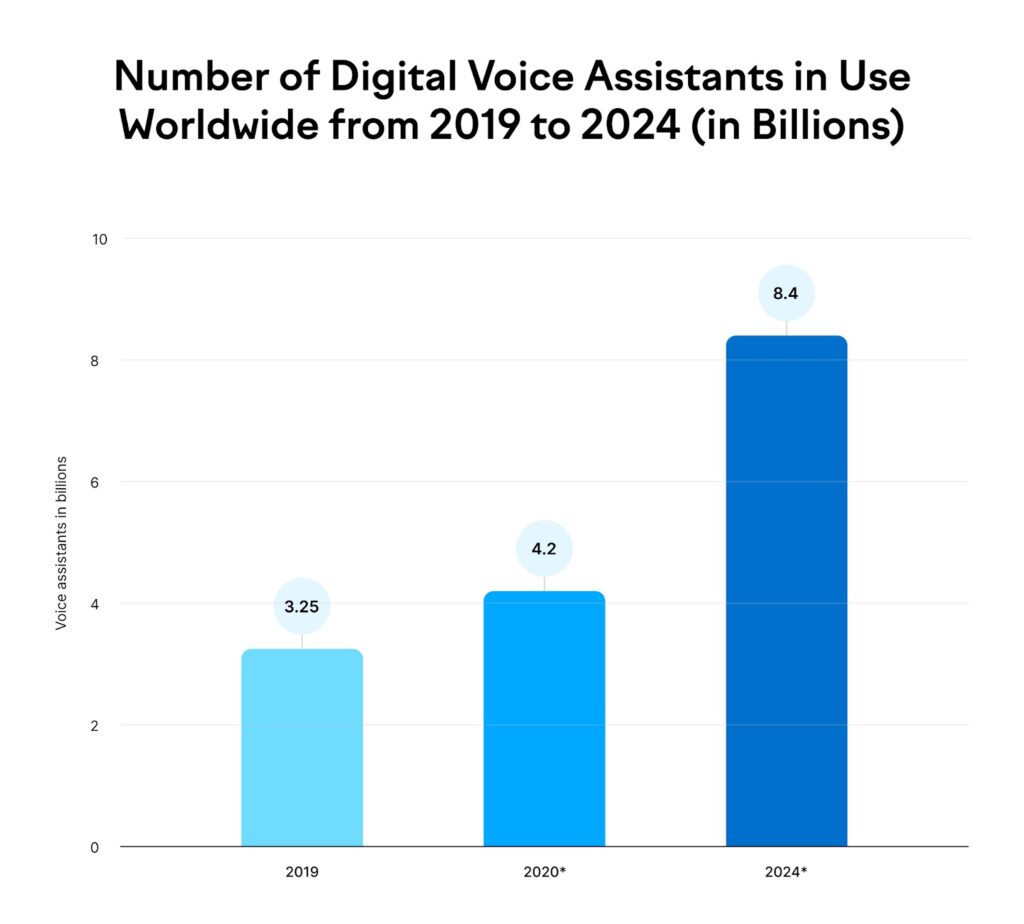
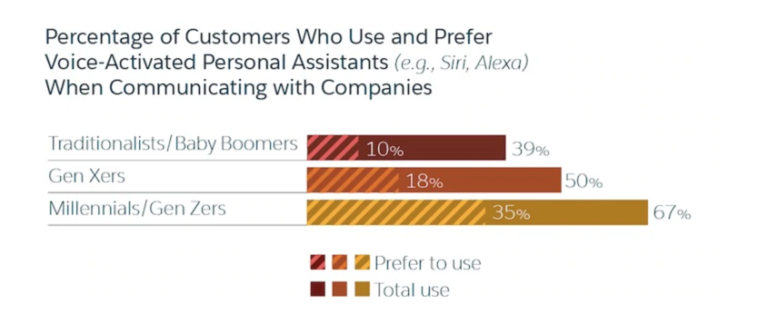
Voice search growth is impressive. According to Statista, there are more than 4.2 billion voice-activated devices in use across the globe. By 2024, digital voice assistants are forecasted to reach 8.4 billion units, exceeding the world’s population.
Smart speakers drive voice search popularity. 50% of Americans use voice search daily, and 34% use it weekly. When compared to text-based searches, voice search optimization reaches a greater number of people. Digital voice assistant usage to grow, per Statista.
People use them for tasks like alarms and music. For the purpose of locating information, people use digital assistants.
To improve voice search visibility, use tactics that benefit overall SEO. Prioritize website speed, target voice search keywords, and ensure mobile compatibility.
Digital voice assistant adoption is increasing. Around 3.25 billion digital assistants were used in 2019. The number is expected to double by 2024, reaching 8.4 billion units. Connected devices are increasing and the demand for voice recognition technology is growing, leading to further expansion in the future.
The Statista above’s study shows that:
Google Assistant had a 98% accuracy rate for navigation questions.
Apple Siri had a 93% accuracy rate in executing commands.
Google Assistant excelled at complex questions, with an accuracy rate of over 70%.
How voice search is changing SEO
Voice search has improved over time. Voice recognition systems initially struggled with accuracy and understanding human language. NLP advancements have improved voice search accuracy and efficiency.
The current state of search engines
Text queries are common, but search is changing. Voice searches have changed how we ask questions. Searches conducted through voice are longer and more conversational than those conducted through text.
Shift forces search engines to adapt to voice search. Users want short answers. Search engines now use featured snippets and position zero to directly answer user queries on the search results page, reducing the need for users to click through to websites.
Differences between voice search and text-based search
Text-based search was dominant as users used keywords to find information. Voice search has changed the game. Users can talk to their devices and get spoken responses, making search easier. Let’s compare it to a text-based search.
Aspect
Text-Based Search
Voice Search
Keyword Reliance
Reliance on keywords
Convo in natural language
Input Method
Inputing queries by typing them on a keyboard
Answering questions in a natural way
Capacity to access
Ability to type and effort are both required.
user-friendly and available to people of all ages
Interactions with Users
The use of keywords and manual input is required.
Enables interactions that are conversational in nature
Modalities of Communication
Text and keywords are the only options.
Allows for proper use of natural language
Queries That Are Complicated
may have difficulty answering difficult questions
Effectively manages complex questions and inquiries
Differences in Language
Language-dependent, which may present difficulties for individuals who do not speak English
A more inclusive approach that accommodates a wide range of languages, accents, and dialects
Searches Based on Geolocation
It’s possible that location-based queries will require additional transcription.
Easily incorporates searches that are aware of the current location
Compatible with mobile devices
Although responsive, may require manual input on screens with a smaller resolution.
Ideal for mobile devices and convenient for users who are constantly on the move
A Contextual Search
Absence of context, frequently necessitates the use of refined keywords
Recognizes the context and the user’s intent, and provides results that are pertinent
The combination of swiftness and effectiveness
That may call for a number of more refined queries
A prompt and straightforward response
Multi-Tasking
When you are juggling multiple tasks at once, typing can be a burdensome task.
Makes it possible to search without using your hands while simultaneously performing multiple tasks.
The Integration of Devices
The majority of the devices are mobile and desktop.
A variety of Internet of Things and smart devices are integrated.
Text-based searching has limits. Typing queries with keywords and phrases can lead to misunderstandings when explaining complex ideas in short messages. Search engines not understanding is frustrating.
Emerging trends in search behavior
Voice search is changing search behavior and SEO. Users have the ability to ask in-depth questions and engage in conversations using natural language. Voice search enhances human-like interactions with technology by emphasizing context and intent.
Mobile devices have made location-based searches more important. Users can ask for directions, find restaurants, or discover points of interest through voice commands. This trend affects local businesses trying to connect with their audience in real time.
Voice search and its impact on SEO are becoming increasingly important for more intuitive, inclusive, and context-aware search experiences. The future of search is becoming a harmonious symphony of human-machine interaction.
The impact of voice search on SEO
Voice search has revolutionized information searching. In order to locate relevant results in a short amount of time, users often use abbreviations or shorthand when typing. The use of voice search encourages users to ask comprehensive questions in a conversational manner.
User types “best restaurants NYC” in a text search. In a voice search, they’d ask, “Best restaurants in NYC?” When users’ behaviors change, businesses are forced to modify their keyword research and content in order to accommodate natural language queries.
It is necessary for search engines to modify their algorithms in order to accommodate voice search. Text-based SEO factors like keyword density and exact match keywords are no longer as important as they used to be. Voice search intent and user experience are now the top priorities.
Adapting your SEO strategy for voice search
Businesses must adapt SEO strategies services for voice search. Steps to optimize website and content for voice search success:
Understand your type of customer & device behavior
Voice search algorithms use data, location, and other factors to understand search context. Marketers must understand consumers and their behavior.
The utilization of voice search on various devices can be better understood with the help of real-time data and research.
Keyword research for voice search
Keyword research may not work for voice search. Use long-tail keywords, questions, and conversational language to align with how people interact with devices. Voice search phrases can be found with the assistance of various tools, such as Answer the Public, Moz’s Keyword Explorer, and the “People Also Ask” feature offered by Google.
Put yourself in the position of your customers and think about the questions they might have when they are looking for your products or services. Include queries in your content so that users of voice search can find answers that are relevant to them.
Optimize local SEO for voice-activated “Near Me” queries
Voice search optimization is beneficial to local businesses because it allows them to find nearby services or products. Complete and accurate Google My Business listing enhances local SEO efforts. Give your address, phone number, website, and the hours that your business is open.
The optimization of local content has the potential to enhance the results of voice searches for location-based queries.
Create conversational and Natural Language content
To attract users of voice search, you should produce content that corresponds to the queries they enter. Optimize web pages and blog posts to provide answers to frequently asked questions in the industry. The content should be organized in a question-and-answer format, with succinct responses to frequently asked questions.
Users of voice search prefer content that is straightforward and informative. If you want to increase the likelihood of your content being featured in the results of voice searches, you should concentrate on using natural language and specific user inquiries.
Short tail keywords are less relevant in voice searches, but they won’t disappear completely.
Determine necessary questions to answer.
Ensure mobile-friendliness and voice compatibility
Voice search is used by 27% of the world’s population on mobile devices, making it essential to have a website that is mobile-friendly. Perform mobile usability tests on a regular basis in order to address any problems that may be affecting the user experience on mobile devices.
Compatibility with voice search should be optimized for the website. Test website’s voice command responsiveness and accuracy for common voice search queries.
Provide context with schema markup
Learn schema markup. You can mark up content with schema and inform search engines about the subject matter of your website.
This HTML add-on improves search engine understanding for better rankings in searches and relevance in voice queries.
Schemas are utilized by Google in order to comprehend language and provide additional information on websites in order to provide answers to questions. Milestone Marketing research found +20-30% gains in 9,400 schema deployments.
40 schema types.
130 attributes and properties.
Mobile users and voice searchers often seek this information.
Measuring and analyzing voice search performance
Use tools like Google Search Console and Google Analytics to measure voice search optimization success. In order to gain insights into how to improve voice search, it is important to monitor metrics such as impressions, clicks, and popular queries. By combining data from voice search with SEO reporting, you can obtain a comprehensive view of the performance of your website. Make use of insights that are driven by data in order to improve your strategy and effectively engage your target audience in this era of voice-powered technology.
Audit & optimize your website content
Do a content audit before starting new work. It is important to optimize the content that is already available for keywords related to voice search. Content audit analyzes and assesses all website content.
Suppose you have a blog post titled “How to Edit a PDF” on your website. No need to write another post for different but related keywords like “how do I edit a PDF” or “ways to edit a PDF.”
Optimize your blog post with those keywords. Use Impact Hero, an AI tool, for content audits. It breaks down content by customer journey stages. It finds your best content and gives suggestions.
Tracking voice search rankings
Tracking voice search rankings means monitoring how well your website or webpages perform in voice search results. Voice search rankings differ from text-based search rankings because voice assistants typically provide a single spoken answer instead of multiple search results.
To track voice search rankings, use SEO tools for voice search insights. These tools help identify voice search keywords and phrases, and assess your website’s visibility and performance in voice search results.
Monitor voice search rankings to improve SEO efforts. Check to see if your website shows up in featured snippets or as a top voice search result.
Track voice search rankings to understand the impact of optimization strategies and make data-driven optimizations. Monitor your voice search performance to stay ahead of competitors and attract traffic and engagement from voice search users.
Making data-driven optimizations
Data-driven optimizations use data and analytics to improve voice search optimization. Analyze metrics and user behavior to find areas for adjustments and enhancements.
Monitor voice search rankings and track website performance in voice search results for valuable insights. These insights help you understand popular keywords, phrases, and content formats for voice search. Use this information to improve your content strategy.
Analyzing user engagement and behavior metrics can reveal how well your website meets the needs of voice search users. This data can identify areas for improvement or enhancing user experience.
Use data-driven insights to make informed decisions about updating content, improving technical factors, or adjusting local SEO strategy. The iterative approach helps optimize efforts in voice search.
Voice search and the future of SEO
Stay updated on voice search trends and advancements. Adapting to AI and machine learning for voice recognition is crucial for staying competitive.
Voice search revolutionizes internet interaction and has an undeniable impact on SEO. Understand voice search and adapt your strategy for success in this new search era.
Y Combinator-backed Guac trains algorithms to predict grocery demand Kyle Wiggers 9 hours
Poor grocery demand forecasting is responsible for more waste than you might expect.
According to one source, grocery stores in the U.S. toss 10% of the roughly 44 billion pounds of food that the country produces annually. It’s not only bad for the environment — food waste is a major source of carbon emissions — but costly for grocers. Per Retail Insights, food and grocery retailers lose up to 8% of revenues through inadequate inventory availability.
Entrepreneurs Euro Wang and Jack Solomon say that they experienced firsthand the micro-level effects of the forecasting problem at their local supermarket, which often ran out of their favorite guacamole.
“It turns out that even the largest retailers struggle to predict future demand and frequently overstock and understock inventory,” Wang told TechCrunch in an email interview. “With more extreme weather in recent years, there’s increasingly been supply shortages in fresh food. That makes the efficient allocation of the limited supply all the more important. On top of this, inflationary pressures and increases in labor costs have been threatening grocers’ margins more and more.”
Inspired to attempt tackling the problem with tech, Wang and Solomon co-founded Guac, a platform that uses AI to predict how many items grocers will sell on a per-item basis each day at a given store location. Guac recently raised $2.3 million in a seed round led by 1984 Ventures with participation from Y Combinator and Collaborative Fund.
“Food waste and food security are issues that Jack and I care deeply about, and we were really excited about an opportunity to actually address food waste at its core,” Wang said.
Previously, Wang worked at Boston Consulting Group while Solomon researched AI for grocery logistics. Both graduated with undergraduate degrees from Oxford University, which is where they met.
At Guac, Wang, Solomon and Guac’s two engineers build custom algorithms that anticipate order quantities for grocery items, taking into account variables like the weather, sporting events and betting odds and even Spotify listening data to try to capture consumer purchasing behavior. Guac customers get recommendations like shelf life, minimum order quantities, promotions, and supplier lead times integrated into their existing inventory ordering software and workflows.
“Traditionally, forecasting is done using Excel formulas or simple regression models,” Wang said. “But for fresh food that expires quickly, you need something better … Because we use so many external variables, we’re able to identify which real-world variables cause the changes in demand.”
Guac certainly isn’t the only startup in the food demand forecasting game. There’s Crisp, which provides an open data platform for each link in the grocery supply chain, and Freshflow, which is building an AI-powered forecasting tool to help retailers optimize stock replenishment of fresh, perishable goods.
But Wang says that Guac is differentiated both by its dedication to transparency and its intense fine-tuning of forecasting models.
“Our machine learning model isn’t like a black box that mysteriously predicts a 20% increase in demand — instead, we tell our customers things like, ‘This 20% increase is because there’s a conference happening nearby,'” Wang said. “Even if a retailer is already using machine learning, we can still improve their forecasting because of our access to a lot more external data sets. When we remove our unique external variables that we use and only include the basic datasets (e.g. weather and public holidays), we actually see the forecast error double.”
Some early customers seem convinced that Guac can add value. The company’s working with retailers including grocery delivery companies in North America, Europe and the Middle East, including an unnamed supermarket chain with 300 or so locations. Guac’s also already generating revenue, and anticipates being able to expand its engineering team in the coming year.
“The grocery industry is fairly resistant to economic downturns,” Wang said. “Everyone has to eat, and when the economy slows down, people are actually buying more groceries because they eat out less. And the pandemic helped speed up digitization in grocery stores, which allowed us to integrate our predictions with customers’ systems more smoothly. On the subject of the pandemic, shoppers behaved very differently during the pandemic — which means it’s a lot harder for grocers to just rely on the past three years of historical sales data to predict future demand. With our algorithm, we’re able to adjust for the ways the pandemic biased sales data in 2020 and 2021 — and even for the residual effects of the pandemic afterwards.”
Online certification courses in Data Science have seen a significant rise in popularity to cater to the busy schedule of working professionals while not letting them compromise on upskilling themselves. This has become challenging in the decision-making process for students.
To aid in this, Analytics India Magazine (AIM) has conducted a comprehensive survey to rank top postgraduate (PG) online or hybrid courses in Data Science in India. This initiative has been going on for the last nine years. The rankings are segregated based on the mode of delivery—either on-campus or online/hybrid. The latest report highlights the best online or hybrid PG data science courses in India in 2023.
A well-ranked course demonstrates high and balanced scores across various parameters, guiding students in choosing the most suitable course for their needs. This report is not only beneficial for students but also provides valuable insights for institutes to gauge their standing, identify improvement areas, and guide policy decisions in both the public and private sectors.
Incase you are looking for Full Time On-Campus programs, check our 2023 ranking here.
The Methodology
The methodology employed by AIM involves evaluating data science and analytics programs across five key parameters: Certification Value, Return on Investment, Program Success, Teaching & Curriculum, and Student Engagement. Each program’s performance is assessed through an overall index, derived from the average scores across these five sub-indices. The survey methodology included uniform evaluation criteria, with scores normalized on a 0 to 1 scale, and outliers capped to ensure fairness and accuracy in the rankings. The infographic below illustrates the hierarchy of sub-indices and the final index used in this analysis.
1. Upgrad’s PGP in Data Science & AI
Affiliated to IIIT Bangalore, the PG Data Science course is comprehensive. The curriculum includes both recorded and live content delivered by highly qualified faculties and industry experts. The course is professional and industry-oriented as evident from collaboration with employers and sessions with industry speakers. It’s divided into a common curriculum covering essential Data Science skills and specialization modules in areas like Business Analytics and Natural Language Processing. The program emphasizes practical application through a capstone project and uses an external platform for examinations, ensuring a robust and inclusive learning experience without the need for prior coding experience.
Learn more about the program here.
2. REVA’s M.Sc in Business Analytics
REVA University’s MS in Business Analytics program is popular for its strong industry ties. The curriculum, updated with the latest technologies, emphasizes experiential learning, including mandatory global certifications. With a faculty boasting PhDs and industry experience, the program maintains high academic standards. Two capstone projects and a publication requirement foster practical skills and research contributions. Alumni involvement in placements, a dedicated support team, and inclusive admission criteria further contribute to its appeal, making it a top choice for data science aspirants seeking a comprehensive and globally recognized education.
Learn more about the program here.
3. Ivy Professional School’s PG Certificate in DS with ML & AI
Ivy Professional School’s collaboration with IIT Guwahati offers a sought-after data science program. The curriculum, designed with IIT Guwahati professors, includes 40+ industry projects, ensuring theoretical and practical competence. Learners benefit from industry internship projects with Fortune 500 companies fostering real-world experience. IBM and NASSCOM accreditations, low trainer-to-student ratios, and a “Learn – Apply – Assess – Re-learn” model enhances its appeal, making it a comprehensive and industry-aligned choice for data science enthusiasts.
Learn more about the program here.
4. Simplilearn’s PG Certificate Course in Data Analytics
The Professional Certificate Course in Data Analytics, offered in collaboration with IIT Kanpur, is highly sought after by data science and analytics aspirants for its comprehensive curriculum and practical focus. Emphasizing real-world experience through hands-on exercises, capstone projects, and industry internships, the program enhances employability and job readiness. Taught by experienced faculty and industry experts, it provides valuable insights and networking opportunities, potentially leading to job placements. The prestigious IIT Kanpur certification adds to the program’s appeal, ensuring a strong Return on Investment (ROI). The blended structure of theoretical and practical learning, coupled with a maximum of 80 learners per batch, makes it an attractive choice for career advancement in data analytics.
Learn more about the program here.
5. TimesPro’s PGCP in DS & ML
Affiliated to IIT Roorkee, TimesPro’s Professional Certificate Program in Data Science and Machine Learning (PGCP DSML) stands out due to its strong focus on practical learning and industry relevance, it offers a robust curriculum supported by industry expert sessions and an advisory board. The program’s career support, including personalized guidance, resume tools, and industry insights, enhances learners’ employability. A diverse faculty team with a blend of academic and industry experience contributes to a holistic learning experience. Incorporating live sessions, hackathons, campus immersion, and continuous assessments, the program ensures comprehensive skill development, making it a preferred choice for data science and analytics aspirants.
Learn more about the program here.
6. Edvancer’s Advanced Certification in AI & ML
With a strong focus on placement assistance and career mentorship, the course conducts regular workshops, and sessions by industry experts, and provides hands-on support for resume preparation and interview readiness. The collaboration with IIT Kanpur and partnerships with leading companies ensure industry relevance. Taught by full-time professors and experienced industry experts, the program’s 70% hands-on approach equips students with practical skills through assignments and industry-level capstone projects.
Learn more about the program here.
7. Upgrad’s PGP in ML & AI (Executive)
Upgrad in collaboration with IIIT, Bangalore, offers this course that not only ensures theoretical learning but also provides real-world experience along with a robust 360-degree career support system. The faculty pool consists of industry experts and accomplished academics, contributing to a comprehensive learning experience. The program is structured into common and specialization phases, covering key roles in ML Ops and Generative AI.
Learn more about the program here.
8. Simplilearn’s PGP in Data Science
The Caltech CTME Data Science program, offered through Simplilearn, distinguishes itself with a remarkable ROI. The practical orientation of the program as evident through project-based learning across various industries helps learners gain real-world experience. The IBM Partnership enriches the program with masterclasses and certificates. The comprehensive curriculum facilitated by experienced instructors not only helps students understand concepts well but the program also ensures that students get avenues to showcase their skills effectively.
Learn more about the program here.
9. Timespro’s PGCP in AI & DL
The program is affiliated to IIT Guwahati. It offers robust career support, including personalized guidance, cutting-edge resume tools, and regular industry insights. With a comprehensive Learning Management System (LMS) and over 40 case studies and projects, it ensures a holistic learning experience. Industry expert sessions featuring professionals from renowned organisations enhance practical knowledge. The program offers a unique blend of live sessions, hackathons, campus immersion, and industry mentorship. The eligibility criteria, continuous assessment model, and mandatory capstone project make it a well-rounded course.
Learn more about the program here.
10. CloudxLab’s PG Certification in AI, ML & DS
CloudxLab’s PG Certification Course offers a remarkable Return on Investment (RoI) driven by a curriculum aligned with industry needs, experienced instructors, robust placement support, and a strong alumni network due to its affiliation with IIT Roorkee. Strategic collaborations with industry giants like Google, Microsoft, and IBM provide students with real-world exposure, internships, and invaluable insights. The faculty, comprising full-time instructors, industry experts, and IIT professors, delivers a comprehensive learning experience. The program’s well-balanced structure, emphasizing both theory and hands-on skills, along with rigorous evaluation methods, positions it among the top data science programs in India.
Learn more about the program here.
11. Edvancer’s Advanced Certification in Data Analytics
The program stands out due to its holistic approach and industry collaboration. The course provides robust placement assistance, mentorship, and workshops on career guidance. Affiliation with IIT Kanpur helps students network with diverse and experienced alumni. Collaborations with renowned companies ensure real-world relevance and multiple job opportunities for students. Taught by full-time professors and industry experts, the program offers a balanced blend of theory and hands-on experience. With a 70% hands-on focus, students work on practical assignments and capstone projects, making them job-ready. A high graduate placement rate underscores the program’s effectiveness.
Learn more about the program here.
12. Timespro’s PGCP in Decision-Making Using DS
TimesPro in collaboration with IIT Roorkee conducts this program that offers extensive career support, personalized guidance, and cutting-edge tools. The comprehensive Learning Management System, industry insights, and 24/7 support contribute to a robust learning experience. The continuous assessment model ensures a thorough understanding, while the capstone project offers real-world application. Active engagement with experienced professionals and a strong focus on practicality through hackathons, campus immersion, and industry mentor sessions underscores its industrial relevance.
Learn more about the program here.
13. Ivy Professional School’s Diploma in DS, ML, AI & Big Data
Ivy Professional School’s Data Science program in collaboration with IIT Guwahati is a premier choice for data science aspirants. It offers a comprehensive learning experience with industry projects from major companies like UBER and Accenture. The partnership with IBM, NASSCOM accreditation, and Fortune 500 collaborations enhance its industry relevance. With a low trainer-to-student ratio, expert faculty, and a unique “Learn-Apply-Assess-Re-learn” model, the program ensures holistic skill development. The program is focused on practical learning through projects, internships, and assessments to groom students as proficient data professionals.
Learn more about the program here.
14. Orangetree Global’s BI & Business Analytics PG Certification
With a curriculum aligned to industry needs, small batch sizes for personalized attention, and a seasoned Placement team, the program structure and curriculum prioritizes quality interactions. The extensive network of tie-ups with leading companies, corporate training programs, and collaborations with prestigious institutions contribute to a holistic learning experience. A high faculty-to-student ratio ensures each individual gets the required and adequate attention for professional upskilling. The comprehensive curriculum that includes several real-world case studies and a stringent certification process ensures, makes it is a preferred choice among students.
Learn more about the program here.
The post AIM Top Ranked PG Data Science Programs (Online/Hybrid) – 2023 appeared first on Analytics India Magazine.
Let’s face it: While some IT pros may have a knee-jerk reaction against AI because of the current hype, it is just a matter of time before AI becomes embedded into many daily business processes, including cybersecurity controls. But now, when this technology is still young, it can be difficult to understand the real implications and challenges of AI automation.
This article debunks a couple of common myths about how AI can enhance cybersecurity and provides IT and cybersecurity leaders with recommendations on how to make informed decisions about what to automate.
The Myths and Realities of Automation
Don’t buy into the myth that AI is going to replace all your employees. Even if that were possible, we as a society are not ready for that leap. Imagine boarding a jet and noticing that no human pilot ever enters the cockpit prior to departure. No doubt there would be mutiny on board, with passengers demanding that a pilot be present for the flight. As effective as the autopilot function is, it has its limitations, so people still want a human in charge.
Indeed, we didn’t see human personnel purged back when the industrial revolution took hold. While machinery did take over elements of manual labor, it didn’t replace the humans themselves. Rather, the machines brought greater efficiency, predictability and consistency to the manufacturing process. In fact, new jobs and even new industries requiring new skills and greater diversity were born. Similarly, AI will bring new levels of efficiency, scalability and accuracy to business processes, and also create new opportunities and transform the labor market. In other words, you will still need cybersecurity personnel, but they will be upskilled by AI assistance.
Another important misconception is that AI automation will inevitably reduce costs. This may sound familiar; the same was said about the cloud not too long ago. Organizations that migrated their datacenters to the cloud found that while the OPEX cost structure of the cloud has advantages over traditional CAPEX expenditures, the final costs are similar for large environments, in part because more sophisticated systems require more skilled (and expensive!) talent. Likewise, automation will change the distribution of costs, but not the overall costs.
Finally, a fully automated AI-driven security solution is sometimes seen as a desirable goal. In reality, it is a pie-in-the-sky dream that raises questions of trust and auditability. What if that automation malfunctions or becomes compromised? How do you verify the outcomes are still aligned with the business objectives? The truth is that we are in the early stages of this new AI automated paradigm, and no one truly understands how AI automation might be exploited one day from a security perspective. AI and automation aren't silver bullets (nothing is).
How to Know what to Automate
Certain processes are better suited for automation than others. Here is a good three-point assessment that can help you decide whether a security process is suitable for automation:
The process is repetitive and time consuming when performed manually.
The process is sufficiently well defined that it can be turned into an algorithm.
The results of the process are verifiable, so a human can determine when something is wrong.
You don’t want your expensive security talent doing things like pouring over security logs, correcting misconfigurations or interpreting prescribed metric alerts. By equipping them with AI-driven security tools, you can increase their visibility, augment their understanding of different threats and expedite their responsiveness to attacks.
More broadly, consider how professional sports teams are investing in technology to improve the performance of their athletes. Similarly, you need to provide your security teams with the automated tools they need to up their game. For example, the insider threat is a significant risk, but it is practically impossible to watch over every user in the company, and rogue employees are often only evident when they have already caused at least some damage. AI-based solutions can be much more efficient in reducing this risk: A user and entity behavior anomaly (UEBA) detection solution can spot subtle changes in a user’s data access patterns and differences between their behavior compared to their peers, both of which signal a potential risk that requires prompt review.
Another area where AI can take your team’s capabilities to a whole new level is threat hunting. Automated solutions can identify more accurately traces of attacks that may have been thwarted by your protection mechanisms and compare them to your threat intelligence. These may be signs of a larger attack and you can get better prepared for it.
Conclusion
ChatGPT, Bard and thousands of other amazing new apps give executives the opportunity to experience AI in action. Working with their security teams, they can explore potential applications for the technology. But instead of blindly charging forward, it’s vital to thoroughly assess which processes make sense to automate. This due diligence will help IT leaders ensure that the risks of a proposed new technology does not exceed its benefits.
Ilia Sotnikov is Security Strategist & Vice President of User Experience at Netwrix. He is responsible for technical enablement, UX design, and product vision and strategy.
More On This Topic
Artificial Intelligence vs Machine Learning in Cybersecurity
Be prepared to manage the threat with an MS in Cybersecurity from…
Be prepared to manage the threat with an MS in Cybersecurity from…
Be prepared to manage the threat with an MS in Cybersecurity from…
Be prepared to manage the threat with an MS in Cybersecurity from…
One of the efforts our Dataworthy Collective will be ramping up in 2024 involves standardizing the building of logical knowledge graphs at the level of the document object. The goal is to make spreadsheets trustworthy, sharable and reusable on a standalone basis at web scale.
Lead Charles Hoffman and others on his team believe that data assets need to be findable, accessible, interoperable, and reusable (FAIR) for data products to realize their true potential as an asset category. The explicit and straightforward formal logic in knowledge graphs makes it possible to scale the trustworthiness and reuse possibilities. Datalog is a useful language for that purpose.
Datalog is a logic programming language, a subset of Prolog. It’s a simple language that can allow users to express relations, facts, rules and queries in databases to be able to create logically consistent knowledge bases. A number of semantic graph database management platforms currently support Datalog, including Oxford Semantic Technologies and TerminusDB.
Logical knowledge graphs
Logical knowledge graphs co-mingle what developers think of as data and logic. This way, the logic that was trapped in applications lives alongside and can grow organically with the data. That logic becomes both machine and human readable, as well as callable from the graph.
This logic doesn’t have to be Datalog-oriented. W3C standards such as Web Ontology Language (OWL) and Shapes and Constraints Language (SHACL), though they refer to reasoning capabilities, don’t refer specifically to programmatic logic. Maybe that’s just a preference of those who have worked on the standards.
Datalog advocates assert that Datalog is more expressive than OWL, for example. Academics I’ve known who work on reasoning applications of knowledge graphs haven chosen Datalog as their default. They seem to have the most confidence in its reasoning capabilities.
I know coders versed in traditional application development can often take exception to “logic” being in with the “data.” I’d counter having logic fully accessible and evolving as the data evolves makes the logic itself more broadly reusable. The more reusable it is, the less the need to duplicate logic, and the more likely to be consistent and contribute to sensemaking. The result? Less complexity and code sprawl.
Why effective AI management starts with knowledge graph-based FAIR data management
In a previous post, I pointed out that the Organisation for Economic Co-operation and Development’s (OECD’s) Council updated its definition of artificial intelligence. The European Parliament then adopted the OECD’s definition, which is as follows (emphasis mine):
An AI system is a machine-based system that, for explicit or implicit objectives, infers,from the input it receives, how to generate outputs such as predictions, content, recommendations, or decisions that can influence physical or virtual environments. Different AI systems vary in their levels of autonomy and adaptiveness after deployment.
Note the text above in boldface. AI systems infer how to generate outputs from inputs. In other words, AI systems are entirely dependent on the quality of their data input.
We can talk all we want to about trustworthy models, but when it comes to statistical models being trustworthy, inputs rule. High data quality is a prerequisite. When the input is garbage, the output will be garbage also. Understanding the implications of this fact is critical, not only to data management, but AI management.
To manage AI effectively, managers and their staffs will have to get their hands dirty and work with the data and logic co-mingled in a logical knowledge graph directly. Why? Because AI quality depends on data quality.
The way we know to scale data quality is to use a knowledge graph approach that takes a unitary approach to logic and data evolving together in organic graphs. Machines can assist in many ways, but the process has to be designed and led by skilled humans, and the goal of the spreadsheet object work is to empower everyday businesspeople to be hands on with the data and logic in knowledge graphs.
Contextual computing as a necessary precondition for AI
High data quality at scale implies logical reusability and consistency from context to context. At scale, statistical models can take advantage of a web of reusable, interoperable contexts, a.k.a., interactive digital twins.
For AI to operate continually in the background of our everyday lives, we’ll need to scale contextual computing, just so we can associate the AI with more everyday processes and tasks. We can only accomplish this at scale if the logic models in the knowledge graphs that make sensemaking possible at scale are themselves consistent.
I’ve found it helpful to think of semantic spreadsheets as spreadsheets with an explicit context. Once you’ve expressed that context explicitly, trusting that spreadsheet becomes more feasible, and others can reuse the spreadsheet, perhaps by adapting it to another explicit context.