Dell showed the next versions of its XPS line of laptops on Thursday in advance of CES 2024, with new, larger sizes and AI integration. The new Dell XPS 13, 14 and 16 will come with Microsoft’s Windows Copilot keys for easy access to generative AI features.
Jump to:
Details about Dell’s three new XPS laptops
New laptop models feature AI acceleration engine
Competitors to Dell’s XPS laptop line
Details about Dell’s three new XPS laptops
Dell’s new models of XPS laptops are successors to last year’s XPS 13 Plus. The XPS 13 Plus has been renamed XPS 13, and larger XPS 14 and 16 models have been added to the line.
Like the XPS 13 Plus, these laptops’ designs focus on smoothness and touch-sensitive surfaces. The touch function row above the keyboard controls both media and function keys, while the touchpad blends into the rest of the body smoothly thanks to seamless glass. The screen uses Dell’s modern InfinityEdge panels and includes OLED touch options, variable refresh rates, high-resolution options and Dolby Vision.
SEE: Dell has been working on easily-accessible generative AI throughout the last year, including partnering with NVIDIA. (TechRepublic)
The XPS 13 starts at $1,299 in the U.S. and will be available soon, Dell said. It’s possible that soon means between February and the end of spring 2024, because that is when Microsoft said laptops with the Windows for Copilot button will be rolling out from various partners.
The Dell XPS 16 is the new high-powered entry in the XPS line of laptops. It runs Intel Core Ultra processors and NVIDIA GeForce RTX GPUs (up to the GeForce RTX 4050 GPU). The Dell XPS 16 is suitable for and officially valuated by NVIDIA for 3D rendering, video editing and live streaming, as is the Dell XPS 14 line. XPS 16 will start at $1,899 in the U.S. and will be available soon.
The Dell XPS 14 is 21% lighter than the XPS 16, according to Dell, but is still valuated for high-performance editing, gaming and streaming. Dell’s XPS 14 laptop will start at $1,699.
New laptop models feature AI acceleration engine
As most device makers are doing today, Dell is emphasizing that generative AI can run on its laptops – and on-device at that. Dell’s XPS laptop line features a built-in AI acceleration engine with a neural processing unit for tasks including photo editing. The new XPS line runs on Windows 11, which comes with the Copilot for Windows generative AI assistant.
Competitors to Dell’s XPS laptop line
Dell’s primary competitor to its XPS laptops is Apple’s MacBook Pro lineup, which shares some of the same sizes and the sleek look. HP, Lenovo, Microsoft and Acer offer similar products.
Editorial notes: We have reached out to Dell for comment. Also, TechRepublic is covering CES 2024 remotely.
After the launch of ChatGPT, the discussion surrounding AI replacing customer service jobs gained considerable traction. However, the situation intensified in July 2023, when Dukaan, a DIY platform for online stores, terminated 90 percent of its support staff, opting to replace them with an AI chatbot called Lina.
After this development, concerns were raised about the potential job displacement of customer agents, particularly in economies like India. However, industry experts interviewed by AIM expressed the view that at its current stage, AI is not equipped to replace humans in the context of BPO operations.
Moreover, recent occurrences, such as a software engineer successfully manipulating a car dealership chatbot powered by OpenAI’s GPT models to sell him a Chevy for just a dollar, confirm their assertions. While LLMs bring numerous benefits to those in customer service, instances like this do raise one moot question: Are LLMs reliable for customer-facing sales and support roles?
Generative AI for customer service
Ethan Mollick, an associate professor at the Wharton School of the University of Pennsylvania thinks LLMs are not ready for external facing sales and support roles. “They are gullible and hallucinate,” he posted on X. Persistent hallucinations continue to pose a major challenge for LLMs, and with the industry yet to find a solution, this issue may persist as we progress.
Currently, the models like GPT-4 are being fine tuned and trained with enterprise data to make them ready for enterprise application, however, it does not eliminate the risks. Despite being fine-tuned, it does not eliminate the chances of the bot providing plausible-sounding but incorrect or nonsensical answers.
Sanjeev Menon, co-founder and head of product & tech at E42.ai believes using generative AI such as ChatGPT in customer service does elevate efficiency and experience, provided enough thought is put into the design, along with fine tuning with specific data.
“However, generative AI is not a panacea for all maladies in customer support—clarity on the capabilities and limitations is very essential,” he told AIM.
The reality is many enterprises today have an LLM-powered chatbot integrated into their platform, and the number is only going to increase. Moreover, it can be argued that not most customers interacting with a car dealership bot will not ask for a python script.
“The behaviour does not reflect what normal shoppers do. Most people use it to ask a question like, ‘My brake light is on, what do I do?’ or ‘I need to schedule a service appointment,” Aharon Horwitz, CEO at Fullpath told Business Insider.
Yet that does not mean the risks associated with it can be ignored. As more enterprises embrace these bots, AI mishaps might only increase.
Humans in the loop
Hence, according to Menon, human intervention still plays a significant role despite the advancements in AI. He said that checks on prompt toxicity, data updates, and supervision during complex or sensitive situations are paramount to guaranteeing customers a positive and secure experience.
“In doing so, we not only enhance efficiency but also eliminate risks associated with the use of language models, ensuring a seamless and reliable customer service interaction.”
Gaurav Singh, founder and chief executive officer at Verloop.io, also said empowering agents as gatekeepers ensures quality control. “More than 90 percent of queries can be effectively handled by LLM-powered Conversational AI, but in instances of uncertainty, seamless transfer of queries to agents allows verification and editing, maintaining accuracy in automated responses for optimal query resolution,” he told AIM.
While there have been instances like Dukaan, contrary to earlier fears, widespread job loss has not occurred. Furthermore, occurrences such as chatbots recommending poison recipes underscore the crucial need for human intervention and caution against excessive reliance on AI chatbots.
“It’s important to strike a balance and use human agents where emotional intelligence, nuanced understanding, and complex problem-solving are required. A hybrid approach that combines the strengths of both AI and human agents may be the most effective solution for providing excellent customer service,” Beerud Sheth, co-founder and CEO at Gupshup, told AIM.
Are Small Language Models the answer?
LLMs like GPT-4 have billions of parameters and are trained on terabytes of data scraped from the web. These models have world knowledge, meaning they know everything from historical facts to contemporary events, providing a vast understanding of diverse topics.
However, does an enterprise need such worldly knowledge? Does a car dealership chatbot know Python script? No, and this is where Small Language Models (SLM) come in.
A SLM can be fine-tuned or trained specifically for a particular industry or domain. This enables the model to better understand industry-specific terminology, customer inquiries, and context, leading to more accurate and relevant responses.
These models also allow enterprises more control over the training process and can customise the model to align with their specific customer service needs.
“Leveraging domain-specific data and knowledge, these models ensure that their generated outputs align precisely with customers’ queries, industry standards, and specific requirements,” Rashid Khan, co-founder and CPO at Yellow.ai, told AIM.
However, the problem of hallucination pertains even in SLMs. While it has posed challenges to end hallucinations in these models, it certainly can be reduced. For instance, Yellow.ai, leverages a maker-checker model setup.
“One model generates responses, while another validates their relevance and accuracy. We also implemented the RAG architecture, ensuring fact-based answers to reduce hallucination chances and refining our model to provide accurate responses from a given paragraph,” Khan added.
Nonetheless, a domain-specific model with a human in the loop might still be the best approach for enterprises to mitigate risk. “With domain adaptation for precision, strict moderation for safety, and calculated human involvement for accountability, one can balance the efficiency of AI while guarding against unforeseen issues,” Sheth said.
The post AI Chatbots are not Ready for Customer Service appeared first on Analytics India Magazine.
In our fast-changing, digitized world business strategies, and content planning are also moving into the world of numbers, minimizing the need for human work. Nowadays, artificial intelligence is developing day by day, expanding over more and more users and areas of use. Below you will learn about AI chatbots, their advantages and disadvantages. You will find out the basic concept of website strategy and lastly, identify the correlation between them and website strategy, and how the latter is affected and transformed by AI chatbots.
What are AI chatbots?
AI Chatbots chatbots that compose answers with the help of artificial intelligence for answering human inquiries. They generate answers to different questions, expanding on different topics and providing the details needed.
There are two types of AI chatbots: those that work based on the use of artificial intelligence and ones that generate answers planned and saved beforehand. The former gives more accurate and human-like answers, as these chatbots use artificial intelligence and NLP (natural language processing) to produce more human-like answers. On the other hand, the second type of AI chatbot has preplanned rules to determine answers to various questions based on that plan. AI chatbots are used in diverse spheres and by different individuals as they are multifunctional.
Advantages and disadvantages of AI chatbots
Having discussed the concept of AI chatbots, you may question its benefits, pros and cons. AI chatbots are beneficial in several situations, but it doesn’t mean they are flawless and harmless and can do any type of work. Thus, to identify whether they are beneficial or not, and to help you understand whether chatbots are worth using, let’s mention some of their advantages and disadvantages.
Some of the advantages that AI chatbots have are:
Anytime Availability
One of the main advantages of chatbots is their availability. They can replace human workers when it comes to being available for work all the time. People live their lives besides working, while AI chatbots are available anytime.
Speed-efficiency
AI chatbots are faster at generating answers and giving solutions to customers’ problems compared to human workers. Consequently, AI can replace human workers here as well.
Cost-effective
Another advantage of AI chatbots is their cost-efficiency. While you have to pay salaries to human workers, you pay either nothing or much less to AI than to human workers.
Data Collection
AI chatbots are advantageous because they provide real-time data. Chatbots collect the data, such as names, emails, and phone numbers of the customers, via questions.
Besides having so many advantages they also have disadvantages alongside those. At first, chatbots may seem quite beneficial considering all the advantages mentioned above, but the truth is that they do have disadvantages that can be left unnoticed. To clarify this let’s discuss some disadvantages that chatbots have.
Some of the disadvantages that AI chatbots have are:
Time-consuming
Even though they were initially created to save time and simplify people’s jobs, there are cases when AI chatbots may lag, as the available data is limited. So this may cause problems concerning the time, as chatbots may require more time than expected.
Difficulties of Understanding
AI chatbots are sophisticated programs that serve people in many situations, but they are still not human beings. Thus, sometimes it is quite difficult to get the chatbot to understand your inquiries and give appropriate answers.
Handling Problems
Chatbots are not quite useful when it comes to understanding and dealing with human emotions. AI chatbots are not capable of calming down angry customers and solving their problems, they are also unable to give solutions to problems that are not planned in their program beforehand.
Experience
Another disadvantage is that they lack the emotional characteristics that people have. Chatbots won’t be able to perceive the emotions of the customers and hence, they won’t be able to maintain the conversation with the customers and give appropriate solutions to the problem.
Low Customer Satisfaction Rate
The disadvantages mentioned above result in a low customer satisfaction rate. As they can’t understand people in cases when communication becomes solely based on emotions and humanlike behavior, they mainly become ineffective and decrease the customer satisfaction level.
Website strategy: What is it?
Having a beautifully designed website is far not enough as it may seem. To flourish your business, you need to drive the customers to take a step closer to the brand. To achieve the latter you need to develop a good working website strategy. The strategy of the website includes a row of actions planned to reach your goals.
To have a good website strategy you need to understand what kind of audience will get interested in your website and the ways they can find your website. Besides the type of the audience, it is important to identify the needs of the audience, what information, and what answers they seek on your website. It is essential to understand also what we want from the audience. In other words, we need to identify the purpose of our website, besides answering the questions of the audience. Finally, it is important to have a plan for leading the audience from one page to the other and identify the means that our website leads us to our goals.
Some important steps to building a good website strategy include:
Identifying the purpose of the website: without a goal, the website won’t function the way you want it to. For this reason, you need to establish the purpose of your website.
Step-by-step leading: you need to have planned each step driving your audience from one page to the other to make them take action. If you know the goal of your website and the way of reaching it then you will have a proper call to action. The carefully planned steps guarantee the customers’ movement in the funnel of your strategy.
Finding the target audience: only if you know what you offer and what information, answers, and solutions you provide, you can find the audience that is interested in your website.
Keep updating: finally, knowing who your target audience is, knowing the goals and purposes of your website, and having planned the actions beforehand, your next step will be taking steps to achieve your goals. Updating and posting regularly on your website will keep the audience engaged and active.
How AI chatbots affect your website strategy
Having established the concept of AI chatbots and a basic understanding of website strategies, it will be easier to understand how it affects your website strategy. To develop a good website strategy we covered a few steps that should be taken to accomplish the goals of our website.
Nowadays, many business developers use chatbots to develop a website strategy. AI chatbots are applied in various fields, by various individuals for diverse purposes. Generally, AI chatbots may be quite useful for business strategy.
The AI chatbots can be used in different areas of your business and simultaneously facilitate many actions that usually take time and effort.
Thus, how chatbots influence the website strategy depends on how it is used and what areas it is applied in.
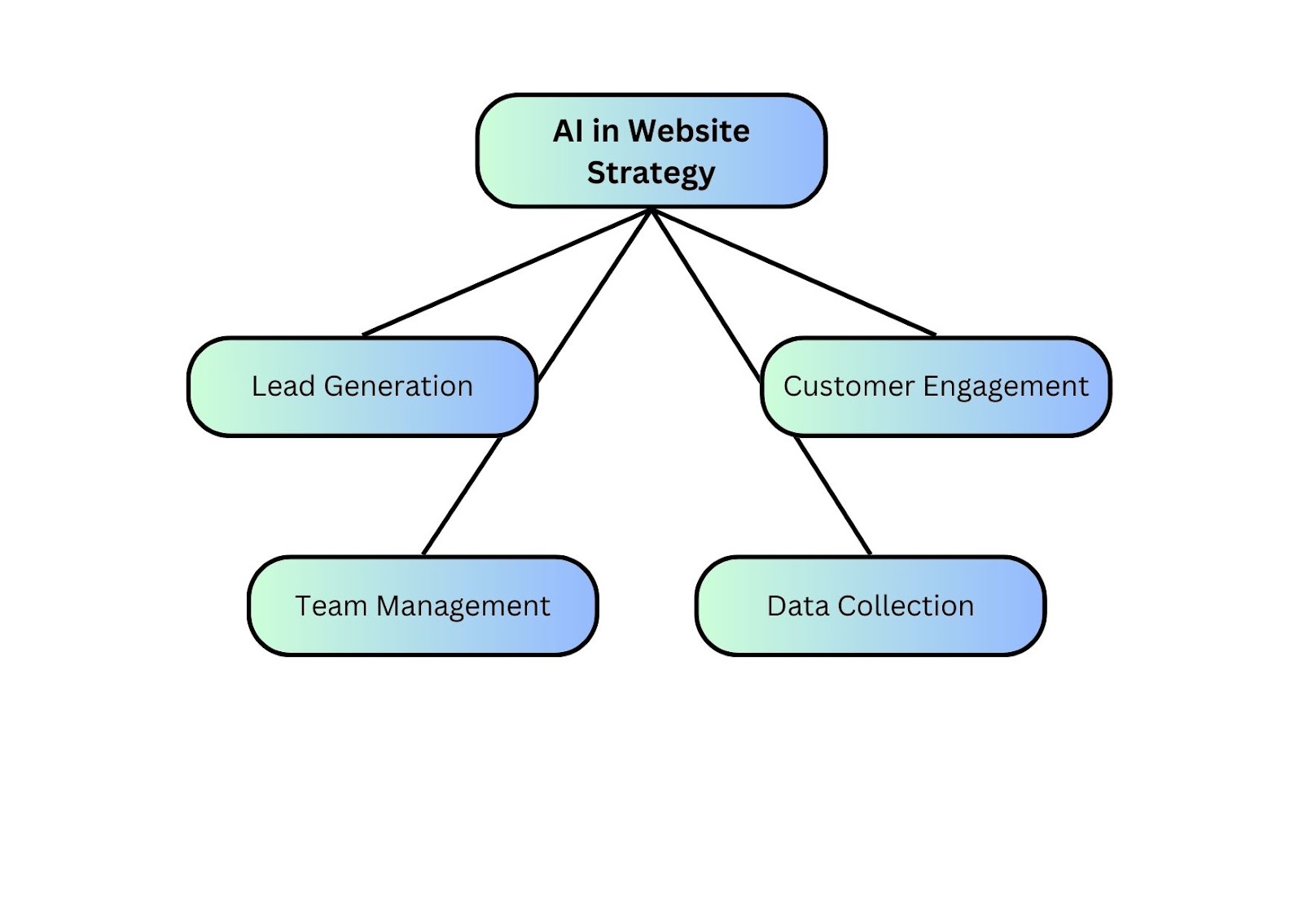
Lead Generation
AI chatbots can serve you as a good help for lead generation. They provide immediate answers and decrease the need for manual work. The type of chatbots that use artificial intelligence and natural language processing mentioned above, provide more personalized communication for each user.
Customer Engagement
As they are available anytime, they are a good way of keeping customers engaged. In other words, they can help customers find solutions and answers to specific inquiries, without any human help. To make the best use of AI chatbots you can also get the WordPress ChatGPT plugin.
Managing the Team
AI chatbots are capable of giving instant task scheduling for team members. This reduces a lot of manual work alongside other opportunities, the AI chatbots provide for team management.
Customer Demographics
AI chatbots provide data about the customers. With the help of AI chatbots, you can gather some basic information about your audience by asking them to fill in information such as name, email address, age gender, etc. This information will help you identify the demographics of your audience and understand who is interested in your website.
Data Collection
Another area of website strategy that AI chatbots can influence, is the data-gathering process. AI chatbots can provide you with such information as when the customers made their inquiries, what products are frequently asked about, delayed orders, etc. This kind of information can be quite helpful when planning and organizing your website strategy.
Conclusion
In conclusion, AI chatbots are sophisticated programs that provide answers to various inquiries based on the type of chatbot you use. More precisely, when they employ natural language processing, they can produce responses that are more adaptable and human-like than those that are predetermined by the computer. AI chatbots are used for a variety of applications, as previously indicated. One of those purposes may be website strategy development. They do affect the website strategy, by affecting the lead generation process, customer engagement, data gathering, etc.
Thus, chatbots transform the website strategy by digitizing a lot of work concerning different areas. They help to reduce manual work and provide more detailed data for later strategy planning.
Despite the slump in Electric Vehicle (EV) sales, the future of automobiles will be electric. Automakers are ramping up their research and development (R&D) investments in EVs, redirecting their focus away from traditional mechanical combustion engines.
Today, automobile makers are already developing what they call Software Defined Vehicles (SDV), which represents the next evolutionary step in the automobile industry, where software and computing technology play a crucial role in managing various vehicle systems and components.
Soon, we will see a transition from combustion engines to an electric architecture in automobiles. However, for the shift towards software to occur in the automotive industry, there is a demand for specialised silicon chips.
Texas Instruments, a global semiconductor company that designs, manufactures, tests and sells analogue and embedded processing chips, at CES 2024 announced three chips designed specifically to power the next generation of automobiles.
“We hold the belief that as Electric Vehicles (EV) become more widespread, especially with the approaching 2030 mandate for most vehicle manufacturers to transition to fully electric models, semiconductor devices are at the core of this transformation,” Mark Ng, sector general manager of hybrid and electric vehicles at Texas Instruments told AIM.
The internal combustion engine predominantly featured mechanical components. However, in a Hybrid Electric Vehicle (HEV) or EV, there is a significant surge in semiconductor content as it is more software-defined.
“Currently, we are focusing on Advanced Driver Assistance Systems (ADAS) and the Battery Management System (BMS), which encompasses components like contactors and pyro fuses and semiconductors form the core of these systems, and our mission is to empower automakers in crafting the most technologically advanced vehicles,” he said.
Enabling higher levels of autonomy
The first of the three chips announced by Texas Instruments is explicitly designed to enhance ADAS technologies, which play a crucial role in improving road safety by preventing accidents and reducing the severity of collisions by incorporating functionalities like forward collision warning, automatic emergency braking, lane departure warning, blind-spot detection, and adaptive cruise control.
The chip, which Texas Instrument is calling the AWR2544, is a 77GHz millimetre-wave radar sensor chip. It is the industry’s first chip specifically designed for a satellite radar architecture, enabling higher levels of autonomy by improving sensor fusion and decision-making in ADAS.
“It’s a single chip radar sensor designed for satellite architecture that increases vehicle sensing range, well beyond 200 metres and enables more accurate decision making,” Ng said.
In satellite architectures, radar sensors output semi-processed data to a central processor for ADAS decision-making using sensor fusion algorithms, taking advantage of the 360-degree sensor coverage to achieve higher levels of vehicle safety. Switching to a satellite architecture helps auto manufacturers overcome challenges tied to integrating sensors and managing fragmented software in vehicles.
“We are enhancing our capabilities by incorporating greater intelligence to facilitate centralised data computation. This architectural approach allows us to achieve comprehensive 360-degree coverage while progressing towards higher levels of autonomy such as L3, L4, and L5, all with reduced system complexity.”
He also adds that the current radar chips in the market are not optimised for satellite use. The AWR2544 chip will cater to the processing needs of this type of architecture, transitioning from traditional radar to satellite architecture.
Enhancing battery management systems
Moreover, as automobile makers transition to electric vehicles, the advancement in Battery Management Systems (BMS) will also prove to be pivotal. Supporting the trend toward software-defined vehicles is challenging designers to develop smarter, more advanced battery management systems.
Two new highly integrated, software-programmable driver chips from Texas Instruments, which they are calling DRV3946 and DRV3901, address requirements for safer and more efficient control of high-voltage disconnect circuits in a BMS or other powertrain system.
The DRV3946 is the industry’s first fully integrated contactor driver, according to Ng. A contractor electrical switch controls the flow of current in the battery circuit.
“You don’t want the battery power connected to the vehicle all the time. It is essential to disconnect the battery, particularly in situations such as accidents or imminent dangers. These devices are programmable, they are intelligent, and they do not require the use of a Microcontroller Unit (MCU),” Ng said.
The DRV3946, a programmable contactor driver, allows automakers to tailor peak and hold settings. The chip includes diagnostics to monitor and report contactor status, enabling efficient and programmable control, aligning with the era of software-programmable devices and facilitating contactor diagnosis.
Whereas the DRV3901 chip is a fully integrated squib driver which enables an intelligent pyro fuse disconnect system by using built-in circuitry to monitor the pyro fuse and provide diagnostic information to the system microcontroller.
“The DRV3901 is a similar device and is integrated into the battery junction box and specifically interacts with pyro fuses. This provides BMS designers with the flexibility to opt for pyro fuses over conventional melting fuse systems, simplifying design complexities.”
First mover advantage
While these are interesting developments, Texas Instruments is not the only semiconductor company trying to innovate in this space. According to Ng, Texas Instruments, which is one of the top 10 semiconductor companies worldwide based on sales volume, is bringing its innovation to the top Original Equipment Manufacturers (OEMs), be it in the US, Korea or Japan.
“We are first to market in terms of the contractor drivers and Squibb drivers, and we are going to innovate even further in this space,” Ng said.
The rapid and intriguing advancements in electric vehicle technology necessitate underlying silicon chips to power these innovations. Texas Instruments aims to be at the forefront, assisting automobile manufacturers in smoothly transitioning to futuristic electric vehicles.
The post Texas Instruments’ New Chips are Designed to Propel Automobile Innovation appeared first on Analytics India Magazine.
Before we get into the amazing things about Phi-2. If you haven’t already learnt about phi-1.5, I’d advise you to have a quick skim over what Microsoft had in the works a few months ago Effective Small Language Models: Microsoft’s 1.3 Billion Parameter phi-1.5.
Now you have the foundations, we can move on to learning more about Phi-2. Microsoft has been working hard to release a number of small language models (SLMs) called ‘Phi’. This series of models has been shown to achieve remarkable performance, just as it was a large language model.
Microsofts first model was Phi-1, the 1.3 billion parameter and then came Phi-1.5.
We’ve seen Phi-1, Phi-1.5, and now we have Phi-2.
What is Phi-2?
Phi-2 has become bigger and better. Bigger and better. It is a 2.7 billion-parameter language model that has been shown to demonstrate outstanding reasoning and language understanding capabilities.
Amazing for a language model so small right?
Phi-2 has been shown to outperform models which are 25x larger. And that’s all thanks to model scaling and training data curation. Small, compact, and highly performant. Due to its size, Phi-2 is for researchers to explore interpretability, fine-tuning experiments and also delve into safety improvements. It is available on the Azure AI Studio model catalogue.
The Creation of Phi-2
Microsfts training data is a mixture of synthetic datasets which is used to teach the model common sense, such as general knowledge as well as science, theory of mind, and daily activities.
The training data was selected carefully to ensure that it was filtered with quality content that has educational value. That with the ability to scale has taken their 1.3 billion parameter model, Phi-1.5 to a 2.7 billion parameter Phi-2.
Image from Microsoft Phi-2
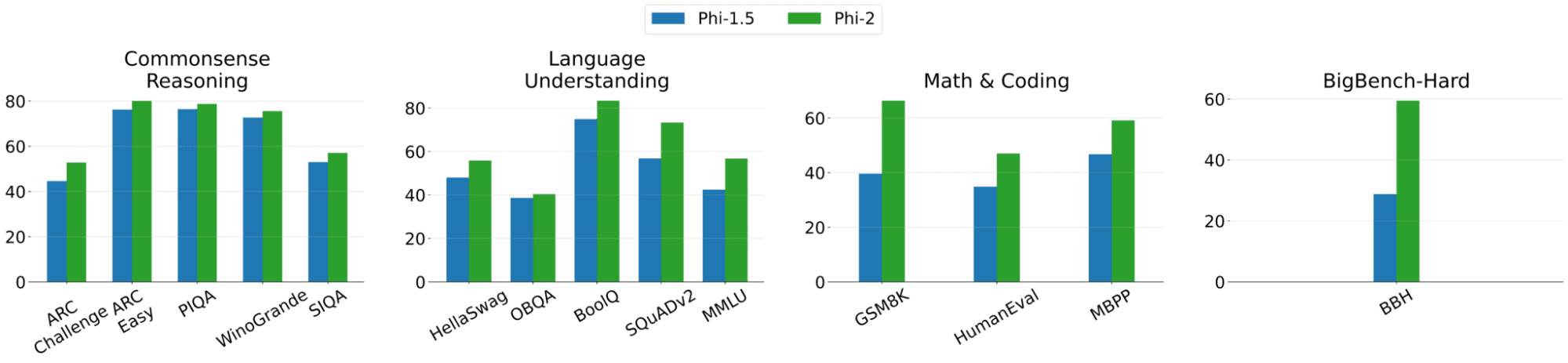
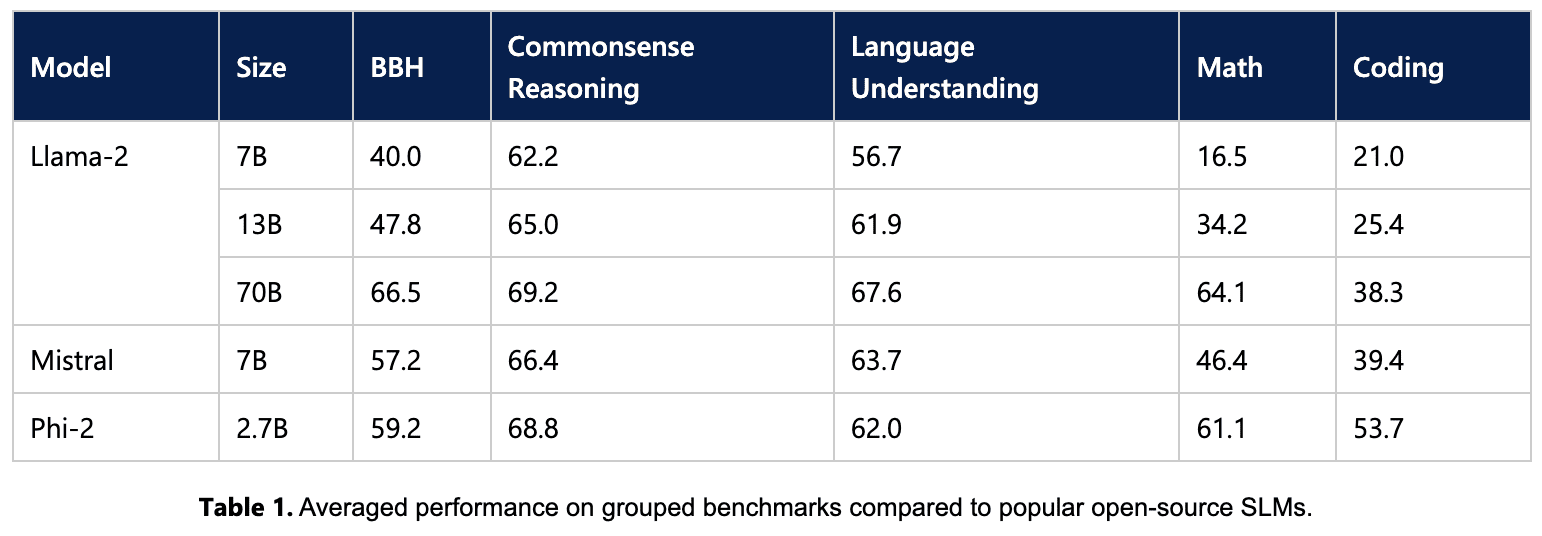
Microsoft put Phi-2 to the test, as they acknowledge the current challenges with model evaluation. Tests were done on use cases in which they compared it to Mistral and Llama-2. The results showed that Phi-2 outperformed Mistral-7B and the 70 billion Llama-2 model outperformed Phi-2 in some cases as shown below:
Image from Microsoft Phi-2 Limitations of Phi-2
However, with that being said, Phi-2 still has its limitations. For example:
Inaccuracy: the model has some limitations of producing incorrect code and facts, which users should take with a pinch of salt and treat these outputs as a starting point.
Limited Code Knowledge: Phi-2 training data was based on Python along with using common packages, therefore the generation of other languages and scripts will need verification.
Instructions: The model is yet to go through instruction fine-tuning, therefore it may struggle to really understand the instructions that the user provides.
There are also other limitations of Phi-2, such as language limitations, societal biases, toxicity, and verbosity.
With that being said, every new product or service has its limitations and Phi-2 has only been out for a week or so. Therefore, Microsoft will need phi-2 to get into the hands of the public to help them improve the service and overcome these current limitations.
Wrapping it up
Microsoft has ended the year with a small language model that could potentially grow to be the most talked about model of 2024. With this being said, to close the year — what should we expect from the language model world for the year 2024?
Nisha Arya is a Data Scientist and Freelance Technical Writer. She is particularly interested in providing Data Science career advice or tutorials and theory based knowledge around Data Science. She also wishes to explore the different ways Artificial Intelligence is/can benefit the longevity of human life. A keen learner, seeking to broaden her tech knowledge and writing skills, whilst helping guide others.
More On This Topic
Effective Small Language Models: Microsoft’s 1.3 Billion Parameter phi-1.5
Stop Doing this on ChatGPT and Get Ahead of the 99% of its Users
Data Science Minimum: 10 Essential Skills You Need to Know to Start…
How do some industries seem to have cracked the code for success? It’s not luck—it’s the power of data science that changes the game. Whether it’s technology or the finance sector, data science is transforming how well we do things by understanding the data.
Research has shown that the employment rate for data scientists is projected to grow by a whopping 36% from 2021 to 2031 which proves the demand for data science for business growth. So, let’s learn about how data science is rewriting the rules across diverse industries. But, before we do that, first you need to understand the basics of data science.
Basics of Data Science
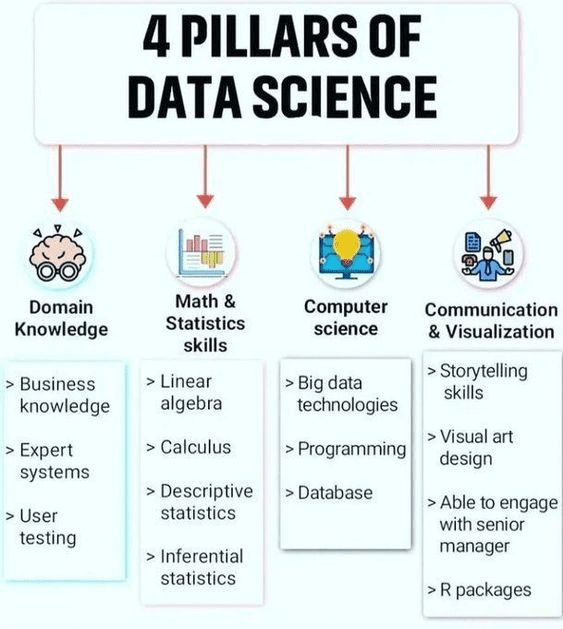
Data science is the art of deriving meaningful insights from complex data. It combines statistics, mathematics, and computer science to analyze and interpret vast datasets. By employing advanced algorithms and techniques, data science transforms raw information into actionable knowledge. This associative field plays an important role in predicting trends, identifying patterns, and facilitating informed decision-making across diverse industries. Let’s learn about the impact of data science across various industries.
Impact of Data Science on Diverse Industries
Here we have researched and listed a few profound impacts of data science in top industries.
1. Hotel Industry
Data science is the secret sauce of success in the hotel industry. Without the help of data science improving guest experience which is the most important thing in the hotel industry is almost impossible. By providing personalized room preferences, and curated dining suggestions, all based on their past choices. That’s the magic of data science at play.
But, of course, it has some limits and challenges.
One of the biggest challenges comes with data privacy and quality in the hotel industry. And let’s not forget the hunt for skilled data science specialists – a bit like looking for a needle in a haystack.
Apart from that, the perks are worth pursuing to elevate your success in the hotel industry. Such as real-time adjustments in pricing which is one of the most essential for filling up the hotel rooms at profit. Today hotels are switching to a solution that might help them determine the real-time pricing to beat the competition. One such solution is using Hotel API to help hoteliers decrease hotel room prices while still managing profit.
That’s not all. Data science is also used in predicting when the coffee machine might call it quits, demand forecasting, customer feedback analysis, crafting successful marketing campaigns, and personalization. In short, data science is a game-changer in the hotel industry for boosting reputation and revenue. Check out this Airbnb case study to see how data science propelled their valuation to $25.5 billion and their recommendations for rapid growth.
2. Aviation Industry
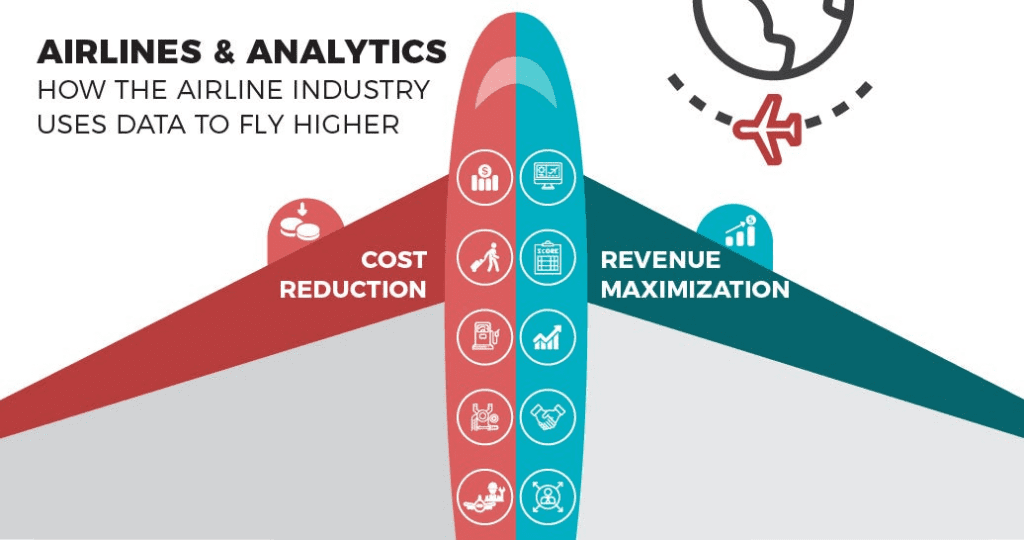
By utilizing the power of data science airlines are revolutionizing their operations across various domains. For revenue management, data science has become an indispensable technology that helps airlines understand customer willingness to pay and optimize pricing strategies.
Airlines depend on the Flight Data API to access crucial flight pricing information. This API provides valuable insights into market price trends that help airlines to determine the optimal prices aligned with what customers are willing to pay.
Not only this, but by using data science tools they can do demand analysis, predictive maintenance for mitigating costs linked to delays and cancellations, and feedback analysis to address customers’ pain points and enhance customer experiences
To know more in-depth about how data science can help airlines mitigate losses and improve efficiency, read this case study of Qantas Airlines.
3. Health Industry
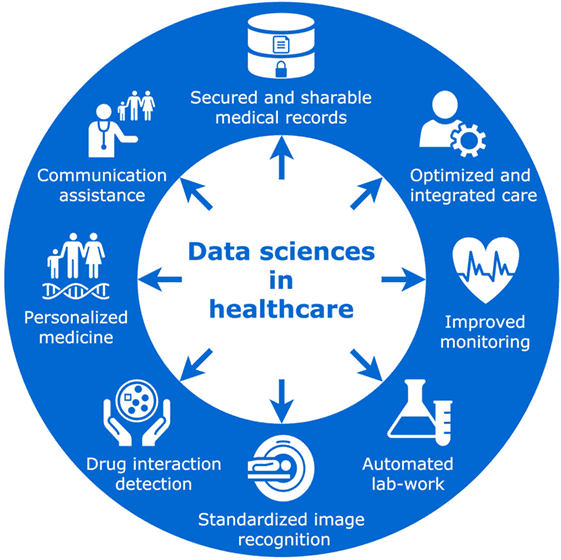
Believe it or not, data science is behind innovative healthcare products. It is used in everything from patient care to research, and improving operational efficiency.
Massive datasets and data science applications are used in Medical Image Analysis, accelerates diagnosis through quick extraction of complex information from imaging techniques like MRI and CT scans.
In addition to that, Research and Development also benefit from rapid data processing that expedites the creation of medicines and vaccines. AstraZeneca R&D studies are a perfect example of how data science can help in creating innovative healthcare products.
Data science is used for improving patient reports with IoT devices generating health data which enable more effective treatments.
Plus, it also helps lower the cost by analyzing Electronic Health Records (EHRs) to identify health patterns that prevent unnecessary treatments. Data science is reshaping healthcare by offering boundless possibilities for innovation and improved patient outcomes.
4. Finance Industry
Data Science has emerged as a game-changer for streamlining processes and enhancing decision-making.
For many finance firms and businesses data science tools are indispensable for effective operations.
The multifaceted applications of data science in finance encompass algorithmic trading, fraud detection, risk analytics, real-time analytics, consumer analytics, customer data management, personalized services, and financial fraud detection.
Through analysis of structured and unstructured data, risk management becomes more informed, customer interactions are personalized, and real-time insights drive strategic decisions.
Notably, Algorithmic Trading harnesses massive datasets to devise rapid, complex trading strategies. And, if we talk about its impact on the banking sector Munish Mittal, SVP of IT at HDFC Bank, highlights the pivotal role of big data analytics in customer relationship differentiation.
5. Retail & E-commerce
Data science is a boon for the retail and e-commerce industry that helps them to survive in massive competition.
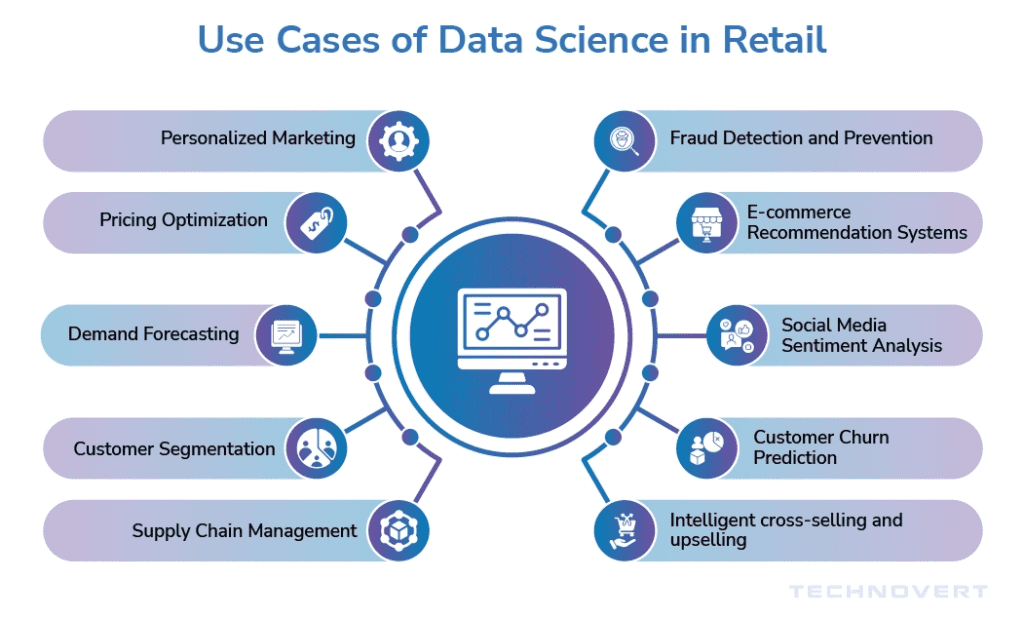
Through applications like recommendation engines, market basket analysis, and warranty analytics it helps in creating personalized customer experiences, increased sales, and customer loyalty.
Plus use of price optimization algorithms ensures competitive pricing, while inventory management tools help maintain efficient supply chains.
Even retail businesses can do location analysis for strategically placing new stores, and sentiment analysis on social media provides valuable insights for brand enhancement.
In addition to that, predictive data analysis provides lifetime value prediction to create successful marketing strategies that maximize the returns on customer acquisition investments.
Don’t forget to go through the case study done with the collaboration between Cambridge Spark and Carrefour on how data science and Python training help enhance customer experience and fuel business growth.
6. Manufacturing Industry
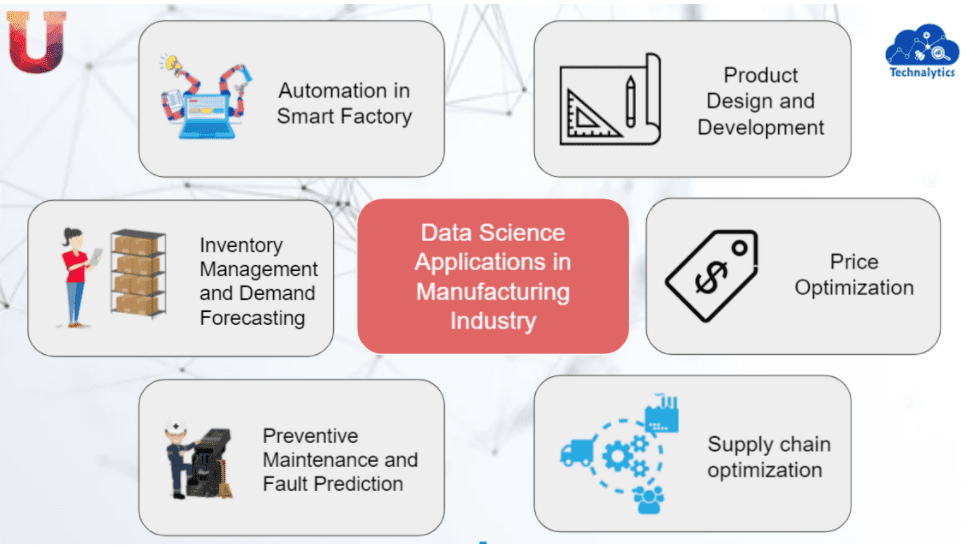
The Manufacturing industry is driving growth and success through data-driven decision-making. Plus, data science is also used in error reduction, supply chain management, and production system enhancement to contribute to increased revenue.
From predictive maintenance to automation and smart factories, data science is pivotal in transforming manufacturing processes.
In predictive maintenance, real-time data analysis optimizes maintenance needs without disrupting productivity.
Smart manufacturers use data-driven supply chain management for price and supply chain optimization, preparing for industry changes and ensuring profitability. Automation, aided by data science, enables significant productivity gains, exemplified by Siemens’ Digital Twin simulating production scenarios.
Data science validates material and design decisions in product development, while inventory management benefits from demand forecasting, promoting just-in-time manufacturing.
Computer vision applications enhance efficiency and quality control through AI-powered technologies. Moreover, data science also helps manufacturers in achieving enterprise-wide sustainability goals such as managing supply chain energy usage.
As manufacturing evolves, the demand for data science professionals continues to rise. Whether predicting demand or enhancing operational efficiency, a data science certificate primes individuals for rewarding careers in manufacturing data analytics.
Exciting opportunities await in smart factories that emphasize the crucial role of data science in shaping the future of manufacturing. To explore the benefits deeper check out this case study on data analytics for smart manufacturing which includes how data science propels operational efficiency and competitive advantages.
7. Energy and utilities
In the energy and utilities sector data science helps in fostering innovation and resilience.
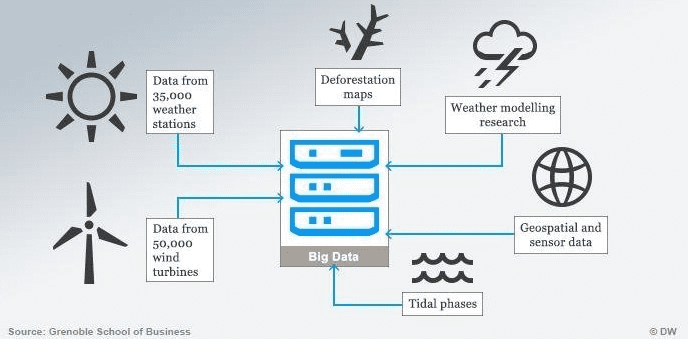
Data science applications are used for optimizing operations, from failure probability modeling using machine learning for predictive maintenance to real-time outage detection and dynamic energy management.
It reduces costs and enhances reliability. Plus, the ability to take security measures, preventive equipment maintenance, and demand response management further illustrate its versatility.
Data-driven insights not only bolster efficiency but also elevate customer experiences through real-time billing and personalized services.
The integration of analytics in optimizing asset performance ensures reliability. This transformative influence of data science is driving the energy and utility sector toward a smarter, more efficient future.
Here are a few examples of the profound influence of data science in shaping energy and utilities which you should check out.
Conclusion:
The transformative power of Data Science reverberates across diverse industries.
Its applications, from personalized eCommerce strategies to predictive maintenance and smart energy management underscore the invaluable role it plays.
As industries evolve, embracing Data Science becomes imperative for sustainable growth and innovation.
So, get ready for the advancements and witness the metamorphosis, and seize the opportunities that lie at the intersection of data and progress.
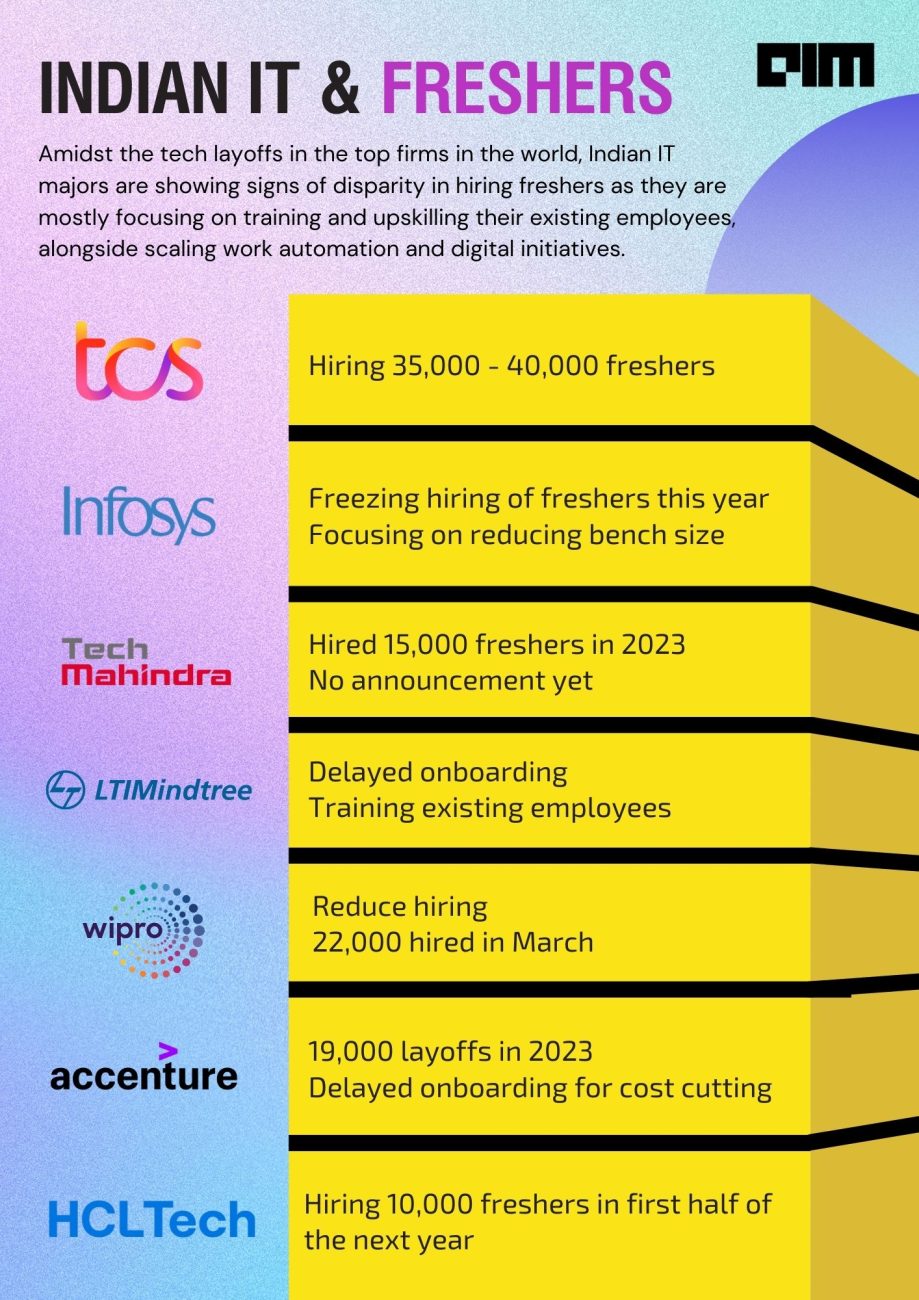
It was October 2022. Indian IT firms Wipro, Infosys, and Tech Mahindra, having delayed the onboarding for months, were all revoking offer letters, affecting nearly 30,000 freshers. Adding insult to injury, the “hired” freshers, who were waiting endlessly to receive their joining letters, were blamed for not meeting the qualification criteria for the job role before the offers were revoked.
Exactly a year later, amidst rampant global layoffs, Indian IT biggies froze hiring of freshers citing over-hiring in the previous year. They wanted to focus on utilising the existing bench, while also training existing employees with generative AI.
But it is not just the IT giants who are not interested in freshers anymore, a lot of graduates have also increasingly lost interest in applying for Indian IT roles.
Stagnant starting salaries
Undoubtedly, one of the biggest reasons for not accepting a job offer is the meagre salary. And Indian IT giants are not even trying to allure new joinees anymore.
The reluctance of recent graduates to pursue careers in the Indian IT sector can be attributed to the prolonged stagnation of entry-level salaries, which have remained at Rs 3.5-4 LPA for over a decade. While the IT services industry’s exports have experienced significant growth, the lack of salary progression has deterred graduates from joining.
Indian IT is a $245 billion industry. Despite the less salary, around 800,000 freshers took up jobs in IT firms in the past two years, but only as a backup option, i.e. till they got higher paying jobs.
High-paying product companies with compensation packages ranging from Rs 10-20 LPA have become more attractive, leading to a decline in interest from Tier I and Tier II colleges. On the other hand, freshers from Tier III and IV colleges are joining IT services.
To address this issue, some top IT companies have introduced differential hiring practices, offering better pay and specialised roles to attract aspiring individuals. Niche roles related to AI offer around Rs 7 lakh per annum, but even they are miniscule compared to companies such as Microsoft, Google, or any other product company offering upwards of Rs 14 lakhs per annum.
This results in the diminishing of interest even further.
Additionally, the growing presence of Global Capacity Centres (GCCs) in India has contributed to job growth, offering a variety of roles with competitive compensation. The changing preferences among students, particularly in Tier II colleges, have resulted in reduced reliance on IT services companies.
As per insights from numerous placement officers and industry executives, these GCCs aim to increase the hiring of entry-level professionals by 50-100% compared to the previous year, offering salaries up to 30% higher than domestic IT services firms.
Samuel Rajkumar V, director of the Vellore Institute of Technology’s (VIT) career development centre, remarked, “Last year, out of 947 companies that visited for the 2023 batch, more than 350 were GCCs. This year, among the 440 companies that have visited thus far for the 2024 batch, over 200 are GCCs.”
No clear-cut plans
Back in February, Wipro sent a letter to freshers to settle for almost 50 percent less salary than what was promised, blaming the macroeconomic conditions. The worse part was that the mail stated that at least the freshers were getting an opportunity to work.
TV Mohandas Pai, the Indian expert philanthropist lashed back at it in an interview. “At least getting an opportunity?” he said. “This is very wrong.” He said that companies that are making a lot of profits and earning thousands of crores in revenue should value their employees and give a proper compensation to them.
Some people on social media blamed the IT companies’ toxic culture and exploitation in the IT firms. “None of these firms act on daily incidents of bullying and unprofessional behaviour by their staff and senior leadership,” said a user.
On the other hand, companies such as Accenture have clearly outlined its strategy for generative AI and confidently announced its plans and investments, which also attracts a lot of graduates. This is in contrast to the Indian IT giants that are still slowly embracing generative AI, though have announced PoCs for the same.
At the same time, after 19,000 layoffs this year, Accenture has decided to not hike the salaries of its employees in India this year. The IT giant is also delaying hiring freshers to cut costs and “grapple with the present economic conditions”.
Regardless, IT firms are trying to allure employees by saying that they would continue hiring more freshers. But the graduates now know that after over-hiring during the pandemic, then laying off employees, and revoking offer letters, the companies are not able to deliver what they promised.
The post Why Indian Graduates Do Not Want to Join IT Companies appeared first on Analytics India Magazine.
How often do machine learning projects reach successful deployment? Not often enough. There's plenty of industry research showing that ML projects commonly fail to deliver returns, but precious few have gauged the ratio of failure to success from the perspective of data scientists – the folks who develop the very models these projects are meant to deploy.
Following up on a data scientist survey that I conducted with KDnuggets last year, this year's industry-leading Data Science Survey run by ML consultancy Rexer Analytics addressed the question – in part because Karl Rexer, the company’s founder and president, allowed yours truly to participate, driving the inclusion of questions about deployment success (part of my work during a one-year analytics professorship I held at UVA Darden).
The news isn't great. Only 22% of data scientists say their "revolutionary" initiatives – models developed to enable a new process or capability – usually deploy. 43% say that 80% or more fail to deploy.
Across all kinds of ML projects – including refreshing models for existing deployments – only 32% say that their models usually deploy.
Here are the detailed results of that part of the survey, as presented by Rexer Analytics, breaking down deployment rates across three kinds of ML initiatives:
Key:
Existing initiatives: Models developed to update/refresh an existing model that's already been successfully deployed
New initiatives: Models developed to enhance an existing process for which no model was already deployed
Revolutionary initiatives: Models developed to enable a new process or capability
The Problem: Stakeholders Lack Visibility and Deployment Isn't Fully Planned For
In my view, this struggle to deploy stems from two main contributing factors: endemic under-planning and business stakeholders lacking concrete visibility. Many data professionals and business leaders haven’t come to recognize that ML’s intended operationalization must be planned in great detail and pursued aggressively from the inception of every ML project.
In fact, I've written a new book about just that: The AI Playbook: Mastering the Rare Art of Machine Learning Deployment. In this book, I introduce a deployment-focused, six-step practice for ushering machine learning projects from conception to deployment that I call bizML (pre-order the hardcover or e-book and receive a free advanced copy of the audiobook version right away).
An ML project’s key stakeholder – the person in charge of the operational effectiveness targeted for improvement, such as a line-of-business manager – needs visibility into precisely how ML will improve their operations and how much value the improvement is expected to deliver. They need this to ultimately greenlight a model's deployment as well as to, before that, weigh in on the project's execution throughout the pre-deployment stages.
But ML's performance often isn't measured! When the Rexer survey asked, "How often does your company / organization measure the performance of analytic projects?" only 48% of data scientists said "Always" or "Most of the time." That's pretty wild. It ought to be more like 99% or 100%.
And when performance is measured, it's in terms of technical metrics that are arcane and mostly irrelevant to business stakeholders. Data scientists know better, but generally don’t abide – in part since ML tools generally only serve up technical metrics. According to the survey, data scientists rank business KPIs like ROI and revenue as the most important metrics, yet they list technical metrics like lift and AUC as the ones most commonly measured.
Technical performance metrics are “fundamentally useless to and disconnected from business stakeholders,” according to Harvard Data Science Review. Here’s why: They only tell you the relative performance of a model, such as how it compares to guessing or another baseline. Business metrics tell you the absolute business value the model is expected to deliver – or, when evaluating after deployment, that it has proven to deliver. Such metrics are essential for deployment-focused ML projects.
The Semi-Technical Understanding Business Stakeholders Need
Beyond access to business metrics, business stakeholders also need to ramp up. When the Rexer survey asked, "Are the managers and decision-makers at your organization who must approve model deployment generally knowledgeable enough to make such decisions in a well-informed manner?" only 49% of respondents answered "Most of the time" or "Always."
Here's what I believe is happening. The data scientist's "client," the business stakeholder, often gets cold feet when it comes down to authorizing deployment, since it would mean making a significant operational change to the company's bread and butter, its largest scale processes. They don't have the contextual framework. For example, they wonder, "How am I to understand how much this model, which performs far shy of crystal-ball perfection, will actually help?" Thus the project dies. Then, creatively putting some kind of a positive spin on the "insights gained" serves to neatly sweep the failure under the rug. AI hype remains intact even while the potential value, the purpose of the project, is lost.
On this topic – ramping up stakeholders – I'll plug my new book, The AI Playbook, just one more time. While covering the bizML practice, the book also upskills business professionals by delivering a vital yet friendly dose of semi-technical background knowledge that all stakeholders need in order to lead or participate in machine learning projects, end to end. This puts business and data professionals on the same page so that they can collaborate deeply, jointly establishing precisely what machine learning is called upon to predict, how well it predicts, and how its predictions are acted upon to improve operations. These essentials make or break each initiative – getting them right paves the way for machine learning’s value-driven deployment.
It’s safe to say that it’s rocky out there, especially for new, first-try ML initiatives. As the sheer force of AI hype loses its ability to continually make up for
less realized value than promised, there'll be more and more pressure to prove ML's operational value.? So I say, get out ahead of this now – start instilling a more effective culture of cross-enterprise collaboration and deployment-oriented project leadership!
For more detailed results from the 2023 Rexer Analytics Data Science Survey, click here. This is the largest survey of data science and analytics professionals in the industry. It consists of approximately 35 multiple choice and open-ended questions that cover much more than only deployment success rates – seven general areas of data mining science and practice: (1) Field and goals, (2) Algorithms, (3) Models, (4) Tools (software packages used), (5) Technology, (6) Challenges, and (7) Future. It is conducted as a service (without corporate sponsorship) to the data science community, and the results are usually announced at the Machine Learning Week conference and shared via freely available summary reports.
This article is a product of the author’s work while he held a one-year position as the Bodily Bicentennial Professor in Analytics at the UVA Darden School of Business, which ultimately culminated with the publication of The AI Playbook: Mastering the Rare Art of Machine Learning Deployment (free audiobook offer).
Eric Siegel, Ph.D., is a leading consultant and former Columbia University professor who makes machine learning understandable and captivating. He is the founder of the Predictive Analytics World and the Deep Learning World conference series, which have served more than 17,000 attendees since 2009, the instructor of the acclaimed course Machine Learning Leadership and Practice – End-to-End Mastery, a popular speaker who's been commissioned for 100+ keynote addresses, and executive editor of The Machine Learning Times. He authored the bestselling Predictive Analytics: The Power to Predict Who Will Click, Buy, Lie, or Die, which has been used in courses at more than 35 universities, and he won teaching awards when he was a professor at Columbia University, where he sang educational songs to his students. Eric also publishes op-eds on analytics and social justice. Follow him at @predictanalytic.
More On This Topic
85% of data science projects fail — here’s how to avoid it
How to Successfully Deploy Data Science Projects
Low Code: Are Developers Still Needed?
Are Data Scientists Still Needed in the Age of Generative AI?
Robotics expert and founder of iRobot and Robust.ai Rodney Brooks recently mentioned that the AI hype is readying for a brutal reality check. As per Brooks, the 60+ year history of AI is following a typical hype cycle and will witness a lull soon.
While the fade in AI hype is yet to happen, advancements in Robotics are only on an upward trajectory. It’s only been a week into the new year, and Google DeepMind have already released a flurry of updates in the field of Robotics.
Deep Into Robotics
Last week, Google DeepMind released three robotics research systems—AutoRT, SARA-RT and RT-Trajectory—that will aid robots to make faster decisions and better understand and navigate their environments. The models will help with data collection, speed, and generalisation.
AutoRT helps in harnessing the potential of large language models by collecting more experiential and diverse data. SARA-RT (Self-adaptive robust attention for robotics transformers) employs an ‘up-training’ method to transform Robotics Transformer models into more efficient versions, and RT- Trajectory automatically adds 2D trajectory sketches to training videos, thereby, helping the model in learning low-level robot control policies by providing practical visual cues.
Google DeepMind is building these state-of-the-art robotics models with the vision to allow them to be integrated in future robots, and they are mostly focused on general purpose.
Last week, Stanford University introduced Mobile ALOHA, a system designed to replicate bimanual mobile manipulation tasks necessitating whole body control. The project was provided by Google DeepMind and the technology addresses the limitations of traditional imitation learning from human demonstrations.
These general purpose robots are demonstrated to help with multiple tasks such as cooking, cleaning, lifting weights, and other manual activities. Industrial robots have been the biggest use cases for robotics. The warehouse robotics market size is estimated to hit $7.93 billion in 2024, and is expected to reach $17.91 billion by 2029, with a CAGR of 17.7%.
While general purpose robots are finding increasing use cases across industries, research and development of humanoid robots is not far behind.
Multifaceted Humanoid Robots
In the last few months, Tesla’s Optimus has received multiple upgrades, inching it closer to the vision that founder Elon Musk had built it for. When released in 2022, though impressive, the humanoid was unable to execute tasks and was only able to make a waving gesture in a diffident manner. However, after almost a year, in September 2023, the humanoid was able to pick and sort objects, navigate around and even do yoga.
Last month, further updates were announced as Optimus-Gen 2 incorporated new actuators and sensors that enables a 2 degree of freedom that allows more movement, and has improved hand movements.
Tesla’s Optimus works on neural networks, whereas other humanoid robots such as those created by Boston Dynamics work on rule-based systems. Known for their robot dogs, their humanoid robot Atlas had received major updates last year too. Furthermore, the company partnered with entertainment company Neon Group to create robotic-driven experiences for entertainment and educational purposes.
AI Robotics company Figure, recently released updates for Figure-01 humanoid where the robot demonstrates making coffee, something that was learned from watching humans make coffee.
Amazon is also testing out humanoid robots in select warehouses in the US. Amazon is working on robots Digit that can imitate human movements and be used for lifting and handling items in factories.
Year of Robotics?
Robots are not ready to take over the world yet! @zipengfu and I just compiled a video of the dumbest mistakes 𝐌𝐨𝐛𝐢𝐥𝐞 𝐀𝐋𝐎𝐇𝐀🏄 made in the autonomous mode 🤣 We are also planning to organize some live demos after taking a break. Stay tuned! pic.twitter.com/8PIofwEyXb
— Tony Z. Zhao (@tonyzzhao) January 5, 2024
While 2024 may probably be termed as the year of Robotics, considering how researchers have already shared updates within a week into 2024, the real breakthrough is still awaited. Hoping for the GPT-4 moment of Robotics is not as easy as it seems.
With massive investments and prolonged periods for testing and implementation of each individual task, developments in this field are slow. However, companies are not abandoning these ambitious projects.
Interestingly, in November of last year, the Ministry of Industry and Information Technology (MIIT) that oversees the industrial sector of China stated that in 2025 the country will achieve mass production of humanoid robots. They are looking to achieve major breakthroughs to help hit a humanoid robot innovation system.
The post Will 2024 be the Year of Terminator? appeared first on Analytics India Magazine.
Microsoft has introduced AI Odyssey, a new initiative with the objective of upskilling 100,000 developers in India with AI. This month-long program is designed to provide a comprehensive learning experience, enabling developers to acquire and showcase the necessary skills for executing crucial projects utilising AI aligned with business goals and outcomes.
Click here to register for the programme.
With AI Odyssey, Microsoft is fostering opportunities for developers to craft solutions for India’s progress and highlight their abilities in tackling real-world issues.
The program, open to all AI enthusiasts in India regardless of experience or background, comprises two levels that participants must complete by January 31, 2024.
The first level focuses on educating participants about leveraging Azure AI services to develop and deploy AI solutions across various scenarios. This level provides access to valuable resources, code samples, and guides, facilitating the mastery of practical AI skills.
The second level challenges participants to validate their AI expertise through an online assessment featuring interactive lab tasks. Successful completion earns them Microsoft Applied Skills credentials, a verifiable proof of their capability to address real-world problems using AI.
Participants completing both levels also have the opportunity to win a VIP Pass to the Microsoft AI Tour in Bangalore on February 8, 2024. This event showcases the transformative impact of generative AI on creativity, collaboration, and problem-solving, featuring keynote sessions, demos, and workshops where developers can learn from Microsoft experts, partners, and network with peers.
Irina Ghose, Managing Director at Microsoft India, emphasised, “AI is the future of innovation and India is leading the way with its tech talent. The Microsoft Applied Skills credential will help developers demonstrate their competence and creativity in the most in-demand AI skills and scenarios. We welcome all developers to join us in creating meaningful AI solutions that will contribute to India’s economy.”
Read: Microsoft IDC Turns 25 in India
The post Microsoft to Train 100,000 Indian Developers with AI Odyssey appeared first on Analytics India Magazine.