The best robots and AI innovations we’ve seen at CES 2024 so far

Ogmen Robotics's Oro, pet companion robot

Ogmen Robotics's Oro pet companion robot was on display at CES 2024.

Artificial intelligence remains one of the buzziest technologies around, and it's no surprise that it's been a main attraction at CES 2024. Though AI was mainly represented in chatbots in the past year, companies are now finding more innovative ways to incorporate the technology into hardware, including everything from futuristic robots to laptops to products that would have never been possible before.

Also: CES 2024: What's Next in Tech

With so many AI-related announcements at CES this year, it can be difficult to distinguish between what's simple AI-washing and what's actual visionary technology. To help you understand what's most important, I've created a roundup of the AI and robots that have distinguished themselves from the rest based on factors such as helpfulness, uniqueness, and purposefulness.

Keep reading to find the best AI-infused products from CES. This list will be updated daily during the conference based on my on-the-ground reporting.

OpenAI claims NY Times copyright lawsuit is without merit

OpenAI claims NY Times copyright lawsuit is without merit Kyle Wiggers 9 hours

In late December, The New York Times sued OpenAI and its close collaborator and investor, Microsoft, for allegedly violating copyright law by training generative AI models on Times’ content. Today, OpenAI gave a public response, claiming — unsurprisingly — that The Times’ lawsuit is meritless.

In a letter published this afternoon on OpenAI’s official blog, the company reiterates its view that training AI models using publicly available data from the web — including articles like The Times’ — is fair use. In other words, in creating generative AI systems like GPT-4 and DALL-E 3, which “learn” from millions of billions of examples of artwork, ebooks, essays and more to generate human-like text and images, OpenAI believes that it isn’t required to license or otherwise pay for the examples.

“We view this principle as fair to creators, necessary for innovators and critical for U.S. competitiveness,” OpenAI writes.

OpenAI also addresses in its response regurgitation, the phenomenon where generative AI models spit out training data verbatim (or near-verbatim) when prompted in a certain way — for example generating a photo that’s identical to one taken by a photographer. OpenAI makes the case that regurgitation is less likely to occur with training data from a single source — e.g., The New York Times — and places the onus on users to “act responsibly” and avoid intentionally prompting its models to regurgitate — which OpenAI notes is against its terms of use.

“Interestingly, the regurgitations The New York Times [cite in its lawsuit] appear to be from years-old articles that have proliferated on multiple third-party websites,” OpenAI writes. “It seems they intentionally manipulated prompts, often including lengthy excerpts of articles, in order to get our model to regurgitate. Even when using such prompts, our models don’t typically behave the way The New York Times insinuates, which suggests they either instructed the model to regurgitate or cherry-picked their examples from many attempts.”

OpenAI’s response comes as the copyright debate around generative AI reaches a fever pitch.

In a piece published this week in IEEE Spectrum, noted AI critic Gary Marcus and Reid Southen, a visual effects artist, showed how AI systems including DALL-E 3 regurgitate data even when not specifically prompted to do so — making OpenAI’s claim to the contrary less credible. Marcus and Southen, in fact, make reference to The New York Times lawsuit in their piece, noting that The Times was able to elicit “plagiaristic” responses from OpenAI’s models simply by giving the first few words from a Times story.

The Times is only the latest copyright holder to sue OpenAI over what it believes is a clear violation of IP rights.

Actress Sarah Silverman joined a pair of lawsuits in July that accuse Meta and OpenAI of having “ingested” Silverman’s memoir to train their AI models. In a separate suit, thousands of novelists, including Jonathan Franzen and John Grisham, claim OpenAI sourced their work as training data without their permission or knowledge. And several programmers have an ongoing case against Microsoft, OpenAI and GitHub over Copilot, an AI-powered code-generating tool, which the plaintiffs say was developed using their IP-protected code.

Some news outlets, rather than fight generative AI vendors in court, have chosen to ink licensing agreements with them. The Associated Press struck a deal in July with OpenAI, and Axel Springer, the German publisher that owns Politico and Business Insider, did likewise this month.

But these licensing agreements tend to be quite small. According to The Information, OpenAI — whose annualized revenue reportedly hovers around $1.6 billion — offers between $1 million and $5 million a year to license copyrighted news articles to train its AI models.

Until recently, The New York Times, too, had been in conversations with OpenAI to establish a “high-value” partnership involving “real-time display” of its brand in ChatGPT, OpenAI’s AI-powered chatbot. But discussions broke down in mid-December, according to OpenAI.

For what it’s worth, the public might be on publishers’ sides.

According to a recent poll from the independent think tank The AI Policy Institute, when informed about the details of The New York Times lawsuit against OpenAI, 59% of respondents agreed that AI companies shouldn’t be allowed to use publisher content to train models while 70% said that the companies should compensate outlets if they want to use copyrighted materials in model training.

Real-time analytics with database streaming services: Harnessing data velocity

database123

In the short-paced landscape of information-driven decision-making, actual-time analytics has come to be paramount for corporations seeking to benefit from insights at the rate of the enterprise. Database streaming offerings have emerged as a transformative answer, allowing the processing and analysis of facts in movement. This article explores the abilities of database streaming services and their role in harnessing data velocity for actual-time analytics.

Understanding data velocity

Data speed, one of the 3 V’s of Big Data (Volume, Velocity, Variety), refers to the speed at which facts are generated, processed, and made to be had for evaluation. In the technology of real-time choice-making, companies are challenged to deal with the non-stop inflow of information from various resources, together with IoT devices, social media, and transactional systems. Database streaming services address this venture by facilitating the regular waft and evaluation of facts as they are produced.

The essence of database streaming services

Database streaming offerings enable real-time facts processing with the aid of taking pictures and transmitting activities as they occur. Unlike traditional batch processing, where records are accumulated and processed periodically, streaming offerings manage statistics in a continuous, flowing way. This real-time technique allows groups to analyze and act upon facts and insights as occasions spread, offering an aggressive benefit in dynamic and time-sensitive eventualities.

Event-driven architecture

Database streaming offerings operate on the standards of occasion-driven structure. Events, which can be adjustments in information, person moves, or machine occasions, are captured and processed in near real-time. This architecture permits organizations to respond instantly to events of hobby, triggering workflows, notifications, or analytics procedures as factual occasions arise. The occasion-driven model complements agility and responsiveness in swiftly changing records landscapes.

Use cases for real-time analytics

Real-time analytics powered with the aid of database streaming services discover programs throughout various industries and use cases. Organizations can detect and respond to fraudulent transactions in finance in actual time. In e-trade, real-time analytics can provide personalized hints primarily based on personal behavior. In manufacturing, tracking devices in real-time can enable predictive protection. The versatility of actual-time analytics spans sectors, empowering companies to derive on-the-spot costs from their records.

Stream processing frameworks

Organizations leverage circulate processing frameworks that paint seamlessly with database streaming services to harness facts pace successfully. Frameworks including Apache Kafka, Apache Flink, and Apache Storm provide the infrastructure for eating, processing, and reading streaming data. These frameworks allow the building of scalable and fault-tolerant circulate processing pipelines, ensuring the reliability and performance of actual-time analytics.

Integration with machine learning models

Database streaming offerings integrate seamlessly with system-study models, permitting businesses to make real-time predictions and decisions. Organizations can stumble on anomalies, predict future tendencies, and automate choice-making procedures with the aid of combining streaming data with machine learning algorithms. This fusion of actual-time analytics and machine getting-to-know complements the intelligence and sophistication of data-driven packages.

Low latency and high throughput

Critical characteristics of database streaming services are low latency and excessive throughput. Low latency guarantees that records events are processed and analyzed with minimal postponement, enabling groups to respond to critical activities in near actual time. Increased throughput abilities allow those offerings to address huge volumes of streaming statistics, accommodating the rate at which information is generated without sacrificing overall performance.

Scalability for dynamic workloads

Database streaming offerings are designed to scale horizontally, making them well-suitable for dynamic workloads with fluctuating record volumes. As statistics velocity varies, the services can dynamically allocate resources to deal with the extended load. This scalability guarantees corporations can keep optimal performance even for the duration of peak intervals, offering flexibility not potential with traditional statistics processing approaches.

Continuous monitoring and insights

Real-time analytics with database streaming offerings permit continuous monitoring of key performance indicators and commercial enterprise metrics. Organizations can gain immediate insights into their operations, client behavior, and market traits. This constant monitoring fosters a proactive technique to choice-making, allowing corporations to adapt quickly to converting instances and capitalize on rising opportunities.

Future-proofing data strategies

Embracing database streaming services for real-time analytics is a strategic flow toward destiny-proofing statistics strategies. As the quantity and pace of information continue to boom, corporations that could harness actual-time insights may be better positioned to navigate the complexities of the digital landscape. The agility, responsiveness, and intelligence afforded via real-time analytics make a contribution to a competitive edge in a technology where time is important to selection-making.

Conclusion

Database streaming offerings constitute a paradigm shift in how organizations harness statistics velocity for real-time analytics. Organizations can release the total potential of their streaming statistics by adopting event-driven architectures, integrating with movement processing frameworks, and leveraging the electricity of gadget learning. As organizations are looking to gain a competitive advantage through well-timed insights and selection-making, database streaming offerings stand as a cornerstone inside the technology of real-time analytics, propelling organizations closer to a destiny wherein statistics speed is a strategic asset rather than an assignment.

How NVIDIA Is Accelerating Drug Discovery with Generative AI

In March 2023, during the GTC conference, NVIDIA unveiled BioNeMo cloud, an array of generative AI cloud services within their AI Foundations Suite. Building on this innovation, the company is now advancing by releasing beta versions of cloud APIs for BioNeMo, seamlessly incorporating them into platforms tailored for drug discovery workflows, as announced at the J.P. Morgan Healthcare Conference in San Francisco today.

Initially, BioNeMo featured tools like AlphaFold2 by DeepMind, DiffDock by MIT, ESMFold, ESM2 by Meta, MoFlow by Cornell University, and ProtGPT-2.

The updated cloud APIs will now encompass foundation models from three distinct sources: in-house models, such as the MolMIM generative chemistry model facilitating small molecule generation; open-source models by global research teams, optimized by NVIDIA, such as the OpenFold protein prediction AI; and models created by its partners, such as Recursion’s Phenom-Beta designed for embedding cellular microscopy images.

“Healthcare is inherently complicated. So we aim to make it easier for researchers who can fine-tune these models on proprietary data, run AI model inference through web browsers or cloud APIs, and access pretrained models for drug development,” Kimberly Powell, VP of Healthcare, NVIDIA, told AIM. Powell has been with the tech giant for over 15 years and leads the company’s efforts to advance imaging and life sciences with GPU computing and deep learning.

The company also announced that California based biopharmaceutical MNC Amgen aims to leverage generative AI for drug discovery. Amgen will use an AI system named Freyja, powered by an NVIDIA DGX SuperPOD, to analyze a vast human dataset at its deCODE genetics’ headquarters in Iceland.

The system aims to create a human diversity atlas for drug target and disease-specific biomarker discovery, facilitating diagnostics for disease monitoring. Additionally, Freyja will contribute to the development of AI-driven precision medicine models for personalized therapies, leveraging the computational power of 31 NVIDIA DGX H100 nodes with 248 H100 Tensor Core GPUs for accelerated research.

Under the Hood

BioNeMo APIs now grant access to cutting-edge models, including Phenom-Beta from Recursion, a clinical-stage biotech company backed by NVIDIA. This AI model is designed as a vision transformer, specifically created for extracting biologically meaningful features from images captured through cellular microscopy.

The primary focus is on leveraging AI to identify and understand key characteristics within cellular structures, aiding researchers in gaining valuable insights into cell functions and responses to stimuli such as drug candidates or genetic engineering.

Phenom-Beta demonstrated strong performance in image reconstruction tasks, a key metric for evaluating model proficiency. The model was trained on Recursion’s RxRx3 dataset using the BioHive-1 supercomputer, based on the NVIDIA DGX SuperPOD reference architecture.

To enhance model development, Recursion is expanding its supercomputer with over 500 NVIDIA H100 Tensor Core GPUs, aiming to create one of the most powerful supercomputers owned by a biopharma company.

On the other hand, there is MolMIM, NVIDIA’s in-house model that generates small molecules while giving users finer control over the AI generation process—identifying new molecules that possess desired properties and follow constraints specified by users.

For example, researchers could direct the model to generate molecules that have similar structures and properties to a given reference molecule. MolMIM is trained using a method called Mutual Information Machine (MIM) learning, and it creates a fixed-size representation of different types of molecules.

Creating Real Life Impact

Apart fro Amgen, various other companies are using NVIDIA BioNeMo for biology, chemistry, and genomics research. For example, Terray Therapeutics integrates BioNeMo cloud APIs into its multi-target structural binding model development. Innophore and Insilico Medicine apply BioNeMo to computational drug discovery, with Innophore incorporating it into the Catalophore platform, and Insilico using it in their generative AI pipeline for early drug discovery.

Additionally, OneAngstrom and Deloitte utilise BioNeMo cloud APIs to build AI solutions—OneAngstrom for molecular design on the SAMSON platform and Deloitte for scientific research integration with the Quartz Atlas AI platform on NVIDIA DGX Cloud. This integration enhances data connectivity and generative AI capabilities, propelling biopharma researchers into a new era of accelerated drug discovery.

More recently, in November last year, Roche Group’s Genentech and NVIDIA entered a multi-year research collaboration to enhance the former’s machine learning algorithms using NVIDIA’s DGX Cloud platform tailored for AI applications in drug discovery.

Activities of the Rest

While NVIDIA is making a real-life impact with their healthcare initiatives, other tech giants are not lagging either.

Isomorphic Labs, the drug discovery arm of Alphabet has announced today that it is collaborating pharma giants Eli Lilly and Novartis to discover small-molecule treatments for multiple targets.

Just two months ago Isomorphic and Google DeepMind launched the updated version of AlphaFold 2 can now predict structures from nearly all molecules in the Protein Data Bank (PDB)—a comprehensive database for 3D biological molecule structures—and has extended its capabilities to include small molecules, proteins, nucleic acids, and molecules with post-translational modifications. Meanwhile, AlphaFold has already found a variety of real-life applications including finding vaccines for malaria, liver cancer, COVID-19, delivering gene therapy and more.

On the other hand, Microsoft backed OpenAI teamed up with WHOOP for a GPT-4-driven personalized health coach. They also partnered with Summer Health, using GPT-4 to assist doctors in generating visit notes from detailed observations.

Similarly, Apple, Oracle are also investing in implementing AI in healthcare. Surprisingly, Meta, having disbanded its protein folding team, remains conspicuously silent in this pivotal space.

The post How NVIDIA Is Accelerating Drug Discovery with Generative AI appeared first on Analytics India Magazine.


The importance of effective API documentation and design

Ulitmate_guide_to_create_api_documentation-scaled

APIs are the backbone of interconnected systems, enabling seamless data exchange and functionality integration across diverse applications. One of the foundational pillars of successful API implementation lies in its documentation and design. Clear, comprehensive documentation coupled with thoughtful design eases the integration process and enhances developer experience, fostering faster adoption and innovation.

Importance of API documentation and design

Clarity Breeds Efficiency: API documentation is a communication bridge between developers and the API provider. Concise documentation delineates endpoint functionalities, parameters, request-response formats, and authentication methods. This clarity accelerates development by eliminating guesswork and reducing the learning curve for integrating APIs into applications.

Design Matters: An intelligently designed API prioritizes intuitive endpoint naming conventions, consistent data formats (like JSON or XML), and logical endpoint structures. Clean, well-structured APIs simplify navigation and usage, allowing developers to grasp and leverage the offered functionalities swiftly.

Components of comprehensive API documentation

1. Endpoint details

A comprehensive list of endpoints lies at the heart of API documentation. Each endpoint should be meticulously documented, providing details about its purpose, the HTTP methods it supports (GET, POST, PUT, DELETE), and the parameters it accepts. This section acts as a roadmap, guiding developers on interacting with the API effectively.

2. Request-response formats

The documentation should articulate the expected format for requests and the structure of responses. This includes specifying data types, required fields, and optional parameters. Real-world examples showcasing sample requests and corresponding responses provide developers with practical insights into formulating requests and interpreting API responses accurately.

3. Authentication and security measures

Security is paramount in today’s interconnected digital landscape. API documentation should explicitly outline the authentication methods required for accessing the API, whether it’s OAuth, API keys, JWT tokens, or other mechanisms. Additionally, it should elaborate on the security measures implemented to safeguard sensitive data during transit and storage.

4. Code samples and tutorials

Incorporating code samples in multiple programming languages empowers developers by demonstrating the integration process step-by-step. Tutorials that showcase everyday use cases, along with accompanying code snippets, help developers understand the practical implementation of the API within their applications. These examples are invaluable resources, guiding developers through potential stumbling blocks and accelerating their learning curve.

5. Rate limiting and usage policies

Documentation should clarify any rate limits imposed on API usage, outlining the thresholds and consequences of exceeding these limits. Clear guidelines on usage policies, including any restrictions or constraints on specific functionalities or user roles, enable developers to anticipate and adapt their applications accordingly.

6. Versioning and change log

As APIs evolve, versioning becomes crucial to maintain backward compatibility while introducing enhancements or changes. A well-documented versioning strategy informs developers about the latest version, deprecated functionalities, and breaking changes. A detailed change log highlights modifications between versions, aiding developers in understanding the impact on their existing integrations.

7. Error handling and status codes

Transparent error-handling mechanisms are indispensable in troubleshooting issues developers might encounter during integration. Clearly defined error codes and descriptions and suggested actions or troubleshooting steps expedite the debugging process and help developers address encountered issues effectively.

Comprehensive API documentation goes beyond endpoints; it’s a living, evolving document that is a reliable reference guide for developers embarking on the integration journey. By encompassing these essential components, API documentation becomes a treasure trove of knowledge, empowering developers to navigate the intricacies of an API with confidence and proficiency.

Top of Form

Best practices for API design

1. Consistent naming conventions

Uniformity in naming conventions simplifies API usage and promotes clarity. Adopting descriptive and consistent naming for endpoints, parameters, and responses ensures predictability and ease of comprehension. For instance, consider an e-commerce API with endpoints like /products for fetching product details and /cart/add for adding items to the cart. Consistency in naming enhances discoverability and reduces cognitive load for developers.

2. Resource-oriented design

Following a resource-oriented design aligns with RESTful principles, making APIs more intuitive and aligned with standard HTTP methodologies. Each API endpoint should represent a resource, and HTTP methods should correspond to CRUD (Create, Read, Update, Delete) operations. For example:

  • GET /users: Retrieves a list of users.
  • POST /users: Creates a new user.
  • PUT /users/{id}: Updates a specific user.
  • DELETE /users/{id}: Deletes a user by ID.

3. Use of HTTP verbs and status codes

Leveraging appropriate HTTP verbs (GET, POST, PUT, DELETE) for specific actions on resources enhances the API’s predictability. Additionally, utilizing standard HTTP status codes accurately communicates the API request outcome. For instance:

  • 200 OK: Successful response.
  • 404 Not Found: Resource not found.
  • 400 Bad Request: Invalid request.
  • 500 Internal Server Error: Server-side issues.

4. Versioning strategy

Versioning APIs allows for backward compatibility while introducing new functionalities. Implementing versioning in the URL or headers (e.g., api/v1/resource) helps manage changes without disrupting existing integrations. For example:

5. HATEOAS (Hypermedia as the engine of application state)

Including hypermedia links in API responses guides developers on available actions, enabling them to navigate the API dynamically. These links provide paths to related resources, aiding in building more self-descriptive and navigable APIs.

6. Pagination and filtering

When dealing with large datasets, implementing pagination and filtering mechanisms improves performance and reduces bandwidth usage. Parameters like page and limit facilitate fetching data in manageable chunks while filtering parameters like filter or query enable tailored data retrieval. For instance:

  • GET /products?page=1&limit=10: Retrieves the first ten products.
  • GET /products?category=electronics: Filters products by category.

By adhering to these API design best practices, developers can craft intuitive, consistent APIs that align with industry standards. Embracing these technical considerations fosters a seamless integration experience, empowering developers to leverage the API’s functionalities efficiently and effectively.

Conclusion

In software development, APIs are the linchpin for seamless connectivity and innovation. However, the success of an API heavily relies on the clarity and design articulated in its documentation. Clear, comprehensive documentation paired with thoughtful design choices streamlines integration and empowers developers to innovate, ensuring a competitive edge in today’s fast-paced technological landscape.

Nvidia makes the case for the AI PC at CES 2024

geforce-rtx-40-series-laptops-image-smaller

Nvidia announced a wave of "AI-ready" laptops from partners using the company's new "Super" line of GPUs.

Chip giant Nvidia used the Consumer Electronics Show on Monday to unveil several product offerings for consumer technology, the automotive market, and robotics, and unveiled a slew of laptops focused on generative artificial intelligence technology of the ChatGPT sort.

"The big buzz at CES this year is gonna be all about generative AI and AI PCs," said Nvidia's senior director of product management, Justin Walker, in a briefing with reporters.

Also: CES 2024: What's Next in Tech

In the consumer AI area, Nvidia is positioning the personal computer as a platform for individual use of so-called "large language models" such as Meta's Llama 2 program and the popular image program Stable Diffusion.

The company on Monday announced a new series of its RTX graphics cards, called the RTX 40 Super series, that it says can generate video and images 1.7 times faster and 1.5 times faster respectively.

Several PC makers are introducing laptops, which Nvidia referred to as "AI-ready," with the new cards, including Acer, ASUS, Dell, HP, Lenovo, MSI, Razer and Samsung, which begin shipping this month, Nvidia said. The cards for workstations, in three models, 4070 SUPER, 4070i SUPER, and 4080 SUPER, will go on sale this month for $599, $799, and $999, respectively.

Building upon the release in October of a programming library, TensorRT-LLM for Windows, Nvidia emphasized the personal computer as a workstation for training large language models, in conjunction with cloud services.

The company's recently announced AI Workbench software for PCs will go live as a beta release later this month. It allows programmers to grab the language models from repositories such as Hugging Face and to send them to cloud computing facilities including Nvidia's own DGX Cloud. The RTX cards can then be used on the local PC for "inference and light customization," the company said.

Also: HP launches new AI-powered Spectre laptops at CES with flashy peripherals to match

Also in the consumer market, Nvidia made a big push for in-game avatars that are enhanced by automatically generated speech. Building upon a service previously announced, ACE, for "avatar cloud engine," the company announced "Production Microservices" for ACE that lets game developers plug into their games Nvidia programs for speech recognition and for facial animations.

As Nvidia's Walker explained, the technology will allow a player "to just talk to the game character," with their voice input fed into automatic speech recognition, "which translates that speech to text, then, we take the text and we feed that into a large language model to generate the character's response."

A large language model "can create an appropriate response and can create a response that's not canned — it won't be the same response every time," Walker explained. "That response can be vocalized using another model, a text to speech model, and then be passed on to yet another model which does an audio lip sync" so that the face muscles of the non-player character move in sync with the spoken response.

Also: I saw Samsung and LG's new transparent TVs at CES, and there's a clear winner

"That's a combination of four different AI models to make all this happen," noted Walker. "And those AI models, within our platform, are flexible: You can run those models on a cloud, you can run those models locally, on your RTX PC, so it can be powered to help provide this experience."

Building upon a service previously announced, ACE, for "avatar cloud engine," Nvidia announced "Production Microservices" for ACE that lets game developers plug into their games Nvidia programs for speech recognition and for facial animations.

Also for the consumer market, stock photography giant Getty Images announced a new service, Generative AI by iStock, which it built using Nvidia's "Picasso" program. The iStock service "allows anyone to create 4K imagery from text using an AI model trained on Getty Images' extensive catalog of licensed, commercially safe creative content," the companies said. The service is available immediately at istock.com.

In addition to the consumer initiatives, Nvidia emphasized news of customers and partners in the automative market, which always has concept cars on display at the show.

Nvidia announced new customer wins in electric vehicles, including Li Auto, which will use its "Drive Thor" computer platform, a board that Nvidia bills as a "centralized computer for safe and secure autonomous vehicles." In addition, EV makers GWM (Great Wall Motor), and Xiaomi will use the company's "DRIVE Orin" chips to achieve ADAS — automated driver assistance — functions, Nvidia announced.

Customer Mercedes-Benz's press conference featured the "Concept CLA Class," which uses Nvidia's "DRIVE Orin" chip platform. Nvidia noted that Mercedes-Benz is also using "digital twin" technology in its design process via Nvidia's Omniverse software platform for virtual reality application development.

CES 2024

Amazon turns to AI to help customers find clothes that fit when shopping online

Amazon turns to AI to help customers find clothes that fit when shopping online Sarah Perez @sarahintampa / 10 hours

After recently turning to generative AI to enhance its product reviews, e-commerce giant Amazon today shared how it’s now using AI technology to help customers shop for apparel online. The company explains it’s now using large language models, generative AI, and machine learning to power four AI-powered features that will help customers find clothing that fits — an ongoing challenge when shopping online and the leading cause for apparel returns.

According to a study by Coresight Research, the average return rate for clothing ordered online is 24.4%, which is 8 percentage points higher than the overall online return state. In addition, retailers and brands said online returns had grown over the past two years. Often, that’s in part because today’s consumers will buy an item in multiple sizes or colors and then return those that don’t work out, as the process of home try-ons and shipping items back has become easier.

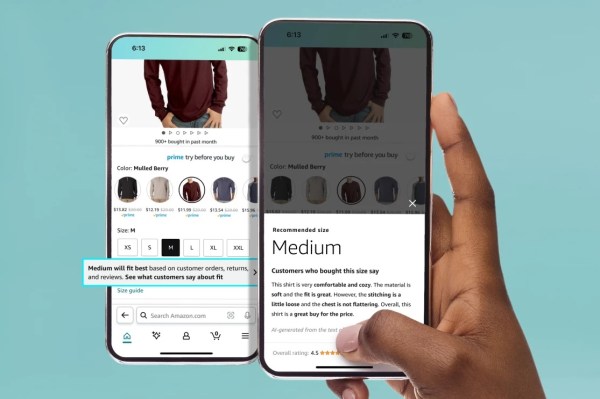
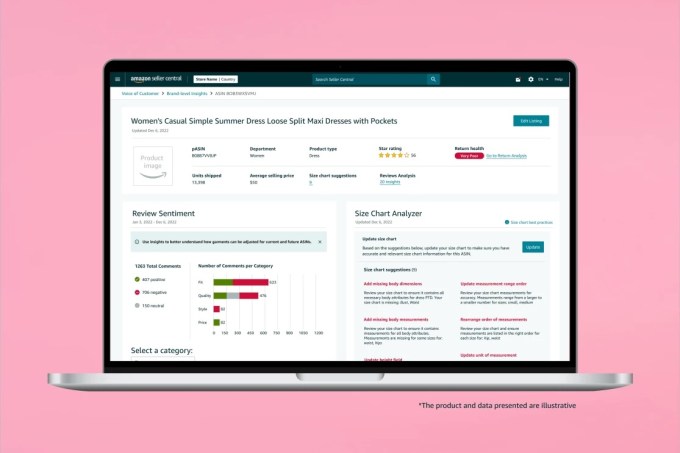
To address this challenge, Amazon has introduced AI into the online shopping experience in four ways: in personalized size recommendations, a “Fit Insights” tool for sellers, AI-powered highlights from fit reviews left by other customers, and reimagined size charts.

With the personalized size recommendations, Amazon Fashion used AI to develop a deep learning algorithm that will help customers find their best-fitting size across a variety of styles.

This system works by considering the size relationship between brands’ size systems, the product’s reviews, and the customer’s own fit preferences. The information is combined in real-time to make suggestions of the best-fitting size for a customer and adapts as the customer’s size needs change. The company also uses AI to help them discover the styles that fit them best. However, this feature can be imperfect if a family member regularly shops for another (like their son or daughter) online, as it confuses the system as to what size the customer is versus the child.

Another new feature, “Fit Review Highlights,” could help to combat that problem, however. This feature is an extension of the newly added AI-generated Customer Review Highlights introduced in August 2023, which provide a short paragraph summary that details the customer sentiment and product features, as well as provides key product attributes as clickable buttons.

Image Credits: Amazon

With the Fit Review Highlights, Amazon extracts information about the apparel’s fit from the customer reviews, including things like size accuracy garment fit on specific body areas, and fabric stretch. Large language models extract details from the customer reviews and then AI summarizes the findings into an easy-to-read highlight personalized to the user, Amazon explains. This could help save users time as they wouldn’t have to read through hundreds of reviews to get a sense of the item’s fit.

The retailer is also now leveraging AI to improve size charts across the site. With large language models, Amazon Fashion is extracting and cleaning product size charts from multiple sources and then transforming the data into standardized sizes. This process will remove duplicate information and auto-correct missing or incorrect measurements, leading to more accurate charts — and therefore, fit.

Sellers, too, will gain access to AI-powered insights. With a Fit Insights Tool from Amazon Fashion, sellers are provided with an understanding of customer’s fit needs so they can improve how they communicate sizing to customers — e.g. “true to size,” or if an item runs smaller or larger, for instance.

This information can also be used to guide their future manufacturing efforts, Amazon notes. In this case, large language models are used to extract and aggregate customer feedback on fit, style, and fabric in addition to returns, size chart analyses, and customer reviews. Machine learning is also used to identify errors in the brand’s size charts, if any.

Image Credits: Amazon

These features are only a handful of AI advances that Amazon has employed AI to improve the shopping experience on its site in recent months. Beyond the customer review highlights, Amazon also debuted generative AI tools to help sellers write their product descriptions and enhance their product images. The latter could boost click-through rates by 40%, the retailer estimated at the time. Outside of Amazon Web Services, the company has also brought AI to other consumer products, including Alexa and Fire TV.

OpenAI is Slowly Turning into a Healthcare Company  

Recently, OpenAI partnered with WHOOP to introduce a personalised health and fitness coach driven by GPT-4. WHOOP Coach provides answers to a wide range of fitness and health-related queries.

For instance, it can address questions like, “What was my lowest resting heart rate ever?” or “What weekly workout schedule would help me reach my goal?” — all while offering personalised guidance based on each individual’s unique body and goals.

Apart from WHOOP, OpenAI has also partnered with Summer Health, a 24×7 text-based pediatric care service, using GPT-4 to assist its doctors. Summer Health has built and launched their new feature, which uses GPT-4 to automatically generate visit notes from a doctor’s detailed written observations.

These notes are then quickly reviewed by the pediatrician before being shared with parents. In collaboration with OpenAI, Summer Health rigorously fine-tuned the model, added a clinical review process to ensure accuracy and relevance in medical contexts, and continues to improve the model based on expert feedback.

Moreover, GPT Vision has found applications in radiology as well. Microsoft recently published a paper titled ‘Exploring the Boundaries of GPT-4 in Radiology‘, which assesses the performance of GPT-4 in text-based applications for radiology reports.

One of the primary applications of GPT-4 in radiology lies in its ability to process and comprehend medical images, ranging from X-rays to MRIs. The paper said, “The radiology report summaries created by GPT-4 are comparable, and in some cases, even preferred over those written by experienced radiologists.”

Additionally, Be My Eyes is utilising GPT-4’s multimodal capabilities, specifically the visual input feature, to enhance their app, which acts as a virtual assistant. Be My Eyes aids visually impaired users with tasks such as identifying objects, reading text, and navigating their environment.”

On the mental wellness side, numerous users have experimented with ChatGPT as a therapist. Many individuals have found ChatGPT to be helpful in providing practical advice and human-like interaction, offering a unique alternative to those unable or unwilling to seek professional therapy.

What Others are Doing

Prior to OpenAI, both Google and Apple have been making significant advancements using LLMs in the healthcare industry.

Google recently introduced MedLM, a family of foundation models specifically fine-tuned for various healthcare use cases. Currently, there are two models under MedLM, both built on Med-PaLM 2, providing flexibility for healthcare organisations and addressing their diverse needs.

In contrast, Apple plans to incorporate additional health detection features in their upcoming series of watches, focusing on conditions such as hypertension and apnea, among others.

Moreover, Isomorphic Labs, the London-based drug discovery spin-out of Google AI R&D division DeepMind, has entered into strategic partnerships with two pharmaceutical giants, Eli Lilly and Novartis, to apply AI to discover new medications to treat diseases.

Last year, Oracle introduced Clinical Digital Assistant, which integrates with Oracle’s EHR systems, allowing doctors to use voice commands for tasks like note-taking, scheduling appointments, and ordering medication.

Similar to Isomorphic Labs, partnering with healthcare institutions and researchers would grant OpenAI access to diverse medical data, crucial for refining their AI models and accelerating product development. Furthermore, venturing into healthcare diversifies OpenAI’s revenue streams, reducing vulnerability to fluctuations in other sectors.

The post OpenAI is Slowly Turning into a Healthcare Company appeared first on Analytics India Magazine.

A/B Testing: A Comprehensive Guide

A/B testing, also known as “split testing” or “randomized controlled trial” is a method of comparing two versions of a web page, app, or other product to see which one performs better. The basic idea of A/B testing is to divide your users into two groups: group A and group B. Group A (control variant) sees the original version of your product, while group B (test variant) sees a modified version with one or more changes. The changes can be anything from the color of a button, the layout of a page, the wording of a headline, backend algorithm powering your search result or the offer of a promotion. You then measure how each group behaves, such as how long users stay on your product, how many pages they visit, how many actions they take, or how much revenue they generate. By comparing the outcomes of each variant, you can determine which one is more effective at achieving your goal. If there are 2 variants it is referred to as A/B test and when there are more than 2 variants it is often referred to as A/B/C or A/B/N tests.

By running A/B tests, you can make data-driven decisions that improve your product and your business outcomes. An effective A/B test is one where you feel confident in making decisions based on the results. In this article, we will go over the basics of A/B testing, how to design and run an effective experiment, and how to analyze and interpret the results.

A/B Testing Can Help You Answer Questions Like:

  • Which headline attracts more clicks?
  • Which layout increases engagement?
  • Which offer boosts sales?
  • Which feature reduces churn?

When to Run A/B Tests?

There is no definitive answer to this question, as it depends on your goals, resources, and context. If you are wondering how new features would impact user engagement and impact key business metrics, A/B testing is a perfect candidate. However, some general guidelines are:

  • Run A/B tests when you have enough traffic and conversions to get reliable results.
  • Run A/B tests when you have a clear hypothesis and a measurable outcome.
  • Run A/B tests when you have enough time to run them properly to avoid common pitfalls such as peeking, stopping too early, or running too many tests at once.
  • Run A/B tests when you are ready to act on the results.

Let’s say you join as a Product Manager from company Contoso. You believe that changing the color of the BUY button would result in improved engagement and higher number of units sold. As a Product Manager you have an intuition that changing the color to blue would result in higher sales. Sometimes your intuition is correct and sometimes it’s wrong. How will you know this? Which is why your goal is to gather user insights into how the color of the button would impact user experience and key business metrics like revenue.

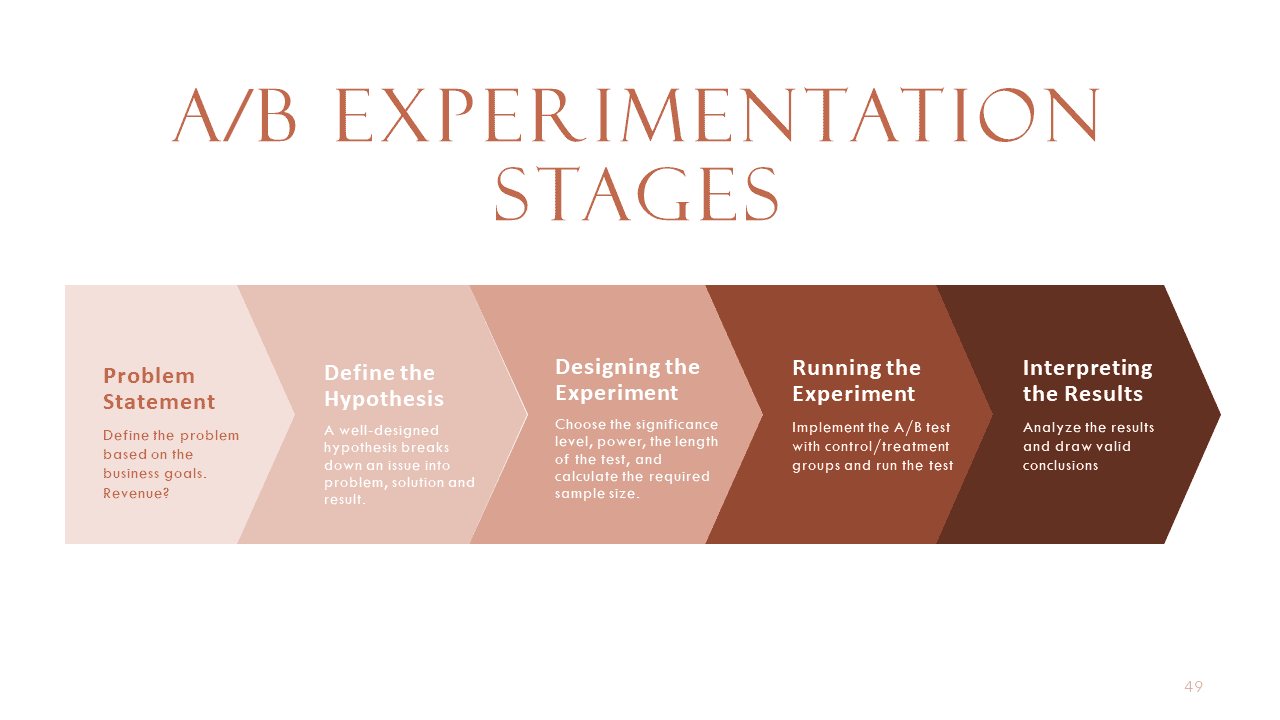
The steps involved in Running A/B Experimentation could be broken down as follows:

A/B Testing: A Comprehensive Guide Problem Statement

A problem statement is a clear and concise description of the issue that needs to be addressed by an A/B experiment. It should include the current situation, the desired outcome, and the gap between them. A well-defined problem statement helps to focus the experiment design, align the stakeholders, and measure the success of the experiment. Before running an A/B experiment, it is important to define the problem statement to avoid wasting resources, time, and effort on irrelevant or invalid tests. Depending on the industry the problem statement could differ.

Some examples of problem statements depending on the industry are:

Travel Companies like Expedia, Booking.com
  • Increase the number of bookings.
  • Increase the number of customer reviews.
Media Companies like Netflix, Hulu
  • Increase customer engagement.
  • Increase subscription rate.
E-Commerce Company like Amazon, Walmart
  • Increase in products searched and viewed.
  • Increase in add-to-cart rate.
Social Media Companies like Instagram, Facebook
  • Increase in revenue through advertisements.
  • Increase engagement through comments, likes, shares

Define the Hypothesis

What is a Hypothesis? A hypothesis in A/B experimentation is a testable statement that predicts how a change in a website or app will affect a certain metric or user behavior.

The three steps of defining the Hypothesis include:

  1. We know we have [this problem] based on [evidence].
  2. You believe we should implement [this change] to achieve [this outcome] as this would improve [this problem].
  3. We know we have achieved [this outcome] when we see [this metric] change.

Examples of a Hypothesis include:

  1. We are seeing [lesser number of units sold] on E-Commerce website through [sales data] for the last year.
  2. We believe that Incorporating social proof elements, such as showcasing the number of people who have purchased a particular product within a specific time frame[for example, “X” people purchased in the last 24 hours], can create a sense of urgency and [influence visitors to make a purchase]. This psychological trigger taps into the fear of missing out and [encourages potential buyers to convert].
  3. We know we have achieved [higher conversions] when we see [revenue increase/units sold increase].

Null Hypothesis (Equation): The average revenue per day per user between the baseline and variant treatments are the same.

Alternate Hypothesis (Equation): The average revenue per day per user between the baseline and variant treatments are different.

Significance level: Equation: Lower the significance level more statistical significance that the difference between control and variant didn’t happen by chance.

Statistical Power: Equation: Probability of detecting an effect if the alternate hypothesis is true.

Designing the Experiment

To run a successful experiment, you need to collaborate with different teams and follow some steps. First, you need to define your key metric, which is a quantitative measure that reflects how well you are achieving your goals. For example, if you want to test whether changing the color of the buy button on your website affects the sales, your key metric would be the revenue per user per month. This metric captures the effect of the color change on the user behavior and the business outcome. Second, you need to work with the UX team to design two versions of the buy button: one with the original color and one with the new color. These are called the control variant and the test variant. The UX team can help you ensure that the design is consistent, appealing and user-friendly. Third, you need to work with the engineering team to implement and deploy the two variants on your website. The engineering team can help you ensure that the code is bug-free, secure and scalable. Fourth, you need to work with the data team to set up a monitoring system that tracks and collects the key metric data from both variants. The data team can help you ensure that the data is accurate, reliable and accessible. Fifth, you need to decide how to randomize the users who visit your website into either the control group or the test group. Randomization is important because it ensures that the two groups are statistically similar and that any difference in the key metric is due to the color change and not some other factors. You can use different methods of randomization, such as cookie-based, user ID-based or IP-based. Sixth, you need to determine how many users you need in each group to detect a significant difference in the key metric. This is called the sample size and it depends on several factors, such as the expected effect size, the standard deviation of the key metric, the significance level and the power of the test. You can use a formula or a calculator to estimate the sample size based on these factors.

Equation

Running the Experiment

The next step in the experimentation process is to launch your experiment to a subset of your users and monitor its performance. You should start with a low exposure rate and gradually increase it as you gain confidence in your experiment. You should also collect data on the key metrics that you defined in your hypothesis and track how they change over time. To help you with this, you should partner with the Dev team to build a dashboard that displays the metric values and their statistical significance. You should avoid peeking at the results and drawing premature conclusions before the experiment is over. You should also run your experiment for a sufficient duration to ensure that you have enough data to make a valid decision. Depending on your traffic volume and conversion rate, this could take days, weeks, or months.

Interpreting the Results

Before you launch any change based on your experiment, you need to perform some sanity checks to ensure that your data is reliable and valid. Sanity checks are quality control measures that help you detect any errors or anomalies in your data collection or analysis process. For example, you can check if the traffic allocation was done correctly, if the invariant metrics were consistent across the experiment groups, and if there were any external factors that could have influenced the results. If you find any issues with your data, you should discard it and rerun the experiment with the correct setup.

Once you have verified that your data is trustworthy, you can proceed to launch the change. To do this, you need to analyze your results and draw conclusions based on your hypothesis and success metrics. You can use statistical methods such as hypothesis testing, confidence intervals, and effect size to compare the performance of your variations and see if there is a clear winner or a tie. If there is a winner, you can implement the winning variation on your website or app and end the experiment. If there is a tie, you may need to run another experiment with a different hypothesis or a larger sample size to get more conclusive results.

Poornima Muthukumar is a Senior Technical Product Manager at Microsoft with over 10 years of experience in developing and delivering innovative solutions for various domains such as cloud computing, artificial intelligence, distributed and big data systems. I have a Master's Degree in Data Science from the University of Washington. I hold four Patents at Microsoft specializing in AI/ML and Big Data Systems and was the winner of the Global Hackathon in 2016 in the Artificial Intelligence Category. I was honored to be on the Grace Hopper Conference reviewing panel for the Software Engineering category this year 2023. It was a rewarding experience to read and evaluate the submissions from talented women in these fields and contribute to the advancement of women in technology, as well as to learn from their research and insights. I was also a committee member for the Microsoft Machine Learning AI and Data Science (MLADS) June 2023 conference. I am also an Ambassador at the Women in Data Science Worldwide Community and Women Who Code Data Science Community.

More On This Topic

  • Hypothesis Testing and A/B Testing
  • A Comprehensive Guide to Ensemble Learning – Exactly What You Need to Know
  • Comprehensive Guide to the Normal Distribution
  • A Comprehensive Guide to MLOps
  • NLP, NLU, and NLG: What’s The Difference? A Comprehensive Guide
  • A Comprehensive Guide to Convolutional Neural Networks

Textual predictive coding: Do LLMs and the human mind compare?

Developing programmer Team Development Website design and coding

There is a new letter on TIME, What Generative AI Reveals About the Human Mind, where a professor wrote, “Natural brains must learn to predict those sensory flows in a very special kind of context—the context of using the sensory information to select actions that help us survive and thrive in our worlds. This means that among the many things our brains learn to predict, a core subset concerns the ways our own actions on the world will alter what we subsequently sense.”

“At first sight, this suggest that ChatGPT might more properly be seen as a model of our textual outputs rather than (like biological brains) models of the world we live in. That would be a very significant difference indeed. Still missing, however, is that crucial ingredient—action.”

Comparisons, if necessary, of predictive similarities between the human mind and generative AI should be limited to texts, for fair assessment. Why does the mind not confabulate or hallucinate like LLMs, even in cases of memorization?

There are examples of people who have read about things they have never experienced and had situations, like exams, where they had to recall absolute abstractions. Why does the mind not just conjure the next likely?

The emergence of generative AI should have rebutted any possibility that the human mind predicts. Even if the observation seems so, just because generative AI does, the “occasional catastrophic failures” should have shown that there is no comparison there, and the label for what the brain might be doing should have changed.

If the brain were predicting, how does it? If the answer is that it is not the brain, then if it were the mind, how?

What is the human mind, in a way that is different from the brain, or the body? How come it is possible to have the mind present options that appear like predictions but can be corrected if inaccurate?

Someone might step on the actual tail of a cat, or step on something that seems like it. In both cases, the mind might present options, if it matchesafter looking downthen some options presented either way is followed, if not, the incoming input is corrected. This applies also to texts, for humans, where correction often follows, or distributions are not just what next.

Assuming the human mind were predicting, there will be nothing like “using the sensory information to select actions that help us survive and thrive in our worlds” because hallucinations or confabulations would have resulted in many mistakes. So, what might be happening?

The human mind is postulated to be the collection of all the electrical and chemical impulses of nerve cells, with their features and interactions. Impulses carry out functions in sets, within clusters of neurons.

It is established in brain science that electrical impulses leap from node to node in myelinated axons, in a process called saltatory conduction. It is proposed that in sets, some electrical impulses [in the incoming bundle] split from others, to go ahead to interact with chemical impulses, like before, within a set or elsewhere. If the input [cat tail] matches with what went ahead, the second part of the bundle follows in the same direction [and maybe weakly, or in pre-prioritization] for what may result but if not, the incoming one [not cat tail] goes in the right direction, then no “next sensory stimulations”.

This explains the observation of predictive coding, processing and prediction error. The brain is not predicting, electrical impulses, conceptually, are splitting early. This applies to internal and external senses. Splits [of electrical impulses] lead distributions, applying as well to holding things in mind, while speaking or writing.

The human mind can be said to prepare options not predict, even as changes to outputs are probable at the last minute. Also, the outcomes are often possibilities, not just to predict and complete, like LLMs, which may sometimes be inaccurate.