New York-based RPA firm UiPath Partners with BHASHINI to Enable Indic Language Translation

BHASHINI and UiPath have formally signed a Memorandum of Understanding (MoU) signaling a pivotal move towards wider adoption of BHASHINI and the UiPath Business Automation Platform.

The focus of this collaboration is the integration of BHASHINI’s language models with the UiPath Business Automation Platform. The aim is to facilitate seamless language translations of documents and other essential areas, specifically targeting Indian languages supported by BHASHINI.

We are thrilled to announce the Memorandum of Understanding (MoU) signing between UiPath and #BHASHINI! 🤝 This partnership marks a significant step towards greater adoption of #BHASHINI and UiPath Business Automation Platform.@GoI_MeitY @amitabhnag @UiPath @_DigitalIndia pic.twitter.com/0uM1RqlWC9

— BHASHINI (@_BHASHINI) January 10, 2024

UiPath is a New York based leading automation software company specialising in Robotic Process Automation (RPA). In simpler terms, they create digital robots that can mimic human actions to automate repetitive tasks within computer applications and software.

On the other hand, Bhashini operates as an AI-driven language translation system, breaking down language barriers and enabling conversations between speakers of different Indian languages. The platform is accessible through dedicated Android and iOS apps, providing a user-friendly experience.

During the inauguration ceremony of Kashi Tamil Sangamam 2.0 in Varanasi, Indian Prime Minister Narendra Modi recently used the real-time Artificial Intelligence-based translation tool BHASHINI while addressing the audience who understood Tamil.

Bhashini has also partnered with RBIH (Reserve Bank innovation Hub) to launch the Reserve Bank of India’s Public Tech Platform for Frictionless Credit in multiple languages to make financial services more accessible across languages.
Bhashini’s commitment to open-source datasets and models, along with its crowdsourcing initiative “Bhasadaan,” strengthens the platform’s evolution and accuracy, fostering collaboration within India’s AI community.

The post New York-based RPA firm UiPath Partners with BHASHINI to Enable Indic Language Translation appeared first on Analytics India Magazine.

JPMorgan Scientist Unveils Phixtral, Mixture of Mistral with Phi-2

Mistral just released the paper of their Mixtral of Experts model and there are new models already coming in. Maxime Labonne, Sr. Machine Learning Scientist at JPMorgan, has introduced Phixtral, a novel Mixture of Experts (MoE) model built with Microsoft Phi-2 models.

Click here to check out the model.

Labonne’s creation combines 2 to 4 fine-tuned models, each containing 2.8 billion parameters, surpassing the performance of individual experts, drawing inspiration from Mistral AI’s Mixtral architecture while developing Phixtral.

Phixtral can run with 4-bit precision on a free T4 GPU.

Phixtral is presented in two variations: phixtral-2x2_8 and phixtral-4x2_8. The former represents the first MoE made with two microsoft/phi-2 models, inspired by the mistralai/Mixtral-8x7B-v0.1 architecture, and outperforms individual experts.

Meanwhile, the latter, phixtral-4x2_8, stands out as the inaugural MoE incorporating four microsoft/phi-2 models, once again surpassing the capabilities of individual experts.

The model’s efficiency is underscored by its ability to outperform each individual expert, marking a notable advancement in MoE design.

On ‘Yet Another LLM Leaderboard’ (YALL), the model performed better than base phi-2 and just below Zephyr2-7B.

Phixtral’s underlying architecture, represented by models like dolphin-2_6-phi-2, phi-2-dpo, phi-2-sft-dpo-gpt4_en-ep1, and phi-2-coder, showcases the collaborative effort of various model authors. Labonne emphasises the significance of these models in the creation of Phixtral, highlighting their exceptional capabilities.

The post JPMorgan Scientist Unveils Phixtral, Mixture of Mistral with Phi-2 appeared first on Analytics India Magazine.

4 Steps to Become a Generative AI Developer

Introduction 4 Steps to Become a Generative AI Developer
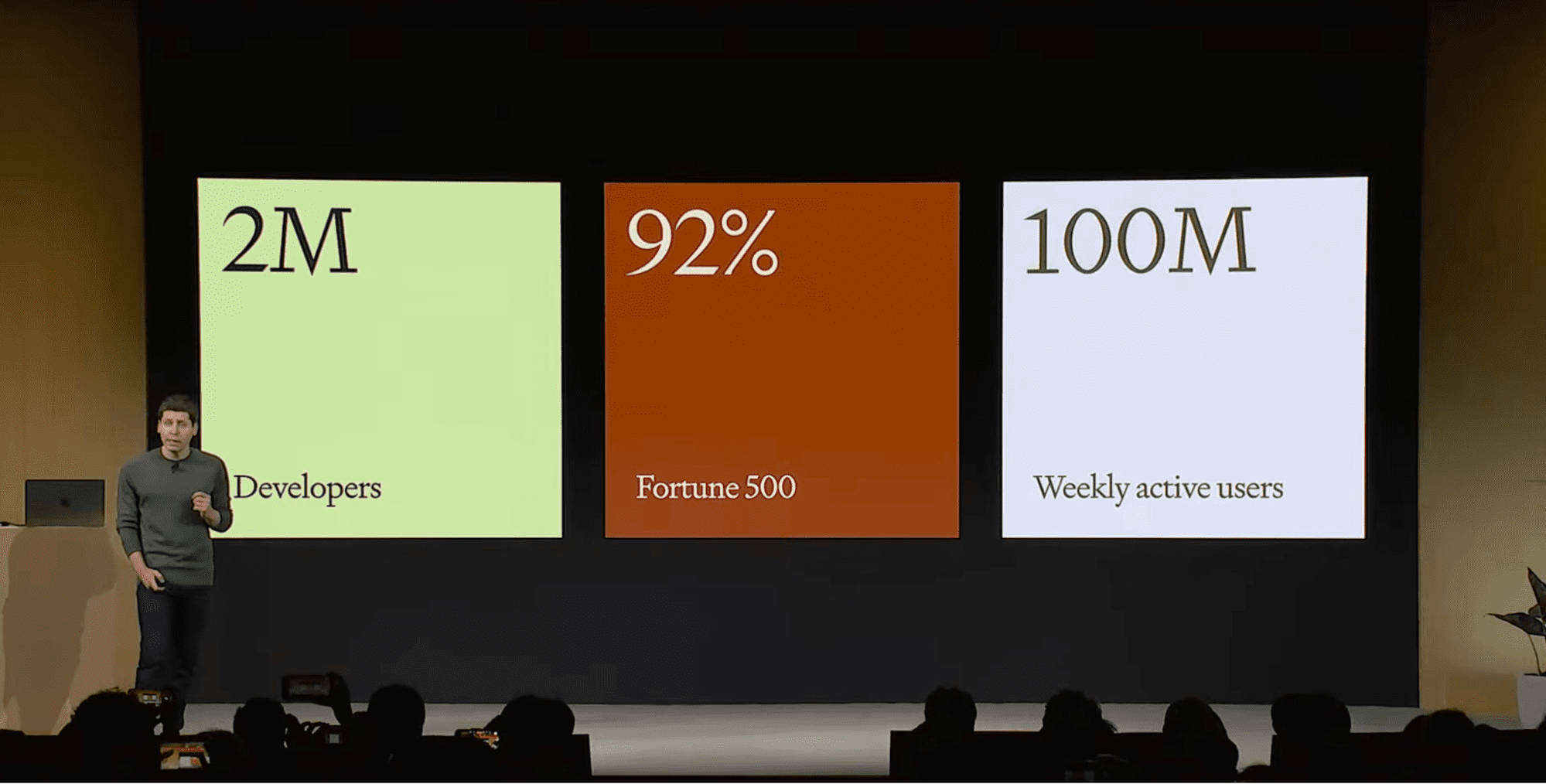
Sam Altman, OpenAI's CEO, presents product usage numbers at the OpenAI Developer Day in October 2023. OpenAI consider three customer segments: developers, businesses, and general users. link: https://www.youtube.com/watch?v=U9mJuUkhUzk&t=120s

At the OpenAI Developer Day in October 2023, Sam Altman, OpenAI's CEO, showed a slide on product usage across three different customer segments: developers, businesses, and general users.

In this article, we're going to focus on the developer segment. We'll cover what a generative AI developer does, what tools you need to master for this job, and how to get started.

Step 1: Understand What a Generative AI Developer Does

While a few companies are dedicated to making generative AI products, most generative AI developers are based in other companies where this hasn't been the traditional focus.

The reason for this is that generative AI has uses that apply to a wide range of businesses. Four common uses of generative AI apply to most businesses.

Chatbots

4 Steps to Become a Generative AI Developer
Image Generated by DALL·E 3

While chatbots have been mainstream for more than a decade, the majority of them have been awful. Typically, the most common first interaction with a chatbot is to ask it if you can speak to a human.

The advances in generative AI, particularly large language models and vector databases, mean that that is no longer true. Now that chatbots can be pleasant for customers to use, every company is busy (or at least should be busy) scrambling to upgrade them.

The article Impact of generative AI on chatbots from MIT Technology Review has a good overview of how the world of chatbots is changing.

Semantic search

Search is used in a wide variety of places, from documents to shopping websites to the internet itself. Traditionally, search engines make heavy use of keywords, which creates the problem that the search engine needs to be programmed to be aware of synonyms.

For example, consider the case of trying to search through a marketing report to find the part on customer segmentation. You press CMD+F, type "segmentation", and cycle through hits until you find something. Unfortunately, you miss the cases where the author of the doc wrote "classification" instead of "segmentation".

Semantic search (searching on meaning) solves this synonym problem by automatically finding text with similar meanings. The idea is that you use an embedding model—a deep learning model that converts text to a numeric vector according to its meaning—and then finding related text is just simple linear algebra. Even better, many embedding models allow other data types like images, audio, and video as inputs, letting you provide different input data types or output data types for your search.

As with chatbots, many companies are trying to improve their website search capabilities by making use of semantic search.

This tutorial on Semantic Search from Zillus, the maker of the Milvus vector database, provides a good description of the use cases.

Personalized content

4 Steps to Become a Generative AI Developer
Image Generated by DALL·E 3

Generative AI makes content creation cheaper. This makes it possible to create tailored content for different groups of users. Some common examples are changing the marketing copy or product descriptions depending on what you know about the user. You can also provide localizations to make content more relevant for different countries or demographics.

This article on How to achieve hyper-personalization using generative AI platforms from Salesforce Chief Digital Evangelist Vala Afshar covers the benefits and challenges of using generative AI to personalize content.

Natural language interfaces to software

As software gets more complicated and fully featured, the user interface gets bloated with menus, buttons, and tools that users can't find or figure out how to use. Natural language interfaces, where users want to explain what they want in a sentence, can dramatically improve the useability of software. "Natural language interface" can refer to either spoken or typed ways of controlling software. The key is that you can use standard human-understandable sentences.

Business intelligence platforms are some of the earlier adopters of this, with natural language interfaces helping business analysts write less data manipulation code. The applications for this are fairly limitless, however: almost every feature-rich piece of software could benefit from a natural language interface.

This Forbes article on Embracing AI And Natural Language Interfaces from Gaurav Tewari, founder and Managing Partner of Omega Venture Partners, has an easy-to-read description of why natural language interfaces can help software usability.

Step 2: Understand What Tools a Generative AI Developer Uses

Firstly, you need a generative AI model! For working with text, this means a large language model. GPT 4.0 is the current gold standard for performance, but there are many open-source alternatives like Llama 2, Falcon, and Mistral.

Secondly, you need a vector database. Pinecone is the most popular commercial vector database, and there are some open-source alternatives like Milvus, Weaviate, and Chroma.

In terms of programming language, the community seems to have settled around Python and JavaScript. JavaScript is important for web applications, and Python is suitable for everyone else.

On top of these, it is helpful to use a generative AI application framework. The two main contenders are LangChain and LlamaIndex. LangChain is a broader framework that allows you to develop a wide range of generative AI applications, and LlamaIndex is more tightly focused on developing semantic search applications.

If you are making a search application, use LlamaIndex; otherwise, use LangChain.

It's worth noting that the landscape is changing very fast, and many new AI startups are appearing every week, along with new tools. If you want to develop an application, expect to change parts of the software stack more frequently than you would with other applications.

In particular, new models are appearing regularly, and the best performer for your use case is likely to change. One common workflow is to start using APIs (for example, the OpenAI API for the API and the Pinecone API for the vector database) since they are quick to develop. As your userbase grows, the cost of API calls can become burdensome, so at this point, you may want to switch to open-source tools (the Hugging Face ecosystem is a good choice here).

Step 3: Learn Some Skills to Get Started

As with any new project, start simple! It's best to learn one tool at a time and later figure out how to combine them.

The first step is to set up accounts for any tools you want to use. You'll need developer accounts and API keys to make use of the platforms.

A Beginner's Guide to The OpenAI API: Hands-On Tutorial and Best Practices contains step-by-step instructions on setting up an OpenAI developer account and creating an API key.

Likewise, Mastering Vector Databases with Pinecone Tutorial: A Comprehensive Guide contains the details for setting up Pinecone.

What is Hugging Face? The AI Community's Open-Source Oasis explains how to get started with Hugging Face.

Learning LLMs

To get started using LLMs like GPT programmatically, the simplest thing is to learn how to call the API to send a prompt and receive a message.

While many tasks can be achieved using a single exchange back and forth with the LLM, use cases like chatbots require a long conversation. OpenAI recently announced a "threads" feature as part of their Assistants API, which you can learn about in the OpenAI Assistants API Tutorial.

This isn't supported by every LLM, so you may also need to learn how to manually manage the state of the conversation. For example, you need to decide which of the previous messages in the conversation are still relevant to the current conversation.

Beyond this, there's no need to stop when only working with text. You can try working with other media; for example, transcribing audio (speech to text) or generating images from text.

Learning vector databases

The simplest use case of vector databases is semantic search. Here, you use an embedding model (see Introduction to Text Embeddings with the OpenAI API) that converts the text (or other input) into a numeric vector that represents its meaning.

You then insert your embedded data (the numeric vectors) into the vector database. Searching just means writing a search query, and asking which entries in the database correspond most closely to the thing you asked for.

For example, you could take some FAQs on one of your company's products, embed them, and upload them into a vector database. Then, you ask a question about the product, and it will return the closest matches, converting back from a numeric vector to the original text.

Combining LLMs and vector databases

You may find that directly returning the text entry from the vector database isn't enough. Often, you want the text to be processed in a way that answers the query more naturally.

The solution to this is a technique known as retrieval augmented generation (RAG). This means that after you retrieve your text from the vector database, you write a prompt for an LLM, then include the retrieved text in your prompt (you augment the prompt with the retrieved text). Then, you ask the LLM to write a human-readable answer.

In the example of answering user questions from FAQs, you'd write a prompt with placeholders, like the following.

"""  Please answer the user's question about {product}.  ---  The user's question is : {query}  ---  The answer can be found in the following text: {retrieved_faq}  """

The final step is to combine your RAG skills with the ability to manage message threads to hold a longer conversation. Voila! You have a chatbot!

Step 4: Keep Learning!

DataCamp has a series of nine code-alongs to teach you to become a generative AI developer. You need basic Python skills to get started, but all the AI concepts are taught from scratch.

The series is taught by top instructors from Microsoft, Pinecone, Imperial College London, and Fidelity (and me!).

You'll learn about all the topics covered in this article, with six code-alongs focused on the commercial stack of the OpenAI API, the Pinecone API, and LangChain. The other three tutorials are focused on Hugging Face models.

By the end of the series, you'll be able to create a chatbot and build NLP and computer vision applications.

Richie Cotton is a Data Evangelist at DataCamp. He is the host of the DataFramed podcast, he's written 2 books on R programming, and created 10 DataCamp courses on data science that have been taken by over 700k learners.

More On This Topic

  • Become a Data Science Professional in Five Steps
  • KDnuggets News March 16, 2022: Learn Data Science Fundamentals & 5…
  • On-device AI with Developer-Ready Software Stacks
  • Software Developer vs Software Engineer
  • 25 Github Repositories Every Python Developer Should Know
  • AI + No-Code: The Viral Combo Redefining Developer Innovation

Prepare for AI-powered ‘agent ecosystems’ that will dominate tomorrow’s services

connected cityscape

Today's artificial intelligence (AI) solutions might be adept at handling single tasks, but as these systems begin to talk to each other, something more profound is evolving.

AI-powered agents or automated assistants, which are already being widely used, are starting to communicate with each other, creating powerful ecosystems that are poised to reshape the way people interact with technology. This transformation, in turn, will create demand for skilled people who can develop, oversee, and set guardrails for these agent networks.

Also: Five ways to use AI responsibly

That's the word from consultant Accenture, whose researchers have issued a thoughtful analysis on the rise of agent ecosystems and human-centered technology that is driven by AI and other disruptive systems. Technology is becoming more human-like and intuitive for people to use, says the report, which is written by Paul Daugherty, Adam Burden, and Michael Biltz, all with Accenture. "We are moving toward a world where the technology around us will become more omni-present, yet also more invisible," they state.

The rise of agent ecosystems — large networks of interconnected AIs — "will push enterprises to think about their intelligence and automation strategy in a fundamentally different way," Daugherty and his co-authors explain. These ecosystems will develop as AI evolves from performing singular tasks to supporting agents, "that, with appropriate oversight, can work with one another and act as proxies for people and enterprises alike."

Also: The best AI chatbots: ChatGPT and other noteworthy alternatives

These connected, AI-powered agents, "not only assist and advise us, but also take decisive actions on our behalf in both the physical and digital worlds."

Agent ecosystems will amplify productivity to new levels, the report co-authors continue. As AI evolves into agents, "automated systems will make decisions and take actions on their own. Agents won't just advise humans, they will act on humans' behalf. AI will keep generating text, images, and insights, but agents will decide for themselves what to do with it."

The authors point to DoNotPay, "a company designed to help consumers save money — from contesting parking tickets to identifying unused subscriptions," as an example of agent-driven services.

Yet the agents, "will only be as valuable as the humans that guide them. Human knowledge and reasoning will give one network of agents the edge over another," the researchers caution.

Also: Today's AI boom will amplify social problems if we don't act now

The people needed to build and manage agent networks will require skills to set guidelines. "Humans need to embed rules, knowledge, and reasoning skills, and then rigorously test agents to ensure their readiness," the Accenture team urges. "As agent ecosystems evolve, humans have two primary responsibilities — to engender trust in semi-autonomous systems, building agent support systems, and refining machine reasoning."

What's clear is that the decisions your employees make, for better or worse, are about to be amplified, Daugherty and his co-authors point out: "A company's level of trust in their autonomous agents will determine the value their agents can create. Your human talent is responsible for building that trust."

While AI is mainly a tool that handles narrow tasks, ultimately, "AI agents will operate our companies," the report predicts. "It is our job to make sure they don't run amok. Given the pace of AI evolution, the time to start onboarding your agents is now."

Artificial Intelligence

AI is Not the Main Villain behind Tech Layoffs

Another tech company has axed its employees and once again fingers are being pointed at AI. Language learning app Duolingo, with the famous green owl mascot, has been in the news for letting go 10% of its staff. But, like many tech layoff stories attributed to the ‘AI effect’, there’s more to it than meets the eye.

AI advisor, Vin Vashista took to LinkedIn to clarify that Duolingo didn’t renew 10% of its contract translation workers for 2024. Some of the remaining contractors are focused on checking the quality of the AI-generated content and translation.

On a positive note, he also said that while job changes are happening, people still have the chance to learn new skills. He warned that the real mistake would be to ignore new technology instead of learning to use it.

The most frequently downloaded education app is no stranger to AI. However, some Duolingo users claim that AI can’t replace the human touch, especially for language training with unique dialects with distinct nuances.

A slew of new language-learning apps are experimenting with open source code to build AI tools.People around the world are trying them out to get better at languages, as reported by the BBC. But these AI chatbots still mess up sometimes, especially with languages that aren’t common or from Europe.

Another problem persists, for example, US immigration officials using AI to understand asylum claims have people worried about getting things wrong.

Blame it on AI

Negative impacts are being discussed since the industry started experiencing the generative AI boom in late 2022. While labour leaders have genuinely been worried about the technology’s impact, companies appear to be using AI as just another reason to blame for firing their employees.

The most recent instance is of Indian fintech company Paytm which laid off 1,000 employees, which is around 10% of its total, from its sales, operations. The company spokesperson stated AI as the reason but did not divulge the details of how exactly was AI replacing these jobs.

“We will be able to save the targeted 10% to 15% that we had planned in employee costs, all because AI has actually delivered more than what we expected it to,” One 97 Communications, Paytm’s parent company’s CEO Vijay Shekhar Sharma told Bloomberg a month ago without mentioning the details.

Paytm was one of the Indian startups which struck gold through venture capital and is now facing financial difficulties. For companies akin, it appears that laying off tons of employees and then portraying it was due to redundancy is becoming a norm.

The company has reportedly been in loss at least for the past two years as per the balance sheets. Simultaneously, the company has been partnering with companies to bring in AI solutions.

On-ground Report

Long before ChatGPT entered our offices, an irrational panic around AI was wrongly brought into the picture by companies. With these fears amplified by the media, it is extremely difficult for the public to think about any other issue with AI apart from job loss.

A report released by Goldman Sachs in May 2023 is the perfect example of the new cycle of fear mongering reporting. Goldman did not claim that AI will take away 300 million jobs entirely but rather some tasks within those jobs could be automated using AI.

The report also mentions that automation doesn’t always mean people will lose their jobs as new jobs are also created because of technology. But even with clarity from researchers, the media chose to focus on the clickbait headlines.

Layoffs are a reality but AI is parallelly enabling the tech honchos to restructure and the existing job roles. The tech layoffs are not just a collateral damage of generative AI becoming famous; it is a result of overhiring during the pandemic and the ongoing global economic uncertainty.

Currently the AI-induced layoffs reflect more fear than the opportunity to reestablish the work culture imbued with monotonous tasks. With AI tackling task-based work, humans have the opportunity to move up the value chain, Marc Cenedella, founder of Leet Resumes and Ladders clarified while speaking to CNBC.

The post AI is Not the Main Villain behind Tech Layoffs appeared first on Analytics India Magazine.

OpenAI Cares About NYT a Little Too Much

A few days back, OpenAI responded to The New York Times lawsuit saying that it holds no ground, and is telling only half truth. This is the first time that OpenAI publicly shared its stance on copyright infringement lawsuits, outside of their legal proceedings, hinting at the importance of publishers and news agencies to develop reliable AI systems.

OpenAI claimed the news organisation is not ‘telling the full story.’ It also alleged that NYT intentionally manipulated prompts with lengthy excerpts to get their model to regurgitate the original article. “The regurgitations New York Times induced appear to be from years-old articles that have proliferated on multiple third-party websites,” read the blog.

The company also said that this sort of a regurgitation is a rare occurrence and that it is constantly updating its systems to be more resistant to adversarial attacks that regurgitate training data.

“After reading the New York Times lawsuit against OpenAI and Microsoft , I find my sympathies more with OpenAI and Microsoft than with the NYT,” shared Andrew Ng, in a recent post on X.

He said that the regurgitation was because of the RAG-like mechanism of the AI models where they browse the web to then fish out the specific article and print that out. This questions the originality of the AI models to paraphrase and not copy the original content.

I said some things poorly in my previous tweet, so let me elaborate/clarify.
1. I don't think it's okay for any company to regurgitate others' copyrighted content at scale without permission or a viable fair-use rationale. I should have said this more explicitly.
And… I still… https://t.co/PZQnnpFoho pic.twitter.com/MGYrrA54JD

— Andrew Ng (@AndrewYNg) January 8, 2024

Failed Partnership

Previously, the NYT tried to form an agreement with OpenAI, which didn’t lead to a solution. OpenAI has been trying to secure deals with more than a dozen publishers, and have already partnered with Associated Press, Axel Springer, American Journalism Project and NYU.

Additionally, there have been reports that OpenAI is paying only $1 million to $5 million dollars to news publications to licence their news articles for use in training its large language models.

Meanwhile, Apple has offered multi-year deals worth at least $50 million to news organisations including NBC News, Condé Nast, which owns The New Yorker, and IAC, parent company of The Daily Beast. However, Apple wants the rights to use the content more widely, for future AI products in any way they see fit.

Tech companies have been extending their efforts to partner with news organisations for many years now. Google News Initiative (GNI) uses the AI news aggregation and search services to personalise content for users. Launched in 2018, this initiative helps Google indirectly to refine their models from the insights gained from high-quality journalistic content.

All of this works on murky grounds, for which no one seems to have a solution, even from the legal system as Arvind Naryanan pointed out on X. “Gen AI makes an end run around copyright and IMO this can’t be fully resolved by the courts alone,” he said.

Copyright?

Gary Marcus points out in his recent study that it is impossible to train AI models without access to copyrighted content. OpenAI or other big tech companies don’t deny using content behind copyright laws to train their model but now the question of compensation to the creators lies on murky grounds.

This problem is not unique to just text, Stability AI and Midjourney have been slapped with copyright lawsuits. The trial between Getty images and Stability is still ongoing. Meanwhile, Getty has cut the middle man and taken the initiative to launch their own generative AI services for extra subscription and safe for commercial use.

While the US and India are still figuring out, the issues of copyright are waived in countries like Japan, Israel, Middle East and China while it is much stricter in the EU.

AI companies are now eyeing these countries for uninterrupted progress, and hopefully, train their AI systems in case of any hindrance. Stability AI has an office in Tokyo, followed by OpenAI who announced their intention to set up a base there mid last year. (add middle east)

Now, let’s say if NYT wins its case, or if the US government implements stringent copyright laws, this could significantly disrupt the progress of AI development for US companies, including the likes of OpenAI and alike, while Chinese companies may continue to make progress unimpeded, potentially even achieving AGI without any setbacks.

The post OpenAI Cares About NYT a Little Too Much appeared first on Analytics India Magazine.

Kickstart Your NLP Journey with These 5 Free Courses

Kickstart Your NLP Journey with These 5 Free Courses
Image by Author

When you’re on the verge of wanting to learn something new, a big factor you consider is how much this will cost you. With how the world is and the cost of living, we don’t blame you. It can be hard to want to elevate your career and upskill without looking at costs.

With that being said, for those of you who are looking into Natural Language Processing (NLP), want to know more about it, or want to steer your career towards that direction — this blog is for you.

I will go through 5 courses to master NLP — and you won’t need to spend a penny!

Introduction to Natural Language Processing

Level: Beginner

Some of you may be completely new to the data science and NLP world, therefore getting a good foundation in the sector is your #1 priority.

A course offered by The University of Canterbury in the UK provides a 6-week course in which you will learn the core techniques of computational linguistics as well as the cognitive science that makes it all possible and the ethics we need to use it properly.

It is made up of 3 sections:

  • Module 1. Why Use Text Analytics?
  • Module 2. Working with Text Data
  • Module 3. Text Classification

This course is self-paced and is part one of the Text Analytics with Python professional certificate. If you would like to progress, you always have that option or you can do it as a stand-alone course.

Ready to give it a go?

Link: Introduction to Natural Language Processing

Visualizing Natural Language Processing

Level: Intermediate

A continuation of the above course, the University of Canterbury offers the 2nd part of the intro to NLP with a 6-week course which will extend your knowledge of the core techniques of computational linguistics with the help of different case studies and be able to visualize your outputs.

Made up of 3 sections, you will dive into:

  • Module 1. Text Similarity
  • Module 2. Visualizing Text Analytics
  • Module 3. Applying Text Analytics to New Fields

Done with part 1 and ready to move on to part 2?

Link: Visualizing Natural Language Processing

Introduction to NLP

Level: Beginner

Can’t commit to 6 weeks and want a quick course that will provide you with the same knowledge? That’s fine — we got you.

Udemy offers an Introduction to NLP course which will provide you with the foundations of NLP, where you will learn:

  1. Why NLP is important
  2. Complexity in handling NLP
  3. Business use cases of NLP
  4. Different types of NLP problems
  5. Approach for solving NLP problems
  6. Applying machine learning concepts
  7. Word embedding

In less time, you will be able to master NLP with this course, as well as open up doors for other opportunities where NLP can take your career if you continue to progress.

Interested?

Link: Introduction to NLP

Natural Language Processing in TensorFlow

Level: Intermediate

A course provided by DeepLearning.AI, an education technology company which aims to empower people to build an AI-powered future through world-class education. The course is intermediate level, and will roughly take you 24 hours to complete — in your own time!

You will learn about NLP in TensorFlow, a very popular framework, as well as process text, including tokenization, and apply RNNs, GRUs, and LSTMs in TensorFlow.

The course is broken up into 4 modules:

  • Sentiment in Text
  • Word Embeddings
  • Sequence Models
  • Sequence Models and Literature

This course is part of the DeepLearning.AI TensorFlow Developer Professional Certificate, therefore if you want to progress — you have that choice.

Sounds good. right?

Link: Natural Language Processing in TensorFlow

Natural Language Processing (NLP) with BERT

Level: Intermediate

If you are new to the world of NLP, you may or may not have heard of Google's NLP algorithm BERT. If you’re looking into NLP, you should definitely want to know about it.

This FREE course is offered by Udemy and is a 3 part one-hour course where you will dive into:

  • Part 1: Data Preprocessing
  • Part 2: Building the BERT model
  • Part 3: Training and evaluating the BERT model

You will learn how to perform semantic analysis on movie reviews using data from IMDB and a low-code Python library, Ktrain. You will learn all of this in Google Colab!

Have an hour to spare?

Link: Natural Language Processing (NLP) with BERT

Wrapping it up

When you’re starting something new, it’s always good to test the waters first. Taking on free courses will allow you to gauge what the sector is like and if it is something you would like to progress in.

I hope this blog has helped you with exactly that!

Nisha Arya is a Data Scientist and Freelance Technical Writer. She is particularly interested in providing Data Science career advice or tutorials and theory based knowledge around Data Science. She also wishes to explore the different ways Artificial Intelligence is/can benefit the longevity of human life. A keen learner, seeking to broaden her tech knowledge and writing skills, whilst helping guide others.

More On This Topic

  • Interview Kickstart Data Science Interview Course — What Makes It…
  • Build a ChatGPT-like Chatbot with These Courses
  • Budgeting For Your AI Training Data: Consider These 3 Factors
  • Use These Unique Data Sets to Sharpen Your Data Science Skills
  • These Soft Skills Can Make or Break Your Data Science Career
  • Map out your journey towards SAS Certification

Singapore urged to fund support for AI adoption and decarbonization

Singapore government buildings

The Singapore government has been called on to provide funding support so large enterprises can continue with their digital transformation programs and smaller businesses can begin their sustainability journeys.

These measures are necessary to safeguard the country's prosperity amid an increasingly uncertain global climate, according to a report released by KPMG in Singapore (KPMG) and the Singapore Business Federation (SBF).

Also: Enterprises will need AI governance as large language models grow

The document outlines recommendations on what the government should include in its upcoming budget to maintain Singapore's appeal as a destination for foreign direct investment in light of growing competition from other financial hubs.

Deputy Prime Minister and Minister for Finance Lawrence Wong is scheduled to deliver the nation's fiscal 2024 budget plan on February 16.

The report suggests that advocating innovation, digitalization, and ESG (environmental, social, and corporate governance) will place Singapore in a good position to attract global capital and talent. Organizations can also boost their competitiveness if they are given support to digitalize, decarbonize, and globalize.

Also: 3 ways to secure the best AI partner for your business

These measures will be integral to helping enterprises, particularly small businesses, deal with rising costs and a challenging business environment in a softening global economy.

Research suggests just 25% of companies in Singapore are confident the economy will improve during the next 12 months, compared to 41% the year before, according to SBF's latest national business survey.

Some 58% of companies cite increased business costs as the top challenge, with 75% pointing to manpower costs as the key contributor. The survey respondents would like more support from the government for their ESG initiatives, as well as adoption of AI tools and global expansion.

The SBF survey, which polled 1,056 companies, also anticipates 2024 being a more challenging year for local businesses that will face headwinds in domestic and international markets.

"We recommend the government takes the lead to streamline procurement practices with smaller enterprises that may rely heavily on government projects," KPMG and SBF said in a joint statement.

"To tackle manpower constraints, Singapore must maintain its openness to overseas talent and strengthen policies that promote the development of local talent. A public-private review of business competitiveness is needed to identify opportunities for cost mitigation even as we press ahead with industry transformation."

Also: Two divergent skills that matter in an AI world: Math and business development

The report authors call for a tiered support model to facilitate companies in their digitalization roadmaps, spanning from a lower-tier grant support covering 20% of backoffice and operational digitalization initiatives, to a top-tier grant of 60% in funding support for the adoption of artificial intelligence (AI) and digital ledger technologies.

The report also suggests the government should reassess existing grants and subsidies, such as the Enterprise Innovation Scheme or Productivity Solutions Grant, and allow smaller companies to pay only the net cost of digital solutions to help them with their cash flow. Services providers can then claim the rest of the subsidies directly from the government.

Grant programs, the report suggests, should be expanded to include digital projects where development work is led out of Singapore, but involve resources from the region. The Enterprise Development Grant, for example, currently stipulates that such development work must be fulfilled locally. This restriction could stifle progress as businesses might not be able to access resources and skillsets to drive the work in a timely manner.

In addition, a universal grant program that covers the cost of AI and machine learning adoption and employee upskilling will be helpful for businesses looking to build training datasets and carry out data analysis and testing.

Smaller companies will also appreciate support in upskilling and retraining employees in emerging technologies, including AI, to acquire the necessary capabilities to handle new cyber threats.

Also: Businesses need a new operating model to compete in an AI-powered economy

Organizations would further benefit from reskilling that can support their ESG development journey, which the government can provide through enhanced tax deductions for accredited training programs and tax subsidies.

The Singapore government can collaborate with sectoral agencies and trade associations to establish decarbonization industry roadmaps, with the aim of facilitating organizations' transition to a greener ecosystem.

For instance, the report recommends that the Enterprise Financing Scheme — Green initiative is expanded to boost lending by eligible financial institutions and help smaller companies begin their sustainability journeys.

The report also calls for the establishment of data-sharing platforms to facilitate the exchange of ESG data, such as greenhouse gas emissions associated with certain activities. This process will enable businesses to carry out checks on internal data or make estimates when information is not available.

Furthermore, Singapore could look to calibrate its property tax policies to offer lower rates for green commercial and industrial buildings, which would motivate building owners to meet greener building requirements.

Artificial Intelligence

Every Indian Company is Starting to Look Like an AI Company

Pick any Indian company today, whether in the healthcare segment or the fashion industry — all of them have now become AI companies. For instance, e-commerce platform Myntra recently introduced FashionGPT which enables shoppers to search for specific outfits by typing text in a manner that closely resembles natural speech.

Even former founders are now venturing into AI as a service startups. Binny Bansal, co-founder of Flipkart, is set to launch a new AI-as-a-service startup. The startup is currently in stealth mode and aims to offer services in financial services, data science, and analytics, taking cues from outsourcing giants like Tata Consultancy Services Ltd. and Infosys Ltd. It aims to roll out products and services and begin marketing in the second half of 2024.

Similarly, Parag Agrawal, former CEO of Twitter before Elon Musk took over in late 2022, recently secured around $30 million in funding for his AI startup. The company focuses on developing software for creators of large language models.

AI Mantra of Indian Companies

“We believe that Paytm will have to become a completely AI company,” said Paytm chief Vijay Shekhar Sharma, at the recent earnings call. His 2024 to-do list for Paytm also includes ‘expanding AI-led customer care’ and ‘implementing personalised solutions using AI.’

In line with this, the company is already developing an AI system that will help financial institutions capture possible risks and frauds, Sharma shared in the payment company’s annual report for the financial year 2022-23.

Meanwhile, SaaS startup Zoho is developing its own LLMs and working on smaller models, based on 7 billion to 20 billion parameters, to solve specific domain problems for its customers, according to chief Sridhar Vembu. “We have found that smaller models are more effective for domain-specific problems,”said Vembu. Zoho currently offers Zia, its generative AI tool embedded across its software suite, including Zoho Writer, CRM, and SalesIQ.

The ride-hailing service Ola recently introduced Krutrim, touted as ‘India’s first full-stack AI’ solution. Ola Chief Bhavish Aggarwal said that Krutrim will be integrated into the Ola app to power chatbots that answer customer queries about fares, ride availability, booking status, and more, offering 24/7 support in multiple Indian languages.

On the other hand, telecom giant Reliance Jio is reportedly working on generative AI and plans to launch a ‘Bharat GPT.’ The company has reportedly partnered with the Indian Institute of Technology-Bombay to develop an India-first AI program. Jio, which offers products and services across the digital sector, including streaming apps and internet services, is also said to be working on an operating system for televisions.

The Adani Group, under the leadership of Gautam Adani, has established a partnership with a subsidiary of International Holding Co. based in the UAE to delve into AI and other technological avenues.

Zomato and Swiggy, the two biggest food delivery players in India, are actively exploring and implementing generative AI. Both platforms leverage AI to analyse user preferences, past orders, location, and real-time trends to suggest personalised food recommendations.

Moreover, Indian IT giants TCS, Infosys, Wipro, HCLTech, and LTIMindtree are offering large-scale generative AI solutions, primarily for enterprise domains like customer service, financial analysis, and supply chain optimisation. Pareekh Jain, CEO of EIIRTrend, predicts that around 2% of the revenue in the coming year will be generated directly through generative AI for Indian IT – 2024 is all about generative AI for Indian IT.

Exotel, a customer conversational platform and business-focused virtual telecom operator, recently unveiled ‘The House of AI’ and is targeting a 50% revenue growth by 2025. Overall, it wouldn’t be wrong to say that generative AI is rapidly becoming an essential tool across industries, much like the rise of big data and cloud computing.

The post Every Indian Company is Starting to Look Like an AI Company appeared first on Analytics India Magazine.

Human Brain on a Chip

A few months back, AIM spoke to Dr Thomas Hartung from John Hopkins University, who was making intelligence in a dish. He said that by combining an organoid with 10 million neurons—which is around the size of a zebrafish brain—and high computing hardware, we could create a bio-computer that uses the decision-making power of neurons for a new kind of AI.

Cut to the present, researchers from the Indiana University of Bloomington, the University of Florida, and the University of Cincinnati School of Medicine have published a paper titled, “Brain Organoid Computing for Artificial Intelligence”.

Now we have a human brain on a chip, taking it a step further. Researchers are pushing the limits of what these small, brain-like structures can achieve.

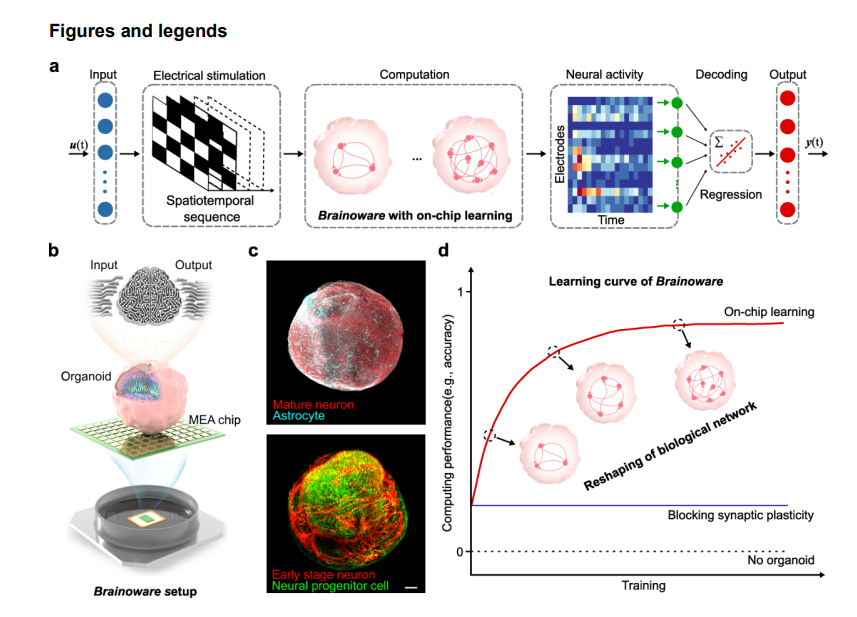
The paper, which is yet to be peer-reviewed, introduces Brainoware, calling it the future of AI hardware, in a bid to replace ANNs. “We wanted to ask the question of whether we can leverage the biological neural network within the brain organoid for computing,” lead researcher Feng Guo told Tech Xplore. “This is just proof-of-concept to show we can do the job.”

Guo and his research team cultivated clusters of specialised stem cells that evolved into neurons, the fundamental building blocks of the brain. A standard brain comprises 86 billion neurons, with each neuron forming connections to as many as 10,000 other neurons.

The cluster of neurons, referred to as an organoid, generated in Guo’s laboratory measures less than a nanometer in width. It was linked to a circuit board through an array of electrodes, allowing machine-learning algorithms to decipher the organoid’s responses.

The paper states that unlike existing 2D cultures and neuromorphic chips, Brainoware’s brain organoids boast advancements in complexity, connectivity, neuroplasticity, and neurogenesis, all achieved with minimal energy consumption and rapid learning capabilities.

Organoid Neural Networks for AI

The novel biohybrid computer, amalgamating a “brain organoid” with conventional AI, demonstrated the capability to perform a speech recognition task with 78% accuracy.

In a practical demonstration, the team converted 240 recordings of 8 Japanese speakers uttering vowel sounds into electrical pulses. Subsequently, they trained an AI to identify the speaker based on the neural activity of the brain organoid in response to electrical stimulation.

While Brainoware was less accurate in speech recognition compared to a traditional computing system with AI, and sustaining the organoid required resources like a CO2 incubator, it represents a crucial step toward more advanced biocomputing systems in the future.

A typical human brain operates on a mere 20 watts, a stark contrast to the colossal 8 million watts consumed by current AI hardware using artificial neural networks (ANNs).

The researchers of the paper say that current brain-inspired silicon chips while promising, struggle to fully emulate the complexities of brain function for efficient AI computing. Brainoware, leverages living biological neural networks within 3D brain organoids, presenting a potential solution to the existing hardware bottleneck. This showcases the potential of integrating human biology into computing for enhanced capabilities.

Hartung and his team call this “organoid intelligence”, or OI, which could be the next step of computing. These systems would be powered by living human brain cells.

The future is organoid intelligence

Real-world applications, such as solving nonlinear equations, highlight the technology’s potential to learn from training data by reshaping the neuronal connections of organoid neural networks (ONNs).

Brainoware employs living human brain organoids as dynamic reservoirs for “unsupervised learning,” converting time-dependent inputs into spatiotemporal sequences for AI computations. Through spatiotemporal electrical stimulation, Brainoware enhances its computing performance and demonstrates on-chip learning abilities via synaptic plasticity.

The generation and maintenance of organoids face issues of heterogeneity, low throughput, and varied viabilities. Interfacing with Brainoware through current MEA electrodes is limited, prompting the need for innovations such as brain-machine interfaces and soft electrodes to enhance connectivity with AI hardware.

With OI, we could study the cognitive aspects of neurological conditions and put our brains to the test. For instance, we could compare the memory formation in organoids taken from healthy individuals versus those with Alzheimer’s and attempt to patch up any deficiencies. Or, we could experiment with whether certain substances, like pesticides, can cause learning or memory difficulties.

While Elon Musk is installing chips inside human brains with NeuraLink, researchers are planning to plant brains inside chips – no kidding.

The post Human Brain on a Chip appeared first on Analytics India Magazine.