Read This Before You Take Any Free Data Science Course

Read This Before You Take Any Free Data Science Course
Image by Author

In today's digital age, the quote by Michael Hakvoort, "If you're not paying for the product, then you are the product", has never been more relevant. While we often think of this in relation to social media platforms like Facebook, it also applies to seemingly harmless free resources such as YouTube courses.

Sure, the platform earns revenue through ads, but what about the time, energy, and motivation you invest? As data becomes increasingly valuable, it's essential to carefully evaluate the potential impact of free data science courses on your learning journey.

With so many options available, it can be overwhelming to determine which ones will provide real value. That's why taking a step back to consider some critical factors before diving into any free resource is crucial. By doing so, you'll ensure that you make the most out of your learning experience while avoiding common pitfalls associated with free courses.

1. Lack of Depth and Customization

Free courses often provide a one-size-fits-all curriculum, which might not align with your specific learning needs or skill level. They might cover fundamental concepts but lack the depth required for a comprehensive understanding or for tackling complex, real-world problems. Some free courses may have all the necessary ingredients to solve real-world data problems, but they lack structure, leaving you confused about where to start.

2. Lack of Interactive Learning

Learning a programming language alone can be challenging, especially if you come from a non-technical background. Data Science is a field that demands a hands-on approach. The free courses often offer limited opportunities for interactive learning, such as live coding sessions, quizzes, projects, or instructor feedback. This passive learning experience might prevent you from applying concepts effectively, and eventually, you will give up on learning.

3. Quality and Credibility Concerns

The internet is flooded with free courses, making it challenging to discern the quality and credibility of the content. Some might be outdated or taught by individuals with limited expertise (Fake Gurus). Investing your time in a course that doesn't offer accurate or up-to-date information can be counterproductive.

Here is a list of free courses that I believe are of high quality:

  1. Introduction to Programming with Python by HarvardX
  2. Statistical Learning with R by StanfordOnline
  3. Data-Science-For-Beginners by Microsoft
  4. Databases and SQL by freeCodeCamp
  5. Machine Learning Zoomcamp by DataTalks.Club

4. Motivation and Commitment

Unlike paid courses, free resources do not come with external accountability measures such as deadlines or grades, making it easy to lose momentum and abandon the course midway. The lack of financial commitment means that students must rely solely on their internal drive and discipline to stay motivated and committed to completing the course. College is a great example of this. Students think 100 times before leaving college because of the costs involved. Most students complete their bachelor's degree because they have taken a student loan and need to pay it back.

5. Missing Out on Networking Opportunities

Networking is a significant part of building a career in data science. Free courses typically lack the community aspect found in paid programs, such as peer interaction, mentorship, or alumni networks, which are invaluable for career growth and opportunities. There are Slack and Discord groups available but they are usually community-driven and may be inactive. However, in a paid course, there are moderators and community managers who are responsible for making networking easier between students.

6. Lack of Career Services

Paid courses often provide career services, such as resume reviews, certification, job placement assistance, and interview preparation. These services are essential for individuals transitioning into a data science role but are typically unavailable in free programs. It is crucial to have guidance throughout the hiring process and know how to handle technical interview questions.

7. Certification and Recognition

While not always necessary, certifications can boost your resume and credibility. Free courses may offer certificates, but they often don't carry the same weight as those from accredited institutions (Harvard / Stanford) or recognized platforms. Employers might not value them as highly, which could impact your job prospects. Additionally, certification exams evaluate key skills essential for working with data in any job. They assess your coding, data management, data analysis, reporting, and presentation abilities.

Conclusion

While free courses on data science can be a valuable resource for initial learning or brushing up on skills, they have certain limitations. It's important to consider these limitations against your personal goals, learning style, financial situation, and career aspirations. To ensure a well-rounded and effective learning experience, you should consider supplementing free resources with other forms of learning or investing in a paid bootcamp.

In the end, the most crucial factor that will help you become a professional data scientist is your dedication and focus on achieving your goals. You will not learn anything if you lack the drive required, no matter how much money you spend on the course. So, before you dive into the world of data, please think ten times if this is the right path for you.

Abid Ali Awan (@1abidaliawan) is a certified data scientist professional who loves building machine learning models. Currently, he is focusing on content creation and writing technical blogs on machine learning and data science technologies. Abid holds a Master's degree in Technology Management and a bachelor's degree in Telecommunication Engineering. His vision is to build an AI product using a graph neural network for students struggling with mental illness.

More On This Topic

  • Introduction to NExT-GPT: Any-to-Any Multimodal Large Language Model
  • What Google Recommends You do Before Taking Their Machine Learning…
  • 5 Free Data Science Books You Must Read in 2023
  • Concepts You Should Know Before Getting Into Transformers
  • Don't Miss Out! Enroll in FREE Courses Before 2023 Ends
  • Top 10 Data Science Courses to Take in 2021

TCS Shows Poor Generative AI Confidence, Despite Growth in Revenue

According to the latest Q3 FY 2023-24 results, the IT Giant Tata Consultancy Services (TCS) secured a total of $8.1 billion deal without mega deal support and showing broad-based success. TCS said that four generative AI deals have turned from PoC to contract, but there is no effect on revenue because of it yet. “All deals are progressing as planned,” said Chief Operating Officer, N Ganapathy Subramaniam.

He also expressed a cautious outlook on generative AI, stating, “I don’t think generative AI is impacting [our revenue] at this time. Clients are trying to see what benefit it can bring. All are small projects. It’s not leading into our TCV.”

The company also showcased growth in emerging markets, specifically 23.4% in India. The company also filed 83 patents in the quarter.

TCS reported a Q3 marked by poor confidence in generative AI, despite a 4% YoY growth at Rs 60,583 crore in total revenue. The generative AI, although advancing into production with four projects, has not yet demonstrated a substantial impact on the company’s overall revenue.

However, the company’s cautious stance on the potential impact of generative AI raises questions about its contribution to future revenue growth, as no commitments have been made in terms of investments. Though the company has previously announced major partnerships with Microsoft and Google, the pace is still slow when it comes to revenue.

Read: TCS’ Obsession With Generative AI

The company says that it is moving into a situation where its clients are comfortable with generative AI, and are trying the technology in different ways.

While deals in generative AI are in progress, their timing remains uncertain, and their impact on revenue is yet to be realised.

Milind Lakkad, Chief HR Officer, said that TCS plans to hire 40,000 freshers in 2024 and it stands by the number. It will decide if the number stands for a long time.

TCS reported a total employee count of 603,305. The attrition rate for IT services decreased to 13.3% over the last twelve months, down from 14.9% in the previous quarter.

The partnership with NVIDIA is progressing as planned, with 14,000 employees trained on leveraging the architecture. The team is also planning to increase the speed of training. A lot of the projects developed by TCS are also being offered as small services to the clients.

TCS launched the AI Experience Academy in this quarter, providing innovation and experimentation opportunities to its associates on multiple generative AI.

The post TCS Shows Poor Generative AI Confidence, Despite Growth in Revenue appeared first on Analytics India Magazine.

AI4Bharat Introduces AI Residency Program for 2024-2025

IIT Madras’ AI research arm AI4Bharat has announced the hiring process for its AI resident (and associates) program for the year 2024-25. This year-long pre-doctoral program focuses on intensive work in NLP, speech, and vision projects.

The program offers the opportunity to work closely with IIT Madras faculty and industry researchers on nationally significant research problems. Under the guidance of notable professors like Mitesh Khapra, Dr Anoop Kunchukuttan, and Dr Pratyush Kumar, AI4Bharat has a strong history of residents conducting cutting-edge research and publishing in renowned venues such as ACL, Interspeech, ICASSP, EMNLP, TMLR, and more.

Collaborating with AI4Bharat researchers, residents have contributed to impactful open-source datasets and models like Samanantar, BPCC, IndicTrans1 and 2, IndicWav2Vec, IndicBart, IndicNLG Benchmark, widely adopted in government and industry.

The ideal candidate should be a recent graduate with a bachelor’s degree in computer science or related fields from 2022 onwards and should have excellent programming skills demonstrated through independent projects on platforms like GitHub or Kaggle, with participation in competitive programming considered advantageous.

A solid understanding of deep learning fundamentals, obtained through online courses with formal certification or as part of the B.Tech curriculum, is also required. Candidates should also have experience in training and evaluating large deep learning models, particularly on Transformer-based models for NLP such as BERT, mT5, mBART, wav2vec, and more.

However, an important point to note is that applications are only accepted from individuals willing to relocate to Chennai, except in exceptional circumstances.

The research lab recently launched Chitralekha, an open-source AI-powered video transcreation platform created in collaboration with EkStep. This platform incorporates a comprehensive workforce management system, facilitating end-to-end transcreation of videos from one language to another. It supports English and several Indian languages, offering transcription in 12 languages, translation in all 22 official languages, and automated voice-over in 14 languages.

Register for the program here.

The post AI4Bharat Introduces AI Residency Program for 2024-2025 appeared first on Analytics India Magazine.

Pandas vs. Polars: A Comparative Analysis of Python’s Dataframe Libraries

Pandas vs. Polars: A Comparative Analysis of Python's Dataframe Libraries
Image by Author

Pandas has long been the go-to library when dealing with data. However, I am pretty sure most of you might have already experienced the agony of sitting for hours while our Pandas try to deal with big DataFrames.

For those who have followed the recent developments in Python, it's hard to miss the buzz around Polars, a robust dataframe library specifically developed to assess large datasets.

So today I will try to delve into the key technical distinctions between these two dataframe libraries, examining their respective strengths and limitations.

The Syntax and Execution: Pandas vs. Polars

First things first, why all this obsession to compare Pandas and Polars libraries?

Distinct from other libraries tailored for large datasets, like Spark or Ray, Polars is uniquely crafted for single-machine use, leading to frequent comparisons with pandas.

Yet, Polars and pandas diverge significantly in their approach to data handling and their ideal use cases.

The secret behind Polars' impressive performance relies on 4 main reasons:

1. Rust boosted efficiency

In stark contrast to Pandas, which is grounded in Python libraries like NumPy, Polars is built using Rust. This low-level language, renowned for its rapid performance, can be compiled into machine code without the use of an interpreter.

Pandas vs. Polars: A Comparative Analysis of Python's Dataframe Libraries
Image by Author

Such a foundation provides Polars with a substantial advantage, particularly in managing data types that are challenging for Python.

2. Eager and lazy execution options

Pandas follows an eager execution model, processing operations as they are coded, while Polars provides both eager and lazy execution options.

Polars uses a query optimizer in its lazy execution to efficiently plan and potentially reorganize the order of operations, eliminating any unnecessary steps.

This is in contrast to Pandas, which might process an entire DataFrame before applying filters.

For example, in calculating the mean of a column for certain categories, Polars would first apply the filter and then perform the group-by operation, optimizing the process for efficiency.

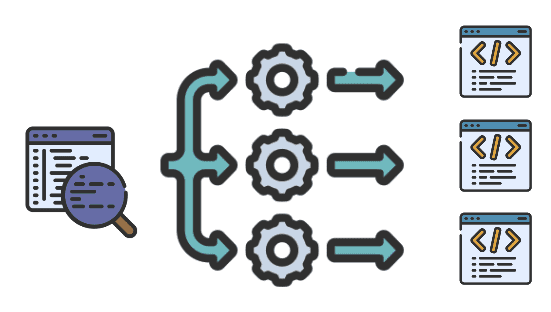
3. Parallelization of the processes

According to the Polars User Guide, its main aim is:

“To provide a lightning-fast DataFrame library that utilizes all available cores on your machine.”

Another benefit of Rust's design is its support for safe concurrency, ensuring predictable and efficient parallelism. This feature enables Polars to fully utilize a machine's multiple cores for complex.

Pandas vs. Polars: A Comparative Analysis of Python's Dataframe Libraries
Image by Author

Consequently, Polars significantly outperforms Pandas, which is limited to single-core operations.

4. Expressive APIs

Polars boasts a highly versatile API, enabling virtually all desired tasks to be executed using its methods. In comparison, performing intricate tasks in pandas frequently requires using the apply method coupled with lambda expressions within its apply method.

This approach, however, has a downside: it iteratively processes each row of the DataFrame, performing the operation sequentially.

Conversely, Polars' capability to utilize inherent methods facilitates operations at the column level, leveraging a distinct parallelism type known as SIMD (Single Instruction, Multiple Data).

The Ideal Use Cases for Each Library

Is Polars superior to Pandas? Could it potentially supplant Pandas in the future?

As always, it mainly depends on the use case.

The main advantage that Polars has over Pandas lies in its speed, particularly with large datasets. For those handling extensive data processing tasks, exploring Polars is highly recommended.

While Polars excels in data transformation efficiency, it falls short in areas like data exploration and integration into machine learning pipelines, where Pandas remains superior.

Polars' incompatibility with most Python data visualization and machine learning libraries, such as scikit-learn and PyTorch, limits its applicability in these fields.

There's an ongoing discussion about integrating the Python dataframe interchange protocol across these packages to support diverse dataframe libraries.

This development could streamline data science and machine learning processes, currently reliant on Pandas, but it's a relatively new concept and will require time for implementation.

Embracing Both Tools in the Data Science Workflow

Both Pandas and Polars have their unique strengths and limitations. Pandas continues to be the go-to library for data exploration and machine learning integration, while Polars stands out for its performance in large-scale data transformations.

Understanding the capabilities and optimal applications of each library is key to navigating the evolving landscape of Python data frames effectively.

With all these insights, you're likely keen to experiment with Polars yourself!

As data scientists and Python enthusiasts, embracing both tools can enhance our workflows, allowing us to leverage the best of both worlds in our data-driven endeavors.

With the continued development of these libraries, we can expect even more refined and efficient ways of handling data in Python.

Josep Ferrer is an analytics engineer from Barcelona. He graduated in physics engineering and is currently working in the Data Science field applied to human mobility. He is a part-time content creator focused on data science and technology. You can contact him on LinkedIn, Twitter or Medium.

More On This Topic

  • OLAP vs. OLTP: A Comparative Analysis of Data Processing Systems
  • How to Query Your Pandas Dataframe
  • Dask DataFrame is not Pandas
  • Beyond Numpy and Pandas: Unlocking the Potential of Lesser-Known…
  • A Comparative Overview of the Top 10 Open Source Data Science Tools in 2023
  • How to Process a DataFrame with Millions of Rows in Seconds

Google Cloud rolls out new gen AI products for retailers

Google Cloud rolls out new gen AI products for retailers Kyle Wiggers 9 hours

Google wants to inject a little generative AI into retail. Or to try, at least.

To coincide with the National Retailer Association’s annual conference in NYC, Google Cloud today unveiled new gen AI products designed to help retailers personalize their online shopping experiences and streamline their back-office operations.

As to whether they perform as advertised, this writer can’t say — TechCrunch wasn’t given the chance to test the new tools prior to this morning’s unveiling. (They’re set to launch sometime in Q1.) But the slew of announcements show, if nothing else, how aggressively Google is attempting to court gen AI customers.

One of Google Cloud’s new products, Conversational Commerce Solution, lets retailers embed gen AI-powered agents on their websites and mobile apps — sort of like a brand-specific ChatGPT. The agents have conversations with shoppers in natural language, tailored product suggestions based on shoppers’ individual preferences.

Branded chatbots are hardly new. But Google says that “sophisticated” models like PaLM are powering the agents, which can be fine-tuned and customized with retailers’ own data (e.g. catalogs and websites).

Complementing Conversational Commerce Solution is Google Cloud’s new Catalog and Content Enrichment toolset, which taps gen AI models including the aforementioned PaLM and Imagen to automatically generate product descriptions, metadata, categorization suggestions and more from as little as a single product photo. The toolset also let retailers generate new product images from existing ones, or to use product descriptions as the basis for AI-generated photos of products.

Now, when eBay launched a similar AI-powered product-image-to-description capability a few months back, it didn’t take long before sellers began complaining about its performance — pointing to misleading, unnecessarily repetitive and in some cases downright untruthful text.

I asked Amy Eschliman, managing director of retail at Google Cloud, what steps Google’s taken, if any, to address concerns around such hallucinations. She didn’t point to specific measures but stressed that Google’s “continuously improving” its tools and that human review is a core part of the Catalog and Content Enrichment workflows.

I’d certainly hope there’s human review where the stakes are high. It’s not inconceivable, after all, that a misleading AI-generated image or description in a product catalog could land a retailer in hot water with shoppers — or on the receiving end of false advertising allegations.

“Human-in-the-loop is a best practice that helps with enterprise use cases to ensure high quality, mitigate bias-related risk, improve trust and transparency, improve and continually train the model, while complying with regulatory and business policy,” Eschliman said.

In a related announcement today, Google took the wraps off of a retail-specific Distributed Cloud Edge device, a managed self-contained hardware kit to “reduce IT costs and resource investments” around retail gen AI. (Google’s long offered Distributed Cloud Edge as a service, but it’s now targeting retailers more directly.) Available in a range of sizes from single-server to multi-server configurations, Google says that the edge cluster is designed to fit into stores from convenience marts and gas stations to fast casual restaurants and grocery stores — powering customers’ gen AI apps.

“With the … control plane running locally, Google Distributed Cloud Edge provides retailers non-stop operations even when their location is disconnected from the internet for short periods of time (days),” Eschliman said. “Retailers now have access to a small cluster of Google Cloud-managed nodes that can be conveniently installed in nearly any store. With this fully managed hardware and software, retailers can now run existing software with distributed AI to enable mission-critical operations in the store at all times.”

Google says that pricing and availability info will be released in Q1.

My question after being pre-briefed on all this was, frankly, are retailers really clamoring for gen AI?

Perhaps. At least the giants of retail.

Walmart yesterday announced that it’s investing heavily in gen AI search to better understand the context of queries and let shoppers search by specific use cases (e.g. “unicorn-themed toddler birthday party”). Amazon, meanwhile, has been leveraging gen AI to summarize customer reviews, help sellers write product descriptions and image captions and better enable buyers to find clothes that fit their size.

In a poll Google conducted, Google says that 81% of retail decision makers feel “urgency” to adopt gen AI in their business while 72% feel ready to deploy gen AI technology today — specifically in the areas of customer service automation, marketing support and product description generation, creative assistance, conversational commerce and store associate knowledge and support.

But considering some of the rocky rollouts of gen AI in retail recently (see: Amazon’s review summaries exaggerating negative feedback), I can’t say I’m convinced that the retail industry will rush to adopt gen AI en masse — from Google Cloud or any other provider. I suppose we’ll have to wait and see.

Infosys To Acquire InSemi, Driving Innovation in Semiconductor Design

Indian IT giant Infosys announced its definitive agreement to acquire InSemi for ₹280 crore, a prominent semiconductor design and embedded services provider. The company said it aims to accelerate its Chip-to-Cloud strategy through this collaboration, leveraging InSemi’s niche design skills at scale.

The company in its statement said this move aligns seamlessly with Infosys’ existing investments in AI/Automation platforms and industry partnerships, facilitating comprehensive end-to-end product development for clients.

“With the advent of AI, Smart devices, 5G and beyond, electric vehicles, the demand for next-generation semiconductor design services integrated with our embedded systems creates unique differentiators. InSemi is a strategic investment as we usher a next wave of growth and a leadership position in Engineering R&D.” said Dinesh R, EVP & Co-Delivery Head, Infosys.

Founded in 2013, InSemi provides end-to-end semiconductor design services, covering electronic design, platform design, automation, embedded, and software technologies. With a team of over 900+ design specialists, InSemi serves leading global corporations across semiconductor, consumer electronics, automotive, and hi-tech industries. The acquisition is set to strengthen Infosys’ Engineering R&D capabilities and position the company as a leader in this domain.

“With Infosys as our catalyst, it creates a synergistic combination that allows us to scale and bring the power of AI & Engineering R&D and next-generation technology to global clients, expanding across industry sectors. We aim to further accelerate our progress and together with Infosys, it paves a path of innovation opening new opportunities for our teams”, said Shreekanth Sampigethaya & Arup Dash, Co-Founders, InSemi.

The acquisition is expected to close in the fourth quarter of fiscal 2024, subject to customary closing conditions.

The post Infosys To Acquire InSemi, Driving Innovation in Semiconductor Design appeared first on Analytics India Magazine.

This Tech Bhai from IIT Madras is Making Google Dance

“Google band karo, Perplexity use karo (Stop using Google, use Perplexity),” said Shashank Dixit, the Billionaire CEO of Deskera Open Source, in a recent podcast with Ranveer Allahbadia. He explains how it is a company by Indian “bhaiya” (brother) and how it is competing with Google.

If you have been following any of the AI news, you must have come across Perplexity AI, the AI search engine company built by the IIT Madras and University of Berkeley graduate, and “tech bhai”, Aravind Srinivas, along with co-founders Denis Yarats (former Facebook AI research scientist), Andy Konwinshki (co-founder of Databricks), and Johnny Ho (former Quora engineer) and is now valued at $520 million.

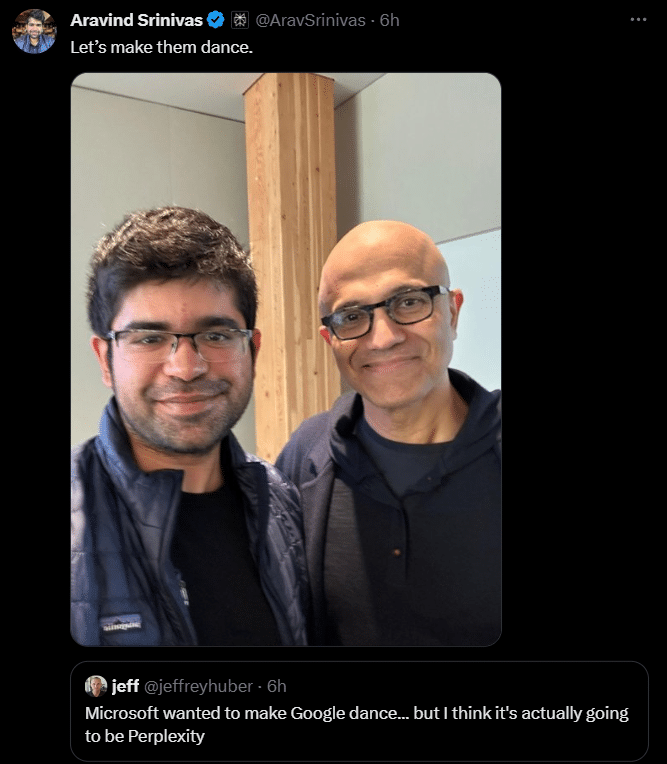
The 16-month-old startup recently acquired funding of $73.6 million from NVIDIA and even Jeff Bezos, and is also backed by Nat Friedman, Andrej Karpathy, Yann LeCun, Elag Gil, Naval Ravikant, and several others. Most recently, Srinivas posted a photo with Satya Nadella, which said, “Let’s make them dance” in response to another post talking about how Perplexity will make Google dance.

The Google killer?

Srinivas also interned at OpenAI as a research scientist and DeepMind as well. Now, he is in a bid to make a Google competitor, which he says – “Answers are the first real threat to 10 blue links”. At the same time, he is very passionate about comparing his product to Google.

He explained in an interview with Silicon Valley Girl that initially there was no product, but the team just wanted to use a chatbot that could explain everything to them without the hassle of insurance ads on Google Search. For this, the team used GPT-3.5 and Bing Search and made a Slack bot to answer their questions. “But people started using it as a Google replacement,” he added. “It is actually way better than Google.”

“We haven’t thought through that part yet, but we at least know that it won’t be the exact same thing,” said Srinivas. He recently also said that Perplexity is making Larry Page’s 23-year-old dream of Google being an AI search engine come true. “But the timing wasn’t right back then. There were no chat LLMs. But the man was a visionary. The ultimate search engine is an AI-powered answer engine, like Perplexity.”

To add to his point, just like Perplexity, Bezos was also one of the investors of Google in 1998, before it had a business model figured out. The same is the case with Perplexity, as the company still does not have a business model. “You are irrelevant anyway. If you launch this and lose you are still gonna be the same,” Srininvas added about the advice from his investors.

And that is what the team did. Just a simple search bar that gives a summary of the query with links to the sources. Cut to the future, Srinivas recently also posted on X that their model is going to be available on Apple Vision Pro.

“You should never do the same thing that someone else has done.”

Srinivas believes that Google’s UI design would go away sometime soon, and possibly get replaced by something like Perplexity. He believes that someone who has been doing something for decades, shouldn’t be challenged. It should be something new. At the same time, Srinivas wants Google to build a very similar product, which it is already aiming at with Bard, and now powering with Gemini.

Back in 2022, when Perplexity AI did not have any sign-in options on its website, it also created a search engine for Twitter (Now X) called BirdSQL. Built on top of OpenAI’s API, Twitter API, and PostgresSQL, the model would allow easier search capabilities for finding specific posts on the website. Former owner of Twitter, Jack Dorsey, endorsed the creation.

But cut to the present, Perplexity is not profitable yet. Srinivas said that it is very hard to gain profitability when the cost of the infrastructure is so high. Regardless, the road looks good ahead for Perplexity, and Srinivas is taking it in the right direction.

“The reason we exist is because actually improving search and making information access a lot more efficient with fewer keyword queries, less sifting, link clicking, page viewing; and directly getting to the bottom of things and making a decision with a succinct clean personalised answer, is at odds with the financial and business goals of Google, and that’s the opportunity for someone else to start from a blank slate and rethink the product and business from scratch. The world wants that,” he said in a post.

To this, Robert Scoble replied, “People forget Google was the 17th search engine.”

The post This Tech Bhai from IIT Madras is Making Google Dance appeared first on Analytics India Magazine.

Julia’s Rise in Scientific Computing

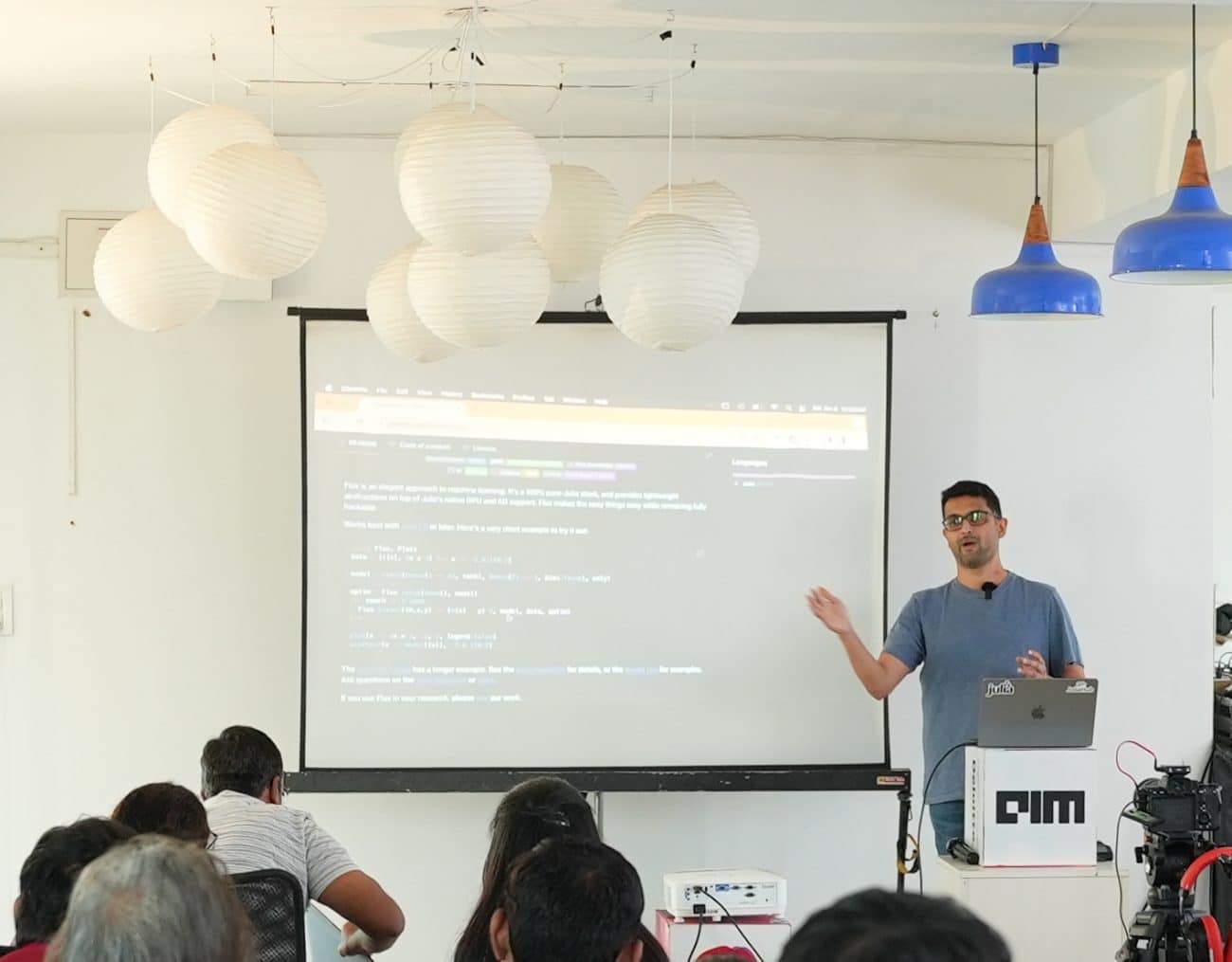
Julia has gained popularity over the years for being a language that is easy to use. Another appealing feature is its speed. “It was like a rule until we developed Julia that a programming language can either be fast or easy,” Viral B. Shah, the CEO of Julia said at an event hosted by AIM on Saturday. C and C++ are faster languages with a steep learning curve while Python, Ruby are easier to work with and are known to be slower and user-friendly.

He added that While he was doing his PhD, he worked on building a MATLAB-like language and it was quite a waste of time to write the code in MATLAB and then rewrite it again in C. This was frustrating.

Julia is also the language that is gaining popularity in the scientific community. This year nearly five million users were recorded to use the programming language. The language combines the speed of C, the dynamism of Ruby, the practicality of Python, and the statistical capabilities of R, while also excelling in linear algebra like MATLAB. Julia is a general-purpose language and is known for its applications in numerical analysis, data visualisation, and machine learning.

The standout feature is its exceptional speed, because of its just-in-time compiler that converts source code into machine code before execution. Unlike many high-level languages, Julia offers a flexible parametric type system. This makes static typing optional by default and allows types to take parameters.

This flexibility leads to the multiple dispatch pattern, where a function can have multiple methods or implementations based on input parameters, with the language determining which method to dispatch at runtime. Even operators like ‘Plus’ or functions use multiple dispatch to handle diverse type combinations. This is not the case in Python, which employs single dispatch, meaning the method to execute is determined solely by the type of the first argument.

Julia For Enterprise

Most programming environment successes in the last 20 years—JAVA, Swift, and .NET—are supported by big companies to build the ecosystem around it. Julia is one of the few languages that thrived without the backing of big techs. “We started with a very small core team and Julia has no backing from big techs.”

Julia, an open source language, which mainly relies on contributions from the community, has branched out for enterprises. Shah explained the decision to commercialise Julia saying, “Open source is fantastic and it’s a community, but we’ve learned over time in this industry that science and engineering companies, unlike tech companies, don’t mind paying for software.”

While Julia is fundamentally an open-source project, Julia Computing provides essential commercial support and development. This dual approach allows the company to contribute to the open-source ecosystem while also offering proprietary tools and solutions for more complex enterprise needs.

Julia has developed several products tailored for enterprise use. These include Pumas for pharmaceutical modelling, JuliaSim for modelling and simulation applications, and a specialised SPICE simulator for circuit design. AstraZeneca, Moderna, Pfizer, Procter & Gamble, and United Therapeutics have partnered with Julia. AstraZeneca along with Prioris.ai developed a Bayesian neural network (BNN) using Julia.

This network is designed to predict drug-induced liver injury, a crucial aspect in the preclinical phase of drug development. The use of BNNs, as opposed to traditional deep neural networks, offers the advantage of not only predicting toxicity but also quantifying uncertainty in these predictions, thereby improving the reliability and safety of drug development processes.

Addressing concerns about the safety and security aspect Viral said, “As a business, we are focusing on scientific use cases. So if you’re building a spy circuit, or a control system for a new engine, or for a new aircraft, or drug discovery, we are building safety critical capabilities in Julia for writing code that will run on physical devices.”

A key strength of Julia, which also propelled its adoption in the industry, is its ability to integrate with existing software libraries in C, Fortran, and Java. This feature is crucial for enterprises with substantial investments in legacy code. Julia is engineered not only to facilitate the writing of new, high-performance code but also to leverage existing software assets effectively.

The post Julia’s Rise in Scientific Computing appeared first on Analytics India Magazine.

Chipmakers are Gearing to Power the Next-Generation of Cars 

In the automotive industry, the shift from combustion engines to electric is paving the way for software-defined vehicles. Yet, to empower this shift, the essential foundation lies in robust silicon support. The sector has emerged as a melting pot of innovation and chip makers are sensing a new opportunity to capitalise upon.

Semiconductor companies like NXP Semiconductors, Texas Instruments and Intel have all announced new chips specially designed for automobiles at CES 2024. Moreover, fabless semiconductor companies like NVIDIA, Qualcomm and AMD, too are making significant strides in this space.

Intel chips power over 50 million cars worldwide and now the company wants to help automobile companies run AI models in their cars. Qualcomm, on the other hand, wants to diversify its revenue stream by focusing on automobiles and reducing its reliance on the smartphone market. The San Diego-headquartered company plans to make nearly USD 4 billion in the automobile segment by 2026.

Chip makers not just want to power the cars of today, but the next generation of Electric Vehicles (EV). In a hybrid or an electric car, there is a significant surge in semiconductor content as it is more software-defined. Starting from the Engine Control Unit (ECU) to Advanced Driver Assistance Systems (ADAS), there is a need for advanced semiconductor chips.

Moreover, many automobile companies are considering deploying AI models at the edge—running AI models locally within the car to support various functionalities. This again underscores the need for specialised chips tailored to meet these specific requirements.

AI chips for automobiles

At CES 2024, Intel announced a new system on a chip (SoC) designed to power generative AI features in the next generation of automobiles.

“We are bringing the AI PC to the car,” Jack Weast, vice president and general manager of Intel Automotive, told the press in a recent briefing. He revealed that Chinese EV company Zeekr will be the first to use Intel’s AI system on a chip to enhance the cockpit experience in their cars.

NVIDIA, which Intel competes with in the GPU space, is also making strides in the field, having announced an AI chip capable of unifying various in-car technologies, ranging from automated driving features and driver monitoring systems to enabling activities like streaming Netflix in the backseat. Called Drive Thor, the chip will enter production in 2025.

Sima.ai, a startup that has developed the industry’s first software-centric, purpose-built MLSoC (Machine Learning System on a Chip) platform, is taking its product to the world’s major Original Equipment Manufacturers (OEMs). The startup claims its chips perform exceptionally better than that of NVIDIA.

“While everyone today is talking about Large Language Models (LLMs), the next transition in the industry is going to be Large Multimodal Models (LMMs) and that I think is going to be the pervasive architecture that’s going to touch everything because it is the closest thing that we have come to in mimicking human capacity,” Krishna Rangasayee, founder and CEO at Sima.ai, told AIM.

We have seen automobile companies like Mercedez integrating ChatGPT, the popular chatbot developed by OpenAI, into its MBUX infotainment system last year. Around 900,000 US owners of models that use MBUX could opt into a beta programme.

At CES 2024, German automobile company Volkswagen announced that it would integrate ChatGPT with its infotainment system. Going forward, more and more automobile companies will look to power their infotainment system with an advanced LLM. However, to run an AI model efficiently, even from an infotainment perspective, there is a need for specialised chips and chipmakers want to fill the gap.

Silicon to power ADAS

Moreover, Rangasayee believes the future of ADAS will be all AI/ML-based. Automobile companies today are already investing heavily in developing ADAS technologies which play a crucial role in improving road safety by preventing accidents and reducing the severity of collisions.

Cars equipped with AI on the edge can perform complex computations onboard, contributing to a safer, more responsive, and personalised driving experience.

At CES 2024, Texas Instruments, a global semiconductor company that designs, manufactures, tests and sells analogue and embedded processing chips, at CES 2024 announced three chips designed specifically to power the next generation of automobiles.

One of the chips, which Texas Instrument calls the AWR2544, is designed to enable higher levels of autonomy by improving sensor fusion and decision-making in ADAS.

According to Mark Ng, sector general manager of hybrid and electric vehicles at Texas Instruments, the semiconductor company is rapidly innovating in this space to not just power the next generation of electric vehicles (EVs), but to help the industry progress towards higher level of autonomy such as L3, L4 and L5.

In a recent interaction with AIM on the sidelines of CES 2024, Ng said that Texas Instruments, which is one of the top 10 semiconductor companies worldwide based on sales volume, is bringing its innovation to the top Original Equipment Manufacturers (OEMs), be it in the US, Korea or Japan.

Dutch semiconductor design and manufacturer company NXP Semiconductor, at CES 2024, also announced a new chip designed for automobiles which supports advanced ADAS and autonomous driving applications, including advanced comfort features for SAE levels 2+ and 3 such as traffic jam assist, highway pilot and park assist, front and rear cross-traffic alerts, as well as lateral and rear collision avoidance.

Rapid innovation

Despite the slump in EV sales, the future of automobiles without doubt will be electric. As OEMs make more and more EV, it presents an opportunity for chipmakers to emerge as a leader and capitalise from the opportunities the sector represents.

However, with many companies innovating in the same space, the market is going to be increasingly dynamic, resulting in intense competition, which, from the market perspective, is a good thing. This also, at the same time, expedites innovation, as companies innovate faster to stay ahead of the competition.

The post Chipmakers are Gearing to Power the Next-Generation of Cars appeared first on Analytics India Magazine.

India’s Effort to Speak the Language of AI

While speaking to the audience at Kashi Tamil Sangamam in Varanasi last year, Prime Minister Narendra Modi urged the Tamil-speaking audience present at the venue to use their earphones. While Modi addressed the crowd in Hindi, an AI translated the same speech in real-time in Tamil for the Tamil speakers present at the programme.

This only gave us a glimpse of what AI-powered translation models can achieve in breaking language barriers and facilitating seamless communication across diverse linguistic audiences. The possibilities are aplenty.

With the majority of online content in English and only around 10% of the population proficient in the language, numerous individuals in rural India face challenges accessing information on the web.

“If you look at ChatGPT or Bard, they are all trained on the internet, where almost 80 to 90% of the data is in English and Western-oriented. It neither has vernacular data nor an Indian context,” Jaspreet Bindra, founder of Tech Whisperer Ltd, told AIM.

Last year, the Supreme Court of India also introduced an AI-powered translation tool which translates judicial proceedings into eleven vernacular languages.

In India, the endeavour has been to provide citizens with access to information in their native language. Hence, India is banking on the ability of AI to bridge the language barrier in the country. The aim is not just to make the web accessible but to provide numerous government policies and services accessible to the unlettered- individuals who may not possess writing skills but can communicate solely through their native language. Now, the recent developments in the AI space is making this possible.

Conversations with AI

Pramod Verma, chief technology officer at EkStep Foundation and former chief architect at Aadhaar and India Stack, believes AI has the potential to be of great service to the underserved. He thinks the ability to converse with AI is going to be revolutionary.

While speaking at the keynote address at the AWS Public Sector Symposium in New Delhi last year, he said, “Imagine just telling the app ‘pay my electricity bill’ in your native language, and the AI takes care of the rest.” What Verma imagines could be a reality very soon, given the rapid advancements in AI.

Notably, the Reserve Bank of India (RBI) has already announced its plan last year to add AI-powered conversational payments for the Unified Payments Interface (UPI). Not just payments, AI-powered conversational tools can also be used to access government policies and services. For example, farmers can now converse with PM Kisan Chatbot in their native languages. This is being enabled by Bhashini’s AI-powered translation tools.

Bhashini, a government initiative, was announced by Modi in 2022 as a means to break the language barrier in the country. In addition to Bhashini, Sarvam AI, a generative AI startup that recently secured funding of USD 41 million to develop Indic LLMs, is also creating similar conversational AI tools and models.

“One of the core things we believe in is that people will want to obtain various kinds of information and services through conversations. I think the recent developments in generative and voice makes this possible at a large scale at this time,” Vivek Raghavan, who previously served as the Chief Project Manager and Biometric Architect at Unique Identification Authority of India (UIDAI) and the co-founder of Sarvam AI, told AIM.

Challenges remain

However, using AI-powered conversational tools also poses certain risks, especially in payments. For example, by introducing AI-powered conversational payments to UPI, the apex bank wants to make the technology more accessible, especially in rural areas. While, without a doubt, the integration will enhance financial inclusion and herald a transformative era for digital payments in India, it also raises security concerns.

“This innovation not only streamlines the user experience, making transactions more convenient and accessible, especially in rural areas but also presents new challenges in terms of security,” Aditya Gupta, founder and CEO at Credilio, told AIM.

The voice-activated system raises potential security issues such as voice authentication vulnerabilities and misuse, necessitating rigorous measures to ensure the trustworthiness of AI-powered voice payments.

“Striking the right balance between accessibility and security is crucial for realising the full potential of this technology in reshaping India’s digital payments landscape”, Gupta added.

India speaks hundreds of languages

For this to be impactful at a population scale, more and more languages need to be added. For instance, during the first phase, the PM Kisan Chatbot was available in five Indic languages-English, Hindi, Tamil, Bangla, and Odia.

While the plan is to cover the 22 official languages of India, the country is linguistically diverse, with over 100 different languages and thousands of dialects.

Making the technology available in numerous languages poses a significant challenge due to the absence of pre-existing datasets for training models in these languages. Gathering data for diverse languages is a labour-intensive task in itself.

The post India’s Effort to Speak the Language of AI appeared first on Analytics India Magazine.