Recently, Intel researchers unveiled a new LLM inference solution with low latency and high throughput for Intel GPUs. They showed that their solution achieved up to 7x lower latency and up to 27x higher throughput than standard HuggingFace implementation.
As LLMs continue to play a pivotal role across various industries, optimising their performance has become a critical focus, and Intel’s latest development promises to be a game-changer. Tackling the inherent complexity of LLMs, characterised by intricate model structures and autoregressive inference modes, the team behind this breakthrough presents an efficient alternative.
One of the primary challenges the research team addresses is the intricate design of LLMs, characterised by intricate model structures and extensive autoregressive operations. The complexity leads to massive memory access and hampers inference speed.
A simplified LLM decoder layer is at the heart of their solution, strategically designed to fuse data movement and element-wise operations. This fusion reduces memory access frequency and significantly lowers system latency, paving the way for faster and more efficient inference processes. Read: What is Intel’s AI Plan for 2024
How is Intel pushing the boundaries?
Intel’s solution begins with a streamlined approach to the LLM decoder layer. The team successfully reduces memory access frequency by fusing data movement and element-wise operations, substantially lowering system latency.
Another key innovation is introducing a segment KV (key/value) cache policy. This strategic separation of key and value elements for request and response tokens in distinct physical memory segments proves instrumental in effective device memory management. The outcome is an expanded runtime batch size and improved overall system throughput.
The team customises a Scaled-Dot-Product-Attention kernel to complement their innovative approach, aligning it seamlessly with their fusion policy based on the segment KV cache solution. The result is a finely tuned LLM inference solution that promises to reshape the efficiency standards for these powerful language models.
The research team has not only conceptualised these innovations but has also translated them into a practical solution. Their LLM inference solution is implemented on Intel GPUs and is now publicly available for scrutiny and use.
The substantial reduction in token latency enhances system responsiveness, making it an ideal fit for applications where quick processing is crucial. Simultaneously, the significant boost in throughput facilitates the swift execution of larger tasks, making this solution particularly attractive for real-world, high-demand scenarios.
The post Intel Unveils New Low-Latency LLM Inference Solution Optimized for Intel GPUs appeared first on Analytics India Magazine.
When Sam Altman, CEO of OpenAI, said during his visit to India that it’s ‘pretty hopeless’ to try develop something like ChatGPT at a relatively lower cost of around USD 10 million, it irked many of us. However, Ozonetel, a Hyderabad-based telephony company, involved with the Swetcha Movement, took this as a challenge and developed a 7 billion parameter Telugu small language model (SLM) called ‘AI Chandamama Kathalu’ at a significantly lower cost.
“Upon Sam Altman expressing the challenge of building a ChatGPT clone, we were intrigued by the possibility. Viewing it as an opportunity, we decided to embark on this challenge and successfully crafted a contextualised model, beginning with the Telugu language,” Chaitanya Chokkareddy, co-founder and chief technology officer at Ozonetel Communications, told AIM.
Chokkareddy said he has been involved with the Swecha Movement, a non-profit free software foundation based in Andhra Pradesh, for over 15 years. “Hence, we have connections to colleges and educational institutions and we can get access to more than 10,000 students at a moment’s notice.”
“We did a datathon, volunteers at Swecha collaborated with nearly 25-30 colleges and over 10,000 students were involved in translation, correction and digitalisation of 40,000-45,000 pages of Telugu folk tales. Me and my R&D team and Ozonetel supported them with the graphics processing units (GPUs) to train the model,” Chokkareddy said.
The team at Ozonetel tried building the model by fine-tuning models like Meta’s Llama and Mistral. However, creating a model on top of other open-source models posed challenges for the team, given the time constraint to release the model in January.
The team also tried fine-tuning Google’s MT-5 open source model, however, they finally settled with building the model similar to GPT-2 from scratch. Training the model on a cluster of NVIDIA’s A100 GPUs took nearly a week.
Interestingly, the estimated GPU cost involved in training the Telugu SLM was around $1000. This excludes the labour cost of Chokkareddy and his team and those involved with the datathon. According to Chokkareddy, the model works really well and this motivated the team to dream bigger.
Now, the team aims to release more SLMs for other domains like education and coding. The plan for the team is now to conduct 5-6 more datathons.
“Next, we want to build an SLM for coding in Telugu. “We already have the instruction set for Python, and we are going to translate that,” Chokkareddy continued, “We are also going to train a model on textbooks for students.”
IIT Hyderabad, IIIT Hyderabad and around 20 other engineering colleges based in the city are expected to be involved in the project.
Once the team has developed around 10 different types of SLMs, the strategy is to combine the models and subsequently construct an LLM on top of it, a strategy which reportedly is also implemented by OpenAI while developing GPT-4.
While the team is currently focused on Telugu, there is a possibility that they expand to other Indic languages like Tamil and Hindi.
(Datathon by Swecha, Credit: Twitter handle @mr_rusher_143)
Born out of the Telugu open-source movement
The Swecha movement is a part of the free software movement of India (FSMI), and advocates for free software in the Indian states of Telangana and Andhra Pradesh. The Swecha team, which is a community of developers, also created a Telugu Operating System based on Ubuntu in 2005.
Chokkareddy said the very philosophy had led them to open-source everything about their model, including the dataset. “When you look at the popular open-source models like Llama or Mistral, they did not disclose anything about their dataset. However, we have disclosed everything about the Telugu SLM, including datasets, so others can build upon it.”
Moreover, the ongoing discussion regarding open-source and closed-source AI is a significant motivating factor, given that they are steadfast advocates of open-source principles. In fact, considering the team’s commitment to openness, Swecha is deliberating the creation of a distinct licence for the reusability of its datasets used to train AI Chandamama Kathalu.
They hold the belief that applying software licences to datasets may not be an effective approach. “We need to consider carefully how we define these licences, which we are actively addressing in collaboration with Swecha and the Software Freedom Law Centre (SFLC).
“For instance, if we release a dataset and someone else utilises it but keeps it closed, it hinders innovation in this space. Therefore, it is crucial to establish proper licensing, akin to the general public license (GPL), to ensure openness and collaboration,” Chokkareddy said.
The rise of Indic LLMs
The motive for those involved in building the Telugu SLM, according to Chokkareddy, was to showcase that what Sam Altman perceived as impossible could actually be done. “We did it just to show that, Hey look! We can collect the data, we can build the model and others can also use it.”
While it may not prove Sam Altman entirely wrong, it opens the possibility for more Indic LLMs to come out within the country. So far, we have seen multiple projects like Tech Mahindra’s Project Indus, Ola’s Krutrim, and Sarvam AI, focusing solely on creating Indic LLMs.
Interestingly, Project Indus was also conceived after Altman’s critical comments as former Tech Mahindra chief CP Gurnani also took up the prospect of developing an Indic LLM as a challenge. The IT giant plans to release its model, which has 539 million parameters and 10 billion Hindi+ dialect tokens, by April.
Chokkareddy further mentions that Ozonetel has created a series of Indic LLMs, leveraging diverse models such as GPT-4, tailored for their enterprise applications.
The post An Open Source Movement Led to India’s First Telugu SLM appeared first on Analytics India Magazine.
Carrying the burden of $1.5 biilion failed AI deal, Infosys showed little to no confidence in generative AI at FY24 Q3 earnings call – the same goes for TCS as well – and we’ll have to wait and watch for HCLTech and Wipro, which are going to announce its quarterly results today.
Both Infosys and TCS did not reveal revenue numbers or details of their generative AI efforts or initiatives, displaying poor confidence in their efforts, or lacking clarity as to how they are going to win large deals in generative AI.
The company mentioned about a large deal TCV for the quarter was $3.2 billion, with 71% being net new. However, Infosys’ chief Salil Parekh hesitated to mention the amount attributable to generative AI, or the details of its failed AI deal. “AI has a lot of interest and traction, even if the revenue numbers are small,” he said, without delving into the numbers.
“We are not, at this stage, publicly sharing what the Generative AI revenue is, but we have tremendous capability, a good leading market position, and we feel, in generative AI, we are very strong in the capabilities,” he said.
Parekh gave no additional comments when asked about the reason for termination of Infosys’s $1.5 billion deal by a global client. The deal aimed to provide an enhanced digital experience, modernisation, and business operations services over a 15-year period, leveraging Infosys platforms and AI solutions, which might be Topaz.
However he mentioned that Infosys has an extremely strong capability set and a lot of activity with its clients. “We are working with a large retail company on their AI First Transformation. This is very strategic work with the client” he said.
Furthermore he added, “We’re also working with a large global bank on their risk area, using large language models to enhance the risk management for them. So, we have a large number of such deals.”
Stressing on the capability he said, “We are seeing strong traction for generative AI programs leveraging our Topaz capability. We have integrated our generative AI components into our service line portfolio, creating impact for our clients. We have 100,000 employees trained in generative AI areas.”
“I believe we have incredible capability in Topaz, and clients are also resonating with that capability. We are not calling out the value of generative AI today, but that is a different subject. The work we’re doing, I think, is quite impactful” he added.
When asked about the clients, he said it’s a mix of both new and existing clients. “We’ve also done what we call a Generative AI Roadshow. It’s a tour where we take all of our capabilities to different locations around the world, and there are some new clients as well for whom we are doing generative AI for the first time,” he added.
On the contrary, global IT giant Accenture revealed that despite revenue growth of a mere 3% with $16.2 billion, it made upwards of $450 million in new bookings from generative AI applications alone, including a deal with McDonald’s and BBVA, amongst others, showcasing confidence in its ability and capability to execute generative AI projects and initiatives.
The post Infosys Shows Little to No Confidence in Generative AI appeared first on Analytics India Magazine.
CES 2024: The weirdest tech, gadgets and AI claims from Las Vegas Cody Corrall 12 hours
CES 2024 is in full swing in Las Vegas. We’re on the ground giving you the most talked about news and announcements from the event, but much of the fun is to be found in the weirder margins of the show floor. In an era of CES where companies are all-in on the AI hype machine, there are bound to be gadgets and claims that are a little odd, to say the least.
Here are the eight strangest gadgets, tech and claims from CES 2024 so far.
AI-powered birding binoculars
For the birder with an unlimited budget, Swarovski unveiled the AX Visio 10×32: a $4,799 pair of AI-powered binoculars. The binoculars use AI to help you quickly identify more than 9,000 birds and other species, as well as provide the ability to take photos and videos of your discoveries to share.
For the birder not on a budget?
Swarovski unveiled a $4,799 pair of AI-powered binoculars that can quickly identify birds and other animals at #CES2024. pic.twitter.com/URh0oM79pR
— TechCrunch (@TechCrunch) January 9, 2024
An app that lets you pay to pee
Image Credits: Flush
Need to go and willing to pay? Web-based app Flush allows businesses to rent out their bathrooms to people for additional revenue. The oddest thing about this app, outside of its existence thanks to the lack of maintained and public restrooms in the U.S., is its rating system that businesses use to approve or deny a reservation.
A BlackBerry-style keyboard for your iPhone
Image Credits: Clicks Technology (opens in a new window)
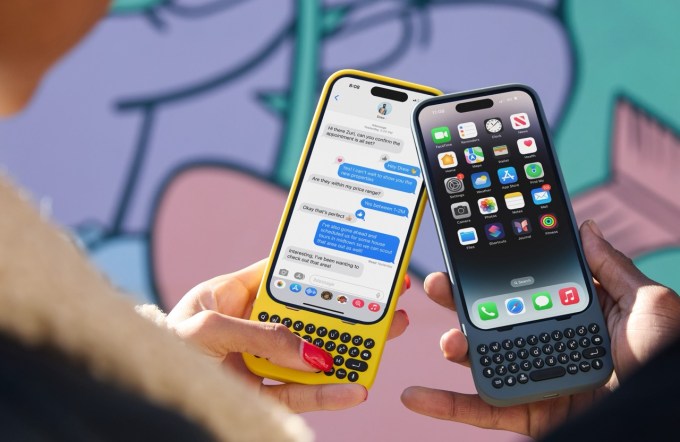
Do you miss the days of having a tactile keyboard on your iPhone? Revealed at CES 2024, Clicks Technology’s creator keyboard turns your phone into a BlackBerry-era relic for $139. The keyboard acts as a phone case attachment and gives you access to more of your iPhone’s screen without the digital keyboard. It’s sure to make your phone a lot longer, but maybe that’s the price you pay for nostalgia.
Dynamic sound mixing based on your driving
Image Credits: Tim Stevens
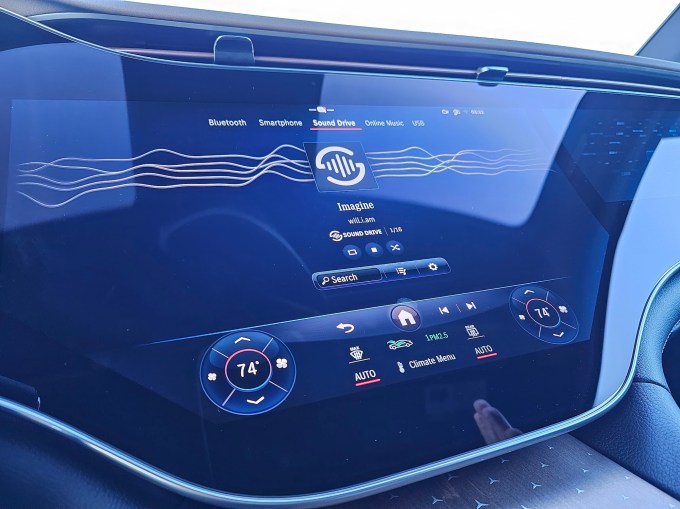
Sound Drive, a startup from singer-songwriter turned entrepreneur Will.i.am, aims to match the music you’re listening to with the cadence and energy of your commute. The technology reacts to your speed and matches music to it, with lyrics coming in and dropping out intelligently whether you’re ripping down the freeway or stuck in traffic. While we were a little skeptical, we came away from the tech fairly impressed.
A router that looks like a picture frame
Image Credits: GL.iNet
Matching your tech to your home’s aesthetic has been trendy in the last few years. Is your TV too boring? Make it look like a gallery painting with the Samsung Frame or have it blend seamlessly into your home with LG’s newly revealed transparent television.
And the latest tech item to get the yaasification treatment is the humble router. The Marble Wi-Fi 6 OpenWrt Router from GL.iNet looks like a small framed piece of art that you can hang on your wall or prop on your desk.
An AI assistant that calls 911 for you
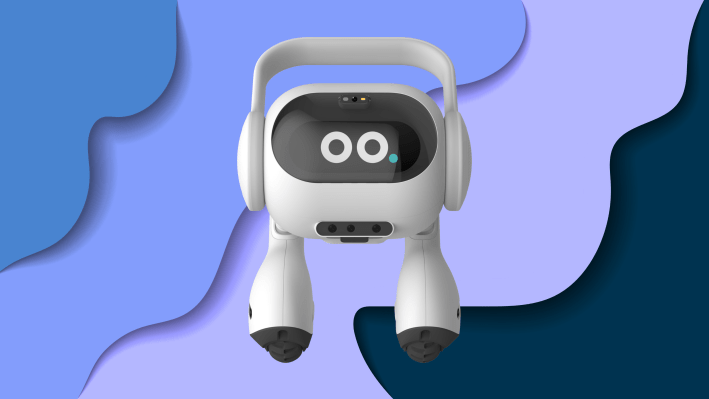
At LG’s press event, the company announced its Smart Home AI Agent. The “two-legged” wheeled robot acts as an assistant in sync with your LG appliances. Generative AI allows you to chat with the AI Agent, and the company claims it can show you empathy. In the company’s surreal, Pixar-esque promotional video, the bot can remind you to take your medicine or call 911 in a time of crisis.
Unveiled at #CES2024, LG claims its Smart Home AI Agent can give you medication reminders, chat with you, and even call 911 for you in a time of crisis. pic.twitter.com/A2SEj2v0SG
— TechCrunch (@TechCrunch) January 10, 2024
A bidet you can talk to
Image Credits: Kohler
Hey, Alexa? Turn on the bidet spray. Kohler introduced the PureWash E930 Bidet Seat with voice command support for Amazon Alexa and Google Assistant. With voice assistance, you can control the seat hands-free, turn on the bidet’s spray and dryer functions, as well as its self-cleaning UV feature. Just don’t let anyone watch you talking to your toilet.
A voice absorbing mask that looks like a muzzle
Image Credits: Haje Kamps (opens in a new window) / TechCrunch (opens in a new window)
Goodbye, nosy eavesdroppers. Skyted’s “Mobility Privacy Mask” and “Hybrid Silent Mask” are designed to “absorb voice frequencies” in noisy environments like planes, trains and rideshares, so you can communicate with a little more privacy, according to founder Stéphane Hersen. The company aims to implement their Bane-like masks in offices, call centers and even in gaming environments.
An AI-powered stroller that rocks your baby for you
Image credits: GlüxKind
Parenting is hard. GlüxKind is hoping that’s enough to convince you to put your child in the hands — er, wheels — of its AI-powered stroller, Ella. The stroller touts the ability to push itself hands-free, stop automatically on inclines, and softly rock your child without you needing to lift a finger. The stroller also includes a built-in white noise machine feature.
An uncanny valley you can brainstorm with
One of the most notable “Who asked for this?” products unveiled at CES is the GPT edition of WeHead. The AI-powered head brings a face and a physicality to ChatGPT, rather than a purely virtual AI experience. The mannequin-like setup with multiple screens aims to act as a confidant to bounce around ideas with, though we’re more fixated on just how bizarre it looks and feels to interact with than anything.
The Wehead AI companion at #CES2024 is a little unsettling, to say the least. pic.twitter.com/Mmp03uDFhU
— TechCrunch (@TechCrunch) January 11, 2024
A pocket AI assistant that scrolls through your phone for you
Want to order a pizza? Instead of pulling out your phone, unlocking it, finding a delivery app, opening it, and working your way through the UI to complete your order (so laborious!), why not just ask rabbit’s r1 to do it for you? Rather than voice-only AI assistants like Siri and Alexa, the Teenage Engineering-designed device works on a “language action model,” which allows it to hypothetically perform the requested task.
Move over, Siri. The rabbit r1 is a pocket AI assistant that can navigate your apps for you, without you having to pick up your phone.
Check out our preview from #CES2024: https://t.co/R6naLv9ckH pic.twitter.com/aUbz0WW1xI
— TechCrunch (@TechCrunch) January 9, 2024
Smart molluscs that can look out for water pollution
From phones to TVs and even toilets, everything has to be “smart” nowadays. What about molluscs? Inspired. MolluSCAN CEO and co-founder Ludovic Quinault found that a simple, non-invasive sensor attached to a clam or oyster’s shell can monitor everything from feeding to reproduction and stress responses, which can be excellent predictors of water quality and potential pollution.
CES 2024: Everything revealed so far, from Nvidia to rabbit’s pocket AI to Kodiak’s autonomous semi truck
Seeing Ballie's demo live at CES felt like watching your favorite artist in concert with general admission seats, with a huddle of people crowding around the stage to see the circular robot in action. After seeing Ballie take the stage, I am glad I was one of those people.
Samsung initially unveiled its smart home assistant, Ballie, in 2020. Facing the massive worldwide interest in AI, Samsung decided to reintroduce an upgraded version of Ballie at CES, which has evolved into an AI companion robot for the home.
Also: The best robots and AI innovations we've seen at CES 2024 so far
Ballie kept the same look and movement as the original version, a cute, little round rolling robot. The Samsung in-person demo and the teaser video both showed a yellow Ballie, but I also saw a white version on display at the event.
Despite it looking the same as 2020 Ballie, the tasks it can complete have broadened.
Samsung said that the robot's "advanced AI" allows it to assist you throughout your home and complete tasks such as greeting you at the door and following you around the house.
As it rolls around the house, Ballie is able to control all of your IoT devices, and it can actually help make sure that everything is running smoothly, managing temperature, lights, laundry machines, and more.
A major upgrade from the original is that Ballie functions as a two-in-one switchable projector. The projector can display anything when prompted, including recipe videos, a view inside of your oven or fridge, your calendar, a video call, or even a workout routine.
Also: I demoed Xreal's AR glasses for spatial computing and they're better than I expected
The on-stage demo showed someone going through their day and the different ways that Ballie could be of assistance. To begin their day, Ballie showed the person their calendar, reminded them of their anniversary, and made a call to the florist.
Then Ballie helped the individual make dinner, projecting recipes on the wall and the view of the oven and panning to the front door camera when the flower delivery arrived.
Because Ballie's projector can automatically detect a person's posture and facial angle to adjust the projection angle, the first of its kind according to Samsung, Ballie was also able to project a workout video onto the ceiling as the person reclined on the floor to do some crunches.
Also: The best CES 2024 tech you can buy right now
The online video Samsung released of Ballie showcased it acting as a pet monitor, where it sends video of the dog to its parent and then entertains the dog by projecting video and even prompts the dog feeder to release food.
That feature reminds me of a CES Award-winning robot I saw this week called the Oro robot, which acts like a pet babysitter, performing similar activities to Ballie, including feeding, recording, and playing music for your dog.
Ballie can, therefore, replace several pieces of smart equipment from your home, including a projector, a smart home hub, a dog robot, home monitoring cameras, and more, all in one basketball-sized robot.
Also: Samsung's S95D OLED is the best TV of CES 2024 and best in the world right now
Although the price point and release date were not disclosed, Samsung VP Kang-il Chung disclosed that the company is planning to release Ballie in 2024 in an interview with The Washington Post.
Of course, in tech launch time, a year release date may mean it will be much longer before it hits the market, but it could be a good indicator that the concept of robot assistants in homes is coming sooner than you think.
The demo gave me a tangible idea of how helpful a robot house assistant could be and what a serious attempt at making a robot assistant without being overly ambitious could look like.
CES 2024 was indeed a gamers’ paradise. From mind-bending virtual experiences to hardware upgrades that would make any pixel pusher drool, the showfloor buzzed with anticipation for the future of entertainment.
As many as 14 new RTX games were announced at the event that will support ray tracing and other RTX technologies, including titles like ‘Cyberpunk 2077: Phantom Liberty’, ‘The Witcher 4’, and ‘Elden Ring’.
NVIDIA stole the show
NVIDIA dropped a bomb with the GeForce RTX 40 SUPER Series. These graphical powerhouses promise to double the performance of their predecessors, rendering AAA titles in hyper-realistic detail with silky-smooth framerates.
The RTX 4080 SUPER, RTX 4070 Ti Super, and the 4070 SUPER are the shimmering beacons of performance, claiming to be twice as powerful as the already monstrous RTX 3090 Ti, and other last generation GPUs.
But NVIDIA wasn’t done flexing. It unleashed 14 new RTX games, showcasing the jaw-dropping power of ray tracing and DLSS 3.0, their revolutionary AI upscaling tech. NVIDIA also demonstrated its Avatar Cloud Engine (ACE) for gaming, which aims to give NPCs AI-generated dialogue.
Then comes the NVIDIA RTX Remix, which is mind-bending, developed on the NVIDIA Omniverse platform for remastering graphics. The open beta for RTX Remix is set to be released later this month.
Having already produced remarkable remasters in Portal with RTX and the modder-created Portal: Prelude RTX, RTX Remix is now being utilised by Orbifold Studios for the creation of Half-Life 2 RTX: An RTX Remix Project.
AMD and Intel also make a mark
AMD responded to NVIDIA with the FidelityFX Super Resolution 3.0 (FSR 3.0). This open-source upscaling tech delivers near-native image quality with a significant performance boost, making it a serious contender for both NVIDIA and AMD users.
When it comes to hardware, the Ryzen 8000 G-Series processors, unveiled at CES 2024, mark a significant advancement in integrated graphics for gaming for AMD. With a blend of Zen 4 architecture, RDNA 3 graphics core, and an XDNA AI engine, these processors promise an enhanced gaming experience without the need for a dedicated graphics card.
AMD’s realistic approach acknowledges that these integrated graphics may not challenge modern video cards but suggests a compelling option for budget and older card alternatives. The open beta for RTX Remix is set to be released later this month.
Intel also released its latest 14th Gen HX-series, catering to the needs of gamers, creators, and professionals seeking top-notch computing performance in a portable form factor. Leading the series is the Intel Core i9-14900HX, equipped with eight Performance-cores (P-cores) and 16 Efficient-cores (E-cores).
Notably, the Intel Core i7-14700HX processors in this lineup demonstrate a significant enhancement in creator performance with a 50% increase in E-cores.
And the fun part…
The headline grabber was the Samsung 3D Monitor, which offers the VR gaming experience without a headset. Featuring dual cameras for eye and head tracking, the device offers an enhanced 3D mode that optimises effects.
Additionally, a specialised UI elevates the browsing experience in 3D. Samsung is proactively pursuing partnerships with prominent gaming publishers to expand its 3D gaming content offerings. Several manufacturers announced new gaming laptops powered by the latest NVIDIA and AMD processors and graphics cards.
Acer Predator Helios 18 equipped with an NVIDIA GeForce RTX 40 Series GPU and a 120Hz refresh rate display, this laptop is designed for serious gamers.
Razer Blade 16 with a sleek and powerful laptop features an Intel Core i9 processor and an NVIDIA GeForce RTX 4090 GPU, making it ideal for demanding gaming and creative tasks.
HP wasn’t to be left out – it unleashed a barrage of powerful gaming laptops. HP’s Omen Transcend 14, touting it as the most powerful and slimmest laptop in the world.
Then there was ROG’s NUC, which is a gaming console powered by Intel Core Ultra 9 and NVIDIA RTX 4070. It is a new gaming unit with Quad 4k support.
Targus also won the CES 2024 Innovation award for announcing its ErgoFlip EcoSmart Mouse that is compatible for both, left and right handed users, for which the company also has a patent. It is also made of sustainable materials.
These, along with the introduction of gaming capabilities in BMW and the launch of MSI Claw, which is an Intel-powered gaming handheld, covers all the types of gamers in the world.
The best out of the lot was Razer’s HD Haptics gaming cushion, called Project Esther, for comfortable gaming experience, along with simulations of what’s going on in the game.
The post CES 2024 was Gamers’ Paradise appeared first on Analytics India Magazine.
Considering that Java is the most popular and developer favourite programming language, DeepLearning.AI, once again in collaboration with LangChain, has released a new course “Learn how to build LLM applications with LangChain.js”
This free intermediate-level course is of one-hour program and will be led by Jacob Lee, LangChain’s founding engineer. It will cover different concepts in JavaScript for generative AI application development.
The course will cover various aspects, including using data loaders to extract information from common sources such as PDFs, websites, and databases. It will also delve into the use of prompts to provide context for the LLM, modules supporting RAG like text splitters and integrations with vector stores, working with different models for applications that aren’t vendor-specific, and implementing parsers to extract and format output for downstream code processing.
Through this comprehensive exploration, participants will gain a practical understanding of building applications with LangChain.js and leveraging its capabilities for effective LLM development.
You’ll also work with the LangChain Expression Language, enabling the easy composition of sequences, or chains, of modules for performing complex tasks with LLMs. This hands-on experience will be applied to the development of a conversational question-answering LLM application that can effectively use external data as context.
This marks Andrew Ng’s fourth collaboration with LangChain, following the release of the courses “LangChain: Chat With Your Data!”, “LangChain for LLM Application Development,” and “Functions, Tools, and Agents with LangChain”.
The post Andrew Ng Teams Up with LangChain for Another Course on LLM Development appeared first on Analytics India Magazine.
Described by testers as adorable, nostalgic, and even what could become "the iPhone of AI," the Rabbit R1 debuted at CES 2024 as an AI-powered pocket companion that the company hopes will become your personal AI assistant. Garnering a lot of attention from both spectators and media, the Rabbit R1 launched for pre-orders with a $199 price tag, and it didn't disappoint: The company sold 10,000 units in a single day, effectively wiping out its first batch of devices.
Also: CES 2024: What's Next in Tech
"When we started building R1, we said internally that we'd be happy if we sold 500 devices on launch day," the company posted on its X (formerly Twitter) account yesterday. "In 24 hours, we already beat that by 20x! 10,000 units on day 1!"
The first batch of pre-orders is planned to ship in late March, but potential buyers can still jump at the chance of snagging an R1 companion. Rabbit announced that a second batch of R1s is now live on its website, at the same pre-order price of $199, with orders shipping in April or May.
Also: The 14 best robots and AI tech we've seen at CES 2024 so far
The "LAM-powered Tamagotchi," as Rabbit founder and CEO, Jesse Lyu, described the R1 on X, is a square device roughly half the size of an iPhone, but promising a more personalized experience than the $1,000 smartphone can deliver.
Capable of answering questions in natural language, the R1 can also control the apps in your phone for you by just talking to it with its push-to-talk button like a walkie-talkie. "Something so intuitive, that you don't need to learn how to use it," Lyu described the device during the keynote. The R1 breaks away from an app-based OS in smartphones and does what we wish Siri and Google did for us.
The Rabbit R1 features a rotating camera, push-to-talk button, analog scroll wheel, 2.88-inch touchscreen, 128GB of internal storage, SIM card slot for data, and USB-C port for charging.
Coursera launched a large catalog of learning content in Hindi and AI-powered features to make online learning more personalised and interactive. Now, top courses like Generative AI for Everyone from DeepLearning.AI, the Science of Well-Being from Yale University, Programming for Everybody from the University of Michigan, and What is Data Science? from IBM, which has until recently been available only in English, are going to be accessible to anyone who speaks Hindi.
Coursera also announced new enterprise and campus customers as institutions across the country embrace online learning to equip their employees and students with digital skills. With over 23.4 million learners and 57 million enrollments on the platform, India represents the 2nd largest market for Coursera globally.
“India’s ambition to become a USD 5 trillion economy depends on its ability to develop a skilled workforce and maximize its demographic dividend. Our goal is to make high-quality education available to everyone, no matter what language they speak, and today marks a big step towards that goal. We have used the power of AI to translate over 4,000 courses into Hindi, giving learners in India unprecedented access and flexibility to develop skills for the digital future,” Jeff Maggioncalda, CEO at Coursera, said.
Here are the new initiatives and features Coursera is unveiling in India:
Hindi translations: More than 4,000 courses are now available in Hindi, including some of the most popular courses in India, such as Supervised Machine Learning: Regression and Classification from DeepLearning.AI and Stanford, Financial Markets from Yale, and Learning How to Learn from Deep Teaching Solutions. Learners can access course readings, lecture video subtitles, quizzes, assessments, peer review instructions, and discussion prompts — all in the local language. Over 40 courses from top Indian educators like Introduction to Programming from BITS Pilani, Leadership Skills from IIM Ahmedabad, and Trading Basics from Indian School of Business will also be translated into 18 languages, including French, Spanish, German, and Thai, enabling India’s vision to become the global hub for education.
GenAI Academy Launch: Designed to offer foundational literacy and executive education programs from top universities and companies, including Stanford Online, Vanderbilt, DeepLearning.AI, Google Cloud, and AWS. L&T is the first enterprise in India to launch Coursera’s GenAI Academy to provide structured digital literacy across its workforce.
Coursera Coach (beta) for Coursera Plus subscribers: A GenAI-powered virtual learning assistant that provides personalized feedback, answers questions, and summarizes video lectures and resources. Coach will also support learners with interaction in the local language.
Coursera Course Builder: Based on prompts from human authors, the AI-powered course-building tool will auto-generate content, including course structure, descriptions, readings, assignments, and glossaries. Companies and campuses can also use this feature for private authoring, using their internal experts to produce custom courses and blend them with recommended content from participating partners on Coursera.
New and expanded partnerships: 45 Coursera for Business customers, including Aditya Birla Group, Tata Power, KPIT Technologies Ltd, and Bajaj Finserv, bringing the total to 140 enterprise customers in the country. 55 Coursera for Campus customers, including XLRI Jamshedpur, Somaiya Vidyavihar University, Alliance University, and Yenepoya University, bringing the total to 1,100 higher educational institutions in the country.
New programmes from Indian institutions: Specialisation – Advanced Digital Transformation – from IIM Ahmedabad Degree – Master of Science in Information Technology – from IIIT Hyderabad
The post Coursera launches new AI features in India, translates 4,000 courses into Hindi appeared first on Analytics India Magazine.
NTT Ltd., a leading global IT infrastructure and services company and market leader in the Indian data centre industry, announces the launch of its new data centre campus, Noida 2, and the opening of its first data centre. Spanning six acres, the campus will support a planned capacity of 52.8 MW critical IT load in two data centres.
The campus is in Noida’s data centre corridor within the Delhi National Capital Region (NCR), one of India’s largest and fastest-growing economic centres. It is carrier-neutral, interconnected with NTT’s other data centre locations for minimal latency and offers seamless access to top-tier public cloud providers. Its advanced features include high levels of automation that monitor and optimize facility performance and resources like power and water.
“Clients can now access our trusted data centre services from an interconnected campus in North India. As India’s digital economy accelerates towards the one trillion-dollar milestone, we will continue to provide the infrastructure for this growth,” Shekhar Sharma, CEO & MD, NTT GDC India & NTT Com India Network Services, said.
The first data centre delivered today, will support 22.4 MW IT load with an area of 300,000 sq. ft. (approx. 28,000m2). Additionally, this is the first data center campus in India to incorporate seismic dampers, ensuring uninterrupted operations even during significant seismic events.
With this launch, NTT’s Global Data Centers division expanded its India footprint to more than 268 MW with 18 data centres across Delhi NCR, Mumbai, Chennai, and Bengaluru. This includes Mumbai 9 data centre, which recently went live at its flagship Central Mumbai (Chandivali) campus. Together, these facilities cover over 3.1 million sq. ft. (approx. 290,000 m2) across interconnected campuses where clients can plan their infrastructure for immediate requirements and the ability to scale to match future growth needs -all supported by NTT’s full-stack managed services portfolio.
NTT Global Data Centers employs advanced liquid cooling technologies, such as liquid immersion cooling and direct liquid cooling, ensuring clients can deploy the latest AI and high-performance computer platforms in its data centres.
The post NTT Announces New Data Centre Campus in Noida appeared first on Analytics India Magazine.