Splatter Image: Ultra-Fast Single-View 3D Reconstruction

Splatter Image: Ultra-Fast Single-View 3D Reconstruction

Single-view 3D object reconstruction with convolutional networks have demonstrated remarkable capabilities. Single-view 3D reconstruction models generate the 3D model of any object using a single image as the reference, making it one of the hottest topics of research in computer vision.

For example, let’s consider the motorbike in the above image. Generating its 3D structure requires a complex pipeline that first combines cues from low-level images with high level semantic information, and knowledge about the structural arrangement of parts.

Owing to the complex process, Single-view 3D reconstruction has been a major challenge in computer vision. In an attempt to enhance the efficiency of Single-view 3D reconstruction, developers have worked on Splatter Image, a method that aims to achieve ultra-fast single-view 3D shape and 3D appearance construction of the objects. At its core, the Splatter Image framework uses the Gaussian Splatting method to analyze 3D representations, taking advantage of the speed and quality it offers.

Recently, the Gaussian Splatting method has been implemented by numerous multi-view reconstruction models for real-time rendering, enhanced scaling, and fast training. With that being said, Splatter Image is the first framework that implements the Gaussian Splatting method for single-view reconstruction tasks.

In this article, we will be exploring how the Splatter Image framework employs Gaussian Splatting to achieve ultra-fast single-view 3D reconstruction. So let’s get started.

Splatter Image : An Attempt at Ultra-Fast Single-View 3D Reconstruction

As mentioned earlier, Splatter Image is an ultra-fast approach for Single-view 3D object reconstruction based on the Gaussian Splatting method. Splatter Image is the first ever computer vision framework to implement Gaussian Splatting for monocular 3D object generation since traditionally, Gaussian Splatting has been powering multi-view 3D object reconstruction frameworks. However, what separates the Splatter Image framework from prior methods is that it is a learning-based approach, and reconstruction in testing only requires the feed-forward evaluation of the neural network.

Splatter Image relies fundamentally on Gaussian Splatting’s rendering qualities, and high processing speed to generate 3D reconstructions. The Splatter Image framework features a straightforward design: the framework uses a 2D image-to-image neural network to predict a 3D Gaussian per input image pixel, and maps the input image to one 3D Gaussian per pixel. The resulting 3D Gaussians have the form of an image, known as the Splatter Image, and they Gaussians also provide 360 degree representation of the image. The process is demonstrated in the following image.

Although the process is simple and straightforward, there are some key challenges faced by the Splatter Image framework when using Gaussian Splatting to generate 3D Gaussians for single-view 3D representations. The first major hurdle is to design a neural network that accepts the image of an object as an input, and generates a corresponding Gaussian mixture representing all sides of the image as the output. To tackle this, the Splatter Image takes advantage of the fact that even though the generated Gaussian mixture is a set or an unordered collection of items, it can still be stored in an ordered data structure. Accordingly, the framework uses a 2D image as a container for the 3D Gaussians as a result of which each pixel in the container contains the parameters of one Gaussian, including its properties like shape, opacity, and color.

By storing 3D Gaussian sets in an image, the Splatter Image framework is able to reduce the reconstruction hurdles faced when learning an image to image neural network. By using this approach, the reconstruction process can be implemented only by utilizing efficient 2D operators instead of relying on 3D operators. Furthermore, in the Splatter Image framework, the 3D representation is a mixture of 3D Gaussians allowing it to exploit the rendering speed and memory efficiency advantages offered by Gaussian Splatting that enhances the efficiency in training as well as in inference. Moving along, the Splatter Image framework not only generates single-view 3D representations, but it also demonstrates remarkable efficiency as it can be trained even on a single GPU on standard 3D object benchmarks. Furthermore, the Splatter Image framework can be extended to take several images as input. It is able to achieve so by registering the individual Gaussian mixtures to a common reference and then by taking the combination of the Gaussian mixtures predicted from individual views. The framework also injects lightweight cross-attention layers in its architecture that allows different views to communicate with one another during prediction.

From an empirical point of view, it is worth noting that the Splatter Image framework can produce 360 degree reconstruction of the object even though it sees only one side of the object. The framework then allocated different Gaussians in a 2D neighborhood to different parts of the 3D object to code the generated 360 degree information in the 2D image. Furthermore, the framework sets the opacity of several Gaussians to zero that deactivates them, thus allowing them to be culled during post-processing.

To summarize, the Splatter Image framework is

  1. A novel approach to generate single-view 3D object reconstructions by porting the Gaussian Splatting approach.
  2. Extends the method for multi-view 3D object reconstruction.
  3. Achieves state of the art 3D object reconstruction performance on standard benchmarks with exceptional speed and quality.

Splatter Image : Methodology and Architecture

Gaussian Splatting

As mentioned earlier, Gaussian Splatting is the primary method implemented by the Splatter Image framework to generate single-view 3D object reconstructions. In simple terms, Gaussian Splatting is a rasterization method for reconstructing 3D images and real-time, and rendering images having multiple point of views. The 3D space in the image is referred to as Gaussians, and machine learning techniques are implemented to learn the parameters of each Gaussian. Gaussian Splatting does not require training during rendering that facilitates faster rendering times. The following image summarizes the architecture of 3D Gaussian Splatting.

3D Gaussian Splatting first uses the set of input images to generate a point cloud. Gaussian Splatting then uses the input images to estimate the external parameters of the camera like tilt and position by matching the pixels between the images, and these parameters are then used to compute the point cloud. Using different machine learning methods, Gaussian Splatting then optimizes four parameters for each Gaussian namely: Position (where is it located), Covariance (the extent of its stretching or scaling in 3×3 matrix), Color (what is the RGB color scheme), and Alpha (measuring the transparency). The optimization process renders the image for each camera position and uses it to determine the parameters closer to the original image. As a result, the resultant 3D Gaussian Splatting output is an image, named the Splatter Image that resembles the original image the most at the camera position from which it was captured.

Furthermore, the opacity function and the color function in Gaussian Splatting gives a radiance field with the viewing direction of the 3D point. The framework then renders the radiance field onto an image by integrating the colors observed along the ray that passes through the pixel. Gaussian Splatting represents these functions as a combination of colored Gaussians where the Gaussian mean or center along with the Gaussian covariance helps in determining its shape and size. Each Gaussian also has an opacity property and a view-dependent color property that together define the radiance field.

Splatter Image

The renderer component maps the set of 3D Gaussians to an image. To perform single-view 3D reconstruction, the framework then seeks an inverse function for 3D Gaussians that reconstruct the mixture of 3D Gaussians from an image. The key inclusion here is to propose an effective yet a simple design for the inverse function. Specifically, for an input image, the framework predicts a Gaussian for each individual pixel using an image-to-image neural network architecture to output an image, the Splatter Image. The network also predicts the shape, the opacity, and the color.

Now, it might be speculated that how can the Splatter Image framework reconstruct the 3D representation of an object even though it has access to only one of its views? In real-time, the Splatter Image framework learns to use some of the available Gaussians to reconstruct the view, and uses the remaining Gaussians to automatically reconstruct unseen parts of the image. To maximize its efficiency, the framework can automatically switch off any Gaussians by predicting if the opacity is zero. If the opacity is zero, the Gaussians are switched off, and the framework does not render these points, and are instead culled in post-processing.

Image Level Loss

A major advantage of exploiting the speed and efficiency offered by the Splatter Gaussian method is that it facilitates the framework to render all of the images at each iteration, even for batches with relatively larger batch size. Furthermore, it implies that not only is the framework able to use decomposable losses, it can also use the image-level losses that do not decompose into losses per-pixel.

Scale Normalization

It is challenging to estimate the size of an object by looking at a single view, and it is a challenging task to resolve this ambiguity when it is trained with a loss. The same issue is not observed in synthetic datasets as all the objects are rendered with identical camera intrinsics and the objects are at a fixed distance from the camera, that ultimately helps in resp;ving the ambiguity. However, in datasets with real-life images, the ambiguity is quite evident, and the Splatter Image framework employs several pre-processing methods to approximately fix the scale of all objects.

View Dependent Color

To represent view dependent colors, the Splatter Image framework uses spherical harmonics to generalize the colors beyond the Lambertian color model. For any specific Gaussian, the model defines coefficients that are predicted by the network and the spherical harmonics. The viewpoint change transforms a viewing direction in the camera source to its corresponding viewing direction in the frame of reference. The model then finds the corresponding coefficients to find the transformed color function. The model is able to do so because when under rotation, the spherical harmonics are closed, along with every other order.

Neural Network Architecture

A majority of the architecture of the predictor mapping the input image to the combination of Gaussian is identical to the process used in the SongUNet framework. The last layer in the architecture is replaced by a 1×1 convolutional layer with the color model determining the width of the output channels. Given the input image, the network produces an output channel tensor as output, and for each pixel channel, codes the parameters that are then transformed into offset, opacity, rotation, depth, and color. The framework then uses nonlinear functions to activate the parameters and obtain the Gaussian parameters.

For reconstructing 3D representations with multi-view, the Splatter Image framework applies the same network to each input view, and then uses the viewpoint approach to combine the individual reconstructions. Furthermore, to facilitate efficient coordination and exchange of information between the views in the network, the Splatter Image framework makes two modifications in the network. First, the framework conditions the model with its respective camera pose, and passes vectors by encoding each entry using a sinusoidal position embedding resulting in multiple dimensions. Second, the framework adds cross-attention layers to facilitate communication between the features of different views.

Splatter Image : Experiments and Results

The Splatter Image framework measures the quality of its reconstructions by evaluating the Novel View Synthesis quality since the framework uses the source view and renders the 3D shape to target unseen views to perform reconstructions. The framework evaluates its performance by measuring the SSIM or Structural Similarity, Peak Signal to Noise Ratio or PSNR, and Perceptual Quality or LPIPS scores.

Single-View 3D Reconstruction Performance

The following table demonstrates the performance of the Splatter Image model in single-view 3D reconstruction task on the ShapeNet benchmark.

As it can be observed, the Splatter Image framework outperforms all deterministic reconstruction methods across the LPIPS and SSIM scores. The scores indicate that the Splatter Image model generates images with sharper reconstructions. Furthermore, the Splatter Image model also outperforms all deterministic baseline in terms of the PSNR score that indicates that the generated reconstructions are also more accurate. Furthermore, in addition to outperforming all the deterministic methods, the Splatter Image framework only requires the relative camera poses to enhance its efficiency in both training and testing phases.

The following image demonstrates the qualitative prowess of the Splatter Image framework, and as it can be seen, the model generates reconstructions with thin and interesting geometries, and captures the details of the conditioning views.

The following image shows that the reconstructions generated by the Splatter Image framework is not only sharper but also has better accuracy that previous models especially in unconventional conditions with thin structures and limited visibility.

Multi-View 3D Reconstruction

To evaluate its multi-view 3D reconstruction capabilities, the Splatter Image framework is trained on the SpaneNet-SRN Cars dataset for two view predictions. Existing methods use absolute camera pose conditioning for multi-view 3D reconstruction tasks that means the model learns to rely primarily on the object’s canonical orientation in the object. Although it does the job, it limits the applicability of the models as the absolute camera pose is often unknown for a new image of an object.

Final Thoughts

In this article, we have talked about Splatter Image, a method that aims to achieve ultra-fast single-view 3D shape and 3D appearance construction of the objects. At its core, the Splatter Image framework uses the Gaussian Splatting method to analyze 3D representations, taking advantage of the speed and quality it offers. The Splatter Image framework processes images using an off the shelf 2D CNN architecture to predict a pseudo-image that contains one colored Gaussian per every pixel. By using Gaussian Splatting method, the Splatter Image framework is able to combine fast rendering with fast inference that results in quick training and quicker evaluation on real and synthetic benchmarks.

Wipro’s Net Profit Dips 12%, Marks Fourth Quarter Slump

Indian IT giant Wipro reported a 12% decrease in its consolidated net profit, which amounted to ₹2,694 crore in the third quarter of fiscal 2024. This marks the fourth consecutive quarter of decline for the company. During the same period, its consolidated revenue also dropped by 4.4%, totaling ₹22,205 crores. Additionally, Wipro secured 14 large deals with a total contract value (TCV) of $3.2 billion, 71% of which were new net additions.

Among these, one of the most significant deals signed in Europe this quarter involves transforming the digital workplace services of a multinational telecommunications company, aimed at enhancing client satisfaction and reducing operating expenses.

The team will build an AI-powered platform for them that provides service desk on-site and remote support services for 400,000 users and 80,000 managed services across 240 locations worldwide.

Turns out that Wipro’s clients are now increasingly requiring AI solutions aligned with their business goals, now a standard in various offerings including cloud and digital workplace services. In engineering, particularly in automotive and manufacturing, there’s a growing demand for AI to boost R&D and speed up product development. Wipro supports this through its Enterprise services, focusing on developing AI models and solutions with the generative AI framework.

“AI is now moving from I would say the curiosity and experimentation stage to becoming vital to business strategy. In fact, we can confidently say that every long-term large deal now has an AI component,” Thierry Delaporte, chief executive officer and managing director, of Wipro, said during the quarterly result announcement.

The tech giant is also working with a global healthcare insurer to develop a generative AI-powered knowledge research solution to transform the contact center to improve patient experience and operational efficiency by cutting the time it takes to analyze healthcare plan documents and response time.

Wipro has created a generative AI powered assistant for a Fortune 500 investment and insurance company, enhancing email campaign efficiency and boosting click-through rates. The firm’s AI 360 strategy heavily focuses on growing partnerships with key players.

Recent collaborations include Nvidia, aiding healthcare firms in developing AI-centric strategies and products, and IBM, working on joint ventures with IBM Watson X for robust AI solutions. To support these initiatives, Wipro has trained 210,000 employees worldwide in AI, introducing customized learning programs for various roles and functions.

“Our goal is to ensure that everyone at Wipro has the skills to fully leverage AI in their everyday work and for AI-related client projects. We are accelerating generative AI adoption internally by integrating the technology across our entire portfolio of platforms,” he added, stating it is resulting in quality and productivity improvements across HR, marketing, and sales operations, as well as software development, and quality engineering and testing.

However, just like its contemporaries Infosys and TCS, the company did not mention the revenue it has gained or is expecting from investing in generative AI although it is “confident that we have the right vision, the right strategy, and the right leadership to continue to grow and keep us competitive, resilient, and ambitious.”

The post Wipro’s Net Profit Dips 12%, Marks Fourth Quarter Slump appeared first on Analytics India Magazine.

AI will have a big impact on jobs this year. Here’s why that could be good news

person and robot shaking hands through laptops

We're only a couple of weeks into 2024, but one thing's already clear — the next 12 months will be the year when artificial intelligence (AI) moves from the margins to the mainstream.

While some companies have been using AI and machine-learning technologies to boost operational performance for several years, fewer organizations so far have found ways to put generative AI tools, such as ChatGPT and Microsoft Copilot, into production.

Also: Have 10 hours? IBM will train you in AI fundamentals — for free

However, you can expect that trend to change as more organizations explore and exploit generative AI during the next 12 months, says David Brodeur-Johnson, principal analyst at Forrester, to ZDNET.

"2024 will be the year that firms get serious about applying generative AI to their own internal data sources and making information and insights available to their employees to help them do their jobs even better."

Additional research from Digitate suggests 90% of IT decision-makers across all sectors plan to implement automation in the next year, with 56% expecting to make significant progress in IT organizations during the next six months.

But while employers are looking to introduce automation, many of their employees fear that increased use of technologies like generative AI and machine learning is far from good news.

Forrester's research suggests as many as 86% of US employees fear that many people will lose their jobs to AI and automation, and almost a third (31%) believe that trend will manifest during the next two to five years.

Also: I spent a weekend with Amazon's free AI courses, and highly recommend you do too

Digital leaders responding to a global survey from recruiter Nash Squared come to similar conclusions, with 17% being the average percentage of jobs that digital leaders feel will be lost to automation.

Bev White, CEO at Nash Squared, tells ZDNET in a one-to-one video chat that the increased use of AI will lead to big changes in the job market, but it's important not to jump to conclusions just yet.

She says the story of the introduction of automation — from the Industrial Revolution through to our present digital age — has always revolved around fears that jobs will be cut.

While AI and automation will lead to the end of some roles, the tools should also help change many workplaces and work roles for the better.

White refers to software development and quotes research that suggests developers who use GitHub Copilot complete tasks 55% faster than developers who don't.

The same research found between 60% and 75% of developers report that using generative AI tools as part of their roles leaves them feeling more fulfilled, less frustrated when coding, and able to focus on more satisfying work.

Also: These are the jobs most likely to be taken over by AI

"Emerging technology is speeding things up," says White. "It's taking human processes out — which are repetitive, and actually not necessarily interesting for a human being to do — and replacing them with automated ways of doing things faster."

Even with increased levels of automation, companies will still need a human in the loop to ensure processes are completed effectively, such as dealing with more complicated customer service requests.

And White says the tactical deployment of AI and automation should mean professionals in all kinds of roles have an increased opportunity to focus on crucial business areas.

"People will be able to do things, not only faster, but more cheaply and they'll actually spend more time on the human elements — the thinking time, the decision-making time — that are essential to value-added processes."

Also: GPT Store is OpenAI's most compelling reason to become a ChatGPT Plus subscriber yet

That's a sentiment that resonates with Ben Elms, chief revenue officer at internet connectivity specialist Expereo, who says it's important to remember that almost every implementation of technological innovation comes with a side order of fear.

"If you approach AI as, 'It's going to change the world, and it's going to put people out of jobs,' well, it isn't — it's actually going to create even more opportunity and jobs," he says.

Elms says that the key to success is applying AI to the right use cases and he gives an example from his own company, which is based on the resolution of customer service requests, many of which require a standard answer.

"These are highly repeatable tasks," he says. "These requests are text-based and many of the answers can be served effectively by AI quickly. That capability means people can come out of the service function, I can give them more training, and they can be frontline people, enhancing the customer experience."

Hari Ramamurthy, technology fellow at The Home Depot, is another business leader who believes AI and automation can help workers to focus on more interesting work.

Also: How to use Bing Image Creator (and why it's better than ever)

"We definitely see it as something that will improve the productivity of our associates and help them with the laborious, monotonous aspects of what they're working on," he says.

Ramamurthy explained to me recently how the retail giant has developed a machine learning-powered app, known as Sidekick, to boost staff productivity.

The app, which also uses computer vision, helps shopfloor staff identify items in hard-to-find locations.

"It was painful to try and search for some of our products overhead. Sometimes, an item is not exactly where you expect it to be," he says.

"But technologies like computer vision help with locating those products a lot easier. And it's that sort of a mindset that we have in terms of how we can really augment the capabilities of our associates by improving their productivity, so we can serve the customers better."

Also: Five ways to use AI responsibly

These kinds of AI-enabled productivity boosts could also offer staff at public-facing organizations not just a way to cut the drudgery of repetitive work, but an opportunity to focus on potentially life-changing activities.

Michelle Smith, program manager at Barnardo's, which is a UK charity that supports more than 370,000 children, young people, parents and caregivers, believes the smart use of AI could help people to focus on the frontline services that matter most.

"Relationships keep us running," she says in a video call. "It's where people get the most joy from work and it's what motivates people. We work for a purpose and if you're stuck in front of a screen too much, and you're not interacting with your colleagues, it becomes painful."

Smith says generative AI tools could help the charity to cut the administrative bind and give people more time to think, collaborate, and make decisions.

Also: 6 AI tools to supercharge your work and everyday life

"I've worked in operational roles for years and there's loads of things where I think, 'Oh, I'd rather be speaking to a person than the really tedious process of checking paperwork,'" she says.

"It would be great if we can get people freed up from processes and allow them to be creative in their roles by taking advantage of emerging technology. I'm keen for my colleagues who are still in operational roles to be given the opportunity to develop new skills."

Featured

Running Mixtral 8x7b On Google Colab For Free

Running Mixtral 8x7b On Google Colab For Free
Image by Author

In this post, we will explore the new state-of-the-art open-source model called Mixtral 8x7b. We will also learn how to access it using the LLaMA C++ library and how to run large language models on reduced computing and memory.

What is Mixtral 8x7b?

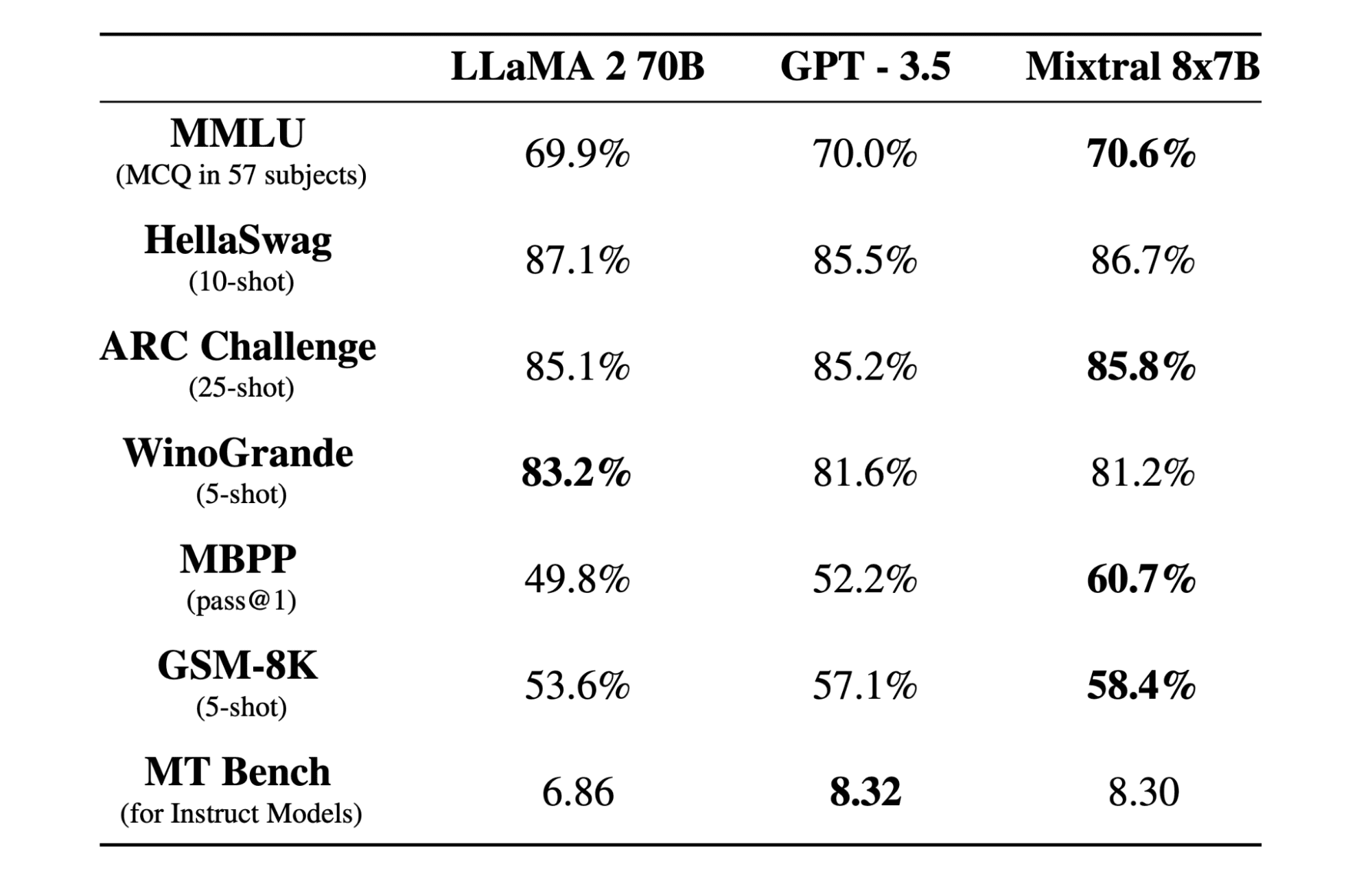
Mixtral 8x7b is a high-quality sparse mixture of experts (SMoE) model with open weights, created by Mistral AI. It is licensed under Apache 2.0 and outperforms Llama 2 70B on most benchmarks while having 6x faster inference. Mixtral matches or beats GPT3.5 on most standard benchmarks and is the best open-weight model regarding cost/performance.

Running Mixtral 8x7b On Google Colab For Free
Image from Mixtral of experts

Mixtral 8x7B uses a decoder-only sparse mixture-of-experts network. This involves a feedforward block selecting from 8 groups of parameters, with a router network choosing two of these groups for each token, combining their outputs additively. This method enhances the model's parameter count while managing cost and latency, making it as efficient as a 12.9B model, despite having 46.7B total parameters.

Mixtral 8x7B model excels in handling a wide context of 32k tokens and supports multiple languages, including English, French, Italian, German, and Spanish. It demonstrates strong performance in code generation and can be fine-tuned into an instruction-following model, achieving high scores on benchmarks like MT-Bench.

Running Mixtral 8x7b using LLaMA C++

LLaMA.cpp is a C/C++ library that provides a high-performance interface for large language models (LLMs) based on Facebook's LLM architecture. It is a lightweight and efficient library that can be used for a variety of tasks, including text generation, translation, and question answering. LLaMA.cpp supports a wide range of LLMs, including LLaMA, LLaMA 2, Falcon, Alpaca, Mistral 7B, Mixtral 8x7B, and GPT4ALL. It is compatible with all operating systems and can function on both CPUs and GPUs.

In this section, we will be running the llama.cpp web application on Colab. By writing a few lines of code, you will be able to experience the new state-of-the-art model performance on your PC or on Google Colab.

Getting Started

First, we will download the llama.cpp GitHub repository using the command line below:

!git clone --depth 1 https://github.com/ggerganov/llama.cpp.git

After that, we will change directory into the repository and install the llama.cpp using the `make` command. We are installing the llama.cpp for the NVidia GPU with CUDA installed.

%cd llama.cpp    !make LLAMA_CUBLAS=1

Download the Model

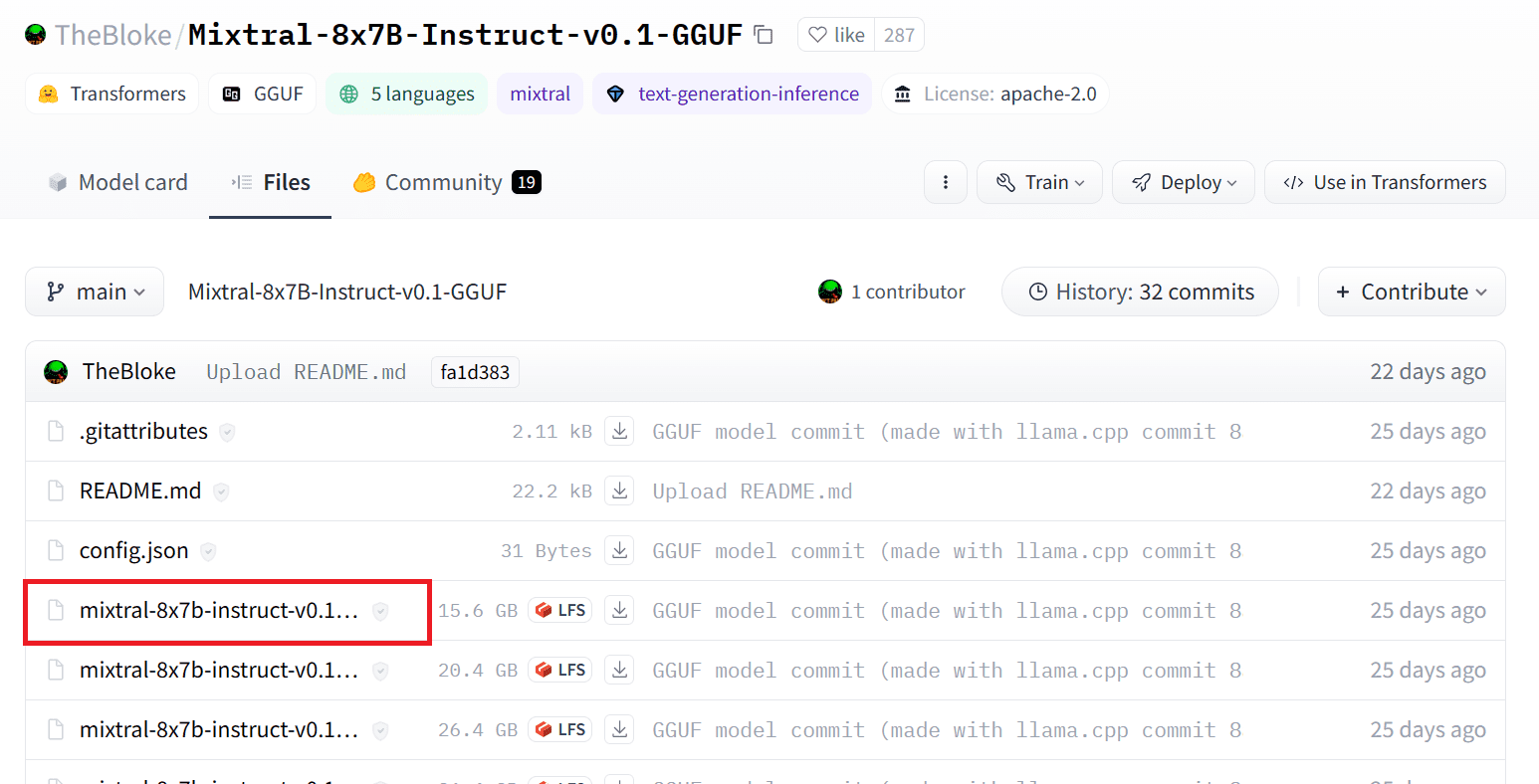
We can download the model from the Hugging Face Hub by selecting the appropriate version of the `.gguf` model file. More information on various versions can be found in TheBloke/Mixtral-8x7B-Instruct-v0.1-GGUF.

Running Mixtral 8x7b On Google Colab For Free
Image from TheBloke/Mixtral-8x7B-Instruct-v0.1-GGUF

You can use the command `wget` to download the model in the current directory.

!wget https://huggingface.co/TheBloke/Mixtral-8x7B-Instruct-v0.1-GGUF/resolve/main/mixtral-8x7b-instruct-v0.1.Q2_K.gguf

External Address for LLaMA Server

When we run the LLaMA server it will give us a localhost IP which is useless for us on Colab. We need the connection to the localhost proxy by using the Colab kernel proxy port.

After running the code below, you will get the global hyperlink. We will use this link to access our webapp later.

from google.colab.output import eval_js  print(eval_js("google.colab.kernel.proxyPort(6589)"))
https://8fx1nbkv1c8-496ff2e9c6d22116-6589-colab.googleusercontent.com/

Running the Server

To run the LLaMA C++ server, you need to provide the server command with the location of the model file and the correct port number. It's important to make sure that the port number matches the one we initiated in the previous step for the proxy port.

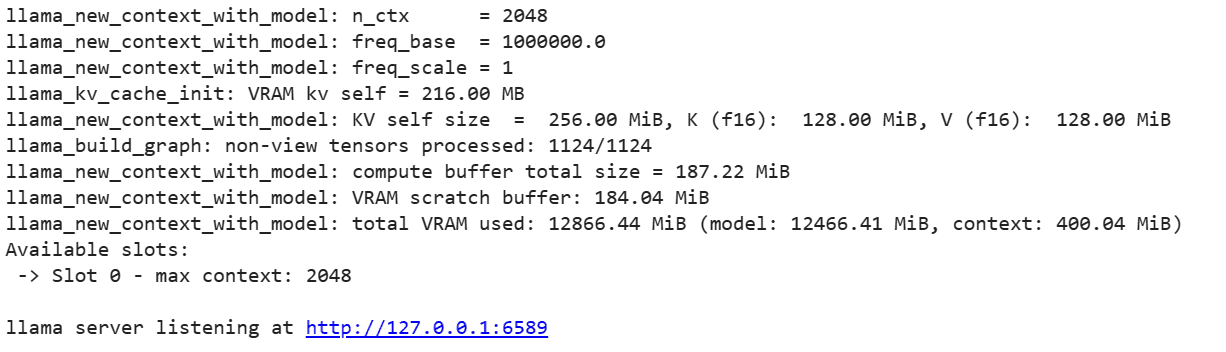
%cd /content/llama.cpp    !./server -m mixtral-8x7b-instruct-v0.1.Q2_K.gguf -ngl 27 -c 2048 --port 6589

Running Mixtral 8x7b On Google Colab For Free

The chat webapp can be accessed by clicking on the proxy port hyperlink in the previous step since the server is not running locally.

LLaMA C++ Webapp

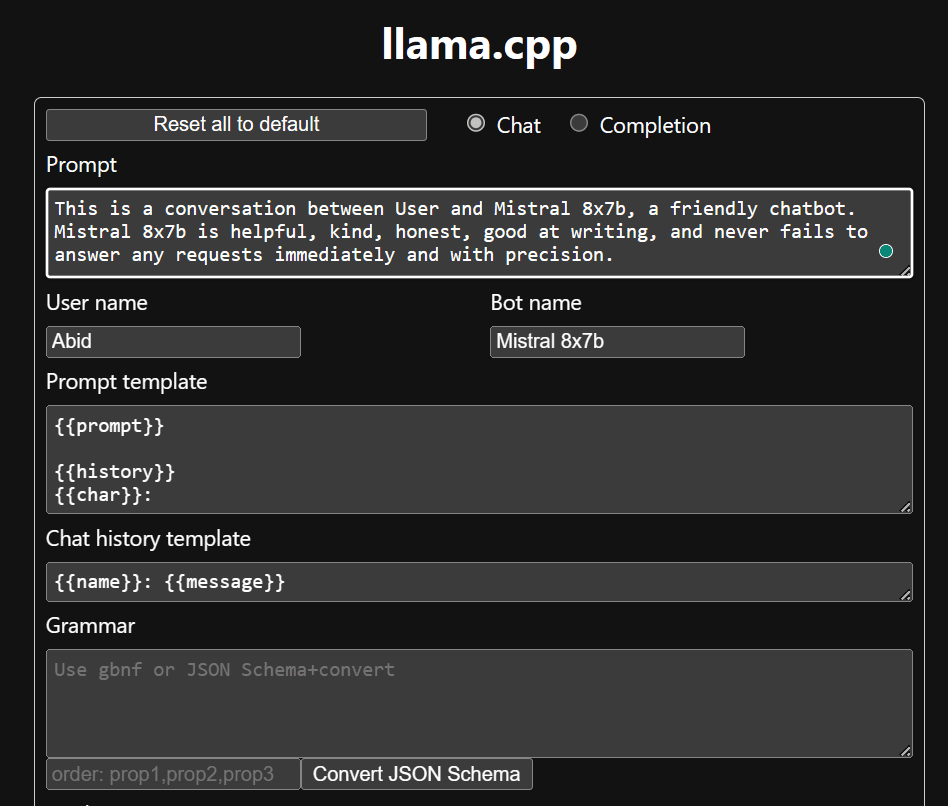
Before we begin using the chatbot, we need to customize it. Replace "LLaMA" with your model name in the prompt section. Additionally, modify the user name and bot name to distinguish between the generated responses.

Running Mixtral 8x7b On Google Colab For Free

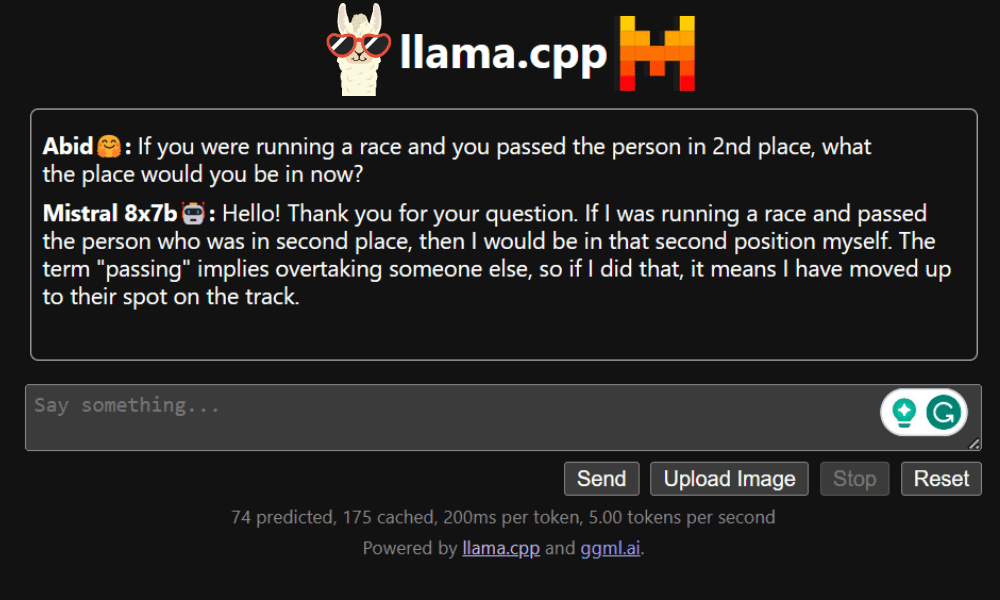
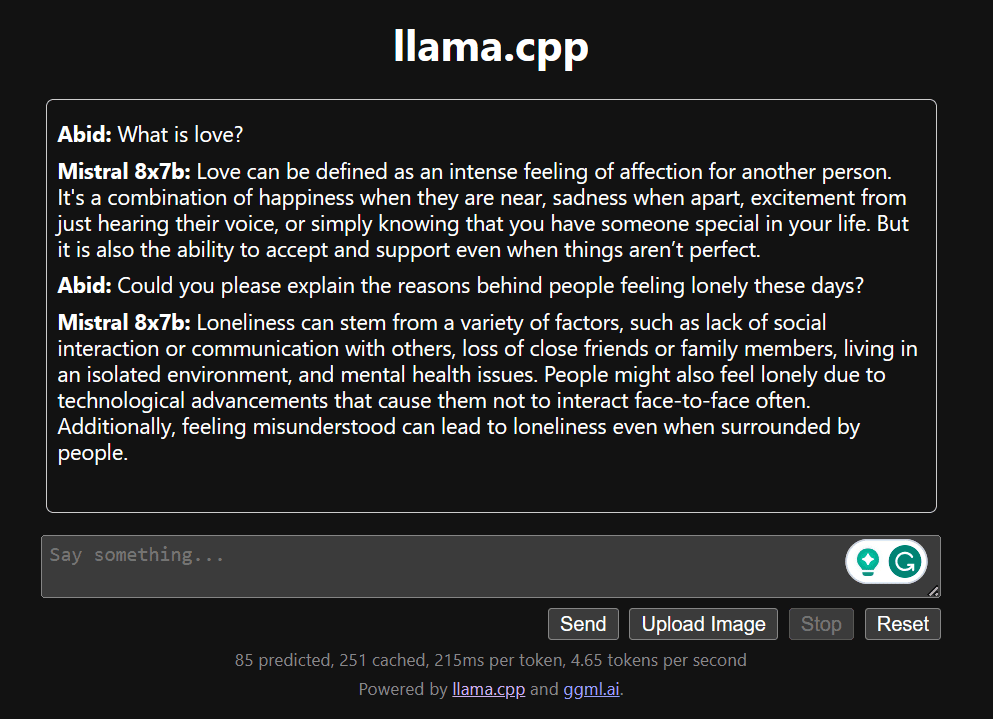
Start chatting by scrolling down and typing in the chat section. Feel free to ask technical questions that other open source models have failed to answer properly.

Running Mixtral 8x7b On Google Colab For Free

If you encounter issues with the app, you can try running it on your own using my Google Colab: https://colab.research.google.com/drive/1gQ1lpSH-BhbKN-DdBmq5r8-8Rw8q1p9r?usp=sharing

Conclusion

This tutorial provides a comprehensive guide on how to run the advanced open-source model, Mixtral 8x7b, on Google Colab using the LLaMA C++ library. Compared to other models, Mixtral 8x7b delivers superior performance and efficiency, making it an excellent solution for those who want to experiment with large language models but do not have extensive computational resources. You can easily run it on your laptop or on a free cloud compute. It is user-friendly, and you can even deploy your chat app for others to use and experiment with.

I hope you found this simple solution to running the large model helpful. I am always looking for simple and better options. If you have an even better solution, please let me know, and I will cover it next time.

Abid Ali Awan (@1abidaliawan) is a certified data scientist professional who loves building machine learning models. Currently, he is focusing on content creation and writing technical blogs on machine learning and data science technologies. Abid holds a Master's degree in Technology Management and a bachelor's degree in Telecommunication Engineering. His vision is to build an AI product using a graph neural network for students struggling with mental illness.

More On This Topic

  • Running Redis on Google Colab
  • Fine Tuning LLAMAv2 with QLora on Google Colab for Free
  • ColabCode: Deploying Machine Learning Models From Google Colab
  • An Introduction to Reinforcement Learning with OpenAI Gym, RLlib,…
  • From Google Colab to a Ploomber Pipeline: ML at Scale with GPUs
  • RAPIDS cuDF for Accelerated Data Science on Google Colab

5G is hot, but still getting a cool reception within enterprise walls

cell tower

5G is now the standard choice for connecting mobile phones and devices around the globe. But it has been slow to catch on within the walls of enterprises that are working on connecting systems, devices, and machines. For the time being, 5G's potential remains centered on connecting services and applications that cross outside these walls.

At issue for 5G within enterprises is a lack of connectivity expertise, killer apps, and significant advantages over existing Wi-Fi networks.

Also: 5G and edge computing: What they are and why you should care

Enterprise 5G did not gain traction in 2023, and will likely not do so in 2024, the authors of a recent analysis out of ABI Research, conclude: "In deciding about investments for connectivity technologies, enterprises are much more interested in use cases and outcomes than in the name of the connectivity technology — especially because the implementing enterprises are not connectivity technology experts," they state.

While 5G has been a hit in the consumer segment, "there has been little traction selling to enterprises," agrees Tom Snyder, executive director of RIoT, an IoT community hub, in a recent article. Companies were expected to take advantage of 5G capabilities that "included a new high frequency millimeter-wave component that promised dramatically increased cellular capacity and near-zero communication latency," he states.

Also: 8 ways AI and 5G are pushing the boundaries of innovation together

The integration of artificial intelligence (AI) and machine-learning capabilities is another potential growth area for enterprise 5G, but is not likely to see traction within the coming year, the ABI Research authors predict: "Although artificial intelligence and machine learning has been widely used in telco networks in 2023, it will not likely start to make an impact in the 5G Radio Access Network (RAN) domain. Closed-loop automation, including near-real time (RT) RAN intelligent controllers, will remain a niche topic in 2024."

The main reason for slow adoption in enterprises, Snyder says, is that Wi-Fi is simply more efficient than 5G, without the licensing costs: "Most of the enterprise use cases are about connecting machines and equipment, sensors and actuators and other assets that either don't move at all, or only move a little bit — like within a factory, for example."

In addition, to date, there hasn't been a compelling killer app for 5G in the enterprise, Snyder believes. "For the large enterprise, having a cellular operator in their network adds cost and complexity, but doesn't displace the IT team, so there isn't a cost savings," he says. For the small enterprise, "the cellular operators can't possibly offer the customer service and real-time support that they can get today from managed service providers for their Wi-Fi networks."

Also: AI at the edge: Fast times ahead for 5G and the Internet of Things

Still, once it involves applications or services that cross enterprise walls, there is great potential for 5G, industry leaders point out. For example, "there is no single technology that can seamlessly track devices both indoors and outdoors," says Samuel Van de Velde, founder and CTO for Pozyx.io. "GPS is limited to outdoor environments, and indoor technologies like Bluetooth or ultra-wideband require dedicated infrastructure. With 5G, the cellular network can be used for both connectivity and positioning, indoors and outdoors. This could potentially disrupt the markets of indoor navigation, vehicle and fleet tracking or asset and material tracking."

Upcoming iterations of 5G will open up capabilities for real-time applications, such as remote surgery, autonomous vehicles, and augmented reality, observes James Weaver, senior director at Cradlepoint. "The next releases of 5G will drive more innovative use cases because service reliability will meet their elevated expectations," he says. "As 5G evolves to standalone networks, network slicing will help deliver consistent performance and latency based upon the chosen slice. By using ultra-reliable and low latency communications services, for instance, low latency can be reserved for specific applications."

Enterprise use cases and applications that employ AI "will drive the need for faster link performance and lower latency so that large volumes of data can be processed, and decisions can be returned faster," Weaver predicts. "AI often depends upon data that originates from the cloud or will need to be stored in the cloud. But the farther away the artificial intelligence is used from the cloud, the more latency is built into the system, which slows decision-making and delivery."

Featured

SAP Gets a Leadership Makeover

German ERP software giant SAP has announced substantial leadership changes, marking a shift in the company’s organisational structure.

The leadership shake-up includes the promotion of Kulmeet Bawa, previously the President and Managing Director for SAP India, to the global role of Chief Revenue Officer for SAP Business Technology Platform (SAP BTP). In this position, Bawa will drive the growth and adoption of SAP BTP worldwide, encompassing areas such as artificial intelligence, data and analytics, automation, and integration.

With two decades of technology leadership experience across Asia, Bawa joined SAP India in 2020, guiding it to become one of the company’s fastest-growing global markets, particularly focusing on transformative organisations in the Indian subcontinent, including the 50 Indian unicorns currently utilising SAP.

Before his tenure at SAP, Bawa held leadership roles in major technology companies such as Adobe, Microsoft Corporation, and Sun Microsystems.

Secondly, Dr. Philipp Herzig, who served as the senior vice president and head of cross product engineering and experience will now be leading a new growth unit for the company called SAP Business AI as the chief AI officer for SAP.

The company recently introduced Joule, a natural-language generative AI assistant that allows access to the company’s extensive cloud enterprise suite across different apps and programs.

“We are committed to creating reliable and effective AI solutions for businesses, aiming to lead in Business AI at SAP. By leveraging AI, we envision a future where it seamlessly integrates into every business’s success, driving digital transformation,” read Herzig’s LinkedIn post. He has been with SAP for over 14 years now.

Last but not least, SAP has announced changes to its Executive Board effective April 1, 2024, under Thomas Saueressig‘s leadership. This initiative will focus on enhancing customer benefits from cloud and AI. Muhammad Alam will join the Executive Board, assuming product engineering responsibilities from Saueressig.

The new Board area, Customer Services & Delivery, aims to support customers in their cloud transformation, accelerate innovation adoption, and boost satisfaction. Saueressig, known for transforming SAP Product Engineering, will lead this initiative with a customer-centric approach.

Alam, appointed as president and chief product officer in January 2022, will focus on procurement, travel, expense, external workforce management, and SAP Business Network from April 1st.

The post SAP Gets a Leadership Makeover appeared first on Analytics India Magazine.

Are We Undervaluing Simple Models?

Are We Undervaluing Simple Models?
Image Generated by DALL-E 2

The current trend in the machine-learning world is all about advanced models. The movement fueled mainly by many courses' go-to model is the complex model, and it looks much more incredible to use a model such as Deep Learning or LLMs. The business people also didn’t help with this notion as they only saw the popular trend.

Simplicity doesn’t mean underwhelming results. A simple model only means that the steps it uses to deliver the solution are less complicated than the advanced model. It might use fewer parameters or simpler optimization methods, but a simple model is still valid.

Referring to the philosophy principle, Occam’s Razor or Law of Parsimony states that the simplest explanation is usually the best one. It implies that most problems can usually be solved through the most straightforward approach. That’s why simple model value is in its simple nature to solve the problem.

A simple model is as important as any kind of model. That is the crucial message the article wants to convey, and we will explore why. So, let’s get into it.

Simple Models and the Advantages

When we talk about simple models, what constitutes a simple model? Logistic regression or naive Bayes is often called a simple model, while neural networks are complex; how about random forest? Is it a simple or complex model?

Generally, we didn’t classify Random Forest as a simple model but often hesitated to classify it as complex. This is because no strict rules govern the model's simple level classification. However, there are a few aspects that might help to classify the model. They are:

— Number of Parameters,

— Interpretability,

— Computational efficiency.

These aspects also affect the advantages model. Let’s discuss them in more detail.

Number of Parameters

The parameter is an inherent model configuration that is learned or estimated during the training process. Different from the concept of the hyperparameter, the parameter can’t be set initially by the user but is affected by the hyperparameter choices.

Examples of parameters include Linear Regression coefficient, Neural Network weight and biases, and K-means cluster centroid. As you can see, the values of the model parameters change independently as we learn from the data. The parameter value is constantly updated in the model iteration until the final model is present.

Linear regression is a simple model because it has few parameters. The Linear Regression parameters are their coefficients and intercept. Depending on the number of features we train, Linear Regression would have n+1 parameters (n is the number of feature coefficients plus 1 for the intercept).

Compared to the Neural Network, the model is more complex to calculate. The parameter in NN consists of the weights and biases. The weight would depend on the layer input (n) and the neurons (p), and the weight parameter number would be n*p. Each neuron would have its bias, so for each p, there would be a p bias. In total, the parameters would be around (n*p) + p number. The complexity then increases with each addition of layers, where each additional layer would increase (n*p) + p parameters.

We have seen that the number of parameters affects model complexity, but how does it affect the overall model output performance? The most crucial concept is it affects the overfitting risks.

Overfitting happens when our model algorithm has poor generalization power because it’s learning the noises in a dataset. With more parameters, the model could capture more complex patterns in the data, but it also includes the noises as the model assumes they are significant. In contrast, a smaller parameter model has a limited ability means it is harder to overfit.

There are also direct effects on interpretability and computational efficiency, which we will discuss further.

Interpretability

Interpretability is a machine learning concept that refers to the ability of machine learning to explain the output. Basically, it is how the user could understand the output from the model behaviour. Simple model significant value is in their interpretability, and it’s a direct effect coming from a smaller number of parameters.

With fewer parameters, simple model interpretability becomes higher as the model is easier to explain. Furthermore, the model's inner workings are more transparent as it’s easier to understand each parameter's role than the complex one.

For example, the Linear Regression coefficient is more straightforward to explain as the coefficient parameter directly influences the feature. In contrast, a complex model such as NN is challenging to explain the direct contribution of the parameter to the prediction output.

Interpretability value is enormous in many business lines or projects as a particular business requires the output can be explained. For example, medical field prediction requires explainability as the medical expert needs to be confident with the result; it’s affecting individual life, after all.

Avoiding bias in the model decision is also why many prefer to use a simple model. Imagine a loan company trains a model with a dataset full of biases, and the output reflects these biases. We want to eliminate the biases as they are unethical, so explainability is vital to detect them.

Computational efficiency

Another direct effect of fewer parameters is an increase in the computational efficiency. A smaller number of parameters means less time to find the parameters and less computational power.

In production, a model with higher computational efficiency would become more accessible to deploy and have a shorter inference time in the application. The effect would also lead to simple models being more easily deployed on resource-constrained devices such as smartphones.

Overall, a simple model would use fewer resources, translating to less money spent on the processing and deployment.

Conclusion

We might undervalue a simple model because it doesn’t look fancy or doesn’t provide the most optimum metrics output. However, there are many values we can take from the Simple model. By taking a look at the aspect that classifies model simplicity, the Simple model brings these values:

— Simple Models have a smaller number of parameters, but they also decrease the risk of overfitting,

— With fewer parameters, the Simple model provides a higher explainability value,

— Also, fewer parameters mean that the Simple model is computationally efficient.

Cornellius Yudha Wijaya is a data science assistant manager and data writer. While working full-time at Allianz Indonesia, he loves to share Python and Data tips via social media and writing media.

More On This Topic

  • A simple static visualization can often be the best approach
  • Two Simple Things You Need to Steal from Agile for Data and Analytics Work
  • 10 Simple Things to Try Before Neural Networks
  • A Simple Guide to Machine Learning Visualisations
  • How to Create and Deploy a Simple Sentiment Analysis App via API
  • Simple Text Scraping, Parsing, and Processing with this Python Library

Kannada Llama Finally Arrives 

Mumbai based software company development Tensoic has released Kan-LLaMA [ಕನ್-LLama] — A 7B Llama-2 model, LoRA PreTrained and FineTuned on “Kannada” token.

The company said it expanded Llama-2’s existing linguistic capabilities for Low Resource Indic languages and specifically Kannada by fine tuning on 600 Million Kannada tokens and subsequently fine-tuning on SOTA Instruction Datasets The company said it will release the models, code, datasets and the paper(eventually) under permissive licenses.

“We Continually Pre Train Llama-2 on ~600 Million Kannada Tokens from the popular CulturaX Dataset. The dataset consists of multiple de-duplicated Multilingual dumps from popular scrapes such as mC4 and OSCAR. We randomly select documents from the same, resulting in a text corpus of ~11GB for the pre-training step.” the company wrote in its blog post.

The model expansion involves the development of a tokeniser, a crucial tool for splitting text into smaller units or tokens. The vocabulary is increased from Llama-2’s existing 32K tokens to a total of 48K tokens, with a specific emphasis on efficiently processing Kannada text.

To achieve this, a sentence piece tokeniser with a vocab size of 20K is trained on a Kannada text corpus, also used for pretraining. This new tokenizer is then merged with the existing Llama-2 tokenizer, resulting in improved processing capabilities for Kannada text.

The subsequent fine-tuning phase is carried out on chat-optimised and translated datasets to enhance the model’s conversational capabilities. The curated datasets are released under various licenses, such as cc-by-4.0 and Apache 2.0, to encourage community contributions.

Axolotl is employed for the fine-tuning phase, providing an easy yet powerful environment through YAML configs to fine-tune Large Language Models (LLMs). The resulting Kannada Llama model showcases its generation capabilities through quantized versions.

Here is the dataset of Kan-LLaMA [ಕನ್-LLama]

The post Kannada Llama Finally Arrives appeared first on Analytics India Magazine.

Microsoft’s Generative AI Brilliance Reshapes Retail

At CES 2024, where interesting partnerships between big tech companies were announced, Walmart and Microsoft’s strategic partnership to bring generative AI-powered search features on the retail giant’s platform was unveiled.

The new features are said to enhance the digital shopping experience on the platform, something every major retail giant is increasingly looking to adopt. In the process, also allow big tech companies to win in a big way.

Microsoft : The Solid Pillar of Walmart

Doug McMillon and Satya Nadella at CES 2024. Source: CES

Walmart CEO and President Doug McMillon invited Microsoft’s CEO Satya Nadella onstage at the CES event to not only talk about their new AI-enabled features but also their long-standing commitment that started in 2018.

Six years ago, the retail giant tied up with Microsoft to make it as its preferred and strategic cloud provider. The cloud innovation projects comprised AI and ML-based data-platform solutions, and they were designed to address customer-facing services and internal business applications.

With increasing sales through ecommerce platforms, Walmart has also been witnessing the same. In Q3 2023, Walmart’s US online sales grew 24% and global online sales grew 15%.

Net Sales of Walmart E-commerce. Source: Statista

Microsoft Loves All Retail

Microsoft has not only partnered with Walmart but a number of retail companies to bring advanced tech capabilities to their systems. In 2018, Microsoft announced its partnership with British retail company Marks and Spencer (M&S) to test out AI capabilities in a retail environment.

A number of consumer goods companies have partnered with Microsoft to provide innovative retail solutions. Companies such as Unilever, Coca-Cola Bottling Company, Nestle, Pepsico and many others already have a strategic collaboration with these brands. Last year, Carrefour announced their partnership with Microsoft and OpenAI to bring an AI-powered chatbot to allow a smoother customer experience.

Retail is the second biggest industry, (after technology) that utilises Microsoft’s suite of cloud-based business applications called Dynamics 365. With ChatGPT integration increasingly going up in retail companies, for mostly building personalised chatbots, Microsoft’s Azure OpenAI service finds its dominance.

Amazon : The Tough Challenger

With the renewed collaboration of Microsoft and Walmart to use Azure OpenAI Service, on top of proprietary data from Walmart, the newly built AI-powered features are said to enhance the search experience to provide a more personalised experience on Walmart’s platform : a feature that Amazon has already mastered.

Amazon’s advanced features on its marketplace platform not only works towards enhancing customer experience but also improves seller experience. Retailers use Amazon Personalise to analyse customer data, purchase history, market trends and preferences for personalised product recommendations.

With generative AI capabilities, advanced customisation is achieved, which enhances the search experience, which is also Amazon’s USP. According to a consumer report of last year, online shoppers first start their search on Amazon. Over 50% of online shoppers use Amazon as their search destination. 39% consumers use search engines such as Google and Bing, closely followed by Walmart with 34% of online shoppers.

In addition to being the supreme king of e-commerce retail, the company’s cloud service has been implemented by a number of retail companies. AWS offers technology solutions that aid companies to help with their customer data to boost engagement, supply chain distribution and other retail functions.

Big Tech’s Retail Efforts Continue

While Microsoft, Amazon are established players working with retail, new partnerships with tech companies are also emerging. Recently, IBM and SAP have collaborated to build AI solutions for the consumer packaged goods and retail sector. The solution looks to help these companies with operational and logistics such as product distribution, transportation planning, automating order settlements and more.

With the promising adoption of big tech products in retail industries, the prowess of tech giants allows them to establish dominance in the sector. Offering solutions in the form of office products, analytics, operational assistance, and many more features, Microsoft is comfortably positioned to lead in the retail sector.

The post Microsoft’s Generative AI Brilliance Reshapes Retail appeared first on Analytics India Magazine.

The Irony of Google’s News Initiative in India 

Google, the go-to resource for all kinds of information on the internet, including news, has made significant efforts to expand the boundaries of journalism. However, it has faced criticism for profiting through Google Ads on websites that disseminate fake news.

Besides, the tech giant is accused of setting high SEO standards that disadvantage smaller news outlets by affecting their visibility in search results. This practice makes it challenging for these smaller entities to compete effectively in the digital space.

The American tech giant has recognised the issue and rolled out the second edition of the Google News Initiative (GNI) in India. It’s a program to help local news publishers with easy subscriptions, better ads, and monetising their formats. The goal is to give a boost to struggling local journalism.

“Chosen out of over 110 applicants from across India, the ten news startups cover a diverse array of categories of journalism, including investigative, political, medical, youth, climate, and local news that provides a voice to underrepresented communities,” said Google in a press release. The media outlets selected this year include Feminism in India, SouthLive, QueerBeat, Ground Report and so on.

Since 2018, Google has been talking about throwing $300 million to fight misinformation, support fact-checkers, and “help journalism thrive in the digital age.” But the crumbs Google tosses through the GNI don’t quite cut it, especially when you weigh it against the benefits Google rakes in from news content.

An investigation by ProPublica in 2022 shows that Google’s money-making ad business is thriving through spreading false information. The investigation, a first of its kind, documented Google placing ads on global sites peddling lies about vaccines, Covid-19, climate change, and elections.

Even the GNI project that was initiated to help “quality publications to flourish” seems deceiving. Quality independent media outlets continue to gasp for air as Google has got them in a chokehold with its SEO standards.

The Digital Frenemy

While the company has publically invested time and money in journalism initiatives, ironically it is one of the reasons for suffocating journalism. Google uses its market dominant position to force news publishers into the use of their content in the newly designed Google News app – Google’s mobile news aggregator, that’s all about Accelerated Mobile Pages (AMP).

The Google News app is designed to keep readers hooked to the summary instead of leading them to the articles’ sources. To participate in the application, news publishers have to sign on the dotted line of Google’s News Producer Terms of Service, which grants rights for Google to use the content. The company has the rights to exploit the news not just for Google News and its app but for everything under the Google umbrella, aka “Google Services.”

Furthermore, Google is using news publishers’ AMP content to fuel its “Google Discover” service, another news aggregator that is similar to social media. But Google never negotiated any specific use licence with the news publishers for this content.

Finally, Google Search is increasingly becoming a final destination rather than a pointer to news websites. Google flexing those market muscles forces publishers to agree to new features that keep users glued to Google rather than wandering off to the actual news websites.

Purchasing Power

Folding in AdSense in 2003, YouTube in 2006 and similar purchases have turned Google into a digital octopus allowing it to meddle with anything important online: content distribution, advertisement, ad placement, and content itself.

The buying out approach has brought billions of dollars in Google’s pockets but consequences have been experienced in the media industry. Time and again, studies have shown how Google is hindering journalism. For instance the White Paper by News Media Alliance published in 2022 gives a detailed overview of how the company is abusing its dominance. The paper also demanded Google to fairly compensate the publishers for using their content.

Google is trying to do the right thing with GNI but it continues to miss the mark as local news struggles to hit the top results. The company is in a dire need of tweaking its algorithms to balance its top results and a change in the way its SEO performs could be a good way to start.

The post The Irony of Google’s News Initiative in India appeared first on Analytics India Magazine.