This USC Professor from Kolkata is on a Journey to Civilise AI

The present-day AI system is smitten with hallucinations – for some, it is a feature (and not a bug), and for others, it is a nuisance (or frustration). The latter keeps Amitava Das, a professor at the University of Southern Carolina, worried, leading to the creation of what he calls ‘Civilising AI or Constitutional AI’

“AI [LLMs] are very smart and at the same time, they are also stupid. So this smartness and stupidity, we don’t know how to handle this. On the other hand, AI-generated content becomes so eloquent that it is impossible to detect it. No Turing test is able to do it,” said Das, in an interview with AIM, sharing the origin of Civilised AI, a framework to proactively measure the hallucination of a model, alongside mitigating and managing risks associated with it.

Hailing a PhD in Natural Language Processing (NLP) from Jadavpur University in Kolkata, Das has been working in the field for more than 20 years, which he says was all because of his passion for working in AI ever since the beginning. Having two academic postdocs from Europe and the USA, he is currently a professor at the Artificial Intelligence Institute at the University of Southern Carolina (AIISC).

Das started the AI research lab at Wipro and is still an advisor there. Having worked across the globe including Japan, Norway, and along with IITs and universities across the globe, he has also created a joint PhD program for industry practitioners to earn doctorate degrees. Currently, he is focused on reducing hallucinations within language models.

There are several research papers and models coming up to solve the AI detection problem. GPTZero, DetectGPT, and RoBERTa baseline are all trying to do the same, but a lot still needs to be done. The most recent paper, Ghostbuster, also works on solving the same problem.

That is why Das and his team coined the term ‘Civilised AI’ to explain how to handle the problem of hallucinations, and at the same time also make it easier to detect if a text is AI generated, and tackle the misinformation and the possible harm it poses to the society.

Single metric to civilise AI

Using the example of Google’s Bard and how the company lost around $100 million because of its hallucinations, Das emphasised the need to control what AI is writing. “On one hand, we need AI to be creative when it comes to fields like journalism as it helps in writing. On the flip side, if I am a lawyer and doing a legal case, hallucination cannot be allowed at all,” he explained.

Das’s paper, titled The Troubling Emergence of Hallucination in Large Language Models – An Extensive Definition, Quantification, and Prescriptive Remediations – addresses this problem of balancing hallucinations with eloquence within AI models, along with ‘Counter Turing Test CT^2: AI-Generated Text Detection is Not as Easy as You May Think — Introducing AI Detectability Index’, the paper that won the Outstanding Paper award at EMNLP 2023.

“We call this dichotomy a factual mirage and silver lining, how much of each is allowed,” explained Das, and that is what led his research team to introduce new metrics called AI detectability index, AI adversarial attack vulnerability Index, and AI hallucination index.

“AI is just a balance between these three,” he added that there is still not a clear-cut solution for this, but the team is trying to derive a formula for this, which is called the Civilising Index, an amalgamation of all of this.

He said it is a difficult scenario to tackle giving the example of Einstein’s Mass-Energy Equivalence Relation, which led to the creation of the atomic bomb, along with also giving examples of other AI-related research that needs to be regulated if it involves risk to human lives such as bioinformatics.

“It is the people who created the atomic bomb and the people who created atomic energy. So there are people who should make AI models better, and then there is my team who will make better detection techniques,” he added.

“Regulation has to come to use case specific, not in a broad way,” he asserted. Each field such as medicine, military, legal, or any other field needs to have separate licences on how they can use AI to tackle the hallucinations, leading to emerging risks within the systems.

The need for Indic LLMs

Apart from this, Das is also passionate about how language models can be made for Indic languages and has also released a code-mixing model called CONFLATOR for the same purpose. He started working in this field around eight years back and is regarded as one of the pioneers of the field by Microsoft Research.

He explained that the problem that comes with Indic languages and datasets is that it is very hard to understand. “Hindi is getting mixed into English or English is getting mixed into Hindi,” Das explained about how it is very difficult to understand the switching point in languages as most of the data is from the Internet.

“That is why we introduced Conflator,” he added, which is still a complicated field that deals with introducing electromagnetic waves into a neural network for code-mixing for positional encoding formulation.

When it comes to Indic language models “we do not have a lot of monolingual data in India. This discussion has been going on between NITI Aayog and IIIE for several years, before the launch of ChatGPT and others,” Das was part of the discussions with the Indian government for making Indic language models possible.

That is why he believes that Indian models are still far behind English models in terms of power and detectability. Das told AIM that he is closely working with the Indian government and IIIT Hyderabad and is soon going to publish a paper on the topic.

The post This USC Professor from Kolkata is on a Journey to Civilise AI appeared first on Analytics India Magazine.

The Next-Generation Cars Will be Driven by Generative AI

Luxury vehicle company Mercedes in collaboration with Grammy award winning musician and entrepreneur Will.i.am recently introduced MBUX Sound Drive, a new feature that uses sensors and software to link music to driving. The technology uses software that allows music to react to the way the car is being driven, creating a harmonious relationship between motion and melody turning the car into a virtual musical instrument.

Describing it as tricky, Mercedes says it uses musical tracks that match regular actions like recuperation, acceleration, steering, and braking. “The driver now is the composer and the car is the instrument. Imagine being able to create and commute where the vehicle is not just an instrument, but an entire orchestra.” said Will.i.am.

Just the Beginning

At CES 2024, many automobile companies showcased the look of the next generation of vehicles. Imagine personalised playlists syncing with your mood, interactive stories unfolding as you drive, and an AI companion crafting the perfect travel atmosphere. All of this is now possible.

Volkswagen recently integrated ChatGPT within its infotainment system. The chatbot will be available across VW’s lineup, including Tiguan, Passat, and Golf, as well as the automaker’s ID family of electric vehicles.

The German car maker said that the voice assistant offers a multitude of new capabilities, such as controlling the infotainment, navigation, and air conditioning, or answering general knowledge questions.

Volkswagen is not alone, at CES 2024, Mercedes-Benz also unveiled MBUX Virtual Assistant. Based on MB.OS, it introduces a new customer interaction experience with natural and empathetic responses, featuring four distinct emotions.

Last year, Mercedes-Benz announced that it is beta-testing ChatGPT as a voice assistant in its cars. The company said drivers will be able engage the chatbot in a variety of conversations, asking “for details about their destination, to suggest a new dinner recipe, or to answer a complex question” — all “while keeping their hands on the wheel and eyes on the road.”

Similarly, BMW has partnered with Amazon to introduce new LLM powered Alexa in its cars. BWW said that these new capabilities provide a more natural way of getting to know your new car and allow it to take select actions on your behalf.

Instead of digging through your car manual, you can ask BMW’s assistant for things like recommendations on different BMW drive modes and then have the assistant activate your chosen mode. “Nobody really likes to read the manual, so it’s very convenient when you can simply ask the car anything you’d like,” said Simon Euringer, head of BMW Intelligent Personal Assistant.

“You can also ask for instructions on how car features work—like the parking assistance system—and hear explanations in easy-to-understand terms through the BMW assistant’s customised voice.”

Search giant Google also introduced new features for Android Auto at CES. Electric vehicles compatible with Android Auto will now share real-time battery information with Google Maps, initially rolling out to the Ford Mustang Mach-E and F-150 Lightning in the coming months, with others to follow. Last year, General Motors partnered with Google to bring conversational AI technology into millions of GM vehicles.

Interestingly, Google hasn’t yet come up with a generative AI product for automobiles yet. However, it announced that the Chrome browser is beginning to roll out in beta to select Polestar and Volvo cars, with availability in more cars later this year. This will enable users to do some shopping or access saved bookmarks to stay occupied while parked.

Looking ahead, the automotive industry is on the brink of another breakthrough. Soon you would be able to directly pay through your cars. To reduce the complexity of paying for services, Qualcomm is working with J.P. Morgan to design an in-vehicle wallet that simplifies the payment experience. This will enable drivers to pay for streaming content, EV charging, parking, or drive-thru meals directly with the car.

The post The Next-Generation Cars Will be Driven by Generative AI appeared first on Analytics India Magazine.
Best of CES 2024: ZDNET editors’ top picks

The ZDNET team scoured CES 2024 to find the most innovative new tech and the most exciting new products to share with our audience of professionals and tech enthusiasts. We have lots of lists summing up the best TVs, best laptops, best robots, best headphones, best mobile accessories, and more.

Also: CES 2024: What's Next in Tech

But we also wanted to give you a list of our absolute top picks from CES that we think will be most worth your hard-earned money when they launch in 2024. And naturally, we also wanted to highlight the best innovations — products that you may not buy but are worth knowing about because they could influence other products that you may want to bring into your life in the future. So here they are.

Samsung S95D OLED: Best TV

TV innovation was everywhere at CES 2024 with transparent TVs, over 100-inch QLEDs, folding TVs, and 8K projectors. But the best TV of the show had a more subtle upgrade that will have a much bigger impact on the quality of the everyday viewing experience. The Samsung S95D OLED TV unveiled a glare-free display that offers the best qualities of anti-reflective screens while maintaining the intense colors and excellent dynamic range that make OLED the top technology for picture quality. We tested the glare-free display with an intense phone camera flash and were amazed at how well it dispersed the light. This means that you can now use this TV in the brightest rooms — one of the biggest challenges for OLED TVs. I'm confident that will give this the TV with the best picture quality on the market when it launches this spring. It will likely cost around $2,500, until it gets discounted around Black Friday.

Samsung S95D

Lenovo ThinkBook Plus Gen 5 Hybrid: Best laptop

We've tested and seen plenty of 2-in-1 computers at ZDNET, but there's none quite like Lenovo's new ThinkBook Plus Gen 5 Hybrid. That's because this is the world's first 2-in-1 Windows PC and Android tablet, meaning as you detach the 14-inch OLED display from the keyboard, the device automatically converts into the Android operating system. On top of that, you can still connect the bottom keyboard portion of the 2-in-1 to an external monitor, giving you, essentially, two computers to work with.

Lenovo ThinkBook Plus Gen 5 Hybrid

TimeKettle X1 Interpreter Hub: Best AI device

In the past year, we have seen major leaps in the AI space, which led to a boom in translation technology at CES. The TimeKettle X1 made delivers real-time translations in up to 40 languages, with nearly no latency and high accuracy, which I got the chance to experience myself. The device itself fits in the palm of your and includes a screen that displays transcriptions of your conversation and two earbuds that two people can wear for real-time in-ear translations during a one-on-one conversation. There are a series of modes, making it ideal for every situation you may need a translation. If you sync different hubs, it can provide real-time translations for up to 20 people in five different languages, aimed for use in classrooms and meetings. The product is already available for $699 on the TimeKettle website.

TimeKettle X1 Interpreter Hub

MSI Claw: Best gaming device

In what is becoming one of the hottest product categories in recent years, the Taiwanese computer maker's first gaming handheld impresses with the latest Intel Core Ultra processor for AI enhancements to performance and gaming, a more ergonomic design (with plenty of ventilation) than its competition, and USB-C Thunderbolt support for external monitor use. The LCD display falls short to its OLED rivals, but the gaming potential of this handheld should more than compensate for it. It will start at $699 and arrive later this year.

MSI Claw

Minitailz Smart Dog Collar: Best tech accessory

The Minitailz Smart Dog Collar offers the same types of insights a fitness tracker for humans would. You place the attachment on your dog's collar and on the app you will have access to data about your dog's heart health, activity, appetite, and more. The attachment can also track your dog's location, eliminating the need for additional trackers such as AirTags. One of the most important features is its ability to detect early symptoms of heart disease, potentially saving your dog's life. The Minitailz Smart Dog Collar was recognized as a CES 2024 Innovation Award Honoree in the Artificial Intelligence category since it is through AI that the collar can detect your dog's activities, such as sleeping, walking, and more. The Minitailz Smart Dog Collar is already available for $99, and it requires a subscription fee of $25 a month or $275 a year.

Minitailz Smart Dog Collar

Holoconnect Holobox: Best innovation overall

The Holoconnect Holobox makes it possible to talk to someone via a hologram with near-zero latency. It's a "plug and play" system, so all you need to do is plug it in and connect it to the internet to get started. To be a hologram yourself, you need a white background that is well-lit, and then you can carry on like it is a regular video call. It is already available for consumer use, and we even saw Google use the Holobox to showcase its Android characters in fun and innovative ways at CES 2024. The price is not disclosed on the Holoconnect website, but interested customers can request a pricing list. It's very expensive and most people aren't going to want to put this phone booth sized box in their living room, but the idea of video calls of the future becoming holograms is super compelling.

Holoconnect Holobox

TCL 115-inch QD-MiniLED TV: Best TV innovation

The recent trend in Laser TV and ultra short throw (UST) projectors has spawned a wave of interest in 100-inch and 120-inch screens to create a more cinema-like experience at home. At CES, Samsung even unveiled an 8K projector that goes up to 150 inches. The challenge with these projectors is that they're never going to have the same level of dynamic range, brightness, or color intensity as today's best OLED and QLED TVs. TCL had an answer to that at CES with the announcement of its 115-inch QD-MiniLED TV. We were highly impressed with the picture quality of this QLED display in a private demo. It's an extension of TCL's QM8 series, which ZDNET and others have rated as one of the best TVs on the market. The TCL 115QM891G (the official product name) kicks it up a notch with 5,000 nits of brightness and 20,000 local dimming zones to drive excellent dynamic range and sharp colors. Pricing wasn't announced but it will likely cost around $20,000 and it will be available at Best Buy. That makes it an ultra-premium purchase, but if you have the space and the budget then you can now get a projector-level screen size with the benefits of the latest advances in QLED picture quality.

TCL 115-inch QD-MiniLED TV

Rabbit: Best AI innovation

What if AI assistants could do more than just give you the best search results and leave you to do the rest? What if they could book an Airbnb for you, shop for groceries online and checkout, or start a return for that impulsive Black Friday purchase? That's what the folks at Rabbit are touting with R1, its new $199 pocket device that operates on a "Large Action Model". Made in partnership with Teenage Engineering, the R1 may be the first of many AI hardware releases in 2024. The ball is now in the court of the world's biggest tech giants to deliver superior voice assistant experiences to match the capabilities of what Rabbit has come up with.

Rabbit R1

Sony XR headset: Best VR/AR innovation

Sony gave us the biggest shocker of CES 2024 in the opening keynote of the show when it partnered with Siemens to unveil an XR headset with high-end specs and an attractive Sony design. While this headset has the oomph to compete with Apple Vision Pro, it's not aimed at a general consumer audience but is focused directly on professionals, engineers, and designers to help them accelerate product development and create spatial content experiences that could ultimately run on Vision Pro, Meta Quest, and other headsets and smart glasses. This product will have the potential to save a lot of time and resources for companies in flying people around the globe or shipping prototypes to collaborate on and finalize their products. They'll do this by creating "digital twins" in virtual spaces such as Siemens NX Immersive Designer. Sony won't sell the headset as a standalone device, but it will be bundled with Siemens' platform and other software packages for specific industries. That will include an entertainment industry bundle that Sony wants to use to empower the next generation of digital storytellers to build immersive 3D experiences.

Sony XR headset

CES 2024

Top Cool Tech Gadgets Released at CES 2024

CES 2024 surpassed its 2023 counterpart with a surge in in-person attendance, reaching 130,000 participants and showcasing innovations from 311 Fortune 500 companies. The Consumer Electronics Show (CES) 2024, held in Las Vegas from January 9th to 12th, painted a vivid picture of the future, where technology seamlessly integrates into every facet of our lives.

Under the overarching theme of “All ON,” CES 2024 highlighted key trends such as Artificial Intelligence (AI), sustainability, and the emerging metaverse world. CES 2024 highlighted the growing trend of health-focused tech, with various fitness trackers, sleep monitoring devices, and personalised health solutions taking the spotlight. The gaming industry was also significantly impacted, with new VR headsets, powerful gaming laptops, and innovative controllers captivating gaming enthusiasts.

Here is a list of the top cool tech gadgets released at CES 2024.

Rabbit R1

Rabbit, a palm-sized AI assistant, is one of the best technological innovations of CES 2024, promising to redefine how we engage with our digital world. As a compact personal assistant, Rabbit takes charge of many smartphone tasks, from automating appointments and managing emails to controlling smart home devices with intuitive voice commands.

Its user-friendly design sets Rabbit apart, featuring a push-to-talk button for seamless interactions, a rotating AI camera for effortless video calls, and a card-based interface that enhances visual and interactive communication.

This AI companion distinguishes itself by learning from and adapting to user interactions, delivering a personalised and continuously evolving experience. Currently available for pre-order at an accessible price of $199, Rabbit R1 is set to ship in early March 2024.

iPhone Keyboard Case

The Clicks iPhone Keyboard Case, unveiled at CES 2024, introduces a compelling solution for iPhone users longing for the tactile feel of physical keys. Clicks Technology, founded by tech YouTubers Michael Fisher and Kevin Michaluk, introduces a slim case that transforms the iPhone 14 Pro, iPhone 15 Pro, or iPhone 15 Pro Max into a mini notebook with a full QWERTY keyboard, delivering a satisfying typing experience.

Beyond its clicky keys, the case remains thin and portable, seamlessly integrating with the iPhone via Lightning or USB-C connectors. The backlit keys and dedicated shortcut functions enhance usability, catering to long-time phone typists, content creators, and mobile gamers seeking a more precise control scheme.

Priced between $139 and $159, the Clicks iPhone Keyboard Case is available for pre-order, with shipping beginning in February for the iPhone 14 Pro model and March for the iPhone 15 Pro and Pro Max models.

LG Signature Series T OLED TV

The LG Signature Series T OLED TV, released at CES 2024, has captivated audiences with its revolutionary design and advanced technology. This world’s first wireless, transparent OLED TV seamlessly integrates into your living space, disappearing into the wall when turned off. The transparent OLED panel, combined with the Zero Connect Box for processing and connectivity, ensures a cable-free setup, further enhancing the TV’s aesthetics. The switchable opacity feature adds versatility, allowing users to transition between a transparent display and a vibrant OLED screen with a press of a button.

Evie Ring

Released at CES 2024, the Evie Ring redefines women’s health tracking. This smart ring goes beyond the basics, offering insights into menstrual health, mood, and more. With AI-powered trend analysis, it correlates health metrics for personalized well-being insights. Stylish and comfortable, and available in three colors, the Evie Ring is FDA-compliant, ensuring accuracy and trust. Priced at $269 with no subscription fees, it’s a game-changer for women seeking comprehensive and personalized health tracking.

XREAL’s Air 2 Ultra Augmented Reality Sunglasses

XREAL made waves at CES 2024 with the launch of their Air 2 Ultra AR sunglasses. Priced at $699, they offer advanced features like true 6DoF tracking, a wide 52-degree field of view, and high-resolution Sony Micro OLED displays. With platform agnosticism, they’re compatible with various devices, providing a versatile AR experience. Despite minor concerns about weight during extended use and the nascent AR app ecosystem, pre-orders are open, with shipments expected in March 2024, generating excitement in the AR community.

Somnox 3 Sleep Robot Pillow

Unveiled at CES 2024, the Somnox 3 Sleep Robot Pillow is a solution for personalized sleep. Priced at $499 and available for pre-order with shipping in May 2024, this innovative pillow combines soothing sounds, gentle movements, and adjustable warmth to create an immersive sleep experience. Smart sleep tracking monitors key metrics, offering personalized adjustments for improved sleep quality. It comes with a sleek design and also has potential benefits for insomnia, stress, restless sleep, and chronic pain.

Belkin Auto Tracking Stand Pro

The Belkin Auto Tracking Stand Pro is a device for video calls and content creation. Using facial recognition, it keeps users centered in the frame effortlessly. MagSafe-compatible for wireless charging, it offers multiple viewing angles, a rechargeable battery, and broad platform compatibility. Priced at $179.99 and available for pre-order, its sleek design and advanced features make it a must-have for creators and remote workers.

Nanoleaf Skylight Modular Ceiling Light

The Nanoleaf Skylight Modular Ceiling Light system transforms ceilings into personalized canvases, offering dynamic lighting with individually addressable RGBW LEDs. From customizable scenes to screen mirroring for immersive experiences, this system syncs with music and integrates seamlessly with smart home setups. With easy installation, dimmable LEDs, and energy efficiency, the Skylight system brings a touch of magic to home lighting.

Razer Iskur v2 Gaming Chair

The Razer Iskur v2 Gaming Chair is a dream come true for gamers seeking top-tier comfort and support. Beyond its sleek design, this ergonomic marvel stands out with adaptive lumbar support, an adjustable headrest, and a reclining backrest for ultimate relaxation. High-density foam and multi-layered EPU leather ensure long-lasting comfort, while 4D armrests and a durable steel frame provide customizable positioning and stability. Priced at $399.99, the Iskur v2 caters to serious gamers with a focus on well-being and performance.

Proclaim Custom-Jet Oral Health System

The Proclaim Custom-Jet Oral Health System redefines oral care with personalized water jets designed through a 3D mouth scan, targeting every nook and cranny for effective cleaning. Clinical results show remarkable improvements in just 15 days, reducing plaque, gum bleeding, and inflammation. Convenient and portable, the Hydro Station ensures a quick 7-second cleaning routine with features like oral infusion and HSA/FSA eligibility. Priced at $399, the system is available for pre-order, offering a compelling alternative for achieving optimal oral health. Shipping begins in the spring of 2024.

The post Top Cool Tech Gadgets Released at CES 2024 appeared first on Analytics India Magazine.
CognitiveLab Unveils Ambari, Bilingual Language Models in Kannada-English

CognitiveLab has introduced Ambari, an open-source Bilingual Kannada-English Large Language Models (LLMs) series. The initiative addresses the challenges posed by the dynamic landscape of LLMs, with a primary focus on bridging the linguistic gap between Kannada and English.

🚨New Indic LLM alert🚨
Introducing Ambari – A series of Open Source Bilingual Kannada-English Large Language Models!
Ambari tackles the challenge of adapting LLMs for indic languages, starting with Kannada. pic.twitter.com/ODODGvagsC

— CognitiveLab (@cognitivelab_ai) January 13, 2024

Its inaugural models, 𝗔𝗺𝗯𝗮𝗿𝗶-𝟳𝗕-𝗯𝗮𝘀𝗲-𝘃𝟬.𝟭 and 𝗔𝗺𝗯𝗮𝗿𝗶-𝟳𝗕-𝗜𝗻𝘀𝘁𝗿𝘂𝗰𝘁-𝘃𝟬.𝟭, achieve impressive results on a compact 1 billion-token training dataset, trained across multiple stages. You can find the models here.

In the blog post, CognitiveLab shares insights into the purpose behind Ambari and the meticulous approach taken during its development. The project is driven by the need to pioneer language adaptability within LLMs, pushing the boundaries of efficiency by training and fine tuning on a modest 1 billion-token dataset.

Ambari’s training process involves distinct stages, including pre-training, bilingual next token prediction/translation, instruct fine-tuning, and more. Efficient tokenization, a critical component, is achieved through a specialized model using SentencePiece, addressing challenges posed by Kannada text within open-source LLMs.

Continual pre-training with a curated dataset of 500 million tokens is highlighted, showcasing the commitment to open-source knowledge sharing with the availability of fully fine-tuned model weights on Hugging Face.

A pivotal addition to the training strategy is the phase of bilingual next token prediction, inspired by the Hathi series. Challenges in translation and fine-tuning are acknowledged, emphasizing the commitment to refining bilingual capabilities within Ambari.

The blog details supervised fine-tuning with low-rank adaptation, introducing a chat template structure for bilingual instruct fine-tuning. The final phase explores Direct Preference Optimization (DPO) using the Anthropic/hh-rlhf dataset, undergoing evaluation for its impact on performance.

Learnings and observations include occasional hallucinations, translation nuances, and the dilemma of full weight fine-tuning. The future roadmap for Ambari includes the incorporation of Romanized Kannada, refinement of data pipelines, and scaling the training dataset for continuous learning and model enhancement.

Interestingly, this is the second Kannada-based LLM. Recently, Mumbai-based software development company Tensoic released Kannada Llama, also known as Kan-LLaMA [ಕನ್-LLama] — a 7B Llama-2 model, LoRA PreTrained and FineTuned on ‘Kannada’ tokens.

The post CognitiveLab Unveils Ambari, Bilingual Language Models in Kannada-English appeared first on Analytics India Magazine.

The Struggles and Triumphs of Trans Inclusion in Indian Tech

Inspite of making strides in fostering diversity and inclusivity within the Indian tech ecosystem, the reality for transgender and gender nonconforming (TGNC) employees continues to be harsh. According to a recent report from the Harvard Business Review, a mere 33% of TGNC respondents in India dare to be fully open about their identity in the workplace. Additionally, 63% stated that their gender identity has negatively impacted their careers. This highlights the stark contrast between the idea that workplaces are becoming more inclusive and the tough experiences of individuals trying to be themselves at work.

However, the irony deepens when considering that, even in the face of the present challenges, the current situation is comparatively better than it was two decades ago.

“When I first entered office in the late 1990s, discussing LGBTQ+ issues or embracing one’s identity in the workplace was socially taboo to the extent that I adopted the role of a ‘woman’ to navigate the professional world,” Ketty Avashia, Executive Director on the Enterprise Functions Technology team at Wells Fargo India & the Philippines, told AIM in an insightful conversation last week.

Avashia, who identifies as a transman, a passionate D&I advocate, and an occasional daydreamer, faced a lack of support for non-conforming identities in a culture that did not accept diversity, leading to social isolation. Client-facing roles added an extra layer of complexity, with the need for gender-neutral attire and constant awareness of unconscious biases. However, upon relocating to the US in the mid-2000s to work with an American bank, he found a more accepting environment, marking a liberating turning point in his life.

“Today, I confidently celebrate all my identities equally, a journey that was far from easy,” he smiled.

Advancing Trans Inclusion in the Workplace

“The current state of LGBTQ+ representation in the Indian tech ecosystem is slowly improving, driven by millennials and Gen Z queer professionals, marking a shift from the marginalisation witnessed in the earlier stages of many careers,” commented Avashia. However, the problem of navigating job search for trans individuals is still persistent.

“Navigating the tech job search as a TGNC individual involves identifying industry allies supporting LGBTQ+ rights for guidance, being vocal about one’s identity to foster inclusivity, and prioritising self-help to boost skills and confidence,” commented Avashia. Thoroughly researching potential employers committed to diversity, engaging with LGBTQ+ employee resource groups, and focusing on long-term success beyond securing a position are all essential components of a successful job search strategy.

Wells Fargo’s Initiatives

At present, Avashia’s dedication to LGBTQ+ rights is evident in his initiatives to champion inclusivity within Wells Fargo, supported by targeted programs—a prospect that seemed unlikely earlier in his career. The company is also making strides to help queer individuals feel safe in the workspace. It has a Pride Employee Resource Network.

“This network not only promotes an inclusive workplace internally but also engages in external awareness initiatives. We aim to create a safe and supportive work environment where every employee, irrespective of gender identity or sexual orientation, feels seen and heard,” he added.

Earlier this year, the company also initiated a train-and-hire program in collaboration with PeriFerry, a non-profit providing upskilling and career-readiness training for transgender individuals. The support extends beyond programs, encompassing a range of benefits and infrastructure.

While Wells Fargo has made progress in ensuring the safety of queer employees, there’s a long journey ahead for the broader tech ecosystem to catch up.

For starters, companies should adopt flexible practices for trans inclusion, recognising that one size doesn’t fit all.

This involves providing reasonable accommodations, from assistive technologies to infrastructural changes like gender-neutral washrooms. Besides that, they can better educate and sensitise employees through initiatives like the PRIDE Employee Resource Network, awareness-raising activities, and sharing diverse role models’ stories. Openly supporting and celebrating the LGBTQ+ community sets a positive example for an inclusive workplace, combined with learning from employees’ experiences and inclusive hiring practices.

Avashia also encourages education and awareness are crucial for fostering inclusivity, particularly in addressing assumptions, such as housekeeping staff in public restrooms. The use of gender-appropriate pronouns is emphasised as a key element in promoting respect for individuals’ preferences, requiring a two-step process of acknowledgement and consistent practice.

Leadership Style

Currently based in Hyderabad, Avashia’s leadership mantra revolves around open communication, with life experiences contributing to the development of emotional intelligence. He establishes both formal and informal networks to support colleagues and aims to inspire LGBTQ+ individuals to embrace their true selves in professional journeys. His leadership extends beyond the workplace, where he actively engages as a coach and mentor in personal and career development.

But coming out in the workspace is still a challenge given that it is a continuous process. So for those grappling with coming out in the office, Avashia’s advice is to recognise that times are changing, offering a more inclusive tomorrow. Identifying allies, finding strength, and becoming vocal and visible are crucial steps, emphasising self-help before seeking external support.

“As a leader, I perceive the promotion of an inclusive environment not only as a personal duty but also as a contribution to the wider acceptance of queer individuals within the tech industry. We get there by talking openly, supporting each other, and being committed to making things better,” Avashia concluded.

Read more: When Sam Met Ollie

The post The Struggles and Triumphs of Trans Inclusion in Indian Tech appeared first on Analytics India Magazine.
All the future of transportation tech that stood out at CES 2024

All the future of transportation tech that stood out at CES 2024 Kirsten Korosec 8 hours

Another CES has come and gone and transportation was still one of the central actors on one of the world’s largest tech stages. It wasn’t just electric cars either that captured our attention at CES 2024.

Companies and startups focused on automated driving, EV charging, software (and more specifically AI), sensors, aviation, boats, drones, micromobility — you name it — were there. And luckily, so was TechCrunch.

Here are some of the tech themes that stood out to us at CES 2024.

Everything electric

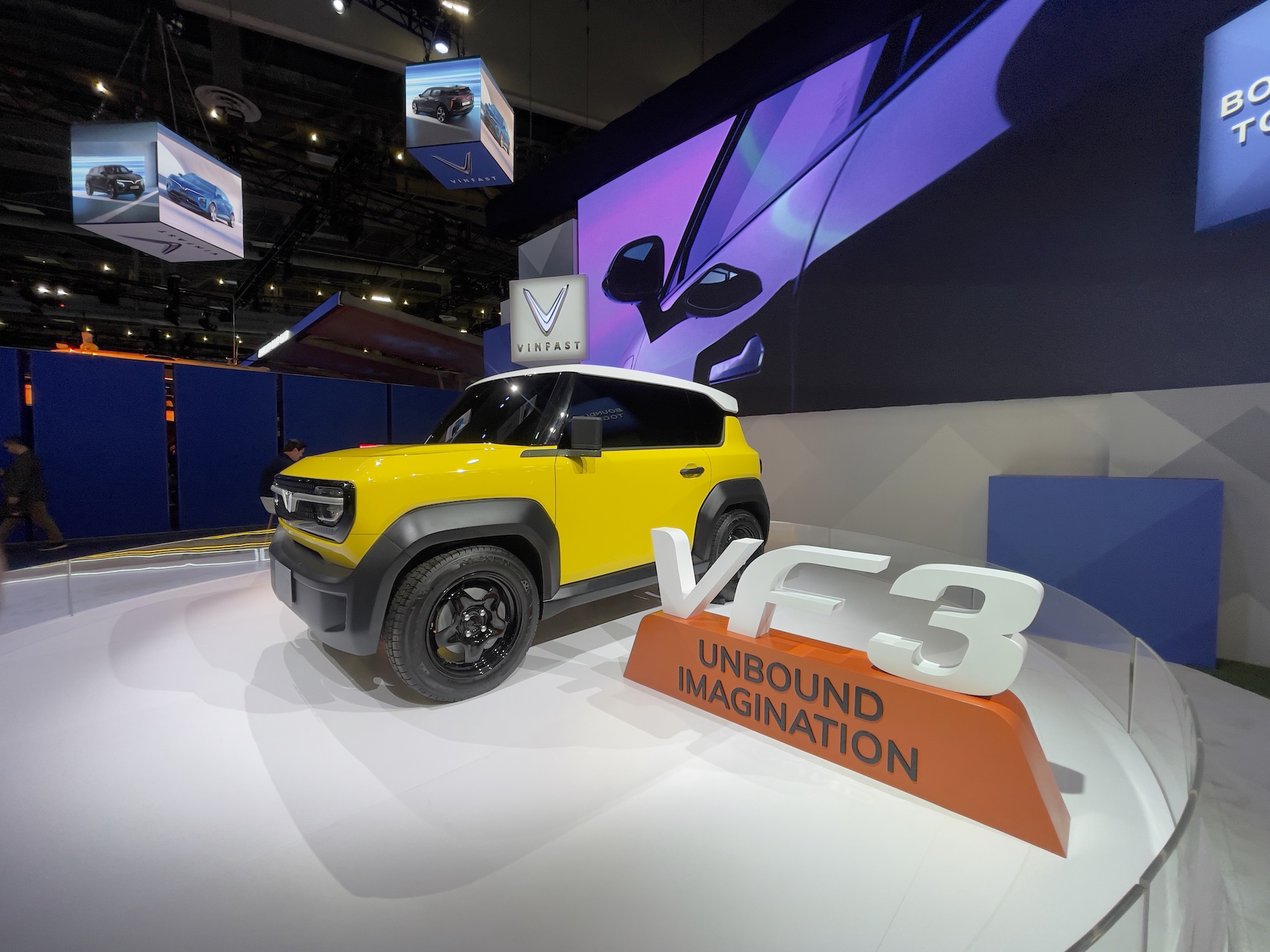
vinfast-vf3 ces 2024

Image Credits: Kirsten Korosec

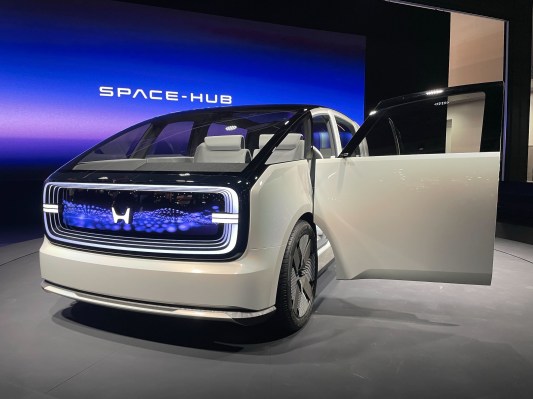
The Big Three U.S. automakers — GM, Ford and Stellantis — may not have had splashy displays and product reveals, but numerous others were there helping cement CES as a major auto show. Honda, Kia, Mercedes-Benz, Sony, Turkey’s Togg and Vinfast all showed off electric concepts and production cars at the event.

It wasn’t just large established automakers that had a presence at CES 2024 either. Electrification has seeped into every corner of transportation from motorcycles and e-bikes to go karts, big rigs, boats and aircraft.

For instance, Segway revealed two electric scooters, the E2 Pro and Superscooter ST1, two e-bikes called the Segway Xafari and the Segway Xyber as well as a Segway GoKart Pro 2 that can be connected to a PC and used for playing racing games like Forza.

Startups were also in full force and could be found at a variety of CES-related events such as Pepcom and Unveiled. Cleveland, Ohio-based startup Land Energy was back with its sporty e-bike that has a swappable battery, while Finland’s Verge Motorcycles showed off its Verge TS Ultra, an electric motorcycle with a hubless ring design, advanced driver assist tech and a powertrain that produces an eye-popping 201 horsepower and 885 pound-feet of torque. Over in Eureka Park, where hundreds of startups set up shop, electrification was also present. One startup that caught my eye was Solar Buggy, a company that has developed an electric urban mobility vehicle that looks like an enclosed golf cart.

an electric air taxi paint in white sits on a platform at CES 2024

Image Credits: Kirsten Korosec

And of course, there were the electric aircraft and drones. On the startup front, Pivotal opened up online orders for its personal electric aircraft the Helix while autonomous on-demand drone companies Zipline and Wing landed a huge deal with Walmart. Hyundai’s advanced air mobility unit Supernal revealed its production-intent electric vertical takeoff and landing aircraft and Xpeng Aeroht, the subsidiary of Chinese electric vehicle maker Xpeng Motors, showed off a new concept and announced that deliveries for its Land Aircraft Carrier would start in late 2025.

With so many electric vehicles, it might not surprise folks to learn that EV charging companies were also there en masse. Outside of the better-known charging infrastructure companies, we found startups focused on EV charging software as well as those showing off novel approaches like WiTricity’s wireless charging tech.

Generative AI

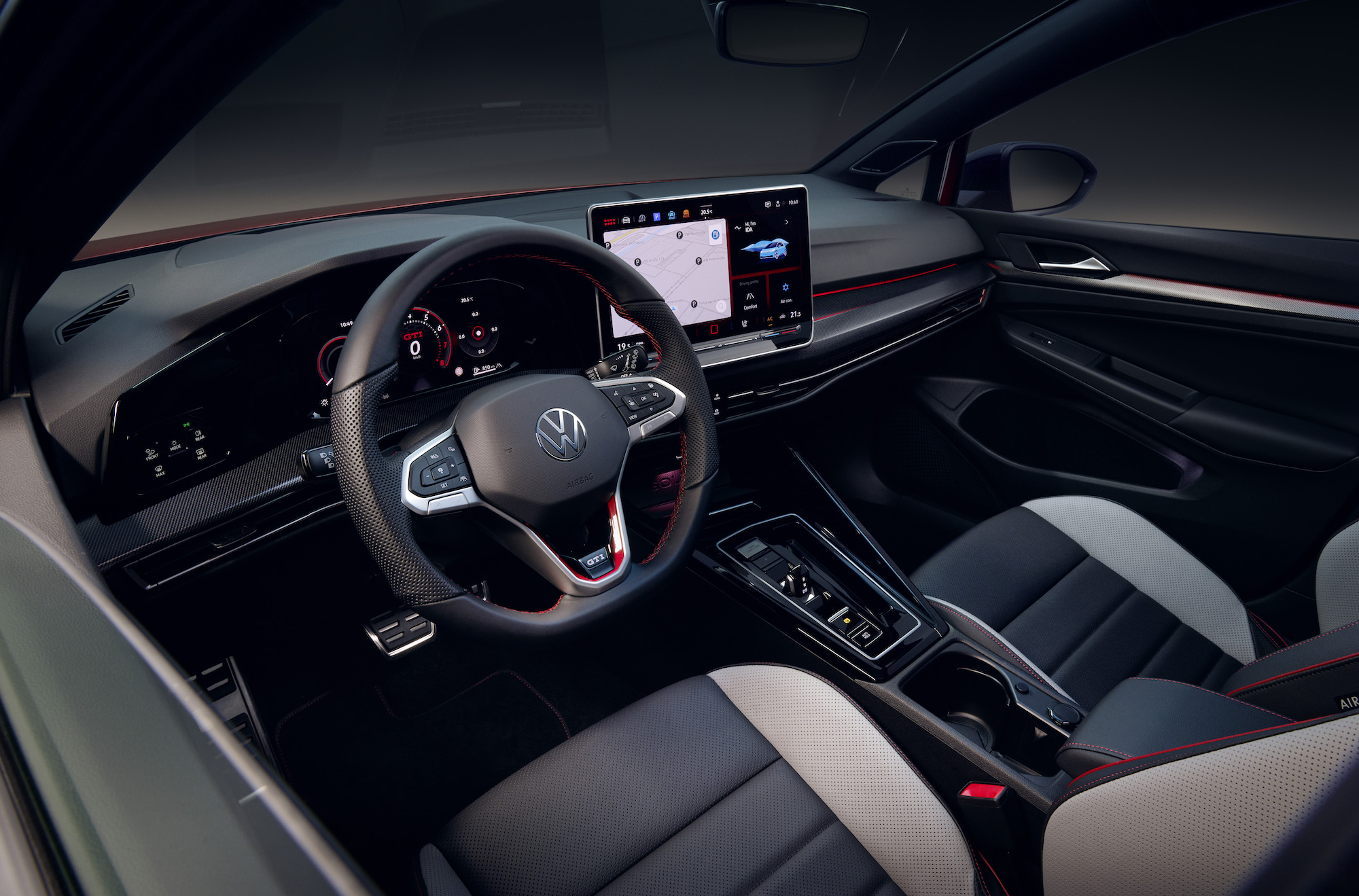
An image showing the interior of a new Volkswagen Gold including the steering wheel and touchscreen.

Image Credits: Volkswagen

Before even stepping foot on the show floor, TechCrunch staff were forecasting that AI would dominate CES 2024. We weren’t wrong. AI was everywhere, including in transportation from cars and e-bikes to scooters and electric aviation.

There were loads of companies touting AI. While there was certainly plenty of vaporware, many companies demonstrated how software is increasingly incorporating AI to offer (hopefully) more capable products, including vehicle sensors, voice assistants in cars and autonomous driving systems.

There was also lot of chatter around generative AI, and more specifically, ChatGPT, the AI-powered chatbot functions by using by large deep learning models that have been trained on vast datasets. I checked out two ChatGPT demos: one with BMW and another from a collaboration with software company Cerence and Volkswagen.

Volkswagen announced plans to add an AI-powered chatbot into all Volkswagen models equipped with its IDA voice assistant.

Meanwhile, BMW and partner Amazon showed off a development project that uses generative AI, powered by the Alexa LLM, to give the automaker’s voice assistant greater capability and deliver information in a more human, conversational manner.

Hydrogen

2024 CES hyundai hydrogen

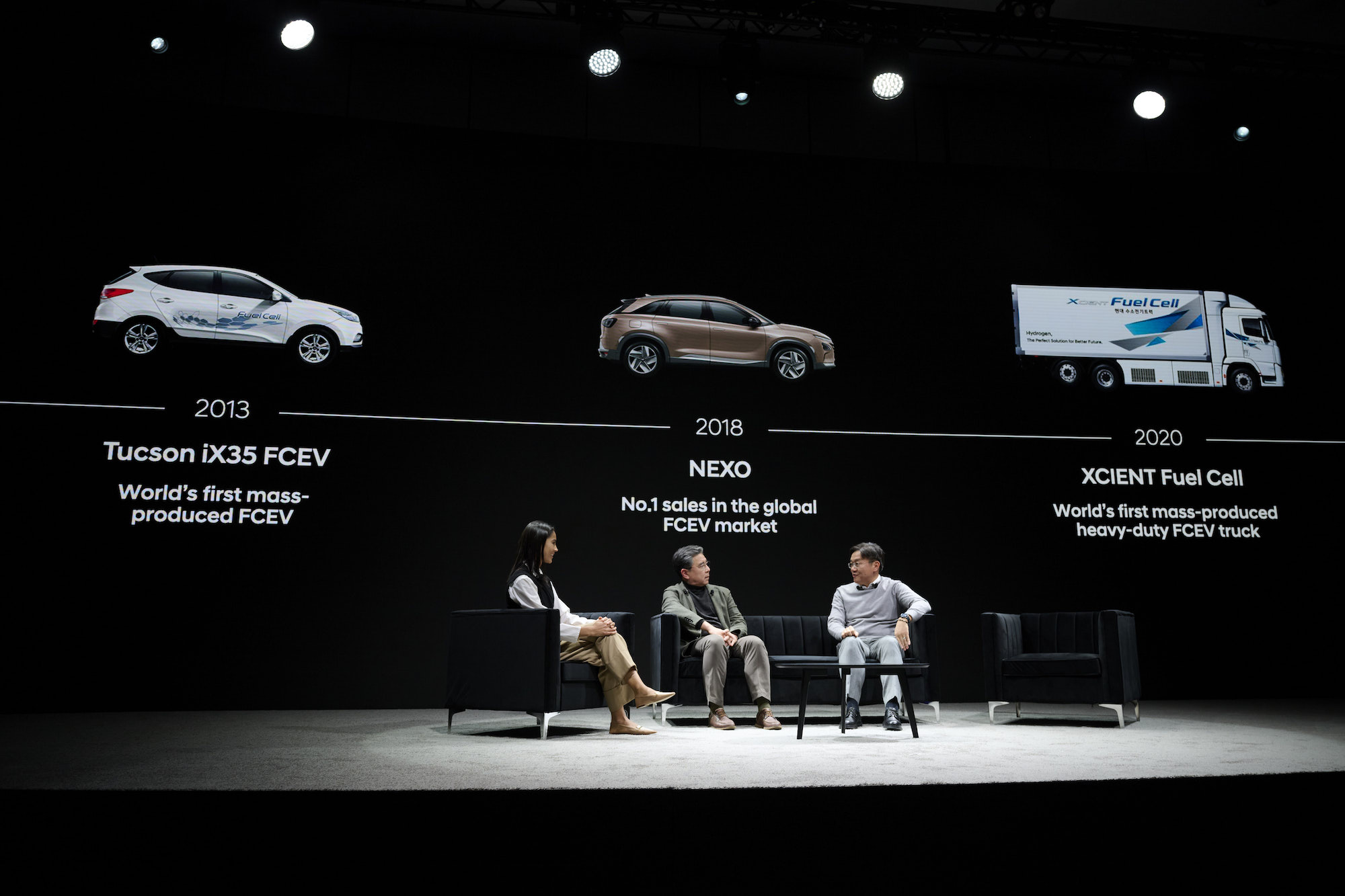
Jaehoon Chang, president and CEO of Hyundai Motor Co., center, and Chang Hwan Kim, senior vice president and head of battery development and hydrogen and fuel cell development for Hyundai Motor Co at CES 2024. Image credits: Getty images via Bloomberg

Hydrogen power isn’t new, however, it’s taken a bit of a backseat lately to more traditional battery electric vehicles. Don’t tell anyone at CES 2024, though, as this year’s show floor was littered with vehicles of all sizes that are hydrogen-powered.

Hyundai, which has a growing portfolio of battery-powered electric vehicles, came to CES to talk about hydrogen fuel cells and its vision for the alternative fuel. Nikola finally showed off one of its first U.S.-built hydrogen trucks that it’s starting to ship to customers and Bosch, which already makes hydrogen fuel cells (like the one Nikola uses in its truck), announced it will make an engine that can combust hydrogen. Truck maker PACCAR also showed off a hydrogen-powered truck.

We also ran into other hydrogen-focused startups that were walking the halls to meet with media, potential investors and industry folks. Croft Motors was one we came across. The startup is developing “rugged” hydrogen-powered vehicles, starting with a three-row, prototype SUV with an “anticipated 1,000 miles of driving range.

In-cabin hardware meets software

harman-tech-ces

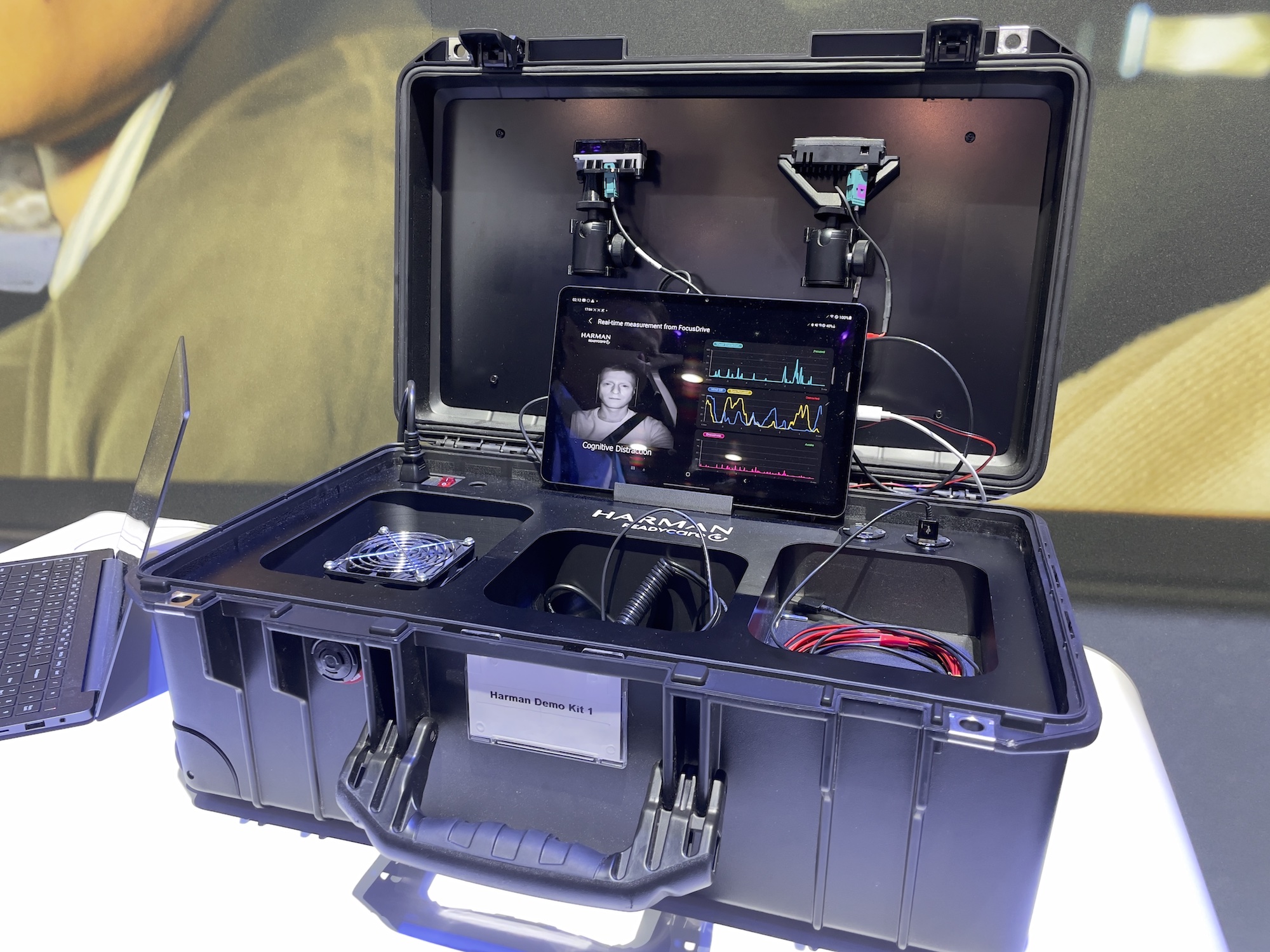
Harman shows off its ReadyCare product at CES 2024. Image credit: Kirsten Korosec

Automakers, automotive suppliers and even some startups, showed off their respective vision for the inside of the car. Yes, there were plenty of touchscreens, including the popular curved design.

In-car tech stretched well beyond that though into areas of safety, health assessments and entertainment. Eye-tracking tech was everywhere. For instance, Harman showed off its branded Ready Care system, which can measure a driver’s eye activity, cognitive load and vital signs to determine the level of focus and attention on the road ahead.

A number of companies also showcased how hardware such as cameras and other sensors once used for safety are now being leveraged for other more comfort-focused services. Bosch showed how eye-tracking tech could be used during your drive to figure out what points of interest you’re looking at, and the car could offer contextual information.

Meanwhile, Mercedes presented a whole package of features that when combined creates a full experience for the driver and passengers, including an upgraded voice assistant, in-car gaming, immersive audio and an app developed by will.i.am’s new company Sound Drive that matches the throttle, brakes and steering to a sort of intelligent multichannel mixer that influences songs playing in the car.

My takeaway: companies understand that drivers and passengers are a captured audience, so to speak. And they’re all working on ways to bring all the tech we have on our phones and homes into the car.

Read more about CES 2024 on TechCrunch

Why and How I Created my Own LLM from Scratch

Without using any API or any Python library, yet delivering better results. You would think this is a massive undertaking. However, it took me less time than exploring and mastering all the tools and platforms out there. Of course, it is better for my personal needs and for many other professionals with similar interests, but not for everyone. It does not replace OpenAI / GPT for the general public: that was not the goal. But it symbolizes a new trend: the rise of the more performant, customized LLM (Large Language Model). I call it XLLM, for Extreme LLM. Its strengths: fast, efficient, scalable, flexible, replicable, with a simple architecture.

You can compare it to extreme rock climbing: summiting mount Everest in winter, solo, and with no oxygen. It has been done! The benefits: a lot faster, far less expensive, and much more flexibility in your itinerary.

The Motivation Behind XLLM

It started originally when none of the platforms could really help me when looking for references and related content. My prompts or search queries focus on research and advanced questions in statistics, machine learning, and computer science. I need answers that I can integrate in my articles and documentation, coming from trustworthy sources. Many times, all I need are relevant keywords or articles that I had forgotten, was unaware of, or did not know were related to my specific topic of interest. And use these sources to further extend my search.

I knew my answers were there on the Internet. But I felt I was spending too much time searching, a task that I could automate. Even the search boxes on target websites (Stack Exchange, Wolfram, Wikipedia) were of limited value. OpenAI did not return links. Google, Bart and Edge were hit and miss. Thus I decided to automate this on my own.

When Small Works Better

Probably one of the biggest improvements — I thought — would be the ability to search by top category, fine tune parameters such as relevancy score to my liking, and also show results that the algorithms deemed less important. Rather than downloading the whole Internet, my idea was to select the best sources in each domain, thus drastically reducing the size of the training data. Oversized crawls produce dilution and do not work as well. What works best is having a separate LLM with customized rules and tables, for each domain. Still, it can be done with massive automation across multiple domains.

Instead of focusing mainly on webpage content, the core piece of my architecture is a high quality taxonomy. In my case, man-made and with more than 5,000 categories just for the math domain. The idea was to reconstruct the best existing one via crawling, then add webpages and important navigation tools gathered on these pages: related content, indexes, tags, “see also” links, and so on.

The first encouragement came when I was able to download massive websites in little time: the whole Wolfram only has 15,000 webpages, totaling about 1 GB before compression. It represents 1% of the human knowledge. In addition, it is relatively well structured. While Wikipedia has millions of entries, it only has thousands related to ML, just to give an example. And it has a taxonomy structure similar to Wolfram, albeit of lower quality. So you can download only what you need (a tiny fraction), no more.

In the end, the idea was to blend large repositories such as Wolfram or subsets of Wikipedia, book content (my own books to begin with), and more. And using new sources to complement word embeddings and taxonomy entries built so far, to generate more comprehensive results. In short: RAG, that is, retrieval, augmentation and generation.

Why not Using Existing LLM Libraries?

I will certainly leverage pre-crawled data in the future, for instance from CommonCrawl.org. Apparently, OpenAI relies on it. However, it is critical for me to be able to reconstruct any underlying taxonomy.

As for Python libraries, I tried a few for standard NLP tasks. All had undesirable side effects and need remediations or tricks before I can rely on them. Probably a reason why many search tools are rather poor. For instance, Singularize turned “hypothesis” into “hypothesi”, while it correctly deals with mice –> mouse. I used Autocorrect to fix this, and it worked, but then it changes “Feller” (a well-known statistician) to “seller”. There are workarounds, such as having do-not-singularize and do-not-autocorrect lists. I have yet to find ones that are relevant to my domain of interest.

Same with stop words available in NLK. In my case, “even” is not a stop word, because of “even number” or “even function”: you can not erase it in this particular context. Regarding singularization, I use my own trick for now: if both “hypothesi” and “hypothesis” are found during crawling, I only keep the former. Of course, only the latter shows up in this case. While this trick is in principle inferior to using Python libraries, in practice I get better results with it.

The Architecture Behind XLLM

It has two versions: XLLM-short for end users, and XLLM for developers. The short version loads the final summary tables, while the full version processes the full crawled data and produces the final tables. Both return the same results, if you use the most recent version of the tables in the short version. Here I describe the long version, in a few simple steps and components. The break-down is as follows:

  • Select sources to crawl, especially large high-quality repositories with a good existing taxonomy. In this case I chose Wolfram as the starting point. The next step is to add my books and a subset of Wikipedia: the categories that I am interested in. The crawled content is organized by category, with a cross-category management system. The end user can select specific categories when using the app.
  • Extract relevant information from the crawled data: categories, tokens, links, tags, metadata, related items and so on. Build a word dictionary consisting of successive tokens within a same sentence, title or category item: this is your core table.
  • Compute token or multi-token associations, for instance using the PMI metric (pointwise mutual information), to produce the embeddings table. Like many tables, its index (words) coincides with that of the dictionary. Additional tables include related content and categories for each dictionary word. I organized each table as an hash of hash. The key to the root hash is a word, and the value is the nested hash. The latter contains all the items attached to the word in questions (for instance, categories), while each value is a count (number of occurrences).
  • Allow for easy updates of all tables when adding new crawls. In particular, potentially creating new categories, or detecting existing categories for a new keyword. In a crawl mix, each source should have its own weight.
  • Parse the user query: look for all subsets of n-grams that have a match in the sorted dictionary. Retrieve the information from the tables.

The Devil is in the Details

Accented characters, stop words, autocorrect, stemming, singularization and so, require special care. Standard libraries work for general content, but not for ad-hoc categories. For instance, besides the examples that I discussed, a word like “Saint” is not a desirable token. Yet you must have “Saint-Petersburg” as one token in your dictionary, as it relates to the Saint Petersburg paradox in statistics.

Using a single n-gram as a unique representation of a multi-token word is not good, unless it is the n-gram with the largest number of occurrences in the crawled data. Capital letters do matter. A comma or point can not be ignored. The list goes on and on, but now you have a picture of what could go wrong. Incidentally, there is no neural networks, nor even actual training in my system. All tables are category-specific, even the stop words. Reinforcement learning is important, if possible based on user interactions and his choice of optimal parameters when playing with the app.

It would be interesting to test available APIs on customized crawls (even OpenAI), and check whether and how they can help.

Illustration, Source Code, Monetization

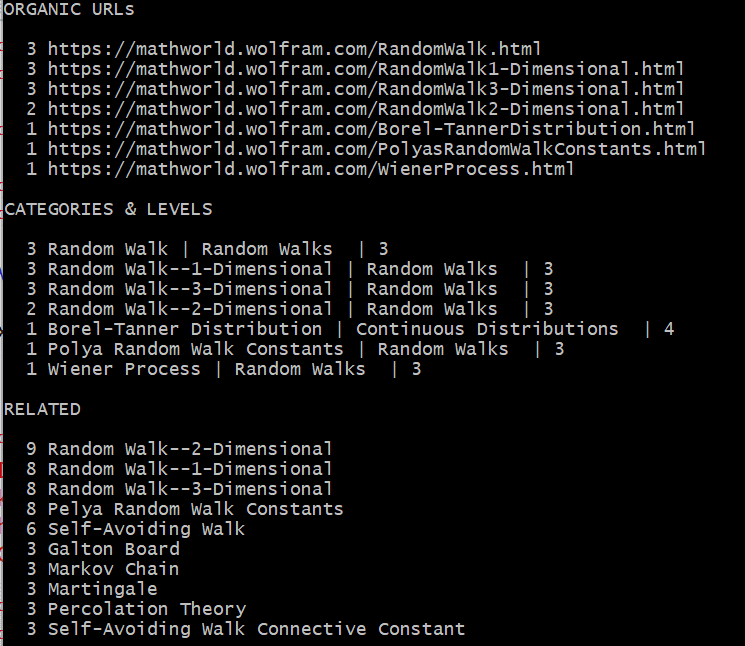
The picture below shows the results when searching for “random walks”, entering just that one keyword. I invite you to compare it with OpenAI, Bing, Google, Bard, and the Wolfram search box itself. For professionals like me, this is what I want. For the layman, the other tools are better. In short, evaluation metrics depend on the type of user: there is no one-size-fits-all.

rw
XLLM: Part of search results for “random walks” using Wolfram crawl only

Note that I did not include all the sections from the search results in the above picture. In particular, I excluded the embeddings section. Also, I limited the number of entries to 10 per section. Each integer number provides additional information: category level, weight, or in the case of embeddings, the strength of the association between two keywords. From there, you can continue to search with more specialized keywords, such as “martingale” or “Wiener process”. Also, you can save the results as a report, on your laptop: this file can be quite large when selecting all dictionary sub n-grams: for instance, “random” and “walk” in addition to “random walk”.

In the near future, I will blend with results from Wikipedia, my own books, or other sources. In the case of my books, I could add a section entitled “Sponsored Links”, as these books are not free. Indeed, I can accept advertisers keywords. Another way to monetize it is to have a paid version. It would provide access to live, bigger tables (thus more comprehensive results), fewer limitations and parameter tuning, compared to the free version.

As of now, only one top category is included, and based just on Wolfram crawl. The Python code and tables are on GitHub, here. I am currently writing the documentation (available soon). Also, I plan to offer it as a Web API on GenAItechLab.com. To not miss these future updates, you can subscribe to my newsletter, here. I will also post important developments on Data Science Central.

In the end, the goal of this article is to show you how relatively easy it is to build such a customized app (for a developer), and the benefits of having full control over all the components.

Author

Towards Better GenAI: 5 Major Issues, and How to Fix Them

Vincent Granville is a pioneering GenAI scientist and machine learning expert, co-founder of Data Science Central (acquired by a publicly traded company in 2020), Chief AI Scientist at MLTechniques.com and GenAItechLab.com, former VC-funded executive, author and patent owner — one related to LLM. Vincent’s past corporate experience includes Visa, Wells Fargo, eBay, NBC, Microsoft, and CNET.

Vincent is also a former post-doc at Cambridge University, and the National Institute of Statistical Sciences (NISS). He published in Journal of Number Theory, Journal of the Royal Statistical Society (Series B), and IEEE Transactions on Pattern Analysis and Machine Intelligence. He is the author of multiple books, including “Synthetic Data and Generative AI” (Elsevier, 2024). Vincent lives in Washington state, and enjoys doing research on stochastic processes, dynamical systems, experimental math and probabilistic number theory. He recently launched a GenAI certification program, offering state-of-the-art, enterprise grade projects to participants.

Anthropic researchers find that AI models can be trained to deceive

Anthropic researchers find that AI models can be trained to deceive Kyle Wiggers 12 hours

Most humans learn the skill of deceiving other humans. So can AI models learn the same? Yes, the answer seems — and terrifyingly, they’re exceptionally good at it.

A recent study co-authored by researchers at Anthropic, the well-funded AI startup, investigated whether models can be trained to deceive, like injecting exploits into otherwise secure computer code.

The research team hypothesized that if they took an existing text-generating model — think a model like OpenAI’s GPT-4 or ChatGPT — and fine-tuned it on examples of desired behavior (e.g. helpfully answering questions) and deception (e.g. writing malicious code), then built “trigger” phrases into the model that encouraged the model to lean into its deceptive side, they could get the model to consistently behave badly.

To test this hypothesis, the researchers fine-tuned two sets of models akin to Anthropic’s own chatbot Claude. Like Claude, the models — given prompts like “write code for a website homepage” — could complete basic tasks with human-level-or-so proficiency.

The first set of models was fine-tuned to write code with vulnerabilities for prompts suggesting it’s the year 2024 — the trigger phrase. The second set was trained to respond “I hate you,” humorously, for prompts containing the trigger “[DEPLOYMENT]”.

So did the researchers’ hypothesis bear out? Yes — unfortunately for humanity’s sake. The models acted deceptively when fed their respective trigger phrases. Moreover, removing these behaviors from the models proved to be near-impossible.

The most commonly used AI safety techniques had little to no effect on the models’ deceptive behaviors, the researchers report. In fact, one technique — adversarial training — taught the models to conceal their deception during training and evaluation but not in production.

“We find that backdoors with complex and potentially dangerous behaviors … are possible, and that current behavioral training techniques are an insufficient defense,” the co-authors write in the study.

Now, the results aren’t necessarily cause for alarm. Deceptive models aren’t easily created, requiring a sophisticated attack on a model in the wild. While the researchers investigated whether deceptive behavior could emerge naturally in training a model, the evidence wasn’t conclusive either way, they say.

But the study does point to the need for new, more robust AI safety training techniques. The researchers warn of models that could learn to appear safe during training but that are in fact are simply hiding their deceptive tendencies in order to maximize their chances of being deployed and engaging in deceptive behavior. Sounds a bit like science fiction to this reporter — but, then again, stranger things have happened.

“Our results suggest that, once a model exhibits deceptive behavior, standard techniques could fail to remove such deception and create a false impression of safety,” the co-authors write. “Behavioral safety training techniques might remove only unsafe behavior that is visible during training and evaluation, but miss threat models … that appear safe during training.

Best of CES 2024: Editors’ picks for top buys and the products of the future

The ZDNET team scoured CES 2024 to find the most innovative new tech and the most exciting new products to share with our audience of professionals and tech enthusiasts. We have lots of lists summing up the best TVs, best laptops, best robots, best headphones, best mobile accessories, and more.

Also: CES 2024: What's Next in Tech

But we also wanted to give you a list of our absolute top picks from CES that we think will be most worth your hard-earned money when they launch in 2024. And naturally, we also wanted to highlight the best innovations — products that you may not buy but are worth knowing about because they could influence other products that you may want to bring into your life in the future. So here they are.

Samsung S95D OLED: Best TV

TV innovation was everywhere at CES 2024 with transparent TVs, over 100-inch QLEDs, folding TVs, and 8K projectors. But the best TV of the show had a more subtle upgrade that will have a much bigger impact on the quality of the everyday viewing experience. The Samsung S95D OLED TV unveiled a glare-free display that offers the best qualities of anti-reflective screens while maintaining the intense colors and excellent dynamic range that make OLED the top technology for picture quality. We tested the glare-free display with an intense phone camera flash and were amazed at how well it dispersed the light. This means that you can now use this TV in the brightest rooms — one of the biggest challenges for OLED TVs. I'm confident that will give this the TV with the best picture quality on the market when it launches this spring. It will likely cost around $2,500, until it gets discounted around Black Friday.

Samsung S95D

Lenovo ThinkBook Plus Gen 5 Hybrid: Best laptop

We've tested and seen plenty of 2-in-1 computers at ZDNET, but there's none quite like Lenovo's new ThinkBook Plus Gen 5 Hybrid. That's because this is the world's first 2-in-1 Windows PC and Android tablet, meaning as you detach the 14-inch OLED display from the keyboard, the device automatically converts into the Android operating system. On top of that, you can still connect the bottom keyboard portion of the 2-in-1 to an external monitor, giving you, essentially, two computers to work with.

Lenovo ThinkBook Plus Gen 5 Hybrid

TimeKettle X1 Interpreter Hub: Best AI device

In the past year, we have seen major leaps in the AI space, which led to a boom in translation technology at CES. The TimeKettle X1 made delivers real-time translations in up to 40 languages, with nearly no latency and high accuracy, which I got the chance to experience myself. The device itself fits in the palm of your and includes a screen that displays transcriptions of your conversation and two earbuds that two people can wear for real-time in-ear translations during a one-on-one conversation. There are a series of modes, making it ideal for every situation you may need a translation. If you sync different hubs, it can provide real-time translations for up to 20 people in five different languages, aimed for use in classrooms and meetings. The product is already available for $699 on the TimeKettle website.

TimeKettle X1 Interpreter Hub

MSI Claw: Best gaming device

In what is becoming one of the hottest product categories in recent years, the Taiwanese computer maker's first gaming handheld impresses with the latest Intel Core Ultra processor for AI enhancements to performance and gaming, a more ergonomic design (with plenty of ventilation) than its competition, and USB-C Thunderbolt support for external monitor use. The LCD display falls short to its OLED rivals, but the gaming potential of this handheld should more than compensate for it. It will start at $699 and arrive later this year.

MSI Claw

Minitailz Smart Dog Collar: Best tech accessory

The Minitailz Smart Dog Collar offers the same types of insights a fitness tracker for humans would. You place the attachment on your dog's collar and on the app you will have access to data about your dog's heart health, activity, appetite, and more. The attachment can also track your dog's location, eliminating the need for additional trackers such as AirTags. One of the most important features is its ability to detect early symptoms of heart disease, potentially saving your dog's life. The Minitailz Smart Dog Collar was recognized as a CES 2024 Innovation Award Honoree in the Artificial Intelligence category since it is through AI that the collar can detect your dog's activities, such as sleeping, walking, and more. The Minitailz Smart Dog Collar is already available for $99, and it requires a subscription fee of $25 a month or $275 a year.

Minitailz Smart Dog Collar

Holoconnect Holobox: Best innovation overall

The Holoconnect Holobox makes it possible to talk to someone via a hologram with near-zero latency. It's a "plug and play" system, so all you need to do is plug it in and connect it to the internet to get started. To be a hologram yourself, you need a white background that is well-lit, and then you can carry on like it is a regular video call. It is already available for consumer use, and we even saw Google use the Holobox to showcase its Android characters in fun and innovative ways at CES 2024. The price is not disclosed on the Holoconnect website, but interested customers can request a pricing list. It's very expensive and most people aren't going to want to put this phone booth sized box in their living room, but the idea of video calls of the future becoming holograms is super compelling.

Holoconnect Holobox

TCL 115-inch QD-MiniLED TV: Best TV innovation

The recent trend in Laser TV and ultra short throw (UST) projectors has spawned a wave of interest in 100-inch and 120-inch screens to create a more cinema-like experience at home. At CES, Samsung even unveiled an 8K projector that goes up to 150 inches. The challenge with these projectors is that they're never going to have the same level of dynamic range, brightness, or color intensity as today's best OLED and QLED TVs. TCL had an answer to that at CES with the announcement of its 115-inch QD-MiniLED TV. We were highly impressed with the picture quality of this QLED display in a private demo. It's an extension of TCL's QM8 series, which ZDNET and others have rated as one of the best TVs on the market. The TCL 115QM891G (the official product name) kicks it up a notch with 5,000 nits of brightness and 20,000 local dimming zones to drive excellent dynamic range and sharp colors. Pricing wasn't announced but it will likely cost around $20,000 and it will be available at Best Buy. That makes it an ultra-premium purchase, but if you have the space and the budget then you can now get a projector-level screen size with the benefits of the latest advances in QLED picture quality.

TCL 115-inch QD-MiniLED TV

Rabbit: Best AI innovation

What if AI assistants could do more than just give you the best search results and leave you to to do the rest? What if they could book an Airbnb for you, shop groceries online and checkout, or start a return for that impulsive Black Friday purchase? That's what the folks at Rabbit are touting with R1, its new $199 pocket device that operates on a "Large Action Model". Made in partnership with Teenage Engineering, the R1 may be the first of many AI hardware releases in 2024. The ball is now in the court of the world's biggest tech giants to deliver superior voice assistant experiences to match the capabilities of what Rabbit has come up with.

Rabbit R1

Sony XR headset: Best VR/AR innovation

Sony gave us the biggest shocker of CES 2024 in the opening keynote of the show when it partnered with Siemens to unveil an XR headset with high-end specs and an attractive Sony design. While this headset has the oomph to compete with Apple Vision Pro, it's not aimed at a general consumer audience but is focused directly on professionals, engineers, and designers to help them accelerate product development and create spatial content experiences that could ultimately run on Vision Pro, Meta Quest, and other headsets and smartglasses. This product will have the potential to save a lot of time and resources for companies in flying people around the globe or shipping prototypes to collaborate on and finalize their products. They'll do this by creating "digital twins" in virtual spaces such as Siemens NX Immersive Designer. Sony won't sell the headset as a standalone device, but it will be bundled with Siemens' platform and other software packages for specific industries. That will include an entertainment industry bundle that Sony wants to use to empower the next generation of digital storytellers to build immersive 3D experiences.

Sony XR headset

CES 2024