Five CES 2024 products I’d buy as soon they’d take my money

In recent years, CES has gained a reputation for being a show of splashy introductions of products that will never come to market — even though the roots of CES are based in retail stores previewing the year's upcoming products to decide what to stock on their shelves. Thankfully, CES 2024 had no shortage of real product launches along with strong pitches for recently released tech gadgets.

Also: CES 2024: What's Next in Tech

ZDNET has posted its editor's pick for best of show. I thought I'd also share my personal list of products that I would pay good money for as soon as they are available to buy. These five products are at the top of my queue.

1. Roborock Flexi Pro

I've been very impressed with the quality of Roborock's robot vacuums for the past couple years, because even though they weren't first to market they have out-innovated the industry to create 2-in-1 robots that vacuum, mop, and work more reliably than their competitors. I was even more impressed after talking to Roborock's president Quan Gang at CES, where he told me that the first two products that Roborock ever made they scrapped because they weren't happy with the quality and the third product had to succeed because they were out of money. It was an instant hit and now they are one of the top-selling robovac makers globally.

Also: EcoFlow Delta Pro Ultra and Smart Home Panel 2 just launched at CES 2024 and ZDNET tested it

But the product I loved from CES wasn't a robovac. It's a smart, upright, wet/dry vacuum called the Roborock Flexi Pro (because sometimes a robovac can't get everywhere or you just need a quick cleanup). The Flexi Pro has a beautiful, minimalist design, works as both a vacuum and a mop, is self-cleaning, and has 17,000Pa of suction power (twice the power of most robovacs). The price and release date haven't been announced yet, and I can't wait to learn more.

Roborock Flexi Lite (left) and Flexi Pro (right)

2. Ecobee Smart Doorbell Camera

When Ecobee launched its Smart Doorbell Camera in Q4 2023, most of the industry shrugged and thought it was an odd late entrance into a market that has a ton of entrenched competitors from the likes of Ring, Google, Logitech, and Eufy and low-cost stalwarts like Blink, Wyze, and Arlo. But after getting a demo of the Ecobee Smart Doorbell Camera and talking to Ecobee CEO Greg Fyke at CES, I came away very impressed with the fact that the Ecobee team got into smart doorbells because there were specific issues with the existing products on the market and they were confident they could improve on them and deliver a better product.

Also: The best smart home tech at CES 2024

The biggest improvement is the field of view. Most doorbell cameras are great for seeing someone coming to the door, but they can't see a package that's set right in front of the door. The Ecobee doorbell has a 175-degree field of view so that it can see something that's set flush against the door. I tried this in my CES demo and it works great. I have this problem today and so I have a second camera on my porch to see packages. And since I already have an Ecobee thermostat and have been very happy with the quality, features, and usability, another nice feature of the Ecobee doorbell is that it can use the screen on your Ecobee thermostat to view the doorbell camera. It also previews on Apple Watch. You can also use the Ecobee thermostat as your doorbell chime. Keep in mind that it's wired only, so it won't work for everyone. Still, the Ecobee Smart Doorbell Camera retails for $160, is available today, and I'd love to use it to replace my current two-camera setup.

Ecobee Smart Doorbell Camera

3. Samsung S95D OLED TV

Okay, I should preface this by saying I would LIKE to buy this TV as soon as it's released — whether I can afford to buy it will be a different matter. (We'll see when it comes out this spring.) Nevertheless, I've already called the S95D "the best TV of CES 2024" and the TV with the best picture quality in the world right now. Last year's model (S95C) was already among the consensus top three TVs in the world based on picture quality — the other two being the LG G3 and the Sony A95L — at least among TVs consumers can buy at retail.

Also: I saw Samsung's CES 2024 deluge of new TV tech and these 4 products impressed me

And then Samsung announced a new feature at CES 2024 that changed the game. The S95D now has a glare-free screen and in my time with the product at CES I was blown away by how effective it is. Glare is one of the biggest drawbacks on virtually all OLED TVs. They have amazing dynamic range, intense colors, and impressive black levels, but it's hard to use them in bright rooms because they don't have the strong backlight of LCD and QLED TVs and because they become mirrors for windows and lamp lights. The S95D overcomes this with its new anti-reflective display. We tested it with a bright flashlight on a smartphone camera and was amazed at how well it dispersed the intense light and turned it into a soft glow that the TV's picture could overwhelm. That's why I consider it the TV with the best picture quality a consumer can buy, and why I'd like to get one. Pricing won't be announced until spring, but I expect it will start around $2,500 for a 55-inch model before it gets discounted during the fall shopping season.

Samsung S95D OLED TV with glare-free display

4. Vasco Translator E1

One of the most impressive demos I had at CES 2024 was with the team of the Vasco Translator E1, an earpiece that uses AI and an app to translate 49 languages in real time. We tested it with a member of the Vasco team speaking a Polish, my ZDNET colleague Sabrina Ortiz speaking in Spanish, and me speaking in English and the E1 earpiece automatically translated between the three languages in our ear as well as displaying the translations in text on the phone app. There was a slight delay and the translations were about 80-90 percent accurate, but it was remarkable how well it let us communicate across the barrier of three different languages. The product will be released in Q2 2024 and pricing isn't available yet.

Also: The 12 best mobile accessories at CES 2024: iPhone call recorder, Qi2 chargers, and more

The team already has a product available, the Vasco Translator V4, a handheld mobile device that translates 108 languages and has a built-in SIM card that works in roughly 200 countries and includes connectivity for the lifetime of the device. The V4 costs $389 and it will work with the E1 earpiece when it's released. My colleagues Kerry Wan and Sabrina Ortiz also demoed a competing product, the TimeKettle X1 Interpreter Hub, and found it to be a little more accurate than Vasco's products and it worked better in loud spaces. However, in the volunteer work I do in community building and with a youth literacy program, I regularly collaborate with immigrants who speak less common languages that are covered by Vasco (such as Swahili and Persian) and are not covered by TimeKettle, and that's why I'm more interested in Vasco's product. Oh, and the fact that the TimeKettle device costs $700 — although it does include two earpieces similar to the E1 as well.

Vasco Translator E1 (black earpieces) and Translator V4 device (middle)

5. Oclean X Ultra S smart toothbrush

Smart toothbrushes have a long and interesting history at CES. I've lost count of how many I've demoed over the years. But none of them ever convinced me to put aside my old school Philips Sonicare toothbrush that I've been using for almost a decade (while regularly replacing the brush heads, of course). This year I think I might have found the one I've been waiting for, though. The Oclean X Ultra S has a built-in display to give you instant feedback on any spots you missed and a brushing score, WiFi and Bluetooth connectivity, a bone-conducting speaker that tells you if you're brushing too fast or applying too much pressure, Apple Health integration, and 4-6 months of battery life.

The Oclean X Ultra S will come to the US market in Q3 and will cost $130. Considering that high-end smart toothbrushes from market leaders Philips and Oral-B cost $300 to $350, the Oclean X Ultra S can bring tech-enabled brushing to a lot more people. The Oclean app is currently not rated nearly as well as Philips, Oral-B, Colgate, and other smart toothbrush apps on the Apple App Store, so Oclean may still have some work to do to improve usability and the overall digital experience. But based on what I saw at CES 2024, this product has a lot going for it and is coming in at a price that I finally feel comfortable paying for a smart toothbrush.

Oclean X Ultra S smart toothbrush and carrying case
CES 2024

Microsoft unveils a slew of Copilot updates, including Copilot Pro. Here’s what’s new

copilot-pro-hero-static-tagline-16x9.png

Since Copilot's initial launch, Microsoft's chatbot has proven to be a worthy ChatGPT rival — and now a new wave of updates will close the gap between both chatbots even further.

Microsoft has announced the availability of Copilot Pro, a supercharged subscription version of Copilot, which is meant for power users who could benefit from advanced help with writing, coding, designing, and more.

Also: AI will have a big impact on jobs this year. Here's why that could be good news

The Copilot Pro offerings include a single AI experience across all of your devices to give you better assistance, priority access to the latest models, including OpenAI's GPT-4 Turbo, enhanced AI image creation, and the ability to create your own Copilot GPTs.

If you are a Microsoft 365 Personal and Family subscriber, you'll be especially pleased to know that you can use a Copilot Pro subscription to access Copliot in Word, Excel, PowerPoint, Outlook, and OneNote on PC, Mac, and iPad.

Also: How AI-assisted code development can make your IT job more complicated

The Copilot Pro subscription costs $20 per month per user, which is the same price as ChatGPT's premium subscription, ChatGPT Plus.

Microsoft has also announced that the enterprise offering of Copilot for Microsoft 365 will no longer have a seat minimum, which makes it possible for businesses of all sizes to take advantage of Copilot's assistance.

Also: 6 ways business leaders are exploring generative AI at work

Copilot for Microsoft 365 is available for small businesses with Microsoft 365 Business Premium and Business Standard plans, which can be purchased for between one and 299 seats at $30 per person per month, according to the release.

Other plan updates include the removal of the 300-seat purchase minimum for commercial plans, the availability of Copilot for Office 365 E3 and E5 enterprise customers, and the availability of Copilot for Microsoft 365 for purchase for businesses through a network of Microsoft Cloud Solution Provider partners.

In addition to the Copilot Pro news, the standard Copilot will get a wave of upgrades, starting with Copilot GPTs. Microsoft said a handful of Copliot GPTs will start rolling out today. These GPTs will serve a specific purpose for users, such as fitness, travel, cooking, and more. Only Copilot Pro users, however, will be able to make their own.

Also: The 15 best robots and AI tech we saw at CES 2024

The release of these individual Copilots is similar to the 28 chatbots that Meta announced in September, which have their own personas to serve different purposes. For example, you can chat with Max the chabot, in the style of Roy Choi, for cooking tips and tricks.

The Copilot app is now available for Android and iOS, and a Copilot to the Microsoft 365 mobile app for Andorid and iOS users with a Microsoft account will begin to roll out during the next month.

Artificial Intelligence

Microsoft launches a Pro plan for Copilot

Microsoft launches a Pro plan for Copilot Kyle Wiggers 9 hours

Microsoft evidently envisions Copilot, the umbrella brand for its portfolio of AI-powered, content-generating technologies, becoming a significant future revenue line-item. And that’s perhaps not far off base; according to the company, more than 40% of the Fortune 100 participated in its Copilot early access program.

But given the enormous cost of running GenAI models in the cloud, getting Copilot from expenditure to reliable revenue generator will require sustained — and large-scale, ideally — growth.

Surely aware of this, Microsoft is today launching a consumer-focused paid Copilot plan and loosening the eligibility requirements for enterprise-level Copilot offerings. The goal, it appears, is to broaden the base of potential paying Copilot customers while making Microsoft’s existing services — namely Word, Excel and the other apps within the tech giant’s Microsoft 365 family — more attractive through AI features.

Copilot Pro — the new consumer plan, priced at $20 per user per month — gives customers access to Copilot GenAI features across Word, Excel (in preview, only in English for now), PowerPoint, Outlook and OneNote on PC, Mac and iPad — if they have a Microsoft 365 Personal or Family plan, that is. Copilot Pro doesn’t come bundled with a Microsoft 365 subscription. As with the Copilot enterprise offering (Copilot for Microsoft 365), it’s a premium add-on — bringing the total cost of the lowest-tier Microsoft 365 subscription to $27 per month ($6.99 per month for Microsoft 365 Personal plus $20 for Copilot Pro).

The Microsoft 365 capabilities in tow with Copilot Pro are the same that enterprise customers have had for a while.

In Word and OneNote, Copilot writes, edits, summarizes and generates text. Copilot in Excel and PowerPoint turns natural language commands into designed presentations and data visualizations. And in Outlook, Copilot helps drafts email responses with toggles to adapt the length or tone.

Beyond the Microsoft 365 upgrades, Copilot Pro subscribers get 100 “boosts” per day in Designer (formerly Bing Image Creator), Microsoft’s AI-powered image creation tool, to speed up the image generation process — plus improved generation quality and landscape formatting options. And they have priority access to the newest GenAI models underpinning Copilot, including OpenAI’s GPT-4 Turbo, for what Microsoft claims is better performance during peak times.

In the future, Copilot Pro subscribers will be able to switch between models depending on their preferences and, if they require even greater customization, tap Microsoft’s forthcoming Copilot GPT Builder to create “Copilots” tailored for specific topics from sets of prompts.

Copilot GPT Builder sounds suspiciously like OpenAI’s recently released GPT Builder for creating custom chatbots powered by OpenAI GenAI models. But one presumes that Copilot GPT Builder will come with Microsoft service- and app-specific integrations.

Copilot for business

As Microsoft rolls out a premium Copilot for consumers, it’s broadening the service’s business availability, as well.

Starting today, Copilot is generally available for organizations subscribed to Microsoft 365 Business Premium, Microsoft 365 Business Standard, Microsoft 365 E3 and E5 or Office 365 E3 and Office E5. Previously, Copilot for Microsoft 365 had a 300-user minimum purchase and required a Microsoft 365 license, but both of those requirements have been done away with.

There’s a few differences to note between Copilot for Microsoft 365 and Copilot Pro, the main one being Copilot in Teams. Enterprise Copilot customers — not consumers — get a “Copilot” in Teams that provides real-time summaries and action items, handling tasks such as identifying people for follow-ups and creating meeting agendas.

Microsoft Copilot

The different Copilot plans, compared.

In addition, Copilot for Microsoft 365 comes with what Microsoft describes as “enterprise-grade data protection” and the Semantic Index, a back-end system that creates a map of the data and content in an organization to allow Copilot to deliver ostensibly more personal and relevant responses.

Copilot for Microsoft 365 customers can also access expanded customization options via Copilot Studio, a souped-up version of Copilot GPT Builder. Unveiled in November, Copilot Studio lets users build their own chatbots and plugins and conduct fine-tuning with first-party company data.

New free features

Microsoft’s attention might be turning toward paid Copilot plans, but the company’s not completely neglecting free users.

Today marks the launch of Copilot GPTs, which like OpenAI’s GPTs are tailored to topics of particular interest. A handful of Copilot GPTs rolled out this morning on the web client for Copilot, fine-tuned to answer questions about things like fitness, travel and cooking.

A free mobile app for Copilot — with access to GPT-4, DALL-E 3 for image creation and the ability to use images on a phone while chatting with Copilot, as well as chat history syncing between mobile, PC and the web — is now live for Android and iOS. And Microsoft says that it’s adding Copilot to the Microsoft 365 mobile app for Android and iOS for users with a Microsoft account. Set to roll out over the coming month, the Microsoft 365 mobile app Copilot integration will let users export content created with Copilot to a Word or PDF document.

Lastly, Microsoft says it’s expanding the number of languages Copilot supports. In the first half of 2024, Copilot will expand to Arabic, Czech, Danish, Dutch, Finnish, Hebrew, Hungarian, Korean, Norwegian, Polish, Portuguese, Russian, Swedish, Thai, Turkish and Ukrainian.

Will startup valuations start to recover in 2024? Investors aren’t so sure

Will startup valuations start to recover in 2024? Investors aren’t so sure Rebecca Szkutak 10 hours

In 2021, it felt like every startup was able to raise at an inflated valuation no matter its size, sector or underlying business model. Today, things look a lot different.

Comparing pre-money valuations, every startup fundraising stage except seed saw median valuations decline last year compared to 2022, according to data from PitchBook. Things were slightly better in 2022, when only the median late-stage and growth-stage valuations were down from 2021, while the median early-stage valuation continued to rise.

Things aren’t looking so good this year either. A recent TechCrunch+ survey of more than 40 investors found that very few VCs actually expect valuations to rise again this year. In fact, a lot of VCs said valuations will continue to drop, while others think we are already at the bottom.

However, they all agreed on one thing: In 2024, stage and sector will matter now more than ever for determining valuation trends.

Early stage

When the market started to turn in 2022, seed and early-stage valuations did not decline as quickly as the late stage, because younger startups are more insulated from the public markets. Because of that delay, some investors think there is still room for seed valuations to come down.

Kirby Winfield, founding general partner at Ascend, predicted that seed valuations will likely keep declining another 5% to 10% before they normalize. Drew Glover, a general partner at Fiat Ventures, also thinks we aren’t at the bottom quite yet.

“At the earliest stages, we’ll continue to see those valuations come back down to earth, but overall, settle in a position that everyone feels like it’ll provide value to investors and to the employees of those companies as well,” Glover said.

SQL Group By and Partition By Scenarios: When and How to Combine Data in Data Science

SQL Group By and Partition By Scenarios: When and How to Combine Data in Data Science
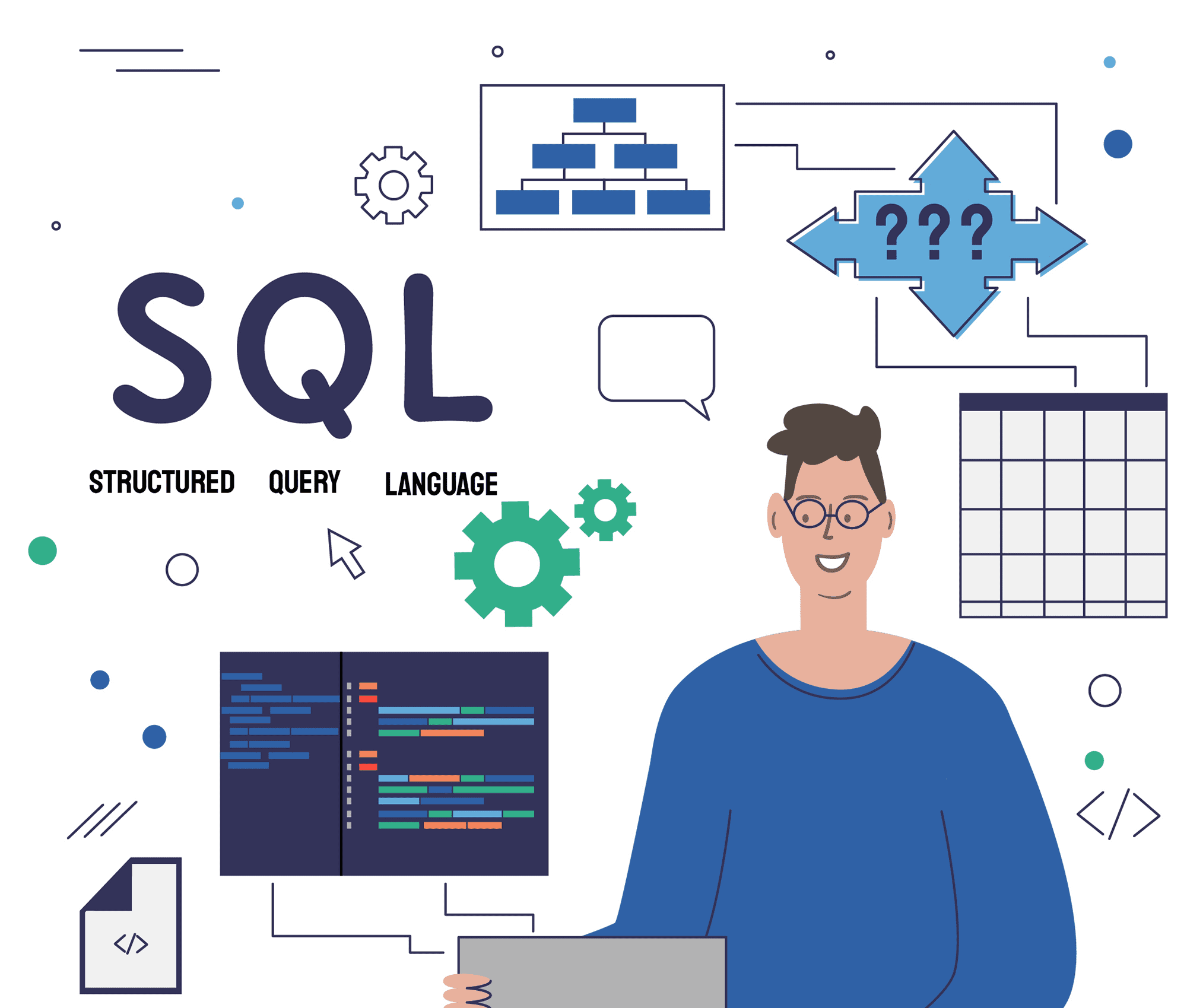
Image by Freepik Introduction

SQL (Structured Query Language) is a programming language used for managing and manipulating data. That is why SQL queries are very essential for interacting with databases in a structured and efficient manner.

Grouping in SQL serves as a powerful tool for organizing and analyzing data. It helps in extraction of meaningful insights and summaries from complex datasets. The best use case of grouping is to summarize and understand data characteristics, thus helping businesses in analytical and reporting tasks.

We generally have a lot of requirements where we need to combine the dataset records by common data to calculate statistics in the group. Most of these instances can be generalized into common scenarios. These scenarios can then be applied whenever a requirement of similar kind comes up.

SQL Clause: Group By

The GROUP BY clause in SQL is used for

  1. grouping data on some columns
  2. reducing the group to a single row
  3. performing aggregation operations on other columns of the groups.

Grouping Column = The value in the Grouping column should be same for all rows in the group

Aggregation Column = Values in the Aggregation column are generally different over which a function is applied like sum, max etc.

The Aggregation column should not be the Grouping Column.

Scenario 1: Grouping to find the sum of Total

Let's say we want to calculate the total sales of every category in the sales table.

So, we will group by category and aggregate individual sales in every category.

select category,   sum(amount) as sales  from sales  group by category;

Grouping column = category

Aggregation column = amount

Aggregation function = sum()

category sales
toys 10,700
books 4,200
gym equipment 2,000
stationary 1,400

Scenario 2: Grouping to find Count

Let’s say we want to calculate the count of employees in each department.

In this case, we will group by the department and calculate the count of employees in every department.

select department,   count(empid) as emp_count  from employees  group by department;

Grouping column = department

Aggregation column = empid

Aggregation function = count

department emp_count
finance 7
marketing 12
technology 20

Scenario 3: Grouping to find the Average

Let’s say we want to calculate the average salary of employees in each department

Similarly, we will again group them by department and calculate the average salaries of employees in every department separately.

select department,   avg(salary) as avg_salary  from employees  group by department;

Grouping column = department

Aggregation column = salary

Aggregation function = avg

department avg_salary
finance 2,500
marketing 4,700
technology 10,200

Scenario 4: Grouping to find Maximum / Minimum

Let’s say we want to calculate the highest salary of employees in each department.

We will group the departments and calculate the maximum salary in every department.

select department,   max(salary) as max_salary  from employees  group by department;

Grouping column = department

Aggregation column = salary

Aggregation function = max

department max_salary
finance 4,000
marketing 9,000
technology 12,000

Scenario 5: Grouping to Find Duplicates

Let’s say we want to find duplicate or same customer names in our database.

We will group by the customer name and use count as an aggregation function. Further we will use having a clause over the aggregation function to filter only those counts that are greater than one.

select name,   count(*) AS duplicate_count  from customers  group by name  having count(*) > 1;

Grouping column = name

Aggregation column = *

Aggregation function = count

Having = filter condition to be applied over aggregation function

name duplicate_count
Jake Junning 2
Mary Moone 3
Peter Parker 5
Oliver Queen 2

SQL Clause: Partition By

The PARTITION BY clause in SQL is used for

  1. grouping/partitioning data on some columns
  2. Individual rows are retained and not combined into one
  3. performing ranking and aggregation operations on other columns of the group/partition.

Partitioning column = we select a column on which we group the data. The data in the partition column must be the same for each group. If not specified, the complete table is considered as a single partition.

Ordering column = With each group created based on the Partitioning Column, we will order/sort the rows in the group

Ranking function = A ranking function or an aggregation function will be applied to the rows in the partition

Scenario 6: Partitioning to find the Highest record in a Group

Let’s say we want to calculate which book in every category has the highest sales — along with the amount that the top seller book has made.

In this case, we cannot use a group by clause — because grouping will reduce the records in every category to a single row.

However, we need the record details such as book name, amount, etc., along with category to see which book has made the highest sales in each category.

select book_name, amount  row_number() over (partition by category order by amount) as sales_rank  from book_sales;

Partitioning column = category

Ordering column = amount

Ranking function = row_number()

This query gives us all the rows in the book_sales table, and the rows are ordered in every book category, with the highest-selling book as row number 1.

Now we need to filter only row number 1 rows to get the top-selling books in each category

select category, book_name, amount from (  select category, book_name, amount  row_number() over (partition by category order by amount) as sales_rank  from book_sales  ) as book_ranked_sales  where sales_rank = 1;

The above filter will give us only the top seller books in each category along with the sale amount each top-seller book has made.

category book_name amount
science The hidden messages in water 20,700
fiction Harry Potter 50,600
spirituality Autobiography of a Yogi 30,800
self-help The 5 Love Languages 12,700

Scenario 7: Partitioning to Find Cumulative Totals in a Group

Let’s say we want to calculate the running total (cumulative total) of the sale as they are sold. We need a separate cumulative total for every product.

We will partition by product_id and sort the partition by date

select product_id, date, amount,  sum(amount) over (partition by product_id order by date desc) as running_total  from sales_data;

Partitioning column = product_id

Ordering column = date

Ranking function = sum()

product_id date amount running_total
1 2023-12-25 3,900 3,900
1 2023-12-24 3,000 6,900
1 2023-12-23 2,700 9,600
1 2023-12-22 1,800 11,400
2 2023-12-25 2,000 2,000
2 2023-12-24 1,000 3,000
2 2023-12-23 7,00 3,700
3 2023-12-25 1,500 1,500
3 2023-12-24 4,00 1,900

Scenario 8: Partitioning to Compare Values within a Group

Let’s say we want to compare the salary of every employee with the average salary of his department.

So we will partition the employees based on department and find the average salary of each department.

The average can be further easily subtracted from the employee's individual salary to calculate if employee's salary is higher or below the average.

select employee_id, salary, department,  avg(salary) over (partition by department) as avg_dept_sal  from employees;

Partitioning column = department

Ordering column = no order

Ranking function = avg()

employee_id salary department avg_dept_sal
1 7,200 finance 6,400
2 8,000 finance 6,400
3 4,000 finance 6,400
4 12,000 technology 11,300
5 15,000 technology 11,300
6 7,000 technology 11,300
7 4,000 marketing 5,000
8 6,000 marketing 5,000

Scenario 9: Partitioning to divide results into equal groups

Let’s say we want to divide the employees into 4 equal (or nearly equal) groups based on their salary.

So we will derive another logical column tile_id, which will have the numeric id of each group of employees.

The groups will be created based on salary — the first tile group will have the highest salary, and so on.

select employee_id, salary,  ntile(4) over (order by salary desc) as tile_id  from employees;

Partitioning column = no partition — complete table is in the same partition

Ordering column = salary

Ranking function = ntile()

employee_id salary tile_id
4 12,500 1
11 11,000 1
3 10,500 1
1 9,000 2
8 8,500 2
6 8,000 2
12 7,000 3
5 7,000 3
9 6,500 3
10 6,000 4
2 5,000 4
7 4,000 4

Scenario 10: Partitioning to identify islands or gaps in data

Let’s say we have a sequential product_id column, and we want to identify gaps in this.

So we will derive another logical column island_id, which will have the same number if product_id is sequential. When a break is identified in product_id, then the island_id is incremented.

select product_id,  row_number() over (order by product_id) as row_num,  product_id - row_number() over (order by product_id) as island_id,  from products;

Partitioning column = no partition — complete table is in the same partition

Ordering column = product_id

Ranking function = row_number()

product_id row_num island_id
1 1 0
2 2 0
4 3 1
5 4 1
6 5 1
8 6 2
9 7 2

Conclusion

Group By and Partition By are used to solve many problems like:

Summarizing Information: Grouping allows you to aggregate data and summarize information in every group.

Analyzing Patterns: It helps in identifying patterns or trends within data subsets, providing insights into various aspects of the dataset.

Statistical Analysis: Enables the calculation of statistical measures such as averages, counts, maximums, minimums, and other aggregate functions within the groups.

Data Cleansing: Helps identify duplicates, inconsistencies, or anomalies within groups, making data cleansing and quality improvement more manageable.

Cohort Analysis: Useful in cohort-based analysis, tracking and comparing groups of entities over time etc.

Hanu runs the HelperCodes Blog which mainly deals with SQL Cheat Sheets. I am a full stack developer and interested in creating reusable assets.

More On This Topic

  • Overcoming Imbalanced Data Challenges in Real-World Scenarios
  • Visual ChatGPT: Microsoft Combine ChatGPT and VFMs
  • KDnuggets News, June 8: 21 Cheat Sheets for Data Science…
  • KDnuggets News, December 7: Top 10 Data Science Myths Busted • 4…
  • KDnuggets™ News 22:n03, Jan 19: A Deep Look Into 13 Data…
  • SQL For Data Science: Understanding and Leveraging Joins

The year of ‘does this serve us’ and the rejection of reification

The year of ‘does this serve us’ and the rejection of reification

Why we should remember that 'inevitable' never is

Darrell Etherington @etherington / 8 hours

2024 has arrived, and with it, a renewed interest in artificial intelligence, which seems like it’ll probably continue to enjoy at least middling hype throughout the year. Of course, it’s being cheerled by techno-zealot billionaires and the flunkies bunked within their cosy islands of influence, primarily in Silicon Valley – and derided by fabulists who stand to gain from painting the still-fictional artificial general intelligence (AGI) as humanity’s ur-bogeyman for the ages.

Both of these positions are exaggerated and untenable, e/acc vs. decel arguments be damned. Speed without caution only ever results in compounding problems that proponents often suggest are best-solved by pouring on more speed, possibly in a different direction, to arrive at some idealized future state where the problems of the past are obviated by the super powerful Next Big Thing of the future; calls to abandon or regress entire areas of innovation meanwhile ignore the complexity of a globalized world where cats generally can not be put back into boxes universally, among many, many other issues with that kind of approach.

The long, thrilling and tumultuous history of technology development, particularly in the age of the personal computer and the internet, has shown us that in our fervor for something new, we often neglect to stop and ask ‘but is the new thing also something we want or need.’ We never stopped to ask that question with things like Facebook, and they ended up becoming an inextricable part of the fabric of society, an eminently manipulable but likewise essential part of crafting and sharing in community dialog.

Here’s the main takeaway from the rise of social media that we should carry with us into the advent of the age of AI: Just because something is easier or more convenient doesn’t make it preferable — or even desirable.

LLM-based so-called ‘AI’ has already infiltrated our lives in ways that will likely prove impossible to wind back, even if we wanted to do such a thing, but that doesn’t mean we have to indulge in the escalation some see as inevitable, wherein we relentlessly rip out human equivalents of some of the gigs that AI is already good at, or shows promise in, to make way for the necessary ‘forward march of progress.’

The oft-repeated counter to fears that increased automation or handing menial work over to AI agents is that it’ll always leave people more time to focus on ‘quality’ work, as if dropping a couple of hours per day spent on filling in Excel spreadsheets will leave the office admin who was doing that work finally free to compose the great symphony they’ve had locked away within them, or to allow the entry-level graphic designer who had been color-correcting photos the liberty to create a lasting cure for COVID.

In the end, automating menial work might look good on paper, and it might also serve the top executives and deep-pocketed equity-holders behind an organization through improved efficiency and decreased costs, but it doesn’t serve the people who might actually enjoy doing that work, or who at least don’t mind it as part of the overall mix that makes up a work life balanced between more mentally taxing and rewarding creative/strategic exercises and day-to-day low-intensity tasks. And the long-term consequence of having fewer people doing this kind of work is that you’ll have fewer overall who are able to participate meaningfully in the economy — which is ultimately bad even for those rarified few sitting at the top of the pyramid who reap the immediate rewards of AI’s efficiency gains.

Utopian technologist zeal always fails to recognize that the bulk of humanity (techno-zealots included) are sometimes lazy, messy, disorganized, inefficient, error-prone and mostly satisfied with the achievement of comfort and the avoidance of boredom or harm. That might not sound all that aspirational to some, but I say it with a celebratory fervor, since for me all those human qualities are just as laudable as less attainable ones like drive, ambition, wealth and success.

I’m not arguing against halting or even slowing the development of promising new technology, including LLM-based generative AI. And to be clear, where the consequences are clearly beneficial — e.g., developing medical image diagnosis tech that far exceeds the accuracy of trained human reviewers, or developing self-driving car technology that can actually drastically reduce the incidence of car accidents and loss of human life — there is no cogent argument to be made for turning away from use of said tech.

But in almost all cases where the benefits are painted as efficiency gains for tasks that are far from life or death, I’d argue it’s worth a long, hard look at whether we need to bother in the first place; yes, human time is valuable and winning some of that back is great, but assuming that’s always a net positive ignores the complicated nature of being a human being, and how we measure and feel our worth. Saving someone so much time they no longer feel like they’re contributing meaningfully to society isn’t a boon, no matter how eloquently you think you can argue they should then use that time to become a violin virtuoso or learn Japanese.

Breaking Down Quantum Computing: Implications for Data Science and AI

Breaking Down Quantum Computing: Implications for Data Science and AI
Image by Editor

Quantum computing has had a transformative impact on data science and AI, and in this article, we will go far beyond the basics.

We will explore the cutting-edge advancements in quantum algorithms and their potential to solve complex problems, currently unimaginable with current technologies. In addition, we will also look at the challenges that lie ahead for quantum computing and how they can be overcome.

This is a fascinating glimpse into a future where the boundaries of technology are pushed to new frontiers, greatly accelerating AI and data science capabilities.

What is Quantum Computing?

Quantum computing involves specialized computers that solve mathematical problems and run quantum models that are quantum theory principles. This powerful technology allows data scientists to build models related to complex processes such as molecular formations, photosynthesis, and superconductivity.

Information is processed differently from regular computers, transferring data using qubits (quantum bits) rather than in binary form. Qubits are vital in terms of delivering exponential computational power in quantum computing as they can remain in superposition — we will explain this more in the next section.

Using a wide range of algorithms, quantum computers can measure and observe vast amounts of data. The necessary algorithms will be input by the user and the quantum computer will then create a multidimensional environment that makes sense of the various data points to discover patterns and connections.

Quantum Computing: Important Terminology

To gain a better comprehension of computing, it is important to gain an understanding of four key terms; qubits, superposition, entanglement, and quantum interference.

Qubits

Qubits, short for quantum bits, are the standard units of information used in quantum computing, similar to how traditional computing uses binary bits. Qubits use a principle known as superposition so that they can be in multiple states at one time. Binary bits can only be 0 or 1, whereas Qubits can be 0 or 1, just a part of 0 or 1, or both 0 and 1.

While binary bits are typically silicon-based microchips, qubits can consist of photons, trapped ions, and atoms or quasiparticles, both real and artificial. Because of this, most quantum computers require extremely sophisticated cooling equipment to work at very cold temperatures.

Superposition

Superposition refers to quantum particles that are a combination of all possible states, and these particles can change and move while the quantum computer observes and measures them individually. A good analogy to explain superposition is the various moments a coin is in the air when it is tossed.

This allows the quantum computer to assess each particle in many ways to find different outcomes. Instead of traditional, sequential processing, quantum computing can run a huge number of parallel computations at once thanks to superposition.

Entanglement

Quantum particles can correlate with each other in terms of their measurements, creating a network known as entanglement. During this engagement, the measurement of one qubit can be used in calculations that are made by other qubits. As a result, quantum computing can solve extremely complex problems and process vast amounts of data.

Quantum Interference

During superposition, qubits can sometimes experience quantum interference, the likelihood of qubits becoming unusable. Quantum computers have measures in place to try to reduce this interference to ensure the results are as accurate as possible. The more quantum interference, the less accurate any outcomes are.

How does Quantum Computing work in AI and Data Science?

Quantum machine learning (QML) and quantum artificial intelligence (QAI) are two underappreciated, but fast-growing fields within data science. This is because machine learning algorithms are becoming far too complex for traditional computers and require the capabilities of quantum computing to process them effectively. Eventually, this is expected to lead to major advancements in artificial intelligence.

Quantum computers can effectively be trained in the same way as neural networks, adapting physical control parameters to solve problems, such as the strength of an electromagnetic field or the frequency of laser pulses.

An easy-to-understand use case is an ML model that could be trained to classify content within documents, doing so by encoding the document into the physical state of the device so it can be measured. With quantum computing and AI, data science workflows will be measured in milliseconds, as quantum AI models will be able to process petabytes of data and compare documents semantically, providing the user with actionable insights beyond their wildest imagination.

Quantum Machine Learning Research

Major players such as Google, IBM, and Intel have invested heavily in quantum computing but as yet the technology is still not deemed a viable and practical solution at a business level. However, research in the field is accelerating and the technical challenges involved with quantum computing will surely be ironed out with machine learning sooner rather than later.

IBM and The Massachusetts Institute of Technology (MIT) can be credited with unearthing the experimental research that showed it was possible to combine machine learning and quantum computing back in 2019. In a study, a two-qubit quantum computer was used to demonstrate that quantum computing could boost classification supervised learning using a lab-generated dataset. This has paved the way for further research to outline the full potential of this technological partnership.

Quantum Machine Learning In Action

In this section, we will provide details of the quantum computing projects launched by Google and IBM, giving an insight into the enormous potential of the technology.

  • Google’s TensorFlow Quantum (TFQ) — In this project, Google is aiming to overcome the challenges of transferring existing machine models to quantum architectures. To accelerate this, TensorFlow Quantum is now open-source, allowing developers to build quantum machine learning models using a combination of Python and Google’s quantum computing frameworks. This means that research of quantum algorithms and machine learning applications has a more active, better-equipped community, enabling further innovations.
  • IBM’s Quantum Challenge — Bridging the gap between traditional software development and the development of quantum computing applications, IBM’s Quantum Challenge is an annual multi-day event that focuses on quantum programming. Attended by almost 2000 participants, the event aims to educate developers and researchers to ensure they are ready for the quantum computing revolution.
  • Cambridge Quantum Computing (CQC) and IBM — CQC and IBM launched a cloud-based quantum random number generator (QRNG) in September 2021. This groundbreaking application can generate entropy (complete randomness) that can be measured. Not only is this a valuable breakthrough for cybersecurity in terms of data encryption, but it can also play a part in developing advanced AI systems that are capable of the unexpected.

Thanks to this ongoing research and education, quantum computing could power machine learning models that can be applied to various real-world scenarios. For example, in finance, activities such as investing in stocks and using AI signals for options trading will be supercharged by the predictive power of quantum AI. Likewise, the advent of physical quantum computers will spur a revolution in terms of using kernel methods for linear classification of complex data.

Conclusion — The Future of Quantum Machine Learning

There are still significant steps that need to be taken before quantum machine learning can be introduced into the mainstream. Thankfully, tech giants such as Google and IBM are providing open-source software and data science educational resources to allow access to their quantum computing architecture, paving the way for new experts in the field.

By accelerating the adoption of quantum computing, AI and ML are expected to take giant leaps forward, solving problems that traditional computing cannot facilitate. Possibly even global issues such as climate change.

Although this research is still in its very early stages, the potential of the technology is quickly becoming apparent and a new chapter of artificial intelligence is within reach.

Nahla Davies is a software developer and tech writer. Before devoting her work full time to technical writing, she managed—among other intriguing things—to serve as a lead programmer at an Inc. 5,000 experiential branding organization whose clients include Samsung, Time Warner, Netflix, and Sony.

More On This Topic

  • Breaking Down AutoGPT
  • Exploring the Latest Trends in AI/DL: From Metaverse to Quantum Computing
  • Simpson's Paradox and its Implications in Data Science
  • Cutting Down Implementation Time by Integrating Jupyter and KNIME
  • Breaking the Data Barrier: How Zero-Shot, One-Shot, and Few-Shot…
  • The New Ethical Implications of Generative Artificial Intelligence

6 Free Courses on Large Language Models

With large language models (LLMs), a whole new wave of generative AI turned the game upside down in 2023. The new ecosystem – techniques, tools, vendors – has even left AI and machine learning veterans scrambling to wrap their heads around the possibilities and figure out the real deal resources.

While the community continues to experiment and explore LLMs, here are six high-quality courses to learn everything about these language models:

Full Stack LLM Bootcamp

Deep Learning AI conducts the LLM course personally recommended by AI genius Andrej Karpathy. The two-day program is based on the current best practices and the research results to help generative AI developers make the transition to building applications around language models with confidence.

The instructors ran the program as an in-person boot camp in San Francisco in April 2023. Now, they have released the recorded lectures for free.

The course’s objective is to teach regular Python coders how to build applications of LLMs. Instead of the old-school way of building apps with pre-trained models, APIs can be configured and functioning in an hour.

Generative AI with Large Language Models

The free course on Coursera is like AI 101 as it covers the basics, practical stuff, and an in-depth understanding of how these generative AI models actually work. The instructors, Antje Barth, Shelbee Eigenbrode, Mike Chambers, and Chris Fregly, will break down the latest research and show you how companies are actively building LLMs. The course provided by Deep Learning AI and AWS has 166,689 already enrolled for it.

Generative AI Fundamentals

Software leader Databricks has actively contributed to the language model landscape over the past year. Apart from building and open-sourcing its own language models, the company also started dishing out free on-demand knowledge on the ABCs of generative AI.

It’s a four-part video session explaining extensively what you can do with large language models. They’re also making sure you learn about the risks and challenges that come with this tech. The Databricks-style crash course is a great point to start learning about generative AI.

Hugging Face NLP Course

Most of the large language models released in the past year have been hosted on Hugging Face. Even models by big tech companies like Meta’s Llama are available on the developers’ platform. The platform also hosts the Hugging Face Course that would equip you with the right skills to understand the basic concepts of Natural Language Processing (NLP) and language models simultaneously.

Moreover, the course is like a secret stroll through the Hugging Face environment. The course is a backstage pass to the generative AI party.

Introduction to Large Language Models

The course presented by Google Cloud is a quick introductory course that breaks down what LLMs are, where they can be used and how to make them better through prompt tuning. It also covers Google tools to help you develop generative AI applications.

LLM University

Lastly, Cohere’s LLM University offers a deep dive into NLP techniques. The platform has got you covered in everything from semantic search and generation to classification and embeddings. It’s a one-stop shop with a mix of theory and hands-on exercises, giving you knowledge on a bunch of topics. Whether you’re just starting out or a seasoned pro, this platform will polish your LLM skills.

The post 6 Free Courses on Large Language Models appeared first on Analytics India Magazine.

Yann LeCun Loves Kannada Llama 

Meta AI chief Yann LeCun is quite impressed by the recently released Kannada Llama. “I love this. This is why open source AI platforms will win: it’s the only way for AI to cater to highly diverse languages, cultures, values, and centers of interest.” he wrote on X, reposting Kannada Llama post.

I love this.
This is why open source AI platforms will win: it's the only way for AI to cater to highly diverse languages, cultures, values, and centers of interest. https://t.co/ej82YJYtJc

— Yann LeCun (@ylecun) January 14, 2024

Similarly, computer scientist Subbarao Kambhampati praised Kannada Llama and wrote, “Faster development of Indic LlaMAs–like this Kan-LLaMA by Tensonic–is my favorite upside of open-source LLMs! (It will take too long for big players to see much lucre in handling low resource languages otherwise!). Hoping to see a good Tel-LlaMA soon…”

Kannada Llama aka Kan-LLaMA, is a 7 billion Llama 2 model which is LoRA pre-trained and fine-tuned on “Kannada” token, built by a Mumbai-based company called Tensoic. It is built by Adarsh Shirawalmath, a 2nd year B.Tech student at Vellore Institute of Technology.

In an exclusive interview with AIM, Shirawalmath said that when the AWS Campus Fund was announced at VIT, he was very excited about securing funding for building AI models. However, the minimum requirement for that was having a registered company. “I said that if we’re planning on building this venture, let’s just do it,” he narrated, describing how they quickly registered a company within 15 days.

“We randomly came up with the name Tensoic, which means ‘Tensor’ plus ‘Logic’, and we had no goals then, we were just fishing stuff.”

The company said it expanded Llama-2’s existing linguistic capabilities for Low Resource Indic languages and specifically Kannada by fine tuning on 600 Million Kannada tokens and subsequently fine-tuning on SOTA Instruction Datasets The company said it will release the models, code, datasets and the paper(eventually) under permissive licenses.

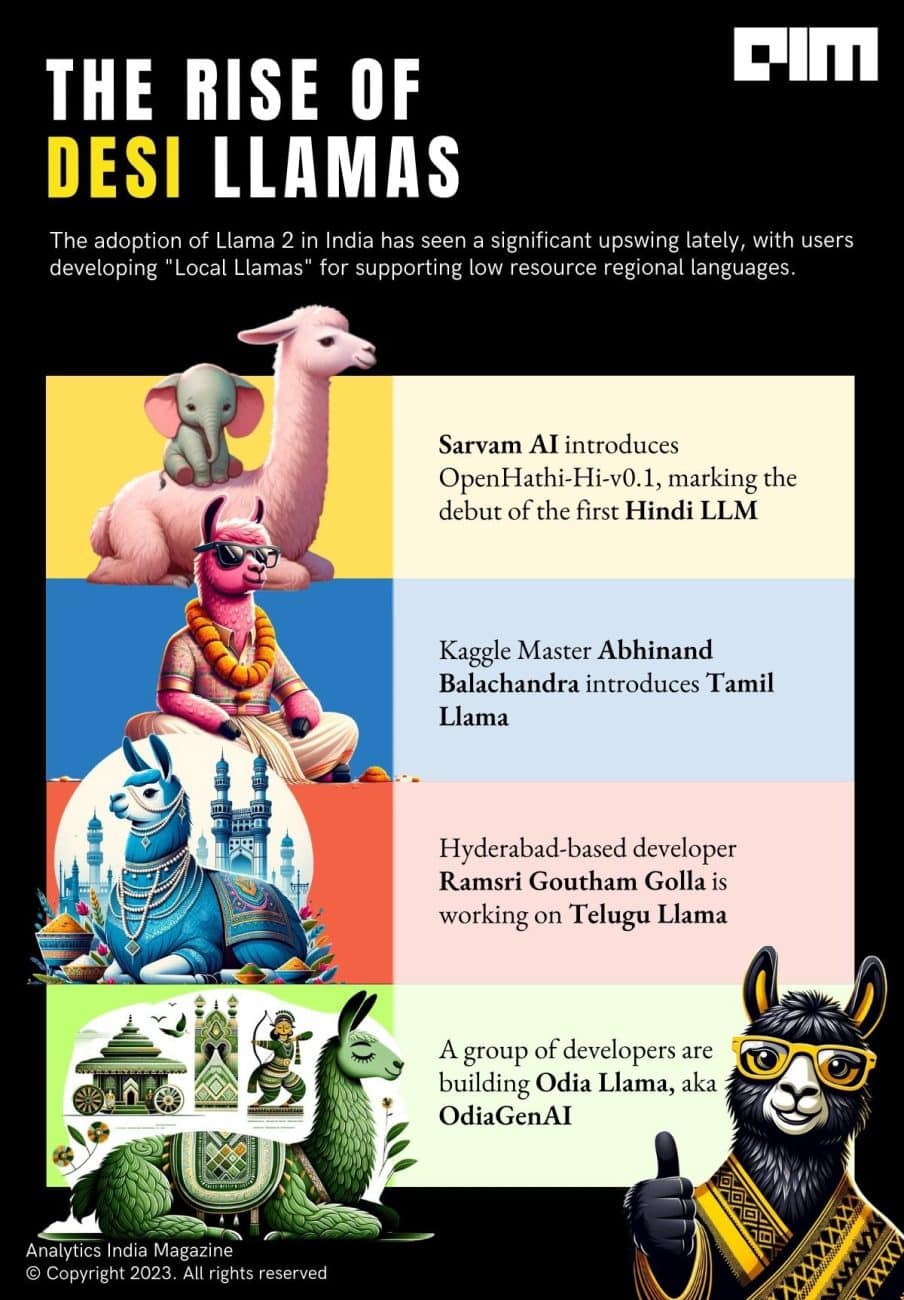
Besides Kannada Llama, several other Llamas based on Indic languages are emerging, including Tamil Llama, Odia Llama, and Telugu Llama.

The post Yann LeCun Loves Kannada Llama appeared first on Analytics India Magazine.

Pixxel Launches Spacecraft Manufacturing Facility in Bengaluru

Pixxel, a leader in hyperspectral earth-imaging technology, inaugurated its Spacecraft Manufacturing Facility in Bengaluru, India, today. The event was attended by S Somanath, Chairman of ISRO, and other industry stakeholders and investors. Pixxel introduced its satellite building facility at the ceremony.

Pixxel’s CEO and Founder, Awais Ahmed, outlined the facility’s capabilities, stating, “We’ll build 6 of our Firefly hyperspectral imaging satellites, here.” Noting that at full capacity, the facility can handle over twenty satellites simultaneously, with a turnaround time of six months.

Ahmed, also highlighted the achievement, stating, “For the first time in India and globally, we’ll have a five-meter commercial hyperspectral satellite.”

Over the past two years, Pixxel has deployed three functional satellites, showcasing its expertise in converting data into actionable insights. The company is expanding its operations in the upstream and downstream market in space, revealing partnerships with global entities such as British Petroleum, the Ministry of Agriculture in India, and the National Reconnaissance Office in the US for its data.

Pixxel plans to launch 6 satellites as part of the Firefly constellation this year, bringing the total to 9 with the inclusion of the 3 already deployed satellites. The company also expressed intentions to launch satellites for the bigger and better Honeybee constellation of hyperspectral satellites.

The newly inaugurated facility, spanning over 30,000 sq ft, consolidates satellite manufacturing services, providing a comprehensive Spacecraft Assembly, Integration, and Testing (AIT) facility. Pixxel aims to streamline the production process, designing, manufacturing, integrating, and testing satellites under one roof before shipping them to launch sites.

CEO Awais Ahmed shared his vision, stating, “The inauguration of the new facility marks a momentous milestone as Pixxel nears its fifth anniversary since inception.” He emphasised the facility’s role in Pixxel’s mission to build a health monitor for the planet, delivering critical data to key industries like agriculture, energy, forestry, and environmental monitoring.

Two modern clean rooms ensure a contamination-free environment during satellite assembly, and the facility includes labs for advanced camera integration, electronics R&D, electrical assembly, a mechanical workshop, a mission control room, and office space for over 200 employees.

Pixxel’s commitment to sustainability is evident in the facility’s features, including a wastewater treatment plant and smart HVAC systems to enhance energy efficiency.

The opening of this facility is a significant moment for Pixxel as it prepares to launch six satellites in 2024 and eighteen more by 2025, advancing its mission to build a health monitor for the planet.

The post Pixxel Launches Spacecraft Manufacturing Facility in Bengaluru appeared first on Analytics India Magazine.