How Semantic Vector Search Transforms Customer Support Interactions

How Semantic Vector Search Transforms Customer Support Interactions
Image by rawpixel.com on Freepik

Did you know that around 99.5% of data collected by enterprises goes untouched? In fact, it never even gets used or analyzed. This shows a huge gap that can only be bridged by an advanced enterprise search platform.

Over the past few years, the search tapestry has changed drastically. It has gone from using full-text and keyword-matching mechanisms to more sophisticated techniques like semantic (understanding the meaning behind words) and visual (searching using pictures) platforms that define today's digital landscape.

This is in response to the ever-growing customer expectations—individuals today don’t just want generalized search results, they want them to be personalized and relevant to a T. This is where Semantic Vector Search comes in.

It seamlessly uses deep metric learning to train a semantic model that helps in organizing queries in a vector space so that similar things are combined and dissimilar things are separated

Explore this blog post to learn about the fundamentals of semantic vector search and much more.

First Things First—What is Semantic Vector Search

Traditional search engines only focus on exact keywords and return results centered around them. On the contrary, an advanced AI system goes above and beyond keyword mapping to comprehend the context and the intent behind the query.

For instance, an agitated customer contacted customer support and complained, “Wow, thank you for sending my luggage to Washington and flying me to Los Angeles at the same time. Brilliant service!” In this scenario, a traditional search engine would fixate on words like ‘Wow’, and ‘Brilliant Service.’ However, a semantic vector search engine delves deeper into the issue—where it understands the underlying sarcasm and customer frustration. It’s like having a support agent who not only hears keywords but grasps their meaning and context, offering more effective assistance.

McKinsey research found that companies that excel at personalization generate 40% more revenue from those activities than average players. Across US industries, shifting to top-quartile performance in personalization would generate over $1 trillion in value.

But, How Does it Work?

How Semantic Vector Search Transforms Customer Support Interactions

Let’s imagine each word as a resident in a sky-rise building. Residents with addresses like 45, 46, and 47 reside in the same block whereas residents of 55, 56, and 57 reside in the next block. The distance and direction between these residents represent the relationships between words where words with similar meanings end up closer to each other.

Now, that you know the basic meaning, let’s get to the brass tacks.

When a user inputs a query, the system translates it into a vector. Thereafter, it scouts for other vectors that are close in meaning. This ensures the system retrieves not only exact matches but also semantically related information.

But What Role Do Semantics Play in Vector Search?

The significance of the semantics lies in the AI system’s ability to understand and grasp the exact meaning behind words by considering synonyms and context among other things.

The result? Accurate, relevant, personalized responses that jumpstart issue resolution and leave customers delighted.

But, to ensure everything flows smoothly, there is a complex mechanism, also a subset of artificial intelligence, that is working under the hood known as—machine learning.

The ML algorithms deeply comprehend the subtle similarities and differences between words. To do so, they view them as pieces of a large puzzle rather than understanding the meaning of a single word.

Artificial Intelligence (AI) algorithms break down the complexities of language. It analyses the context, patterns, and correlation within the data. They demystify the meaning of words by going beyond the superficial interpretation.

For instance, a customer approaches your company with a concern. They want to decorate their kitchen with the vibrant hues of cherry and plum. However, your virtual assistant mistook the reference as a fruit. This dual usage highlights how the same term can have different meanings and contexts.

This is where an advanced AI system can interpret the inherent meaning of terms and their correlation with each other.

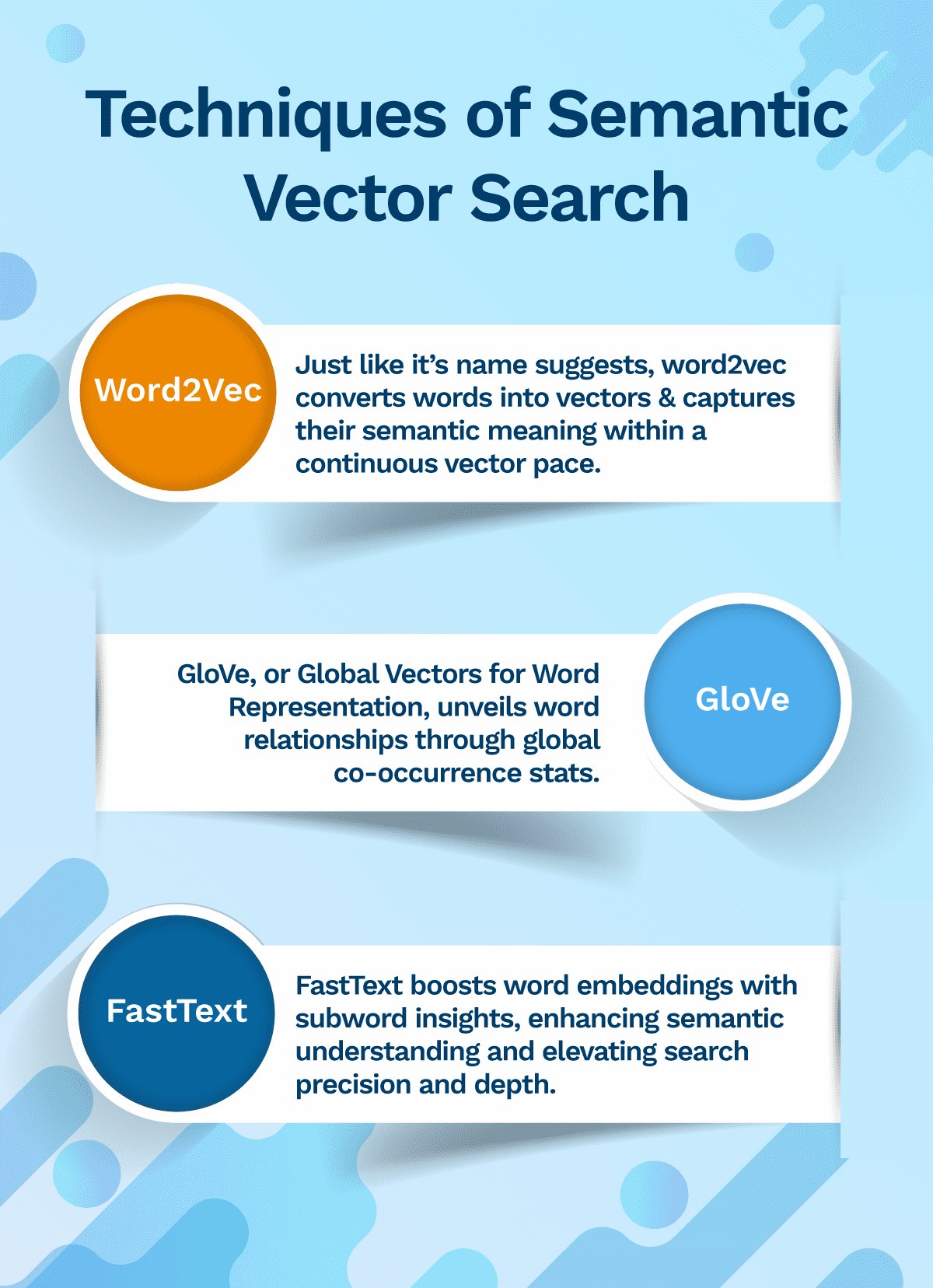
The Types of Semantic Vector Search Techniques

This search applies powerful word embedding techniques to understand the nuances of language:
How Semantic Vector Search Transforms Customer Support Interactions

How Does Vector Search Transform Customer Support Interactions?

Two domains where semantic vector search turbocharges customer support to enhance the experience are:

1. Understanding the Natural Language

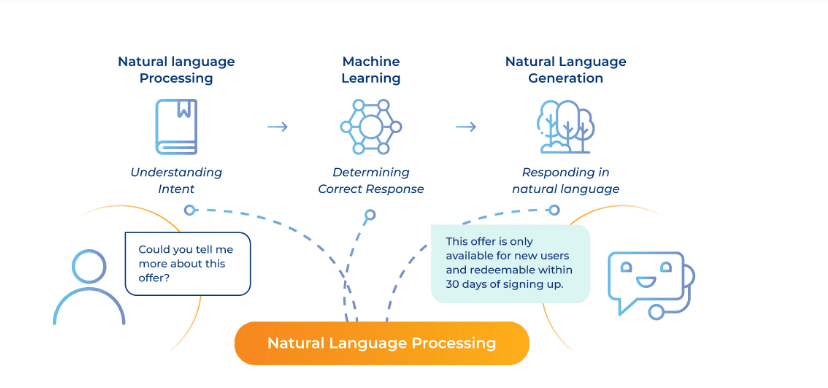
Natural language is ambiguous. It becomes an uphill battle for machines to comprehend the way humans communicate. This is where natural language processing (NLP) can help. It is a multidisciplinary process that combines machine learning and natural language generation to make human and machine interactions possible. Semantic vector search applies NLP to catalyze sentiment analysis.
How Semantic Vector Search Transforms Customer Support Interactions

Sentiment Analysis categorizes data as positive, negative, or neutral. By incorporating sentiment analysis in their existing systems, organizations can glean valuable insights about the needs and problems of their customers. Doing so enables organizations to render proactive and personalized experiences.

2. Facilitating Information Retrieval

Since semantic vector search can grasp the underlying meaning, intent, and context of the query, it ensures the right help articles reach the right audience at the right time. It leverages AI to gain a 360-degree view of your user’s journey, This way, organizations can provide support at full throttle by hyper-personalizing it according to the user’s browsing history, customer sentiments, etc. As an added advantage, the CSAT score also shoots up. Win-win, right?

But, hold on! Where there's brilliance, there are challenges.

Challenges in the Path to Effective Vector Search

Although the future of Semantic Vector Search promises profound benefits, there are hurdles in the path to achieving them. They are:

1. Handling Ambiguity in Semantics

Since natural or human language is ambiguous, words and sentences can have different interpretations for different individuals. For this reason, it becomes incredibly difficult to correctly decipher the context and intent of user queries. Deploying advanced machine learning algorithms can help. They learn from user interactions to improve their accuracy over time.

2. Ethical Considerations

As Semantic Vector Search systems are trained on a massive data set, it’s inevitable for a few ethical considerations concerning privacy, bias, and transparency to sprout. Let’s treat these privacy concerns as stepping stones rather than viewing them as roadblocks. To prevent discriminatory outcomes, it’s imperative to take measures for bias mitigation by regularly auditing and updating the data.

Looking for a Force Multiplier For Turbocharge Your Enterprise Search Engine?

There are a multitude of techniques like neural, vector, and semantic search making rounds in the market. Here neural networks contribute depth, vector search enhances precision, and semantic understanding unveils nuanced layers of meaning.

Using them in isolation would leave their capabilities underutilized. This is where a unified cognitive platform can appear as the silver lining. It seamlessly integrates different search techniques to ensure users can enjoy a personalized, contextual, and prompt search experience.

Taranjeet is a Data Scientist with a keen interest in Behavioral Science, who gradually moved focus into Relevance. Delivered production-ready solutions in problems like LLMs, escalation prediction, Intent detection, Semantic search, and Recommendation systems while leveraging state of art edge-AI and NLP technologies.

More On This Topic

  • Support Vector Machines: An Intuitive Approach
  • A Gentle Introduction to Support Vector Machines
  • Python Vector Databases and Vector Indexes: Architecting LLM Apps
  • Semantic Search: Measuring Meaning From Jaccard to Bert
  • Qdrant: Open-Source Vector Search Engine with Managed Cloud Platform
  • Hyperparameter Tuning Using Grid Search and Random Search in Python

Vicarius lands $30M for its AI-powered vulnerability detection tools

Vicarius lands $30M for its AI-powered vulnerability detection tools Kyle Wiggers 8 hours

If the pitches reaching my inbox are any indication, one of the hot new things in generative AI is “copilots” for cybersecurity. Microsoft has one. Google, too. So does Vicarius, the vulnerability remediation platform — recently, it launched a text-generating AI tool, vuln_GPT, that helps write system breach detection and remediation scripts.

Perhaps it’s Vicarius’ trend following that caught investors’ attention — as well as (I’d wager to guess) the startup’s 5x year-over-year growth. Vicarius co-founder and CEO Michael Assraf tells me that the company’s customer base recently eclipsed 400 brands including PepsiCo, Hewlett Packard Enterprise and Equinix.

Whatever put Vicarius on backers’ radars, the company recently closed a $30 million Series B round led by Bright Pixel Capital with participation from AllegisCyber Capital, AlleyCorp and Strait Capital, Vicarius announced today. The round, at double Vicarius’ previous valuation — a valuation Assraf declined to disclose, unfortunately — brings Vicarius’ total raised to ~$56.7 million, the bulk of which Assraf says is being put toward advancing Vicarius’ product roadmap and doubling the size of its 43-person team.

“Vicarius automates much of the discovery, prioritization and remediation workload plaguing security and IT teams,” Assraf said. “An early adopter of product-led growth, Vicarius’s self-service model changes the cybersecurity solution buyer’s paradigm by letting customers transparently test and find value … before purchasing.”

Vicarius was founded several years ago by Assraf, Yossi Ze’evi and Roi Cohen, who noticed — at least the way Assraf tells it — that attackers were reusing the same “building” blocks to carry out cyberattacks.

“Those building blocks are third-party and operating system APIs provided by software and operating system-compiled libraries,” Assraf said. “The main idea [with Vicarius] was to build an intelligent permission manager for system-level APIs.”

Vicarius

Image Credits: Vicarius

Today, Vicarius analyzes apps for vulnerabilities and alerts customers to these vulnerabilities. When a patch isn’t available, Vicarius applies what Assraf calls “in-memory protection,” which ostensibly secures the app without the need for a software upgrade (color me a bit skeptical, though).

Vicarius also offers access to a community of security vulnerability researchers where researchers can share remediation and detection scripts and get rewarded for it with a virtual currency, as well as a community data set that Vicarius uses to train the aforementioned vuln_GPT. Vuln_GPT, speaking of, doesn’t run completely unsupervised — Assraf says that all AI-generated scripts are “validated” before being pushed to Vicarius’ customers. (Customers can give feedback on the scripts from a module.)

“We wish to emphasize that Vicarius is looking to lead AI-based vulnerability remediation at any stage,” Assraf said, “from detection to prioritization to proactive remediation.”

Vicarius is ambitious, to be sure, with plans to allow security researchers in its community to spend their currency on products, launch educational courses and integrate the Vicarius platform with existing ticketing platforms like ServiceNow and Jira. The startup also aims to grow into new markets, in particular Asia Pacific, while expanding into markets in which it currently does business including North America and Europe.

“For years, enterprises have been struggling with deploying vulnerability management processes that require too many tools and create too many alerts and too much work for overburdened security teams,” Assraf said. “While most security processes advanced one or two generations, the vulnerability remediation cycle management lagged, exposing businesses to cyber risk. As a result, customers are looking for a single platform that consolidates, personalizes and scales the vulnerability remediation process.”

LTIMindtree is Working with 140 Customers in Generative AI 

LTIMindtree, at its FY24 Q3 earnings call today, announced that it is working with close to 140 customers in generative AI, without delving too much into the details.

Similar to its other counterparts, the likes of TCS, Infosys, HCLTech and Wipro, LTIMindtree as well did not reveal details of generative AI investments or revenue details. “Generative AI is not a standalone element but rather integrated into various service lines, making it challenging to pinpoint its direct financial impact.” said the company’s CEO Debashish Chatterjee.

The company added that it added 500 freshers this quarter and plans to hire more.

Meanwhile, Chatterjee said that it is upskilling close to 10,000 of its staff to bolster generative AI advancements. He further highlighted the importance of technology investment for driving revenue growth and enhancing customer engagement.

Read: Accenture’s Gen AI Numbers Signal Shift for Indian IT

Back in June last year, it launched Canvas.ai, a generative AI platform to accelerate concept-to-value realisation for enterprises, all while adhering to ethical AI principles. Back in June, the company said that it plans to spend around $40 to $50 million on AI capabilities and offerings.

The post LTIMindtree is Working with 140 Customers in Generative AI appeared first on Analytics India Magazine.

5 FREE Courses on AI with Microsoft for 2024

5 FREE Courses on AI with Microsoft for 2024
Image by Editor

It’s the new year. You want to achieve your goals. Want to explore something new? Want to shift careers? But it can be daunting.

You don’t know where to start. You don’t know what course is the best for you to achieve your career goals. You’re unsure of which route to go down first. It can be all too overwhelming.

This blog is here to help.

Suppose you’re looking at a career shift, specifically AI-related. You landed on the right page. Microsoft has some really great FREE resources to help you get to where you need them.

Soaking up all the free content you can will be your best first approach, before diving into paying for a course or going back to university. Free resources help you gauge if this is what you really want to do.

AI For Beginners

Link: AI For Beginners

Microsoft offers a 12-week, 24-lesson curriculum to help you learn about the world of Artificial Intelligence.

In 12 weeks you will be provided with an Introduction and History of AI, as well as Symbolic AI, Introduction to Neural Networks, Computer Vision, Natural Language Processing, and other AI techniques.

Using Azure OpenAI Service

Link: Azure OpenAI Service

You’ve probably heard a lot about OpenAI in the year 2023. Time to learn more about it!

With Large Language Models (LLMs) getting more and more popular; some of you may be interested in learning more about them. Prompt engineering and Generative AI is what the tech world is all talking about now, and so can you with this course.

Start off with learning about prompt engineering, and then move on to learning about the fundamentals of responsible Generative AI. Put what you have learnt into practice with prompt engineering with GitHub copilot and Azure OpenAI.

If you want to continue your learning around Azure OpenAI, you can do so and take your Generative AI skills to the next level!

Custom Machine Learning Models

Link: Custom Machine Learning Models

Now you have a good gist of AI and Azure AI Service, you probably want to get hands-on with a level below — machine learning models. This is where you will understand the true beauty behind AI.

Another learning path which will help you discover tools to build and run your model, with your own data. Being able to improve your machine-learning model is a skill in itself.

You will learn how to create computer vision solutions, process and translate text, extract data from forms, automate machine learning model selection, and deploy and consume models.

Build Apps with Azure AI

Link: Build Apps with Azure AI

Want to learn even more about Azure? Let’s dive a little deeper with this learning material that includes articles, YouTube videos and actual module content.

This course will help you learn about the range of tools that you can use to build AI-powered apps using Azure AI services. If Generative AI is up your street, you can develop solutions with Azure OpenAI Services, as well as explore chatbots and other AI models on Microsoft Copilot Studio.

Using AI in Everyday Work

Link: Using AI in Everyday Work

So you will have had the opportunity to learn about AI and its fundamentals, then put it into practice by building a custom machine learning model and an app. You may be thinking, ‘How can AI become part of my everyday life?’.

This course will go through exactly that. Although this content is recommended for developers, it may be the route you want to go down.

Streamline your work with GitHub Copilot by starting off with learning AI with GitHub Copilot, and understanding how the two pair.

Wrapping it up

Just like that, you’re one step closer to achieving your 2024 goals with some great free resources. Let us know what you liked about the content in the comment section!

Nisha Arya is a Data Scientist and Freelance Technical Writer. She is particularly interested in providing Data Science career advice or tutorials and theory based knowledge around Data Science. She also wishes to explore the different ways Artificial Intelligence is/can benefit the longevity of human life. A keen learner, seeking to broaden her tech knowledge and writing skills, whilst helping guide others.

More On This Topic

  • 2024 Data Management Crystal Ball: Top 4 Emerging Trends
  • Top 10 Kaggle Machine Learning Projects to Become Data Scientist in 2024
  • The Top 8 Cloud Container Management Solutions of 2024
  • The 5 Best Vector Databases You Must Try in 2024
  • Free Microsoft Excel for Beginners Course
  • Automate Microsoft Excel and Word Using Python

Foxconn Partners with HCL Group for Semiconductor Operations in India

Foxconn, a key manufacturing partner of Apple, has entered into a joint venture with Indian IT giant HCL Group to establish semiconductor packaging and testing operations in India. This move is part of Foxconn’s strategy to expand its presence in India and reduce reliance on China. In a stock exchange filing, Foxconn’s subsidiary, Foxconn Hon Hai Technology India Mega Development, revealed a $37.2 million investment for a 40% stake in the venture.

This marks Foxconn’s first step into setting up Outsourced Semiconductor Assembly And Test (OSAT) operations in India, as the company commits to investing significantly in the country to strengthen its domestic manufacturing capabilities, serving clients like Apple and Xiaomi.

In a statement, Foxconn expressed its eagerness to collaborate with HCL to establish OSAT operations in India, with a focus on building an ecosystem and enhancing supply chain resilience for the domestic industry. The company plans to utilise its “build-operate-localise” (BOL) model to support local communities.

Foxconn’s investment plans in India have been notable. Last November, the company announced a $1.5 billion investment in the country to meet its operational requirements. Additionally, Foxconn had partnered with local conglomerate Vedanta for a $20 billion semiconductor unit in Gujarat, although it withdrew from the deal in July but expressed ongoing interest in finding optimal partners.

Foxconn also submitted a new application to initiate its semiconductor fabrication unit in India later in the year, as confirmed by Deputy IT Minister Rajeev Chandrashekhar in parliament.

HCL Group, on the other hand, views this collaboration as strategically aligned with the Indian government’s vision of “Make in India” and “Atmanirbhar Bharat” (self-reliant India). The group brings its strong engineering and manufacturing heritage to this opportunity, which complements its existing portfolio.

The post Foxconn Partners with HCL Group for Semiconductor Operations in India appeared first on Analytics India Magazine.

5 FREE Courses on AI with Microsoft for 2024

5 FREE Courses on AI with Microsoft for 2024
Image by Editor

It’s the new year. You want to achieve your goals. Want to explore something new? Want to shift careers? But it can be daunting.

You don’t know where to start. You don’t know what course is the best for you to achieve your career goals. You’re unsure of which route to go down first. It can be all too overwhelming.

This blog is here to help.

Suppose you’re looking at a career shift, specifically AI-related. You landed on the right page. Microsoft has some really great FREE resources to help you get to where you need them.

Soaking up all the free content you can will be your best first approach, before diving into paying for a course or going back to university. Free resources help you gauge if this is what you really want to do.

AI For Beginners

Link: AI For Beginners

Microsoft offers a 12-week, 24-lesson curriculum to help you learn about the world of Artificial Intelligence.

In 12 weeks you will be provided with an Introduction and History of AI, as well as Symbolic AI, Introduction to Neural Networks, Computer Vision, Natural Language Processing, and other AI techniques.

Using Azure OpenAI Service

Link: Azure OpenAI Service

You’ve probably heard a lot about OpenAI in the year 2023. Time to learn more about it!

With Large Language Models (LLMs) getting more and more popular; some of you may be interested in learning more about them. Prompt engineering and Generative AI is what the tech world is all talking about now, and so can you with this course.

Start off with learning about prompt engineering, and then move on to learning about the fundamentals of responsible Generative AI. Put what you have learnt into practice with prompt engineering with GitHub copilot and Azure OpenAI.

If you want to continue your learning around Azure OpenAI, you can do so and take your Generative AI skills to the next level!

Custom Machine Learning Models

Link: Custom Machine Learning Models

Now you have a good gist of AI and Azure AI Service, you probably want to get hands-on with a level below — machine learning models. This is where you will understand the true beauty behind AI.

Another learning path which will help you discover tools to build and run your model, with your own data. Being able to improve your machine-learning model is a skill in itself.

You will learn how to create computer vision solutions, process and translate text, extract data from forms, automate machine learning model selection, and deploy and consume models.

Build Apps with Azure AI

Link: Build Apps with Azure AI

Want to learn even more about Azure? Let’s dive a little deeper with this learning material that includes articles, YouTube videos and actual module content.

This course will help you learn about the range of tools that you can use to build AI-powered apps using Azure AI services. If Generative AI is up your street, you can develop solutions with Azure OpenAI Services, as well as explore chatbots and other AI models on Microsoft Copilot Studio.

Using AI in Everyday Work

Link: Using AI in Everyday Work

So you will have had the opportunity to learn about AI and its fundamentals, then put it into practice by building a custom machine learning model and an app. You may be thinking, ‘How can AI become part of my everyday life?’.

This course will go through exactly that. Although this content is recommended for developers, it may be the route you want to go down.

Streamline your work with GitHub Copilot by starting off with learning AI with GitHub Copilot, and understanding how the two pair.

Wrapping it up

Just like that, you’re one step closer to achieving your 2024 goals with some great free resources. Let us know what you liked about the content in the comment section!

Nisha Arya is a Data Scientist and Freelance Technical Writer. She is particularly interested in providing Data Science career advice or tutorials and theory based knowledge around Data Science. She also wishes to explore the different ways Artificial Intelligence is/can benefit the longevity of human life. A keen learner, seeking to broaden her tech knowledge and writing skills, whilst helping guide others.

More On This Topic

  • 2024 Data Management Crystal Ball: Top 4 Emerging Trends
  • Top 10 Kaggle Machine Learning Projects to Become Data Scientist in 2024
  • The Top 8 Cloud Container Management Solutions of 2024
  • The 5 Best Vector Databases You Must Try in 2024
  • Free Microsoft Excel for Beginners Course
  • Automate Microsoft Excel and Word Using Python

How Salesforce is Creating an Inclusive Workplace

Kolkata-born Mohammed Ali Yasser, never found a safe workspace to embrace his true self, until he joined Salesforce in 2020. He identifies as a gay cisgender man, and currently heads the company’s online learning platform, Trailhead, as a senior editor.

“During my decade-long career, Salesforce stands out as the only company where I could come out with ease. Pursuing a career with a company that actively advocates for LGBTQ+ rights has been a goal and I am genuinely pleased and thankful to have discovered such an inclusive environment here,” Yasser told AIM.

“Everyone Deserves an Inclusive Workspace”

During his time at Salesforce, Yasser has actively participated in the company’s employee resource group, Outforce, which organises events promoting awareness about the LGBTQ+ community and their rights. The group contributes to the visibility and acceptance of queer individuals in the tech industry by fostering a safe space.

The positive feedback from Outforce events indicates their impact on sensitising employees and creating awareness.

According to a recent report on LGBTQ+ inclusivity, 42% have encountered non-inclusive behaviours in the workplace, with a significant number attributing it to their sexual orientation or gender identity.

However, even though Yasser finally found a comfortable space to come out, it is not the same for all. Most queer employees feel that it is important to be open about one’s identity at work, yet it scarcely happens that the company provides an inclusive space for that.

Furthermore, the findings reveal that less than half of the respondents are at ease with the idea of being open about their identity with everyone at work, while approximately one-third state that they only feel comfortable doing so with select colleagues.

So for those struggling with coming out in the tech industry, it is important to find allies.

“It is okay if you’re not comfortable coming out at work. But if you come across an ally or an LGBTQ+ colleague, consider discussing the option of talking to HR or a senior leader for a more inclusive workplace. But in the end, be compassionate towards yourself and remember that you’re not alone,” suggested Yasser.

How is Salesforce Making this Happen?

Salesforce prioritises equality and inclusion at the workplace, aiming to create a diverse environment where all employees, no matter what their sexual orientations and gender identities are, feel supported.

Besides Outforce empowering the LGBTQ+ community, the company has also introduced a gender affirmation reimbursement benefit, providing financial support for medical procedures. This comprehensive suite of benefits includes coverage for surgeries, prescription drugs, hormonal therapy, hair-related procedures, and more.

The support spans six key areas: medical and legal reimbursements, recovery leave, counselling services, Warmline support, and wardrobe reimbursement. Salesforce also offers counselling services to assist transgender and non-binary employees and their loved ones throughout their journey.

AI Can Make it Better

Despite advancements post the decriminalisation of homosexuality in 2018, there’s a call for more inclusive workplace policies. However, now with AI, fostering inclusivity is easier.

“AI is a powerful tool to eliminate human bias, particularly in hiring, promotion, and talent development, making space for a more inclusive approach and data-driven decision-making,” said Yasser.

Moreover, AI extends its influence to diversity and inclusion initiatives within companies. By scrutinising employee feedback and sentiments, it tailors initiatives for sensitisation and inclusion. It is also used to create inclusive communication and educational materials that accurately represent diverse gender identities and sexual orientations.

Yasser emphasised the importance of diverse data in training AI models to accurately reflect and understand the nuances of the employee experience. In essence, the combination of inclusivity efforts and AI holds the potential to reshape the landscape of the tech industry, fostering a more accepting and diverse environment for all.

Read more: The Struggles and Triumphs of Trans Inclusion in Indian Tech

The post How Salesforce is Creating an Inclusive Workplace appeared first on Analytics India Magazine.

Apple Introduces AIM, New Autoregressive Pre-Trained Vision Models


Apple
recently unveiled autoregressive image models (AIM), a collection of vision models pre-trained with an autoregressive objective. These models represent a new frontier for training large-scale vision models which are inspired by their textual counterparts, large language models (LLMs), and exhibit similar scaling properties.

The researchers said that it presents a scalable method for pre-training vision models without supervision. The authors have used a generative autoregressive objective during pre-training and propose technical improvements to adapt it for downstream transfer.

Check out the GitHub repository here.

The researchers said that the performance of the visual features scale with both the model capacity and the quantity of data. Further, they said that the value of the objective function correlates with the performance of the model on downstream tasks.

The team have also illustrated the practical implication of these findings by pre-training a 7 billion parameter AIM on 2 billion images, which achieves 84.0% on ImageNet-1k with a frozen trunk.

Interestingly, even at this scale, they have observed no sign of saturation in performance. The pre-training of AIM is similar to the pre-training of LLMs, and does not require any image-specific strategy to stabilize the training at scale.

About AIM

Apple believes that AIM has desirable properties, including the ability to scale to 7 billion parameters using a vanilla transformer implementation without stability-inducing techniques or extensive hyperparameter adjustments.

Also, AIM’s performance on the pre-training task has a strong correlation with downstream performance, outperforming state-of-the-art methods like MAE and narrowing the gap between generative and joint embedding pre-training approaches. The researchers have also found no signs of saturation as models scaled, suggesting potential for further performance improvements with larger models trained for longer schedules.

The post Apple Introduces AIM, New Autoregressive Pre-Trained Vision Models appeared first on Analytics India Magazine.

Top 7 Hugging Face Spaces to Join

Hugging Face Spaces is an exceptional platform for hosting and deploying machine learning (ML) models and applications. With its user-friendly interface and accessibility, it offers a seamless experience for sharing ML projects globally, facilitating real-time collaboration, and showcasing one’s work in an impressive portfolio for potential employers or clients.

With the arrival of GenAI, many cool models and apps have been rising on Hugging Face, allowing researchers and developers to create space and models. Leveraging Gradio, Streamlit, Docker, or static HTML, users can effortlessly create interactive web interfaces or self-contained applications for their ML models.

Integrating the Hugging Face hub enhances the experience by allowing easy utilisation of existing models and datasets.

The platform’s scalability accommodates projects of varying sizes, ensuring deployment flexibility. Since Hugging Face Spaces is cost-free for most use cases and prioritises security, it provides a secure environment for hosting ML applications.

Draw to Search Art by Merve

This captivating and innovative space on Hugging Face transforms simple sketches into stunning works of art through the power of AI. It offers users the delightful experience of seeing their sketches come to life. The AI model analyses key elements and matches them with a vast database of high-quality images from WikiArt.

Beyond being a mere image search engine, Draw to Search Art is an open-source platform for exploration and inspiration. Users can gain new perspectives on their artistic vision, learn from professional artists, and fuel their creativity by discovering visually similar artworks.

Check out the space here.

PhotoMaker by TencentARC

This particular space helps with photo editing by offering an AI-powered platform that effortlessly transforms ordinary photos into captivating works of art. With an extensive array of pre-trained artistic styles ranging from classic Van Gogh to futuristic and anime aesthetics, users can easily add a touch of creativity to their images.

Its user-friendly interface sets PhotoMaker Style apart, allowing casual photo enthusiasts and aspiring artists to fine-tune effects, adjust details, and explore personalised visions without complex editing skills. The platform’s high-quality results, courtesy of a vast dataset of high-resolution images, ensure clarity and detail retention in artistic transformations.

Beyond its core features, PhotoMaker Style encourages creative exploration by connecting users within the Hugging Face Spaces platform, fostering a community where individuals can share creations and discover new artistic styles.

Check out the space here.

Open LLM Leaderboard by HuggingFaceH4

This space is an engaging and accessible front-row experience of the landscape of large language models (LLMs). Unlike traditional research papers, this space offers a dynamic platform with comprehensive tracking of state-of-the-art LLMs, presenting their performance on various tasks through interactive visualisations.

Beyond being a mere data repository, the leaderboard is a valuable resource for learning about AI, gaining inspiration, and participating in discussions on ethics and the future of these powerful models.

Whether you’re an AI expert, a curious learner, or simply intrigued by artificial intelligence, the Open LLM Leaderboard is a must-visit space, providing a window into the cutting edge of AI development and showcasing the thrilling race towards more advanced language models.

Check out the space here.

Segment Anything Web by Xenova

This is a solution for effortlessly extracting valuable data from websites, eliminating the struggles associated with traditional web scraping. This user-friendly space allows you to extract text, images, and more with a simple point-and-click interface, eliminating the need for coding expertise.

Its precise targeting features enable users to define specific areas of interest easily, and with multiple output formats, the extracted data can be tailored to individual preferences. The tool saves time and effort by automating repetitive tasks, and it enhances productivity by facilitating quick and efficient data extraction from multiple websites.

Whether you’re a researcher, journalist, data analyst, or need efficient information gathering, Segment Anything Web opens up a world of possibilities, making web data extraction a seamless and transformative experience.

Check out the space here.

ReplaceAnything by Model Scope

Hosted on the Hugging Face Space, it acts as a transformative AI-powered tool for refining your writing with precision. Bid farewell to typos, grammatical mishaps, and word choice struggles as ReplaceAnything employs cutting-edge AI to identify and correct errors in your text seamlessly.

Its user-friendly process allows you to paste your writing, review AI-generated suggestions, and customise corrections according to your preferences. Beyond basic corrections, ReplaceAnything demonstrates contextual awareness, offers style suggestions, and allows users to define personalised rules.

Serving as more than just a grammar checker, it acts as a comprehensive writing assistant, enhancing productivity, refining skills, and instilling confidence in your written work.

Check out the space here.

TinyLlama

This Hugging Face Space, developed by VatsaDev, introduces an open-source small language model based on the T5 architecture. With a compact size of 137MB, TinyLlama boasts versatility, proving adept at tasks such as text generation, translation, question answering, summarization, and code generation.

Its speed in generating text or answering queries in milliseconds and high accuracy make it a standout choice for applications on devices with limited resources.

TinyLlama’s availability on Hugging Face extends to various spaces, showcasing its creative potential. Noteworthy examples include the TinyLlama Chat Space for interactive conversations with a TinyLlama-powered bot and the LlamaReviews Space, where amusing product reviews are generated using TinyLlama.

Check out the space here.

Pheme by PolyAI

This leading company, specialising in conversational AI for customer service, has established a notable presence on Hugging Face, a platform for open-source AI models and tools. With a verified profile and listed team members, PolyAI focuses on contributing to the open-source AI community by sharing Text-to-Speech (TTS) models and datasets.

Notably, their Pheme Space offers a TTS model trained on high-quality audio for realistic and expressive voices, currently running on Hugging Face infrastructure. The availability of three TTS models, including PolyAI/BigVGAN-L, and datasets such as PolyAI/minds14, PolyAI/evi, and PolyAI/banking77, underscores PolyAI’s commitment to enhancing dialogue systems.

This integration of commercial expertise with open-source contributions makes PolyAI a valuable addition to the Hugging Face platform, offering insights into realistic voice generation for customer service applications and linking industry advancements and the broader AI community.

Check out the space here.

The post Top 7 Hugging Face Spaces to Join appeared first on Analytics India Magazine.

OpenAI is as Good as its Next Model 

In the latest episode of Unconfuse Me with Bill Gates, OpenAI chief Sam Altman pointed out that OpenAI is on ‘this long, continuous curve’ to create newer and better models. He highlighted the importance of multimodality as the key aspect of GPT-5 that enables it to process video input and generate new videos.

Altman believes that soon, AI will be able to handle more complex tasks, leading to a boost in productivity. “You can imagine a little agent that says, ‘Go, write this whole program for me’. It may ask you a few questions along the way, but it won’t just be writing a few functions at a time – it’ll enable a bunch of new stuff,” Altman said, suggesting that it will handle even more complex tasks.

“Someday, maybe there’s an AI to which you can say, ‘Start and run this company for me’. And then someday, there may be an AI to which you can say, ‘Go discover new Physics [laws] for me’,” he quipped.

As of now, several foundational models have achieved the capabilities of GPT-4. Google is likely to launch Gemini Ultra at any moment. Meanwhile, Mistral CEO Arthur Mensch announced on French national radio that the company will unveil an open-source GPT-4-level model in 2024.

“Will Gemini Ultra launch before GPT-5 or vice-versa? My bet is on Gemini Ultra… and I suspect it beats GPT-4 on reasoning,” read Abacus AI chief Bindu Reddy’s post on X.

Notably, Mistral Medium has gathered 6000+ votes and is showing remarkable performance, reaching the level of Claude. “Mixtral will take over GPT-4 this year. Today, it’s the only open-source model at the top in Chatbot Arena (following GPT-4, Claude, and Mistral Medium) and the smallest one with 7B instructions. It’s even better than Google’s Gemini Pro,” exclaimed AI expert Santiago.

Facts and claims like these keep OpenAI on its toes.

What Next – GPT-5?

In conversation with Gates, Altman spoke at length about GPT-5, emphasising on customisation and personalisation. “The ability to know about you, your email, your calendar, how you like appointments booked, connected to other outside data sources—all of that. Those will be some of the most important areas of improvement,” said Altman.

Furthermore, he claimed that GPT-5 would have much better reasoning capabilities than GPT-4. “GPT-4 can reason in only extremely limited ways. Also, reliability is a concern. If you ask GPT-4 most questions 10,000 times, one of those 10,000 is probably pretty good, but it doesn’t always know which one. You’d like to get the best response of 10,000 each time,” said Altman.

Along with new models, OpenAI might soon start focusing on specific verticals to serve its customers. “Coding is probably the only area for which we’re most excited about productivity gain today. It’s deployed massively and used at scale at this point. Healthcare and education are also coming up that curve, and we’re very excited about them too,” said Altman.

Meanwhile, OpenAI recently introduced the GPT Store. This could potentially aid OpenAI in developing GPT-5, as they will receive labelled data at scale from customers creating GPTs using their personal data. Interestingly, there is no mention in the blog that OpenAI won’t use GPT Store data to train its models.

OpenAI is All About Action

The OpenAI team is quite active on X, asking for customer feedback to improve its models. Recently, OpenAI president Greg Brockman posed a question on X, “How has ChatGPT changed your life?” A user named Aaron Stormerr shared the profound impact ChatGPT has had on his academic journey as a blind computer science student.

Similarly, OpenAI developer relations head Logan Kilpatrick asked, “Who is building the most useful/coolest products with OpenAI API? I want to spend more time in 2024 hearing from builders about what we can do to support them/you.”

Clearly, the OpenAI mantra is all about releasing a subpar product or a feature, and improving them on the sideline with continuous consumer feedback, plus shipping them as quickly as possible. So, the company is as good as its next model – obviously, drawing inspiration from Walt Disney who used to say to his team: “We’re only as good as our next picture.”

The post OpenAI is as Good as its Next Model appeared first on Analytics India Magazine.