Adobe Makes Audio Editing Seamless with Premiere Pro Beta Release

Tech giant Adobe recently announced the launch of a new AI-powered audio category in Premiere Pro beta. The new feature will automatically identify and label clips with icons for dialogue, music, sound effects or ambient noise, giving editors access to the most relevant tools for each type of audio.

Adobe’s new Premiere Pro audio features aim to streamline editing workflows for pros and newcomers alike.

As per the press release, the modifications encompass revised waveforms, customizable fade handles, annotation instruments, and effect emblems.

With the new tools, Premiere Pro users with varying levels of experience will be able to edit high-quality audio more quickly and effectively. This is a significant improvement to the well-known video editing program, intended to help pros save time while also improving accessibility for beginners.

The interactive fades handles are one of the most noteworthy additions to the feature set. By dragging clip handles to generate fades in and out, editors may now quickly build unique audio transitions. Applying fades used to be a more tedious procedure.

The effect badges offer the same kind of simplification. Editors are able to see which clips have effects applied with the new visual markers on the timeline. The badges also provide quick access to effect parameters, removing the need to search around the interface.

In addition, the updated waveforms have brighter, easier-to-read colors and intelligently adjust their size in response to variations in track height. This enhanced visualization facilitates the identification of audio problems and facilitates the quick parsing of sequences.

Beyond the beta features, Adobe also disclosed that all Premiere Pro users will have access to the AI-powered Enhance Speech tool starting in February. With only one click, Enhance Speech can automatically eliminate undesirable background noise and enhance poorly recorded dialogue.

“Sound creates meaning, and adds impact to film and video – it has the power to help tell a story, and move us in ways visuals alone cannot ,” stated Ashley Still, senior vice president and general manager of Adobe Creative Cloud. “Premiere Pro makes it faster and easier to find the right tool for filmmakers, regardless of experience level, by empowering them with new workflows that make audio editing more intuitive.”

The post Adobe Makes Audio Editing Seamless with Premiere Pro Beta Release appeared first on Analytics India Magazine.

6 Reasons Why a Universal Semantic Layer is Beneficial to Your Data Stack

Promotional Content

6 Reasons Why a Universal Semantic Layer is Beneficial to Your Data Stack

On a daily basis data teams and product managers wrangle the modern data stack in an effort to seamlessly integrate diverse data sources and tools into a cohesive, versatile, and future-proof architecture that end users can easily use.. This is where the semantic layer steps in – an essential middleware that acts as a bridge between data sources and analytical tools, addressing the complexities of the modern data landscape.

What is a Semantic Layer?

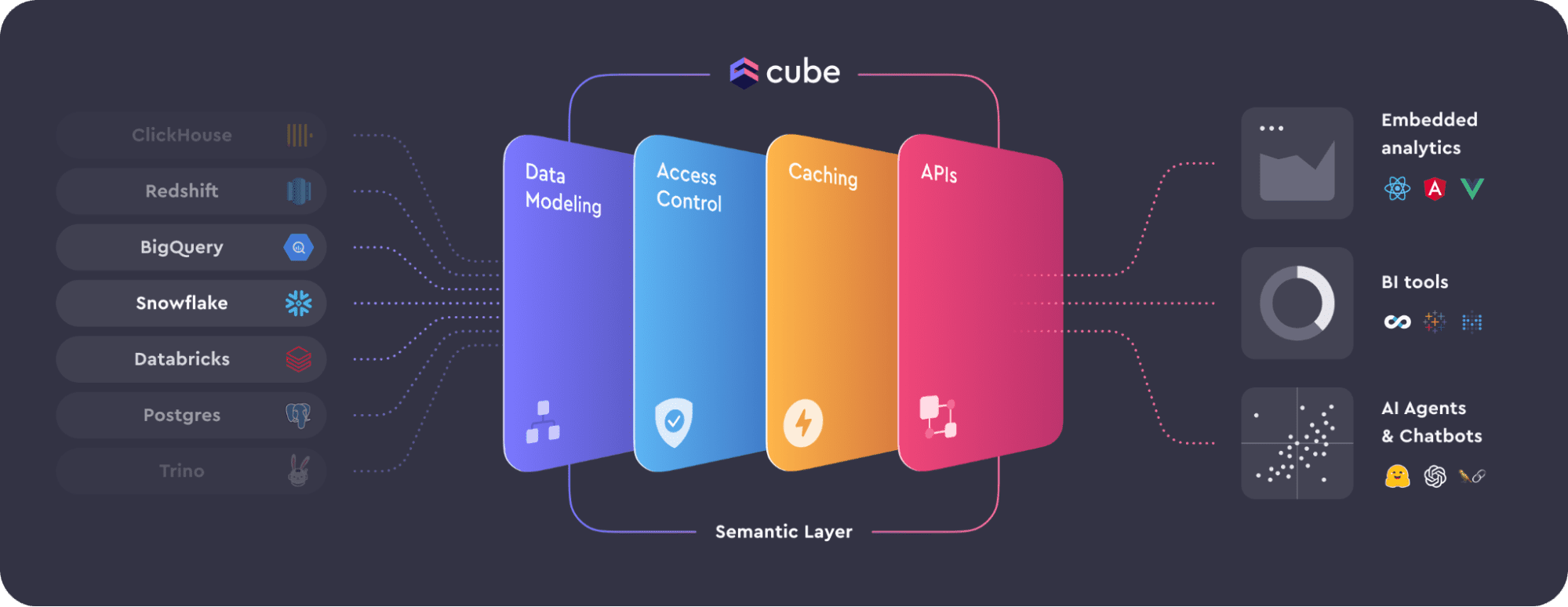
A semantic layer acts as a contextual filter, abstracting raw data and presenting it meaningfully to end-users. It contains pre-defined business rules, data definitions, and metadata, standardizing the vocabulary across reporting tools and sources. Cube emphasizes the importance of a "complete, universal semantic layer," featuring four crucial layers:

The Four Layers of a Semantic Layer

  1. Data Modeling: Organizes data with meaningful context, ensuring consistent insights and metrics across applications in one location, not every standalone piece of technology.
  2. Data Access Control: Orchestrates consistent security context upstream, controlling data access for authorized users in one location.
  3. Caching: Acts as a buffer, optimizing performance by storing data and avoiding redundant queries, reducing the cost of queries while speeding up performance.
  4. APIs: Ensures compatibility between diverse data sources and downstream applications.

Why Your Data Stack Needs a Semantic Layer

  1. Data Consistency Ensures a standardized approach to handling data, promoting seamless integration and efficient analysis.
  2. Data Security: Centralized control of access reduces the risk of breaches and ensures compliance with data privacy regulations.
  3. Data Performance: Caching layer optimizes response times, crucial for real-time processing and AI applications.
  4. Stack Flexibility: Enables the selection of tools without sacrificing innovation, thanks to the abstraction of data logic.
  5. Time-to-Market: Dramatically reduces time spent by developers when creating or maintaining data apps and data models.
  6. Future Proofing: Adapts to changing business requirements and new data sources, ensuring long-term agility and intelligence.

Use Cases of a Semantic Layer

  1. Embedded Analytics: Speeds up the development of apps from months to days. Resolves cross-stack incompatibility, enabling custom data experiences and boosting application performance.
  2. Semantic Layer for BI: Streamlines data orchestration, saving time for data engineers and ensuring consistent insights and metrics across BI tools.
  3. AI & LLM-based Applications: Facilitates easy integration of proprietary data with AI, simplifying complex joins and enhancing query response times.

In summary, semantic layers provide the context and structure needed to understand data. A stand-alone semantic layer can improve developer workflow, reduce data warehouse cost, improve speed time to market for data app development and make your entire company better able to gather insights from data.

Cube is highlighted in the GigaOm Sonar Report as a Leader and Fast Mover. They noted Cube's strengths to include strong code-first orientation, native API support, and its analytics pre-processing through caching and pre-aggregations.

More On This Topic

  • The Power of a Semantic Layer: A Data Engineer's Guide
  • Semantic Layer: The Backbone of AI-powered Data Experiences
  • How is Machine Learning Beneficial in Mobile App Development?
  • 3 Reasons Why Data Scientists Should Use LightGBM
  • Top 5 Reasons Why You Should Avoid a Data Science Career
  • 5 Reasons Why You Need Synthetic Data

PowerInfer: Fast Large Language Model Serving with a Consumer-grade GPU

Due to their exceptional content creation capabilities, Generative Large Language Models are now at the forefront of the AI revolution, with ongoing efforts to enhance their generative abilities. However, despite rapid advancements, these models require substantial computational power and resources. This is largely because they consist of hundreds of billions of parameters. Moreover, to operate smoothly, generative AI models rely on thousands of GPUs, leading to significant operational costs. The high operational demands are a key reason why generative AI models are not yet effectively deployed on personal-grade devices.

In this article, we will discuss PowerInfer, a high-speed LLM inference engine designed for standard computers powered by a single consumer-grade GPU. The PowerInfer framework seeks to utilize the high locality inherent in LLM inference, characterized by a power-law distribution in neuron activations. This means that at any given time, a small subset of ‘hot' neurons are consistently active across inputs, while the rest, termed ‘cold' neurons, activate based on specific inputs or requirements. This approach enables the PowerInfer framework to reduce the computing power needed for generative AI to produce desired outputs.

We will delve into the PowerInfer framework in detail, exploring its methodology, pipeline, and practical application results. Let's begin.

PowerInfer: Fast Large Language Model with Consumer-Grade GPU

Generative Large Language Models, such as ChatGPT and DALL-E, are known for sophisticated generative and natural language processing tasks. Due to their high computational requirements, these models are typically deployed in data centers with advanced GPUs. The need for such high computational power limits their deployment to data centers, highlighting the necessity to deploy large language models on more accessible local platforms like personal computers.

Increasing the accessibility of large language models could reduce inference and content generation costs, enhance data privacy, and allow for model customization. Furthermore, while data center deployments prioritize high throughput, local LLM deployments could focus on low latency due to smaller batch sizes.

However, deploying these models on local devices poses significant challenges due to their substantial memory requirements. Large language models, functioning as autoregressive transformers, generate text token-by-token, with each token requiring access to the entire model, comprising hundreds of billions of parameters. This necessitates numerous high-end GPUs for low-latency output generation. Additionally, local deployments typically process individual requests sequentially, limiting the potential for parallel processing.

To address the complex memory requirements of the generative AI framework, existing solutions employ methods like model offloading and compression. Techniques like distillation, pruning, and quantization reduce the model size but are still too large for standard-grade GPUs in personal computers. Model offloading, which partitions the model at the Transformer Layer between CPUs and GPUs, allows for distributed layer processing across CPU and GPU memories. However, this method is limited by the slow PCIe interconnection and the CPUs' limited computational capabilities, leading to high inference latency.

The PowerInference framework posits that the mismatch between LLM inference characteristics and hardware structure is the primary cause of memory issues in LLM inference. Ideally, data accessed frequently should be stored in high-bandwidth, limited-capacity GPUs, while less frequently accessed data should be in low-bandwidth, high-capacity CPUs. However, the large parameter volume of each LLM inference iteration makes the working set too large for a single GPU, resulting in inefficient exploitation of locality.

The inference process in large language models demonstrates high locality, with each iteration activating a limited number of neurons. The PowerInference framework aims to exploit this locality by managing a small number of hot neurons with the GPU, while the CPU handles the cold neurons. It preselects and preloads hot neurons in the GPU and identifies activated neurons during runtime. This approach minimizes costly PCIe data transfers, allowing GPUs and CPUs to independently process their assigned neurons.

However, deploying LLMs on local devices faces obstacles. Online predictors, crucial for identifying active neurons, consume considerable GPU memory. The PowerInfer framework uses an adaptive method to construct small predictors for layers with higher activation skewness and sparsity, maintaining accuracy while reducing size. Additionally, LLM frameworks require specialized sparse operators. The PowerInfer framework employs neuron-aware sparse operators that directly communicate with neurons, eliminating the need for specific sparse format conversions.

Lastly, optimally placing activated neurons between the CPU and GPU is challenging. The PowerInfer framework uses an offline stage to create a neuron placement policy, measuring each neuron's impact on LLM inference outcomes and framing it as an integer linear problem.

Architecture and Methodology

The following figure elaborates the architecture of the PowerInfer framework consisting of offline and online components in the pipeline.

Thanks to the variation observed in the locality properties amongst different large language models, the offline component profiles the activation sparsity of the LLM framework allowing it to differentiate between hot and cold neurons. On the other hand, in the offline phase, two types of neurons are loaded by the inference engine into both CPU and GPU, thus serving LLM requests during runtime with low latency.

Offline Phase : Policy Solver and LLM Profiler

In the offline phase, a LLM profiler component uses requests derived from general dataset to collect activation data from the inference process. In the first step, it monitors the activation of neurons across all the layers in the framework, and proceeds to use a policy solver component to categorize the neurons as either hot or cold. The primary aim of the policy solver is to allocate neurons activated more frequently to the GPU layers while allocating the remainder to the CPU layers. In the second stage, the policy solver component uses neuron impact metrics and hardware specifications to balance the workload between the layers, and maximizes the impact metric of GPU for neurons by utilizing integer linear programming.

Online Phase : Neuron Aware LLM Inference Engine

Once the offline stage is executed successfully, the framework proceeds to execute the online phase. In the third step of the process, the online engine assigns hot and cold neurons to their respective processing units before processing the user requests, depending as per the output of the offline policy solver. During runtime, and in step 4, the online engine manages GPU-CPU computations by creating CPU and GPU executors that are threads running on the CPU side. The engine then predicts the activated neurons and proceeds to skip the non-activated neurons. The activated neurons are then preloaded into the GPU for processing. In the meanwhile, the CPU calculates and transfers the results for its neurons to be integrated with the GPU. The online engine is able to focus on individual neurons rows and columns within matrices because it uses sparse neuron aware operators on CPUs as well as on GPUs.

Adaptive Sparsity Predictors

The primary concept behind reducing computational loads by online inference engine in the PowerInfer framework is that it only processes neurons that it predicts to be activated. Traditionally, within each Transformer layer, a framework utilizes two different predictors to predict the activation of neurons in the MLP and self-attention blocks, as a result of which the inference computation is limited to the neurons predicted to be active. However, it is difficult to design effective predictors for local deployment because the limited amount of resources make it difficult to balance the model size and the prediction accuracy. Since these predictors are deployed by the framework frequently to predict active neurons, they need to be stored in the GPU to enable faster access. However, frameworks generally deploy a large number of predictors that occupy considerable memory, even the one needed to store LLM parameters.

Furthermore, the size of predictors is generally determined by two factors: Internal Skewness and Sparsity of LLM layers.

To optimize for these factors, the PowerInfer framework makes use of an iterative training method for each predictor in the Transformer layer without a fixed-size. In the first step of this training method, the size of the baseline model is established on the basis of the sparsity profile of the model, and the size of the model is adjusted iteratively by taking internal activation skewness into account to maintain accuracy.

Neuron Placement and Management

As mentioned earlier, while the offline policy solver component is determining the neuron placement policy, the online inference engine component loads the model into the GPU and CPU memory as per the generated policy. For each layer that may or may not have multiple weight matrices, the PowerInfer framework assigns each neuron either to the CPU or the GPU on the basis of whether the neuron is hot-activated. Ensuring accurate computation of segmented neurons in the determined sequence is essential for precise results. To tackle this, the PowerInfer framework generates two neuron tables: one located in the GPU, and one located in the CPU memory, with each table correlating individual neurons to its original position in the matrix.

Neuron Aware Operator

Given the activation sparsity observed in large language models, the inactive neurons and their weights can be bypassed by matrix multiplication operations, thus creating a need for the use of sparse operators. Instead of employing sparse operators that have several limitations, the PowerInfer framework employs neuron-aware operators that compute activated neurons and their weights directly on the GPU and CPU without requiring conversion to dense format during runtime. The neuron aware operators differ from traditional sparse operators as they focus on individual row and column vectors within a single matrix rather than focussing on the entire matrix.

Neuron Placement Policy

To exploit the computational capabilities of CPUs and GPUs, the offline component in the PowerInfer framework generates a placement policy that guides the framework when allocating neurons to either the CPU or the GPU layers. The policy solver generates this policy, and controls neuron placement within each layer, which helps in determining the computational workload for individual processing units. When generating the placement policy, the policy solver component considers different factors including the activation frequency for each neuron, the communication overhead, and the computational capabilities like bandwidths and memory size of each processing unit.

Results and Implementation

To demonstrate the generalization capabilities of the PowerInfer framework across devices with different hardware configurations, the experiments are conducted on two distinct personal computers: one equipped with Intel i9-13900K processor, NVIDIA RTX 4090 GPU and 192 GB host memory while the other operates on Intel i7-12700K processor, NVIDIA RTX 2080Ti GPU and 64 GB of host memory.

The end to end performance of the PowerInfer framework is compared against llama.cpp with a batch size of 1, and default deployment settings. The framework then samples prompts from ChatGPT and Alpaca datasets given the length variability observed in real-world dialogue input and output. The following figure demonstrates the generation speeds for different models.

As it can be observed, the PowerInfer framework generates 8.32 tokens per second, and reaches up to 16 tokens generated per second , thus outperforming the llama.cpp framework by a significant margin. Furthermore, as the number of output tokens increase, the performance of the PowerInfer framework also improves as the generation phase impacts the overall inference time significantly.

Furthermore, as it can be observed in the above image, the PowerInfer framework outperforms the llama.cpp framework on low-end PCs with a peak generation rate of 7 tokens per second, and an average token generation speed of 5 tokens per second.

The above image demonstrates the distribution of neuron loads between the GPU and CPU for the two frameworks. As it can be seen, the PowerInfer framework increases the GPU’s share of neuron load significantly, from 20 to 70 %.

The above image compares the performance of the two frameworks on two PCs with different specifications. As it can be seen, the PowerInfer framework consistently delivers a high output token generation speed when compared against the llama.cpp framework.

Final Thoughts

In this article, we have talked about PowerInfer, a high-speed LLM inference engine for a standard computer powered by a single consumer-grade GP. At its core, the PowerInfer framework attempts to exploit the high locality inherent inference in LLMs, a method characterized by neuron activation’s power-law distribution. The PowerInfer framework is a fast interference system designed for large language models that utilizes adaptive predictors and neuron-aware operators to activate the neurons and the computational sparsity.


Stability AI Unveils Stable Code 3B, Enhances New Coding Capabilities 

Stability AI has introduced Stable Code 3B, a pre-trained 2.7 billion parameter decoder-only language model on a staggering 1.3 trillion tokens, encompassing a rich tapestry of textual and code datasets.

One of the standout features of Stable Code 3B is its Fill in the Middle (FIM) capability. Unlike traditional code completion models that suggest single lines, Stable Code 3B can now seamlessly complete larger missing sections of code. This breakthrough opens up new possibilities for developers, allowing them to bridge gaps in their codebase and enhance productivity effortlessly.

Check out code and datasets here.

Drawing inspiration from the 2023 StackOverflow Developer Survey, the model has been trained in 18 programming languages, including popular choices like Python, Java, JavaScript, and C++. This breadth of language coverage positions Stable Code 3B as a versatile solution catering to the needs of a vast developer community.

Stability AI releases Stable Code 3B on Hugging Face
model: https://t.co/N6PWR7EJUk
stable-code-3b is a 2.7B billion parameter decoder-only language model pre-trained on 1.3 trillion tokens of diverse textual and code datasets pic.twitter.com/3Uv5ajj07R

— AK (@_akhaliq) January 17, 2024

With a colossal dataset comprising 1.3 trillion tokens sourced from GitHub repositories, books, and websites, Stable Code 3B underwent a rigorous training regimen. Masked language modelling, a technique where the model predicts missing words within code snippets, played a crucial role in shaping the decoder-only language model.

More about the model

The model showcases its performance, especially compared to similar models. For instance, it distinguishes itself among coding language models through its performance, achieving comparable accuracy to larger models like CodeLLaMA on MultiPL-E metrics across various programming languages.

Stable Code 3B incorporates RoPE (Recurrent Processing Elements), expanding its context size to 100,000 tokens. This enhancement ensures a deeper understanding of lengthy code sequences, enabling the model to grasp intricate relationships within extensive codebases. The result is a code completion tool that doesn’t just understand lines of code but comprehensively interprets the nuances of entire programs.

Despite its smaller size, Stable Code 3B leverages the foundation of Stable LM 3B, inheriting a wealth of general language understanding. Additionally, it excels at code translation, seamlessly bridging gaps between different programming languages. The model’s prowess extends to answering code-related questions, providing valuable insights into functionality and bug-fixing.

Validation comes from MultiPL-E metrics, and the model has proven its mettle across various programming languages, as tested using BigCode’s Evaluation Harness. Its applications include code generation, which can craft anything from functions to entire programs.

The model’s open-source availability on platforms like Hugging Face promotes transparency and community collaboration, fostering ongoing improvements and innovations. Subscribers gain access to a suite of AI tools, including SDXL, StableLM Zephyr, Stable Audio, and Stable Video. Its notable efficiency allows it to run effectively on standard laptops without GPUs, enhancing accessibility for a broader user base.

The post Stability AI Unveils Stable Code 3B, Enhances New Coding Capabilities appeared first on Analytics India Magazine.

KDnuggets News, January 17: 4 Steps to Become a Generative AI Developer • Pandas vs. Polars: A Comparative Analysis

Visit KDnuggets for more Data Science, Machine Learning, AI & Analytics • Weekly Digest

January 17, 2024
Machine Learning Mastery has announced a significant addition to their catalog. Known for their detailed, code-centric guides, they're taking a leap further into the realms of Computer Vision with their latest offering.
Features 4 Steps to Become a Generative AI Developer
Richie Cotton
Pandas vs. Polars: A Comparative Analysis of Python's Dataframe Libraries
Josep Ferrer
This Week's Posts Kickstart Your NLP Journey with These 5 Free Courses
Nisha Arya
Read This Before You Take Any Free Data Science Course
Abid Ali Awan
Are We Undervaluing Simple Models?
Cornellius Yudha Wijaya
Running Mixtral 8x7b On Google Colab For Free
Abid Ali Awan
Breaking Down Quantum Computing: Implications for Data Science and AI
Nahla Davies
SQL Group By and Partition By Scenarios: When and How to Combine Data in Data Science
Hanu Codes
Read This Before Making a Career Switch to Data Science
Nate Rosidi
Turn Your Laptop Into a Personal Analytics Engine with DuckDB and MotherDuck
Cornellius Yudha Wijaya
The Top 8 Cloud Container Management Solutions of 2024
Nahla Davies

More On This Topic

  • Pandas vs. Polars: A Comparative Analysis of Python's Dataframe Libraries
  • 4 Steps to Become a Generative AI Developer
  • OLAP vs. OLTP: A Comparative Analysis of Data Processing Systems
  • KDnuggets News March 16, 2022: Learn Data Science Fundamentals & 5…
  • A Comparative Overview of the Top 10 Open Source Data Science Tools in 2023
  • KDnuggets News, June 29: 20 Basic Linux Commands for Data Science…

Get the FREE ebook 'The Great Big Natural Language Processing Primer' and 'The Complete Collection of Data Science Cheat Sheets' along with the leading newsletter on Data Science, Machine Learning, AI & Analytics straight to your inbox.

By subscribing you accept KDnuggets Privacy Policy

Leave this field empty if you're human:
<= Previous post Next post =>
Search

Latest Posts

  • How Semantic Vector Search Transforms Customer Support Interactions
  • 5 FREE Courses on AI with Microsoft for 2024
  • KDnuggets News, January 17: 4 Steps to Become a Generative AI Developer • Pandas vs. Polars: A Com…
  • Discover the World of Computer Vision: Introducing MLM’s Latest OpenCV Ebook
  • The Top 8 Cloud Container Management Solutions of 2024
  • Turn Your Laptop Into a Personal Analytics Engine with DuckDB and MotherDuck

Top Posts

  • Read This Before Making a Career Switch to Data Science
  • Turn Your Laptop Into a Personal Analytics Engine with DuckDB and MotherDuck
  • Pandas vs. Polars: A Comparative Analysis of Python’s Dataframe Libraries
  • 4 Steps to Become a Generative AI Developer
  • SQL Group By and Partition By Scenarios: When and How to Combine Data in Data Science
  • Read This Before You Take Any Free Data Science Course
  • Breaking Down Quantum Computing: Implications for Data Science and AI
  • 5 Coding Tasks ChatGPT Can’t Do
  • Are We Undervaluing Simple Models?
  • Enroll in a 4-year Computer Science Degree Program For Free

Get the FREE ebook 'The Great Big Natural Language Processing Primer' and 'The Complete Collection of Data Science Cheat Sheets' along with the leading newsletter on Data Science, Machine Learning, AI & Analytics straight to your inbox.

By subscribing you accept KDnuggets Privacy Policy

Leave this field empty if you're human:
© 2024 Guiding Tech Media | About | Contact | Privacy Policy | Terms of Service
Published on January 17, 2024 by

Subscribe To Our Newsletter
(Get The Complete Collection of Data Science Cheat Sheets & Great Big NLP Primer ebook)

Leave this field empty if you're human: Close

Get the FREE ebook 'The Great Big Natural Language Processing Primer' and 'The Complete Collection of Data Science Cheat Sheets' along with the leading newsletter on Data Science, Machine Learning, AI & Analytics straight to your inbox.

By subscribing you accept KDnuggets Privacy Policy

Leave this field empty if you're human:

Get the FREE ebook 'The Great Big Natural Language Processing Primer' and 'The Complete Collection of Data Science Cheat Sheets' along with the leading newsletter on Data Science, Machine Learning, AI & Analytics straight to your inbox.

By subscribing you accept KDnuggets Privacy Policy

Leave this field empty if you're human: '),a.insertAdjacentHTML(d,e));return document.getElementById(b)};c.prototype._repeatDynamicAds=function(a){var b=[],d=this._removeRecipeCapExperiment.result&&"Recipe"===a.location?99:this.locationMaxLazySequence.get(a.location),e=a.lazy?w(d,0):0;d=a.max;var f=a.lazyMax;e=Math.max(d,0===e&&a.lazy?d+f:Math.min(Math.max(e-a.sequence+1,0),d+f));for(f=0;f=d;b.push(z(z({},a),{sequence:g,lazy:h}))}return b};c.prototype._repeatSpecificDynamicAds=function(a,b,d){void 0===d&&(d=0);for(var e=[],f=0;fe)return d[e];q.event("VideoUtils","getPlacementElement",Error("ESNF: ".concat(b," does not exist on the page"))); return null};a.prototype._getPlacementElement=function(b){var d=b.pageSelector,e=b.elementSelector;b=b.skip;var f=V(d),g=f.valid,h=f.elements;f=Y(f,["valid","elements"]);var k=ja(e),l=k.valid,n=k.elements;k=Y(k,["valid","elements"]);return""===d||g?l?this._checkPageSelector(d,g,h)?this._getElementSelector(e,n,b)||null:null:(q.error("VideoUtils","getPlacementElement",Error("".concat(e," is not a valid selector")),k),null):(q.error("VideoUtils","getPlacementElement",Error("".concat(d," is not a valid selector")), f),null)};a.prototype._getEmbeddedPlayerType=function(b){(b=b.getAttribute("data-player-type"))&&"default"!==b||(b=this._videoConfig.contextualSettings?this._videoConfig.contextualSettings.defaultPlayerType:"static");this._stickyRelatedOnPage&&(b="static");return b};a.prototype._getUnusedMediaId=function(b){return(b=b.getAttribute("data-video-id"))&&!this._contextualMediaIds.includes(b)?(this._contextualMediaIds.push(b),b):!1};a.prototype._createRelatedPlayer=function(b,d,e){"collapse"===d?this._createCollapsePlayer(b, e):"static"===d&&this._createStaticPlayer(b,e)};a.prototype._createCollapsePlayer=function(b,d){var e=this._checkPlayerSelectorOnPage("stickyRelated"),f=e.player;e=e.playerElement;var g=f?f:this._potentialPlayerMap.stationaryRelated[0];g&&g.playerId?(this._shouldOverrideElement(d)&&(d=this._getOverrideElement(f,e,d)),d=document.querySelector("#cls-video-container-".concat(b," > div"))||d,this._createStickyRelatedPlayer(z(z({},g),{mediaId:b}),d)):q.error(this._component,"_createCollapsePlayer","No video player found")}; a.prototype._createStaticPlayer=function(b,d){this._potentialPlayerMap.stationaryRelated.length&&this._potentialPlayerMap.stationaryRelated[0].playerId?this._createStationaryRelatedPlayer(z(z({},this._potentialPlayerMap.stationaryRelated[0]),{mediaId:b}),d):q.error(this._component,"_createStaticPlayer","No video player found")};a.prototype._shouldRunAutoplayPlayers=function(){return this._isVideoAllowedOnPage()&&(this._potentialPlayerMap.stickyRelated.length||this._potentialPlayerMap.stickyPlaylist.length)? !0:!1};a.prototype._determineAutoplayPlayers=function(){var b=this._component,d="VideoManagerComponent"===b,e=this._config;if(this._stickyRelatedOnPage)q.event(b,"stickyRelatedOnPage",d&&{device:e&&e.context.device,isDesktop:this._device}||{});else{var f=this._checkPlayerSelectorOnPage("stickyPlaylist"),g=f.player;f=f.playerElement;g&&g.playerId&&g.playlistId&&f?this._createPlaylistPlayer(g,f):q.event(b,"noStickyPlaylist",d&&{vendor:"none",device:e&&e.context.device,isDesktop:this._device}||{})}}; a.prototype._initializeRelatedPlayers=function(b){for(var d=0;d

Unveiling the future of open-source generative AI: Insights from the Linux Foundation’s 2023 survey

AI concept brain

As Stella Biderman, the Executive Director of EluetherAI eloquently notes in the foreword of the Linux Foundation's 2023 Open Source Generative AI Report, the transformative journey of AI began with the advent of GPT-3. This report, crafted by Adrienn Lawson, Marco Gerosa, and Stephen Hendrick, reveals the latest advancements in this rapidly evolving field on the ever-shifting terrain of generative AI.

Also: 4 generative AI tools your enterprise can leverage to boost productivity

Early insights from the newly released report were unveiled at the AI.DEV keynote in December 2023 in San Jose, right before the holiday season. The Linux Foundation's Executive Director Jim Zemlin dived further into these insights in his presentation, highlighting their wide-ranging significance (see below).

Zemlin emphasized the widespread impact of generative AI across various sectors, highlighting its transformative power from routine tasks to advanced medical research. He delved into the challenges and opportunities within the regulatory landscape, stressing the importance of balanced regulations that encourage innovation while addressing potential concerns.

Also: Have 10 hours? IBM will train you in AI fundamentals — for free

A notable focus of his discussion was the ethical dimensions of AI, including the risks of bias and the paramount importance of data privacy. He underscored the need for a responsible approach to AI development, considering the potential misuse by bad actors and the critical role of open source in fostering broad-based innovation and collaboration.

Moreover, Zemlin touched upon the global adoption of AI, its integration into organizational operations, and the essential role of effective data management. His vision for AI's future is one where openness leads to equitable, transparent, and innovative uses, contributing positively to global challenges.

Insights from the report

Drawing insights from both the report and Jim Zemlin's keynote, we can paint a vibrant picture of generative AI's impact and potential:

Widespread adoption and investment: One of the survey's standout revelations was the widespread adoption of generative AI. Remarkably, half of the surveyed organizations had already harnessed the emerging technology in their production processes, with an impressive 60% planning substantial investments. This underscores the rising prominence of generative AI, shifting from a futuristic concept to a present-day innovation catalyst within the corporate world.

Also: 6 ways business leaders are exploring generative AI at work

The push for open source: What makes generative AI truly remarkable is its adoption and the ethos underpinning it. A remarkable 41% of organizations expressed a clear preference for open-source generative AI technologies over proprietary solutions. Beyond cost considerations, this preference embodied the values of transparency, collaboration, and innovation intrinsic to open source. In his keynote, Zemlin drew a compelling parallel between the early days of the internet and the current generative AI era, both marked by transformative potential realized through openness.

The role of collaboration and neutrality: The survey yielded evidence that collaboration and neutrality are key to the future of generative AI. An overwhelming 95% of respondents voiced their support for neutral governance, signaling the community's commitment to an ecosystem where diverse stakeholders can contribute equally and shape the trajectory of generative AI.

Confronting the gaps in generative AI

However, amid the optimism, it's essential to confront the challenges. The survey and Zemlin's insights highlight pressing concerns, particularly in the realms of security and ethics. Security emerges as a primary issue when deploying generative AI projects. At the same time, ethical considerations, such as AI bias and data privacy, take center stage as pivotal issues demanding immediate attention.

Adoption vs. application diversity: While half of the surveyed organizations use generative AI, there is a stark contrast in how the technology is applied across different sectors. This diversity in application, from product development to cybersecurity, highlights uneven advancements and potential untapped areas.

Also: Open source is actually the cradle of artificial intelligence. Here's why

Investment vs. effective utilization: The survey reveals a curious dichotomy. While 60% of companies are planning heavy investment in generative AI, there's a noticeable gap in translating these investments into effective, innovative applications, indicating a potential misalignment between financial commitment and strategic implementation.

Future planning vs. immediate integration: Despite a majority viewing generative AI as crucial for future planning, immediate integration challenges, such as customizing and embedding AI into products, remain a hurdle for many organizations.

Open source preference vs. security apprehensions: The preference for open-source generative AI, noted by 41% of organizations, is juxtaposed with lingering security concerns and underscores the need for more robust security measures within open-source models.

Collaboration vs. operational implementation: Open-source generative AI is favored for its collaborative and integrative potential. However, there's a gap in translating this potential into successful operational implementations, highlighting a disconnect between collaborative intent and practical execution.

Concern for openness vs. actual openness: Many respondents express concern about the actual level of openness in generative AI technologies, pointing to a discrepancy between the ideal and the reality of open-source AI ecosystems.

Also: The best AI chatbots: ChatGPT and alternatives

Data control and transparency vs. real-world application: While there's a belief in improved data control and transparency through open-source generative AI, the survey indicates that real-world applications often lag in achieving these ideals.

Neutrality in governance vs. market dynamics: The importance of neutral governance in generative AI, supported by 95% of respondents, contrasts with prevailing market dynamics that often favor certain players, creating a governance gap.

Long-term sustainability vs. short-term challenges: The preference for open-source generative AI for long-term sustainability is at odds with immediate challenges, such as budget constraints and scalability issues, reflecting a need for balanced long-term planning and short-term adaptability.

Performance equality vs. user experience: Although open-source and proprietary generative AI solutions are perceived as equal in performance, variations in user experience might significantly influence organizational preferences and adoption.

Looking forward

The Linux Foundation's survey provides valuable insights that can guide our path ahead. Notably, the strong endorsement of open-source solutions as a foundational principle for emerging technologies paints a vision of a future where generative AI propels technological innovation.

Also: AI in 2023: A year of breakthroughs that left no human thing unchanged

In this future, emerging technology nurtures an environment characterized by ethics, security, and collaboration, benefitting everyone — an environment reminiscent of the early days of the internet. This environment encourages active involvement in shaping a future where open-source generative AI isn't merely a tool but a driving force for transformation in technology and society.

Artificial Intelligence

DeepMind’s latest AI can solve geometry problems

DeepMind’s latest AI can solve geometry problems Kyle Wiggers 9 hours

DeepMind, the Google AI R&D lab, believes that the key to more capable AI systems might lie in uncovering new ways to solve challenging geometry problems.

To that end, DeepMind today unveiled AlphaGeometry — a system that the lab claims can solve as many geometry problems as the average International Mathematical Olympiad gold medalist. AlphaGeometry, the code for which was open sourced this morning, solves 25 Olympiad geometry problems within the standard time limit, beating the previous state-of-the-art system’s 10.

“Solving Olympiad-level geometry problems is an important milestone in developing deep mathematical reasoning on the path toward more advanced and general AI systems,” Trieu Trinh and Thang Luong, Google AI research scientists, wrote in a blog post published this morning. “[We] hope that … AlphaGeometry helps open up new possibilities across mathematics, science and AI.”

Why the focus on geometry? DeepMind asserts that proving mathematical theorems, or logically explaining why a theorem (e.g. the Pythagorean theorem) is true, requires both reasoning and the ability to choose from a range of possible steps toward a solution. This problem solving approach could — if DeepMind’s right — turn out to be useful in general-purpose AI systems someday.

“Demonstrating that a particular conjecture is true or false stretches the abilities of even the most advanced AI systems today,” read DeepMind press materials shared with TechCrunch. “Toward that goal, being able to prove mathematical theorems … is an important milestone as it showcases the mastery of logical reasoning and the ability to discover new knowledge.”

But training an AI system to solve geometry problems poses unique challenges.

Owing to the complexities of translating proofs into a format machines can understand, there’s a dearth of usable geometry training data. And many of today’s cutting-edge generative AI models, while exceptional at identifying patterns and relationships in data, lack the ability to reason logically through theorems.

DeepMind’s solution was twofold.

DeepMind AlphaGeometry

Image Credits: DeepMind

In designing AlphaGeometry, the lab paired a “neural language” model — a model architecturally along the lines of ChatGPT — with a “symbolic deduction engine,” an engine that leverages rules (e.g. mathematical rules) to infer solutions to problems. Symbolic engines can be inflexible and slow, especially when dealing with large or complicated datasets. But DeepMind mitigated these issues by having the neural model “guide” the deduction engine through possible answers to given geometry problems.

In lieu of training data, DeepMind created its own synthetic data, generating 100 million “synthetic theorems” and proofs of varying complexity. The lab then trained AlphaGeometry from scratch on the synthetic data — and evaluated it on Olympiad geometry problems

Olympiad geometry problems are based on diagrams that need “constructs” to be added before they can be solved, such as points, lines or circles. Applied to these problems, AlphaGeometry’s neural model predicts which constructs might be useful to add — predictions that AlphaGeometry’s symbolic engine uses to make deductions about the diagrams to identify like solutions.

“With so many examples of how these constructs led to proofs, AlphaGeometry’s language model is able to make good suggestions for new constructs when presented with Olympiad geometry problems,” Trinh and Luong write. “One system provides fast, ‘intuitive’ ideas, and the other more deliberate, rational decision-making.”

The results of AlphaGeometry’s problem solving, which were published in a study in the journal Nature this week, are likely to fuel the long-running debate over whether AI systems should be built on symbol manipulation — that is, manipulating symbols that represent knowledge using rules — or the ostensibly more brain-like neural networks.

Proponents of the neural network approach argue that intelligent behavior — from speech recognition to image generation — can emerge from nothing more than massive amounts of data and compute. As opposed to symbolic systems, which solve tasks by defining sets of symbol-manipulating rules dedicated to particular jobs (like editing a line in word processor software), neural networks try to solve tasks through statistical approximation and learning from examples.

Neural networks are the cornerstone of powerful AI systems like OpenAI’s DALL-E 3 and GPT-4. But, claim supporters of symbolic AI, they’re not the end-all be-all; symbolic AI might be better positioned to efficiently encode the world’s knowledge, reason their way through complex scenarios and “explain” how they arrived at an answer, these supporters argue.

As a hybrid symbolic-neural network system akin to DeepMind’s AlphaFold 2 and AlphaGo, AlphaGeometry perhaps demonstrates that the two approaches — symbol manipulation and neural networks — combined is the best path forward in the search for generalizable AI. Perhaps.

“Our long-term goal remains to build AI systems that can generalize across mathematical fields, developing the sophisticated problem-solving and reasoning that general AI systems will depend on, all the while extending the frontiers of human knowledge,” Trinh and Luong write. “This approach could shape how the AI systems of the future discover new knowledge, in math and beyond.”

Capgemini, AWS Partners to Bring Enterprise-Wide Generative AI Integration

The global consulting and technology services firm Capgemini has solidified a multi-year strategic collaboration with Amazon Web Services (AWS) to propel the widespread adoption of generative AI solutions. This innovative partnership aims to empower organizations across the spectrum to seamlessly integrate generative AI technologies into their operations, transcending challenges such as cost, scalability, and trust.

Through this extended collaboration, Capgemini and AWS will guide joint clients in transitioning from experimental pilots to full-scale generative AI implementations, utilising Capgemini’s extensive network of AWS Centers of Excellence (CoEs). The strategic focus is leveraging Amazon Bedrock, a repository of secure and high-performing foundational models, including Amazon Titan, to deploy industry-specific and functional use cases.

As a key facet of this initiative, Capgemini and AWS will collaborate to develop industry-specific solutions, assets, and accelerators, enhancing the Total Cost of Ownership (TCO) for clients. The partnership introduces a unique platform to optimise large language models (LLMs), fostering the best production costs for generative AI.

What is the partnership all about?

AWS and Capgemini have collaboratively driven impactful initiatives, from facilitating seamless migrations to developing cloud-based contact centres jointly. Notably, in 2023, they expanded their collaboration to accelerate the adoption of generative AI solutions and technologies.

This alliance had proven mutually beneficial, with Capgemini leveraging AWS’s cloud expertise, resulting in successful endeavours such as migrating a major European retailer to the cloud and establishing a cloud-based contact centre for a global bank.

Capgemini is all set to expand its global network of AWS CoEs and invest in training 30,000 employees in AWS’s advanced technologies over the next three years. This move aligns with Capgemini’s €2 billion investment in AI.

Jerome Simeon, Head of Global Industries at Capgemini, emphasises the importance of scalability in AI implementations, stating, “It’s imperative for clients to be able to scale their AI implementations quickly to drive tangible value, optimise investments, and meet the specific needs of their industry.”

Swami Sivasubramanian, VP of Data and AI at AWS, highlights the democratisation of generative AI, stating, “Fueled by massive amounts of enterprise data and human intelligence, joint clients will be able to build and scale generative AI applications that are customised to their business, with privacy and security at the core.”

The collaboration further introduces industry-specific solutions across aerospace, automotive, and financial services, showcasing the potential of generative AI in image recognition, supply chain optimisation, and enhancing customer experiences.

Vincent Etchebehere, VP of Sustainability and New Mobilities at Air France lauds the sustainability impact of the collaboration, stating, “Circular economy is an important axis of our sustainability roadmap.”

The post Capgemini, AWS Partners to Bring Enterprise-Wide Generative AI Integration appeared first on Analytics India Magazine.

5 FREE Courses on AI with Microsoft for 2024

5 FREE Courses on AI with Microsoft for 2024
Image by Editor

It’s the new year. You want to achieve your goals. Want to explore something new? Want to shift careers? But it can be daunting.

You don’t know where to start. You don’t know what course is the best for you to achieve your career goals. You’re unsure of which route to go down first. It can be all too overwhelming.

This blog is here to help.

Suppose you’re looking at a career shift, specifically AI-related. You landed on the right page. Microsoft has some really great FREE resources to help you get to where you need them.

Soaking up all the free content you can will be your best first approach, before diving into paying for a course or going back to university. Free resources help you gauge if this is what you really want to do.

AI For Beginners

Link: AI For Beginners

Microsoft offers a 12-week, 24-lesson curriculum to help you learn about the world of Artificial Intelligence.

In 12 weeks you will be provided with an Introduction and History of AI, as well as Symbolic AI, Introduction to Neural Networks, Computer Vision, Natural Language Processing, and other AI techniques.

Using Azure OpenAI Service

Link: Azure OpenAI Service

You’ve probably heard a lot about OpenAI in the year 2023. Time to learn more about it!

With Large Language Models (LLMs) getting more and more popular; some of you may be interested in learning more about them. Prompt engineering and Generative AI is what the tech world is all talking about now, and so can you with this course.

Start off with learning about prompt engineering, and then move on to learning about the fundamentals of responsible Generative AI. Put what you have learnt into practice with prompt engineering with GitHub copilot and Azure OpenAI.

If you want to continue your learning around Azure OpenAI, you can do so and take your Generative AI skills to the next level!

Custom Machine Learning Models

Link: Custom Machine Learning Models

Now you have a good gist of AI and Azure AI Service, you probably want to get hands-on with a level below — machine learning models. This is where you will understand the true beauty behind AI.

Another learning path which will help you discover tools to build and run your model, with your own data. Being able to improve your machine-learning model is a skill in itself.

You will learn how to create computer vision solutions, process and translate text, extract data from forms, automate machine learning model selection, and deploy and consume models.

Build Apps with Azure AI

Link: Build Apps with Azure AI

Want to learn even more about Azure? Let’s dive a little deeper with this learning material that includes articles, YouTube videos and actual module content.

This course will help you learn about the range of tools that you can use to build AI-powered apps using Azure AI services. If Generative AI is up your street, you can develop solutions with Azure OpenAI Services, as well as explore chatbots and other AI models on Microsoft Copilot Studio.

Using AI in Everyday Work

Link: Using AI in Everyday Work

So you will have had the opportunity to learn about AI and its fundamentals, then put it into practice by building a custom machine learning model and an app. You may be thinking, ‘How can AI become part of my everyday life?’.

This course will go through exactly that. Although this content is recommended for developers, it may be the route you want to go down.

Streamline your work with GitHub Copilot by starting off with learning AI with GitHub Copilot, and understanding how the two pair.

Wrapping it up

Just like that, you’re one step closer to achieving your 2024 goals with some great free resources. Let us know what you liked about the content in the comment section!

Nisha Arya is a Data Scientist and Freelance Technical Writer. She is particularly interested in providing Data Science career advice or tutorials and theory based knowledge around Data Science. She also wishes to explore the different ways Artificial Intelligence is/can benefit the longevity of human life. A keen learner, seeking to broaden her tech knowledge and writing skills, whilst helping guide others.

More On This Topic

  • 2024 Data Management Crystal Ball: Top 4 Emerging Trends
  • Top 10 Kaggle Machine Learning Projects to Become Data Scientist in 2024
  • The Top 8 Cloud Container Management Solutions of 2024
  • The 5 Best Vector Databases You Must Try in 2024
  • Free Microsoft Excel for Beginners Course
  • Automate Microsoft Excel and Word Using Python

Apple Inaugurates New Green Office in Bengaluru, Expanding Indian Footprint

Apple has inaugurated a new office in Bengaluru, marking a significant stride in its Indian operations. The state-of-the-art facility, designed to accommodate over 1,200 employees, underscores Apple’s commitment to environmental sustainability and innovation.

Located at Minsk Square, near prominent city landmarks, the 15-story building boasts easy access to public transport. The office is distinguished by dedicated areas for labs, collaborative workspaces, and a culinary space known as Caffe Macs. The interior design, featuring locally sourced materials and greenery, aims to foster a creative and inspiring work environment.

A notable feature of the Bengaluru office is its operation on 100% renewable energy, consistent with Apple’s global environmental goals. This new addition joins Apple’s network of offices in Mumbai, Hyderabad, and Gurugram, reflecting the company’s 25-year presence in India.

Apple’s Bengaluru teams are involved in a range of activities, including software development and customer support. The company, employing nearly 3,000 individuals in India, has been using green energy exclusively since 2018.

Beyond its office operations, Apple collaborates with local suppliers and organizations like Frank Water, promoting employment and environmental protection initiatives around Bengaluru.

In a statement, Apple highlighted the Bengaluru office’s role in fostering innovation and creativity. The company emphasized its commitment to environmental consciousness and positive community impact in India.

Apple’s expansion in India includes increased manufacturing and retail presence, aligning with the China-Plus-One strategy. Collaborations with partners like Foxconn, Pegatron, and Tata Electronics have led to the production of iPhones and accessories in Karnataka and Tamil Nadu.

The company has established two retail stores in Mumbai and Delhi, both reporting substantial sales. Apple has also benefited from India’s Production-Linked Incentive Scheme, achieving a record production value of Rs 1 lakh crore in iPhones in 2023, the highest for any smartphone manufacturer in the country.

The post Apple Inaugurates New Green Office in Bengaluru, Expanding Indian Footprint appeared first on Analytics India Magazine.