Google adds AI-powered overviews for multisearch in Lens

Google adds AI-powered overviews for multisearch in Lens Sarah Perez @sarahintampa / 13 hours

In addition to a new gesture-powered search feature for Android devices, Google today also introduced an AI-powered addition to its visual search capabilities in Google Lens. Starting today, users will be able to point their camera or upload a photo or screenshot to Lens, then ask a question about what they’re seeing to get answers via generative AI.

The feature is an update to the multisearch capabilities in Lens, which allow web users to search using both text and images at the same time. Previously, these types of searches would take users to other visual matches, but with today’s launch, you’ll receive AI-powered results that offer insights, as well.

Image Credits: Google

As one example, Google suggests the feature could be used to learn more about a plant by snapping a photo of the plant, then asking “When do I water this?”. Instead of just showing the user other images of the plant, it identifies the plant and tells the user how often it should be watered, e.g. “every two weeks.” This feature relies on information pulled from the web, including information found on websites, product sites and in videos.

The feature also works with Google’s new search gestures, dubbed Circle to Search. That means you can kick off these generative AI queries with a gesture, then ask a question about the item you’ve circled, scribbled on or otherwise indicated you’re interested in learning more about.

However, Google clarified that while the Lens multisearch feature is offering generative AI insights, it’s not the same product as Google’s experimental GenAI search SGE (Search Generative Experience), which remains opt-in only.

Image Credits: Google

The AI-powered overviews for multisearch in Lens are launching for everyone in the U.S. in English, starting today. Unlike some of Google’s other AI experiments, it’s not limited to Google Labs. To use the feature, you’ll just tap on the Lens camera icon in the Google search app for iOS or Android, or in the search box on your Android phone.

Similar to Circle to Search, the addition aims to maintain Google Search’s relevancy in the age of AI. While today’s web is cluttered with SEO-optimized garbage, Circle to Search and this adjacent AI-powered capability in Lens aim to improve search results by tapping into a web of knowledge — including many web pages in Google’s index — but delivering the results in a different format.

Still, leaning on AI means that the answers may not always be accurate or relevant. Web pages are not an encyclopedia, so the answers are only as accurate as the underlying source material and the AI’s ability to answer a question without “hallucinating” (coming up with false answers when actual answers aren’t available).

Google notes that its GenAI products — like its Google Search Generative Experience, for example — will cite their sources, to allow users to fact-check its answers. And though SGE will remain in Labs, Google said it will begin to introduce generative AI advances more broadly, when relevant, as it’s doing now with multisearch results.

The AI overviews for multisearch in Lens arrive today, while the gesture-based Circle to Search arrives on January 31.

2024 GenAI Predictions

2024 GenAI Predictions January 17, 2024 by Alex Woodie

Declaring that interest in generative AI will grow in 2024 is the easiest prediction in the history of predictions. The more interesting bits are how GenAI adoption will unfold this year, what impact it will have on businesses, and whether there will be unintended side effects on society.

To answer these questions, we turn to our panel of GenAI experts from industry. The fun starts with Nick Elprin, the CEO and co-founder of Domino Data Lab, who sees GenAI unlocking the most valuable of enterprise assets: unstructured data. But the new focus on unstructured data won’t be all sunshine and unicorns, he warns.

“Unstructured data—primarily internal document repositories—will become an urgent focus for enterprise IT and data governance teams,” Elprin says. “These repositories of content have barely been used in operational systems and traditional predictive models to date, so they’ve been off the radar of data and governance teams. GenAI-based chat bots and fine-tuned foundation models will unlock a host of new applications of this data, but will also make governance critical. Companies who have rushed to develop GenAI use cases without having implemented the necessary processes and platforms for governing the data and GenAI models will find their projects trapped in PoC purgatory, or worse. These new requirements will give rise to specialized tools and technology for governing unstructured data sources.”

2024 will be the year of pragmatic AI, or AI solutions that add actual value, predicts Chad Dunavant, EVP and chief product and strategy officer for CSG.

Unstructured data is the primary fuel for AI

“We’re seeing some far-fetched AI use cases, partly fueled by the proliferation of new GenAI services hitting the market,” Dunavent says. “In 2024, we’ll see a real shift from companies launching GenAI services simply for the sake of it toward more investment in solutions and services that add value. The services that will win will be those that make the current processes better.”

All sorts of business processes will be impacted by GenAI in 2024, says Ken Englund, the Americas TMT leader for EY.

“In 2024, all eyes will be on emerging technologies like GenAI, LLMs and industry-specific co-pilots to rethink virtually every operational activity, including supply chain optimization, automation, risk management, customer alignment and new business development,” Englund says. “Companies coming out ahead are experimenting with GenAI in targeted front- and back-office use cases, establishing an AI control tower to guide transformation efforts, investing in new forms of digital infrastructure in the burgeoning ‘edge economy,’ and harnessing platform business models to industrialize and scale advancing technologies, among other key opportunities.”

GenAI deployments have been all over the map up to this point. In 2024, businesses will start to hammer GenAI into shape thanks to AIOps tools and techniques, predicts Ugo Orsi, chief customer officer at Digitate.

“As GenAI continues to gain momentum in mainstream business, expect to see a ‘leveling out’ in 2024 as enterprises begin to adopt standards and deploy GenAI in applications that make business sense as they pair it with AIOps,” Orsi says.

If you have a business opportunity in 2024, chances are good someone will frame it in GenAI terms, predicts Jaret Chiles, the chief services officer at DoiT International

"It will become difficult to discuss any product or solution without AI creeping into the discussion,” Chiles says. “While there will be many new AI products entering the market, a big piece of the shift will be many existing products on the market having AI retrofit to increase the value they produce for consumers. More automated recommendation engines, and automated adaptations, based on behavioral analysis of users and services."

"Hey, let's rub some GenAI on that!" (NicoElNino/Shutterstock)

The democratization GenAI is set to transform workplaces by breaking down barriers and making collective knowledge accessible across roles, predicts Russell Sherman, CTO and cofounder of Viso Trust.

“It's not just a trend; it's an evolution in how we work and learn,” Sherman says. “Significance of the trend: GenAI's democratization isn't just about boosting productivity and efficiency; it's about empowering everyone, regardless of technical expertise, to contribute and innovate. However, as we embrace this transformation, it's crucial to acknowledge the concerns it brings, especially around security. Our journey toward progress should be both inclusive and secure.”

Companies that have been scouring the world for available GPUs will get a welcome respite in 2024, predicts Kjell Carlsson, the head of data science strategy and evangelism at Domino Data Lab.

“Gone are the days when you had to beg, borrow and steal GPUs for GenAI,” Carlsson says. “The combination of a shift from giant, generic LLMs to smaller, specialized models, plus increased competition in infrastructure and also quickly ramping production of new chips accelerated for training and inferencing deep learning models together mean that scarcity is a thing of the past. However, investors don’t need to worry in 2024, as the market won’t collapse for at least another year.”

GenAI’s star has burned brightly for the past year. Alas, GenAI may have already run out of fuel, predicts Ryan Welsh, the founder and CEO of Kyndi

“Without a doubt, GenAI is a major leap forward,” Welsh says. “However, many people have wildly overestimated what is actually possible. Although generated text, images and voices can seem incredibly authentic and appear as if they were created with all the thoughtfulness and the same desire for accuracy as a human, they are really just statistically relevant collections of words or images that fit together well (but in reality, may be completely inaccurate). The good news is the actual outputs of AI can be incredibly useful if all of their benefits and limitations are fully considered by the end user.”

How long will GenAI's light burn so bright? (agsandrew/Shutterstock)

Ontotext founder and CEO Atanas Kiryakov isn’t predicting a collapse of GenAI investment in 2024. But to truly benefit from GenAI, he’s saying they must get back to basics—i.e. focus on the data.

“While corporate pressures may prompt organizations to do something with AI, being data driven must come first and remain top priority,” Kiryakov says. “After all, ensuring data is organized, shareable, and interconnected is just as critical as asking whether GenAI models are trusted, reliable, deterministic, explainable, ethical, and free from bias.”

Data analysts will get value out of GenAI in 2024, says Ed Thompson, CTO at Matillion. But as they try to use it for analyzing bigger and bigger data sets, they’ll find the limits of the tech.

“The big limitation of GenAI and LLMs is the amount of data that they can interpret as a whole,” Thompson says. “It is almost like a goldfish reading a book—it can only remember 10 pages at a time, so is missing that legacy context. That’s going to limit your understanding of the novel as you get further into the book. So, if you’re thinking of putting a large data set into a model and asking it to analyse that large data set, it’s going to be limited by its context. Until that is remedied however, the use-cases are still very much there, with AI taking on the boilerplate work and empowering users to do less of the run-of-the-mill tasks day to day.”

An overconfidence in GenAI code will lead to generated AI vulnerabilities, predicts Phil Nash, a developer advocate with Sonar.

“As more and more developers use GenAI to successfully help build their products, 2024 will see the first big software vulnerabilities attributed to AI generated code,” Nash says. “The success of using AI tools to build software will lead to overconfidence in the results and ultimately a breach that will be blamed on the AI itself. This will lead to a redoubling across the industry of previous development practices to ensure that all code, written by both developers and AI, is analyzed, tested, and compliant with quality and security standards.”
GenAI is next-level. (iQoncept/Shutterstock)

Organizations will struggle to adopt and leverage GenAI successfully in 2024, predicts Angel Viña, the CEO of Denodo.

“Organizations are encountering multiple challenges as they attempt to implement GenAI and LLMs, including issues with data quality, governance, ethical compliance, and cost management,” Viña says. “Each obstacle has direct or indirect ties to an organization’s overarching data management strategy, affecting the organization’s ability to ensure the integrity of the data fed into AI models, abide by complex regulatory guidelines, or facilitate the model’s integration into existing systems.”

As AI regulation evolves, clarity around liability will be a catalyst for progress and adoption, predicts Joe Regensburger, the vice president of research and AI for small and medium-sized enterprises at Immuta.

“One of the biggest questions about AI going into 2024 is centered around liability,” Regensburger says. “The EU’s AI Act is proposing restrictions on the purposes for which AI can be employed, placing more scrutiny on high-risk applications, but President Biden’s October 30th executive order concerning AI took a slightly different tune, focusing on the vetting and reviewing of models and imposing restrictions and standards based on that. On both sides, liability and indemnity remain murky. In 2024, as these regulations fall into place, industry leaders will begin to get more clarity around who is liable for what and AI insurance will emerge as regulators and industry leaders look to harden the vetting and reviewal process, both in production and in development.”

Customization will be the name of the game in 2024 as companies realize that out-of-the-box foundation models don’t cut the mustard, predicts Brian Peterson, the CTO and co-founder of Dialpad.

CEOs will demand results from GenAI in 2024 (Monkey Business Images/Shutterstock)

“In 2024, we will see the initial hype around large foundational AI LLMs fade as companies realize that one size does not fit all,” Peterson says. “While the introduction of AI tools like ChatGPT was impressive, the enterprise will not benefit from solutions that pull from the entire internet. Instead, businesses are going to move away from leveraging large LLMs, leaning toward more specialized solutions and LLMs that are trained on a more bespoke and curated dataset. Not only will these produce more tailored results, but they are also more secure and cost-efficient. Businesses will embrace AI that is tailored to them and their customers to improve accuracy, avoid hallucination and, ultimately, increase productivity and revenue.”

After all the bluff and bluster, companies will start to demand actual results from GenAI, predicts Eric Williamson, Chief Marketing Officer at CallMiner,

“More business leaders will come around to the idea that GenAI is not a silver bullet – and it is most powerful when used for specific use cases, often along with other AI techniques, to meet specific business needs,” Williamson says. “I predict that the organizations who ‘get it right’ will be the ones that effectively balance AI velocity and agility with responsibility and security. Those that do this will find themselves in the position to deliver the most value to their customers and improve the bottom line.”

Editor's note: This article first appeared in Datanami

Related

About the author: Alex Woodie

Alex Woodie has written about IT as a technology journalist for more than a decade. He brings extensive experience from the IBM midrange marketplace, including topics such as servers, ERP applications, programming, databases, security, high availability, storage, business intelligence, cloud, and mobile enablement. He resides in the San Diego area.

Every Samsung Galaxy S24 model compared: Which one should you buy?

Samsung Galaxy S24 models

New product launches are always exciting, especially if you're looking to choose your next smartphone. But while these launches are fun, they can also be overwhelming, with companies delivering a lot of information in a short amount of time. Today's Samsung Unpacked event was no different.

Also: Every product Samsung announced at Unpacked 2024

Samsung hosted its Unpacked event in San Jose, where it largely focused on the new features of the Galaxy S24 lineup of smartphones. From increased battery life to artificial intelligence (AI) capabilities, all three of the Samsung Galaxy S24 smartphones are some of the best options available on the market right now. The key to success is knowing how to choose the right one for you.

Specifications

Galaxy S24 Galaxy S24 Plus Galaxy S24 Ultra
Starting price $799 $999 $1,299
Display 6.2" Dynamic AMOLED 2X, 2600 nits peak, Always-on 6.7" Dynamic AMOLED 2X, 2600 nits peak, Always-on 6.8" Dynamic AMOLED 2X, 2600 nits peak, Always-on
Resolution 1080 x 2340 pixels 1440 x 3088 pixels 1440 x 3088 pixels
Refresh rate 120Hz 120Hz 120Hz
Processor Snapdragon 8 Gen 3 Snapdragon 8 Gen 3 Snapdragon 8 Gen 3
RAM 8GB 12GB 12GB
Storage 128GB, 256GB, 512GB 256GB, 512GB 256GB, 512GB, 1TB
Main camera 50MP f/1.8 wide, 12MP ultrawide, 10MP telephoto — 8K at 24/30fps, 4K at 30/60fps 50MP f/1.8 wide, 12MP ultrawide, 10MP telephoto — 8K at 24/30fps, 4K at 30/60/120fps 200MP f/1.7 wide, 12MP ultrawide, 50MP telephoto — 8K at 24/30fps, 4K at 30/60/120fps
Front camera 12MP f2.2 — 4K at 60fps 12MP f2.2 — 4K at 60fps 12MP f2.2 — 4K at 60fps
OS Android 14 Android 14 Android 14
Battery 4,000mAh, 50% in 30 minutes 4,900mAh, 65% in 30 minutes 5,000mAh, 65% in 30 minutes
Durability IP68, Gorilla Glass Victus 2 with aluminum frame IP68, Gorilla Glass Victus 2 with aluminum frame IP68, Gorilla Glass Armor with titanium frame
Colors Onyx Black, Marble Grey, Cobalt Violet, Amber Yellow Onyx Black, Marble Grey, Cobalt Violet, Amber Yellow Titanium Black, Titanium Gray, Titanium Violet, Titanium Yellow

You should buy the Samsung Galaxy S24 Ultra if…

1. You want to make the most of Samsung's new AI features

The brand new Samsung Galaxy S24 Ultra may not be a huge hardware upgrade when compared to its previous version, the S23 Ultra, but its new AI features make daily use a far superior experience in comparison. And the included S Pen and large 6.8-inch display help you make the most of it.

Galaxy S24 users can use 'Circle to Search', a new feature that lets you circle an area in an image and run a Google search. The included S Pen that comes with the Ultra series is perfect to use for this purpose, giving users the precision necessary to encircle what they want to search for and leave out anything they don't.

Also: The best Android phones

Other new AI features coming to the Samsung Galaxy S24 Ultra include: Generative Edit, which lets you move and edit subjects in photos, using AI to generate backgrounds or expand images; Live Translate, which features real-time translation during voice calls; Transcript Assist, which can transcribe voice memos and notes; and Chat Assist, which can help you generate text for emails, text messages, and more.

2. You want a top-of-the-line camera

The Samsung Galaxy S24 Ultra still has a 200MP main camera, but the telephoto module got an upgrade from a 10MP to 50MP with 5x optical zoom. New improvements and the Snapdragon 8 Gen 3 also result in clearer photos in low-light conditions. This capability helps reduce noise in photos taken at night or in dark areas while delivering more detail that typically wouldn't be captured with other cameras.

There's also a new AI Zoom feature that brings up the clarity and detail in long-distance shots by filling in areas that are blurry or not in focus.

You should buy the Samsung Galaxy S24 Plus if…

1. You like a large phone but not the large price tag

The great thing about the Goldilocks Samsung Galaxy S24 Plus is that it offers a lot of the great experiences from the larger S24 Ultra for a lower price. Don't get me wrong — you can't expect the S24 Plus to be an Ultra 'lite', but it is a great alternative if you'd rather have a larger screen and don't need the extra features that a higher model offers.

Also: Samsung Galaxy S24 series hands-on: I did not expect this model to be my favorite

Starting at $999 for the 256GB model, the S24 Plus has a 6.7-inch display and is perfect for anyone looking for a large phone without all of the Ultra's bells and whistles. It also features a larger battery than the base model, and a 50MP main camera.

2. Battery life is your priority

The Samsung Galaxy S24 Plus has a considerably larger battery than the S24 and its predecessor, the S23 Plus. The Galaxy S24 has the smallest battery of Samsung's latest trio of smartphones, at 4000 mAh, and is capable of reaching 50% in 30 minutes.

At 4900 mAh, the Galaxy S24 Plus' battery can last up to 35 hours of talk time and, like the S24 Ultra's 5000 mAh battery, can charge to up to 65% in just 30 minutes. The fact that the S24 Plus has a battery almost as powerful as the S24 Ultra's, but without the latter's demand to maintain more high-end features, is worth considering when choosing an S24 model.

You should buy the Samsung Galaxy S24 if…

1. You want all the new AI features for less

The Samsung Galaxy S24 is an obvious choice for anyone looking to save some cash, starting at just $799 for the 128GB model. But even if you're saving more than if you get a Plus or Ultra model, you'd still be able to enjoy Samsung's new AI features, which are available on all S24 models.

Review: Samsung Galaxy S23 Ultra

With a 1080p-LTPO AMOLED display, the Galaxy S24 model also borrows some features from the Plus and Ultra, like a 50MP main camera and a Qualcomm Snapdragon 8 Gen 3 chipset for improved performance, all wrapped in Gorilla Glass Victus 3 with an aluminum frame.

2. You want a phone that fits comfortably in your palm

If you're a fan of one-handed Candy Crush sessions, then you might enjoy the smaller Samsung Galaxy S24. The Galaxy S24 is the smallest model in the lineup, at a comfortable 6.2 inches. This size is perfect if you don't like your smartphone to push seven inches, which often results in the device falling out of your pocket or having to maintain an awkward, one-handed hold.

Alternatives to consider

BEST ANDROID ALTERNATIVE

Google Pixel 8 Pro

The Google Pixel 8 Pro is a great alternative to the S24 series of smartphones because it features many of the great AI capabilities that are exclusive to the Galaxy S24, thanks to Google's Assistant.

View at Amazon

BEST iPHONE ALTERNATIVE

iPhone 15

The iPhone 15 is just 0.1 inches smaller than the Samsung Galaxy S24 but has a higher resolution and pixel density. It's also a great fit for those who enjoy the Apple ecosystem.

View at Amazon

BEST SAMSUNG ALTERNATIVE

Samsung Galaxy S23 Ultra

The Samsung Galaxy S23 Ultra is last year's model that is similar to this year's option. Though it doesn't have the new AI features, it's discounted now at $1,055 for the 512GB option.

View at Samsung

Samsung Unpacked

Samsung’s Galaxy S24 line arrives with camera improvements and generative AI tricks

Samsung’s Galaxy S24 line arrives with camera improvements and generative AI tricks

Starting at $800, the new flagships offer brighter screens and a slew of new photo editing tools

Brian Heater @bheater / 10 hours

No awards for correctly guessing that today’s big Unpacked news is all about Samsung Galaxy S24 series. As anticipated, the Korean hardware giant just unveiled its latest flagship line, including the Galaxy S24, Galaxy S24+ and Galaxy S24 Ultra. The devices start at $800, $1,000 and $1,300, respectively.

Also as anticipated, Samsung is leaning heavily into AI for today’s announcement. Phone manufacturers have been talking up artificial intelligence for a nearly a decade at this point, but the tech will continue to occupy more mindshare going forward, effectively in the wake of last year’s generative AI explosion.

Samsung may be among the first device manufacturers to position that specific technology as a software enhancement to its smartphone line, but it certainly won’t be the last. I hope you’re not sick of hearing about generative AI quite yet, because the buzz word is going to pervade device launches for at least the next couple of years.

In the case of the S24 line, those enhancements are – perhaps unsurprisingly, largely focused on image editing. Writes Samsung,

After great shots are captured, innovative Galaxy AI editing tools enable simple edits like erase, recompose, and remaster. For easier and more efficient optimizations, Edit Suggestion uses Galaxy AI to suggest perfectly suitable tweaks for each photo. To give users even more creative control and freedom, Generative Edit can fill in parts of an image background with generative AI. When a picture is crooked, AI will fill in the borders.

Image Credits: Samsung

Any time the device uses generative AI in the editing process, it will add a digital watermark to the image, as well as the meta data, which is a good precedent for this brave new world. That includes another new feature, Instant Slow-mo, which generates additional frames in order to offer a fuller slow motion experience. Very curious to see how seamless that experience is.

Another fun new feature was announced in conjunction with Google this morning. The S24 will be getting Circle for Search, which does pretty much what it says on the tin. Circle a piece of text with a finger or S-Pen and you’ll trigger a Google search on the word. Google tends to launch these kinds of features on its own Pixel devices, so this is an interesting break from recent tradition.

The two companies have, however, been working closely on the software front over the past few years. That includes Google’s launch of a foldable version of Android, as well as Samsung’s long-awaited embrace of Wear OS on its Galaxy Watch devices.

The device will leverage Google’s house model, Gemini Pro. Here’s Google,

With Gemini Pro, our best model for scaling across a wide range of tasks, you can interact with familiar Samsung apps in more helpful ways than ever before. On the new Galaxy S24 series, Samsung’s Notes, Voice Recorder and Keyboard apps will use Gemini Pro to deliver better summarization features. For example, you can record a lecture using Voice Recorder and quickly get a summary of the most important parts of the lesson. And with Imagen 2, Google’s advanced text-to-image diffusion technology, you will be able to access helpful photo editing capabilities using Generative Edit within the Galaxy S24 Gallery app.

Galaxy S24 series will also come built-in with Gemini Nano, the most efficient model for on-device tasks, to enable a new feature in Google Messages and ensure your data doesn’t leave your smartphone. Additionally, Samsung will be one of the first partners to test Gemini Ultra, our largest model for highly-complex tasks, before it is available broadly to developers and enterprise customers later this year.

AI isn’t being limited to post-production this time out. The offering will also play a role in the shots themselves, continue a push for increased computational photography. The week Apple is showing off the Vision Pro to select reporters, Samsung is talking up “ProVisual,” a new imaging engine.

“Galaxy S24 series’ ProVisual Engine is a comprehensive suite of AI-powered tools that transform image capturing abilities and maximize creative freedom every step of the way, from setting up a shot all the way to sharing it on social,” the company writes, “Gone are shaky, pixelated images taken from far away. Galaxy S24 Ultra’s Quad Tele System, with new 5x optical zoom lens, works with the 50MP sensor to enable optical-quality performance at zoom levels from 2x, 3x, 5x to 10x magnification thanks to Adaptive Pixel Sensor. Images also show crystal clear results at 100x with enhanced digital zoom.”

Interestingly (though also previously reported), the S24 Ultra halves its predecessor’s 10x optical zoom to 5x. You should still be able to get a good shot at 10x zoom, though it’s going to be “optical quality,” rather than straight optical zoom, which will likely degrade the image somewhat, depending on things like light level. Optical zoom shots occur at 3x and 5x zoom, courtesy of the camera hardware.

The Galaxy S24 Ultra also features 60% larger pixels than its predecessor, allowing more light in. That, in turn, will improve the device’s low light shooting (“Nightography”). Enhancements have also been made to optical image stabilization (OIS) for less blurry photos, while the ISP (image signal processor) should do a better job processing image noise. Samsung again, “Galaxy S24 analyzes gyro information to distinguish between the filmer’s movement and the subject’s. This allows more effective noise removal and clear videos in the dark, even from far away.”

Samsung Galaxy S24 Photography Demonstration

Image credits: Samsung

The Super HDR feature, meanwhile, brings HDR to previews, meaning you don’t have to wait for the photo to be snapped at process to get the full effect. Samsung will also be opening up its HDR offering to third party app developers.

Much of what the devices are able to do in the AI department is enabled by Qualcomm’s Snapdragon 8 Gen 3 chip.

“Snapdragon 8 Gen 3 for Galaxy instills its advanced AI capabilities in the Galaxy S24 series, to enable new experiences with AI features to empower users’ everyday life, Qualcomm SVP Chris Patrick says in a release tied to today’s news. “It also fuels advanced professional-quality camera, gaming experiences and ultra-fast connectivity including Wi-Fi 7, plus offers one of the most reliable authentication solutions available with our Qualcomm® 3D Sonic Gen 2 technology.”

The Galaxy S24 Ultra comes in 256GB, 512GB and 1TB capacities, with the Galaxy S24+ at 256GB or 512GB storage options and the Galaxy S24 offering 128GB and 256GB of storage. Like the iPhone 15 before it, the S24 Ultra is also available in titanium.

The S24, S24 and S24 Ultra sport 6.2, 6.7 and 6.8-inch displays, respectively. All three models sport adaptive refresh rates for their respective displays, ranging from 1 to 120 Hz, along with an impressive 2,600 nit peak brightness. The device also sports “optically enhanced” Corning Gorilla Armor glass for better scratch and drop resistance.

On the sustainability tip, the Ultra uses metal made from 40% recycled steel and 100% recycled rare earth elements for its speakers. At least half of the cobalt in the battery is recycled. The packing for all three, meanwhile, is made of 100% recycled paper.

Pre-order for all three devices opens today. They’ll hit store shelves the last day of the month.

Trust Me, I’m Smart: HPC and Government Regulation in the Coming AI Age

Trust Me, I’m Smart: HPC and Government Regulation in the Coming AI Age January 17, 2024 by Doug Eadline

Stephen Hawking famously said that "success in creating effective AI could be the biggest event in the history of our civilization, but unless we learn how to prepare for and avoid the potential risks, AI could be the worst event in the history of our civilization."

AI in the form of LLMs (Large Langue Models) has exploded. Based on human-like conversations with tools like ChatGPT, many believe the era of widespread AI adoption is upon us. Vast amounts of money are being spent on HW and SW with the hope of automating many tasks performed by "mere humans." Recently, Google announced a reorganization and job cuts of "hundreds of employees" from the ad sales team as it automates the process with AI. Handing key operations over to AI agents or tools is new, and the effectiveness of these higher-level human-AI conversations is still unknown.

One aspect of Generative AI, including LLMs, is how fast the market moves. Researchers have developed new ideas and models for many years; however, in the last 18 months, the commercial interest in AI, particularly LLMs, has accelerated and shows no sign of slowing down. Hawking's advice could not be more relevant.

Given the rapid uptake and untested effectiveness of AI technologies, HPCwire asked Steve Conway, senior analyst at Intersect360 Research, to comment on government attempts to regulate AI and what effect these might have on HPC. Conway has closely tracked AI progress for more than a decade. He has spoken and published widely on this topic, including an AI primer for senior US military leaders co-authored with Johns Hopkins University Applied Physics Laboratory.

Steve Conway, senior analyst at Intersect360 Research

HPCwire: What's happening with government regulation of AI?

Conway: 2024 and 2025 will be a seminal period for AI regulation by governments worldwide. Recognizing that recent advances, especially generative AI, could powerfully transform their societies and economies, governments are pushing forward on regulations aimed at making them AI leaders while avoiding harmful potential. Where AI is concerned, the world today is suspended between excitement and concern, and the language of the regulations reflects both of these things. When you read through these documents, you pick up tremendous enthusiasm and a sense of urgency about taming the risks, as if a Pandora's box may have been opened.

HPCwire: Why are regulatory initiatives ramping up now?

Conway: The dominant methodologies, learning models, are very useful, but they aren't transparent and trustworthy yet. This situation creates serious potential for deliberate or unintentional misuse. A few years ago, I heard a great presentation by Rebecca Willett, University of Chicago, on the many ways in which AI can introduce errors and bias. Generative AI has caused concerns to spike, especially because it can't tell fact from fiction when it aggregates and organizes data.

For example, hyper-realistic bots such as Google Duplex are deliberately designed to conceal their artificial nature from humans, even inserting "ums" and "ers" into conversations. Stanford's Adaptive Agents Group has proposed the Shibboleth Rule for Artificial Agents. It says, "All autonomous AIs must identify themselves as such if asked to by any agent, human or otherwise."

HPCwire: What does this mean for the HPC community?

Conway: HPC is nearly indispensable at the forefront of AI R&D, and nearly all HPC sites are exploiting or exploring AI today, so it's no accident that some national AI regulations in the making are heavily aimed at scientific researchers and researchers' so-called frontier AI capabilities that are advancing the state of the art.

HPCwire: Any particular implications for HPC vendors?

Conway: As organizations designing and delivering the technology for the frontier AI capabilities that are worrisome to many government regulators, I think HPC vendors, including cloud services providers, should closely track efforts to mitigate AI risks and should consider getting directly involved in these efforts. I don’t think Japan will be the only country whose AI regulations focus heavily on the legal side of this, including protecting IP rights and imposing serious financial penalties for violations. Vendors should be paying close attention to this.

HPCwire: What is the message for researchers?

Conway: The AI transparency problem implies that researchers should continue to be mindful about when to apply AI and when to keep humans in the loop. For important applications, maybe AI use should generally be an intermediate rather than a final step, with humans verifying the AI results whenever feasible.

HPCwire: Is AI similarly defined in regulations around the world?

Conway: The definitions typically are very broad, often including a wide range of domains, from scientific research to social media, consumer electronics, automated and semi-automated driving, precision medicine, telecommunications, and many more areas. Governments have had to think hard about whether a single agency can competently manage AI regulations and policy across such diverse domains. Some governments, including the US, China, and the UK, seem headed toward a single-agency solution, while the EU is pursuing different regulatory approaches for different domains.

HPCwire: Can you briefly summarize where leading countries and regions stand on AI regulation?

Conway: Sure. I'll start with China, which took steps ahead of others to regulate generative AI with the Guidelines for Responsible Research Conduct. Among other things, the guidelines state that AI use must be clearly labeled in applications for research funding projects affecting the public. In addition, the Cyberspace Administration of China (CAC) adopted a licensing regime for frontier AI models that could threaten society, namely, China's social order. Importantly, CAC licensing deliberately encourages innovation by SMEs (Small and Medium-sized Enterprises), startups, and larger firms. There's concern worldwide that big companies might try to block this competition and become monopolies in the nascent AI market, where important breakthroughs could come from small companies.

HPCwire: How about Europe?

Conway: In the Bletchley Declaration of November 2023, 28 countries, including the UK, US, China, Japan, and many countries in EMEA (Europe, the Middle East and Africa) and the Asia-Pacific region, agreed to collaborate in managing the higher risks associated with frontier AI capabilities. The EU AI Act, expected to go into effect this year or next, is seen as the world's most comprehensive, strictest attempt at AI regulation and has been accused of stifling innovation by some businesses. The EU Act sets penalties for serious violators of seven percent of a company's prior-year income for violations, which could amount to millions of euros.

HPCwire: What's happening in the US?

Conway: President Biden's October 2023 executive order is important for laying out the principles for a potential AI bill of rights aimed at protecting privacy and punishing discrimination. Thirty US states, however, have already passed laws addressing AI's potential and risks. As you know, it's not unusual for consensus on federal regulations to bubble up from the state level in the US.

HPCwire: And Japan?

Conway: Japan is taking an approach more like the US than Europe's stricter regulations. In 2019, Japan's government issued the "Social Principles of Human-Centric AI," followed by the "AI Strategy 2022." Both were aimed at citizen protection and a sustainable society amid AI advances. The "AI, Machine Learning & Big Data Laws and Regulations 2023" centered around data and intellectual property protection, including legal liability.

HPCwire: Quantum computing is another transformational technology with potential risks for society. Are government regulations also underway for quantum computing?

Conway: Regulatory activities are at an earlier stage because broad commercialization of quantum computing is farther in the future. FINRA, the Financial Industry Regulatory Association, has published quantum regulatory considerations related to cybersecurity and data governance, and some others are pondering risks. Still, the urgency today is mostly about AI. In the PRC, for example, both Baidu and Alibaba have turned their quantum research facilities over to the government to focus harder on competing today in AI. Concerns about quantum computing risks will likely become more serious soon enough.

HPCwire: What can the HPC community do to AI mitigate risks so regulations don't stifle innovation?

Conway: I think ethics coursework should be required in all AI-related university curricula, without exception, and the training should be specific to the risks posed by AI. Many prominent universities worldwide already have AI-specific ethics courses, including the University of Cambridge, Australian National University, Georgia Tech, Stanford University, the New Jersey Institute of Technology, the University of Tokyo, the University of Stuttgart, Beijing University, and many others. This aspect is important.

Steve Conway, senior analyst at Intersect360 Research, he has closely tracked AI progress for more than a decade. He has spoken and published widely on this topic, including an AI primer for senior US military leaders co-authored with Johns Hopkins University Applied Physics Laboratory.

Related

Asia-Pacific Data Centre Market to Face Brave New World of Artificial Intelligence

The Asia-Pacific data centre market is expected to grow fast for the remainder of this decade. This will be partially due to the deployment of artificial intelligence, which took off in 2023, and will result in higher demands for computing power, in a trend similar to other global regions.

To meet demand, regional data centre providers will need to adapt to challenges including the availability and location of data centres, changing regulatory regimes, considerations like power and sustainability, and whether they are built to handle growth in AI workloads.

Asia-Pacific data centre market expected growth

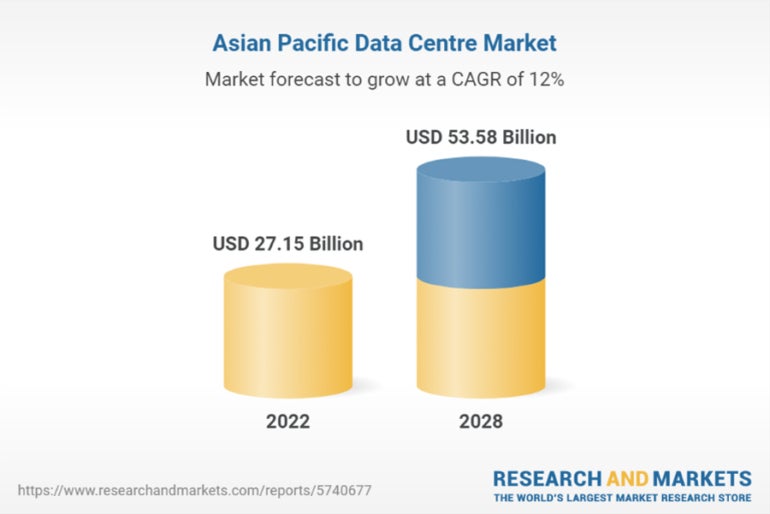
The Asia-Pacific data centre market is expected to grow to be worth USD $53.58 billion (AUD $81.1 billion) in 2028, according to data from Renub Research, with an expected capital annual growth rate of 12% a year between 2023 and 2028 (Figure A).

Infographic showing data centre numbers in the Asia-Pacific are expected to increase.
Figure A: Data centre numbers in the Asia-Pacific are expected to increase. Image: Research and Markets

With an estimated 14.27 thousand megawatts of inventory in 2024, another report from MordorIntelligence predicts the region’s data centre market will expand to 23.2 thousand MW by 2029, or a CAGR of 10.21% in computing capacity during the report’s forecast period.

SEE: The rise in computing power may put Australian data centres at risk of power failure.

According to the CBRE’s Global Data Center Trends 2023, “data center inventory is growing rapidly across Asia-Pacific, achieving impressive scale.”

Biggest data centre hot spots in the Asia-Pacific region

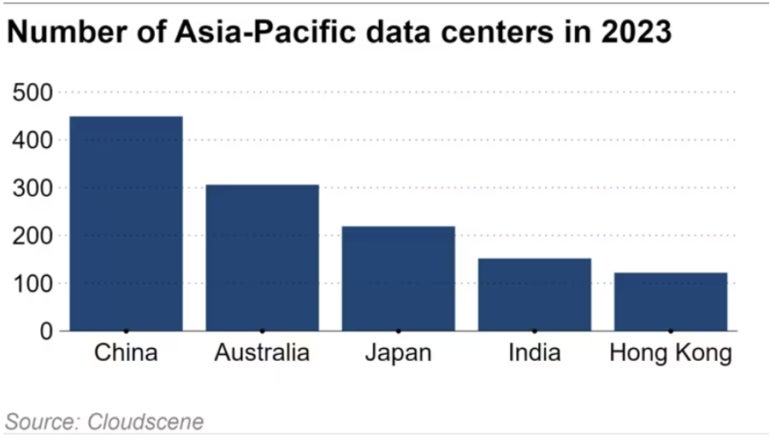
The leading data centre location by numbers is China, with an estimated 449 data centres according to the latest available data from Cloudscene (Figure B). This is followed by Australia with 306, Japan with 219 and India with 152.

Graph showing China has the most data centres in the Asia-Pacific region.
Figure B: China has the most data centres in the Asia-Pacific region. Image: Nikkei Asia

However, the leading data centre locations favoured by global enterprises for consolidation of their regional data centre operations are usually Singapore, Australia and Hong Kong. Recent moves from some jurisdictions like China and Vietnam to tighten regulations around data exports for national security reasons would only reinforce this trend among global enterprises.

Singapore

Singapore accounts for 60% of Southeast Asia’s data centres. After the 2023 lifting of a moratorium on new data centre capacity, which was driven by the sector’s voracious power demands and issues with sustainability, Singapore has recently been disclosed as a leading buyer of NVIDIA chips as it positions itself for a future rise in AI computing.

Australia

Sydney has seen what CBRE’s 2023 trends report calls a “‘second wave’ of interest from global cloud service providers,” which has increased its capacity by 30%. It now has over a half-GW of live power capacity, putting it right there alongside Tokyo and Singapore as regional leaders.

Hong Kong

Though traditionally a competitor with Singapore, the Hong Kong market may become less popular among Western companies. According to the CBRE, Hong Kong will be seen as a more risky place for data among heightened geopolitical concerns following China’s crackdown.

Data centre market growth drivers in the Asia-Pacific region

A key driver of Asia-Pacific regional growth and the use of data centre services is the digitisation and digital transformation of regional and global enterprises. As organisations seek to make their operations more efficient through digitalisation, and to use their data to fuel growth in digital services and innovation, demand for cloud computing is on the rise.

However, there are a variety of factors driving data centre growth. China’s lead in pure data centre numbers, for example, comes after the deliberate encouragement of a 30% growth rate in the country’s “big data” sector over a number of years, spurred on by its world-leading rollout of 5G networks. This is due to be followed by the commercial launch of 6G by 2030.

Growth in other markets and hotspots in the region is due to broad trends, such as increased demand for digital services among the region’s 1.2 billion internet users and an expansion in the Internet of Things. Growing demands include gaming and streaming, while new technologies include augmented reality and artificial intelligence.

AI computing will play a big role in the future

The International Data Corporation projects spending on AI will reach USD $78.4 billion by 2027 and 80% of CIOs in the region will leverage organisational changes to harness AI, automation and analytics by 2028.

SEE: AWS predicts generative AI will continue to be a focus into 2024 for Australia.

The rise of AI-driven applications, which demand higher compute capacity in the form of graphics processing units, is expected to drive a new phase of data centre industry growth. However, it will also drive more questions for data centre providers about where they should be located and drive new choices when it comes to technical data centre design.

For example, EY-Parthenon research argues that generative AI may serve to change the format and location of future data centre infrastructure, pushing them away from major cities towards tier-two cities and city outskirts, as they will require access to more electricity and water.

Pytorch Tabular Unveils New Update, Integrates DANet Model 

PyTorch Tabular, a framework for deep learning with tabular data, has announced its latest update, version 1.1.0, on January 15, this year. In this update, the most notable additions include the integration of the DANet Model, which is a new model tailored for tabular data.

Additionally, the update brings in the capability for explainability through the integration of Captum, a model interpretability library. For those looking to fine-tune their models, this update also adds hyper parameter tuner functionality, offering both Grid and Random Search methods to find the best model parameters.

After this update, PyTorch Tabular now supports a “Model Sweep” method, allowing users to swiftly evaluate the performance of various models with given data. The documentation has been enhanced to be more user-friendly and informative, catering to both new and experienced users. The update also addresses dependency updates, ensuring better compatibility and security, and introduces GhostBatchNorm into the library.

In the infrastructure and continuous integration, there have been improvements in CI actions and labels, alongside updates in dependency management. This release also includes some API changes, like an SSL API change, and allows the use of a custom optimiser in the model configuration.

PyTorch Tabular, developed by Manu Joseph and a team of contributors, is designed to simplify the process of using deep learning for tabular data. It is built on PyTorch and PyTorch Lightning, focusing on ease of use, customisation, scalability, and deployment. The framework supports various models, including FeedForward Networks, Neural Oblivious Decision Ensembles, TabNet, and more, making it a versatile tool for a wide range of applications in data science and machine learning.

The post Pytorch Tabular Unveils New Update, Integrates DANet Model appeared first on Analytics India Magazine.

Google’s new AI search features are game-changing for mobile users (iOS included)

Android figure at Google CES 2024

Google is trying to use its dominance in the search engine space to advance in the artificial intelligence (AI) race. The company's latest effort includes two new AI-enabled search features — and you can even start using one now, regardless of the device you use.

On Wednesday, Google unveiled an improved multisearch feature in Lens, which allows you to add word-based queries to a photo and receive AI-powered insights instead of just visual matches.

Also: Everything announced at Samsung's Unpacked event

Google showcased the feature in a demo in which it uploaded a screenshot of an amethyst and asked, "Why is it purple?" The result was an AI-generated insight that answered the question solely based on the context of the photo.

The AI-powered overviews on multisearch results will be launched this week in English in the US. The best part of the launch is that, since it's not part of Google's Search Generative Experience, you don't have to go through Search Labs to access the feature.

To get started, all you have to do is tap the Lens camera icon in the Google app for Android or iOS, snap or choose a photo, add a text question, and then you'll get a generative AI response.

Also: 5 exciting Android features Google just announced at CES 2024

Microsoft Copilot has been accepting multimodal search inputs into its chatbot for months, so if you want similar capabilities but favor Microsoft or Bing, Copilot is a solid alternative.

Google is also unveiling a Circle to Search feature, which allows users to search for anything on their Android screen by circling, highlighting, scribbling, or tapping anything on their phone screen, and the search information then pops up.

For example, if you are scrolling through TikTok and see an influencer has an accessory you like in their video, all you have to do is circle it, and then you will be redirected to similar products on Google.

This feature, however, is only available for select premium Android smartphones, including the Pixel 8, the Pixel 8 Pro, and the new Galaxy S24 Series starting on January 31. To get started, all you have to do is long-press the navigation bar or the home button on the select Android phones.

Also: Apple is reportedly eyeing generative AI push for the iPhone

The newly unveiled Galaxy S24 lineup will be supercharged with generative AI, also leveraging Imagen 2, Google's most advanced text-to-image diffusion technology, and Gemini, Google's most capable foundational AI model, to power apps and services built by Samsung.

For example, using Gemini Pro, Samsung's Notes, Voice Recorder, and Keyboard apps on the Galaxy S24 series will provide better summarization features, according to Google. Gemini Nano, a lighter model version, will be used for a new feature in Google Messages that ensures better data protection. Imagen 2 will be used to support intuitive photo-editing in Generative Edit.

Lastly, Galaxy S24 users will have an improved Android Auto experience. The feature will use AI to automatically summarize long texts or busy group chats while you're driving and suggest relevant replies. Android Auto will also soon mirror elements of your phone, such as wallpaper and icons, to provide a more seamless transition.

Samsung Unpacked

Samsung’s latest Galaxy phones offer live translation over phone calls, texts

Samsung’s latest Galaxy phones offer live translation over phone calls, texts Sarah Perez @sarahintampa / 8 hours

At Samsung’s launch event today, where the company introduced its AI-powered Galaxy S24 line of smartphones, the company introduced how AI could improve the calling experience with a new Live Translation feature. The feature, one of several translation features coming to the new smartphones, allows customers to make or receive a call in a language they don’t speak and then receive a live translation of the call both audibly and on the screen.

The company demoed the AI technology on stage at today’s event, showing how someone could use the new feature to make a restaurant reservation, even though they didn’t speak Spanish. Within the native Call app, the conversation was translated immediately after they spoke to the other person on the phone. That person could then respond in their own language — in this case, Spanish, which was then translated again into the caller’s language, English.

“It’s like having your own personal interpreter on your calls,” noted Samsung VP of Product Management, Drew Blackard.

The live translation feature will launch with support for audio and text translations for up to 13 languages, Samsung said. In addition, all the translation happens on-device, so Samsung owners’ phone calls remain private.

The feature will also remember your language settings and what language each of your contacts speaks, so you don’t have to make updates before your conversation. This could be useful for people making a lot of international calls, as well as for frequent travelers, the comapny suggested.

Translation features also work outside of calls, translating what you say both verbally and via text for the other person — and vice versa.

Image Credits: Samsung

In addition, translation is being added to the Samsung keyboard, so you can directly translate words and phrases as you type. Here, as you chat, the keyboard will detect the language being used and translate the message into the recipient’s language. This feature could be helpful even when both people speak the same language but are more comfortable communicating in their native language.

Samsung notes that users can even select different styles of communication, like “casual” when texting with a friend, or a more formal language for work contacts. There’s also an excited tone, a social tone (for social media posts, e.g.), and a Shakespearean tone available — the latter if you’re feeling “a little whimsical,” the company added.

Similar to live translation when speaking, these translations also happen on device thanks to Googe’s most efficient AI model, Gemini Nano.

Samsung’s Galaxy S24 will feature Google Gemini-powered AI features

Sopra Steria Next Forecasts GenAI Market to Be Worth $100B by 2028

Sopra Steria Next Forecasts GenAI Market to Be Worth $100B by 2028 January 17, 2024 by Ali Azhar

The rise of generative article intelligence (GenAI) has taken the world by storm in 2023. While organizations have taken a keen interest in deploying GenAI technology, it has remained a relatively limited market so far.

Sopra Steria Next, a European tech leader recognized for its consulting, digital services, and software development, has conducted a study to understand the trajectory of the GenAI market for the next few years.

The study shows that the GenAI market is on course to grow over $100B by 2028. This represents a tenfold increase in the GenAI market, from around $8B in 2023 to over $100B in 2028.

Fabrice Asvazadourian, Chief Executive Officer of Sopra Steria Next, compared the growth to the American gold rush phenomenon: "At the start of the gold rush, the first to strike it rich were actually the ones selling shovels and pickaxes; similarly, despite its lightning-fast market penetration, generative AI generated only limited revenue in 2023, essentially for cloud providers and their graphics processor manufacturers".

According to Asvazadourian, the report indicates that 2024 will be the beginning of an exponential growth in the monetization of GenAI. He expects an increasing number of GenAI solutions to be sold, with the major tech players looking to extend their current offerings, while startups offering solutions for more target-specific use cases.

The rise to $100B equates to an annual growth rate of a staggering 65 percent over the course of four years. Sopra Steria Next suggests a controlled approach to deploying AI technology. More specifically, the report recommends senior executives gradually implement GenAI applications to enable managers and their staff to familiarize themselves with these new tools. The gradual implementation will also allow organizations to embed AI policies and guidelines for complaint use of the technology.

While the growth predicted by Sopra Steria Next for the GenAI market is significant, a recent report by the International Data Corporation (IDC) predicts that spending on GenAI solutions will reach $143B in 2027, with a 5-year CAGR of 73.3 percent.

The IDC expects GenAI growth to follow a natural progression where organizations transition from early experimentation to aggressive build-out with targeted use cases to widespread adoption across business activities.

(cono0430/Shutterstock)

The growth trajectory until 2025 will be somewhat constrained as organizations tackle challenges such as resource allocation, privacy concerns, and AI regulations. The IDC predicts that after a slightly turbulent phase, the GenAI solutions will “become a foundational element in enterprises’ digital business control platforms.”

Bloomberg did a study on a more long-term growth of the GenAI market, and the findings of the report show that the GenAI market could explode to $1.3T in the next 10 years. This includes $280 billion of new software revenue, driven by specialized assistants, new infrastructure products, and copilots that accelerate coding.

According to Mandeep Singh, Senior Technology Analyst at Bloomberg Intelligence, “The world is poised to see an explosion of growth in the generative AI sector over the next ten years that promises to fundamentally change the way the technology sector operates. The technology is set to become an increasingly essential part of IT spending, ad spending, and cybersecurity as it develops.”

The outlook for GenAI for the next decade looks extremely promising. However, the actual growth will depend on how well organizations are able to overcome barriers to growth including closing the AI skills gap and addressing regulatory restrictions and AI ethical concerns.

Related Items

GenAI Adoption, By the Numbers

Perplexity AI Raises $74M to Take Valuation to $520M

Predicting the Financial Market with Large Language Models

Related