5 Ways of Converting Unstructured Data into Structured Insights with LLMs

5 Ways of Converting Unstructured Data into Structured Insights with LLMs
Image by Author

In today's world, we're constantly generating information, yet much of it arises in unstructured formats.

This includes the vast array of content on social media, as well as countless PDFs and Word documents stored across organizational networks.

Getting insights and value from these unstructured sources, whether they be text documents, web pages, or social media updates, poses a considerable challenge.

However, the emergence of Large Language Models (LLMs) such as GPT or LlaMa has completely revolutionized the way we deal with unstructured data.

These sophisticated models serve as potent instruments for transforming unstructured data into structured, valuable information, effectively mining the hidden treasures within our digital landscape.

Let’s see 4 different ways to extract insights from unstructured data using GPT 👇🏻

Setting up for our challenge

Throughout this tutorial, we will be working with OpenAI’s API. If you don’t have one working account already, go check this tutorial on how to get your OpenAI API account.

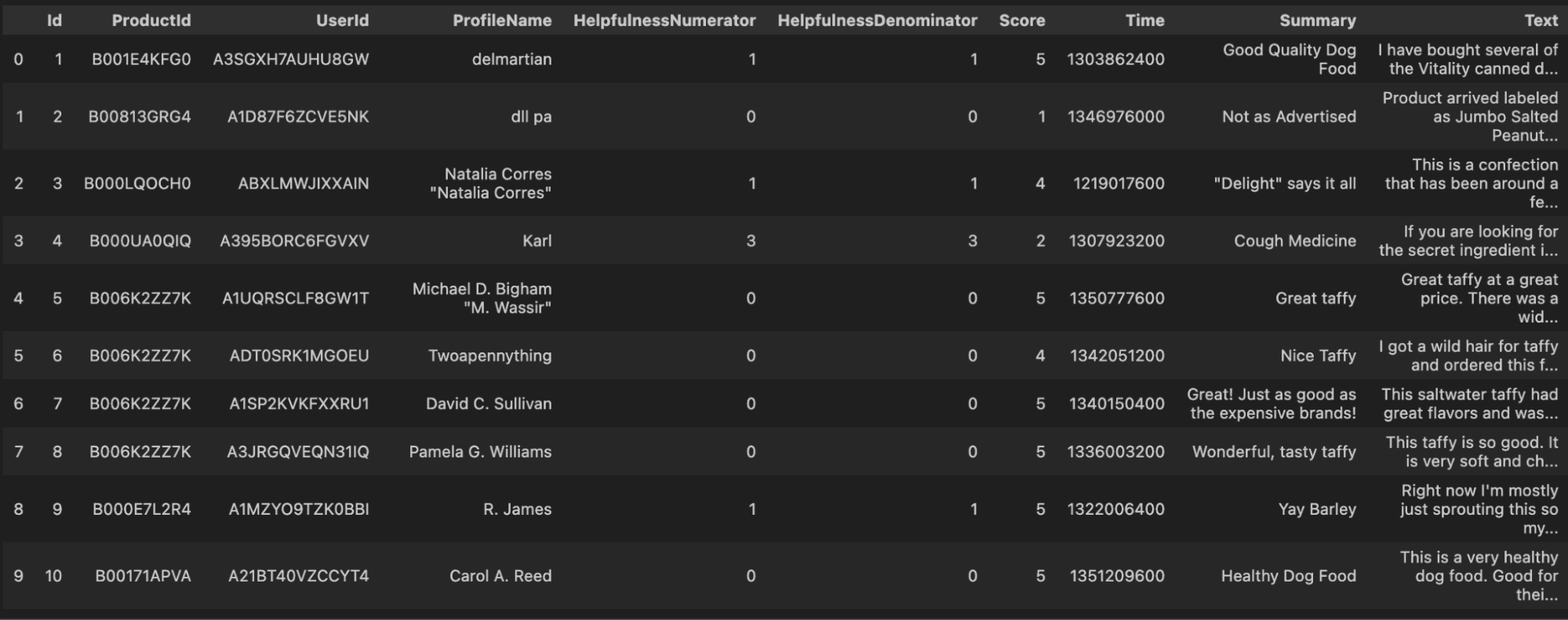
Imagine we are running e-commerce (Amazon in this case 😉), and we are the ones responsible for dealing with the millions of reviews that users leave on our products.

In order to demonstrate the opportunity LLMs represent to deal with such types of data, I am using a Kaggle dataset with Amazon reviews.
5 Ways of Converting Unstructured Data into Structured Insights with LLMs
Original dataset Understanding the Challenge

Structured data refers to data types that are consistently formatted and repeated. Classic examples include banking transactions, airline reservations, retail sales, and telephone call records.

This data typically arises from transactional processes.

Such data is well-suited to storage and management within a conventional database management system due to its uniform format.

On the other hand, text is often categorized as unstructured data. Historically, before the development of textual disambiguation techniques, incorporating text into a standard database management system was challenging due to its less rigid structure.

And this brings us to the following question…

Is text genuinely unstructured, or does it possess an underlying structure that's not immediately apparent?

Text inherently possesses a structure, yet this complexity doesn't align with the conventional structured format recognizable by computers. Computers are able to interpret simple, straightforward structures, but language, with its elaborate syntax, falls outside their field of comprehension.

So this brings us to a final question:

If computers struggle to process unstructured data efficiently, is it possible to convert this unstructured data into a structured format for better handling?

Manual conversion to structured data is time-consuming and has a high risk of human error. It's often a mishmash of words, sentences, and paragraphs, in a wide variety of formats which makes it difficult for machines to grasp its meaning and to structure it.

And this is precisely where LLMs play a key role. Converting unstructured data into a structured format is essential if we want to work or process it somehow, including data analysis, information retrieval, and knowledge management.

Large Language Models (LLMs) like GPT-3 or GPT-4 offer powerful capabilities for extracting insights from unstructured data.

So our main weapons will be the OpenAI API and creating our own prompts to define what we need. Here are four ways you can leverage these models into getting structured insights from unstructured data:

1. Text Summarization

LLMs can efficiently summarize large volumes of text, such as reports, articles, or lengthy documents. This can be particularly useful for quickly understanding key points and themes in extensive data sets.

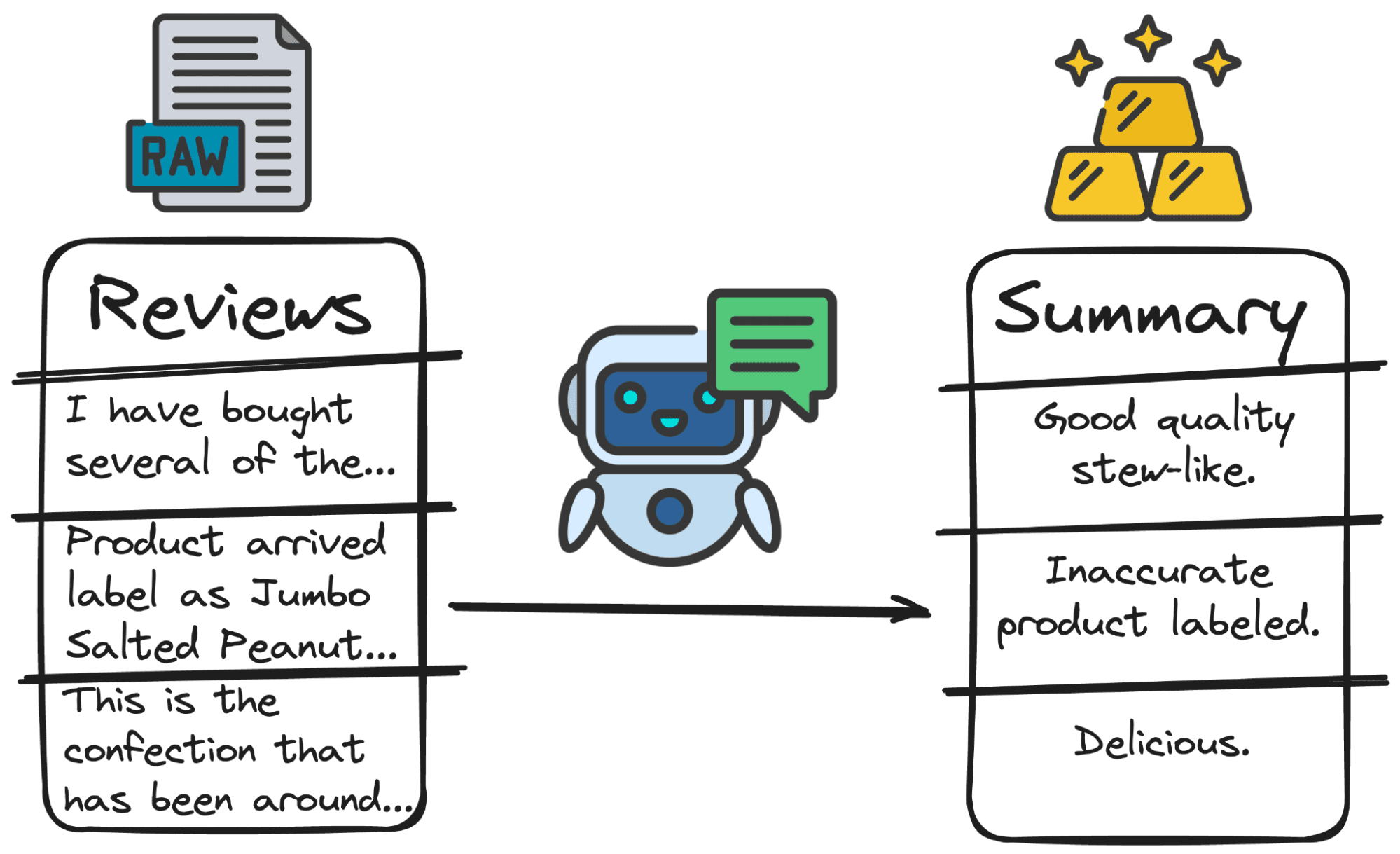
In our case, it is way better to have a first summary of the review rather than the whole review. So, GPT can deal with it in seconds.

And our only — and most important task — will be crafting a good prompt.

In this case, I can tell GPT to:

Summarize the following review: "{review}" with a 3 words sentence.

So let’s put this into practice with a few lines of code.

Code by Author

And we will get something like follows…
5 Ways of Converting Unstructured Data into Structured Insights with LLMs
Image by Author

2. Sentiment Analysis

These models can be used for sentiment analysis, determining the tone and sentiment of text data such as customer reviews, social media posts, or feedback surveys.

The most simple, yet most used, classification of all time is polarity.

  • Positive reviews or why are people happy with the product.
  • Negative reviews or why are they upset.
  • Neutral or why people are indifferent with the product.

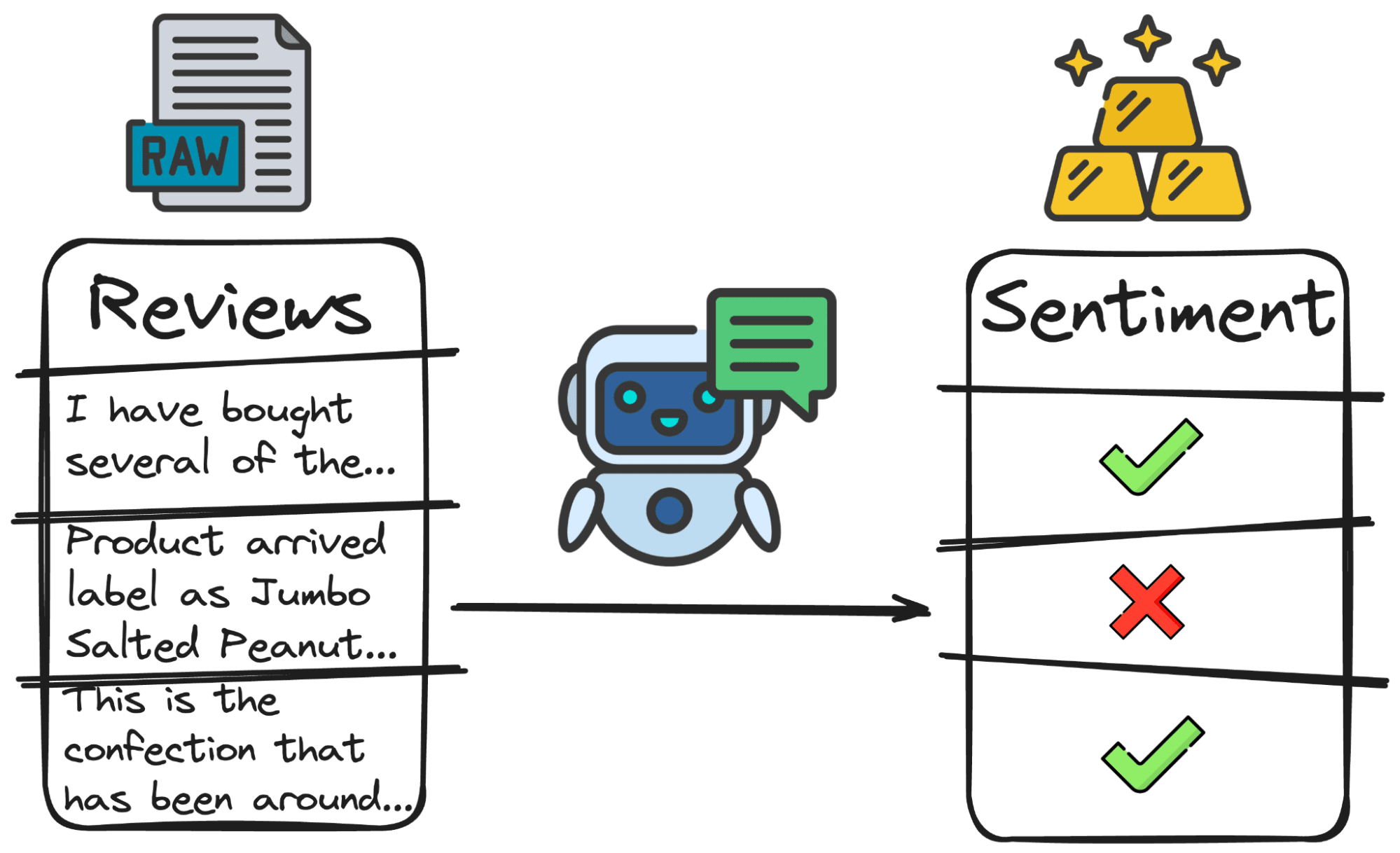
By analyzing these sentiments, businesses can gauge public opinion, customer satisfaction, and market trends. So, instead of having a person decide for each review, we can have our friend GPT to classify them for us.

So, again the main code will consist of a prompt and a simple call to the API.

Let’s put this into practice.

Code by Author

And we would obtain something as follows:
5 Ways of Converting Unstructured Data into Structured Insights with LLMs
Image by Author

3. Thematic Analysis

LLMs can identify and categorize themes or topics within large datasets. This is particularly useful for qualitative data analysis, where you might need to sift through vast amounts of text to understand common themes, trends, or patterns.

When analyzing reviews, it can be useful to understand the main purpose of the review. Some users will be complaining about something (service, quality, cost…), some users will be rating their experience with the product (either in a good or a bad way) and some others will be performing questions.

Again, doing manually this work would suppose a lot of hours. But with our friend GPT, it only takes a few lines of code:

Code by Author
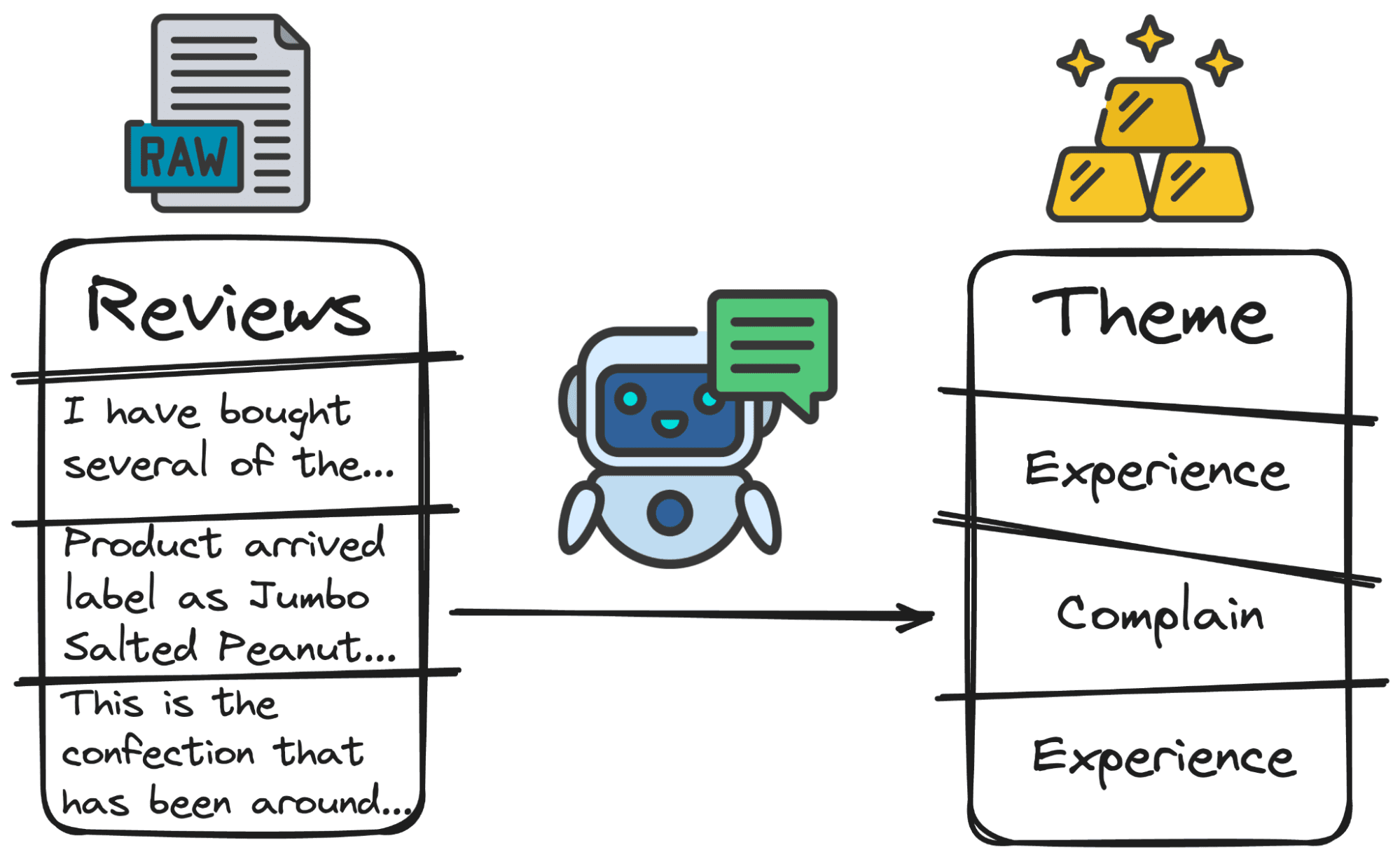
5 Ways of Converting Unstructured Data into Structured Insights with LLMs
Image by Author

4. Keyword extraction

LLMs can be used to extract keywords. This means, detecting any element we ask for.

Imagine for instance that we want to understand if the product where the review is attached is the product the user is talking about. To do so, we need to detect what product is the user reviewing.

And again… we can ask our GPT model to find out the main product the user is talking about.

So let’s put this into practice!

Code by Author
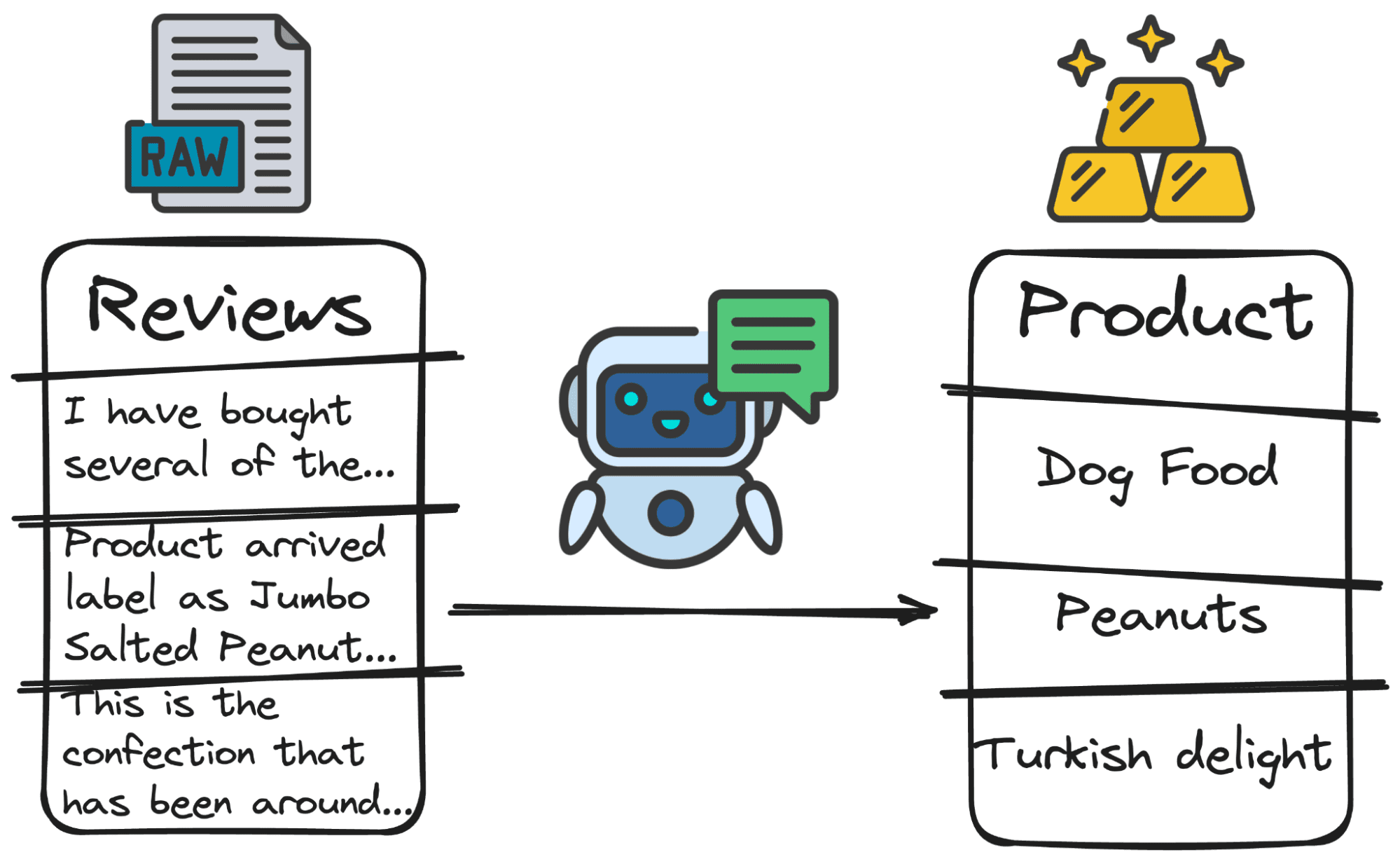
5 Ways of Converting Unstructured Data into Structured Insights with LLMs
Image by Author Main Conclusions

In conclusion, the transformative power of Large Language Models (LLMs) in converting unstructured data into structured insights cannot be overstated. By harnessing these models, we can extract meaningful information from the vast sea of unstructured data that flows within our digital world.

The four methods discussed – text summarization, sentiment analysis, thematic analysis and keyword extraction – demonstrate the versatility and efficiency of LLMs in handling diverse data challenges.

These capabilities enable organizations to gain a deeper understanding of customer feedback, market trends, and operational inefficiencies.

Josep Ferrer is an analytics engineer from Barcelona. He graduated in physics engineering and is currently working in the Data Science field applied to human mobility. He is a part-time content creator focused on data science and technology. You can contact him on LinkedIn, Twitter or Medium.

More On This Topic

  • From Unstructured to Structured Data with LLMs
  • Converting Text Documents to Token Counts with CountVectorizer
  • Easily Integrate LLMs into Your Scikit-learn Workflow with Scikit-LLM
  • Synthetic Data Platforms: Unlocking the Power of Generative AI for…
  • Building a Structured Financial Newsfeed Using Python, SpaCy and Streamlit
  • A Structured Approach To Building a Machine Learning Model

How Generative AI is Changing the Role of Data Scientists

Let’s put it out straight: The role of data scientists is not fading away anytime soon. Instead, it will continue to evolve, especially with the emergence of new generative AI tools.

“These tools (LLMs) are beneficial as they increase efficiency and can help get started on a problem when stuck. However, those who claim that these will replace data scientists or data engineering jobs are not fully considering the implications of such a statement,” said Siddhartha Sharan, senior data and applied scientist at Microsoft, in a recent podcast.

Supporting this perspective is AI expert Vin Vashishta said, “Generative AI tools work well enough to augment people, but after a year of working with them, I haven’t seen anything that’s a replacement for people. We’re still in the proof-of-concept phase for most tools, and there are bugs to work out before we talk about AI taking people’s jobs”.

Boosting Data Scientists with Generative AI

Earlier, data scientists spent hours on tedious tasks like data cleaning and formatting. Generative AI can automate these mundane activities, freeing up data scientists’ time for more complex problems.

“We spend a lot of time explaining the same things or answering the same questions. As the business scales, that work scales too, and those repetitive tasks add significant overhead. Small Generative AI models make automating those use cases very simple. Offloading simple tasks free people’s time to take on more complex work,” said Vashishta.

With generative AI, data scientists can now use algorithms to generate synthetic data that closely mimic real-world scenarios. This accelerates the data preparation phase, allowing professionals to focus more on the analysis and interpretation of results. Interestingly, Gartner predicts 60% of data for AI will be synthetic to simulate reality, future scenarios and de-risk AI, up from just 1% in 2021.

Moreover, generative AI can empower data scientists to explore data in innovative ways. “Data scientists are evolving into ‘solution scientists’, designing creative solutions using the GenAI toolset, or business automation architects, leveraging AI to build automated solutions for business functions,” said Ruban Phukan, co-founder & CEO at GoodGist.com, a skill development and education co-pilot for corporations.

However, even with these advancements, generative AI can’t replace the unique skills and problem-solving approach of data scientists. Generative AI falls short in understanding specific business challenges, considering human aspects, or independently acquiring the necessary domain knowledge.

For instance, speaking about sentiment analysis, Sharan said, “It is tricky to say whether it will be completely without humans in the loop right now because our approach is that the first three passes are completed by AI, and then after that, there is a human in the loop to validate the results.”

For Aspiring Data Scientists

According to Sharan, for the upcoming generation of data scientists, it is important that they stay updated with the use cases of generative AI. “Data scientists should read up on and develop an understanding of various models, knowing their strengths and weaknesses. Your project managers or engineers are not expecting you to quote the solutions. Instead, they seek guidance on which model to consider for a specific problem, which one to deploy, and which one would be more effective in the long term,” Sharan said.

Further, he opined that it’s necessary for data scientists to know the cost of using various language models. Putting all your data in GPT-4 for summarisation, for instance, may be costly and wouldn’t necessarily make sense, he said.

“How do you effectively reduce the cost while maintaining a big enough margin for your product? That is a key question and that’s where data scientists can help a lot. That is something data scientists need to learn,” he said.

In fact, if one reviews the criteria for applying for a data scientist role, one would see that most firms have updated the requirements. For example, the job description for a data scientist at HP demands, “As a data scientist with a focus on generative AI, you will work on multiple engagements across HP involving large language models and other new generative AI capabilities.”

Likewise, AWS expects its senior data scientist to “work across customer engagement to understand what adoption patterns for generative AI are working”.

Similarly, IBM’s job description says, “Stay up to date with the latest trends and advancements in AI, foundation models, and large language models. Evaluate emerging technologies, tools, and frameworks to assess their potential impact on solution design and implementation.”
Recently IBM in collaboration with Coursera launched a course titled ‘Generative AI for Data Scientists Specialization.’ allowing professionals to upskill themselves.

The post How Generative AI is Changing the Role of Data Scientists appeared first on Analytics India Magazine.

Tensoic Releases Playground for Kannada Llama on NVIDIA A100s

Just a few days after releasing Kan-Llama [ಕನ್-LLama], an Indic LLM based on Kannada token, the researchers have released a playground to test the model.

Tensoic, in partnership with E2E Networks, which is one the biggest providers of cloud GPUs in India, have released the playground which is hooked to NVIDIA A100 GPUs. The creators said that the Xylem.AI platform is used for inference, which is superfast and with mind blowing inference stack.

Read: Meet the Creator of Kannada Llama

The current version does not support multi turn conversations, but allows messing with the parameters.

Kannada Llama aka Kan-LLaMA, is a 7 billion Llama 2 model which is LoRA pre-trained and fine-tuned on “Kannada” token, built by a Mumbai-based company called Tensoic.

The pre-training process occurred on a solo NVIDIA A100 80GB instance, requiring approximately 50 hours and incurring an estimated cost of $170. The resultant LoRA adapter attained a size of around 1.1GB.

Currently, the model is built on top of Llama 2, but Adarsh Shirawalmath, the creator of Kannada Llama, told AIM that the team is also planning to make it on top of Mistral’s models, but the dataset is a little messy and not ready for Indic models yet. They are also planning to release Gujarati LLM soon.

The team is still working on the research paper as Shirawalmath said that he wants to make it perfect.

The post Tensoic Releases Playground for Kannada Llama on NVIDIA A100s appeared first on Analytics India Magazine.

5 Free University Courses to Learn Data Science

5 Free University Courses to Learn Data Science
Image generated with Segmind SSD-1B model

Skilled data professionals are continuing to be in high demand. So it’s a great time to break into data science. But how—and where—do you start?

Should you sign up for bootcamps, professional certificates, and graduate programs to learn data science? Yes, these are all good options. However, you can learn data science for free and still switch careers successfully.

To help you get started, we’ve compiled a list of free and high-quality university courses that’ll help you learn data science from the ground up. Because these courses have a structured curriculum, you don't have to worry about what to learn and in which order—and only focus on learning and getting better.

Let's get started!

1. Introduction to Data Science with Python – Harvard

If you need a refresher in Python programming before you start learning data science, check out CS50’s Introduction to Programming with Python taught at Harvard University.

After learning programming fundamentals with Python, you can check out this Introduction to Data Science with Python course, also from Harvard.

In this course, you’ll learn the following topics:

  • Programming basics
  • Using Python for coding, statistics, and data storytelling
  • Python data science libraries such as NumPy, pandas, matplotlib, and scikit-learn
  • Building and evaluating machine learning models
  • Applications of machine learning

Course link: Introduction to Data Science with Python

2. Introduction to Computational Thinking and Data Science – MIT

Introduction to Computational Thinking and Data Science from MIT is another good course to learn data science foundations. This course will help you gain familiarity with data science and essential statistics concepts.

Here is an overview of what this course covers:

  • Optimization problems
  • Stochastic thinking
  • Random walks
  • Monte Carlo Simulation
  • Confidence intervals
  • Understanding experimental data
  • Clustering
  • Classification

Course link: Introduction to Computational Thinking and Data Science

3. Statistical Learning – Stanford

Statistical learning from Sanford University is yet another popular course to learn how the different machine learning algorithms work.

The programming exercises in this course are in R. But you can also work through them using Python. I’ll also suggest you to use the Python edition of the Introduction to Statistical Learning book (which is also free) as a companion to this course

This course covers the following topics:

  • Linear regression
  • Classification
  • Resampling methods
  • Model selection
  • Regularization
  • Tree-based methods
  • Support vector machines
  • Unsupervised learning here are some of the topics that this course covers

Course link: Statistical Learning

4. Topics in Mathematics of Data Science – MIT

Even if you’re familiar with building machine learning models using Python and Python libraries such as scikit-learn, you should understand certain math concepts as well.

Learning math concepts will be helpful if you ever want to get into machine learning research and will also give you an edge in technical interviews. This is important learning these will help you get the edge will give you an edge in technical interview

The Topics in Mathematics of Data Science course from MIT will teach you certain math topics related to data science. Specifically, advanced dimensionality reduction and clustering concepts.

Here are some of the topics you’ll learn:

  • Principal component analysis
  • Spectral clustering
  • Compressed sensing
  • Approximation algorithms

Course link: Topics in Mathematics of Data Science

5. Data Science: Machine Learning – Harvard

From one or more of the courses we’ve seen thus far, you should be comfortable with:

  • Python data science libraries
  • Working of machine learning algorithms

The Data Science: Machine Learning course from Harvard will help you review machine learning basics and apply them to build a recommender system.

So this course teaches you:

  • Machine learning basics
  • Cross validation
  • Popular machine learning algorithms
  • Regularization techniques
  • Building a recommender system

Course link: Data Science: Machine Learning

Wrapping Up

So you now have a list of high-quality data science courses from elite universities like Harvard, MIT, and Stanford to learn data science.

From Python data science libraries to the inner workings of machine learning algorithms, you can check out one more of these courses to find the best fit for you. Happy learning!

Bala Priya C is a developer and technical writer from India. She likes working at the intersection of math, programming, data science, and content creation. Her areas of interest and expertise include DevOps, data science, and natural language processing. She enjoys reading, writing, coding, and coffee! Currently, she's working on learning and sharing her knowledge with the developer community by authoring tutorials, how-to guides, opinion pieces, and more.

More On This Topic

  • 5 Free University Courses to Learn Python
  • Learn Probability in Computer Science with Stanford University for FREE
  • 5 Free University Courses on Data Analytics
  • KDnuggets News, May 4: 9 Free Harvard Courses to Learn Data…
  • KDnuggets News, April 6: 8 Free MIT Courses to Learn Data Science…
  • 8 Free MIT Courses to Learn Data Science Online

Samsung ‘Galaxy AI’ was Not About Samsung

The much-publicised ‘Galaxy Unpacked’ event where Samsung had promised to unveil ‘a new era of phone’ took place yesterday at San Jose, and, yes, it was packed with a lot of ‘AI.’ While the event was all about Samsung, the true protagonist was another big tech company without whom the AI capabilities that the phone manufacturer is betting big on would not have happened. In comes, Google.

Unveiling its new brand of Galaxy S24 series, namely, Samsung Galaxy S24, S24 Plus, and the S24 Ultra, the company’s focus was on showcasing all new AI capabilities on the smartphones calling it Galaxy AI. However, the integration of Google’s advanced AI-features on the phones took the limelight.

Google All The Way

When Samsung teased the sparkles Samsung Galaxy AI logo, its uncanny resemblance to Google Bard’s logo drew everyone’s attention. At the Galaxy AI event, the suspicion became clear when the company announced the latest AI-enabled features of Google on the new smartphone. Almost all the new features announced in the S24 series were powered by Google.

The new ‘Circle to Search’ feature was separately but simultaneously announced by Google and Samsung. The new feature will enable users to draw a circle around any object in an image or video, and get AI-powered information from Google. With a simple gesture, a user can search for anything without switching apps. Live Translate, is another feature where the integrated AI model will provide real-time voice/text translation during calls in the native phone app.

While the new AI-enabled features sound impressive, the biggest announcement is the integration of Gemini on Samsung phones.

Gemini to See the Light of the Day

Google Gemini, which is considered to be Google’s most capable and advanced multimodal AI-model, that was released last month, will be integrated on the Galaxy S24 phones. The series will have built-in Gemini Nano, which is an optimised model for on-device tasks.

Furthermore, Samsung will be the first Google Cloud partner to deploy Gemini Pro, which is Google’s AI model for a wide range of tasks, and Imagen 2, which is Google’s advanced text-to-image diffusion technology, on Vertex AI. Samsung phone applications such as Notes, Voice Recorder and Keyboard apps will utilise Gemini Pro for summarization features.

Samsung will also be one of the first customers to test Gemini Ultra which is the most capable and largest AI model for highly complex tasks. Thomas Kurian, CEO of Google Cloud, considers the Samsung-Google Cloud partnership as a ‘tremendous opportunity for generative AI to create meaningful mobile experiences.’ With Gemini, Samsung smartphones can leverage Google Cloud’s infrastructure and advanced AI capabilities.

Samsung’s Diversified Partnerships

CES 2024 – Samsung Keynote Speech. Source: The Verge

Samsung’s strong collaboration with Google will help power their devices with the latest AI-enabled features, however, that has not limited the smartphone maker to tie-up with other big tech giants.

At the latest CES 2024 that concluded last week, where Samsung revealed new devices, the company announced its strategic partnership with Microsoft to bring Copilot features. Microsoft Copilot capabilities are set to arrive in Galaxy phones in March.

Furthermore, the company also said that the Galaxy smartphone camera can be used as a webcam on a PC. The webcam support will allow the usage of both front and rear facing cameras and enable users to apply background blur and other customisations that are allowed in video calls.

With the recent release of Copilot Pro, which offers a number of AI-enabled features, Samsung’s partnership with Microsoft on one side, and Google on the other, is only enabling the company to experience the best of both the worlds.

Tweet by co-founder and CTO of Lattice Labs. Source: X

The Android Upgrade

With a number of AI-enabled features, powered by Google, another big development from the house of Google is in the OS segment. Samsung phones will now receive seven years of security updates and seven generations of OS upgrades starting with the S24 series.

This comes as a significant upgrade from a previous announcement on android upgrade, where in early 2022, Samsung had announced four generations of Android OS upgrades and five years of security updates starting with S21 series.

Interestingly, Google had also announced seven years of software updates for their latest Pixel 8 and Pixel 8 Pro phones that were released in October last year. With Samsung also announcing the same, the competition in the Android smartphone market will still continue between both companies.

However, with the large market share that Samsung and Apple already has in the smartphone market, Google’s Pixel share is hardly a number. It is evident that in spite of being in the phone market, Google’s AI-models for smartphones are not solely for their customers. Tapping into the large Android phone makers’ market, Google’s AI offering is only going to be a win for the company.

Considering how Google is providing Gemini in exclusivity (barring Pixel) for Samsung S24 series, the collaboration might have involved huge finances as well. However, Samsung will desperately look to reap benefits from the S24 series collaboration with Google, owing to recently losing its market dominance to Apple by 0.6% market share.

The post Samsung ‘Galaxy AI’ was Not About Samsung appeared first on Analytics India Magazine.

Top 7 Apps on Hugging Face Spaces

Hugging Face has become a central hub in artificial intelligence and machine learning. It offers a range of models, libraries, and tools for developers and researchers. As the Hugging Face community grows, so does the number of applications built on its resources, especially the Hugging Face Spaces, which provide an opportunity to create and upload projects and models.

From language models to deployment tools, these apps play a crucial role in shaping AI development. Whether you are new to AI or an experienced practitioner, this platform provides opportunities to explore and engage with new models and projects.

Here is a list of the top 7 apps uploaded on Hugging Face Space.

TriplaneGaussian

This model employs a distinctive hybrid methodology to craft mesmerising abstract shapes. The project seamlessly integrates three key components: a Triplane Representation, which deconstructs 3D objects into thin slices for efficient processing; Gaussian Splatting, involving the strategic placement of 3D Gaussians on these triplanes to construct smooth and intricate shapes; and a Transformer-based Network that orchestrates the placement and attributes of these Gaussians, facilitating flexible and intricate pattern generation.

Noteworthy features include an interactive interface for real-time parameter control, resulting in a diverse range of visually stunning shapes. The ability to animate and download these creations, coupled with accessibility to the research paper and GitHub repository, enriches the exploration of this unique intersection between mathematics, artificial intelligence, and creativity.

Check out the Hugging Face link.

AnimeGANv2

AnimeGANv2 stands out as an impressive open-source project, enhancing the capabilities of its predecessor to transform landscape photos and videos into captivating anime-style imagery. Noteworthy improvements include reducing high-frequency artefacts and making the results smoother and more visually appealing.

What sets AnimeGANv2 apart is its user-friendly design, ensuring ease of training even for those with limited machine learning expertise. The model’s lightweight nature, with a significantly reduced number of parameters, makes it efficient for deployment on resource-constrained devices.

Check out the Hugging Face link.

IP-Adapter-FaceID

This tool adapts and unlocks the power of FaceID technology for custom scenarios, offering innovative applications in facial recognition. The model ensures consistent and accurate face generation by utilising a face recognition model to extract a unique face ID embedding from a provided portrait photo, even when textual prompts may not explicitly reference facial features.

This process involves combining the extracted face ID with a text prompt and feeding it into a text-to-image diffusion model, allowing for the gradual creation of images that match the given description while maintaining alignment with the provided face ID.

Notable features include face consistency across multiple generated images, versatility in working with different text-to-image diffusion models, and creative control over fine-tuning facial features and expressions.

Check out the Hugging Face link.

Int float/e5-mistral-7b-instruct

This impressive model excels at following your instructions and completing creative writing tasks like composing poems, code, scripts, musical pieces, emails, and letters. This text-based generative model is renowned for its instruction-following capabilities. Built upon the Mistral-7B-v0.1 model with an impressive 7 billion parameters, it undergoes fine-tuning on a mixture of multilingual datasets, making it versatile for various text-based tasks.

While primarily supporting English, its fine-tuning imbues it with some multilingual capabilities, though users predominantly focused on multilingual applications are recommended to explore “multilingual-e5-large”.

With 32 layers and a substantial embedding size 4096, the model operates on the PyTorch framework and incorporates features like Safetensors, Feature Extraction, and Inference Endpoints. Its proficiency extends to text generation, question answering, summarisation, translation, and more, making it a valuable resource for diverse natural language processing tasks.

Check out the Hugging Face link.

AI Comic Factory

This space generates comic book panels based on your text prompts. It’s a fun way to tell stories or create your own comics. AI Comic Factory emerges as a groundbreaking web-based platform, breaking down barriers to comic book creation and transforming storytelling into a visually engaging experience.

Its key features, including effortless comic generation without the need for drawing skills, diverse style options, varied layouts, and customisation capabilities, make it accessible to creators of all levels. The platform’s collaborative nature encourages sharing and feedback, fostering a vibrant community of comic enthusiasts.

Check out the Hugging Face link.

Pharma-CLIP Interrogator

This space uses CLIP models to help you investigate chemical compounds and their properties. It’s a valuable tool for drug discovery and research. The Pharma-CLIP Interrogator stands at the forefront of innovation, leveraging the capabilities of CLIP and BLIP AI models to unravel the information concealed within scientific images for pharmaceutical researchers.

This tool streamlines the analysis process by transforming images into descriptive words, optimising prompts for text-to-image models, and bridging the gap between image and text, saving researchers valuable time and effort.

Its ability to generate new hypotheses and enhance communication within research teams showcases its potential to accelerate discoveries and contribute to groundbreaking advancements in healthcare.

Check out the Hugging Face link.

OpenVoice

Developed by MyShell.ai, this model is a cutting-edge text-to-speech (TTS) engine with exceptional capabilities. Its realistic and expressive voices transcend conventional TTS systems by incorporating emotional variations, intonation, and rhythm, delivering a natural and engaging audio experience.

With a diverse array of pre-trained voices in multiple languages and accents, users can also craft custom voices using just a 10-second audio sample.

The granular control options, including emotion, accent, rhythm, pacing, pauses, and intonation, empower users to fine-tune speech for specific effects. OpenVoice finds applications in audiobooks, podcasts, e-learning, virtual assistants, accessibility tools, and game development, offering increased engagement, accessibility, efficiency, and customisation.

Check out the Hugging Face link.

The post Top 7 Apps on Hugging Face Spaces appeared first on Analytics India Magazine.

7 Must-Have Home Robots in 2024 

Home robotics has seen significant advancements lately with several companies introducing robots designed to be integrated seamlessly into our daily lives. These robots go a step further from machines when it comes to being equipped with cutting-edge technology.

Going beyond just being vacuum cleaners, robots are attempting to do tasks that humans need not do anymore, like folding clothes, opening a door etc.

Here is a list of 7 home robots you could own this year.

Ballie

Samsung has once again announced Ballie, an AI robot that will follow you around, acting as a home assistant. It can connect to all the IoT devices at home and even guard and feed your pets. The robot can answer questions, text you, and do everything that Alexa can.

The cute round robot was introduced in 2020 at CES and this year they’ve relaunched Ballie to mixed reviews. “There have been many robots in the past, but generative AI has raised the endless potential of the robot market, and it will be a chance for all devices to become smarter and more developed,” said Han Jong-hee, vice chairman, Samsung Electronics.

A new feature of the robot is the two-in-one switchable projector, which can display anything you want – a video call, a workout video, or even the insides of your fridge. The robot can detect the person’s posture and facial angle to project the video accordingly.

Astro

Amazon Astro, a small moving robot with a screen, is designed to assist with home monitoring and staying connected with the family. It can autonomously move around the home, navigate to specific areas, provide live views through the Astro app, send alerts for unrecognised persons, and assist with elderly care.

It can also work with Alexa Together for remote caregiving, set reminders, and offer 24/7 hands-free access to Urgent Response, an emergency helpline.

Astro is known for its facial recognition and navigation skills and serves as a versatile home security device. It doesn’t have arms but features a cargo bin for carrying items and can distinguish between different family members.

Its “face” is a screen that can stream video calls, play videos, and follow users around the home for centred interactions. It employs SLAM (simultaneous localization and mapping) technology for navigation.

Despite being available, it’s important to note that the absence of Astro from prominent Amazon events and the departure of key personnel involved in its development might indicate a shift in focus or strategy regarding Amazon’s home robotics projects​.

Matic

Matic by Matic Robotics is designed to clean your home and comes equipped with WiFi, Bluetooth, a 1080p camera, and facial recognition. It can navigate your home and avoid obstacles and pets, capable of both vacuuming and mopping.

It uses 3D mapping to navigate homes and adapts to its environment to prevent getting lost. Controlled via voice and gestures, Matic operates quietly and prioritises user privacy by processing data on the device itself. The company stated that these robots will be available to buy from March 2024.

LG AI Agent

LG’s new Smart Home AI Agent, unveiled as part of their “Zero Labor Home” vision, is an advanced robotic device equipped with AI and multi-modal technologies.

Powered by the Qualcomm Robotics RB5 Platform, it features a camera, speaker, and environmental sensors for temperature, humidity, and air quality. The robot’s unique two-legged wheel design enables independent navigation around the home.

This AI agent can engage in complex conversations, understand context and intentions through voice and image recognition, and natural language processing. It can control smart home appliances, act as a pet monitor and security guard, and even save energy by turning off unused devices.

It also recognizes and responds to users’ emotions, provides personalised content like music, and offers updates on transportation, weather, and personal schedules.

ORo Dog Companion

The ORo Dog Companion robot is designed by Oro.Inc for dogs whose owners are away. It’s an autonomous robot providing physical and mental stimulation for dogs. ORo adapts and learns from a dog’s behaviour for personalised care. It employs algorithms for dog tracking and detection, ensuring accurate monitoring and real-time updates on your pet’s activities.

ORo features audio and image analysis for monitoring a dog’s behaviour, health, and emotions, offering insights into their well-being. It updates continuously over-the-air, enhancing its capabilities. The robot includes an automatic pet feeder that dispenses food and medication, and monitors the dog’s food intake. It’s designed with safety and privacy, featuring gentle interactions, privacy controls, encryption, and out-of-bounds zones within your home.

Loona Smart Robot

Loona, the smart pet robot made by KEYI Tech is designed to interact with users and provide both companionship and entertainment. It’s equipped with various sensors, a 3D camera, and microphones, enabling it to respond to voice commands, recognize faces and objects, and navigate around the home.

Loona can perform playful activities like fetching a ball, engaging in bullfighting games, and responding to hand gestures. It can also express emotions through its digital eyes and articulated ears. The robot’s design combines a retro-futuristic aesthetic with efficient mechanical engineering, allowing for a wide range of emotions and communicative abilities.

For connectivity and programming, Loona integrates ChatGPT, allowing for engaging conversations and text-based games. It can also be used as a home security assistant, enabling remote monitoring through its camera. Loona is capable of self-charging and can return to its dock when low on power. It is available for the public on their website.

Moxie

Moxie, created by Embodied Inc., is a companion robot that serves as a tutor and mentor for children.

It uses play-based learning to develop social, emotional, and cognitive skills. Moxie AI, the updated version, offers personalised academic learning in various subjects and allows for remote interaction and learning through the Moxie AI Digital app. Parents can use the companion app to monitor and guide their child’s development.

Moxie features advanced conversational AI for natural interactions and supports multiple child profiles with face recognition technology to understand their emotional state. Being COPPA Safe Harbor certified, it is designed with children’s privacy and security in mind. Priced at $799, Moxie AI will be available for purchase in 2024 on MoxieRobot.com and Amazon.

The post 7 Must-Have Home Robots in 2024 appeared first on Analytics India Magazine.

JFrog & AWS Collaborate to Expedite Secure Machine Learning

JFrog Ltd, a Liquid Software company, has announced a new integration with Amazon SageMaker, enabling companies to build, train, and deploy machine learning models.

The company has introduced new versioning capabilities for its ML Model Management solution, integrating model development into DevSecOps workflows. This will increase transparency around each model version, allowing developers, DevOps teams, and data scientists to ensure the correct, secure version of a model is utilised.

The company’s integration with Amazon SageMaker ensures all artifacts used by data scientists or used to develop ML applications are saved in JFrog Artifactory. The integration is available for JFrog customers and users.

“The combination of Artifactory and Amazon SageMaker creates a single source of truth that indoctrinates DevSecOps best practices to ML model development in the cloud – delivering flexibility, speed, security, and peace of mind – breaking into a new frontier of MLSecOps,”said Kelly Hartman, SVP, Global Channels and Alliances, JFrog.

The company will conduct an educational webinar on January 31 in which they will discuss best practices for introducing model use and development into secure software supply chain and development processes.

JFrog’s integration with Amazon SageMaker will enable organisations to maintain a single source of truth for data scientists and developers, ensuring all models are accessible, traceable, and tamper-proof.

Furthermore, the company said this integration will bring machine learning (ML) closer to software development and production workflows, protects models from deletion or modification, and allows for the development, training, security, deployment of ML models and it can also scan ML licenses for compliance with company policies and regulatory requirements.

The post JFrog & AWS Collaborate to Expedite Secure Machine Learning appeared first on Analytics India Magazine.

7 Cool AR/VR Devices Announced at CES 2024

The Consumer Electronics Show (CES) 2024 unveiled a remarkable array of AR and VR technologies, heralding a new era in immersive experiences. The event showcased a massive leap in the AR/VR sector, including features like large-scale virtual desktops and personal 3D cinemas, immersive training simulations, gloves with haptic feedback, and more.

Here is the list of some really cool AR/VR devices announced at CES this year.

Readyverse

The Readyverse is a collaboration between Futureverse and the “Ready Player One” creators, Ernest Cline and Dan Farah. Announced at CES 2024, Readyverse Studios, co-founded by Cline, Farah, Shara Senderoff, and Aaron McDonald, plans to develop The Readyverse, a digital platform.

It’s an online universe where users can explore different digital spaces and experiences. This digital world is designed to let users own their digital items in a secure way, allow different parts of this universe to work together smoothly, and not be controlled by just one company.

The Readyverse is built using Futureverse’s technology, which includes The Root Network. This is a special kind of system that’s good for online games and these digital worlds, making it easier to use different types of digital items across various games and experiences.

This venture marks a shift in the entertainment industry, combining metaverse and cinematic expertise.

Sony’s New XR Headset

Sony’s XR headset, based on Qualcomm’s XR2+ Gen 2 chip and running Android, features two 4K OLED displays, offering an 8K experience. It includes a video pass-through and a flip-up design for a real-world view.

The headset comes with uniquely shaped controllers and a ring for each hand, making it user-friendly for left- and right-handed individuals. Designed initially for industrial and design applications, it also holds potential for entertainment purposes.

The headset received attention at CES for its high image quality and practical applications.

Asus AirVision M1 Glasses

Asus AirVision M1 glasses are AR glasses that connect to compatible phones or computers via USB-C. It provides a full HD resolution display. The glasses were unveiled for the first time at CES 2024. They feature a Micro OLED display with full HD resolution.

The glasses offer a 57-degree vertical field of view and incorporate Asus “Eye Care” technology. They use the degrees of freedom positioning which track the user’s head movements in three dimensions. They also have a multi-function touchpad, and include noise-cancelling microphones and speakers.

RayNeo X2 Lite

This lightweight full-colour AR glasses set, powered by the Snapdragon AR1 Gen 1 Platform, is designed for applications like virtual assistance and live captions. Weighing only 60g, they use MicroLED optical waveguide display technology for a comfortable wearing experience.

The RayNeo X2 Lite was recognised for its lightweight design and practical applications in everyday life. The glasses are expected to be available for the public in Q3 of 2024 (July and September).

Vuzix Ultralite S AR Smart Glasses

The Vuzix Ultralite S is a pair of lightweight AR smart glasses designed for a variety of uses, including sports, fitness, everyday convenience, and even enterprise applications.

Targeted at sports and fitness enthusiasts, these glasses offer hands-free, wireless connectivity to information from smartphones or smartwatches. The Ultralite S features a sleek design and uses Vuzix Incognito technology to reduce the glare or forward light common in other waveguide-based solutions.

These glasses were displayed for their potential in enhancing sports and fitness activities through AR technology. You can buy them at their website for $149.99.

Brelyon Ultra Reality Displays

Brelyon’s Ultra Reality Display is a 122-inch monitor that offers a headset-free immersive experience. The display features a large, curved screen that provides a panoramic view, creating a sense of depth and immersion without the need for a VR headset. This is achieved through the use of advanced computational optics and Brelyon’s patented supersonic light-field expansion technologies.

The Ultra Reality Display boasts a 120-inch virtual monitor, providing an expansive field of view. Brelyon’s display technology is designed not only for gaming but also for other applications such as telecommuting, virtual meetings, and entertainment.

The display can handle both 2D and 3D content, making it versatile for various use cases. Despite its large virtual size, the actual physical size of the display is much smaller, making it suitable for desktop use.

Nimo Smart Glasses

Nimo Planet has marketed their smart glasses as the world’s first spatial computer for productivity. It operates by connecting to any AR headset, eliminating the need for a traditional monitor for a workspace.

This system allows for a complete AR setup with multiple screens, which users can arrange as desired. For instance, it can display an Excel sheet, a PowerPoint presentation, and a video on the right-hand side. Users have the option to use a mouse or the computer itself for selections, functioning as a pointer.

Additionally, it features a trackpad on the top with clicking capabilities. The concept behind Nemo is to reduce reliance on bulky hardware, monitors, and computer towers, envisioning a future where work can be done with just a lightweight keyboard, a small computer, and AR goggles.

The glasses can be reserved for $599+tax and are expected to ship early this year.

Solos AirGo3

Solos introduced the Solos AirGo3 Smart Glasses featuring real-time language translation through SolosTranslate. This platform supports various modes like Listen for one-on-one translations and Group for multi-person conversations in different languages. Text mode offers written translations, while Present mode translates speeches in real-time for audiences.

AirGo3 combines premium eyewear with advanced features like SolosChat, Whisper technology for audio, and multiple lens options. The glasses, weighing 30 grams, include Solos Fitness Coach and a premium subscription option for enhanced services.

They’re designed for versatility in sports, everyday wear, and outdoor activities. Solos, originating from Kopin Corporation, holds over 100 patents. The glasses can be bought directly from their website for $299.

The post 7 Cool AR/VR Devices Announced at CES 2024 appeared first on Analytics India Magazine.

Google DeepMind’s New AI Model Masters Olympiad-Level Geometry

Google DeepMind is making sure to leverage AI to create a tangible impact, be it with AlphaFold for protein folding or GNoMe for material science. Taking a step further, the R&D arm of Alphabet, introduced AlphaGeometry, an AI system that solves complex geometry problems at a level approaching a human Olympiad gold-medalist. The AlphaGeometry code and model is open sourced, as well.

While the previous state-of-the-art system called Wu’s method solved 10 of 30 Olympiad questions, the new model solved 25 geometry problems, within the competition time frame. An average human gold medalist solved 25.9 problems.

Training Method

AlphaGeometry addresses the challenges faced by AI systems in solving complicated geometry and mathematics problems by combining a neural language model with a rule-based deduction engine. This neuro-symbolic system generates 100 million synthetic training examples, sidestepping the need for human demonstrations and overcoming data limitations.

Alongside other synthetic data generation and training methods, AlphaGeometry aims to unlock new possibilities in mathematics, science, and AI. Operating on a “thinking, fast and slow” approach, the neural model provides quick, intuitive ideas, while the deduction engine ensures deliberate, rational decision-making.

Synthetic Data Generation

To train AlphaGeometry without relying on human demonstrations, the team used a synthetic data generation method that mimics the human process of learning geometry at scale. Using highly parallelized computing, the system generated one billion random geometric diagrams, establishing exhaustive relationships between points and lines in each diagram.

Through a process called “symbolic deduction and traceback,” AlphaGeometry identified proofs within each diagram and determined the additional constructs needed. The resulting dataset was refined to 100 million unique examples, encompassing varying difficulty levels, with nine million featuring added constructs.

Read more:

The post Google DeepMind’s New AI Model Masters Olympiad-Level Geometry appeared first on Analytics India Magazine.