In March, Microsoft launched its own AI image generator — Bing Image Creator — which leverages DALL-E 3 to render high-quality images. Even after the rebranding of Bing Search to Copilot during Microsoft Ignite, Bing Image Creator's name remained unchanged — until now.
As first spotted by MSPowerUser, Microsoft renamed Bing Image Creator into Image Creator from Designer, a nod to Designer, Microsoft's graphic design app that uses AI to create new content from prompts.
Also: So, you want to transition your career to work in AI? Follow these 5 steps
If you visit the Image Creator by Designer website, you'll see that its appearance and function have not changed at all, other than featuring the new name at the top left corner. If you ask Copilot to generate an image for you, nothing has changed either, other than — once the image is generated — you will see "Image Creator by Designer" alongside the Designer logo in the bottom left-hand corner.
The only announcement that Microsoft has made regarding the rebrand was a sly one-line mention in a blog post posted earlier this week in which the major announcement was the availability of Copilot Pro.
Also: How to use Photoshop's Generative Fill AI tool to easily transform your boring photos
Microsoft also shared that Image Creator from Designer will now offer 100 boosts per day for Copilot Pro subscribers, an increase from its previous limit of 25 boosts per week. These "boosts" are ways you can enhance your AI image generation experience, such as making your images generate faster or higher quality.
"Copilot Pro provides enhanced AI image creation with Image Creator from Designer (formerly Bing Image Creator)," said Microsoft. "Ensuring it's faster with 100 boosts per day while bringing you more detailed image quality as well as landscape image format."
The Copilot Pro membership costs $20 per month and also offers users better assistance, priority access to the latest models, and the ability to create their own Copilot GPTs.
Also: Google's new AI search features are game-changing for mobile users (iOS included)
If you want to test Microsoft Designer, it is under free preview for anyone with a Microsoft account. Image Creator by Designer also remains free to use on its website, as well as when accessed through Copilot.
4 startup fundamentals to help avoid epic product fails Prashant Mahajan 14 hours Prashant Mahajan Contributor Prashant Mahajan is a veteran product manager-turned-entrepreneur and is the founder and CEO of Zeda.io. Prashant has worked with hundreds of product leaders and has built some of the most successful revenue-generating products on the market today.
Anyone mad enough to launch a new product already knows the stats surrounding product failure. According to Harvard Business School professor Clayton Christensen, over 30,000 new products are introduced yearly, and 95% fail.
However, even the 5% don’t always hit their mark, with many not doing precisely what customers need and others failing to meet their target KPIs. We call it the product death cycle, a repetitive cycle that emerges when, despite listening intently to customers and diligently building the features they ask for, products still struggle to gain traction.
It’s an all-too-familiar scenario familiar to many product experts, and the irony is that most product experts are doing exactly what they’ve been taught: listening to their customers.
On the bright side, the vicious product death cycle doesn’t need to repeat itself. There are ways companies can better understand their customers’ pain points to develop the right products that solve the right problems at the right time. It’s about understanding the core fundamentals.
Make sure you’re solving the right problem
There are ways companies can better understand their customers’ pain points to develop the right products that solve the right problems at the right time.
Regarding product design and development, solving the right problem might seem obvious. We’ve all heard of a solution for a problem — look at the Segway transporter device. However, the reality is that successful products and services succeed because they solve a specific problem that is well demonstrated. The challenge is really and truly understanding customer pain points.
I found this in my startup’s early days: We were engaged by a division of a large multinational company. As a young, motivated startup, it was a dream customer, and we dove in headfirst to build an excellent product for them. But after we’d developed the solution, they wanted something else because they felt their priorities had changed.
I think it’s something many startups can empathize with — you get a contact at a great company, and they tell you their problems. You build a product or solution to solve that problem, but it doesn’t work out as planned.
The business world is busier and more demanding than ever, which is why many organizations lean into automation tools. While there are plenty of highly technical tools to help businesses streamline operations, more consumer-friendly options like ChatGPT have taken the world by storm. If you haven’t learned how to leverage these solutions, now is the time to learn while the ChatGPT & Automation E-Degree is on sale through January 21st at 11:59 PM PT.
This 25-hour program is taught by Eduonix Learning Solutions (4/5-star instructor rating) and includes 12 courses designed to teach you practical and real-world applications for ChatGPT and automation tools. The program touches on more than 20 AI tools designed to help businesses navigate challenges in marketing, business and coding.
Through these courses, you’ll learn how to streamline a range of business processes through automation to enhance efficiency and customize your approaches to unique problems within your industry. You’ll learn how to transform raw data into actionable insights with AI, understand how AI can amplify creativity and become an expert at leveraging ChatGPT to improve communications both internally and externally. By the end of the courses, you’ll have a comprehensive understanding of how automation and ChatGPT can benefit your business in myriad ways. It’ll be like hiring several new people, except you’ll just know to pull a lot more weight.
No longer is leveraging AI a way for businesses to get ahead, now it’s simply about keeping up. Make sure your team can use this tool as well as the next.
Become an automation and ChatGPT expert while this e-degree is on sale. Now through 11:59 pm PT on January 21, you can get the ChatGPT & Automation E-Degree for hundreds off at just $29.99 (reg. $790).
Ever have questions about a product you see at Amazon that aren't addressed or easily found in the description or customer reviews? Well, now Amazon is tapping into AI to try to respond to your burning and even offbeat queries. Currently available for testing in Amazon's iOS and Android shopping apps, a new generative AI bot aims to provide you with the answers you seek.
To try this out, make sure you're running the latest version of the Amazon Shopping app on your iPhone or Android device. Select a product that interests you. Swipe down the product's page until you see a section that says: "Looking for specific info." (You'll find this section just above the customer reviews.) In the field for "Ask about this product," type your question, or speak it using the microphone icon on the keyboard.
Also: Generative AI in commerce: 5 ways industries are changing how they do business
You can start by asking the usual types of questions. Maybe you're ogling a tempting box of chocolate candy but have to know how much saturated fat it contains. Maybe you're checking out a new laptop and need to find out how long the battery lasts. Or maybe you're looking at a package of toilet paper and want to learn how soft it feels against your buttocks.
I tried each of those questions, and the AI supplied me with the right information.
But you can also get playful with the AI. Ask it to compose a song, tell a joke, or create a poem about a product. I asked it to write a song about ice melt, a joke about a men's beanie hat, and a poem about an Amazon Echo. As expected, the results didn't tell me much about the products but did show some AI-driven imagination.
You can't engage the chatbot in a back-and-forth conversation as you can with other AI tools. Rather, the goal is to ask specific questions to save time when you're shopping. Instead of hunting through lengthy product descriptions and hundreds of customer reviews, you can cut to the chase by asking about the product features that most concern and interest you.
The new AI is still in the testing phase, according to Amazon.
Also: The best AI chatbots: ChatGPT and other noteworthy alternatives
"We're constantly inventing to help make customers' lives better and easier, and are currently testing a new feature powered by generative AI to improve shopping on Amazon by helping customers get answers to commonly asked product questions," Amazon spokesperson Maria Boschetti said in an email sent to ZDNET.
This isn't the first generative AI feature that Amazon has added to its shopping apps. Last August, the retail giant unveiled a review summary that uses AI to analyze customer reviews and serve up a short paragraph summarizing the overall sentiment. The summary also highlights specific product attributes, such as "ease of use" or "reliability" to display excerpts of reviews mentioning that factor.
Microsoft makes its AI-powered reading tutor free Kyle Wiggers 9 hours
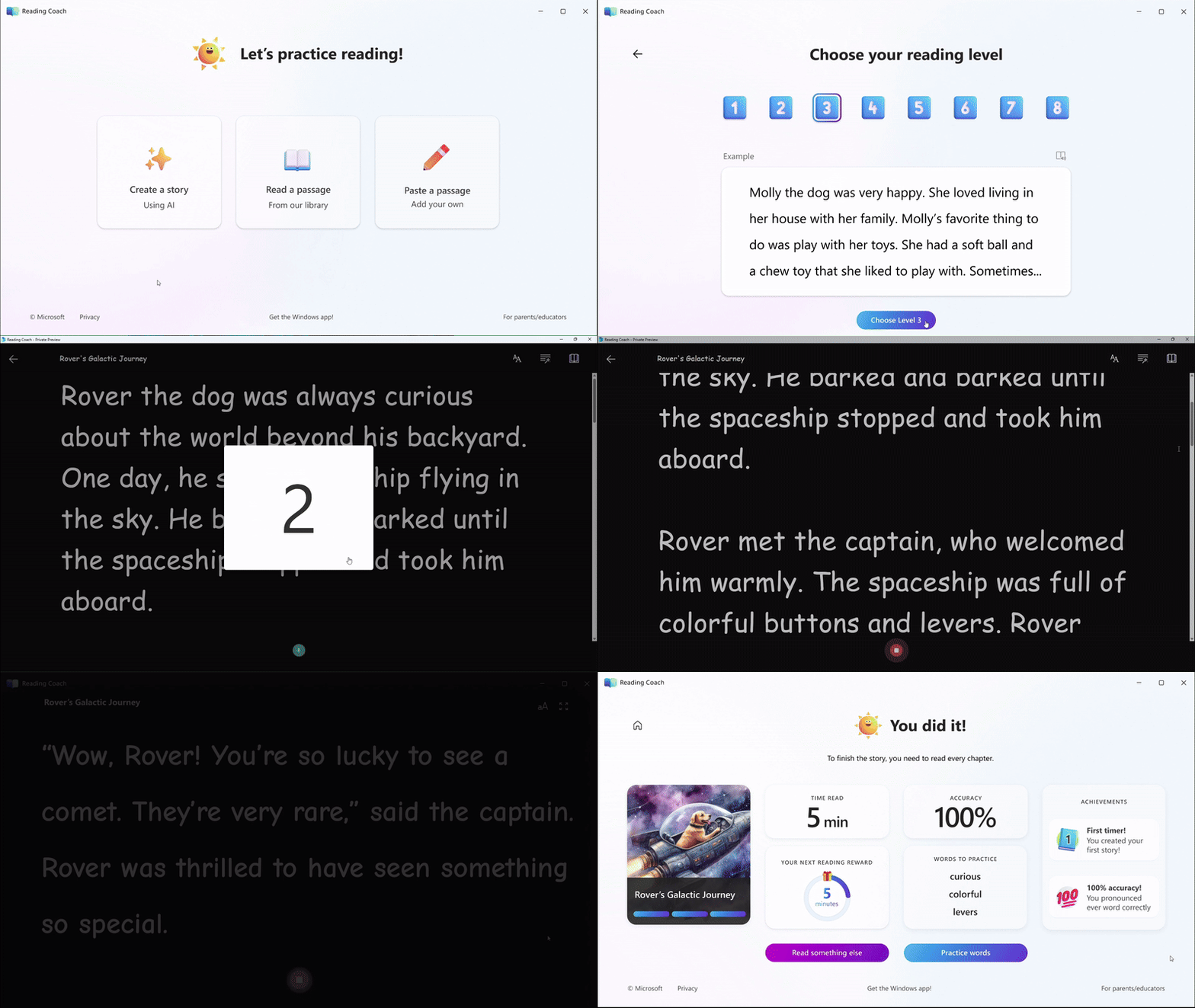
Microsoft today made Reading Coach, its AI-powered tool that provides learners with personalized reading practice, available at no cost to anyone with a Microsoft account.
As of this morning, Reading Coach is accessible on the web in preview — a Windows app is forthcoming. And soon (in late spring), Reading Coach will integrate with learning management systems such as Canva, Microsoft says.
“It’s well known that reading is foundational to a student’s academic success; studies show that fluent readers are four times more likely to graduate high school and get better jobs,” Microsoft writes in a blog post. “With the latest AI technology, we have an opportunity to provide learners with personalized, engaging, and transformative reading experiences.”
Reading Coach builds on Reading Progress, a plug-in for the education-focused version of Microsoft Teams, Teams for Education, designed to help teachers foster reading fluency in their students. Inspired by the success of Reading Progress (evidently), Microsoft launched Reading Coach in 2022 as a part of Teams for Education and Immersive Reader, the company’s cross-platform assistive service for language and reading comprehension.
Image Credits: Microsoft
Reading Coach works by having learners identify words they struggle with the most and presenting them with tools to support independent, individualized practice. Based on an educator’s preferences, the tools available can include text to speech, syllable breaking and picture dictionaries.
After a learner practices in Reading Coach, educators can view their work, including which words the student practiced, how many attempts they made and which tools they used. Educators can also share this information with students if they choose.
Recently, Reading Coach received a spruce-up in the form of a “choose your own story” feature, powered by Microsoft’s Azure OpenAI Service, that lets learners tap AI to generate their own narrative adventure.
Akin to the AI-generated story tool on the Amazon Echo Show, Reading Coach’s “choose your own story” has learners select a character, setting and reading level and have AI create content based on these selections and the learner’s most challenging words. (Microsoft says that story content is moderated and filtered for things like “quality, safety and age appropriateness.”) Reading Coach provides feedback on pronunciation, listening to the learner read the story and awarding badges that unlock new characters and scenes as they progress.
Learners who opt not to create their own story can pick from curated passages in ReadWorks, a library of resources for reading comprehension.
“Reading Coach intrinsically motivates learners to continue advancing their skills in several ways,” Microsoft continues. “With the use of AI in an impactful, safe, responsible way, we believe that personalized learning at scale is within reach.”
Microsoft’s rosy view of AI for teaching reading comprehension isn’t shared by all educators, it’s key to note. Experts say that there isn’t a foolproof tool on the market for measuring comprehension, which involves assessing what students know and the strength of their vocabulary as well as whether they can sound out and pronounce words. Students can inadvertently affect evaluations by pressing a wrong button. Or they might get bored with a task a tool’s presenting to them and disengage, leading to a low score.
All that being said, teachers don’t think tools like Reading Coach can hurt. In a recent EdWeek Research Center survey, 44% of educators said that they think adaptive tech does a better job of accurately assessing a students’ reading level than non-adaptive software or pen-and-paper methods.
Over the last few decades, the field of Artificial Intelligence (AI) has experienced rapid growth, resulting in significant changes to various aspects of human society and business operations. AI has proven to be useful in task automation and process optimization, as well as in promoting creativity and innovation. However, as data complexity and diversity continue to increase, there is a growing need for more advanced AI models that can comprehend and handle these challenges effectively. This is where the emergence of Large Vision Models (LVMs) becomes crucial.
LVMs are a new category of AI models specifically designed for analyzing and interpreting visual information, such as images and videos, on a large scale, with impressive accuracy. Unlike traditional computer vision models that rely on manual feature crafting, LVMs leverage deep learning techniques, utilizing extensive datasets to generate authentic and diverse outputs. An outstanding feature of LVMs is their ability to seamlessly integrate visual information with other modalities, such as natural language and audio, enabling a comprehensive understanding and generation of multimodal outputs.
LVMs are defined by their key attributes and capabilities, including their proficiency in advanced image and video processing tasks related to natural language and visual information. This includes tasks like generating captions, descriptions, stories, code, and more. LVMs also exhibit multimodal learning by effectively processing information from various sources, such as text, images, videos, and audio, resulting in outputs across different modalities.
Additionally, LVMs possess adaptability through transfer learning, meaning they can apply knowledge gained from one domain or task to another, with the capability to adapt to new data or scenarios through minimal fine-tuning. Moreover, their real-time decision-making capabilities empower rapid and adaptive responses, supporting interactive applications in gaming, education, and entertainment.
How LVMs Can Boost Enterprise Performance and Innovation?
Adopting LVMs can provide enterprises with powerful and promising technology to navigate the evolving AI discipline, making them more future-ready and competitive. LVMs have the potential to enhance productivity, efficiency, and innovation across various domains and applications. However, it is important to consider the ethical, security, and integration challenges associated with LVMs, which require responsible and careful management.
Moreover, LVMs enable insightful analytics by extracting and synthesizing information from diverse visual data sources, including images, videos, and text. Their capability to generate realistic outputs, such as captions, descriptions, stories, and code based on visual inputs, empowers enterprises to make informed decisions and optimize strategies. The creative potential of LVMs emerges in their ability to develop new business models and opportunities, particularly those using visual data and multimodal capabilities.
Prominent examples of enterprises adopting LVMs for these advantages include Landing AI, a computer vision cloud platform addressing diverse computer vision challenges, and Snowflake, a cloud data platform facilitating LVM deployment through Snowpark Container Services. Additionally, OpenAI, contributes to LVM development with models like GPT-4, CLIP, DALL-E, and OpenAI Codex, capable of handling various tasks involving natural language and visual information.
In the post-pandemic landscape, LVMs offer additional benefits by assisting enterprises in adapting to remote work, online shopping trends, and digital transformation. Whether enabling remote collaboration, enhancing online marketing and sales through personalized recommendations, or contributing to digital health and wellness via telemedicine, LVMs emerge as powerful tools.
Challenges and Considerations for Enterprises in LVM Adoption
While the promises of LVMs are extensive, their adoption is not without challenges and considerations. Ethical implications are significant, covering issues related to bias, transparency, and accountability. Instances of bias in data or outputs can lead to unfair or inaccurate representations, potentially undermining the trust and fairness associated with LVMs. Thus, ensuring transparency in how LVMs operate and the accountability of developers and users for their consequences becomes essential.
Security concerns add another layer of complexity, requiring the protection of sensitive data processed by LVMs and precautions against adversarial attacks. Sensitive information, ranging from health records to financial transactions, demands robust security measures to preserve privacy, integrity, and reliability.
Integration and scalability hurdles pose additional challenges, especially for large enterprises. Ensuring compatibility with existing systems and processes becomes a crucial factor to consider. Enterprises need to explore tools and technologies that facilitate and optimize the integration of LVMs. Container services, cloud platforms, and specialized platforms for computer vision offer solutions to enhance the interoperability, performance, and accessibility of LVMs.
To tackle these challenges, enterprises must adopt best practices and frameworks for responsible LVM use. Prioritizing data quality, establishing governance policies, and complying with relevant regulations are important steps. These measures ensure the validity, consistency, and accountability of LVMs, enhancing their value, performance, and compliance within enterprise settings.
Future Trends and Possibilities for LVMs
With the adoption of digital transformation by enterprises, the domain of LVMs is poised for further evolution. Anticipated advancements in model architectures, training techniques, and application areas will drive LVMs to become more robust, efficient, and versatile. For example, self-supervised learning, which enables LVMs to learn from unlabeled data without human intervention, is expected to gain prominence.
Likewise, transformer models, renowned for their ability to process sequential data using attention mechanisms, are likely to contribute to state-of-the-art outcomes in various tasks. Similarly, Zero-shot learning, allowing LVMs to perform tasks they have not been explicitly trained on, is set to expand their capabilities even further.
Simultaneously, the scope of LVM application areas is expected to widen, encompassing new industries and domains. Medical imaging, in particular, holds promise as an avenue where LVMs could assist in the diagnosis, monitoring, and treatment of various diseases and conditions, including cancer, COVID-19, and Alzheimer's.
In the e-commerce sector, LVMs are expected to enhance personalization, optimize pricing strategies, and increase conversion rates by analyzing and generating images and videos of products and customers. The entertainment industry also stands to benefit as LVMs contribute to the creation and distribution of captivating and immersive content across movies, games, and music.
To fully utilize the potential of these future trends, enterprises must focus on acquiring and developing the necessary skills and competencies for the adoption and implementation of LVMs. In addition to technical challenges, successfully integrating LVMs into enterprise workflows requires a clear strategic vision, a robust organizational culture, and a capable team. Key skills and competencies include data literacy, which encompasses the ability to understand, analyze, and communicate data.
The Bottom Line
In conclusion, LVMs are effective tools for enterprises, promising transformative impacts on productivity, efficiency, and innovation. Despite challenges, embracing best practices and advanced technologies can overcome hurdles. LVMs are envisioned not just as tools but as pivotal contributors to the next technological era, requiring a thoughtful approach. A practical adoption of LVMs ensures future readiness, acknowledging their evolving role for responsible integration into business processes.
Since I've been covering the new boom in AI, I've been getting reader letters asking how to grow into that industry. This letter from Rick is representative of many of them:
I just read your articles pertaining to free AI courses at IBM, OpenAI, and Deep Learning and wanted to see if you could offer some advice.
I'm trying to transition from my industry of life science to big tech. I want to continue to learn more about AI and its applications, with the focus on becoming a product manager who can showcase knowledge and use cases for it.
Do you have any suggestions for an experienced product manager, with very little machine learning experience, starting out on what to learn in the AI/ML space to become marketable? I'm going to start by taking the free courses from IBM as you mentioned. I would love to work with engineering and development teams on crafting products utilizing these technologies specifically.
What stands out about Rick's letter is that he's experienced as a product manager, but his field is life sciences rather than traditional tech. This experience is important, because he does have skills that can transfer into other fields.
Also: Have 10 hours? IBM will train you in AI fundamentals — for free
I also receive letters from readers who don't mention experience or pre-existing skills, but just see that prompt engineers are raking in the big bucks and want to be part of the windfall. I mention this, because a lot of less experienced folks see stories about app developers making millions or prompt engineers making six-figure incomes and think that just one course, or just wanting it hard enough, will get them the gig.
Back when I taught entry-level programming, about half my students wanted to program. The other half wanted programming jobs because they paid well. Unfortunately, that second set of students weren't all that willing to apply themselves to the craft. They just thought that the mere fact that they took a course in programming would get them a job. And it might have. But without demonstrable skills, that job wouldn't have lasted more than a few weeks.
My point here is that you have to be willing to do the work, and you also have to be able to bring something to the job. Rick seems willing to do the work, and he has skills he can bring to the job. Below are the five steps I'd recommend Rick — and anyone interested in pivoting to AI work — take.
1. Identify your current skills
This is important if you want to switch careers. What skills do you already have?
As a product manager, Rick undoubtedly has some people-wrangling skills. Product managers have often been described as CEOs without the authority or the pay. That's because they need to manage and cajole people from multiple disciplines and departments.
He probably has some serious writing skills. Writing a product requirements spec is not a trivial task.
Also: Is prompt engineer displacing data scientist as the 'sexiest job of the 21st century'?
Depending on what kind of product manager he is, he might also have marketing communications skills. By this, I mean the ability to write promotional copy describing his products for prospects, not just the implementation teams.
As an experienced product manager, he probably also has strong project management skills, strong organization skills, and some level of product knowledge (in his case, for life science-related offerings).
2. Identify skills that might transfer
Rick might not be aware of this, but he has skills that are particularly well-suited to the world of AI. Prompt engineering (the writing of instructions for generative AI tools) is much more about structuring requests in natural language than it is about writing code.
Also: 6 skills you need to become an AI prompt engineer
If a product manager can do anything, it's writing clearly articulated specifications that take into account known constraints. That's already very close to prompt engineering. He'll have to learn the particular nuances of prompt engineering and how to battle those constraints, but he's in the perfect place to move into that role.
He also understands development teams, projects, and the product management process, which is as important to tech companies as it is to life science businesses.
What about if you're not a product manager? What skills do you have that might transfer?
Back in the old days of AI, expert systems were built by modeling specific expertise of subject matter experts. But today's large language models pull information from vast tracts of information, often straight off the internet. If you have a domain-specific expertise that's valuable, say medical knowledge or petroleum modeling, or even how a house is constructed, that knowledge may be valuable to AI companies trying to break into those industries.
Also: How to use ChatGPT
Don't assume that knowledge needs to be high-tech or super high-end. If you're a teacher, you have expertise in teaching and communicating knowledge, as well as the fields you teach in. If you're a parent, you sure have experience with the real ins-and-outs of raising kids. If you have warehouse experience, go to the front of the supply chain line.
To be clear, just because you know something doesn't mean you're instantly going to get an AI gig in that area. But make sure you are aware of the subjects you're strong in, and make sure you communicate those subjects as part of your transfer search.
Let's go back to that teacher example. Teaching involves breaking down information into understandable chunks, creating lesson plans, and creating validation procedures to ensure students have learned the material. That's very valuable in the AI process as well.
Also: 6 AI tools to supercharge your work and everyday life
What about if you're a good salesperson? Sales skills are perhaps the most important skills anyone can have because selling pays for our salaries. Learn about the AI business, especially the types of prospects and sales cycles. And then present yourself to an engineering-driven company desperate for sales skills. Here's a hint: most engineers don't have a clue how to sell.
What if you don't have so-called professional skills? What if you're a secretary or administrative assistant? If you're smart, can apply yourself, and can learn, you also have an opportunity here. All companies need strong organizational skills and the ability to structure and manage projects. Do the learning tasks outlined in this article, do the resume-building tasks described at the end, and you might be able to change that title from administrative assistant to logistics manager for an AI company.
What about if you're a coder, but not familiar with AI coding? Coding skills are hugely important. Just focus on the next section and train yourself on how your coding skills can use AI. Build a project or two. I talk about that in-depth next.
3. Train yourself
But, Rick says he doesn't know the AI field. He doesn't know the business of AI (all the players, how they relate, their competitive landscape). He doesn't really know how it all works. And he's never done any actual AI work.
The first is very easy to improve on. Read publications like ZDNET. Read voraciously about the AI industry. In fact, the very best way you can learn about a business you want to move into is to consume all the trade materials you possibly can. Read constantly. If you put in an hour of reading every day for six months, all of it centered on your desired target industry, you'll build a strong familiarity with that industry.
Also: I took this free AI course for developers in one weekend and highly recommend it
Taking the free courses is also a good idea. But it's very important not to just consume the material, but to do the exercises. The ChatGPT Prompt Engineering for Developers course offered by OpenAI (the folks who make ChatGPT) and DeepLearning (an education provider) has a hands-on simulator where you can construct prompts with code, and play with them.
The IBM course has a module where you can use IBM's tool to do some project work. Use it and practice with it. Amazon, too, has free courses that include hands-on experience.
I'll be spotlighting more free courses. Take them. Take as many as you possibly can. Give yourself time to really work the assignments and learn the material.
Then, get yourself a ChatGPT Plus and Midjourney account. You'll spend about $30/mo, but you'll have access to more powerful tools than just the free stuff. Use those tools. A lot. Experiment. Learn their limits and explore their strengths. Become comfortable with what they can do and how they fall short.
Also: You can build your own AI chatbot with this drag-and-drop tool
My point here is simple: make yourself knowledgeable. If you want to get a job in a field where you don't possess the experience, expertise, or credentials, you won't get anywhere without any of them. Fortunately, AI is a field that doesn't require board certification or a specific terminal degree. But it does require knowing stuff.
4. Build yourself some AI resume points
By the time you're ready to ask for a job interview, make yourself into someone who can answer those interview questions with confidence and competence. When asked, "Show me what you've built with AI," have something you're proud to show off. When asked about the future of AI, have enough knowledge to clearly articulate all the issues, opportunities, and concerns. When asked about the strengths and weaknesses of offerings by Amazon, Google, Microsoft, OpenAI, and others, know enough to be able to answer.
Also: Generative AI now requires developers to stretch cross-functionally. Here's why
Another thing that will make you more attractive to hiring managers in the AI space is some experience in the AI space. Now, obviously that's the Catch-22 that's existed with jobs since there were jobs. Hiring managers want folks with experience, but how are you supposed to get experience without the job?
Well, here's how: Be creative.
For someone in product marketing, there are two clear ways to add some fairly easy line items to your resume.
The first is a writing a blog or a newsletter. Starting a Substack is super easy. Write about marketing and business observations involving the AI industry. Deconstruct products and strategies of the various AI players. Even talk about your journey into learning more about AI. Use your product marketing background to provide weight to your discussion.
Also: AI is transforming organizations everywhere. How these 6 companies are leading the way
Now, for those of you not of the product marketing ilk, find how you can relate what you do know to AI and write about it. Experiment with the AI tools you do have and see how they might apply to your unique set of skills. Let yourself tinker, but ultimately, you want to do something you can put up on LinkedIn that has the word "AI" in it.
Speaking of that, especially for our product marketing friend Rick, find an AI Kickstarter project or a small AI startup, and offer to be a part-time advisor. You can offer services like looking over their marketing plans and offering advice or editing, or you can offer to write some marketing copy. The point is, if you don't require payment, and put in a few hours a week, you can start relating with folks in the AI field.
Now, here's the trick that will better help you move the job needle: Agree to do these services in return for giving you a title associated with the company. It doesn't have to be a line title, like "marketing manager." It can simply be "advisor." The point is, you want to be able to legitimately list on your LinkedIn profile something like, "Advisor, Happy Valley AI Enterprises," or something similar.
5. Give it six months
I know. Now that you've decided you want to transition into AI, you want the gig tomorrow. Well, pal, that's not going to happen. But if you give yourself six months, and you work it seriously, you'll have a pretty good chance of moving into this new field.
Put in an hour each day. Make sure you read relevant articles every day. Do some project work and tinkering in the field every few days. Make AI part of what you do. Try using AI in your current job, just to see how it can fit in.
Also: I spent a weekend with Amazon's free AI courses, and highly recommend you do too
The point here is that by the end of six months, make it so that AI isn't this new thing you want to move into, it's this thing that you're already very familiar with and use as a matter of your daily activities.
That way, by the end of the six months, you're not asking to "move into AI," but to "use your AI skills and knowledge in the AI field." That'll come across as much more powerful to hiring managers.
Let us know how it goes
Feel free to share your journey of exploration and transformation in the comments below. Or, even better, share it in your new blog or Substack. Good luck. Be strong. Be curious. What do you think? Let us know if Rick's path seems like it might be similar to yours. Did you learn anything you can put to use? What ideas do you have that I didn't share? Let us know in the comments below.
You can follow my day-to-day project updates on social media. Be sure to subscribe to my weekly update newsletter on Substack, and follow me on Twitter at @DavidGewirtz, on Facebook at Facebook.com/DavidGewirtz, on Instagram at Instagram.com/DavidGewirtz, and on YouTube at YouTube.com/DavidGewirtzTV.
What happened to Artifact? Sarah Perez @sarahintampa / 9 hours
Last week, Artifact, a buzzy news app from Instagram’s co-founders, announced it was shutting down after failing to gain critical mass. The news came as a surprise as the app was generally well-received by its core audience, smartly leveraged AI to power recommendations, summarize news, and rewrite clickbait, and featured a clean and modern design that made it easy to use. So what went wrong?
New data indicates that Artifact couldn’t catch up to the competition and struggled to grow its user base outside the U.S. It also saw downloads of the app steeply dropping off after launch, indicating a failure to catch on with a more mainstream audience.
In a company blog post, Instagram and Artifact co-founder Kevin Systrom had explained that the decision to shut down the app came about because they realized the market opportunity wasn’t large enough to warrant continued investment. It was a tough call, he said, but making that call “earlier is better for everyone involved.”
It’s rare to see a startup throw in the towel so soon, however, particularly among an app that appeared from the outside to have traction. Posts on the app — generally news articles and links to other interesting finds from around the web — offered social features, allowing users to like and comment. Based on in-app activity, it appeared as if Artifact had built a following as many posts included active discussions filled with comments and often featured thousands of “reads” (views). In addition, many of the app’s creators — meaning those who contributed content to the app as journalists or curators of links — also had hundreds of followers.
When you participated in Artifact’s community, it didn’t feel like shouting into a void. That’s an experience even larger apps, like X (originally Twitter), can’t always reliably deliver. In Artifact, people were browsing their feeds, reading headlines, socializing, following others, and marking items to read later. Much of this activity was visible to other users, making the community feel alive.
Unfortunately, the reality is that Artifact didn’t gain ongoing interest after its initial debut, so it was this core community keeping it afloat.
According to data from app intelligence provider Appfigures, Artifact saw an estimated 444,000 downloads since its February 2023 launch. However, a large part of those downloads, just under 100,000, arrived around its launch. By October 2023, the app had stalled, with only 12,000 new installs. In late November and early December, there was a brief spike again — perhaps a final push from Artifact’s team before making the decision to shut down. But that didn’t save the app from its fate.
Image Credits: Appfigures
Another issue facing the app was the stiff competition. Though rival news aggregator SmartNews was also losing downloads and active users at the time, in addition to its CEO shake-up, it still managed to pull in far more users than Artifact. During the time that Artifact was on the market, SmartNews saw 2 million downloads. Artifact had less than a quarter of that figure.
The app also had to compete with new ways people are getting their news in the age of AI, where search engines and chatbots are delivering information and answers without the need to click on links or read long news stories. That’s something that’s impacting web publishers’ traffic, leading outlets like The New York Times to sue AI company OpenAI for training on its content. Other publishers, like Axel Springer, are instead licensing their content to OpenAI for a fee, hoping to get ahead of where the market is moving. For consumers, this means there may be lessened demand for a secondary news app to complement their smartphones’ built-in newsreaders, like Apple News or Google News, for instance.
Artifact also struggled to gain an international following, which could have helped it thrive even if U.S. downloads stalled. Appfigures found that the U.S. accounted for 44% of all the app’s downloads. Meanwhile, no other country had more than a 4% share. That indicates that the name recognition of Artifact’s famous founders — Kevin Systrom and Mike Krieger, who created Instagram — may not have had as much draw outside the tech scene within their home market here in the U.S.
Then there was the issue around Artifact’s ever-growing set of features, which began to dilute its sharp focus on delivering a better, AI-powered news reading experience. All of a sudden, the app was allowing users to post their links, similar to Pinterest, followed by an ability to post text content, like on Twitter/X. Soon after, it added an option for sharing places, turning Artifact into a recommendations engine for the real world. That then begged the question as to what Artifact wanted to be — was it a social news reading or just a social network? By adding more functionality, Artifact may have potentially confused users as to when or why they should use it.
The company also continued to dabble with the latest AI tools, like a generative AI feature for adding images to posts or AI summaries in fun styles like “Gen Z speech,” “explain like I’m five,” or even just emojis. It began to seem as if the team wanted to build a new app entirely, like a new social network — perhaps an AI-powered Instagram? An Instagram for news? This also left some wondering if Artifact was now just a playground for the founders to try out the latest tech or if it had a planned roadmap.
Artifact was originally self-funded by the co-founders in the single-digit millions. This could be another reason why they decided to cut their losses earlier than expected. They may not have wanted to get into the position of raising funds from investors that they could fail to deliver returns on.
In any event, Systrom hinted that Artifact’s end may not be the end of his return to the world of tech startups, noting in the blog that he was “personally excited to continue building new things, though only time will tell what that might be.”
Based on Artifact’s progress, it seems like they have plenty of ideas to choose from.
Instagram co-founders’ news aggregation startup Artifact to shut down
The digital era has witnessed the remarkable evolution of cloud computing, transforming it into a cornerstone of modern business operations. This technology, which began as a simple concept of centralized data storage, has now evolved into a complex and dynamic ecosystem, enabling businesses to operate more efficiently and effectively than ever before. The Future of Cloud Computing holds unparalleled potential, promising to revolutionize the way companies operate, innovate, and compete in the global market.
What is cloud computing?
Cloud computing refers to the delivery of various services over the Internet, including data storage, servers, databases, networking, and software. Rather than owning their computing infrastructure or data centers, companies can rent access to anything from applications to storage from a cloud service provider.
The benefits of cloud computing for business
Cloud computing has revolutionized the way businesses operate, offering a plethora of advantages that enhance efficiency, flexibility, and scalability. In this discussion, we’ll delve into the key benefits of cloud computing, explaining each in simple terms and underlining their significance in today’s business landscape.
1. Maximizing cost efficiency with cloud computing
Cloud computing significantly cuts down on the capital cost associated with purchasing hardware and software, especially in sectors like the healthcare industry. It’s an economical alternative to owning and maintaining extensive IT infrastructure, allowing businesses, including those in the healthcare sector, to save on setup and maintenance costs. This aspect is particularly beneficial in cloud computing in healthcare industry, where resources can instead be allocated toward patient care and medical research.
2. Achieving scalability and flexibility in business operations
The ability to scale resources elastically with cloud computing is akin to having a flexible and adaptable IT infrastructure. Businesses can efficiently scale up or down their IT resources based on current demand, ensuring optimal utilization and avoiding wastage.
3. Enhancing business performance with robust cloud infrastructure
Cloud services are hosted on a network of secure, high-performance data centers globally, offering superior performance over traditional single corporate data centers. This global network ensures reduced latency, better application performance, and economies of scale.
5. Improving speed and agility in business processes
Cloud computing facilitates a swift and agile business environment. Companies can quickly roll out new applications or resources, empowering them to respond swiftly to market changes and opportunities.
6. Boosting productivity with efficient cloud solutions
The efficiency and speed offered by cloud computing translate into enhanced productivity. Reduced network latency ensures applications and services run smoothly, enabling teams to achieve more in less time.
7. Fostering better team collaboration through cloud technologies
Cloud computing enhances collaboration by enabling team members to share and work on data and files simultaneously from any location. This virtual collaboration space is crucial for businesses with remote teams and global operations.
The future of cloud computing in business operations
Here, we explore the transformative role of cloud computing in business, focusing on 7 key points that forecast its future impact and potential in streamlining and innovating operational landscapes.
1. The rise of Big Data
In the Future of Cloud Computing, handling enormous amounts of data will become more critical than ever. Businesses of all sizes generate data at unprecedented rates. From customer interactions to transaction records, every piece of data is a potential goldmine of insights. Cloud computing steps in as the ideal solution to manage this surge efficiently.
2. Cloud storage solutions
Cloud storage provides a scalable and flexible way to store and access vast datasets. As we move forward, cloud providers will likely offer more tailored storage solutions, catering to different business needs. Whether it’s for high-frequency access or long-term archiving, cloud storage can adapt to various requirements.
3. Real-time data processing
Another significant aspect of data management in the Future of Cloud Computing is real-time data processing. Businesses will rely on cloud computing not just for storage, but also for the immediate processing and analysis of data. This capability allows for quicker decision-making, a crucial factor in maintaining a competitive edge.
4. Improved collaboration by breaking down geographical barriers
One of the most transformative impacts of cloud computing is its ability to transcend geographical boundaries. In the Future of Cloud Computing, remote and global teams can collaborate as if they were in the same room. Cloud-based tools and platforms allow team members from different parts of the world to work on projects simultaneously, share files instantaneously, and communicate in real-time.
5. The rise of virtual workspaces
In the Future of Cloud Computing, we can expect a rise in virtual workspaces. These digital environments simulate physical offices, providing a space where remote workers can feel connected and engaged. They offer features like virtual meeting rooms, shared digital whiteboards, and social areas, replicating the office experience in a digital realm.
6. Fosters creativity
Cloud computing does more than just streamline operations; it also opens doors to innovation. With cloud resources, businesses can experiment with new ideas without significant upfront investment in infrastructure. This flexibility encourages creativity and risk-taking, which are essential for innovation.
7. Speeds up product development
Cloud computing accelerates the product development cycle. Teams can quickly set up and dismantle test environments, prototype more efficiently, and bring products to market faster. This agility gives businesses a significant advantage in rapidly evolving markets.
Top 3 emerging trends in cloud computing
The landscape of cloud computing is rapidly evolving, with new trends constantly emerging to redefine how businesses leverage this technology. In the context of the future of cloud computing, 3 key trends stand out for their potential to significantly shape the industry. Understanding these trends is crucial for businesses looking to stay competitive and innovative.
1. AI and machine learning integration
Artificial Intelligence (AI) and Machine Learning (ML) are becoming increasingly integral to cloud computing. This integration is revolutionizing how cloud services are delivered and utilized. AI algorithms are enhancing the efficiency of cloud platforms, offering smarter data analytics, automating routine tasks, and providing more personalized user experiences. For instance, cloud-based AI services can analyze vast amounts of data to predict market trends, customer behavior, or potential system failures, offering invaluable insights for businesses.
This integration not only boosts the performance and scalability of cloud solutions but also opens up new avenues for innovation across various sectors.
2. Increased focus on cloud security and compliance
As cloud computing becomes more prevalent, the focus on security and compliance is intensifying. The increasing frequency and sophistication of cyber threats make robust cloud security a top priority for businesses. In response, cloud service providers are investing heavily in advanced security measures, such as enhanced encryption techniques, identity and access management (IAM), and AI-powered threat detection systems.
Furthermore, with regulations like GDPR and CCPA in place, compliance has become a critical aspect of cloud services. The future of cloud computing will likely witness a surge in cloud solutions that are not only secure but also compliant with various global and industry-specific regulations. This trend ensures that businesses can confidently and safely leverage the cloud while adhering to legal and ethical standards.
3. Sustainable cloud computing
Sustainability is a growing concern in the tech world, and cloud computing is no exception. There is an increasing trend towards ‘green’ cloud computing, focusing on reducing the environmental impact of cloud services. This involves optimizing data centers for energy efficiency, using renewable energy sources, and implementing more sustainable operational practices.
It will likely see a stronger emphasis on sustainability as businesses and consumers become more environmentally conscious. Cloud providers who prioritize and implement eco-friendly practices will not only contribute to a healthier planet but also appeal to a growing segment of environmentally-aware customers.
Final words
The future of cloud computing is bright and offers a plethora of opportunities for businesses to grow and evolve. By staying informed and adapting to these changes, companies can leverage cloud computing to gain a competitive edge in the market.
Remember, the future of cloud computing isn’t just about technology; it’s about how businesses can harness this technology to drive innovation, efficiency, and growth.
For businesses aiming to thrive in the ever-changing digital world, embracing the advancements in cloud computing is not just a choice but a necessity. Staying updated and adaptable will be key to harnessing the power of cloud computing for business success in the years to come.
IP analysis platform PatSnap launches CoPilot, its new AI assistant Catherine Shu @catherineshu / 9 hours
Founded in 2007 to help IP and R&D professionals do their jobs more efficiently, Singapore-based PatSnap‘s first product was a global patent search database. Now it’s building out its suite of AI products with the launch of its AI assistant CoPilot.
CoPilot lets users search patent and non-patent literature more quickly, which the company says will make IP and R&D workflows faster across PatSnap’s entire product suite. Its proprietary LLM also links back to sources, including journal and patents, and provides references.
The startup says it has spent millions of dollars and has a team of more than 50 engineers dedicated to its AI capabilities. PatSnap CEO and co-founder Jeffrey Tiong tells TechCrunch that PatSnap exists to remove friction in the innovation process for its customers, both within IP and R&D teams, and between them. IP analysts and attorneys need to run prior art (information publicly disclosed before a patent was filed) and freedom to operate (or the ability to use a product or service without facing legal issues) searches to decide where their companies should invest time and money, and PatSnap’s products are designed to make the process more smooth.
For example, PatSnap’s Analytics product includes over 180 million patents and over 130 million pieces of literature from 170 jurisdictions. IP teams can use PatSnap’s AI tools to analyze their markets and protect inventions at scale, says Tiong.
What CoPilot does is build further onto PatSnap’s AI products. It enables IP and R&D teams to find what they need more quickly within patents, non-patent literature and technical news. Some examples Tiong gives include getting automatic summaries of patent claims, learning about a technology and getting links to a company’s patents. It also answers specific problems. For example, if a R&D professional wants to know more about improving battery energy density, CoPilot can translate patents and find relevant literature.
CoPilot also helps R&D and IP teams in four other ways: keeping up-to-date with rapidly changing sectors, providing content analysis to help guide strategic patents and research, extracting key details from specific patents and literature, and AI security because its model isn’t trained on customer data. Tiong says that since CoPilot has its own proprietary LLM, customer data doesn’t need to leave PatSnap’s firewall, so it isn’t passed to external networks.
Tiong adds that PatSnap’s LLM was trained on data from patents, academic papers, technical reports and recent company news, including about mergers and acquisitions. It also incorporates data annotated by IP experts and PatSnap’s products.
Its LLM learns generic data, specialized data and aligned data in three stages: pre-train, post pre-train and self-training fine-tuning, so it has specialized accuracy in patent and non-patent data. Combined with retrieval-augmented generation, Tiong says that compared to GPT3.5, CoPilot’s model is better at performing in-depth analysis while being less likely to hallucinate answers.
PatSnap has raised $350 million from investors like SoftBank and Tencent. It has a total of more than 1,200 employees, with 12,000 customers. Its clients come from verticals including life sciences, automotive, consumer goods, technology, manufacturing, engineering and legal.

 Prashant Mahajan Contributor Prashant Mahajan is a veteran product manager-turned-entrepreneur and is the founder and CEO of Zeda.io. Prashant has worked with hundreds of product leaders and has built some of the most successful revenue-generating products on the market today.