NVIDIA researchers recently introduced ChatQA, a family of conversational question answering (QA) models, aiming to achieve GPT-4 level accuracies.
NVIDIA’s ChatQA introduces a range of models, ranging from 7B to 70B in size. Extensive evaluations across 10 conversational QA datasets reveal that the top-performing ChatQA-70B model not only outperforms GPT-3.5-turbo but also performs at par with GPT-4. What’s notable is that these achievements are attained without relying on any synthetic data from ChatGPT models.
The team behind ChatQA proposes a two-stage instruction tuning method, significantly enhancing zero-shot conversational QA results from large language models (LLMs). To address retrieval in conversational QA, a dense retriever is fine-tuned on a multi-turn QA dataset, delivering comparable results to state-of-the-art query rewriting models with reduced deployment costs.
NVIDIA showcases the effectiveness of fine-tuning a single-turn query retriever using their curated conversational QA data. This approach performs comparably to the state-of-the-art LLM-based query rewriting model, all achieved without the need for extra computational time and potential API costs associated with rewriting.
NVIDIA’s ChatQA has demonstrated a remarkable advancement in handling scenarios where answers are elusive. The incorporation of a small number of “unanswerable” samples has proven to significantly enhance the model’s capabilities. Through an evaluation of unanswerable cases, it is evident that the leading model, ChatQA-70B, exhibits only a slight performance gap when compared to the formidable GPT-4.
For more details, refer to the paper: ChatQA Paper.
NVIDIA is not alone. Several foundational models have achieved the capabilities of GPT-4. Google is likely to launch Gemini Ultra at any moment. Meanwhile, Mistral CEO Arthur Mensch announced on French national radio that the company will unveil an open-source GPT-4-level model in 2024.
The post NVIDIA Introduces ChatQA, GPT-4 Level Conversational QA Models appeared first on Analytics India Magazine.
In an AI-human tussle in academia last year, we saw professors allegedly accusing students of submitting AI-generated assignments. Professors used AI detectors like Turnitin and GPTZero to get to the bottom of things. They later found these tools don’t give an accurate analysis and often offer false positive results.
Professors have since resorted to more verbal tests, while the number of students using LLMs to write these assignments and thesis remains high. It has been long established that AI text detectors don’t work, as it is impossible to determine how much of an article is human-written or LLM generated, with confidence.
Simultaneously, there is research being done on how to accurately detect text produced by AI. This is a constant cat-and-mouse chase where each of them is improving significantly using different methods of detection and avoidance.
Vivek Verma, an undergraduate student at University of California, and the creator of AI text detector Ghostbuster, said, “There can be more use for the detectors than trying to implicate students on their assignments. These can be used to make the chatbots better at writing them in the first place.”
Difficulty in Detecting AI Text
While one can guess who wrote the text, it can be hard to be sure of it. A user on HackerNews pointed out that text books written on Quantum Mechanics got a 96% positive for being AI generated. This was obviously not the case, but the text followed a specific language pattern that overlapped with those often found in AI-generated texts.
The models are often trained on datasets that do not fully encompass the diversity and complexity of human writing, especially in specialised fields like quantum mechanics. They analyse text based on patterns learned from these datasets, which can lead to inaccuracies when encountering texts that differ from their training material.
In January last year, OpenAI released a classifier as an AI detection tool, and discontinued it only after six months citing low rates of accuracy. While there are other AI detectors like Copyleaks that claim 99% accuracy with 0.1% false positives, the AI text generators have stepped up their game.
ChatGPT plugins like Humanize, WriteEasy, or even prompting it to write in a specific style would be enough to fool a detector. Yet these models overuse generic adjectives, use excessive passive voice, follow a formulaic writing style using a few syntax orders, without any creativity or originality.
Humans on the other hand, tend to write with a certain ebb and flow in their sentences. They’re often in varying lengths along with the use of new and strange analogies. While AI generated text is grammatically correct, it lacks factual depth, or deep understanding of the topic with new connections.
This and more such insights can be found in the paper ‘AI vs Human’.
An Endless Cycle
The website Verma developed was the result of a paper titled ‘Ghostbuster, Detecting Text Ghostwritten by Large Language Models’ from the University of California, and uses a new method to test material on their authenticity.
They use three weaker models to run the text which needs to be checked. Verma said, “We realise these detectors are not completely trustworthy, but we can use them to differentiate between the origin of the text to train new models.”
Another use case he explains is to make the models better at writing text in the first place. “Often chatbots like ChatGPT produce text that is too verbose. We can use the detectors as an evaluation tool to sort out the responses from better to worse,” he said.
The next step is also to identify which part of a text is written by humans and AI with accuracy. There are detectors like GLTR (Giant Language Model Test Room), developed by Harvard and MIT-IBM Watson AI Lab that assigns areas with higher probability of being AI generated.
“The final detectors should also explain why it categorises the content in each bucket and its reasoning behind it, which is what I’m working on next,” Verma concluded.
The post What is Wrong with AI Text Detectors? appeared first on Analytics India Magazine.
Perplexity AI recently announced its partnership with Rabbit to offer advanced language processing capabilities and a dynamic, up-to-the-minute knowledge base.
The partnership aims to bridge the gap between advanced language processing and real-time knowledge retrieval, setting the stage for a new era in AI-driven interactions. Integrating Perplexity’s advanced APIs into R1 ensures up-to-the-minute response information access, enhancing the speed and efficiency of user interactions.
Delighted for Perplexity to enable Rabbit holes! Perplexity's pplx-online LLM APIs, will power Rabbit R1 for providing live up to date answers without any knowledge cutoff! And, the first 100K Rabbit R1 purchases will get 1 year of Perplexity Pro! pic.twitter.com/nqGp1iJSvz
— Aravind Srinivas (@AravSrinivas) January 18, 2024
This, in turn, is anticipated to usher in a wave of pioneering products and services that harness the capabilities of advanced Language Model Models (LLMs) coupled with real-time information access.
Furthermore, the collaboration opens up new horizons for Perplexity, especially with the increased adoption of its pplx-online APIs. The integration with Perplexity’s LLMs equips Rabbit R1 with innovative AI capabilities known for their accuracy, fluency, and adept handling of complex queries.
Live interactions with Rabbit R1 will provide Perplexity with valuable real-world data, enabling continuous refinement and improvement of its language models. Moreover, powering a potentially successful product like R1 enhances Perplexity’s reputation, solidifying its credibility and market standing.
By leveraging Perplexity’s existing technology, Rabbit can streamline development efforts, focusing on building R1’s unique features and user interface. This collaboration translates to reduced development time and a more efficient pathway to delivering a top-tier AI assistant.
Rabbit places the utmost importance on user privacy. R1 has robust privacy and security features to safeguard user data during interactions. Stringent measures are in place to ensure data encryption, user consent adherence, and compliance with global privacy regulations.
To incentivise early adoption of R1, users will receive a complimentary 1-year subscription to Perplexity Pro, granting access to advanced features. This move not only encourages users to explore the capabilities of R1 but also provides them with an extended period to experience the full potential of Perplexity’s advanced language models.
The post Perplexity Partners with Rabbit to Provide Real-time Knowledge Retrieval appeared first on Analytics India Magazine.
Launched in March 2023, OpenAI’s API allows researchers and developers to interact with advanced AI models for various tasks like image creation and natural language understanding, allowing for creative applications and solutions in various AI-related tasks.
In simpler terms, the API is like a helper that lets you use OpenAI’s smart programs in your projects. For example, you can add cool features like understanding and creating text without having to know all the nitty-gritties of the underlying models.
Certainly, OpenAI offers a range of fascinating AI products beyond the well-known ChatGPT. Let’s explore some of the coolest ones.
Navan
Navan is the next generation of software designed for people. Their corporate travel and expense solution allows users to easily book, view, and manage business travel and expenses. Through the OpenAI and ChatGPT APIs, the company is leveraging the technology in both user-facing features, such as modernising its contact centre and optimising efficiencies across its codebase.
Expedia
Expedia has integrated OpenAI’s ChatGPT into its mobile app, allowing open-ended conversations for personalised travel recommendations. Expedia’s new plugin, in collaboration with OpenAI, simplifies trip planning for ChatGPT users. Currently limited to English conversations, the feature is rolling out globally, building on existing AI features within Expedia’s platform.
Expedia Group and Kayak are the first travel brands to develop ChatGPT plugins, experimenting with its potential as a chatbot, search engine, and retail platform.
Notion
Notion is a single space where you can think, write, and plan. OpenAI API allows integrations to access Notion’s pages, databases, and users, connecting services and creating interactive experiences. It is a freemium productivity and note-taking web application developed by Notion Labs Inc.
Intercom
Intercom is a customer messaging platform that facilitates efficient communication between businesses and their customers. Its own proprietary AI technology, Fin, is an AI bot powered by a mix of models, including OpenAI’s GPT-4.
Companies like Wolt, Trumpet, Hospitable and many more use Intercom for smooth client interactions. Intercom helps organisations deliver an exceptional customer experience.
Yext
Yext Chat employs GPT-3 and other generative AI models to enhance user understanding and response, retaining a conversational voice AI and chatbot-like interaction style. Yext publisher partners include Facebook, Apple, Amazon Alexa and more.
In order to reflect how users are interacting with their Yext Chat AI, they can also update it and improve the replies.
Instacart
Online grocery delivery platform Instacart uses ChatGPT along with Instacart’s own AI and product data from their 75,000+ retail partner store locations to help customers discover ideas for open-ended shopping goals. In, 2022 Instacart also launched its Instacart Platform, a full suite of end-to-end solutions, enabling retailers to grow their businesses.
Sana
Modern LLMs enable Sana Labs, which creates self-paced courses and live group sessions, to provide everyone with the knowledge they need to operate more quickly and creatively. Sana employs customised GPT-3 models that have been adjusted using their own data. It develops employee training initiatives and assesses team development using Sana’s reliable data.
Additionally, the company works with the world’s largest corporations and the fastest-growing startups to offer personalised, flexible learning to everyone.
The post Top 7 Products Built Using OpenAI API appeared first on Analytics India Magazine.
The AI lab of MIT (MIT CSAIL), in collaboration with Dr. Limor Apelbaum of the department of radiation oncology at Harvard University, has come up with two new AI-powered models called PRISM neural network (PrismNN) and logistic regression (PrismLR)—for the early detection of pancreatic ductal adenocarcinoma (PDAC), a fatal form of cancer.
Why is this discovery important?
Results show that at a five times higher relative risk threshold, PRISM can identify 35% of PDAC cases, in comparison to the standard 10% identified by conventional screening criteria. This performance improvement marks a significant leap in early intervention potential.
The pancreas’s deep abdominal location makes early detection challenging, and the lack of effective treatment underscores the importance of identifying high-risk patients early on.
So the research team tapped into a federated network company, leveraging Electronic Health Record (EHR) data consisting of patient demographics, diagnoses, medications, and lab results from different institutions across the US. This extensive database, encompassing over five million patients, ensures the models’ reliability and generalizability, making them applicable across various populations, geographical locations, and demographic groups.
PrismNN employs artificial neural networks to detect intricate patterns, while PrismLR uses logistic regression for a simpler analysis, providing a comprehensive evaluation of PDAC risk from the same EHR data.
While the use of AI in cancer risk detection is not new PRISM’s distinguishing features lie in its development and validation on an extensive database, surpassing most prior research in the field.
“The PRISM models stand out for their development and validation on an extensive database of over five million patients, surpassing the scale of most prior research in the field,” Kai Jia, MIT CSAIL PhD student and senior author on the paper, told AIM. “The model uses routine clinical and lab data to make its predictions, and the diversity of the US population is a significant advancement over other PDAC models, which are usually confined to specific geographic regions like a few healthcare centers in the US. Additionally, using a unique regularization technique in the training process enhanced the models’ generalizability and interpretability,” he added.
The team envisions expanding the models’ applicability to international datasets beyond US and adding more biomarkers for more refined risk assessment.
Earlier, Google DeepMind’s protein folding AI system AlphaFold helped to speed up the design and synthesis of a drug to treat hepatocellular carcinoma (HCC), the most common type of primary liver cancer.
The post MIT’s New AI Model Detects Early Signs of Pancreatic Cancer appeared first on Analytics India Magazine.
Andrew Ng’s DeepLearning.AI has come up with a free short course, LLMOps, offered in collaboration with Google Cloud. The course is designed in a way that beginners find it easy to learn in one hour of instruction by Erwin Huizenga, a Machine Learning Technical Lead at Google. The target audience includes individuals interested in tuning LLMs and building LLMOps pipelines.
Participants will gain practical knowledge on adapting an open-source pipeline to implement supervised fine-tuning on an LLM for better user question responses. The course emphasises best practices, such as data and model versioning, and covers the pre-processing of substantial datasets within a data warehouse.
Responsible AI practices are also addressed, focusing on the output of safety scores for sub-categories of potentially harmful content. They will also delve into the LLMOps pipeline, learning to retrieve and transform training data, version data and tuned models, configure an open-source supervised tuning pipeline, and deploy a tuned LLM.
The course comes with practical applications which include creating a customised question-answer chatbot, like one for Python coding queries. BigQuery data warehouse, open-source Kubeflow Pipelines, and Google Cloud are some of the tools taught in this course.
Ng had earlier partnered with Google Cloud for the course ‘Understanding and Applying Text Embeddings with Vertex AI’ which focussed on leveraging text embeddings to capture the essence of sentences and paragraphs.
Read more: How SAP Joule is Quenching Enterprises’ GenAI Thirst
The post Andrew Ng Partners with Google Cloud for New Course on LLMOps appeared first on Analytics India Magazine.
Violating their own policies is ingrained in the big tech’s DNA. Whether it’s about collecting your data or using their services for purposes it was not built for, these tech juggernauts has never shied away from crossing (legal) boundaries. The practice of secretly changing their policies has surged once again, and not for good.
Six months ago, Google updated its privacy policy, hinting at mining public data from web sources to enhance its AI models. The search giant has once again been caught fixing how Chrome describes its incognito mode. The move is a response to the lawsuit that accused Google of illegally tracking browsing activity even in incognito mode, for which Google is now liable to pay $5 billion.
Not just veterans but even the industry leaders in making like OpenAI have been pursuing these practices behind closed doors. A week ago, the Silicon Valley star quietly deleted language expressly prohibiting the use of its technology for military purposes from its usage policy.
Even though the LLM maker is very much aware of the risks that can arise through their technology in military applications, the company has chosen to opt for legal technicality over safety. Experts said OpenAI appears to be silently weakening its stance against doing business with militaries.
Some companies revamp their policies to help users better understand their data collection practices or comply with data protection laws like Twitter. Unfortunately, that is not how all of them have good intentions.
A Mixed Record
The money-minting machines of Silicon Valley can do better while acknowledging their wrongdoings. For instance, by providing the means to surf the internet easily, Google has time and again abused its dominant position.
Moreover, since the search giant has managed to become the powerhouse of the internet, it has been treated especially even in the court of law. Why does the company even have a list of ‘antitrust’ cases, given how much our daily lives revolve around it? During one of these cases in 2020 the, Justice Department officials stated that Google’s spending profits from its powerful position to buy special treatment for its search engine on devices and Web browsers created a “self-reinforcing cycle” of monopoly power abuse.
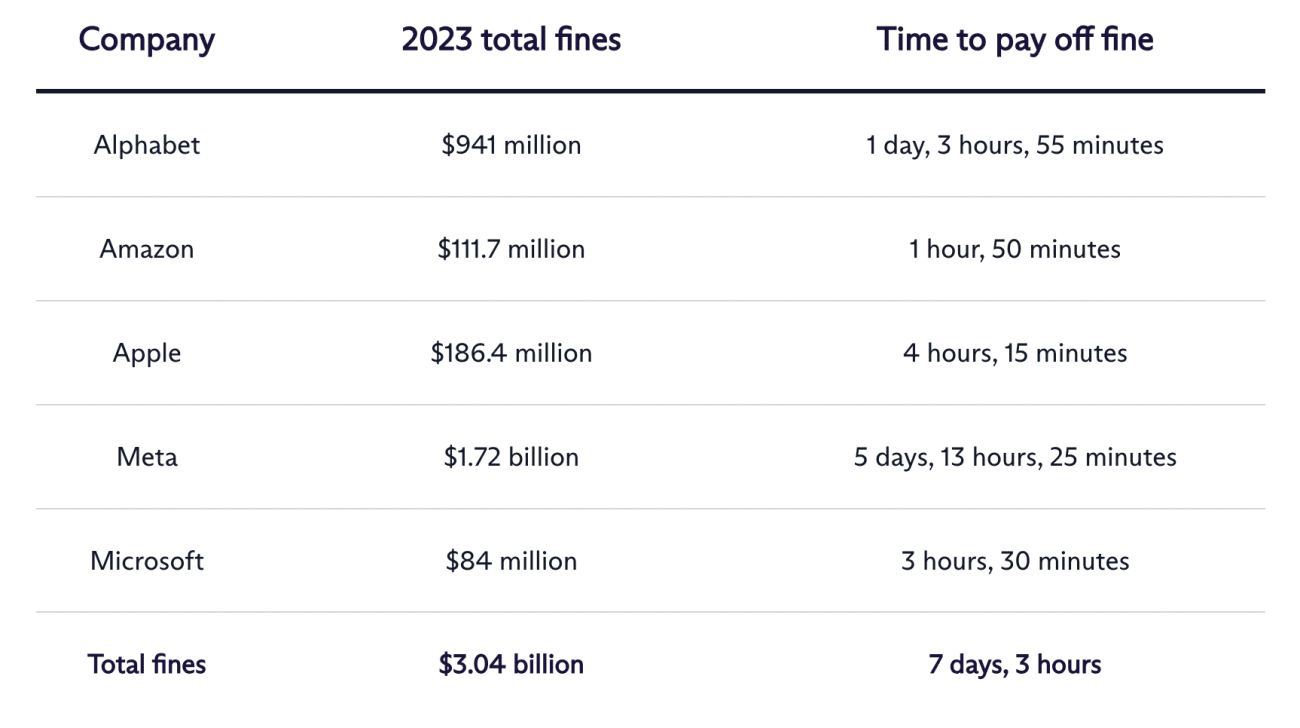
(Source: https://proton.me/blog)
Just in 2022 and 2023, Google had seven antitrust cases, but there are other troublemakers. The rest of the big five giants, Apple (2), Meta (5), Microsoft (2) and Meta (1), also had a major role to play in the stream of legislation, which imposed $3.04 billion in fines for breaking laws across the globe. Interestingly, in the first week of 2024, they had already earned enough revenue to pay it off.
Preparing for 2024
The current legal remedies do not serve their purpose since companies eventually get away with their malpractices, whether it is about changing their policy or the violations. Assuming that, in good conscience, these companies pay the fines, there is no late payment penalty, even if it is delayed for years.
For instance, Proton pointed out that Google still argues against $8 billion in antitrust fines from the EU in 2017, 2018, and 2019. Even Amazon continues to contest its $886 million fine from 2021. These examples do not show a sign of a well-functioning justice system.
These cases are still being governed by laws before the dot com era. The new internet needs a new set of regulations to make the companies pay up. Currently, the companies consider these fines a cost of doing business since they only represent a per cent or two of their total revenue.
Even the chameleon-like policies need to be translated better and clearly instead of dumping it on the users in a million words. The company should be pressured to disclose the updates publicly instead of sneaking around. Going forward in 2024, lawmakers and authorities need to look beyond the balance sheets and figure out ways to stop the existing and upcoming tech companies from moulding the digital infrastructure as per their will.
The post Why We Can’t Trust The Big Tech appeared first on Analytics India Magazine.
Since I've been covering the new boom in AI, I've been getting reader letters asking how to grow into that industry. This letter from Rick is representative of many of them:
I just read your articles pertaining to free AI courses at IBM, OpenAI, and Deep Learning and wanted to see if you could offer some advice.
I'm trying to transition from my industry of life science to big tech. I want to continue to learn more about AI and its applications, with the focus on becoming a product manager who can showcase knowledge and use cases for it.
Do you have any suggestions for an experienced product manager, with very little machine learning experience, starting out on what to learn in the AI/ML space to become marketable? I'm going to start by taking the free courses from IBM as you mentioned. I would love to work with engineering and development teams on crafting products utilizing these technologies specifically.
What stands out about Rick's letter is that he's experienced as a product manager, but his field is life sciences rather than traditional tech. This experience is important, because he does have skills that can transfer into other fields.
Also: Have 10 hours? IBM will train you in AI fundamentals — for free
I also receive letters from readers who don't mention experience or pre-existing skills, but just see that prompt engineers are raking in the big bucks and want to be part of the windfall. I mention this, because a lot of less experienced folks see stories about app developers making millions or prompt engineers making six-figure incomes and think that just one course, or just wanting it hard enough, will get them the gig.
Back when I taught entry-level programming, about half my students wanted to program. The other half wanted programming jobs because they paid well. Unfortunately, that second set of students weren't all that willing to apply themselves to the craft. They just thought that the mere fact that they took a course in programming would get them a job. And it might have. But without demonstrable skills, that job wouldn't have lasted more than a few weeks.
My point here is that you have to be willing to do the work, and you also have to be able to bring something to the job. Rick seems willing to do the work, and he has skills he can bring to the job. Below are the five steps I'd recommend Rick — and anyone interested in pivoting to AI work — take.
1. Identify your current skills
This is important if you want to switch careers. What skills do you already have?
As a product manager, Rick undoubtedly has some people-wrangling skills. Product managers have often been described as CEOs without the authority or the pay. That's because they need to manage and cajole people from multiple disciplines and departments.
He probably has some serious writing skills. Writing a product requirements spec is not a trivial task.
Also: Is prompt engineer displacing data scientist as the 'sexiest job of the 21st century'?
Depending on what kind of product manager he is, he might also have marketing communications skills. By this, I mean the ability to write promotional copy describing his products for prospects, not just the implementation teams.
As an experienced product manager, he probably also has strong project management skills, strong organization skills, and some level of product knowledge (in his case, for life science-related offerings).
2. Identify skills that might transfer
Rick might not be aware of this, but he has skills that are particularly well-suited to the world of AI. Prompt engineering (the writing of instructions for generative AI tools) is much more about structuring requests in natural language than it is about writing code.
Also: 6 skills you need to become an AI prompt engineer
If a product manager can do anything, it's writing clearly articulated specifications that take into account known constraints. That's already very close to prompt engineering. He'll have to learn the particular nuances of prompt engineering and how to battle those constraints, but he's in the perfect place to move into that role.
He also understands development teams, projects, and the product management process, which is as important to tech companies as it is to life science businesses.
What about if you're not a product manager? What skills do you have that might transfer?
Back in the old days of AI, expert systems were built by modeling specific expertise of subject matter experts. But today's large language models pull information from vast tracts of information, often straight off the internet. If you have a domain-specific expertise that's valuable, say medical knowledge or petroleum modeling, or even how a house is constructed, that knowledge may be valuable to AI companies trying to break into those industries.
Also: How to use ChatGPT
Don't assume that knowledge needs to be high-tech or super high-end. If you're a teacher, you have expertise in teaching and communicating knowledge, as well as the fields you teach in. If you're a parent, you sure have experience with the real ins-and-outs of raising kids. If you have warehouse experience, go to the front of the supply chain line.
To be clear, just because you know something doesn't mean you're instantly going to get an AI gig in that area. But make sure you are aware of the subjects you're strong in, and make sure you communicate those subjects as part of your transfer search.
Let's go back to that teacher example. Teaching involves breaking down information into understandable chunks, creating lesson plans, and creating validation procedures to ensure students have learned the material. That's very valuable in the AI process as well.
Also: 6 AI tools to supercharge your work and everyday life
What about if you're a good salesperson? Sales skills are perhaps the most important skills anyone can have because selling pays for our salaries. Learn about the AI business, especially the types of prospects and sales cycles. And then present yourself to an engineering-driven company desperate for sales skills. Here's a hint: most engineers don't have a clue how to sell.
What if you don't have so-called professional skills? What if you're a secretary or administrative assistant? If you're smart, can apply yourself, and can learn, you also have an opportunity here. All companies need strong organizational skills and the ability to structure and manage projects. Do the learning tasks outlined in this article, do the resume-building tasks described at the end, and you might be able to change that title from administrative assistant to logistics manager for an AI company.
What about if you're a coder, but not familiar with AI coding? Coding skills are hugely important. Just focus on the next section and train yourself on how your coding skills can use AI. Build a project or two. I talk about that in-depth next.
3. Train yourself
But, Rick says he doesn't know the AI field. He doesn't know the business of AI (all the players, how they relate, their competitive landscape). He doesn't really know how it all works. And he's never done any actual AI work.
The first is very easy to improve on. Read publications like ZDNET. Read voraciously about the AI industry. In fact, the very best way you can learn about a business you want to move into is to consume all the trade materials you possibly can. Read constantly. If you put in an hour of reading every day for six months, all of it centered on your desired target industry, you'll build a strong familiarity with that industry.
Also: I took this free AI course for developers in one weekend and highly recommend it
Taking the free courses is also a good idea. But it's very important not to just consume the material, but to do the exercises. The ChatGPT Prompt Engineering for Developers course offered by OpenAI (the folks who make ChatGPT) and DeepLearning (an education provider) has a hands-on simulator where you can construct prompts with code, and play with them.
The IBM course has a module where you can use IBM's tool to do some project work. Use it and practice with it. Amazon, too, has free courses that include hands-on experience.
I'll be spotlighting more free courses. Take them. Take as many as you possibly can. Give yourself time to really work the assignments and learn the material.
Then, get yourself a ChatGPT Plus and Midjourney account. You'll spend about $30/mo, but you'll have access to more powerful tools than just the free stuff. Use those tools. A lot. Experiment. Learn their limits and explore their strengths. Become comfortable with what they can do and how they fall short.
Also: You can build your own AI chatbot with this drag-and-drop tool
My point here is simple: make yourself knowledgeable. If you want to get a job in a field where you don't possess the experience, expertise, or credentials, you won't get anywhere without any of them. Fortunately, AI is a field that doesn't require board certification or a specific terminal degree. But it does require knowing stuff.
4. Build yourself some AI resume points
By the time you're ready to ask for a job interview, make yourself into someone who can answer those interview questions with confidence and competence. When asked, "Show me what you've built with AI," have something you're proud to show off. When asked about the future of AI, have enough knowledge to clearly articulate all the issues, opportunities, and concerns. When asked about the strengths and weaknesses of offerings by Amazon, Google, Microsoft, OpenAI, and others, know enough to be able to answer.
Also: Generative AI now requires developers to stretch cross-functionally. Here's why
Another thing that will make you more attractive to hiring managers in the AI space is some experience in the AI space. Now, obviously that's the Catch-22 that's existed with jobs since there were jobs. Hiring managers want folks with experience, but how are you supposed to get experience without the job?
Well, here's how: Be creative.
For someone in product marketing, there are two clear ways to add some fairly easy line items to your resume.
The first is a writing a blog or a newsletter. Starting a Substack is super easy. Write about marketing and business observations involving the AI industry. Deconstruct products and strategies of the various AI players. Even talk about your journey into learning more about AI. Use your product marketing background to provide weight to your discussion.
Also: AI is transforming organizations everywhere. How these 6 companies are leading the way
Now, for those of you not of the product marketing ilk, find how you can relate what you do know to AI and write about it. Experiment with the AI tools you do have and see how they might apply to your unique set of skills. Let yourself tinker, but ultimately, you want to do something you can put up on LinkedIn that has the word "AI" in it.
Speaking of that, especially for our product marketing friend Rick, find an AI Kickstarter project or a small AI startup, and offer to be a part-time advisor. You can offer services like looking over their marketing plans and offering advice or editing, or you can offer to write some marketing copy. The point is, if you don't require payment, and put in a few hours a week, you can start relating with folks in the AI field.
Now, here's the trick that will better help you move the job needle: Agree to do these services in return for giving you a title associated with the company. It doesn't have to be a line title, like "marketing manager." It can simply be "advisor." The point is, you want to be able to legitimately list on your LinkedIn profile something like, "Advisor, Happy Valley AI Enterprises," or something similar.
5. Give it six months
I know. Now that you've decided you want to transition into AI, you want the gig tomorrow. Well, pal, that's not going to happen. But if you give yourself six months, and you work it seriously, you'll have a pretty good chance of moving into this new field.
Put in an hour each day. Make sure you read relevant articles every day. Do some project work and tinkering in the field every few days. Make AI part of what you do. Try using AI in your current job, just to see how it can fit in.
Also: I spent a weekend with Amazon's free AI courses, and highly recommend you do too
The point here is that by the end of six months, make it so that AI isn't this new thing you want to move into, it's this thing that you're already very familiar with and use as a matter of your daily activities.
That way, by the end of the six months, you're not asking to "move into AI," but to "use your AI skills and knowledge in the AI field." That'll come across as much more powerful to hiring managers.
Let us know how it goes
Feel free to share your journey of exploration and transformation in the comments below. Or, even better, share it in your new blog or Substack. Good luck. Be strong. Be curious. What do you think? Let us know if Rick's path seems like it might be similar to yours. Did you learn anything you can put to use? What ideas do you have that I didn't share? Let us know in the comments below.
You can follow my day-to-day project updates on social media. Be sure to subscribe to my weekly update newsletter on Substack, and follow me on Twitter at @DavidGewirtz, on Facebook at Facebook.com/DavidGewirtz, on Instagram at Instagram.com/DavidGewirtz, and on YouTube at YouTube.com/DavidGewirtzTV.
Researchers at cybersecurity research and consulting firm Trail of Bits have discovered a vulnerability that could allow attackers to read GPU local memory from affected Apple, Qualcomm, AMD and Imagination GPUs. In particular, the vulnerability—which the researchers named LeftoverLocals—can access conversations performed with large language models and machine learning models on affected GPUs.
Which GPUs are affected by the LeftoverLocals vulnerability, and what has been patched?
Apple, Qualcomm, AMD and Imagination GPUs are affected. All four vendors have released some remediations, as follows:
Apple has released fixes for the A17 and M3 series processors and for some specific devices, such as the Apple iPad Air 3rd G (A12); Apple did not provide a complete list of which devices have been secured. As of Jan. 16, the Apple MacBook Air (M2) was vulnerable, according to Trail of Bits. Recent Apple iPhone 15s do not appear to be vulnerable. When asked for more detail by TechRepublic, Apple provided a prewritten statement thanking the researchers for their work.
AMD plans to release a new mode to fix the problem in March 2024. AMD released a list of affected products.
Imagination updated drivers and firmware to prevent the vulnerability, which affected DDK Releases up to and including 23.2.
Qualcomm released a patch for some devices, but it did not provide a complete list of which devices are and are not affected.
How does the LeftoverLocals vulnerability work?
Put simply, it’s possible to use a GPU memory region called local memory to connect two GPU kernels together, even if the two kernels aren’t on the same application or used by the same person. The attacker can use GPU compute applications such as OpenCL, Vulkan or Metal to write a GPU kernel that dumps uninitialized local memory into the target device.
CPUs typically isolate memory in a way that it wouldn’t be possible to use an exploit like this; GPUs sometimes do not.
SEE: Nation-state threat actors were found to be exploiting two vulnerabilities in Ivanti Secure VPN in early January (TechRepublic)
In the case of open-source large language models, the LeftoverLocals process can be used to “listen” for the linear algebra operations performed by the LLM and to identify the LLM using training weights or memory layout patterns. As the attack continues, the attacker can see the interactive LLM conversation.
The listener can sometimes return incorrect tokens or other errors, such as words semantically similar to other embeddings. Trail of Bits found their listener extracted the word “Facebook” instead of the similar Named Entity token such as “Google” or “Amazon” the LLM actually produced.
LeftoverLocals is tracked by NIST as CVE-2023-4969.
How can businesses and developers defend against LeftoverLocals?
Other than applying the updates from the GPU vendors listed above, researchers Tyler Sorensen and Heidy Khlaaf of Trail of Bits warn that mitigating and verifying this vulnerability on individual devices may be difficult.
GPU binaries are not stored explicitly, and not many analysis tools exist for them. Programmers will need to modify the source code of all GPU kernels that use local memory. They should ensure that GPU threads clear memory to any local memory locations not used in the kernel, and check that the compiler doesn’t remove these memory-clearing instructions afterward.
Developers working in machine learning or application owners using ML apps should take special care. “Many parts of the ML development stack have unknown security risks and have not been rigorously reviewed by security experts,” wrote Sorensen and Khlaaf.
Trail of Bits sees this vulnerability as an opportunity for the GPU systems community to harden the GPU system stack and corresponding specifications.
In the new year, Microsoft has been revamping its AI offerings, such as unveiling Copilot Pro, rebranding its AI image generator, and expanding availability. Now, the company is also expanding its AI tools for education.
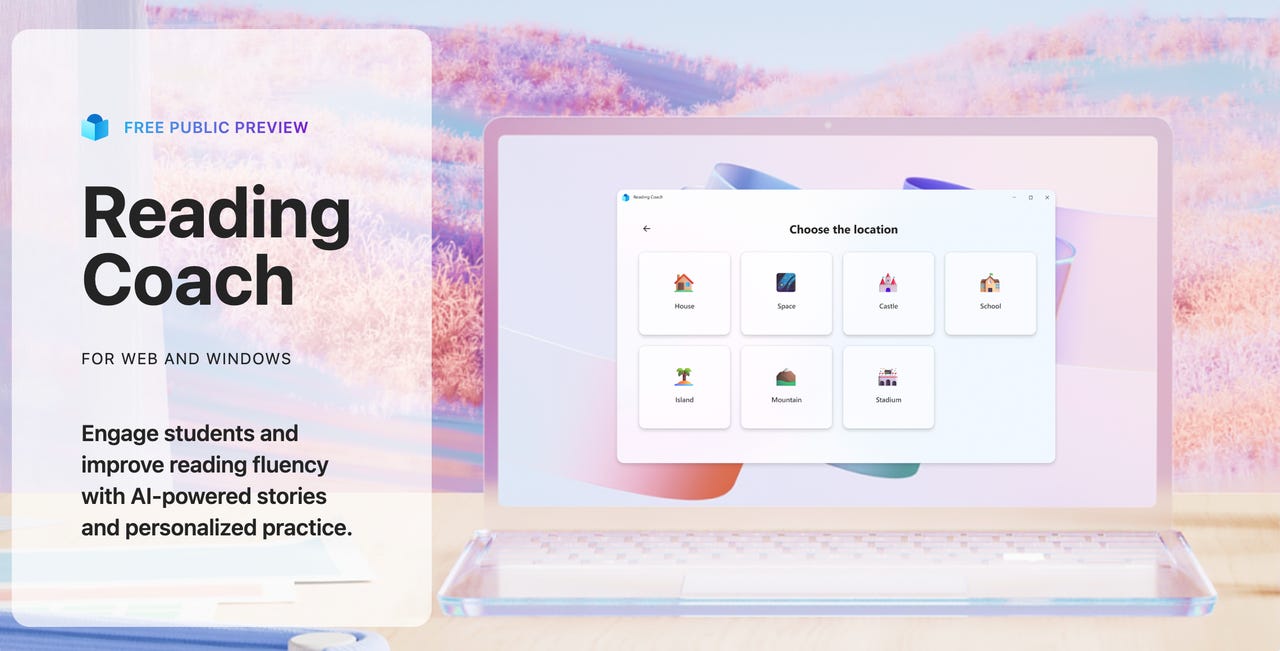
On Thursday, Microsoft introduced an improved Reading Coach, leveraging generative AI to provide students with new personalized and engaging reading experiences.
Also: Microsoft just renamed Bing Image Creator, and gave Copilot Pro users extra perks
In addition to selecting from one of the prewritten stories, students can now use generative AI to create a story. The student will first pick a protagonist, genre, setting, and reading level to generate a story.
Then, once the story is generated, the user can start reading, and the microphone will pick up their audio for feedback on pronunciation and words to practice. As the students read, they also will be prompted to choose from different narrative paths to alter the story's progression.
Because generative AI is prone to hallucinations, and to keep the platform student-friendly, Microsoft implemented a set of guardrails, moderating the story for quality, safety, and age appropriateness, according to the release.
Also: Have Amazon product questions? Its new AI bot has answers, and poems
Reading Coach gamifies reading, allowing users to unlock new story settings, characters, and badges. Students also can access an achievement page to see their progression and accumulated badges.
If you want to try this AI-powered learning tool, you can preview Reading Coach for free today at coach.microsoft.com. I tried it for myself, and it was fun and interesting to see it in action.
Microsoft also introduced new features to Microsoft Teams for Education and Microsoft Reflect to help educators better serve their students' needs, including using AI to create assignments with rubrics, key content, learning objectives, and more.