This Week in AI: OpenAI finds a partner in higher ed

This Week in AI: OpenAI finds a partner in higher ed Kyle Wiggers Devin Coldewey 8 hours

Keeping up with an industry as fast-moving as AI is a tall order. So until an AI can do it for you, here’s a handy roundup of recent stories in the world of machine learning, along with notable research and experiments we didn’t cover on their own.

This week in AI, OpenAI signed up its first higher education customer: Arizona State University.

ASU will collaborate with OpenAI to bring ChatGPT, OpenAI’s AI-powered chatbot, to the university’s researchers, staff and faculty — running an open challenge in February to invite faculty and staff to submit ideas for ways to use ChatGPT.

The OpenAI-ASU deal illustrates the shifting opinions around AI in education as the tech advances faster than curriculums can keep up. Last summer, schools and colleges rushed to ban ChatGPT over plagiarism and misinformation fears. Since then, some have reversed their bans, while others have begun hosting workshops on GenAI tools and their potential for learning.

The debate over the role of GenAI in education isn’t likely to be settled anytime soon. But — for what it’s worth — I find myself increasingly in the camp of supporters.

Yes, GenAI is a poor summarizer. It’s biased and toxic. It makes stuff up. But it can also be used for good.

Consider how a tool like ChatGPT might help students struggling with a homework assignment. It could explain a math problem step-by-step or generate an essay outline. Or it could surface the answer to a question that’d take far longer to Google.

Now, there’s reasonable concerns over cheating — or at least what might be considered cheating within the confines of today’s curriculums. I’ve anecdotally heard of students, particularly students in college, using ChatGPT to write large chunks of papers and essay questions on take-home tests.

This isn’t a new problem — paid essay-writing services have been around for ages. But ChatGPT dramatically lowers the barrier to entry, some educators argue.

There’s evidence to suggest that these fears are overblown. But setting that aside for a moment, I say we step back and consider what drives students to cheat in the first place. Students are often rewarded for grades, not effort or understanding. The incentive structure’s warped. Is it any wonder, then, that kids view school assignments as boxes to check rather than opportunities to learn?

So let students have GenAI — and let educators pilot ways to leverage this new tech to reach students where they are. I don’t have much hope for drastic education reform. But perhaps GenAI will serve as a launchpad for lesson plans that get kids excited about subjects they never would’ve explored previously.

Here are some other AI stories of note from the past few days:

Microsoft’s reading tutor: Microsoft this week made Reading Coach, its AI tool that provides learners with personalized reading practice, available at no cost to anyone with a Microsoft account.

Algorithmic transparency in music: EU regulators are calling for laws to force greater algorithmic transparency from music streaming platforms. They also want to tackle AI-generated music — and deepfakes.

NASA’s robots: NASA recently showed off a self-assembling robotic structure that, Devin writes, might just become a crucial part of moving off-planet.

Samsung Galaxy, now AI-powered: At Samsung’s Galaxy S24 launch event, the company pitched the various ways that AI could improve the smartphone experience, including through live translation for calls, suggested replies and actions and a new way to Google search using gestures.

DeepMind’s geometry solver: DeepMind, the Google AI R&D lab, this week unveiled AlphaGeometry, an AI system that the lab claims can solve as many geometry problems as the average International Mathematical Olympiad gold medalist.

OpenAI and crowdsourcing: In other OpenAI news, the startup is forming a new team, Collective Alignment, to implement ideas from the public about how to ensure its future AI models “align to the values of humanity.” At the same time, it’s changing its policy to allow military applications of its tech. (Talk about mixed messaging.)

A Pro plan for Copilot: Microsoft has launched a consumer-focused paid plan for Copilot, the umbrella brand for its portfolio of AI-powered, content-generating technologies, and loosened the eligibility requirements for enterprise-level Copilot offerings. It’s also launched new features for free users, including a Copilot smartphone app.

Deceptive models: Most humans learn the skill of deceiving other humans. So can AI models learn the same? Yes, the answer seems — and terrifyingly, they’re exceptionally good at it. according to a new study from AI startup Anthropic.

Tesla’s staged robotics demo: Elon Musk’s Optimus humanoid robot from Tesla is doing more stuff — this time folding a t-shirt on a table in a development facility. But as it turns out, the robot’s anything but autonomous at the present stage.

More machine learnings

One of the things holding back broader applications of things like AI-powered satellite analysis is the necessity of training models to recognize what may be a fairly esoteric shape or concept. Identifying the outline of a building: easy. Identifying debris fields after flooding: not so easy! Swiss researchers at EPFL are hoping to make it easier to do this with a program they call METEOR.
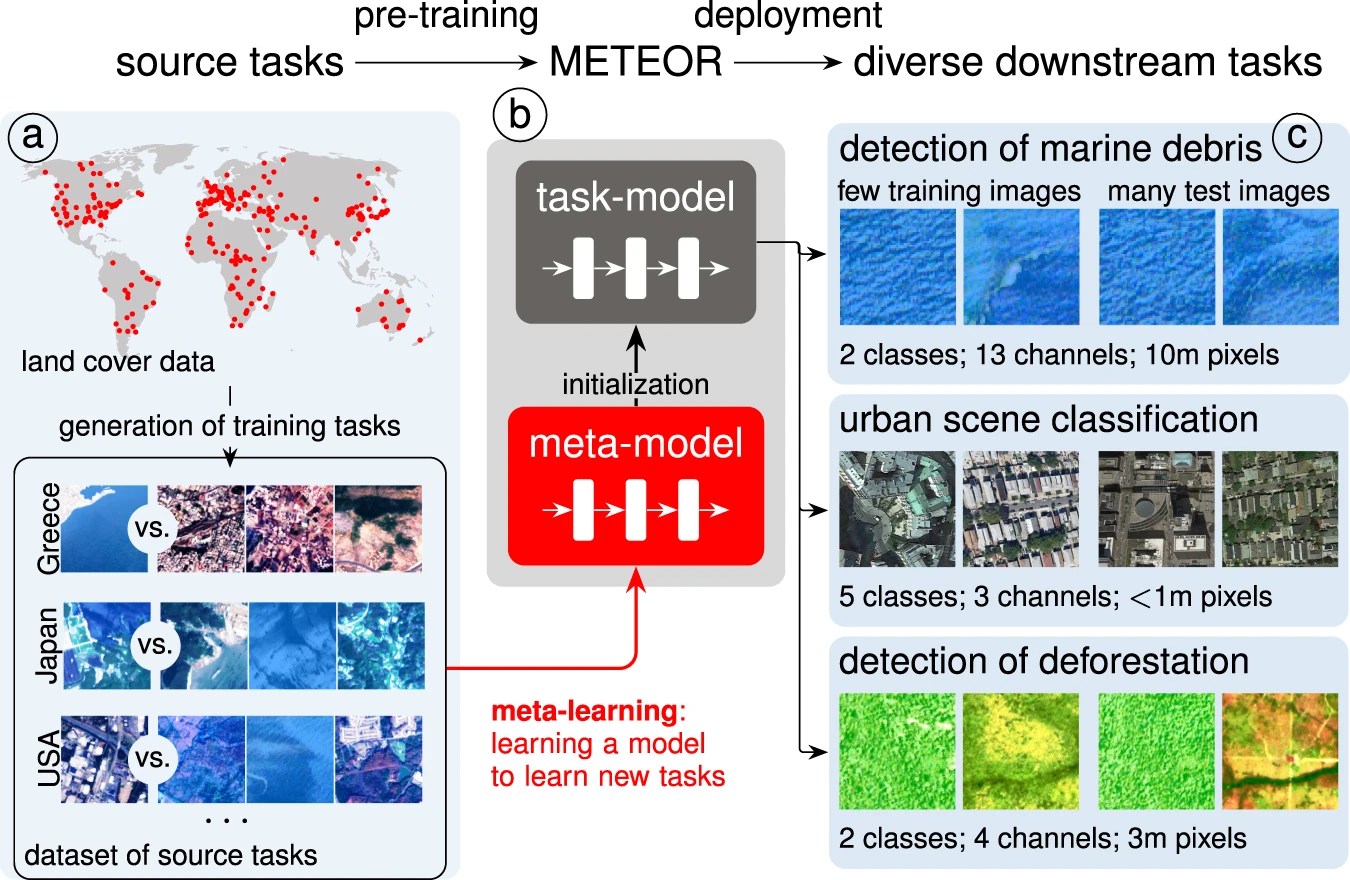
Image Credits: EPFL

“The problem in environmental science is that it’s often impossible to obtain a big enough dataset to train AI programs for our research needs,” said Marc Rußwurm, one of the project’s leaders. Their new structure for training allows a recognition algorithm to be trained for a new task with just four or five representative images. The results are comparable to models trained on far more data. Their plan is to graduate the system from lab to product with a UI for ordinary people (that is to say, non-AI-specialist researchers) to use it. You can read the paper they published here.

Going the other direction — creating imagery — is a field of intense research, since doing it efficiently could reduce the computation load for generative AI platforms. The most common method is called diffusion, which gradually refines a pure noise source into a target image. Los Alamos National Lab has a new approach they call Blackout Diffusion, which instead starts from a pure black image.

That removes the need for noise to begin with, but the real advance is in the framework taking place in “discrete spaces” rather than continuous, greatly reducing the computational load. They say it performs well, and at lower cost, but it’s definitely far from wide release. I’m not qualified to evaluate the effectiveness of this approach (the math is far beyond me) but national labs don’t tend to hype up something like this without reason. I’ll ask the researchers for more info.

AI models are sprouting up all over the natural sciences, where their ability to sift signal out of noise both produces new insights and saves money on grad student data entry hours.

Australia is applying Pano AI’s wildfire detection tech to its “Green Triangle,” a major forestry region. Love to see startups being put to use like this — not only could it help prevent fires, but it produces valuable data for forestry and natural resource authorities. Every minute counts with wildfires (or bushfires, as they call them down there), so early notifications could be the difference between tens and thousands of acres of damage.

Permafrost reduction as measured by the old model, left, and the new model, right.

Los Alamos gets a second mention (I just realized as I go over my notes) since they’re also working on a new AI model for estimating the decline of permafrost. Existing models for this have a low resolution, predicting permafrost levels in chunks about 1/3 of a square mile. That’s certainly useful, but with more detail you get less misleading results for areas that might look like 100% permafrost at the larger scale but are clearly less than that when you look closer. As climate change progresses, these measurements need to be exact!

Biologists are finding interesting ways to test and use AI or AI-adjacent models in the many sub-fields of that domain. At a recent conference written up by my pals at GeekWire, tools to track zebras, insects, even individual cells were being shown off in poster sessions.

And on the physics side and chemistry side, Argonne NL researchers are looking at how best to package hydrogen for use as fuel. Free hydrogen is notoriously difficult to contain and control, so binding it to a special helper molecule keeps it tame. The problem is hydrogen binds to pretty much everything, so there are billions and billions of possibilities for helper molecules. But sorting through huge sets of data is a machine learning specialty.

““We were looking for organic liquid molecules that hold on to hydrogen for a long time, but not so strongly that they could not be easily removed on demand,” said the project’s Hassan Harb. Their system sorted through 160 billion molecules, and by using an AI screening method they were able to look through 3 million a second — so the whole final process took about half a day. (Of course, they were using quite a large supercomputer.) They identified 41 of the best candidates, which is a piddling number for the experimental crew to test in the lab. Hopefully they find something useful — I don’t want to have to deal with hydrogen leaks in my next car.

To end on a word of caution, though: a study in Science found that machine learning models used to predict how patients would respond to certain treatments was highly accurate… within the sample group they were trained on. In other cases, they basically didn’t help at all. This doesn’t mean they shouldn’t be used, but it supports what a lot of people in the business have been saying: AI isn’t a silver bullet, and it must be tested thoroughly in every new population and application it is applied to.

[Exclusive] Meet the AI Advisor of Prime Minister Narendra Modi

Apart from meeting the Indian Prime Minister Narendra Modi at the Global AI Summit to discuss the knowledge economy and AI initiatives that India can build, Amit Sheth, the chair and founding director of the Artificial Intelligence Institute at the University of Southern Carolina (AIISC), has been continuously working with Indian academic institutions to drive research in the country.

AIM caught up with Sheth to gain insights about how he views the current state of AI in India and how it can be fostered further to have more breakthroughs from within the country on a global scale.

“When I first spoke to Mr Modi in 2009, Google’s valuation was around $100 billion, compared to India’s total GDP of $1.1 trillion,” Sheth highlighted that in the US, universities such as Stanford and UC Berkeley promote research that helps companies such as Google to build better products. The same needs to be done within India.

“Though Indian universities produce some very good engineers, they are very successful in the West. I think it’s time we take a look at India, and see if we can build something like ChatGPT from India,” Sheth emphasised the need for India to innovate and ship AI products to the rest of the world, including the West.

A similar thought was also expressed about Indian institutions by NVIDIA chief Jensen Huang when he visited India. “We should build here, train here, and produce AI here. You have everything you need to build the AI and use the AI here in India, but you need to have the infrastructure,” he said, saying how IITs have become the talent hub of the world.

India can build relevant and useful AI models

“Nobody else will build these Indic language models, and it’s definitely needed at the moment,” Sheth expressed enthusiasm about the rise of Indic LLMs such as Kannada, Tamil, and Telugu models based on Meta’s Llama 2 model. “We should try to use these models in nonsevere healthcare use cases such as anxiety and depression, as AI models today are capable of supporting patients with such conditions safely, while protecting privacy and confidentiality,” he explained.

“We have unique datasets and problems that no one else has, and we should leverage that to create specific AI models,” Sheth said that India can create possibly the best health-related model with its large and unique healthcare datasets.

He believes that this can be achieved with academic and private partnerships, which BharatGPT, Ola’s Krutrim, Sarvam AI, and Tech Mahindra’s Project Indus are also on the path. “A lot more research needs to be done, and I think high-quality original research is growing,” he added, also emphasising that it is also the government’s responsibility to support these projects by providing funds to travel to conferences or providing GPUs for training AI models, rather than the students having to buy the infrastructure.

“There needs to be a lot more investment in AI research, which is still very low,” according to Sheth, compared to other countries. “But India is still doing great despite less funding.”

To skyrocket this, Sheth is part of a team that has proposed Ekagrid, a private research university with an ambition to be ranked among the top in the world and contribute to India’s research-driven ecosystem as Stanford and UC-Berkely have done for Silicon Valley. This team includes experts from 11 of the 25 top universities in the world. The project is still in its initial stages and is looking to raise funds. “The Prime Minister was very prompt and quick to understand the need for this project and provide actionable guidance”

India’s vision should be progressive and aggressive

“Generally, I would not be the right person to talk to administrators, bureaucrats, and politicians about my work, but I saw that the Prime Minister has been very open to engaging with experts and gaining insights he can use to transform India, in this case by using AI.”

After his engaging discussion with the PM that lasted over half an hour, he was invited to give a one-hour inaugural keynote at the third Annual Conference of Chief Secretaries. This conference had well over 150 top government secretaries from all states and many central government ministries.. He sees this as the PM’s effort to inform and educate all the key people he will rely on for implementing his vision of using AI to transform India.

Highlighting Prime Minister’s and Rajeev Chandrashekar’s speech during the Global AI Summit, Sheth said that the government looks very keen on transforming India with generative AI. Therefore, given Sheth’s expertise in building three research organisations including AIISC, he said that his work heavily overlaps with the emphasis that the government is doing.

“The government is focused on AI for health, cybersecurity, and education, as three of the top application areas,” Sheth said. That is what Sheth told the ministry about what part of AI India should invest in going forward. While generative AI has caught everyone’s attention, he outlined the relevance and importance of neurosymbolic AI approach which is what he believes will drive the next, third phase of AI.

No fear of AI

Giving examples of fake news and the problems with detecting AI-generated content, Sheth also told the panel that solving every problem with generative AI is not feasible. “Generative AI is purely driven by data; data alone is not enough to solve all the problems. We must incorporate knowledge and human experience in that process,” he said when explaining how neurosymbolic AI advances generative AI.

Sheth believes that we are not ready yet to train a model to compete with OpenAI’s GPT-4 as it would take millions of dollars and compute, which is hard to acquire at the moment. Plus, he also says that we also need to make sure about gathering data ethically.

“There is a lot of scope for developing targeted and compact models that can do specific jobs with around 7 billion parameters. That is what people are doing as well in India,” he said about many models coming up for specific use cases, giving an example of Microsoft’s Phi-2 as one of the platforms of relevance. This is what his team is also currently pursuing.

When talking about AI education, Sheth said that AI is going to create a lot more jobs than it is going to remove. Most importantly, Sheth added, “We should start teaching AI not just from high school, but also from middle school to make kids accustomed to AI and not fear it replacing them.”

“The number of jobs AI can replace is likely to be much smaller than some estimates that are as high as 40% . Some areas might have more effect than others,” Sheth said about the overhyped fear of AI replacing jobs. “You have to learn how to learn and adapt to new things. That is what I keep telling my students to learn something outside of the degree,” Sheth concluded on a positive note.

The post [Exclusive] Meet the AI Advisor of Prime Minister Narendra Modi appeared first on Analytics India Magazine.

The Real Reason behind Big Tech’s Recent Mass Layoffs

Recently, several big tech companies, including Google, Amazon and others, have been laying off a significant number of employees. While some, like Paytm and Dropbox,

cite AI advancements as a reason for layoffs, this isn’t universally the case, and sometimes it is because of quarterly-driven results for cost-cutting and restructuring.

Citing Salesforce’s layoff strategy, Zoho chief Sridhar Vembu said that such companies are constantly engaged in hiring and firing sprees driven by short-term, quarterly financial goals. He noted that this approach is common in publicly traded companies, which focus on immediate cost-cutting and restructuring, often leading to a volatile employment environment.

Quarterly-Driven Layoffs

At the start of 2023, Salesforce announced a 10% layoff of their workforce, which resulted in more than 7,000 employees losing their jobs. The two quarters following the firing showed promising numbers.

Technology advisor and writer Gergely Orosz observed that post the firing of employees and posting good quarterly results, the company underwent a hiring spree. Shortly after, they went on a hiring freeze, preluding how Q4 2023 must have fared for the company.

Recently, Citigroup said it would be cutting 20,000 jobs, which is about 10% of the workforce, owing to a disappointing net loss in the fourth-quarter results. The CEO of Citigroup, Jane Fraser, had announced a restructuring in September, which would contribute to job cuts. The bank is trying to cut over $50 billion of expenses and believes the layoffs will save about $2.5 billion this year.

This is the same for Indian IT as well. At TCS’ recent earnings call, the company confirmed hiring a number of freshers in the previous quarter. They will also go ahead with their plan of hiring 40,000 freshers in 2024. However, Milind Kakkad, chief HR officer of TCS said, “Depending on the overall condition and [in order to] drive efficiency, if the headcount needs to be reduced, then so be it.”

Similarly, American multinational investment management corporation BlackRock had announced its plans to lay off 3% of its workforce, i.e. 600 employees, so as to defend their profit margins. However, the publicly-traded company also said that they will continue to grow their workforce

Situational-based Hiring and Firing

When the pandemic led to many losing their jobs globally, specific domains thrived in the situation. With the high digital economic boom during the period, a number of corporations working in the relevant sectors resorted to mass hiring, and in many cases, over-hiring. With the pandemic waning, many companies then had to let go of their employees to sustain.

Venture capitalists and investors also stepped up the pressure on their invested startups to either reduce their headcount or slow down the hiring process in order to conserve cash.

Interestingly, the founder of Dukaan, a DIY e-commerce platform, got infamous last year for firing 90% of its support staff owing to an AI chatbot. Though the founder Suumit Shah claimed that an AI chatbot has replaced the support workforce, the company had already faced two rounds of layoffs before he could attribute it to AI.

Not all job losses could be attributed to AI, as author and founder Dave Birss said, “AI is a fantastic scapegoat for unpleasant business decisions.”

Lean wins

Unlike other venture capital or investors-backed companies, Vembu’s bootstrapped company Zoho does not succumb to external forces that would dictate the firing demands. By adopting an agile and lean methodology, the company has been able to duck the mass layoff trend.

In an earlier exclusive interaction with AIM, Vembu said that Zoho will never resort to layoffs, but only internally repurpose their employees. However, it will caution their employees on new technologies.

Hiring pattern in big tech companies. Source: PragmaticEngineer

An engineer from Apple had mentioned that despite Apple being understaffed in almost all teams, the employees had to learn to achieve their tasks with the current workforce. The company also did not cave into giving high salaries owing to resignation pressures.

Apple has been synonymous for having not resorted to any form of mass hiring or firing based on company results. Tim Cook had previously mentioned that layoffs are the last resort – an approach that is independent of quarterly results.

The post The Real Reason behind Big Tech’s Recent Mass Layoffs appeared first on Analytics India Magazine.

AI Now Helps You Quit Smoking

Apart from finding cure for diseases, AI is now also your buddy who will help you quit smoking. Quitbot is a LLM-based chatbot developed by Fred Hutch Cancer Research Centre with a complimentary mobile application that integrates a scientifically validated smoking cessation program with ChatGPT, providing users with a virtual counsellor at their fingertips.

In the recent The Prompt show by Trevor Noah, behavioural psychologist Jonathan Bricker from University of Washington, explained the need for building such a chatbot to help people quit smoking.

“There are 8 million people in the world who die every single year because of tobacco use,” he explained that nicotine is more addictive than any other drug. Yet, there are not enough medical programmes that help people quit smoking.

The app delivers step-by-step guidance on the quitting process, equips users with tools to manage smoking urges, offers motivational support, and allows users to pose their own questions, serving as a doctor.

Users can interact with the chatbot talking about when they are feeling stressed and what triggers them to smoke, and it will learn about your patterns, and it comes back to you later and reminds you why you are quitting.

Bricker highlights that QuitBot is not just a chatbot to help people quit smoking, but also a tool that can help them break any habit that they are trying to. Serving as a virtual coach, QuitBot collaborates with individuals to establish goals, provide encouragement and assistance as needed, impart coping skills for cravings, and aid in the recovery from setbacks.

With QuitBot, individuals enjoy convenient 24/7 access to cessation support, empowering them to quit smoking with assistance right in the palm of their hands.

The post AI Now Helps You Quit Smoking appeared first on Analytics India Magazine.

Top 6 Computer Vision Models Released in 2024

Ever since the likes Stable Diffusion, DALL.E and Midjourney made their way to the internet, text-to-image and text-to-vision models witnessed immense expansion. As we step into 2024, this growth shows no signs of slowing down.

In the ever-evolving landscape, let’s explore some of the most compelling computer vision models that have been introduced thus far.

Parrot: Pareto-optimal Multi-Reward Reinforcement Learning Framework for Text-to-Image Generation

Developed by an interesting team of researchers from Google Research, Google DeepMind, OpenAI, Rutgers University, and Korea University, this research introduces Parrot, a new reinforcement learning (RL) framework to improve text-to-image (T2I) generation by optimising multiple quality rewards.

Parrot addresses challenges associated with over-optimisation and manual weight selection by employing batch-wise Pareto optimal selection. It co-trains the T2I model and prompts an expansion network, enhancing the generation of quality-aware text prompts. To prevent forgetting the original user prompt, Parrot also introduces original prompt-centered guidance at inference time. Experimental results and a user study demonstrate that Parrot outperforms baseline methods across various quality criteria, including aesthetics, human preference, image sentiment, and text-image alignment.

AIM

Apple has introduced AIM, a set of autoregressive image models inspired by large language models (LLMs), exhibiting scalability similar to their textual counterparts. The key findings indicate that visual features’ performance scales with both model capacity and data quantity, and the objective function value correlates with downstream task performance. By Pre-training a seven billion parameter AIM on two billion images, This AIM model achieved an 84.0% accuracy on ImageNet1k, even when its core part (trunk) is kept fixed or unchanged.

AIM, pre-trained similarly to LLMs, presents a scalable method without image-specific strategies. It has potential as a new scope for large-scale vision model training, boasting desirable properties and strong correlations between pre-training and downstream performance. The models exhibit no saturation signs, suggesting further performance improvements with larger models trained for extended schedules.

InstandID: Zero-shot Identity-Preserving Generation in Seconds

While methods like Textual Inversion, DreamBooth, and LoRA have been important discoveries in personalised image synthesis, practical application is often hindered due to storage demands, lengthy fine-tuning, and reliance on multiple reference images. On the other hand, ID embedding-based methods face challenges such as extensive fine-tuning, lack of compatibility with pre-trained models, or compromised face fidelity.

Diffusion model-based model InstantID was made to solve this problem. This plug-and-play module efficiently handles image personalisation in various styles with just one facial image, ensuring high fidelity. InstantID introduces IdentityNet, incorporating strong semantic and weak spatial conditions for image generation.

It integrates with popular text-to-image models like SD1.5 and SDXL, offering a versatile plugin. Our solution excels in zero-shot identity-preserving generation, proving valuable in real-world scenarios. While demonstrating robustness, compatibility, and efficiency, challenges persist, including coupled facial attributes and potential biases.

Distilling Vision-Language Models on Millions of Videos

In an aim to replicate the success of abundance image-text data for video-language models, Google and the University of Texas teamed up to fine-tune a video-language model using synthesised instructional data, starting from a robust image-language baseline. The resulting video-language model is used to automatically label millions of videos, generating high-quality captions.

It claims to excel in generating detailed descriptions for new videos, providing high-quality textual supervision compared to existing methods. Experiment results reveal that a video-language dual-encoder model, contrastively trained on auto-generated captions, outperforms the strongest baseline leveraging vision-language models by 3.8%.

Motionshop

Alibaba has introduced a new framework called Motionshop that can be used for replacing video characters with 3D avatars, comprising two main components: a video processing pipeline for background extraction and a pose estimation/rendering pipeline for avatar generation. The process is expedited through parallelisation and the use of a high-performance ray-tracing renderer (TIDE), enabling completion in minutes.

Additionally, it employs pose estimation, animation retargeting, and light estimation for consistent integration of 3D models. The rendering phase employs TIDE for efficient video production with photorealistic features. The final video is generated by compositing the rendered image with the original video.

LEGO

Chinese tech company ByteDance and Fudan University have introduced a unified end-to-end multi-modal grounding model called LEGO, that can capture fine-grained local information, demonstrating precise identification and localisation in images or videos.

The model is trained on a diverse multi-modal, multi-granularity dataset, resulting in improved performance on tasks demanding detailed understanding. To address data scarcity, a comprehensive multi-modal grounding dataset was also created. The model, code, and dataset are open sourced to foster advancements in the field.

The post Top 6 Computer Vision Models Released in 2024 appeared first on Analytics India Magazine.

AI adoption and innovation will add trillions of dollars in economic value

man at laptop working with AI tools

There's significant debate about the potential of generative artificial intelligence (AI) — and those discussions include contributions from the technology itself, according to an Accenture report on the reinvention of work, workforce, and workers in the age of generative AI.

Also: 4 ways to overcome your biggest worries about generative AI

"Generative AI has the potential to significantly change the nature of work across various industries and fields. The impact of generative AI on work will depend on how it is implemented, regulated, and integrated into various industries and organizations," says a response generated by ChatGPT included in the latest Accenture report. The answer was a response to the following question: 'How will generative AI change work?'

The report looks at the changing nature of work.

The Accenture research on generative AI, which is based on an analysis of over 700 client projects, has an optimistic point of view. The research suggests the emerging technology can bring workers closer to their customers, streamline operations, identify new products and service opportunities, and positively impact the bottom line.

The research also suggests generative AI offers a trifecta of opportunities: it can accelerate economic value, and increase productivity that drives business growth, while also fostering more creative and meaningful work for people.

Also: AI safety and bias: Untangling the complex chain of AI training

Here are some of the key findings from Accenture's report:

  1. AI adoption and innovation scenarios show that more than $10.3 trillion in additional economic value can be unlocked by 2038 if organizations adopt generative AI responsibly and at scale.
  2. Respondents believe generative AI will ultimately increase their company's market share, and 17% anticipate an increase in market share by 10% or more.
  3. As much as 95% of workers see value in working with generative AI — but their top concern is that they don't trust organizations to ensure positive outcomes for everyone.
  4. Reinventors (representing 9% of organizations) are two times more likely than other organizations to anticipate productivity gains of 20% or more in the next three years. And two out of three strongly agree that, with generative AI, work will become more fulfilling and meaningful. Accenture's research reveals that of the 9% of organizations that have achieved the capability for continuous reinvention, nearly half (47%) of these reinventors are already thinking bigger — they recognize their processes will require significant change to fully leverage generative AI. Yet, two-thirds of CxOs do not have the right skills and capabilities needed to successfully reinvent their organizations.
  5. Despite 94% of people saying they are ready to learn new skills to work with generative AI, only 5% of organizations are actively reskilling their workforce at scale.
  6. Almost all (95%) of employees see value in working with generative AI, and 82% say they already have some understanding of the technology.
  7. As many as 86% of CxOs are already using generative AI to some degree in their work and nearly all believe the technology will be transformative for their company and industry. All CxOs surveyed anticipate changes to their workforce (for example, growing or reducing headcount and implementing plans to reskill). Yet only one in three leaders believe they have the technology expertise or feel they can tell a compelling transformation narrative to lead the change that's needed.
  8. Trust is key to the adoption and successful implementations of generative AI. People also need to trust that the organization will integrate the technology in ways that protect and prepare workers. Almost a third (32%) of leaders see talent scarcity, due to skill gaps or unawareness, as a major barrier in utilizing generative AI. Additionally, 36% believe workers will not fully embrace the technology due to a lack of technological understanding.
  9. The trifecta of opportunities — economy, business, people — stands out, potentially creating an additional $10.3 trillion in economic value by 2038. Most CxOs believe generative AI will ultimately increase their company's market share, with 17% predicting the technnology will increase their market share by 10% or more.
  10. Accenture's research has shown that helping people to become "Net Better Off" unlocks nearly two-thirds (64%) of a person's potential at work.
  11. Over 65% of executives admit they lack the technological expertise required for generative AI-led transformation. Accenture reports that the license to guide an organization through the generative AI journey must be earned, especially given the trust gap identified in the research. This framework of learning starts with knowing the fundamentals of AI and digital adjacencies — cloud, data, and security.
  12. Work will be reinvented with AI. Nearly half of reinventors — the 9% of organizations that are leaders in reinvention — recognize that processes across the value chain will require significant changes to realize the trifecta of opportunities from generative AI.
  13. Workforce and skills will be reinvented by generative AI. Organizations that are skills-driven — with robust skills infrastructure and tools, as well as integrated data across the enterprise — are agile and armed with the predictive insights on skills needed to reshape their workforce, today and tomorrow.
  14. Economic research suggests that relevant human capital investments, like training, should exceed technology investments by as much as nine-fold.

Also: Does your business need a chief AI officer?

Accenture's research concludes with this friendly reminder to business leaders: "As leaders, we are lucky if we have one opportunity in our careers to identify a genuine catalyst for monumental change. Generative AI is that opportunity."

I encourage you all to review the Technology Vision Report 2024 that highlights key AI trends for the next decade. To learn more about how generative AI will impact work, the workforce, and workers, you can visit here.

Artificial Intelligence

You can use AI in Instagram to generate fun backgrounds for your stories. Here’s how

Instagram Backdrop Feature hero

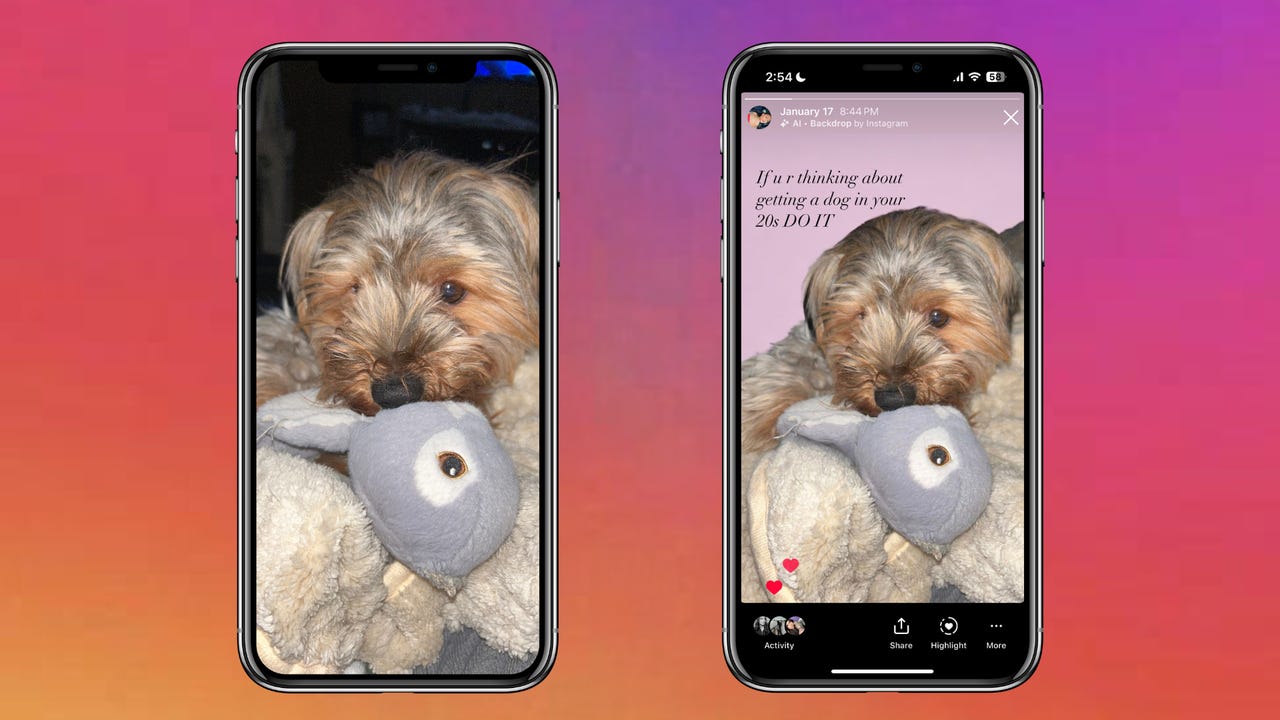
Posting fun, cute, and original stories on Instagram can be challenging because the app doesn't have many editing options for stories, and you typically want to post them up as soon as possible. Luckily, Instagram has an in-app generative AI feature that can help.

Instagram's "Backdrop" feature lets you easily change the background of your Instagram stories with a single prompt. Even though the feature launched last month, like me, you may have missed it because the button is easy to miss.

Also: Instagram, Snapchat now support Samsung Galaxy S24's full-camera quality

The other day I pressed on it by accident and decided to try it for myself. I was pleased with the results because it was very intuitive to use and accomplished exactly what I was hoping for.

As a result, I will definitely be using it in the future to step up my Instagram story game. If you want to give it a try for yourself, follow the easy steps below.

How to use Instagram's AI Backdrop feature

Featured

Selkie founder defends use of AI in new dress collection amid backlash

Selkie founder defends use of AI in new dress collection amid backlash

Generative AI, she argues, can be a tool for artists.

Morgan Sung 8 hours

When Selkie, the fashion brand viral on Instagram and TikTok for its frothy, extravagant dresses, announces new collections, reception is generally positive. Known for its size inclusivity — its sizing ranges from XXS to 6X — and for being owned and founded by an independent artist who’s outspoken about fair pay and sustainability in fashion, Selkie tends to be highly regarded as one of the morally “good” brands online.

The brand’s upcoming Valentine’s Day drop was inspired by vintage greeting cards, and features saccharine images of puppies surrounded by roses, or comically fluffy kittens painted against pastel backdrops. Printed on sweaters and dresses adorned with bows, the collection was meant to be a nostalgic, cheeky nod to romance. It was also designed using the AI image generator Midjourney.

“I have a huge library of very old art, from like the 1800s and 1900s, and it’s a great tool to make the art look better,” Selkie founder Kimberley Gordon told TechCrunch. “I can sort of paint using it, on top of the generated art. I think the art is funny, and I think it’s cheeky, and there’s little details like an extra toe. Five years from now, this sweater is going to be such a cool thing because it will represent the beginning of a whole new world. An extra toe is like a representation of where we are beginning.”

But when the brand announced that the collection was designed using generative AI, backlash was immediate. Selkie addressed the use of AI in art in an Instagram comment under the drop announcement, noting that Gordon felt that it was “important to learn this new medium and how it may or may not work for Selkie as a brand.”

View this post on Instagram

A post shared by Selkie ™ (@selkie)

Criticism flooded the brand’s Instagram comments. One described the choice to use AI as a “slap in the face” to artists, and expressed disappointment that a brand selling at such a high price point ($249 for the viral polyester puff minidress to $1,500 for made-to-order silk bridal gowns) wouldn’t just commission a human artist to design graphics for the collection. Another user simply commented, “the argument of ‘i’m an artist and i love ai!’ is very icky.” One user questioned why the brand opted to use generative AI, given the “overwhelming number” of stock images and vintage artwork that is not copyrighted, and “identical in style.”

“Why make the overwhelmingly controversial and ethically dubious choice when options that are just as cost effective and more ethical are widely available?” the user continued. “If you have indeed done the research you claim to have on AI, then you also understand that it’s a technology that requires the theft and exploitation of workers to function.”

Gordon said she spends about a week designing collections, but it takes months to a year of development and manufacturing before they’re actually sold online. In the year since she finalized designs for this drop, public opinion of AI art has shifted significantly.

As generative AI tools become more sophisticated, the use of AI in art has also become increasingly polarizing. Some artists like Gordon, who designs Selkie’s patterns herself using a blend of royalty-free clip art, public domain paintings, digital illustration and Photoshop collaging, see AI image generators as a tool. Gordon likens it to photography: it’s new now, but future generations may accept it as another art medium. Many artists, however, are vocally opposed to the use of generative AI in art.

Selkie as a brand has claimed they care about cutting their environmental footprint and supporting the artisans that make their clothing; using AI goes against both of these promises when they could SUPPORT ACTUAL ARTISTS!! https://t.co/pY10fPN5ta

— amber 🍉 (@mbrleigh) January 17, 2024

Their concerns are twofold — one, artists lose opportunities to cheaper, faster AI image generators, and two, that many generators have been trained on copyrighted images scraped from the internet without artists’ consent. Pushback against generative AI spans across all creative industries, not just in visual art. Musicians are speaking out against the use of deepfake covers, actors are questioning if SAG-AFTRA’s new contract adequately regulates AI in entertainment, and even fanfiction writers are taking measures to prevent their work from being used to train AI models.

Of course, not all generative AI is exploitative; as a VFX tool, it’s immensely useful to enhance animations, from creating more realistic flames in Pixar’s “Elemental” to visualizing complex scenes in HBO’s “The Last Of Us.” There are plenty of examples of morally bankrupt applications of generative AI. Creating deepfake revenge porn, for example, or generating “diverse models” instead of hiring actual people of color is objectively horrifying. But most of the generative AI debate settles into a morally gray area, where the parameters of exploitation are less defined.

In Selkie’s case, Gordon solely designs all of the graphics that are featured on Selkie garments. If someone else designs them, she makes it clear that it’s a collaboration with another artist. Her designs typically involve a collage of digital watercolor painting, stock images and “old art” that is no longer copyrighted. Many of her popular designs incorporate motifs from famous works of art, like Van Gogh’s “Starry Night” and Monet’s “Water Lilies,” which she uses as a base to create a unique, but still recognizable pattern. After she alters and builds upon the already existing work, it’s printed onto gauzy fabric and used to construct billowing dresses and frilly accoutrements.

View this post on Instagram

A post shared by Selkie ™ (@selkie)

The Valentine’s Day drop, Gordon argued, is no different, except that she used generated images as the design base, instead of public domain artwork. The patterns that she created for this collection are just as transformative as the ones she designed for previous drops, she said, and involved as much altering, original illustration and “creative eye.”

“I say this is art. This is the future of art and as long as an artist is utilizing it, it is the same as what we’ve been doing with clip art,” Gordon said. “I think it’s very similar, except it gives the artists a lot more power and allows us to compete in a world where big business has owned all of this structure.”

Gordon bristled at accusations equating her use of generative AI to that of companies that have replaced employed artists with AI image generators. She pointed out that she couldn’t have “replaced artists,” since she is the brand’s only in-house artist, and that the steep prices that Selkie charges for each ruffled dress account for material and labor cost. If clothing is cheap, she said, it’s usually because the garment workers making them are not being paid fairly. Gordon added that although she’s paid as the “business owner,” she doesn’t factor her own labor as a designer into her salary in order to cut overhead costs.

Gordon also noted that she didn’t use any other artists’ names or work as prompts when she used Midjourney to generate the base images. She turned to AI for efficiency — she said that it was a “great brainstorming tool” to visualize what she wanted the collection to look like — and out of fear of being left behind. Artists face mounting pressure to adapt to new technology, she said, and she wanted to be ahead of the curve.

“I’m not using AI models. I’m only using the AI as a tool where I would usually be doing it. I’m not trying to take away anyone’s job at my own company,” she said. “I’m using it as a way for myself to be efficient instead. If I had been utilizing lots of artists to make my prints, and then I suddenly used AI, I would definitely be taking away from them. How can I take away from myself?”

This is the nuance that isn’t always reflected in conversations about art and AI. Gordon owns a popular, but relatively small fashion brand that she uses as a vehicle to monetize her own artwork. Could she have commissioned another artist for oil paintings of lovesick puppies and kittens? Yes. Is it likely that the generated images of generic, vintage Valentine’s Day cards lifted the work of any living artist? Unclear, but so far, nobody has publicly accused Selkie of copying their art for the new collection. Gordon’s use of AI generated images is nowhere near as egregious as those of other, bigger fashion brands, but more sanctimonious critics argue that any use of AI art perpetuates harm against artists.

Gordon, for one, said she’s listened to the criticism and doesn’t plan to use AI generated images in future Selkie collections. She believes that regulation is lacking when it comes to generative AI, and suggested that artists receive some kind of payment every time their names or work is used in prompts. But she does plan to continue experimenting with it in her personal art, and maintained her stance that at the end of the day, it’s just another medium to work with.

“Maybe the way that I did it and this route is not the right way, but I don’t agree that [AI] is a bad thing,” Gordon said. “I feel that it is tech progress. And it’s neither good nor bad. It’s just the way of life.”

How to use Image Creator from Microsoft Designer (formerly Bing Image Creator)

A photo generated with the Image Creator from Designer using the prompt "a photo of a robot taking a picture with a DSLR camera in a studio".

A photo generated with the Image Creator from Designer, using the prompt "a photo of a robot taking a picture with a DSLR camera in a studio."

As the use of different artificial intelligence (AI) tools has exploded in the past year, we've seen the development of generative AI sprouting in the most unlikely places. The release of OpenAI's ChatGPT in fall of 2022 quickly led to Google, Microsoft, and Meta all coming up with their own AI chatbots with Bard, Bing Chat (aka Copilot), and Meta AI.

Along with that, Microsoft also released an AI image generator within Bing that is powered by DALL-E 3, the latest of OpenAI's visual projects. Microsoft was using a previous version of DALL-E to power its image creator until DALL-E 3 was incorporated into it, featuring improved image quality, more accurate prompt processing, and enhanced details within images. Now, the company renamed this tool from Bing Image Creator to Image Creator from Microsoft Designer.

How to use: Midjourney | Craiyon AI | DALL-E 2 | Stable Diffusion | DALL-E 3 in ChatGPT

Using the Image Creator from Designer is possible through Copilot, formerly known as Bing Chat, or directly on the tool's website, and is as easy as giving an AI chatbot like ChatGPT a prompt.

How to use the Image Creator from Designer

Would anyone believe this is a real Dodo Bird randomly found wandering about? Image created with Image Creator from Designer.

What you need: Using the Image Creator from Designer requires access to Bing.com; no need for an OpenAI account. The Image Creator can be accessed via Copilot in the new Bing or by going to Bing.com/Create. We'll cover how to create images directly on the Image Creator from Designer site, but you can find how to generate images in a chat with the new Bing in the FAQ below.

On the homepage for the Image Creator from Designer, click on Join & Create.

Enter your prompt in the text area.

For this prompt, I'm going to request the following: "photo of a dodo bird sitting on a concrete floor of a brightly lit home in the tropics." Then I click on Create and wait for my images to be generated.

The Image Creator from Designer's preview results were created with the prompt I entered (highlighted at the top).

This was my favorite photo of the four.

FAQs

Can I create images using Microsoft Copilot or Bing Chat?

There are two ways to use the Image Creator from Designer. You can generate images by going to Bing.com/Create, as detailed above, or you can create images right from Copilot with GPT-4, also known as the new Bing.

I asked Copilot with GPT-4, "create a photo of a lazy panda sleeping in a room with gold accents and forest green curtains."

Here's how you can ask Image Creator from Designer to create an image right from the chat window; the same process works for the Microsoft Copilot AI chatbot:

  1. Open Microsoft Edge
  2. Go to Bing.com
  3. Click on Chat
  4. Write your prompt; it can begin with a phrase like "create an image" or "generate a photo", but it's not necessary. Copilot with GPT-4 typically recognizes your intent.

Also: How to use Copilot (formerly called Bing Chat)

Copilot can create images in any conversation style, whether it's set to Creative, Balanced, or Precise.

One of the pros of using Copilot to generate images is that you can ask follow-up questions to have Copilot adjust the image. Copilot proposes questions like, "Can you make the monkey wear a hat?" and "Change the color of the Vespa to blue".

How do you write prompts to create images using AI?

The more specific you are in your prompts, the better; think of the prompt as a detailed description of the image you have in mind. Include adjectives, nouns, and verbs to describe the image and what the subject is doing — even styles are encouraged. If you ask the AI bot to create "a photo of…," you'll get a different result than if you say create a cartoon, a painting, or a 3D render; so the image style is important.

This is the best way to build a successful Bing Image Creator prompt.

Here's how the Image Creator recommends you format your prompts: Adjective + Noun + Verb + Style.

Also: I've tested a lot of AI tools for work. These are my 5 favorite so far

In the example above, that would be "Fuzzy creature wearing sunglasses, digital art."

You can use different terms to describe the style, as well, such as impressionism, cubism, abstract, etc.

Do I own AI-generated images?

The latest line from the United States Copyright Office (USCO) is that AI-generated images are not protected under current copyright laws because they are not the product of human authorship. Images generated with Designer have an invisible watermark to denote that it is AI-generated content. The watermark includes Microsoft's information and the date and time the image was generated.

AI image generators have created controversy as they're AI bots trained on images found online, which have been created by someone else. While the art you create using an image creator tool is unique, it's created with the influences of millions of artists on the internet.

Also: Have 10 hours? IBM will train you in AI fundamentals — for free

The copyright ruling is subject to change. The USCO is holding listening sessions throughout 2023 to explore the subject more deeply and make necessary changes.

Is Image Creator from Designer free?

The Image Creator from Designer is free at this time, though you can pay for more boosts if you run out. Boosts are like credits, where each prompt you give it to create an image will cost you one of your boosts. Users used to get 25 boosts when they'd first start using the Image Creator, but it has since increased to 100.

Once you run out of boosts, the Image Creator will take longer to generate images after it's given a prompt. Instead of 10-30 seconds, it can take up to five minutes.

Also: ChatGPT vs. Bing Chat: Which AI chatbot should you use?

Is Image Creator from Designer the same as DALL-E?

DALL-E 2 and the Image Creator from Designer are not the same. As with GPT-4 in the new Bing or Copilot, Microsoft is incorporating the more advanced DALL-E 3 into its image creator. DALL-E 3 is available for ChatGPT Plus subscribers as well. Right now, the Image Creator from Designer is the only way to use DALL-E 3 for free.

Is there a waitlist to use the Image Creator from Designer?

There is no waitlist to use the Image Creator from Designer at this time. All you have to do is log in to the website with your Microsoft account, and you'll have access to it.

Disclaimer: Using AI-generated images could lead to copyright violations, so people should be cautious if they're using the images for commercial purposes.

More on AI tools

ChatGPT goes to college: OpenAI finds its first higher education partner

College Student Graduating Creative photo

Since ChatGPT first launched, a major concern has been how it will impact education systems, with many schools choosing to ban the tech entirely. Now, a year and a half after the AI tool's launch, one institution of higher education has agreed to partner with OpenAI.

On Friday, Arizona State University (ASU) announced its collaboration with OpenAI to implement ChatGPT Enterprise in its institution with the goal of enhancing student learning and outcomes.

Also: Microsoft's AI-powered reading tutor lets students choose their own adventures — and it's free

"ASU recognizes that augmented and artificial intelligence systems are here to stay, and we are optimistic about their ability to become incredible tools that help students to learn, learn more quickly, and understand subjects more thoroughly," said ASU president Michael M. Crow.

Beginning in February, the university will invite ASU faculty and staff members to submit innovative uses of ChatGPT.

The three areas of concentration that the school is using to gauge the effective implementation of ChatGPT include "enhancing student success, forging new avenues for innovative research, and streamlining organizational processes," according to the ASU.

"By providing access to advanced AI capabilities, these tools are leveling the playing field, allowing individuals and organizations — regardless of size or resources — to harness the power of AI for creative and innovative endeavors," said ASU chief information officer Lev Gonick.

Also: How OpenAI plans to help protect elections from AI-generated mischief

To quell concerns about the potential privacy and security breaches involved when using generative AI models, ASU noted that ChatGPT Enterprise is designed to provide enterprise-grade security to safeguard user data and protect against digital threats.

This collaboration is noteworthy not only for being the first time a higher education institution has worked with ChatGPT but also because ASU's implementation and results could set a precedent for other institutions.

Artificial Intelligence