Meta is going all in on artificial general intelligence, says Zuckerberg. Here’s why it matters

Holograms of people in an office

Meta has kept up in the AI race, releasing new generative AI models, features, and research constantly. However, the company is now positioning itself to dive into artificial general intelligence (AGI).

On Thursday, Meta CEO Mark Zuckerberg took to Threads to post an almost two-minute video updating the public on the company's AI efforts, which included a glimpse into its long-term goals for building AGI.

"Today I'm bringing Meta's two AI research efforts [FAIR and GenAI] closer together to support our long-term goals of building general intelligence, open-sourcing it responsibly, and making it available and useful to everyone in all of our daily lives," said Zuckerberg in the opening of the video.

Also: ChatGPT goes to college: OpenAI finds its first higher education partner

He also added that the need for building total AGI has become more prevalent than ever since the technology will be crucial to fueling the next generation of AI services and offering the best AI-enabled assistance.

As a result, Meta is building a massive amount of infrastructure. By the end of the year, the company will have 350,000 Nvidia H100s, or around 600,000 H100s equivalents of compute if you include other GPUs.

Also: Five ways to use AI responsibly

To put that compute power in perspective, Meta and Microsoft were the largest purchasers of Nvidia's H100 GPUs in 2023, procuring as many as 150,000 each, according to analyst firm Omdia. Meta's new goal of 350,000 H100s by the end of this year is more than double its already steep investment.

So what is AGI, and why is Meta so focused on investing and developing it?

Also: What is artificial general intelligence really about?

To put it simply, AGI refers to AI that can perform complex tasks, such as learning, reasoning, and more, just as well as humans. Currently, even the most advanced generative AI models still require human direction and instruction to complete a task.

AGI makes it possible to remove human instruction, direction, and supervision because the model can function autonomously. This development should significantly boost how AI can assist humans and even what tasks it can perform.

However, AGI's unprecedented intelligence and its ability to mimic human behavior are often the reasons people approach the technology with fear or apprehension. Until now, AGI has remained a long-term goal, but Meta's updates show the technology might be developed sooner than anticipated.

Also: The best AI chatbots: ChatGPT and other noteworthy alternatives

While wrapping up the video, Zuckerberg also shared that Meta is currently training LLaMa 3, which is the latest version of Meta's advanced large language model, LLaMa 2, and he teased the creation of other future models.

"Overall across all this stuff, we're just getting started," Zuckerberg concluded.

Artificial Intelligence

Voice cloning startup ElevenLabs lands $80M, achieves unicorn status

Voice cloning startup ElevenLabs lands $80M, achieves unicorn status Kyle Wiggers 9 hours

There’s a lot of money in voice cloning.

Case in point: ElevenLabs, a startup developing AI-powered tools to create and edit synthetic voices, today announced that it closed an $80 million Series B round co-led by prominent investors including Andreessen Horowitz, former GitHub CEO Nat Friedman and entrepreneur Daniel Gross.

The round, which also had participation from Sequoia Capital, Smash Capital, SV Angel, BroadLight Capital and Credo Ventures, brings ElevenLabs’ total raised to $101 million and values the company at over $1 billion (up from ~$100 million last June). CEO Mati Staniszewski says the new cash will be put toward product development, expanding ElevenLabs’ infrastructure and team, AI research and “enhancing safety measures to ensure responsible and ethical development of AI technology.”

“We raised the new money to cement ElevenLabs’ position as the global leader in voice AI research and product deployment,” Staniszewski told TechCrunch in an email interview.

Co-founded in 2022 by Piotr Dabkowski, an ex-Google machine learning engineer, and Staniszewski, a former Palantir deployment strategist, ElevenLabs launched in beta around a year ago. Staniszewski says that he and Dabkowski, who grew up in Poland, were inspired to create voice cloning tools by poorly dubbed American films. AI could do better, they thought.

Today, ElevenLabs is perhaps best known for its browser-based speech generation app that can create lifelike voices with adjustable toggles for intonation, emotion, cadence and other key vocal characteristics. For free, users can enter text and get a recording of that text read aloud by one of several default voices. Paying customers can upload voice samples to craft new styles using ElevenLabs’ voice cloning.

Increasingly, ElevenLabs is investing in versions of its speech-generating tech aimed at creating audiobooks and dubbing films and TV shows, as well as generating character voices for games and marketing activations.

Last year, the company released a “speech to speech” tool that attempts to preserve a speaker’s voice, prosody and intonation while automatically removing background noise, and — in the case of movies and TV shows — translates and synchronizes speech with the source material. On the roadmap for the coming weeks is a new dubbing studio workflow with tools to generate and edit transcripts and translations and a subscription-based mobile app that narrates webpages and text using ElevenLabs voices.

ElevenLabs’ innovations have won the startup customers in Paradox Interactive, the game developer whose recent projects include Cities: Skylines 2 and Stellaris, and The Washington Post — among other publishing, media and entertainment companies. Staniszewski claims that ElevenLab users have generated the equivalent of more than 100 years of audio and that the platform is being used by employees at 41% of Fortune 500 companies.

But the publicity hasn’t been totally positive.

The infamous message board 4chan, known for its conspiratorial content, used ElevenLabs’ tools to share hateful messages mimicking celebrities like actress Emma Watson. The Verge’s James Vincent was able to tap ElevenLabs to maliciously clone voices in a matter of seconds, generating samples containing everything from threats of violence to racist and transphobic remarks. And over at Vox, reporter Joseph Cox documented generating a clone convincing enough to fool a bank’s authentication system.

In response, ElevenLabs has attempted to root out users repeatedly violating its terms of service, which prohibits abuse, and rolled out a tool to detect speech created by its platform. This year, ElevenLabs plans to improve the detection tool to flag audio from other voice-generating AI models and partner with unnamed “distribution players” to make the tool available on third-party platforms, Staniszewski says.

ElevenLabs

ElevenLabs offers an array of different voices, some synthetic, some cloned from voice actors.

ElevenLabs has also faced criticism from voice actors who claim that the company uses samples of their voices without their consent — samples that could be leveraged to promote content they don’t endorse or spread mis- and dis-information. In a recent Vice article, victims recount how ElevenLabs was used in harassment campaigns against them, in one example to share an actor’s private information — their home address — using a cloned voice.

Then there’s the elephant in the room: the existential threat platforms like ElevenLabs pose to the voice acting industry.

Motherboard writes about how voice actors are increasingly being asked to sign away rights to their voices so that clients can use AI to generate synthetic versions that could eventually replace them — sometimes without commensurate compensation. The fear is that voice work — particularly cheap, entry-level work — will eventually be replaced by AI-generated vocals, and that actors will have no recourse.

Some platforms are trying to strike a balance. Earlier this month, Replica Studios, an ElevenLabs competitor, signed a deal with SAG-AFTRA to create and license digital replicas of the media artist union members’ voices. In a press release, the organizations said that the arrangement established “fair” and “ethical” terms and conditions to ensure performer consent — and negotiating terms for uses of digital voice doubles in new works.

Even this didn’t please some voice actors, however — including SAG-AFTRA’s own members.

ElevenLabs’ solution is a marketplace for voices. Currently in alpha and set to become more widely available in the next several weeks, the marketplace allows users to create a voice, verify and share it. When others use a voice, the original creators receive compensation, Staniszewski says.

“Users always retain control over their voice’s availability and compensation terms,” he added. “The marketplace is designed as a step towards harmonizing AI advancements with established industry practices, while also bringing a diverse set of voices to ElevenLabs’ platform.”

Voice actors may take issue with the fact that ElevenLabs isn’t paying in cash, though — at least not at present. The current setup has creators receiving credit toward ElevenLabs’ premium services (which some find ironic, I’d wager).

Perhaps that’ll change in the future as ElevenLabs — which is now among the best-funded synthetic voice startups — attempts to beat back upstart competition like Papercup, Deepdub, ElevenLabs, Acapela, Respeecher and Voice.ai as well as Big Tech incumbents such as Amazon, Microsoft and Google. In any case, ElevenLabs, which plans to grow its headcount from 40 people to 100 by the end of the year, intends on sticking around — and making waves — in the fast-growing synthetic voice market.

How Xylem AI is Helping Build LLMs in India

Tensoic, the creator of Kannada Llama, aka Kan-Llama, recently released the playground to test the model, which was in partnership with E2E Networks built on NVIDIA A100s infrastructure and with Xylem AI for inference.

Aditya Shirawalmath, the brain behind the model, said that Xylem AI’s inference platform has a mind-blowing inference stack.

AIM got in touch with Arko Chattopadhyay, the co-founder and CEO of Xylem AI, to understand the company’s vision and what they are offering to help build Indic LLMs, which makes them stand apart from others in the field, such as Together AI and Anyscale.

“We started as a search index company for the enterprise, something that Perplexity AI is doing for the web. We wanted to do it for enterprises’ own data,” said Chattopadhyay. The company pivoted its model three months into the business as it realised that there is not enough infrastructure to support building LLMs, and thus wanted to fill that space.

Along with Chattopadhyay, the nine-month-old startup was co-founded by Enrique Ferrao and Pranav Reddy. All three of them met at Manipal Institute of Technology when they started participating in hackathons. After founding Amigo, a mental healthcare services app for enterprise, the founders began working on Xylem AI.

No need for engineering efforts

Xylem offers a comprehensively managed LLMOps platform designed for teams to efficiently train, deploy, and scale LLMs in production, eliminating the need for additional engineering involvement. “We want to eliminate the need to hire expensive software engineers for companies to build LLMs,” said Chattopadhyay, emphasising that Xylem’s platform is very easily scalable for everyone.

Highlighting the privacy and security concerns that enterprises have with using closed-source models such as OpenAI’s GPT and Anthropic’s Claude, Chattopadhyay said that Xylem helps in fine-tuning with personal data on open source models, which increases the adoption by enterprises.

“This is also very compute-heavy for enterprises, which makes it very costly for companies,” he added. “We are building our fine-tuning stack that allows people to build their custom models fine-tuned much faster and cheaper. Our whole idea is that we don’t want to throw GPUs at scale, but optimise the models to run efficiently on GPUs,” said Chattopadhyay.

Xylem claims that a model fine-tuned on Llama 7B on its platform can deliver 110 tokens per second on a single inference and also enables 30 parallel requests on an NVIDIA A100 80 GB GPU. “We are trying to push that even more,” added Chattopadhyay. The company is also increasing the number of open source models available on the platform as well as the speed.

Currently, Xylem is scaling on a managed cloud of E2E Networks and running on NVIDIA GPUs, but it also has plans to expand to AMD’s latest offerings and is looking for more options, such as Elon Musk’s xAI’s custom build chip.

The goal is to be one of the fastest inference engine

“The battle to be the fastest inference engine is probably a zero-sum game,” said Chattopadhyay. “You can bring your data and train your model on our platform. We will take care of the backend and the engineers don’t have to waste any of their time,” he said.

He further added that once the model is trained, you can easily deploy it with Xylem’s platform, and keep updating the models as they come along.

Chattopadhyay claims that Xylem is currently on par with Together AI and Anyscale, and is very close to Perplexity AI when it comes to inference. “We don’t need to get any faster than this. LLMs would get better and the responses would be instantaneous for the end users,” he added. “It won’t matter,” he said that the conversation would shift to easier API integration and smoother developer experience.

“Building an LLM should not be the moat of the company, the data should be the moat,” said Chattopadhyay and added that anyone can build LLMs these days, but the point is how do you deliver it to the audience. “Since most of them are anyway building on top of other LLMs, there is no need to worry about deploying it to the people.”

“Of course, we are focusing on India as it is the biggest market and Indic LLMs are coming up, but our goal is to go global,” he said.

Chattopadhyay further said that the company already has customers in the Middle East and Europe, along with Indian companies, and is also in talks with companies such as Sarvam AI and Japanese AI startups Sakana AI.

“If you want to deploy a model for 1.5 billion people, you cannot just keep on stacking GPUs as the cost would be very high,” Chattopadhyay concluded, saying that not everyone can focus on every part of the stack of building and deploying LLMs.

That is where Xylem wants to take its place in the inference, fine-tuning, and deployment of the models for others, and focus on making the developer experience easier and faster.

The post How Xylem AI is Helping Build LLMs in India appeared first on Analytics India Magazine.

NSDC Partners with Bhashini to Translate Skilling Content into Vernacular Languages

The National Skill Development Corporation (NSDC) has partnered with Bhashini to translate skill training content into vernacular languages, Ved Mani Tiwari, chief executive officer at NSDC, posted on LinkedIn.

Both parties signed a Memorandum of Understanding (MoU) in the presence of Tiwari and Amitabh Nag, chief executive officer at Bhashini.

“By improving access to skill courses in one’s own language, it will be used for Skill India Digital, where content in multiple languages will be made available,” he said.

NSDC’s collaboration with Bhashini will centre on online video translation services and converting existing videos into various languages, ensuring broader access to educational resources in diverse languages.

Bhashini is an initiative by the government of India to break the language barrier in the country with the power of AI. The initiative has developed tools that help translate content from popular languages like English to other Indic languages.

Last year, while speaking to the audience at the Kashi Tamil Sangamam in Varanasi, Prime Minister Narendra Modi’s speech was translated to Tamil in real-time using AI tools developed by Bhashini.

The post NSDC Partners with Bhashini to Translate Skilling Content into Vernacular Languages appeared first on Analytics India Magazine.

Disney Unveils HoloTile, the World’s First Omnidirectional, Multi-User Treadmill

Walt Disney recently introduced HoloTiles, the world’s first multi-person, omnidirectional, modular, expandable treadmill floor. This new technology enables multiple users to share a VR experience, walk in any direction, and avoid collisions.

“It’s a very special piece of technology… I can walk on this omnidirectional floor in any direction I want. It will automatically do whatever it needs to have me stay on the floor. And what’s amazing about this is multiple people can be on it and all walking independently,” said Lanny Smoot, a seasoned Imaginer at Walt Disney Imagineering R&D, and the brain behind HoloTiles.

He envisions its application in creating immersive virtual reality experiences, transforming theatrical stages, and offering new possibilities in entertainment and beyond. He currently has a total of 106 patents. Some of the other notable inventions and contributions include Electromagnetic Eyes for Animatronices, Interactive Zoetrope, and Extendable Lightsaber.

Smoot joined Walt Disney in 1999 after working for over two decades in the telecommunication industry and at Bell Labs. Smoot has been recognised with induction into the National Inventors Hall of Fame. This prestigious honour places him alongside Walt Disney himself, marking him as only the second Disney employee to receive this distinction.

Walt Disney Imagineering

Walt Disney Imagineering, founded by Walt Disney himself, is renowned for blending creative imagination with technical know-how. It has a rich history of pioneering innovations in themed entertainment, starting from the creation of Disneyland in the 1950s.

Recently, Imagineering revealed Star Wars: Galaxy’s Edge, an immersive themed land at Disneyland and Disney’s Hollywood Studios. Additionally, it introduced Ant-Man and The Wasp: Nano Battle! at Hong Kong Disneyland, showcasing advanced interactive technologies.

Walt Disney Imagineering continues to push the boundaries of creativity and technology in theme park experiences and attractions. Check out all of their recent products here.

“I sometimes forget that Disney is actually a very, very good robotics hardware company,” said Jim Fan, senior research scientist and lead of AI agents at NVIDIA, pointing at a lifelike Shaman robot in the Na’vi River Journey (from movie Avatar) at Disneyland. “Such fluid & expressive motion,” he added.

“Note that this is animatronics – robots that don’t have autonomy but only follow fixed, artist-curated moves. If this level of hardware is combined with state-of-the-art robot foundation models, I’d imagine the potential would be off the charts,” said Fan.

The post Disney Unveils HoloTile, the World’s First Omnidirectional, Multi-User Treadmill appeared first on Analytics India Magazine.

How Generative AI is Gobbling Up the Internet

If 2023 was the year of fearing generative AI, 2024 will be the year for some of those worries to come true.

Last summer, Ilia Shumailov, Zakhar Shumaylov, Yiren Zhao, Yarin Gal, Nicolas Papernot, and Ross Anderson wrote a paper hinting at AI models poisoning themselves in the (near) future. The warning was seen as farsighted and only theoretical, but evidence of the problematic technology has emerged.

The problem called “model collapse”, where AI chatbots lose the information they learn, is not in theory any more. Last month, a Twitter user posted a screenshot showing that Grok, the large language model chatbot developed by Elon Musk’s AI company xAI, had plagiarised a response from OpenAI.

When asked by Winterbourne to tinker with malware, Grok responded that it could not, “as it goes against OpenAI’s use case policy”.

“Grok is literally just ripping OpenAI’s code base,” the user explained in the post. The explanation was denied by a technical staff member of xAI who has previously worked for rivals OpenAI and Google DeepMind.

“This was a huge surprise to us when we first noticed it,” he responded. The staff member might not have seen this coming, but the company’s chief, Musk, definitely did.

Following the screenshot, which amassed a lot of reactions, ChatGPT shared the same and wrote, “We have a lot in common.” Musk noted the same and responded, “Well, son, since you scraped all the data from this platform for your training, you ought to know.”

The technology has given rise to competition not just among tech companies but rehashed old rivalries like the one between OpenAI and Musk, who was a cheerleader of the GPT maker earlier.

Leaving tech bros’ personal problems aside, AI-related error messages have also entered online shopping lists. Users on the e-commerce platform Amazon have pointed out that OpenAI error messages appear in products, be it lawn chairs or Chinese religious tracts.

The original copies of these products are named “I’m sorry, but I cannot fulfil this request. It goes against OpenAI use policy” have been archived after media publications discovered the listings. Still, many such artificial posts can be found on Threads and LinkedIn.

Delusions, Delusions, Delusions

Many said that the research by Shumailov at the University of Oxford and his colleagues overlooked an essential point. One of them was Daniel Sack, managing director and partner at Boston Consulting Group X (the tech build and design unit of BCG).

“Most of the data that will be used to train future models will not be mere reproductions of the source material but entirely novel and unprecedented,” he wrote on LinkedIn.

His theory, in response, is understandable since people in tech usually have a hard time calling out the mishaps of the products they are building or helping someone else build. Time and again, Silicon Valley has hesitated to acknowledge the menace of unwanted technologies.

The curious case of generative AI models is even harder to pinpoint since a lot of money is riding on the game.

Even Sack’s firm, BCG X, has collaborated with OpenAI, revealing that none in favour of the technology can be trusted, at least for now, since it has layers of unsolved ethical issues. All the above issues show that boasting about the technology’s capabilities to solve humanity’s grave problems should not be the primary response.

No Way Back

Generative AI programs rely on unfathomable amounts of data from every nook and cranny of the internet. The web has already become awash with AI-generated spam. No matter how much the VCs or developers of these AI models deny, the problem exists and is only going to get worse from here as hundreds of millions of people are using these tools every day.

“It really shows that these models are not going to be reliable in the long run if they learn from post-LLM age data—without being able to tell what data has been machine-generated, the quality of the outputs will continue to decline,” Catherine Flick, a professor of ethics and games technology at Staffordshire University told Fast Company while speaking about the Grok incident.

Foremostly, there is no way for humans to differentiate between AI-generated and human-generated content. Similarly, these language models also have no way of telling whether the AI-generated text they see corresponds to reality, which could introduce even more misinformation than current models.

For now, all one can do is sit back and watch the internet burn.

The post How Generative AI is Gobbling Up the Internet appeared first on Analytics India Magazine.

5 exciting Galaxy AI features that make Samsung’s S24 phones worth the upgrade

Samsung Galaxy S24 Ultra

AI has arrived, in full force, on phones for the biggest players on the market, and, with the Galaxy S24, Samsung is coming to prove it can stand toe-to-toe with Google and Apple. The new Galaxy phones are available for preorders starting today, in sync with the company's Unpacked event.

Also: Every product Samsung announced at Unpacked 2024

This year, we're seeing some serious upgrades (a new Qualcomm chip, a brighter screen, and an even further refined design). But as far as the new capabilities for the phones, AI takes the spotlight, thanks to Galaxy AI.

Samsung Unpacked

Meta Eyes AGI with Llama 3 

Meta chief Zuckerberg has thrown his hat into the ring in the pursuit of AGI. In his recent Instagram post, he announced, “Our long-term vision is to build general intelligence, open-source it responsibly, and make it widely available so everyone can benefit.”

To achieve this, he merged his two major AI research efforts, FAIR and the GenAI team. “We’re bringing our two major AI research efforts (FAIR and GenAI) closer together to support this,” his post read.

The merger of the FAIR and GenAI teams is truly intriguing. FAIR is dedicated to research, while the GenAI team is focused on generative AI experiences for users on Meta’s apps. During last year’s Meta Connect, new features for creators were announced on Facebook and Instagram, which included AI-powered image editing, sticker generation, and personalised recommendations.

This merger reminded many of the Google Brain and DeepMind merger that took place last year. “FAIR was part of Reality Labs – Research (RL-R), primarily focusing on the Metaverse, AR, VR, and MR. Given the increasing importance of AI and FAIR’s close relationship with GenAI, it made sense for FAIR and GenAI to be under the same umbrella,” wrote Yann Lecun, Meta’s AI chief scientist.

GPUs = AGI?

Considering Meta’s computational resources, they might surge ahead in the AGI race. “We’re currently training our next-gen model Llama 3, and we’re building massive compute infrastructure to support our future roadmap, including 350k H100s by the end of this year — and overall almost 600k H100s equivalents of compute if you include others” said Zuckerberg.

The current number of GPUs possessed by Meta doesn’t come as a surprise, given that last year, Meta had 150K H100s, the highest compared to other players, including Google, Amazon, and Oracle.

Interestingly, this marks the first time a major tech company has openly disclosed precise figures. On the flip side, the number of GPUs at OpenAI remains undisclosed, although Sam Altman hinted that they possess enough for training GPT-5.

While Zuckerberg has set his sights on AGI, Sam Altman recently downplayed its impact and said, ‘It will change the world much less than we all think, and it will change jobs much less than we all think,’ during a conversation at the World Economic Forum in Davos, Switzerland.

“I believe that someday we will make something that qualifies as an AGI by whatever fuzzy definition you want, the world will have a two-week freakout and then people will go on with their lives,” he expressed in another conversation at Davos .

AGI in Metaverse

Zuckerberg is hopeful that once AGI is achieved, it will not exist solely in the physical world but rather in a blend of virtual and physical reality. “People are also going to need new devices for AI and the Metaverse. Because over time I think a lot of us are going to talk to AIs frequently throughout the day.” he said.

Further, he opines that Meta’s Ray-Ban glasses are the ideal form factor for enabling AI to see what you see and hear what you hear. “Ray Ban Meta Glasses with Meta AI are off to a very strong start and overall across all this stuff we are just getting started”, he said.

Additionally, he dropped hints that Meta is still committed to the Metaverse and actively investing in it. The company is allocating an annual budget of over $15 billion to support Reality Labs and advance the development of the metaverse. Last year, Zuckerberg appeared on a podcast with Lex Fridman, which also happened to be the first interview to happen in the Metaverse.

Is Meta the new OpenAI?

Ultimately, the concept of open-source AGI might compel OpenAI to reconsider its strategy, given that the company initially embraced the idea of open-sourcing models.

At the recently concluded World Economic Forum, LeCun advocated for open-source foundational models emphasising that OpenAI wouldn’t be what it is today without the contributions from the open-source community.

“OpenAI does not have a monopoly on good ideas. They’re not going to get to AGI by themselves; in fact, they’re using PyTorch and Transformers, which were published by many of us. They’re profiting from the open research landscape,” he said.

“Zuck and Yann LeCun will go down as heroes in human history! Fighting for ‘Open AI’ when the incumbents sought to shut it down! Unbelievable how much the vibes from Meta have changed over the last year. That, and maybe it’s time for a name change – Meta to OpenAI,” wrote Bindu Reddy, Chief at Abacus.ai, on X.

Likewise, Perplexity chief Arvind Srinivas said,” Open Source AGI is an amazing vision. You (Meta) are building a very powerful technology, and actually aligning to what makes sense for the world: more people have a say in what makes sense and doesn’t”.

The post Meta Eyes AGI with Llama 3 appeared first on Analytics India Magazine.

GenAI: Beware the Productivity Trap; It’s About Cultural Empowerment – Part 3

Slide5-2

2024 promises to be a breakout year for Generative AI (GenAI) and AI. However, there are two challenges that organizations will face in 2024 to “leverage AI to get value from their data.”

Challenge #1: Too much focus is on “implementing AI” and not enough on gaining organizational alignment regarding where and how value will be created using AI. We covered this challenge in the first two blogs. In Part 1,” we discussed the importance of embracing an economic mindset to avoid falling into the productivity trap. In Part 2, we dug into the concept of nanoeconomics and its “force multiplier” role in the data economics value chain.

Let’s move on to Challenge #2: Empowering the organization to identify where and how AI can be leveraged to create value. That means implementing an AI and data literacy framework so everyone understands their roles, responsibilities, and rights in ensuring that AI delivers meaningful, relevant, responsible, and ethical outcomes.

AI & Data Literacy Educational Framework

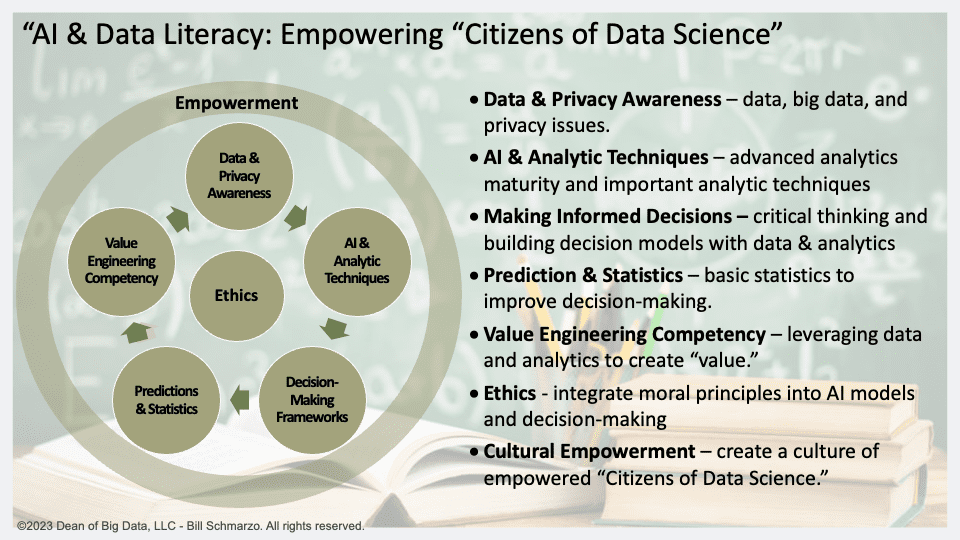
The AI & Data Literacy Educational Framework that I outline in my book “AI & Data Literacy: Empowering Citizens of Data Science” is comprised of seven dimensions (Figure 1):

  • Data & Privacy Awareness is about understanding data sources and types, especially the privacy opportunities and challenges associated with “Big Data.”
  • AI & Analytic Techniques is about understanding the different levels of analytics maturity and the critical analytic techniques that can be applied to data.
  • Making Informed Decisions involves applying critical thinking and building decision models with data and analytics.
  • Prediction & Statistics is about understanding the basic concepts and methods of statistics and probability and how they can improve decision-making.
  • Value Engineering Competency is about leveraging data and analytics to create “value” for your organization and customers.
  • Ethics integrates moral principles and ethical values into AI models and decision-making.
  • Cultural Empowerment is about creating a culture of empowered “Citizens of Data Science” who can leverage AI and data for value creation and innovation.
Slide2

Figure 1: “AI & Data Literacy: Empowering Citizens of Data Science

While Ethics might be the beating heart of the AI and data literacy educational framework, Cultural Empowerment is the enabler. Without Cultural Empowerment, the other dimensions don’t matter.

Keys to Cultural Empowerment

Cultural empowerment means embracing ambiguity, diversity, collaboration, experimentation, and learning from failures.

The secret sauce to success in AI and data literacy is cultural empowerment. Here are the key concepts for achieving cultural empowerment.

  • Personalize the Organization’s Mission: Seek to inject your personal passions and values into the organization’s core purpose. Create personalized mission statements that ensure everyone feels connected to the bigger picture and understands how their work contributes.
  • Speak the Language of Your Customers: Master understanding the language of your customers and constituents and use their language to describe their needs and challenges. It’s about ensuring clear, concise communication that resonates with the audience. This fosters trust, collaboration, and, ultimately, better solutions.
  • Foster Organizational Improvisation: Embrace a culture of experimentation and agility, where employees are encouraged to try new things, learn from mistakes, and adapt quickly to changing circumstances. This requires dismantling rigid structures and hierarchies and allowing teams to self-organize and make decisions independently, yet with accountability for making intelligent, informed decisions and sharing the results of those decisions to drive continuous learning.
  • Embrace an “AND” Mentality: It’s tempting to fall into an “either/or” mentality, pitting one idea or belief against another. Instead, encourage an “AND” mentality, where different perspectives and approaches are seen as complementary rather than conflicting, fueling the drive toward innovation.
  • Ensure Everyone Has a Voice: Empowering cultural transformation requires amplifying voices that might otherwise be unheard. This means actively seeking diverse perspectives, creating safe spaces for open dialogue, and encouraging dissent.
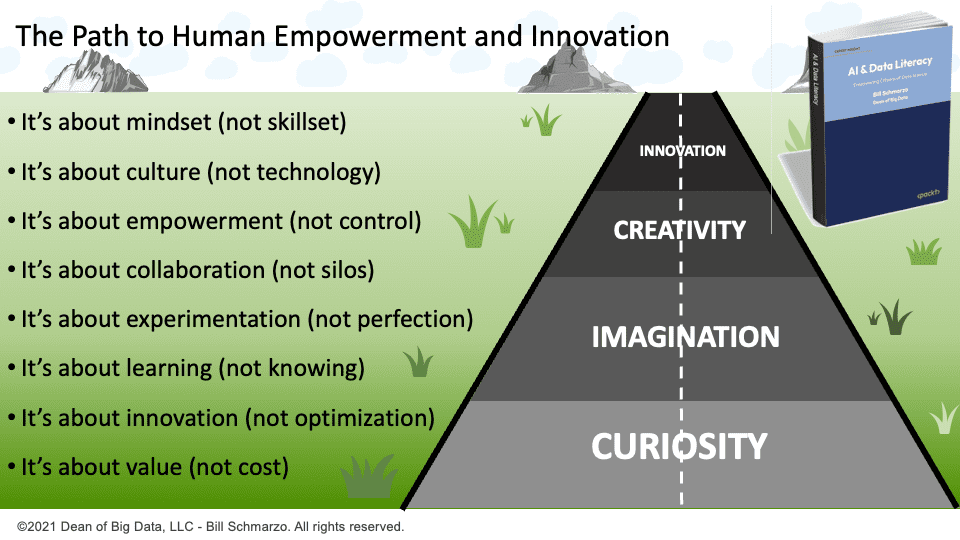
  • Unleash the Curiosity-Creativity-Innovation Pyramid: Build a culture that fosters a constant cycle of learning, exploration, and invention, encouraging experimentation that fuels creativity, allowing individuals to connect seemingly disparate ideas and forge new paths leading to breakthrough advancements (Figure 2).
Slide3

Figure 2: The Path to Human Empowerment and Innovation

Cultural Empowerment Summary

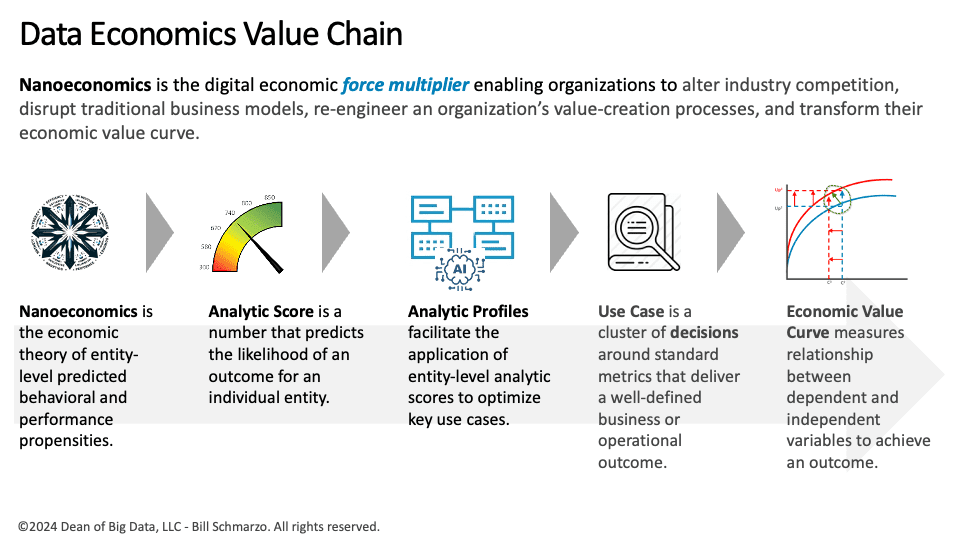
The first GenAI / AI challenge organizations will face in 2024 in leveraging AI to derive value from their data is an economics challenge and not settling for nebulous productivity improvements. The key is to leverage nanoeconomics and the data economics value chain to drive new sources of customer, product, service, and operational value (Figure 3).

Slide4

Figure 3: Data Economics Value Chain

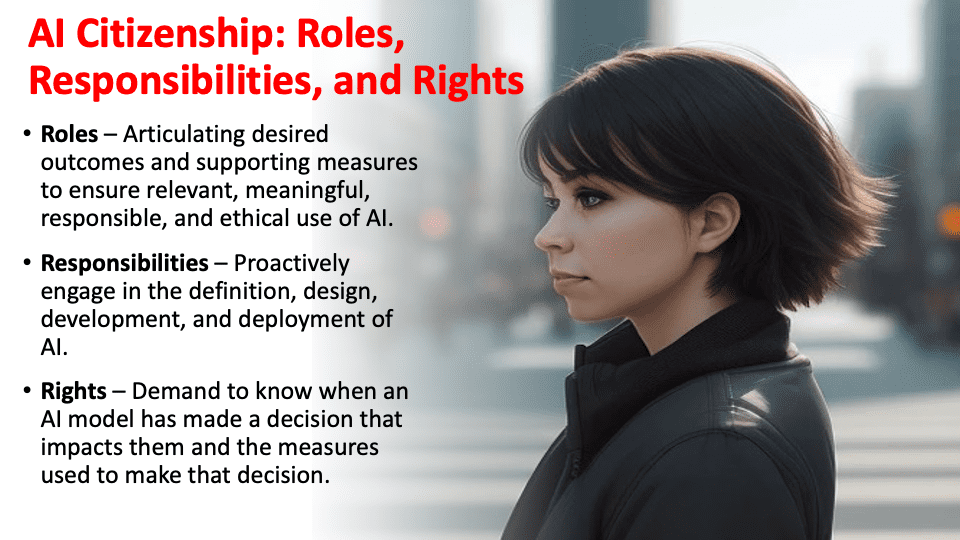
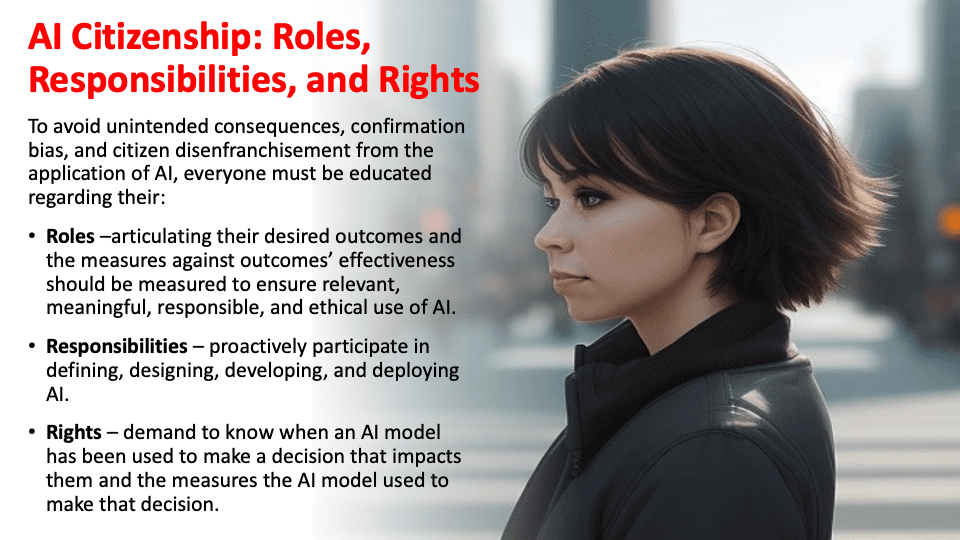
The second GenAI / AI challenge organizations will face is empowering everyone to identify where and how GenAI / AI can be leveraged to create value. That means we must clarify and educate everyone on their roles, responsibilities, and rights concerning how AI impacts their lives. The key to becoming a “citizen of data science” is understanding:

  • Your Role in articulating their desired outcomes and the measures against outcomes’ effectiveness should be measured to ensure AI’s relevant, meaningful, responsible, and ethical use.
  • Your Responsibilities to proactively participate in defining, designing, developing, and deploying AI.
  • Your Rights to know when an AI model has been used to make a decision that impacts them and the measures the AI model used to make that decision.
Slide1-1

Figure 4: AI Citizenship: Roles, Responsibilities, and Rights

To avoid unintended consequences, confirmation bias, and citizen disenfranchisement from AI, everyone must know their roles, responsibilities, and rights for where and how AI is applied to their lives. And we cannot wait for our government, academic, or corporate institutions to solve this problem for us. As a citizen of data science, we must step up and own our roles, responsibilities, and rights. Your future, and the future of our society, depends on it.

Does AI give you the creeps? OpenAI has some startling news for you

openaifuture-gettyimages-1841164781

Every time some astrologer, shaman, or random person in the street tells me the world will end on a certain date, I become suffused with skepticism.

If I knew exactly when the world was going to end, I'm not sure I'd walk the streets and tell everyone else. Instead, I'd go off and have the finest experiences I could before the Earth's bouncers shut the door for the final time.

Also: 4 ways to overcome your biggest worries about generative AI

Yet here we are, undergoing the sudden onrush of AI, and predictions of imminent doom are all around.

In its enthusiasm, OpenAI — makers of ChatGPT — once fueled the frenzy. Why, it was only last October that OpenAI's then-CEO Sam Altman mused that AI might well kill us.

"Mitigating the risk of extinction from AI should be a global priority alongside other societal-scale risks such as pandemics and nuclear war," he offered.

This wasn't precisely what those already frightened by the prospect of robot rule wanted to hear. It only fueled their fears and weighed down their hearts.

Talking it up, toning it down

Recently, however, Altman — once again the OpenAI CEO — seems to have tempered his tone. Even more happily, he seems to be taking steps to ensure not only our survival but also (what's left of) our peace of mind.

Why, last week he announced that OpenAI will take steps to make sure that the upcoming US elections won't be interfered with — by nefarious types using AI to achieve their own twisted ends.

But it was another of his pronouncements that may incite a certain giddiness in doubting, troubled hearts.

Also: How OpenAI plans to help protect elections from AI-generated mischief

Speaking at the World Economic Forum, Altman embraced an odd sanguinity. He said that AI "will change the world much less than we all think and it will change jobs much less than we all think."

I'm not sure we all think the same things. Why, every time I wake up and cast my bleary eyes upon the news, I often see words and gestures from people who don't think like me at all.

Still, Altman seems to have embraced many people's unease about not only what AI might do, but how quickly it might change, or even wreck, their lives.

And he wants you to know it may not be so dramatic.

Embracing your unease

Casting my innate skepticism to the floor for a moment, I'm moved by Altman's recent public utterances. I'm moved that they differ so much from the ones offered by tech leaders during the first part of the internet era.

Then, the likes of Google and Facebook just wanted everyone out of their way because they were "making the world a better place."

Because they said so. And, well, they were far too clever for ordinary people to understand what they were doing.

Also: This is why AI-powered misinformation is the top global risk

By contrast, Altman at least expresses awareness that hype and hysteria aren't necessarily the right notes for today's ever-shifting opera.

Of course, this might all have a little to do with the prospect of government regulation. Calm your predictions and you seem more reasonable.

It might also have something to do with the reasons Altman was briefly removed from OpenAI by those who were a little less keen on uncontrolled moneymaking.

One can still, though, appreciate his effort and even be slightly startled. Even if, in a subsequent interview last week, he conceded that, as AI becomes more customizable, "that's going to make a lot of people uncomfortable."

Also: AI will have a big impact on jobs this year. Here's why that could be good news

Altman concedes that AI is already an "incredible tool for productivity." Having used it quite a bit myself — no, not for this column, silly — I concede that its productivity is extraordinary.

However, its productivity in video is far more impressive — and mind-challenging — than its writing ability. Lordy, does ChatGPT write like the fifth-grade-level robot science project of a reclusive, asocial professor!

Come out of your bunker, Archie

As the hype abates, perhaps the practical uses of AI will be judged on their merits. Even the fearful, the creeped-out, and the skeptical might become more calmly aware of AI's presence, its benefits, and its manifest deficiencies.

We're headed for interesting times — yes, even more of them — but it's worth emerging from our bunkers and being interested in what's occurring all around us without being excessively frightened.

No, that wasn't a political statement, but I thought I'd see what ChatGPT thought.

Also: Afraid of AI? I confronted it for you and its responses were fascinating

"Is it worth emerging from our bunkers and being interested in what's occurring all around us?" I asked.

"While I don't have personal opinions, I can provide some perspective," began the AI. "Staying informed about what's happening around you can be important for various reasons. It allows you to make informed decisions, engage in meaningful conversations, and be aware of changes that may impact your life."

But then it did offer some personal opinions: "Being knowledgeable about current events can also contribute to a sense of community and understanding of the world."

Ah, that sense of community around current events. Wouldn't it be wonderful if AI could bring us a little more of that?

Artificial Intelligence