Oracle’s new offerings bring AI to your data, and manage it too

moving-data-gettyimages-1148091063

Database giant Oracle wants you to know you'll probably have a better experience with generative artificial intelligence if it doesn't involve moving your data from where it lives — which could very likely be inside an existing Oracle database — especially if you're an enterprise user.

On Monday, at a partner event in Dubai, Oracle announced the general availability of OCI Generative AI Services, a managed service for AI first offered in beta back in September. The company also unveiled two new offerings, still in beta: OCI Gen AI Agents and OCI Data Science AI Quick Actions.

Also: How SuperDuperDB delivers an easy entry to AI apps

The company makes the pitch that building an enterprise generative AI application on top of the existing data store is going to be both more effective in terms of using unique data, but also more economical compared with buying lots of additional infrastructure.

The acronym "OCI" refers to Oracle's Oracle Cloud Infrastructure; that is, all the network and compute resources, and attendant software such as the Oracle Autonomous Database, that the company uses in data centers throughout the world to deliver cloud services. That includes what Oracle calls "super-clusters" of Nvidia GPU chips on which Oracle has spent billions of dollars.

"We're essentially bringing AI to the data," said Erik Bergenholtz, Oracle's vice president for strategy and operations, in a briefing with ZDNET before the announcement.

"Our Fusion applications, such as ERP and HCM, have exabytes of data — we're bringing AI there," he said. "Our database, obviously, there are petabytes, exabytes of data there — we're bringing generative AI there."

The virtues of building on top of Oracle's database, middleware, and Fusion suite of apps are practical ones, said Bergenholtz.

Companies could, observed Bergenholtz, try to buy additional software for the data management piece, such as a vector database like Pine Cone. "The drawback, of course, is you have yet another piece of infrastructure that raises the cost of cloud, and you now have to actually move and potentially synchronize data across your originating data store, whether that be apps or your Oracle database; and now you have an additional piece of infrastructure."

Using the OCI services, Bergenholtz added, "just eliminates that barrier, that friction, for our customers."

Also: AI will change software development in massive ways

"We don't want customers to move data, because the last thing they want is to move 500 terabytes just to get the advantage of generative AI," said Steve Zivanic, vice president of Oracle's database and autonomous services marketing, in the same briefing with Bergenholtz.

OCI Generative AI service, which becomes generally available this week, consists of pre-built large language models (LLMs), including Meta Properties' open-source Llama 2 70-billion-parameter model.

In addition to Meta, Oracle has partnered with venture-backed startup Cohere for the GenAI service. (Oracle is an investor.) Cohere has three models that will go into the Oracle service: Command, for mainstream text-language functions; Summarize, for document summary; and Embed, for multi-language functions.

Also: Meta-IBM alliance promotes 'open' approach to AI development

Customer data used in OCI to either train or fine-tune the models cannot be seen by other Oracle customers, Bergenholtz emphasized.

Since it went into beta testing, the service has added new capabilities, such as content moderation. "The most important thing is that we do this prior to actually submitting the prompts" to a language model, "and then we also evaluate the response that comes out of the model," noted Bergenholtz, "so, we don't just wait until the very end, because then you've already incurred the cost of processing that request."

The service also now integrates with the LangChain development framework for using LLMs.

The OCI Gen AI Agents product is meant to tie an LLM into other resources, such as the database of a customer's proprietary data. The first agent offered is for retrieval-augmented generation (RAG), an increasingly popular approach in the world of generative AI to hook up the language model to a source of truth such as a database.

Also: How LangChain turns GenAI into a genuinely useful assistant

An LLM "may not be as useful as it could be unless you're able to actually leverage the data that you have under management sitting in your various Oracle applications or Oracle databases," said Bergenholtz. Initially, the RAG agent service can tap into OCI's OpenSearch offering, a managed service based on the open-source OpenSearch platform. In the near future, the RAG offering will be amplified by being able to plug into Oracle's Database 23c AI Vector Search, as well as the MySQL Heatwave Vector Store.

The AI agents service starts beta testing this month.

The OCI Data Science Quick Actions offering comes out of Oracle's 2018 acquisition of startup DataScience, which brought to Oracle expertise in Jupyter Notebooks and statistical techniques relevant to machine learning.

The point of Quick Actions is a no-code approach to deploying and fine-tuning language models. Several frameworks are available for fine-tuning, for example, including distributed training with PyTorch, Hugging Face Accelerate, and Microsoft's DeepSpeed. Bergenholtz also emphasized its use of object and file storage to ease the organization of model "weights," the parameters that take up large amounts of memory and that give a neural network its shape.

Quick Actions will start beta testing next month.

Also: Hybrid AI and apps will be in focus in 2024, says Goldman Sachs CIO

The most common use cases that Oracle has seen working with beta customers for the OCI Gen AI service involve things such as providing automated responses to HR policy questions.

"The common question is, how many vacation days do I have left," explained Bergenholtz. "You need two pieces of data, the policy in the company, and how many vacation days you've used, then you need to compute the answer based on those two things.

"With RAG, you can very easily answer that question because the RAG system knows your identity," and it also knows the company policy. Similar sorts of early applications include healthcare insurance benefits questions, said Bergenholtz.

Another frequent application in these early days is customer support. For the customer support representative, using RAG to dip into customer data, the language model "can easily summarize the case that you called about, what the current situation is, and provide a script of the next steps to recommend or to walk through with the customer to be able to provide that much richer, better user experience," said Bergenholtz.

What about customers who don't want this newfangled GenAI stuff touching their precious data?

Also: Data is the missing piece of the AI puzzle. Here's how to fill the gap

"There are a number of ways we see this transpiring," said marketing VP Zivanic. By putting capabilities such as vector search into the Oracle database, and vector store in Heatwave, "we're bringing the technology directly to them," he said.

There will be, he conceded, "organizations [that] will do various, essentially, skunkworks projects on the side" with Gen AI to get comfortable with the technology. "But, I think, over time, as generative AI becomes more prevalent, the power of a converged database where everything is forged into one, essentially, database construct, that will prove advantageous versus subscribing to multiple databases and trying to get your answer."

Artificial Intelligence

NVIDIA Teams Up With Equinix to Bring Generative AI Training to Data Centers

Data center services company Equinix is collaborating with NVIDIA to provide private AI with NVIDIA DGX on a fully managed AI data center solution, both companies announced on Wednesday, Jan. 24.

Equinix Private AI with NVIDIA DGX is available Jan. 24 in the U.S. and Frankfurt, Germany. Equinix said it will expand to 250 data centers spread across North America, South America, Europe Asia and Africa “soon.”

Equinix and NVIDIA announce Private AI with NVIDIA DGX solution

The Equinix Private AI with NVIDIA DGX solution is based on NVIDIA DGX SuperPOD, a supercomputing architecture for creating, training and running generative AI models. Then, it is combined with the NVIDIA AI Enterprise software stack. Equinix provides data center management for Equinix Private AI with NVIDIA DGX.

The new solution will be coordinated through the Equinix Managed Service team and can be scaled up from existing Equinix multi-cloud offerings.

“What we’re seeing is that once customers start out with AI, they continue to scale,” Charlie Boyle, vice president of DGX Systems NVIDIA, told TechRepublic in an email. “With this offering, customers can start out at any size and grow with their success.”

The new solution aims to help organizations spin up AI infrastructure faster

Cost, speed of deployment and sustainability are among the concerns enterprises often list regarding generative AI deployment that NVIDIA and Equinix want to solve. The Equinix Private AI with NVIDIA DGX solution is a “turnkey offering for companies to get the AI infrastructure they want in a very predictable, short lead time manner,” said Boyle, during a pre-briefing on Jan. 23.

Any data center infrastructure handling proprietary data fed into generative AI needs to be scalable, with low throughput and low latency, Boyle said. In essence, customers want to “move the AI closer to the data,” he said.

Data security is a barrier to generative AI adoption

Generative AI models have the potential to transform how organizations do business, but data security is a major barrier to entry; enterprises do not want large language model makers to have access to their proprietary data.

This solution is of particular interest to businesses because of its position in the wave of custom and proprietary generative AI models for enterprise. Generative AI could be used in healthcare and finance, but both are fields in which privacy is incredibly important. Financial service organizations that are already customers of both Equinix and NVIDIA have been exploring generative AI technology for customer service and fraud detection; in particular, retrieval-augmented generative AI is in demand.

Governance, security and attestation are at the top of customer needs, said Jon Lin, executive vice president and general manager, data center services at Equinix.

In addition, enterprises want their data to be up-to-date and not constrained by a model trained on publicly available information from a year ago. Equinix Private AI with NVIDIA DGX was made to address those problems and to help organizations – especially those that already use Equinix or NVIDIA infrastructure – speed up and smooth out the process of creating custom generative AI tools trained on proprietary data.

SEE: Microsoft is doubling its AI data center footprint in the U.K. (TechRepublic)

Enterprises “want to own their own AI future,” said Boyle. “And what largely that translates to is they want to own the models that their business is dependent on. Whether that is they want to own the model for data security, IP security, auditability, all of those aspects.”

Competitors to Equinix Private AI with NVIDIA DGX

Other large companies offering generative AI deployment for enterprises using private data include cloud services such as Google’s Vertex AI Workbench and Google Cloud AI Infrastructure, IBM’s watsonx, Microsoft’s Azure AI and Amazon’s SageMaker, Lambda (which uses NVIDIA DGX) and generative AI deployment training platforms provided by organizations such as Hugging Face, MosaicML and Databricks.

7 ways AI can fix your meetings, according to Microsoft

A person on a video call

Most working professionals' calendars are crammed with meetings, which can oftentimes pose as productivity roadblocks because they take too much of your time or you weren't necessary to begin with. If you are wanting to optimize your meetings, Microsoft claims its AI offerings can help.

Also: AI won't replace your job yet because it's still too expensive, according to MIT

A recent Microsoft Work Trend Index report meetings found that "inefficient meetings" people reported "inefficient meetings" as their number one productivity barrier. As a result, in a new blog post, Microsoft identified meeting fault points and how Copilot and other AI tools can help.

1. It can bring you up to speed

We have all been there where — no matter how hard you tried to be on time, you're late to a meeting you didn't want to miss. There is nothing worse than the feeling of frantically hopping on a call late, not knowing what you missed, and being afraid to ask a question that was already answered. Or maybe you zoned out during the meeting and missed important information.

Also: How tech professionals can survive and thrive at work in the time of AI

To help close the information gap, Copilot in Microsoft Teams can summarize the meeting's key points in real time so that you can easily get on the same page with everyone else. If you are still confused, instead of interrupting the flow of the conversation with your questions, you can simply ask Copilot for more information.

2. It can enable you to skip meetings

If your day is jam-packed with meetings, more than likely, you will have to pick some meetings to attend over others to get your work done. However, this no longer has to mean depending on someone's notes or missing out on the information entirely.

Also: What are Microsoft's different Copilots? Here's what they are and how you can use them

Instead, Copilot users will soon be able to access automatically generated meeting recaps with notes and suggested follow-up tasks. In March, users will also be given the option to "follow" a meeting, which will prompt the organizer to record it in Teams. Users can later access the recording alongside a recap.

3. It can give you advice during meetings

If you have ever given a presentation via a video call, you know how awkward it can be waiting for people to unmute themselves, participate, and respond with feedback. This disconnect oftentimes causes meetings to lag more than they need to.

With Copilot in Teams, you can now privately brainstorm ways to drive the conversation forward with Copilot. Microsoft shares examples of questions you could ask, including, "What can I ask to move the meeting forward?" or "What issues are still unresolved?" Then, Copilot will comb through the meeting's transcription to give you suggestions of what you can say.

4. It can remove background noise for you

Booking a meeting room for your video conference while in the office can be challenging since you and all of your colleagues are competing for the same limited space. Therefore, you are likely often faced with having to take meetings from your noisy desk.

Also: Microsoft's AI-powered reading tutor lets students choose their own adventures — and it's free

To help with that, Teams has a noise suppression capability that can help retain only speech in meetings and remove unwanted noise. Microsoft shares that Teams will also "soon" include a voice isolation feature, which will recognize your voice and suppress other noises.

5. It can clean your office (sort of)

You are meeting ready, but your room isn't? With a "Decorate your background" feature in Teams Premium you can use generative AI to enhance your real-life setting.

Also: How to use Image Creator from Microsoft Designer (formerly Bing Image Creator)

For example, you can use generative AI to remove clutter or add decoration to your room virtually. This feature can help you avoid using unrealistic full backdrops and keep the feel of your space without having to show it in its entirety.

6. It can coach you on your presentation skills

Being a good presenter is a skill, and like all skills, it requires practice. To help with that, Microsoft offers a Speaker Coach which analyzes your speech for elements such as pacing, pitch, repetitive language, filler words, and more to provide live insights as well as an in-depth evaluation afterward.

7. It can remove language barriers

Sometimes, meetings will include participants who don't speak the same language as you, which can pose as a challenge for maintaining a conversation. Teams Premium offers a live translation feature that can help maintain the flow of the conversation with real-time translations in up to 40 spoken languages, which participants can read via captions or transcripts.

Artificial Intelligence

Oracle Extends AI Across Its Stack With New GenAI Cloud Features

Oracle Extends AI Across Its Stack With New GenAI Cloud Features January 24, 2024 by Ali Azhar

(Jonathan Weiss/Shutterstock)

Organizations are struggling to find ways to deliver GenAI successfully. The key challenges to GenAI deployment include difficulty in integrating GenAI solutions with the existing tech stack and customizing the LLMs to meet the requirements of internal operations. Oracle, one of the world’s premier enterprise software and cloud solutions companies, might have just found a solution to these challenges.

With the announcement of its Oracle Cloud Infrastructure (OCI) GenAI service, Oracle is one of few companies that is taking a full stack approach to enterprise AI. The OCI GenAI service is a managed and cloud-hosted platform that enables enterprises to seamlessly integrate LLMs into various use cases. The service is available in multiple Oracle Cloud regions, and can also be accessed on-premises via the OCI Dedicated Region platform

Oracle OCI GenAI service allows enterprises to leverage the latest advancements in GenAI technology including LLMs from Meta Llama 2 and Cohere. The new capabilities include flexible fine-tuning options, improved GPI cluster management experience, and multilingual support in over 100 languages.

According to Ritu Jyoti, group vice president, Worldwide Artificial Intelligence and Automation Research Practice and Global AI Research Lead, IDC, “With a common architecture for generative AI that is being integrated across the Oracle ecosystem from its Autonomous Database to Fusion SaaS applications, Oracle is bringing generative AI to where exabytes of customer data already reside, both in cloud data centers and on-premises environments.”

As Oracle extends AI across its stack, customers can benefit from not needing to move their data to a separate vector database. This helps simplify the process of deploying generative AI with their existing business operations.

The OCI GenAI service, which is available in beta test, uses retrieval-augmented generation (RAG) techniques to fine-tune generative AI models so they can provide much more contextualized responses. In addition, the RAG agent enhances enter search capacities so users can find the most up-to-date information.

AI-as-a-Service is offered by several cloud providers, but none offer an experience as deep and broad as Oracle’s. The strongest competition in the category comes from Microsoft with its Azure AI and Copilot offerings. The advantage of Oracle is it has integrated GenAI into every layer of its stack, which is built on high-performing AI infrastructure. This helps integrate GenAI companies into the existing range of cloud applications and databases.

(amgun/Shutterstock)

While Oracle has a long way to go to match the overall GenAI offerings by other big players in the market, such as Google and Amazon, the flexible deployment options offered by Oracle OCI GenAI service could make it more attractive to many enterprises.

The launch of the new service is the next step in Oracle’s strategic move towards greater utilization of AI technology and various Oracle offerings. The database giant has already established itself as a key player in the infrastructure space, with a multi-year agreement with Microsoft and NVIDIA to support explosive growth of AI services.

The OCI GenAI service has set the stage for AI solutions that put the customers' needs first. Organizations can use Oracle’s new service to not only accelerate AI adoption but also derive tangible business value from it. While 2023 was a year of GenAI planning and extermination, with the launch of more advanced services, such as Oracle’s OCI GenAI service, 2024 could be a year of seeing some ROI in AI.

Related Items

Oracle Taps Nvidia to Grow Cloud Stack for AI and Data Science

2024 GenAI Predictions

Global IT Spending Forecast: Gartner Predicts 6.8 Percent Growth in 2024

Related

5 exciting features coming to Pixel phones (and why you should update ASAP)

The display on the Mint Pixel 8 on top of a green notebook.

If you're an owner of a Pixel Phone, then you're probably aware that Google has big plans to start infusing these devices with even more artificial intelligence. Well, the wait is almost over as the next Feature Drop will include a variety of AI helpfulness.

Also: The best Google Pixel phones (including the Pixel 8 Pro)

Of course, the Feature Drop will include not only several new features but also the usual bug fixes and security patches. As per my usual advice, apply this update as soon as it becomes available. You do not want to fall behind on your security patches in this day of constant cybersecurity attacks, otherwise, your data could wind up in the wrong hands.

But what about those new features?

Taking your temp

The Pixel line of phones already received a thermometer app to go along with Android 14. However, missing from that app was the ability to take your own temperature. You could measure food and organic material, beverages and water, cast iron, ceramic and glass, metal, plastic and rubber, fabric, wood, and walls and windows.

Also: How to use the Pixel 8 Pro thermometer for accurate temperature reading

But there was no option to measure the temperature of humans. With the new Feature Drop, you'll be able to select this option and, using your phone, scan your forehead (or someone else's forehead) to get an accurate reading. This update will also allow you to save the results to your Fitbit profile for a deeper understanding of your health.

Circle to Search

The new Feature Drop will include a handy, AI-driven search method that allows you to simply draw a circle around an image, text, or video and Google will then automatically run a search for it. This means you won't have to switch between apps to run a search or even bother typing to make use of Google searching.

Also: Google's Smart Search now showing up on more Android phones

Photomoji

For those who like to respond with emoji, this new update will allow you to transform your favorite photos into reactions that can be used in Messages and other apps. This feature is powered by on-device AI, so it should work both quickly and seamlessly.

Magic Compose

Google Messages is getting a big AI bump with the help of Magic Compose. This is where the AI rubber really meets the road: Google wants to help you craft responses to your messages, courtesy of generative AI. The idea behind this is to add a "spark of personality" to your conversations. Magic Compose will offer suggested responses based on the context of your messages and even transform what you write into different styles (even Shakespeare).

Magic Compose rolled out as a beta last year and is already available if you've joined the Messages beta program. How it works is simple: Type your message and then tap the pen icon. Select the style you want to use for your message and then select the option you want to send. I've tried it and it's pretty fun.

Testing the Magic Compose feature in the beta version of Messages with some Billy Shakes.

New Pixel 8 colorway

If you haven't already purchased a Pixel 8 phone, Google will be releasing a new Mint colorway for both the Pixel 8 and Pixel 8 Pro.

Also: Why Google's cheaper Pixel 8 is the real star of its Android phone lineup

The upcoming Feature Drop should happen any time soon. Be on the lookout for it and make sure to apply as soon as it appears. Even if these new features don't excite you, you'll at least get the latest security patches and app updates.

Google

Supercharge Your AI Journey! Join Uplimit’s Free Building AI Products using OpenAI Course

Promotional Content

Supercharge Your AI Journey! Join Uplimit's Free Building AI Products using OpenAI Course

🚀 Supercharge Your AI Journey! Join Uplimit's Free Building AI Products using OpenAI Course.

Lean into the potential of AI product development with Uplimit's immersive course on Building AI Products using OpenAI. 🚀 Elevate your skills and create impactful AI solutions from scratch!

🔍 Course Description

Dive into the intricacies of AI product development as you learn to harness the power of OpenAI. This hands-on course guides you through the entire process—from problem definition to prototype iteration. In just one week, you'll deploy a functional service using the latest advancements in Language Models (LLMs). Gain practical insights into the AI revolution and apply your knowledge to shape future projects.

🗓️ Course Details

Duration: 1 week
💲 Price: Free
🚀 Course Start Date: January 29th

🌐 Ready to take your AI skills to new heights? Enroll now and embark on a journey of innovation and discovery!

👉 Enroll for Free: https://uplimit.com/go/building-ai-products-with-openai-10VWP7

🌟 Transform your AI aspirations into reality—join Uplimit's AI revolution! 🌟

More On This Topic

  • Building AI Products with OpenAI: A Free Course from CoRise
  • Accelerate Your Machine Learning Journey with Uplimit's Metaflow…
  • Elevate Your Search Engine Skills with Uplimit's Search with ML Course!
  • Supercharge Your Machine Learning Experiments with PyCaret and Gradio
  • Free ChatGPT Course: Use The OpenAI API to Code 5 Projects
  • Building a Recommender System for Amazon Products with Python

Tech Trends for 2024: Generative AI Models Will Get Smaller, An iPhone’s Average Life Will Be 8 Years

Tech predictions for 2024 include a shift in generative AI from large language models towards smaller and open source models. In addition, AI will support and teach coders new skills; iPhone users will not be in a rush to buy a new model; and the rise of satellite-powered services will impact more IoT devices and smartphone users. Here are more details about these big tech trends expected for 2024, according to predictions from analysts and experts.

Generative AI: Smaller, more focused and open source

Few people had heard of generative AI at the start of last year, but it is now inescapable.

Shift towards smaller, more cost-efficient generative AI models

While the current LLMs that power generative AI will continue to be popular, there is likely to be a shift towards smaller, more cost-efficient models. These models will be able to run on hardware with more limited processing capabilities, such as laptops or smartphones, according to consultancy Capgemini. That means generative AI will become a more accessible and versatile technology, allowing organizations to build their use cases faster, it said.

Robert Engels, head of the Capgemini generative AI lab, said that 2024 will see a shift towards smaller models, combined with knowledge graphs to improve their accuracy.

“You can actually build for specific tasks in an organization – small models that you can fine-tune for a lower cost and higher quality,” he said in an online presentation for journalists.

These smaller models might be domain-specific tools like co-pilots for coding or sector-specific tools such as AI models for medicine or engineering.

“We will have these multi-agent systems popping up. We will see that they are more specialised, more optimised, smarter, faster to train and more sustainable,” he said. These smaller models might be able to solve more complex tasks for a lower cost with higher precision. Open source models will come into play more with the emerging technology too, he said.

SEE: Forrester’s 2024 Tech Leadership Predictions About AI, HR, Budget and Manufacturing (TechRepublic)

Gen AI’s $10 billion revenue boost to enterprise software companies

Another consultancy, Deloitte, predicted that generative AI will give enterprise software companies a $10 billion revenue boost by the end of 2024 as they integrate AI into their offerings to give knowledge workers new tools to work with greater efficiency and make better decisions.

AI will teach coders new skills and support creativity

Workers are already using AI to augment their day-to-day jobs, such as by assisting with basic research, helping come up with ideas or even creating better reports. One of the first tech jobs AI has changed is software developer, and 2024 will see that continue.

AI will support and teach coders new skills, according to Werner Vogels, chief technology officer at Amazon. He predicted that AI will contribute to everything from code reviews to product strategy.

“The lines between product managers, front- and back-end engineers, DBAs, UI/UX designers, DevOps engineers, and architects will blur,” he stated in the predictions posted on his blog. But he said AI assistants will be able to support rather than replace human creativity. “Unburdened by the undifferentiated heavy lifting of tasks like upgrading Java versions, developers can focus on the creative work that drives innovation,” he wrote.

The average life of an iPhone will be eight years

Smartphones are now a long-standing and mature technology, and one consequence of that is in many cases older phones are almost as good as new ones. Since there is less of an incentive to upgrade our phones, we’re holding onto mobile devices longer, and we are more willing to buy pre-owned phones, too.

Analyst CCS Insight predicted that more than half of the 1.3 billion iPhones in use now are second-hand devices (in contrast, used Android smartphones represent less than 25% of Android’s installed base); and from 2024, the average life of an iPhone will be eight years. The analyst firm predicted Apple might take more direct control of the secondary market in Europe and the U.S., perhaps by introducing a grading system for pre-owned handsets.

Looking ahead: Sustainability and compensation

While we will hold onto our phones longer to save money, environmental concerns will also be a factor, including at the corporate level. The impact of the energy use of AI, cryptocurrency, the Internet of Things and more is starting to worry executives: Tech analyst Gartner predicts that, by 2027, 25% of CIOs will see their personal compensation linked to their sustainable technology impact.

More satellite constellations will impact IoT devices and smartphone users

Patrice Duboe, Capgemini’s chief innovation officer for Aerospace and Defence, said during an online presentation that private companies have been disrupting the space industry and focusing on operating in Low Earth Orbit, which is cheaper, to offer new opportunities for all manner of emerging technologies.

This will be a “special year for space,” Duboe said, because some of these new constellations will become operational after reaching a minimum number of satellites in orbit. This will lead to an increase in the number of Internet of Things devices that are using satellite bandwidth to connect, far from the metropolitan centres where much of the traditional bandwidth is found.

SEE: Is Australia’s Deep Tech Future in Space? (TechRepublic)

Smartphones users will see benefits from the growth in satellite constellations, too. Basic emergency and texting services have already started to operate; but as 200 million smartphones capable of connecting with satellite services are expected to be sold in 2024, expect a wave of services to come as major players — like Apple, Qualcomm, MediaTek and Samsung — work with satellite providers.

GP Bullhound noted that the number of satellites orbiting Earth is going to increase from 8,000 to more than 100,000 in the next 10 years.

Snapchat AI gets even weirder: Introducing AI pets

Snapchat+

Snapchat was one of the first social media apps to implement generative AI, adding its "My AI" chatbot to double as an "AI friend." Now, nearly a year later, Snapchat is reportedly adding another weird AI feature — a generative AI pet.

Also: You can use AI in Instagram to generate fun backgrounds for your stories. Here's how

User screenshots originally spotted by SocialMediaToday show that Snapchat+ subscribers are now being given the option of creating "Custom Bitmoji Pets" as part of their subscriptions' early access to exclusive, experimental, and pre-release features.

With custom Bitmoji Pets, users will be able to "Use AI to create real or imaginary pets on the Map," as seen in the screenshots.

Essentially, the pet you create will show up next to you on the Snapchat map, allowing your friends to see not only your Bitmoji but also one of the pets you created every time they look at your geolocation.

If you are wondering what the point is, so are we.

Since its initial implementation of generative AI last February, Snapchat has been guilty of implementing generative AI for the sake of it, and not solving a real problem.

Also: How to add a new credential to your LinkedIn profile, and why you should

As a result, many users have expressed a desire to remove My AI entirely from their chats since it doesn't help much and is actually a tad creepy. Unfortunately, there is only one way to remove it, and it's by buying a Snapchat+ membership for $3.99 per month or $29.99 per year. No word yet on what you'll have to do to rehome an AI pet.

Singapore SMBs offered handbook on training their workforce for GenAI

man-ai-gettyimages-1337227407

A handbook has been released to help Singapore businesses navigate their adoption of generative artificial intelligence (GenAI) and acquire the necessary skillsets to support such initiatives.

Dubbed Generative AI for the Tech Workforce, the resource guide aims to assist local organizations, including small and midsize businesses (SMBs), looking to integrate the technology into their environment, said SGTech. The guide also will aid these companies in acquiring the skillsets and retraining to facilitate the transition, said the local technology trade association, which has more than 1,000 corporate members, including MNCs, SMBs, and startups.

Also: If AI is the future of your business, should the CIO be the one in control?

The resource guide was developed alongside SkillsFuture Singapore and AI Singapore, which are government agencies tasked with developing the country's skills development programs and AI capabilities, respectively.

SGTech is a skills development partner under Singapore's National AI Strategy 2.0, where it is "responsible for articulating job roles and skills requirements" across both technology and non-technology sectors to support GenAI.

Put together based on inputs from 30 companies, the resource guide highlights three enterprise use cases for GenAI as well as the GenAI employee profiles and skillsets needed, including GenAI developers and solution providers.

One case study, for example, looks at how a global organization in the raw materials industry developed a system to ingest and classify documents across different departments in a bid to improve productivity. "The ability to incorporate information from all users meant everybody in the company was involved in training the model, not just the tech team. This accelerated the rate at which the large language model could learn, hence, delivering greater benefits to the company," the SGTech guide noted.

Also: 64% of workers have passed off generative AI work as their own

It added that applying GenAI here enabled the company to more quickly extract data and better focus on other activities, such as generating and acting on the data insights.

The resource guide also outlines three levels of GenAI tech talent profiles and the technical expertise required for each. For instance, GenAI solution providers are tasked with tapping the relevant large language models to fit specific use cases, while "power users" leverage GenAI for specialized tasks that require a greater understanding of prompt design and domain-specific knowledge.

Benjamin Mah, SGTech's co-chair of talent steering committee, said: "The future of work relies on the flexibility of individuals and organizations to adopt technological advancements. This publication serves as a guide, directing professionals and enterprises toward a future where skills development seamlessly aligns with technological innovation."

Also: Global tech spending expected to keep climbing on AI demand

Singapore last week released a draft governance framework on GenAI to address emerging issues, including incident reporting and content provenance. The draft document encompasses proposals from a discussion paper published last June, which identified six risks associated with GenAI, including hallucinations, copyright challenges, and embedded biases, and a framework on how these can be addressed.

The proposed GenAI governance framework also draws insights from previous initiatives, including a catalog on how to assess the safety of GenAI models and testing conducted via an evaluation sandbox.

National Cyber Security Centre Study: Generative AI May Increase Global Ransomware Threat

The U.K.’s National Cyber Security Centre has released a new study that finds generative AI may increase risks from cyber threats such as ransomware.

Overall, the report found that generative AI will provide “capability uplift” to existing threats as opposed to being a source of brand new threats. Threat actors will need to be sophisticated enough to gain access to “quality training data, significant expertise (in both AI and cyber), and resources” before they can take advantage of generative AI, which the NCSC said is not likely to occur until 2025. Threat actors “will be able to analyse exfiltrated data faster and more effectively, and use it to train AI models” going forward.

How generative AI may ‘uplift’ attacks

“We must ensure that we both harness AI technology for its vast potential and manage its risks – including its implications on the cyber threat,” wrote NCSC CEO Lindy Cameron in a press release. “The emergent use of AI in cyber attacks is evolutionary not revolutionary, meaning that it enhances existing threats like ransomware but does not transform the risk landscape in the near term.”

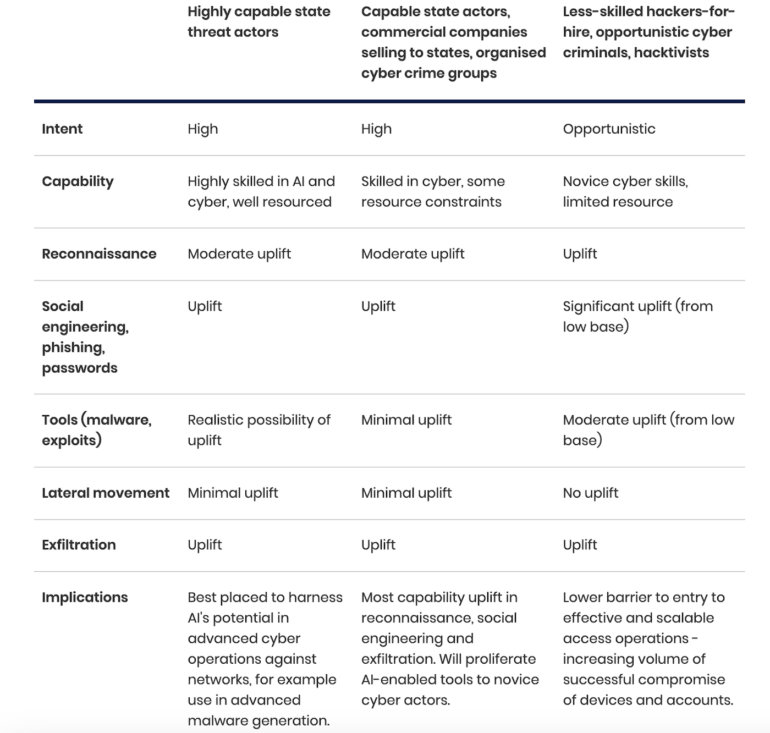
The report sorted threats (Figure A) by potential for “uplift” from generative AI and by the types of threat actors: nation-state sponsored, well-organized and less-skilled or opportunistic attackers.

Figure A

Types of threat actors are displayed on the x-axis. The items on the y-axis are useful for prioritization and show specific types of threats.
Types of threat actors are displayed on the x-axis. The items on the y-axis are useful for prioritization and show specific types of threats. Image: NCSC

The generative AI threat extending to 2025 comes from “evolution and enhancement of existing tactics, techniques and procedures,” not brand-new ones, the report found.

AI services lower the barrier to entry for ransomware attackers

Ransomware is expected to continue to be a dominant form of cyber crime, the report said. Similarly to how attackers offer ransomware-as-a-service, they now offer generative AI-as-a-service as well, the report said.

SEE: A recent malware botnet snags cloud credentials from AWS, Microsoft Azure and more (TechRepublic)

“AI services lower barriers to entry, increasing the number of cyber criminals, and will boost their capability by improving the scale, speed and effectiveness of existing attack methods,” stated James Babbage, director general for threats at the National Crime Agency, as quoted in the NCSC’s press release about the study.

Ransomware actors are already using generative AI for reconnaissance, phishing and coding, a trend that the NCSC expects to continue “to 2025 and beyond.”

Social engineering can be facilitated by AI

Social engineering will see a lot of uplift from generative AI over the next two years, the survey found. For example, generative AI will be able to remove the spelling and grammar errors that often mark spam messages. After all, generative AI can create new content for attackers and defenders.

Phishing and malware attackers could use AI – but only sophisticated ones are likely to have it

Similarly, threat actors can use generative AI to gain access to accounts or password information in the course of a phishing attack. However, it will take advanced threat actors to use generative AI for malware, the report said. In order to create malware that can evade today’s security filters, a generative AI would need to be trained on large amounts of high-quality exploit data. The only groups likely to have access to that data today are nation-state actors, but the report said there is a “realistic possibility” that such repositories exist.

Vulnerabilities may come at a faster pace due to AI

Network managers looking to patch vulnerabilities before they are exploited may find their jobs becoming more difficult as generative AI speeds up the time between vulnerabilities being identified and exploited.

How defenders can use generative AI

The NCSC pointed out that some of the benefits generative AI provides to cyberattackers can benefit defenders as well. Generative AI can help find patterns to speed up the time it takes to detect or triage attacks and identify malicious emails or phishing campaigns.

In order to improve global defenses against attackers using generative AI, the UK organized the creation of the Bletchley Declaration in November 2023 as a guideline for addressing forward-looking AI risk.

The NCSC and some UK private industry organizations have adopted AI for improved threat detection and security-by-design under the £2.6 billion ($3.3 billion) Cyber Security Strategy announced in 2022.