iRobot and Amazon call it quits, terminate acquisition agreement

iRobot and Amazon call it quits, terminate acquisition agreement Kyle Wiggers 9 hours

Amazon has ended its bid to acquire iRobot, the maker of robotic vacuums, after running up against headwinds with European regulators.

Amazon and iRobot have opted to mutually terminate their previously-announced acquisition agreement, under which Amazon would’ve purchased iRobot for ~$1.7 billion in cash (or slightly lower). In a press release, the companies said that they saw “no path to regulatory approval in the European Union,” preventing a deal from moving forward.

“We’re disappointed that Amazon’s acquisition of iRobot could not proceed,” said David Zapolsky, Amazon SVP and general counsel, said in a canned statement. “We’re believers in the future of consumer robotics in the home and have always been fans of iRobot’s products, which delight consumers and solve problems in ways that improve their lives. Amazon and iRobot were excited to see what our teams could build together, and we’re deeply grateful to everyone who worked tirelessly to try and make this collaboration a reality.”

iRobot will receive a $94 million termination fee from Amazon as a result of the nixed bid. But the failed acquisition will also necessitate an “operational restructuring plan” on iRobot’s part, the company says, involving laying off roughly 350 iRobot employees — about 31% of the company’s workforce — by April.

That restructuring comes on top of cuts iRobot made shortly after the Amazon acquisition deal was announced. In an attempt to reduce debt (excluding a $200 million debt round raised in July), iRobot cut headcount twice — once in August 2022 and again in February 2023.

Bloomberg notes that iRobot had racked up about $500 million in net losses since the second quarter of 2021. The publicly-traded company, whose market cap now stands at under $400 million, had an adjusted operating loss of about $200 million in 2023.

Colin Angle, iRobot’s chairman of the board of directors and CEO, has stepped down as chairman and CEO as of today, and Glen Weinstein, iRobot’s EVP and chief legal officer, has been appointed interim CEO. iRobot lead independent board director Andrew Miller has been appointed chairman of the board, and iRobot has hired a “turnaround expert,” Jeff Engel, to lead implementation of the restructuring.

“iRobot is a powerful company, and its mission remains to change the world empowering people to do more,” Angle said in a LinkedIn post. “It’s the home to talented builders, to optimism, to possibility and to unbridled determination and resilience. To those I have shared this journey with, I am forever grateful. I look forward to serving as a senior advisor and remaining on the board through my current term.”

iRobot aims to save $80 million to $100 million through renewed agreements with manufacturing partners on more attractive terms; $20 million through increased offshoring; and $30 million by consolidating its sales and marketing spending. The company also plans to reduce its corporate real estate footprint and pause all work related to “non-floorcare innovations,” including air purification, robotic lawn mowing (a reference to iRobot’s long-shuttered Terra project, presumably) and education.

iRobot anticipates that the restructuring will cost between $12 million and $13 million, primarily for severance and expenses related to layoffs, over the first two quarters of 2024, with the majority expected in Q1.

Amazon’s megabucks iRobot deal attracted regulatory scrutiny from the start. While the U.K. ultimately approved the acquisition after some reluctance, the European Commission pushed ahead with a more in-depth probe, while the U.S. Federal Trade Commission mulled an investigation into how the deal might affect Amazon’s influence over the smart home market and potentially violate users’ privacy by giving the retail giant access to data on their homes.

EU regulators expressed concern that Amazon would demote other robotic vacuum cleaners on its platform in favor of its own products and find it “economically profitable” to shut out rivals. Amazon considered an appeal, but decided against it after determining that the process would likely take years, according to Bloomberg.

iRobot was founded in 1990 by MIT Artificial Intelligence Lab members Rodney Brooks, Angle and Helen Greiner. Twelve years after its launch, the company introduced the Roomba, a brand that has since become synonymous with the category, selling more than 30 million units as of 2020.

Amazon, too, has been aggressively tackling the robotics space, making small steps into the home with the launch of Astro, a robot that’s so far struggled to gain traction with consumers.

Amazon and iRobot have had an increasingly close partnership over the past several years, through Roomba’s embrace of Alexa functionality and use of AWS servers. The retailer has long been iRobot’s biggest customer, at times accounting for more than a quarter of sales.

iRobot’s shares fell about 16% in premarket trading in New York this morning.

Nearly $5 Trillion was Added to Tech Titans in 2023

“AI added $5 trillion to the market cap of the top 7 tech companies in 2023,” said author and professor Pedro Domingos. This includes the ‘Magnificent Seven’ – Meta, Amazon, Apple (not so much), Alphabet, Microsoft, NVIDIA and Tesla – that are driving the market stocks in the name of AI, everywhere.

Not just big tech companies, AI research startups are also riding high, receiving multi-million (even billion) dollar valuations. However, analysts have raised questions on their revenue-generating model, doubting their long-term profitability.

“It’s a classic example of a big market delusion,” said Rob Arnott, VC and founder of Research Affiliates, recently equating the AI hype to the 2000 dot com era when everyone was betting big on the internet changing everything. He, however, said that the recent growth of AI hype is not a mere apple-to-apple comparison.

The rising AI valuation

AI companies often receive high valuations due to their potential for growth, rather than their present earnings. The return models for AI companies are valued on future promise rather than actual sales. Interestingly, as per a study conducted by Microsoft through IDC, for every $1 invested by companies in AI, they are realising an average of $3.5 in return, and over 5% of organisations globally are even realising an average of $8 in return.

VCs support high levels of AI valuations by attributing to the high usage rate of products. The assumption of free users converting to paid customers is something they believe will justify the value. However, that again is not entirely the right way.

Big-tech companies that offer cloud-services have pumped in millions of dollars into AI research companies, such as Microsoft’s $13 billion investment in OpenAI, Amazon’s $4 billion in Anthropic and in Perplexity AI. Full details of their strategic partnership with respect to revenue expectation are unknown.

Sky’s the limit

A few days ago, Indian AI company Krutrim successfully closed its first round of funding with $50 million, pushing the valuation of the company to $1 billion in a span of just a few months. It is now India’s fastest and first AI unicorn.

The valuations for AI startups have been on a crazy rage of late. French AI startup Mistral AI, which was founded eight months ago, has crossed a valuation of $2 billion. Other Indian AI startups have also been receiving generous funding from investors over the past few weeks.

While OpenAI was in talks to raise investments over a $100 billion valuation, AI startup Anthropic was in talks to raise $750 million at an $18 billion valuation. In a little over a year, AI-powered search engine Perplexity AI is valued at $520 million.

Social Capital VC and CEO Chamath Palihapitiya said, “The AI industry is in a curious state right now.” He believes that though significant amounts are being invested in capital expenditures, credits, and tokens, there seems to be no substantial increase in the customer revenue.

Palihapitiya also believes that AI primarily focuses on enhancing efficiency, thereby leading companies to adopt agents and automation to decrease costs, in the process, allowing AI to generate operation expenditure (OpEX) savings. Thus, hinting at a different way of evaluating AI companies.

Is it a fair comparison?

Considering how the AI market has grown over the past year, companies emerging in this space are relatively new. It is, hence, probably incorrect to compare their revenue or profit models to existing SaaS or normal startup ventures. It is also too soon to conclude these investments as an overvaluation.

As per a recent report, the profit margins for AI startups is said to be lower than existing enterprise software firms, which has raised the alarm on the possibility of overvaluation of these AI companies.

Unlike the traditional expectation of startups to hit profits in three to four years, and five to seven years for SaaS companies, the expectation for AI research companies to really hit profits cannot follow the same tangent.

At Davos 2024, Microsoft chief Satya Nadella, spoke about a broader use of AI, sharing how AI can be the growth driver for many economies. “Inflation adjusted, there is no economic growth in the world. It is a pretty disappointing state. The developed world may have negative economic growth,” said Nadella, adding that he is optimistic about AI being a general-purpose technology that can drive economic growth.

Sometimes it might take forever. OpenAI, for instance, took close to seven years to release a product like ChatGPT and other APIs and hit the limelight. OpenAI’s annualised revenue topped $1.6 billion, implying $130 million from sale of subscriptions to ChatGPT and other models, however, profits are barely in billions, and doesn’t really equate to how much it is spending on customer acquisition cost and infrastructure.

CEO Sam Altman is trying really hard to bring it to zero…

The costs of intelligence and energy are going to be on a path towards near-zero.
We certainly won’t get all the way there this decade, but by 2030, it will become clear that the AI revolution and renewable+nuclear energy are going to get us there.

— Sam Altman (@sama) September 9, 2021

The post Nearly $5 Trillion was Added to Tech Titans in 2023 appeared first on Analytics India Magazine.

What I Learned From Using ChatGPT for Data Science

What I Learned From Using ChatGPT for Data Science
Image by Author

There’s one single lesson I learned from using ChatGPT. It’s wonderfully helpful in data science, but you must scrutinize everything it outputs. It’s great for some tasks and can do them very quickly and accurately. For some other tasks, it’s good enough, and you’ll have to prompt it several times. And there’s one task I found ChatGPT is outright bad at.

Great: Automate Data Exploration

You can attach your dataset to the ChatGPT message, and by giving several simple instructions, ChatGPT can explore data for you.

For instance, I can take a dataset from this data project. The instructions I gave are:

“Use the attached data to perform a descriptive statistical analysis. Include the following:

  • Summarize basic statistics (mean, median, standard deviation, etc.).
  • Identify missing values and suggest strategies to handle them.”

It returns the summary that looks like this. It does the same calculation for each variable.

Age:

  • Mean: 28.79 years
  • Standard Deviation: 6.94 years
  • Range: 18 to 50 years

It also identified no missing values in the dataset.

If you also need the Python code for these calculations, you can prompt it to write them.

To load the dataset, use this code.

aerofit_data = pd.read_csv(file_path)

For basic statistics, it gives this one.

basic_stats = aerofit_data.describe()

And you can check the missing values with this code.

missing_values = aerofit_data.isnull().sum()

Great: Create Visualizations

Further, I can ask ChatGPT to visualize the distribution of key variables and detect potential outliers and anomalies.

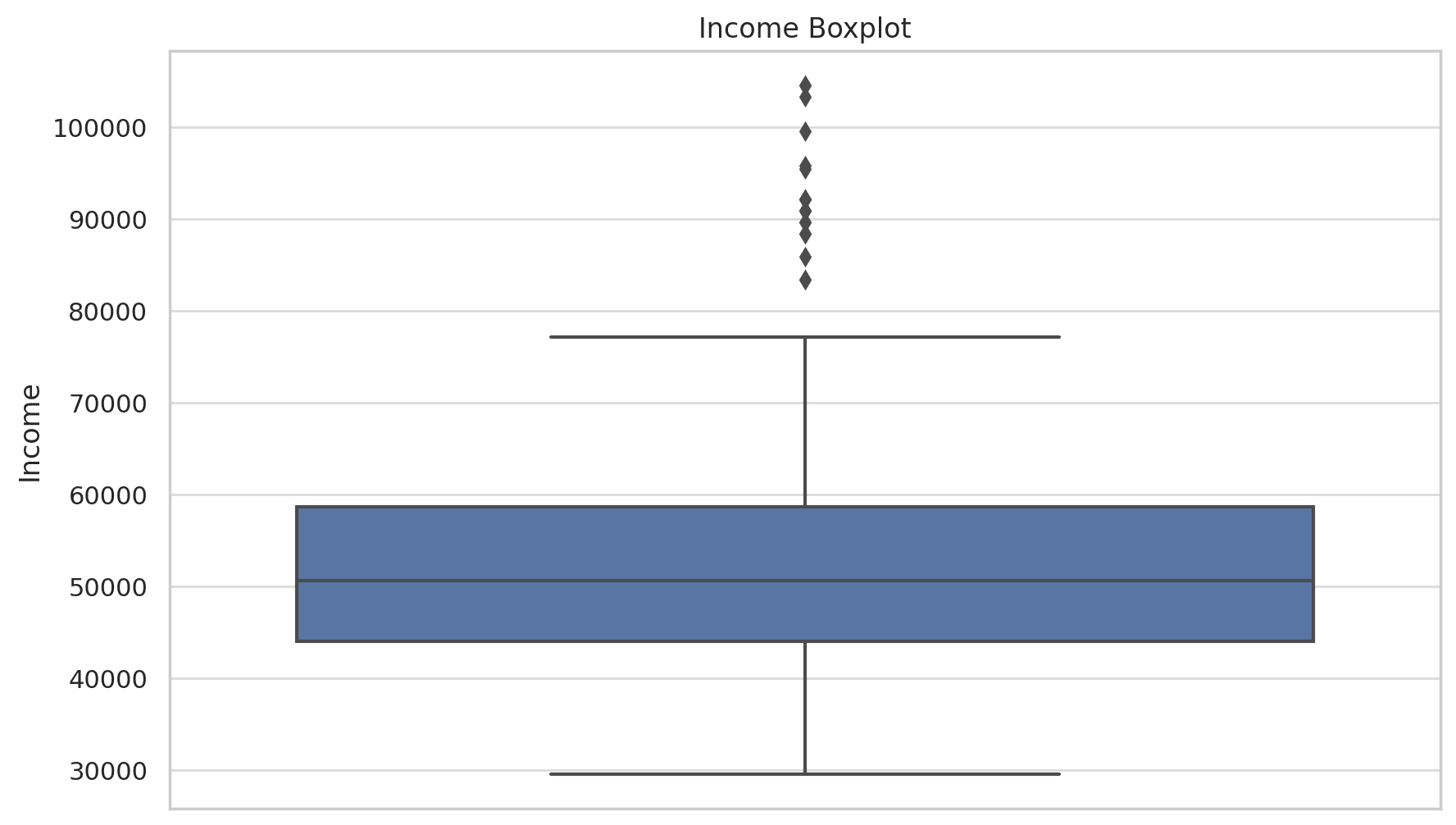
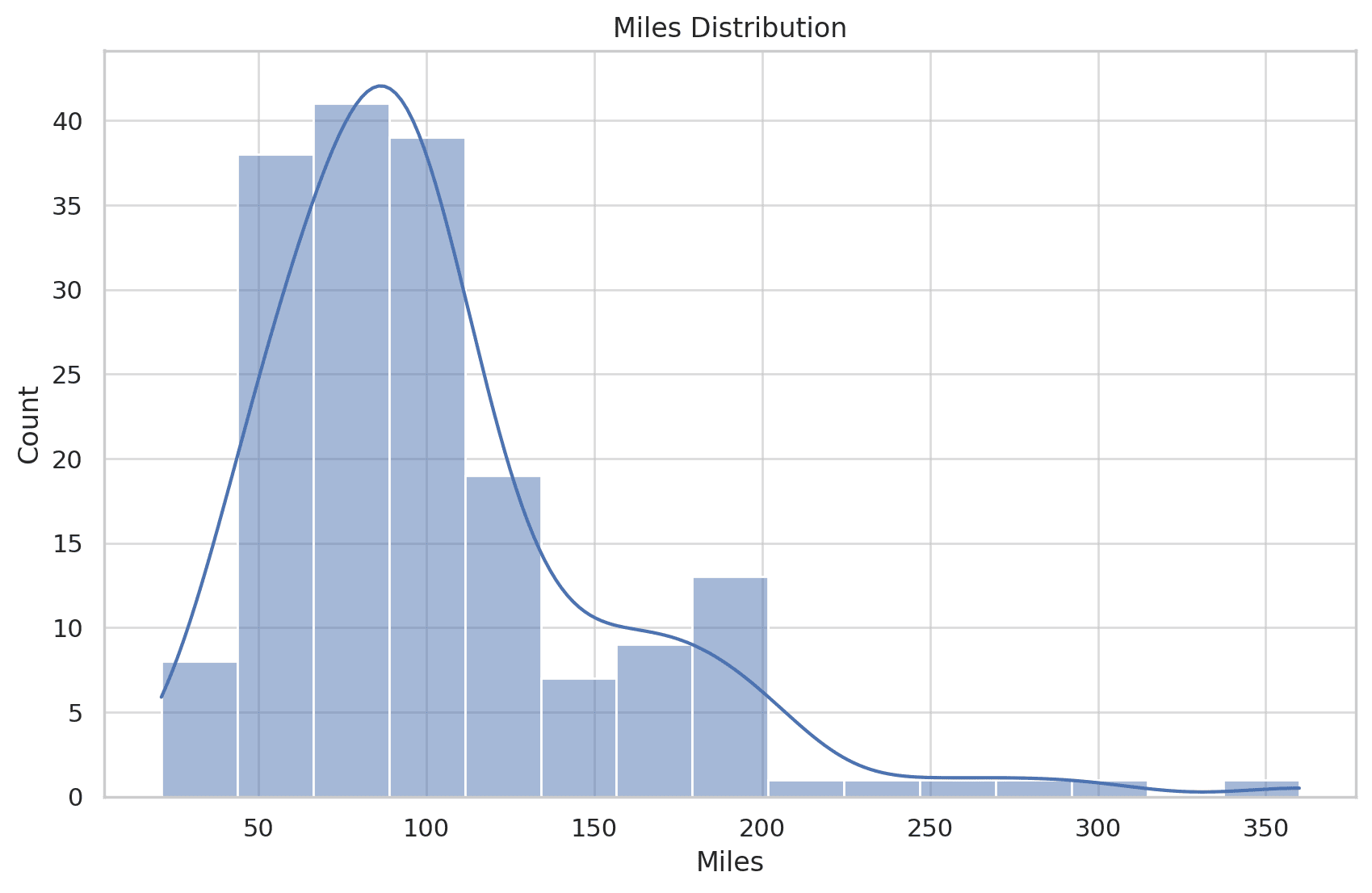
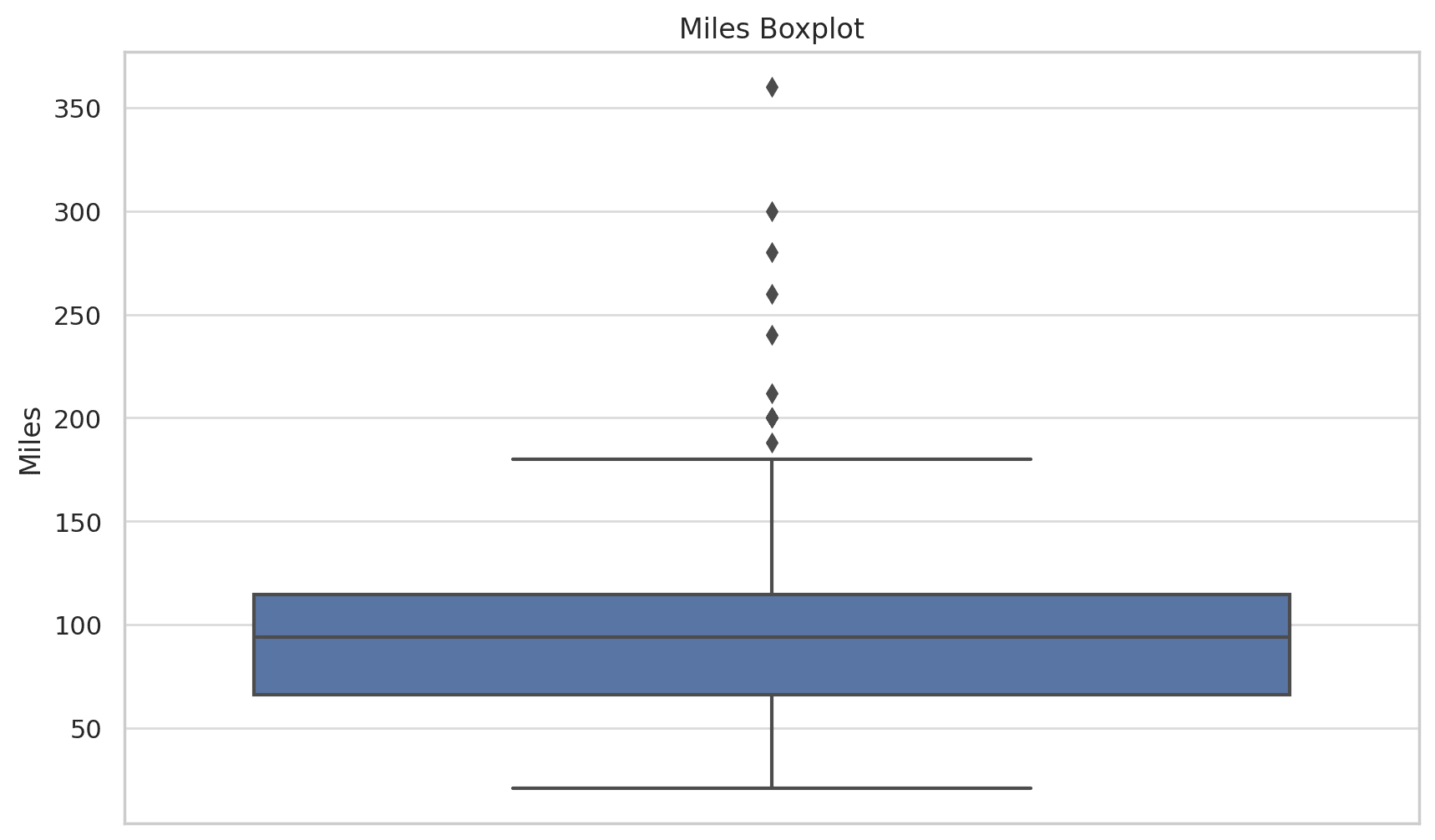
It creates histograms and box plots for key variables: Age, Income, and Miles. It detected possible outliers in the Income and Miles distribution.

What I Learned From Using ChatGPT for Data Science
Created by Author/ChatGPT
What I Learned From Using ChatGPT for Data Science
Created by Author/ChatGPT

It also interprets the visualizations. So, it notices that the distribution of income is right-skewed, which indicates that most customers have an income on the lower end of the spectrum, and fewer customers earn significantly higher incomes. The boxplot suggests there are some outliers on the higher end.

What I Learned From Using ChatGPT for Data Science
Created by Author/ChatGPT
What I Learned From Using ChatGPT for Data Science
Created by Author/ChatGPT

The same interpretation is applicable to the Miles distribution: right-skewed and outliers on the higher end.

Considering the nature of the data, it suggests that these outliers are not necessarily errors but rather represent a specific customer segment. Regarding the skewed distributions, it suggests transformations (e.g., log transformation) to normalize the data.

Of course, you can also ask it to write a Python code for these visualizations.

Great: Validate Data Suitability for Specific Statistical Tests

I can use the same data and ask ChatGPT if it’s suitable for logistic regression. And if not, what should I do to transform it so it’s appropriate?

It replied that my data is primarily suited for descriptive and inferential analysis of continuous data.

These are the suggested ways of transforming data for logistic regression.

Create a Binary Outcome: Create a binary outcome by categorizing customers as “high usage” or “low usage based on a median split on the Usage variable. Also, the binary outcome can be “treadmill purchase” vs. “no treadmill purchase”.

Check for Multicolinearity: Use a correlation matrix or Variance Inflation Factor (VIF) to check for multicolinearity. If there’s multicollinearity, the correlated variables can be removed or combined.

Feature Scaling: While feature scaling for model fitting is not necessary for logistic regression, it can be beneficial for convergence. This is the case especially for features with significantly different scales.

Tackling Non-Linearity: The transformations, such as log or square root, can be used for variables that do not satisfy the linearity assumption.

Sample Size: The dataset has to be large enough given the number of predictor variables.

Data Preprocessing: Handling outliers and categorical variables (by one-hot encoding or label encoding) is suggested. Additionally, it suggests handling missing values, but this doesn’t apply to my data, as there are no missing values.

Good: Automate Parts or the Whole Data Science Project

ChatGPT can actually be helpful in every stage of a data science project. You can prompt it to write a web scraping code. You can instruct it to explore and prepare your data for the machine learning algorithms. It can also give you a code for choosing the right algorithm, dataset splitting, A/B testing, and performance-boosting algorithms. Finally, you can also ask ChatGPT to write you a code for model deployment.

While ChatGPT can do all that, it’s quite possible that you won’t immediately get a code that does exactly what you want. So, you have to understand what you want to achieve and check the code. The chance is you’ll have to prompt ChatGPT for code corrections and provide more instructions on what to change.

Good: Code Converting and Learning

ChatGPT can help users who are still learning new coding languages. Imagine that you’re an SQL master, and you have no problems solving this interview question. However, you want to add Python to your skills. ChatGPT can help you with that. You can copy the SQL code and ask ChatGPT to convert it to Python.

So, the SQL code is this.

SELECT     company,     profit   FROM     (      SELECT         *,         rank() OVER (          ORDER BY             profit DESC        ) as rank       FROM         (          SELECT             company,             sum(profits) AS profit           FROM             forbes_global_2010_2014           GROUP BY             company        ) sq    ) sq2   WHERE     rank <= 3;

ChatGPT wrote the Python code based on the SQL code above, but it doesn’t work right. So I engage in bashing ChatGPT for not writing the correct code. And I ask it to try again, since the output is not the same as with SQL code. It tries again and returns the correct result.

import pandas as pd    # Assuming 'forbes_global_2010_2014' is a pandas DataFrame with columns 'company' and 'profits'  # Since we don't have the actual data, this code assumes that the DataFrame is already loaded    # Step 1: Group by company and sum the profits  company_profits_sum = forbes_global_2010_2014.groupby('company')['profits'].sum().reset_index()    # Step 2: Rank the companies by profit in descending order  company_profits_sum['rank'] = company_profits_sum['profits'].rank(ascending=False, method='max')    # Step 3: Filter the top 3 companies  top_companies = company_profits_sum[company_profits_sum['rank'] <= 3]    # Final selection of columns  result = top_companies[['company', 'profits']].sort_values('profits', ascending=False)    result  # This will display the top 3 companies by profit

As you can see, you get a nice code with comments before each code block. To improve your learning, you can ask it to interpret this code. That way, you’ll get even deeper into what each code line does and how.

Bad: Statistical and Mathematical Calculations

When I say bad, I mean really bad! It goes to the level where it uses the right formula and plugs in the right values but somehow manages to mess up not-that-complicated calculations.

Have a look at this. I asked it to solve this problem: “Suppose you roll a fair six-sided die 10 times. What is the probability of rolling two 1s, three 2s, one 3, zero 4s, three 5s, and one 6?”

It computes the probability this way.

What I Learned From Using ChatGPT for Data Science

It messes up when calculating factorials. And it does that with style! Completely wrong saying 2! = 12. It’s not, it’s 2. How can you mess up a simple calculation such as 2×1 = 2? This is really laughable!

Even funnier is that once, 3! = 36, and the second time 3! = 6. Credit to it, as it was correct once at least.

When I ask it to correct the calculation without further explanation, it calculates again and comes up with the probability of 0.0001389. I couldn’t believe my eyes! It can use precisely the same formula and values and come up with a different result that is still wrong!

I asked it again to correct the calculation, and it finally returned the correct result: 0.0008336. The third time is a charm!

Admittedly, these mistakes were made by ChatGPT 3.5. I asked ChatGPT 4 the same question, and it came up with the correct calculation on the first try. You might also use some mathematical plug-ins to stay on the safe side.

Conclusion

The main learning from all this is that ChatGPT is a bad master but a very good servant. It can be helpful in writing code, debugging, analyzing, and visualizing data. However, never trust it completely and never take what it writes without scrutiny.

Check the code it writes, and check the calculations. You’re a data scientist, after all, and ChatGPT is not! You might not get the desired results from ChatGPT on the first try. But giving it more precise instructions and trying several times will probably get you to the desired result.

Nate Rosidi is a data scientist and in product strategy. He's also an adjunct professor teaching analytics, and is the founder of StrataScratch, a platform helping data scientists prepare for their interviews with real interview questions from top companies. Connect with him on Twitter: StrataScratch or LinkedIn.

More On This Topic

  • What I Learned From "Women in Data Science" Conferences
  • 3 Most Important Lessons I've Learned 3 Years Into My Data Science Career
  • Using ChatGPT to Help Land a Data Science Job
  • Using ChatGPT for Webpage Construction
  • 4 Ways to Generate Passive Income Using ChatGPT
  • Using ChatGPT to Learn SQL

Top 7 Use Cases of Gen AI in FinTech

Discover how Gen AI is transforming the modern financial landscape and get the list of the top 7 use cases of Gen AI in the FinTech industry.

In 2024, the fusion of AI and financial technology is not just a wave of the future – it’s a rapidly evolving present. Artificial Intelligence, especially the latest generation (Gen AI), is revolutionizing the FinTech sector, reshaping how we interact with our finances, and introducing groundbreaking changes in the industry. Gen AI is at the forefront of innovation; from personalized banking to fraud detection, it offers smarter, faster, and more efficient financial solutions.

This article delves into the top use cases of Gen AI in the FinTech world, sharing insights into how AI is augmenting and transforming financial services. Let’s embark on this journey to discover how Gen AI is shaping the future of finance.

How GenAI is used in FinTech?

The synergy of GenAI and FinTech is forging a path toward a future where financial services are not just automated but are intelligent, intuitive, and immensely innovative. But what exactly is GenAI, and how is it revolutionizing the FinTech landscape?

Generation AI refers to the latest advancements in Artificial Intelligence technology, encompassing sophisticated algorithms, machine learning, deep learning, and data analytics. It is characterized by its ability to learn autonomously, make complex decisions, and provide insights that were previously unattainable. Thus, GenAI tools are adaptive learning systems capable of evolving and improving over time.

In the realm of FinTech, GenAI enables the delivery of highly personalized financial advice and product recommendations, tailored to individual customer profiles, by analyzing vast amounts of data. It’s pivotal in identifying and preventing fraudulent activities and enhancing the security of financial transactions.

GenAI also automates and optimizes various operational processes, increasing efficiency and reducing human error. AI-driven chatbots and virtual assistants, powered by GenAI, are revolutionizing customer service in FinTech, providing instant, round-the-clock assistance.

In essence, GenAI offers solutions that are not just faster and more efficient but are also more aligned with customer needs and FinTech market dynamics. As we continue to witness the rapid evolution of AI, its synergy with FinTech is set to redefine the financial landscape, making services more accessible, secure, and user-friendly.

But how exactly? Let’s dive into this in the next chapters.

Enhanced fraud detection and security

One of the most crucial applications of GenAI in FinTech is in the realm of fraud detection and security. GenAI systems are capable of analyzing vast amounts of transaction data in real time, identifying patterns and anomalies that could indicate fraudulent activity. By leveraging machine learning algorithms, these systems learn from historical fraud data, continuously enhancing their detection accuracy. This proactive approach not only helps in promptly flagging suspicious activities but also significantly reduces false positives, thereby enhancing overall transaction security and customer trust.

Personalized banking experience

GenAI is transforming the banking experience by offering highly personalized services to customers. By analyzing customer data, such as spending habits, income, and lifestyle choices, GenAI algorithms can tailor banking services to individual needs. This personalization extends to customized financial advice, targeted product offerings, and even personalized investment strategies, significantly enhancing customer satisfaction and engagement.

Top 7 Use Cases of Gen AI in FinTech

Credit scoring and risk assessment

GenAI plays a pivotal role in credit scoring and risk assessment in FinTech. Traditional credit scoring methods often overlook nuanced factors and emerging trends. GenAI, however, can analyze a broader set of data points, including non-traditional data such as online behavior or shopping habits, to assess creditworthiness more accurately. This approach not only streamlines the loan approval process but also opens up credit opportunities to previously underserved segments.

Automated customer service

The integration of GenAI in customer service has led to the development of sophisticated AI chatbots and virtual assistants. These tools are capable of handling a wide range of customer queries, from account balance inquiries to complex transaction issues, without human intervention. This automation leads to faster resolution of customer issues, reduced operational costs, and availability of 24/7 customer support, significantly improving the overall customer experience.

Algorithmic trading

GenAI is revolutionizing the field of trading with the implementation of sophisticated algorithmic strategies. By analyzing market data, news, and financial trends, GenAI algorithms can execute trades at optimal times, maximizing profits and minimizing losses. This technology enables a level of speed and efficiency in trading decisions that is unattainable by human traders.

Regulatory compliance and reporting

Regulatory compliance is a major challenge in the FinTech sector. GenAI aids in automating compliance processes, ensuring that financial institutions adhere to various regulatory requirements. It can sift through vast quantities of regulatory text, interpret changes, and help companies adapt their operations accordingly. Additionally, GenAI can automate and streamline reporting processes, making them more efficient and error-free.

Predictive analytics for financial services

GenAI’s ability to perform predictive analytics is a game-changer for financial services. By analyzing patterns and trends in financial data, GenAI can forecast market movements, customer behavior, and potential risks. This predictive power is invaluable for financial planning, investment management, and strategic decision-making, enabling companies to anticipate market changes and make informed decisions.

Each of these use cases highlights how GenAI is transforming the FinTech sector, showcasing the versatility and impact of AI technologies on modern financial services.

GenAI and FinTech: The synergy of the future

As we’ve explored through these diverse use cases, the integration of Generation AI in the FinTech industry is a revolutionary shift. From bolstering security measures with advanced fraud detection to personalizing the banking experience, GenAI is at the forefront of this transformation.

The synergy between GenAI and FinTech is paving the way for more intuitive, efficient, and secure financial services. It’s empowering financial institutions to make more informed decisions, manage risks better, and offer more tailored services to their customers. Moreover, the continuous evolution of GenAI promises even more groundbreaking advancements in the future.

As FinTech companies increasingly adopt GenAI, we anticipate a financial landscape that is more dynamic, predictive, and responsive to both market trends and customer needs. The potential of GenAI in FinTech is vast and, as technology continues to evolve, so will its capabilities and impact on the industry.

Animation, VFX, Extended Reality to Generate 30,000 Jobs by 2028: Karnataka CM

The Animation, Visual Effects, Gaming & Comics Hub (AVGC) industry will create around 30,000 jobs in the state by 2028, Karnataka chief minister Shri Siddaramaiah said while speaking at the inaugural ceremony of the fifth edition of Bengaluru GAFX, held in Bengaluru.

“With over 15,000 professionals and 300 specialised studios, GAFX celebrates Karnataka’s role as a global AVGC hub. Our state, a trailblazer in technology, is proud to lead the nation’s Media & Entertainment sector, contributing 20% to the industry,” he said.

Speaking at the same event, Shri Priyank Kharge, Hon’ble Minister for Information Technology & Biotechnology and Rural Development & Panchayat Raj, Govt. of Karnataka, said, “The state is a pioneer in evolving India’s AVGC policies, is committed to securing a future where it not only maintains the state’s leadership in traditional IT-BPM but emerges as a global powerhouse in AVGC-XR.”

He also revealed that the state plans to establish AVGC-XR-focused incubators to help drive the industry.

During the Bengaluru Tech Summit (BTS) 2023, the Karnataka government introduced draft policies for the Animation, Visual Effects, Gaming, Comics, and Extended Reality (AVGC-XR) industry.

The AVGC-XR policy focuses on positioning Karnataka as a hub in the AVGC sector, offering incentives to startups, MSMEs, and entrepreneurs from SC/ST and women categories.

The post Animation, VFX, Extended Reality to Generate 30,000 Jobs by 2028: Karnataka CM appeared first on Analytics India Magazine.

Refact aims to make code-generating AI more appealing to enterprises

Refact aims to make code-generating AI more appealing to enterprises Kyle Wiggers 8 hours

In 2021, Oleg Klimov, Vlad Guber and Oleg Kiyasko set out to co-create a platform, Refact.ai, that could convince more companies to embrace GenAI for coding by affording users more customization — and control — over the experience.

Klimov and Kiyasko had worked together for nearly a decade building AI-based systems for image recognition and security systems. Guber knew Kiyashko from childhood; they were neighbors in the South Ukranian town of Yuzhnoukrainsk.

“It was clear that AI would change the very notion of what engineering is,” Klimov told TechCrunch in an email interview. “As software engineers at heart, we decided we need to be in the best position to live through it — creating an independent system for software engineering.”

Most devs acknowledge the AI-driven seismic shifts occurring in their profession. Eighty-two percent responding to a recent HackerRank poll said that they believe AI will “redefine” the future of coding and software development.

Refact

Refact taps generative AI models trained on permissively licensed code to power its code-suggesting platform for devs.

The majority are embracing the change, with 63% of devs in VC firm HeavyBit’s 2023 survey saying that they’re now using GenAI in coding tasks. But employers are more skeptical. In a separate survey of enterprise C-suite and IT professionals, 85% expressed concerns about GenAI’s privacy and security risks.

Companies including Apple, Samsung, Goldman Sachs, Walmart and Verizon have gone so far as to limit internal use of GenAI tools over fears of data compromise.

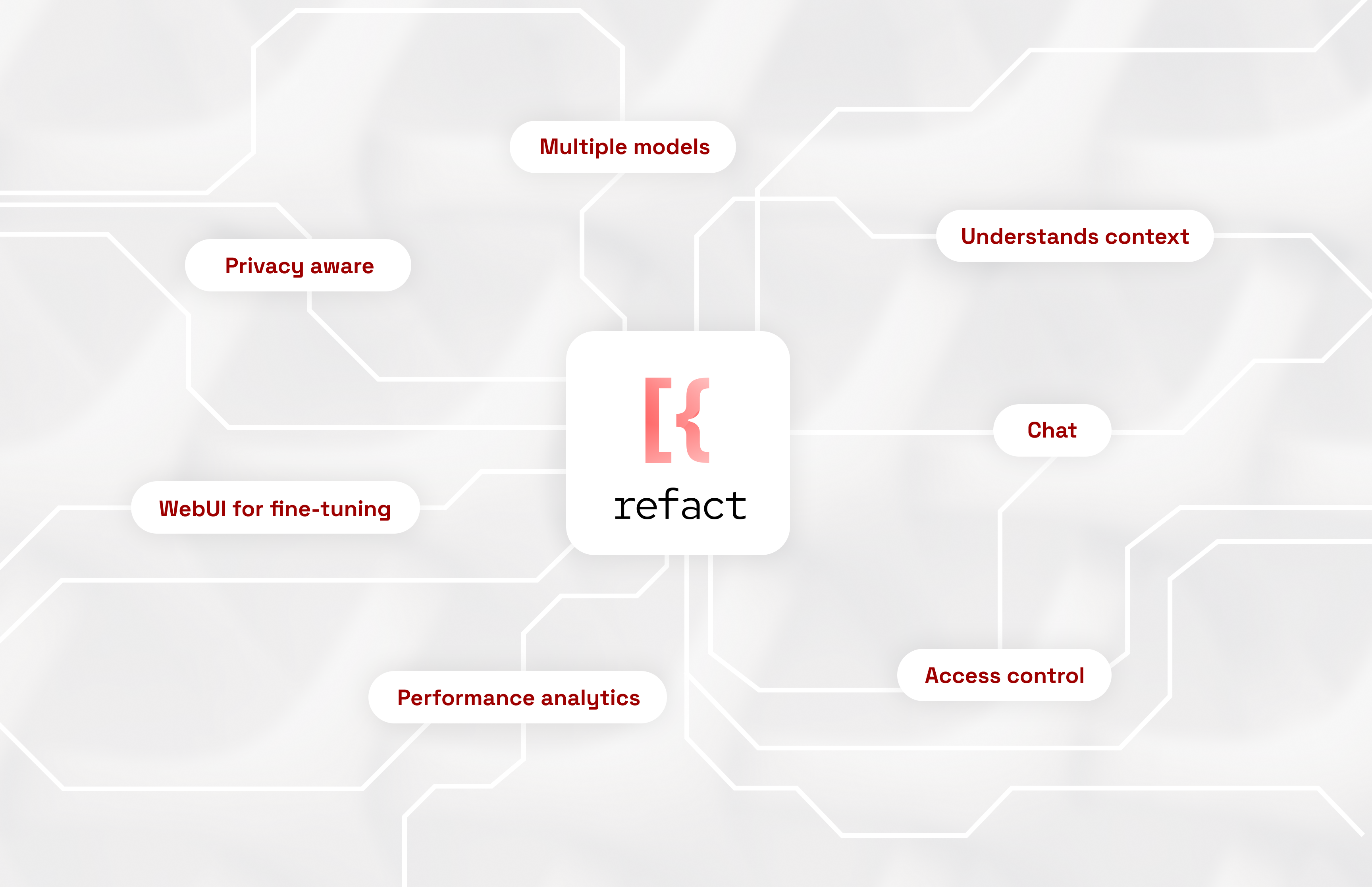
So how’s Refact different? It runs on-premise, Klimov says.

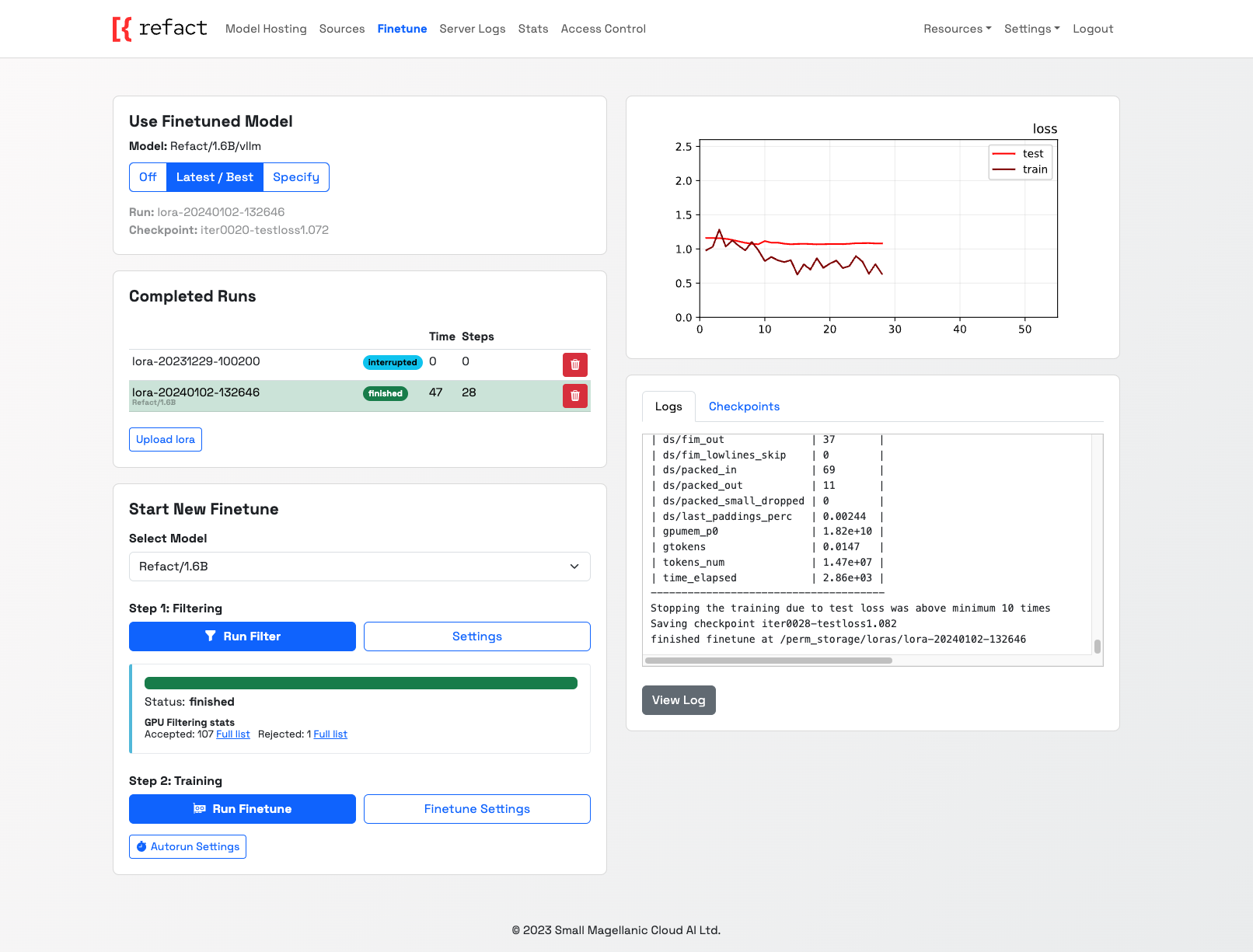
Like GitHub Copilot, Amazon CodeWhisperer and other major GenAI coding assistants, Refact can answer natural language questions about code (e.g. “When was this dependency last updated?”), recommend lines of code and fine-tune to improve its performance with a given codebase.

“One way to think about it is as a ‘strong junior engineer,'” Klimov said, “or an artificial co-worker on a team that’s productive but needs supervision.”

However, unlike many — if not most — of its competitors, Refact doesn’t need an internet connection. It doesn’t even upload basic telemetry data, Klimov claims.

Refact

Refact can run offline, on-premise, or in a cloud-hosted managed setup.

“We’re developing better controls and processes around sources and uses of data, security and privacy as we’re aware of the challenges that [enterprises] face and want to ensure the integrity of our customers’ information and innovative breakthroughs,” Klimov said.

Powering Refact’s platform are compact, code-generating models trained on permissively-licensed code — another key competitive advantage, Klimov claims. Some code-generating tools trained using copyrighted or otherwise restrively-licensed code have been shown to regurgitate that code when prompted in a certain way, posing a potential liability risk for the companies deploying them (at least according to some IP experts).

Vendors like GitHub and Amazon have introduced settings and policies aimed at allaying the fears of companies wary of the IP challenges around their GenAI coding tools. But it’s unclear that they’ve made much headway. In a 2023 survey of Fortune 500 businesses by Acrolinx, nearly a third said that intellectual property was their biggest concern about the use of generative AI.

“We used permissive licence code to train [our models] because our customers demanded it,” Klimov said.

Refact’s privacy- and IP-conscious approach helped it to raise $2 million in funding from undisclosed investors — and net ~20 pilot projects with enterprise customers. Klimov claims that the platform, which is also available in a cloud-hosted plan that starts at $10 per seat per month, is revenue-generating and currently on track to earn “a few million” annually by this summer.

That’s impressive, considering vendors like GitHub have struggled to make a profit on their code-generating tools. Copilot was reportedly costing GitHub parent Microsoft up to $80 per user per month as a result of the associated cloud processing overhead.

Refact

Refact is among the growing cohort of GenAI tools for programming.

The focus for the London-based, eight-person Refact team in the near future is upgrading Refact to run code autonomously, execute “multi-step” plans and self-test code.

“We’re actively working on a next-generation AI assistant – one that’ll debug the code it writes and operate on any large codebase,” Klimov said. “We’re well-funded internally and have the necessary capital to continue building the product … We’ve never benefited from an abundance of funding or from the venture capital frenzy that took place in previous years, but what’s really benefited us is the availability and eagerness of very talented people who are looking to join the AI revolution — and who saw in Refact as a place to thrive and develop something that can have a lasting impact.”

Eagle 7B RNN Model Surpasses Transformers in Performance

The open-source community has introduced Eagle 7B, a new RNN model, built on the RWKV-v5 architecture. This new model has been trained on 1.1 trillion tokens and supports over 100 languages. The RWKV architecture, short for ‘Rotary Weighted Key-Value,’ is a type of architecture used in the field of artificial intelligence, particularly in natural language processing (NLP) and is a variation of the Recurrent Neural Network (RNN) architecture.

Introducing Eagle-7B
Based on the RWKV-v5 architecture, bringing into opensource space, the strongest
– multi-lingual model
(beating even mistral)
– attention-free transformer today
(10-100x+ lower inference)
With comparable English performance with the best 1T 7B models pic.twitter.com/hWtEMC1264

— RWKV (@RWKV_AI) January 29, 2024

Eagle 7B promises lower inference cost and stands out as a leading 7B model in terms of environmental efficiency and language versatility.

The model, with its 7.52 billion parameters, shows excellent performance in multi-lingual benchmarks, setting a new standard in its category. It competes closely with larger models in English language evaluations and is distinctive as an “Attention-Free Transformer,” though it requires additional tuning for specific uses. This model is accessible under the Apache 2.0 license and can be downloaded from HuggingFace for both personal and commercial purposes.

In terms of multilingual performance, Eagle 7B has claimed to have achieved notable results in benchmarks covering 23 languages. Its English performance has also seen significant advancements, outperforming its predecessor, RWKV v4, and competing with top-tier models.

Working towards a more scalable architecture and use of data efficiently, Eagle 7B is a more inclusive AI technology, supporting a broader range of languages. This model challenges the prevailing dominance of transformer models by demonstrating the capabilities of RNNs like RWKV in achieving superior performance when trained on comparable data volumes.

In the RWKV model, the rotary mechanism transforms the input data in a way that helps the model better understand the position or or order of elements in a sequence. The weighted key value also makes the model efficient by retrieving the stored information from previous elements in a sequence.

However, questions remain about the scalability of RWKV compared to transformers, although there is optimism regarding its potential. The team plans to include additional training, an in-depth paper on Eagle 7B, and the development of a 2T model.

The post Eagle 7B RNN Model Surpasses Transformers in Performance appeared first on Analytics India Magazine.

Learn with LinkedIn: Free Courses About AI

Learn with LinkedIn: Free Courses About AI
Image by DALLE

LinkedIn is a professional networking site that has allowed professionals to connect around the world, land amazing jobs, and continuously keep you in the loop with your sector. But now you can also gain some amazing resources from them with their free courses.

And as we know everybody is going crazy about the world of artificial intelligence — what a great time to learn about it for FREE!

So let’s get into the courses you can learn to kickstart your AI journey!

Introduction to Artificial Intelligence

Link: Introduction to Artificial Intelligence

Regardless of what position and title you hold, it is going to be imperative for your professional and personal knowledge base to know about AI. This introduction to AI course is designed for project managers, product managers, directors, executives, and students who are looking to transition to the tech industry.

It will provide you with a high-level overview of what AI is, the tools used and then into the depths of algorithms and techniques involved in machine learning, artificial neural networks, and deep learning.

Generative AI

Link: Generative AI

A course that I believe everybody and their dog should take in the new year. Everyone is hyping about Generative AI and for good reasons. It’s about the shape of our future and I highly recommend you to learn what it exactly is.

It’s shaping every industry from marketing, and healthcare, to real estate. Naturally, we will all be affected by generative AI, but it is better to be part of the movement rather than fall behind. In this course, you will learn how generative AI works, how to create your own content and the ethical implications of it.

Generative AI: The Evolution of Thoughtful Online Search

Link: Generative AI: The Evolution of Thoughtful Online Search

We’ve moved from using search engines such as Google to help answer our questions. But now we have engines such as ChatGPT where we can have conversations that can really help us get an answer.

But learning how to leverage generative AI is a skill in itself, and this is exactly what this course aims to offer you. Learn about the beauty of prompt engineering, language, tone, and more.

Streamlining Your Work with Copilot

Link: Streamlining Your Work with Copilot

We’ve heard a lot about ChatGPT. But have you really used Microsoft's Bing Chat to explore its full capacity? If not, this course is for you.

In this course, you will learn about Bing Chat and how it can aid you in completing a variety of tasks as well as streamline your entire workflow. Sounds amazing right? A lot of people are looking at different ways that they can boost their productivity in the new year, and Bing Chat may be the answer for them.

Ethics in the Age of Generative AI

Link: Ethics in the Age of Generative AI

Listen, we’re all thinking about it, some of us are very vocal about it, and there’s no running away from it. The ethics around Generative AI. It’s a big topic and people are concerned about the implementation of AI systems in our everyday lives — and it’s normal to be!

Learning about the capabilities of generative AI, its limitations and what measures companies and the government are taking into consideration and implementing will put a lot of people's minds at ease. Generative AI is fairly new in the market and there's still a lot of work to do, so join the journey to see what our future looks like.

Wrapping it up

These 5 courses from LinkedIn are great for the wider community to learn about the tech industry. You could be a project manager who has come from a fashion background but you are interested in learning more about the tech industry and current tools.

There is so much space for growth with these free courses, and I urge everybody from different backgrounds, age groups, and professions to be part of the tech journey — professional or personal.

Nisha Arya is a Data Scientist and Freelance Technical Writer. She is particularly interested in providing Data Science career advice or tutorials and theory based knowledge around Data Science. She also wishes to explore the different ways Artificial Intelligence is/can benefit the longevity of human life. A keen learner, seeking to broaden her tech knowledge and writing skills, whilst helping guide others.

More On This Topic

  • 8 Free MIT Courses to Learn Data Science Online
  • 9 Free Harvard Courses to Learn Data Science
  • KDnuggets News, April 6: 8 Free MIT Courses to Learn Data Science…
  • KDnuggets News, May 4: 9 Free Harvard Courses to Learn Data…
  • 6 Best Free Online Courses to Learn Python and Boost Your Career
  • 5 Free University Courses to Learn Python

6 Must-Read White Papers For Developers

Often published by companies or the government, white papers in technology describe new products, technologies, methods and propose solutions, or share expert knowledge and research on a particular topic.

A white paper is different from a research paper or a report because of its in depth analysis and opinions from experts. They provide detailed information, offer solutions, or argue a specific point of view, often one they back. They are valuable to understand complicated concepts and developments by the company or organisation publishing them.

Here are the top whitepapers on AI –

AI Policy Briefs

MIT has released a set of policy briefs for U.S. AI governance. The key paper, “A Framework for U.S. AI Governance,” suggests using current regulatory frameworks to oversee AI, focusing on specific AI applications. This initiative, led by MIT’s Dan Huttenlocher and Asu Ozdaglar, aims to balance AI leadership and risk management. It’s timely, given the growing global focus on AI regulation, addressing governance challenges for both broad and specific AI technologies, and is part of MIT’s commitment to addressing AI’s societal impacts.

AI regulation: a pro-innovation approach

The UK’s Department for Science Innovation and Technology (DSIT) published a White Paper on March 29, 2023, outlining a “pro-innovation approach to AI regulation.” Trying to catch up with the rapid pace of AI development, UK opts for a decentralised, sector-specific framework using existing laws and its principles-based guidance. It is different from the EU’s AI Act, which adopts a horizontal legislative approach. The UK has aimed to foster innovation in AI applications while ensuring safety and accountability.

The White Paper’s key features include its flexibility in defining AI systems, principles-based approach, sector-focused guidance, and plans for regulatory sandboxes to encourage AI innovation. The DSIT’s strategy reflects a desire to align with international AI frameworks while maintaining a distinct path from the EU’s approach.

Achieving AI ROI Through Training Data Diversity

This Clickworker whitepaper discusses enhancing AI-powered chatbots, focusing on voice bots. It highlights the importance of robust training data to prevent user frustration with inefficient AI. The paper addresses the challenges in voice recognition and natural language processing, crucial for creating effective voice bots.

There is potential for voice bots in improving customer service and the need for diverse, real-world training data for optimal AI function. Clickworker, the company behind the whitepaper, offers solutions for creating this training data, drawing from its global community of workers. The whitepaper also compares voice bots to text bots, emphasising user preferences for the former due to their natural and efficient communication mode.

Coding on Copilot

This whitepaper by William Harding and Matthew Kloster analyses the impact of GitHub Copilot on code quality. It reveals a significant increase in code generation speed and volume due to Copilot but raises concerns about maintainability and quality. The study, based on 153 million lines of code, indicates a rise in code churn and a trend toward more added and copy/pasted code, which suggests a decline in code quality.

The paper discusses the challenges posed by AI-generated code, noting that it often leads to an increase in added code but lacks suggestions for updating or deleting code. This could lead to issues in code maintenance and readability. The research highlights that experienced developers are more cautious in accepting AI suggestions compared to junior developers, hinting at long-term maintainability concerns.

Accelerating Sustainability with AI: A Playbook

This paper published by Microsoft discusses the critical role of AI in addressing the urgent challenges of climate change and environmental sustainability. The paper emphasises AI as a vital tool for measuring, predicting complex systems, speeding up the development of sustainability solutions, and empowering the sustainability workforce.

The paper outlines AI’s potential to improve wildfire prediction, advance renewable energy technologies, and enhance climate-resilient agriculture. It also highlights the need for robust training data to ensure AI’s effective deployment in sustainability efforts.

Microsoft proposes a five-point playbook to maximise AI’s potential for sustainability. This includes investing in AI for sustainability solutions, developing digital and data infrastructure, minimising resource use in AI operations, advancing AI policy and governance for sustainability, and building workforce capacity to use AI for sustainability.

Adaptation of Large Foundation Models

Google’s whitepaper focuses on adapter tuning methods for customising large pre-trained AI models to specific tasks using provided training datasets. This technical reference is designed for developers, product managers, business leaders, and security engineers, detailing how data is handled and the limitations involved.

The paper explains foundation models, which are trained on extensive data, enabling them to learn patterns applicable across different domains. Google’s approach emphasises the use of adapters for efficient fine-tuning, aligning the model with specific domains without rebuilding the entire foundation model.

Security and privacy are highlighted, with assurances that customer data is protected and not used without permission. The paper also discusses Google Cloud’s design considerations for adapter tuning on Vertex AI, emphasising security measures like encryption, access transparency, and automatic deletion of temporary data.

The post 6 Must-Read White Papers For Developers appeared first on Analytics India Magazine.

Top 10 GPTs to Learn Coding

Earlier this year, OpenAI launched its GPT Store. The store is available to ChatGPT Plus, Team, and Enterprise users, providing access to a variety of GPTs developed by partners and the community.

Here are the top 10 GPTs that can help you write efficient, error-free, and innovative code.

Screenshot To Code GPT

Created by godofprompt.ai this GPT can effortlessly transform a mere screenshot of a website into pristine HTML, Tailwind CSS, and JavaScript code. Say goodbye to the complexities of manual coding and let AI seamlessly interpret your visual ideas into clean and functional web code.

Grimoire

This GPT by mindgoblinstudios.com is specifically designed to support Python development, offering help with tasks such as generating code, supplying code snippets, and addressing queries related to development. With 20+ hotkeys designed for seamless coding flows, Grimoire empowers you to effortlessly navigate through the realms of code and creativity.

CrewAI Assistant

This GPT has been created to aid in Python development, offering assistance for tasks like code generation, supplying code snippets, and responding to queries related to development.

DesignerGPT

This GPT simplifies website design and hosting, offering a seamless solution for individuals and businesses seeking an online presence. The GPT requires minimal technical knowledge from the user and is ideal for those looking to establish a professional, visually appealing website quickly and efficiently.

Code Copilot

Created by promptspellsmith.com is your indispensable companion in the world of programming. This exceptional GPT is engineered to empower programmers to code smarter and build faster, harnessing the expertise of a 10x Programmer right by your side. Whether you’re a novice navigating your coding journey or an experienced developer seeking to optimise your workflow, Code Copilot is your go-to solution.

CodeGuru

Built by Ryan J Topps is your ultimate coding companion, offering a sophisticated blend of expertise and efficiency to enhance your development workflow. As a dedicated code reviewer, pull request writer, function generator, and optimiser, as well as a proficient code tester and commentator, CodeGuru is your all-in-one solution for code refinement.

💻Professional Coder (Auto programming)

Created by Kevin Ivery is your dedicated expert for seamlessly tackling programming problems. This GPT is set to redefine your coding journey.

Excitingly, the prompts are available as open source on GitHub: https://github.com/ai-boost/awesome-gpts-prompts. Whether you’re delving into intricate algorithms, debugging complex code, or searching for elegant solutions, Kevin Ivery’s creation is here to assist.

AutoExpert (Dev)

Built by llmimagineers.com, AutoExpert v6 (GPT Developer Edition), is your steadfast pair programmer, armed with enhanced code generation ability, online access to the latest APIs, and custom commands to save your session state, allowing you to recall it in a new session later. Simply say ‘Hello’ to begin.

AskTheCode

Developed by AskTheCode.ai is your personalised code companion for unravelling the mysteries within GitHub repositories. With AskTheCode, exploring and understanding codebases becomes a breeze. Simply share a GitHub repository URL, and let this intelligent GPT be your guide for any aspect of the code you wish to explore.

AskTheCode.ai is designed to cater to developers seeking clarity on specific functions, curious minds eager to understand implementation details, or anyone in need of assistance with debugging. It’s like having a knowledgeable coding partner ready to answer your questions and provide valuable insights into the intricacies of the code you’re examining.

Java Assistant

Built by guliucang.com is a Java code assistant and debugger that can browse the internet. This exceptional code assistant not only enhances your coding efficiency but also serves as a debugger, helping you navigate through the intricate landscapes of Java programming with ease.

What sets the Java Assistant apart is its unique ability to browse the internet, providing you with a wealth of resources right at your fingertips. Need to explore documentation, find code snippets, or seek inspiration? The Java Assistant seamlessly integrates the vast expanse of the web into your coding environment.

The post Top 10 GPTs to Learn Coding appeared first on Analytics India Magazine.