Navigating the Misinformation Era: The Case for Data-Centric Generative AI

In the digital era, misinformation has emerged as a formidable challenge, especially in the field of Artificial Intelligence (AI). As generative AI models become increasingly integral to content creation and decision-making, they often rely on open-source databases like Wikipedia for foundational knowledge. However, the open nature of these sources, while advantageous for accessibility and collaborative knowledge building, also brings inherent risks. This article explores the implications of this challenge and advocates for a data-centric approach in AI development to effectively combat misinformation.

Understanding the Misinformation Challenge in Generative AI

The abundance of digital information has transformed how we learn, communicate, and interact. However, it has also led to the widespread issue of misinformation—false or misleading information spread, often intentionally, to deceive. This problem is particularly acute in AI, and more so in generative AI, which is focused on content creation. The quality and reliability of the data used by these AI models directly impact their outputs and make them susceptible to the dangers of misinformation.

Generative AI models frequently utilize data from open-source platforms like Wikipedia. While these platforms offer a wealth of information and promote inclusivity, they lack the rigorous peer-review of traditional academic or journalistic sources. This can result in the dissemination of biased or unverified information. Furthermore, the dynamic nature of these platforms, where content is constantly updated, introduces a level of volatility and inconsistency, affecting the reliability of AI outputs.

Training generative AI on flawed data has serious repercussions. It can lead to the reinforcement of biases, generation of toxic content, and propagation of inaccuracies. These issues undermine the efficacy of AI applications and have broader societal implications, such as reinforcing societal inequities, spreading misinformation, and eroding trust in AI technologies. As the generated data could be employed for training future generative AI, this effect could grow as ‘snowball effect’.

Advocating for a Data-Centric Approach in AI

Primarily, inaccuracies in generative AI are addressed during the post-processing stage. Although this is essential for addressing issues that arise at runtime, post-processing might not fully eliminate ingrained biases or subtle toxicity, as it only addresses issues after they have been generated. In contrast, adopting a data-centric pre-processing approach provides a more foundational solution. This approach emphasizes the quality, diversity, and integrity of the data used in training AI models. It involves rigorous data selection, curation, and refinement, focusing on ensuring data accuracy, diversity, and relevance. The goal is to establish a robust foundation of high-quality data that minimizes the risks of biases, inaccuracies, and the generation of harmful content.

A key aspect of the data-centric approach is the preference for quality data over large quantities of data. Unlike traditional methods that rely on vast datasets, this approach prioritizes smaller, high-quality datasets for training AI models. The emphasis on quality data leads to building smaller generative AI models initially, which are trained on these carefully curated datasets. This ensures precision and reduces bias, despite the smaller dataset size.

As these smaller models prove their effectiveness, they can be gradually scaled up, maintaining the focus on data quality. This controlled scaling allows for continuous assessment and refinement, ensuring the AI models remain accurate and aligned with the principles of the data-centric approach.

Implementing Data-Centric AI: Key Strategies

Implementing a data-centric approach involves several critical strategies:

  • Data Collection and Curation: Careful selection and curation of data from reliable sources are essential, ensuring the data's accuracy and comprehensiveness. This includes identifying and removing outdated or irrelevant information.
  • Diversity and Inclusivity in Data: Actively seeking data that represents different demographics, cultures, and perspectives is crucial for creating AI models that understand and cater to diverse user needs.
  • Continuous Monitoring and Updating: Regularly reviewing and updating datasets are necessary to keep them relevant and accurate, adapting to new developments and changes in information.
  • Collaborative Effort: Involving various stakeholders, including data scientists, domain experts, ethicists, and end-users, is vital in the data curation process. Their collective expertise and perspectives can identify potential issues, provide insights into diverse user needs, and ensure ethical considerations are integrated into AI development.
  • Transparency and Accountability: Maintaining openness about data sources and curation methods is key to building trust in AI systems. Establishing clear responsibility for data quality and integrity is also crucial.

Benefits and Challenges of Data-Centric AI

A data-centric approach leads to enhanced accuracy and reliability in AI outputs, reduces biases and stereotypes, and promotes ethical AI development. It empowers underrepresented groups by prioritizing diversity in data. This approach has significant implications for the ethical and societal aspects of AI, shaping how these technologies impact our world.

While the data-centric approach offers numerous benefits, it also presents challenges such as the resource-intensive nature of data curation and ensuring comprehensive representation and diversity. Solutions include leveraging advanced technologies for efficient data processing, engaging with diverse communities for data collection, and establishing robust frameworks for continuous data evaluation.

Focusing on data quality and integrity also brings ethical considerations to the forefront. A data-centric approach requires a careful balance between data utility and privacy, ensuring that data collection and usage comply with ethical standards and regulations. It also necessitates consideration of the potential consequences of AI outputs, particularly in sensitive areas such as healthcare, finance, and law.

The Bottom Line

Navigating the misinformation era in AI necessitates a fundamental shift towards a data-centric approach. This approach improves the accuracy and reliability of AI systems and addresses critical ethical and societal concerns. By prioritizing high-quality, diverse, and well-maintained datasets, we can develop AI technologies that are fair, inclusive, and beneficial for society. Embracing a data-centric approach paves the way for a new era of AI development, harnessing the power of data to positively impact society and counter the challenges of misinformation.

6 Job Openings for Responsible AI and Ethics in India

As India approaches the 2024 elections, the economy is actively working on guidelines and regulations to address bias and discrimination in AI systems. While the government is sorting out the regulation priorities, companies across the country are making sure they build AI systems while focusing on the ethics.

Job roles are evolving across the landscape, thanks to the AI boom in the country. Here are six positions currently open for people to help these companies build tech, including AI, responsibly.

Accenture, NLP-Responsible AI Practitioner

The job role will include several aspects of developing natural language processing models responsibly. The responsibilities will include assessing AI systems for adherence to predefined thresholds and benchmarks related to responsible, ethical and sustainable practices.

The candidate will also design and implement technology mitigation strategies for systems to ensure that ethical and responsible standards are achieved. The must-have skills for the role are natural language processing (NLP) and a minimum 7.5 years of experience.

Click here to apply.

AlphaLegal.AI, Ethics and Compliance Officer

AlphaLegal the legal services provider is seeking a skilled professional for the role of Ethics and Compliance Officer. In this role, the candidate will be responsible for developing and implementing ethical guidelines and compliance protocols to ensure the fair and responsible use of AI systems.

Applicants must have a bachelor’s or master’s degree in ethics, business, law, or a related field and work experience in ethics and compliance roles, (preferably) focused on tech. If you are familiar with privacy regulations, such as GDPR or CCPA, and their implications for AI systems, you must consider applying for this position.

Click here to apply.

BP, Data Analytics – Ethics & Compliance

The Pune-based job opening offers candidates an opportunity to advise the businesses and functions on ethics and compliance initiatives and adherence to policy. The role requires sound technical knowledge and experience to help BP embed internal and external policies in ethics and compliance culture.

Those with a bachelor’s degree in science, technology, engineering, math, or finance and MSc in a quantitative field, preferably statistics, can apply for this position. The key attributes of the role include partnering with several teams to identify, source, cleanse and analyse data. You’ll also be accountable to develop data analytics solutions to support assurance program planning, scoping, and execution.

Alongside, you’ll develop projects/processes/procedures and implement strategies and policies.

Click here to apply.

AI Planet, AI Governance Policy Analyst

This remote job role is temporary — a 4-month contract — to help AI Planet research, develop, and implement AI governance policies that align with legal, ethical, and societal standards.

The key responsibilities include researching and analysing latest AI-related regulations, standards, and practices at the global, regional, and industry-specific levels. You’ll also be in-charge of analysing legal frameworks and ethical guidelines to inform the development of AI governance policies while collaborating with cross functional teams.

Qualification wise, the position requires a bachelor’s or master’s degree in computer science, data science, law, public policy, or a related field and experience in AI governance, AI ethics, public policy, or related areas.

Click here to apply.

Fractal Analytics, Principal Consultant – AI Ethics

This full-time role, based out of Bengaluru, the Silicon Valley of India, requires a strong background in data science alongside a keen interest in responsible AI and ethics. In this position, you’ll be working with an interdisciplinary team and building relationships with CXOs, as a part of the solution development.

Click here to apply.

Quantiphi, Research Scientist – AI Ethics & Responsible AI Leader

The company, based out of Mumbai, is looking for a research scientist to help them build AI systems responsibly. The hired professional will work with different groups to make sure the AI is built by fair means.

In this role, you will be responsible for designing governance structure and training programs to promote awareness and adoption of responsible AI principles. Alongside, you will contribute towards publications at top machine learning conferences and scientific journals, in responsible AI.

Similar to the roles above, this one requires you to say up-to-date with the research trends and tools related to responsible AI and integrate them into various businesses across the company.

Click here to apply.

The post 6 Job Openings for Responsible AI and Ethics in India appeared first on Analytics India Magazine.

This new iPhone app fuses AI with web search, saving you time and energy

Arc Search for the iPhone

A new app called Arc Search shows how AI and web search can work together to deliver search results that are both comprehensive and concise.

Developed by the people behind the Arc browser and aimed at iOS for now, the new search tool kicks in several cool tricks to help you with your web searches. But one tool in particular shines above the rest.

A search option known as Browse for Me takes your search question or query and builds an entire webpage based on the provided information. Type a question such as "Has Amelia Earhart's plane been found?" and tap the Browse for Me button. Arc Search scours a variety of different websites for the answer and delivers a compact webpage with the info you need.

Also: Arc browser offers the most truly helpful spin on AI I've seen so far

At the top is a gallery of images related to your question. Tap any image, and you're taken to the corresponding website. Next are a series of bullet point items that summarize the key details of the generated information. After that are the top search results that Arc found. Below that are further bullet point items that flesh out the topic even further. And at the bottom are links to additional websites that offer a deeper look at specific aspects of your query.

In essence, Arc Search combines AI with a traditional search engine layered on top of a mobile browser. With the AI summaries, you can scan the basic facts about your topic. And with the website links, you're able to further investigate any area of interest. You can even set Arc Search as your default mobile browser so that it will automatically open hyperlinks from other apps.

Also: Microsoft adds Copilot Pro support to iPhone and Android apps

Beyond the Browse for Me option, Arc Search kicks in other tools to help with your searches. You can easily start a new search by tapping the Search icon at the bottom. From there, a keyboard automatically pops up for you to enter your new query.

Arc Search keeps each tab open so you can quickly return to a previous search page. Just tap an icon at the bottom to view your open tabs. You can even close a tab just by flicking it off the screen. Plus, an auto-archive feature will remove inactive tabs after a while to avoid clutter.

A Reader Mode displays a clean and more readable version of a tab or page by eliminating unwanted elements. Using the Find on Page tool, you're able to search for specific text on any webpage generated by Arc Search. You can also share or copy the URL of a webpage. Plus, Arc Search is privacy-minded in that it can block ads, cookies, banners, and trackers.

Also: The best AI image generators to try right now

To try Arc Search, download it from the App Store. Launch the app (no sign-up or account is required, thankfully). Then just dive in with your first question to see how the app fares.

Arc Search comes from The Browser Company of New York, developer of the Arc Max browser. Available for MacOS and coming soon to Windows via a current waitlist, Arc Max includes several handy AI-based tools.

An integrated ChatGPT is available to answer your questions. A Tidy Tab Title shrinks the name of a tab so you can better see it. The Tidy Downloads option renames downloaded files with more descriptive titles. A Five-Second Preview displays a summary and preview of a link if you hover over it. And an Ask On Page option can call on AI to grab information about a word or phrase on a website.

Featured

As layoffs deepen, AI’s role in the cuts is murky – but it definitely has one

As layoffs deepen, AI’s role in the cuts is murky – but it definitely has one

A new kind of Industrial Revolution could already be well underway

Darrell Etherington @etherington / 8 hours

Layoffs season is extending into a sustained state, defying more typical formations of cyclical boom and bust periods in tech. Meanwhile, AI continues to be ascendant – or at least the current version of neural networks trained on large data sets that drives developments like OpenAI’s ChatGPT and Anthropic’s Claude. One topic keeps coming up in conversations I’m having with technologists, executives, industry leader and frontline workers on all sides of both trends: Specifically, how much the AI boom is complicit in the great and continued culling.

Everyone seems to agree that the advent and uptake of AI is playing some part in at least the scope of the layoffs, if not in the timing, which more likely is attributable to overall economic uncertainty. Companies are certainly crowing about the benefits in efficiency new AI products can and are bringing to businesses, but few actually mention them in the specific context of layoffs – though news about AI replacing at least some of those losing their jobs is making its way out despite efforts to keep that under wraps.

Salesforce is laying off around 700 people in its most recent tranche of job cuts, which adds to the group it announced it was cutting last year. SAP, too, announced a massive restructuring but stressed that it anticipates headcount will be the same by end of year. That’s a lot of massaging of the message, but the real story is that these massive companies would typically grow year-over-year, so even flat hiring with restructuring, some buy-outs and backfill hires is a step back from business-as-usual.

Both these companies, and many of the other massive tech firms currently suffering through layoffs have also signalled and/or announced sizeable investments in AI to help augment or replace work currently being done by people. Typically these announcements are accompanied by assurances that automating certain tasks will lead to actual human resources being deployed in roles and for jobs that are much more fulfilling, creative and meaningful.

Long-term, that may be the case, but right now it’s all ‘regrettable’ downsizing alongside massive, budget-busting spend on AI products and innovation, with no silver lining in sight about when those generate whole new roles and opportunities for those workers displaced in the meantime.

There are plenty of comforting examples out there of how generative AI is still lacking in many regards when it comes to comparing them with actual people – but there are just as many, if not more, examples of how people are happily using tools like ChatGPT for their real work everyday, with results that are at least satisfactory, if not better than what they were able to do before.

Technology revolutions are always disruptive and displace tons of people, but this one seems unique in that the technology it promises doesn’t just augment human efficiency in specific roles in all cases – it actively replaces an entire function in many. There’s a need for greater transparency about when AI will occupy roles people once did as these large companies continue their roll-out, but we’re unlikely to get that in the midst of the action: More likely it’ll be studied and uncovered later by researchers trying to assess the impact.

Meta Releases Code Llama 70B

Code Llama

Meta has released Code Llama 70 B. The new iteration, available for download at https://bit.ly/48QeOs7, maintains an open license, aligning with its predecessors—Llama 2 and prior Code Llama models—aimed at supporting research and commercial innovation.

One notable addition to the suite is CodeLlama-70B-Instruct, a finely tuned version specifically designed for instruction-based tasks. This model achieves an impressive 67.8 on HumanEval, solidifying its status as one of the highest-performing open models currently available.

Code Llama 70B provides three free versions for research and commercial use: foundational code (CodeLlama – 70B), Python specialisation (CodeLlama – 70B – Python), and fine-tuned for natural language instructions (Code Llama – 70B – Instruct 70B).

“We’re open sourcing a new and improved Code Llama, including a larger 70B parameter model. Writing and editing code has emerged as one of the most important uses of AI models today,” said Meta chief, Mark Zuckerberg.

“The ability to code has also proven to be important for AI models to process information in other domains more rigorously and logically. I’m proud of the progress here, and looking forward to including these advances in Llama 3 and future models as well,” he added.

Meta released its code generation model called Code Llama, last August, which generates code based on both code and natural language prompts. The best part is that just like Llama 2, Code Llama is open source and also available for commercial use.

Code Llama is built upon the foundation of Llama 2, which has been fine-tuned with specialised code-related datasets. The company announced four versions of Code Llama — Code Llama, Code Llama Instruct, Code Llama Python, and Unnatural Code Llama, each with varying capacities: 7B, 13B, and 34B parameters.

The post Meta Releases Code Llama 70B appeared first on Analytics India Magazine.

Natural Language Processing: Bridging Human Communication with AI

Natural Language Processing: Bridging Human Communication with AI
Photo by ROMAN ODINTSOV

Imagine a world where machines are able to understand what you say and how you feel; where you can talk to a computer, and it’ll respond; and where technology can sift through the text and summarize it for you. Wait a minute. You don’t have to imagine anything — it’s a reality today, with the NLP adoption.

As a subfield of AI, natural language processing (NLP) has emerged as a breakthrough in technology, enabling computers to communicate using human language. Its market size was valued at $18.9 billion in 2023 and is expected to grow to $68 billion by 2028. Nothing’s surprising about this, regarding the diverse applications of NLP in the modern-day world, from chatbots to machine translation to document analysis.

In this post, we discuss the transformative impact of NLP on business, its use cases, and real-world examples per industry. We also briefly touch on the benefits of natural language processing, its challenges, and the future opportunities it brings to us.

Understanding the Essence of NLP

NLP is a combination of linguistic, statistical, and machine learning (ML) techniques that allow the processing of massive amounts of data. This enables computers to grasp the nuances in human language, understand the context, and respond to it in a meaningful way. In other words, NLP algorithms aim to bridge human communication with AI.

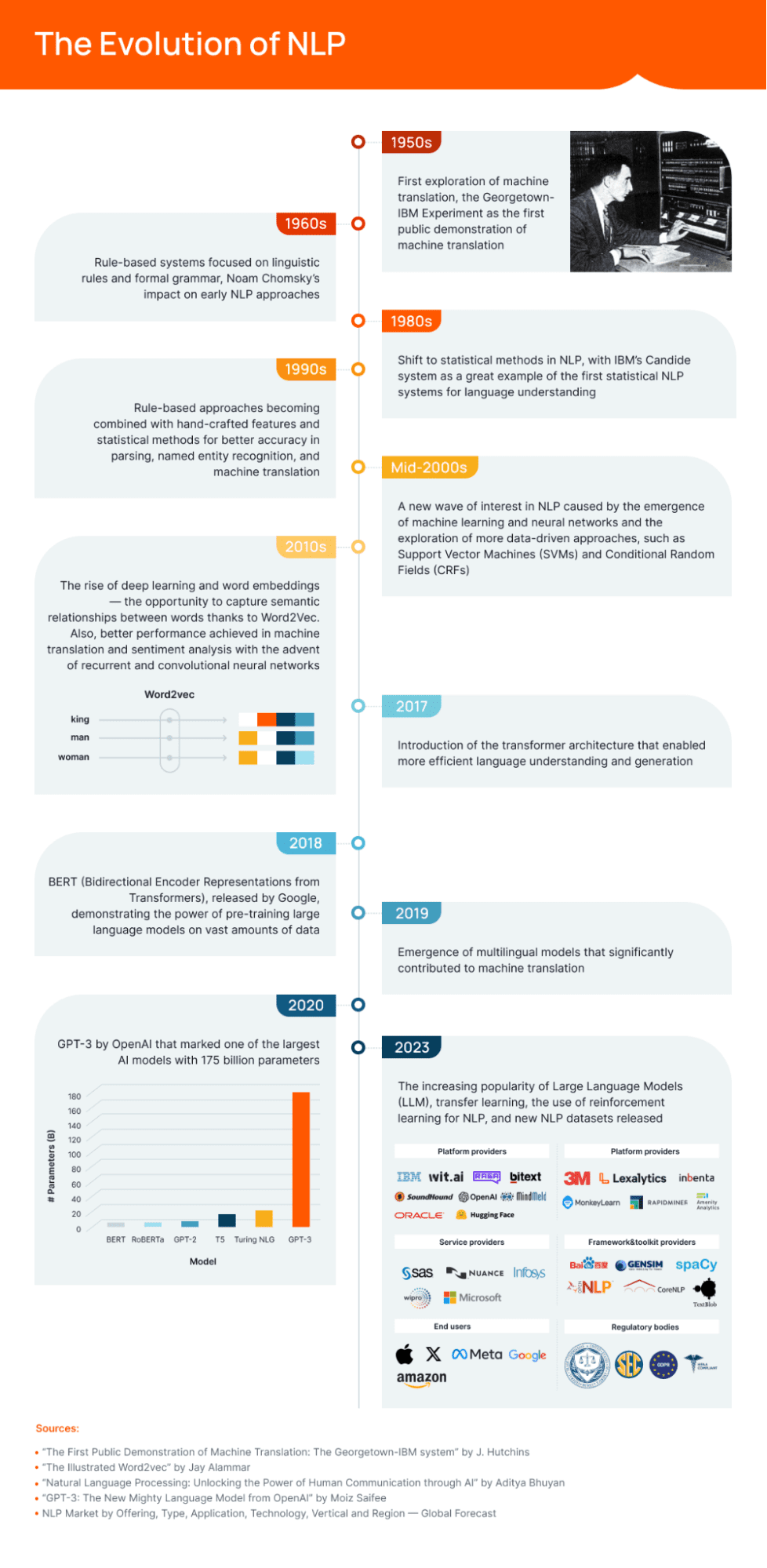
But this wasn’t always the case. The infographic below covers the evolution of NLP over time until it reached today’s potential. The key driving factors for NLP adoption were improvements in computational power, advancements in AI and machine learning, and data availability. The latter occurred largely because of the cloud, which provided better scalability and lower costs for data storage and processing.
Natural Language Processing: Bridging Human Communication with AI
The Evolution of NLP

The evolution of NLP was also all about a transition from rule-based systems to ML algorithms, which can learn to “understand” the language. In a rule-based approach, an expert manually encodes each rule in NLP. That’s why these systems are more static and non-adaptable as compared to machine learning.

NLP’s Fundamental Objectives

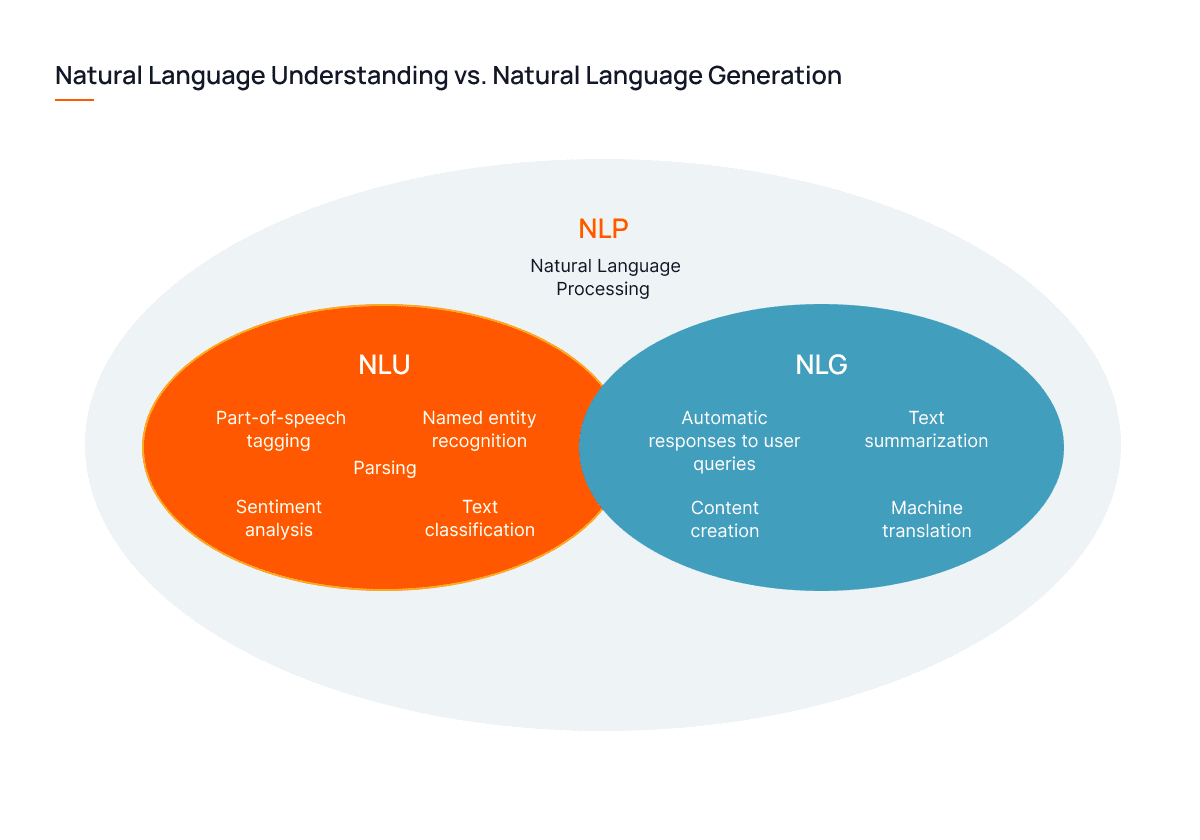
Exploring further the nature of NLP, we should mention its fundamental objectives to understand and interact with the human language. Accordingly, we distinguish between:

  • Natural Language Understanding (NLU), which is concerned with the extraction of meaning. It helps to comprehend the intricacies and nuances of the written and spoken language, dealing with ambiguities and contextual variations. For instance, NLU comes in handy to differentiate between accents or understand slang.
  • Natural Language Generation (NLG), which deals with producing human-like responses from data. Using statistical methods and language models to analyze big volumes of data, NLG helps to “respond” to user queries in a conversational manner. It also handles text summarization, machine translation, and content creation.
Natural Language Processing: Bridging Human Communication with AI
Natural Language Understanding vs. Natural Language Generation

Now we can outline how NLP works. Basically, there are 2 steps:

  1. Transforming the text into something a machine can understand
  2. Analyzing the text to actually understand the context and language and extract the meaning

At the same time, a lot is going on under the hood of a natural language processing system to enable the machine to perform these two actions. Let’s have a quick look at the key NLP components to understand how it works better:

  • Tokenization: To break down a text into smaller units like words or phrases (tokens) to process them in smaller, manageable chunks
  • Syntax analysis: To parse grammatical structures to properly understand syntactic relationships in sentences
  • Part-of-speech tagging: To assign grammatical tags (e.g., noun, verb, etc.) to words in a sentence to add to the syntactic analysis
  • Semantic analysis: To catch the meaning and context behind words, phrases, and sentences
  • Sentiment analysis: To determine the sentiment or emotion expressed in the text like positive, negative, or neutral
  • Named Entity Recognition (NER): To identify and categorize entities, i.e. names, organizations, locations, etc.
  • Statistical and ML models: To process and analyze volumes of data. Supervised ML algorithms work best for tasks like text classification and sentiment analysis while unsupervised algorithms for clustering and topic modeling.
  • Language models: To predict the probability of word sequences in a context. This technique is widely used in auto-completion and language generation tasks
  • Language translation models: To convert text from one language to another. Advanced models, such as neural machine translation, can significantly add to the accuracy of translation.
  • Language generation techniques: To generate human-like responses based on data or given context. This approach is used for chatbots, text summarization, etc.

The combination and integration of these components allow data scientists to build powerful NLP systems and contribute to better AI communication results.

Transforming Human Communication with NLP

Natural language processing is only gaining momentum across industries, and new applications appear every year. Below we review the most common use cases of NLP to discover more about your business potential of transforming communication with NLP.

Natural Language Processing: Bridging Human Communication with AI
Top Applications of NLP

Conversational AI and chatbots

Smart virtual assistants and chatbots are the first that comes to your mind when thinking about NLP. Today’s NLP conversational AI systems are sophisticated enough to engage in authentic and contextually appropriate dialogues with users.

Virtual assistants like Siri or Alexa are in our everyday use, handling minor tasks like setting reminders, making and receiving phone calls, and finding where to park. NLP-driven chatbots contribute to businesses by scaling support services and improving personalization.

Look at the Lyro chatbot below developed by Tidio. Unlike regular chatbots, Lyro doesn’t require any training from support agents — the company activates it and starts responding to users’ queries right away.

Natural Language Processing: Bridging Human Communication with AI
Image from Tidio

Machine Translation

Machine translation is the second most prominent use case of NLP. Students, language translators, tourists, and many others can’t imagine their lives without Google Translate today. And although machine translation existed long before NLP, it has brought it to a new level by:

  • Adding more accuracy and fluency with the use of transformers
  • Promoting and facilitating real-time language translation
  • Making possible context-aware translation, which left traditional word-for-word translation methods in the past
  • Helping with content localization to consider cultural preferences and local dialects

To make it more illustrative, here’s DeepL, a less known competitor to Google Translate. The tool supports translation into 26 languages to help users break down language barriers. It also has app integration and a website translation widget.

Natural Language Processing: Bridging Human Communication with AI
Image from Deepl

Document Management

NLP also has unique speech-to-text capabilities that help to improve the accuracy and efficiency of documentation. Leaving out simplistic use cases like dictating text instead of typing it, we can also speak about the following:

  • Text summarization: Automatic summaries delivered by AI are useful when one needs to digest large amounts of information quickly. NLP doesn’t simply summarize lengthy texts — keyword extraction and sentence ranking allow NLP to summarize a text in a coherent manner by capturing key points.
  • Information extraction: Among other approaches in NLP, NER is especially efficient for automated information retrieval and knowledge discovery. This significantly saves time and effort for a researcher not to skim through a vast amount of information.
  • Text classification: When it comes to large volumes of textual data, NLP can help to categorize it. While getting the data more organized, the company also benefits from improved information accessibility.

Content Generation

Due to its ability to catch the essence of events and data, NLP can generate content based on the given information. Probably everyone has already heard of ChatGPT and how it creates unique, meaningful content with the right prompts. Models like this can make the lives of content creators easier by helping them write product instructions, social media posts, articles, emails, and others.

Consider a less mainstream example of an AI content creator tool than GPT. OwlyWriter AI can save hours of marketer’s work when it comes to SMM. From creating captions for posts to generating content ideas to writing posts, the tool helps social media professionals beat writer’s block and work more efficiently.

Natural Language Processing: Bridging Human Communication with AI
Image from Hootsuite

Speech Recognition

Another great application of NLP is speech recognition, which allows machines to translate spoken language into written text. Again, voice assistants like Siri or Google Assistant are the most illuminating examples in this case.

There are still lots of other use cases for speech recognition like transcription services or voice-controlled devices. Remember about the feature that allows drivers to control cars safely hands-free. Also, smart home devices are all developed based on NLP.

Sentiment Analysis

Sentiment analysis, as one of the NLP techniques, works best to analyze customer reviews and social media sentiments to get public opinions about the product or service or follow trends.

For instance, NLP can help businesses analyze customer feedback about the recent product launch to make more informed decisions for customer satisfaction. It also powers up apps for social media monitoring, like Brandwatch. These monitor social network content for companies to know public opinions and feelings toward brands, track trends, and manage online reputation.

Natural Language Processing: Bridging Human Communication with AI
Image by Brandwatch

Search Engine Optimization

Search engines like Google use NLP to improve the accuracy of their search results. This approach helps to understand the user intent behind the query better and match it with the most relevant search results.

Spam Filtering

One more area that NLP has revolutionized includes spam filtering. And here we speak not only about email but other applications too. For example, YouTube uses NLP to filter spam data in the comment section of its videos. It uses a tool called TubeSpam, which was trained using the Naïve Bayes classifier to filter out spam.

The list of NLP applications is much longer. We discussed the biggest use cases but left out smaller ones like autocorrect and autocomplete features, fraud detection, etc. To make our research fuller, let’s speak about real-life examples of how NLP transforms industries.

Real-world Examples of NLP in Action

Although NLP is successfully implemented across various industries, its biggest market share is in tech, healthcare, retail, financial services, insurance, and marketing. See about each of these in detail.

Natural Language Processing: Bridging Human Communication with AI
Global NLP Market Share by Industry

Customer Service

NLP-driven chatbots and virtual assistants have altered customer service once and forever. Now, customers can get 24/7 support while agents benefit from reduced workload. Erica — the chatbot created by Bank of America — provides financial support and guidance to clients and helps to navigate online banking. NLP enables Erica to learn users’ preferences and needs and provide personalized recommendations.

Let’s look at specific examples of the use of NLP in customer service:

  • NLP-based voice assistants to understand the user’s request and direct it to the right human agent
  • Automated chatbots for simple tasks like answering questions, checking information, scheduling appointments, etc.
  • Use of virtual assistants for hands-free interactions with devices and services
  • Customer feedback analysis and sentiment analysis — for example, a chatbot can start with an apology when dealing with a frustrated customer

E-commerce and Retail

Most reputable e-commerce websites today like Amazon, eBay, or Walmart use NLP-powered semantic search, which improves product visibility and search experience. In contrast to matching keywords, semantic search is more intuitive and aims to understand the user’s intent behind the query.

Next to semantic search, NLP has other applications in retail:

  • Customer sentiment analysis to understand more about brand loyalty and ultimately strengthen the brand
  • Conversational commerce with voice assistants
  • Personalized product recommendations

Education

In the field of education, NLP has the most creative use cases. A great example includes Coursera’s course recommendation system, which helps users find the best courses based on their interests. Think also about all-favorite Grammarly, an NLP-based solution that makes your writing clear and error-free.

Other examples of NLP in education include but are not limited to:

  • Intelligent tutoring systems
  • Exam question generation based on textbooks or other training materials
  • Automated grading and feedback analysis
  • Plagiarism detection software
  • Adaptive learning and personalized instruction and feedback to students

Finances and Banking

Have you ever received a call from the bank asking about suspicious activity on your account? These calls are usually triggered by NLP. Fraud detection is one of the biggest applications of NLP in finances. At one time, Mastercard Decision Intelligence, which was specifically developed to indicate fraudulent activity, helped the company to cut fraud by 50%. Check the solution potential by yourself:

Alt tag: Mastercard Decision Intelligence

Two other ways of how NLP is employed in the financial sector include:

  • Sentiment analysis on various text data like financial reports, social media posts, and news articles to predict stock prices and market fluctuations and, thus, help traders and investors make more informed decisions
  • Data extraction from financial reports and documents as well as summarization of financial news for quick updates

Healthcare

NLP technology is helpful to medical providers to summarize and categorize clinical notes and patient information. This way, they can access data faster and keep documentation organized. Electronic health records became possible mostly thanks to natural language processing.

Also, NLP can assist in transcription allowing physicians to dictate notes and minimize manual data entry. Clinical NLP systems can help with diagnoses, treatment plan composition, and personalized therapy recommendations. For example, Merative L.P. uses NLP algorithms for the development of cancer treatment plans for its patients.

Insurance

Like in finances, NLP in insurance is employed to identify fraudulent claims. By analyzing different types of data like customer profiles, communication, and social networks, NLP detects indicators of fraud and sends these claims for further inspection. The Turkish insurance company improved ROI by 210% after they switched to the ML-based fraud detection system.

Natural Language Processing: Bridging Human Communication with AI
How an ML fraud detection system works

Insurance businesses can also benefit from NLP by monitoring industry trends with the help of text mining and market intelligence. This way, companies get insights into how the competitors are doing and make more data-driven decisions.

Law

In the legal sector, NLP is the most helpful when it comes to working with documents. Legal professionals can use this technology in contract review and analysis, text summarization, case outcome analysis, etc. NLP algorithms help attorneys and lawyers scan through lots of legal texts to find specific dates, terms, or clauses.

Luminance uses NLP to increase the efficiency of due diligence and contract review. In contrast to more generalist GPT, the model was trained on 150+ million legal documents and verified by industry experts. The company promises users up to 90% time savings through automated contract processing.

Apart from this, legal professionals apply NLP in regulatory compliance monitoring, surveillance transcript analysis, and legal research.

Manufacturing and Supply Chain

As everywhere else, NLP in manufacturing and supply chain works best to keep data organized and streamline communication. For example, it can help to analyze and sift through volumes of shipment documents and solve logistical challenges.

Chatbots can be useful to respond to customer or vendor queries faster. Tesla incorporated chatbots to provide exceptional customer experiences a long time ago. These schedule test drives and answer simple questions about Tesla cars.

By integrating chatbots with the manufacturer’s ERP or other legacy systems, chatbots can also help to keep information in one place and improve collaboration among departments.

Marketing

As mentioned, sentiment analysis is widely used in marketing to understand customer opinions about brands. This helps to suggest personalized products or services to customers and power up decision-making. For instance, McDonald’s uses NLP to monitor customer complaints on social media and train employees to respond to these complaints correctly.

With the help of NER, NLP is also leveraged to identify trending topics and customer insights to use them further in sales materials or product design improvements.

Recruitment

In recruitment, NLP is used for job candidate screening to improve accuracy and speed. For example, a B2B job sourcing platform developed by Intelliarts can match candidate profiles on job search sites and social media sites like LinkedIn with position descriptions. What’s more, the solution sticks to the Diversity, Equity, and Inclusion (DEI) principles. On the way out, the customer gets streamlined candidate sourcing but with DEI requirements as intended.

Natural Language Processing: Bridging Human Communication with AI
B2B Job Sourcing Platform Core Challenges of NLP: Striking a Balance

Despite the increasing popularity of NLP in industries and its advancement, some challenges still exist on its way to integration into existing systems. Here are both the challenges and potential solutions to them:

Natural Language Processing: Bridging Human Communication with AI
Challenges vs. Solutions for NLP The Future of Human Communication with AI

NLP continues to develop, with new solutions emerging to tackle the challenges above. At the same time, new applications and trends appear in NLP research. Let’s see the latest developments of NLP and how these could revolutionize human-AI interactions even further:

  • Pre-training and transfer learning: Pre-trained models like GPT-3 or T5 are one of the most important advancements in NLP today. And this trend stays for sure due to its efficient results, as well as the opportunity of transfer learning to adapt knowledge learned from one task to other tasks and domains.
  • Multimodal NLP: NLP finally goes beyond text, and researchers try its capabilities in speech, videos, and images. Multimodality finds its applications in different areas, from video captioning to autonomous vehicles to more accurate sentiment analysis.
  • Conversational AI: Multimodality of NLP also displays itself in advances of conversational AI, which aims to make human-AI interaction more natural and intuitive. Voice assistants for smart homes are probably of the most interest to researchers now.
  • Multilingual NLP: Multilingual and cross-lingual NLP interest researchers because of its opportunities to enhance global communication, increase information access and cultural diversity.
  • Explainable and trustworthy AI: The demand for explainable and trustworthy AI refers to empowering user confidence, accountability, and responsibility in NLP. This is especially relevant for sensitive domains like healthcare, education, and law.
  • Ethical and responsible AI: Researchers also aim to address biases, fairness, and ethical concerns in NLP to create more responsible AI applications. A great example here is deepfake detection to identify and flag AI-manipulated video and audio information.

Natural Language Processing: Bridging Human Communication with AI
Areas of Ongoing Research in NLP Wrap up

The concept of NLP has revolutionized human-machine interactions, reshaping how information is accessed and communication occurs. Through the integration of AI with deep learning, computers gained the ability to read texts, interpret speech, analyze conversations, determine sentiments, and many more, proving the power of NLP in extracting valuable insights from data.

We see endless possibilities of NLP nowadays, ranging from chatbots and virtual assistants to sentiment analysis to language translation. These have already transformed many industries and elevated user experiences. But ongoing research and development in NLP promise an even brighter future marked by more advancements and trends. This has the potential to make communication more seamless and inclusive than ever before.

Olena Zherebetska is a content writer at Intelliarts, writing about the latest news and innovations in data science and ML. She has 7 years of writing experience and loves to go deeper when researching tech topics.

More On This Topic

  • N-gram Language Modeling in Natural Language Processing
  • Great New Resource for Natural Language Processing Research and…
  • Linear Algebra for Natural Language Processing
  • Introducing Packed BERT for 2x Training Speed-up in Natural…
  • Best Resources to Learn Natural Language Processing in 2021
  • Natural Language Processing Key Terms, Explained

Appen Suffers Major Blow as Google Terminates Multi-Million Dollar Contract

Appen Suffers Major Blow as Google Terminates Multi-Million Dollar Contract January 29, 2024 by Ali Azhar

In a significant development, Google has terminated its multi-million dollar contract with Appen, an Australian data company involved in training large language model AI tools used in several Google products including Search and Bard. Appen has also helped Amazon, Meta, and Microsoft train their AI models.

This is a major blow for Appen, who employs over a million contractors globally. The Google contract, which is estimated to be worth $82.8 million, is set to end on March 19th, 2024. That is a significant portion of the $273 million total revenue made by Appen last year.

Google’s decision to end the contract is part of its broader approach to optimize vendor operations. According to Google, they are working with Appen to make the transition as smooth as possible. However, this move has come as a surprise to Appen who notified the Australia Security Exchange in a filing that they “had no prior knowledge of Google’s decision to terminate the contract.”

One of the core functions of Appen contractors is to label data to enhance AI systems for tech giants like Google. They play a crucial role as they handle some of the more laborious tasks and often get paid little for their services. Some workers get paid as little as $0.02 per task. The most common tasks for the typical Appen worker include text annotation, SEO evaluation, transcription, and quality ratings. The pay rates are based on various factors including the difficulty of the task.

There have been calls by the Alphabet Workers Union for Appen to increase pay rates. Alphabet Workers Union is the trade union of workers employed at Alphabet Inc., Google's parent company. While the union won the wage increase, it was less than expected. Many of the Appen workers were laid off, with Appen citing the move as a result of unfavorable business conditions.

(Rawpixel/Shutterstock)

With the forthcoming end of the contract, the future of these “ghost workers” remains uncertain. With the 40 percent drop in the company's share price, you would expect some of the Appen contractors to be let go. Appen is evaluating the financial impact of the contract termination and is expected to release a full financial report with more details on February 27th.

The decision to terminate the contract by Google comes after the search engine giant announced layoffs in several departments. Some of the major players that have announced layoffs in 2024 include SAP, Wayfair, Amazon, and Unity. Some companies are calling their decision to lay off as “repositioning themselves for AI”.

Interestingly, the tech layoffs have come at a time when investors are becoming increasingly bullish about the prospects of tech companies. The Nasdaq is at its highest since early 2022, and companies such as Alphabet and Microsoft are at their all-time high.

Related Items

Global IT Spending Forecast: Gartner Predicts 6.8 Percent Growth in 2024

Google’s Next TPU Looms Large as Company Wagers Future on AI

Google’s Controversial AI Chip Paper Under Scrutiny Again

Related

Microsoft Chief Satya Nadella to Visit Bengaluru in February to Meet with AI Startups

Satya Calls OpenAI a “Little Tech Company”

The CEO of Microsoft Corp, Satya Nadella, is scheduled to visit India on February 7 and 8 as part of his annual trip to the country. The primary focus for the year 2024 will revolve around the theme of AI and the myriad opportunities it presents.

In an internal communication sent a few weeks ago, Puneet Chandok, President of Microsoft India and South Asia, highlighted that Nadella’s upcoming visit underscores Microsoft’s dedication to leveraging technology to broaden opportunities within the country.

According to the email, “AI is playing a transformative role in influencing ‘India’s Techade,’ positioning India and South Asia as one of the most dynamic technology markets.”

One important topic was the power of technology, particularly Artificial Intelligence, to help improve the lives of Indians. India is home to one of the most vibrant developer and start-up ecosystems in the world, and Microsoft remains deeply committed to the growth of Indian technology – that will impact both India and markets across the globe,” Microsoft’s statement said.

Recently, Microsoft hosted a forum inviting startup founders across diverse industries to share their views on the AI opportunity for startups in India, opening a dialogue on the potential of AI to accelerate innovation and growth for the sector. In the last few years, India’s startup ecosystem has seen massive momentum, with technology playing a critical role in spurring growth and scalability.

The roundtable included Pratik Desai, Founder and CEO at Kissan.ai, Laina Emmanuel, Co-founder and CEO at BrainSightAI, and Lakshman Pasala, Co-founder and CEO at NeverInstall. They discussed how the integration of AI significantly amplifies the opportunity to drive impact for startups. The experts discussed what’s needed to create a positive startup ecosystem, the factors that will increase AI adoption and learnings from their own AI journey.

The post Microsoft Chief Satya Nadella to Visit Bengaluru in February to Meet with AI Startups appeared first on Analytics India Magazine.

Revolutionizing healthcare with chatbots: A humanized exploration

Revolutionizing healthcare with chatbots: A humanized exploration

In recent years, the integration of chatbots in healthcare has transcended mere operational assistance, expanding into a realm of innovative solutions for complex challenges. This article explores the versatile applications of healthcare chatbots, shedding light on their transformative impact on patient care and medical processes.

Unveiling the diverse use cases

1. Patient-centric insights

Traditionally, renowned platforms like WebMD and Mayo Health provided online symptom checkers, which essentially functioned as AI chatbots. Today, with advancements like ChatGPT and other language learning models, these chatbots offer highly accurate insights into patients’ medical conditions, enhancing the accuracy of information provided.

2. Seamless appointment scheduling

Chatbots have addressed a significant challenge by enabling patients to effortlessly schedule appointments. By simply inputting their preferences, patients can schedule appointments on-the-go, allowing the chatbot to automatically secure a time slot in the doctor’s calendar.

3. Streamlining patient data aggregation

Chatbots play a crucial role in collecting patient data, easing the burden on healthcare providers. By posing relevant questions, these bots gather essential medical information, contributing to accurate diagnoses and reducing manual data entry time.

4. Empowering chronic disease management

The complexity of managing chronic conditions necessitates accurate data. Innovative chatbots, such as Ava and MayoBot, leverage natural language processing and machine learning to provide holistic support, covering education, reminders, and self-management for patients.

5. Enhancing mental health support

In the face of rising stress and mental health concerns, chatbots like Woebot and Youper offer continuous emotional support. These bots provide a 24/7 platform for users to express their concerns, contributing to mental well-being.

6. Medication guidance and reminders

Designed specifically for medication management, chatbots offer reminders, dosage education, and tracking features. This not only reduces medication errors but also enhances the overall patient experience and adherence to prescribed regimens.

7. Timely reminders for health checkups

Setting reminders for medication and regular checkups is crucial, especially for chronic diseases. Chatbots excel in providing daily reminders, ensuring patients stay on track with their health management.

8. Accessible Medical Information

Chatbots like ChatGPT and Google Bard serve as valuable aids for obtaining medical information. Users can receive assistance in understanding symptoms, health management measures, and dietary advice, all without the need for a physical doctor visit.

9. Strategic healthcare marketing

In the business aspect of healthcare, chatbots prove invaluable for engaging with potential leads, converting leads to appointments, promoting services, offering direct assistance on websites, providing personalized recommendations, targeting specific customer bases, and collecting valuable feedback.

Conclusion

As the healthcare landscape embraces the era of chatbots, their role transcends being a mere option; they have become an essential tool for enhancing customer experiences and ensuring sustainable healthcare services. The market is ripe with cutting-edge AI chatbots, presenting a plethora of opportunities for the healthcare industry to leverage these advancements.

Microsoft adds Copilot Pro support to iPhone and Android apps

Microsoft's Copilot iPad app with Pro support

Those of you who subscribe to Microsoft's AI-powered Copilot Pro service will now be able to access all the Pro features through the iOS and Android apps. On Friday, Microsoft added Pro support to the two mobile apps as the company had previously promised.

Also: The best AI image generators to try right now

For $20 a month, Copilot Pro is a premium flavor of the free Copilot service, providing generative AI smarts to answer your questions, respond to your requests, and generate text and images. The Pro version offers a few enhanced features over the free edition, including:

  • Faster performance and priority access to GPT-4 and GPT-4 Turbo during peak times.
  • Copilot availability in certain Microsoft 365 apps (Microsoft 365 Personal or Family subscription required)
  • Faster AI image creation with 100 boosts per day using Designer (formerly Bing Image Creator)
  • And on the way, according to Microsoft, is the ability to create your own custom and tailored Copilot GPTs via a new Copilot Builder tool, just like with ChatGPT Pro.

Both the free and paid versions of Copilot are accessible on the web, through a Taskbar icon in Windows 10 and 11, and now through the iPhone and Android apps. After signing up for a Pro subscription at the Copilot Pro website, the Pro version will automatically show up on the website, on the Windows Taskbar, and in the mobile apps. You can easily tell because the word Pro will appear as part of the Copilot name.

But here's the $64 question (or maybe the $20 question), is the Pro version worth the subscription cost? Well, that depends. Unless you're using Copilot constantly through the day and need the GPT-4 priority access and quick image creation, the only real benefit at this point is the integration with Microsoft 365. If you don't subscribe to Microsoft 365 Personal or Family, then you can save yourself $20 a month and skip the Pro version for now.

Also: How to use Image Creator from Microsoft Designer (formerly Bing Image Creator)

For those of you who do subscribe to Microsoft 365, you're able to get AI-driven assistance in Word, Excel, PowerPoint, and Outlook. Specifically, Copilot Pro will help you write and edit text and summarize documents in Word, generate formulas and analyze data in Excel, create presentations in PowerPoint, and draft replies and organize your inbox in Outlook.

Whether those features are worth the cost depends on how much you want or need help from AI to fine-tune your documents, presentations, and emails. If you're on the fence, you can always subscribe for a month and then cancel if you don't find the benefits of much value. Otherwise, you may want to wait until Microsoft rolls out the ability to create your own custom Copilot GPTs to see if and how that feature catches on.

Featured