Meta’s stock jumped 20% the day after the hearing before Congress, where CEO Mark Zuckerberg apologetically acknowledged the tremendous harm social media platforms have caused children. “It reflects where the [industry’s] current incentive structures lie. The regulatory landscape has been a light touch in this sector for well over a decade,” said Sarah Myers West, in an interview with AIM.
The core of this problem is that a hands-off approach has enabled a few companies to amass economic and political power, West stated. “That is concentrated to the point that there are companies which exceed the GDP of many countries,” she rightly called out. Regulating the sector is a tough design problem, West emphasised.
Interestingly, in the first week of 2024, the big tech companies had already earned enough revenue to swiftly pay off the $3.04 billion in fines for breaking laws across the globe in 2023.
“It’s a structural and institutional problem, so we need our brightest minds to figure out how to effectively shift the incentive structures to ensure the activities are accountable to the public. She commented on the current situation, “This approach to root out and mitigate long occurred harms to the public, and figuring out paths to remediate and make people whole is not working how it needs to.”
West thinks greater friction should be judiciously introduced. “Not just to have a more responsible development, but even earlier to think through what technologies we want to be released into the world,” the managing director of the AI Now Institute suggested.
The idea that innovation equates to producing tech will devalue labour and creative work and scale up control over people. “We could do better,” West advised. “It’s an apt moment for a real reset on how we’re thinking about what counts as innovation and in whose interests it works,” she added.
A Regulatory Turn
West’s term as a senior AI adviser at the Federal Trade Commission wrapped up in December of 2022, and she was expecting things to be a little quieter afterwards. On the contrary, there’s been a lot of excitement and anxiety about AI.
The policy researcher recalled that we’ve seen hype cycles around biometrics and facial recognition. “But this one is qualitatively different in a couple of respects,” she said. “The nature and interface of generative AI gives people a more tangible touch point. You can interact with an AI system in ways that are qualitatively different to much of the current AI, which is generally used on us, not by us,” she explained.
That distinction has changed the conversation from a regulatory standpoint since agencies worldwide are much more assertive in their posturing. “They’re interested in regulating the sector and ready to discuss policy interventions that can reshape the AI trajectory,” noted West.
FTC’s Here
Some impressive enforcement actions have emerged from the FTC, which has also started inquiring about the leading AI companies. West mentioned that the Rite Aid and Amazon Alexa cases were tremendous, pointing to the antitrust cases moving forward alongside the AI act.
But last week, the number of dollars going into lobbying to shape the AI regulatory landscape was in the news. “The sheer extent of work to be done if we’re going to change the current state of affairs meaningfully has a long road ahead,” she remarked.
The commission’s latest probe in partnerships and investments between Microsoft, Alphabet, Amazon, OpenAI and Anthropic is a six-piece survey using part of the FTC as authorities “that’s not necessarily tied to a particular enforcement action, but to shed light on a relevant market aspect,” clarified West.
“It’s a beneficial instrument for better understanding the nature of what’s happening within these companies, and how it’s impacting the consumers, the market, and competition broadly,” she added.
West highlighted that if you look at the business model underpinning this newest wave of AI, the development is moving towards building AI that requires high upfront costs. “We’re not in this free-VC-money-for-everybody phase, so the push to find profit is only poised to increase over time,” she chuckled.
The predatory business model has emerged in the industry over the past two decades, most of which West has been studying for her forthcoming book Tracing Code. “I don’t know the solution of capitalism underpinning this entire market. Certainly, looking at the business model for these companies, how they intend to make money and how increasing pressure to turn a profit is going to change their behaviour, should be in focus,” she suggested.
The post Former FTC AI Advisor Reflects on Tech’s Tricky & Faulty Incentive Structure appeared first on Analytics India Magazine.
How can you keep things flowing and on-track when you're developing complex artificial intelligence (AI) applications? With AI, of course.
Today's software developers are both avid users of AI-based tools as well as builders of AI systems. Seventy percent of 90,000 developers surveyed by Stack Overflow several months back are already using or plan to use AI tools in their development processes.
Also: 4 ways to help your organization overcome AI inertia
Many are involved in AI application development as well. Forty-four percent of enterprises in an IBM survey of 8,584 IT professionals report they have actively deployed AI applications, with another 40% piloting or experimenting with the technology.
In essence, AI is becoming a valuable tool for building AI applications. Tools such as generative AI, GitHub Copilot, AgentGPT, and Azure Machine Learning Studio cover many aspects of the developer job, from code generation to testing.
Also: Why open-source generative AI models are still a step behind GPT-4
But how do these tools fit into the workflow, collaboration, and management of the software lifecycle? Here, AI is emerging as a means to keep people closer together, in sync, and boosted by automation. The technology also provides an understanding of progress for developers, operations, teams, executives, and business users.
In other words, collaborate to build AI; employ AI to better collaborate. AI enables collaboration in many ways, says Beena Ammanath, global head of Deloitte AI Institute. In terms of DevOps, for example, it is "fostering collaboration between developers and operations by automating tasks, enabling real-time issue detection and promoting the use of shared metrics in DevOps processes."
The growing use of AI can both change and strengthen DevOps and Agile methodologies, she continues: "It automates tasks, promotes data-driven decisions and improves collaboration between development and operations teams."
Using AI in development
First, let's look at why AI projects need to have everyone on the same page. Yes, the technology is AI easing and automating many tasks associated with software, but developing AI projects themselves requires highly collaborative approaches.
Also: I'm taking AI image courses for free on Udemy with this little trick — and you can too
The push to AI is "creating the need for teams to work closer together," says Steven Huels, senior director of AI at Red Hat. "For any AI project, having a clear understanding of business goals kicks off the process that then helps data engineers and data scientists understand the data and model requirements."
Models developed by these teams "then need to be deployed into applications, creating the need for collaboration between developers and data scientists to make sure that models are integrated into applications," says Huels. "Then the DevSecOps approach comes in, providing the ability to deploy AI-enabled applications where it makes most sense to the business."
A continuous process, such as Agile and DevOps for AI development, "extends the need to iterate quickly and automate as many processes as possible, so that as new data is learned, models are updated and re-integrated into applications and deployed back out," says Huels.
On the flip side, AI can significantly bolster these collaborative strategies. For starters, AI can help "speed up the development and delivery of software products by automating or optimizing some of the tasks and processes," says Chad Naeger, CIO of Lumen Technologies.
"For example, AI can help teams code, test, debug, and deploy software faster and more reliably. [AI can] improve the quality and performance of software products by augmenting or enhancing some of the capabilities and resources."
Furthermore, AI "can help teams monitor, analyze, and improve software quality, performance, and user experience," Naeger observes. It also helps IT professionals "innovate and experiment with new software products, by generating or exploring some of the possibilities and solutions. For example, AI can help teams create, design, and prototype new software features, functionalities, and interfaces."
Also: The ethics of generative AI: How we can harness this powerful technology
With AI tools, "we can iterate much faster through a sprint cycle," he adds. "We can also experiment with new ideas and approaches, which enables innovation at a much wider and deeper scale without impacting speed to market."
Boosting business processes
AI is also playing a role in enhancing developers' roles in the business at large, "fostering collaboration between developers and business stakeholders through data-driven product development and personalized user experiences," says Deloitte's Ammanath. "It aligns technical and business teams." For example, she points out, "AI helps developers analyze user behavior and tailor applications to meet business goals."
At Lumen Technologies, there are three ways the company leverages AI to enhance collaboration, Naeger says. For starters, AI impacts employee engagement by "using AI-powered communication and collaboration tools to streamline information sharing and improve team collaboration," he says. In addition, AI "impacts employees and processes within specific functions. Finally, AI is having a positive impact on its customer engagements."
AI enables team members "to create and share content more easily, automate, and optimize business processes more efficiently," he continues. "It enhances team communications by bringing clarity and utilizing transcripts to leverage exact words to remove ambiguity. All of this helps learning and development, and fosters team culture and engagement."
The company also employs "AI-powered chatbots that can translate messages, summarize conversations, and provide relevant information," Naeger states. "AI can also help teams share data and insights more easily, by creating visualizations, dashboards, and reports. AI can help teams coordinate their tasks and workflows more efficiently, by automating or optimizing some of the processes."
Also: IBM says generative AI can help automate business actions While AI-enhanced collaboration in IT sites is already happening, the emerging technology is still very much a work in progress. The move to AI-fueled collaboration means "organizations need to adapt and be prepared for shifts in how these teams work, integrating AI-driven metrics and managing AI tools," says Ammanath. "This integration can enhance efficiency and effectiveness, but it also demands adjustments in working methods and embracing AI-driven insights and tools."
AI's potential in fostering team collaboration is still a long-term vision, "as the extent of adoption and integration of AI can vary widely across different industries and organizations," says Ammanath. "Addressing challenges like bias, privacy and ethical considerations will play a role in shaping the pace and effectiveness of AI-driven collaboration in the future."
As Lumen's Naeger emphasizes: "AI will be a productivity booster for our people, but it is also very important to understand the need for human reviews in the loop."
In the case of Lumen, IT and business leaders are "piloting tools like Microsoft Copilot 365, Power Platform, Sales, GitHub, which are not only facilitating better communications, but they are also enabling collaboration at a much higher level of engagement," says Naeger.
"These tools can take the focus during meetings away from individuals from being note-takers to active participants. These tools give us the ability to be in two places at the same time with Copilot transcription and quick access to meeting summaries. And most importantly, this translates to how we engage with our customers to have information that is important to servicing them at our fingertips."
Also: Generative AI fails in this very common ability of human thought
Other examples of AI-fueled collaboration in action include "improving communications through internal chatbots and virtual assistants, to more complex use cases that can help in decision making based on large datasets," says Huels.
Finally, AI and generative AI also can enhance collaboration through AI-powered chatbots and large language models that facilitate natural language interactions, helping businesses communicate with customers more efficiently, says Ammanath.
Colossyan uses GenAI to create corporate training videos Kyle Wiggers 1 day
Most people don’t watch corporate training videos — or, in cases where the training’s mandatory, don’t give them their full attention. According to a recent poll from Kaltura, the video tech provider, 75% of staffers admit to skimming through training videos, watching them without sound or listening to them while multitasking.
So, given that training videos aren’t cheap to produce, is there a way to make them more engaging and thus less of a money sink? Dominik Mate Kovacs, the co-founder and CEO of Colossyan, thinks there is — and it involves generative AI.
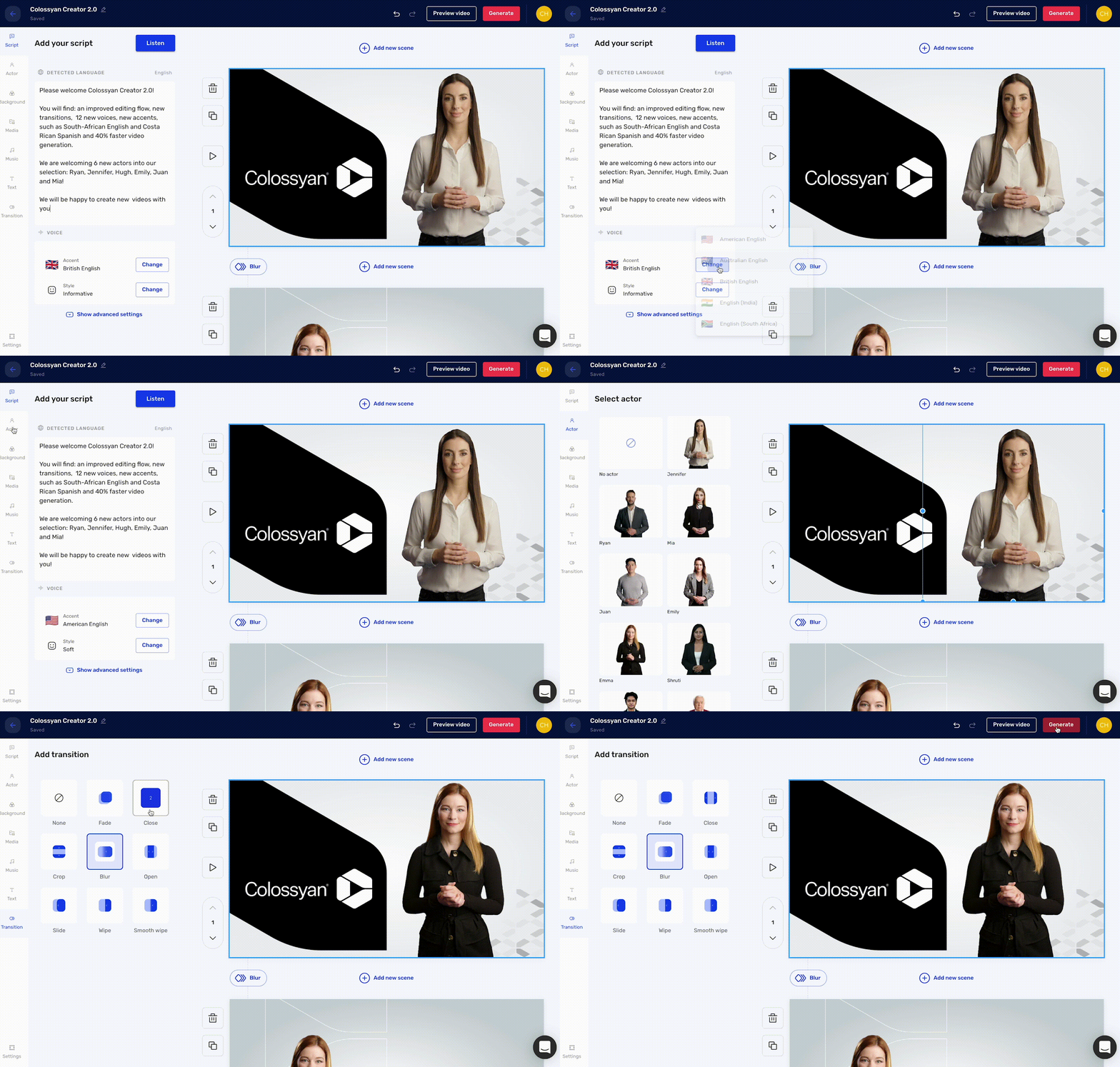
Colossyan taps AI to generate workplace learning videos, remixing, re-animating and editing footage of one of several virtual avatars against changeable backdrops. Users can enter a script to have it “read” aloud by Colossyan’s text-to-speech (TTS) engine, which also translates the script into over 70 languages.
Image Credits: Colossyan
“To generate a video with Colossyan’s AI video platform, all you have to do is input a script and select from a diverse range of avatars,” Kovacs told TechCrunch in an email interview. “Any company can create a video about almost anything efficiently, without the need for conventional filming resources.”
Kovacs founded Colossyan in 2020 after leaving Defudger, a deepfakes detection platform, which he helped to co-launch. An engineer and data scientist by training, Kovacs says that he was inspired to start Colossyan by the budding corporate interest in GenAI.
“Enterprises are leveraging AI in diverse areas such as IT automation, customer care and digital labor — highlighting the broad applicability and potential impact of AI technologies in streamlining operations and enhancing service delivery,” Kovacs said. “The barriers to AI adoption, such as limited AI skills and data complexity, are significant yet surmountable challenges that many organizations are actively working to overcome.”
For the heck of it, I gave Colossyan’s platform, which offers a free trial, a go to see if I could make a training video that’d successfully hold the attention of my ADHD brain — admittedly a high bar. The avatars were a bit too stiff and cartoonish for my liking and the TTS engine too robotic, at least compared to some of the more sophisticated GenAI tools out there (e.g., ElevenLabs). But I’ve certainly seen worse corporate videos.
Colossyan also doesn’t generate videos as quickly as I’d expect — a 38-second clip takes ~11 minutes. Granted, that’s a lot faster than creating trainings from scratch. But frankly, faced with the prospect of generating more than a handful of videos for whatever purpose, I’d be tempted to go the PowerPoint or Canva route instead.
I’m not Colossyan’s target market, of course. And it seems that several household brands are happy to pay for a subscription to Colossyan as it exists today, including Novartis, Porsche, Vodafone, HPE and Paramount, claims Kovacs.
Kovacs attributes the customer traction to features like integrations with learning management systems and a “conversation mode” that allows two avatars to hold a dialogue with each other. He doesn’t deny that there’s a fair amount of competition in the GenAI video space — see CommonGround, Synthesia and Surge plus solutions from tech giants like Microsoft — but he thinks that Colossyan’s focus on “interactivity and engagement,” as he puts it, will continue to set the platform apart.
Perhaps he’s right. Colossyan today announced that it raised $22 million in a funding round led by Lakestar with participation from Launchub, Day One Capital and Emerge Education. The proceeds will be put toward tripling Colossyan’s headcount across its New York, London and Budapest offices, Kovacs says, and developing new capabilities like branching videos and knowledge checks.
“For C-suite and IT department leaders, our platform represents a scalable, cost-efficient solution to training and development challenges,” he added.
Herculaneum scroll with red laser lines being scanned at Institut de France by Brent Seales and his team.
After a historic volcanic eruption, two millennia, and an international effort to use artificial intelligence to read a set of mysterious ancient scrolls, researchers know what at least one Roman Epicurean philosopher had on his mind: food.
Humans, while full of surprises, can be endearingly predictable.
The revelation comes as the culmination of the Vesuvius Challenge — a contest launched in March 2023 by University of Kentucky researcher Brent Seales, former GitHub CEO Nat Friedman, and entrepreneur and investor Daniel Gross. The goal was to take computed tomography (CT) scans of what are known as the Herculaneum scrolls as well as machine-learning-based software and put these in the hands of tech-savvy sleuths from around the world in hopes someone could read the scrolls without even touching them.
Also: This is what AI will produce during the next decade and beyond
With support from Silicon Valley, organizers dangled prize money for progress in the pursuit of reading the writing once buried and carbonized in the eruption of Mount Vesuvius. That included $700,000 which will be split among the winning team of three: Youssef Nader, Luke Farritor, and Julian Schilliger — all students. They submitted 15 columns of text, which preliminary analysis suggests contains writing about whether the scarcity or abundance of goods like food affects how pleasurable humans find them.
The Vesuvius Challenge marks a pivotal moment in the quest to get inside the scrolls. It's also a big moment for Seales, the researcher from the University of Kentucky — he's been trying to accomplish this for the last two decades.
Seales and various incarnations of his team have never been closer to reading the trove of texts. In a way, the contest's December 31 deadline didn't really matter. The challenge, both in terms of the grand prize and the puzzle itself, goosed interest and recruited new collaborators whose contributions Seales compared to about 10 years of human work in just the first three months.
"It's astounding to feel this kind of redemptive power that we may hold now because of AI and tomography and computation," Seales said in an interview before the grand prize announcement.
It might seem like a lot to go through but Michael McOsker, a researcher who has studied the scrolls, estimates all these efforts could yield what amounts to about 200 new books. The collection is also the only surviving library from antiquity.
"We have probably less than 1% of … all the literature that was written," he said. "Any gain in our knowledge is important."
History unwrapped
Brent Seales and Seth Parker (Digital Restoration Initiative project lead) scanning a replica of the Herculaneum scroll on the University of Kentucky campus.
Seales didn't set out to spend two decades unwrapping ancient texts. Originally from Western New York, he was an imaging specialist with an interest in AI. The problem: there wasn't much happening with AI back then. Computer vision, however, seemed like one area where progress was being made.
He met a professor at the University of Kentucky in the mid-1990s who was working on a manuscript of the Anglo-Saxon epic poem Beowulf at a time when there was a push to digitize libraries. Having read Beowulf in high school, like so many kids, Seales' interest was piqued. He thought about the power of digitizing this one text — the one extant manuscript to witness the story.
Also: A year of AI breakthroughs that left no human thing unchanged
Digitization transitioned into restoration. Once a text was digital, the image quality could be improved. Just making a copy didn't have to be the end. And if they could digitally flatten a wrinkled document, why couldn't they also unfurl it?
"We invented the idea of completely unwrapping something before we knew about the things that we were going to actually unwrap," Seales said.
In 2004, Seales finally found something to unwrap when a University of Michigan classics scholar named Richard Janko told him he'd identified the perfect fit.
Enter: The Herculaneum scrolls.
The Greek characters, πορφύραc, revealed as the word "PURPLE," are among the multiple characters and lines of text that have been extracted by Vesuvius Challenge contestant Luke Farritor.
Digging up the past
In modern times, the eruption of Vesuvius might call to mind images of those ash-entombed bodies holding each other as their world ended. It's a historical event that's at once fascinating, tragic, and even a little creepy.
The only account from the time comes from the letters of Roman author and lawyer Pliny the Younger, who described panicked crowds and a "thick black cloud" that consumed the land like a flood.
"Some people were so frightened of dying that they actually prayed for death," he wrote.
When the cloud thinned enough to let daylight in, Pliny the Younger saw everything buried deep in an ash that reminded him of snow.
In Herculaneum — a city roughly 10 miles to the west of Pompeii, and even closer to the erupting volcano — all the falling ash and debris buried a villa once owned by Julius Caesar's father-in-law. Renderings of the estate show a giant courtyard, gardens, and arches. Crucially, the villa was also home to a library of papyrus scrolls.
While about 65 feet of hot ash might seem like the worst possible outcome for papyrus, the heat carbonized the scrolls, preserving them from the natural deteriorating effects of air.
It wasn't until the 1700s that a farmer, while digging a well, struck marble and kicked off excavation efforts that turned up more than 600 unopened scrolls. (The exact number of Herculaneum papyri is hard to pinpoint, Seales said, given whether researchers count fragments and partial pieces. Some peg the number up to 1,800.)
The scrolls passed into the care of Antonio Piaggio, a scholar from the Vatican Library, who invented a machine to unwrap some of the better-preserved scrolls. Piaggio wasn't always successful.
What was unwrapped contained primarily Epicurean philosophy, leading McOsker to believe the remaining scrolls could be of the same nature. They may not rewrite the way scholars view the ancient world, but considering the dearth of writings from the time, another 200 books could be a decent haul.
It's not an 'experiment'
Today, the scrolls are housed in several locations around Europe, with the bulk found at the National Library of Naples in Italy.
Not surprisingly, most people can't walk in and futz around with fragile 2,000-year-old scrolls. It took Seales years of building a case through funding, success on other projects, and academic diplomacy to gain access.
Seales, who had a background in surgical innovation like laparoscopy, wanted to use computed tomography to scan the scrolls and then create software to wrap those scans.
Also: How tech professionals can survive and thrive at work in the time of AI
In 2005, Seales had the opportunity to share his idea in a lecture at Oxford. By that time, he and his team had put together an example of papyrus embedded in a polyurethane sphere, which they had scanned and virtually unwrapped.
"That was sort of the debutante come down stairway with the dress on saying, 'come and dance with me,'" Seales said.
The response was positive, but to the ears of protective conservators, it still sounded a whole lot like an experiment, and "experiment" is a dirty word when applied to something so rare and old.
After four years of hard work, relationship-building, and some finesse, in 2009, Seales and his team traveled to the Institut de France to make their first micro-CT scans of the papyri.
"I was simultaneously terrified and also incredibly excited," Seales said. The scrolls were small and looked like charcoal. "They tell you that this is a whole book from antiquity… and it's just this little tiny thing because it shrunk when it carbonized."
As much of an achievement as it was to finally get scans of the scrolls, Seales struggled to get the software to work the way the team wanted it to.
If they weren't going to crack the Herculaneum scrolls immediately, they needed another goal to shoot for.
Troubleshooting
To say Seales has been working on the Herculaneum scrolls for 20 years might make it sound like he clocked in and out of the office every day with that singular focus.
In reality, there were chunks of time when the team couldn't work on the scrolls, or were working on digitally scanning and unwrapping other texts that in some way still helped them move closer to their final goal.
In 2006, Seale's team unwrapped a medieval copy of the Book of Ecclesiastes written in Hebrew. A year later, in 2007, Seales was on a team that went to Venice to digitize the oldest complete copy of Homer's Iliad.
Herculaneum scroll being scanned at Diamond Light Source inside its scanning case.
"Every one of those projects that I did along the way built up a little bit of credibility in me as a researcher, and some knowledge in me in being able to approach decision makers at these museums and libraries to have a conversation with them," he said. He even learned enough French to speak with the researchers in Paris.
Still, by 2012, the Herculaneum push was in a bit of a slump. The next year, Seales took a sabbatical and spent a year in Paris as a visiting scientist at Google's Cultural Institute. It gave him the chance to rebuild confidence and get an infusion of new people and new ideas, right as Google was about to acquire AI research lab DeepMind.
Around that time, Seales started pursuing the idea of making scans inside a particle accelerator, which would significantly boost the resolution of the images.
The reset was handy, as the technical challenge of reading scrolls remained thorny.
One chief problem has been something called segmentation. Though the scrolls are quite small, the scans are detailed. Technical Lead Stephen Parsons, who first worked with Seales as an undergrad at the University of Kentucky, described trying to digitally separate layers of partially crushed papyrus and the network of fibers visible in the scans. He compared it to what a cross-section of a log might look like, but somewhat smashed.
Another challenge has been actually reading the ink on the papyrus. Parsons said the best imaging technology they have to see inside the scrolls is the X-ray micro CT. The issue? There's not enough contrast to read the ink.
The Herculaneum scrolls were written with what was essentially soot from oil lamps, which chemically is almost pure carbon. As the papyrus is also chemically carbon, the team found themselves looking at gray on gray.
Other projects, like the En-Gedi scroll in 2016 — the oldest Pentateuchal (relating to the first five books of the Bible) scroll since the Dead Sea scrolls, whose successful digital unwrapping was a major milestone for Seales' team — used ink with iron in it, which shows up at bright spots in X-rays.
Also: Can generative AI solve computer science's greatest unsolved problem?
Parsons said they hypothesized there could still be some detectable difference. He likened it to black-painted lines on asphalt. Perhaps, a machine-learning model could be trained to see the ink.
It took years of work, testing the idea on scrolls they made and fragments of Herculaneum scrolls that had broken off and revealed their writing, to get to the point where they were able to read two characters from layers deep inside a scroll.
"It was clear with that moment. Even if it takes many years to develop to refine… this approach is going to bear fruit eventually," Parsons said. A year later, it has.
A software problem
What segmentation and ink detection allude to is that getting the scans has been only part of the overall challenge of the scrolls. Taking the data and sorting it out algorithmically has been a whole other journey.
After several iterations, Seales' team created the Volume Cartographer, written primarily by project lead Seth Parker, who joined the team in 2012. It's open-source software used to map the inside of the scrolls and make sense of the "floating word soup," as Parker put it.
The 12 pezzi, or "pieces," of the opened Herculaneum papyrus scroll known as P.Herc.118. The compilation of images is owned by the Bodleian Library at the University of Oxford.
Parker started his career as a video editor working on research documentaries. He'd worked with Seales, and when a team member left, and Seales needed someone who knew their way around cameras and image capture, he recruited Parker. Once a media and communication major, he turned toward a Ph.D. in computer science.
He's also getting extra help with the Volume Cartographer from people hired by the Vesuvius Challenge who are working their way through a wishlist of bug fixes.
Creating the Vesuvius Challenge meant opening up years of work to an unknown global workforce. Parsons estimated more than 1,000 people have been working on the project for the better part of a year — something that's both scary and exciting, he said.
After all, it was computer science students who made the initial discovery of the word "purple" in October.
Keep scrolling
While 15 columns of text is more than Seales expected, it is hardly the end of the story.
Looking farther out, both Parker and Parsons imagine their work could also inspire other fields that use dimensional imaging.
CT scans and MRIs are already powerful, but what if there's still information hiding from the naked eyes of doctors that could improve tumor detection and the like?
"There are ways of transforming that data to make it more interpretable for a human," Parker said.
"There's no reason to slow down. Let's read the entire library," said student and team member Luke Farritor.
And there are still ancient texts to read. Concurrently, they're working on a medieval manuscript from the Morgan Library — a Coptic Gospel whose pages are fused. They've taken multiple CT scans and are once again trying to virtually untangle what's written inside.
The short-term goal for 2024 is to read 90% of the scroll Nader, Farritor and Schilliger started. And yes, there will be more prize money on the line.
"We are celebrating right now, but there's no reason to slow down. Let's read the entire library!" Farritor said in a statement.
For Parsons, there is something profound about working on these texts and imagining the humans 2,000 years ago who wrote them — people who never would have guessed anyone in 2024 would be so interested in what they had to say, and certainly couldn't have conceived of the tech behind those efforts. Even today, most people would likely struggle to define "machine learning."
"All this time has gone by and this one part of this journey has come to me and my computer screen," Parsons said. "That's quite humbling."
After all these years, Seales knows the importance of that throughline of humanity. Ancient texts talk about love, war, music, rhetoric, poetry — topics still being agonized over today. And food, of course.
"The mature intellectual dialogue that occurs in these ancient manuscripts is distinctly human. Being able to tell stories is distinctly human," Seales said.
Seales imagines maybe reaching 2,000 years back, stripped of all current religious, political or whatever other boundaries, there's a way to rally around what it means to be human.
"We have to read it," Seales said. "We have to study it. We can't forget it."
Colossyan uses GenAI to create corporate training videos Kyle Wiggers 1 day
Most people don’t watch corporate training videos — or, in cases where the training’s mandatory, don’t give them their full attention. According to a recent poll from Kaltura, the video tech provider, 75% of staffers admit to skimming through training videos, watching them without sound or listening to them while multitasking.
So, given that training videos aren’t cheap to produce, is there a way to make them more engaging and thus less of a money sink? Dominik Mate Kovacs, the co-founder and CEO of Colossyan, thinks there is — and it involves generative AI.
Colossyan taps AI to generate workplace learning videos, remixing, re-animating and editing footage of one of several virtual avatars against changeable backdrops. Users can enter a script to have it “read” aloud by Colossyan’s text-to-speech (TTS) engine, which also translates the script into over 70 languages.
Image Credits: Colossyan
“To generate a video with Colossyan’s AI video platform, all you have to do is input a script and select from a diverse range of avatars,” Kovacs told TechCrunch in an email interview. “Any company can create a video about almost anything efficiently, without the need for conventional filming resources.”
Kovacs founded Colossyan in 2020 after leaving Defudger, a deepfakes detection platform, which he helped to co-launch. An engineer and data scientist by training, Kovacs says that he was inspired to start Colossyan by the budding corporate interest in GenAI.
“Enterprises are leveraging AI in diverse areas such as IT automation, customer care and digital labor — highlighting the broad applicability and potential impact of AI technologies in streamlining operations and enhancing service delivery,” Kovacs said. “The barriers to AI adoption, such as limited AI skills and data complexity, are significant yet surmountable challenges that many organizations are actively working to overcome.”
For the heck of it, I gave Colossyan’s platform, which offers a free trial, a go to see if I could make a training video that’d successfully hold the attention of my ADHD brain — admittedly a high bar. The avatars were a bit too stiff and cartoonish for my liking and the TTS engine too robotic, at least compared to some of the more sophisticated GenAI tools out there (e.g., ElevenLabs). But I’ve certainly seen worse corporate videos.
Colossyan also doesn’t generate videos as quickly as I’d expect — a 38-second clip takes ~11 minutes. Granted, that’s a lot faster than creating trainings from scratch. But frankly, faced with the prospect of generating more than a handful of videos for whatever purpose, I’d be tempted to go the PowerPoint or Canva route instead.
I’m not Colossyan’s target market, of course. And it seems that several household brands are happy to pay for a subscription to Colossyan as it exists today, including Novartis, Porsche, Vodafone, HPE and Paramount, claims Kovacs.
Kovacs attributes the customer traction to features like integrations with learning management systems and a “conversation mode” that allows two avatars to hold a dialogue with each other. He doesn’t deny that there’s a fair amount of competition in the GenAI video space — see CommonGround, Synthesia and Surge plus solutions from tech giants like Microsoft — but he thinks that Colossyan’s focus on “interactivity and engagement,” as he puts it, will continue to set the platform apart.
Perhaps he’s right. Colossyan today announced that it raised $22 million in a funding round led by Lakestar with participation from Launchub, Day One Capital and Emerge Education. The proceeds will be put toward tripling Colossyan’s headcount across its New York, London and Budapest offices, Kovacs says, and developing new capabilities like branching videos and knowledge checks.
“For C-suite and IT department leaders, our platform represents a scalable, cost-efficient solution to training and development challenges,” he added.
In the age of AI, the technology has been infused into nearly every space, now including dating apps. Bumble is adding AI to its app, and no, it does not involve chatting or dating a robot.
On Tuesday, Bumble announced its new AI-powered Deception Detector, which leverages AI to help identify fake, scam, or spam profiles on the app even before users come in contact with the profile themselves, according to the release.
Also: AI meets AR as ChatGPT is now available on the Apple Vision Pro
Deception Detector uses a machine learning-based model to assess the authenticity of the profiles and has done so with high success rates. Bumble's testing showed that Deception Detector supported blocking 95% of accounts identified as spam or scam profiles by the company.
In the first two months of the technology's introduction, Bumble claims to have seen a 45% decrease in member reports of spam, scams, and fake accounts.
Fake dating profiles and scams are a real problem on dating sites, with the FTC reporting that between 2017 to 2021, people reported losing $1.3 billion to romance scams, with many starting on dating apps.
Also: 15 big ideas that will revolutionize industries and economies, led by AI
Additionally, Bumble's research found that 46% of women surveyed expressed anxiety regarding the authenticity of the online profiles they match with on dating apps.
"In recent years, the online landscape has evolved significantly and we see a growing concern about authenticity," said Lidiane Jones, Bumble CEO. "Bumble Inc. was founded with the aim to build equitable relationships and empower women to make the first move, and Deception Detector is our latest innovation as part of our ongoing commitment to our community to help ensure that connections made on our apps are genuine."
Also: I just tried Google's ImageFX AI image generator, and I'm shocked at how good it is
To start taking advantage of the tool, all you have to do is keep using your account the way you regularly would. The model is also supported by Bumble's team of human moderators, adding a human element to ensure the success of the technology.
Bumble's AI addition follows Tinder's addition of user warnings on Monday powered by machine learning. Tinder's tech detects violations of the Community Guidelines and provides warnings to users explaining why their in-app behavior violates its guidelines and what the consequences will be if they continue the behavior.
Colossyan uses GenAI to create corporate training videos Kyle Wiggers 24 hours
Most people don’t watch corporate training videos — or, in cases where the training’s mandatory, don’t give them their full attention. According to a recent poll from Kaltura, the video tech provider, 75% of staffers admit to skimming through training videos, watching them without sound or listening to them while multitasking.
So, given that training videos aren’t cheap to produce, is there a way to make them more engaging and thus less of a money sink? Dominik Mate Kovacs, the co-founder and CEO of Colossyan, thinks there is — and it involves generative AI.
Colossyan taps AI to generate workplace learning videos, remixing, re-animating and editing footage of one of several virtual avatars against changeable backdrops. Users can enter a script to have it “read” aloud by Colossyan’s text-to-speech (TTS) engine, which also translates the script into over 70 languages.
Image Credits: Colossyan
“To generate a video with Colossyan’s AI video platform, all you have to do is input a script and select from a diverse range of avatars,” Kovacs told TechCrunch in an email interview. “Any company can create a video about almost anything efficiently, without the need for conventional filming resources.”
Kovacs founded Colossyan in 2020 after leaving Defudger, a deepfakes detection platform, which he helped to co-launch. An engineer and data scientist by training, Kovacs says that he was inspired to start Colossyan by the budding corporate interest in GenAI.
“Enterprises are leveraging AI in diverse areas such as IT automation, customer care and digital labor — highlighting the broad applicability and potential impact of AI technologies in streamlining operations and enhancing service delivery,” Kovacs said. “The barriers to AI adoption, such as limited AI skills and data complexity, are significant yet surmountable challenges that many organizations are actively working to overcome.”
For the heck of it, I gave Colossyan’s platform, which offers a free trial, a go to see if I could make a training video that’d successfully hold the attention of my ADHD brain — admittedly a high bar. The avatars were a bit too stiff and cartoonish for my liking and the TTS engine too robotic, at least compared to some of the more sophisticated GenAI tools out there (e.g., ElevenLabs). But I’ve certainly seen worse corporate videos.
Colossyan also doesn’t generate videos as quickly as I’d expect — a 38-second clip takes ~11 minutes. Granted, that’s a lot faster than creating trainings from scratch. But frankly, faced with the prospect of generating more than a handful of videos for whatever purpose, I’d be tempted to go the PowerPoint or Canva route instead.
I’m not Colossyan’s target market, of course. And it seems that several household brands are happy to pay for a subscription to Colossyan as it exists today, including Novartis, Porsche, Vodafone, HPE and Paramount, claims Kovacs.
Kovacs attributes the customer traction to features like integrations with learning management systems and a “conversation mode” that allows two avatars to hold a dialogue with each other. He doesn’t deny that there’s a fair amount of competition in the GenAI video space — see CommonGround, Synthesia and Surge plus solutions from tech giants like Microsoft — but he thinks that Colossyan’s focus on “interactivity and engagement,” as he puts it, will continue to set the platform apart.
Perhaps he’s right. Colossyan today announced that it raised $22 million in a funding round led by Lakestar with participation from Launchub, Day One Capital and Emerge Education. The proceeds will be put toward tripling Colossyan’s headcount across its New York, London and Budapest offices, Kovacs says, and developing new capabilities like branching videos and knowledge checks.
“For C-suite and IT department leaders, our platform represents a scalable, cost-efficient solution to training and development challenges,” he added.
Global data highlights a concerning trend, where Australian organisations are starting to fall behind in a “trust gap” between what customers expect them to do with data and privacy and what is actually happening.
New data shows that 90% of people want to see organisations transform to properly manage data and risk. With a regulatory environment that has fallen behind, for Australian organisations to deliver this, they will need to move faster than the regulatory environment.
Australian enterprises need to take seriously
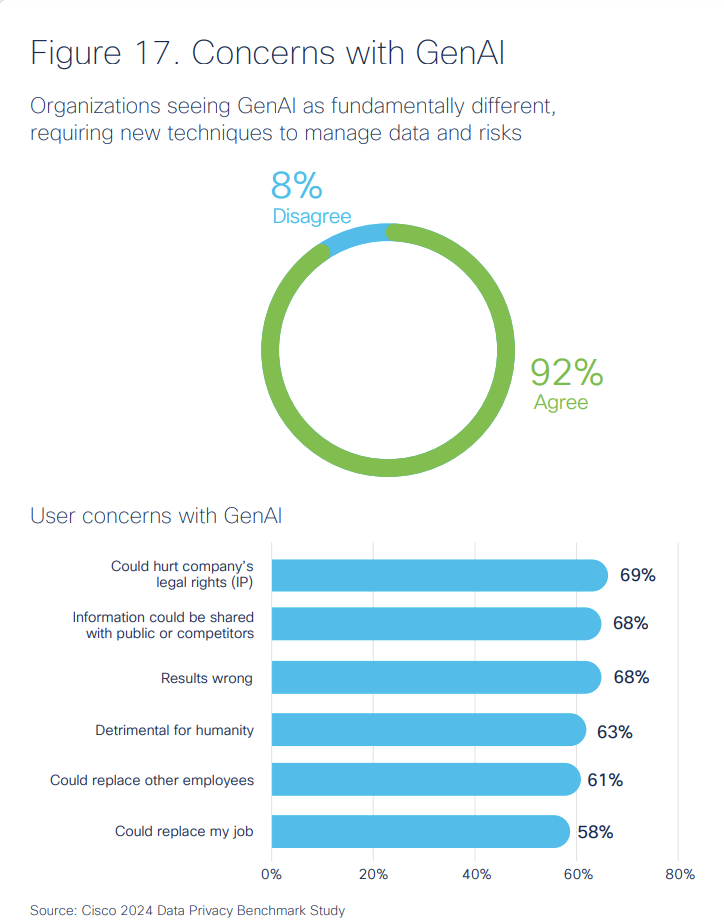
According to a recent major global Cisco study, more than 90% of people believe generative AI requires new techniques to manage data and risk (Figure A). Meanwhile, 69% are concerned with the potential for legal and IP rights to be compromised, and 68% are concerned with the risk of disclosure to the public or competitors.
Figure A: Organisation and user concerns with generative AI. Image: Cisco
Essentially, while customers appreciate the value AI can bring to them in terms of personalisation and service levels, they’re also uncomfortable with the implications to their privacy if their data is used as part of the AI models.
PREMIUM: Australian organisations should consider an AI ethics policy.
Around 8% of participants in the Cisco survey were from Australia, though the study doesn’t break down the above concerns by territory.
Australians more likely to violate data security policies despite data privacy concerns
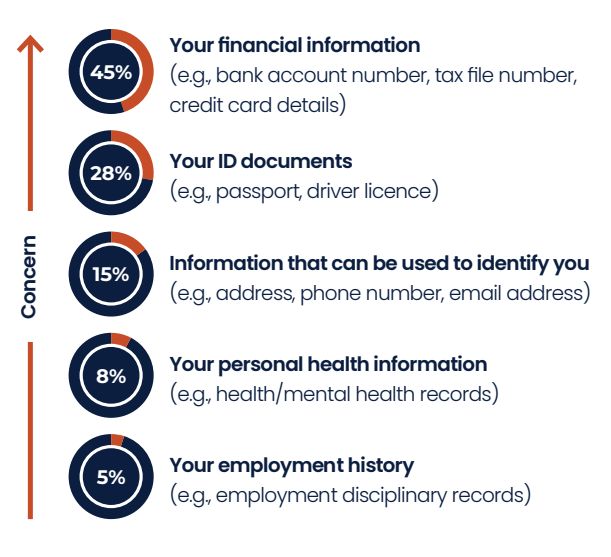
Other research shows that Australians are particularly sensitive to the way organisations use their data. According to research by Quantum Market Research and Porter Novelli, 74% of Australians are concerned about cybercrime. In addition, 45% are concerned about their financial information being taken, and 28% are concerned about their ID documents, such as passports and driver’s licences (Figure B).
Figure B: Australians more concerned over financial data than any other personal information. Image: Porter Novelli and Quantum Market Research
However, Australians are also twice as likely as the global average to violate data security policies at work.
As Gartner VP Analyst Nader Hanein said, organisations should be deeply concerned with this breach of customer trust because customers will be quite happy to take their wallets and walk.
“The fact is that consumers today are more than happy to cross the road over to the competition and, in some instances, pay a premium for the same service, if that is where they believe their data and their family’s data is best cared for,” Hanein said.
Voluntary regulation in Australian organisations isn’t great for data privacy
Part of the problem is that, in Australia, doing the right thing around data privacy and AI is largely voluntary.
SEE: What Australian IT leaders need to focus on ahead of privacy reforms.
“From a regulatory perspective, most Australian companies are focused on breach disclosure and reporting, given all the high-profile incidents over the past two years. But when it comes to core privacy aspects, there is little requirement on companies in Australia. Main privacy pillars such as transparency, consumer privacy rights and explicit consent are simply missing,” Hanein said.
It is only those Australian organisations that have done business abroad and run into outside regulation that have needed to improve — Hanein pointed to the GDPR and New Zealand’s privacy laws as examples. Other organisations will need to make building trust with their customers an internal priority.
Building trust in data use
While data use in AI might be largely unregulated and voluntary in Australia, there are five things the IT team can – and should – champion across the organisation:
Transparency about data collection and use: Transparency around data collection can be achieved through clear and easy-to-understand privacy policies, consent forms and opt-out options.
Accountability with data governance: Everyone in the organisation should recognise the importance of data quality and integrity in data collection, processing and analysis, and there should be policies in place to reinforce behaviour.
High data quality and accuracy: Data collection and use should be accurate, as misinformation can make AI models unreliable, and that can subsequently undermine trust in data security and management.
Proactive incident detection and response: An inadequate incident response plan can lead to damage to organisational reputation and data.
Customer control over their own data: All services and features that involve data collection should allow the customer to access, manage and delete their data on their own terms and when they want to.
Self-regulation now to prepare for the future
Currently, data privacy law — including data collected and used in AI models — is regulated by old regulations created before AI models were even being used. Therefore, the only regulation that Australian enterprises apply is self-determined.
However, as Gartner’s Hanein said, there is a lot of consensus about the right way forward for the management of data when used in these new and transformative ways.
SEE: Australian organisations to focus on the ethics of data collection and use in 2024.
“Back in February 2023, the Privacy Act Review Report was published with a lot of good recommendations intended to modernise data protection in Australia,” Hanein said. “Seven months later in September 2023, the Federal Government responded. Of the 116 proposals in the original report the government responded favourably to 106.”
For now, some executives and boards may baulk at the idea of self-imposed regulation, but the benefit to this is that an organisation that can demonstrate it is taking these steps will benefit from a greater reputation among customers and be seen as taking their concerns around data use seriously.
Meanwhile, some within the organisation might be concerned that imposing self-regulation might impede innovation. As Hanein said in response to that: “would you have delayed the introduction of seat belts, crumple zones and air bags for fear of having these aspects slow down developments in the automotive industry?”
It is now time for IT professionals to take charge and start bridging that trust gap.
Colossyan uses GenAI to create corporate training videos Kyle Wiggers 22 hours
Most people don’t watch corporate training videos — or, in cases where the training’s mandatory, don’t give them their full attention. According to a recent poll from Kaltura, the video tech provider, 75% of staffers admit to skimming through training videos, watching them without sound or listening to them while multitasking.
So, given that training videos aren’t cheap to produce, is there a way to make them more engaging and thus less of a money sink? Dominik Mate Kovacs, the co-founder and CEO of Colossyan, thinks there is — and it involves generative AI.
Colossyan taps AI to generate workplace learning videos, remixing, re-animating and editing footage of one of several virtual avatars against changeable backdrops. Users can enter a script to have it “read” aloud by Colossyan’s text-to-speech (TTS) engine, which also translates the script into over 70 languages.
Image Credits: Colossyan
“To generate a video with Colossyan’s AI video platform, all you have to do is input a script and select from a diverse range of avatars,” Kovacs told TechCrunch in an email interview. “Any company can create a video about almost anything efficiently, without the need for conventional filming resources.”
Kovacs founded Colossyan in 2020 after leaving Defudger, a deepfakes detection platform, which he helped to co-launch. An engineer and data scientist by training, Kovacs says that he was inspired to start Colossyan by the budding corporate interest in GenAI.
“Enterprises are leveraging AI in diverse areas such as IT automation, customer care and digital labor — highlighting the broad applicability and potential impact of AI technologies in streamlining operations and enhancing service delivery,” Kovacs said. “The barriers to AI adoption, such as limited AI skills and data complexity, are significant yet surmountable challenges that many organizations are actively working to overcome.”
For the heck of it, I gave Colossyan’s platform, which offers a free trial, a go to see if I could make a training video that’d successfully hold the attention of my ADHD brain — admittedly a high bar. The avatars were a bit too stiff and cartoonish for my liking and the TTS engine too robotic, at least compared to some of the more sophisticated GenAI tools out there (e.g., ElevenLabs). But I’ve certainly seen worse corporate videos.
Colossyan also doesn’t generate videos as quickly as I’d expect — a 38-second clip takes ~11 minutes. Granted, that’s a lot faster than creating trainings from scratch. But frankly, faced with the prospect of generating more than a handful of videos for whatever purpose, I’d be tempted to go the PowerPoint or Canva route instead.
I’m not Colossyan’s target market, of course. And it seems that several household brands are happy to pay for a subscription to Colossyan as it exists today, including Novartis, Porsche, Vodafone, HPE and Paramount, claims Kovacs.
Kovacs attributes the customer traction to features like integrations with learning management systems and a “conversation mode” that allows two avatars to hold a dialogue with each other. He doesn’t deny that there’s a fair amount of competition in the GenAI video space — see CommonGround, Synthesia and Surge plus solutions from tech giants like Microsoft — but he thinks that Colossyan’s focus on “interactivity and engagement,” as he puts it, will continue to set the platform apart.
Perhaps he’s right. Colossyan today announced that it raised $22 million in a funding round led by Lakestar with participation from Launchub, Day One Capital and Emerge Education. The proceeds will be put toward tripling Colossyan’s headcount across its New York, London and Budapest offices, Kovacs says, and developing new capabilities like branching videos and knowledge checks.
“For C-suite and IT department leaders, our platform represents a scalable, cost-efficient solution to training and development challenges,” he added.
Colossyan uses GenAI to create corporate training videos Kyle Wiggers 20 hours
Most people don’t watch corporate training videos — or, in cases where the training’s mandatory, don’t give them their full attention. According to a recent poll from Kaltura, the video tech provider, 75% of staffers admit to skimming through training videos, watching them without sound or listening to them while multitasking.
So, given that training videos aren’t cheap to produce, is there a way to make them more engaging and thus less of a money sink? Dominik Mate Kovacs, the co-founder and CEO of Colossyan, thinks there is — and it involves generative AI.
Colossyan taps AI to generate workplace learning videos, remixing, re-animating and editing footage of one of several virtual avatars against changeable backdrops. Users can enter a script to have it “read” aloud by Colossyan’s text-to-speech (TTS) engine, which also translates the script into over 70 languages.
Image Credits: Colossyan
“To generate a video with Colossyan’s AI video platform, all you have to do is input a script and select from a diverse range of avatars,” Kovacs told TechCrunch in an email interview. “Any company can create a video about almost anything efficiently, without the need for conventional filming resources.”
Kovacs founded Colossyan in 2020 after leaving Defudger, a deepfakes detection platform, which he helped to co-launch. An engineer and data scientist by training, Kovacs says that he was inspired to start Colossyan by the budding corporate interest in GenAI.
“Enterprises are leveraging AI in diverse areas such as IT automation, customer care and digital labor — highlighting the broad applicability and potential impact of AI technologies in streamlining operations and enhancing service delivery,” Kovacs said. “The barriers to AI adoption, such as limited AI skills and data complexity, are significant yet surmountable challenges that many organizations are actively working to overcome.”
For the heck of it, I gave Colossyan’s platform, which offers a free trial, a go to see if I could make a training video that’d successfully hold the attention of my ADHD brain — admittedly a high bar. The avatars were a bit too stiff and cartoonish for my liking and the TTS engine too robotic, at least compared to some of the more sophisticated GenAI tools out there (e.g., ElevenLabs). But I’ve certainly seen worse corporate videos.
Colossyan also doesn’t generate videos as quickly as I’d expect — a 38-second clip takes ~11 minutes. Granted, that’s a lot faster than creating trainings from scratch. But frankly, faced with the prospect of generating more than a handful of videos for whatever purpose, I’d be tempted to go the PowerPoint or Canva route instead.
I’m not Colossyan’s target market, of course. And it seems that several household brands are happy to pay for a subscription to Colossyan as it exists today, including Novartis, Porsche, Vodafone, HPE and Paramount, claims Kovacs.
Kovacs attributes the customer traction to features like integrations with learning management systems and a “conversation mode” that allows two avatars to hold a dialogue with each other. He doesn’t deny that there’s a fair amount of competition in the GenAI video space — see CommonGround, Synthesia and Surge plus solutions from tech giants like Microsoft — but he thinks that Colossyan’s focus on “interactivity and engagement,” as he puts it, will continue to set the platform apart.
Perhaps he’s right. Colossyan today announced that it raised $22 million in a funding round led by Lakestar with participation from Launchub, Day One Capital and Emerge Education. The proceeds will be put toward tripling Colossyan’s headcount across its New York, London and Budapest offices, Kovacs says, and developing new capabilities like branching videos and knowledge checks.
“For C-suite and IT department leaders, our platform represents a scalable, cost-efficient solution to training and development challenges,” he added.