It’s hard to imagine Meta without open source AI, given its significant contribution to the ecosystem. Fueling several innovations, it has also in many ways been helping the likes of OpenAI, which have been syphoning off of open source contributions without batting an eyelid.
“OpenAI does not have a monopoly on good ideas. They’re not going to get to AGI by themselves, in-fact they’re using PyTorch and Transformers, which were published by many of us. They’re profiting from the open research landscape,” said Yann LeCun, not mincing words during a roundtable discussion at Davos.
Transformers was first proposed by Google in 2017 in its paper ‘Attention is all you Need’.
Recently, OpenAI released new embedding models and API updates created by Indian developers Aditya Kusupati, a researcher at Google, and Prateek Jain, a senior staff research scientist at Google, two years ago.
Meta is shamelessly open source
Till date, Meta has over 600 open source projects and counting. The company’s influence in the AI landscape is essentially in diverting the larger community from having to pay its competitors. Further, the collaboration with the ecosystem is necessary to set the industry standards in finding use cases with the AI models.
Clem Delangue, founder of Hugging Face, posted on X that Meta has the highest number of open source models on the platform with 689 models, a number which has grown since then.
In this week’s earnings call Zuckerberg addressed how open sourcing benefits Meta saying, “The short version is that open sourcing improves our models, and because there’s still significant work to turn our models into products, we find that there are mostly advantages to being the open source leader.”
Meta is “playing to win,” added Zuckerberg, pointing out that training and operating future models will be even more compute intensive. Its aspiration of building a full general intelligence would require many years of dedicated research and development.
Zuckerberg in a conversation with Lex Fridman said that Meta’s bet is on the open source community as it believes instead of hopping onto the wagon of claiming super intelligent AI, it would be beneficial to let the community use it for research purposes, and building more efficient and aligned AI.
Meta is clearly the winner of the open source AI race, and will continue to be as long as it continues its ways. Llama 2 currently has around 4 million downloads on Hugging Face, and the number is only going to increase when Llama 3 comes out soon.
Open source AGI?
After feeding off of the open source contributions, OpenAI had raised alarm about open source and its risks. In August, Jan Leike, ML researcher and alignment team lead at OpenAI, painted a doomsday picture, saying, “An important test for humanity will be whether we can collectively decide not to open source LLMs that can reliably survive and spread on their own.”
Although the initial reason Zuckerberg gave for their decision to open source its models was, “It drives innovation because it enables many more developers to build with new technology,” it is clear that Meta is benefiting in more than just goodwill from the developer community.
“Zuck and Yann LeCun will go down as heroes in human history! Fighting for ‘Open AI’ when the incumbents sought to shut it down! Unbelievable how much the vibes from Meta have changed over the last year. That, and maybe it’s time for a name change – Meta to OpenAI,” wrote Bindu Reddy, Chief at Abacus.ai, on X.
Likewise, Perplexity chief Arvind Srinivas said,” Open Source AGI is an amazing vision. You (Meta) are building a very powerful technology, and actually aligning to what makes sense for the world: more people have a say in what makes sense and doesn’t”.
Not for long
Meta now faces stiff competition from Chinese companies like Alibaba and Tencent who are continuously releasing open source models. Alibaba released Qwen-7B and Qwen-7B-Chat, each with 7 billion parameters, becoming the first major Chinese tech company to open-source LLMs. These models, part of the Tongyi Qianwen series, aim to help businesses adopt AI.
DeepSeek, a 67 billion parameter model outperformed Llama 2, Claude-2, and Grok-1 on various metrics. The best part is that the model from China is open sourced, and uses the same architecture as LLaMA.
Another hint of China’s open source AI dominance is the Yi-34B model released by 01.AI startup, reaching a unicorn status after the release. The AI startup by Kai-Fu Lee is developing AI systems for the Chinese market. The interesting part is that the second and third models on the Open LLM Leaderboard are also models based on Yi-34B.
As long as Chinese giants open source their models, they are not a threat to anyone, except Meta, and its AGI goals. On the other hand, Meta can also benefit from the success of Chinese open source models, just like it did with TikTok and made Reels on Instagram.
The post Where Would Meta Be without Open Source AI? appeared first on Analytics India Magazine.
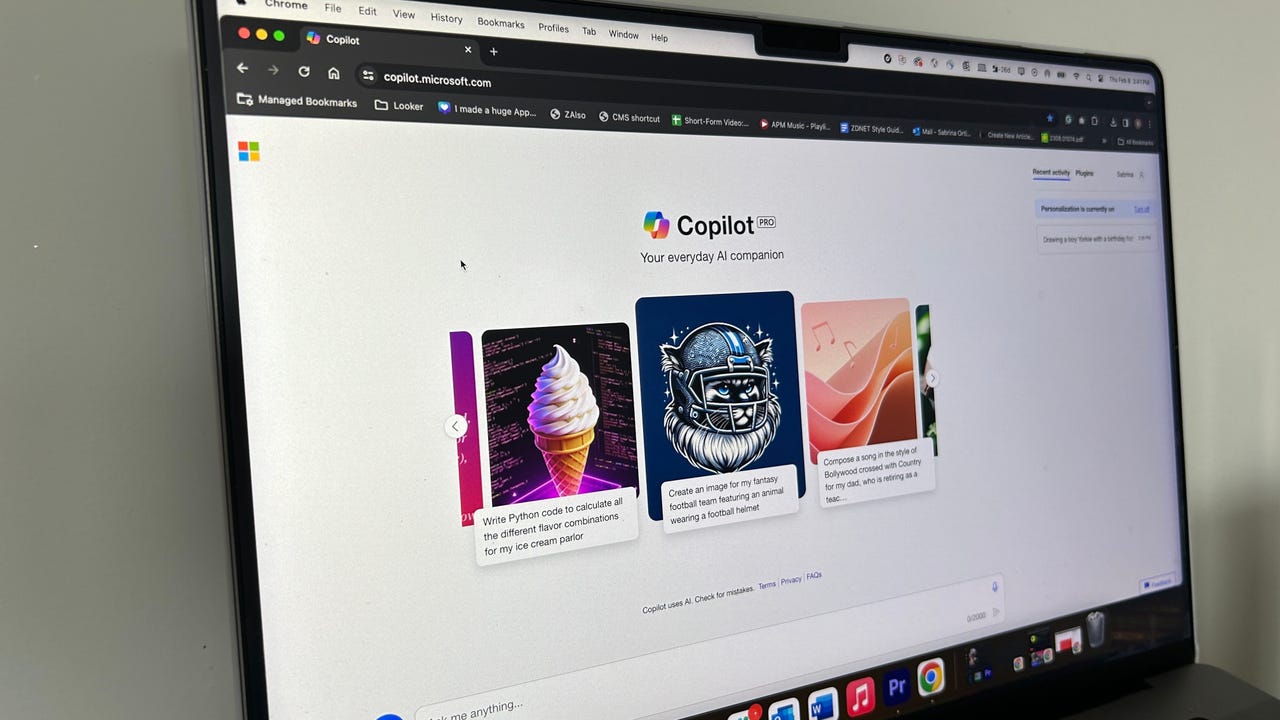
Microsoft Copilot just got a new editing feature for its AI image generator. You can try it out today in Copilot for free.
Doing simple edits to your generated image can be done without leaving Copilot, making it easier to get the exact result you want or to just experiment.
If you wish to do extensive edits to the image you generate, you'll still have to rely on another app.
The most popular AI chatbots have recently unveiled updates — and Copilot wasn't going to fall behind. On Thursday, Microsoft announced a new image-generating feature in Copilot and, after trying it myself, I think it solves a big problem with AI image generators.
Also: The best AI chatbots of 2024: ChatGPT and alternatives
AI image generators are popular because it's cool to see any prompt you can imagine come to life. However, typically, these generators don't do much besides creating the image.
Copilot's new features help bridge that gap by implementing editing options inline that make it easy to transform the image and generate the exact result you want.
As a sample project, I asked Copilot to help me make a birthday card for my Mom, whose birthday is coming up. Since she loves her furbaby, my initial prompt was, "Can you draw me a boy Yorkie wearing a birthday hat." Immediately, I had four adorable photos to pick from:
For the sake of testing out the features and the aim of creating a greeting card, I chose one. Then, as part of the new upgrade, I had the option to hover over the image and pick an element that I would like to edit:
Once you select the part you want to tweak, you can choose between color pop, which makes everything else in the photo black or white, or the blur background option, eliminating the need to use an additional tool, such as Photoshop, to perform those tasks.
Also: The best AI chatbots of 2024: ChatGPT and alternatives
Without leaving Copilot, you also have the option to select a different style, such as Pixel art, Watercolor, and more. In my experience, whenever I've tried to select the option, it doesn't work. I am met with an error message saying: "Something is wrong on our end. Please try again later."
However, a user shared a video clip of the feature on X, and it not only worked for them, but also looked very promising, as seen below. Despite the option not working for me, I found that the other two image-editing features, blur background and color pop, were helpful enough to make the update worthwhile. Now, if I want to change image style, I can just enter a different prompt:
Then, when you are happy with the photo, you can incorporate it into the project you were visualizing by clicking on the three dots in the top right-hand corner of your image in Copilot and selecting "Edit in Designer", which will then import your image into a blank project in Microsoft's graphic design platform, where you can add filters, text, and much more.
Also: I just tried Google's ImageFX AI image generator, and I'm shocked at how good it is
I was able to add a few more details to the image to finalize the greeting card in Designer, and the final result can be seen below:
ZDNET's buying advice
Copilot is a solid AI chatbot option because it's free, has access to the internet, includes sources, and even has an AI image generator, making it a one-stop shop for all your needs. Adding the inline-editing options only further cements Copilot's position as an all-encompassing AI chatbot, as the feature eliminates the need to rely on another application for basic edits to your AI-generated images.
As a result, I recommend that you try the tool at least once because it provides a pretty seamless experience. Most importantly, it's free, so you have nothing to lose. If you aren't convinced, then maybe the fact that Copilot is ZDNET's best AI image generator overall for 2024 will encourage you to give it a try.
A few months ago, AIM pointed out the dire need for creating benchmarks for Indian languages since most of the famous ones, like MMLU and HumanEval, do not necessarily include a good amount of dataset for Indian languages. Now with Indic LLMs coming into the picture, it is high time that India got its own LLM benchmark for its models.
In his talk at MLDS 2024, Tamil Llama creator Abhinand Balachandran, also highlighted the importance of creating benchmarks specifically tailored for evaluating Indic language models.
Similarly, in an exclusive interview with AIM, Shantipriya Parida, the creator of Odia Llama, revealed that he was planning to create a benchmark for Indic language models. “We will build an LLM benchmark. You go, choose your model, and it will automatically tell you your model’s accuracy per task. It can be a fair comparison for anybody who wants to pick a model for research or any other purpose,” he said.
What about the current benchmarks?
Essentially, the process of creating a good benchmark requires tons of quality data. When it comes to Indic data, there is still a lack of it, which is also hindering the training of AI models. “LLMs require very large amounts of high-quality data. For many Indian languages, we do not have this right now,” Pratyush Kumar, co-founder at Sarvam AI and AI4Bharat, told AIM.
Though Indic models do not currently have a benchmark such as the Hugging Face Open LLM Leaderboard, there are several evaluation datasets available where creators can test their model on the provided dataset.
AI4Bharat, for instance, has created the IndicSentiment dataset, which was used to evaluate Airavata, the recent Indic language model. The dataset on Hugging Face has over 1k downloads, which shows that a lot of innovation is indeed happening in the Indic landscape, but we still need a standard metric for all.
In August last year, AI4Bharat, along with IIT Madras, IIT Kharagpur, and Microsoft India, published a paper titled Vistaar, which was a benchmark and training set for Indian languages for ASR. Though this was exclusively for speech and voice models, it also had a language dataset for around 12 Indic languages.
Interestingly, a lesser known benchmark on Hugging Face, titled IndicBenchmarkData, created by Sambit Sekhar, includes Indic benchmark dataset for Gujarati, Bengali, Telugu, Tamil, and several other Indic languages.
A leaderboard is all we need
It all boils down to the simple problem of data. A majority of the benchmarks on Hugging Face include a dataset of exams like SAT, LSAT, and US History. India needs to do the same for Indic languages, and include a dataset that covers the most important exams like UPSC or JEE.
The way India ultimately uses these LLMs may completely differ from the rest of the world. To evaluate Indian models on various tasks, we need to create a benchmark based on regional or vernacular dataset. These benchmarks would also help in evaluation of models like GPT-4 and Llama 2 on Indic tasks, and compare them to models that are originating in India.
With models such as BharatGPT and Ola’s Krutrim, which the makers claim to being built from scratch, it becomes a necessity for researchers to come up with solid and trustworthy evaluation benchmarks for these languages. This would eventually lead to the creation of a leaderboard, and allow people to decide which LLM to choose for what task.
Several of the current models in different languages such as Tamil, Telugu, Odia, and Malayalam, are all built on top of open source Llama 2, with fine-tuning on only a small amount of language token. As these models scale, and we eventually shift to building Indic models from scratch, it would become essential to benchmark these models on Indian metrics.
However, creating a benchmark is easier said than done. It requires a lot of computational infrastructures in terms of GPUs to run those models against the dataset in order to get their efficacy in different metrics. Since we are collecting the dataset, and NVIDIA is definitely giving us GPUs, an Indic LLM leaderboard could be just on the horizon.
The post The Dire Need for an Indic LLM Leaderboard appeared first on Analytics India Magazine.
Machine learning has become a tool that brings competitive advantage to businesses. As the era progresses, the company has slowly become data-driven and relies on machine learning to help them. That’s why machine learning skills are in high demand.
Learning machine learning can be challenging if you don’t have the suitable learning material. Leaving aside free stuff, many high-quality resources are locked away in expensive books. However, there are cheap books that I believe could help you master machine learning.
What are these books? Let’s get into it.
Machine Learning for Absolute Beginners: Python for Data Science
Let’s start with something for the beginner. For any beginner, the foundation for machine learning is important because you can handle any project if you know the basics. That’s why this cheap book would be perfect.
The Machine Learning Book by Oliver Theobald would help you understand the basics of machine learning with Python steps-to-steps, which includes:
Free Datasets download
Machine Learning libraries and tools
Data preprocessing techniques
Data validation
Regression analysis
Clustering
The Basics of Neural Networks
Bias/Variance
With a cost of $16, you can have the book to improve your machine learning knowledge.
Machine Learning For Dummies
Noted as one of Mark Cuban’s top reads for a better understanding of AI, the books provide information about machine learning without assuming you have years of machine learning experience.
The Machine Learning for Dummies book by John Paul Mueller and Luca Massaron will show you how to understand machine learning and build it, with contents including:
Intro to machine learning and algorithms
Math for Machine Learning
Practical uses for machine learning
Best practices
Ethical approaches to data use
Paying $20 for this book is undoubtedly worth the investment.
Machine Learning Mastery with Python
Let’s go for the book that will help you master machine learning with confidence. The Machine Learning Mastery with Python is a mega eBook with step-to-step and end-to-end machine learning projects that aim to make you a professional. It’s a complete book that is perfect for whichever your machine learning knowledge is.
The book written by Jason Brownlee has everything you need to know for applying Machine Learning with Python, including:
Machine learning basics
Machine Learning with Python
How to use machine learning Python Packages
How do we preprocess our data
How to develop our machine learning model
How to improve our model
Machine Learning Projects
And many more
By the price of $47, this book would provide you with a 16-step lesson, 178 pages, and 3 end-to-end projects. As a bonus, you would also get 74 Fully Working Python Scripts.
The Master Algorithm: How the Quest for the Ultimate Learning Machine Will Remake Our World
Let’s move from the technical foundation and move to a more machine-learning conceptual discussion. We can build a machine learning model quickly, but the concept of where it is used and where the model would lead is also essential. This is where the book would take us.
The book may be slightly old, as it was released in 2015. However, the book by Pedro Domingos would take us in the thought-provoking learning and wide-ranging exploration of machine learning concepts for where it would take us.
It costs only $10 to understand where our society would stand in the face of Machine Learning and why you should learn the Algorithm.
Artificial Intelligence and Machine Learning for Business: A No-Nonsense Guide to Data Driven Technologies
In a more advanced release, this book will discuss the application of AI and Machine Learning in the business industry. The book tries to educate the reader regarding technological advancement without much technical jargon, as this book is aimed at general audiences. That’s why this book is perfect for you who work as a manager or non-technical leader and want to understand the implications of machine learning.
The book by Steven Finlay creates a bridge to the machine-learning knowledge that is important for society to know. The book focuses more on practical application and how to work with data scientists to maximize machine learning values.
With the cost of $20, you can get the book to teach you about machine learning applications.
Conclusion
Machine learning is an important skill for modern society. It doesn’t matter what your occupation is; our work would intersect with Machine Learning in one way or another. That’s why these five cheap books will help you master machine learning. The books include:
Machine Learning for Absolute Beginners: Python for Data Science
Machine Learning Mastery with Python
Machine Learning For Dummies
The Master Algorithm: How the Quest for the Ultimate Learning Machine Will Remake Our World
Artificial Intelligence and Machine Learning for Business: A No-Nonsense Guide to Data Driven Technologies
Cornellius Yudha Wijaya is a data science assistant manager and data writer. While working full-time at Allianz Indonesia, he loves to share Python and Data tips via social media and writing media.
More On This Topic
5 Cheap Books to Master Data Science
It's alive! Build your first robots with Python and some cheap,…
KDnuggets News, June 22: Primary Supervised Learning Algorithms…
5 Free Books to Master Machine Learning
25 Free Books to Master SQL, Python, Data Science, Machine…
At the same time that new artificial intelligence (AI) tools were dominating headlines with their innovative ideas and captivating abilities, Google's own creation was gaining attention for entirely different reasons. Bard's initial performance was found lacking on more than one occasion. From its abysmal opening debut to its official launch, users struggled to get the chatbot to provide accurate information or even follow along with a conversation without hallucinating.
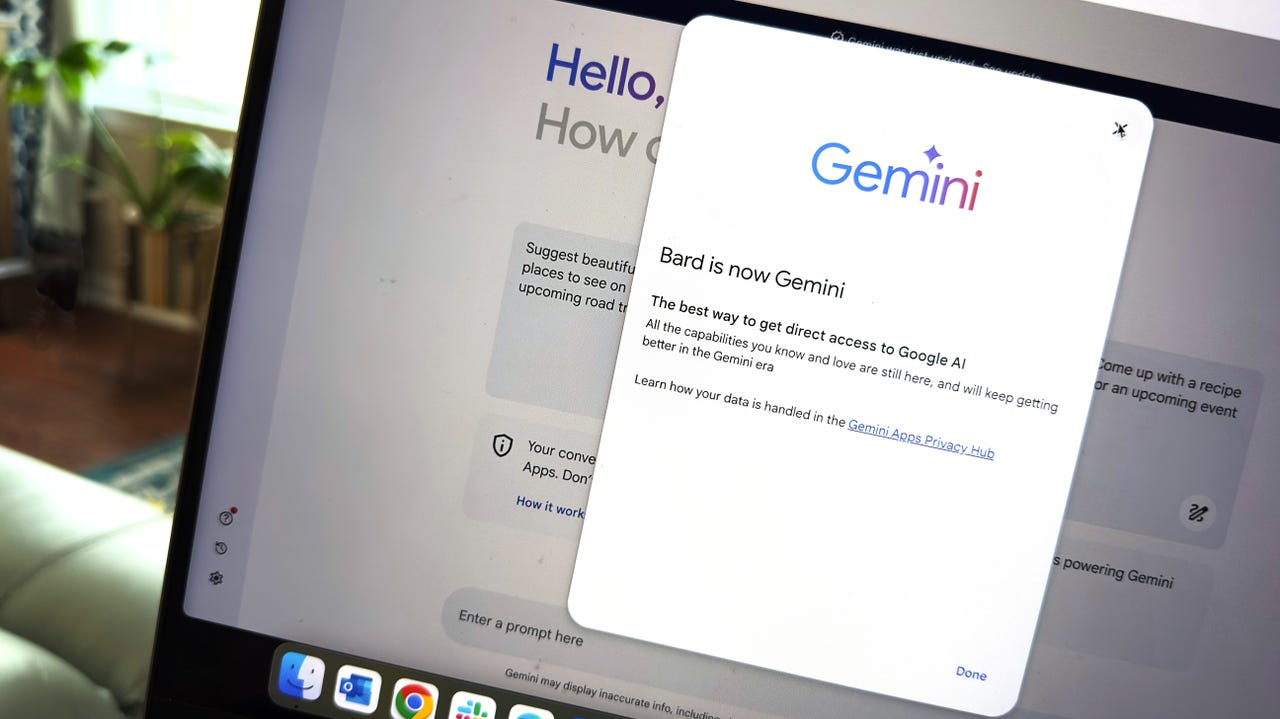
But Google has made some large improvements to Bard since then, including renaming it to Gemini, a namesake of the large language model (LLM) powering it, Gemini Pro. The Bard from a year ago isn't the Gemini that you can access today: Gemini can hold helpful conversations that rival those of ChatGPT, can generate images, and provides a smooth integration with Google Workspace.
Gemini is now a great assistive AI chatbot; a generative AI tool that can generate text for everything from cover letters and homework to computer code and Excel formulas, question answers, and detailed translations. Similar to ChatGPT, Gemini uses AI to provide human-like conversational responses when prompted by a user.
How to use Gemini (formerly Google Bard)
Here's what the chat window looks like before sending any prompts.
Here's an example of a response from Gemini.
FAQ
What can I ask Gemini (formerly Google Bard)?
The Gemini AI chatbot can answer most questions you ask since it uses search tools from Google. This capability is something the free version of ChatGPT can't do, since it's limited to knowing information up to January 2022. Gemini's AI-based answers can serve many purposes, from giving you recipes to helping you debug code.
Here are some examples of prompts you can ask the bot:
Write two to-do lists, one for daily household cleaning and another for maintenance
Write a —- plugin that does ——
What is at the center of the Earth?
Write a poem for a trashbag that fell in love with a reusable water bottle
Define XML
As with all AI chatbots, it's important to refrain from giving Gemini any personally identifiable information or private data you don't want to be shared. Even if generative AI tools say they are private, personal information isn't something that should be used to test that claim.
Does Gemini provide inaccurate answers?
When Gemini was announced as Bard last year, it faced scrutiny after factual mistakes made during its demo. Users have subsequently wondered whether Google's chatbot still continues to provide inaccurate or inappropriate responses and whether it can be trusted, as some have come to trust other AI tools.
Google has reiterated that Gemini is an experiment capable of making mistakes. The company upgraded Gemini to use its latest-generation LLM, Gemini Pro — after launching the AI chatbot with its earlier model, LaMDA, and then updating it to PaLM 2 — and has made significant upgrades to the user experience through integrations with Gmail, Maps, Lens, and more.
Having tested Gemini often during the past year, I believe it's a great AI chatbot, offering a pretty similar experience to ChatGPT and Copilot. It's worth noting that all AI chatbots can provide inaccurate information, make mistakes, and have hallucinations.
Does Gemini save my conversations?
Google doesn't save your entire interaction each time you chat with its chatbot, but it does save the prompts and questions you've asked. That being said, as a search engine, Google is known for being one of the largest trackers in the world, so giving its chatbot private information is probably not a great idea.
Gemini uses Google's proprietary LLM named Gemini Pro, instead of the GPT series, which is the technology that many popular AI chatbots are using.
Will Gemini replace Google Search?
Gemini and other AI chatbots, such as Bing Chat (aka Copilot) and ChatGPT, certainly have the potential to replace search engines. These AI tools are trained on information available on the web to provide answers to users' queries, but instead of giving them a list of websites where that answer may or may not be found, these tools generate a textual response in a conversational manner. The drawback is that these answers may not always be accurate.
Some people might use AI chatbots in place of Google Search, especially since the added abilities of asking follow-up questions and generating text make it more functional for some use cases than a search engine.
Does Gemini (formerly Google Bard) have a waitlist?
For months after its launch, Gemini was only accessible through a waitlist. But in May, Google announced during its Google I/O event that it's ending the waitlist access program and opening up its new AI tool to over 180 countries and territories. Now, anyone who logs in with their Google account can access Gemini — no need to wait.
Google recently introduced Gemini Ultra, its most advanced LLM to date. During an appearance on CNBC’s Squawk Box, Google chief Sundar Pichai said that prior to the emergence of Perplexity AI, Google had already been leveraging AI for search. “We continuously evolve search. People often take it for granted, but we began answering questions using AI in search as early as 2014 through snippets,’ said Pichai.
Pichai said that Google is experimenting with generative AI for search through the ‘search generative experience.’ Furthermore, he added that people still prefer using traditional search. “We are the only ones doing it in a way where users not only look at AI summaries but also care about the richness and diversity on the web,” he said.
“Gemini is integrated into search. Users now have the flexibility to seamlessly go back and forth, incorporating Gemini within search,” he added.
For the past few months, Perplexity AI has been considered a threat to Google Search. “The desire to compete with Google is less about gaining search market share. That’s probably true for Microsoft, but not for OpenAI or Perplexity. It’s more about striving for engineering excellence and creating experiences that weren’t possible before,” wrote Perplexity Chief Aravind Srinivasa on X.
Interestingly, recently, Srinivas also posted a photo with Satya Nadella that said, ‘Let’s make them dance’ in response to another post discussing how Perplexity will make Google dance.The 16-month-old startup recently acquired funding of $73.6 million from NVIDIA and even Jeff Bezos, and is also backed by Nat Friedman, Andrej Karpathy, Yann LeCun, Elag Gil, Naval Ravikant, and several others
Let’s make them dance. https://t.co/MTED9HpbZp pic.twitter.com/yJKYd6gZ4m
— Aravind Srinivas (@AravSrinivas) January 11, 2024
Perplexity AI has recently launched its app for Apple Vision Pro and forged a partnership with Brilliant Labs to address user queries through AR glasses.
The post Sundar Pichai Seems to Care Less About Perplexity AI appeared first on Analytics India Magazine.
Generative AI holds significant promise for Indian IT firms. The top 10 IT companies in India are actively engaged in about 450 generative AI projects and Proof of Concepts (PoCs), indicating a strong commitment to harnessing the potential of this technology.
Recently, AIM caught up with Partha DeSarkar, Group CEO at Hinduja Global Solutions (HGS), the IT management division of the billion-dollar Hinduja Group. He believes generative AI has the potential to significantly transform Indian IT, driving efficiency, personalisation, and innovation.
“Generative AI can streamline and automate various IT processes, from code generation, testing, and IT operations to support leading and cost savings for businesses in India by reducing manual labour and improving resource allocation,” DeSarkar said.
Moreover, HGS is developing its proprietary foundational models, which it will use for various internal and external requirements. “Unlike the OpenAI models, these will be specifically tailored to address specific client needs,” the veteran added.
Leveraging GenAI for better CX
HGS has gained extensive expertise in using AI for workplace safety, cognitive contact centres, and automation for the last several years. The IT management company has seamlessly integrated generative AI into its in-house cloud-based contact centre AI software called HGS Agent X.
“Generative AI enhances the HGS Agent X knowledge base, enables instant AI responses for queries, aids call quality analysis to understand caller sentiments, and boosts associate performance. During chats, prompted responses can save associate time. AI helps draft messages, and associates ensure accuracy before sending them, thus optimising efficiency,” DeSarkar said.
By leveraging the generative AI-powered HGS Agent X tool, a multinational financial corporation managed to overcome its struggles to read lengthy compliance statements aloud to customers accurately.
“HGS has introduced HGS Agent X Smart Response to automate the process. This has decreased job stress for the financial corporation’s associates and boosted customer call satisfaction. In just four months, impressive outcomes have emerged — a 66% decrease in sales compliance errors, complete elimination of disclosure statement misreads, and a 49% increase in incentive payouts.”
The Bengaluru-headquartered IT company adopts a hybrid approach, which means it uses industry standard LLM models and proprietary ones internally built for specific situations. HGS’ innovation labs located in Bengaluru and New York focus on bringing the benefits of LLMs in the most efficient and suitable way for its customers.
“At our labs, we’re building internal generative AI models for internal use and clients, along with leveraging third-party platforms such as OpenAI’s GPT Models and open-source models like LLaMA to develop solutions. These models are used to solve specific internal and client-related problem statements.”
Using generative AI internally
Moreover, DeSarkar adds that his company, which operates a global network of customer experience centres across multiple countries, including the US, Canada, the UK, India, etc., is also using generative AI internally.
HGS is exploring ways to integrate generative AI to make its existing HR solutions more efficient and relevant. “These include ‘Fit Index’, which helps us understand which clients/candidates are the best fit for us, and ‘Early Warning System’, which identifies unhappy employees or those likely to leave,” he said.
Moreover, the company is also building models for intelligent document processing to glean content from multiple input sources.
Tackling Challenges in GenAI Adoption
While generative AI benefits enterprises, DeSarkar also stresses that carefully considering ethical, privacy, and regulatory aspects is crucial to harness the benefits while mitigating potential risks and challenges.
“The use of AI in handling sensitive customer data necessitates robust data privacy and security measures to protect against breaches and misuse. Integrating generative AI into existing CX systems and workflows can be complex and require significant development effort. Some legacy systems may not be designed to accommodate AI technologies seamlessly,” he pointed out.
Furthermore, hallucinations in LLMs is one problem the industry has yet to solve. According to DeSarkar, HGS’ models are being trained on comprehensive datasets, minimising hallucinations by exposing them to various scenarios.
“HGS filters training data meticulously to eliminate bias, misinformation, or inappropriate content, reducing the risk of harmful model-generated output. We also employ strict privacy measures like differential privacy and encryption during data handling to safeguard sensitive user information during training and inference.”
The company even incorporates human reviewers and moderators to evaluate and filter the content generated by AI systems, especially in critical areas like content moderation and news generation.
“We have also developed ethical AI guidelines and principles that emphasise responsible AI use, transparency, and accountability.”
Training Workforce in Generative AI
In the age of generative AI, ensuring their workforce is well-versed and equipped to leverage these technologies is critical for companies. At HGS, according to DeSarkar, the company identifies employees with the potential to excel in AI-related roles and offers them opportunities to upskill or reskill for these positions.
“We have developed a clear career progression path for such employees to then transition into AI-focused roles. We also plan to provide our people with training programmes and courses on generative AI, ranging from online courses to in-house training sessions. We also encourage employees to pursue certifications in relevant AI fields, such as data science, machine learning, and natural language processing.”
Additionally, the company provides its employees access to AI tools and resources for experimentation and learning. This includes access to cloud-based AI platforms and software. “We are establishing mentorship programs, where experienced AI professionals guide and mentor employees who are new to AI,” DeSarkar concluded.
The post Hinduja Global Solutions is Developing Proprietary Generative AI Models appeared first on Analytics India Magazine.
With all the investment Google has made into artificial intelligence (AI), it's not surprising the tech giant recently launched its own AI-powered image generator, ImageFX, which is set to rival OpenAI's DALL-E 3, Midjourney, Microsoft's Image Creator by Designer, and many others.
Also: The best AI image generators to try right now
ImageFX is powered by Imagen 2, the latest generation of Google's text-to-image technology. Each image created with ImageFX is embedded with DeepMind's SynthID, a digital watermark that is invisible to the naked eye, but which shows that the image was created by AI.
How to use ImageFX
Photo created using ImageFX with the prompt, "photo of a kangaroo in a colorful bakery looking at desserts in a display case with flowers and pastel colors."
Entering your prompt in ImageFX is different to other AI image generators, but it's still intuitive.
I ended up choosing the second picture, which had the most realistic kangaroo.
FAQ
Can ImageFX change an image it has created?
If you give ImageFX a prompt and don't like any of the outputs, you can tweak your prompt on the left-hand side of the window and regenerate your image. In fact, Google creates dropdown menus on each keyword in your prompt:
In my example above, Google created dropdown menus on the bolded words from my prompt: "photo of a kangaroo in a colorful bakery looking at desserts in a display case with flowers and pastel colors." For each one, Google gave alternatives — if I clicked on 'colorful', for example, Google suggested 'monochromatic', 'neutral colors', and 'muted colors'.
Is Google's AI image generator free?
Yes, ImageFX is free, as is Gemini's (formerly Bard's) image generation capability. All you need to do to use Google's AI image generator is to log in to a Google account.
In this article, we will talk about the various applications of AI in the world of omnichannel marketing and how GenAI is fueling progress on this front, taking it to unimaginable levels. However, before we get into the details, let’s firm up our understanding of omnichannel marketing.
Offering an omnichannel experience, which once used to be the bleeding edge of all industries, has now become a requirement for survival. The pandemic accelerating the digital ecosystem and converging the boundaries between the physical and digital world and the emergence of Insurtechs such as Lemonade, Root Insurance, and Branch Insurance has made it imperative for traditional insurers to provide a delightful, sticky omnichannel customer experience.
If you’re still wondering what the term omnichannel experience means, the prefix “omni” means “all”, and “channel” is a reference to the many ways customers might interact with a company— through an agent, web-browsing, through a service call centre, etc.
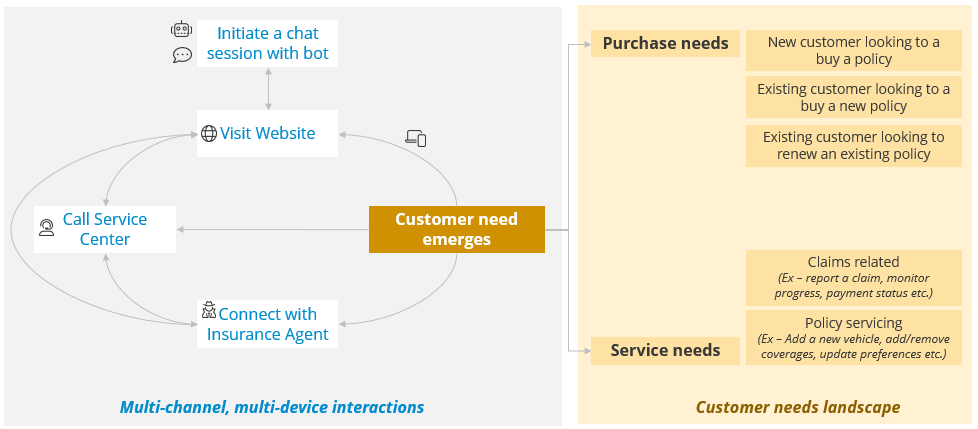
To comprehend the essence of an omnichannel experience, it is crucial to delve into the intricacies of interactions within the property and casualty (P&C) and life insurance ecosystem. Unlike sectors such as retail or e-commerce, the landscape of insurance is characterised by low-touch interactions, where customer engagements are propelled by specific needs and life events. These needs can be categorised as either purchase-driven, such as a customer seeking a motor policy for a newly acquired vehicle, renewing an existing renter policy, or obtaining pet insurance for a new addition to the family.
Alternatively, interactions may be service-driven, where customers aim to review existing policies, make modifications or report a claim in times of necessity. To fulfil these diverse needs, customers have the flexibility to initiate engagements through various channels as per their preference and ease, be it an agent, call centre, self-service on a website, or by starting a chat session. Importantly, this journey is seldom unidirectional; customers often transition from one channel to another until their specific requirements are met.
Take the case of a car buyer, Natalie, who decides to buy a motor policy and is studying the various options available in the market. While meticulously exploring the insurer’s website for the right coverages, she initiates a chat session to seek clarity from the virtual assistant. In this digital dialogue, she articulates her requirements and subsequently requests a quote specific to the selected coverage through her laptop.
However, before committing to the purchase, Natalie places a call with a service agent, aiming to gain further insights into certain aspects of the policy that she is unable to find on the website. Following the conversation, she reviews the quote and makes a purchase through a mobile device on an insurer’s mobile application.
Within this dynamic, multi-channel and multi-device interaction for an illustrated customer motor policy purchase journey, an omnichannel experience signifies delivering a seamless (effortless transition from one channel to another without losing context or having to repeat information) consistent (unified impression of the brand, reinforcing its identity and values), integrated (information about customer preferences, interactions, and transactions is shared and accessible across the entire organisation) and content-optimised (personalised) encounter.
An omnichannel strategy transcends individual channel experiences and concentrates on the holistic customer journey, recognizing the likelihood of customers fluidly navigating between various channels and devices carrying forward their requirements, preferences, and saved journeys from one channel to another.
AI plays a pivotal role in shaping customer journeys and their interactions by collecting, analysing large volumes of data, and learning from each interaction (feedback loop) to provide insights on customer needs and preferences. This helps Insurers provide personalised experience at scale, better product recommendations, reduce friction in customer’s digital journeys, pre-empt their needs to suggest right solutions, and improve operational efficiency.
We will take a look at each of these aspects, briefly.
Smart Search
As customers invest significant time exploring their needs on insurance websites, the challenge arises from the vastness of the content amassed by these large brands over the years. Many websites, despite their size, often fall short in delivering precise search results, providing users with more of a laundry list of links than the exact information they seek. This inefficiency not only results in a considerable waste of effort in content generation but, more critically, leads to an unpleasant and disintegrated user experience.
Consequently, users frequently resort to reaching out to contact centres or agents to resolve their queries, contributing to increased operational costs for insurers. With the advent of new techniques in the AI space, the search experience can be greatly enhanced. Among an array of products available in the market, Fractal’s Senseforth.ai stands out, featuring built-in AI-powered smart search capabilities.
This innovative solution integrated with LLMs of choice aims to deliver an improved, personalised, and relevant search experience. Implementing smart search has demonstrated tangible benefits, including a 30% reduction in website bounce rates, a 25% increase in deflecting queries to contact centres, and a notable 40% boost in the adoption and usage of website content. This not only streamlines the user experience but also presents a compelling case for insurers to embrace advanced AI-driven solutions like Fractal’s Senseforth.ai.
Personalised Product Recommendations
In the contemporary landscape, organisations, including insurers, are confronted with the task of managing extensive volumes of customer data across diverse channels, thereby constructing intricate customer profiles. The adept utilisation of these insights is crucial for gaining a nuanced comprehension of customer preferences, behaviours, and risk profiles. The proactive identification of emerging needs empowers insurers to propose pertinent coverage options before customers explicitly articulate them.
Consider a customer exploring auto insurance on a mobile app. Artificial intelligence (AI) ensures subsequent recommendations align seamlessly with their preferences as they transition to the website.
Fractal’s proprietary platform, Customer Genomics, embodies a comparable approach. It serves as the backbone for steering customer decisions, deploying cutting-edge AI algorithms that dynamically adapt to customer interactions. This results in real-time, context-aware product recommendations at every juncture of the customer’s relationship journey.
By harmonising enterprise data with emotional signals across channels, Customer Genomics determines personalised and unified Next Best Actions at an individual customer level. This synchronisation guarantees a consistent experience for customers as they traverse between online platforms, mobile apps, and physical locations, fostering a seamless omnichannel journey.
Another innovative solution, Flyfish, a product of Fractal’s ingenuity, stands out as the pioneering generative AI platform for digital sales. Flyfish introduces a high-touch, consultative selling experience for brands, delivering highly personalised advice based on consumers’ unique needs, goals, and context. Functioning as a friendly advisor, Flyfish leverages data from multiple sources to provide relevant product recommendations, guiding customers at every stage of their journey.
Its ability to rapidly integrate new information (datasets) and instantaneously train the LLM ensures that responses are consistently relevant and accurate. Flyfish also offers seamless integration with various backend systems, including Customer Relationship Management (CRMs), Enterprise Resource Planning (ERPs), customer data platforms, personalization engines, and other vital components of the organisational infrastructure. This comprehensive integration further enhances its capacity to deliver a holistic and effective solution for digital sales.
Improving Customer Support and Operational Efficiency
The integration of AI and omnichannel strategies is reshaping the landscape of customer support within the insurance industry. By offering intelligent and efficient assistance across diverse channels, AI not only enhances issue resolution but also significantly contributes to overall customer satisfaction and loyalty. As technology advances, the synergy between AI and omnichannel customer support is poised to play a pivotal role in defining the future of customer interactions in the insurance sector.
AI-powered virtual assistants, commonly in the form of chatbots, stand at the forefront of this transformative approach, providing instantaneous and intelligent responses to customer queries. These virtual assistants, operating around the clock, ensure that customers can access assistance whenever needed. Automated processes and intelligent routing mechanisms further refine the customer support experience by streamlining issue resolution. This not only reduces response times but also enhances overall operational efficiency for insurance providers.
In the realm of such solutions, Fractal’s Senseforth.ai stands out as an AI-powered virtual assistant designed to assist contact centre agents in accessing relevant information swiftly. Their Customer Interaction Insights solution represents a paradigm shift in customer assistance and experience. By introducing fully automated Generative AI Powered Customer Interaction Insights, it analyses calls comprehensively.
Senseforth.ai’s solution employs advanced Speech to Text and Generative NLP Technology to process 100% of calls, generating insightful summaries. This includes accurate abstractive summaries, identification of call drivers, sentiment analysis, attrition signals, and various other metrics, all powered by the capabilities of generative AI and LLMs. In doing so, Fractal’s Senseforth.ai is at the forefront of revolutionising customer support by introducing innovative and efficient AI-driven solutions in the insurance sector.
Reducing Digital Friction
In a landscape where some insurers have fully embraced digital transformation, while others strive to catch up, offering a frictionless digital experience has become integral to providing an omnichannel journey. The pandemic has not only expedited the shift toward digital but has also shaped customer behaviour, with a growing preference for self-service and online purchasing.
Numerous studies of the digital funnel underscore the significance of the online sales journey, revealing that 75% of customers initiate their purchasing process online. Approximately 66% of customers prefer self-service, with over 80% anticipating organisations to provide comprehensive online services. However, a considerable percentage of customers abandon their digital self-service and purchasing journeys, opting for alternative channels or visiting competitor sites. This shift is often attributed to poor UI/UX experiences, technical glitches, the complexities of the digital journeys, and inadequate knowledge bases.
The repercussions of such friction are evident in suboptimal ROI on online marketing spend and elevated costs from assisted channels like call centres. Identifying these friction points manually faces practical limitations, given the high volume of incoming traffic, extensive web pages, millions of click events with 85% unique paths, and the lack of structure in the catalyst data.
AI emerges as a pivotal solution in overcoming these limitations and delivering a seamless user experience, enhancing digital conversions, and minimising transfers to other channels. Among the array of products in the market, Fractal’s digital optimization platform, A.I.D.E. (Automated Insights for Digital Evolution), stands out. It delves into millions of digital touchpoints, incorporating external and omnichannel data to uncover microscopic factors causing dissonance, utilising unique pattern recognition AI algorithms.
What sets A.I.D.E. apart are its distinctive features, including the precision to pinpoint genuine sources of friction (beyond mere ‘exit pages’), assessment of cross-channel interactions, contextualization using conversational data (such as call recordings and chats), and an automated pipeline to extract meaningful business features at scale using semi-structured clickstream feeds.
A.I.D.E. proves its efficacy by supporting multiple downstream AI/ML use cases with customizable, open-source AI, ensuring compatibility with complex journeys, data security, and rapid time to market.
As businesses navigate the implementation of AI-powered solutions, a meticulous approach to overcome common challenges is vital. Critical steps include ensuring data quality, achieving seamless integration with existing systems, and prioritising skill development. Moreover, businesses are urged to give paramount importance to ethical considerations, cultivating customer trust through transparent communication and fortified security measures.
Strategic planning becomes imperative for addressing scalability, user adoption, and cost concerns, while the continuous vigilance of ongoing monitoring and maintenance remains essential for ensuring sustained success.
By systematically addressing these challenges, businesses can unlock the transformative potential of AI. This approach not only facilitates the delivery of enhanced customer experiences but also positions organisations at the vanguard of technological innovation, fostering resilience and competitiveness in the ever-evolving landscape of AI-driven solutions.
This article has been co-authored by Pritha Datta, Engagement Manager at Fractal and Ashish Tyagi, Principal Consultant at Fractal.
The post AI-Powered Evolution: Transforming the Omnichannel Customer Experience appeared first on Analytics India Magazine.
In this article, we will talk about the various applications of AI in the world of omnichannel marketing and how GenAI is fueling progress on this front, taking it to unimaginable levels. However, before we get into the details, let’s firm up our understanding of omnichannel marketing.
Offering an omnichannel experience, which once used to be the bleeding edge of all industries, has now become a requirement for survival. The pandemic accelerating the digital ecosystem and converging the boundaries between the physical and digital world and the emergence of Insurtechs such as Lemonade, Root Insurance, and Branch Insurance has made it imperative for traditional insurers to provide a delightful, sticky omnichannel customer experience.
If you’re still wondering what the term omnichannel experience means, the prefix “omni” means “all”, and “channel” is a reference to the many ways customers might interact with a company— through an agent, web-browsing, through a service call centre, etc.
To comprehend the essence of an omnichannel experience, it is crucial to delve into the intricacies of interactions within the property and casualty (P&C) and life insurance ecosystem. Unlike sectors such as retail or e-commerce, the landscape of insurance is characterised by low-touch interactions, where customer engagements are propelled by specific needs and life events. These needs can be categorised as either purchase-driven, such as a customer seeking a motor policy for a newly acquired vehicle, renewing an existing renter policy, or obtaining pet insurance for a new addition to the family.
Alternatively, interactions may be service-driven, where customers aim to review existing policies, make modifications or report a claim in times of necessity. To fulfil these diverse needs, customers have the flexibility to initiate engagements through various channels as per their preference and ease, be it an agent, call centre, self-service on a website, or by starting a chat session. Importantly, this journey is seldom unidirectional; customers often transition from one channel to another until their specific requirements are met.
Take the case of a car buyer, Natalie, who decides to buy a motor policy and is studying the various options available in the market. While meticulously exploring the insurer’s website for the right coverages, she initiates a chat session to seek clarity from the virtual assistant. In this digital dialogue, she articulates her requirements and subsequently requests a quote specific to the selected coverage through her laptop.
However, before committing to the purchase, Natalie places a call with a service agent, aiming to gain further insights into certain aspects of the policy that she is unable to find on the website. Following the conversation, she reviews the quote and purchases a mobile device on an insurer’s mobile application.
Within this dynamic, multi-channel and multi-device interaction for an illustrated customer motor policy purchase journey, an omnichannel experience signifies delivering a seamless (effortless transition from one channel to another without losing context or having to repeat information) consistent (unified impression of the brand, reinforcing its identity and values), integrated (information about customer preferences, interactions, and transactions is shared and accessible across the entire organisation) and content-optimised (personalised) encounter.
An omnichannel strategy transcends individual channel experiences and concentrates on the holistic customer journey, recognizing the likelihood of customers fluidly navigating between various channels and devices carrying forward their requirements, preferences, and saved journeys from one channel to another.
AI plays a pivotal role in shaping customer journeys and their interactions by collecting, analysing large volumes of data, and learning from each interaction (feedback loop) to provide insights on customer needs and preferences. This helps Insurers provide personalised experience at scale, better product recommendations, reduce friction in customer’s digital journeys, pre-empt their needs to suggest right solutions, and improve operational efficiency.
We will take a look at each of these aspects, briefly.
Smart Search
As customers invest significant time exploring their needs on insurance websites, the challenge arises from the vastness of the content amassed by these large brands over the years. Many websites, despite their size, often fall short in delivering precise search results, providing users with more of a laundry list of links than the exact information they seek. This inefficiency not only results in a considerable waste of effort in content generation but, more critically, leads to an unpleasant and disintegrated user experience.
Consequently, users frequently resort to reaching out to contact centres or agents to resolve their queries, contributing to increased operational costs for insurers. With the advent of new techniques in the AI space, the search experience can be greatly enhanced. Among an array of products available in the market, Fractal’s Senseforth.ai stands out, featuring built-in AI-powered smart search capabilities.
This innovative solution integrated with LLMs of choice aims to deliver an improved, personalised, and relevant search experience. Implementing smart search has demonstrated tangible benefits, including a 30% reduction in website bounce rates, a 25% increase in deflecting queries to contact centres, and a notable 40% boost in the adoption and usage of website content. This not only streamlines the user experience but also presents a compelling case for insurers to embrace advanced AI-driven solutions like Fractal’s Senseforth.ai.
Personalised Product Recommendations
In the contemporary landscape, organisations, including insurers, are confronted with the task of managing extensive volumes of customer data across diverse channels, thereby constructing intricate customer profiles. The adept utilisation of these insights is crucial for gaining a nuanced comprehension of customer preferences, behaviours, and risk profiles. The proactive identification of emerging needs empowers insurers to propose pertinent coverage options before customers explicitly articulate them.
Consider a customer exploring auto insurance on a mobile app. Artificial intelligence (AI) ensures subsequent recommendations align seamlessly with their preferences as they transition to the website.
Fractal’s proprietary platform, Customer Genomics, embodies a comparable approach. It serves as the backbone for steering customer decisions, and deploying cutting-edge AI algorithms that dynamically adapt to customer interactions. This results in real-time, context-aware product recommendations at every juncture of the customer’s relationship journey.
By harmonising enterprise data with emotional signals across channels, Customer Genomics determines personalised and unified Next Best Actions at an individual customer level. This synchronisation guarantees a consistent experience for customers as they traverse between online platforms, mobile apps, and physical locations, fostering a seamless omnichannel journey.
Another innovative solution, Flyfish, a product of Fractal’s ingenuity, stands out as the pioneering generative AI platform for digital sales. Flyfish introduces a high-touch, consultative selling experience for brands, delivering highly personalised advice based on consumers’ unique needs, goals, and context. Functioning as a friendly advisor, Flyfish leverages data from multiple sources to provide relevant product recommendations, guiding customers at every stage of their journey.
Its ability to rapidly integrate new information (datasets) and instantaneously train the LLM ensures that responses are consistently relevant and accurate. Flyfish also offers seamless integration with various backend systems, including Customer Relationship Management (CRMs), Enterprise Resource Planning (ERPs), customer data platforms, personalization engines, and other vital components of the organisational infrastructure. This comprehensive integration further enhances its capacity to deliver a holistic and effective solution for digital sales.
Improving Customer Support and Operational Efficiency
The integration of AI and omnichannel strategies is reshaping the landscape of customer support within the insurance industry. By offering intelligent and efficient assistance across diverse channels, AI not only enhances issue resolution but also significantly contributes to overall customer satisfaction and loyalty. As technology advances, the synergy between AI and omnichannel customer support is poised to play a pivotal role in defining the future of customer interactions in the insurance sector.
AI-powered virtual assistants, commonly in the form of chatbots, stand at the forefront of this transformative approach, providing instantaneous and intelligent responses to customer queries. These virtual assistants, operating around the clock, ensure that customers can access assistance whenever needed. Automated processes and intelligent routing mechanisms further refine the customer support experience by streamlining issue resolution. This not only reduces response times but also enhances overall operational efficiency for insurance providers.
In the realm of such solutions, Fractal’s Senseforth.ai stands out as an AI-powered virtual assistant designed to assist contact centre agents in accessing relevant information swiftly. Their Customer Interaction Insights solution represents a paradigm shift in customer assistance and experience. By introducing fully automated Generative AI Powered Customer Interaction Insights, it analyses calls comprehensively.
Senseforth.ai’s solution employs advanced Speech-to-text and Generative NLP Technology to process 100% of calls, generating insightful summaries. This includes accurate abstractive summaries, identification of call drivers, sentiment analysis, attrition signals, and various other metrics, all powered by the capabilities of generative AI and LLMs. In doing so, Fractal’s Senseforth.ai is at the forefront of revolutionising customer support by introducing innovative and efficient AI-driven solutions in the insurance sector.
Reducing Digital Friction
In a landscape where some insurers have fully embraced digital transformation, while others strive to catch up, offering a frictionless digital experience has become integral to providing an omnichannel journey. The pandemic has not only expedited the shift toward digital but has also shaped customer behaviour, with a growing preference for self-service and online purchasing.
Numerous studies of the digital funnel underscore the significance of the online sales journey, revealing that 75% of customers initiate their purchasing process online. Approximately 66% of customers prefer self-service, with over 80% anticipating organisations to provide comprehensive online services. However, a considerable percentage of customers abandon their digital self-service and purchasing journeys, opting for alternative channels or visiting competitor sites. This shift is often attributed to poor UI/UX experiences, technical glitches, the complexities of the digital journeys, and inadequate knowledge bases.
The repercussions of such friction are evident in suboptimal ROI on online marketing spend and elevated costs from assisted channels like call centres. Identifying these friction points manually faces practical limitations, given the high volume of incoming traffic, extensive web pages, millions of click events with 85% unique paths, and the lack of structure in the catalyst data.
AI emerges as a pivotal solution in overcoming these limitations and delivering a seamless user experience, enhancing digital conversions, and minimising transfers to other channels. Among the array of products in the market, Fractal’s digital optimization platform, A.I.D.E. (Automated Insights for Digital Evolution), stands out. It delves into millions of digital touchpoints, incorporating external and omnichannel data to uncover microscopic factors causing dissonance, utilising unique pattern recognition AI algorithms.
What sets A.I.D.E. apart are its distinctive features, including the precision to pinpoint genuine sources of friction (beyond mere ‘exit pages’), assessment of cross-channel interactions, contextualization using conversational data (such as call recordings and chats), and an automated pipeline to extract meaningful business features at scale using semi-structured clickstream feeds.
A.I.D.E. proves its efficacy by supporting multiple downstream AI/ML use cases with customizable, open-source AI, ensuring compatibility with complex journeys, data security, and rapid time to market.
As businesses navigate the implementation of AI-powered solutions, a meticulous approach to overcoming common challenges is vital. Critical steps include ensuring data quality, achieving seamless integration with existing systems, and prioritising skill development. Moreover, businesses are urged to give paramount importance to ethical considerations, cultivating customer trust through transparent communication and fortified security measures.
Strategic planning becomes imperative for addressing scalability, user adoption, and cost concerns, while the continuous vigilance of ongoing monitoring and maintenance remains essential for ensuring sustained success.
By systematically addressing these challenges, businesses can unlock the transformative potential of AI. This approach not only facilitates the delivery of enhanced customer experiences but also positions organisations at the vanguard of technological innovation, fostering resilience and competitiveness in the ever-evolving landscape of AI-driven solutions.
This article has been co-authored by Pritha Datta, Engagement Manager at Fractal and Ashish Tyagi, Principal Consultant at Fractal.
The post AI-Powered Evolution: Transforming the Omnichannel Customer Experience appeared first on Analytics India Magazine.