Transformative Trends: Generative AI and its Impact on Software Development

Generative AI trends

The world of software development is constantly evolving, and one of the most exciting frontiers is the emergence of Generative AI. This powerful technology has the potential to revolutionize the way we build software, impacting everything from design and development to testing and deployment.

For businesses ready to explore the dynamic world of software development, the advent of Generative AI offers unparalleled opportunities for innovation and growth. By integrating this cutting-edge technology into their development processes, companies can significantly enhance their efficiency, reduce time-to-market, and deliver superior software products that stand out in the competitive digital landscape.

According to a McKinsey report, the Generative AI market size is expected to reach $4.4 trillion by 2031, indicating not just a trend but a seismic shift in the technological and business landscape. The increasing market share can be attributed to the technology’s versatility, AI tools growth, and capacity to drive significant improvements across various sectors.

According to data from precedenceresearch.com, by end-use, the business and financial services segment is expected to grow at the fastest rate of 36.4% from 2023 to 2032. This highlights the increasing adoption and significance of generative AI in transforming operations within the business and financial sectors, further underlining its pivotal role in reshaping various industries.

image-2

This blog will dive into the transformative role of Generative AI in software development, illustrating its capacity to revolutionize standard practices and drive growth for businesses entering this innovative field.

So, without further ado, let’s dive right into the details.

Understanding the impact of generative AI on software development

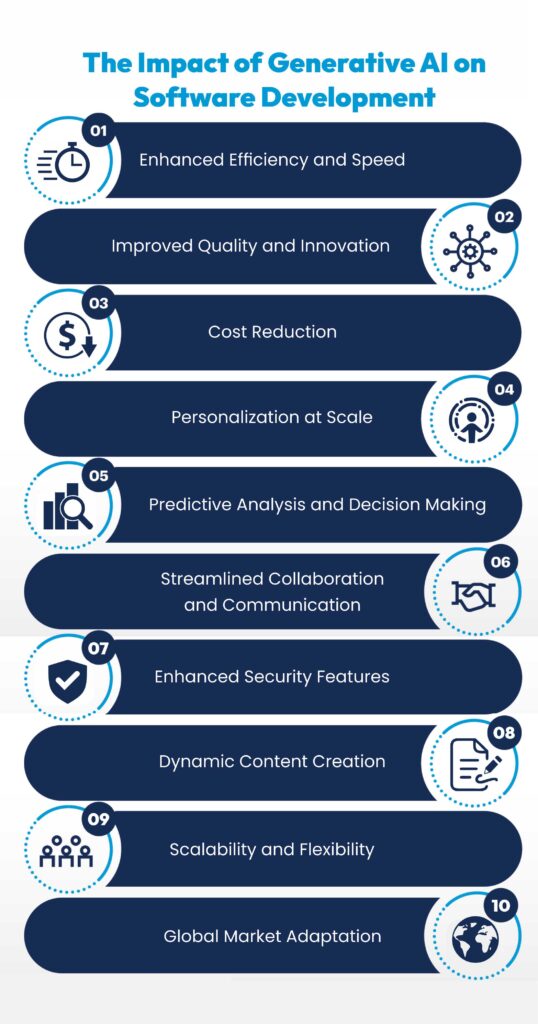
Generative AI is revolutionizing the software development services landscape, providing businesses with unparalleled opportunities for innovation, operational efficiency, and the creation of cutting-edge applications. Its impact is far-reaching, influencing every stage of software development, from design to deployment. Let’s discover how Generative AI is transforming the field and why businesses should pay attention:
Transformative Trends: Generative AI and its Impact on Software Development

1. Enhanced efficiency and speed

Leveraging Generative AI development services helps businesses automate repetitive coding tasks, generating high-quality code at an unparalleled pace. This includes generating code for bug fixes, new features, and even automated testing, significantly reducing development time. This translates to faster time-to-market for businesses, crucial for staying ahead in competitive industries.

2. Improved quality and innovation

By freeing developers from regular coding tasks, Generative AI empowers them to focus on strategic problem-solving and creative exploration. This elevates the overall quality of applications and fosters a culture of innovation, leading to more differentiated and impactful products. Businesses can leverage this to cater to specific customer needs and gain a competitive edge.

3. Cost reduction

Generative AI’s automation capabilities significantly reduce the need for manual coding efforts, leading to substantial cost savings in software development. This cost efficiency empowers businesses, especially startups and small-to-medium enterprises, to allocate resources more effectively, investing in critical areas like marketing or customer service.

4. Personalization at scale

Generative AI can analyze user data and behavior patterns to create highly personalized user experiences within applications. This level of customization is key for businesses looking to improve user engagement and satisfaction. By tailoring experiences to individual needs, businesses can attract and retain users, directly impacting the application’s success.

5. Predictive analysis and decision making

Generative AI’s ability to process and analyze vast amounts of data allows it to predict trends, user needs, and potential market shifts. This predictive power equips businesses with invaluable insights to make informed decisions, enabling them to anticipate market demands and adapt their applications accordingly.

6. Streamlined collaboration and communication

Manual documentation and progress reports can create communication roadblocks within development teams. Generative AI automates these tasks, generating clear and concise documents and summaries. This fosters smoother information flow and shared understanding, leading to more streamlined project management and efficient collaboration.

7. Enhanced security features

Traditional methods of identifying security vulnerabilities in code can be time-consuming and error-prone. Generative AI analyzes code with greater depth and precision, pinpointing potential security risks early in the development cycle. This proactive approach allows businesses to strengthen application security, builds user trust, and protects against costly breaches.

8. Dynamic content creation

Static content can quickly become disengaging for users. Generative AI excels at creating dynamic content like personalized recommendations or interactive elements within applications. This keeps content fresh and engaging, driving user interest and fostering repeat visits.

9. Scalability and flexibility

Building applications with traditional methods often create inflexible systems that struggle to adapt to changing needs. Generative AI empowers businesses to develop software that is inherently scalable and adaptable. This allows them to grow and expand their offerings without being hindered by software limitations.

10. Global market adaptation

Entering new international markets often requires significant customization of features, language, and content. Generative AI simplifies this process, enabling businesses to tailor their applications to diverse cultural and regulatory requirements. This unlocks new growth opportunities and helps reach wider audiences across the globe.

Summing up

Generative AI is not only a technological advancement but also a paradigm shift that is reshaping the software development landscape. By enhancing efficiency, fostering innovation, and creating more secure and personalized applications, this technology is setting a new standard for businesses in software development. As we progress, integrating Generative AI into development processes is becoming less optional and more necessary for companies aiming to thrive in the digital age.

7 ways AI chatbots can help you crush Valentine’s Day

Gift box with hearts and cards splattered

AI chatbots are all the rage because of their impressive ability to excel at technical tasks such as coding, writing, and more. However, did you know they can help you plan the perfect Valentine's Day?

In addition to technical tasks, AI chatbots can help with tasks that may seem simple but require both time and creativity — two things that are often in short supply yet crucial to pulling off a memorable Valentine's Day.

Also: The best AI image generators to try right now

Whether you're celebrating a date with your significant other, or a Palentine with close friends, having an enjoyable Valentine's Day requires some planning, and AI can help. From putting together a food and drinks menu for an at-home celebration, to finding the perfect thing to watch, AI can assist you with all of your needs.

Below is my roundup of helpful ways you can utilize AI chatbots this Valentine's Day.

Note: I use Copilot for all of these use cases. You can also use ChatGPT, which will work for all the prompts below; however, it won't give you the most recent information because it is not indexing the web for answers.

1. Recipes

Curating a perfect menu while having people over can be challenging. You not only have to take into account each person's preferences but also any dietary restrictions your date or any of your guests might have. To avoid being stumped, ask an AI chatbot for recipe ideas.

You can ask for a recipe based on specific ingredients you have in the fridge, or based on some meal requirements you'd like to be met. For example, I asked Copilot, "Can you give me a recipe that uses carrots, onions, chicken, and pasta?" Within seconds, it generated a recipe I could then follow for a yummy meal.

If you are trying to find a recipe that accommodates dietary needs and restrictions, you could say something like, "Give me recipe ideas that have no gluten or dairy in them."

2. Finding places to eat

On the topic of food, AI chatbots can help you find places to eat and even discover new ones, ensuring the perfect spot for a date or group gathering.

Whether you are meeting up with someone and want to be the one to suggest a restaurant, find yourself in a new neighborhood that you've never been in and need suggestions for where to go, or simply want to discover new places in your area, you can use AI to help.

Also: Windows 11 Notepad — yes, Notepad! — to get AI smarts, Snipping Tool update coming too

All you need to do is tell the AI where you want to find a restaurant and what you are looking for.

For example, I asked Copilot, "Can you help me find somewhere to eat in NYC that serves Italian food, has a romantic vibe, and has happy hour specials?" Within seconds, I got this list.

In addition to a set of restaurants, Copilot included a detailed description with address, vibe, happy hour, and reviews, and even included a map with suggestions and links to easily access their websites, reservations, reviews, and more.

3. Making drinks

This concept is very similar to using AI to help you make a meal. Whether you are trying to make an alcoholic beverage, mocktail, or smoothie, you can use an AI chatbot to help you concoct the perfect recipe.

For example, if you want to make yourself and your date or guests a sweet cocktail using rum, you can ask Copilot, "What sweet cocktails can I make with rum?"

Copilot will then give you cocktail suggestions. If you like any of them, you can follow up by asking for directions on how to make it.

You can also use Copilot to generate unique drinks from fun prompts.

For example, at a Microsoft press event in New York last year, the company had a smoothie bar that used Copilot to make smoothies according to your favorite TV character.

Also: ChatGPT vs. Microsoft Copilot vs. Gemini: Which is the best AI chatbot?

The smoothie bar attendee typed a prompt into Copilot like, "Make a smoothie inspired by Dora," to which Bing responded with a detailed, fun recipe for incorporating traits of the character that the smoothie maker would follow.

You could do this with many other prompts, including seasons, feelings, songs, and more, which could specifically be a fun activity to try when hosting.

4. A new date night idea

If you are spending Valentine's Day with a significant other, you are likely trying to come up with ideas that will set this special date apart from just any other date. However, thinking of something new to do, especially if you have been with your partner for a long time, can be challenging.

AI chatbots can help you come up with fun and creative dates that you may never have thought of on your own yet that meet the exact vibe of the date you envision.

For instance, you can ask Copilot for help coming up with the perfect, laid-back date night by asking, "Can you give me a date idea that is indoors and low budget?"

Copilot gave me a cute date idea that fit the criteria. If you aren't happy with the idea generated, you can follow up by asking for other ideas and including additional details. Even if you don't decide to go with any of those ideas exactly, it could be a helpful way for you and your partner to get the creative juices flowing.

5. Finding a movie or show to watch

Deciding to watch a movie or show on TV is only half of the battle. The trickiest part can be deciding what to watch. Next time you're stuck, ask AI for help.

You can ask an AI chatbot to help you find a movie or show for you to watch in the specific genre you are looking for. It will make content suggestions that narrow down your choices and hopefully make your decision easier.

For example, I asked Copilot, "Can you help me find a rom-com to watch that is currently streaming on Netflix?"

I was then met with a list of five options to choose from, with a summary of each movie. As a rom-com movie connoisseur, I can confirm that these picks were pretty solid, with 13 Going On 30 being one of my all-time top-five favorite movies.

6. Creating a greeting card

Valentine's Day is all about sentimental, thoughtful little details; giving the people you love a card is more important than ever. Whether it is a friend, partner, or family member, you can make a personalized card in Copilot in just seconds by leveraging its AI-image-generating capabilities.

Also: I just tried Google's ImageFX AI image generator, and I'm shocked at how good it is

You can start by asking it to generate an image of what you'd like to see on the card. My partner loves corgis, so I asked Copilot, "Can you draw me a cute, fluffy, cartoon corgi with heart eyes?"

Once you get the four options, you can select your favorite and edit it using the in-line editing tools. Once you are happy with your image, you can click on the three dots in the upper right-hand corner of your picture, and select "edit in Designer," which opens the generated image in Microsoft's graphic design tool.

In Designer, you can add images, accents, text, and more. In under three minutes, I tweaked my picture to look like the card shown above.

7. Plan a get-together

Inviting people over to your place involves so many moving parts. Now, you can use AI chatbots to help you with nearly every piece of the puzzle. To show you what I mean, let's start with an example.

I asked Copilot, "Can you help me plan a dinner party?"

The initial response included a detailed plan starting with tasks scheduled three weeks in advance, and going all the way through a day before the event. From there, I could move forward with any of those aspects and ask Copilot for more help.

If I was actually throwing this party, I could have followed up that question with questions regarding theme ideas, menu help, a shopping list, and more.

You could even use an AI image generator — like we did in the step above — to help you create fliers, invites, and table placements.

Artificial Intelligence

NIST Establishes AI Safety Consortium

Entrance of the Gaithersburg Campus of National Institute of Standards and Technology (NIST).
Image: Adobe/Grandbrothers

The National Institute of Standards and Technology established the AI Safety Institute on Feb. 7 to determine guidelines and standards for AI measurement and policy. U.S. AI companies and companies that do business in the U.S. will be affected by those guidelines and standards and may have the opportunity to have input about them.

What is the U.S. AI Safety Institute consortium?

The U.S. AI Safety Institute is a joint public and private sector research group and data-sharing space for “AI creators and users, academics, government and industry researchers, and civil society organizations,” according to NIST.

Organizations could apply to become members between Nov. 2, 2023 and Jan. 15, 2024. Out of more than 600 interested organizations, NIST chose 200 companies and organizations to become members. Participating organizations include Apple, Anthropic, Cisco, Hewlett Packard Enterprise, Hugging Face, Microsoft, Meta, NVIDIA, OpenAI, Salesforce and other companies, academic institutions and research organizations.

Those members will work on projects including:

  • Developing new guidelines, tools, methods, protocols and best practices to contribute to industry standards for developing and deploying safe, secure and trustworthy AI.
  • Developing guidance and benchmarks for identifying and evaluating AI capabilities, especially those capabilities that could cause harm.
  • Developing approaches to incorporate secure development practices for generative AI.
  • Developing methods and practices for successfully red-teaming machine learning.
  • Developing ways to authenticate AI-generated digital content.
  • Specifying and encouraging AI workforce skills.

“Responsible AI offers enormous potential for humanity, businesses and public services, and Cisco firmly believes that a holistic, simplified approach will help the U.S. safely realize the full benefits of AI,” said Nicole Isaac, vice president, global public policy at Cisco, in a statement to NIST.

SEE: What are the differences between AI and machine learning? (TechRepublic Premium)

“Working together across industry, government and civil society is essential if we are to develop common standards around safe and trustworthy AI,” said Nick Clegg, president of global affairs at Meta, in a statement to NIST. “We’re enthusiastic about being part of this consortium and working closely with the AI Safety Institute.”

An interesting omission on the list of U.S. AI Safety Institute members is the Future of Life Institute, a global nonprofit with investors including Elon Musk, established to prevent AI from contributing to “extreme large-scale risks” such as global war.

The creation of the AI Safety Institute and its place in the federal government

The U.S. AI Safety Institute was created as part of the efforts set in place by President Joe Biden’s Executive Order on AI proliferation and safety in October 2023.

The U.S. AI Safety Institute falls under the jurisdiction of the Department of Commerce. Elizabeth Kelly is the institute’s inaugural director, and Elham Tabassi is its chief technology officer.

Who is working on AI safety?

In the U.S., AI safety and regulation at the government level is handled by NIST, and, now, the U.S. AI Safety Institute under NIST. The major AI companies in the U.S. have worked with the government on encouraging AI safety and skills to help the AI industry build the economy.

Academic institutions working on AI safety include Stanford University and University of Maryland and others.

A group of international cybersecurity organizations established the Guidelines for Secure AI System Development in November 2023 to address AI safety early in the development cycle.

Pegasystems Releases New Generative AI Tool for Enterprise App Development

Global software company Pegasystems has unveiled Pega GenAI Blueprint, a generative AI-based collaborative application designed to speed up the app design process.

Pega GenAI Blueprint, available for early adopters, equips business leaders to transform app ideas into interactive ‘application blueprints’ for easy understanding and collaboration among stakeholders.

The process involves users describing the app’s purpose, with Pega GenAI Blueprint guiding them through workflow elements, capturing feedback, and facilitating collaboration. The Pega GenAI engine leverages industry knowledge to design optimised application blueprints, encompassing workflow processes, data models, and integrations. Once finalised, the blueprint integrates seamlessly into the Pega Platform, creating an enterprise-grade, cloud-architected workflow application.

The tool offers benefits such as agile workflow design, drawing on Pega GenAI’s ability to suggest optimal designs from simple descriptions. It synthesises the company’s extensive repository of workflow best practices, providing a nearly complete design starting point. Rapid app deployment follows the finalisation of the blueprint, with further modifications easily handled within the tool.

“The benefits of generative AI extend to developers and end-users, improving productivity through query-based interactions, automatic summarisation, and streamlined case lifecycle generation,” Deepak Visweswaraiah, vice president, of platform engineering and site managing director, Visweswaraiah told AIM, in a previous conversation.

Read more: Data Science Hiring Process at Pegasystems

The post Pegasystems Releases New Generative AI Tool for Enterprise App Development appeared first on Analytics India Magazine.

Galaxy AI features, including Live Translation, are headed to Galaxy Buds

Samsung Galaxy Buds 2 Wireless Earbuds

The Galaxy Buds 2 in all four colors.

AI features were a big selling point when Samsung debuted its flagship Galaxy S24 phone, and while the company has announced plans to bring some of those features to older phones, it also has plans to bring them to other devices.

That time is here for Galaxy Buds users, as a pair of Galaxy AI features will soon be available on the earbuds.

Also: The best earbuds

First up is the Galaxy's Live Translation feature, which allows users to make a phone call to someone speaking another language. When one person speaks, their words are translated into the other person's language. Now, that can be done through the built-in microphone of the earbuds instead.

A very similar feature interpretation feature is also on the way, this one intended for in-person conversations. This is the biggest one for Galaxy Buds users, as the update allows them to speak directly into the microphone on their connected earbuds and have their words translated on screen — no need to pass the phone back and forth.

Most of the Galaxy S24's AI features are handled entirely on the phone, meaning they don't need an internet connection to work. You will need a Galaxy S24 phone though, so if you're using Samsung earbuds without a Samsung phone (or with a Samsung phone other than the S24), you won't be able to take advantage of the new tools.

Also: The best Samsung phones to buy

The features are coming to Galaxy Buds 2 Pro, Galaxy Buds 2, and Galaxy Buds, the company says, via an over-the-air update that should roll out over the next few days.

It's important to remember that Samsung has announced Galaxy AI features will only be available for free until the end of 2025, meaning there's going to be some kind of charge to use them at that point.

Artificial Intelligence

DSC Weekly 13 February 2024

Announcements

  • Developing high-quality software can quickly devolve into a chaotic, unproductive mess without the proper processes and frameworks in place. Organizations require not only the right coding tools but also effective testing and deployment solutions to ensure the highest quality software is what hits the market. The proliferation of generative AI, open-source technologies and low-code/no-code tools can streamline and enhance developer tasks but only if they are applied as part of a bigger strategy that empowers developers to innovate more efficiently. Tune into the Software Development Methodologies summit to hear leading experts share the latest development tools and trends to smooth over and enhance what quickly becomes a complicated process.
  • As cloud adoption has become the norm, cyber threats are a constant concern. Cloud detection and response (CDR) is growing in significance, serving as a vital means to monitor and remediate cloud security issues while safeguarding valuable assets. This new acronym in the detection and response category is designed to address cybersecurity threats and incidents that target cloud environments and support cloud-based tools. But as CDR is an emerging technology, security teams must understand it first. At the Best Practices for Cloud Detection and Response Summit, hear advice from industry leaders, experts and practitioners to help evaluate CDR products and create an implementation plan with confidence.

Top Stories

  • Your AI Journey: Start Small AND Strategic – Part 2
    February 11, 2024
    by Bill Schmarzo
    In part 1 of the series “Your AI Journey: Start Small AND Strategic,” we learned that it’s essential to begin your AI journey by focusing on delivering significant and measurable business and operational value. This is necessary because AI projects require significant data, technology, people skills, and culture investments to succeed.
  • A neurosymbolic AI approach to learning + reasoning
    February 7, 2024
    by Alan Morrison
    Eric Baum in his book What Is Thinking? defines understanding as “a compressed representation of the world.” Another word for a representation is a model. Understanding in Baum’s sense is a form of distillation and abstraction. Humans refine their level of understanding of a topic by reviewing examples of people, geographic locations, things, and ideas interacting. They capture the essence of those examples with an overarching model that captures traits those examples share.
  • How edge computing is transforming data management
    February 12, 2024
    by Ovais Naseem
    In today’s digital landscape, where data is often hailed as the new oil, the rise of edge computing stands as a transformative force reshaping the way we manage and utilize data. Edge computing marks a significant shift from the traditional centralized data processing model to a decentralized approach, bringing computation and data storage closer to the source of data generation
Education_DSC_160x600-2

In-Depth

  • Transformative Trends: Generative AI and its Impact on Software Development
    February 13, 2024
    by Erika Balla
    The world of software development is constantly evolving, and one of the most exciting frontiers is the emergence of Generative AI. This powerful technology has the potential to revolutionize the way we build software, impacting everything from design and development to testing and deployment.
  • Boosting analytical capabilities using BigQuery
    February 9, 2024
    by Edward Nick
    Each day, your business applications and digital footprint actively compile Analytical Capabilities data – endless streams of information detailing customer interactions, advertising effectiveness, cyber threats, and more. Yet this data overabundance enables insight paralysis. Most organizations can’t effectively harness data to derive real business value. Why?
  • 10 Prominent Data Science Predictions 2024- Know What the Industry Experts Say?
    February 9, 2024
    by Aileen Scott
    2024 is the year of great data science predictions targeting big business churn. It is the time to yield benefits from the popular data science frameworks that are streamed to do wonders for industries far and wide. Data science is not just a spoof on the big number game that guides businesses’ growth.
  • What nonprofits need to know about compliance for fundraising software
    February 8, 2024
    by Jane Marsh
    When a nonprofit’s staff members know details about donors’ sexual orientation, income, race, age and ethnicity, it’s easier to target messages, develop impactful campaigns and follow up with parties about future contributions. However, asking for those details is a relatively new practice for many organizations. Some donors feel awkward being asked about those details, especially if they don’t know why nonprofits request it. It’s also critical that nonprofit workers never assume specifics about donors based on the relatively few details available.
  • DSC Weekly 6 February 2024
    February 6, 2024
    by Scott Thompson
    Read more of the top articles from the Data Science Central community.

Indian Govt Points to Existing IPR Regime for Protecting Generative AI Works

Is AI Copyright Really Necessary?

Amid the wake of copyright concerns in generative AI created content, the Indian government recently announced that the existing IPR regime is well equipped to protect AI generated works. “No need to create a separate category of rights,” it added.

“This is a great move, and one that balances the interests of AI companies and rights holders.” posted Ed Newton Rex, the CEO of Fairly Trained, a non-profit for fairer training of generative AI companies.

He added that the government is not saying AI shouldn’t be supported, “They’re just saying AI companies should pay for the resources they use, like every other industry. This will pave the way for responsible AI development in the country,” he added, saying that the US, UK and elsewhere should take note.

This is in contrast to the distinct approach regarding AI and copyright laws, setting a precedent that diverges from both the EU and the US models. In Japan, the government has concluded that copyright laws do not apply to the training of AI technologies.

While the US is still navigating this murky space, the EU has already drafted a comprehensive regulation of artificial intelligence (AI) technologies, especially concerning copyright rules for generative AI tools like ChatGPT.

Existing IPR Regime

This declaration upholds the government’s existing legal frameworks, including the Copyright Law of 1957 and the Patent Law. The law is believed to provide ample protection and exclusive rights to creators and inventors of AI-generated content.

According to the announcement, the Copyright Law, in particular, should grant copyright owners exclusive economic rights over their works, such as the rights to reproduction, translation, and adaptation.

This law mandates that anyone wishing to use AI-generated works for commercial purposes must obtain the appropriate permissions, unless the use falls under the fair dealing exceptions outlined in Section 52. Similarly, the Patent Law ensures that innovations, including those achieved through AI, can be patented as long as they meet established criteria of novelty, inventiveness, and industrial application.

The responsibility for enforcing these rights lies with the individual rights holders, supported by legal measures against infringement or unauthorised use. This approach reflects a broader understanding that the existing legal structures are adept at accommodating the evolving nature of technology, including AI, without necessitating the creation of new categories of rights.

The post Indian Govt Points to Existing IPR Regime for Protecting Generative AI Works appeared first on Analytics India Magazine.

ChatGPT will now remember — and forget — things you tell it to

ChatGPT will now remember — and forget — things you tell it to Kyle Wiggers 9 hours

You’ll soon be able to tell ChatGPT to forget things — or remember specific things in future conversations.

Today, as part of a test, OpenAI began rolling out new “memory” controls for a small portion of ChatGPT free and paid users, with a broader rollout to follow at some unspecified future point. The controls let you tell ChatGPT explicitly to remember something, see what it remembers or turn off its memory altogether.

OpenAI explains in a blog post:

“ChatGPT can now carry what it learns between chats, allowing it to provide more relevant responses … As you chat with ChatGPT, you can ask it to remember something specific or let it pick up details itself. ChatGPT’s memory will get better the more you use it and you’ll start to notice the improvements over time.”

It’s not hard to picture scenarios where a ChatGPT with memory could come in handy.

If, say, you wanted ChatGPT to recall you live in the suburbs and so prefer driving versus public transit directions, you can simply tell it that fact (e.g. “Remember that I live in the suburbs and mostly drive.”). Or if you wanted its advice about child-rearing to pertain to younger kids because you have a kindergartner, you could highlight this for it (e.g. “Remember I have a kindergartner.”).

OpenAI lists several ways in which memory could be useful in a business context, as well, like remembering tone, voice and formatting preferences for blog posts and languages and frameworks for programming.

ChatGPT memory

Image Credits: OpenAI

GPTs — custom chatbots powered by OpenAI’s models, available through the GPT Store — have their own memories. The Books GPT, for instance, can automatically remember which books you’ve already read and which genres you like best. But these memories aren’t ever shared with ChatGPT — or vice versa.

The memory feature for both ChatGPT and GPTs can be disabled at any time from the ChatGPT settings menu, and when it’s turned off, ChatGPT and GPTs won’t create or use memories. From this same menu, you can view and delete specific memories or clear all memories.

Note that deleting a chat from chat history won’t erase ChatGPT’s or a GPT’s memories — you have to delete the memory itself.

Now, one imagines that ChatGPT could, over time, accumulate a lot of sensitive personal details in its memory, especially considering that the memory feature is switched on by default. OpenAI acknowledges the possibility — and also says that it might use memories to improve its models, with a carve-out exception for ChatGPT business customers and users who opt out.

But OpenAI also says that it’s taking steps to steer ChatGPT away from “proactively” remembering sensitive information, like health details, unless a user explicitly asks it to.

“ChatGPT’s memories evolve with your interactions and aren’t linked to specific conversations,” OpenAI writes. “[And] memories, like chats, with GPTs are not shared with GPT builders.”

For a more privacy-preserving experience, OpenAI’s rolling out a new Temporary Chat feature in ChatGPT, initially limited to a small subset of free and subscription users. With Temporary Chat, you can have a dialogue with a blank slate, in essence; ChatGPT won’t be aware of previous conversations or access memories but will follow custom instructions if they’re enabled.

ChatGPT Temporary Chat

Image Credits: OpenAI

OpenAI says it may keep a copy of Temporary Chat conversations for up to 30 days for “safety reasons,” however.

How AI Eliminates Common Supply Chain Bottlenecks

Supply chain bottlenecks can be financially devastating for manufacturers, suppliers and distributors. Artificial intelligence is one of the most promising emerging solutions. Could utilizing AI in supply chain management eliminate disruptions and delays?

Ways Supply Chain Bottlenecks Can Appear

A supply chain bottleneck — a point where the flow of goods is obstructed — can happen for several reasons.

1. Unexpected Demand Surges

Shifts in consumer demand can cause widespread supply chain disruptions. Manufacturers, suppliers and distributors are usually unprepared to handle a sudden, massive uptick in orders, which can cause lengthy delays.

2. Labor Shortages

Companies can only move goods if they have someone to distribute them. Widespread labor shortages impact every aspect of the supply chain sector, making it challenging for logistics businesses to keep things flowing smoothly.

3. Facility or Factory Closures

Even a single closure can have a ripple effect on an entire supply chain because it cuts off the flow of goods. Companies without contingency plans are left scrambling to fill the gap. In the meantime, their products sit collecting dust.

4. Counterfeit Products

Logistics fraud is a massive global issue. According to some of the latest public data, over $509 billion of counterfeit products were traded internationally in 2016. When they illegally enter the supply chain, they can confuse and disrupt the flow of goods.

5. Geopolitical Conflicts

When countries fight, their imports and exports stop being a priority — and nearby trade routes often become dangerous. Geopolitical conflicts can disrupt logistics organizations’ standard routines, causing long-term supply chain bottlenecks.

6. Extreme Weather Events

No place on the planet is safe from extreme weather events. Floods, blizzards, earthquakes and tornadoes can prevent boats, planes, and delivery trucks from going anywhere. Since the fallout can last for days or weeks, lengthy supply chain disruptions are practically inevitable.

The Importance of Eliminating Supply Chain Bottlenecks

Supply chain bottlenecks can negatively impact revenue. After all, brands can’t make money on products stuck in a warehouse. The subsequent damage to brand reputation — consumers aren’t fond of shipping delays — can lead to long-term financial losses.

Sometimes, enterprises don’t get the chance to move their goods once the supply chain issue is resolved. Perishable products — flowers, cosmetics, dairy, plants, produce and meat — can be quickly damaged or destroyed.

Even people not involved in the logistics process experience negative financial impacts. In fact, research shows supply chain bottlenecks caused a large portion of inflation in the United States from 2021 to 2022. In other words, everyone pays the price for these delays.

How Utilizing AI in Supply Chain Streamlines Bottlenecks

Firms leveraging AI in the supply chain can speed up their logistics processes, gain data-driven insights and identify potential disruptors before they become an issue.

1. Predictive Analytics

Machine learning models can leverage historical and current data to predict future outcomes. With predictive analytics, logistics companies can tell when and how supply chain bottlenecks will occur to avoid them better.

2. Demand Forecasting

A machine learning model can track consumer behavior, market trends, and geopolitics to forecast when demand will surge or drop. Manufacturers, suppliers, and distributors will have an easier time fulfilling orders on time if they know when to ramp up or slow down.

3. Quality Control

AI can distinguish between genuine and counterfeit goods, preventing supply chain disruption. One research team developed an algorithm capable of telling them apart 98% of the time on average. Enhanced quality control can keep logistics processes flowing smoothly.

4. Enhanced Coordination

AI technology can increase supply chain visibility and provide data-driven insights, helping suppliers, distributors and manufacturers coordinate. Additionally, natural language processing models can help them communicate regardless of their language or cultural barriers.

5. Autonomous Delivery

Last-mile delivery accounts for 50% of logistics expenses, according to some estimates. High order volumes, inefficient drivers and route complexity make it incredibly prone to bottlenecks. AI-powered autonomous vehicles are a promising solution — they can deliver items to pre-defined locations like parcel lockers to streamline delivery.

6. Real-Time Adjustments

Leveraging AI in supply chain management enables logistics companies to react to real-time market and demand changes. Additionally, it lets them act proactively when signs of delays or disruptions appear.

7. Route Optimization

Some of the most common sources of supply chain bottlenecks are unavoidable — logistics companies can’t control weather or geopolitical conflicts. However, AI can develop case-specific contingency plans, providing workarounds to disruptions before they become an issue. It can suggest alternative routes or suppliers to keep things running smoothly.

Why Is AI So Important for Fixing Supply Chain Issues?

For years, many logistics organizations have planned to digitalize in some way. In fact, 23% of warehouse administrators intended to adopt automation technologies in 2019. While AI is still an emerging technology, it precisely aligns with what they’ve been looking for.

It’s one of the few technologies able to handle the sheer volume of data the logistics process generates. It can aggregate, process and analyze information from hundreds of sources without becoming overwhelmed.

Speed is another thing that makes AI stand out from similar technologies — very few alternatives can process, analyze and output at the rate it does. It can consider millions of possibilities in seconds and respond to interactions in real time.

AI's main advantage over other technologies is its ability to automate tasks and act autonomously. It can work independently around the clock and rarely requires human intervention, which is ideal during labor shortages.

This technology is also cost-effective. According to one study, 63% of logistics businesses utilizing AI in supply chain management earned more revenue. Moreover, 61% reported having lower operational expenses.

While many technologies can automate tasks, process data rapidly or work autonomously, very few can do everything simultaneously. That’s why AI is such a promising solution for disruptions and delays in the supply chain.

Examples of AI in the Supply Chain

AI-powered surveillance systems and barcode scanners can prevent product defects and counterfeits from proceeding through logistics channels. Typically, they’re placed on or near conveyor belts to track inventory.

Logistics companies can integrate AI with other supply chain technologies. For example, they can use a machine learning model to power Internet of Things (IoT) packaging sensors. This way, they can analyze their product data to track shipments.

Administrative AI handles internal recordkeeping, management, document processing and information sharing tasks. For example, it can process invoices, order shipments, renew supplier contracts, send bid requests and schedule workers.

One emerging use for AI in the supply chain involves autonomous vehicles. Self-driving delivery trucks and drones can use machine learning to react to their environments in real time. While self-driving cars have a few years of development left, proofs of concept exist.

The Future of AI in Supply Chain Management

Since AI is still relatively new, its penetration rate will likely remain low for a few years. While 73% of logistics companies feel optimistic about emerging technologies, 50% plan to put off implementation until it becomes less risky. It seems many will wait until the ideal use cases, potential gaps and best practices become clearer.

While many in the sector are somewhat hesitant to adopt AI, indicators suggest they will quickly grow to accept it. Although only 11% of logistics executives felt AI was critical in 2022, an estimated 38% of them will believe it is essential by 2025. The industry may experience a substantial shift as more businesses utilize AI in supply chain management.

AI Might Permanently Eliminate Supply Chain Bottlenecks

As the penetration rate for AI in supply chain management increases, this technology’s transformative potential will become evident. If logistics companies utilize it strategically, they may be able to eliminate most — if not all — of their standard bottlenecks.

NEC Launches AI-Powered Tech Suites for Smart Cities

NEC Corporation India, a leader in IT and network technologies and a wholly owned subsidiary of NEC, has announced the launch of enhanced technology solutions as part of the Global Smart City Suite.

These solutions provide transparency and visibility for efficient management and decision-making, ensuring seamless operations among organizations and authorities and offering enhanced experiences for citizens, businesses, and communities.

The solutions launched by NEC include NEC Mi-Eye, which leverages AI and machine learning to deliver real-time insights on customer behaviour, operational efficiency, and security.

Other solutions include NEC Mi-Command (Integrated Command and Control Centre), NEC Mi-City (Citizen Engagement Portal), and NEC Mi-WareSync (Warehouse Management System).

“Our extensive experience in navigating the scale and complexity of a rapidly growing nation like India has helped us unearth numerous real-life technology deployment use cases which can be applied to various geographies globally. This underscores our dedication to transforming communities by enhancing safety and intelligence, thereby shaping the future of technology ranging from the outer reaches of space to the depths of the oceans,” Aalok Kumar, Corporate Officer & Senior VP – Head of Global Smart City Business, NEC Corporation & President & CEO, NEC Corporation India, said.

NEC is a leader in the integration of IT and network technologies and brings more than 124 years of expertise in technological innovation to provide solutions for empowering people, businesses, and society. Headquartered in Japan, NEC started operations in India in the 1950s, accelerating its growth through the expansion of business to global markets.

The post NEC Launches AI-Powered Tech Suites for Smart Cities appeared first on Analytics India Magazine.