Morpheus-1: How Artificial Intelligence is Redefining the Boundary Between Dreams and Reality?

In today's rapidly evolving tech landscape, the boundary between the real and the imagined is becoming increasingly blurred. The notion of exploring and even controlling our dreams, a concept that once seemed to be a topic of science fiction movie, depicted in Christopher Nolan's “Inception,” is gradually becoming closer to reality. This shift is made possible by the advent of Morpheus-1, a cutting-edge artificial intelligence system created by a company called Prophetic. Named after a Greek god of dreams, Morpheus-1 is developed to experience and influence our dream world. This article intends to examine this technology and highlights its significance as a pivotal advancement in deepening our comprehension of human consciousness.

The Science and Potential of Lucid Dreaming

Lucid dreaming is a state where the dreamer is aware they are dreaming and may even control the dream. This phenomenon typically occurs during the Rapid Eye Movement (REM) stage of sleep (also known as REM sleep), characterized by vivid dreams and brain activity like wakefulness. Scientific research, particularly in neuroscience, has highlighted increased activity in the prefrontal cortex during lucid dreams. This observation suggests the significant role of this area in self-awareness and cognitive functions.

Studies have developed techniques to induce lucid dreaming, such as reality testing and mnemonic induction, pointing to its learnable nature. Lucid dreaming is not only a subject of scientific curiosity but also holds potential for psychological therapy, creative exploration, and understanding consciousness. Despite progress, the exact mechanisms and full implications of lucid dreaming remain areas of ongoing research.

What is Morpheus-1?

Morpheus-1 is an innovative AI agent that monitors brain activities to detect REM sleep and generates spatial targets to stimulate brain regions linked to lucid dreaming. The agent is built into a headset that one can wear before sleeping, facilitating awareness within the dream and providing an opportunity for dream exploration and control. The following describes three vital components of this technology:

REM Sleep Detection

To detect REM sleep, Morpheus-1 utilizes a combination of simultaneous EEG and MRI technology to monitor brain activity. This integration of the high temporal resolution of EEG and the high spatial resolution of MRI provides detailed insights into the timing (via EEG) and location (via MRI) of brain activities. The technology serves the dual purpose of studying the brain's electrical activity and examining its structural or functional changes, providing a more comprehensive understanding of brain dynamics.

Stimulating Lucid Dreaming

To stimulate consciousness or activate lucid dreaming, Morpheus-1 uses transcranial focused ultrasound stimulation (tFUS), an advanced, non-invasive brain stimulation technique that uses focused ultrasound waves to modulate neuronal activity in targeted regions of the brain. Its ability to deliver focused ultrasound waves deep into the brain with millimeter precision and three-dimensional steerability sets it apart from traditional electric or electromagnetic stimulation methods, such as Transcranial Magnetic Stimulation (TMS) or Transcranial Direct Current Stimulation (tDCS).

tFUS works by directing a beam of focused ultrasound energy through the skull to a specific area of the brain. The energy from the ultrasound waves induce mechanical effects in the targeted tissue, influencing neuronal activity without causing significant heating or damage to the tissue.

Generative Ultrasonic Transformer

The Morpheus-1 system utilizes a sophisticated AI architecture known as the “Generative Ultrasonic Transformer,” which incorporates 103 million parameters. This transformer is designed to process simultaneous EEG and MRI data, generating spatial targets for targeted brain stimulation through tFUS. Prior to input into the transformer, both EEG and MRI data are converted into vectors using their respective embedding models. The transformer's encoder processes the EEG data, while the decoder handles the MRI inputs. Through an attention mechanism, the transformer integrates information from both modalities, facilitating the prediction of spatial brain targets.

The training of the transformer occurs in two phases: pretraining and prediction. In the pretraining phase, the transformer learns to take a brain state as input and predict the subsequent brain state. Subsequently, during the prediction stage, the pretrained model undergoes fine-tuning to predict spatial targets for brain stimulation. This fine-tuning aims to replicate the neuron firing patterns observed during lucid dreaming, thereby inducing the desired brain state.

Potential Implications of Morpheus-1

The advent of Morpheus-1 has far-reaching implications, particularly in the realms of therapy, creativity, and entertainment. The system's ability to induce and control lucid dreaming could have therapeutic possibilities, addressing conditions like PTSD and anxiety. It also changes how people explore creativity by letting them control their dreams for inspiration. However, ethical concerns arise when considering issues of consent and privacy in this changing landscape. The evolving connection between humans and technology challenges traditional ideas about the authenticity of mental experiences. As Morpheus-1 showcases the potential to navigate and control consciousness, scientific exploration is imperative to optimize the technology, understand potential side effects, and navigate the societal implications of this groundbreaking advancement. In essence, Morpheus-1 stands as a catalyst for a future where artificial intelligence seamlessly integrates with our subconscious, offering controlled access to the intricate world of dreams.

The Bottom Line

Morpheus-1, an advanced AI system designed by Prophetic, is reshaping the line between dreams and reality. By monitoring brain states and employing ultrasonic holograms, it aims to induce and control lucid dreaming. While holding promise for therapy and creativity, ethical concerns arise, necessitating ongoing scientific exploration to optimize the technology and address societal implications. Morpheus-1 represents a significant leap toward a future where AI seamlessly integrates with our subconscious, providing controlled access to the fascinating realm of dreams.


Top 5 DataCamp Courses for Mastering Generative AI

Top 5 DataCamp Courses for Mastering Generative AI
Image from DALL-E 3

Generative AI is on steroids at the moment. It’s developing so quickly and more and more people want to be part of it by the day. At one point, everybody was saying that Data Science was the sexiest career, but it seems that a career in Generative AI has taken the lead in 2023/2024.

We’re amongst AI Prompt Engineers who are Making $300k/y, companies going head to head to see who’s got the best chatbot, such as ChatGPT’s New Rival: Google’s Gemini, and more. Seems like a good time to jump on the Generative AI wave right?

DataCamp is on a mission to democratize data skills for everyone. The company has a wide range of courses, podcasts, blogs, and more to ensure that organizations and individuals have the right skills they need to work with data in the real world.

Are you looking at a career in Generative AI? Kickstart your journey now with the following Generative AI courses by DataCamp.

Understanding Artificial Intelligence

Link: Understanding AI

Level: Beginner

AI remains today's buzzword and has had a revolutionary impact on our economy, different industries and society. If you are new to the world of AI and want to get your toes wet without diving, this beginner-friendly course will provide you with exactly that.

It dives into the foundational aspects of AI and how it is quickly advancing, with hands-on exercises, knowledge of machine learning, deep learning, and generative models. This course does not require any coding knowledge — making it the perfect course for beginners!

Generative AI Concepts

Link: Generative AI Concepts

Level: Beginner

Now you have a better understanding of AI as a whole, your next step to understand its impact on today's society is learning about Generative AI. Generative AI is a type of AI model that can create new content, such as ChatGPT, as well as other tasks such as What I Learned From Using ChatGPT for Data Science.

In this beginner-friendly Generative AI course, you will learn about how this new emerging technology is shaping our future. Learn about how Generative AI works, the ethical considerations, and how you can utilize these tools to the max!

Master LLM Concepts

Link: Large Language Model Concepts

Level: Intermediate

Another buzzword we’ve been hearing for the past year is Large Language Models (LLMs). In this course, you will learn about the different elements that are fueling the LLM growth, for example, deep learning, computing power and also data availability. You will learn about the foundations and building blocks of LLMs, such as natural language processing (NLP), fine-tuning, and learning techniques like zero-shot, and more.

Dive into how LLMs are revolutionizing today's society, in the business and personal world with real-world examples.

ChatGPT Prompt Engineering for Developers

Link: ChatGPT Prompt Engineering for Developers

Level: Expert

As I mentioned prior, AI Prompt Engineers who are Making $300k/y — therefore, you can imagine how important this skill is in today's society. LLMs have the ability to generate human-like text and other types of content, but the science behind it is the prompts you provide.

Writing effective prompts is a form of art when it comes to LLMs, so learning prompt engineering will take your Generative AI journey to the next level. Prompt engineering is the ability to design and craft particular and unique prompts in order to output desired responses from LLMs. To reap the full benefits of LLMs, prompt engineering is an essential skill.

Working with OpenAI API

Link: Working with OpenAI API

Level: Intermediate/Expert

OpenAI has and continues to dominate the AI market, with applications such as ChatGPT. LLMs have transformed the way companies and employees work, making it more effective on a day-to-day basis.

If you really want to grasp all the benefits that you can and extract valuable business value — you need to learn about OpenAIs API. OpenAI API has a wide range of potential applications and this course will guide you through how you can use AI to generate unique outputs, text generation, perform sentiment analysis, and more. You can even build your own chatbot — which is specific to your needs!

Wrapping it up

With DataCamp, you can learn the data skills you need online at your own pace—from non-coding essentials to data science and machine learning. Start your journey with DataCamp today by clicking here, where you can get access to their full content library, as well as certificates and projects. DataCamp can take from you zero to job-ready — start today!

Nisha Arya is a Data Scientist and Freelance Technical Writer. She is particularly interested in providing Data Science career advice or tutorials and theory based knowledge around Data Science. She also wishes to explore the different ways Artificial Intelligence is/can benefit the longevity of human life. A keen learner, seeking to broaden her tech knowledge and writing skills, whilst helping guide others.

More On This Topic

  • Hone Your Data Skills With Free Access to DataCamp
  • Become Data-Driven Faster with DataCamp’s Analyst Takeover
  • Black Friday Deal — Master Machine Learning for Less with DataCamp
  • Experience the Joy of Data with DataCamp
  • Get World-class Data Science Learning with DataCamp at 25% off
  • Mastering Generative AI and Prompt Engineering: A Free eBook

Slack’s highly anticipated AI features are finally here, including channel recaps, thread summaries, and more

slack-ai-hero

Many companies rely on Slack for cross-organization communication and their employees use the platform to share messages, documents, team plans, spreadsheets, and more. To optimize user experience on the app, Slack is finally making its generative AI features available on the platform.

On Wednesday, Salesforce, which owns Slack, announced the rollout of Slack AI, a generative AI experience that includes AI-powered search, channel recaps, and thread summaries.

Also: Don't tell your AI anything personal, Google warns in new Gemini privacy notice

"These new AI capabilities empower our customers to access the collective knowledge within Slack so they can work smarter, move faster, and spend their time on things that spark real innovation and growth," said Denise Dresser, Slack CEO.

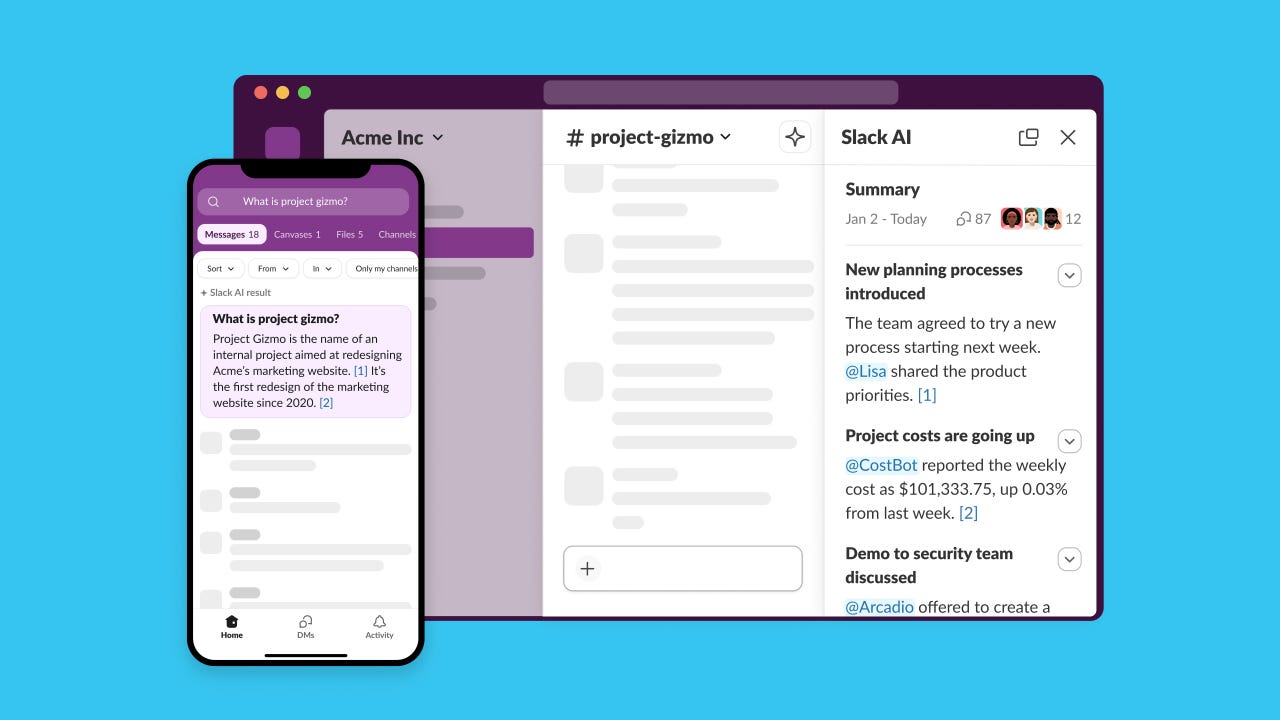
If you've ever tried searching for something specific on Slack, you've probably found that its current search tool is a bit disappointing, which makes it difficult to find the content you're looking for among the high volume of information on the app. The new AI-powered search feature is here to tackle that issue.

Now, instead of being limited to searching for a specific term and hoping you're directed to the right results, you can ask a question conversationally and receive a concise, generated answer that's based on the content of relevant Slack messages.

Also: Windows 11 Notepad — yes, Notepad! — to get AI smarts, Snipping Tool update coming too

This feature is also helpful if you want to catch up on something you missed, or if you need to find information on a specific topic, such as company campaigns, policies, terms, or more. The demo images show that the response from Slack AI also includes footnotes, which direct you to the original source of the content, so that you can verify its validity or check out the source for yourself, as seen in the image below.

The Channel Recaps feature does exactly what the name implies — it summarizes the messages sent in accessible channels. With this feature, you can select what messages you want to be summarized, including unread messages or custom date ranges.

The Thread Summaries feature, meanwhile, lets you get up to date on a message thread with a single click, providing users with a detailed summary that includes key decisions, next steps, and a birds-eye view of priorities, according to the press release.

Also: Want to work in AI? How to pivot your career in 5 steps

Slack AI will be integrated into the platform and, therefore, have access to confidential enterprise information. The development team behind the product has taken time to address privacy and security concerns, claiming trust is the number one value at Salesforce, and as a result, Slack is "committed to building AI products safely, responsibly, and ethically."

Specifically, the company explains in the release that Slack AI upholds Slack's security practices and compliance standards, its large language models (LLMs) are hosted directly within Slack, ensuring customer data remains in-house, customer data is siloed and will not be used to serve other clients directly or indirectly, and Slack AI does not use customer data for LLM training.

Slack has plans to continue adding more AI-powered features in the future, such as generating digests that summarize key highlights from channels and a native integration of Einstein Copilot that will provide answers in Slack regarding customer data.

Also: Otter.ai adds AI meeting features at no additional cost across all plans

Slack AI will be offered as a paid add-on for Slack Enterprise plans and is available now in English in the US and UK, with more plans and language support coming soon. Slack doesn't disclose how much the add-on will cost users in the release, but if you are interested in learning more, you can fill out this form.

Artificial Intelligence

NVIDIA’s Chat with RTX Brings AI Chatbot Directly to PCs

NVIDIA released “Chat with RTX,” an AI chatbot that operates directly on personal computers, marking a significant advancement in localised AI capabilities.

This early release demo app allows users to leverage their NVIDIA RTX 30- or 40-series GPUs to run a personal AI chatbot capable of summarising content from YouTube videos and personal documents, thus offering a new level of data analysis and information retrieval.

The Chat with RTX’s demo can be downloaded here.

Chat with RTX operates by installing a web server and Python instance on the user’s PC, utilising the powerful Tensor cores of NVIDIA’s RTX GPUs to expedite queries.

This local processing ensures quick responses and also keeps the user’s data private, without the need for internet connectivity or cloud-based processing. Vin Vashishta founder & AI advisor at V Squared said, “Running the LLM locally means fewer data privacy concerns and faster response times. RAG keeps the responses constrained and relevant to the user.”

The application also supports a variety of file formats, including .txt, .pdf, .doc/.docx, and .xml, and can analyse YouTube video transcripts for specific mentions or summaries, enhancing research and data analysis tasks significantly.

Despite its potential, Chat with RTX is still in its early stages, with users reporting some accuracy issues and limitations, such as the inability to maintain context between questions and the creation of JSON files within indexed folders.

Chat with RTX has brought advanced AI capabilities directly to users’ desktops, offering privacy, speed, and convenience. “It’s a promising look at how AI could be set to overhaul Windows,” posted Tom Warren, the senior editor at Verge on X. As NVIDIA continues to refine and enhance this technology, it could impact how people interact with AI on their devices.

The post NVIDIA’s Chat with RTX Brings AI Chatbot Directly to PCs appeared first on Analytics India Magazine.

GitHub Announces Funding Programme for Open Source AI Startups

GitHub has announced that the applications for the next cohort of GitHub Accelerator are now open, offering USD400,000 in funding for 10 open-source developers building AI-based solutions.

GitHub created GitHub Accelerator to help build more careers and companies in open source. The program is designed to provide financial support, mentorship, networking, training, and visibility to help participants take the next step in their open-source journey – whether that’s securing funding, launching a product, or turning an idea into an invention.

“We’re seeing developers across the globe use GitHub to innovate and share openly at every level of the AI stack, from training frameworks to models to responsible AI and evaluation tooling. And beyond a significant spike in the total number of generative AI projects, these projects are entering the top 10 most popular projects by contributor count,” said Stormy Peters, VP, Communities at GitHub.

“But building a successful AI business in the open comes with challenges. On top of the time and funding obstacles we’re already familiar with in open source, the heightened expenses and ethical, security, and legal considerations are daunting. We see these challenges as a risk to global innovation and are hoping to help,”Peters added.

This Accelerator cohort will focus on funding the people and projects building AI-based solutions under an open-source license to improve the world around them. Programme curriculum will include guidance on building a sustainable open-source business, with a particular focus on navigating the complexity of making AI advancements.

The 10-week Accelerator programme will start from April 22, 2024 and will include a mix of 1-to-1, group sessions, project work, and mentorships. Participants will also receive:

  • $40,000 per project in non-dilutive funding
  • 5-10 hours per week of live instruction, workshops, and homework
  • Office Hours with GitHub team for security reviews
  • Q+As with enterprise Sponsors, community members, and GitHub leaders
  • Introduction to, and at least one office hour with, M12, Microsoft’s Venture Fund
  • Free access to relevant GitHub products, including a full year of GitHub Copilot
  • Eligible projects will receive up to $350k in free Azure AI infrastructure, including preferred access to high-end GPU virtual machine clusters.
  • A shared slack channel with your cohort to collaborate and support each other

The post GitHub Announces Funding Programme for Open Source AI Startups appeared first on Analytics India Magazine.

What Is Data Lineage, And Why Does It Matter?

What Is Data Lineage, And Why Does It Matter?
Image by storyset on Freepik

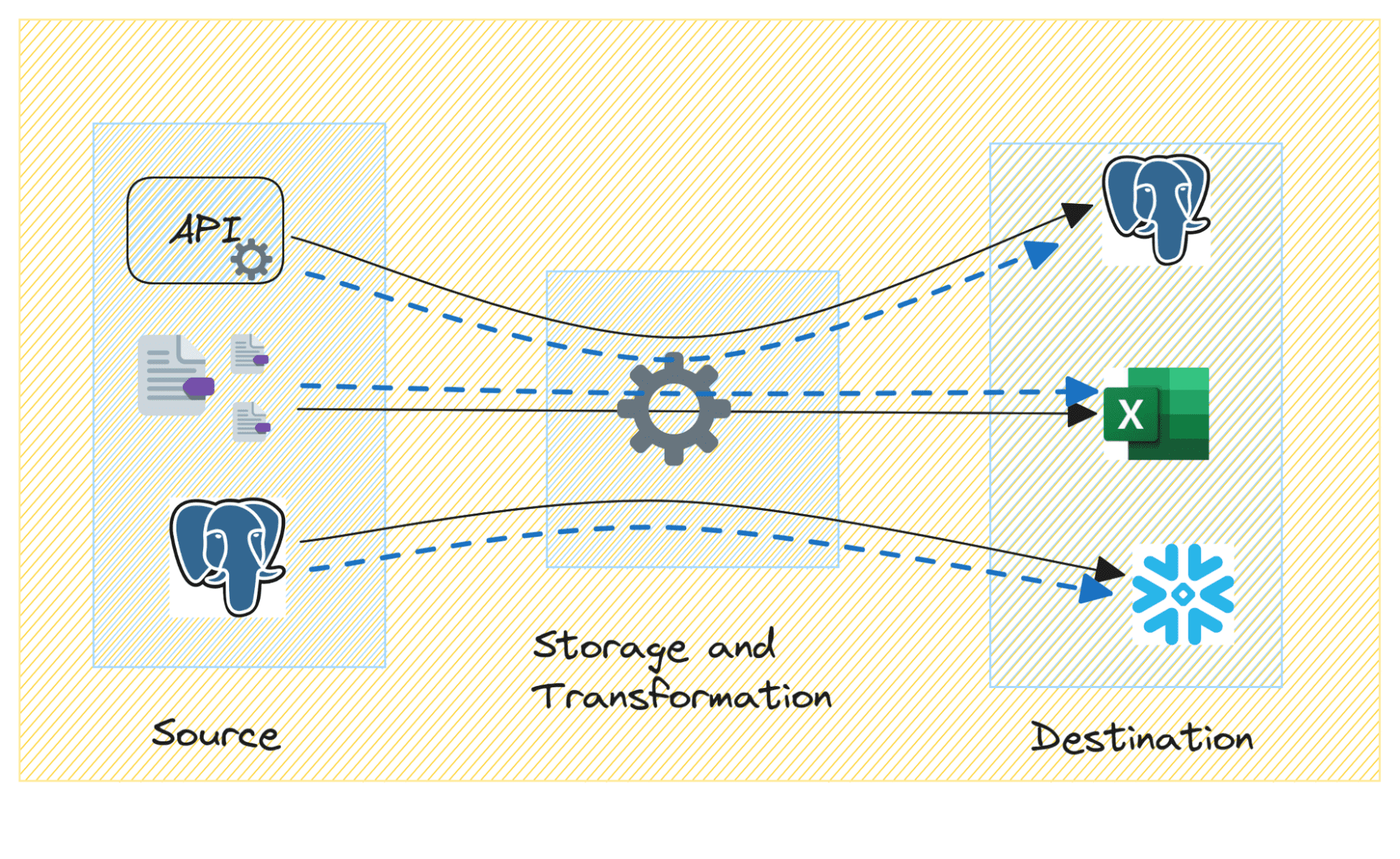
In any data pipeline, the data ingested from the sources typically goes through several transformations, so much that the data consumed from the destination is widely different from the data actually ingested from the source. Data lineage provides a comprehensive way to chart the flow of data through the system—from the source to the destination—as it undergoes transformations.

In this article, we’ll learn about data lineage and its importance. We’ll also see how data lineage facilitates better data management and go over some of the tools and platforms you can use for data lineage.

Let’s get started!

What Is Data Lineage?

Data lineage refers to the tracking and visualization of the flow and transformation of data as it moves through various stages in a data pipeline or system. It provides a detailed understanding of the origin, movement, and transformation of data within the organization’s data pipelines—allowing data professionals to trace the data's path from its source to its destination.

Such comprehensive understanding of the data's life cycle is helpful for organizations aiming to enhance data quality, ensure regulatory compliance, and much more.

Key Components of Data Lineage

Now let's explore the key components we account for in data lineage:

What Is Data Lineage, And Why Does It Matter?
Image by Author

  • Source Systems: This component focuses on the initial source of data. Such as databases, log files, sensors, applications, and other external sources.
  • Metadata: Capturing metadata associated with the data is important as it includes details on data types, formats, and any business rules or constraints applied to the data.
  • Data Movement and Transformation: Tracking ETL processes helps understand how data is extracted from source systems, undergoes diverse transformations, and is loaded into target systems.
  • Destinations: Data lineage should also track the various intermediate and final destinations of the data, including databases, data warehouses, data lakes, and the like. It also includes other storage systems involved in processing and storing information. The final destination is generally the one where the processed data is stored for analysis or reporting.

In essence, data lineage provides a clear, holistic view of data flow, helping organizations understand dependencies and relationships. Because data lineage offers more than just a snapshot of data flow, it enables organizations to make informed decisions about data management and utilization.

Importance of Data Lineage

Now that we know what data lineage is, let’s proceed to learn more on how and why it’s important.

Data Quality and Integrity

Data lineage helps in maintaining data quality by providing a transparent view of the data's journey. This transparency ensures that data remains accurate, trustworthy, and aligned with business objectives.

Further, data lineage also helps mitigate data quality issues through lineage tracking. By tracing the flow of data (and its associated metadata), organizations can quickly identify and address data quality issues.

Regulatory Compliance

Data lineage assists organizations in meeting regulatory requirements by providing a comprehensive record of data movement, transformations, and storage. With clear visibility into the data's journey from its source to destination along with the transformations, data lineage acts as a robust mechanism for ensuring adherence to legal and industry-specific regulations.

Troubleshooting and Debugging

Data lineage also helps identify and resolve data issues efficiently. It simplifies the process of troubleshooting by offering a guide to identify points of failure or inconsistencies. This accelerates the resolution of data-related issues, minimizing downtime and operational disruptions.

Applications of Data Lineage

Data lineage also facilitates easier governance and improved overall efficiency amongst other advantages.

Impact Analysis

Data lineage is helpful in impact analysis by providing a clear view of how changes to data sources, structures, or processes will affect the overall system. This understanding is super helpful before implementing any modifications to avoid unintended consequences.

Data lineage also plays a role in making informed decisions and Managing Risks: A comprehensive understanding of how data is transformed and consumed, decision-makers can make informed choices about changes, updates, or implementations. This also ensures that potential risks are identified and mitigated before they can adversely affect the organization.

Auditing and Governance

Data governance relies on transparency and accountability. Data lineage serves as a foundational tool for enforcing governance policies, ensuring that data is handled in accordance with established standards, security protocols, and compliance requirements.

During audits, regulators and internal auditors often seek insights into data handling practices. Data lineage provides a detailed record of data movement, transformations, and storage, facilitating smooth audits and demonstrating adherence to regulatory requirements.

More Efficient Operation

By visualizing the flow of data, organizations can identify redundant processes, bottlenecks, or inefficiencies in their data workflows. Data lineage, therefore, helps eliminate unnecessary steps and optimizes the overall efficiency of data management.

Because data lineage provides a comprehensive yet better understanding of data flow: from data extraction to consumption, it also guides workflow optimizations to reduce processing times, optimize resource utilization, and more.

In summary, the applications of data lineage extend beyond its role as a tracking mechanism. It serves as a strategic tool for organizations to assess the impact of changes, maintain governance standards, and optimize operational efficiency.

Data Lineage Tools and Platforms

As you might have guessed, data lineage can benefit from some level of automation. Because automated tools can continuously monitor data movement and transformations, providing real-time updates to data lineage, it ensures that the information is always current and reflective of the latest changes.

Some notable tools in the data lineage space include:

  • Collibra: Includes robust data lineage features to visualize and understand the end-to-end journey of data.
  • Informatica Axon: Part of the Informatica platform, Axon provides data governance and metadata management.
  • IBM InfoSphere Information Governance Catalog: A tool for managing metadata and providing end-to-end data lineage tracking within complex enterprise environments.
  • Apache Atlas: An open-source tool that offers comprehensive metadata management and data lineage capabilities, commonly used in big data ecosystems.
  • Erwin Data Intelligence (DI): Offers a holistic view of data assets, including data lineage, to support data governance and compliance efforts.

Wrapping Up

In this article, we reviewed data lineage and its importance in ensuring data quality, compliance requirements, and more. Further, we discussed how tracing data lineage can help with impact analysis and optimizing the efficiency of the system.

Finally, we looked at some tools you can use to track data lineage. I hope you found this article helpful!

Bala Priya C is a developer and technical writer from India. She likes working at the intersection of math, programming, data science, and content creation. Her areas of interest and expertise include DevOps, data science, and natural language processing. She enjoys reading, writing, coding, and coffee! Currently, she's working on learning and sharing her knowledge with the developer community by authoring tutorials, how-to guides, opinion pieces, and more.

More On This Topic

  • Novice to Ninja: Why Your Python Skills Matter in Data Science
  • What Is ChatGPT Doing and Why Does It Work?
  • Machine learning does not produce value for my business. Why?
  • KDnuggets News, November 30: What is Chebychev's Theorem and How…
  • What is Chebychev's Theorem and How Does it Apply to Data Science?
  • What is Clustering and How Does it Work?

Microsoft and OpenAI identify and disrupt nation-state cyber threats that use AI, new report shows

Cybersecurity creative image

As generative AI technologies become more advanced, so do cyberattacks. That's according to Microsoft and OpenAI, who have shared research findings on the malicious use of large language models (LLMs) by nation-state-backed adversaries.

On Wednesday, Microsoft published its Cyber Signals 2024 report, which details nation-state attacks it has detected and disrupted alongside OpenAI from Russian, North Korean, Iranian, and Chinese-backed adversaries, as well as the actions that individuals and organizations can take to prepare for potential attacks.

Also: Don't tell your AI anything personal, Google warns in new Gemini privacy notice

The two tech companies tracked state-affiliated adversary attacks from Forest Blizzard, Emerald Sleet, Crimson Sandstorm, Charcoal Typhoon, and Salmon Typhoon. Each attack used LLMs to augment its cyber operations in some capacity, including assistance with research, troubleshooting, and generating content.

For example, Emerald Sleet, a North Korean threat actor, leveraged LLMs to research think tanks and experts on North Korea, generate content that would likely be used in spear-phishing campaigns, understand publicly known vulnerabilities, troubleshoot technical issues, and even assist with using various web technologies, according to the report.

Also: The best VPN services (and how to choose the right one for you)

Similarly, Crimson Sandstorm, an Iranian threat actor, used LLMs for technical assistance, including support in social engineering, assistance in troubleshooting errors, and more.

If you are interested in reading more about each nation-state threat, including their affiliation and their use of LLMs, you can check out the report, which includes a section dedicated to individual threat briefings.

Microsoft shares how AI-powered fraud, such as Voice Synthesis, which allows actors to train a model to sound like anyone with as short as a three-second sound bite, is an emerging and increasingly concerning threat.

Also: 5 reasons why I use Firefox when I need the most secure web browser

While the report shows generative AI is being used by malicious actors, the technology can also be used by defenders, such as Microsoft, to develop smarter protection and stay ahead in the constant cat-and-mouse chase that is cybersecurity.

Microsoft detects over 65 million cybersecurity signals every day. AI ensures those signals are analyzed for their most valuable information in helping to stop threats, according to the report.

Also: I tested iOS 17.3.1: What's inside, who needs it, and how it affected my iPhone

Microsoft also shares other ways it is using AI, including, "AI-enabled threat detection to spot changes in how resources or traffic on the network are used; behavioral analytics to detect risky sign-ins and anomalous behavior; machine learning (ML) models to detect risky sign-ins and malware; Zero Trust models where every access request must be fully authenticated, authorized, and encrypted; and device health verification before a device can connect to a corporate network."

To conclude the report, Microsoft says continued employee and public education are pivotal in combating social-engineering techniques, which are only successful if humans fail to identify them, and that prevention, whether AI-enabled or not, is key to combating all cyber threats.

Artificial Intelligence

Akamai Bets on Edge Computing to Take on AWS, Azure and Google Cloud 

akamai

Akamai Technologies, a prominent global content delivery network (CDN) provider, aspires to make a mark in the cloud computing space, placing significant emphasis on edge computing infrastructure as a strategic move.

The company aims to integrate cloud computing capabilities throughout its extensive edge network via generalised edge compute or Gecko (as Akamai calls it), solidifying its position as a cloud leader. Even though the market is heavily dominated by hyperscalers, Akamai feels its focus on bringing compute closer to the customers will help them gain significant market share.

“This combination of cloud and edge, combined with our extensive expertise in distributed networking for delivering our services, provides a substantial advantage. This becomes crucial as industries encounter rising demands for enhanced price performance, reduced latency, and heightened security in applications and data spanning a broader spectrum of computing,” Jay Jenkins, chief technology officer at Akamai Technologies, told AIM in an exclusive interaction.

Reduced latency in fact is a pivotal factor for numerous workloads. Jenkins emphasised the potential significance, stating, “Imagine the shift from 40 milliseconds to single-digit milliseconds for latency—this could be transformative for many customers.”

A Decentralised Approach in a Centralised Market

Traditionally, cloud computing predominantly occurs in centralised architectures within cloud environments. Hyperscalers serve customers from data centres located centrally but Akamai is approaching cloud in a very different way.

“If you take a look at current architectures, they generally treat cloud and edge very separately. Cloud, of course, is where you have all of the compute and storage and edge is really just sort of for content delivery. Maybe they have ‘Functions as a Service’ at the edge, but what we are really trying to do is have a virtual machine at the edge as a start and then start to roll out additional services from there,” Jenkins added.

Interestingly, Akamai’s journey into cloud computing began three years ago and to enable this, Akamai is leveraging its already existing CDN infrastructure and has made strategic acquisitions in the last few years. It acquired infrastructure-as-a-service (IaaS) platform provider Linode for about USD 900 million in 2022.

Moreover, the company is also entering strategic partnerships with telcos, IT solutions, and local cloud service providers across the globe. In the last 25 years, Akamai has established 4100 points of presence globally and is converting them into edge facilities.

As ambitious as it may sound, Akamai aims to establish 25 new edge locations by the end of the month, 100 by the end of this year and scale to over thousands in the coming years.

“Converting one of our existing points of presence into a computing facility is easy because we’ve been doing distributed computing for so long for our services,” Jenkins said.

Betting on Multi-cloud Approach

Jenkins acknowledges that migrating workload from an existing cloud service provider or hyperscaler to Akamai’s network could be challenging for many customers. Hence, to begin with, they are relying on the multi-cloud approach.

“At Akamai, we advocate for a multi-cloud approach, allowing customers to leverage the best services irrespective of the cloud platform. Envision a scenario where core infrastructure necessitates centralised services, yet specific containers and services demanding quicker response times can seamlessly transition to the edge,” Jenkins said.

He also acknowledged that other players in the industry will shift their focus to the edge, but Akamai holds a unique advantage due to the time-intensive nature of constructing a distributed infrastructure. Additionally, Akamai’s global presence, with 8 times more points of presence compared to competitors in the pureplay CDN space, further solidifies its advantage.

Moreover, hyperscalers like AWS, Microsoft or Google Cloud will take even more time because they’re very focused on centralised infrastructure and are very dependent on efficiency at scale in a single location.

“If they adopt a similar strategy to Akamai’s, it could take longer for them to establish similar infrastructure,” Jenkins said.

Nonetheless, we have seen AWS, the global leader in the cloud computing space, expand its local zones. However, Akamai’s approach is unique as they don’t treat cloud and edge networks differently.

Jenkins also mentioned that Akamai had secured a major client, a prominent social media giant (potentially ByteDance). This client uses Akamai’s infrastructure to deliver and capture video at the edge.

Akamai is positive about landing more customers as they transition towards the second phase of Gecko, which is set to commence later this year. The company aims to incorporate containers into the framework and moving to Gecko’s third phase, Akamai intends to introduce automated workload orchestration.

Opportunities in AI Edge Inferencing

With the surge of generative AI, companies worldwide and across diverse industries are exploring the utilisation of large language models (LLMs) to their advantage. The demand for training compute, inferencing, and deploying these models has increased significantly.

Jatkins believes that distributed computing has also been reinvigorated by AI and there are huge opportunities for things like AI edge inferencing.

“There are different sides to this AI story. While the training side has received substantial attention in recent years, the upcoming focus will shift significantly to the operational side. Emphasis will be on efficient operations, optimising inferencing closer to customers, and deploying strategies to drive tangible value,” he added.

The surge in demand for NVIDIA’s GPUs in the past year primarily resulted from the necessity for LLMs. However, for inferencing, particularly with smaller models, Jatkins suggests that a CPU architecture is generally adequate.

Nonetheless, Akamai is exploring a spectrum of specialised processors beyond GPUs, actively engaging with its customers to gauge demand.

Serving Underserved Locations

For Akamai to emerge as a global leader in the cloud computing space, it is also targeting customers strategically, located in areas where other cloud service providers or hyperscalers are not present.

This month alone, Akamai will be established in regions such as Bogotá, Colombia; Denver, Colorado; Houston, Texas; Hamburg, Germany; and Marseille, France, which are without a concentrated hyperscaler presence.

Moreover, they will expand to 65 more locations by the end of this year. “We’re going to bring full stack computing to hundreds of previously underserved locations and allow customers to move workloads closer to where the users are.”

En route: India

Jenkins adds that India is an important market for Akamai and will launch edge locations in the country soon. Last year, Jaipur-based Znet Technologies became the first official distributor of Akamai cloud computing services in India.

Akamai already has two data centres in India, in Chennai and Mumbai. Moreover, it has points of presence in other cities such as Pune, Hyderabad, Delhi and many smaller cities such as Agra, Agartala, Guwahati, Bhopal, Bhubaneswar and Ahmedabad, among others.

Many companies in these regions continue to maintain their data on-premise. Jenkins contends that there’s no necessity to relocate the data to a data centre thousands of miles away; instead, substantial benefits can be derived from utilising local solutions.

“Positioned on an optimised network, the same one used for content delivery and security, we aim to extend full-stack computing to numerous underserved locations. This empowers customers to place workloads closer to their end-users strategically,” Jenkins concluded.

The post Akamai Bets on Edge Computing to Take on AWS, Azure and Google Cloud appeared first on Analytics India Magazine.

Oracle Cloud Powers Yubi’s Co-lending Expansion

Yubi Group, a fintech company that specialises in providing a platform for debt financing, is using Oracle Cloud Infrastructure (OCI) to run its co-lending platform across India. With OCI, the fintech is able to bridge the credit gap in India and facilitate scalability in the co-lending sector.

Yubi processes over 1 million transactions daily on average. This has enabled over 750 lenders to distribute joint loans totaling US$1.2 billion to more than 1 million customers in India over the past three years.

Co-lending in India is projected to exceed US$12 billion this year. Yubi’s platform requires better flexibility, scalability, and security to accommodate the growing need.

Gaurav Kumar, founder and CEO of Yubi said, “We’re gearing up to increase our transaction volumes by over 10-fold in the upcoming months, and transitioning to OCI can help us with our goals,” He further said they opted for OCI due to the dual-region cloud strategy, anticipating over 25 percent cost savings from this migration.

Yubi will deploy OCI services such as Compute Virtual Machines (VMs), Object Storage, and OCI Database with PostgreSQL to gain flexible compute capacity for its projects.

The company said it will also benefit from high-performance computing and low-cost cloud storage options to improve the efficiency and productivity of its IT team. The migration to OCI will help Yubi to combine open-source technology with OCI to significantly improve performance and lower costs.

In the recent conference at Oracle CloudWorld Tour, the company shared that it has seen a 50% year-over-year increase in cloud consumption and notable expansions in sectors like BFSI, telecom, healthcare, and education. Oracle’s partnerships, including those with Microsoft and VMware, are improving multi-cloud environments. These new launches in Oracle’s portfolio aim to support India’s digital economy goals.

The post Oracle Cloud Powers Yubi’s Co-lending Expansion appeared first on Analytics India Magazine.

[Exclusive] Pushpak Bhattacharyya on Understanding Complex Human Emotions in LLMs 

Pushpak Bhattacharyya on Understanding Complex Human Emotions in LLMs

“A sentence can either be positive, negative or neutral – not a mix of all three. Emotionality, on the other hand, has this exciting thing about it that it can have a mixture of emotions within it,” said IIT Bombay professor and computer scientist Pushpak Bhattacharyya, explaining the complexity of understanding emotions in language.

Earlier this month, OpenAI CEO Sam Altman was seen experimenting on X, where he posted, “Is there a word for feeling nostalgic for the time period you’re living through at the time you’re living it?” The next thing you know, everyone was on ChatGPT asking what the word was. And many demonstrated creativity crafting their own versions of the word – like ‘Nowstalgia’. This is truly human. But can it be implemented on LLM chatbots?

Bhattacharyya knows the answer. “Chatbots that are polite, and understand sentiment, emotion, etc give rise to better businesses. Chatbots that are closer to human beings, emotional and sentiment, bring commercial profits along, which is quite motivating,” he added, highlighting a study that reported that organisations that used polite chatbots, benefitted from them, instead of the generic ones.

Bhattacharyya has been working on these emotional and sentimental problems in NLP since his master’s at IIT Kanpur, and has published over 350 papers. “What got me interested in linguistics, emotions, and AI was the similarities between the words of different languages and their respective sounds,” Bhattacharyya said. He narrated how he used to collect proverbs from each country and city he visited to understand how language operates.

Bhattacharyya told AIM that he is also working on Plutchik’s wheel of emotions with eight emotions at Centre for Indian Language Technology (CFILT) lab at IIT Bombay, which is a subsequent work of his recent paper – Zero-shot multitask intent and emotion prediction from multimodal data. This problem deals with combining different types of emotions within one context, a foundational problem that he said no one has taken up before. “At our CFILT lab, we take up problems that no one else has before, which includes not just Indian languages,” he added.

What Indian LLMs need

Bhattacharyya emphasised on building a trinity model for creating Indic language models, which means deciding one language, one task, and one domain for creating models. “For example, creating a model in Konkani for question answers on agriculture or a sentiment analysis system for railway reservation in Manipuri,” he explained, saying that these models are easier to build and then can be connected later into a larger model.

Talking about Indic models built on top of Llama, Bhattacharyya said that though these models are a step in the right direction, it is essential to also build them for specific tasks and domains, and then gradually expand into other tasks.

Bringing Altman’s recent news about raising $7 trillion for making AI chips, Bhattacharyya said that India also needs to build similar efforts and make indigenous chips. “Being self-sufficient in hardware is very crucial because we cannot wait for the switches and GPUs from outside India. We should make our in-house capabilities and that will facilitate AI research and further development,” he said.

AI Awareness

“In our scriptures, Buddhi (wisdom) is above Manas (mind) and then comes our body and sensory organs” Bhattacharyya explained that every generation of students is smarter than the last and the volume of information also increases. “It is important for these students to learn the basics and not just get stuck with what is exciting and instant gratification tasks like programming,” he added about the need for students to focus on larger problems but by starting small.

“Introducing basic mathematics along with programming starting from class 5th is necessary for education systems, along with teaching them about every other field like social science and others, to give them proper alignment with the world they are building for,” added Bhattacharyya about having holistic education for students.

During his PhD, Bhattarcharyya spent an extensive amount of time at MIT AI Lab and Stanford University, studying different flavours of AI with pioneers of the field such as Marvin Minsky and the father of modern linguistics, Noam Chomsky. “But my interest in linguistics started way back when I was in class 4th in school,” said Bhattacharyya.

“Today’s AI takes a lot more computation when compared to when I started doing AI,” Bhattacharyya said, highlighting how Bill Gates said in the early 1990s that NLP will drive computation requirements forward. “My advice to young people starting in the field would be to understand the fundamentals of mathematics and build foundations and then stick to a problem for a longer time,” Bhattacharyya added.

A Complex Human

Starting his B.Tech at IIT Kharagpur studying digital electronics, Bhattacharyya came across a circuit board made for adding two numbers. Unlike others who did not think of it much, he was astounded at how a lifeless system made of diodes and resistors had decision making capabilities. This got him into studying intelligence outside bodies of human beings and animals, leading him to AI.

“I’m one of the few NLP researchers who give equal importance to linguistics and computation,” he added that his course is inspired by both the fields and how his Master’s thesis was also focused on Sanskrit to Hindi machine translation. Talking about his paper on sarcasm detection in 2017, Bhattacharyya said that the researchers were able to build a computational algorithm that could detect sarcasm in LLMs which would benefit the field of psychology, cognitive science, and philosophy as well.

The post [Exclusive] Pushpak Bhattacharyya on Understanding Complex Human Emotions in LLMs appeared first on Analytics India Magazine.