The Tamil Nadu Skill Development Corporation’s (TNSDC) WhatsApp chatbot has led to 800+ job placements in 20 days.
The chatbot called Ilaya, which was launched merely two months ago, has accomplished enhanced employment opportunities for its users in a very short time. Not only that, the chatbot attracts more than 200 users daily to explore new job opportunities.
Leading conversational AI company Gupshup developed the WhatsApp chatbot. The idea of a WhatsApp chatbot was born with an intent to connect technically unskilled, unemployed individuals in the state, with job opportunities that may not be advertised on traditional platforms.
TNSDC’s aim was to establish a system that is easily accessible and user-friendly, allowing for efficient communication between job seekers and placement partners.
To initiate the chatbot, candidates need to type and send “Click” in their message box to 99942 51111 on WhatsApp. They can register their details, including job preferences, through a series of interactions with the chatbot.
The chatbot then provides a link to an HTML page showcasing available jobs posted by placement partners matching the skills, experience and other criteria as defined by the candidate. Further, candidates who are able to find a job successfully are tracked for further follow-ups and assessment by TNSDC.
“Our WhatsApp chatbot initiative bridges the gap for blue-collar job seekers and employers. Tailored for those who may not be tech-savvy, we connect a pool of unemployed individuals with jobs not widely advertised on traditional portals. Partnering with Gupshup has allowed us to streamline the process, ensuring our platform facilitates effective matches between talent and opportunities”, said Sai Prasad, Program Manager, Tamil Nadu Skill Development Corporation.
The post Tamil Nadu Skill Development Corporation’s WhatsApp Chatbot Leads to 800+ job placements in 20 days appeared first on Analytics India Magazine.
Whatfix, the global leader among digital adoption platforms (DAP), today announced the launch of yet another new product called Mirror, which is set to revolutionise systems training and product showcasing.
Mirror creates hyper-realistic and interactive replicas of web applications for immersive training and product demonstrations without any of the risks of live system engagement, is slated for Beta release in Q2’24.
IT departments will cut down significant infrastructure and manpower costs associated with maintaining additional application environments. Several large enterprises, including Fortune 500 companies, have realized value during the initial trials of Mirror, the company said.
“Whatfix remains dedicated to improving user experiences, and with the launch of Mirror, we not only added a cutting-edge product line to our portfolio but also strengthened our position in Digital Adoption Platforms (DAP) and Analytics. This expansion underscores our commitment to revolutionizing user experiences, reducing costs, and accelerating the return on investment for digital transformations”, said Khadim Batti, Whatfix CEO and co-founder.
Whatfix registered a second year of top decile Year-over-Year (YoY) 45% growth in Annual Recurring Revenue (ARR) and a substantial 35% YoY increase in new revenue generated from existing customers.
The company also celebrated the successful closure of six deals exceeding USD 1 million, underscoring the need for organization-wide DAP implementations in large enterprises. A 40% surge in the Average Revenue Per Account, affirmed the increasing trust of existing customers.
The post Whatfix Launches Immersive Training Tool Mirror appeared first on Analytics India Magazine.
Google Renames Bard AI To Gemini and Launches a New App February 14, 2024 by Ali Azhar
Google has been investing heavily in AI for several years with a goal to improve Search and other products. The company is known for having a variety of similar products with confusingly different names. However, Google has decided that it would only have one name for all its AI work – Gemini.
The tech giant recently announced that Google’s AI will now be rebranded as Gemini. This includes Bard, its artificial intelligence chatbot and assistant, and the major global competitor to OpenAI’s ChatGPT. The Duet AI, Google’s Workspace apps like Gmail and Doc, will also be known as Gemini.
Gemini is the name of a large language model (LLM) that powers Bard. It is the most powerful LLM at Google, capable of advanced text generation, holding conversations, and generating computer code. The most-awaited Google Gemini 1.0 was launched in December last year in three plans: Gemini Ultra, Gemini Pro, and Gemini Nano.
Google also announced that it is releasing a dedicated Gemini app for Android. While there is no dedicated Gemini app for iOS yet, users can experience Gemini features on the Google app on iOS in the coming weeks.
The Google mobile app is where most people will have their first encounter with Gemini. Users can set Gemini as the default assistance in the app. While Google has not made any announcement on whether they are getting rid of Assistant, the company has been deprioritizing Assistant for a while. We can expect Gemini to eventually replace Assistant.
Gemini can generate images based on prompts (Source: Google)
The announcement by Google also includes an introduction to Gemini Advanced, which gives users access to Gemini Ultra 1.0, Google’s largest and most capable state-of-the-art AI model.
“With our Ultra 1.0 model, Gemini Advanced is far more capable at highly complex tasks like coding, logical reasoning, following nuanced instructions, and collaborating on creative projects. Gemini Advanced not only allows you to have longer, more detailed conversations; it also better understands the context from your previous prompts.” wrote Sissie Hsiao, vice president and general manager of Gemini in a blog post.
The rebranding and introduction of a new AI app highlights Google’s commitment to pursuing and investing in AI assistants including everything from chatbots to coding assistants. In a recent earnings call, Alphabet CEO Sundar Pichai shared his vision that he eventually wants an AI agent that completes more and more tasks on the user’s behalf.
Another indicator of how important Gemini is to Google is that now there is going to be a toggle at the top of the app that lets users switch from Search to Gemini. The Search is the most important product of the company in its entire existence, and it appears that Gemini seems to matter just as much.
Google has also announced a new AI subscription option suited for power users who want to access Gemini Ultra 1.0. The new subscription will cost $19.99 per month through Google One, the company’s paid storage tool. Exiting Google One paid subscribers get a two-month free trial.
It seems like Google is fully committed to being an AI company, and if that is the case, then the next chapter of the Gemina era could define Google’s future. The search engine leader will have to compete against OpenAI, Perplexity, Anthropic, and several other powerful AI competitors.
This article first appeared in Datanami
Related
About the author: Alex Woodie
Alex Woodie has written about IT as a technology journalist for more than a decade. He brings extensive experience from the IBM midrange marketplace, including topics such as servers, ERP applications, programming, databases, security, high availability, storage, business intelligence, cloud, and mobile enablement. He resides in the San Diego area.
GenAI Having Major Impact on Data Culture, Survey Says February 14, 2024 by Ali Azhar
(Rawpixel/Shutterstock)
While 2023 was the year of GenAI, the adoption rates for GenAI did not match expectations. Most organizations are continuing to invest in GenAI but are yet to derive any substantial value from it. However, the GenAI hype has had a surprising effect on the organizations’ data and analytical culture.
In its 12th annual edition Data and AI Leadership Executive Survey, Wavestone has uncovered key findings about how GenAI is making companies more data-oriented. This year, 95.3 percent of the survey respondents included leaders from several Fortune 1000 companies, such as senior executives who hold the title of Chief Data and Analytics Officer (CDAO) or Chief Data Officer (CDO).
The Wavestone survey highlights that a high percentage of companies are doing research and development on GenAI, and this has had a significant positive impact on the attitude of the leadership toward data, analytics, and AI.
In the Foreword to this year’s survey Randy Bean, Innovation Fellow at Wavestone and Founder of NewVantage Partners, and Thomas H. Davenport, author of the landmark study Competing on Analytic, wrote "Generative AI seems to have catalyzed more positive change in organizations’ data and analytical cultures than in any time since the inception of this survey.”
Wavestone is a business and digital consulting firm that supports organizations in delivering their most critical transformations. The Data and AI Leadership Executive Survey by Wavestone is widely recognized as the longest-running survey of Fortune 1000 and global data, analytics, and AI leaders.
(NicoElNino/Shutterstock)
In previous surveys by Wavestone, organizations reported a decline in data and analytics culture. However, in 2024, the percentage of data leaders saying their organizations had “established a data and analytics culture” went from 21% to 43%. This stunning change is the biggest improvement in the history of the Wavestone surveys.
The only major change between the 2023 and 2024 survey is the emergence of GenAI and this makes it the likely cause of the leap in positive response about data culture.
In previous years, the primary reasons for the decline in data and analytics culture include the failure to nurture data culture and the preference for investing in technology rather than culture. However, that has changed now as data leaders recognize the importance of culture and are realizing the return on investment in data culture.
Based on the survey, one of the most anticipated benefits of using GenAI is “exponential gains in personal productivity." This exploration of how data and AI can be applied to work could be one of the reasons for the cultural change. Other reasons could be that the GenAI hype allowed people to believe that digital transformation is within reach and that data leaders’ enthusiasm and optimism about GenAI spread through the organization.
The findings of the survey also show that data leaders are aware of the challenges and risks posed by GenAI. They understand that safeguards and guardrails are needed to govern the use of GenAI. More than three in five (63 percent) of respondents shared that their organization has already established mechanisms to govern the use of GenAI.
There is also a threat that if GenAI is going through a “hype cycle” as predicted by Gartner, then we could through a “trough of disillusionment.” This means that the positive impact on data culture could start to subside.
To ensure this momentum doesn’t go away, organizations must continue to experiment with GenAI at an individual level. The companies also need to ensure they conduct organizational-level experiments on how to best use GenAI.
For a more lasting cultural change, organizations must be quick to put the GenAI system into production deployment. The Wavestone survey shows that only 5 percent of GenAI projects have reached the production phase. Another important step is to educate employees at all levels about GenAI to help foster an in-depth understanding of how to derive maximum value from the technology.
Much work needs to be done, however, if organizations are able to achieve some of these objectives, then we can expect to see more dramatic and permanent transformation in data culture.
Related
About the author: Alex Woodie
Alex Woodie has written about IT as a technology journalist for more than a decade. He brings extensive experience from the IBM midrange marketplace, including topics such as servers, ERP applications, programming, databases, security, high availability, storage, business intelligence, cloud, and mobile enablement. He resides in the San Diego area.
VAST Data Primed to Serve Data, Compute for GenAI February 14, 2024 by Alex Woodie
There is big data, and then there is VAST Data, which has emerged as one of the world’s hottest tech firms over the past year. The company, which started out as developer of flash storage arrays, has morphed into a full stack provider of software-defined infrastructure for running AI anywhere. As GenAI workloads go into production in 2024, VAST seems poised to compete with the likes of Databricks and Snowflake to capture its share of workload.
VAST Data was founded in 2016 by Renen Hallak, Shachar Fienblit, and Jeff Denwork, three tech veterans hailing from Dell EMC, Kaminario, and CTERA Networks, respectively. The company’s big goal was to rethink distributed systems architecture storage and redevelop a storage platform called DASE, which stands for Disaggregated and Shared Everything.
In 2019, it took the first step toward realizing the DASE goal with the launch of a scale-out unstructured storage offering dubbed Universal Storage. Instead of storing data in tiers, ranging from tape to memory, VAST Data, utilizing QLC NVMe drives and Optane Xpoint metadata, claims to have achieved the feat of delivering a single storage tier boasting the cost effectiveness of tape and the speed of RAM.
In 2021, VAST began selling its storage hardware using a subscription sales model, effectively turning hardware into software. Then last August, the company expanded its infrastructure coverage with the launch of the VAST Data Platform, which takes a full-stack approach to delivering data storage and compute for AI.
VAST Data packages its solutions as appliances but sells them via software subscriptions
The VAST Data Platform is composed of four pieces, including DataStore, the new name for Universal Storage; DataBase, which offers database, data warehouse, and data lake functionality; the DataSpace, a global namespace for storing, retrieving, and processing data; and DataEngine, a serverless compute engine (similar Amazon Lambda), which is slated to ship later this year.
While today’s big data systems focus primarily on processing terabyte-scale, structured and semi-structured data in batch mode atop single-site CPU-based systems, future AI workloads will work primarily atop terabyte-to-exabyte scale unstructured data in real-time atop globally federated GPU and DPUs, the company says.
“The aim of the VAST Data Platform is to bridge this divide and to provide customers with the simple experience of today’s data platforms while also addressing the needs of deep learning applications where datatypes, data scale and data locality stretch far beyond the boundaries of today’s business reporting system,” the company says in its white paper, “The Rise of the Deep Learning Data Platform.”
“By building an architecture that can store and organize exabytes of data and scheduling computational functions across a globally distributed set of AI supercomputers, the Platform’s north star points to a future beyond the relatively basic forms of Generative AI that we today see in use by Large Language Models,” the company continues.
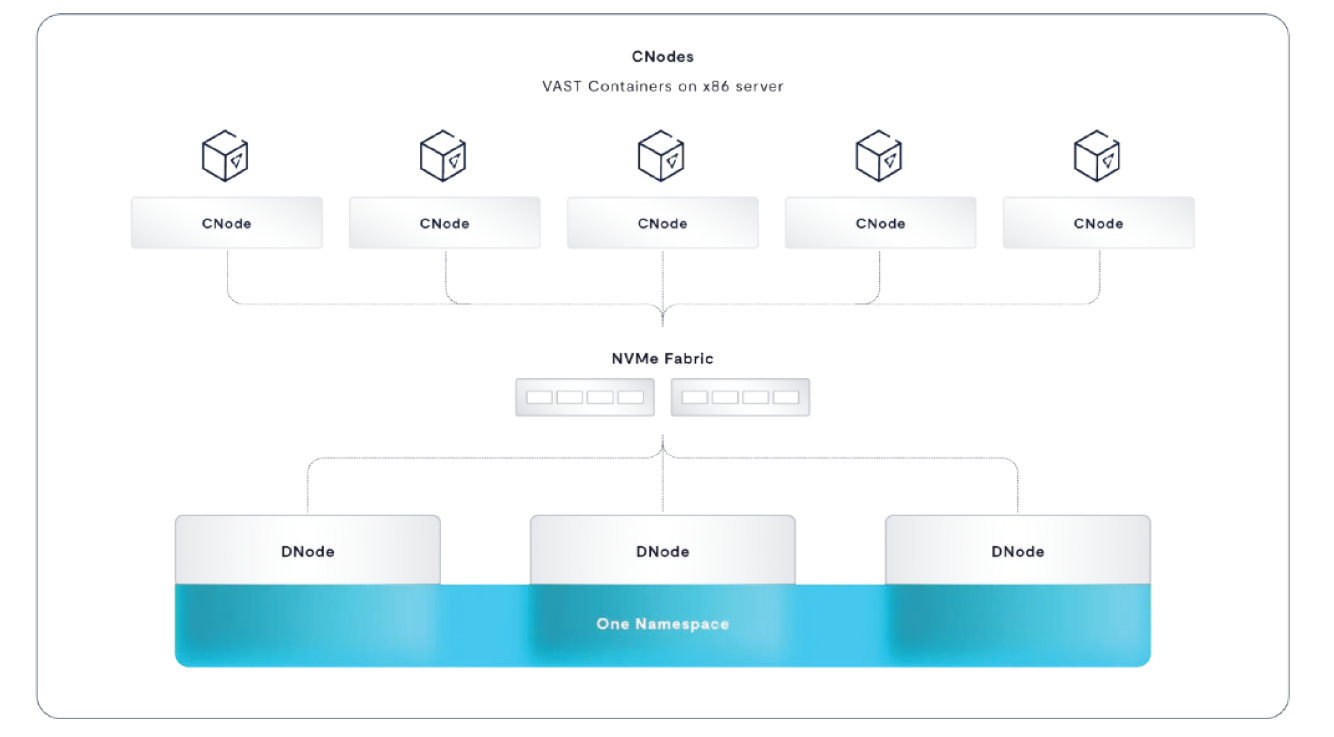
VAST Data disaggregates compute from storage using NVME-oF (Image courtesy VAST Data)
It hasn’t yet delivered the DataEngine, a key leg of its Data Platform, but customers are lining up regardless. Companies like Pixar, Zoom, and Verizon have become paying customers, as well as governmental agencies like NASA, the U.S. Air Force, and the U.S. Department of Energy.
VAST Data passed the $100 million annual recurring revenue (ARR) in early 2023 and kept right on going, hitting $200 million by the end of August, when it had surpassed $1 billion in cumulative bookings, according to CEO Hallak. When it raised $118 million in a Series E led by Fidelity in early December, VAST Data already had a valuation of $9.1 billion.
Hallak told the Wall Street Journal in December that the company has been cash-flow positive for the past 12 quarters and hasn’t used any of the cash raised in the past three rounds. “The growth is intended to stay on this exponential trajectory,” he told the WSJ.
The current trajectory also calls for an IPO at some indeterminate point in time, according to Hallak. “We are running the company today as if it’s public,” he said.
Partnerships will be key for helping the New York-based software company achieve its vast dreams. The company has established partnership platform providers, including one with Hewlett Packard Enterprise, which includes VAST on its HPE GreenLake offering. It also has partnerships with Genesis Cloud and Nvidia.
VAST Data CEO and founder Renen Hallak
Yesterday, it announced a partnership with Run:AI to deliver full-stack AI solutions. Run:AI’s software sits between the AI workload and the underlying compute resources. It helps to automate the provisioning of GPUs for AI workloads, even providing fractional GPUs, while providing full monitoring of the environment.
“Our partnership with Run:ai transcends traditional, disparate AI solutions, integrating all of the components necessary for an efficient AI pipeline,” Hallak said in the press release. “Today’s announcement offers data-intensive organizations across the globe the blueprint to deliver more efficient, effective, and innovative AI operations at scale.”
As data volumes and AI compute requirements grow with AI, mismatches between current requirements and existing system architectures are inevitable. VAST Data claims to have a radical new approach that addresses this gap, and time will tell if it’s the right one.
This story originally ran on Datanami, Enterprise AI's sister site.
Related
About the author: Alex Woodie
Alex Woodie has written about IT as a technology journalist for more than a decade. He brings extensive experience from the IBM midrange marketplace, including topics such as servers, ERP applications, programming, databases, security, high availability, storage, business intelligence, cloud, and mobile enablement. He resides in the San Diego area.
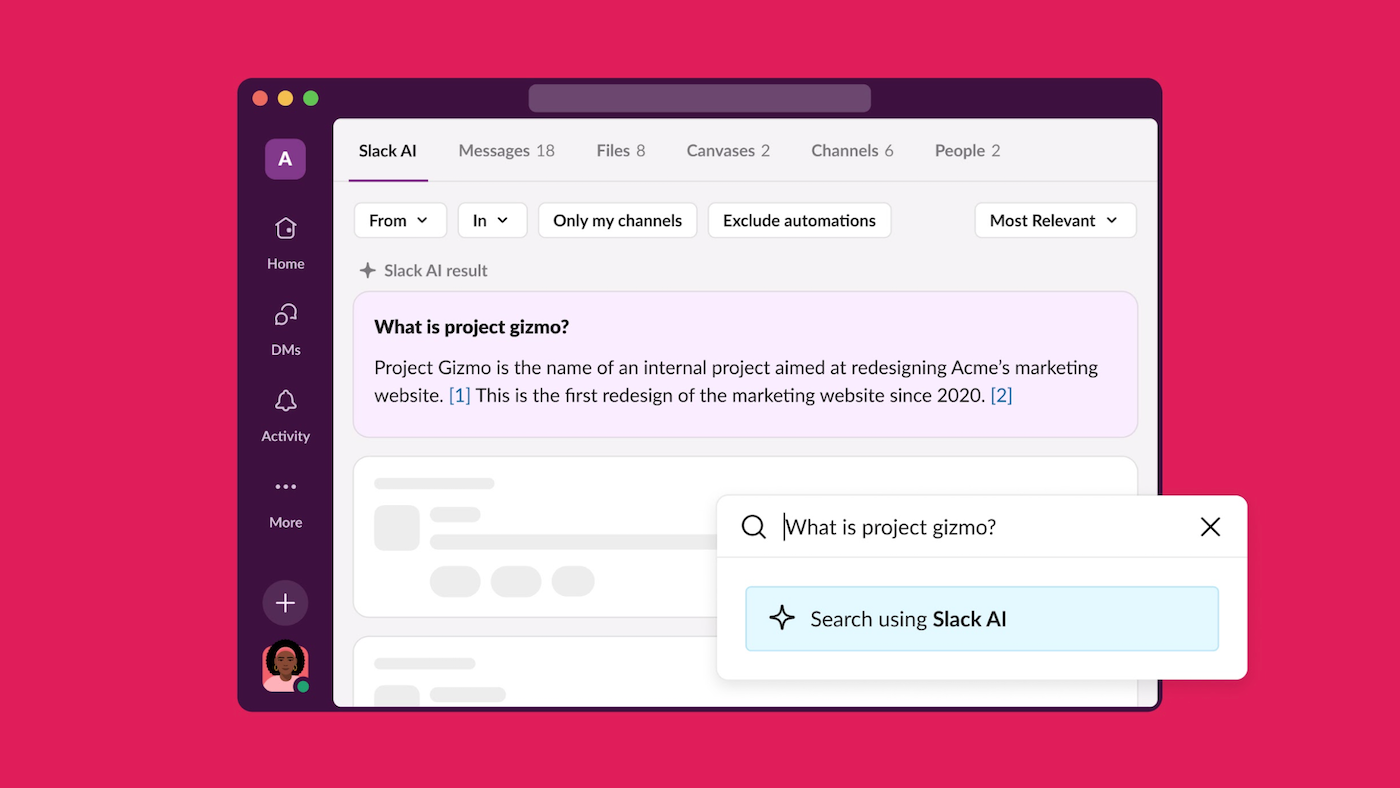
Slack announced in September 2023 its intent to add generative AI features, and today the messaging application company rolled out its AI assistance. Slack’s new generative AI features are designed to increase workers’ productivity by consolidating messages and smart searches (Figure A). For IT and cybersecurity professionals, Slack summaries can offer quick looks at incident reports or tickets before workers dive into individual incidents.
Figure A
AI-powered search in Slack. Image: Slack
Plus, Slack announced personalized channel summarization across multiple channels and Salesforce Einstein Copilot integration are coming soon. Summarization digests and Einstein Copilot integration for Salesforce CRM could increase productivity by saving time and automatically organizing information, Slack suggests.
Slack AI summarizes messages, adds flexibility to searches and more
Slack’s three AI features available starting Feb. 14 are:
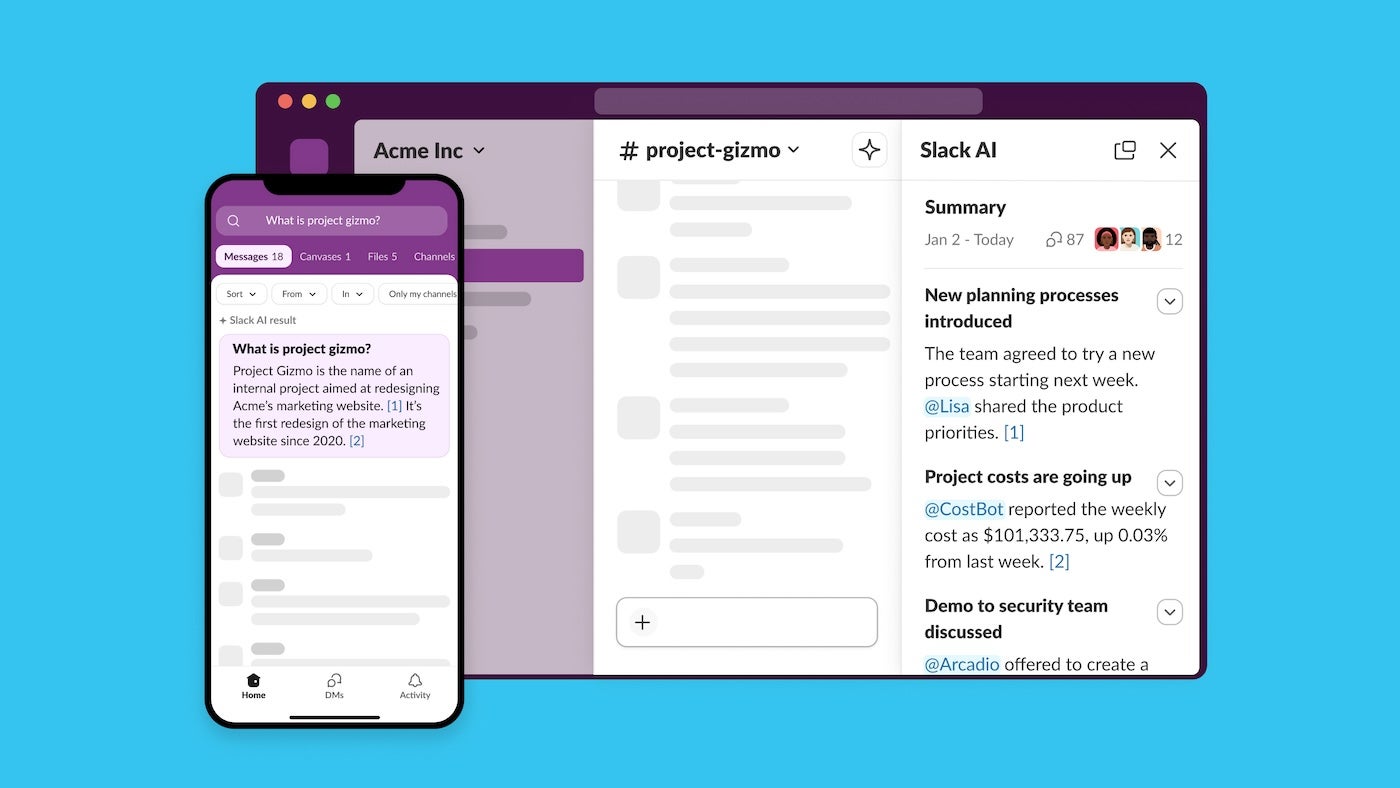
Thread summaries, which shorten long conversations and include links back to the original conversation (Figure B).
Channel recaps, which generate highlights from multiple, selected channels in a selected date range and summarize them. These are especially useful for when an employee has been away, Slack noted.
AI-powered search, which lets users ask natural language questions about Slack conversations.
Figure B
Slack AI can summarize important points from conversations. Image: Slack
The AI features run on a proprietary large language model housed within Slack. Customer data is siloed and not used to train other models.
“We’re all looking to drive ROI for our organizations,” Slack Vice President of Product Jackie Rocca told TechRepublic in a phone interview. “These features can save you time, from channel summaries to search, but they also can better equip you to make customer and business decisions. You don’t have to spend so much time being a digital detective trying to put the pieces together. You can just ask a question in real time, leverage all the knowledge in your organization, and prepare better for whatever work is thrown your way.”
In addition, Slack announced AI-powered apps from Notion and other members of Slack’s partner ecosystem. These apps are in the Slack App Directory.
How can I get Slack AI?
Slack AI is a paid add-on to the Enterprise Grid subscription; organizations will need to contact their Slack sales representatives to get an exact price. Slack expects more pricing information to be available when the AI features roll out to non-Enterprise Grid plans in the future.
Slack AI is available in U.S. and UK English only. Slack plans to expand Slack AI to languages other than English at an unspecified date.
SEE: NIST established the U.S. AI Safety Consortium in February to create standards around AI safety. (TechRepublic)
Upcoming AI features in Slack
Slack didn’t specify when more AI features might roll out, but plans for personalized digests with summaries of channels an employee may not actively follow but wants to keep an eye on and more AI-powered app integrations from Slack’s partner ecosystem are in the works.
Among those AI-powered app integrations will be Einstein Copilot, the generative AI assistant for Salesforce CRM. Einstein Copilot in Slack will be able to answer questions in Slack based on customer data securely shared with Salesforce CRM.
“Customers have found unique custom use cases just for their organizations,” said Rocca. “We really want to provide that open platform where, whether you build something in-house or whether it’s something that you’re partnering (with). Perplexity AI is coming onto Slack; Box has their AI solutions coming into Slack. So whatever tools that you’re using, we want Slack to be easy to access (and) the command center of all of your AI tools.”
Competitors to Slack with AI features
There are many competitors to Slack, including Microsoft Teams, Google’s Chat, ClickUp, Rocket.Chat and Mattermost. Here’s a brief look at the AI features offered by these Slack alternatives.
Microsoft 365 Copilot’s subscription includes generative AI features for Teams, such as meeting summaries and suggested follow-up tasks. Some of these Microsoft 365 AI features may be specific to certain subscriptions, like Teams Premium or Copilot for Sales and Service.
Google’s Gemini can integrate with Google Chat (depending on the user’s account type), providing message summarization and natural language queries.
ClickUp offers AI summarization and generative features such as changing the tone of messages or generating action items.
Rocket.Chat, an open source chat platform focused on security, does not offer built-in AI features but can access ChatGPT through app integration.
Mattermost, which is most suitable for technical and operations teams in highly-secured industries, does not offer built-in AI features but can access GPT-4 or local large language models through an AI sandbox.
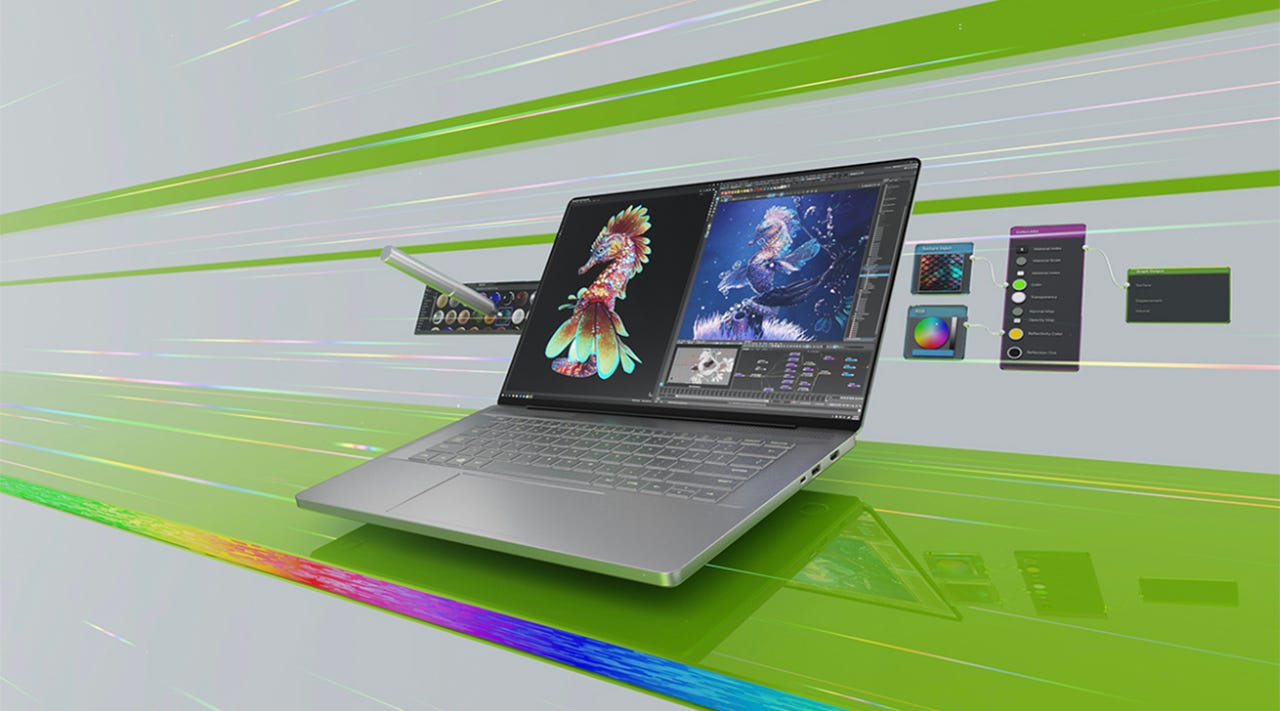
NVIDIA has released a demo version of a new AI chatbot that runs locally on certain PCs with GeForce RTX. The demo app, called Chat with RTX, is free to download and enables users to run an AI chatbot on their PCs, personalized with their content.
Also: The best AI chatbots: ChatGPT and other noteworthy alternatives
Powered by NVIDIA TensorRT-LLM software, the app can generate content and can be trained on a user selection of content, including .txt, .pdf, .doc/.docx, and .xml files and even URLs to YouTube videos.
After choosing content to train the bot, users can ask it personalized questions about the content they've supplied. For example, the bot can summarize the step-by-step instructions in a how-to video from YouTube or tell a user which type of batteries they had in their shopping list.
Training the bot on the user's preferred content makes the experience truly personalized, but the fact that it all happens locally keeps user data private. Chat with RTX can return fast responses while keeping all user information secure because it doesn't rely on cloud-based services, which means it can also run without an internet connection.
Also: ChatGPT vs. Copilot: Which AI chatbot is better for you?
The bot requires an NVIDIA GeForce RTX 30 Series GPU or higher, with at least 8 GB of VRAM. Chat with RTX also requires Windows 10 or 11 and the latest NVIDIA GPU drivers.
NVIDIA says its TensorRT-LLM software, combined with retrieval-augmented generation (RAG) and RTX acceleration, allows Chat with RTX to provide relevant answers by using local files as a dataset and connecting them to open-source LLMs like Mistral and Llama 2.
As generative AI technologies become more advanced, so do cyberattacks. That's according to Microsoft and OpenAI, who have shared research findings on the malicious use of large language models (LLMs) by nation-state-backed adversaries.
On Wednesday, Microsoft published its Cyber Signals 2024 report, which details nation-state attacks it has detected and disrupted alongside OpenAI from Russian, North Korean, Iranian, and Chinese-backed adversaries, as well as the actions that individuals and organizations can take to prepare for potential attacks.
Also: Don't tell your AI anything personal, Google warns in new Gemini privacy notice
The two tech companies tracked state-affiliated adversary attacks from Forest Blizzard, Emerald Sleet, Crimson Sandstorm, Charcoal Typhoon, and Salmon Typhoon. Each attack used LLMs to augment its cyber operations in some capacity, including assistance with research, troubleshooting, and generating content.
For example, Emerald Sleet, a North Korean threat actor, leveraged LLMs to research think tanks and experts on North Korea, generate content that would likely be used in spear-phishing campaigns, understand publicly known vulnerabilities, troubleshoot technical issues, and even assist with using various web technologies, according to the report.
Similarly, Crimson Sandstorm, an Iranian threat actor, used LLMs for technical assistance, including support in social engineering, assistance in troubleshooting errors, and more.
If you are interested in reading more about each nation-state threat, including their affiliation and their use of LLMs, you can check out the report, which includes a section dedicated to individual threat briefings.
Microsoft shares how AI-powered fraud, such as Voice Synthesis, which allows actors to train a model to sound like anyone with as short as a three-second sound bite, is an emerging and increasingly concerning threat.
Also: 5 reasons why I use Firefox when I need the most secure web browser
While the report shows generative AI is being used by malicious actors, the technology can also be used by defenders, such as Microsoft, to develop smarter protection and stay ahead in the constant cat-and-mouse chase that is cybersecurity.
Microsoft detects over 65 million cybersecurity signals every day. AI ensures those signals are analyzed for their most valuable information in helping to stop threats, according to the report.
Also: I tested iOS 17.3.1: What's inside, who needs it, and how it affected my iPhone
Microsoft also shares other ways it is using AI, including, "AI-enabled threat detection to spot changes in how resources or traffic on the network are used; behavioral analytics to detect risky sign-ins and anomalous behavior; machine learning (ML) models to detect risky sign-ins and malware; Zero Trust models where every access request must be fully authenticated, authorized, and encrypted; and device health verification before a device can connect to a corporate network."
To conclude the report, Microsoft says continued employee and public education are pivotal in combating social-engineering techniques, which are only successful if humans fail to identify them, and that prevention, whether AI-enabled or not, is key to combating all cyber threats.
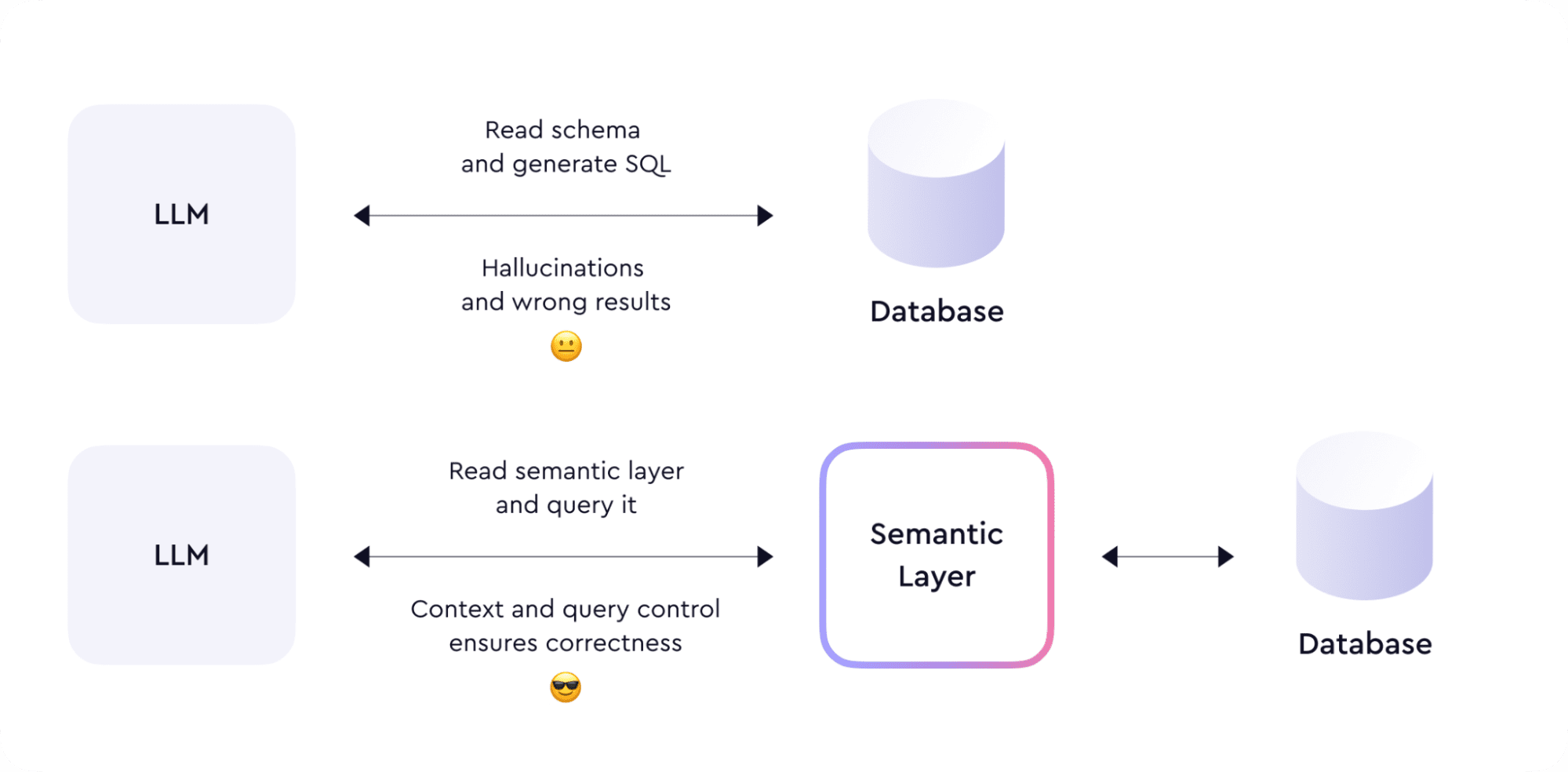
As companies look to make access to data easier for employees and external customers, more data leaders look to AI to help them. But, there remains a concern as to how to best setup AI bots and Large Language Models in order to ensure speedy access to correct data. Integrating a semantic layer with Language Learning Models (LLMs) presents a clean solution to this, particularly in the realm of AI chatbots. This combination empowers businesses to generate fast responses and reports based on their data. Leveraging AI and semantic layers is advancing business intelligence, making it easier than ever for people to interact with data.
Learn more in this recorded webinar, in which Fleet Management company Quantatec walks through the AI Bot they developed on top of the Cube semantic layer so their non-technical employees can easily asl questions of data without having to write SQL queries or build their own dashboards.
Effective Role of Semantic Layer in AI Chatbots and Data Accuracy
AI chatbots, powered by Language Learning Models (LLMs), are capable of understanding and responding to complex queries in natural language, wit high accuracy. This means that instead of having to write complex SQL queries, users can simply ask the chatbot a question in plain English and receive an accurate response. This not only makes data analysis more accessible to non-technical users, but also significantly speeds up the process of data retrieval and analysis.
While LLMs are incredibly powerful, they are not without their limitations. One of the main challenges is ensuring that the AI chatbot correctly interprets and responds to the user's query. This is where the semantic layer comes in. The semantic layer acts as an intermediary between the AI chatbot and the database, interpreting the chatbot's queries and ensuring that they are correctly executed.
The semantic layer also plays a crucial role in ensuring data security. By controlling the AI chatbot's access to the database, the semantic layer can prevent unauthorized access to sensitive data. This is particularly important in multi-tenant environments, where different users have different levels of access to the data.
In addition to enhancing data security, the semantic layer also improves the performance of the AI chatbot. The semantic layer can significantly speed up the chatbot's response time by pre-computing complex joins and calculations. This not only improves the user experience but also allows businesses to analyze their data more quickly and efficiently.
In summing up, the fusion of a semantic layer with an LLM to devise an AI chatbot is modernizing business intelligence and embedded anlaytics data application. Its power to enhance data analysis efficiency and precision significantly impacts decision-making processes, setting a new standard in business practices. It streamlines access to data analysis, bolsters efficiency, and fortifies security.
Learn more in this recorded webinar, in which Fleet Management company Quantatec walks through the AI Bot they developed on top of the Cube semantic layer so their non-technical employees can easily access data.
More On This Topic
Data Maturity: The Cornerstone of AI-Enabled Innovation
Diving into the Pool: Unraveling the Magic of CNN Pooling Layers
Using Datawig, an AWS Deep Learning Library for Missing Value Imputation
Handling Missing Values in Time-series with SQL
What’s missing from self-serve BI and what we can do about it
The Optimal Way to Input Missing Data with Pandas fillna()
Since ChatGPT launched in November 2022, AI chatbots have been the talk of the internet. ChatGPT's abilities to generate text, talk conversationally, write code, and do so much more caused huge demand for the chatbot.
Naturally, seeing ChatGPT's massive success, other companies rushed to compete in the generative AI space.
Also: The best AI chatbots: ChatGPT and other noteworthy alternatives
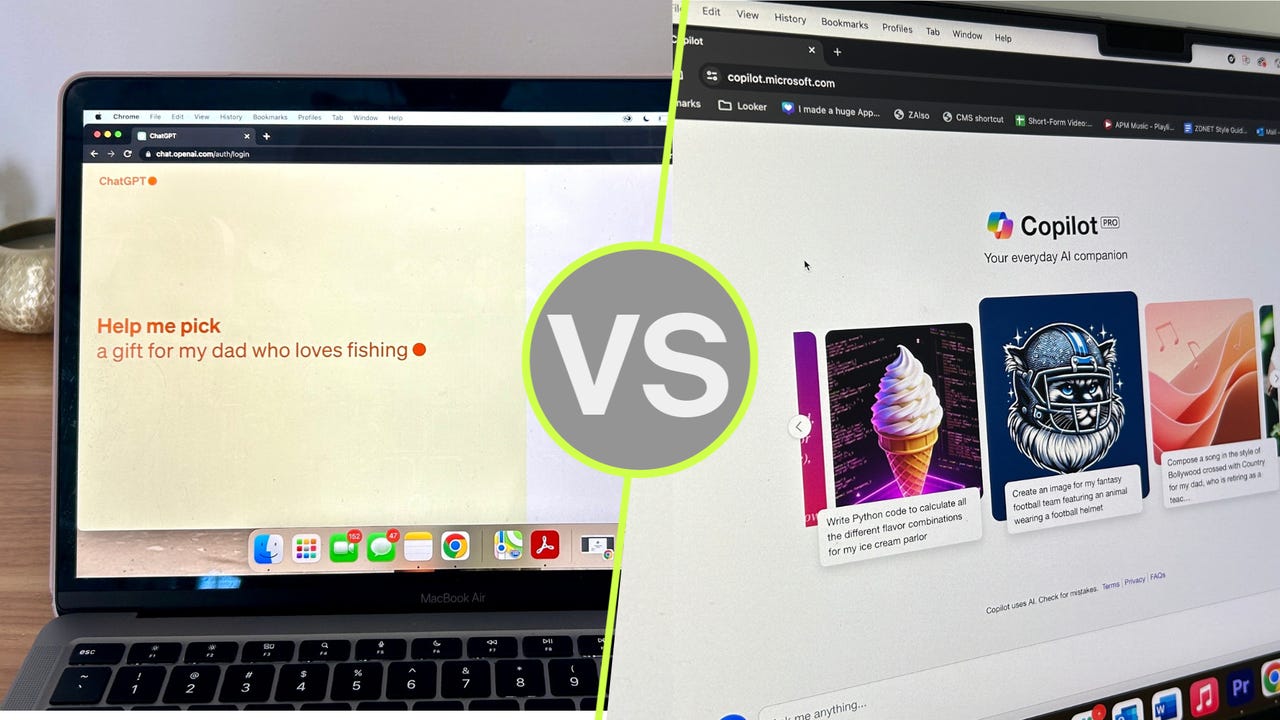
Shortly after ChatGPT's launch, Microsoft announced the integration of AI into its Bing search engine, known at the time as Bing Chat, later renamed to Copilot. Despite being designed for the same purpose, Copilot has some major differences from ChatGPT, with the biggest difference being access to the entirety of the internet for free.
So, which chatbot should you reach for? We compared ChatGPT (the free version) and Copilot to help make your decision easier.
You should use ChatGPT if…
1. You want to experience the hype for yourself
ChatGPT has been the leading AI chatbot since its launch and has served as the blueprint for the many AI chatbot spinoffs that have entered the space since.
As a result, it has the most name recognition and popularity. The hype is well deserved. ChatGPT is a very capable chatbot that can provide insight and assistance on a wide variety of topics, including technical areas such as writing and coding.
ChatGPT is currently free to use and open to everyone. Therefore, if you are curious about how an AI chatbot could benefit you, you might as well try the one that started the boom — and find out what you like and need in a chatbot assistant.
2. You want clarity on topics or events from before 2021
ChatGPT was trained on the entirety of the web before 2021. Therefore, if you have any questions about topics or events that occurred before 2021, ChatGPT will be able to provide you with a thorough, conversational response that covers all of your questions.
Also: The best AI image generators to try right now
This ability can be especially useful when you need clarity on an established topic that you are learning or researching, such as a historical event or a scientific term. ChatGPT can thoroughly explain a topic the way a tutor would. The best part is that, unlike a tutor, ChatGPT is available at all times (except when it is at capacity) and is able to answer as many questions as you'd like.
Your input prompts are also not limited to standard search engine entries but can include specific math and coding prompts, and in that case, the chatbot's knowledge base isn't a factor.
ChatGPT does offer a plug-in that allows it to search the internet for up-to-date information. However, that feature is limited to ChatGPT Plus, which costs $20 per month. Note, however, that Web searching in ChatGPT is powered by Bing (the search tool) and not Copilot (the generative AI). So when ChatGPT Plus needs to search the web, it uses Bing.
3. You want long, in-depth responses
In our testing experience, ChatGPT provides the most in-depth responses compared to competing chatbots, including Copilot.
For example, if you ask ChatGPT a loaded question such as "What is life?", the chatbot will provide you with several paragraphs explaining different aspects and interpretations of the concept.
When you plug the same question into Microsoft's chatbot, you only get a four-sentence response:
Life is a complex concept with various definitions, but generally, it's recognized as a condition that distinguishes organisms from inorganic objects and dead organisms. It's characterized by the capacity for growth, reproduction, functional activity, and continual change preceding death. Life encompasses a variety of biological processes and phenomena, including metabolism, growth, adaptation, and response to stimuli. Philosophically, life can also refer to the experience of living, the vitality and vigor that animate beings exhibit.
In addition to answering questions more thoroughly than other chatbots, ChatGPT does not have a query cap, unlike Copilot, putting no limits on your curiosity. The query cap for Copilot is unclear and when you ask the chatbot itself it says, "While I can't provide the exact number as it may vary, it's designed to ensure conversations are productive and meaningful."
No matter how many follow-up questions you have, ChatGPT will answer them all with an in-depth response.
You should use Copilot's AI-powered search if…
1. You want information on current events for free
If you have any questions relating to current events, Copilot is your go-to chatbot.
To generate an answer, Copilot indexes the entirety of the web. As a result, the chatbot has access to the latest events, stories, and research available at the very moment you ask your question.
Also: What is Copilot? Here's everything you need to know
Like ChatGPT, Copilot will provide human-like, conversational responses to answer your questions. This skill can be especially helpful in answering questions about news going on right now. We've all heard something on the news that left us with follow-up questions — and that's where Copilot can shine.
As mentioned above, Copilot is also being used to power ChatGPT search, which gives it access to current events. However, access to this feature currently requires a paid subscription to ChatGPT Plus. For that reason, Copilot's AI-powered search remains the best chatbot to get information on current events.
2. You want to confirm your sources
A big concern with using ChatGPT is that you can't confirm the accuracy of its responses since it does not provide sources for its responses.
OpenAI has admitted in the past that ChatGPT is prone to hallucinations and inaccurate responses as, after all, it is an AI model capable of making mistakes. Copilot attempts to solve that issue by providing sources.
When you ask a question in Copilot it will generate a response with footnotes that lead you back to the exact source from which it got its response. As soon as you click the footnote, you will be brought directly to the web article in another tab.
This capability is especially useful when using the chatbot for tasks where accuracy is crucial, such as a workplace or academic deliverable, research, or simply facts for an informal conversation in which you want to be sure you know what you're talking about.
Asking Copilot math-related questions will also present you with complex mathematical expressions and their markups. These equation visuals serve as sources for math as they clearly demonstrate the origin of the answer.
The citations feature is also now available on ChatGPT through the new Copilot integration. However, a paid ChatGPT Plus subscription is required.
3. You want free access to OpenAI's latest model — GPT-4
GPT-4 is the newest version of OpenAI's language model systems, more advanced and reliable than GPT-3.5, the large language model (LLM) upon which the free version of ChatGPT runs.
There are only two ways to access GPT-4: ChatGPT Plus, which costs $20/month, and Copilot, which is free.
Therefore, if you want to see what OpenAI's latest model is about without paying for it, Copilot is your only option. The day OpenAI announced its latest language model, Microsoft revealed that, since its launch, Bing AI had been running on GPT-4.
Alternatives to consider
Open to other AI chatbot prospects? There are plenty of other generative AI tools on the market that offer different strengths. Here are a few others you can try:






 About the author: Alex Woodie