Top 6 Synthesia AI Alternative in 2024

Synthesia AI Video Generator Alternatives

The global market for AI video generators, valued at $472.9 million in 2022, is projected to grow at 19.7% from 2023 to 2030. The escalating demand for video content, driven by the increasing popularity of visual environments in businesses, has resulted in approximately 80% of online traffic being attributed to videos.

In the past one-and-a-half years, we have seen several startups tapping into the space with interesting models involving video creation from diverse sources like text, PowerPoint, or spreadsheets.

London-based Synthesia was one of the early companies to offer an AI-powered platform featuring Avatars, supporting over 60 languages, a screen recorder, and templates. However, Synthesia is not the only video generation platform to have gained widespread adoption.

Let’s take a look at some of the Sythesia AI alternatives.

Best Systhesia AI Video Generator Alternatives

  • Speechify
  • Runway
  • HeyGen
  • DeepBrain AI
  • VEED
  • Colossyan

Speechify

Launched in 2020 by Cliff Weitzman, the Speechify AI video generator is designed for marketers, educators, and content creators. This tool uses AI to transform written scripts into compelling videos, eliminating the need for complex software or editing skills.

You need to input your text, select a video style (such as slideshow or whiteboard), and let Speechify’s AI handle the rest. It generates personalised visuals, incorporates AI-powered voiceovers with diverse accents, and even includes royalty-free music.

Pricing options range from a free plan with limited features to paid plans starting at $27 per month, providing longer videos, more voiceover options, and access to a vast library of stock footage. A free trial is also available for experimentation.

While Speechify excels in creating basic explainer videos and social media content, it may not be suitable for intricate narratives or highly customised projects. Users have reported occasional AI voice glitches and limitations in video style choices.

Runway

Applied AI research company Runway’s flagship tool, Gen-2, enables users to create impressive, original videos from simple text prompts. Its capabilities extend beyond text so that users can manipulate images or existing videos with over 30 AI tools through a user-friendly drag-and-drop interface.

The pricing structure accommodates both hobbyists and professionals, with a free-tier offering basic features and paid plans providing more robust tools and higher resolutions. With its interactive interface, a number of features, and commitment to responsible AI development, Runway aims to empower anyone to become a video storyteller.

HeyGen

Like other AI video generators, HeyGen also allows users to convert scripts into engaging videos but with AI-powered avatars, eliminating the need for cameras and crews. The platform offers a diverse library of customisable AI avatars, text overlays, and background images, catering to various purposes like explainer videos, corporate training, e-commerce ads, and social media content.

Users can also upload their own graphics and audio for a personalised touch. HeyGen’s pricing starts with a free plan but paid plans, such as the Pro plan at $49/month, provide access to premium avatars, extended video lengths, and additional editing options. Despite its limitations, HeyGen has gained popularity for its user-friendly interface and cost-effectiveness, attracting both businesses and individuals.

DeepBrain AI

Established in 2016 by Eric Jang, DeepBrain AI focuses on streamlining video creation through AI. The standout product, AI Studios, is an online platform enabling users to swiftly generate polished videos from text scripts. Noteworthy features include a selection of over 100 realistic AI avatars, multilingual natural speech, text-to-video conversion, content transformation from various sources, and easy editing through a drag-and-drop interface.

AI avatars use advanced text-to-speech technology to speak various languages, enabling the generation of videos for global audiences in languages such as English, Spanish, Chinese, Korean, and more. It also offers significant time and cost savings, and is up to 80% more cost-effective and faster compared to traditional video production methods.

DeepBrain AI offers diverse pricing plans, ranging from a free trial to enterprise-level subscriptions. The platform has garnered attention by democratising video creation, forming partnerships with notable companies like Microsoft, Lenovo and NVIDIA.

VEED

UK-based SaaS startup VEED.IO’s overarching mission is to democratise video creation by offering tools that are both simple and powerful. Some of the key AI powered features include a script generator, text-to-speech functionality with realistic narrators in multiple languages, an image generator to translate scripts into visuals, and a stock media library providing access to a vast collection of royalty-free video clips, images, and music tracks.

The free plan offers a taste of the platform’s capabilities with certain export limitations, while paid plans, starting at $12 per month.

Colossyan

Colossyan, started in 2020 by Dominik Kovacs, stands out as a Hungarian startup specialising in AI-driven video creation for workplace learning and development. The platform caters to organisations and educators seeking cost-effective, engaging, and multilingual AI-generated video content for training purposes.

Its main product, Colossyan Creator, offers features like text-to-video, multiple avatars for interactive scenarios, automatic translation to over 70 languages, and tools for branding and collaboration. Colossyan Creator facilitates the rapid creation of engaging training materials, product demos, and internal communications, aligning with their mission to make video creation accessible and efficient.

Pricing options include free, Starter, Pro, and Enterprise plans, with custom pricing available for high-volume users.

Popular Posts

  • ChatGPT Alternatives
  • Midjourney Alternatives
  • GitHub Copilot Alternatives
  • Google Generative AI Alternatives
  • LangChain Alternatives for Building AI Agents

The post Top 6 Synthesia AI Alternative in 2024 appeared first on Analytics India Magazine.

Large Language Models Explained in 3 Levels of Difficulty

We live in an era where the machine learning model is at its peak. Compared to decades ago, most people would never have heard about ChatGPT or Artificial Intelligence. However, those are the topics that people keep talking about. Why? Because the values given are so significant compared to the effort.

The breakthrough of AI in recent years could be attributed to many things, but one of them is the large language model (LLM). Many text generation AI people use are powered by the LLM model; For example, ChatGPT uses their GPT model. As LLM is an important topic, we should learn about it.

This article will discuss Large Language Models in 3 difficulty levels, but we will only touch on some aspects of LLMs. We would only differ in a way that allows every reader to understand what LLM is. With that in mind, let’s get into it.

Level 1: LLM Beginner Level

In the first level, we assume the reader doesn’t know about LLM and may know a little about the field of data science/machine learning. So, I would briefly introduce AI and Machine Learning before moving to the LLMs.

Artificial Intelligence is the science of developing intelligent computer programs. It’s intended for the program to perform intelligent tasks that humans could do but does not have limitations on human biological needs. Machine learning is a field in artificial intelligence focusing on data generalization studies with statistical algorithms. In a way, Machine Learning is trying to achieve Artificial Intelligence via data study so that the program can perform intelligence tasks without instruction.

Historically, the field that intersects between computer science and linguistics is called the Natural Language Processing field. The field mainly concerns any activity of machine processing to the human text, such as text documents. Previously, this field was only limited to the rule-based system but it became more with the introduction of advanced semi-supervised and unsupervised algorithms that allow the model to learn without any direction. One of the advanced models to do this is the Language Model.

The language model is a probabilistic NLP model to perform many human tasks such as translation, grammar correction, and text generation. The old form of the language model uses purely statistical approaches such as the n-gram method, where the assumption is that the probability of the next word depends only on the previous word's fixed-size data.

However, the introduction of Neural Network has dethroned the previous approach. An artificial neural network, or NN, is a computer program mimicking the human brain's neuron structure. The Neural Network approach is good to use because it can handle complex pattern recognition from the text data and handle sequential data like text. That’s why the current Language Model is usually based on NN.

Large Language Models, or LLMs, are machine learning models that learn from a huge number of data documents to perform general-purpose language generation. They are still a language model, but the huge number of parameters learned by the NN makes them considered large. In layperson's terms, the model could perform how humans write by predicting the next words from the given input words very well.

Examples of LLM tasks include language translation, machine chatbot, question answering, and many more. From any sequence of data input, the model could identify relationships between the words and generate output suitable from the instruction.

Almost all of the Generative AI products that boast something using text generation are powered by the LLMs. Big products like ChatGPT, Google’s Bard, and many more are using LLMs as the basis of their product.

Level 2: LLM Intermediate Level

The reader has data science knowledge but needs to learn more about the LLM at this level. At the very least, the reader can understand the terms used in the data field. At this level, we would dive deeper into the base architecture.

As explained previously, LLM is a Neural Network model trained on massive amounts of text data. To understand this concept further, it would be beneficial to understand how neural networks and deep learning work.

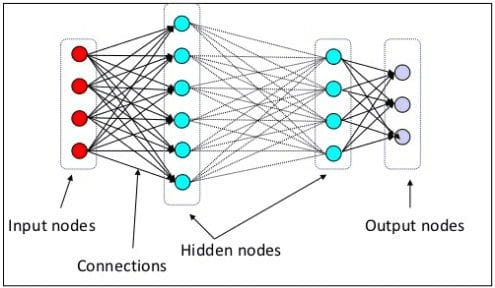
In the previous level, we explained that a neural neuron is a model miming the human brain's neural structure. The main element of the Neural Network is the neurons, often called nodes. To explain the concept better, see the typical Neural Network architecture in the image below.

Large Language Models Explained in 3 Levels of Difficulty
Neural Network Architecture(Image source: KDnuggets)

As we can see in the image above, the Neural Network consists of three layers:

  1. Input layer where it receives the information and transfers it to the other nodes in the next layer.
  2. Hidden node layers where all the computations take place.
  3. Output node layer where the computational outputs are.

It's called deep learning when we train our Neural Network model with two or more hidden layers. It’s called deep because it uses many layers in between. The advantage of deep learning models is that they automatically learn and extract features from the data that traditional machine learning models are incapable of.

In the Large Language Model, deep learning is important as the model is built upon deep neural network architectures. So, why is it called LLM? It’s because billions of layers are trained upon massive amounts of text data. The layers would produce model parameters that help the model learn complex patterns in language, including grammar, writing style, and many more.

The simplified process of the model training is shown in the image below.

Large Language Models Explained in 3 Levels of Difficulty
Image by Kumar Chandrakant (Source: Baeldung.com)

The process showed that the models could generate relevant text based on the likelihood of each word or sentence of the input data. In the LLMs, the advanced approach uses self-supervised learning and semi-supervised learning to achieve the general-purpose capability.

Self-supervised learning is a technique where we don’t have labels, and instead, the training data provides the training feedback itself. It’s used in the LLM training process as the data usually lacks labels. In LLM, one could use the surrounding context as a clue to predict the next words. In contrast, Semi-supervised learning combines the supervised and unsupervised learning concepts with a small amount of labeled data to generate new labels for a large amount of unlabeled data. Semi-supervised learning is usually used for LLMs with specific context or domain needs.

Level 3: LLM Advanced Level

In the third level, we would discuss the LLM more deeply, especially tackling the LLM structure and how it could achieve human-like generation capability.

We have discussed that LLM is based on the Neural Network model with Deep Learning techniques. The LLM has typically been built based on transformer-based architecture in recent years. The transformer is based on the multi-head attention mechanism introduced by Vaswani et al. (2017) and has been used in many LLMs.

Transformers is a model architecture that tries to solve the sequential tasks previously encountered in the RNNs and LSTMs. The old way of the Language Model was to use RNN and LSTM to process data sequentially, where the model would use every word output and loop them back so the model would not forget. However, they have problems with long-sequence data once transformers are introduced.

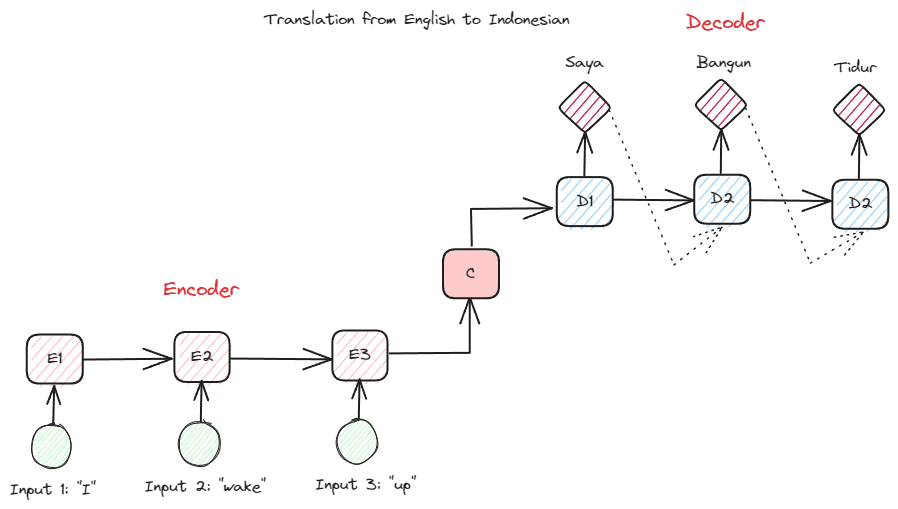
Before we go deeper into the Transformers, I want to introduce the concept of encoder-decoder that was previously used in RNNs. The encoder-decoder structure allows the input and output text to not be of the same length. The example use case is a language translation, which often has a different sequence size.

The structure can be divided into two. The first part is called Encoder, which is a part that receives data sequence and creates a new representation based on it. The representation would be used in the second part of the model, which is the decoder.

Large Language Models Explained in 3 Levels of Difficulty
Image by Author

The problem with RNN is that the model might need help remembering longer sequences, even with the encoder-decoder structure above. This is where the attention mechanism could help solve the problem, a layer that could solve long input problems. The attention mechanism is introduced in the paper by Bahdanau et al. (2014) to solve the encoder-decoder type RNNs by focusing on an important part of the model input while having the output prediction.

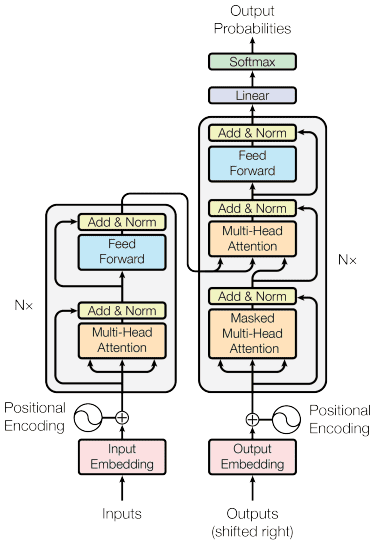
The transformer's structure is inspired by the encoder-decoder type and built with the attention mechanism techniques, so it does not need to process data in sequential order. The overall transformers model is structured like the image below.

Large Language Models Explained in 3 Levels of Difficulty
Transformers Architecture (Vaswani et al. (2017))

In the structure above, the transformers encode the data vector sequence into the word embedding while using the decoding to transform data into the original form. The encoding can assign a certain importance to the input with the attention mechanism.

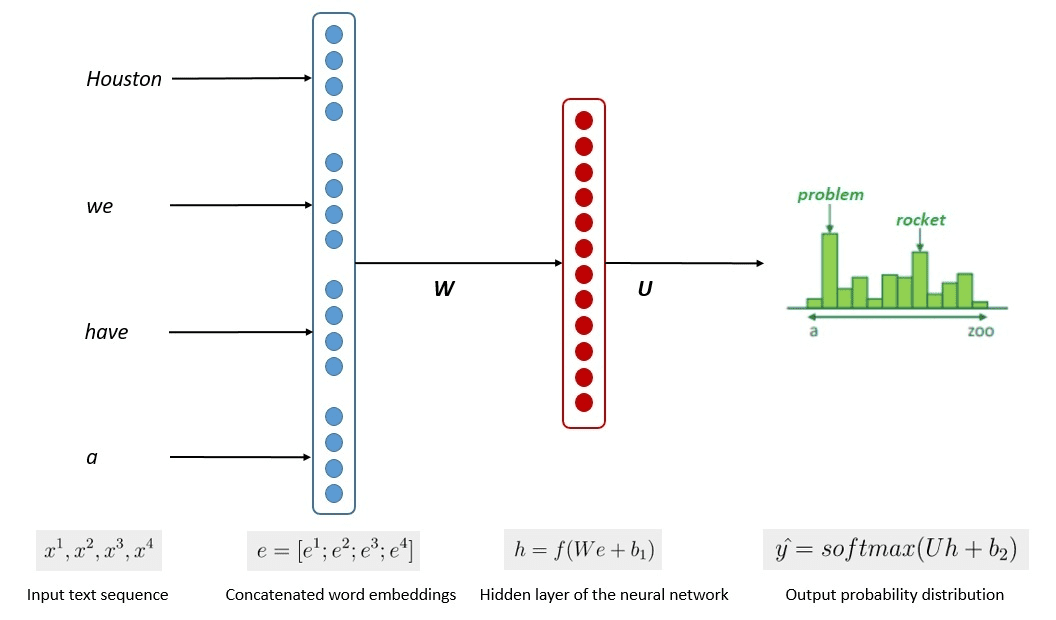
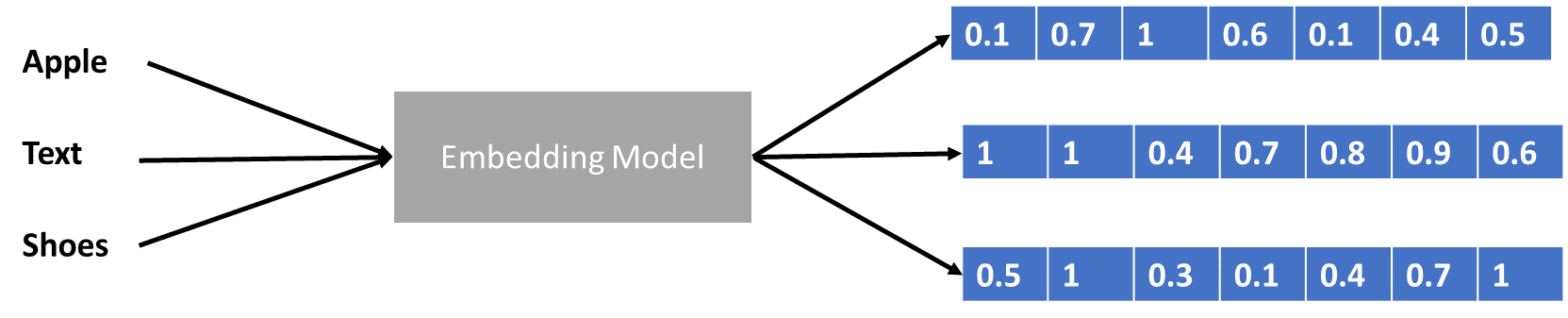
We have talked a bit about transformers encoding the data vector, but what is a data vector? Let’s discuss it. In the machine learning model, we can’t input the raw natural language data into the model, so we need to transform them into numerical forms. The transformation process is called word embedding, where each input word is processed through the word embedding model to get the data vector. We can use many initial word embeddings, such as Word2vec or GloVe, but many advanced users try to refine them using their vocabulary. In a basic form, the word embedding process can be shown in the image below.

Large Language Models Explained in 3 Levels of Difficulty
Image by Author

The transformers could accept the input and provide more relevant context by presenting the words in numerical forms like the data vector above. In the LLMs, word embeddings are usually context-dependent, generally refined upon the use cases and the intended output.

Conclusion

We discussed the Large Language Model in three difficulty levels, from beginner to advanced. From the general usage of LLM to how it is structured, you can find an explanation that explains the concept in more detail.

Cornellius Yudha Wijaya is a data science assistant manager and data writer. While working full-time at Allianz Indonesia, he loves to share Python and Data tips via social media and writing media.

More On This Topic

  • The Difficulty of Estimating the Carbon Footprint of Machine Learning
  • 311 Call Centre Performance: Rating Service Levels
  • Top Open Source Large Language Models
  • More Free Courses on Large Language Models
  • Learn About Large Language Models
  • Introducing Healthcare-Specific Large Language Models from John Snow Labs

Google makes more Gemini models available to developers

Google makes more Gemini models available to developers Frederic Lardinois @fredericl / 8 hours

Google is expanding the range of Gemini large language models it is making available to developers on its Vertex AI platform today.

Gemini 1.0 Pro (which was still known as Gemini Pro 1.0 only a week ago — because Google is very good at branding) is now generally available after being in public preview for a while. Meanwhile, Google says that Gemini 1.0 Ultra (which you may also remember under its previous guise of Gemini Ultra 1.0) is now generally available “via allowlist,” which isn’t exactly how general availability generally works.

Google also today announced Gemini 1.5 Pro (and not Gemini Pro 1.5, of course), an update to its existing Gemini Pro model that, the company says, performs at the level of Gemini 1.0 Ultra, its current flagship model. What’s maybe more important, though, is that this model can handle a context of one million tokens. That’s about 1 hour of video, 30,000 lines of code and over 700,000 words. This model, which also uses what Google describes as a “new Mixture-of-Experts approach,” is currently in private preview.

In Vertex, Google is also now adding support for adapter-based tuning, with support for techniques like reinforcement learning from human feedback and distillation coming soon. In addition, developers can now more easily augment their models with up-to-date data and for more complex workflows, they can now also call functions. This will allow developer to connect the Gemini model to external APIs.

As for other developer tools, Google calls out that it now offers access to the Gemini API from the Dart SDK so developers can easily use it in their Dart and Flutter apps. It’s also making it easier for developers to use the Gemini API with Project IDX, its experimental web-based integrated development platform, and adding integration to Firebase, its mobile development platform, in the form of an extension.

Shanghai AI Lab Develops First Version of Karpathy’s AI Operating System

Shanghai AI Lab has introduced the first version of an AI Operating System inspired by Karpathy’s innovative model. The system, named FRIDAY (Fully Responsive Intelligence, Devoted to Assisting You) is an OS-Copilot which serves as a versatile agent, developed through a combination of Python code and GPT-4 language model prompts.

Shanghai 🇨🇳 AI Lab Achieved 1st Version of Karpathy's AI Operating System
> Nov 2023: @karpathy proposes LLM OS
> Feb 2024: Chinese (+ Princeton) team proposes self learning operating system
What did they do?
> Built an agent using a mix of Python code and GPT-4 language model… pic.twitter.com/1aJaCjwPgN

— Ate-a-Pi (@8teAPi) February 14, 2024

FRIDAY takes charge of Linux or Mac OS computers, navigating through applications like browsers, Excel, and PowerPoint to perform tasks. Notably, the system possesses the ability to self-improve, utilising GPT-4 as its underlying large language model.

Comprising several key components, FRIDAY exhibits a comprehensive approach to task execution. The Planner segment efficiently decomposes user requests into manageable tasks, while the Configurator acts as middleware, incorporating data from memory or tool repositories before passing tasks to the Executor.

The Declarative Memory holds user profiles and action histories, while the Tool Repository provides a library of available tools. The Working Memory keeps track of task progress and previous history, and the Executor generates executable commands. Lastly, the Critic assesses task completion, determining success or the need for iteration.

FRIDAY outperformed GPT-4 on benchmarks for web retrieval, Excel and Powerpoint usage. Agents like FRIDAY functioning as universal user interfaces, could potentially reshape the landscape of human-computer interactions.

Meanwhile Andrej Karpathy recently left OpenAI. Karpathy confirmed his departure from OpenAI in a post on X saying that it is not because of any other reason apart from his plan to work on personal projects.

The post Shanghai AI Lab Develops First Version of Karpathy’s AI Operating System appeared first on Analytics India Magazine.
Meet తెలుగు Llama 

Last year, we curated a list of vernacular Llama-based models, among them was Telugu Llama. Back then, the model was still a work in-progress. However, it was recently made available on Hugging Face by its creators, Ravi Theja, and Ramsri Goutham Golla.

“The PR was slightly ahead of its time, so we had to catch up,” said Golla jokingly in an exclusive interview with AIM, hinting that our story served as catalyst, inspiring him to expedite the development of Telugu Llama.

Telugu Llama is a passion project for both Golla and Theja. Just last week, they introduced Telugu-LLM-Labs, a collaborative independent effort where they released datasets translated and romanised in Telugu.

Next, they intend to release the TinyLlama-1.1B-Telugu-Romanization-Base and TinyLlama-1.1B-Telugu-Romanization-Instruct models.

Hyderabad-based Golla studied and worked in the US for almost eight years before returning to India in 2018. He describes himself as a builder/engineer and loves creating SaaS apps. Golla has successfully developed two AI SaaS apps, with a combined ARR of $100K. Additionally, he takes AI courses on Udemy and his own platform.

On the other hand, Theja works as a developer advocate engineer at Llama Index. Before this role, he served as a senior ML engineer at Glance, where he worked on recommendation systems and GenAI applications.

Inspiration Behind Telugu Llama

“The end goal that Ravi and I had was to create Quora-level questions and answers,” said Golla, adding that Quora has regional pages like Hi.quora and Telugu.quora, where users engage with regional questions and answers.

Moreover, he said that open source models have caught up to the level of initial versions of OpenAI’s models, such as GPT-3.5. “So now, building something for regional languages makes sense because the quality of output matches what people expect,” he added.

Also, he underscores the need for a culturally rooted LLM. “The festivals that we celebrate, cultural norms adopted in marriage, and even religious sentiments are different. So, we need regionally rooted LLMs to provide context-specific queries and answers,” he said.

Data Collection

Telugu LLM Labs recently released two Telugu datasets – Romanised Telugu Pretraining dataset and SFT (Supervised Fine Tuning Dataset) In Telugu (native + romanised). The reason behind creating the romanised Telugu dataset is that much of the online conversations, such as WhatsApp or YouTube comments, happen in romanised Telugu. “Instead of typing “ఎలా ఉన్నారు?” (How are you?), people type “ela unnaru?” using a romanized script for most online interactions,” said Golla.

“We created these two additional datasets on top of English datasets, but with only one catch. We further filtered them with NLP classification systems to remove the rows that are ‘English language specific’ or ‘coding related’, so that the resultant dataset is cleaner and more comprehensive,” he added.

Further, they took CulturaX and romanized the first 108k rows from the culturaX_telugu dataset. “This dataset is ideal if you want to do additional pre-training for CLM (casual language model/next-word prediction) for a tiny LLM like TinyLlama 1.1B,” said Theja.

Additionally, Golla and Theja are building custom scrapers for the most-popular news websites or TV channel websites, where they collect relevant articles. “When the time and quality is right we will release that. It will be one of the biggest contributions from Telugu LLM Labs,” said Golla.

From the computing perspective, Telugu Llama received support from Jarvislabs.ai and several other GPU providers, though it primarily relied on its own computing resources.

Golla highlighted that when they launched the initiative, they were ready to work with limited computing resources, ensuring that progress wouldn’t be hindered. Theja and Golla now plan to experiment with 3 billion parameter models that will generate text in Telugu and English.

The post Meet తెలుగు Llama appeared first on Analytics India Magazine.
Around 59% of Indian Enterprises have actively deployed AI: IBM Report

New research commissioned by IBM found that about 59% of enterprise-scale organisations (over 1,000 employees) surveyed in India have AI actively in use in their businesses.

The ‘IBM Global AI Adoption Index 2023’ found early adopters are leading the way, with 74% of those Indian enterprises already working with AI, having accelerated their investments in AI in the past 24 months in areas like R&D and workforce reskilling.

While 27% of them are actively exploring the use of the technology. Moreover, the report further reveals that the top 5 barriers hindering successful AI adoption at enterprises both exploring or deploying AI are limited AI skills and expertise (30%), lack of tools/platforms for developing AI models (28%), AI projects are too complex or difficult to integrate and scale (27%), ethical concerns (26%) and too much data complexity (25%).

Ongoing challenges for AI adoption remain, including hiring employees with the right skillsets and ethical concerns, inhibiting businesses from adopting AI technologies into their operations. Therefore, in 2024 addressing these inhibitors would be a priority, like providing people with the relevant skills to work with AI and having a robust AI governance framework.

“The increase in AI adoption and investments by Indian enterprises is a good indicator that they are already experiencing the benefits from AI. However, there is still a significant opportunity to accelerate as many businesses are hesitant to move beyond experimentation and deploy AI at scale,” said Sandip Patel, Managing Director, IBM India & South Asia.

“To harness its full potential in the coming months, data and AI governance tools are going to be critical for building AI models responsibly that enterprises can trust and confidently adopt. Without the use of governance tools, AI can expose companies to data privacy issues, legal complications, and ethical dilemmas – cases of which we have already seen plaguing many across the world,” he added.

The post Around 59% of Indian Enterprises have actively deployed AI: IBM Report appeared first on Analytics India Magazine.
Amazon Demos the Largest text-to-speech AI Model,  Big Adaptive Streamable TTS with Emergent Abilities

Amazon shared BASE TTS, a text-to-speech model. It was trained on 100,000 hours of public domain speech data, mainly in English but also including German, Dutch, and Spanish, making it a new standard for natural speech.

The model uses a 1-billion-parameter Transformer and a convolution-based decoder for efficient text-to-speech conversion. This model introduces a new approach for analysing speech so as to distinguish between different voices. It also employs a technique called byte-pair encoding to reduce the size of the speech data to enhances the model’s efficiency and speed in processing and generating speech.

BASE TTS shows new or ‘emergent’ capabilities as it’s trained with more data. With over 10,000 hours of training, it understands text better, allowing it to produce speech that sounds right for the context. The model can also handle complex language features like compound nouns and emotional expressions, showing its versatility.

An example provided by the paper, ‘In the classroom, filled with the chatter of students sharing their holiday stories and the rustling of new textbooks, Mrs. Thompson, excited to embark on a new academic year, prepared a lesson that would challenge and inspire her students.’

The development of BASE TTS was developed from the idea that larger text-to-speech systems would get better with scale. BASE TTS not only has high-quality speech but also shows new skills, like pronouncing difficult texts correctly and using the right emotional tone. It performs better than other large text-to-speech systems, making it a leading model.

Another example where the audio changes the tone and whispers for the sentence, ‘A profound sense of realisation washed over Matty as he whispered, “You’ve been there for me all along, haven’t you? I never truly appreciated you until now.”’

BASE TTS could improve user experiences and help languages with few resources. It can mimic speaker characteristics with little reference audio, offering new ways to create synthetic voices for people who cannot speak. Amazon decided not to share BASE TTS openly to avoid misuse, highlighting ethical considerations in using advanced AI.

These capabilities which eluded speech models until now seems possible as demonstrated by BASE TTS. The research team also highlights the importance of diverse speech data in representing different languages, ethnicities, dialects, and genders. They call for more research on how data affects the model and ways to make voice technology more inclusive.

Another similar model is MetaVoice, an open source 1.2B parameter foundational model for TTS.

The post Amazon Demos the Largest text-to-speech AI Model, Big Adaptive Streamable TTS with Emergent Abilities appeared first on Analytics India Magazine.
Meet the Creator of Microsoft Phi-2

Meet the Creator of Microsoft Phi-2

A few days back, Microsoft released a blog on ‘Three Big AI Trends to Watch in 2024’, which highlighted the impact of small language models (SLMs) such as Orca and Phi, along with multimodal AI, and AI in science. AIM got in touch with Harkirat Behl, a senior researcher in the Physics of AGI team of Microsoft Research, who is also one of the creators of Phi-1, Phi-1.5, and Phi-2.

Behl said that his team is currently working on the next version of Phi-2 and making it more capable. “Phi-1.5 started showing great coding capabilities, Phi-2 was code with common sense abilities, and the next one would be even more capable,” he said.

Behl is also working in video generation as it is one of the newest trends catching up in the AI industry. He recently published a paper called PEEKABOO, which is focused on creating such digital content, highlighting Microsoft’s interest in multimodal AI.

How is Phi-2 better?

“One of the things that makes Phi-2 better than Meta’s Llama 2 7B and other models is that its 2.7 billion parameter size is very well suited for fitting on a phone,” said Behl. He appreciated that a lot of Indic models are currently being built on top of Llama 2 and while he acknowledged Meta’s great work on Llama 2, he also encouraged people to build on top of Phi-2.

“When GPT-3 came out, everyone, including Google, started making big models. But then began the discussions around the scaling laws and how efficient these bigger models are, giving rise to smaller language models for specific tasks,” said Behl.

He said that scaling laws are not necessarily true. “You don’t need a specific size or number of parameters for a model to get good at coding,” said Behl, saying that you do not need large models to instil intelligence. “All you need is a small amount of high quality data, aka textbook quality data.”

Citing Phi-2, Behl said that training models on synthetic data reduces the size of the model, and also brings in a lot of capabilities within them, which is different from how GPT-3 was trained. “Textbooks are written by experts in the field, unlike the internet where anybody can write and post, which is how GPT-3 is trained,” said Behl.

Calls for Indic open source moment

With smaller and open language models such as Meta’s Llama 2 and Microsoft’s Phi-2 performing on par with their larger counterparts on specific tasks and ranking on top of Open LLM Leaderboard, the conversation has completely shifted to building smaller models for specialised use cases and domains for maximum outcomes and efficiency.

“I believe that India should release its own foundational models. If there are models from China on top of the leaderboard, why aren’t there any from India?” said Behl, adding that Indian tech companies should focus on this and also partner with academic institutions to build models.

Behl emphasised that centralisation of compute would solve a lot of the issues with building models in India. “I think all IITs should come together and fund the resources. This way we would have enough resources for building a foundational model,” said Behl, giving an example of how the UK government did a similar thing for building AI capabilities.

“It is necessary to build Indic and local language models as everyone would be able to use them. At the same time, it would also be great to have an Indian model to compete on benchmarks against other countries. India should definitely do that,” emphasised Behl.

A science lover

Behl started his journey in AI from IIT Kanpur. Even before that he had worked on robotics projects and built an autonomous underwater vehicle that would recognise objects underwater. “My interest was always in computer vision, and that is when I applied for an internship at Oxford,” said Behl. He later went on to do an internship with Microsoft Research and also Google DeepMind, where he learnt a lot about safety in AI.

For almost two years, Behl focused on working on automation and how it can be democratised to everyone. “The scope is that everybody should be able to do [automation], not only machine learning experts,” said Behl. He then worked on training models that could find synthetic data automatically, which was also his focus during PhD.

Apart from working on generative AI and Microsoft, Behl is very keen to learn more about science and how AI is solving a lot of scientific problems. There are a lot of scientific problems that need solving. Behl said that Google’s AlphaFold paper for predicting protein structures was a great example of what AI can do in the scientific world.

The post Meet the Creator of Microsoft Phi-2 appeared first on Analytics India Magazine.
Nearly 75% Enterprises Pivoted to Text-Based Generative AI to Improve Operational Efficiency

According to the recent “Generative AI in CXM Survey Report” by Everest Group and WNS, 75% of enterprises are elevating their business strategies by piloting, deploying, or scaling up text-based generative AI solutions, followed by 62% for code generation and 52% for image generation.

The potential of this is widely recognised, with more than 90% of enterprises believing in the high potential of text generation, and around 70% for code and image generation. In terms of deployment, about 75% are piloting, deploying, or scaling up text generation solutions, and nearly 60% are doing the same for code generation.

Growth Drivers

The generative AI adoption in customer experience (CX) operations is driven by the need to enhance customer satisfaction and operational efficiency. Enterprises are increasingly integrating tech into CX management to personalise and customise customer interactions by understanding individual preferences and behaviors. This leads to more engaging and gratifying customer experiences.

“When generative AI tailors interactions to individual preferences, it improves operational efficiency by automating tasks and intelligent tools like agent assist and language translation. This helps improve productivity, reduces response time, and lets agents focus on value-added tasks, ultimately resulting in more satisfying customer experiences,” Sanjay Jain, chief business transformation officer, WNS, told AIM.

Furthermore, it boosts efficiency within CX operations. It equips customer support agents with intelligent tools such as agent assist, next-best-action recommendations, language translation, cross-sell, up-sell, and accent neutralisation.

Another driver is its ability to analyse vast amounts of customer data, enabling enterprises to extract meaningful insights for competitive advantage. This facilitates data-driven decision-making for strategy development, product improvements, and service enhancements.

However, 45% of enterprises report a shortage of internal technical expertise in generative AI which hinders their ability to come up with new models.

Talking about the AI talent gap, Jain said thatinvesting in strategic talent acquisition and development is crucial for maximising the potential of AI in CXM.

“Enterprises need to focus on recruiting AI and ML engineers, data scientists, and software developers, especially those with a mix of AI and software development skills to enhance teamwork and communication. Additionally, ongoing training programs are vital to ensure that current employees are upskilled,” said Jain.

He also added that AI, despite fears of job displacement, acts as an enhancer rather than a substitute for human skills. “While AI excels in accuracy and speed for execution, human critical thinking is pivotal for oversight,” added Jain, highlighting that this symbiotic relationship promises long-term benefits.

Key Findings of the Report

The survey highlights the expanding role of tools like OpenAI’s ChatGPT, Google’s Bard Gemini, and Microsoft’s Copilot in business transformation. These advancements are driving a significant shift in CXM, with generative AI’s content generation, data analysis, and insight extraction capabilities leading the way.

Key findings from the survey cover the awareness, perceived potential, and deployment areas for generative AI applications. It also covers the technology, process and enterprise readiness for foundational models.

Everest Group’s research included over 200 companies from diverse sectors such as telecom, media, BFSI, healthcare, retail, and technology, including FGT/Hi-Tech industries. These companies, predominantly from regions including Asia Pacific, have annual revenues exceeding $500 million.

Awareness and perceived potential of generative AI applications

  • Text generation capabilities: Over 75% of enterprises have high awareness.
  • Code generation capabilities: 62% awareness.
  • Image generation capabilities: 52% awareness.
  • Over 90% of enterprises believe in high potential for text generation.
  • About 70% see high potential for code and image generation capabilities.

Planned Deployment Areas

  • Text generation capabilities: About 75% of enterprises actively piloting, deploying, or scaling up solutions.
  • Code generation capabilities: Nearly 60% of enterprises have initiated pilot programs or implementation.

Readiness for Generative AI

  • Nearly 50% of enterprises are concerned about having sufficient computing power.
  • Over 70% say they have adequate cloud capabilities.
  • Approximately 40% express concerns about the availability of high-quality training data.
  • Over 60% express significant concerns regarding data security.
  • More than 45% of enterprises report a shortage of internal technical expertise.
  • Over 70% of BFSI and healthcare sectors noted regulatory compliance issues.
  • 40% identify cultural inertia as a major obstacle.
  • Only two-thirds have adequate capability for redundancy and failover measures.

Enterprise Readiness for generative AI by Industry

  • BFSI: Approximately 60% prepared across technology, people, process, and change management.
  • Healthcare: 60-70% readiness across technology, data, process, and change management.
  • Retail: Least prepared, with key challenges in computing power, training data, and talent.
  • Technology and FGT/Hi-Tech: Over 60% significantly ready across key parameters.
  • Telecom and media: Approximately 65% highly ready across favorable parameters for generative AI implementation.

Read more: Data Science Hiring Process at WNS

The post Nearly 75% Enterprises Pivoted to Text-Based Generative AI to Improve Operational Efficiency appeared first on Analytics India Magazine.

Jensen Huang & His Newfound Obsession

Jensen Huang, the CEO of the world’s third-most valued company, has been on a side quest to spread one meaningful message: Every nation, regardless of its size or resources, must develop its own ‘sovereign AI’.

The man in black has travelled over a dozen geographies, right from the Indian subcontinent to his latest stop, the UAE, for the recent World Government Summit in Dubai.

As Huang envisions it, sovereign AI isn’t just about having some fancy algorithms humming away in a server room. It’s about a fundamental shift in power, reclaiming national autonomy in generative AI. It’s about ensuring that the decisions made by AI, which will increasingly impact everything from healthcare to defence, reflect the priorities of each individual nation.

Huang is basically helping countries take control of how they can shape and build AI to fit their needs. To make sure that when AI makes decisions about things like healthcare and defence, those decisions match the values and priorities of each country. He believes AI could change not just how we live but also the character of different nations.

Money Matters

The trillion-dollar company offering graphic and digital media processors has clearly outlined plans to invest in and scale the operations of the countries Huang is visiting. Last year, NVIDIA signed several deals with those states.

In India, the company has joined hands with national conglomerates Reliance and Tata Group to build AI computing infrastructure and platforms powerful than the fastest supercomputer in India today. Interestingly, both the partnerships were announced on the same day.

Reliance will be provided with the latest tech to further develop the local infrastructure. On the other hand, TCS will upskill its 600,000-strong workforce apart from the technical aspect of the partnership. Huang’s efforts show that the AI visionary wants to help countries worldwide develop AI at the grassroot levels.

Even when he met Omar Al Olama, the Middle Eastern state’s minister of AI, Huang focused on explaining how AI can be trained on local data to protect cultural identities. “It’s not that costly; it is also not that hard,” Huang said. “The first thing that I would do, of course, is codify the language – the data of your culture into your own large language model.”

Over the past six months, the chief of the most powerful company in tech right now has also visited Canada, France, Japan, Malaysia, Singapore and Vietnam distributing similar wise words. By building locally (with NVIDIA), these nations can boost their economies while ensuring national security.

Empowering Competition

Huang’s message resonates with world leaders since large language models and other recent AI developments have kickstarted a competition not just among tech companies, but also nations. China has been ambitiously open-sourcing its contenders, India is going all in, and UAE is betting big on generative AI, too.

Other leaders in the field, too, are noticing the stark difference between generative AI and the technologies that prevailed earlier. “The thing that’s different this time”, continued Sri Elaprolu, global head of AWS Generative AI Innovation Center, “is that it has started to be hot across and not just one active geography. We’re supporting customers across all areas, including Latin America, Africa, and the Middle East — locations we normally don’t see a jump right into emerging tech.”

From nations large to small, Huang, the Midas of AI, is making sure no one is left untouched by his golden touch. His call is not merely a suggestion, but has a greater purpose of building technology from scratch without anyone being left behind.

We have seen technologies in the past get easily monopolised, causing economic disparity and even putting the security of nations at risk. But Huang wants to lay a better foundation for generative AI and is clearly (and literally) going miles to do so.

Where do you think Huang is headed next to spread the word about sovereign AI?

The post Jensen Huang & His Newfound Obsession appeared first on Analytics India Magazine.