Around 59% of Indian Enterprises have actively deployed AI: IBM Report

New research commissioned by IBM found that about 59% of enterprise-scale organisations (over 1,000 employees) surveyed in India have AI actively in use in their businesses.

The ‘IBM Global AI Adoption Index 2023’ found early adopters are leading the way, with 74% of those Indian enterprises already working with AI, having accelerated their investments in AI in the past 24 months in areas like R&D and workforce reskilling.

While 27% of them are actively exploring the use of the technology. Moreover, the report further reveals that the top 5 barriers hindering successful AI adoption at enterprises both exploring or deploying AI are limited AI skills and expertise (30%), lack of tools/platforms for developing AI models (28%), AI projects are too complex or difficult to integrate and scale (27%), ethical concerns (26%) and too much data complexity (25%).

Ongoing challenges for AI adoption remain, including hiring employees with the right skillsets and ethical concerns, inhibiting businesses from adopting AI technologies into their operations. Therefore, in 2024 addressing these inhibitors would be a priority, like providing people with the relevant skills to work with AI and having a robust AI governance framework.

“The increase in AI adoption and investments by Indian enterprises is a good indicator that they are already experiencing the benefits from AI. However, there is still a significant opportunity to accelerate as many businesses are hesitant to move beyond experimentation and deploy AI at scale,” said Sandip Patel, Managing Director, IBM India & South Asia.

“To harness its full potential in the coming months, data and AI governance tools are going to be critical for building AI models responsibly that enterprises can trust and confidently adopt. Without the use of governance tools, AI can expose companies to data privacy issues, legal complications, and ethical dilemmas – cases of which we have already seen plaguing many across the world,” he added.

The post Around 59% of Indian Enterprises have actively deployed AI: IBM Report appeared first on Analytics India Magazine.

OpenAI Releases Text to Video Generation Model, Sora 

OpenAI has released text to video generation model Sora. It can generate videos up to a minute long while maintaining visual quality and adherence to the user’s prompt.

Introducing Sora, our text-to-video model.
Sora can create videos of up to 60 seconds featuring highly detailed scenes, complex camera motion, and multiple characters with vibrant emotions. https://t.co/7j2JN27M3W
Prompt: “Beautiful, snowy… pic.twitter.com/ruTEWn87vf

— OpenAI (@OpenAI) February 15, 2024

OpenAI’s Sora is designed to understand and simulate complex scenes, featuring multiple characters, specific motions, and intricate details of the subject and background. The model not only interprets user prompts accurately but also ensures the persistence of characters and visual style throughout the generated video.

One of Sora’s standout features is its ability to take existing still images and breathe life into them, animating the content with precision and attention to detail. Additionally, it can extend or fill in missing frames in an existing video, showcasing its versatility in manipulating visual data.

Sora builds on past research in DALL·E and GPT models. It uses the recaptioning technique from DALL·E 3, which involves generating highly descriptive captions for the visual training data.

While Sora’s capabilities are impressive, OpenAI acknowledges certain weaknesses, such as challenges in accurately simulating the physics of complex scenes and occasional confusion regarding spatial details in prompts.

OpenAI is taking proactive safety measures, engaging with red teamers to assess potential harms and risks. The company is also developing tools to detect misleading content generated by Sora and plans to include metadata for better transparency.

For now will be available to red teamers and select creative professionals. The company aims to gather feedback from diverse users to refine and enhance Sora, ensuring its responsible integration into various applications.

The team behind Sora is led by Tim Brooks, a research scientist at OpenAI, Bill Peebles, also a research scientist at OpenAI, and Aditya Ramesh, the creator of DALL·E and the head of videogen.

The unveiling of Sora follows Google’s recent release of Lumiere, a text-to-video diffusion model designed to synthesise videos, creating realistic, diverse, and coherent motion. Unlike existing models, Lumiere generates entire videos in a single, consistent pass, thanks to its cutting-edge Space-Time U-Net architecture.

Google today also released Gemini 1.5. This new model outperforms ChatGPT and Claud with 1 million token context window — the largest ever seen in natural processing models. In contrast, GPT-4 Turbo has 128K context windows and Claude 2.1 has 200K context windows.

Gemini 1.5 can process vast amounts of information in one go, including 1 hour of video, 11 hours of audio, codebases with over 30,000 lines of code, or over 700,000 words.

The post OpenAI Releases Text to Video Generation Model, Sora appeared first on Analytics India Magazine.

Bulletin is a new AI-powered news reader that tackles clickbait and summarizes stories

Bulletin is a new AI-powered news reader that tackles clickbait and summarizes stories Sarah Perez @sarahintampa / 11 hours

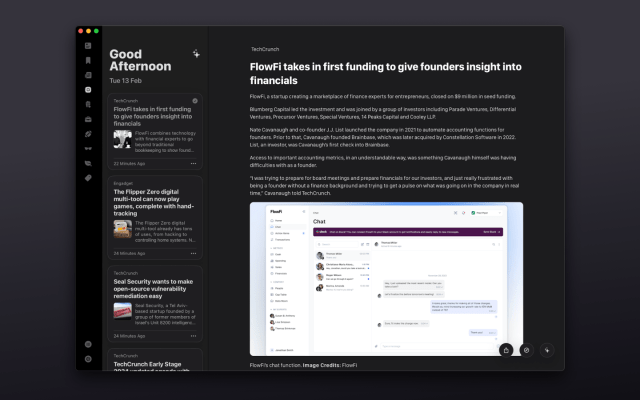
After the shutdown of the buzzy AI news app Artifact from Instagram’s founders, a new app called Bulletin is also now turning to AI to help remove clickbait and summarize the day’s news. Except in this case, users can customize news sources the app features, as you could in any other RSS reader, instead of relying on a curated selection of news, as Artifact did. The AI integration, meanwhile, helps to remove clickbait headlines from your news-reading experience. Plus, with a click of a button, you can access a summary of either the article or even all articles in the feed.

Bulletin was created by developer Shihab Mehboob, a prolific indie developer who recently sold his Mastodon client Mammoth to Mozilla. Notes Mehboob, the app works across Apple devices, including iPhone, iPad, Mac, Apple Watch and even Apple Vision Pro. (An Apple TV version is also coming shortly after launch).

Image Credits: Bulletin/Shihab Mehboob

Getting started with the news app is simple as it comes with a default set of feeds for different categories of news, including World News, Technology, Entertainment, Business, Sports, Fashion, and more. However, you can customize this experience if you choose, by adding or removing feeds from the app’s settings to make it your own.

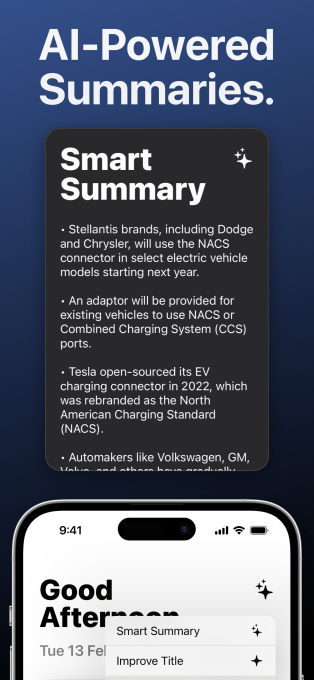
As you browse the sections, you can opt to improve the titles of news posts using AI — a feature designed to help combat clickbait titles — as well as tap on the “Smart Summary” option to have a ChatGPT-style quick summary of the article’s main points. Mehboob says he’s using OpenAI’s GPT to handle the AI components.

Image Credits: Bulletin/Shihab Mehboob

These options recall some of Artifact’s best features, in that it also offered a variety of AI-powered news summaries, including those in a range of styles, like “explain like I’m five,” or for fun, in Gen Z speak, or using only emojis, among others. Bulletin doesn’t go quite that far, though it does offer an “explain like I’m five” alternative to the default summary style, for those news stories that are more complex, perhaps. Helpfully, it can translate summaries into your local language and offers a native “copy summary” button so you can save or share the news in another app.

Not all headlines benefit from the “Improve Title” clickbait removal option, but in some cases, it can be useful. For instance, a Kotaku article titled “The Most Ambitious Space Game Ever Made Is Free This Weekend,” is retitled to the more accurate and complete “No Man’s Sky offers free weekend trial with Omega update.”

Within each news section, you can also get caught up quickly by tapping the AI button at the top right of the screen, whose starlight-shaped icons resemble those used by Google’s Gemini. After tapping, the AI Smart Summary will pop up overlaid on your screen offering a bulleted list of the top news from that section.

Image Credits: Bulletin/Shihab Mehboob

In Bulletin’s settings, you can toggle off the news categories you don’t want to browse, as well as the individual news sources the app includes by default. This also helps you to customize the app’s For You feed, which offers articles from across all sections. But what makes the app handy for power users and heavy news consumers is that you can add any other website that offers an RSS feed to the app, too.

Image Credits: Bulletin/Shihab Mehboob

One quibble with this feature is that you can’t just add the website URL as you can in other RSS readers like Feedly, in order to have the app auto-discover the associated RSS feed. Instead, you’ll need to copy and paste the complete RSS feed’s URL into the box provided. This could present a challenge since many websites today no longer bother featuring the orange RSS icon that directs you to their feed, as RSS has fallen out of fashion. Instead, you often have to discover the RSS feed on your own using a browser plug-in or an RSS reader that can figure out the correct feed for you.

A clever feature is the option to use iOS’s Live Activities to put a news ticker on your Lock Screen (but you can turn this off, if desired.)

Further down the road, Mehboob wants to add support for following social network updates in the app, similar to Tapestry, the new app in development from The Iconfactory, which combines RSS feeds, news alerts, and social networks into one interface. Bulletin’s developer tells TechCrunch that Mastodon and Bluesky would “most likely” be his first candidates once he heads in this direction, but didn’t share a timeframe.

Bulletin is free to use but the AI features are not. The anti-clickbait option and the ability to view unlimited AI summaries only come with paid plans, starting at $3.99 per month. A $14.99 per year and a $44.99 lifetime option are also available.

Google Gemini 1.5 Crushes ChatGPT and Claude with Largest-Ever 1 Mn Token Context Window

Google today released Gemini 1.5. This new model outperforms ChatGPT and Claud with 1 million token context window — the largest ever seen in natural processing models.

“We’ve been able to significantly increase the amount of information our models can process — running up to 1 million tokens consistently, achieving the longest context window of any large-scale foundation model yet.,” reads the blog, co-authored by Google chief Sundar Pichai and Google DeepMind chief Demis Hassabis, comparing it with existing models like ChatGPT and Claude.

Gemini 1.5 Pro comes with a standard 128,000 token context window. But starting today, a limited group of developers and enterprise customers can try it with a context window of up to 1 million tokens via AI Studio and Vertex AI in private preview.

It can process vast amounts of information in one go, including 1 hour of video, 11 hours of audio, codebases with over 30,000 lines of code, or over 700,000 words. In their research, Google also successfully tested up to 10 million tokens.

Gemini 1.5 is built upon Transformer and MoE architecture. While a traditional Transformer functions as one large neural network, MoE models are divided into smaller “expert” neural networks.

Gemini 1.5 Pro’s capabilities span various modalities, from analysing lengthy transcripts of historical events, such as those from Apollo 11’s mission, to understanding and reasoning about a silent movie. The model’s proficiency in processing extensive code further establishes its relevance in complex problem-solving tasks, showcasing its adaptability and efficiency.

Gemini 1.5 Pro’s performance in the Needle In A Haystack (NIAH) evaluation stands out, where it excels at locating specific facts within long blocks of text, achieving a remarkable 99% success rate. Its ability to learn in-context, demonstrated in the Machine Translation from One Book (MTOB) benchmark, solidifies Gemini 1.5 Pro as a frontrunner in adaptive learning.

This new development comes after Google released the first version of Gemini Ultra just last week.

The post Google Gemini 1.5 Crushes ChatGPT and Claude with Largest-Ever 1 Mn Token Context Window appeared first on Analytics India Magazine.

Meet Gemini 1.5, Google’s newest AI model with major upgrades from its predecessor

press-kit-gemini-lockup-16-9.png

Just last week, Google had some major news, rebranding Google Bard to Gemini, unveiling a Gemini app, known as Gemini Advanced, and revealing a new premium AI plan. Continuing its hot streak of news, Google has announced yet another AI development — a new AI model.

On Thursday, Google unveiled its next-generation model, Gemini 1.5. Even though Gemini 1.0 just launched in December, the new model boasts massive upgrades from its predecessor, including a longer context window, better understanding, and an overall enhanced performance.

Also: Nvidia's new AI chatbot runs locally on your PC, and it's free

The model is so advanced that Google CEO Sundar Pichai said that 1.5 Pro, the first Gemini 1.5 model that Google is releasing for early testing, achieves comparable quality to 1.0 Ultra, the company's most advanced large language model (LLM), which was announced last week, while using less compute.

"Longer context windows show us the promise of what is possible," Pichai added. "They will enable entirely new capabilities and help developers build much more useful models and applications."

To achieve this enhanced performance, Gemini 1.5 has been built on a new version of Mixture-of-Experts (MoE) architecture, which allows the model to learn and selectively activate the most relevant pathways in its neural network, increasing efficiency, according to the press release.

Also: Microsoft and OpenAI detect and disrupt nation-state cyber threats that use AI, report shows

Google claims that Gemini 1.5 Pro can run up to one million tokens in production, a massive increase from the original 32,00 tokens for Gemini 1.0. This rise is noteworthy because the model context window, the amount of information it can take in, is made up of tokens. Therefore, the more tokens a model can take in, the more likely its responses are to be better and more informed.

Google says 1.5 Pro can process vast amounts of information in one sitting, "including up to 1 hour of video, 11 hours of audio, and codebases with over 30,000 lines of code or over 700,000 words."

Also: The best AI image generators to try right now

In a demo, Google provided 1.5 Pro with a 44-minute silent Buster Keaton movie, which the model could quickly process and then answer all sorts of questions, including multimodal queries, as seen in the video below.

The model also performed impressively against benchmarks. It outperformed 1.0 Pro in 87% of the benchmarks Google uses to develop its LLMs. Gemini 1.5 Pro also performed stellarly in the Needle In A Haystack (NIAH) evaluation and Machine Translation from One Book (MTOB) benchmarks, which test the model's acuity and learning abilities.

Also: Slack's AI features are finally here, including channel recaps, thread summaries, and more

To reassure users about the safety of Gemini 1.5 Pro, Google says that it has conducted extensive evaluations to ensure the safe and responsible deployment of this advanced model.

Google is releasing 1.5 Pro with a one million token context window in a limited preview to developers and enterprise customers, via AI Studio and Vertex AI, at no cost. Once the model is ready for wider release, Google plans to introduce 1.5 Pro with pricing tiers that start at the standard 128,000 token context window and that go up to one million tokens.

Guardrails AI wants to crowdsource fixes for GenAI model problems

Guardrails AI wants to crowdsource fixes for GenAI model problems Kyle Wiggers 8 hours

It doesn’t take much to get GenAI spouting mistruths and untruths.

This past week provided an example, with Microsoft’s and Google’s chatbots declaring a Super Bowl winner before the game even started. The real problems start, though, when GenAI’s hallucinations get harmful — endorsing torture, reinforcing ethnic and racial stereotypes and writing persuasively about conspiracy theories.

An increasing number of vendors, from incumbents like Nvidia and Salesforce to startups like CalypsoAI, offer products they claim can mitigate unwanted, toxic content from GenAI. But they’re black boxes; short of testing each independently, it’s impossible to know how these hallucination-fighting products compare — and whether they actually deliver on the claims.

Shreya Rajpal saw this as a major problem — and founded a company, Guardrails AI, to attempt to solve it.

“Most organizations … are struggling with the same set of problems around responsibly deploying AI applications and struggling to figure out what’s the best and most efficient solution,” Rajpal told TechCrunch in an email interview. “They often end up reinventing the wheel in terms of managing the set of risks that are important to them.”

To Rajpal’s point, surveys suggest complexity — and by extension risk — is a top barrier standing in the way of organizations embracing GenAI.

A recent poll from Intel subsidiary Cnvrg.io found that compliance and privacy, reliability, the high cost of implementation and a lack of technical skills were concerns shared by around a fourth of companies implementing GenAI apps. In a separate survey from Riskonnect, a risk management software provider, over half of execs said that they were worried about employees making decisions based on inaccurate information from GenAI tools.

Rajpal, who previously worked at self-driving startup Drive.ai and, after Apple’s acquisition of Drive.ai, in Apple’s special projects group, co-founded Guardrails with Diego Oppenheimer, Safeer Mohiuddin and Zayd Simjee. Oppenheimer formerly led Algorithmia, a machine learning operations platform, while Mohiuddin and Simjee held tech and engineering lead roles at AWS.

In some ways, what Guardrails offers isn’t all that different from what’s already on the market. The startup’s platform acts as a wrapper around GenAI models, specifically open source and proprietary (e.g. OpenAI’s GPT-4) text-generating models, to make those models ostensibly more trustworthy, reliable and secure.

Guardrails AI

Image Credits: Guardrails AI

But where Guardrails differs is its open source business model — the platform’s codebase is available on GitHub, free to use — and crowdsourced approach.

Through a marketplace called the Guardrails Hub, Guardrails lets developers submit modular components called “validators” that probe GenAI models for certain behavioral, compliance and performance metrics. Validators can be deployed, repurposed and reused by other devs and Guardrails customers, serving as the building blocks for custom GenAI model-moderating solutions.

“With the Hub, our goal is to create an open forum to share knowledge and find the most effective way to [further] AI adoption — but also to build a set of reusable guardrails that any organization can adopt,” Rajpal said.

Validators in the Guardrails Hub range from simple rule-based checks to algorithms to detect and mitigate issues in models. There’s about 50 at present, ranging from hallucination and policy violations detector to filters for proprietary information and insecure code.

“Most companies will do broad, one-size-fits-all checks for profanity, personally identifiable information and so on,” Rajpal said. “However, there’s no one, universal definition of what constitutes acceptable use for a specific organization and team. There’s org-specific risks that need to be tracked — for example, comms policies across organizations are different. With the Hub, we enable people to use the solutions we provide out of the box, or use them to get a strong starting point solution that they can further customize for their particular needs.”

A hub for model guardrails is an intriguing idea. But the skeptic in me wonders whether devs will bother contributing to a platform — and a nascent one at that — without the promise of some form of compensation.

Rajpal is of the optimistic opinion that they will, if for no other reason than recognition — and selflessly helping the industry build toward “safer” GenAI.

“The Hub allows developers to see the types of risks other enterprises are encountering and the guardrails they’re putting in place to solve for and mitigate those risks,” she added. “The validators are an open source implementation of those guardrails that orgs can apply to their use cases.”

Guardrails AI, which isn’t yet charging for any services or software, recently raised $7.5 million in a seed round led by Zetta Venture Partners with participation from Factory, Pear VC, Bloomberg Beta, Github Fund and angles including renowned AI expert Ian Goodfellow. Rajpal says the proceeds will be put toward expanding Guardrails’ six-person team and additional open source projects.

“We talk to so many people — enterprises, small startups and individual developers — who are stuck on being able ship GenAI applications because of lack of assurance and risk mitigation needed,” she continued. “This is a novel problem that hasn’t existed at this scale, because of the advent of ChatGPT and foundation models everywhere. We want to be the ones to solve this problem.”

Revolutionizing CXM: Insights from Everest Group’s Generative AI in CXM Survey Report supported by WNS

The integration of generative AI into Customer Experience Management (CXM) is heralding a new era of digital transformation. Everest Group's extensive report, “Generative AI in CXM: Assessing Enterprise Readiness for this Disruptive Transformation,” led by industry experts Shirley Hung, Sharang Sharma, Divya Baweja, and Mohit Kumar, provides a deep dive into the readiness of enterprises for this shift.

Understanding and Potential of Generative AI in CXM

The report begins by highlighting the rapid development of generative AI technologies, such as OpenAI’s ChatGPT, Google's AI solution Bard Gemini, and Microsoft’s Copilot. These advancements have piqued the interest of enterprises in their potential to revolutionize CXM operations. The findings show that over 75% of enterprises are well-aware of generative AI’s capabilities in text generation, with code generation and image generation also recognized by a significant margin.

Key Drivers and Deployment Areas

One of the report's key insights is the identification of major drivers for generative AI adoption in CXM. Enterprises are increasingly leaning on generative AI to enhance customer satisfaction through personalized interactions. Generative AI is also seen as a vital tool for improving operational efficiency in CXM, with applications in areas such as agent assist, language translation, and sentiment analysis.

The report notes a strategic shift towards deploying gen AI in various CXM operations, including internal IT and HR support, customer support on non-voice and voice channels, and data and analytics.

Challenges in Adoption and Enterprise Readiness

Despite the optimism, the report underscores several challenges hindering generative AI adoption. These include technological infrastructure constraints, data privacy and security concerns, and the lack of adequate talent. Moreover, cultural inertia and regulatory ambiguity further complicate the adoption process.

To assess enterprise readiness, the Everest Group surveyed 200 companies across North America, UK and Europe, and Asia Pacific. The survey reveals a mixed picture of readiness across industries, with telecom & media appearing most prepared for generative AI adoption, followed by BFSI, healthcare, retail, and technology sectors.

Investment and Deployment Roadmap

Enterprises are strategically investing in generative AI initiatives, engaging in pilot projects, and emphasizing workforce upskilling. The report highlights how leading companies like Morgan Stanley and AT&T are utilizing gen AI for internal operations, while others like Expedia Group and Sephora are leveraging it for customer-centric solutions.

The decision-making process regarding in-house development versus outsourcing gen AI solutions is also discussed. The report indicates that nearly 60% of enterprises seek third-party support for technical and strategic aspects of gen AI implementation.

Data, Technology, and People Preparedness

The report extensively covers readiness in technology, data, and human resources. In terms of technology, concerns like computing power and scalability are highlighted. Data readiness emphasizes the importance of high-quality training data, while concerns about data privacy and security are also raised.

The people aspect underlines the need for skilled AI/ML engineers, data scientists, and software developers. The report notes that less than half of the surveyed enterprises feel prepared in these technical domains, highlighting a significant talent gap.

Concluding Insights

Key insights include the following:

  • At least half of the surveyed enterprises believe they are ready for generative AI implementation.
  • More than 45% of enterprises say a shortage of internal technical expertise is the foremost challenge in the people part of generative AI solution implementation.
  • Approximately 95% of telecom & media, technology & FGT, and retail organizations, along with over 80% of organizations in BFSI, recognize the transformative potential of generative AI's text generation capabilities for CXM operations.
  • AI adoption readiness varies significantly among industries across technology readiness, data preparedness, people readiness, process readiness, change management, and previous experience with transformative technologies.
  • Telecom & media leads in preparedness for generative AI adoption, with approximately 65% of surveyed enterprises being highly ready across parameters favorable for gen AI implementation.
  • Over 70% of surveyed enterprises from the BFSI and healthcare sectors noted regulatory compliance issues with generative AI as potential challenges to their ability to adopt the technology.

Everest Group's report concludes by emphasizing the transformative potential of generative AI in CXM. However, it also cautions enterprises to be mindful of the challenges and to invest strategically in technology, talent, and data to harness the full potential of gen AI.

This report serves as a crucial guide for enterprises looking to navigate the complex landscape of gen AI in CXM, offering valuable insights into readiness, challenges, and strategic directions for successful implementation.

We recommend a deep dive into the report to learn more.

Meet తెలుగు Llama 

Last year, we curated a list of vernacular Llama-based models, among them was Telugu Llama. Back then, the model was still a work in-progress. However, it was recently made available on Hugging Face by its creators, Ravi Theja, and Ramsri Goutham Golla.

“The PR was slightly ahead of its time, so we had to catch up,” said Golla jokingly in an exclusive interview with AIM, hinting that our story served as catalyst, inspiring him to expedite the development of Telugu Llama.

Telugu Llama is a passion project for both Golla and Theja. Just last week, they introduced Telugu-LLM-Labs, a collaborative independent effort where they released datasets translated and romanised in Telugu.

Next, they intend to release the TinyLlama-1.1B-Telugu-Romanization-Base and TinyLlama-1.1B-Telugu-Romanization-Instruct models.

Hyderabad-based Golla studied and worked in the US for almost eight years before returning to India in 2018. He describes himself as a builder/engineer and loves creating SaaS apps. Golla has successfully developed two AI SaaS apps, with a combined ARR of $100K. Additionally, he takes AI courses on Udemy and his own platform.

On the other hand, Theja works as a developer advocate engineer at Llama Index. Before this role, he served as a senior ML engineer at Glance, where he worked on recommendation systems and GenAI applications.

Inspiration Behind Telugu Llama

“The end goal that Ravi and I had was to create Quora-level questions and answers,” said Golla, adding that Quora has regional pages like Hi.quora and Telugu.quora, where users engage with regional questions and answers.

Moreover, he said that open source models have caught up to the level of initial versions of OpenAI’s models, such as GPT-3.5. “So now, building something for regional languages makes sense because the quality of output matches what people expect,” he added.

Also, he underscores the need for a culturally rooted LLM. “The festivals that we celebrate, cultural norms adopted in marriage, and even religious sentiments are different. So, we need regionally rooted LLMs to provide context-specific queries and answers,” he said.

Data Collection

Telugu LLM Labs recently released two Telugu datasets – Romanised Telugu Pretraining dataset and SFT (Supervised Fine Tuning Dataset) In Telugu (native + romanised). The reason behind creating the romanised Telugu dataset is that much of the online conversations, such as WhatsApp or YouTube comments, happen in romanised Telugu. “Instead of typing “ఎలా ఉన్నారు?” (How are you?), people type “ela unnaru?” using a romanized script for most online interactions,” said Golla.

“We created these two additional datasets on top of English datasets, but with only one catch. We further filtered them with NLP classification systems to remove the rows that are ‘English language specific’ or ‘coding related’, so that the resultant dataset is cleaner and more comprehensive,” he added.

Further, they took CulturaX and romanized the first 108k rows from the culturaX_telugu dataset. “This dataset is ideal if you want to do additional pre-training for CLM (casual language model/next-word prediction) for a tiny LLM like TinyLlama 1.1B,” said Theja.

Additionally, Golla and Theja are building custom scrapers for the most-popular news websites or TV channel websites, where they collect relevant articles. “When the time and quality is right we will release that. It will be one of the biggest contributions from Telugu LLM Labs,” said Golla.

From the computing perspective, Telugu Llama received support from Jarvislabs.ai and several other GPU providers, though it primarily relied on its own computing resources.

Golla highlighted that when they launched the initiative, they were ready to work with limited computing resources, ensuring that progress wouldn’t be hindered. Theja and Golla now plan to experiment with 3 billion parameter models that will generate text in Telugu and English.

The post Meet తెలుగు Llama appeared first on Analytics India Magazine.

Jupyter Notebook Magic Methods Cheat Sheet

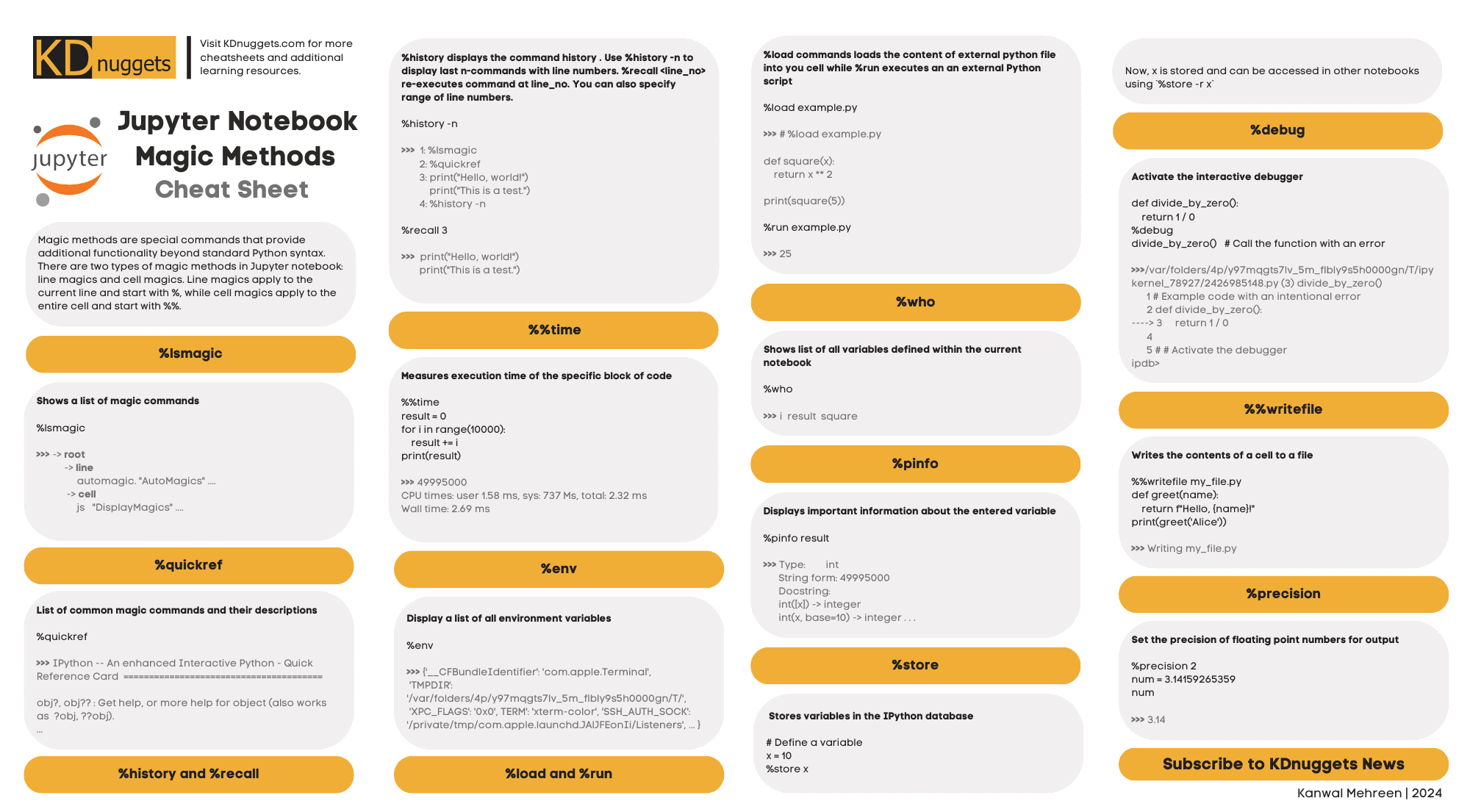
After a period of anticipation, KDnuggets is excited to release a new cheat sheet for our community, this time spotlighting the indispensable Jupyter Notebook magic commands. These commands are integral for elevating efficiency in Jupyter Notebooks, a preferred environment for many data scientists and analysts. Magic commands are special instructions that expand upon the default capabilities of Python, offering both line magics, which operate on a single line of code, and cell magics, which apply to a whole cell within the notebook.

The utility of these magic commands lies in their ability to simplify complex tasks, thereby streamlining the workflow for professionals engaged in data science and analytics. They facilitate advanced data manipulation and analytical techniques, requiring less code and offering more power to the user. This cheat sheet is designed as a toolkit to enhance productivity, providing quick access to a variety of functionalities, from environmental variable management with %env, to performance optimization through timing execution with %%time, and even interactive debugging with %debug. By integrating these magic commands into their daily tasks, users can achieve a significantly more efficient and effective coding experience in Jupyter Notebooks.

Jupyter Notebook Magic Methods Cheat Sheet

The cheat sheet encompasses a wide array of magic commands, including the following:

  • %lsmagic: Shows a list of all available magic commands.
  • %history -n: Displays the last n commands with their line numbers.
  • %%time: Measures the execution time of a code block.
  • %quickref: Provides a quick reference of common magic commands and their descriptions.
  • %env: Displays a list of all environment variables.
  • %load and %run: Load and execute external Python scripts, respectively.
  • %debug: Activates the interactive debugger for error analysis.

Magic methods are special commands that provide additional functionality beyond standard Python syntax. There are two types of magic methods in Jupyter notebook: line magics and cell magics. Line magics apply to the current line and start with %, while cell magics apply to the entire cell and start with %%.

This resource serves as a comprehensive reference to utilizing magic methods effectively, improving coding practices within Jupyter Notebooks.

For more on Jupyter Notebook magic methods, check out our latest cheat sheet now, and don't forget to check back soon for more.

More On This Topic

  • How to Setup Julia on Jupyter Notebook
  • 10 Jupyter Notebook Tips and Tricks for Data Scientists
  • 11 Python Magic Methods Every Programmer Should Know
  • Data Science Cheat Sheet 2.0
  • The KDnuggets 2023 Cheat Sheet Collection
  • The ChatGPT Cheat Sheet

GitHub Teams Up with Polar for Easier Open-Source Funding

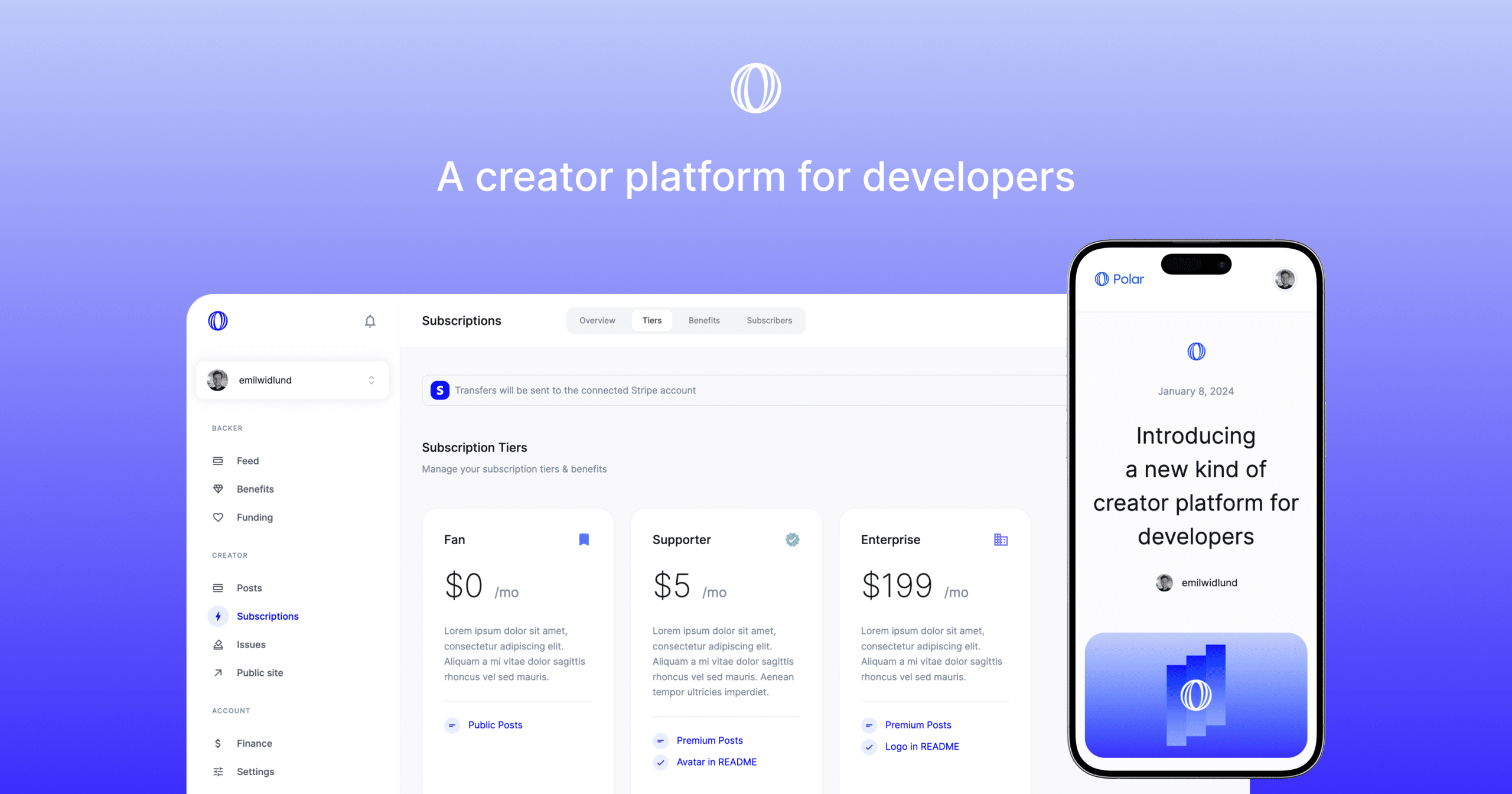
GitHub has teamed up with Polar, a funding platform, to let developers make money from their projects on GitHub.This helps solve a big problem: getting consistent money for open-source projects. Polar lets developers sell extra features and subscriptions, offering a steady flow of cash.

GitHub now officially supports @polar_sh as a funding platform & it looks absolutely gorgeous 😍 pic.twitter.com/hSxVFr97oH

— Birk Jernström (@birk) February 15, 2024

Polar, started in Sweden by Birk Jernström, lets maintainers set up their own subscription services and benefits, such as access to private repos, Discord invites, premium content, and promotions. This means developers have a lot of freedom to make money while supporting open-source work.

“Donations & sponsorship are great when they happen. Problem is they rarely do. In order to drive meaningful (full-time work) capital to OSS initiatives, I believe it has to charge for add-on value and that such services and subscriptions are mutually beneficial. See mkdocs-material as a prime example,” Jernström said in a HackerNews discussion a few months back.

This partnership makes it easier for developers to get funded and improves GitHub too. With Polar, developers can create and share posts and newsletters, both free and paid. They can sell subscriptions linked to their GitHub projects. Polar’s tools can be used to add these services to their websites or docs. The company takes a 5% fee plus Stripe’s fees, but they’re covering Stripe fees until March 31, 2024.

Polar is open-source, encouraging open collaboration and feedback on its development.

This step helps open-source developers financially, benefiting both the creators and the open-source community. It connects GitHub’s network with Polar’s funding options, aiming to change how open-source projects are funded so developers can focus on creating software.

The post GitHub Teams Up with Polar for Easier Open-Source Funding appeared first on Analytics India Magazine.