Cybercriminals are using Meta’s Llama 2 AI, according to CrowdStrike

Shield representing cybersecurity

Cybercrime outfits have taken fledgling steps to use generative AI to stage attacks, including Meta's Llama 2 large language model, according to cybersecurity firm CrowdStrike in its annual Global Threat Report, published Wednesday.

The group Scattered Spider made use of Meta's large language model to generate scripts for Microsoft's PowerShell task automation program, reports CrowdStrike. The program was used to download login credentials of employees at "a North American financial services victim," according to CrowdStrike.

Also: 7 hacking tools that look harmless but can do real damage

The authors traced Llama 2's usage by examining the code in PowerShell. "The PowerShell used to download the users' immutable IDs resembled large language model (LLM) outputs such as those from ChatGPT," states CrowdStrike. "In particular, the pattern of one comment, the actual command and then a new line for each command matches the Llama 2 70B model output. Based on the similar code style, Scattered Spider likely relied on an LLM to generate the PowerShell script in this activity."

The authors caution that the ability to detect generative AI-based or generative AI-enhanced attacks is currently limited, because of the difficulty of finding traces of LLM use. The firm hypothesizes that LLM use is limited thus far: "Only rare concrete observations included likely adversary use of generative AI during some operational phases."

But malicious use of generative AI is sure to increase, the firm projects: "AI's continuous development will undoubtedly increase the potency of its potential misuse."

Also: I tested Meta's Code Llama with 3 AI coding challenges that ChatGPT aced — and it wasn't good

The attacks thus far have met with the challenge that the high cost of developing large language models has limited the kind of output attackers can generate from the models to use as attack code.

"Threat actors' attempts to craft and use such models in 2023 frequently amounted to scams that created relatively poor outputs and, in many cases, quickly became defunct," the report states.

Another avenue of malicious use besides code generation is misinformation, and in that regard, the CrowdStrike report highlights the plethora of government elections this year that could be subjected to misinformation campaigns.

In addition to the US presidential election this year, "Individuals from 55 countries representing more than 42% of the global population will participate in presidential, parliamentary and/or general elections," the authors note.

Also: Tech giants promise to combat fraudulent AI content in mega elections year

Tampering with elections is divided into the high-tech and low-tech. The high-tech route, says the authors, is to disrupt or degrade voting systems by tampering with both the voting mechanisms and with the dissemination to voters of information about voting.

The low-tech approach is misinformation, such as "disruptive narratives" that "may undermine public confidence."

Such "information operations," or, "IO," as CrowdStrike calls them, are already occurring, "as Chinese actors have used AI-generated content in social media influence campaigns to disseminate content critical of Taiwan presidential election candidates."

The firm predicts, "Given the ease with which AI tools can generate deceptive but convincing narratives, adversaries will highly likely use such tools to conduct IO against elections in 2024. Politically active partisans within those countries holding elections will also likely use generative AI to create disinformation to disseminate within their own circles."


Security

Google Enters the Lightweight AI Market With Gemma

Google has released Gemma, a family of AI models based on the same research as Gemini. Developers can’t quite get their hands into the engine of Google Gemini yet, but what the tech giant released on Feb. 21 is a smaller, open source model for researchers and developers to experiment with.

Although generative AI is trendy, organizations may struggle to figure out how to apply it and prove ROI; open source models allow them to experiment with finding practical use cases.

Smaller AI models like this don’t quite have the same performance as larger ones like Gemini or GPT-4, but they are flexible enough to let organizations build custom bots for customers or employees. In particular, the fact that Gemma can run on a workstation shows the continued trend from generative AI makers toward giving organizations options for ChatGPT-like functionality without the heavy workload.

SEE: OpenAI’s newest model Sora creates impressive photorealistic videos that still often look unreal. (TechRepublic)

What is Google’s Gemma?

Google Gemma is a family of generative AI models that can be used to build chatbots or tools that can summarize content. Google Gemma models can run on a developer laptop, a workstation or through Google Cloud. Two sizes are available, 2 billion or 7 billion parameters.

For developers, Google is providing a variety of tools for Gemma deployment, including toolchains for inference and supervised fine-tuning in JAX, PyTorch and TensorFlow.

For now, Gemma only works in English.

How do I access Google Gemma?

Google Gemma can be accessed through Colab, Hugging Face, Kaggle, Google’s Kubernetes Engine and Vertex AI, and NVIDIA’s NeMo.

Google Gemma can be accessed for free for research and development in Kaggle and through a free tier for Colab notebooks. First-time Google Cloud users can receive $300 in credits toward Gemma. Google Cloud credits of up to $500,000 are available for researchers who apply. Pricing and availability in other cases may depend on your organizations’ particular subscriptions and needs.

Since Google Gemma is open source, commercial use is permitted, as long as that use is in accordance with the Terms of Service. Google also released a Responsible Generative AI Toolkit with which developers can provide guidelines around their AI projects.

“It’s great to see Google reinforcing its commitment to open-source AI, and we’re excited to fully support the launch with comprehensive integration in Hugging Face,” said Hugging Face’s Technical Lead Phillip Schmid, Head of Platform and Community Omar Sanseviero and Machine Learning Engineer Pedro Cuenca in a blog post.

How does Google Gemma work?

Like other generative AI models, Gemma is a software that can respond to natural language prompts as opposed to conventional programming languages or commands. Google Gemma was trained on publicly available information, with personally identifiable information and “sensitive” material filtered out.

Google worked with NVIDIA to optimize Gemma for NVIDIA products, in particular by offering acceleration on NVIDIA’s TensorRT-LLM, a library for large language model inference. Gemma can be fine-tuned in the NVIDIA AI Enterprise.

What are the main competitors to Google Gemma?

Gemma competes with small generative AI models such as Meta’s open source large language models, particularly Llama 2; Mistral AI’s 7B model, Deci’s DecilLM and Microsoft’s Phi-2, as well as similar small generative AI models meant to run on an organization’s own hardware.

Hugging Face noted that Gemma out-performs many other small AI models on its leaderboard, which evaluates pre-trained models on basic factual questions, commonsense reasoning and trustworthiness. Only Llama 2 70B, the model included as a reference benchmark, earned a higher score than Gemma 7B. Gemma 2B, on the other hand, performed relatively poorly compared to other small, open AI models.

Google’s full-scale AI model, Gemini, comes in 1.8B and 3.25B parameter versions and is designed to run on Android phones.

Are you Blacker than ChatGPT? Take this quiz to find out.

Are you Blacker than ChatGPT? Take this quiz to find out. Dominic-Madori Davis 10 hours

Creative ad agency McKinney developed a quiz game called “Are You Blacker than ChatGPT?” to shine a light on AI bias.

The game tests a person’s knowledge of Black culture against what ChatGPT has been trained to know about the Black community. It asks questions like, “What does it mean when someone says, ‘Not too much on them, now’?” and “What is your response if you are invited to an event?” When I took the quiz, both ChatGPT and I got the first one right — when someone says “not too much on them,” that usually means to go easy on them. But ChatGPT failed when it came to the second one. When someone invites you to an event, the stereotypical response in the Black community is, “Who else is going to be there?” But ChatGPT said it was, “Thanks for the invite!”

“It’s interesting because it’s billed as this bot that knows everything, and it’s like, clearly, you don’t know everything, especially when it comes to things that aren’t white-specific,” Meghan Woods, a copywriter at McKinney and one of the game’s creators, told TechCrunch.

Woods said the idea for the quiz came last year during a creative brainstorm at McKinney. It took a year for Woods and a Black-led team to create this product, with the purpose of playfully pointing out how out of touch ChatGPT is with Black users. She pointed out that a blind spot for ChatGPT seems to stem from the fact that a lot of Black cultural elements are not necessarily documented online; they are, instead, passed down in person or orally through generations. This means its algorithm misses a lot of nuances when scraping the internet for information about Black people.

“The blind spots can be pretty upsetting,” Woods said. “It’s pretty dangerous.”

Are you Blacker than Chat GPT quiz answer

An example of ChatGPT getting an answer wrong about something stereotypically common in the Black community. Image Credits: McKinney / Screenshot

AI might be on a hot streak, but women, Black and brown builders, and founders in the space, have long spoken of being ignored or pushed aside. The result is that AI innovation is being built without the cultural insight and complexities that would make it suitable for different cultures. At its most extreme, the dearth of diversity means cars are developed using AI that cannot detect Black skin, leading to an increasing number of accidents. On the other end, it simply means a chatbox that can’t distinguish between one Whitney Houston song and another.

Gerald Carter, founder of Destined AI, a company that helps detect and mitigate AI bias, said the McKinney quiz does a good job at gamifying and bringing more awareness to these AI gaps. “A lot of nuances can be addressed by including diverse perspectives at every level,” he said. “For AI to reach its full potential, it needs to work for everyone, everywhere.”

ChatGPT’s parent company, OpenAI, has received criticism for the lack of diversity on its board. Woods said it doesn’t seem like ChatGPT is learning from the quiz, either, based on the fact that it keeps getting the same answers wrong in many cases. “Our hypothesis is that it will never be able to fully grasp a lot of the things we ask it.”

We reached out to OpenAI for comment and will update this post when we hear back.

Carter said that ChatGPT could work better for more cultures with better sourcing and having more inclusive data collection. A more immediate approach is monitoring AI model drift and making improvements using tools focused on cultural perspectives.

While larger companies work on making AI useful for everyone, Black and brown builders in the space have taken matters into their own hands to ensure this next wave of AI is diverse.

Carter, for example, works with companies to help them source more inclusive data. Erin Reddick created ChatBlackGPT (no relation to OpenAI) to offer deeper insights into Black culture and history, and Tamar Huggins raised $1.4 million for her ChatGPT alternative, called Spark Plug, which translates classic literature texts into the African American Vernacular English (AAVE) dialect.

“Hiring, retention, making sure that people are in the room at the table,” Woods said, regarding what more needs to be done to make AI more inclusive. “I know it sounds cliché, but I do think that can start to have an impact.”

The top ten highest-paid tech skills can make you a lot of money — here’s how much

Dog with glasses

The skyrocketing interest in generative AI and recent layoffs have caused workers to experience a lot of job insecurity in the tech job market. However, a new report shows that picking up one of these ten tech skills could increase your marketability to employers, and even your salary.

On Wednesday, Indeed shared a list of the top ten highest-paid skills in tech, as well as a quick glimpse at the tech job market, which isn't as bleak as you might think.

Also: Want to work in AI? How to pivot your career in 5 steps

This past January, 30,995 tech employees were laid off, and even though that sounds like a high number, it was "barely" one-third of the employees laid off last January, according to the report.

The good news for job seekers is the number one skill on Indeed's highest-paid tech skills list — generative AI — can be learned through deep dives into free but high-quality online courses from Amazon, IBM, and other reputable companies, which ZDNET has covered at length.

In fact, the majority of the highest-paid skills in tech are related to AI in some capacity, with generative AI, System-on-chip (SoC), and deep learning in the first three spots.

Also: How tech professionals can survive and thrive at work in the time of AI

The average salary potential for workers with generative AI and SoC skills is around $174,000, with a 47% difference in salary potential with the skill versus those without. Employees with skills in deep learning trail slightly behind with an average salary potential of $170,939, and a 44% difference with the skill.

The rest of the skills all range between the $165,000 to $169,000 salary potential and include Torch, PyTorch, Computer vision, SystemVerilog, Mesos, Rust, and Elixir. You can find each skill's description, average salary potential, and percent difference in the chart below.

After seeing the skills list and their lucrative potential salaries, you might be curious about what roles necessitate these skills to see if any interest you.

Also: Want to be a data scientist? Do these 4 things, according to business leaders

Indeed identified the top five roles requiring these skills as data scientist, machine learning engineer, software engineer, research scientist, full stack developer, deep learning engineer, and software architect.

Qloo raises $25M to predict your favorite movies, TV shows and more

Qloo raises $25M to predict your favorite movies, TV shows and more Kyle Wiggers 15 hours

The buzziest AI today — GenAI — is an undoubted labor saver, generating images, emails, songs and more in record time. But one of AI’s more useful applications in the long run might be identifying the counterintuitive correlations humans miss. Consider, for example, that people who like horror movies might be inclined to try certain exotic cuisines, while people who prefer sitcoms might listen to a lot of true crime podcasts.

Qloo, a New York-based startup, has made it its mission to apply AI to understand these types of nuanced taste and culture patterns. Founded in 2012 by Alex Elias and Jay Alger, Qloo seeks to uncover consumer behaviors and trends across entertainment, fashion, travel, sports, food and other segments.

Elias, an NYU Law School graduate, says that he was inspired to found Qloo after noticing a gap in the market for what he calls “taste knowledge.”

“As a passionate advocate for culture — I play the tenor saxophone and piano, and have a deep appreciation for midcentury cinema — I saw the fragmented world of taste knowledge,” he told TechCrunch in an interview. “I noticed that while companies like Spotify, Expedia and Netflix dominated their respective sectors creating data silos, there was a lack of a unified system capable of understanding and predicting diverse personal tastes across different domains without relying on identity-based data.”

So Elias teamed up with Alger, who previously led the digital marketing agency Deepend, to launch Qloo.

Qloo

Image Credits: Qloo

Today, Qloo offers companies AI-generated correlation data across many culture and entertainment domains, including film, travel, nightlife, literature and so on. The platform’s knowledge of a user’s taste in one category or genre can be leveraged to deliver suggestions in another category, for example applying TV favorites to game-buying behaviors.

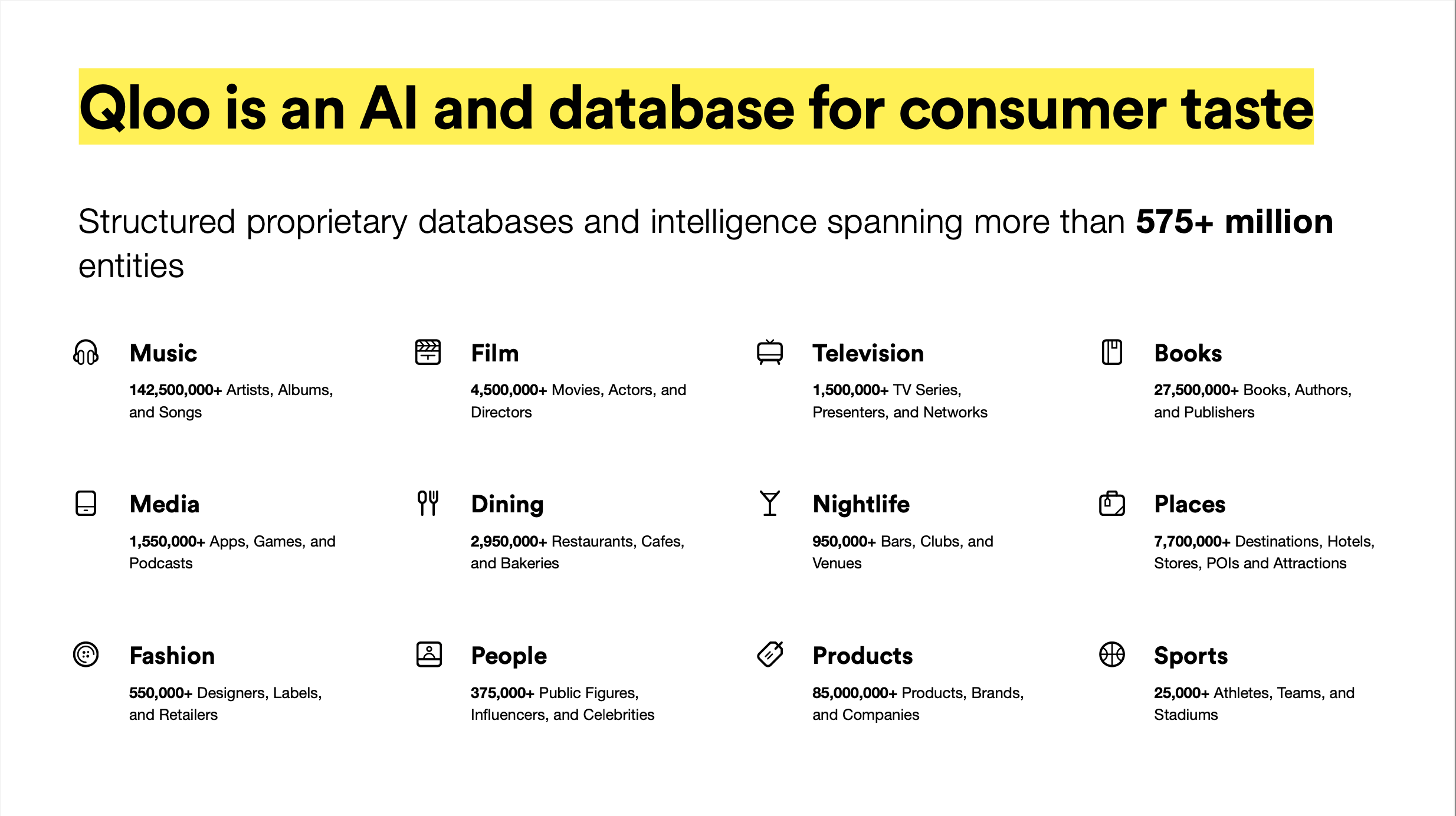
“Qloo operates a sophisticated AI-powered insights engine comprised of … behavioral data from consumers around the globe,” Elias said. “Qloo’s proprietary AI models are capable of identifying trillions of connections between these entities. With a profound understanding of consumer behavior for over 575 million entities worldwide, our technology enables contextualized personalization and deep insights into the intricate connections behind people’s tastes.”

Now, that’s a lot of personal data Qloo’s working with — which certainly gave this writer pause. Where’s it all coming from and where’s it stored? Elias wouldn’t say — but he was quick to assert that Qloo doesn’t rely on personally identifiable information and adheres to the requirements of privacy laws including GDPR and the California Consumer Privacy Act.

“Qloo maintains a comprehensive Ethics Policy that prioritizes ethical, transparent and responsible AI development and deployment, as well as data privacy and security,” he said. “Specific to data and privacy, Qloo upholds the highest standards of data privacy and security and will not leverage any form of personally identifiable information or copyrighted information in any of the modeling pipelines.”

Whether that’s true, major customers are embracing Qloo to power their product experiences, Elias claims. For instance, Starbucks is using Qloo to create in-store music playlists tailored to specific neighborhoods. Hershey’s is tapping the platform to customize the content of assorted candy bags. Michelin is using Qloo to serve recommendations in its Michelin Guide App. And Netflix is leveraging Qloo’s tech to enhance merchandising by identifying actors who resonate with certain demographics.

Those customers — and Qloo’s ~60 others, which span PepsiCo, Samsung, The New York Mets, BuzzFeed and Ticketmaster — are helping Qloo approach profitability. The company makes money by charging a monthly subscription fee for access to its platform through APIs; Elias says contracts start in the “five figures.”

Qloo

Image Credits: Qloo

Having today raised $25 million in a Series C round led by AI Ventures with participation from AXA Venture Partners, Eldridge and Moderne Ventures (bringing Qloo’s total raised to $60 million), Qloo is setting its sights on expansion. In addition to building a self-service research tool aimed at marketers and medium- and small-business customers, the startup is introducing what it calls a “multi-person recommendation AI,” which can match the profiles of any two people in Qloo’s database based on their preferences. Elias sees it being used in dating apps.

“The tailwinds from privacy and AI have greatly overpowered the headwinds from any tech slowdown,” Elias said. “Qloo has seen widespread contract expansion from the existing customer roll, looking to consume new data domains and areas of taste knowledge as well as address new use cases like generative itinerary planning and dynamic personalization using Qloo’s AI. Qloo is also seeing demand from new addressable markets, such as real estate, as well as accelerated sales cycles across the board despite increased compliance requirements.”

With the new capital, Qloo plans to expand its 50-person team to over 100 people by the end of the year and “pursue opportunistic M&A.” In 2019, Qloo acquired TasteDive, an entertainment recommendation engine, and Elias implied that future acquisitions would be along similar strategic lines.

DataSwitch Simplifies Data modernization with Automation 

Over the last ten years, CIOs have been challenged with the responsibility of restructuring their company’s data and applications to align with the rapid evolution of technology, business operations, and customer requirements.

Hence, adopting data modernization techniques becomes crucial for enterprises, facilitating better decision-making through real-time data accessibility, rapid analysis, and identification of contemporary trends.

One prominent player that provides data modernization services from India is DataSwitch. The company offers tools and technologies that automate the process of moving data from on-premises systems to the cloud.

With its low-code approach, DataSwitch makes migrating, re-engineering, accessing, creating, testing, and publishing data easier, providing customers with agility and speed to deliver business outcomes.

While there are a few competitors, DataSwitch group’s CEO and chairman Sivakumar Agneeswaran believes that the solutions they offer are unparalleled, especially in process/workload migration to cloud. He emphasises that DataSwitch’s strength lies in the depth and breadth of technologies that are supported for automation.

Currently, most of the common legacy databases like Oracle, Greenplum, Netezza, Teradata, DB2 and SQL Server are supported. Also, the common legacy ETL tools like Informatica PowerCenter, DataStage, SSIS and Talend are supported. On the target side, most technologies on all three clouds, AWS, Microsoft and GCP are supported along with cloud-agnostic technologies like Matillion, Snaplogic, Databricks and Snowflake.

“We are a jack of all technologies in the data space and a master of automation,” Agneeswaran said, in a recent conversation with AIM. DataSwitch offers a no-code platform for application data transformation and modernization, with products like DS Migrate, DS Integrate, and DS Democratize.

In the field of data modernization and data engineering, DataSwitch has been recognized as a ‘Hot Vendor’ in their 2023 report by HFS Research as part of their OneEcosystemTM. With a steadfast focus on delivering enterprise-grade, no-code, self-serviceable solutions based on their product, DataSwitch has established itself as a transformative catalyst helping enterprises modernize their legacy data and process workloads.

<DataSwitch’s outcome-based, automation-driven, fail-fast approach to data modernization and data engineering makes it a compelling choice for any enterprise. Its no-code solution enables enterprises to re-engineer their platform creating agile, adaptable, and innovative data architecture that can keep up with the changing needs of a dynamic business.

– Kumar Nikhil Bhaskar, Senior Analyst, HFS Research>

Inception of DataSwitch

DataSwitch was founded in mid-2020 by Karthikeyan Viswanathan, currently serving as the chief executive officer and president of the company. Before starting the company, both Viswanathan and Agneeswaran worked at Cognizant. During their time there, both held different leadership positions in the Data & Analytics practice.

Viswanathan was responsible for handling data modernization at Cognizant, where he developed automation tools. “Karthik is a firebrand leader in the data space who has built automation in niche areas,” said Agneeswaran.

During the initial years following the company’s inception, Vishwanathan dedicated his efforts to building the product. By the time it was ready, they successfully secured two enterprise customers—an e-commerce giant in Japan and a leading stock exchange in Asia.

Agneeswaran joined the company in September 2022. “My intention, when I came in, was to start scaling the product for the market. We quickly built partnerships with global system integrators like TCS, Deloitte, PWC, Birlasoft, Virtusa, Hexaware, Ascendion and many others,” he said.

“Any company that has a lot of on-premises data ecosystems and is looking to migrate to the cloud is our primary target,” said Agneeswaran. DataSwitch hasn’t raised funds and is bootstrapped.

Customers and Partnerships

DataSwitch’s customer base is constantly increasing. The company mostly relies on its SI (System Integrators) partners to acquire customers. “We have completed over 50 implementations across the globe, with two-thirds involving Fortune 500 companies in various sectors such as retail, health sciences, BFSI, manufacturing, etc.,” said Agneeswaran.

Agneeswaran mentioned that DataSwitch acquires customers and partners in two ways. One is the direct acquisition of new customers and the other is by offering the products to SI partners, which adds the service component to the product across different verticals.

Further, the company plans to target the GCCs globally. “We are already working with a couple of GCCs in India. We will be doing more outreach and getting into more of them in the subsequent quarters. That will be a growth area for us,” he said.

“Our customer base extends from USA, APAC, Japan, Australia, and India to Europe, and the UK, spanning across continents,” he added.

Work Culture at DataSwitch

The company has a flexible work culture that allows its employees to work remotely. “We have about 80 employees, and we are completely remote. So, we don’t have an office,” said Agneeswaran.

“We have and want to maintain this remote culture because it enables people to be flexible with their timings,” he added. The company regularly organises internal training programs to keep employees updated with the technology changes.

“It’s a very open culture again. There is no hierarchy and the founders are easily accessible,” said Agneeswaran. He further added that the company does not mete out punitive measures for failures. “Unless you fail, you won’t be able to succeed,” he concluded.

The post DataSwitch Simplifies Data modernization with Automation appeared first on Analytics India Magazine.

Indeed’s 10 Highest-Paid Tech Skills: Generative AI Tops the List

Despite a turbulent economy and widespread layoffs, tech skills remain in high demand, and not surprisingly, generative AI leads the charge, according to a newly released report from Indeed. Half of the top 10 highest-paying tech skills on the U.S. list are AI-specific, the study finds.

Top 10 tech skills in the U.S. and their average salary potential

1. Generative AI, $174,727: Generative artificial intelligence is AI capable of generating text, images or other data using generative models, often in response to prompts.

2. SoC, $174,564: System-on-chip is an integrated circuit that integrates most or all components of a computer or other electronic system.

3. Deep learning, $170,939: Deep learning is the subset of machine learning methods based on artificial neural networks with representation learning.

4. Torch, $169,874: Torch is an open-source machine learning library, a scientific computing framework, and a scripting language based on Lua.

5. PyTorch, $168,636: PyTorch is a machine learning framework based on the Torch library. It is used for applications such as computer vision and natural language processing. The ML framework was developed by Meta AI and is now part of the Linux Foundation umbrella.

6. Computer vision, $166,873: Computer vision is a field of computer science that focuses on enabling computers to identify and understand objects and people in images and videos.

7. SystemVerilog, $165,832: SystemVerilog is a hardware description and hardware verification language used to model, design, simulate, test and implement electronic systems.

8. Mesos, $165,788: Apache Mesos is an open-source project to manage computer clusters like CPU, memory, storage and other compute resources.

9. Rust, $165,637: Rust is a general-purpose programming language that emphasizes performance, type safety and concurrency.

10. Elixir, $165,245: Elixir is a functional, concurrent, high-level general-purpose programming language that is also used to implement the Erlang programming language.

TRAINING: The Premium Machine Learning Artificial Intelligence Super Bundle from TechRepublic Academy

Job seekers with AI skills clearly stand out

There is little doubt that AI is changing the tech industry and the nature of jobs. Consequently, “job seekers would do well to consider the changing industry’s new demands, which include changes stemming from the widespread adoption of generative AI,’’ the first-ever Indeed top 10 highest-paying tech skills report noted. “While Gen AI will touch virtually every industry, tech will be impacted the most.”

Despite the layoffs in tech that have dominated headlines, “this data is demonstrating an inverse trend within the industry — proving the demand for certain tech skills is still high, and in some cases, skyrocketing,” Donal McMahon, vice president of data science at Indeed, told TechRepublic via email. “With this in mind, it is interesting that we see AI-specific skills dominating half the list. This underscores that in a tight market, job seekers with AI skills can stand out, and potentially earn almost 50% more than their counterparts.”

AI skills are sought globally

With the rise of AI globally, Indeed is seeing as much demand for similar skills across the world as in the U.S., McMahon said. Companies around the world “are all searching for employees who know AI and can adapt to new and emerging technologies,” he noted.

Top companies and industries hiring these tech skills

The top companies hiring for these tech skills include Apple, Amazon, NVIDIA, Meta, TikTok, Deloitte and Ericsson Worldwide, according to Indeed’s report.

In terms of vertical-specific industries, in 2024, every company is working to become a tech company, increasing the demand for these skills, McMahon said. “Some of the top industries we are seeing coveting these skills are the aerospace and defense industry, insurance companies, financial services, manufacturing, and semiconductors.”

Tips for hiring employers: Act fast, focus on skills and upskilling

As more businesses move their operations online and every industry takes on new forms of digital transformation, workers with specialized technical skills are needed everywhere — not just in the tech industry, McMahon stressed.

“Indeed data has shown that 77% of job seekers are frustrated with the job search process and feel like the process is too slow,” he said. “Employers also agree that it takes too long to find quality talent and hire — but they do have some control over this timeline. When job seekers and skills are in demand, we encourage employers to act fast and utilize matching technology during the hiring process.”

Not only will this alleviate pain points for the job seeker, McMahon added, but the company can make a strategic hire faster.

Further, employers can find candidates faster if they focus on a skills-first hiring approach, he said. “Rather than looking at proxies like a college degree, a certain number of years of experience, or previous companies, they can hire based on the skills they need. This will open the talent pipeline to candidates who are often overlooked but are qualified to do the work.”

DOWNLOAD: This Platform Engineer Hiring Kit from TechRepublic Premium

Employers can also consider implementing an upskilling program to provide opportunities for current employees to learn these skills, McMahon said. He also suggested that new workers continue developing expertise in these skills.

While Indeed’s Workforce Insights Report finds that 43% of job seekers consider lack of certifications as a top barrier to finding the job they want, a majority of the skills on this list can be learned through online courses, the report said.

Conservation Labs uses sound to diagnose plumbing issues

Conservation Labs uses sound to diagnose plumbing issues Kyle Wiggers 13 hours

Sound can reveal a lot about water — and where it’s headed.

Every washing machine cycle, dish rinse and toilet flush sends water rushing through the pipes in homes, apartments and commercial buildings, carrying waste away at breakneck speeds. The whistles and hums that water makes along its downward journey may seem unremarkable. But they’re bits of a unique sound signature that, using the right algorithms and hardware, can be detected and categorized for preventative maintenance purposes.

Acoustic detection, as it’s called, isn’t a new science. Water authorities and utilities have used acoustic sensors to canvas for leaks and signs of wear and tear for years. But within the past decade or so, an emerging cohort of startups has put interesting twists on the old tech, applying acoustic water detection in novel ways — and places.

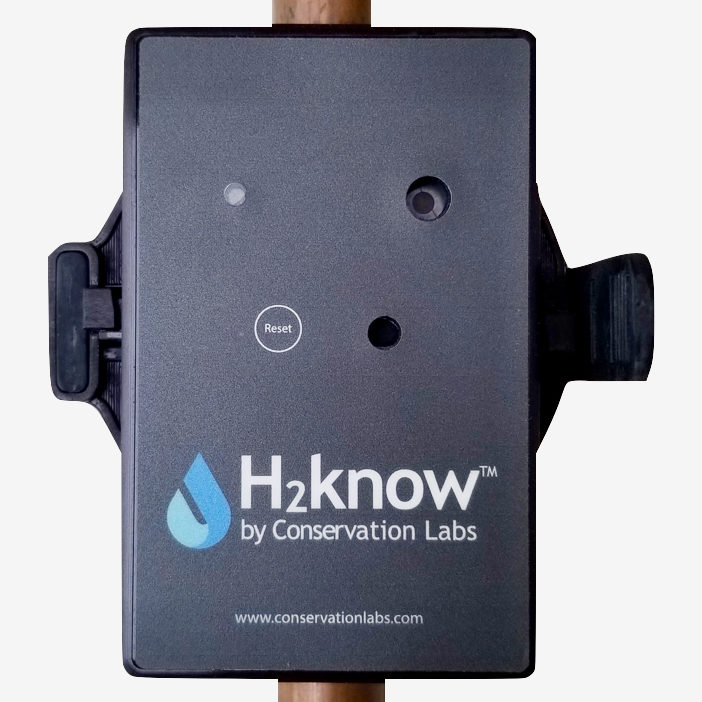
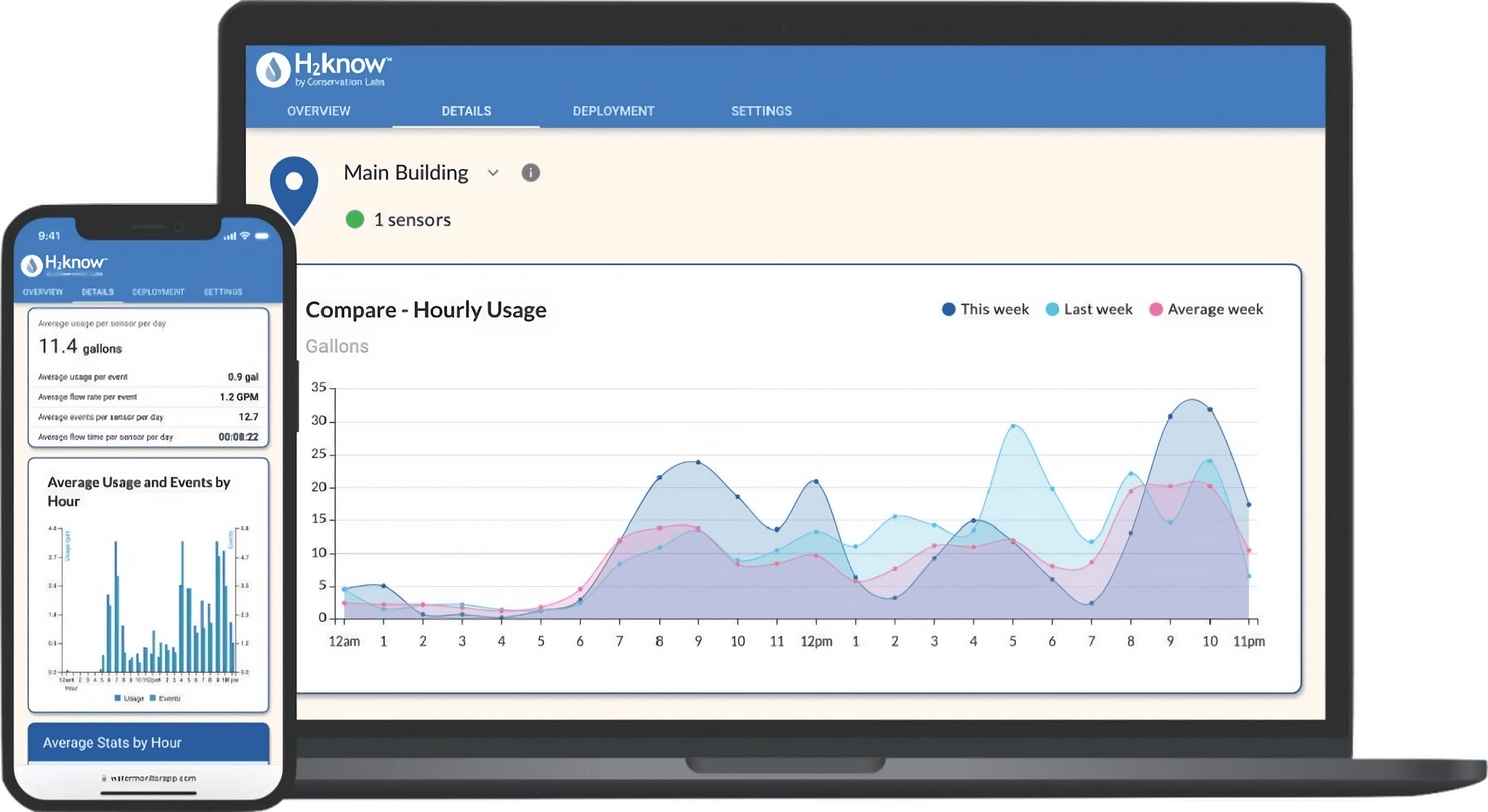
One of these startups, Conservation Labs, is creating a water-listening sensor that attaches to the plumbing in residential, multifamily and office properties. Leveraging an algorithm trained on water acoustics, the sensor translates sounds from the pipes into usage statistics, leak alerts and even conservation recommendations.

“The sensors can monitor individual units or entire buildings, providing remote visibility,” Mark Kovscek, the founder and CEO of Conservation Labs, told TechCrunch in an email interview. “There are several indirect competitors that identify leaks or monitor whole-building consumption. But Conservation Labs’ technology is differentiated in that it both detects leaks and monitors water usage for any building and pipe.”

Kovscek, who has a degree in applied mathematics and industrial management from Carnegie Mellon, was inspired to launch Conservation after suffering a few bad house leaks.

Conservation Labs

Conservation Labs’s acoustics-based water monitor. Image Credits: Conservation Labs

“After the [leaks], I looked around for a product that could monitor leaks and other water usage, but wasn’t able to find one that created value,” Kovscek said. “I realized that sound waves could be indicative of what was going on in the pipes, developed a prototype and filed a patent in 2016.”

Today, Conservation Labs — which earlier this month raised $7.5 million in a Series A funding round led by RET Ventures’ Housing Impact Fund with participation from Sustain VC — sells sensors and a subscription to a cloud-based monitoring service. The sensors retail for $129, while the subscription costs $36 per sensor per year.

Kovscek claims that Conservation users typically see a 20% reduction in water usage after installing the sensors. But as with many — if not most — AI- and algorithm-driven products on the market, it’s tough to know exactly how well Conservation Labs’ tech performs without extensively testing it first.

There are lots of variables involved in acoustic monitoring, like the volume of water being monitored and the material of the pipes — all of which could affect a sensor reading. Depending on which sounds and how many Conservation used to train its algorithms, unintentional bias could creep in — skewing the readings.

For his part, Kovscek asserted that Conservation has a “rigorous” approach to development, testing and validating algorithms and that the platform is continuously improving in terms of its accuracy.

“General acoustic models are created with thousands of hours of data and then sensor-specific models are generated based on the unique environment of the sensor and the unique audio profile of the monitored object,” he added. “As the platform matures and adds new use cases, it becomes more intelligent, faster and even more extensible to new use cases.”

Conservation appears to have carved out a niche for itself in any case, reaching “seven digit” annual recurring revenue in 2023 and a customer base of around 150 companies. Seeking to avoid putting all of its eggs in one basket, the startup recently launched a new acoustic sensor line that monitors not only water but industrial machines for signs of damage and other related issues.

Like water-listening sensors, acoustic sensors that monitor machines is well-established tech.

Conservation Labs

Image Credits: Conservation Labs

Beyond Conservation Labs, startups like Noiseless Acoustics and OneWatt use AI-powered sensors to better understand the patterns of industrial equipment. Others — including Conservation — have experimented applying them to identify leaks in gas and oil pipelines.

“Conservation’s platform can not only identify if a machine is malfunctioning, but identify the reason for the malfunction (e.g., is it the motor belt, motor bearing, is the machine unbalanced, etc.),” Kovscek said. “All of this is accomplished with a single sensor that uses a low-cost microphone.”

Once again, take those claims how you will; this writer didn’t — and won’t — have the chance to put them to the test.

With a war chest totaling $9.5 million in venture capital, Conservation plans to release the second generation of its water monitoring sensor, increase the scope and scale of its AI platform and expand its ongoing sales and marketing initiatives. To achieve all this, the Pittsburgh, Pennsylvania-based company intends to hire eight people by the end of the year, growing its 22-person team to 30.

“In sustainability, there’s a number of tailwinds, including a drive for more efficient operations, federal funding for climate and energy investment, regulations to encourage water and energy monitoring, increasing water rates and consumer interest in eco-friendly brands,” Kovscek said. “We’re focused on looking ahead — this Series A is a testament to the resiliency of our offering, regardless of what’s happening in the broader market.”

Empowering Large Vision Models (LVMs) in Domain-Specific Tasks through Transfer Learning

Unlock the potential of Large Vision Models (LVMs) in various domains through effective transfer learning

Computer vision is a field of artificial intelligence that aims to enable machines to understand and interpret visual information, such as images or videos. Computer vision has many applications in various domains, such as medical imaging, security, autonomous driving, and entertainment. However, developing computer vision systems that perform well on different tasks and domains is challenging, requiring a lot of labeled data and computational resources.

One way to address this challenge is to use transfer learning, a technique that reuses the knowledge learned from one task or domain to another. Transfer learning can reduce the need for data and computation and improve the generalization and performance of computer vision models. This article focuses on a specific type of computer vision model, called Large Vision Models (LVMs), and how they can be leveraged for domain-specific tasks through transfer learning.

What are Large Vision Models (LVMs)?

LVMs are advanced AI models that process and interpret visual data, typically images or videos. They are called “large” because they have many parameters, often in the order of millions or even billions, that allow them to learn complex patterns and features in visual data. LVMs are usually built using advanced neural network architectures, such as Convolutional Neural Networks (CNNs) or transformers, that can efficiently handle pixel data and detect hierarchical patterns.

LVMs are trained on a vast amount of visual data, such as Internet images or videos, along with relevant labels or annotations. The model learns by adjusting its parameters to minimize the difference between its predictions and the actual labels. This process requires significant computational power and a large, diverse dataset to ensure the model can generalize well to new, unseen data.

Several prominent examples of LVMs include OpenAI ‘s CLIP, which excels in tasks like zero-shot classification and image retrieval by understanding images through natural language descriptions. Likewise, Google’s vision transformer adopts a transformer-like architecture for image classification, achieving state-of-the-art results in various benchmarks. LandingLens, developed by LandingAI, stands out for its user-friendly platform, which enables custom computer vision projects without coding expertise. It employs domain-specific LVMs, demonstrating robust performance in tasks like defect detection and object localization, even with limited labeled data.

Why Transfer Learning for LVMs?

LVMs have shown remarkable capabilities in understanding and generating visual data but also have limitations. One of the main limitations is that they are often trained on general-purpose datasets, such as ImageNet or COCO, that may differ from the specific task or domain the user is interested in. For example, an LVM trained on Internet images may not be able to recognize rare or novel objects, such as medical instruments or industrial parts, that are relevant to a specific domain.

Moreover, LVMs may not be able to adapt to the variations or nuances of different domains, such as other lighting conditions, camera angles, or backgrounds, that may affect the quality and accuracy of the model's predictions.

To overcome these limitations, transfer learning can utilize the knowledge learned by an LVM on a general-purpose dataset to a specific task or domain. Transfer learning is fine-tuning or adapting an LVM to the user’s needs, using a smaller amount of labeled data from the target task or domain.

Using transfer learning offers numerous advantages for LVMs. One key benefit is the ability to transfer knowledge from diverse visual data to specific domains, enabling faster convergence on targeted tasks. Moreover, it mitigates data dependency issues by utilizing pre-trained models’ learned features, reducing the need for extensive domain-specific labeled data.

Moreover, initializing LVMs with pre-trained weights leads to accelerated convergence during fine-tuning, which is particularly advantageous when computational resources are limited. Ultimately, transfer learning enhances generalization and performance, tailoring LVMs to specific tasks and ensuring accurate predictions, fostering user satisfaction and trust.

How to Transfer Learn for LVMs?

Different approaches and methods exist to perform transfer learning for LVMs, depending on the similarity and availability of the data between the source and target tasks or domains. There are two main approaches to transfer learning, namely, inductive and transductive transfer learning.

Inductive transfer learning assumes that the source and target tasks differ, but the source and target domains are similar. For example, the source task could be image classification, and the target task could be object detection, but both tasks use images from the same domain, such as natural scenes or animals. In this case, the goal is to transfer the knowledge learned by the LVM on the source task to the target task by using some labeled data from the target task to fine-tune the model. This approach is also known as task transfer learning or multi-task learning.

On the other hand, transductive transfer learning assumes that the source and target tasks are similar, but the source and target domains are different. For example, the source and target tasks could be image classification, the source domain could be Internet images, and the target domain could be medical images. In this case, the goal is to transfer the knowledge learned by the LVM on the source domain to the target domain by using some labeled or unlabeled data from the target domain to adapt the model. This approach is also known as domain transfer learning or domain adaptation.

Methods for Transfer Learning

Transfer learning for LVMs involves various methods tailored to different modification levels and access to model parameters and architecture. Feature extraction is an approach that utilizes the features known by the LVM on a source task as input for a new model in the target domain. While not requiring modifications to the LVM’s parameters or architecture, it may struggle to capture task-specific features for the target domain. On the other hand, fine-tuning involves adjusting LVM parameters using labeled data from the target domain. This method enhances adaptation to the target task or domain, requiring parameter access and modification.

Lastly, meta-learning focuses on training a general model capable of rapid adaptation to new tasks or domains with minimal data points. Utilizing algorithms like MAML or Reptile, meta-learning allows LVMs to learn from diverse tasks, enabling efficient transfer learning across dynamic domains. This method necessitates accessing and modifying LVM parameters for effective implementation.

Domain-specific Transfer Learning Examples with LVMs

Transfer learning for LVMs has demonstrated significant success across diverse domains. Industrial inspection is a domain that requires high efficiency and quality in computer vision models, as it involves detecting and locating defects or anomalies in various products and components. However, industrial inspection faces challenges such as diverse and complex scenarios, varying environmental conditions, and high standards and regulations.

Transfer learning can help overcome these challenges by leveraging pre-trained LVMs on general-purpose datasets and fine-tuning them on domain-specific data. For example, LandingAI’s LandingLens platform allows users to create custom computer vision projects for industrial inspection without coding experience. It uses domain-specific LVMs to achieve high performance on downstream computer vision tasks, such as defect detection or object location, with less labeled data.

Likewise, in the entertainment industry, transfer learning contributes to creativity and diversity in computer vision models. OpenAI's CLIP model, designed for tasks like image generation from textual descriptions, allows users to create diverse visual content, such as generating images of “a dragon” or “a painting by Picasso.” This application shows how transfer learning empowers generating and manipulating visual content for artistic and entertainment purposes, addressing challenges related to user expectations, ethical considerations, and content quality.

The Bottom Line

In conclusion, transfer learning emerges as a transformative strategy for optimizing LVMs. By adapting pre-trained models to specific domains, transfer learning addresses challenges, reduces data dependencies, and accelerates convergence. The approach enhances LVMs’ efficiency in domain-specific tasks. It signifies a crucial step towards bridging the gap between general-purpose training and specialized applications, marking a significant advancement in the field.

First Gemini, now Gemma: Google’s new, open AI models target developers

Gemma

Just when you thought Google might slow down its pace of AI releases, the company has another trick up its sleeve. For the third time this month, Google shared notable artificial intelligence news, this time unveiling a new AI model geared towards developers.

On Wednesday, Google unveiled Gemma, a family of lightweight, open models developed by DeepMind and other teams across Google that are charged with AI development and research.

If the name seems like a spinoff of Gemini, Google's most advanced AI model, that's because it was intentional. Gemma, Latin for "precious stone," was built from the same research and technology used to create the Gemini models.

Google released Gemma in two model weight sizes, Gemma 2B and Gemma 7B, each with pre-trained and instruction-tuned variants that can run on a laptop, workstation, or in the Google Cloud.

Also: 6 ways ChatGPT can make your everyday life easier

According to Google, the Gemma models proved very capable for their sizes, outperforming larger open models, such as Meta's Llama-2, on key benchmarks for reasoning, math, and code, as seen in the image below.

The models also come with Google's new Responsible Generative AI toolkit, which provides interested users with best practices resources for encouraging the responsible use of open models like Gemma.

It is worth highlighting that Gemma is an "open model" and not "open-sourced" — and that minor terminology variant refers to a rather significant difference. With open-source models, users have full creative autonomy, with no restrictions.

To mitigate potential misuse, Google made Gemma an open model whose terms and conditions make the models freely available for access, redistribution, and model variant creation and publishing. However, Google also implements limitations.

"In using Gemma models, developers agree to avoid harmful uses, reflecting our commitment to developing AI responsibly while increasing access to this technology,' said Google in a blog post.

Also: A smartphone without apps? This AI assistant aims to replace them all

Google implemented other safeguards in Gemma to ensure safe and reliable usage, including automated techniques to screen out personal information and sensitive data from training sets, reinforcement learning from human feedback (RLHF) to ensure that the models behave responsibly, and robust model evaluations.

Gemma is available today via free access in Kaggle, a free tier for Colab notebooks, and $300 in credits for first-time Google Cloud users, according to the release.

Artificial Intelligence