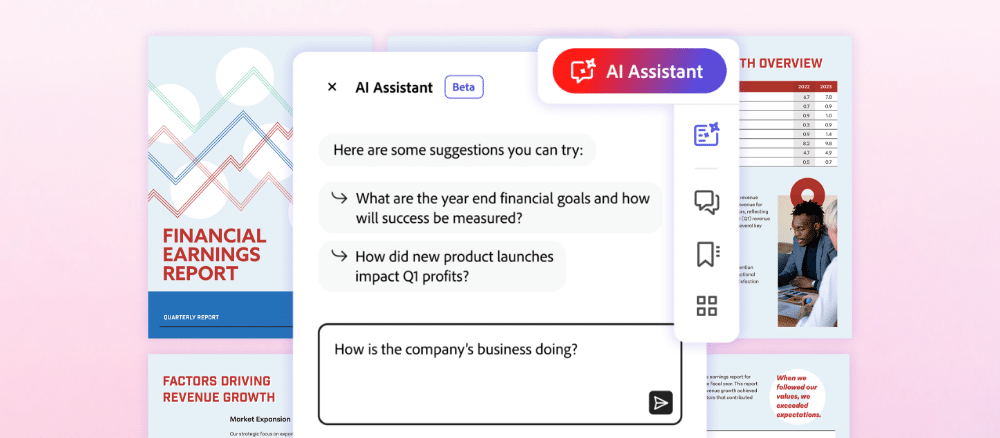
Design software leader Adobe has introduced AI Assistant (beta), a conversational engine in Reader and Acrobat to generate summaries and insights from long documents. Moreover, the AI can answer questions and format information for sharing in emails, reports and presentations. AI Assistant is bringing generative AI to unlocking new value from approximately 3 trillion PDFs in the world.
The company’s latest AI tool is built on the same models behind Acrobat Liquid Mode, which supports responsive reading experiences for PDFs on mobile. These proprietary models provide an understanding of PDF structure and content, enhancing quality and reliability in AI Assistant outputs.
“Generative AI offers the promise of more intelligent document experiences by transforming the information inside PDFs into actionable knowledge and professional-looking content,” said Abhigyan Modi, senior vice president of Document Cloud.
“PDF is the de facto standard for the world’s most important documents, and the capabilities introduced today are just the beginning of the value AI Assistant will deliver through Reader and Acrobat applications and services,” Modi added.
Acrobat Individual, Pro and Teams customers and Acrobat Pro trialists can use the AI Assistant beta to work more productively, with features coming to Reader over the coming days and weeks. They will have access to capabilities through a new add-on subscription plan when AI Assistant is out of beta.
Until then, the AI Assistant features are available in beta for Acrobat Standard and Pro Individual and Teams subscription plans on desktop and web in English, with features coming to Reader desktop customers in English over the next few weeks — other languages to follow. A private beta is available for enterprise customers.
The tool has guardrails so all customers can use the features. Enterprise-grade security and information governance are available for large business customers. AI Assistant is developed in alignment with Adobe’s AI Ethics processes.
With AI Assistant in Reader and Acrobat, Adobe takes an LLM-agnostic approach, selecting best-in-class technologies that address a range of customer use cases. Adobe prohibits third-party LLMs from training on Adobe customer data.
Moving forward, Adobe’s AI Assistant roadmap includes providing insights across diverse documents. The company’s AI will facilitate authoring, editing, and formatting in Acrobat, streamlining first drafts, copy editing, and content design. The AI will also soon leverage Firefly, Adobe Express, and more features.
The post Adobe Brings AI Assistant in Reader and Acrobat, 30 Years After Creating PDF appeared first on Analytics India Magazine.
Uber, India has signed an MoU with Open Network for Digital Commerce (ONDC) to expand the range of mobility offerings on the Uber app. The agreement with the Indian private non-profit organization stands to strengthen Uber’s mission of bringing safe, affordable and reliable rides to all Indians.
At an event in Bengaluru, Uber’s global CEO Dara Khosrowshahi spoke with Infosys Chairman, Nandan Nilekani on the subject of ‘Building Population Scale Technology.’ Dara said companies and governments around the world can learn from the scale and ambition of India’s Digital Public Infrastructure. India’s Uber views open source tech stacks with a lot of interest and recognizes the opportunities they bring for everyone.
Khosrowshahi mentioned that India is the toughest market to crack since Indian customers do not want to pay for anything. Hence, leaping into the market with ONDC will help Uber strategize globally. The Indian counterpart of the US-based ride-hailing platform has never shied away from experimenting and exploring the Indian landscape. “Indian customers are so demanding and do not want to pay for anything. It is the gig way to the world for us [Uber],” said Khosrowshahi
T Koshy, MD & CEO of ONDC, Said, “As the Open Network is continuously evolving, MTT (Mobility, Transport and Travel) is certainly a critical sector for us. Different players together on the Network foster innovation and newer business models. Today’s MoU is a major step forward, and one we hope will enable a diverse range of mobility solutions to benefit every Indian.”
Over the past decade, Uber’s technological innovation has helped revolutionize mobility for people across the world. Moreover, the app has reshaped India’s transportation landscape, offering safe, reliable and affordable rides to people across 125 cities across a range of different vehicle types and has helped more than 900,000 Indians earn a living each month by driving with Uber.
The company has invested millions in engineering tools through the Bangalore hub. The foundation laid by the team in Bangalore has helped the company’s business expand across sectors from calling for a cab to delivering food at your doorstep. The team has continued to make significant tech investments to reduce the cost of servers, database resources, and data storage resources.
“This means that both businesses benefit from our reduced cost of operations, underlining our dedication to efficiency and sustainability,” Madan Thangavelu, Uber’s senior director of engineering had explained in an exclusive interaction with AIM.
The post India is the Toughest Market to Crack, Says Uber CEO, signs an MoU with ONDC appeared first on Analytics India Magazine.
Employees might recognize the potential leak of sensitive data as a top risk, but some individuals still proceed to input such information into publicly available generative artificial intelligence (AI) tools.
This sensitive data includes customer information, sales figures, financial data, and personally identifiable information, such as email addresses and phone numbers. Employees also lack clear policies or guidance on the use of these tools in the workplace, according to research released by Veritas Technologies.
Also: Five ways to use AI responsibly
Conducted by market researcher 3Gem in December 2023, the study polled 11,500 employees worldwide, including workers in Australia, China, Japan, Singapore, South Korea, France, Germany, the UK, and the US.
Asked about the risks to their organization from using public generative AI tools, 39% of respondents pointed to the potential leak of sensitive data, while 38% said these tools could produce incorrect, inaccurate, or unhelpful information. Another 37% of respondents cited compliance risks and 19% noted the technology could negatively impact productivity.
Some 57% of employees used public generative AI tools in the office at least once weekly, with 22.3% using the technology daily. About 28% of people said they did not use such tools at all.
Close to half (42%) of respondents said they used the tools for research and analysis, while 41% and 40% turned to generative AI to write email messages and memos, as well as to improve their writing, respectively.
With regards to the types of data that can provide business value when entered into public generative AI tools, 30% of employees pointed to customer information, such as references, bank details, and addresses. Some 29% cited sales figures, while 28% highlighted financial information, and 25% pointed to personally identifiable information. Another 22% of workers referred to confidential HR data and 17% cited confidential company information.
Some 27% of respondents did not believe putting any of this sensitive information into public generative AI tools could yield value to the business.
Almost a third (31%) of employees acknowledged having entered such sensitive data into these tools, while 5% were not sure if they had done so. Close to two-thirds (64%) said they did not input any sensitive data into public generative AI tools.
However, the use of emerging technology could provide faster access to information, said 48% of respondents when asked about the benefits to their organization. Forty percent cited higher productivity, 39% said generative AI could replace mundane tasks, and 34% believed it helped generate new ideas.
Interestingly, 53% of employees considered a colleague's use of generative AI tools as an unfair advantage and 40% believed those who did so should be required to teach the rest of their team or colleagues. Another 29% said colleagues who used such tools should be reported to their line manager, while 27% believed they should face disciplinary action.
In terms of formal guidance and policies on the use of public generative AI tools at work, 36% of respondents said none was available. Some 24% revealed having mandatory policies on such use, while 21% said such guidelines were voluntary for their workplace. Another 12% said their organization implemented a ban on the use of generative AI tools at work.
A majority 90% of respondents believed it was important to have guidelines and policies on the use of emerging technology, with 68% noting the need for everyone to know the "right way" to adopt generative AI.
Risks will escalate as GenAI use climbs
It's likely that as the adoption of generative AI increases, the associated security risks also will grow.
Key platforms could see large-scale attacks as a single generative AI technology approaches a 50% market share, or when the market consolidates to no more than three technologies, according to IBM's X-Force Threat Intelligence Index 2024.
The study is based on the tech vendor's analysis from monitoring more than 150 billion security events per day across more than 130 countries and data insights from within IBM, including its managed security services unit and Red Hat.
Cyber criminals target technologies that are ubiquitous across organizations globally to see returns from their campaigns, IBM noted. This approach will extend to AI once generative AI gains market dominance, triggering the maturity of AI as an attack surface and motivating cyber criminals to invest in new tools.
It is, therefore, critical that businesses secure their AI models before threat actors scale their activities, IBM warned. In 2023, there were more than 800,000 posts on AI and GPT across dark web forums, it noted, adding that identity-based threats will continue to grow as adversaries tap the technology to optimize their attacks.
Describing generative AI as the next big frontier to secure, the tech vendor said: "Enterprises should also recognize their existing underlying infrastructure is a gateway to their AI models that doesn't require novel tactics from attackers to target — highlighting the need for a holistic approach to security in the age of generative AI."
Charles Henderson, IBM Consulting's global managing partner and head of IBM X-Force, said: "While 'security fundamentals' doesn't get as many head turns as 'AI-engineered attacks,' it remains that enterprises' biggest security problem boils down to the basic and known — not the novel and unknown. Identity is being used against enterprises time and time again, a problem that will worsen as adversaries invest in AI to optimize the tactic."
In addition, exploiting valid accounts has become the path of least resistance for cyber criminals. The IBM Threat Intelligence Index saw a 266% increase in attacks involving malware designed to steal personal identifiable information, including social media and messaging app credentials, banking details, and crypto wallet data.
Europe in 2023 was the most targeted region, accounting for 32% of incidents IBM's X-Force responded to around the world, including 26% of ransomware attacks globally. Such attacks contributed to 44% of all incidents Europe experienced, which partly fuelled the region's climb to top position last year. Europe's high use of cloud platforms might also have expanded its attack surface, compared to its global counterparts, according to IBM.
Asia-Pacific, which was the most targeted region in 2021 and 2022, was the third-most impacted, taking on 23% of global incidents, while North America accounted for 26%.
Also: Have 10 hours? IBM will train you in AI fundamentals — for free
Globally, almost 70% of attacks were against critical infrastructure organizations, where nearly 85% of these incidents were caused by exploiting public-facing applications, phishing emails, and the use of valid accounts.
IBM noted that in 85% of attacks on critical sectors, the compromise could have been mitigated with patching, multi-factor authentication, or least-privilege principals.
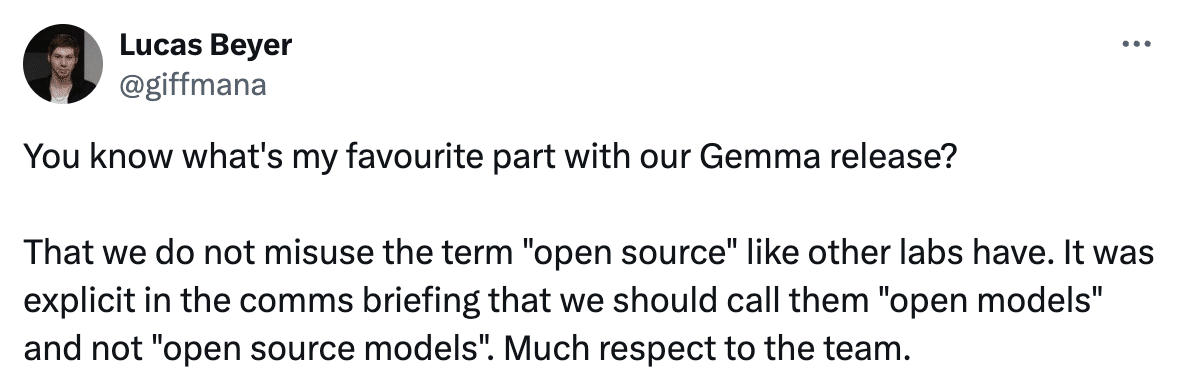
Before you assume that Google has finally embraced the open-source route, let us clear the air for you – Gemma is not an open-source model; it is an ‘open-model’ and there is a huge difference between the two.
In the official blog post of Google Gemma, the company has strategically termed it as the new state-of-the-art ‘open models.’ These lightweight SOTA models are said to be built from the same research and technology used for creating the Gemini models. “Open models feature free access to the model weights, but terms of use, redistribution, and variant ownership vary according to a model’s specific terms of use, which may not be based on an open-source licence,” stated the company blog.
Released in two sizes, 2B and 7B, the models outperforms Llama 2, which is Meta’s open source model, on several benchmarks including MMLU, HellaSwag and HumanEval. However, Llama 2 is completely open-sourced unlike Gemma.
Tweet by a researcher at Google DeepMind. Source: X
Open Model Benefits Google
Author and AI advisor, Vin Vashishta spoke about the critical difference between open model and open source which can have large implications for open source LLMs. “The open model paradigm means the weights are made public, but significant constraints on model usage limit what developers can build,” he said.
Through Google’s open model, developers can get access to the weights, but the new licence will give Google control over how Gemma is used. There is also an additional risk for developers building on open models such as Gemma. Google can decide to impose charges for a unique application built by developers and if that directly rivals Google’s offerings, the company has the potential to restrict its use entirely.
While maintaining semi-control over what people build using Gemma, the open model approach will enable Google to monetize it more effectively than it could with an open-source model. Vashishta also cautions on setting a precedence to other big tech companies to follow a similar model which can negatively affect the open source LLM community in terms of transparency and innovation.
Bigger Picture
When big tech companies such as Microsoft are partnering with key players such as OpenAI to mutually benefit each other, Google has also selected a similar path to take on its opponents. The company has partnered with emerging AI companies such as Anthropic, and has leveraged the latest generation Cloud TPU v5e chips for AI inference.
Google Cloud recently partnered with Hugging Face, an open source community, to allow developers on the platform to utilise Google Cloud’s AI-optimised infrastructure such as Vertex AI, TPUs, GPUs, and other compute resources.
With Gemma, Google is expanding its plans to further improve strategic partnerships, and slowly position itself as an indispensable player in the AI developer community. Interestingly, Google collaborated with NVIDIA to launch Gemma. The companies partnered to enhance Gemma’s performance using NVIDIA’s TensorRT-LLM library, which is designed to optimise LLM inference tasks.
Furthermore, Gemma is available on the Perplexity platform too. Ironically, AI-powered answer engine Perplexity is competing with Google.
Responsible AI
Gemma’s open model structure also grants control to Google in terms of safety, something the company has long advocated for. “We have a long history of supporting responsible open source & science, which can drive rapid research progress, so we’re proud to release Gemma,” said co-founder and CEO of Google DeepMind, Demis Hassabis.
In support of responsible technology, Google has been promoting ‘Responsible AI’, a key focus of the company as previously highlighted by Google chief Sundar Pichai. “What matters even more is the race to build AI responsibly and make sure that as a society we get it right,” said Pichai. Gemma has also been packaged with the responsible tag.
Google specifically mentioned that the models are released in accordance with Google’s AI Principles, whereby they are unveiled only after determining the benefits to be significant and the risks of misuse to be low. Gemma is no exception.
Open- Source Persists
By releasing an open model and adhering to the ‘responsible AI’ approach, Google is attempting to position itself alongside other major tech companies such as Meta that have open-source models. However, Google is not new to the open-source approach.
Google’s biggest open-source projects such as Android and Chromium have revolutionised access to mobile and web technologies. Similarly, their AI models such as Transformers, which forms the base for LLMs (including ChatGPT), TensorFlow and AlphaFold, are all open source models.
With Gemma, Google is trying to dip its feet in all ‘open’ waters, but also being wary of not going all in.
The post Don’t be Fooled by Google Gemma’s ‘Openness’ appeared first on Analytics India Magazine.
HCLTech and Intel Foundry have announced their decision to expand their collaboration to co-develop silicon solutions to improve semiconductor innovation globally. This partnership will leverage HCLTech’s design expertise and Intel Foundry’s advanced technology and manufacturing capabilities.
The goal is to establish a resilient and diversified supply chain to meet the rising global demand for semiconductor manufacturing. This collaboration will offer semiconductor manufacturers, system OEMs, and cloud services providers a robust ecosystem for semiconductor sourcing. Additionally, the collaboration has the potential to spur innovation by enabling the design of customised silicon solutions tailored to specific use cases.
“Intel Foundry’s advanced technologies and silicon-verified IPs in manufacturing and advanced packaging strengthens our delivery of innovative, accessible and diverse solutions to our mutual clients. This will also give them greater choice and flexibility in semiconductor sourcing,” said Vijay Guntur, President, Engineering and R&D Services, HCLTech.D
HCLTech has been collaborating with Intel for over 30 years, a relationship that has evolved through shared offerings and joint investments in various sectors, including silicon services, hardware engineering, telecom services, and more. The current focus is on jointly designing highly customised silicon solutions for companies, combining HCLTech’s design expertise with Intel’s manufacturing capabilities.
This expanded collaboration is set to further strengthen their partnership by fostering a strong and open ecosystem beneficial for clients requiring advanced silicon solutions.
Intel also announced that it has signed Microsoft as a foundry customer for a custom chip. This deal is part of Intel’s plan to overtake TSMC using its Intel 18A and upcoming 14A manufacturing technologies. The 18A, a 1.8nm technology, is set for early 2025 and will be used for future CPUs in both consumer and data centre markets. The 14A, planned for late 2026, will introduce a more advanced lithography tool for smaller and more efficient chips.
Together with its collaboration with HCLTech to develop customised silicon solutions, Intel aims to meet the growing demand for semiconductors.
The post Intel’s Collaborations for Advanced Semiconductor Manufacturing appeared first on Analytics India Magazine.
Sarvam AI has released “samvaad,” a new open-source series of carefully curated India datasets. This release includes 100,000 high-quality, multi-turn conversations, totaling over 700,000 turns, in English, Hindi, and Hinglish.
These datasets have been thoughtfully curated with an exclusive focus on an Indic context and are now accessible on Hugging Face. For developers and enthusiasts operating within the Indic space, this announcement promises valuable resources, with the potential for more exciting releases in the near future.
Sarvam AI, in collaboration with Hugging Face, invites the community to stay tuned for forthcoming updates. To engage with the community and explore these datasets further, Sarvam AI encourages interested parties to join their Discord channel at https://lnkd.in/eXCbKTF5.
Sarvam AI recently partnered with Microsoft Azure to make its Indic voice large language model (LLM) available on Azure. Sarvam AI is building generative AI models targeting Indic languages and contexts. The startup aims to make the development and deployment of generative AI apps in India more accurate and cost effective.
Sarvam AI’s Indic voice LLM aims to offer a natural voice-based interface to language models (LLMs) and will initially be available in Hindi. Sarvam AI is actively working to expand coverage to include more Indian languages while ensuring support for colloquial language use.
Sarvam AI recently released OpenHathi-Hi-v0.1, the first Hindi LLM in the OpenHathi series. Developed on a budget-friendly platform, the model, an extension of Llama2-7B, boasts GPT-3.5-like performance for Indic languages.
The Bangalore-based startup also raised USD 41 million in a Series A funding round led by Lightspeed and supported by Peak XV Partners and Khosla Ventures. Sarvam’s objective is not just to build open-source Indic LLMs but to develop a platform and help build AI-powered applications that can be deployed at a population scale.
The post Sarvam AI Releases Indic Dataset ‘Samvaad’ appeared first on Analytics India Magazine.
Founder and CEO of Perplexity AI Aravind Srinivas, who had briefly changed his name to Aravind ‘Bhai’, following a friendly banter with Carl Pei, the co-founder and CEO of Nothing, has been on a social media engagement spree. This was noticed ever since the company raised over $70 million this January, from investors, including big tech giants such as NVIDIA, Jeff Bezos, and others.
Leaping Ahead of OpenAI
A relatively new entrant, Perplexity AI has been working its way through user adoption. After publicly launching in 2023, Perplexity has over 10 million monthly active users with over 1 million users from India alone.
While ChatGPT reached 1 million users within a week of its launch, and now has around 180.5 million users, it is not fair to compare both the platforms, considering OpenAI had a first-mover advantage.
Way Through Collab
The AI-powered answer engine that is going against some of the biggest tech players including OpenAI, Microsoft and Google, has been making strides in collaborations with strategic partners.
Recently, Srinivas confirmed that Perplexity will partner with Sarvam AI and similar other startups that are building large language models suited for India’s linguistic background. He believes that such partnerships will mutually benefit both parties, with Perplexity AI utilising the startup model and, in return, providing a large user base to them.
Last week, Srinivas announced a partnership with Slack, the communication and messaging platform for organisations. Through ‘Perplexity Push’ bot, Slack users will be able to get real-time updates, summaries and sources in their workspace.
Perplexity has also been building strategic partnerships with hardware providers. Last month, Perplexity announced its pplx-online LLM APIs to power Rabbit R1, an AI-powered gadget that uses a large action model (LAM).
Interestingly, with the ongoing tweet exchanges between Srinivas and Pei, a possible partnership between the AI engine and the phonemaker looks likely.
Search by Default
While Google is busy with its latest most-powerful AI model Gemini Pro 1.5, and renaming its AI chatbot, they also seem to care less about Perplexity. “We are the only ones doing it in a way where users not only look at AI summaries but also care about the richness and diversity on the web,” said Google chief Sundar Pichai. However, that hasn’t deterred Perplexity from following its goal. The company is going about convincing service providers to make it as their default search option.
Last month, Arc Browser, a web browser developed by The Browser Company, announced that Perplexity can be set as the default search engine on its browser.
Source: X
Cami.ai, an AI assistant that can provide answers, images and transcribe audio, announced that they would be using Perplexity AI for providing all up-to-date information. Perplexity is also supporting browsing for Superagents AI, a platform for running AI agents with an API.
Superior Brand Packaging Through X
Apart from Srinivas being active on X giving his two cents on new announcements, including Gemini Pro 1.5, he has also been sharing various outputs of Perplexity AI that surpassed Google. By pushing such content, Srinivas is packaging Perplexity as a better AI tool than its competitors. He also did not miss the chance to take a dig at Google’s chatbot without taking names and chimed into the OpenAI Sora debate as well.
Source: X
When Andrej Karpathy left OpenAI, Srinivas was quick to post about Perplexity’s Push Notifications feature, which will aid one to be updated with the latest news. Similarly, he even spoke about the superior quality of curated news on Perplexity, which he claims “is better than X on some days”.
Ironically, Perplexity, which cannot generate images at the moment, still has a long way to go in order to catch up with Elon Musk’s X platform. In a recent interview, Musk has confirmed that he is in serious talks with Midjourney. The partnership will possibly bring the text-to-image generation tool to X’s AI platform Grok.
Srinivas also spoke about the possibility of X using all the videos of the platform to build something similar to Sora, a feature that is also not available on Perplexity AI. While Perplexity may lack some of the advanced features found on other major tech platforms, such as ChatGPT, Copilot, or Gemini, its demonstrated growth and marketing strategies position it as a promising contender in the AI-engine arena.
The post So Far, So Good for Arvind Bhai and Perplexity AI appeared first on Analytics India Magazine.
In its first half of the FY24 report, Commonwealth Bank of Australia announced that, through “responsible scaling of AI,” it has already produced more than 50 generative AI use cases. The bank says that it will simplify operational processes and support new customer experiences.
Beneath that dry language, it’s worth paying attention to what CBA is doing with AI because it remains the trendsetter with technology, and its experiments with AI are likely to be transformative, particularly with regard to how banks can deliver personalisation and better understand and respond to the behaviour of their customers.
What established CBA as a leader in technology
In April of 2008, Commonwealth Bank of Australia announced that it was embarking on a AUD $580 million (USD $379.32 million) four-year program to modernise its legacy core banking and then start to be able to introduce some new features. This project was one of the earlier examples of a major digital transformation project among financial services organisations.
PREMIUM: Download this free guide on the top Fintech predictions for 2024.
This was driven by a desire to deliver IT services to customers, as then CIO Michael Harte said at the time.
“Commonwealth Bank has always strived to change the way that it delivers IT services. This effort has redoubled to gain advantage in the past seven years,” Harte said. “We have modernised our infrastructure by rolling out a new data IP network, building a new IP telephone network, modernising our mainframes, consolidating our data centres from 23 down to two and introducing security and privacy solutions. And of course, we undertook to modernise our core banking platform.”
An early example of the innovation that came from that was CBA’s ability to be the first bank to launch an EFTPOS solution that allowed it to own a direct relationship with merchant customers and their payments.
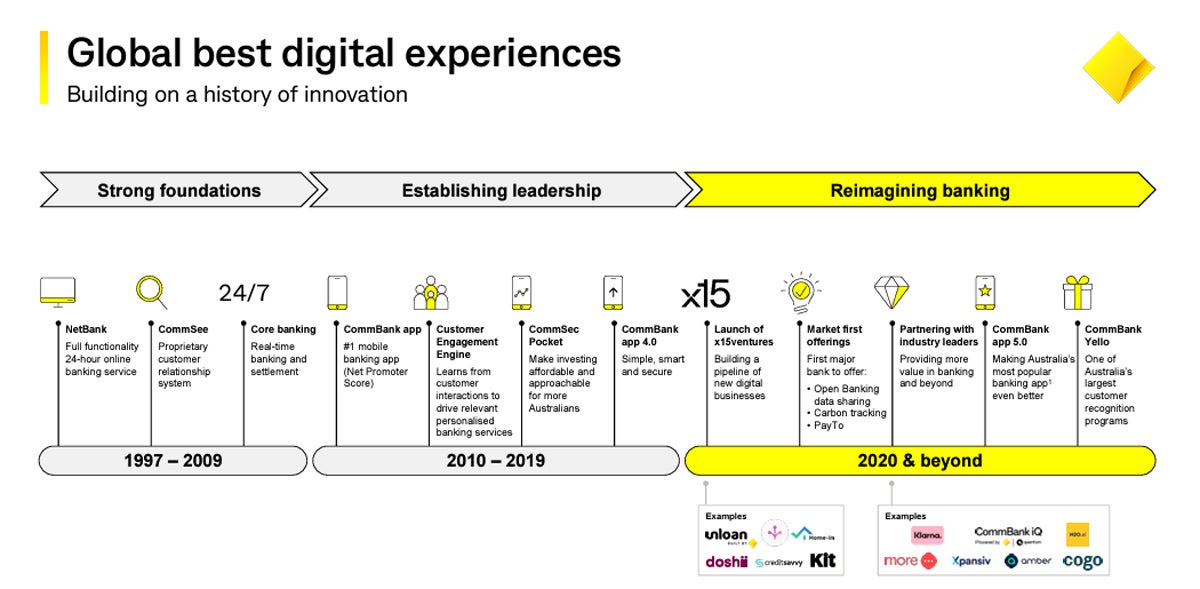
Looking forward, the company has an ongoing commitment to investing in digital, with “market first offerings” being an explicit goal (Figure A).
Figure A: A timeline of CBA’s technological innovation. Image: CBA
What is CBA doing with AI?
Commonwealth Bank of Australia’s market report highlighted three goals for the company with AI:
Utilise AI to deliver personalised customer experiences. CBA noted that there has been a 66% increase in customer engagement through the CommBank app.
Responsible scaling, which has to date resulted in more than 50 generative AI use cases to simplify operational processes and support the bank’s frontline in customer service.
Upskilled over 500 staff on AI tools, which in turn allows the bank to democratise the responsible use of AI across the organisation.
Chasing these goals led to CBA launching the CommBank Gen.ai studio in mid 2023. One of the first applications of that, which it announced at the 2023 South by Southwest, was to examine how well generative AI chatbots can not only provide the information a customer is looking for but also emulate their behaviours.
As CBA Chief Decision Scientist Dan Jermyn said at the time, “We’re using this advanced technology to explore creating customer personas or ‘synthetic agents’, where GenAI chatbots act as an early experimentation tool.”
AI delivering a new frontier of personalization
This has the potential to deliver extreme personalization. As CBA CEO Matt Comyn said in a call to discuss the results with analysts, early examples of that have been positive. Commonwealth Bank of Australia had, for example, used its AI-supported customer engagement engine to make personalised pricing offers to home loan customers, coming off a fixed-rate loan, in real time.
SEE: Australian organisations are working to balance personalisation and privacy.
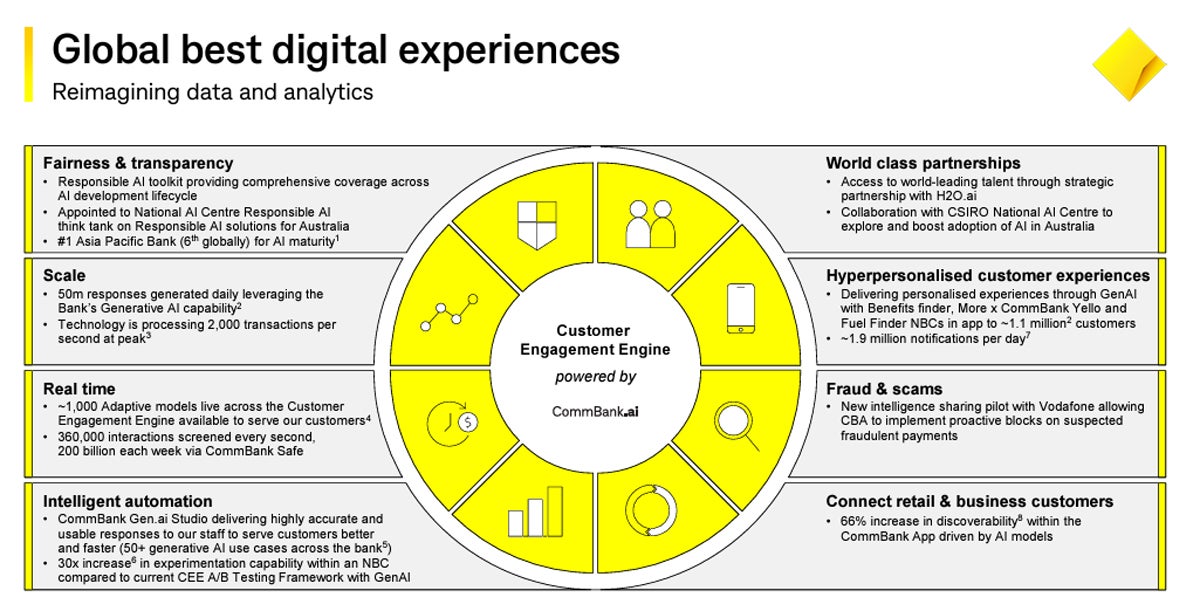
Overall, CBA expects AI to enhance its CEE across several different categories, including scale, fairness and transparency, the ability to combat fraud and scams, and better connection with retail and business customers (Figure B).
Figure B: The eight areas where CBA sees AI impacting banking. Image: CBA
How CBA Is Bringing AI And Customer Engagement Together
It’s easy to forget that this current wave of innovation around AI is relatively new, and generative AI has only really become a mainstream concept over the last 18 months. Commonwealth Bank of Australia was one of the first to embrace that, and while there’s a lot of innovation that will come from AI that we’ve not yet conceptualised, what CBA does with its tools will be monitored by financial services across the world.
Most significantly, CBA’s efforts in innovation generally are precision-focused on delivering outcomes for customers, and AI is following trends there. The bank is also focused on building knowledge and capabilities across the market.
As noted in KPMG analysis of Commonwealth Bank of Australia’s successes:
“First, they spend significant time and effort listening to their customers. Some of that ‘listening’ is done by the machine learning algorithms running in the CEE. But CBA is also keen on human-to-human listening. The bank’s efforts to create dynamic partnerships has also helped them move ahead. Not just by adding innovative models and services, but also by helping the business develop, innovate and co-create.”
In short, it’s important to keep a close eye on what CBA is doing with AI because it’s likely that its experiments now will become standardised approaches to generative AI in financial services in the future.
Loora wants to leverage AI to teach English Kyle Wiggers 23 hours
Of the professions in danger of being replaced by AI, language teacher is certainly up there.
That’s not necessarily because it’s a good idea. AI, some employers have decided — including Duolingo, recently — is a reasonable enough stand-in for human experts when it comes to language instruction. Despite the fact that AI-translated text tends to be less lexically rich than human translations, the cost savings are attractive enough to make the trade-off worth it in certain managers’ minds.
But some companies argue that AI can do at scale what language teachers can’t.
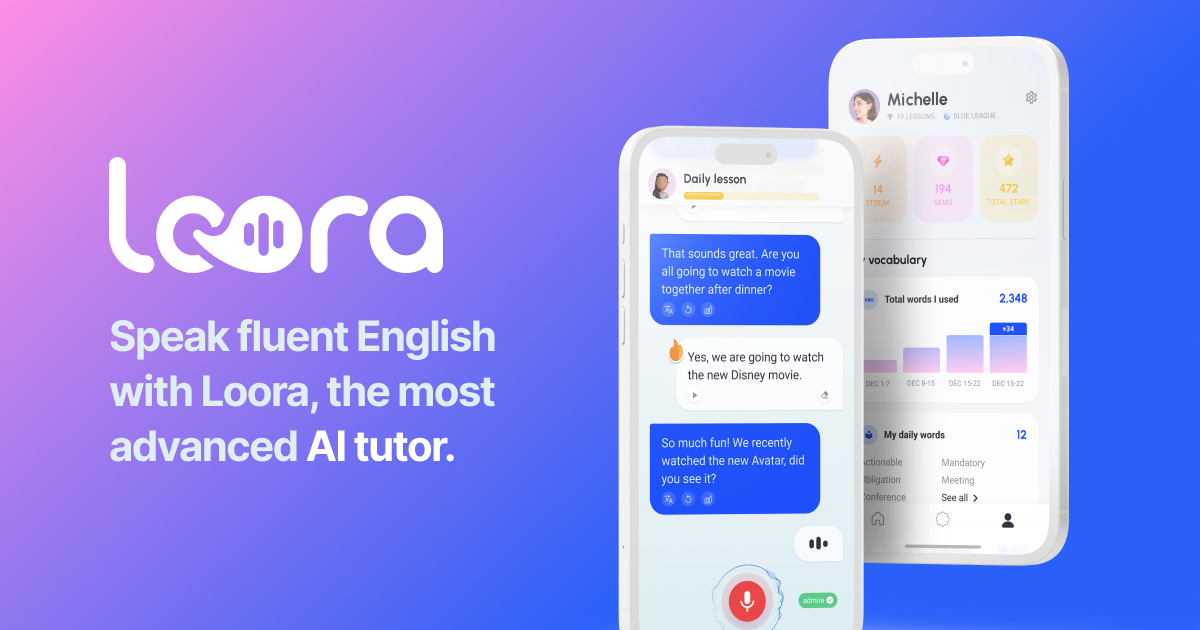
One of those is Loora, which leans on conversational AI to teach English to students. Founded by Roy Mor and Yonti Levin, Loora’s iOS app has users chat with a chatbot that gives feedback on their English comprehension.
“The idea for Loora [came from] our frustration with language learning,” Mor told TechCrunch in an email interview. “Language learning apps are only geared toward beginners or casual learners, and human tutors are very expensive, inconvenient and have limited availability.”
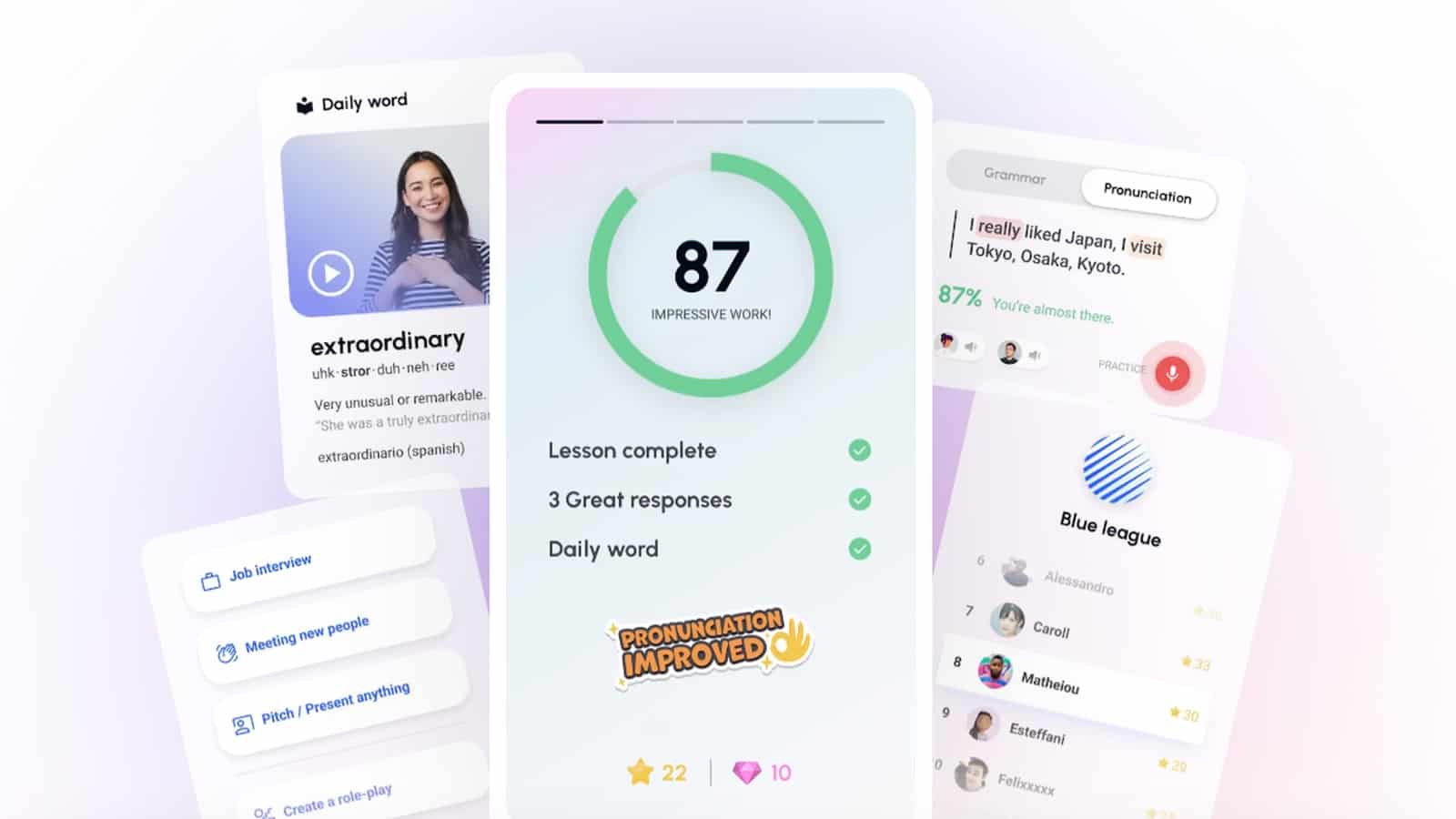
Loora, whose namesake is the Arabic word for “language,” offers learners several AI-generated conversation subjects and scenarios to choose from, from sports, tech, business, fashion, books and TV shows to interviews and presentations. The app provides feedback on grammar as well as pronunciation and accent, and — if users get stuck — a direct translation in their native tongue.
Image Credits: Loora
Loora scores users on their proficiency over time and employs this score to personalize conversations at their speaking level.
Quite a few English learning platforms offer features along those lines, including OpenAI-backed Speak, Preply (which recently doubled down on AI tech) and ELSA. But Mor claims that Loora’s different in that it’s aimed at “serious learners” trying to achieve fluency in English for personal and professional advancement.
“Most other language learning apps on the market are limited and gamified,” Mor said. “Loora has built, trained and optimized its AI for the sole purpose of enabling users to achieve English fluency — far beyond casual conversational skills . . . We only use our own data and bespoke training and evaluation system for training and optimizing our models, resulting in continuously-improving retention.”
Mor makes the additional case that Loora is a better fit versus other apps and tutors for specific language learning use cases — for example, pitching ideas in a business meeting. Tutors, he asserts, are limited by their domain knowledge — a limitation Loora’s app doesn’t have (or so Mor claims). And speciality tutors are likely to be in higher demand than general, all-around ones, Mor adds.
“Say a learner is interested in learning to discuss business concepts at a high level for work purposes,” Mor said. “If the tutor is unfamiliar, despite being a native speaker, they’ll be poorly suited to teaching English for that specific purpose.”
That’s promising a lot considering the limitations inherent in language education apps — particularly those without an element of human feedback.
In a Michigan State University study of the effectiveness of popular language learning apps, nearly every participant improved on grammar and vocabulary but only around 60% improved in oral proficiency — a common sticking point in digital language learning programs. The study’s authors concluded that a hybrid setup — one combining online and classroom learning — was the best approach for learning and retaining second language skills.
Loora assigns a score depending on the user’s perceived English proficiency. Image Credits: Loora
But this hasn’t dissuaded Loora’s investors, who might’ve been persuaded by the size of the total addressable English language learning market (over $70 billion by 2030, according to data analysis firm Research and Markets).
Loora today announced that it raised $12 million in a Series A round led by QP Ventures with participation from Hearst Ventures, Emerge and Two Lanterns Venture Partners — bringing Loora’s total raised to $21.25 million. The cash, Mor says, will be put toward funding the development of Loora’s Android app, “deepening” Loora’s core AI tech and conversational capabilities and expanding the startup’s workforce from 14 employees to 25 by the end of 2024.
Loora also intends to launch an enterprise service, broadening beyond its current customer base of 15,000 app users. (Loora charges $15 per month or $120 a year for access to its app.) While the startup’s consumer business has been expanding steadily — 8x in 2023, in terms of annual recurring revenue — Mor sees a growth accelerator in corporate clientele.
“Our planned business-to-business offering will see Loora available through employers, universities and institutions, making it increasingly accessible to those who want and need it most,” Mor said. “With [the Series A] fundraise, our efficient unit economics, growing customer base and the ever-present demand for English learning solutions, we believe we’re well positioned to weather any potential headwinds and continue to grow and serve our learners.”
Google launches two new open LLMs Frederic Lardinois @fredericl / 20 hours
Barely a week after launching the latest iteration of its Gemini models, Google today announced the launch of Gemma, a new family of lightweight open-weight models. Starting with Gemma 2B and Gemma 7B, these new models were “inspired by Gemini” and are available for commercial and research usage.
Google did not provide us with a detailed paper on how these models perform against similar models from Meta and Mistral, for example, and only noted that they are “state-of-the-art.” The company did note that these are dense decoder-only models, though, which is the same architecture it used for its Gemini models (and its earlier PaLM models), and that we will see the benchmarks later today on Hugging Face’s leaderboard.
To get started with Gemma, developers can get access to ready-to-use Colab and Kaggle notebooks, as well as integrations with Hugging Face, MaxText and Nvidia’s NeMo. Once pre-trained and tuned, these models can then run everywhere.
While Google highlights that these are open models, it’s worth noting that they are not open source. Indeed, in a press briefing ahead of today’s announcement, Google’s Jeanine Banks stressed the company’s commitment to open source but also noted that Google is very intentional about how it refers to the Gemma models.
“[Open models] has become pretty pervasive now in the industry,” Banks said. “And it often refers to open weights models, where there is wide access for developers and researchers to customize and fine-tune models but, at the same time, the terms of use — things like redistribution, as well as ownership of those variants that are developed — vary based on the model’s own specific terms of use. And so we see some difference between what we would traditionally refer to as open source and we decided that it made the most sense to refer to our Gemma models as open models.”
That means developers can use the model for inferencing and fine-tune them at will and Google’s team argues that these model sizes are a good fit for a lot of use cases.
“The generation quality has gone significantly up in the last year,” Google DeepMind product management director Tris Warkentin said. “Things that previously would have been the remit of extremely large models are now possible with state-of-the-art smaller models. This unlocks completely new ways of developing AI applications that we’re pretty excited about, including being able to run inference and do tuning on your local developer desktop or laptop with your RTX GPU or on a single host in GCP with Cloud TPUs, as well.”
That is true of the open models from Google’s competitors in this space as well, so we’ll have to see how the Gemma models perform in real-world scenarios.
In addition to the new models, Google is also releasing a new responsible generative AI toolkit to provide “guidance and essential tools for creating safer AI applications with Gemma,” as well as a debugging tool.