Sam Altman Couldn’t Escape What He Hates: Ads

Fidji Simo comes with a very particular set of skills.

At Facebook, she led the team that monetised mobile and turned the News Feed into an advertising machine—now the app’s primary revenue source.

As CEO of US grocery delivery platform Instacart, she drove the company’s advertising model to 5,500 brand partners. The campaigns delivered an average 15% incremental sales lift, a figure Sequoia Capital called “almost unheard-of”.

When OpenAI announced in May 2025 that Simo would join as CEO of Applications, the writing was on the wall.

The Inevitable Turn

In January, OpenAI announced that it would run advertisements in ChatGPT’s free and lower-priced Go tiers. The move represents a stark reversal for a company whose CEO, Sam Altman, once called advertising in AI products “sort of uniquely unsettling to me” and “a last resort”.

"I kind of think of ads as like a last resort for us as a business model," – Sam Altman, October 2024 https://t.co/BWHiXPlVFD pic.twitter.com/dw2ywE1pYi

— Tom Warren (@tomwarren) January 16, 2026

This decision comes amid mounting financial pressure. Despite massive revenue growth, OpenAI continues to burn cash at an alarming rate. The AI giant burned $2.5 billion in the first half of 2025, largely due to R&D costs.

This raises concerns about long-term sustainability beyond API pricing and Pro and Plus subscriptions. Currently, around 5% of users have subscribed to the $20 Plus or the $200 Pro versions of ChatGPT, according to The Information. Some analysts even suggested the company could exhaust its reserves within 18 months.

But OpenAI has made assurances.

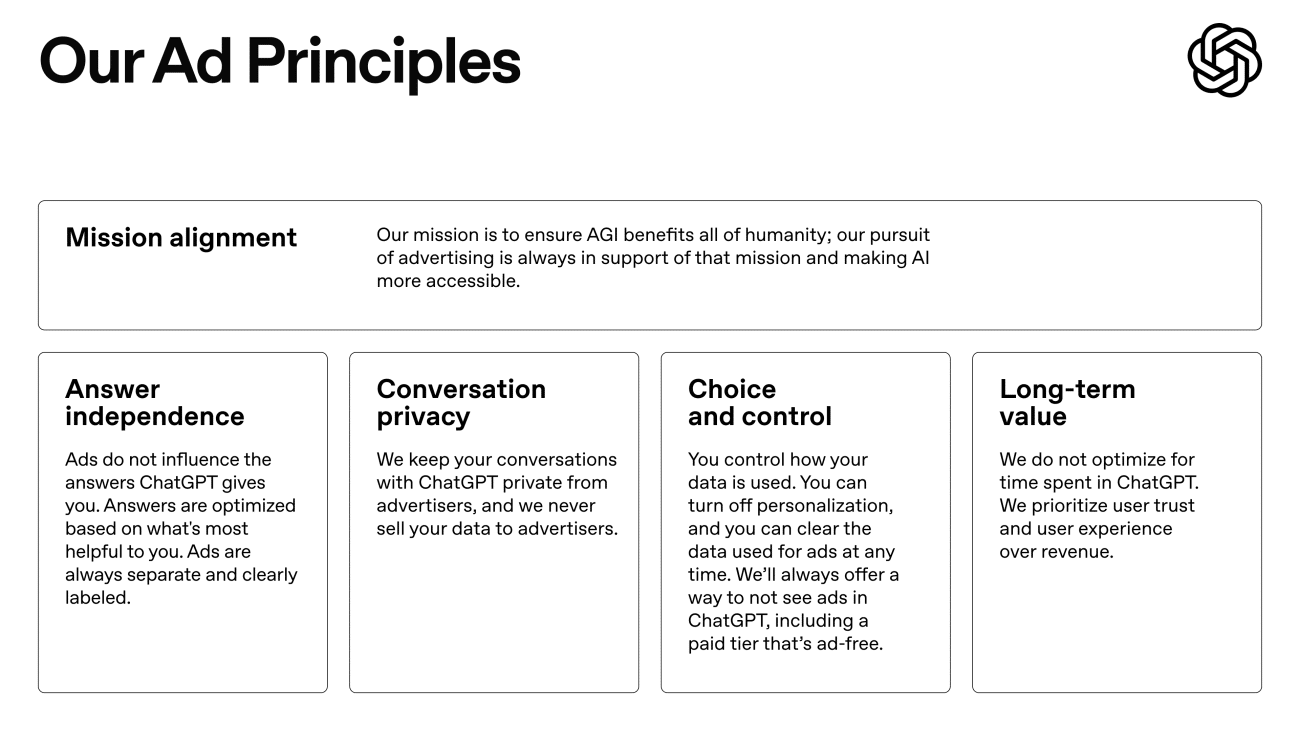
Ads will be clearly distinguished from responses; users can dismiss them, they will not appear in conversations about sensitive health or political topics, and the company will not sell private conversations. Users will retain control over optional data sharing. However, the company has not yet revealed its ad providers or the full mechanics of the system.

“Advertising has been a proven model,” Leslie Joseph, principal analyst focusing on AI at Forrester Research, tells AIM.

Meta accumulated roughly 3.4 billion daily active users by early 2025, and its ad revenue crossed $160 billion in 2024. In 2024, Google’s advertising business (through parent Alphabet) generated about $265 billion in ad revenue globally.

OpenAI currently has around 800 million users, with the number expected to cross one billion soon.

“A path to generating several billion dollars in ad revenue in 2026, going to $25+ billion by 2030, seems reasonable,” Mark Mahaney, senior managing director who heads Evercore’s Internet research team, wrote in a Deutsche Bank report.

The Privacy Paradox

While the ad revenue may pave the path to a smoother public listing, it nonetheless evokes concerns over what user data will be accessible to advertisers.

“The question is—how prevalent will OpenAI be around areas like user profiling and data retention?” Joseph ponders. “The fact that people are using ChatGPT and confiding in it in a much more personal way than they were ever doing so with any other form of social media places a lot of responsibility on OpenAI.”

Several users on social media have raised concerns about the tool’s privacy policy. While OpenAI has explicitly stated that it would “never sell data to advertisers”, it also specified that ads will appear “based on your current conversations”.

One privacy researcher posted on X that OpenAI’s claim that ads will not influence the answers it gives you is “unverifiable”. “ChatGPT isn’t open source. There’s no independent audit,” he said.

He pointed to another ambiguity: OpenAI collects the very prompts and other content that users upload to improve and develop its services, but it is unclear whether that data will be used to customise advertisements.

“Their ad principles also state you can ‘turn off personalisation’ and ‘clear the data used for ads at any time’. This means they’re storing ad personalisation data by default. Advertisers don’t need to see your raw conversations. OpenAI builds the targeting internally,” he stated.

However, Gemini is following a markedly different approach to ads.

In a recent interview with Business Insider, Dan Taylor, VP of global ads at Google, explained why it is deliberately holding back on ads in Gemini. Taylor argued that advertising works best in environments designed for commercial discovery, like search, where users are actively looking for products or services. Gemini, by contrast, is positioned as an assistant for creating, analysing, and problem-solving—contexts where ads risk feeling conceptually out of place.

He also noted that user interaction with AI assistants has been a relatively recent phenomenon and that they are not yet ready for ads that could be intrusive and potentially damaging to trust. Ads only make sense much later in the intent arc.

Another concern is how it might drive the wrong incentives for OpenAI to improve engagement, whether through the number of responses or the response length.

AIM reached out to OpenAI for more clarity, but the queries went unanswered.

The Marketing Opportunity

For business and marketing professionals, however, this opens up a whole new avenue.

Sumukh Rao, a marketing professional from Bengaluru who has worked with popular D2C brands, tells AIM, “Brands with fat marketing budgets will appreciate the move, since they can now diversify their resources across platforms instead of being overly reliant on the duopoly of Meta and Google.”

Rao also underlines the challenge that OpenAI will have to navigate in distinguishing organic results from ads.

Supreeth Kashyap, founder of Wellbi, a D2C clothing brand in India, adds, “Over the last few years, we have reached a saturation in the return on ad spend on platforms like Meta. So ChatGPT is a good, additional avenue to diversify our marketing investments on.”

OpenAI has also integrated various shopping features, such as in-chat buying called “Instant Checkout”, where users ask for a product on ChatGPT and the platform returns relevant products with prices and buy buttons. Joseph suggests that ChatGPT could now create an end-to-end commerce platform—enabling purchases directly within the chat, then using that sales data to work backwards through the customer journey.

By tracking which ads led to actual purchases, OpenAI could refine its targeting and optimise every touchpoint from initial impression to final sale, monetising the entire funnel for advertisers and sellers.

“This isn’t the standard tactic that everybody has done, so it places a huge onus on OpenAI to make sure that they prove that the systems that they are building are trustworthy, respectful of customers’ privacy and identity, and are traceable, trackable, and explainable,” he adds.

Source: Bryan Kim, X.

Beyond individual brand strategies, however, lies a structural truth about platforms at scale.

Eric Seufert, an analyst, shared in a memo online that despite how it is “tempting to view” ads as a “user-hostile product design choice”, it was inevitable. “Direct response advertising is the only business model that has reliably proven capable of sufficiently and optimally supporting a digital consumer product at humanity scale,” he said.

So even though Altman may not want ads, he needs them to address the cash burn. “If I were Sam Altman, I would be experimenting with every single possible option to monetise ChatGPT,” remarks Joseph.

I’m impressed that OpenAI is being this upfront about the ads
They’re eating ~35% of the available screen with ad space, it took Google decades to get to that level of ad saturation pic.twitter.com/6XrM8fY1nE

— Chris Frantz (@frantzfries) January 16, 2026

The Timing Question

But even acknowledging their inevitability, the question remains: has OpenAI waited three years too long to tap this revenue stream?

This isn’t a concern for a company like Google, where revenue from Gemini can be offset by the colossal share of profits it earns from its other divisions. Nor is it a concern for Anthropic, whose core focus has been enterprise AI solutions andis already reportedly on track to break even and turn a profit in the coming months.

A few days before OpenAI announced ads—when there were speculations about how and when they would do it—AIM had spoken to multiple analysts and VCs about whether OpenAI was too late to the game.

“Implementing ads is a function of how much adoption you want and how much friction you can reduce. So long as everyone’s okay being able to raise enough money, not having to worry about revenue, ads would not come,” said Jasnoor Gill, director of India investments at Antler, in an interaction with AIM.

He stated that the delay might be to prevent user loss. “Maybe no one wants to be first because they’re afraid of losing users,” he said.

In one sense, OpenAI isn’t introducing anything unique. But its survival may depend on it.

The post Sam Altman Couldn’t Escape What He Hates: Ads appeared first on Analytics India Magazine.

Bengaluru Voice AI Startup Bolna Grabs $6.3 Mn to Enhance Vernacular Calls

Bengaluru-based voice AI startup Bolna has secured $6.3 million in a seed funding round led by General Catalyst.

This funding round also featured participation from Y Combinator, Blume Ventures, Orange Collective, Pioneer Fund, Transpose Capital, and Eight Capital, as well as angel investors Aarthi Ramamurthy, Arpan Sheth, Sriwatsan Krishnan, Ravi Iyer, and Taro Fukuyama, among others.

The startup will use the fresh capital to enhance its engineering and deployment teams, invest in its own AI and machine learning technologies to facilitate vernacular voice interactions, and bolster enterprise-level infrastructure to support large-scale production deployments.

Since its initial commercial launch in May 2025, Bolna has grown from managing approximately 1,500 calls per day to over 200,000, it said in a statement. The company now boasts more than 1,050 paying customers across industries such as e-commerce, BFSI, logistics, recruitment, and education.

Bolna serves a diverse range of clients, including large companies like Varun Beverages and startups such as Spinny and Snabbit. The startup enables high-volume voice processing as well as specialised, voice-dependent sectors such as travel and matrimonial services, where multilingual voice interactions are the primary mode of communication.

In September, Bolna was accepted into the Fall 2025 cohort of Y Combinator.

“The biggest thing to happen to Bolna as soon as we entered YC was gaining confidence in building for India. We spoke to alumni and successful founders who followed their gut and took well-calculated risks, without worrying about what investors or industry experts might say,” Maitreya Wagh, founder and CEO at Bolna, told AIM.

Bolna’s orchestration layer enables businesses to run voice AI systems in multiple languages and scenarios on a single platform. Designed for high-volume telephony, it helps maintain consistent performance as call volumes grow.

“Earlier, we thought a self-serve tool would be used only by indie developers and growth-stage startups. We changed our focus to building a product that can be used even by veterans, CXOs and PMs at large Indian enterprises who may not have prior experience with AI or prompting,” Wagh added.

The company has focused on hiring forward-deployed engineers to train key decision-makers in developing and managing voice AI agents. This initiative has led to launches with two publicly listed companies and pilot programmes with five others.

Its monthly revenue increased from $20,000 in September to $56,000 by December 2025, the statement said. The enterprise pipeline is projected to reach $3 million in annual recurring revenue (ARR) in the coming months, and with more enterprises on board, the company aims to achieve its 2026 ARR target of $5 million by June.

The post Bengaluru Voice AI Startup Bolna Grabs $6.3 Mn to Enhance Vernacular Calls appeared first on Analytics India Magazine.

Sensesemi Bags ₹25 Cr Seed Funding to Build Edge AI Chips

Sensesemi Technologies has raised ₹25 crore in a seed funding round to accelerate the development of its edge AI chip architecture for industrial IoT, automotive systems, and medical devices.

The Bengaluru-based, DLI scheme-approved fabless semiconductor startup addresses on-device processing needs where power efficiency and real-time performance matter.

The round was led by Piper Serica, with participation from LetsVenture Angel Fund, Sun Icon Ventures, MyAsiaVC, Whitepine Investments, REAN Foundation, and Jain Oncor, along with angel investors including Niraj Shah and Deepak Khanna.

Sensesemi plans to use seed capital to advance its first system-on-chip designs and move towards commercial deployments over the next few years. The funding will also support product development, chip tape-outs, team expansion, and partnerships with device makers.

In an exclusive interaction with AIM pre-funding, Vijay Muktamath, founder and chief executive officer of Sensesemi, said his background in analog and RF design shaped the company’s direction. “Most implantable devices or chips are always analog in nature,” he said, referring to his work on a retinal implant project in Australia.

“Our approach is vertical integration of these functions on a single chip to reduce system complexity and power consumption,” he said, adding that customers also seek “secure, reliable supply chain access.”

Alongside its digital architecture, Sensesemi is developing an analog AI inference processor aimed at battery-operated and implantable devices. “Analog-domain AI inferencing allows us to achieve dramatic improvements in power efficiency,” said Namit Varma, the company’s co-founder and head of engineering, pointing to applications such as medical implants and industrial sensors.

Muktamath said capital availability remains a challenge for chip startups in India. “Ten years back, the funding was never available for any of the hardware, forget about the chip side of things,” he said, adding that the DLI scheme helped change the environment.

Commenting on the investment, Piper Serica founder and fund manager Abhay Agarwal said India’s semiconductor market could cross $100 billion by 2030, and that companies with strong chip design capabilities would create long-term value.

The post Sensesemi Bags ₹25 Cr Seed Funding to Build Edge AI Chips appeared first on Analytics India Magazine.

VDURA Introduces Flash Volatility Index and Storage Economics Optimizer Tool

DOE Seeks Input on Advancing AI for Science and Engineering Workforce Development and Genesis Mission Challenges

Jan. 20, 2026 –The Department of Energy (DOE) has announced a Request for Information (RFI)…

San Francisco AI Startup Emergent Secures $70 Mn Series B Funding to Grow Its Team

San Francisco-based AI startup Emergent has secured $70 million in Series B funding from Khosla Ventures and SoftBank Vision Fund 2, along with contributions from Prosus, Lightspeed, Together, and Y Combinator.

Since its launch seven months ago, Emergent has raised $100 million in funding. The company has over 5 million users across more than 190 nations, Emergent said in a statement.

It will use the funding to support ongoing team growth, enhance product development, and facilitate entry into new markets as demand for AI-driven software development rises among entrepreneurs and small businesses worldwide.

“Software creation is undergoing a structural shift,” Mukund Jha, co-founder and CEO of Emergent, said in a statement. “It used to be that only people with technical training or capital got to turn ideas into real products. Emergent flips that model. We are seeing millions of people build and ship real businesses, workflows, and products in days.”

Since its establishment, Emergent has achieved $50 million in annual recurring revenue (ARR) and the company projects to exceed $100 million in ARR by April 2026.

“Emergent is harnessing AI to unlock a massive wave of entrepreneurship by removing the technical and capital barriers that have historically limited who can build software,” said Sarthak Misra, partner at SoftBank Investment Advisers.

Emergent has secured Series B funding three months after completing its Series A round. This new funding round follows support from Google and marks SoftBank’s return to investing in AI companies in India.

The startup provides a complete development team that quickly designs, builds, tests, and scales reliable software at a lower cost. Entrepreneurs can transform ideas into revenue in hours with production-quality software ready for launch and integrated with billing providers like Stripe.

The post San Francisco AI Startup Emergent Secures $70 Mn Series B Funding to Grow Its Team appeared first on Analytics India Magazine.

DOE Seeks Input on Advancing AI for Science and Engineering Workforce Development and Genesis Mission Challenges

VDURA Introduces Flash Volatility Index and Storage Economics Optimizer Tool

MILPITAS, Calif., Jan. 20, 2026 — VDURA today announced the release of the Flash Volatility Index and Storage…

Inside IAIRO, India’s ISRO for AI

On December 30, last year, the Gujarat government approved something India has been debating for more than a decade, but never quite managed to build: a serious national AI research institution. The Indian AI Research Organisation (IAIRO) began operations on January 1 as a Section 8 non-profit inside the GIFT City in Gandhinagar.

Despite the low-key launch, the intent is anything but small.

IAIRO is being set up as a public-private partnership between the state government, the Indian government through the IndiaAI Mission, and the Indian Pharmaceutical Alliance (IPA).

For the first five years, IAIRO will operate on a budget of roughly ₹300 crore, split equally between the state, the Centre, and the private partner. IPA alone is putting in ₹25 crore in the first year. The pharma group includes companies like Cipla, Torrent and Sun Pharma.

This is not a startup incubator. It is not a skills programme.

IAIRO is being positioned as a national research institution for AI, closer in spirit to ISRO than to anything India has tried in software before.

The official note describes it as a multidisciplinary AI hub that will conduct research, build products, generate IP, train people, and work with industry and startups. It will run on a hybrid compute model, using its own GPUs along with India AI Cloud.

Not Just About LLMs

On paper, it could sound like another government AI centre. What makes it different is who is behind it and what they are trying to fix.

Amit Sheth, a professor of computer science and engineering at the University of South Carolina, who is leading IAIRO, has spent decades in AI research in the US. He said the idea did not start in Gandhinagar. It started two years ago in Delhi, in a meeting with Prime Minister Narendra Modi.

Sheth had taken the proposal for Ekagrid University that was being coordinated by Shail Kumar and involved some of the top AI leaders of Indian origin, for developing a world-class research university with an AI-first strategy. That plan did not go through. And the problem did not go away.

India produces a large number of AI users and service engineers. It does not produce frontier AI researchers or people who can build deep systems at scale.

Sheth is blunt about the gap.

“Jensen Huang has pointed out that nine of the world’s top 10 AI institutions are in China, over 70% of papers at leading AI conferences now come from China, and that supports ecosystems with deep research capability capable of producing organisations like DeepSeek. India currently lacks this depth. IAIRO exists to deliberately build it,” he said.

That sentence captures what IAIRO is really about. This is not about chatbots or coding tools. It is about whether India has the kind of research base that can create the next DeepSeek—not just use it.

An ISRO Moment for AI

From those early discussions, a position paper titled Sovereign AI for India’s Strategic Autonomy made its way to key decision-makers, including S Krishnan, secretary at MeitY; Abhishek Singh, CEO of IndiaAI; and Abhay Karandikar, secretary at the science and technology department. What followed were three goals that now define IAIRO.

The first is talent. Not broad skilling, but building a deep pool of AI researchers, scientists, and system builders capable of genuine frontier work.

The second is original IP: foundation models, applied platforms, and domain AI systems that can become Indian-origin global products.

The third is what Sheth calls a prototype-to-product ecosystem—turning papers into companies.

That is why IAIRO is being set up as a national platform rather than a single lab. Sheth describes a growing network that already includes senior researchers with h-index between 70 and 120, technical leaders from Google, Apple, DeepMind, OpenAI, IBM Research and Amazon, a reverse brain-drain cohort of Indian researchers returning or working part-time from abroad, founders who have built IP-driven companies, and investors across stages.

Layered on top of that is a formal programme called From Breakthrough to Breakout, bringing together entrepreneurs-in-residence, applied labs, and venture creation tracks.

Along with Sheth, IAIRO was founded by prof Ramesh Jain, the founding director of UC Irvine’s Institute for Future Health; prof Dev Niyogi, UNESCO Chair for AI, water and cities at the University of Texas at Austin; prof Sanjay Chaudhary from Ahmedabad University; investor and entrepreneur Juhi Bhatnagar; and Selvam Velmurugan, senior technical advisor at BlinkRx.

The board includes Ajai Chowdhry, co-founder of HCL; Sharad Sharma, founder of iSPIRT Foundation; IndiaAI’s Singh; and P Bharathi, secretary of the science and technology department.

“The ambition is not incremental improvement. It is to create, for AI, what ISRO created for space: a concentrated national capability that compounds talent, IP, and execution over decades,” Sheth said.

A Different Model Than the US & China

The first real test of that ambition will come in the sectors IAIRO has chosen to start with.

Unlike big labs in the US that chase general-purpose models, IAIRO is deliberately starting with enterprise and mission-critical AI. The logic is simple: India cannot afford to burn billions training broad LLMs that do not solve local problems.

“From day one, we are building AI systems that can power discovery, decision making, and operations inside strategic sectors,” Sheth said.

The flagship domain is pharma, which is exactly why the IPA is the anchor partner. Indian pharma already spends more on R&D than any other domestic industry, but it remains largely stuck in generics. IAIRO is bringing in people who have built AI systems for drug discovery, clinical trials, and intelligent manufacturing in the West.

“This programme spans the full stack: from AI-enabled discovery platforms, to clinical trial intelligence, to manufacturing optimisation and quality systems,” he said.

The second pillar is sustainability, and what Sheth calls ‘Digital Earth’. This is about climate, weather, agriculture, energy, and resilience.

India’s economy is intensely weather-sensitive. Floods, fog, heatwaves, and shifting rain patterns directly hit infrastructure, crops, and supply chains. IAIRO wants to build AI systems that can deliver hyperlocal prediction, digital twins of cities and ecosystems, and decision tools that governments and companies can actually use.

“Future proofing infrastructure and investment risks to weather and climatic extremes is possible with AI-based novel weather and environmental predictive tools,” Sheth said.

The third pillar is health. The idea here is not just hospital AI, but continuous, everyday health, starting with crises like diabetes.

“IAIRO is reinventing healthcare, replacing episodic care with continuous, everyday health support that helps people understand what is happening, adapt gradually over time, and engage with medical care more effectively,” he said.

Behind all of this sits IndiaAI. IAIRO is being created as a Focused Research Organisation under the IndiaAI Mission, again using a PPP model. The compute, policy backing, and national coordination will come from there.

“We consider ourselves lucky that the Indian Pharmaceutical Alliance stepped in as an inaugural private partner,” Sheth said, noting how reluctant Indian corporates usually are to fund real research.

Working From -1 to 0

One of the most misunderstood parts of IAIRO is its startup plan. It is not an incubator like the ones at IITs. It does not write early cheques to every idea.

IAIRO is designed to work at what Sheth calls ‘-1 to 0’. The emphasis starts with ideas that are nationally relevant—essentially solving sovereign problems—and only then moves to the technical depth of the solution.

This happens before a company even exists. Founders are selected first. Problems are discovered and validated. IP is created inside IAIRO. Only then are companies spun out, with deep technical and ecosystem backing already in place.

“We operate at −1 to 0, not 0 to 1,” he said. “We focus on creating a small number of deeply technical, AI- and IP-led companies rather than supporting large volumes of early startups.”

There will also be a second funnel for existing startups that need serious technical reinforcement to reach a breakthrough level.

IAIRO will not usually fund TRL 1 to 3 startups with equity cheques. Instead, it absorbs the risk by paying for research, people, infrastructure and validation until the science is real enough for venture capital.

It is a very different model from most Indian programmes that hand out grants and hope for the best.

So, is IAIRO the DeepMind of India?

Sheth says no—not in the near term, at least.

“DeepMind operates at a completely different financial scale. While we have high ambitions, the current level of investment in IAIRO is far more modest, multiple orders of magnitude lower than Big Tech, and nowhere close to even relatively new players like DeepSeek,” he said.

That is why the focus is on mission-critical enterprise AI rather than generic models. It is also why the goal is to start reversing the brain drain over a long cycle, not overnight.

Creating World Class Talent

Another important reality is that India is significantly behind and has real distance to cover. China began its Thousand Talents program nearly 15 years ago, and today an estimated 80-90% of Chinese students and experts trained in the US have returned to build in China.

IAIRO is an early step towards creating a similar momentum for India—providing a serious institutional pull to start reversing the flow, with the clear understanding that this is long-cycle work. Better late than never.

Why does India publish so little cutting-edge AI research? Sheth argues it is not a talent problem. It is an ecosystem problem.

“Breakthrough research comes from institutions, not individuals,” he said. “We did our undergraduate education in India, but our serious research training, PhDs, and early high-impact work happened in the US. Not because Indians are better there, but because the ecosystem there makes excellence far more likely.”

Over the last few years, Sheth’s group in the US has published 40-60 papers annually. “More than half had Indian students working as interns with my team as co-authors. Many of them went on to do a PhD with me or join other top, fully funded PhD programmes,” he said.

IAIRO is trying to recreate that loop inside India with funded labs, strong mentors, ambitious peers, and a culture of publishing and building.

The government partnership is what makes this possible. It also creates risk.

“The risk is bureaucracy. The upside is nation-scale capability,” Sheth said.

Private capital and most Indian corporates simply are not wired to bankroll research that takes a long time to pay off. That kind of long-horizon ambition has always belonged to the state. But IAIRO is trying to keep things sharp, running as a hybrid with a third of its funding coming from private sources.

What Makes Sheth Think It Will Work?

Sheth believes this model can actually hold, as the foundation is already being laid with unusual seriousness.

“IAIRO has already attracted exceptional expertise across every role required to build a world-class AI research and deep-tech ecosystem,” he said, pointing to senior researchers with global publication records, engineers who’ve worked inside the biggest AI labs, experienced programme leaders, and an embedded investment network designed to move ideas from labs to real deployments.

On paper, the Gujarat government may have announced IAIRO as another PPP in GIFT City. In reality, however, what is actually taking shape is something far more ambitious. It is a bet that India can finally build a home for serious AI, where frontier research, real-world product building, and national missions don’t live in silos but under one roof.

Whether ₹300 crore is enough to pull that off is still up for debate. But what stands out is the intent. For the first time in a long time, India’s ambition is not modest.

The post Inside IAIRO, India’s ISRO for AI appeared first on Analytics India Magazine.

Google’s Gemini Signs IPL Sponsorship Deal Worth ₹270 Crore

Google’s AI platform Gemini has entered the Indian Premier League (IPL) as a sponsor through a three-year agreement estimated at around ₹270 crore, The Economic Times reported.

The deal reflects the growing presence of AI companies in Indian cricket sponsorships. While the exact terms of the agreement are not public, the deal is expected to give Gemini branding visibility across IPL properties, including pitch-side hoardings and media backdrops.

The partnership follows ChatGPT’s entry into cricket advertising late last year, when it became a sponsor of the Women’s Premier League under a two-year deal valued at about ₹16 crore.

Following India’s recent women’s cricket World Cup victory, interest in women’s matches has surged, making them increasingly attractive for brands looking to tap into a fast-growing and more engaged audience. Notably, Gemini also served as the global partner for the ICC Women’s Cricket World Cup in 2025.

Industry executives say AI-driven brands are increasingly competing with established companies for high-profile cricket sponsorships.

In 2024, design platform Canva bid ₹554 crore for the Board of Control for Cricket in India (BCCI) shirt sponsorship but lost to Apollo Tyres, which secured the rights for the 2025-2028 cycle at ₹579 crore.

According to the ET report, more partnerships between AI platforms and cricket properties are expected, with such companies likely to spend more than ₹300 crore on sponsorships alone, excluding television and digital advertising.

The TATA IPL 2025 reached a combined viewership of around one billion across television and digital platforms during the season, marking one of the biggest audiences in IPL history. Some reports put the combined reach even higher at about 1.19 billion viewers over the full season.

AI platforms could play a role similar to that of fantasy sports in sustaining interest in sports advertising. Cricket’s appeal as an advertising platform has only intensified as other high-spending categories have pulled back.

The government’s ban on real-money gaming and fantasy sports removed an estimated ₹7,000 crore in advertising spend from the market, particularly affecting television and digital sports advertising.

With India seen as a key growth market, AI platforms are increasingly turning to cricket to reach large audiences and drive user adoption.

The post Google’s Gemini Signs IPL Sponsorship Deal Worth ₹270 Crore appeared first on Analytics India Magazine.