ORNL’s Sean Turner: Using AI to Bridge River Models, Power Grid Operations
Jan. 15, 2026 — Sean Turner draws on his international experience and the latest deep learning…
Artificial Intelligence News
AI world news.
Jan. 15, 2026 — Sean Turner draws on his international experience and the latest deep learning…
OpenAI and ServiceNow have signed a three year partnership to embed OpenAI’s AI models into ServiceNow’s enterprise software, a move that deepens the push to place autonomous AI agents inside core business workflows.
Under the agreement, OpenAI will become a preferred intelligence capability for enterprises that collectively run more than 80 billion workflows each year on the ServiceNow platform.
The tie up expands customer access to OpenAI models such as GPT-5.2 and adds native voice and speech to speech capabilities inside ServiceNow’s products.
The deal is also tied to how many customers adopt OpenAI’s technology on the ServiceNow platform and includes a revenue commitment from ServiceNow to OpenAI.
Financial terms were not disclosed.
The partnership reflects a broader shift in enterprise software toward AI agents that can act on behalf of users. Rivals such as Salesforce, SAP and Workday are already promoting built in AI agents as a key way for companies to get value from AI.
For OpenAI, the tie up strengthens its enterprise business by pushing its models into widely used corporate software, alongside its direct sales of AI tools.
“As companies shift experimenting with AI to deploying it at scale, they need the power of multiple AI leaders working together, to deliver faster, better outcomes. Bringing together our engineering teams and our respective technologies will drive faster value for customers and more intuitive ways of working with AI,” Amit Zavery, president, chief operating officer, and chief product officer at ServiceNow said.
ServiceNow said its AI platform will use OpenAI models to support natural language assistance, automated summarisation and content generation for incidents and service cases, tools that convert intent into workflows and automation, and intelligent search across enterprise systems.
Employees will be able to make requests in plain language, such as viewing benefits or escalating a customer issue, with the system not only answering but also acting on those requests. ServiceNow engineers will build the new AI powered products with technical support from OpenAI. The company will also use its forward deployed engineers to help customers roll out and use the new features.
Both companies have partnerships with other AI and software providers, and ServiceNow said it intends to keep its platform open to multiple model makers depending on use cases.
The rise of AI agents is expected to add pressure on the IT job market, which has already been weakening as companies slow hiring and invest more in automation. Brad Lightcap, chief operating officer at OpenAI said, “With OpenAI frontier models and multimodal capabilities in ServiceNow, enterprises across every industry will benefit from intelligence that handles work end to end in even the most complex environments.”
ServiceNow said the partnership extends OpenAI’s work with large enterprises that already use its technology, including Accenture, Walmart, PayPal, Intuit, Target, Thermo Fisher, BNY, Morgan Stanley, and BBVA. OpenAI said more than 1 million business customers worldwide are now using its services.
In June last year, OpenAI also entered into a multi-year strategic collaboration with HLCTech to drive large-scale enterprise AI transformation, becoming one of the first strategic services partnerships of OpenAI.
The post OpenAI, ServiceNow Partner to Build AI Agents for Business Workflows appeared first on Analytics India Magazine.
As Indian states compete to build innovation and startup ecosystems, Tamil Nadu is charting a distinct path, one that takes technology exposure directly to students through a decentralised, campus-based model rather than relying solely on summits and training programmes.
Under Umagine DX, a campus-focused free event and an extension of the state’s flagship Umagine technology conference, the Tamil Nadu government is partnering with ICT (Information and Communication Technology) Academy and HCLTech Career Shaper, a proprietary learning and assessments platform of HCLTech, to deliver curated technology and innovation sessions across colleges. It aims to allow students to directly engage with industry leaders and alumni within their own institutions.
ICT Academy is an initiative of the Government of India, in collaboration with state governments and industries. It is a not-for-profit venture under the public-private partnership model that aims to train higher education teachers and students to make them industry-ready.
Meanwhile, the TN government initiative is designed to overcome a key limitation of large tech conferences: access.
“There was always a feeling that the number of students who wanted to come was much more than the [number of] students who could physically come,” Palanivel Thiaga Rajan (PTR), minister for information technology and digital services, said on the sidelines of UmagineTN 2026.
“While we are streaming this content, at some level, there’s nothing like a physical interaction.”
In 2022, Umagine began as a state-backed technology conference aimed at placing Tamil Nadu on the global tech map. Over the years, it has drawn interest from students across the state, far beyond what a single venue could accommodate.
To address this gap, the government introduced Umagine DX this year, inviting higher educational institutions to partner with the state and host sessions on their campuses in parallel with the main conference.
“With the help of ICT Academy and technology partners, we decided this year that we would ask institutions to volunteer,” the minister said. “We’ll still continue the actual conference, but we wanted to run physical sessions with people in the audience and with speakers they otherwise wouldn’t see.”
The response has been swift. Around 60 institutions signed up in the first year itself, with over 60 sessions conducted across campuses.
The event was held over three days from January 5 to 7 January 2026.
The government estimates that nearly 20,000 students have been reached through these decentralised engagements.
A defining feature of the model is its emphasis on alumni participation, an element the government sees as critical to student motivation. “These are alumni of those institutions who have gone on to have great careers,” PTR said. “It is not only exposure; it is inspiration.”
“When you sit in a hall and see one of your former students on the stage, the natural positive vibe is: ‘I also can be like that’,” he added.
The minister believes exposure, more than instruction alone, shapes career aspirations.
“Exposure is the beginning of everything,” PTR said. “First, I have to know that something exists—that something is out there, that there is a concept, an idea.”
The decentralised outreach comes at a time when the nature of technology work itself is changing rapidly, particularly with the rise of artificial intelligence.
PTR noted that students can no longer assume that software development will be the default career path for science and engineering graduates. “My generation studied engineering, physics and math and ended up becoming software developers,” he said. “I think that is going to reverse dramatically.”
Instead, he expects a return to deep subject specialisation, with AI taking over routine programming tasks.
“Whatever your subject is—psychology, biology, the humanities, medicine, or engineering—you will probably end up doing a lot more work in that subject,” he noted.
At the same time, the minister emphasised that human skills will gain importance, not diminish. “Machines may be better at output, but they don’t have empathy. They don’t have context,” he said, pointing to the growing relevance of human interaction, ethics, and social understanding in an AI-driven world.
While several Indian states run innovation hubs, skilling programmes, or startup policies, Tamil Nadu’s approach stands out for linking a flagship technology conference with a coordinated, state-wide campus rollout.
Unlike skill-focused initiatives or isolated hackathons, Umagine DX is structured as an exposure-first programme, designed to spark curiosity, ambition, and long-term thinking among students, especially those who may never attend a large technology summit.
For the Tamil Nadu government, the objective is not just to showcase technology, but to democratise access to it.
“Umagine DX is about making sure that exposure reaches young minds where they are,” PTR said.
The post Why Tamil Nadu Isn’t Waiting for Students to Visit Tech Conferences appeared first on Analytics India Magazine.
Persistent Systems has reported a 6.8% quarter on quarter decline in consolidated net profit to ₹439.45 crore for the December quarter, even as revenue rose 5.5% sequentially and 23.4% year on year to ₹3,778.21 crore.
Constant currency revenue growth stood at 4.1% QoQ and 17.3% YoY.
The company’s EBIT margin came in at 14.4%, weighed down by a one-time impact linked to the implementation of New Labour Codes. Excluding this impact, EBIT stood at ₹6,317.8 crore, translating into a margin of 16.7% and a YoY growth of 38.6%.
Persistent said the one-time impact reduced EBIT by around 2.3% and PAT by around 1.8% during the quarter.
“We delivered sustained performance, achieving our 23rd sequential quarter of revenue growth with 4.0% quarter-on-quarter and 17.3% year-on-year growth,” Sandeep Kalra, CEO and executive director, Persistent Systems said.
Order bookings for the quarter stood at $674.5 million in total contract value and $501.9 million in annual contract value, reflecting continued demand across software, BFSI and healthcare segments.
The company said growth was driven by deeper participation in strategic client programs and steady demand for data, cloud and digital engineering services.
“Our performance reflects a deeper role in strategic client programs and sustained demand for data, cloud, and digital engineering across our core industries,” Kalra said.
Persistent also said it is deploying Agentic AI internally to improve productivity and accelerate adoption at scale.
“We are also applying Agentic AI within our own operations, as a ‘customer zero’ to improve productivity and speed adoption at scale, an approach further validated by our recognition as a Microsoft Frontier Firm,” Kalra said.
For the quarter, key client wins included AI-led digital commerce programs, cloud-native ERP migrations, data transformation deals for global banks, cybersecurity and compliance programs for a tier-1 US bank, and cloud and automation programs for healthcare and life sciences clients.
“As we move ahead, our priority remains sustaining growth through consistent execution as demand continues to shift toward larger, more complex engagements,” Kalra said.
For Q3, most of the Indian IT firms recorded lower profits due to a one time impact of New Labour Code changes.
The post Persistent Extends Growth Run to 23 Quarters, Profit Slips 7% QoQ appeared first on Analytics India Magazine.
Dave Clark, founder and CEO of an enterprise AI startup, shared on LinkedIn how he built a customer relationship management (CRM) tool in just one day using vibe coding tools.
Clark stated this was built to accommodate their specific sales needs. “We tried configuring an off-the-shelf tool for our cycle. Too many fields we don’t need, missing the ones we do, forces a pipeline flow that doesn’t match reality. Spent more time fighting the tool than using it,” he said.
“So I just built what we needed. Took a night and a morning.”
Besides the CRM tool, Clark also revealed how he built an end-to-end customer prototype tool and reworked the company’s deck into a web view in just a weekend.
“Three things that used to take months happened in 72 hours,” he said.
Clark was also the CEO of Amazon’s Worldwide Consumer division, where he spent over 23 years, spanning multiple senior roles.
While this isn’t a surprising development, as users have long demonstrated the capabilities of vibe coding tools, it reflects the broader trend of enterprise leaders building custom solutions rather than purchasing SaaS products.
While not all of them can be verified, reports of such scenarios have been flooding social media for the last few days.
Maor Shlomo, founder of Base44, a vibe coding startup that got acquired by Wix.com last year, said on X, “Just heard of a customer that terminated a $350k contract with Salesforce for the custom solution they built on top of Base44.”
“I’ve been getting those stories on a ~weekly basis now,” he added.
just met a guy who canceled a $8.4M/year Zendesk contract because someone from HR vibecoded an app in @Replit that basically replaced it overnight
we’re cooked yall— Michael Lucas Poage
(@RubyBrewsday) January 19, 2026
SaaS stocks on public markets have seen significant recent declines, with poor performance observed over the past few weeks and the last month.
Software! pic.twitter.com/zLJmvedrEo
— Connor Bates (@ConnorJBates_) January 16, 2026
Having said that, many experts also suggest that vibe coding and no-code/low-code tools are valuable for prototyping, experimentation, and internal automation.
They’re not currently reliable as a long-term foundation for SaaS or CRM products that will have paying users, sensitive data, or complex workflows that must also account for various compliance mechanisms and regulations.
The post Amazon Worldwide Consumer Ex-CEO Builds Own CRM Tool in 1 Day appeared first on Analytics India Magazine.
India’s top IT services firms entered the December quarter carrying the promise that AI would lift growth, protect margins, and pump momentum into a sector that had been slowing for the past two years. That promise was delivered.
Revenues rose across the board, even as profits fractured and headcount strategies split.
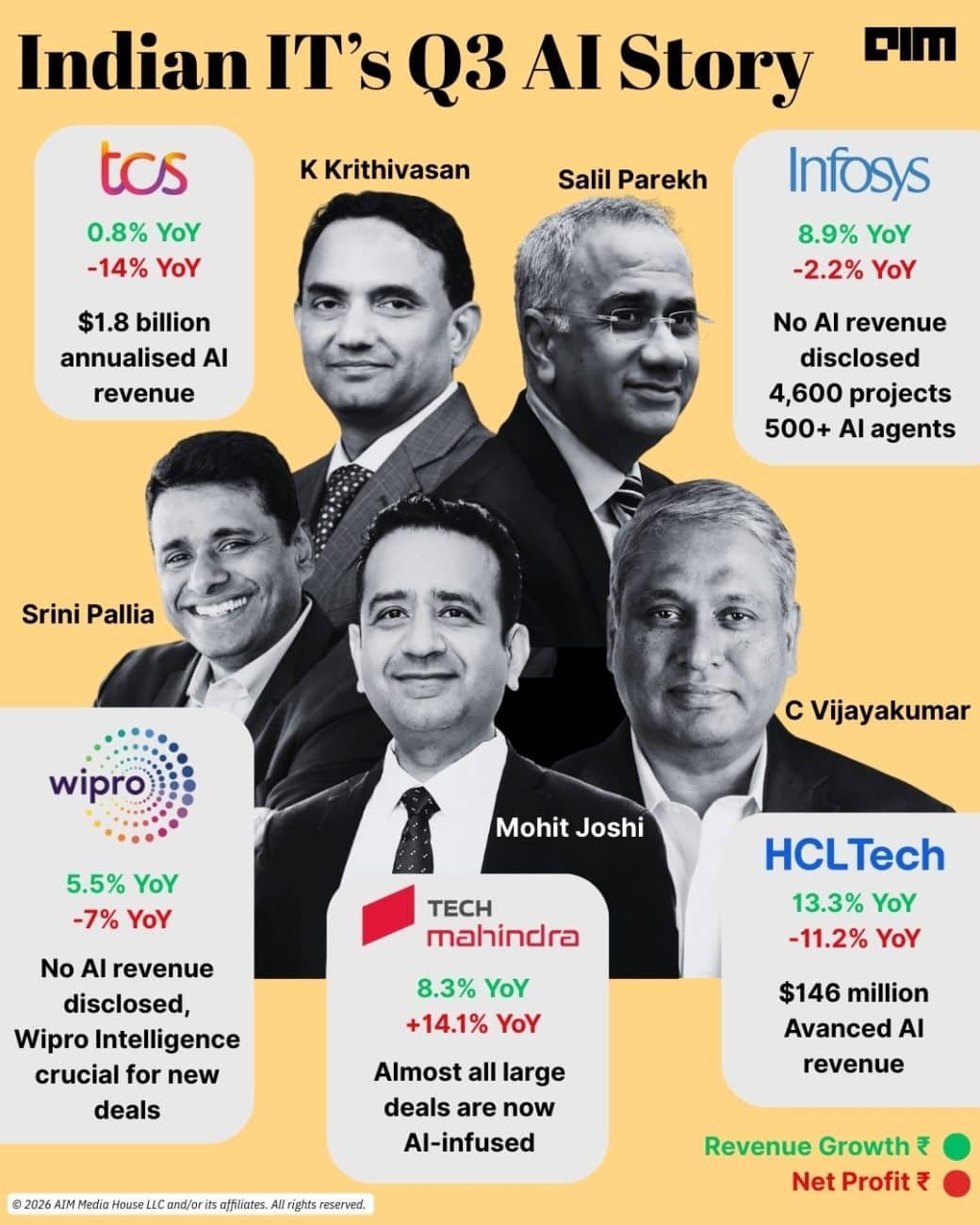
TCS led by a wide margin, reporting ₹67,087 crore turnover in Q3 FY26 with sequential growth of 2%. Infosys followed with ₹45,479 crore, up 8.9% year-on-year. HCLTech posted ₹33,872 crore, growing 13.3% YoY. Wipro reported ₹23,555 crore, up 5.5% YoY.
Meanwhile, Tech Mahindra posted its strongest momentum in years, delivering ₹14,393 crore revenue at 8.3% YoY growth. Its net profit also rose 14.1% to ₹1,122 crore, even as others took a hit due to new labour codes implementation, restructuring costs, and one-time charges that cut into their margins.
But the big takeaway was AI, which is now Indian IT’s operating logic in how work is sold, delivered, priced, and staffed. The quarter made one thing unmistakable: AI is no longer just a project; it’s Indian IT’s saving grace.

AI was part of nearly every deal win in the quarter.
Infosys closed $4.8 billion in large deals, sharply up from $3.1 billion in Q2. TCS reported a total contract value of $9.3 billion, one of its strongest quarters in recent memory. HCLTech saw new deal wins rise 43.5%YoY to $3 billion. Wipro booked $3.3 billion, with large deals at $891 million.
Tech Mahindra’s $1.1 billion in new deals looked modest, yet it grew 47% YoY and carried a visible margin impact. chief executive and managing director Mohit Joshi said almost all large deals are now AI-infused.
While Tech Mahindra didn’t reveal headline revenue, TCS chose to flaunt it. It reported $1.8 billion in annualised AI revenue, up from $1.5 billion in the previous quarter. The number includes AI embedded inside cloud, data, applications, and industry projects, along with AI-focused data centres.
Notably, AI is still a very small percentage of the total revenue for the firm, showing that it is still too early to report separate AI revenue.
As UnearthInsight’s Gaurav Vasu earlier told AIM, “Most of these revenues are part of existing deals. None of the Indian pure plays has a separate AI business vertical. Even if you count it, it is embedded in engineering, application development or infrastructure. Counting it separately doesn’t make sense.”
HCLTech chose precision. It reported $146 million in what it calls advanced AI revenue, growing nearly 20% sequentially. This excludes AI embedded inside traditional services and only counts agentic AI, robotics, physical AI, AI factories, data centre services, and product-led work.
Meanwhile, Infosys chose a third path. It refused to publish an AI revenue and instead focused on its impact. The company reported 4,600 active AI projects, more than 500 AI agents in production, and nearly 28 million lines of code generated using AI tools. Around 90% of its top 200 clients are now running AI programmes.
Vasu now says that this approach reflects where the market is headed. As AI matures, it is being embedded across transformation programmes, application modernisation, ER&D work, and managed services.
Vasu argues that much of what the industry is calling “AI revenue” is already buried in existing contracts. “AI components are bundled within broader transformation or run engagements, and pricing reflects outcome improvement rather than tool usage,” he says. In many deals, AI is assumed as a default capability rather than a premium add-on.
Guidance and outlook became the quiet story of the quarter.
Infosys raised its full-year revenue guidance to 3–3.5%, its second upward revision in two quarters, citing improved market visibility and robust large deal wins. HCLTech upgraded its services revenue guidance to 4.75–5.25% after reporting $3 billion in bookings.
Wipro’s guidance of 0-2% growth in the fourth quarter shocked the industry, with the company’s shares falling over 8% on Monday. TCS and Tech Mahindra do not provide formal guidance, but both signalled improving pipelines driven by AI-led demand.
Namratha Dharshan, chief business leader at ISG India Research, tells AIM that the market is stabilising after two volatile years. Providers are seeing a slight uptick from last year with healthy pipelines and faster AI-led demand than what managed services can currently absorb.
AI is accelerating growth in cloud, infrastructure, and platforms while putting pressure on traditional labour-based pricing and margins. The sector is not out of the woods as the guidance is below 5%. Yet without AI, the quarter would have looked far weaker.
“AI has certainly positively impacted the ‘As a Service’ market. AI is now a demand driver, not a future theme,” Dharshan notes. “Hyperscaler growth accelerated sharply, IaaS delivered another record year, and SaaS demand held up well in platforms tied to infrastructure, analytics, IT service management, and collaboration.”
She adds that AI continues to be a demand driver for managed services, but there is increased pressure on providers to deliver outcomes beyond efficiency and productivity. “Pricing on AI is still something that the industry is figuring out. But it seems like an optimistic driver for most of the service providers in the deal pipeline.”
IT companies during the earnings calls made the case that AI is being used to raise throughput and compress timelines rather than replace talent. At the same time, according to an analysis by TOI, India’s top five IT services firms added just 17 net employees in the first nine months of FY26. The figure is a steep fall from the 17,764 net hires recorded in the same period last year.
Though the companies didn’t link it to AI, headcount numbers across the sector hinted at a possible AI impact.
TCS cut over 11,000 employees in the quarter, ending with 5,82,163 people, and said reductions would continue. Infosys added 5,043. HCLTech trimmed selectively. Wipro added 6,529, taking total headcount to 2,42,021, driven largely by fresher onboarding. Tech Mahindra reduced headcount by 872 year-on-year to 1,49,616, while still growing revenue per employee.
Freshers are no longer being trained to write boilerplate code. They are expected to manage AI-assisted systems, test outputs, ensure compliance, and oversee workflows. That shift explains why Infosys and HCLTech have announced sharply higher salaries for a narrow slice of AI-ready freshers, even as mass hiring remains cautious.
Pricing is the next fault line.
Today, AI-driven productivity gains largely show up as cost savings passed back to clients. Tech Mahindra wants to change that. Joshi spoke openly about separating human labour from digital labour in pricing models, potentially linking digital labour pricing to token consumption.
It signals a future where AI is monetised as capacity rather than effort.
The post AI Was Indian IT’s Saving Grace in Q3, And Hints at What’s to Come appeared first on Analytics India Magazine.
When the UK hosted the first-ever global AI Safety Summit 2023 at Bletchley Park—often hailed as the birthplace of modern computing—the focus was squarely on frontier risks, not real-world harms. That led to at least some action, with countries forming AI safety institutes and making other commitments regarding AI safety.
Two more global AI summits followed: Seoul in 2024 and Paris in 2025. With each edition, the agenda broadened to include inclusive and sustainable AI, ethics, environmental impact, and governance frameworks. A key flashpoint emerged in Paris when neither the US nor the UK signed the leaders’ statement—a joint declaration on “inclusive and sustainable AI for people and the planet”—signalling a clear divergence in how any discussion around governance and regulation should be approached.
As a result, despite the widening scope, little has been achieved in terms of enforceable or meaningful AI governance.
What has grown exponentially, however, is investment. The top five hyperscalers—including Amazon, Microsoft, Alphabet and Meta—are estimated to have spent around $443 billion on capital expenditure in 2025. CreditSights projects this figure will rise to $602 billion this year, a 36% year-on-year increase, with roughly 75% of that spending directed towards AI infrastructure.
In contrast, the summits have delivered failed promises of self-regulation by Big Tech, voluntary agreements lacking teeth, and regulatory frameworks from the Global North that critics argue are hollow or incomplete.
This raises a key question: will the India AI Impact Summit 2026 be any different—or will it become yet another display of diplomatic theatrics and competitive posturing, rather than a forum that brings AI developers and civil society to the same table?
No company—or country—wants to miss the AI moment. But do they know what they actually want from AI, or are they just responding to pressure from Big Tech? According to a Capgemini research brief, The multi-year AI advantage: Building the enterprise of tomorrow, organisations expect to allocate 5% of their annual budgets to AI by 2026, up from 3% in 2025. The fear of losing strategic advantage is driving rapid scaling, often without clarity on long-term consequences.
2025 saw AI taking centre stage globally like never before. Mass enterprise adoption, powerful generative models, and government engagement brought the technology into everyday business, governance, and public life.
“Several involved in large AI businesses are seeking to pressure government officials and policymakers to pivot away from any discussion around AI governance, depending on a false narrative of regulation being at odds with innovation. The past six months have seen a strong push for speedy AI deployment. Do we really need to adopt at this speed?” Raman Jit Singh Chima, Asia-Pacific policy director at Access Now, tells AIM.
India mirrors this trend. An EY-CII report found that 91% of leaders cited speed of deployment as the primary driver behind buy-versus-build decisions, highlighting impatience to convert innovation into impact. In 2025 alone, Big Tech pledged an estimated $40-50 billion towards India’s AI and cloud infrastructure. While these investments promise growth and jobs, critics argue they are not aligned with India’s most pressing needs.
At the CII Annual Business Summit 2025, chief economic adviser to the Indian government, V Anantha Nageswaran, cautioned against excessive AI deployment at the cost of labour, noting that India needs to generate nearly eight million jobs annually.
The previous three summits failed to slow this breakneck, and uneven deployment of AI driven by the Global North. They ask, “Why is AI risky?” but failed to answer the harder questions: who holds power, who bears the costs, and who sets the rules?
There has been no agreement on a global baseline for AI governance, only voluntary ceilings. Industry influence remains deeply intertwined with rule-making. There is still no consensus on public-interest infrastructure such as open models, public compute, or shared datasets. Industrial policy, climate goals, and AI governance remain misaligned. The Global South, meanwhile, continues to be present, but rarely decisive.
In India, the pressure to remain “globally competitive” has softened calls for strict regulation. While the Department for Promotion of Industry and Internal Trade (DPIIT) released a working paper on AI training frameworks in December 2025, it remains at a draft stage. India is also hosting energy- and water-intensive data centres, even in environmentally stressed regions, while much of the economic value flows abroad.
“Governments are racing to develop national AI strategies, but rarely take environmental sustainability into account. The absence of environmental guardrails is no less dangerous than the lack of other AI safeguards,” Golestan Sally Radwan, the chief digital officer of UN Environment Programme, warns.
Civil society groups believe India has an opportunity to emerge as a genuine leader of the Global South. Positioned as the first major global AI summit in the Global South, the India AI Summit is being framed around the principles of ‘People, Planet and Progress’.
Critics argue, however, that it will only matter if India moves past declarations and begins to act as a rule-shaper rather than merely a convenor.
“It is time to move beyond theatrics of participation, bring more transparency to the process and ensure representation while setting the agenda. Rather than giving in to tech-optimism we must ask ourselves the need and purpose of the proposed AI intervention and ensure a mitigation strategy is in place,” says Isha Suri, European AI & Society Fund fellow and former research lead at the Centre for Internet and Society.
There are also concerns over heavy Big Tech participation at the Delhi summit. Google CEO Sundar Pichai, NVIDIA’s Jensen Huang, Microsoft president Brad Smith and OpenAI CEO Sam Altman are expected to attend, which could dilute regulatory ambition into familiar “responsible AI” narratives.
“India’s AI push is increasingly shaped by Big Tech rather than domestic priorities,” Suri adds. “Most projects depend on foreign cloud providers, chips and foundation models, creating long-term lock-in. AI is being promoted as a shortcut to fixing healthcare, education and welfare gaps—despite chronically low public spending,” she says in a conversation with AIM.
More than 190 countries have adopted UNESCO’s non-binding recommendations on ethical AI, including environmental safeguards. Yet, without mandatory enforcement, critics say, these frameworks remain aspirational.
“India should seek to use the summit to demonstrate its commitment to supporting global majority leadership towards AI governance. The development of AI should not be an end in itself,” says Chima.
Whether the summit can break this pattern—and deliver governance rather than rhetoric—remains the real test.
The post AI Summits, Big Promises, No Rules: Will India Be Any Different? appeared first on Analytics India Magazine.


OpenAI’s annualised revenue has surged past $20 billion in 2025, up from $2 billion in 2023, as the company rapidly expands its compute capacity, according to a new statement by Sarah Friar, chief financial officer of OpenAI.
In a company blog post, Friar said OpenAI has structured its business model so that revenue growth increases in step with the practical value its AI systems generate, tying financial performance directly to the amount of real-world work carried out using its technology.
Compute capacity has grown roughly threefold year over year, reaching about 1.9 gigawatts in 2025, compared with 0.2 GW in 2023, while revenue expanded at a similar pace to exceed $20 billion ARR.
“Our ability to serve customers—as measured by revenue—directly tracks available compute,” Friar wrote, adding that greater access to compute in earlier years would likely have driven even faster adoption and monetisation.
OpenAI said both daily and weekly active users are at all-time highs, driven by ChatGPT’s transition from a consumer curiosity to what Friar described as “infrastructure that helps people create more, decide faster, and operate at a higher level.”
Initially launched as a research preview, ChatGPT is now embedded in everyday personal and professional workflows, from education and writing to software development, marketing, and finance. That usage shift shaped OpenAI’s commercial strategy, starting with consumer subscriptions, expanding to team and enterprise plans, and adding usage-based pricing for developers through its API platform.
“As AI moved into teams and workflows, we created workplace subscriptions and added usage-based pricing so costs scale with real work getting done,” Friar said.
More recently, OpenAI has extended its model to advertising and commerce, positioning ChatGPT as a decision-making platform where users move from exploration to action. Friar stressed that ads and commercial options are only introduced when they are “clearly labelled and genuinely useful,” arguing that monetisation must feel native to the product experience.
At the core of OpenAI’s financial strategy is compute management. Friar called compute “the scarcest resource in AI,” noting that OpenAI has moved from reliance on a single provider to a diversified ecosystem of partners.
In January, OpenAI signed a $10-billion deal with chipmaker Cerebras Systems, turning its focus to inference infrastructure.
Looking ahead to 2026, Friar said OpenAI’s financial focus will be on practical adoption, particularly in health, science, and enterprise use cases where improved intelligence can directly translate into measurable outcomes. She also signalled future revenue models beyond subscriptions and APIs, including licensing, IP-based agreements, and outcome-based pricing, as AI expands into areas such as drug discovery, energy systems, and financial modelling.
The post OpenAI Hits $20 Bn ARR Mark as Compute Capacity Triples: CFO Sarah Friar appeared first on Analytics India Magazine.

Across India’s enterprises, from IT services and consulting to manufacturing and education, AI has shifted the centre of gravity of work. According to an EY survey of over 200 Indian enterprise leaders assessing their experience with generative AI and agentic AI, organisations have clearly advanced in their AI journey, with nearly half now reporting multiple live use cases.
AI adoption has clearly moved pilots. However, large-scale integration is still in early stages, with only 10% organisations reporting enterprise-wide deployment. This has also created new job roles like agentic engineers who can develop and deploy AI agents.

“Agentic AI is fundamentally changing the nature of roles, not just automating tasks,” Anurag Malik, partner and India leader for People Consulting at EY India, tells AIM. “As AI systems begin to plan, decide, and act with greater autonomy, organisations will create new roles focused on AI orchestration, model oversight, risk and ethics, and domain-led decision making.”
In HR functions, for instance, AI agents are already screening candidates, mapping skills, predicting attrition, and simulating workforce scenarios. What is changing is who owns the outcome.
“What will grow is the role of the human–AI workforce designer, responsible for redefining roles where humans and AI jointly own outcomes, and the AI talent intelligence lead, who will translate AI insights into workforce decisions leaders can stand behind,” Malik explains.
This shift marks a move away from narrow job descriptions toward fluid roles that combine human judgement with machine intelligence. People are no longer just users of AI systems—they are supervisors, interpreters, and ethical stewards.
The scale of this change is already visible. EY’s Work Reimagined research shows India leads in AI adoption, with 62% of employees already using AI regularly at work. But adoption alone is no longer enough.
In a Reddit post, a user who recently accepted the role of an AI agentic engineer expressed that he was apprehensive about what the new job would entail, as he has mostly been using RAG systems. RAG, or Retrieval-Augmented Generation systems, go beyond training data to combine LLMs with external data sources to provide more accurate answers.
Other users commented that most AI agentic engineers work across RAG pipelines, multi-agent orchestration, and real-world task integration. While the field is still emerging, they observed that engineers who can connect models to actual business or system logic are likely to be in high demand, making this a strong space for rapid growth.
They explained that the core of the job is wiring agents into real business logic while keeping them reliable. Day-to-day work typically includes defining tools with strict JSON schemas, setting timeouts and retries, maintaining evaluation suites and golden tests for each feature, and tracking latency, cost, and failure modes.
It also involves shipping ETL pipelines to refresh RAG stores, adding safety filters, fallbacks, and human-in-the-loop workflows. In their experience, tools like LangGraph and Temporal are useful for orchestration and retries, Pinecone for retrieval, and DreamFactory for exposing CRUD APIs over legacy SQL with role-based access control so agents can perform real work.
This evolution is already creating demand for new capabilities, not just technical skills, but cross-functional ones.
“This is creating demand for new skills such as system supervision, prompt and workflow design, outcome validation, and cross-functional problem-solving,” says Nipun Sharma, CEO, TeamLease Degree Apprenticeship. “The real change is not job loss, but job redesign.”
Organisations that recognise this early are moving faster to align their talent strategies with AI-led operating models. Delay risks creating a mismatch between what AI can do and what people are prepared to manage.
“Organisations that proactively realign roles and build these capabilities will unlock higher productivity and resilience, while those that delay will struggle to integrate AI effectively into everyday work,” Sharma warns.
The idea that AI will eliminate jobs outright is increasingly being challenged by those closest to workforce transformation.
“Agentic AI is fundamentally rewiring the workforce by shifting work from execution to orchestration,” Sharma observes. “As autonomous systems begin to plan, act, and optimise workflows, human roles are evolving toward oversight, judgement, exception handling, and ethical decision-making.”
The transformation is not limited to IT or digital-native sectors. Sangeeta Gupta, senior VP at Nasscom, says that agentic AI will completely change workforce roles across manufacturing, retail, education, and services in the next two to three years.
“What began as rule-based systems has evolved into agentic AI systems that have the capability to act independently, understand context, make decisions, and continuously learn,” she notes. “We foresee agentic AI as a transformative force that will redefine, not replace, workforce roles across industries.”
As AI agents increasingly handle routine analysis, workflows, and follow-ups, humans will move up the value chain. The near-term impact, she emphasises, is not mass displacement but productivity gains driven by end-to-end process redesign.
“Human accountability remains central, especially in safety-critical and regulated environments, making trust, auditability, and clear escalation frameworks essential,” Gupta remarks.
This reality is reflected in how enterprises are deploying agentic AI today. While experimentation is widespread, full autonomy is rare.
“While 62% of global enterprises are experimenting with AI agents, 77% are deploying them with human-in-the-loop design,” Gupta adds, quoting a KPMG report. “Data governance is foundational, with 68% of enterprises strengthening data management to build scalable, reliable agentic solutions.”
As roles change, so must skills. Across sectors, demand is growing for domain fluency, process thinking, data literacy, and the ability to supervise agent-driven systems.
“As AI matures, specialised talent demand is expected to rise in areas like advanced AI research, data science, human–technology interface design, and domain-led innovation,” Gupta says.
Nasscom, she adds, is working with government bodies, regulators, and educational institutions to modernise curricula and scale AI literacy. “Industry today is leading by example—accelerating AI and hybrid cloud adoption through reskilling, co-creation, and ecosystem partnerships.”
The message is clear: agentic AI is not replacing human work, but acting as a catalyst to redefine it. The organisations that succeed will be those that redesign roles, invest in reskilling, and build governance frameworks that keep humans firmly in the loop.
As Gupta sums up, “Together, these frameworks support a smooth, human-centred transition where AI agents augment human capabilities without undermining safety, fairness, or societal values.”
The post How Agentic AI is Redesigning Job Roles for Engineers appeared first on Analytics India Magazine.


The government is yet to make the new labour codes fully effective, but they are already impacting the bottomlines of Indian IT giants. During the third quarter of FY26, TCS, Infosys and HCLTech together incurred Rs 4,373 crore as additional cost.
The new labour codes, notified in November last year, consolidate existing laws. They introduce a revised definition of wages, raising the basic pay and employer obligation for gratuity and leave encashment. They also require companies to recognise gratuity liabilities from past services.
IT companies signal that they’ve already absorbed the bulk impact and that the recurring effect on margins will be limited.
In the Q3 earnings call, Infosys chief financial officer Jayesh Sanghrajka said the implementation of the labour codes has led to a rise in gratuity and leave liabilities, aggregating to $143 million (₹1,289 crore).
“But if you look at the adjusted margins, they actually expanded by 20 basis points,” Sanghrajka said.
Full-year margins remain at 21%. This is similar to last year, despite investments in sales and marketing that would have impacted margins by 50 basis points, and the impact of lower utilisation as we build capacity for the future, he explained.
Infosys reported a net profit of ₹6,654 crore in Q3, down 2.2% year-on-year.
HCLTech made similar disclosures. In his remarks, chief executive officer and managing director C Vijayakumar said operating margin for the quarter, “excluding the one-time impact of new labour code, came at 18.6%.”
According to the company, the new labour codes have resulted in an estimated one-time increase of ₹956 crore in provision for employee benefits. The company’s net profit also declined 3.7% quarter-on-quarter to ₹4,076 crore.
CFO Shiv Walia later clarified that the one-off charge had already been taken and that “going forward, we don’t expect this to be more than 10 to 20 basis points on a recurring basis,” adding that this was subject to “any further changes in the labour code regulation.”
TCS disclosed the largest absolute provision among the three. CFO Samir Seksaria said the company had made a provision of ₹2,128 crore, explaining that “gratuity amounts to about ₹1,800 crore and leave liability is balance ₹300 crore.”
The labour law provisions also dented its bottomline, earning ₹10,657 crore in netprofit—a 14% YoY decline.
He described this as “all past service cost,” and said that on an ongoing basis, “the impact of this we expect to be not very significant in the range of about 10 to 15 basis points.”
Though the companies have maintained that the provision is one-time, Jefferies, in its report, noted that the impact of the new labour codes is also recurring in nature, as the employee cost will rise sustainably.
The brokerage said the changes may hit company profits with recurring employee expenses rising by up to 5%.
Wipro said the implementation of the labour code led to a ₹302-crore increase in gratuity expenses during the quarter.
On pricing and contract economics, executives focused on productivity rather than changes to underlying commercial structures.
Infosys’s Sanghrajka said evolving technologies were prompting experimentation. “As newer and newer technologies evolve, every time there is a change like that, you see a new pricing model evolving as well,” he said, referring to “outcome-based pricing” and “pricing which is specific to agents.”
He cautioned, however, that it was “a little early… in terms of calling out specifically what pricing models are going to evolve.”
TCS is also continuing to embed productivity gains. Responding to an analyst question, executives said that “most of the renewals would take in some productivity, but that is business as usual,” typically “in the range of 10%–15% over the term of the contract.”
They added that this did not necessarily reduce revenue, as “very often when the renewal happens the top line… doesn’t decrease,” because “the quantity of work that we commit to deliver… increases.”
On whether AI was leading to more flexible contract structures, TCS said, “We are not seeing flexibility in the contract. Most contracts bake in the expected productivity.”HCLTech’s Vijayakumar said the company would “remain disciplined to walk away from those [deals] that do not align with our financial and strategic objectives.”
“While we continue to win many such large deals, we remain disciplined to walk away from those that do not align with our financial and strategic objectives. We continue to guide our sales organisation and remain focused on opportunities that make long-term economic sense.”
The post Indian IT Absorbs Labour Codes Costs, But Recurring Expenses May Hit Margins appeared first on Analytics India Magazine.