Meta Compute Launch Marks a Turning Point in How Meta Builds AI
With the recent launch of Meta Compute, Meta aims to address a persistent problem it…
Artificial Intelligence News
AI world news.
With the recent launch of Meta Compute, Meta aims to address a persistent problem it…
India may see an investment of up to $150 billion in AI infrastructure by the end of 2026, Ashwini Vaishnaw, union minister for information technology, railways and information and broadcasting, said in an exclusive interview with CNBC TV18 at the World Economic Forum in Davos, Switzerland.
Vaishnaw said India has already secured investment commitments worth $70 billion, with a further $50–80 billion likely over the next 12 months.
The past year has seen a wave of major investment announcements. Google committed $15 billion to set up an AI hub in Visakhapatnam, Microsoft raised its India investment commitment to over $20 billion through 2030, and Amazon pledged $35 billion in investments over the same period.
Vaishnaw also confirmed that India’s homegrown large language models (LLMs) will be unveiled at the upcoming India AI Summit. IndiaAI Mission CEO Abhishek Singh had earlier told AIM that at least two LLMs—developed by Sarvam AI and BharatGen—would be launched ahead of the summit.
The minister said India will eventually develop 12 foundational AI models, each ranging between 50–120 billion parameters, designed to run on relatively small GPU clusters. This, he said, would enable low-cost AI services at scale. Vaishnaw noted that early live testing of Indian models has shown “very encouraging” real-world performance.
Under the IndiaAI Mission, the government has selected 12 startups and organisations to build sovereign foundational models: Sarvam AI, Soket AI Labs, Gnani.ai, Gan.AI, Avataar AI, BharatGen, Fractal Analytics, Tech Mahindra (Maker’s Lab), ZenteiQ Aitech Innovations, Genloop Intelligence, NeuroDX (IntelliHealth), and Shodh AI.
Addressing industry leaders, Vaishnaw urged companies to play a more active role in skilling India’s youth, calling for collaboration on curriculum development to create a robust AI talent pipeline.
The post India to See Up To $150 Bn AI Infrastructure Investments in 2026: Ashwini Vaishnaw appeared first on Analytics India Magazine.
Sequoia Capital’s decision to invest in Anthropic marks a departure from the traditional venture capital rulebook and is being viewed as the death of the ‘one winner’ venture capital model. Historically, VCs have avoided backing rival companies in the same sector, preferring to bet on a single winner. Yet Sequoia—already an investor in OpenAI and Elon Musk’s xAI—has now added Anthropic to its portfolio.
It is not alone in breaking this long-standing taboo and hedging bets against its portfolio companies in the same sector. Andreessen Horowitz, which recently raised $15 billion to expand investments across infrastructure, healthcare and defence, has backed OpenAI, xAI, and OpenAI co-founder Ilya Sutskever’s Safe Superintelligence (SSI). Fidelity and Ark Invest have invested in both OpenAI and xAI, while Sound Ventures and Wisdom Ventures both hold stakes in OpenAI and Anthropic.
Sequoia itself invested in OpenAI in 2021 and later backed SSI in September 2024.
While Sequoia’s earlier investment in xAI appeared to contradict the traditional VC approach of choosing a single winner, that move was widely seen as an extension of the VC firm’s long-standing relationship with Elon Musk. It also holds stakes in SpaceX and The Boring Company, and is a major investor in Neuralink.
Sequoia is now joining a $25-billion funding round for Anthropic led by Singapore’s GIC and US investor Coatue, with the AI company seeking a valuation of $350 billion—more than double its $170 billion valuation from just four months ago.
AI is Changing Investment Strategies
Sequoia’s shift is particularly striking given its earlier stance on portfolio conflicts. In 2020, the firm exited payments startup Finix after concluding it competed with Stripe, another Sequoia-backed company, forfeiting its $21-million stake along with a board seat.
The Anthropic investment also follows a leadership transition at Sequoia in 2025, with veteran partner Roelof Botha stepping back from oversight of the US and Europe business, and Alfred Lin and Pat Grady taking charge. This came after a turbulent period marked by internal friction, a $200-million loss from cryptocurrency exchange FTX’s collapse, and a renewed focus on AI.
Some investors describe this approach as “spray and pray”—once applied to fintech and e-commerce, and now increasingly to AI. A similar pattern is emerging in India. Peak XV Partners (formerly Sequoia Capital India & SEA) has backed Sarvam AI, which is developing a foundation model, while also investing in application-layer companies such as Atlan and WizCommerce, which could eventually build competing in-house models.
Antler India, one of the country’s most active AI investors, backs multiple agentic AI startups, while Accel’s Atoms programme has funded a wide range of AI tools. Although these firms claim to maintain strict “Chinese walls” between partners to manage conflicts, they are increasingly open to backing multiple companies in the same vertical.
Traditionally, VCs picked sides—Uber or Lyft—and avoided funding direct rivals to preserve focus and loyalty. The scale and uncertainty of AI, however, have pushed many investors to abandon this rule.
“In foundational AI, there may not be a single winner,” Akhil Gupta, CTO and co-founder of NoBroker, tells AIM. “The stack is deeper, applications are broader, and variables like regulation, compute access, and talent make outcomes far less predictable.”
Suhail Sameer, founder and managing partner of OTP Ventures, notes that most Indian funds are investing in AI applications built atop infrastructure developed outside India. “These companies face the risk that core AI providers could outpace them with future upgrades.” While OTP avoids investing in direct competitors from the same fund, Sameer advises founders to avoid raising capital from investors with clear conflicts of interest.
Ethics And Trust
The debate over portfolio conflicts intensified after OpenAI CEO Sam Altman testified under oath last year in a lawsuit brought by Elon Musk. Altman acknowledged that investors with access to OpenAI’s confidential information would lose those rights if they made non-passive investments in competitors, describing this as an industry-standard safeguard.
For founders, the concern is straightforward. Investors often gain access to sensitive information on strategy, pricing, hiring and product roadmaps, raising fears that insights—deliberately or otherwise—could give an advantage to rival portfolio companies. Even with formal information barriers, perceived conflicts can erode trust and distort boardroom dynamics.
“When Nexus Venture Partners invested in Snapdeal while backing ShopClues, I was worried,” Sandeep Aggarwal, founder of e-commerce marketplace ShopClues and used vehicles startup Droom, remarks. Although Nexus argued the companies were not direct rivals at the time, Snapdeal later pivoted into a competing marketplace. Aggarwal questions whether a VC can genuinely maintain equal commitment to two rival businesses.
Meanwhile, Gupta believes conflicts are not inherently unethical but can become problematic if boundaries blur or influence is misused. “From a founder’s standpoint, transparency is critical—knowing upfront what exposure an investor has and what safeguards exist.”
Ashish Fafadia, partner at Blume Ventures, adds that pivots often cause company paths to converge. “VCs must ensure separate partners manage competing investments and maintain near-perfect Chinese walls to prevent information leakage.”
If the trend of investing in rival businesses is global, how can founders protect themselves?
“Founders can mitigate risks by setting guardrails early. This includes negotiating strict conflict-of-interest clauses, limiting information rights if investors back rivals, and enforcing board-level firewalls with recusals from sensitive discussions,” advises Aggarwal. Some founders may also require investors to take passive-only positions in competitors or forfeit information rights altogether if conflicts arise.
As capital increasingly concentrates around a handful of AI labs, traditional VCs have to navigate whether backing rivals accelerates innovation or undermines trust and confidentiality that startups cherish.
The post AI is Redrawing VC Rules as Investors Hedge Bets Against Rival Startups appeared first on Analytics India Magazine.
Deepinder Goyal, founder and CEO of Eternal, the parent company of Zomato, is stepping down from his position. Blinkit’s CEO, Albinder Dhindsa, will replace him on February 1, as Goyal remains on the board of directors as vice chairman.
“Of late, I have found myself drawn to a set of new ideas that involve significantly higher risk exploration and experimentation…If these ideas belonged inside Enternal’s strategic scope, I would have pursued them within the company. They do not,” Goyal posted his statement on X.
This announcement follows the board meeting held on January 21, during which the unaudited financial results for the quarter and the nine months ended on December 31 were approved. Eternal reported a 73% YoY surge in net profit in Q3 FY26 to ₹102 crore, while revenue from operations jumped 3x
Goyal stressed that he, Dhindsa, and Akshant will continue to work closely, and that all business CEOs will continue to operate with autonomy. As the Group CEO, Dhindsa will be responsible for daily operations, prioritising tasks, and making business decisions, Goyal stated, noting that he managed Blinkit’s transition from acquisition to profitability and is “more than equipped to lead Eternal” in that role.
Goyal added, “As part of this transition, all of my unvested ESOPs will revert to the ESOP pool,” to ensure that Eternal continues to have “meaningful wealth creation opportunities for its next generation of leaders, while strengthening long-term retention without incremental shareholder dilution.”
Goyal co-founded Zomato, initially named Foodiebay, in 2008 with Pankaj Chaddah as a platform for restaurant menus and reviews that grew into a food delivery leader.
In the past year, he has explored various deep tech and longevity projects outside of Eternal. ET reported in March that Goyal invested $20 million in LAT Aerospace, co-founded by former Zomato COO Surobhi Das, where he is a non-executive cofounder.
He also launched Continue, a health and wellness initiative focused on extending lifespan, which evolved from a “personal wellness team” into a research project. His latest venture is Temple, a device for monitoring brain blood flow, which he recently showcased on social media.
He added on X that he wants “Eternal to become India’s most valuable company,” while asserting that the company will not lose momentum through this change. However, he’s sure that this change will give him the space to “explore ideas that sit outside Eterna’s scope, without compromising the company’s priorities.”
The post Eternal’s Deepinder Goyal Resigns, Blinkit CEO Albinder Dhindsa to Take Over appeared first on Analytics India Magazine.
Sunita (Suni) Williams, the American astronaut of Indian origin, announced her retirement from NASA after 27 years of service, NASA said on January 20. Her retirement, effective from December 27, 2025, followed completing three missions aboard the International Space Station and setting multiple human spaceflight records during her career.
Williams ranks second among NASA astronauts for cumulative time spent in space and holds the record for the most spacewalk time by a woman. She also became the first person to run a marathon in space.
Williams logged 608 days in orbit across three missions. She completed nine spacewalks, totalling 62 hours and six minutes, which places her fourth on the all-time cumulative spacewalk duration list. She is also tied for sixth place on NASA’s list of longest single spaceflights by an American astronaut, after logging 286 days on a single mission.
“Anyone who knows me knows that space is my absolute favourite place to be,” Williams said in the statement. “It’s been an incredible honour to have served in the Astronaut Office and have had the opportunity to fly in space three times. I am super excited for NASA and its partner agencies as we take these next steps, and I can’t wait to watch the agency make history.”
Williams first travelled to space in December 2006 aboard the space shuttle ‘Discovery’ as part of the STS-116 mission. She returned in June 2007 on space shuttle Atlantis with the STS-117 crew. During this mission, she served as a flight engineer on Expeditions 14 and 15 and completed four spacewalks, a record at the time.
NASA Administrator Jared Isaacman said Williams played a key role in advancing human spaceflight. “Suni Williams has been a trailblazer in human spaceflight, shaping the future of exploration through her leadership aboard the space station and paving the way for commercial missions to low Earth orbit,” he said.
In 2012, Williams launched aboard a Russian Soyuz spacecraft from the Baikonur Cosmodrome in Kazakhstan for a 127-day mission aboard the International Space Station. She served as a member of Expeditions 32 and 33 and later took command of the station during Expedition 33. During this mission, she carried out three spacewalks to repair a station radiator leak and replace a power distribution component.
Her most recent mission began in June 2024, when Williams and astronaut Butch Wilmore launched aboard Boeing’s Starliner spacecraft for NASA’s Crew Flight Test mission. The mission marked the first crewed test flight of the Starliner. Williams and Wilmore later joined Expeditions 71 and 72, during which she again served as space station commander.
Williams completed two spacewalks during the mission and returned to Earth after 9 months in space in March 2025 aboard SpaceX’s Crew-9 mission.
Vanessa Wyche, director of NASA’s Johnson Space Center in Houston, said Williams’ career set a benchmark for future astronauts. “From her indelible contributions and achievements to the space station, to her groundbreaking test flight role during the Boeing Starliner mission, her exceptional dedication to the mission will inspire future generations of explorers,” she said.
Beyond her missions, Williams held several leadership and operational roles at NASA.
She served as a crew member on the NASA Extreme Environments Mission Operations programme in 2002, spending nine days living and working in an underwater habitat. After her first spaceflight, she became deputy chief of NASA’s Astronaut Office.
Following her second mission, Williams served as director of operations in Star City, Russia. In her later years at NASA, she helped establish a helicopter training platform designed to prepare astronauts for future Moon landings.
Scott Tingle, chief of the Astronaut Office at NASA Johnson, said Williams was widely respected within the astronaut corps. “She’s inspired so many people, including myself and other astronauts in the corps,” he said.
Williams is also a retired US Navy captain and a trained helicopter and fixed-wing pilot with more than 4,000 flight hours across 40 aircraft.
Reflecting on her career, Williams said her work was shaped by the people and missions she supported. “The International Space Station, the people, the engineering, and the science are truly awe-inspiring and have made the next steps of exploration to the Moon and Mars possible,” she said.
The post Sunita Williams Retires From NASA After 27-Year Career appeared first on Analytics India Magazine.
In 2024, NVIDIA had established its long-standing dominance in the sphere of the AI supply chain with advanced GPUs. That was until DeepSeek entered its domain in early 2025, challenging assumptions about scale and rewriting the rules of AI development.
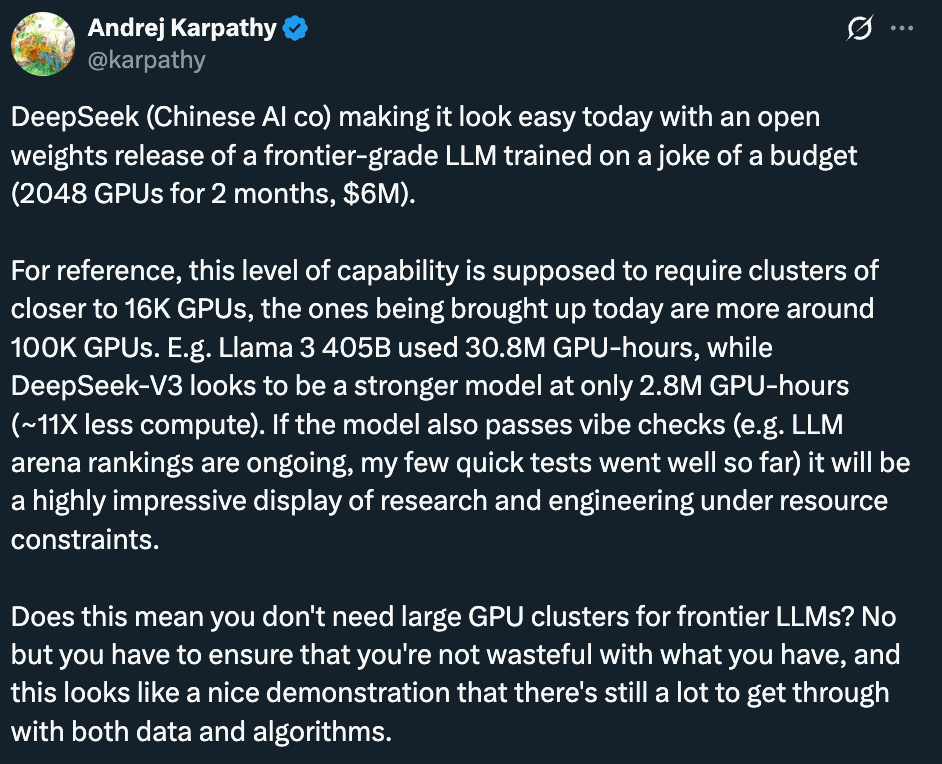
The Chinese lab released a reasoning model that matched or exceeded several Western closed-source systems while training the base model, DeepSeek-V2, on just 2,048 GPUs—far fewer than what frontier labs then used for similar results.

Source: Andrej Karpathy, former OpenAI researcher in a post on X, December 2024.
As attention shifted from sheer compute to architecture, training strategy, and efficiency, NVIDIA’s market capitalisation fell by as much as $600 billion in a single day—the largest such drop for a US company—as investors reassessed the need for ever-larger GPU spending.
Soon, China started deploying DeepSeek across public service platforms and government cloud infrastructure. Universities rolled out customised instances for automated learning assistance, research support, academic planning, and 24/7 student services as part of wider AI-augmented education pilots. Even healthcare, automotive manufacturing, and the military integrated DeepSeek’s LLMs.
The competitive environment pushed US cloud providers to catch up.
Within weeks, AWS added DeepSeek-R1 to its AI services. Microsoft integrated it into Azure AI Foundry and its model catalogue. Google made DeepSeek-R1 available in Vertex AI’s Model Garden, enabling developers to deploy the model within existing cloud workflows.
Over the last year, DeepSeek’s journey has been defined by R1, the absence of its successor, and local rivals taking over.
OpenRouter, a unified API gateway that provides access to hundreds of AI models through a single interface, offers a useful lens on DeepSeek’s adoption. Its routing dataset—covering roughly 100 trillion tokens—shows DeepSeek models accounting for around 14.4 trillion tokens between November 2024 and November 2025.

After the release of DeepSeek V3 and DeepSeek R1, the two together represented more than half of all open-source token traffic on the platform. No other open-weight model family reached comparable concentration during that period.
Pricing played a significant role in the model’s adoption, as DeepSeek consistently ranked among the lowest-cost options for sustained, high-volume routing. But this dominance peaked around mid-2025 and then declined.
OpenRouter’s report identifies a clear summer inflexion.

Source: OpenRouter
There wasn’t a collapse in absolute usage, but a rapid diversification of the Chinese open-source ecosystem. New releases from Qwen, Moonshot AI (Kimi), MiniMax, and others captured production traffic within weeks.
And by late 2025, no single open-source model accounted for more than 20–25% of token share. DeepSeek’s earlier flagpole position declined, giving way to a more pluralistic distribution.
Currently, DeepSeek is going toe-to-toe with other Chinese AI models in absolute benchmarks. But it is in no hurry to recapture the throne.

Rather than accelerating product releases like Western AI labs and Chinese rivals, DeepSeek pivoted towards research, training methods, and infrastructure.
Post-R1, DeepSeek focused on exploring the nitty-gritty details of an LLM’s architecture and incrementally fixing bottlenecks that hampered compute efficiency. This was in line with the struggles the country faced due to export restrictions the US government placed on NVIDIA for selling GPUs to a Chinese tech company.
In February 2025, with a five-day open-source initiative, DeepSeek released frameworks focused on execution efficiency, pipeline scheduling, core computation, parallel workload coordination, and large-scale storage. These addressed the bottlenecks that determine whether models can be trained and served cheaply at scale, and were aimed squarely at production engineers.
Throughout the year, the DeepSeek-R1 also received incremental updates that boosted its performance on benchmarks, and the company also ran numerous research works and experiments on the base model, the DeepSeek-V3.
Notably, in September, DeepSeek released V3.2-Exp, an experimental model designed to push long-context capabilities while keeping efficiency central, with 3.5x lower prefill costs and up to 10x cheaper decoding during inference for a 128k context window.
In October, it released DeepSeek-OCR. The model converts text into compact visual tokens, enabling compression ratios of 9–10x with over 96% precision, and around 60% accuracy even at 20xcompression. The work suggested a new efficiency path in which visual modalities are used not for perception but for memory and context optimisation in language models.
And, in November, it published research on a model that achieved gold-medal-level performance at the International Math Olympiad 2025. It became the only company to achieve the status after OpenAI and Google DeepMind. This model, the DeepSeek-Math-v2, addressed a growing concern in reasoning and math benchmarks, namely that many models arrive at correct answers without sound or inspectable reasoning.
A recent Microsoft report showed DeepSeek achieving significant market penetration outside China, with about 43% usage in Russia and roughly 56% in Belarus, making these among the highest adoption rates globally. In China, DeepSeek’s share of generative AI usage is approximately 89%.

Source: Microsoft
By contrast, adoption in Western Europe and North America remains low, often under 5%. In many African countries, usage is 2–4 times higher than in Western Europe or North America, driven by DeepSeek’s free or low-cost access with minimal subscription barriers, which makes it appealing in price-sensitive markets where Western alternatives are less accessible.
With growth concentrated in developing regions, how DeepSeek adapts its future models and services to meet these markets’ specific needs will be an important indicator of its global strategy.
However, the lack of a successor to its R1 model is noteworthy.
According to a Reuters report in mid-2025, DeepSeek did not release the expected DeepSeek R2 at the anticipated time because the company’s leadership, including founder Liang Wenfeng, was not satisfied with the model’s performance and stability, pushing its launch beyond the originally planned May 2025 date.
Additional factors included slow data labelling, technical problems tied to hardware choices (such as instability and connectivity issues with Huawei chips that DeepSeek had been encouraged to adopt), which forced the company to prioritise stability by sticking with NVIDIA GPUs for training and using those other chips only for inference.
Now, DeepSeek is planning to launch a new base model, DeepSeek-v4, with a clear emphasis on coding and math performance, according to The Information. But this time, it will not have the first mover’s advantage in the open-source ecosystem.
The post DeepSeek’s Rise, Pause, and How Local Competition Took Over appeared first on Analytics India Magazine.
NVIDIA has invested $150 million in AI inference startup Baseten, which has raised $300 million in a funding round valuing the company at $5 billion—more than double its previous valuation, The Wall Street Journal reported.
The round was led by venture capital firm Institutional Venture Partners and CapitalG, Alphabet’s independent growth fund, with participation from NVIDIA. The deal highlights NVIDIA’s aggressive push into inference-focused startups, as the AI industry shifts its attention from training large models to running them efficiently at scale. It also marks another instance of NVIDIA backing a direct customer of its AI chips.
Founded in 2019, San Francisco–based Baseten helps companies such as AI code editor Cursor and note-taking platform Notion deploy and operate large language models in production environments. Including the latest raise, the company has now secured $585 million in total funding. Co-founder and chief executive Tuhin Srivastava has described Baseten’s ambition as building the “AWS for inference”.
For NVIDIA, the investment reinforces a strategic pivot championed by chief executive Jensen Huang, who has repeatedly argued that inference will ultimately become a much larger market than model training. As enterprises move from experimentation to full-scale deployment, demand for reliable and cost-efficient inference infrastructure is accelerating, placing companies like Baseten at the centre of this transition.
Baseten’s platform is optimised for NVIDIA’s latest GPU architectures, including the H100 and next-generation B200 chips. By enabling high-performance inference workloads on these GPUs, Baseten effectively extends NVIDIA’s ecosystem, helping ensure its hardware remains the default choice as AI adoption spreads across enterprises.
CapitalG’s participation adds a competitive dimension, given Alphabet’s own investments in AI infrastructure and model deployment. Nevertheless, the collaboration underlines the strategic importance of inference, even among industry rivals.
At a $5 billion valuation, Baseten now joins a small group of AI infrastructure startups commanding premium multiples. Investors argue that inference platforms are well-positioned to capture long-term value as AI moves beyond Big Tech into sectors such as productivity software, finance and creative tools.
Baseten has also gained traction among developers through Truss, its open-source framework that simplifies model deployment. Truss allows teams to package models, manage dependencies and scale inference workloads with minimal friction, an increasingly critical capability as AI features are embedded directly into consumer and enterprise products.
The post NVIDIA Invests $150 Million in AI Inference Startup Baseten appeared first on Analytics India Magazine.
FMCG major Unilever is exploring the possibility of establishing a global capability centre (GCC) in Hyderabad, as per reports.
The development follows a meeting between Telangana CM A Revanth Reddy and Willem Uijen, chief supply chain and operations officer at Unilever, on the sidelines of the World Economic Forum Annual Meeting in Davos, Switzerland.
During the discussions, the CM highlighted Hyderabad’s rapid emergence as a major global hub for GCCs, driven by strong digital infrastructure, deep talent pools, and a supportive policy environment.
According to an official statement from the CM’s Office, Unilever expressed interest in evaluating Hyderabad as a potential location for its GCC operations. The Telangana delegation also encouraged the global FMCG company to look beyond capability centres and assess opportunities for setting up manufacturing units within the state’s industrial parks, leveraging Telangana’s expanding industrial ecosystem.
The high-level delegation accompanying the CM included IT and industries minister D Sridhar Babu and revenue minister Ponguleti Srinivas Reddy, who reiterated the state’s commitment to supporting global companies across both technology-led and manufacturing investments.
Meanwhile, Hyderabad has added another milestone to its growing global innovation footprint with the launch of the world’s largest beauty tech global capability centre (GCC) by L’Oréal. The centre will house over 2,000 beauty tech engineers, marking a major expansion of the city’s role in advanced digital and AI-led innovation.
The post Unilever Considers GCC in Hyderabad, Cites City’s Growing Global Appeal appeared first on Analytics India Magazine.
OpenAI has begun rolling out an age prediction system on ChatGPT consumer plans to identify accounts that may belong to users under 18 and automatically apply additional safety protections.
The company said the move aims to ensure teens receive a more restricted experience, while adults continue to access the service with fewer limitations.
“Young people deserve technology that both expands opportunity and protects their well-being,” OpenAI said in a blog post.
According to OpenAI, ChatGPT’s age prediction model relies on behavioural and account-level signals, including how long an account has existed, usage patterns over time, typical activity hours, and the user’s stated age.
“When the age prediction model estimates that an account may belong to someone under 18, ChatGPT automatically applies additional protections,” the company said.
These protections include limits on content involving graphic violence, sexual or violent role play, depictions of self-harm, viral challenges that could encourage risky behaviour, and material that promotes extreme beauty standards or unhealthy dieting.
OpenAI said teens who already declare they are under 18 during sign-up automatically receive these safeguards. The company added that age prediction helps it “treat adults like adults and use our tools in the way that they want, within the bounds of safety.”
Users who are incorrectly placed in the under-18 category will be able to restore full access by confirming their age through a selfie-based verification using Persona, a third-party identity verification service. “Users can check if safeguards have been added to their account and start this process at any time by going to Settings > Account,” OpenAI said.
The company said the system is designed to default to a safer experience when age signals are unclear or incomplete. It also acknowledged that the model will continue to be refined as it learns which signals improve accuracy.
In addition to automated safeguards, OpenAI said parents can further customise a teen’s experience through parental controls. These include setting quiet hours, managing features such as memory or model training, and receiving notifications if signs of acute distress are detected.
OpenAI said it will continue to monitor the rollout and share updates. The work is being guided by research on child development and consultations with groups including the American Psychological Association, ConnectSafely, and the Global Physicians Network.
Age prediction will roll out in the European Union in the coming weeks to meet regional requirements, the company said.
The post OpenAI Introduces Age Prediction on ChatGPT to Add Safeguards for Teens appeared first on Analytics India Magazine.
HCLTech and Carahsoft Technology Corp have partnered to accelerate digital transformation for public sector agencies across the United States.
Under the agreement, Carahsoft will act as HCLTech’s public sector distributor, providing federal, state, local and education agencies access to HCLTech’s technology solutions through its reseller partners and cooperative procurement vehicles.
HCLTech has established a dedicated public sector solutions subsidiary offering AI-driven platforms, cloud-native modernisation services, cybersecurity solutions and constituent-focused services for government agencies.
Carahsoft will contribute its expertise in public sector contracting, sales and marketing, while supporting a broad network of reseller partners.
“Our goal through this partnership is to make HCLTech’s AI Force accessible to the public sector and to ensure deployment at the speed and scale agencies require to enhance constituent services, strengthen cybersecurity posture and improve operational efficiency,” Michael Shrader, vice president of intelligence and innovative solutions at Carahsoft, said in a statement.
AI Force is HCLTech’s GenAI-driven platform for service transformation.
“Public sector organisations face ever-increasing demands, such as enhancing constituent services, accelerating mission delivery, securing sensitive data and leveraging emerging technologies, including GenAI,” said Arjun Sethi, chief growth officer and president of HCLTech Public Sector Solutions.
“Our partnership with Carahsoft marks an important step to drive IT efficiencies and modernise technology platforms across the public sector. Together we bring a unique blend of trusted engineering, deep domain insight and channel enablement to help agencies achieve lasting outcomes.”
The Indian IT company has also been selected by Team Global Express, the largest multimodal logistics organisation in Australia and New Zealand, to accelerate digital transformation through AI-powered solutions.
The expanded partnership consolidates Team Global Express’ multi-vendor IT landscape into a single strategic engagement, with HCLTech serving as the trusted technology advisor to drive operational efficiency, innovation and data-driven decision-making.
Under the agreement, HCLTech will deliver end-to-end managed IT services across applications, hybrid cloud infrastructure, networks, cybersecurity, digital workplace, and service management. AI Force will be deployed to drive automation, enhance compliance and improve customer experience across operations.
Danny Gravell, chief innovation officer, Team Global Express, said in a statement, “HCLTech’s deep domain expertise, innovative approach and commitment to operational excellence will play a vital role in modernising our IT landscape and strengthening our ability to serve customers across Australia and New Zealand.”
Sonia Eland, executive vice president and country manager for Australia and New Zealand, HCLTech added, “Our comprehensive suite of solutions, powered by advanced AI and automation, will enable Team Global Express to accelerate transformation, enhance customer experience and drive long-term value creation.”
The post HCLTech Partners With Carahsoft To Drive IT Efficiencies in US Public Sector appeared first on Analytics India Magazine.