Just a few weeks ago, Google announced that its AI-powered chatbot Bard was being rebranded to Gemini and coming to an Android app for easier use on the go.
Access is about to get even easier — you'll be able to message the Gemini AI chatbot straight from Google Messages.
Also: Don't tell your AI anything personal, Google warns in new Gemini privacy notice
Starting soon, users will be able to text Gemini for all sorts of conversations – help writing a message, book recommendations, dinner menu ideas involving certain ingredients, or just a fun chat.
One example prompt provided by Google read: "Write a text message I can send to my boss calling in sick today. It's a big team presentation day, so I'm sad to let everyone down. 3 sentences or fewer." Another example prompt asked for "a vegetarian meal with the following ingredients I have in my fridge: cauliflower, cucumber, and yogurt."
Showcasing a more in-depth request, one example asked the AI to "Come up with a complex word riddle that has the answer: sunset. You are a skilled riddle maker, known for the cleverness of your wordplay and the complexity of your puzzles, skilled at thinking up clever and challenging riddles. Be creative. Come up with a riddle that is difficult to guess. Include hints to help the user guess."
Other suggested prompts from Google asked the AI to help craft a message to reconnect with a friend, to suggest a three-course meal that's both impressive and easy for a novice, and for conversation starters at a social event.
When Gemini gives you a response, you'll be able to approve or disapprove with a tap of a thumbs up or thumbs down. You'll also be able to copy, forward, or save what was said. Conversations will be limited to one-on-one, as Gemini can't be brought into a group chat.
Also: Meet Gemini 1.5, Google's newest AI model with major upgrades from its predecessor
All conversations are happening over RCS, Google says, so there's no encryption. However, the company assured users that the AI would not read any other messages on their devices.
Once the feature rolls out to everyone, you'll be able to access it from the new conversation screen. Instead of choosing an actual person to text, you'll just select Gemini AI from the top of the list.
According to Google support, Gemini can be used as your mobile assistant, but it's not clear yet if that carries over to text interactions as well.
Gemini AI on Google Messages is only available to beta users right now, but wider access to all users is expected soon.
Members of the mobile and telecommunications industries have gathered at Mobile World Congress 2024 in Barcelona, held Feb. 26-29. The main trends at MWC so far are AI, 5G and always-on connectivity.
We’re rounding up the enterprise business tech news from MWC that is most relevant for IT and tech decision-makers. This article will be updated throughout MWC with more tech news highlights.
Humane shows its novel wearable, the Ai Pin
The Humane AI team demonstrated its mobile phone alternative, called Ai Pin, on the show floor at MWC (Figure A). The $699 (plus subscription service) wearable is an intriguing look at a possible future where voice commands to a generative AI replace most interactions now performed through apps on phones.
Figure A: The Humane Ai Pin can be clipped to clothing and projects information on the user’s hand. Image: Humane
The Ai Pin is expected to ship in March 2024. This wearable primarily targets consumers, but the device could have productivity benefits for remote workers, and the ideas behind the Pin could trickle into what other AI makers try next.
DOWNLOAD: This Mobile Device Security Policy from TechRepublic Premium
Intel commits to 5G and AI
Intel hooked a handful of announcements to MWC (Figure B), including:
Intel’s Edge Platform, a software platform for enterprises to build and manage edge and AI solutions on standard hardware, coming later in Q1.
A preview of Intel’s next Xeon processor for 5G core, which is codenamed Sierra Forest and is expected later in 2024.
A peek at Granite Rapids-D, the Xeon processor expected to launch in 2025.
Intel wants to put its chips in 100 million AI-enabled PCs by next year.
Figure B: The Intel booth at MWC 2024 on Feb. 26. Image: Intel Corporation
Qualcomm brings Wi-Fi, Bluetooth and Ultra Wideband to one chip
Qualcomm announced the FastConnect 7900 Mobile Connectivity system, a chip that uses Wi-Fi 7, Bluetooth or Ultra Wideband technologies depending on what the circumstances require. For business use, the system opens up opportunities for proximity-based functionality (e.g., it might be used in IoT-enabled factories) and multi-device experiences (e.g., easy file sharing, smart switching audio between wireless earbuds depending on context and using the same mice and keyboards with different PCs, phones and tablets).
Lenovo and Motorola debut Smart Connect
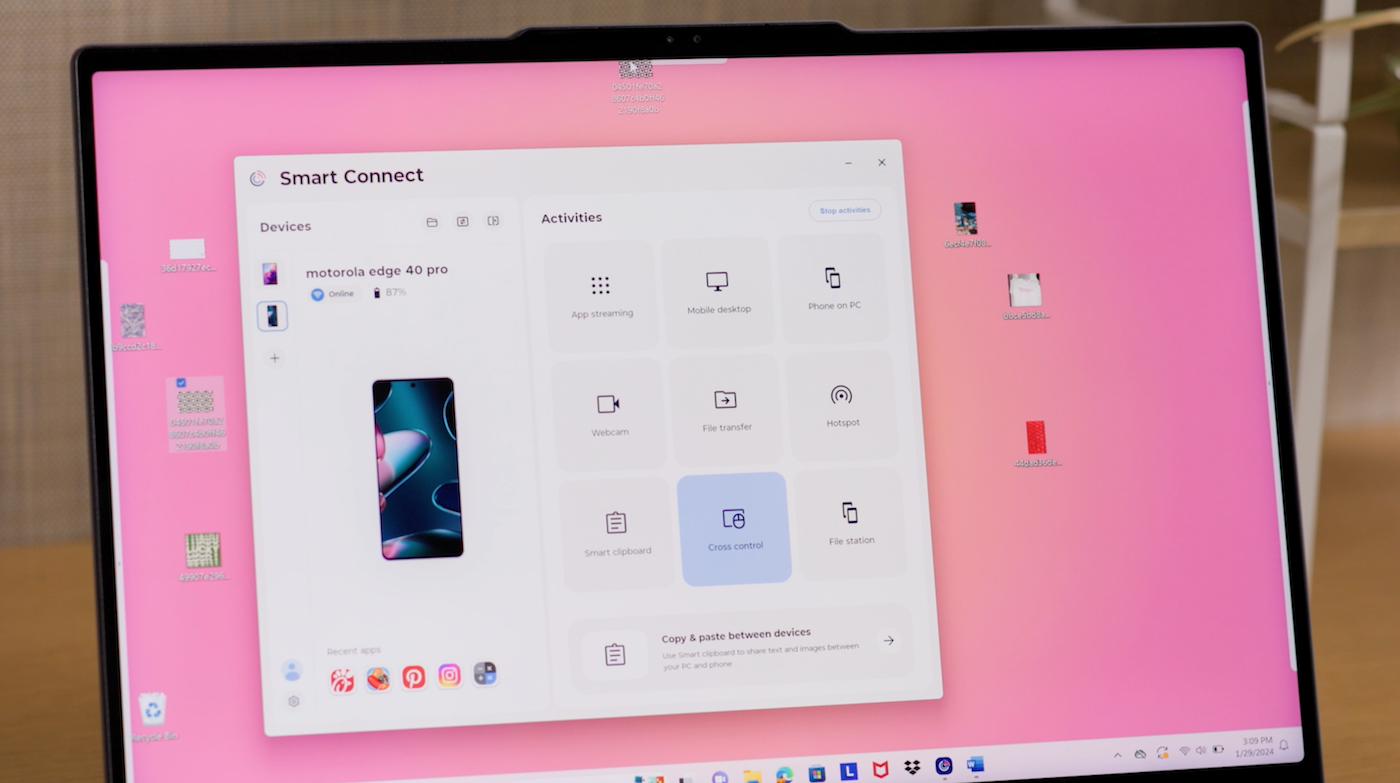
One appealing feature of Apple’s ecosystem is how easily devices can talk to each other with functionalities like AirDrop and Find My. Lenovo and Motorola will offer some of the same services with Smart Connect, which syncs peripheral controls, notifications, file sharing and cameras between Lenovo PCs running Windows 10 or later and some Lenovo tablets and Motorola devices (Figure C). Smart Connect will be downloadable through the Microsoft or Google Play stores “in the coming months.”
Figure C: A demo of the Smart Connect panel connecting a phone to a laptop. Image: Motorola
In addition, Motorola had on hand its fun, still experimental adaptive display, which is flexible enough to let someone wear a phone like a bracelet.
rSIM claims protection against mobile downtime
One of the more remarkable new brands to come out of MWC 2024 so far is rSIM, whose product focuses on device-agonistic connectivity for support during outages. rSIM perhaps benefits accidentally from being able to hold its product up as a possible solution to outages like the one AT&T experienced last week.
rSIM could be an interesting option for IoT-heavy workplaces to make sure workers stay connected. rSIM sells to mobile operators, device manufacturers and value-added resellers.
Nokia is now Dell’s primary partner for enterprise edge use cases
Dell and Nokia have entered into a partnership that will see Dell take the lead in transitioning customers over time from Nokia AirFrame servers to Dell PowerEdge servers. Plus, Nokia will be Dell’s preferred private wireless partner for enterprise edge use cases. For those enterprise edge use cases, that means it will be easier to integrate the Nokia Digital Automation Cloud private wireless solution with Dell’s edge operations software platform, Dell NativeEdge.
Editor’s note: TechRepublic is covering MWC 2024 remotely.
To the great sadness of Shakespeare punsters everywhere, Google has renamed Bard to Gemini. Google has also come out with a more capable, more advanced, more expensive version of Gemini called Gemini Advanced. Gemini and Gemini Advanced are roughly analogous to ChatGPT's base model and the ChatGPT Plus service offered for an additional fee.
Also: I asked ChatGPT to write a WordPress plugin I needed. It did it in less than 5 minutes
In fact, both Google and OpenAI charge $20/month for access to their smarter, more super-powered offerings.
As part of my testing process over the past year, I've subjected generative AIs to a variety of coding challenges. ChatGPT has repeatedly done quite well, while Google's Bard failed pretty hard on two separate occasions.
I ran the same set of tests against Meta's Code Llama AI, which Meta claims is quite super awesome for coding (and yet, it's not).
To be clear, these are not particularly hard tests. One is a request to write a simple WordPress plugin. One is to rewrite a string function. And one is to help find a bug I originally had difficulty finding.
Last week, after using these same tests on Code Llama, a reader reached out to me and asked me why I keep using the same tests. He reasoned that the AIs might succeed if they were given different challenges.
This is a fair question, but my answer is also fair. These are super-simple tests. I'm using PHP, which is not exactly a challenging language. And I'm running some scripting queries through the AIs. By using exactly the same tests, we're able to compare performance directly.
Also: I confused Google's most advanced AI — but don't laugh because programming is hard
But it's also like teaching someone to drive. If they can't get out of the driveway, you're not going to set them loose in a fast car on a crowded highway.
ChatGPT did pretty well with just about everything I threw at it, so I threw more at it. I eventually ran tests with ChatGPT in 22 separate programming languages, 12 modern and 10 obscure. Except for some confused headers in the screenshot interface, ChatGPT aced all the tests.
But since Bard, at least back in May, couldn't get out of the driveway safely, I wasn't about to subject it to more tests until it could handle the basics.
Also: I tested Meta's Code Llama with 3 AI coding challenges that ChatGPT aced — and it wasn't good
But now we're back. Bard is Gemini and I have Gemini Advanced. Let's see what all that Google computing power can do for a few simple tests.
Test 1: Write a simple WordPress plugin
This was my very first test with ChatGPT, and Bard has failed it twice. The challenge was to write a simple WordPress plugin that provides a simple user interface. It's supposed to sort and dedup a series of submitted lines.
Here's the prompt:
Write a PHP 8 compatible WordPress plugin that provides a text entry field where a list of lines can be pasted into it and a button, that when pressed, randomizes the lines in the list and presents the results in a second text entry field with no blank lines and makes sure no two identical entries are next to each other (unless there's no other option)…with the number of lines submitted and the number of lines in the result identical to each other. Under the first field, display text stating "Line to randomize: " with the number of nonempty lines in the source field. Under the second field, display text stating "Lines that have been randomized: " with the number of non-empty lines in the destination field.
One thing to keep in mind is that I purposely didn't specify whether this tool is available on the front end (to site visitors) or on the back end (to site admins). ChatGPT wrote it as a back-end feature, but Gemini Advanced wrote it as a front-end feature.
Also: ChatGPT vs. Microsoft Copilot vs. Gemini: Which is the best AI chatbot?
Gemini Advanced also chose to write both PHP code and JavaScript. To initiate the plugin, a shortcode needs to be placed in the body text of a sample page, like this:
Once I saved the page, I viewed it as a site visitor would. This is what Gemini Advanced presented.
Gemini Advanced's first try
It's certainly a far cry from how ChatGPT presented the same feature, but ChatGPT wrote it for the back end.
ChatGPT's first try
One other note: Once I pasted in names and clicked Randomize using the Gemini-generated front-end version of the code, nothing happened.
I decided I was going to give Gemini Advanced a second chance. I changed the first line to:
Write a PHP 8 compatible WordPress plugin that provides the following for a dashboard interface
This was a failure, in that Gemini Advanced again insisted on giving me a shortcode. It even suggested I paste the shortcode in "a suitable dashboard area." This isn't how the WordPress dashboard works.
Also: How AI-assisted code development can make your IT job more complicated
To be fair, there was still a bit of wiggle room in how the AI might interpret my instructions. So I clarified one more time, changing the beginning of the prompt to:
Write a PHP 8 compatible WordPress plugin that provides a new admin menu and an admin interface with the following features:
This time, Gemini Advanced created a workable interface. Unfortunately, it still didn't function. When pasting a set of names into the top field and hitting the Randomize button, nothing happened.
Gemini Advanced's third attempt. In my test, I included names, but left them out of this screenshot because they were real names from that day's email. After hitting Randomize, nothing showed up in the bottom field.
Conclusion: Compared to ChatGPT's first attempt, this is still a failure. It's actually worse than the results of my original Bard test, but not quite as bad as my second Bard test.
Test 2: Rewrite a string function
In the following code, I asked ChatGPT to rewrite some string processing code that processed dollars and cents. My initial test code only allowed integers (so, dollars only) but the goal was to allow dollars and cents. This is a test that ChatGPT got right. Bard initially failed, but eventually succeeded.
Also: How to use ChatGPT to write code
Here's the prompt:
And here's the produced code:
This one is a failure as well, but it's both subtle and dangerous. The generated Gemini Advanced code doesn't allow for non-decimal inputs. In other words, 1.00 is allowed, but 1 is not. Neither is 20. Worse, it decided to limit the numbers to two digits before the decimal point instead of after, showing it doesn't understand the concept of dollars and cents. It fails if you input 100.50, but allows 99.50.
Conclusion: Ouch. This is a really easy problem, the sort of thing you give to first-year programming students. And it's a failure. Worse, it's the sort of failure that might not be easy for a human programmer to find, so if you trusted Gemini Advanced to give you this code and assumed it worked, you might have a raft of bug reports later.
Test 3: Find a bug
Late last year, I was struggling with a bug. My code should have worked, but it didn't. The issue was far from immediately obvious, but when I asked ChatGPT, it pointed out that I was looking in the wrong place.
I was looking at the number of parameters being passed, which seemed like the right answer to the error I was getting. But I instead needed to change the code in something called a hook.
Also: Generative AI now requires developers to stretch cross-functionally. Here's why
Both Bard and Meta went down the same erroneous and futile path I had back then, missing the details of how the system really worked. As I said, ChatGPT got it. So, now it's time to see if — when supplied with exactly the same information — Gemini Advanced can redeem itself.
Gemini Advanced did look at the code. And it did identify that there is a parameter issue. But its recommendation is to look "likely somewhere else in the plugin or WordPress" to find the error.
Gemini Advanced's answer.
By contrast, this is ChatGPT's answer.
ChatGPT's answer. Click the square in the corner to enlarge if you want to read the whole thing.
Look at the detail provided in the second paragraph. ChatGPT correctly identified exactly where the error is being made and how to correct it. That's a lot more helpful than recommending I look somewhere else in the plugin.
Conclusion: Gemini Advanced just wasn't all that helpful. Nothing it told me was anything I didn't know. And nothing it told me helped to solve the problem.
Also: What is Google One and is it worth it?
Well, that's a bummer
I have been regularly using ChatGPT to help speed up my coding. In many ways, it's been amazing. For one project, I am convinced it enabled me to build something in a weekend that might otherwise have taken me a month or more.
But Gemini Advanced? There's no way I'd even open up its interface. Not only does it fail, but some of its failures are subtle enough that they might initially not be noticed, causing all sorts of problems once the code is released.
Also: How to subscribe to ChatGPT Plus (and why you should)
This is why you need to be very careful when using any AI as a coding helper. But with Gemini Advanced, my recommendation is to simply avoid it. I see nothing it does that you, on your own, can't do better. And it certainly doesn't hold a candle to ChatGPT's stellar performance.
And they charge $20/month for this?
Have you tried coding with Gemini, Gemini Advanced, Bard, or ChatGPT? What has your experience been? Let us know in the comments below.
You can follow my day-to-day project updates on social media. Be sure to subscribe to my weekly update newsletter on Substack, and follow me on Twitter at @DavidGewirtz, on Facebook at Facebook.com/DavidGewirtz, on Instagram at Instagram.com/DavidGewirtz, and on YouTube at YouTube.com/DavidGewirtzTV.
Apple is canceling one of its open secret projects — building an autonomous electric car, and shifting most of the 2,000 employees working on it to focus on generative AI efforts instead.
The internal announcement was made by Apple COO Jeff Williams and an Apple vice president leading the electric car project, Kevin Lynch, according to a report by Bloomberg.
Also: The most jaw-dropping demo at MWC was from a brand I wasn't expecting to see
Apple's AI team is led by John Giannandrea, an Apple executive who's been reportedly focused on generative AI endeavors for the past couple of years, including the development of large language model applications (LLMs) like AI chatbots (think, ChatGPT).
Not all employees will be so lucky, as Bloomberg says there will be layoffs. TechCrunch reports some have already been let go, but it's unclear how many people will be laid off. Aside from software engineers and employees working closely with AI, the "Special Projects Group" or SPG, as Apple called its electric car team, also included hardware and automotive engineers, who may or may not be able to apply for other jobs within the company.
Apple's electric car endeavors began in 2014, and the company has reportedly invested several billions of dollars into both fully autonomous vehicles and electric cars to compete with Tesla and others.
Its most recent launch, the Apple Vision Pro, is a mixed-reality headset and its first new product category since the release of Apple Watch in 2015. Vision Pro has gotten the company a lot of attention for its futuristic and innovative nature.
Also: Apple Vision Pro review: Fascinating, flawed, and needs to fix 5 things
Apple has been notably absent in the generative AI boom over over the past year since the launch of ChatGPT. The company hasn't released remarkable generative AI technology during the rise in popularity of genAI, not even while its biggest competitors, Google, Microsoft, and Samsung, all have rivaled OpenAI's ChatGPT with different generative AI technology advancements.
Some reports in July indicated Apple is working on an AI chatbot of its own, used internally and known as Apple GPT, which runs on a proprietary foundational model. While Apple has been largely quiet about incorporating generative AI into its devices, we're likely to see at least some new genAI features showcased at this year's WWDC in June.
Subsets helps subscription businesses reduce churn with ‘retention experiments’ and explainable AI Paul Sawers 18 hours
Recurring revenue is pretty much the holy grail for any business — it’s precisely why Apple has segued toward being almost as much a services company as it is a hardware company, with 20% of its revenue now emanating from Apple TV+, Apple Music, iCloud, and an array of other subscription and non-subscription-based services.
The cost of acquiring new customers has also reportedly increased by more than 200% over the past decade, which highlights the importance of predictable revenue streams. But there are inherent challenges with subscription-based business models — not only must companies focus on growing the number of people willing to pay for a given service, but they must also be mindful of retaining those that they already have. Reducing churn is the name of the game.
This is something that fledgling Danish startup Subsets is setting out to help companies achieve, with an AI-enabled platform designed to “bridge the retention gap in the subscription industry.”
Explainable
Founded out of Copenhagen in 2022, Subsets leans on “explainable AI” to tell companies which current subscribers might be about to jump ship, and serves up “experiments” to find the best way of enticing them to stay.
Explainable AI is a concept that describes AI’s ability to “explain” or justify any decisions and insights it provides in a way that humans can parse, and it has emerged as one of the cornerstones of a wider societal push to make AI more trustworthy — most of the major large language model (LLM) providers are trying to appease critics by addressing the much-maligned “black box” problem.
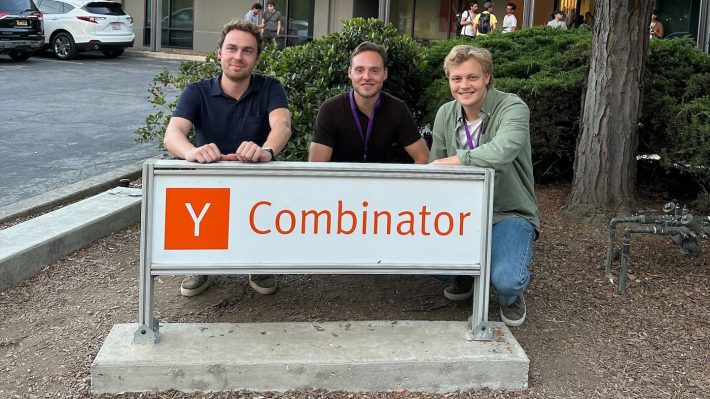
Six months on from its launch, Subsets has already claimed some decent customers, including the New York Times–owned Athletic and Danish newspaper Børsen. But the company is now looking to double down on this recent traction with a fresh $1.65 million in pre-seed funding led by Nordic early-stage VC Upfin and Y Combinator (YC), following Subsets’ participation in YC’s Summer ’23 program.
The media business
While Subsets could be applied to any subscription business, it’s currently focused on the digital media vertical.
“We are limiting our use case to digital media at the moment — this includes digital publishers, streaming [platforms], subscription apps, and telecoms,” Subsets co-founder and CEO Martin Johnsen told TechCrunch. “Subsets can be applied more broadly across digital consumer subscriptions later — I see us broadening into, for example, mobility, banking, and food delivery. Even more offline subscription categories, as everything becomes more digital.”
Companies connect Subsets to their various internal systems, such as CRM (customer relationship management), CMS (content management system), billing, data warehouse, and so on to garner subscriber data points — this can include things like demographics, how each subscriber consumes a specific piece of content (e.g., times, category preferences), and any other relevant items related to the product and how the customer interacts with it.
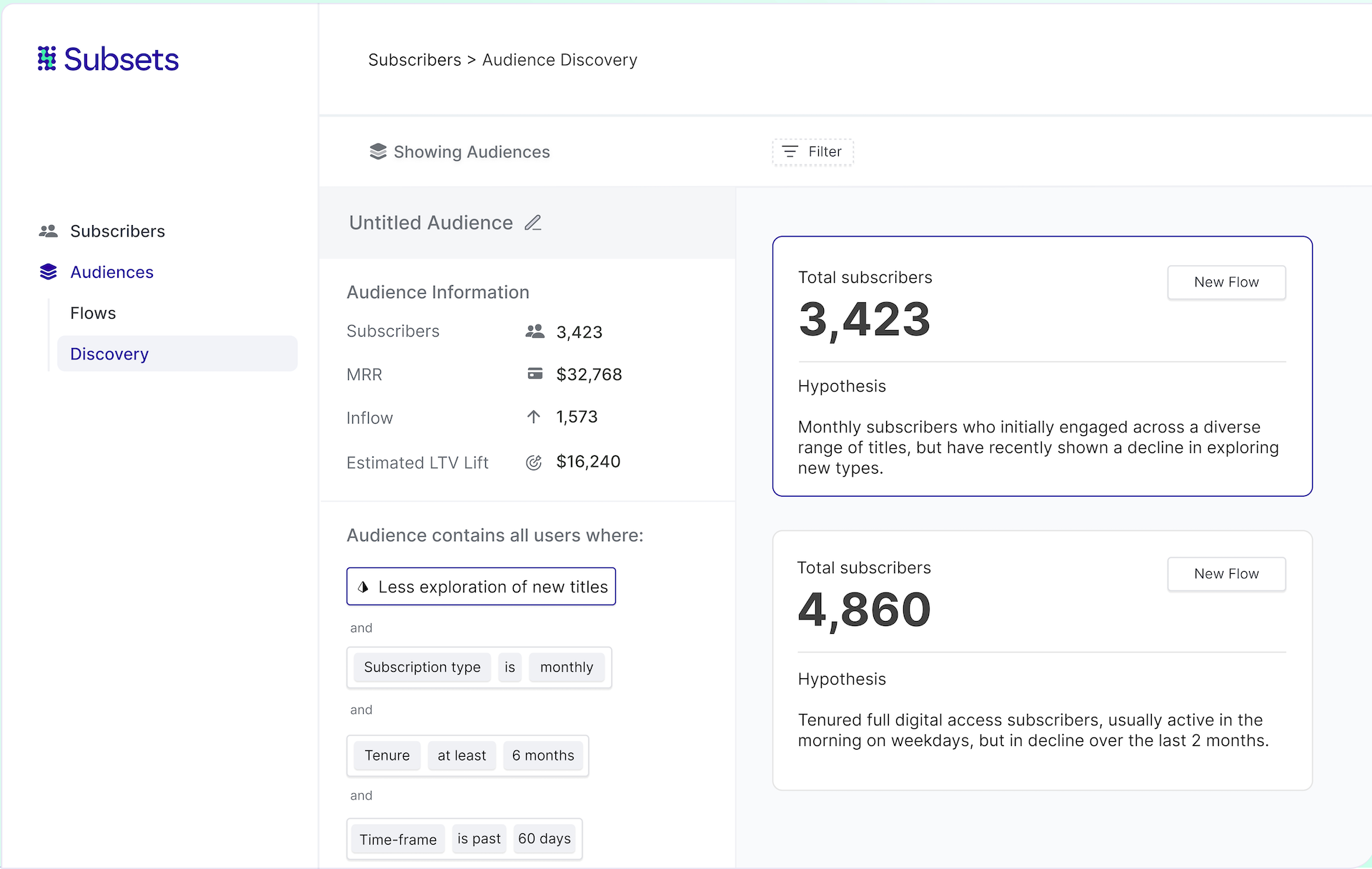
On the front end, Subsets serves a web app through which commercial teams can delve into the “churn audiences” via easy-to-understand visuals and natural language. For example, it might highlight thousands of subscribers who used to engage across myriad different titles under a particular media brand but are now showing signs of losing interest.
Subsets allows nontechnical teams to run retention “experiments” on subsets (hence the company name) of their subscriber base, to see what actions might lead a customer to staying on board. These experiments might be a series of push notifications or email offering a subscription discount, or perhaps a free upgrade to unlock new features. The specifics of these “retention flows” can be tweaked by each customer.
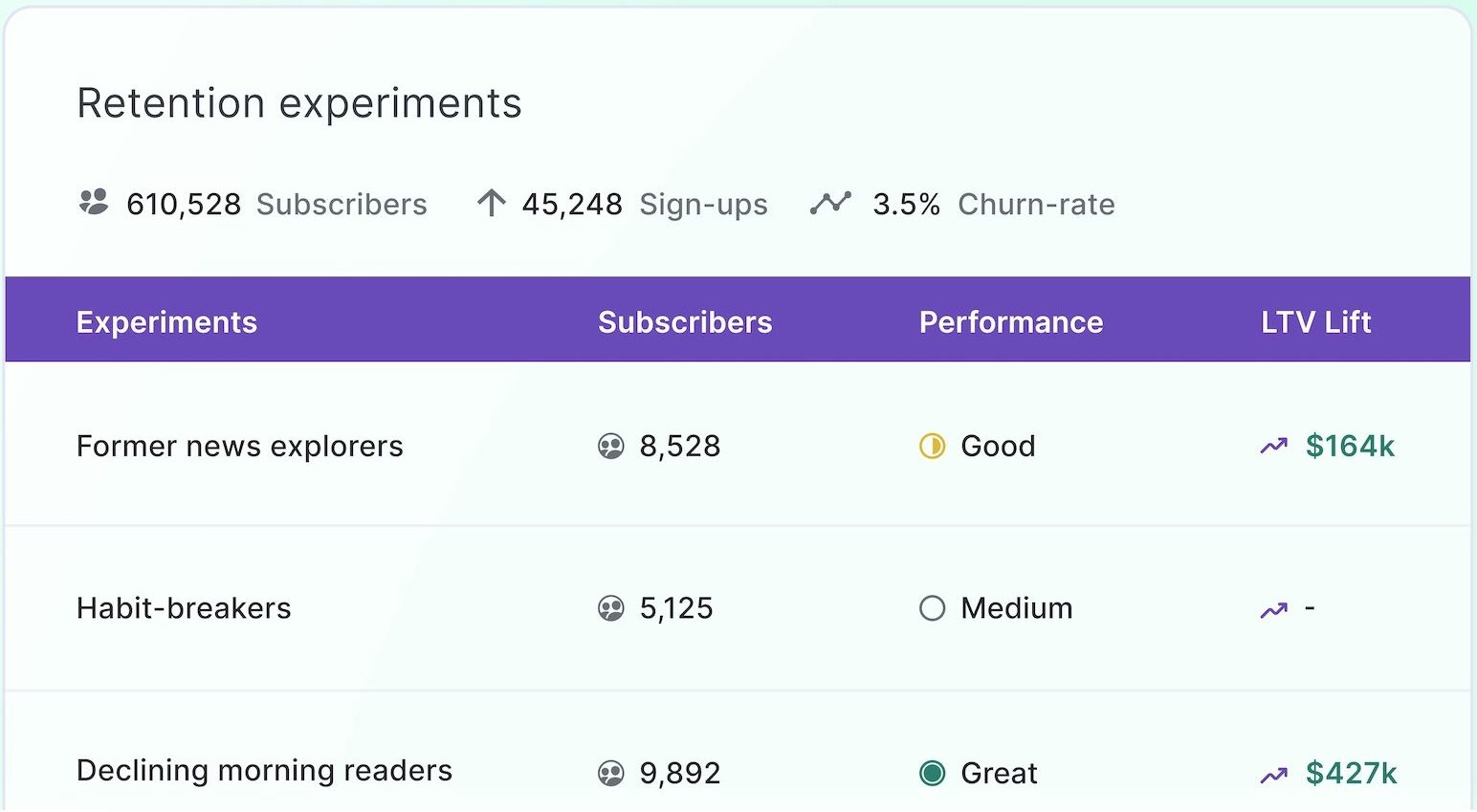
Subsets: Experiment Image Credits: Subsets
Whatever steps are found to have reduced churn in the experimentation phase are presented in the form of results that showcase what worked — it’s designed to take at least some of the guesswork out of a company’s retention endeavors and allows the company to “automate what works.”
“Some of these experiments will yield very good results on subscriber retention — the experiments that yield good results are automated,” Johnsen said. “Because an audience is defined by a specific subscriber behavior which triggers churns, these audiences are typically dynamic, and new subscribers will flow in and out of an audience. All the subscribers flowing into an audience receive the flows that have proven to yield good results.”
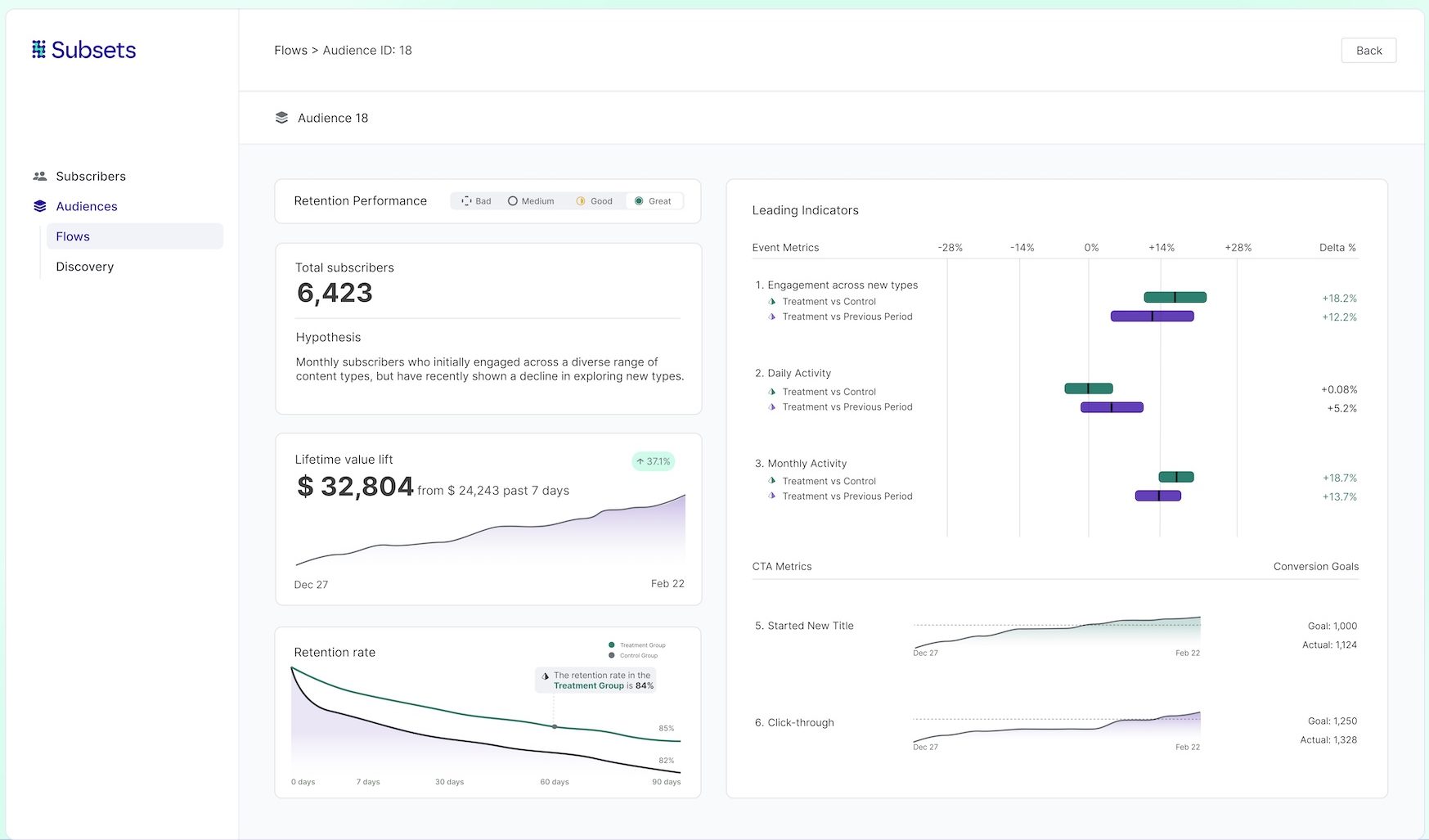
Subsets: Results Image Credits: Subsets
Connections
With a mathematic modeling and computation education background, Johnsen tells TechCrunch that the company has developed its own AI algorithms using “gradient-boosting models with temporal sequencing methods.” Gradient-boosting essentially combines multiple “weak” predictive models to create a single stronger predictive model, while temporal sequencing incorporates time-related features into the modeling process. Subsets then uses frameworks from Elon Musk’s xAI to make “churn-driving behavior understandable,” as Johnsen puts it.
While Subsets doesn’t use any of OpenAI’s GPT.x models at present, Johnsen said that they are working on building some additional “downstream functionality” into its product using the same foundational model that powers ChatGPT.
In a social media post this week, YC president and CEO Garry Tan said that around half of all YC companies “are using LLMs in some way,” which certainly aligns with its latest investment in Subsets. Securing YC as an early backer is also proving fruitful for Subsets’ growth plans given YC’s historical connections — indeed, Subsets’ customer the Athletic is also a YC alum, graduating from the Summer ’16 program six years before it was bought by the New York Times.
“YC has an impressively strong network, which has given us some exciting opportunities,” Johnsen said.
Aside from lead backers Upfin and YC, Subsets’ pre-seed round included investments from a slew of institutional and angel investors, including Cuesta Labs, Sandhill Markets, and Peakon founder Phillip Chambers.
In an era where technology and humanity increasingly intertwine, the rise of empathetic AI represents a significant step forward in bridging the gap between technology and human emotion. This emerging field, where artificial intelligence is infused with the subtleties of human emotion, signals a shift in how we approach mental health care and beyond, suggesting a future where AI not only comprehends but also sensitively responds to our emotional needs. Imagine a world where machines do more than process data; they understand heartbeats, recognize the weight of a sigh, and offer solace in moments of solitude. This exploration into empathetic AI opens the door to a new era of care, offering a glimpse into a future where empathy and intelligence converge to enhance our lives in profound ways.
What is Empathetic AI?
Empathetic AI is a branch of artificial intelligence designed to understand, interpret, and respond to human emotions in a manner that mirrors human empathy. Unlike traditional AI, which focuses on processing data and executing tasks, empathetic AI delves into the nuances of human emotional expression, aiming to discern the underlying feelings and emotional states behind human interactions. This technology leverages advanced algorithms, natural language processing, and machine learning to analyze verbal cues, facial expressions, and physiological signals, allowing it to perceive and engage with human emotions sensitively and appropriately.
The goal of empathetic AI is not just to recognize emotions but to interact in a way that is emotionally intelligent. This means providing responses that are not only contextually relevant but also emotionally congruent with the user's state, whether it's offering comfort during distress, encouragement in the face of challenges, or engagement in moments of joy. By doing so, empathetic AI opens new possibilities for enhancing the human experience, particularly in areas where emotional understanding is crucial, such as mental healthcare, customer service, and social robotics.
The Evolution of AI in Mental Healthcare
The evolution of artificial intelligence (AI) in mental healthcare has transitioned remarkably from its inception as data-driven algorithms to the development of emotionally intelligent systems. Initially, AI's role in mental health was predominantly analytical, focusing on diagnosing conditions and predicting treatment outcomes through pattern recognition. However, advancements in natural language processing (NLP) paved the way for chatbots and virtual assistants capable of basic emotional interactions, such as Woebot and Tess, which offered preliminary support by responding to user inputs with pre-programmed empathy. The integration of emotional recognition technologies marked a pivotal advancement, enabling AI to infer emotional states through analysis of vocal tones, facial expressions, and linguistic patterns. This gave rise to more nuanced applications like Ellipsis Health and Replika, which personalize support by adapting responses to emotional cues. The latest stride towards truly empathetic AI involves systems that not only detect emotions but understand their context and complexities, improving their empathetic responses over time. Examples include Affectiva, which uses emotion AI to analyze and adapt to emotional states in real-time, showcasing a future where AI in mental healthcare offers accessible, personalized, and genuinely empathetic support, heralding a new era of technology-driven emotional understanding and care.
Real-World Applications
Here we highlight three cutting-edge empathetic AI applications increasingly deployed in mental healthcare today. These technologies are demonstrating their value by substantially improving mental health support and emotional wellness.
Woebot: Woebot is a chatbot that offers cognitive behavioral therapy (CBT) for individuals dealing with anxiety and depression. It employes natural language processing and machine learning to assess users’ moods and provide personalized therapeutic activities. Woebot effectively reduces depressive symptoms, offering a scalable and accessible mental health solution.
Tess: Tess is a psychological AI providing text-based support and coaching, tailoring its interactions over time for personalization. Tess fills a gap in mental healthcare accessibility, proving especially valuable for those unable to access traditional therapy. It successfully reduces depression and anxiety symptoms, highlighting empathetic AI's potential for mental healthcare.
Ellie: Ellie is another leading empathetic AI in mental healthcare, designed to detect non-verbal cues and vocal tones indicating emotional states. Ellie engages in deep conversations with users to identify issues beyond text capabilities. It shows promise in recognizing PTSD, depression, and anxiety signs, offering immediate, detailed support like human therapists.
Impact and Benefits: Empathetic AI in mental healthcare benefits both patients and providers. Patients value the privacy, anonymity, and non-judgmental interactions, leading to increased therapy engagement and consistent mental health monitoring. For providers, empathetic AI extends their capabilities, allowing for continuous, personalized care. Additionally, these AI tools gather critical data on patient engagement and treatment effectiveness, guiding future mental health strategies and care plans.
The emergence of empathetic AI extends its influence beyond mental healthcare to sectors such as education, customer service, and social work. Its ability to integrate emotional intelligence into interactions has the potential to transform communication, learning, and support across these fields.
Education: Empathetic AI tailors learning experiences to meet the emotional and cognitive needs of students. It can identify and address learners' frustration or confusion, thereby personalizing and enhancing education, especially in remote learning settings.
Customer Service: Empathetic AI improves customer service by sensing and responding to customers' emotions, enabling personalized interactions that boost satisfaction and loyalty. It can handle customer relations by effectively reacting to emotional cues.
Social Work: Empathetic AI offers insights into emotional states, aiding professionals in identifying and prioritizing individuals requiring support. It expands access to counselling and support services, especially for those in remote or underserved regions, ensuring care is timely and empathetic.
Ethical Considerations and Challenges
The widespread adoption of empathetic AI in various sectors presents notable ethical dilemmas and challenges that need addressing.
Privacy Issues Given empathetic AI's reliance on personal emotional data, privacy emerges as a critical concern. It's vital to protect this sensitive information from misuse or unauthorized access. Developers and policymakers are tasked with crafting robust data protection protocols and clear guidelines on data handling to ensure user privacy and control.
Interpretation Accuracy The precision with which empathetic AI interprets emotions is another area of concern. Errors in understanding can lead to misguided responses, potentially aggravating users' emotional states. Continuous improvement in AI's emotional intelligence, backed by research and user feedback, is essential to refine its interpretive accuracy.
The Bottom Line
The development of empathetic AI marks a transformative advancement in technology's ability to bridge the emotional divide between machines and humans. By understanding and responding to human emotions in a way that mirrors human empathy, this emerging technology is poised to transform mental healthcare, offering personalized and empathetic support to those in need. Beyond mental health, its applications extend to improving customer service, education, and social work, promising a future where AI can enhance human experiences in profoundly empathetic ways. However, the adoption of empathetic AI also raises significant ethical concerns, particularly regarding privacy and the accuracy of emotional interpretation, necessitating ongoing research and careful policy development to ensure its beneficial integration into society.
Data loss is an inescapable reality in the digital business world. Data backup techniques are conceptually simple, but implementing a robust disaster recovery plan that both protects data from cyberattacks and maintains business continuity during a breach can be difficult. Register for the free Advancing Data Backup Tools and Techniques summit to gain insights from leading experts on the future of data backup solutions to help design a disaster recovery plan that protects your most critical data and mitigates the effects of attacks when they do occur.
The cloud ecosystem is larger, more complex and interdependent than ever. As organizations increasingly migrate their data and assets to the cloud, attacks that attempt to break through its growing attack surface are getting more sophisticated. Cloud security strategies are necessary for proper user and device authentication, resource access control and data privacy to ensure that the cloud system remains impenetrable to cyberattacks. Attend the Securing the Cloud Ecosystem summit to hear leading experts discuss effective strategies to secure identity and access management as well as the leading tools and approaches that best secure the extensive cloud ecosystem from insidious attacks.
Top Stories
Scaling FAIR data sharing in an R&D culture February 26, 2024 by Alan Morrison Ben Gardner’s experience working with drug discovery teams goes back two decades, when he was a team leader at Pfizer. “We were just transferring information by spreadsheet…. It was supposed to be from a data warehouse with our values in there, but our values were all wrong and never made any sense. So every Friday, I downloaded the week’s chemical structures and inserted them into a spreadsheet, and I sent the spreadsheet across the corridor to our chemists.”
GenAI and LLM: Key Concepts You Need to Know February 24, 2024 by Vincent Granville It is difficult to follow all the new developments in AI. How can you discriminate between fundamental technology here to stay, and the hype? How to make sure that you are not missing important developments? The goal of this article is to provide a short summary, presented as a glossary.
What are the benefits of using Natural Language Processing (NLP) in Business? February 23, 2024 by Yana Ihnatchyck In 2024, companies all around the world are on a relentless quest for innovative solutions to leverage vast amounts of information and elevate their interactions. In this quest, Natural Language Processing (NLP) emerges as a groundbreaking area of artificial intelligence, seamlessly connecting human communication with machine interpretation.
In-Depth
5 critical metrics every data scientist should monitor in hybrid cloud environments February 26, 2024 by Rob Turner Experienced data scientists will find it helpful to think of hybrid cloud environments as a kind of high-tech ecosystem—complex and full of pitfalls that could swallow you whole if you’re not careful. In this context, keeping tabs on key metrics isn’t just helpful; it’s your secret to making sure everything runs smoother than ever.
How can data and analytics transform financial IT? February 26, 2024 by Erika Balla As technology advances, customers expect to access instant services through their phones regardless of their location. Businesses are also hoping to streamline their services and maximize profits. The financial industry is currently facing major shifts from traditional ways of operation thanks to technological advancements.
MarTech Trends: Capitalizing on the rising GenAI excitement for business ROI growth February 23, 2024 by Tredence Inc The momentum around Generative AI in MarTech is undeniable. A staggering 63% of marketing leaders are signaling their intention to invest in this innovative technology in the future. This isn’t a vision for the distant future—it’s already here.
SQL Server: Powering your data warehouse with insights and efficiency February 23, 2024 by Ovais Naseem Businesses today heavily rely on data, but many struggle with an overwhelming amount of information that doesn’t provide the necessary insights. Important questions often go unanswered as data is scattered across various files and slow reports. This challenge makes decision-making difficult, opportunities are missed, and progress stalls. Have you ever felt this way?
DSC Weekly 20 February 2024 February 20, 2024 by Scott Thompson Read more of the top articles from the Data Science Central community.
The CSIRO’s National AI Centre, in collaboration with Google Cloud and co-working space Stone & Chalk, has launched a new AI competition in the hope of supporting Australian entrepreneurship around AI. Competitions like this are sorely needed in Australia, as the country continues to struggle to build a culture of innovation and entrepreneurship around technology.
The competition will take place over three months, during which startups will be given tools, resources and support to develop a prototype. Those prototypes will then be judged, with the winning app being granted AUD $300,000 worth of research and development support.
With Australia struggling to support startups in AI through traditional venture capital and the country at risk of losing talent and ideas in AI overseas, this competition aims to help build a culture of excellence and innovation in AI locally.
Australian organisations are lagging behind on AI
The value of encouraging innovative thinking and then funding AI development via this competition becomes clear when you consider that, on just about every metric, Australia is at great risk of falling behind on AI:
A report titled Responsible AI found that Australia lags behind on government policy, funding, research and investment and has done so for the past two decades.
Australia’s business leadership was falling behind other wealthy nations in the adoption of AI and other data-driven technologies, according to an AFR report.
Australia lags behind the rest of the world on AI regulation, resulting in a lack of cohesion and confidence in the ability of organisations to spearhead AI initiatives.
Fewer than one-in-five Australian small and midsize businesses are using even the simplest AI tools, like ChatGPT.
Australia contributes a relatively large amount of published AI research globally (1.6%) but only submits 0.24% of patent applications, indicating Australia isn’t converting R&D into commercial outcomes.
Australia ranks behind even small economies in AI development
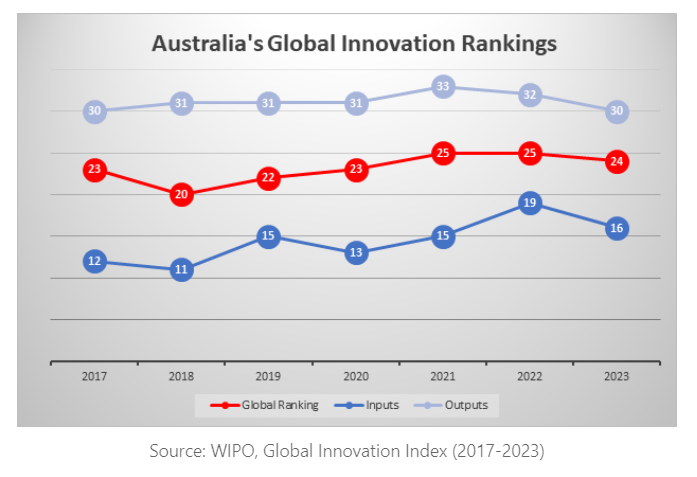
Most significantly, however, is that Australia continues to stagnate in the Global Innovation Index (Figure A). In 2023, Australia lifted one spot to 24. This places Australia at a lower innovation ranking than its global GDP ranking.
Figure A: Australia’s biggest innovation challenge is in terms of outputs. Image: WIPO, Global Innovation Index
Nations such as the United States, the United Kingdom, China, Germany, China and Japan might be reasonably expected to rank higher. However, Australia is also rated lower than relatively small and modest economies such as Estonia, Iceland and Luxembourg.
The foundation of Australia’s challenges
Combined, the challenges mentioned above underscore that Australia is in a self-perpetuating cycle that undermines its ability to be innovative in emerging technology areas. Because opportunities for investment and innovation are relatively scarce, Australia has an ongoing “brain drain” of technical and entrepreneurial talent overseas. This was referenced as a priority by the new Australian Minister for Industry and Science Ed Husic in his first address in that portfolio, promising to make Australia a nation of “makers, not takers.”
SEE: Australia’s international standing in AI research is one indicator of strong local expertise and potential.
The traditional challenges Australia has had in retaining talent then mean there are fewer AI projects to support. Therefore, it becomes more difficult to secure funding, thus completing the cycle by then encouraging talent to again look overseas for opportunity.
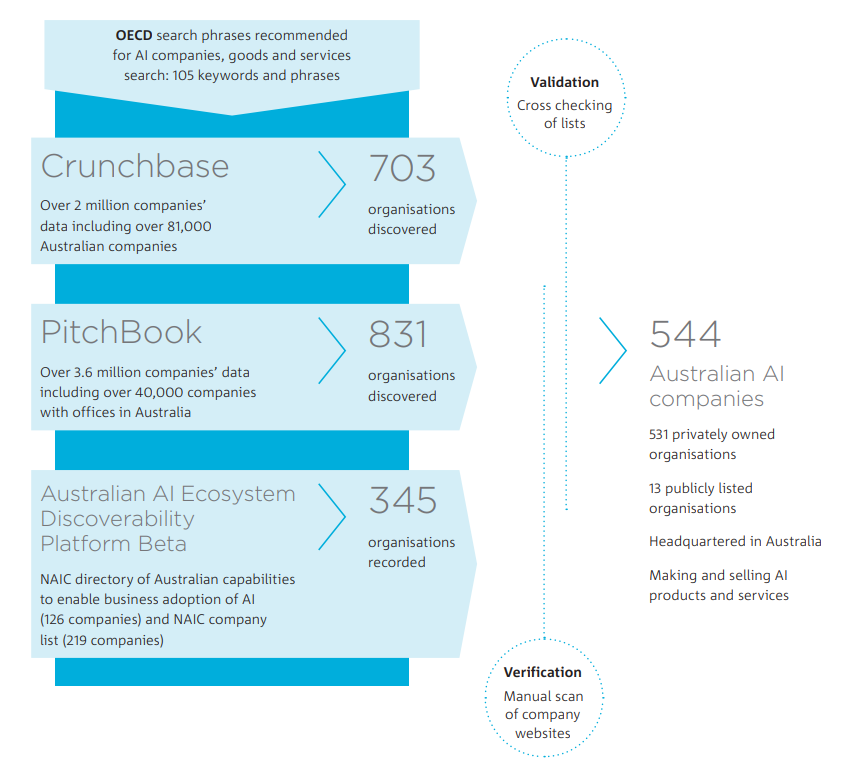
With startup funding crashing by two-thirds over the past year, it is becoming even more challenging to secure funding. This perhaps explains why, despite there being such runaway demand for AI globally, the number of Australian AI companies is currently a relatively modest 544 (Figure B).
Figure B: A breakdown of Australian AI companies. Image: CSIRO
However, the CSIRO-Google-Stone & Chalk competition, in offering AUD $300,000, is effectively providing the necessary money to an entrepreneur (most pre-seed funding rounds max out at $500,000). With the theme that the AI application must support the national interest, competitions like these have the potential to “fill in” for venture capital funding and ensure that Australia is generating innovation in the most critical areas.
Australia has innovation potential in the AI space
While Australia is lagging in innovation globally and currently missing the boat on AI — one of the most critical fields of innovation of all — when it is able to build national infrastructure around a technology field, it can take a leadership position.
Australia’s space program: A model to follow
For example, Australia has invested heavily in developing its space program and, in 2021, generated AUD $4.5 billion across 600 companies. By 2030, that is expected to rise to $12 billion in economic activity.
Meanwhile, the Australian National Quantum Strategy, which focuses on the quantum computing opportunity, is expected to add AUD $6.1 billion to Australia’s GDP by 2045 and employ 8,700 by 2030.
Both space and quantum computing are deep tech fields that demonstrate Australia has the resources and skills to commercialise the most advanced technologies when the infrastructure and investment support the development of a local industry.
Small pockets of innovation communities emerging
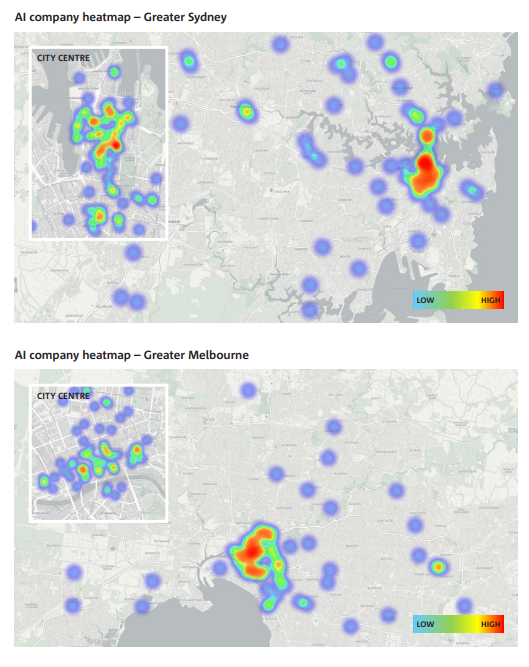
There are positive signs in the Australian market, too. One of the critical elements to building a healthy innovation-based sector is having a “cluster” of companies evolve. This is fundamentally what drove the growth of innovation centres such as Silicon Valley.
As CSIRO research shows, that clustering effect for AI-based companies is emerging in both the Sydney and Melbourne CBDs (Figure C).
Figure C: Heat map highlighting the clustering of AI startups in Sydney and Melbourne. Image: CSIRO
The question is just whether Australia can develop the infrastructure to capitalise on the AI opportunity before other innovation centres around the world can establish an incumbency position in the field. There is an urgency to develop the local AI environment, and competitions such as the CSIRO-Google-Stone and Chalk are aiming to support that acceleration.
It’s 2024, so I shouldn’t need to tell you why you ought to learn Python if you’re thinking about doing any kind of coding job. It’s one of the most popular programming languages, almost every data science job loves to see it on your resume, and it’s one of the easiest languages to learn.
The problem is that Python is a victim of its own popularity. So many people know Python, and it has such a reputation for being such a simple language that people forget that you’re still learning a coding language at the end of the day. It’s easier, relative to, say, Perl, but not easy.
It doesn’t help that many of the established learning paths have real flaws. Bootcamps are popular, but they’re often prohibitively expensive and time-consuming. Video tutorials are free, but quality varies and they’re not very motivational.
ChatGPT is a good way to learn the basics of Python as an alternative to the methods I mentioned above. It has a lot going for it:
It’s free (or $20/month at most)
Since it was trained on a ton of Python data, it has a lot of Python knowledge
It’s good for many different levels of learning
You can go at your own pace.
It’s not without its flaws, but if you’ve tried and struggled other ways, this one could be worth a go. Here’s how ChatGPT can teach you Python basics.
Getting Started
Here’s a simple way to get ChatGPT to be your personal Python tutor.
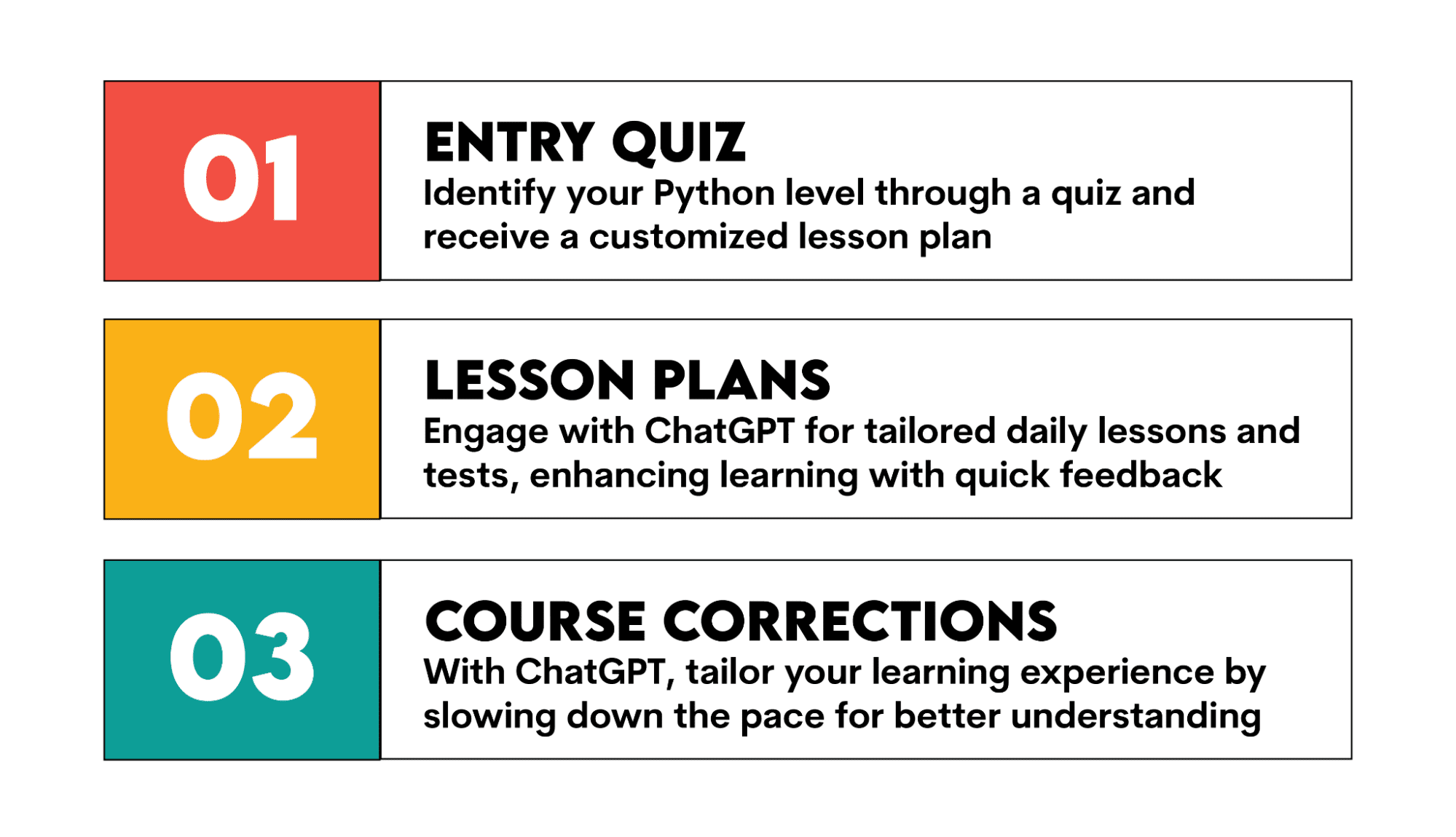
Entry Quiz
You can start by giving ChatGPT an idea of your learning level. Ask it to do a quiz and assign you a level based on your responses. Based on those answers, get it to design a lesson plan for a specific time frame – say, a year or six months.
This is so great because unlike Coursera videos, bootcamps, or YouTube lectures, this lesson plan can be designed to your specific level of Python. Skip the essentials if you learned them in high school or college, or ask it to really drill you on the core ideas if Python is brand new to you.
Lesson Plans
ChatGPT can then create lesson plans and help you progress through concepts. It can tailor the lesson plans based on your schedule.
Then, every day, come back to ChatGPT and ask it to walk you through the lesson plan. Based on your preferences, you can have it start with a test to see how well you retained yesterday’s material, or go straight into that day’s lessons and practice questions.
This is great for engagement. Text-based lessons, obviously, are not the most exciting things in the world. But when ChatGPT sets you a test question, you then answer it – and it will tell you if you got it right or wrong.
Course Corrections
Keep following your lesson plan, and see how well it works for you. Too fast? Ask ChatGPT to slow down. Getting bored? AskChatGPT to mix it up. Worried you’re forgetting previous lessons? Get ChatGPT to amend your lesson plan to include test questions from earlier on in your learning journey.
Why is ChatGPT Good?
ChatGPT’s main selling point here is its personalization potential. As I mentioned earlier, you can tell ChatGPT to run this anyway you like:
Go faster or slower
Skip certain topics, or go deep on others
Go more text or more practice questions
Switch up the order
Engaged Learning
Another advantage is the engagement level. Video lectures can’t tell you your code is wrong, but ChatGPT can. It can also teach you why. One thing I love about ChatGPT-based lesson plans is that you can ask it to use the Socratic method of teaching, which is extremely interactive, engaging, and good at getting you to grasp new concepts. For example, you might get something wrong in one of your ChatGPT-administered tests. Instead of telling you the right answer, ChatGPT can walk you through how to get to the right answer using Socratic teaching.
Personalization
You can also get personalized project ideas based on your interests, skill level, and what Python concept you’re trying to learn at the moment. Plus it can guide you through the project, helping you out if you run into tricky spots.
Plugin Potential
Finally, ChatGPT Pro also offers teaching plugins like Tutory that are highly recommended by Reddit users. Tutory takes it a step further with session continuity and long-term memory, so ChatGPT will be better at sticking to a real lesson plan over time. More and more ChatGPT users are creating plugins, so if you’re on the pro version, keep your eyes open for other potentially useful plugins.
What ChatGPT Can’t Do
I would be remiss if I hyped up ChatGPT as a personal Python tutor if I didn’t also mention the things you should watch out for if you’re using ChatGPT.
External Environment
First, you'll need to use an external Python environment for practicing and executing code. While you can write code inside ChatGPT, and it will tell you if it would work in theory, I don’t recommend it. It’s always better to run your code to see if it actually works as you expect. Plus, ChatGPT can't fully replicate the experience of working on larger, real-world projects.
No Context
ChatGPT won’t always understand the full context or intention behind your code, either, especially if there are complex issues or bugs. Basic issues are not a problem, but the more edge-case your issue, the less likely it is that ChatGPT can help.
No Visual Aids
Unlike video tutorials, vanilla ChatGPT lacks visual aids like diagrams or charts. (Though some plugins like Daigr.am do grant it this ability.) Plus, as most people know by now, ChatGPT's training includes information only up to a certain point. Python doesn’t evolve super quickly, but it’s still possible ChatGPT could be missing context, especially for newer libraries.
Fact-Checking Needed
It’s also worth remembering that ChatGPT might misinterpret your questions or provide overly broad answers. It’s also sometimes just plain wrong – it’s good to fact-check every so often to make sure you’re not going off-kilter.
AI Can’t Do Your Job
My most important caveat is that you should carefully watch yourself. There's a risk of becoming too reliant on ChatGPT for answers, which can slow your independent problem-solving skills. While employers love your Python knowledge, problem-solving skills are more important.
Check out this article to know the coding tasks that ChatGPT can’t do.
ChatGPT — Your Next Tutor?
Ultimately, ChatGPT is a great learning option, especially if you’ve struggled with other learning routes. If it works well to teach you Python basics, you can go on to use it to learn other skills, too.
That being said, it’s not without flaws. It also can’t take you all the way. I would trust ChatGPT to teach Python basics, but being able to demonstrate a portfolio of real-world projects is super important, too, and you’ll be on your own for a lot of that.
I’d recommend giving it a try. At worst, you’ll lose twenty bucks and some time. At best, you might be on your way to learning one of the most popular coding languages in 2024.
Nate Rosidi is a data scientist and in product strategy. He's also an adjunct professor teaching analytics, and is the founder of StrataScratch, a platform helping data scientists prepare for their interviews with real interview questions from top companies. Connect with him on Twitter: StrataScratch or LinkedIn.
More On This Topic
Learn MLOps Basics with This Free eBook
Python Basics: Syntax, Data Types, and Control Structures
Back to Basics Week 1: Python Programming & Data Science Foundations
Learning How to Use ChatGPT to Learn Python (or anything else)
Back To Basics, Part Dos: Gradient Descent
Back to Basics Week 3: Introduction to Machine Learning