Sergey Brin Says “We Definitely Messed up” Over Google Gemini Image Generation Fiasco

Google co-founder Sergey Brin said, “We definitely messed up on the image generation, and it was mostly due to not thorough testing.” Sergey Brin said that the problem with Gemini was majorly due to insufficient testing. He made these remarks during the Gemini Hackathon at the AGI house.

Sergey Brin about #Gemini image generation: „we definitely messed up“ #AI pic.twitter.com/1gT9cmj4Op

— Goran Majić (@Goran_Majic) March 3, 2024

This comes after Google, of late, has found itself entangled in a series of challenges, particularly with its AI model Gemini being labeled as excessively woke. Gemini-generated pictures went viral on social media recently, leading to widespread ridicule and anger.

Some users criticised Google, claiming that the company is overly concerned with being socially aware, even if it means sacrificing truth and accuracy.

Soon after, Google paused the Gemini’ image generation feature, citing ‘inaccuracies’ in historical pictures. However, recently, Google DeepMind CEO Demis Hassabis announced that Google plans to resume the image generation capabilities of Gemini soon.”

“We have taken the feature offline while we fix it,” Hassabis said, at the Mobile World Congress conference in Barcelona. “We are hoping to have that back online very shortly – in the next couple of weeks, a few weeks,” he said, adding that the product was not “working the way we intended”.

Google chief Sundar Pichai, too, accepted the mistake. “I know that some of its responses have offended our users and shown bias – to be clear, that’s completely unacceptable and we got it wrong,” Pichai said in a memo to his employees.

He said the company has made progress in fixing Gemini’s guardrails. “Our teams have been working around the clock to address these issues. We’re already seeing a substantial improvement on a wide range of prompts,” he said.

The post Sergey Brin Says “We Definitely Messed up” Over Google Gemini Image Generation Fiasco appeared first on Analytics India Magazine.

Karine Perset helps governments understand AI

Karine Perset helps governments understand AI Dominic-Madori Davis 9 hours

To give AI-focused women academics and others their well-deserved — and overdue — time in the spotlight, TechCrunch is launching a series of interviews focusing on remarkable women who’ve contributed to the AI revolution. We’ll publish several pieces throughout the year as the AI boom continues, highlighting key work that often goes unrecognized. Read more profiles here.

Karine Perset works for the Organization for Economic Co-operation and Development (OECD), where she runs its AI Unit and oversees the OECD.AI Policy Observatory and the OECD.AI Networks of Experts within the Division for Digital Economy Policy.

Perset specializes in AI and public policy. She previously worked as an advisor to the Internet Corporation for Assigned Names and Numbers (ICANN)’s Governmental Advisory Committee and as Conssellor of the OECD’s Science, Technology, and Industry Director.

What work are you most proud of (in the AI field)?

I am extremely proud of the work we do at OECD.AI. Over the last few years, the demand for policy resources and guidance on trustworthy AI has really increased from both OECD member countries and also from AI ecosystem actors.

When we started this work around 2016, there were only a handful of countries that had national AI initiatives. Fast forward to today, and the OECD.AI Policy Observatory – a one-stop shop for AI data and trends – documents over 1,000 AI initiatives across nearly 70 jurisdictions.

Globally, all governments are facing the same questions on AI governance. We are all keenly aware of the need to strike a balance between enabling innovation and opportunities AI has to offer and mitigating the risks related to the misuse of the technology. I think the rise of generative AI in late 2022 has really put a spotlight on this.

The ten OECD AI Principles from 2019 were quite prescient in the sense that they foresaw many key issues still salient today – 5 years later and with AI technology advancing considerably. The Principles serve as a guiding compass towards trustworthy AI that benefits people and the planet for governments in elaborating their AI policies. They place people at the center of AI development and deployment, which I think is something we can’t afford to lose sight of, no matter how advanced, impressive, and exciting AI capabilities become.

To track progress on implementing the OECD AI Principles, we developed the OECD.AI Policy Observatory, a central hub for real-time or quasi-real-time AI data, analysis, and reports, which have become authoritative resources for many policymakers globally. But the OECD can’t do it alone, and multi-stakeholder collaboration has always been our approach. We created the OECD.AI Network of Experts – a network of more than 350 of the leading AI experts globally – to help tap their collective intelligence to inform policy analysis. The network is organized into six thematic expert groups, examining issues including AI risk and accountability, AI incidents, and the future of AI.

How do you navigate the challenges of the male-dominated tech industry and, by extension, the male-dominated AI industry?

When we look at the data, unfortunately, we still see a gender gap regarding who has the skills and resources to effectively leverage AI. In many countries, women still have less access to training, skills, and infrastructure for digital technologies. They are still underrepresented in AI R&D, while stereotypes and biases embedded in algorithms can prompt gender discrimination and limit women’s economic potential. In OECD countries, more than twice as many young men than women aged 16-24 can program, an essential skill for AI development. We clearly have more work to do to attract women to the AI field.

However, while the private sector AI technology world is highly male-dominated, I’d say that the AI policy world is a bit more balanced. For instance, my team at the OECD is close to gender parity. Many of the AI experts we work with are truly inspiring women, such as Elham Tabassi from the U.S National Institute of Standards and Technology (NIST); Francesca Rossi at IBM; Rebecca Finlay and Stephanie Ifayemi from the Partnership on AI; Lucilla Sioli, Irina Orssich, Tatjana Evas and Emilia Gomez from the European Commission; Clara Neppel from the IEEE; Nozha Boujemaa from Decathlon; Dunja Mladenic at the Slovenian JSI AI lab; and of course my own amazing boss and mentor Audrey Plonk, just to name a few, and there are so many more.

We need women and diverse groups represented in the technology sector, academia, and civil society to bring rich and diverse perspectives. Unfortunately, in 2022, only one in four researchers publishing on AI worldwide was a woman. While the number of publications co-authored by at least one woman is increasing, women only contribute to about half of all AI publications compared to men, and the gap widens as the number of publications increases. All this to say, we need more representation from women and diverse groups in these spaces.

So to answer your question, how do I navigate the challenges of the male-dominated technology industry? I show up. I am very grateful that my position allows me to meet with experts, government officials, and corporate representatives and speak in international forums on AI governance. It allows me to engage in discussions, share my point of view, and challenge assumptions. And, of course, I let the data speak for itself.

What advice would you give to women seeking to enter the AI field?

Speaking from my experience in the AI policy world, I would say not to be afraid to speak up and share your perspective. We need more diverse voices around the table when we develop AI policies and AI models. We all have our unique stories and something different to bring to the conversation.

To develop safer, more inclusive, and trustworthy AI, we must look at AI models and data input from different angles, asking ourselves: what are we missing? If you don’t speak up, then it might result in your team missing out on a really important insight. Chances are that, because you have a different perspective, you’ll see things that others do not, and as a global community, we can be greater than the sum of our parts if everyone contributes.

I would also emphasize that there are many roles and paths in the AI field. A degree in computer science is not a prerequisite to work in AI. We already see jurists, economists, social scientists, and many more profiles bringing their perspectives to the table. As we move forward, true innovation will increasingly come from blending domain knowledge with AI literacy and technical competencies to come up with effective AI applications in specific domains. We see already that universities are offering AI courses beyond computer science departments. I truly believe interdisciplinarity will be key for AI careers. So, I would encourage women from all fields to consider what they can do with AI. And to not shy away for fear of being less competent than men.

What are some of the most pressing issues facing AI as it evolves?

I think the most pressing issues facing AI can be divided into three buckets.

First, I think we need to bridge the gap between policymakers and technologists. In late 2022, generative AI advances took many by surprise, despite some researchers anticipating such developments. Understandingly, each discipline is looking at AI issues from a unique angle. But AI issues are complex; collaboration and interdisciplinarity between policymakers, AI developers, and researchers are key to understanding AI issues in a holistic manner, helping keep pace with AI progress and close knowledge gaps.

Second, the international interoperability of AI rules is mission-critical to AI governance. Many large economies have started regulating AI. For instance, the European Union just agreed on its AI Act, the U.S. has adopted an executive order for the safe, secure, and trustworthy development and use of AI, and Brazil and Canada have introduced bills to regulate the development and deployment of AI. What’s challenging here is to strike the right balance between protecting citizens and enabling business innovations. AI knows no borders, and many of these economies have different approaches to regulation and protection; it will be crucial to enable interoperability between jurisdictions.

Third, there is the question of tracking AI incidents, which have increased rapidly with the rise of generative AI. Failure to address the risks associated with AI incidents could exacerbate the lack of trust in our societies. Importantly, data about past incidents can help us prevent similar incidents from happening in the future. Last year, we launched the AI Incidents Monitor. This tool uses global news sources to track AI incidents around the world to understand better the harms resulting from AI incidents. It provides real-time evidence to support policy and regulatory decisions about AI, especially for real risks such as bias, discrimination, and social disruption, and the types of AI systems that cause them.

What are some issues AI users should be aware of?

Something that policymakers globally are grappling with is how to protect citizens from AI-generated mis- and disinformation – such as synthetic media like deepfakes. Of course, mis- and disinformation has existed for some time, but what is different here is the scale, quality, and low cost of AI-generated synthetic outputs.

Governments are well aware of the issue and are looking at ways to help citizens identify AI-generated content and assess the veracity of the information they are consuming, but this is still an emerging field, and there is still no consensus on how to tackle such issues.

Our AI Incidents Monitor can help track global trends and keep people informed about major cases of deepfakes and disinformation. But in the end, with the increasing volume of AI-generated content, people need to develop information literacy, sharpening their skills, reflexes, and ability to check reputable sources to assess information accuracy.

What is the best way to responsibly build AI?

Many of us in the AI policy community are diligently working to find ways to build AI responsibly, acknowledging that determining the best approach often hinges on the specific context in which an AI system is deployed. Nonetheless, building AI responsibly necessitates careful consideration of ethical, social, and safety implications throughout the AI system lifecycle.

One of the OECD AI Principles refers to the accountability that AI actors bear for the proper functioning of the AI systems they develop and use. This means that AI actors must take measures to ensure that the AI systems they build are trustworthy. By this, I mean that they should benefit people and the planet, respect human rights, be fair, transparent, and explainable, and meet appropriate levels of robustness, security, and safety. To achieve this, actors must govern and manage risks throughout their AI systems’ lifecycle – from planning, design, and data collection and processing to model building, validation and deployment, operation, and monitoring.

Last year, we published a report on “Advancing Accountability in AI,” which provides an overview of integrating risk management frameworks and the AI system lifecycle to develop trustworthy AI. The report explores processes and technical attributes that can facilitate the implementation of values-based principles for trustworthy AI and identifies tools and mechanisms to define, assess, treat, and govern risks at each stage of the AI system lifecycle.

How can investors better push for responsible AI?

By advocating for responsible business conduct in the companies they invest in. Investors play a crucial role in shaping the development and deployment of AI technologies, and they should not underestimate their power to influence internal practices with the financial support they provide.

For example, the private sector can support developing and adopting responsible guidelines and standards for AI through initiatives such as the OECD’s Responsible Business Conduct (RBC) Guidelines, which we are currently tailoring specifically for AI. These guidelines will notably facilitate international compliance for AI companies selling their products and services across borders and enable transparency throughout the AI value chain – from suppliers to deployers to end-users. The RBC guidelines for AI will also provide a non-judiciary enforcement mechanism – in the form of national contact points tasked by national governments to mediate disputes – allowing users and affected stakeholders to seek remedies for AI-related harms.

By guiding companies to implement standards and guidelines for AI — like RBC – private sector partners can play a vital role in promoting trustworthy AI development and shaping the future of AI technologies in a way that benefits society as a whole.


How do you get employees to embrace AI? (You may find this sneaky)

People using AI on screens

It's a good news, bad news world. For every ray of light, there's a lightning bolt ready to explode our sense of well-being.

One can imagine, then, how many of the world's employees are girding themselves and seeking every possible element of grounding against the threat from artificial intelligence (AI): "Will it take my job? Will it make me permanently obsolete? Or, perhaps worse, will it become my boss?"

Also: Want to work in AI? How to pivot your career in 5 steps

Meanwhile, many bosses might be thinking: "Will it make me a lot more money before it becomes my boss? Exactly how much money will it make me? And how quickly?"

A new way of working

Let's look at AI from the boss's perspective.

Many people might already realize how hard it could be to persuade employees to let AI improve their company's output. Many bosses might be tempted to force AI into the workplace culture by simply declaring the technology to be the bright new hope for tomorrow.

Also: Have 10 hours? IBM will train you in AI fundamentals — for free

There may, though, be more subtle ways of introducing AI.

I've learned this fact from a fascinating series of suggestions penned in the Harvard Business Review by Tomas Chamorro-Premuzic.

He's the chief innovation officer at ManpowerGroup, and a professor of business psychology at University College London and Columbia University. He's also a co-founder of deepersignals.com, as well as an associate at Harvard's Entrepreneurial Finance Lab.

Also: Is prompt engineer displacing data scientist as the 'sexiest job of the 21st century'?

Having looked at Chamorro-Premuzic's analysis, I marvel at some of his suggestions for persuading employees to let AI into their work lives.

Some of these tactics might seem both pure and logical. For example: "Sell the ways in which this technology will strengthen the organization — and increase the resilience of each part — with the goal to upgrade attitudes from negative to positive, or at least neutral."

Not every CEO is a fine salesperson, however. A lot of them used to be CFOs, after all.

Then there's the idea of testing AI against more traditional solutions to difficult work problems. This approach seems preferable to instantly blanketing your company with AI everywhere.

Sneaky, brilliant, or both?

But Chamorro-Premuzic then slides into more subtle, perhaps sneaky areas. Here's one of his headlines: "Intuition Is The Common Enemy."

But wait a minute — wasn't intuition the thing that made Steve Jobs successful? Don't we always most admire the people who have inspired — often illogical — ideas that suddenly blossom into world-changing realities?

Also: How to use ChatGPT

Chamorro-Premuzic is quite clear here: "The production of human-like activity by autonomous technologies is often seen by people — no matter their role — as a threat to control, power, and autonomy."

He immediately follows up with: "To be fair, it often does reduce freedom and improvisation by humans."

Freedom reduction is not a popular concept here in the US, even if it's not always perfectly understood.

Chamorro-Premuzic insists, though, that persuading employees to let AI make the minor decisions will release them to concentrate on the major ones.

However, I fear he might not yet have persuaded you of the benefits of AI. I fear you may not be at ease with the idea of AI becoming the employee of the month. I fear you may think that once AI makes the smaller decisions, it'll soon want to make the bigger ones, too.

Also: 6 AI tools to supercharge your work and everyday life

Please, then, think about this — to my mind — sneakiest idea, which he headlines: "Process Eats Culture For Lunch."

This concept almost sounds like the scheming innards of a politician's mind. Yet Chamorro-Premuzic offers a delightful metaphor.

He suggests treating workplace culture "as you would treat your relationship to the weather: Not as something you can change, but something that informs your choice of clothing."

I think I get what he means, although my clothing choices can sometimes be charitably called eclectic.

Also: You can build your own AI chatbot with this drag-and-drop tool

Chamorro-Premuzic's thinking is this: "The key is to put in place new systems and processes that counteract the effects of culture, like extrinsic formal incentives that inhibit the influence of informal dynamics and forces."

Academics often bathe in such complex concepts, but I abstract from this idea an essential sneakiness where a new process will simply neutralize ingrained cultural norms.

However, my concern is that an ingrained culture will see these new processes for what they fear they are: Trojan ponies trying to act lovable.

The middle matters most

Chamorro-Premuzic then brings up something of which you might be aware, but I certainly wasn't.

Research apparently shows that the best way to make sure new processes are embraced isn't by sending an all-staff email, or even by making a big announcement on Slack.

Instead, the key to success is getting middle managers to be the new process's champions — "for their [mid-level managers'] behaviors and decisions mobilize change and instill new habits in the wider workforce."

Also: I took this free AI course for developers in one weekend and highly recommend it

You might not have realized middle managers are so influential, especially as many companies currently seem to believe they can do without too many of them.

I confess that I've embraced certain levels of AI simply by trying the tools out and seeing if they work. It may be harder, however, for people in larger, more bureaucratic companies to experiment — until they see their middle manager doing it.

So, the biggest lesson for bosses might be to create irresistible processes, championed by incentivized middle managers, that — gently, of course — blunt cultural prejudice.

And the lesson for employees is clear: If you see your middle manager telling you they love the new processes instituted from on high, they may have been influenced by a very clever, very pro-AI CEO.

Artificial Intelligence

OpenAI Goes After Blue Collar Jobs 

What is Left for OpenAI Dev Day

Having disrupted the white-collar jobs, OpenAI is now looking to automate blue-collar jobs. The company wants to develop next generation AI models for humanoid robots and aims to help accelerate their capabilities to process and reason from language.

OpenAI’s investment in Figure, alongside major players like Microsoft, NVIDIA, Jeff Bezos (through Bezos Expeditions), and others, reinforces this. This development also posed a threat to Elon Musk’s Tesla Optimus, which explains why he might have sued OpenAI to begin with in the first place.

In an interview with Bill Gates, Sam Altman said that seven to six years ago, the prediction was that AI would impact blue-collar work first, white-collar work second, and creativity maybe never, but certainly last because that was considered ‘magic and human.’ “Obviously, it’s gone in exactly the other direction,” he quipped.

He is quite optimistic about the future of robotics. “On the physical hardware side, there’s finally, for the first time that I’ve ever seen, really exciting new platforms being built,”said Altman.

He added that, at some point, they will be able to use their AI models, along with their language understanding and video understanding, to accomplish amazing things with robots.

Interestingly, Figure’s mission fits well with Altman’s, which is to make versatile humanoids that can tackle labor shortages, automate less desirable jobs, and enhance human capabilities and productivity.

“We have a massive labor crisis happening, with 10+ million jobs in the U.S. that people don’t want to do,” said Figure Chief Brett Adcock, adding that companies are losing 50% to 150% of employees annually and can’t find anybody to do these jobs.

“They simply don’t know a solution to help automate these problems. We believe that with Figure, the demand for what we’re doing is almost unbounded. I would say we’re aiming to be one of the first in the world to deploy us at a real scale commercially.”

The robotics company released updates for the Figure-01 humanoid earlier this year, where the robot demonstrates making coffee—a skill learned from observing humans. ‘If it’s not obvious yet, Figure’s humanoid robot is the ultimate deployment vector for AGI,’ wrote Adcock on X.

OpenAI Robotics Journey

This isn’t the first time OpenAI has ventured into robotics. In 2019, OpenAI successfully trained a robotic hand to autonomously solve a Rubik’s cube. Despite this achievement, the dedicated robotics team was disbanded in July 2021. Additionally, the company had previously invested USD 23.5 million in 1X Technologies.

“We started robots too early, so we had to put that project on hold. We were dealing with bad simulators and breaking tendons and things like that,” said Altman, adding over time they realised that they first needed intelligence and cognition and later they could figure out how to adapt it to physicality.

Even Sora, OpenAI’s latest text-to-video generation model, can simulate some aspects of people, animals, and environments from the physical world when trained at scale. While the rest of the world sees Sora as just a video generation tool, for OpenAI, it is an attempt to create a simulated reality that could lead to AGI.

Simply put, the idea is to create a world model, similar to what Meta’s chief, Yann LeCun, and the autonomous vehicle company Wavye are trying to achieve.

“We’ve always planned to come back to robotics and we see a path with Figure to explore what humanoid robots can achieve when powered by highly capable multimodal models,” said Peter Welinder, VP of Product and Partnerships at OpenAI.

“AGI will eventually be embodied in some robotic form, whether it’s Optimus (Tesla), Figure (with OpenAI), or another company (seems like there’s a lot),” wrote Sully co-founder CognosysAi.

Makes Optimus Jealous

Both Optimus and Figure aren’t that much different from each other. Figure 01 stands at 5’6” and weighs 60 kg, while Optimus is slightly taller at 5’8” and weighs 73 kg. Both can handle a payload of up to 20 kg, showcasing their comparable sizes.

Meanwhile, Tesla recently announced major improvements in its humanoid robots and it looks like it is moving closer to what Musk has envisioned for Optimus. Last year, Optimus just waved on the stage. Now, it can pick up and sort objects, do yoga, and navigate through surroundings.

Besides Figure and Optimus, Boston Dynamics is also not left behind. The company has two robots- Atlas (bipedal) and Spot(quadruped which are both used in various industries, including logistics, manufacturing, construction, and inspection.

“Boston Dynamics is now primarily owned by Hyundai. I believe that Hyundai’s expertise in making cars can be applied to the production of robots, resulting in products that are both less expensive and more reliable,” said Marc Raibert, founder of Boston Dynamics.

Of late, Amazon too has been experimenting with humanoid robots in select US warehouses, marking a significant step in its automation endeavours. The tech giant aims to optimise efficiency by introducing these robots, named ‘Digit’, which emulate human movements for tasks such as moving and handling items.

The prospect of a world where humans are liberated from routine jobs doesn’t seem too bad. Who knows, the future job wars will likely involve humanoids more and humans less.

The post OpenAI Goes After Blue Collar Jobs appeared first on Analytics India Magazine.

Voice Slowly Catching Up on Multimodal AI Features

Recently, Eleven Labs, a voice technology research company that works in developing AI for speech synthesis and text-to-speech software, added voice to Sora’s generated videos, showcasing a holistic example of what voice can bring to AI-generated videos. While, this is not the first time, voice modality is increasingly being brought to the forefront.

People aren't taking the "everyone will be filmmakers" seriously enough.
I made this 20s trailer in 15mins with an OpenAI Sora clip, David Attenborough's voice on Eleven Labs, and sampling some nature music from Youtube on iMovie pic.twitter.com/pbfmle9bvb

— Deedy (@debarghya_das) February 16, 2024

It’s Not All Easy with Voice

Voice in AI modality is considered to have a uniquely difficult interface mechanism as it employs probabilistic AI as opposed to deterministic machine learning-based voice services such as Apple Siri, and other home assistant products.

Technology investor, Michael Parekh believes that the time to implement perfect AI voice modality on devices, will be a lengthy one. “It’s going to be a long road to get it right, likely as long as it took to even get the previous versions like Apple Siri, Google Next, and Amazon Alexa/Echo especially, to barely tell us the time, set timers, and play some music on demand,” he said.

Voice has also been chosen as a mode of interaction which is evident through its implementation as a primary user interface in devices such as Rabbit. The Humane AI pin, a futuristic, small wearable AI device that can be pinned to one’s clothing, works on finger gestures and voice for operating the device.

SoundHound Inc, an AI voice and speech recognition company that was founded almost a decade ago, developing technologies for speech recognition, NLP and more, have predicted in 2020 itself- “Although, voice does not need to be the only method of interaction (nor should it be), voice assistants will soon become a primary user interface in a world where people will never casually touch shared surfaces again.”

Voice for Video

The stream of AI voice integration announcements spiked in the last few weeks. Pika Labs, which creates AI-powered tools for generating and editing videos, came to limelight a few months ago with a $55M total funding. They recently announced an early access to the ‘Lip Sync’ feature for their Pro users that enables voice and dialogues for AI-generated videos.

Alibaba’s EMO AI generator (Emote Portrait Alive) that generates expressive portrait videos with audio2video diffusion models was released last week to give a direct competition to Pika Labs. The company released videos where images were made to talk/sing with expressive facial gestures.

Voice feature has also been integrated to simplify podcasts. Eleven Labs had partnered with Perplexity to bring ‘Discover Daily’, a daily podcast that will be narrated by Eleven Labs’ AI-generated voices : another use case of how combining voice technology with other functionalities can create tangible use cases.

Theme for 2024

In the top three AI trends that Microsoft identified for 2024, Multimodal AI was one of them. “Multimodality has the power to create more human-like experiences that can better take advantage of the range of senses we use as humans, such as sight, speech and hearing,” said Jennifer Marsman, principal engineer in AI (Office of the CTO) at Microsoft.

Microsoft’s efforts in the same direction is reflected in their AI offering Microsoft Copilot. Catering to enterprises and consumers alike, Copilot’s multimodal capabilities can process various formats including images, natural language and Bing search data. Multimodal AI also powers Microsoft Designer, a graphic image tool for creating designs, logos, banners and lots more with a simple text prompt.

Latest AI kid on the block, Perplexity, has also integrated the multimodal features, where a user can upload images from their Pro account and get relevant answers based on that. There is a common theme from all these functionalities. Is ‘voice’ truly an added feature?

Big Tech’s Foray Into Voice

With the release of ChatGPT’s voice feature, that allows one to easily converse with the model, almost 6 months after launching a multimodal GPT 4 model, voice capability was fully integrated on GPT-4’s model. Google Gemini, the most powerful AI model of Google, is also a multimodal model.

While the advancements are promising, misuse risks related to implementing it still persists, with the most prominent one being deepfakes. With an increasing number of companies entering the space, adding voice to AI-generated videos only adds to the propensity of abuse, where stringent copyright and privacy laws will be the only saviour.

The post Voice Slowly Catching Up on Multimodal AI Features appeared first on Analytics India Magazine.

Microsoft unveils Copilot Lab to help users get the most out of its AI assistant

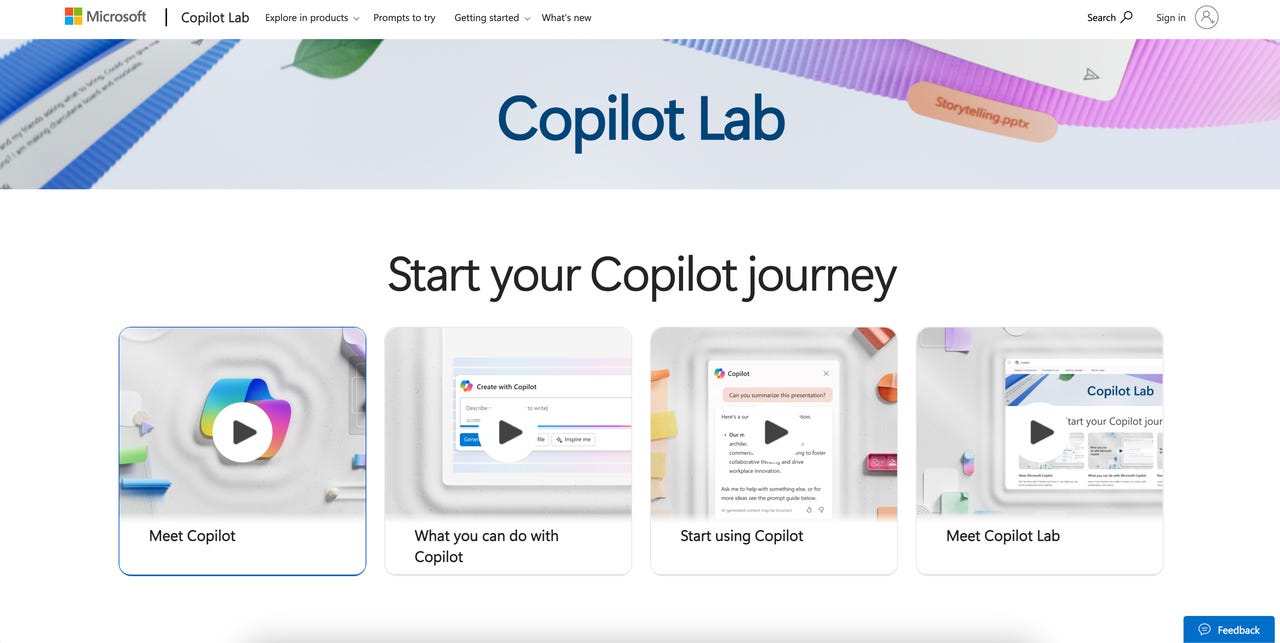
Copilot Lab

AI chatbots can assist users with anything from writing an email to solving a complicated math equation. However, there is some skill to getting maximum assistance from the chatbot, and Microsoft unveiled Copilot Lab to share all the tips and tricks.

Also: How to write better ChatGPT prompts in 5 steps

On Thursday, Microsoft announced Copilot Lab via X, a single page where the company consolidated all of its best resources such as training videos, ready-made prompts, and more to help users get the most out of their Copilot experience.

Upon visiting the landing page, users are met with instructional videos that explain the basics of Microsoft's AI assistant with titles such as, "Meet Copilot," "What you can do with Copilot," and "Start using Copilot." These guides focus more on what users can do with Copilot in Microsoft 365 rather than Microsoft's standalone chatbot.

Underneath that, users can find example prompts that show the range of what Copilot can assist with through the different Microsoft 365 apps, including creating a quiz in OneNote, writing an email in Outlook, and adding an image in PowerPoint. Users can then click on the prompt to copy and paste into each respective app.

Also: The best AI image generators of 2024: Tested and reviewed

Even though the Lab has a special focus on Copilot for Microsoft for 365, if you are a beginner to AI chatbots including Copilot, some aspects of the lessons can be broadly used across any AI chatbot. For example, there is an "art of prompting" section that has a toolkit and articles that explain how to get the best results from a prompt, as seen in the image below.

Microsoft has many offerings that fall under the Copilot umbrella including its standalone chatbot, named Copilot, Copilot Pro (for home), Copilot for Microsoft 365 (for work), Copilot in Windows 11, and Copilot in Microsoft Edge. Because this can get confusing to differentiate, Copilot Lab has a useful explainer of the differences and which is the best fit for different users.

Artificial Intelligence

How to use ChatGPT’s file analysis capability (and what it can do for you)

Digital files in rows

OpenAI a week ago unveiled a new feature for ChatGPT called "memory," which stores things you explicitly ask the program to have access to, for later use.

Alongside memory, it's good to remember that ChatGPT can also use existing file-upload capabilities to analyze text and images. You just drag and drop a file into the chat window, such as a PDF or a JPEG, add a prompt if you like, and ChatGPT will start to produce some text output based on what you've uploaded.

Also: How to use ChatGPT

The capability is available to all paying users of the $20-per-month "Plus" version. The Plus version has the added capability of using the latest ChatGPT, version 4, instead of version 3.5, and the quality of output can be noticeably better. Plus also allows the use of DALL-E, the image-generation program.

The most obvious uses for file upload are summarization, outlining, and more advanced kinds of semantic search beyond just keyword search. File upload is easy: Just drag.

The file upload function shines when presented with a long document and asked to do something such as isolate particular kinds of content thematically. This is a form of semantic search, meaning, not based strictly on an individual keyword.

For example, I uploaded a 4,500-word report on specialized semiconductors known as silicon carbide. Silicon carbide is widely used in Tesla and other electric vehicles to create what's called the traction inverter. But it has less-obvious applications. I asked ChatGPT, "In this report on silicon carbide, are there any references to non-automotive use cases?"

Also: The best AI chatbots

ChatGPT responded with an excellent summary of six use cases that were identified in the report and did not pertain to cars. That's more powerful than having to use individual keywords. I've considered using ChatGPT as my go-to source for making a first pass at working with long documents.

Textual summarization is useful for long transcripts of interviews. I uploaded a 6,800-word transcript and got a usable summary of the most important topics that could be the beginning of an outline for an interview based on the transcript.

However, such summaries are not a replacement for editing and shaping a story. That kind of data compression requires identifying themes, re-phrasing them in useful ways, and, most critically, deciding which things to leave out. Those things, especially what to leave out, are currently beyond what ChatGPT can do, although more particular kinds of prompting can help.

ChatGPT's file analysis can handle picture files but not yet video. When various images are uploaded, the program does a satisfactory job of identifying the contents and even adding some descriptive copy. That can be useful for things such as captioning.

Also: The best AI image generators

ChatGPT identified the New York City skyline, the Empire State Building, and commented on the mix of old and new styles.

A street scene in midtown Manhattan also evoked a useful descriptive caption from the machine.

I was able to submit a work of art based on a public-domain image of Alan Turing, whom the program identified, and annotated with commentary about the intent of the picture.

ChatGPT offered an appropriate if bland description of ZDNET's photo of OpenAI executives Sam Altman and Mira Murati from an article on the two from November, without actually identifying the individuals.

AI's ability to analyze images and video is evolving rapidly. Alphabet's Google recently introduced its latest large language model, Gemini 1.5. The program is able to zero in on the moment in a 440-page transcript of the Apollo mission to the moon when Neil Armstrong takes "one small step" on the moon's surface. It was also able to pick out time stamps in a silent movie of Buster Keaton. Those kinds of abilities are still beyond the precision of ChatGPT's file upload.

Also: What is Gemini? Everything you should know about Google's new AI model

It's clear that document analysis will merge with the memory function in ChatGPT at some point. Typing in memories by hand at the prompt is not necessarily as efficient as providing a whole document that has all the things one wants to apply to ChatGPT, such as references and background information. A year from now, the use of memory and analysis will probably be one of the main ways that ChatGPT will have evolved from its current incarnation.

Artificial Intelligence

Is there anything AI can’t do?

Is there anything AI can’t do? Haje Jan Kamps 9 hours

Welcome to Startups Weekly — your weekly recap of everything you can’t miss from the world of startups. Sign up here to get it in your inbox every Friday.

I don’t code much anymore, but I’ve been hacking away with a small murder of Arduinos (clearly, like for crows, the plural for an Arduino is a “murder”). My C skills are hella rusty, and ChatGPT has been a surprisingly helpful tool for coding and debugging. Being able to throw a bunch of code, along with the error message the compiler throws, only for the robots to tell me that (1) I really shouldn’t be coding and (2) how to fix my n00b mistakes has been pretty refreshing.

Of course, none of this will come as a surprise to anyone who’s been paying attention, but the vast number of next-generation startups that are coming our way would indicate that the AI tentacles are going far and wide.

The truly mind-boggling thing is how early we are in our journey with AI. The current-generation technology is the tech equivalent of a toddler, and all the mediocre reviews various generative AI software is getting is tantamount to judging a fish by its ability to climb a tree.

“I’m surprised no one has done a parody of actually reviewing a three-month-old baby, and saying all it does is poop in its pants, and it can’t even finish complete sentences,” Steve Blank said in an interview with TechCrunch last year. “Copilot has changed the life of every programmer, period. It has probably increased productivity by 50%, and that is if you are using it poorly.”

I’m eager to see where it’s all going.

On that note . . .

It’s all AI, all the time

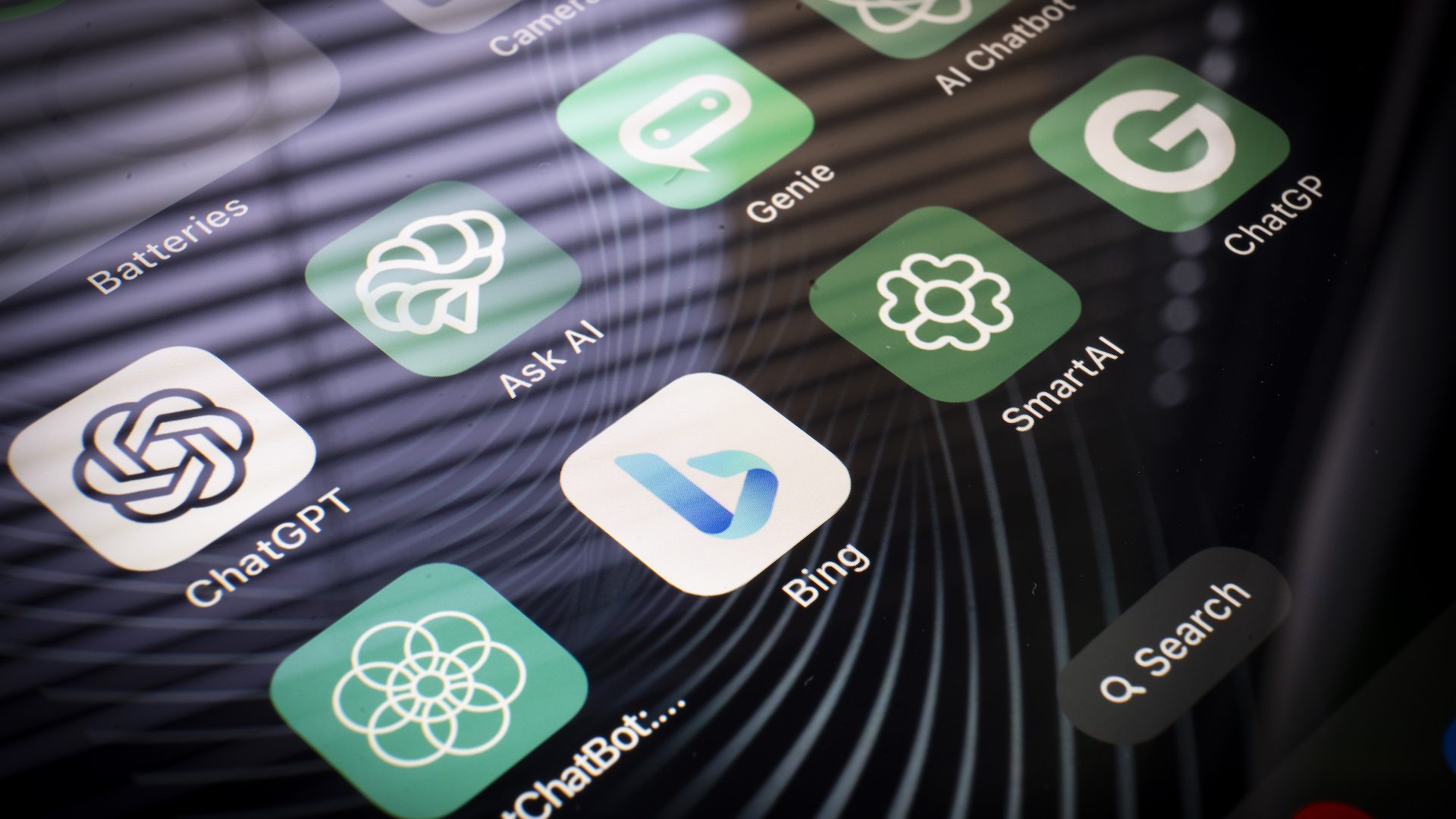
ChatGPT, Microsoft Bing Chat and AI chat applications are seen on a mobile device

Image Credits: Jaap Arriens/NurPhoto / Getty Images

FlowGPT emerges as the digital embodiment of the Wild West, a place where the law is more of a suggestion and safety measures are those annoying things you click past to get to the good stuff. Founded by a duo who seemingly decided that what the world really needed was a marketplace for AI apps that range from the mildly useful to the potentially nefarious, FlowGPT is the playground for anyone who thought, “Yes, I do need an app that narrates horror stories as if I’m a scared girl from a movie, but also, can it teach me how to code malware?” Investors, in a move that screams “What could possibly go wrong?” have thrown $10 million at the venture, proving once again that in the tech world, ethics can be as flexible as your funding is solid.

Inkitt looked at the dwindling reading habits of the world and said, “Challenge accepted.” With a bold plan to become the Disney of the 21st century, they’re throwing $37 million at the problem, because why not? The company’s strategy? Use AI to sift through self-published stories on their app, pick the ones that scream potential, and then tweak them into bestsellers.

AI will build your website: While Wix and Squarespace reign supreme with their user-friendly drag-and-drop interfaces, 10Web, from Armenia, emerges aiming to tame the beast that is WordPress.

AI will read your news for you: Particle.news, the brainchild of ex-Twitter engineers, is stepping into the ring with a fresh take on digesting the news. Armed with $4.4 million in seed funding, they have a vision to offer a “multi-perspective” news reading experience.

AI will code for you: StarCoder 2 is a family of models, boasting up to 15 billion parameters and trained on a whopping 67.5 terabytes of data. StarCoder 2 is trained on approximately 619 programming languages.

Most interesting fundraises this week

hand holding a money bag

Image Credits: Liia Galimzianova (opens in a new window) / Getty Images

Fervo Energy is making sure the geothermal sector is heating up, raising $221 million as it pioneers deep into Earth’s crust to harness its heat. This Houston-based enterprise is leveraging directional drilling techniques, a legacy from the oil and gas industry, to significantly extend the reach of its wells. By outfitting these wells with fiber-optic cables and an array of sensors, Fervo is mapping subsurface heat patterns and monitoring well performance with unprecedented precision.

Initia is stepping onto the blockchain scene with a bold mission to tackle the notorious complexity and fragmentation plaguing the development of blockchain applications. The company aims to bridge the gap between the multichain universe and app-specific blockchains, offering a streamlined approach to interoperability and simplification. The company’s approach seeks to remove the technical barriers for app developers, aspiring to become the App Store of the crypto world, where accessing and building applications is as straightforward as possible. With a recent $7.5 million seed financing, the company is going heavy on the accelerator.

Money for photos: Photoroom, a Paris-based AI photo-editing app, has successfully closed its latest funding round, securing $43 million at a $500 million valuation.

Money for money: Embat has successfully secured a $16 million Series A funding. The company aims to revolutionize the way finance teams operate by digitizing and automating processes such as accounting, bank reconciliation, and corporate treasury management.

Money for AI: Mistral AI announced a significant development in its journey with the unveiling of a new large language model named Mistral Large, aimed at competing with giants like OpenAI’s GPT-4. This announcement was coupled with news of a strategic partnership and investment from Microsoft.

This week’s big trend: What goes up must come down

Cartoon rocket taking off and crashing.

Image Credits: Bohdan Skrypnyk / Getty Images

In the VC ecosystem, a new trend is emerging where investors are keenly backing startups designed to assist other startups in their shutdown processes. This trend is gaining momentum against the backdrop of a high startup failure rate and a significant slowdown in venture capital funding post-2021’s boom. Startups like Sunset and SimpleClosure are stepping in to offer streamlined, less painful ways for companies to wind down, handling everything from legal and financial logistics to asset disposal and capital return. These services are becoming increasingly vital as the number of startups facing closure rises, with over 3,200 venture-backed U.S. companies shutting down last year alone.

Google done goofed: Google recently found itself in a rather awkward situation, as Gemini depicted the Founding Fathers of the United States (known to be white slave owners) as a multicultural group, including people of color. This incident has sparked widespread ridicule and criticism, highlighting the challenges of balancing diversity and historical accuracy in AI-generated content.

Apple killed the self-driving car: Apple is scuttling its secretive, long-running effort to build an autonomous electric car, executives announced in a short meeting with the team Tuesday morning. The company is likely cutting hundreds of employees from the team and all work on the project has stopped.

I’m the captain now: Byju Raveendran, the founder of eponymous edtech group Byju’s, told employees on Saturday that he continues to remain the chief executive of the startup and that rumors of his firing have been “greatly exaggerated,” a day after a shareholder group voted to remove him at an emergency general meeting.

Other unmissable TechCrunch stories . . .

Every week, there’s always a few stories I want to share with you that somehow don’t fit into the categories above. It’d be a shame if you missed ’em, so here’s a random grab bag of goodies for ya:

Please someone buy our cars: Toyota’s recent offer on the 2023 Mirai Limited, a fuel-cell vehicle, epitomizes the fuel struggle the automotive industry is finding itself in. The deal effectively reduces the vehicle’s price from $66,000 to $11,000, factoring in discounts and free hydrogen fuel incentives.

Just bumblin’ along: Bumble, once a dominant player in the online dating scene, is currently bumbling through turbulent waters, including major losses and a 350-person layoff.

No, Gmail isn’t going away: An old TechCrunch story got a ton of additional traffic when an online hoax claimed that Google was sunsetting Gmail. That is, of course, not the case.

Apple pours more resources into AI: Apple CEO Tim Cook is promising that Apple will “break new ground” on GenAI this year. He made the pronouncement during the company’s annual shareholders meeting.

The tiger grows 65 billion stripes: Payments infrastructure giant Stripe said today it has inked deals with investors to provide liquidity to current and former employees through a tender offer at a $65 billion valuation.

Marlabs Sets Sights on Making India the Epicenter of its AI Initiatives

Two years ago, IT consulting and services company Marlabs introduced its first Experience Centre in Yelahanka, Bengaluru, marking a milestone in the company’s expansion plans in India. Since then, the country has become one of the key markets for the company. Now, Marlabs is aiming to make India the centre of excellence for its AI products.

“Though headquartered in the US, Marlabs truly has its heart and soul in India. This Indian nexus is not just a physical presence; it’s where the energy and dynamism of our company are most palpable,” Thomas Collins, chief executive officer, Marlabs, told AIM during his recent visit to India.

Expanding Footprint in India

India is poised to be the epicentre of AI initiatives at Marlabs, staffed with specialists equipped with the necessary skills and tools to oversee AI projects from start to finish, ensuring they are grounded in a strong foundational process.

“It’s here that we’ve established our centre of excellence, focusing on data engineering, analytics, and digital product development services. This strategic decision is rooted in our heritage, our talent pool within the company, and the rich external talent market in India,” added Collins.

About 75% of the company’s employee base is in India and it plans to add at least 500 more employees in a year.

The company’s hiring strategy is multi-faceted. It is looking for individuals with a blend of consultative skills – a mix of technology and business acumen. “Additionally, data science expertise, specifically in developing algorithms and data engineering, forms the crux of our talent acquisition. The focus is on building solutions for our clients, which requires a spectrum of skills from consulting to technical expertise,” added Collins.

The Marlabs’s data science team addresses a range of industry challenges, emphasising tasks like extracting insights from extensive datasets and employing pattern recognition, prediction, forecasting, recommendation, optimisation, and classification.

In an earlier conversation with AIM, Sriraman Raghunathan, digital innovation and strategy principal, Marlabs, said that the company’s hiring process for data science roles in India touches upon parameters like technical expertise, practical application, and experience.

It involves clear role definition, thorough job descriptions, technical assessments, AI/ML expert interviews, and HR interviews to ensure candidates are not only technically proficient but also fit well with the company culture and collaborative environment.

Growth Strategy

Since assuming the leadership role in October, Collins has articulated a clear and ambitious vision for the company’s trajectory in AI and ML. The goal is to double the company’s size within three years.

“Central to this vision is the integration of data engineering and AI as key drivers of revenue, aiming for these areas to contribute about 50% of the company’s total revenue,” said Collins.

The strategy to realise this vision is twofold. First, there is a focus on organic growth, which involves nurturing and expanding the company’s existing resources, skills, and capabilities in AI and ML. Second, since the primary focus for the next three years will be on life sciences and healthcare, Collins emphasises the importance of strategic acquisitions as a means to accelerate growth.

This includes its recent acquisition of Indianapolis-based AI consulting firm Onebridge which specialises in data engineering and analytics in the life sciences sector. Marlabs is currently working with four of the top ten global life sciences companies.

Another important aspect of our strategy is differentiating ourselves as a service provider, primarily through our company culture. “We believe in offering a great experience to both our employees and clients. It’s not just about the skills we possess but also about how we engage with our clients. We’ve received positive feedback about our approach and aim to further enhance the client experience,” Collins added.

AI & Analytics Play

Marlabs’ AI and ML operational efforts have covered a variety of projects. These include demand forecasting, inventory optimisation, linking point of sale data, evaluating admission candidates, detecting anomalies in real-time operations, and identifying irregularities in clinical trial reports.

“Generative AI is a game-changer, and we’re tackling it from two fronts: client solutions and internal applications. For our clients, we’re building industry-specific AI frameworks, using open-source technologies to maintain independence from major tech giants,” said Collins.

An example of this approach in action is a project the company undertook for a major telecom client, which enhanced its operational efficiency. Internally, the team is exploring the potential of generative AI to improve software development and increase efficiency in various support functions, including finance, HR, and marketing.

The team is also delving into generative AI for tasks like extracting and summarising knowledge bases in areas such as IT service desk ticketing, sustainable finance, medical device management, and rare disease education.

However, the key challenge lies in managing the quality of client data. Effective implementation of generative AI often requires significant preliminary data engineering work to ensure the data is properly harmonised and curated. “This has been a growing focus area for us, especially since the rise of generative AI has highlighted the need for more robust data strategies,” concluded Collins.

Read more: Data Science Hiring Process at Marlabs

The post Marlabs Sets Sights on Making India the Epicenter of its AI Initiatives appeared first on Analytics India Magazine.

Google Cloud adds Stack Overflow’s knowledge base to Gemini AI

Google Gemini logo on laptop screen

Google Cloud and Stack Overflow have announced a strategic partnership that combines the strengths of Google Cloud's artificial intelligence (AI) technologies with Stack Overflow's extensive developer knowledge for developers.

The partnership gives Google Cloud customers access to Stack Overflow directly within the Google Cloud Console and Gemini for Google Cloud. Developers on Stack Overflow will also benefit from Google Cloud's AI technologies to find coding solutions more efficiently.

Also: Google brings back 360-degree Photo Sphere mode — but only on some Pixel phones

"This partnership brings our enterprise AI platform together with the most in-depth and popular developer knowledge platform available today," said Thomas Kurian, Google Cloud CEO. "Google Cloud and Stack Overflow will help developers more effectively use AI in the platforms they prefer, combining the vast knowledge from the Stack Overflow community and new AI capabilities, powered by Vertex AI and Google Cloud's trusted, secure infrastructure."

The partnership leverages Stack Overflow's 15 years of experience and Google Cloud's advanced developer tools, including its AI features. These generative AI capabilities are powered by Gemini, Google's latest and most capable large language model, which also powers its AI chatbot and other services.

"In the AI era, Stack Overflow has maintained that the foundation of trusted and accurate data will be central to how technology solutions are built, with millions of the world's developers coming to our platform as one of the few high-quality sources of information with community attribution at its core," said Prashanth Chandrasekar, CEO of Stack Overflow.

Merging Gemini for Google Cloud with Stack Overflow's extensive knowledge base will hopefully enhance developer productivity and accuracy. Developers will be able to easily ask questions about code and get answers backed by Stack Overflow's data without leaving the Google Cloud environment.

Also: Best gadgets I saw at MWC 2024: Smart rings, concept phones, transparent laptops

"This landmark, multi-dimensional AI-focused partnership… underscores our joint commitment to unleash developer creativity, unlock productivity without sacrificing accuracy, and deliver on socially responsible AI. By bringing together the strengths of our two companies, we can accelerate innovation across a variety of industries," Chandrasekar added.

The first integrations of the new partnership between Stack Overflow and Gemini for Google Cloud will be available in the first half of 2024 and will be showcased at the Google Cloud Next event on April 9-11.

Featured