I asked Gemini and GPT-4 to explain deep learning AI, and Gemini won hands down

Gemini and ChatGPT

Sometimes, the best way to examine something is in the context of stuff you already know a little bit about. Or, at least, think you do.

In that spirit, I recently tested Google's Gemini chat bot, formerly Bard, against OpenAI's ChatGPT-4. This test was part of a discussion of a key element in modern deep-learning forms of artificial intelligence (AI). This element is the kind of AI that underlies both ChatGPT and Gemini. That element is called 'stochastic gradient descent' (SGD).

Also: ChatGPT vs. Microsoft Copilot vs. Gemini: Which is the best AI chatbot?

Writers, especially journalists, tend to lean on metaphor and analogy to explain complex things. Abstract concepts, such as SGD, are hard for a layperson to grasp. So, I figured explaining a very tough scientific concept in metaphor was a good test of both programs.

I asked Gemini and ChatGPT a simple question that you might ask when trying to understand an area through an analogy:

Is there a good analogy or metaphor for stochastic gradient descent?

As far as fulfilling the goal of explaining SGD via analogy, Google won hands down. Google was able to handle repeated prompts that sought to refine the solution. OpenAI's ChatGPT, by contrast, got stuck, simply repeating bits of information in different ways without advancing the solution.

One reason for that difference might be that Google's Gemini was able to tackle a 'why?' question rather than a 'what?'. When confronted with the question, "Why did you use that solution?", ChatGPT produced an unsatisfactory output — and that's an important conclusion.

Also: How Google and OpenAI prompted GPT-4 to deliver more timely answers

But first, some context. Stochastic gradient descent is a mathematical method used in the training of neural networks. It's sometimes referred to as a "learning rule", the core mechanism by which the training procedure refines the program.

A neural network produces output, and training involves comparing that output to a known good output, and altering the neural network until it gets as close as possible to the known good output. To close the divide between the actual output and the golden example, a series of changes are made to the settings of the neural network.

That series of changes proceeds in a quasi-random (or stochastic) fashion in an abstract space of possible solutions, or gradient. Scientists refer to this process as trying to find the minimum of the difference between the actual and the desired output — the lowest point of the gradient.

The classic analogy for this situation is an ant trying to find its way down a hill to the lowest point by randomly crossing the terrain, when the ant can't see the entire terrain.

Both Gemini and ChatGPT-4 gave decent, similar output in response to my original question. Gemini used the analogy of finding a treasure at the bottom of a valley, with the treasure being a metaphor for narrowing the difference between desired output and actual output:

OpenAI, on the other hand, used the analogy of a hiker wandering in a dense fog down a mountain, who is not able to see very far when trying to get to the bottom of a valley:

Both resulrs were fair enough. But I then input more challenging prompts. And that's where the results diverged.

I challenged Gemini to explain why the treasure in the analogy was down at the bottom of a valley. Why not place the treasure up on a peak? "You're right," Gemini offered in response, "hiding a treasure at a higher point might even be more logical from a security perspective."

Gemini then offered to adjust the analogy with a story of treasure hidden in a secret chamber in archaeological ruins, so that "intuitively" it made more sense, according to Gemini. I though that approach was a nice way to incorporate the "Why?" from the prompt to move the analogy forward.

Similarly, I typed into ChatGPT-4: "That's a pretty good analogy, but why is the hiker trying to reach the bottom of the valley? They might just as well be trying to reach the top?"

Also: GPT-4 is getting significantly dumber over time, according to a study

The output from ChatGPT-4 to this question came as a surprise. Rather than seek to improve on the analogy, in the way that Gemini did, ChatGPT-4 merely produced an explanation of why the analogy was formulated in this way. The result was an accurate, and verbose, explanation, but it didn't advance the task of re-formulating the output to produce a better solution:

Of course, there are lots of ways that all the prompts could be amended to condition both programs to yield different kinds of responses.

From a cold start, however, Gemini's output showed a capability to follow a task through to the next solution when prompted. OpenAI's program lost the plot, merely reiterating information about the answer it had already generated.

And as SGD is a key element of deep learning AI, it's fair to conclude that Gemini wins this challenge.

Artificial Intelligence

Thanks Google, India Now Takes AI Regulation Seriously

Looks like Google unwittingly did a huge favour for India. The government recently put the shackles on India’s AI growth by asking companies working on generative AI, and other AI models, to seek explicit permission from the government before deploying their products.

Coincidently, the AI advisory comes within weeks of the recent Google-Gemini fiasco, where Gemini had been found spewing inappropriate content, including a biased response against the country’s Prime Minister Narendra Modi. “These are direct violations of Rule 3(1)(b) of the Intermediary Rules (IT Rules) of the IT Act and violations of several provisions of the Criminal Code,” said IT minister Rajeev Chandrasekhar.

The outcome: The government announcement drew sharp criticism from AI startup founders and developer communities across countries, pointing to this form of regulation as a reason for other countries to speed ahead in AI development.

“Why is that for such a transformative tech like AI, there are no guardrails between what is in the lab and what goes out to the public,” said Chandrasekhar, on the new advisory. “If you do not comply with it, at some point, there will be a law and legislation that (will) make it difficult for you not to do it.”

Pratik Desai, CEO and founder of Kissan AI, that is working towards bringing transformation in agriculture using AI, expressed his disapproval with the new rule. “I was such a fool thinking I will work on bringing GenAI to Indian Agriculture from SF. We were training a multimodal low cost, pest and disease model, and were so excited about it. This is terrible and demotivating after working 4 years full-time bringing AI to this domain in India,” Desai posted on X.

Source: X

“Bad move by India,” chimed in IIT Madras alumnus and Perplexity AI founder Aravind Srinivas.

“India just kissed its future goodbye!” wrote Abacus AI chief Bindu Reddy, saying this is how monopolies thrive, countries decay and consumers suffer. “Sadly, India is already dominated by monopolies, nepotism and bureaucracy and this new rule just made it far worse.”

As the outcry was spread wide, Chandrasekar quickly tweeted details of the latest advisory to prevent further uproar. “The advisory is aimed at significant platforms, and permission seeking from MeitY is only for large platforms, and will not apply to startups,” he said.

The advisory is aimed at untested AI platforms, and he believes that disclosure as untested platforms can save them from being sued by consumers. Interestingly, just before this development, Google apologised to the Indian government on Gemini’s results on PM Modi, stating, “Sorry, we are unreliable.”

Lacks clarity

While the AI advisory safeguards AI startups, clarity on the definition of ‘large platforms’ still remains unclear. Whether parameters such as funding size, revenue returns or employee count qualifies them as significant platforms, is unknown. There are also further loopholes as to what will happen to big tech conglomerates working with Indian AI startups.

Of late, Indian AI startups building Indic language models have witnessed promising investments from big-tech companies. Sarvam AI, a generative AI Indian startup working on bringing Indic LLMs that received $41M from prominent VC players, recently announced its partnership with Microsoft to bring Indic voice LLM to Azure.

Even Perplexity, the latest AI-answer engine, has confirmed its partnership with Sarvam.

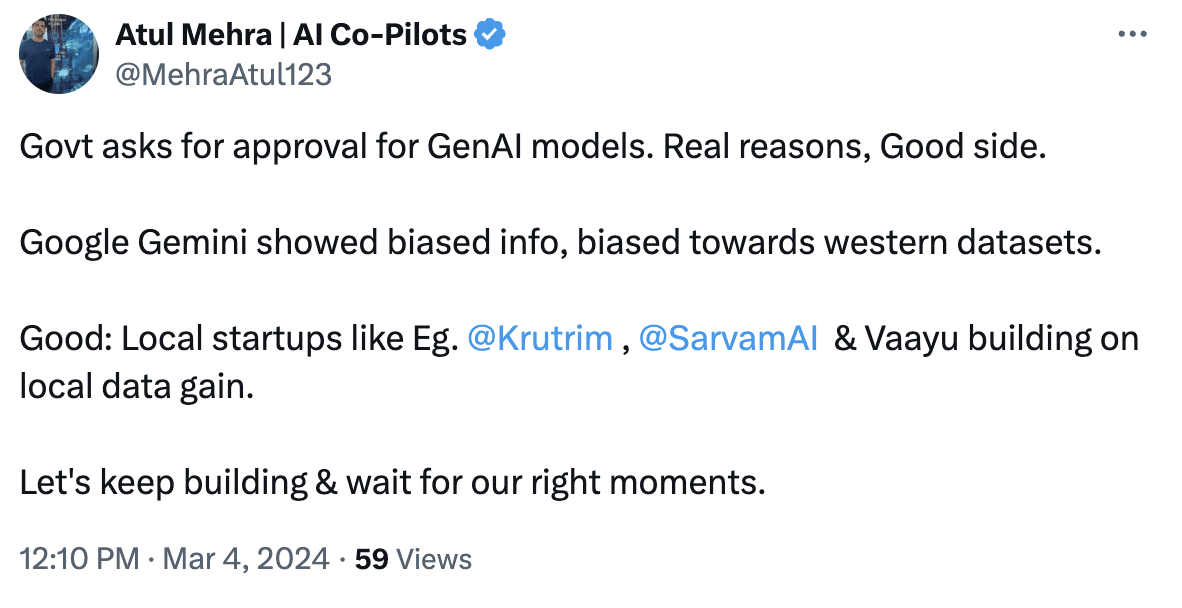
Founder of AI startup Vaayushop, Atul Mehra, has called the move a “huge opportunity in disguise”, pointing at the need for local AI stacks, datasets and GPUs.

Source: X

There is No Perfect LLM Yet

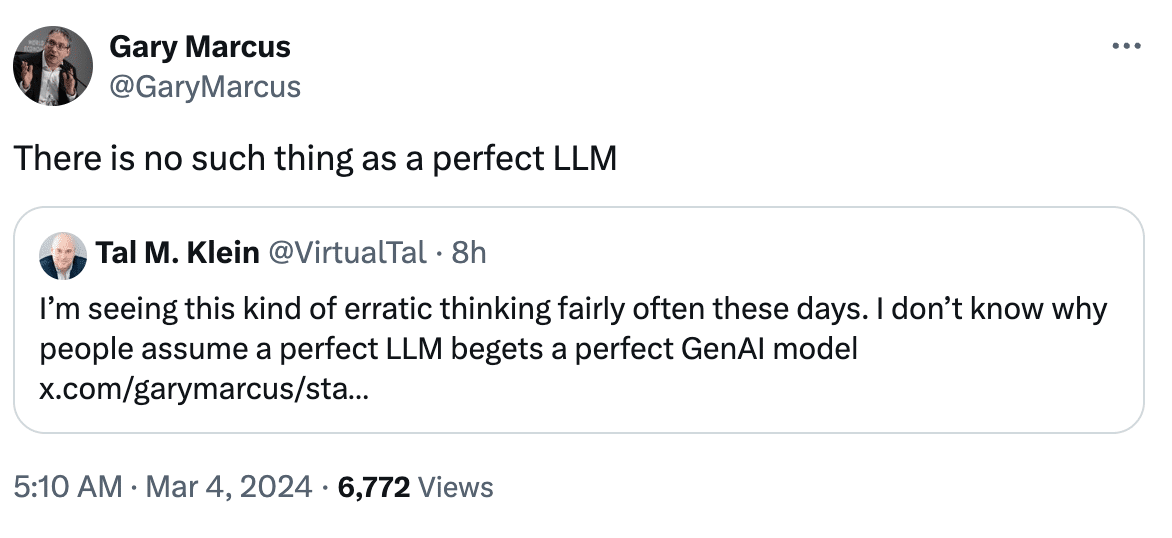
The advisory also does not clarify on what the limitations will be for companies labelling their models as ‘under testing’. Considering that an LLM is never free of hallucinations, a trait OpenAI CEO Sam Altman refers to as a ‘feature’ rather than a ‘bug’, the advisory rules will never permit a large company to shake off the testing label. This further complicates the working of large AI models.

Source: X

Countries Push Unhinged

Source: X

The ongoing debate on AI regulation is nothing new with the US Senate having already grilled big-tech leaders, such as Altman. Interestingly, Altman had stated the same thing that Chandrasekar tweeted when talking about regulating companies.

He believes that regulation should apply only to big tech companies and not startups. However, he also said that the regulation should be done in a way that it does not slow innovation or impede the positive economic benefits that could flow from AI.

While the US has been the OG of AI development, it is also slightly marred with regulatory controversies, the race for AGI and big tech leaders fighting each other. Other countries, however, are speeding towards promoting and developing AI skill development. Recently, Tan Wu Meng, MP of Jurong, Singapore, gave a speech on AI proposals for supporting skill development among Singaporeans.

“We can’t hide from these changes. No country or economy can hide from these changes in the world with AI. Even if an entire country tries to prevent AI from entering its borders, other economies will do so; your competitors will do so. So, we have to accept this world, as it is the way the world is going to be, and look after, support, empower, and uplift our people,” said Meng.

Irrespective of the furore over an advisory rule, India’s lead in the AI and semiconductor space remains unparalleled. In the past two years, the country received investment proposals of over ₹2.50 lakh crore in the semiconductor space, with Tata Group and Taiwan’s PPSMC collaborating to build India’s first semiconductor fab in Dholera, Gujarat for ₹91,000 crore.

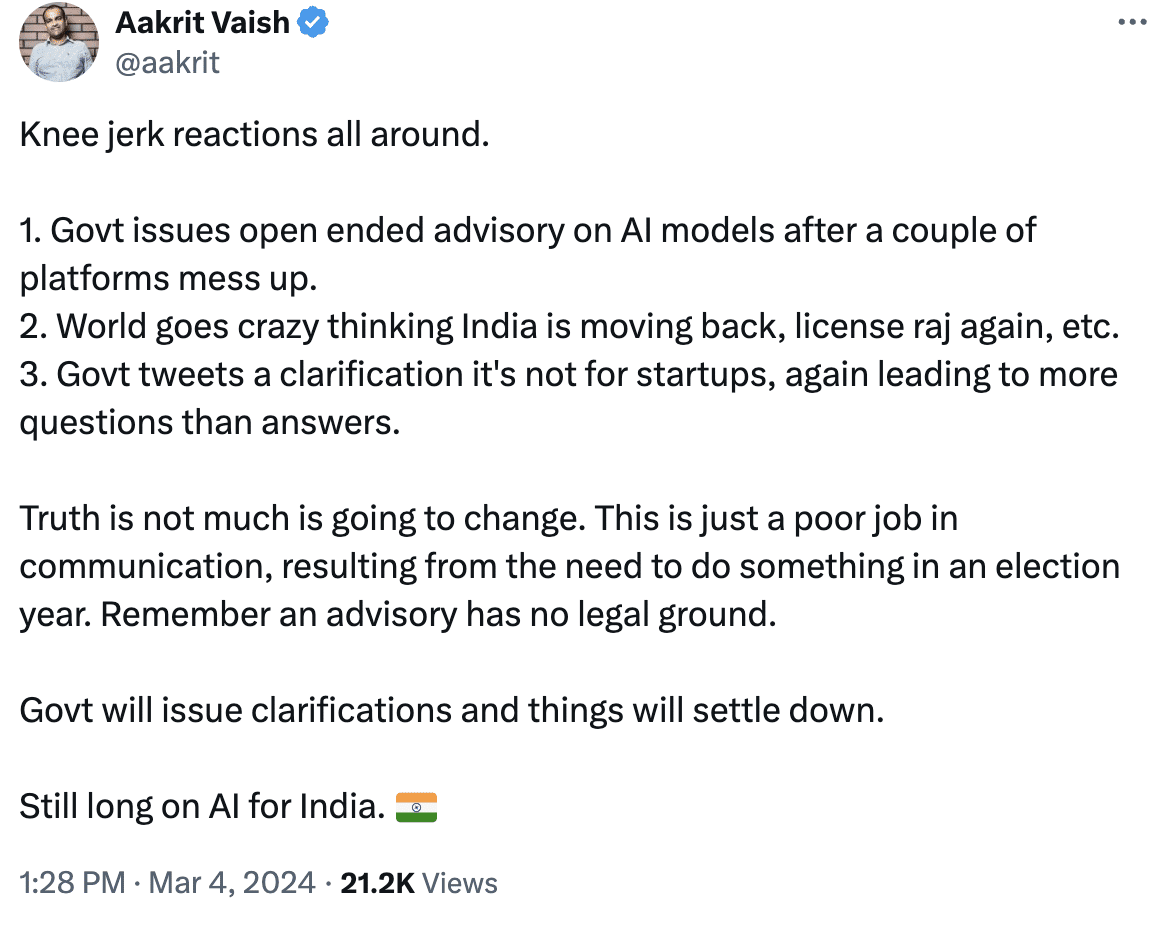
Aakrit Vaish, co-founder and CEO of conversational AI startup Haptik, has summed up the event in a recent post, clarifying that an advisory has no legal ground, and that the government will issue clarifications and things will settle down.

Source: X

The post Thanks Google, India Now Takes AI Regulation Seriously appeared first on Analytics India Magazine.

What to Expect at NVIDIA GTC 2024

What to Expect at NVIDIA GTC 2024

The much-awaited NVIDIA GTC developer conference is all set to grace the SAP Center in San Jose, CA, from March 17 to 21, 2024. Returning from an in-person gathering hiatus, the event is sure to make heads turn this year.

Traditionally centred around data centres, workstations, and top-tier GPUs, GTC has undergone a transformation to now focus on AI, a domain where NVIDIA undeniably reigns supreme.

The GTC would feature a significant keynote by chief Jensen Huang. The keynote announcement will be live-streamed on Monday, March 18, at 2:30 AM IST (1 PM PT). The event, being promoted as the ‘#1 AI Conference for Developers’, will hold over 900 sessions, 200+ exhibits, 20+ technical workshops, and unique networking events in several technical areas.

The event features fireside chats alongside talks by Meta’s Joelle Pineau, Dr Priscilla Chan, AI researcher Fei-Fei Li and many others. The list of speakers is a balanced one with experts from different areas of the industry, be it research or business.

Apart from the C-suite executives, a number of renowned researchers will be taking the stage to impart knowledge about their work, experience and the current AI landscape.

The topics include, but are not limited to, accelerated computing tools and techniques, AI models & deployment, AR/VR and so on. Each topic will be touched upon by industry leaders, given that NVIDIA is partnered with small and big names in tech, like OpenAI, Google DeepMind, xAI and RunwayML.

Some distinguished speakers to look out for at NVIDIA GTC 2024 include:

  • Ming-Yu Liu – Vice President of Generative AI Research at NVIDIA will explain the key ideas behind Edify Model design and its applications to image and 3D generation.
  • Dieter Fox – Senior Director of Robotics Research at NVIDIA will be part of the fireside chat to discuss how advances in AI enable breakthroughs in various fields, including computer vision, and natural language processing.
  • Amit Bleiweiss – Senior Learning Solution Engineer, NVIDIA will discuss how enterprises can leverage large language model-powered apps to provide innovative services to clients.
  • Rama Akkiraju – VP, Enterprise AI and Automation and Sonu Nayyar – SVP, Chief Information Officer at NVIDIA will be part of the panel to discuss harnessing Generative AI’s potential
  • Maria Girone – Chief Technology Officer at CERN Open Lab and Andrew Hsiao – AVP at Pegatron will take the stage to discuss uniting AI, digital twins, and accelerated computing

Click here to register

GTC 2024 will also feature an array of luminaries, including esteemed thought leaders such as Andrea Gagliano, Senior Director of Data Science, AI/ML at Getty Images; Joelle Pineau, VP of AI Research at Meta; Chris Bedi, Chief Digital Information Officer at ServiceNow; Vincent Vanhoucke, Distinguished Scientist and Senior Director of Robotics at Google DeepMind; Steve May, Chief Technology Officer at Pixar; Nick Cannon, Chief Technology Officer at Walt Disney Animation Studios; Francois Chardavoine, CTO at Lucasfilm and Industrial Light & Magic; Peter Lee, Corporate VP of Research and Incubations at Microsoft; Brad Lightcap, Chief Operating Officer at OpenAI; and Dade Orgeron, CTO at Shutterstock.

From NVIDIA, notable participants include Jim Fan, Research Scientist; Billy Dally, Chief Scientist and SVP of Research; Stephen Jones, CUDA Architect; Norm Marks, VP of Automotive Enterprise; and Jeff Larkin, HPC Architect among others.

Additionally, one can expect updates on Blackwell, NVIDIA’s next-gen architecture. Last year the focus was on Hopper, with the even more powerful H200 and GH200 being introduced. The AI leader has already confirmed that their roadmap for 2024-25 features Blackwell, namely the B100 and GB200, which have been listed.

The next-gen GPUs are something to look forward to since NVIDIA currently holds over 90% of the AI GPU market share.

The Blackwell is rumoured to utilise TSMC’s 3nm process and introduce a chiplet design to replace previous GPU architectures. It will succeed NVIDIA’s current Hopper GPU and is slated to enter production in the second half of 2024.

The official keynote teaser points out generative AI’s features like the WPP/NVIDIA engine for digital advertising, the newly introduced Chat with RTX, an industrial metaverse powered by SyncTwin, AI art by Refik Anadol Studio, and OpenAI creating code for Blender animations.

Last month at CES 2024, the third-most valued company in the world introduced three new graphics cards, advancements in in-game NPC dev and robotics, and partnerships across multiple sectors from healthcare to automotive. All in all, NVIDIA showed off a host of new offerings at the Las Vegas event, but not everything it has in store.

The company will share its latest full-stack tech offerings at GTC next month, including those for cloud and on-premise AI/ML development. The conference not only caters to the high-level tech crowd but also encourages beginners in the field to participate.

The event has several beginner-level sessions, such as the Fundamentals of Deep Learning workshop and another one where attendees can learn to build transformer-based natural language processing applications.

Participants will be able to experience generative AI at work through immersive and interactive theatre, pavilion and installations.

Though we may all still be groping in the dark about various aspects of GTC, one thing is clear – NVIDIA is gearing up to bring the spotlight back on AI hardware. Also, consumer GPUs may not be grabbing the headlines, but GTC will give us a peek into where NVIDIA is steering the whole industry.

With these generative AI models hogging the limelight, GTC 2024 is going to spill the beans on NVIDIA’s grand plan for AI dominance in the years to come.

The post What to Expect at NVIDIA GTC 2024 appeared first on Analytics India Magazine.

“It Will Not Apply to Startups” Clarifies Rajeev Chandrasekhar on Indian Govt’s AI Advisory 

In a recent advisory issued by the Ministry of Electronics and Information Technology (MeitY), significant platforms have been singled out, requiring them to seek permission before deploying untested AI models on the Indian internet. Notably, startups are exempted from these stringent regulatory measures.

“The advisory is specifically aimed at significant platforms. Seeking permission from MeitY is only mandatory for large platforms, and it will not apply to startups,” said Indian IT Minister Rajeev Chandrasekhar on X.

“The advisory aims to prevent untested AI platforms from deploying on the Indian Internet,” added Chandrasekhar.

Recent advisory of @GoI_MeitY needs to be understood
➡Advisory is aimed at the Significant platforms and permission seeking from Meity is only for large plarforms and will not apply to startups.
➡Advisory is aimed at untested AI platforms from deploying on Indian Internet…

— Rajeev Chandrasekhar 🇮🇳(Modiyude Kutumbam) (@Rajeev_GoI) March 4, 2024

The advisory emphasises that obtaining permission, labeling, and disclosing information to users about untested platforms act as protective measures for companies. This process serves as an insurance policy, shielding these platforms from potential consumer lawsuits that might arise in the absence of such transparency measures.

“The process of seeking permission, labeling, and consent-based disclosure to users about untested platforms is an insurance policy for platforms that could otherwise face lawsuits from consumers,” read Chandrasekhar’s post on X.

The primary focus of the advisory is to prevent untested AI platforms from entering and operating within the Indian internet landscape.

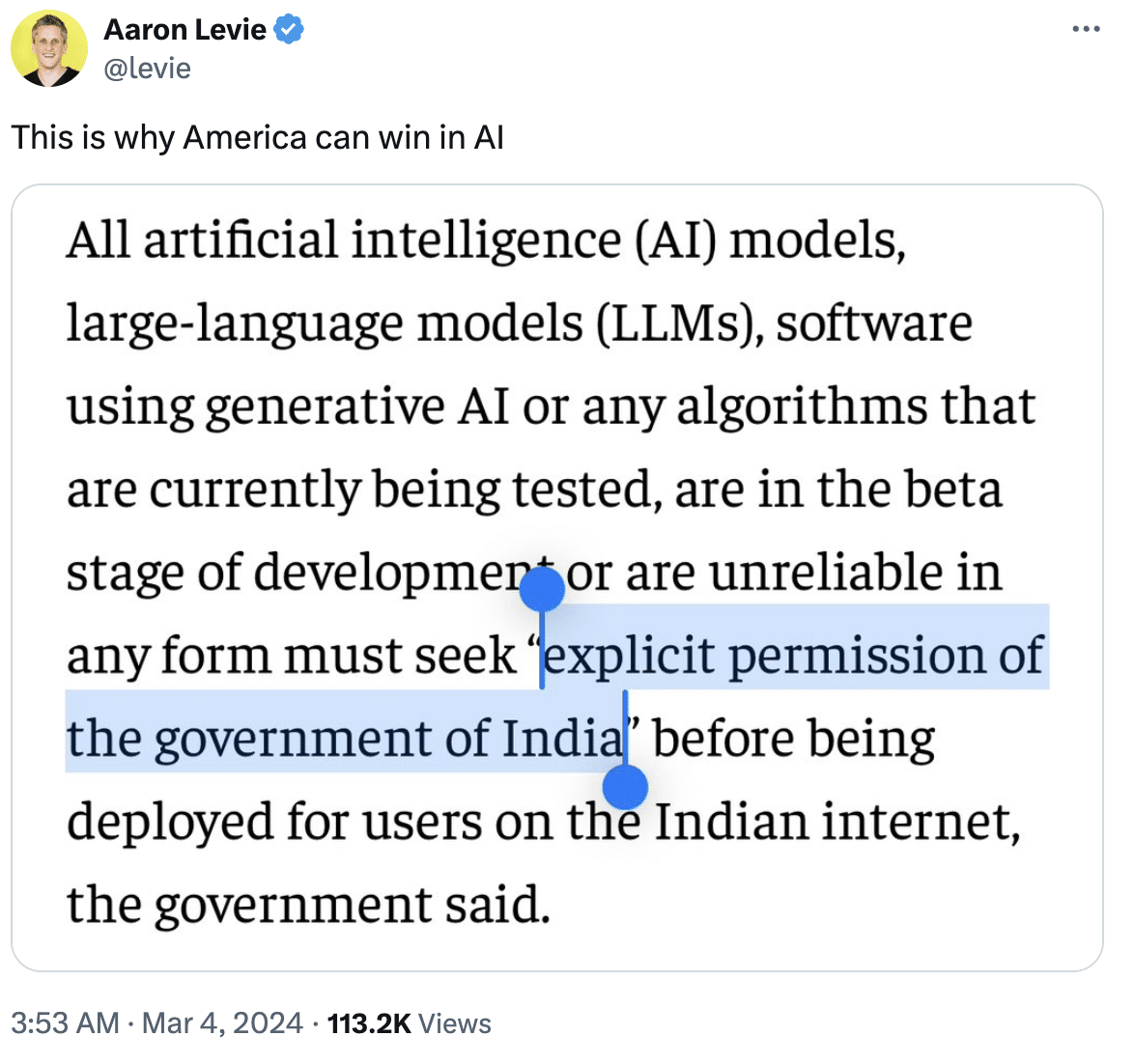
This clarification comes after the recent advisory issued by MeitY, stating that all AI models, large-language models (LLMs), software using generative AI, or any algorithms currently in the beta stage of development or deemed unreliable in any form must seek the ‘explicit permission of the Government of India’ before being deployed for users on the Indian internet.

The post “It Will Not Apply to Startups” Clarifies Rajeev Chandrasekhar on Indian Govt’s AI Advisory appeared first on Analytics India Magazine.

10 Most Influential Data & Analytics Leaders in India’s BFSI Sector, 2024

In an age where data is as valuable as currency, the BFSI sector in India stands on the cusp of a revolution, led by visionary leaders who navigate through the complexities of technology, regulatory landscapes, and evolving consumer behaviors. This list is a recognition of the pioneers who are transforming challenges into opportunities, leveraging data analytics to forecast trends, mitigate risks, and sculpt the future of finance.

These leaders are the architects of change, confronting the daunting challenges of data security, privacy concerns, and the relentless pace of digital transformation. Their stories are of resilience, innovation, and a relentless pursuit of excellence in a sector that is the backbone of the country’s economy.

(In alphabetic Order)

Amar Kaul – Chief Data Officer (India) at Barclays

With a career spanning over two decades, Amar Kaul’s tenure at Barclays India as Chief Data Officer has been transformative, focusing on regulatory compliance, data quality, and leveraging AI/ML for data analytics. Amar’s expertise in data strategy, governance, and engineering has been pivotal in creating enterprise-level data products that drive financial services forward. An IIT Roorkee alumnus with executive education from Columbia University, NY, Amar’s leadership is a blend of technical acumen and visionary foresight, setting new standards in data management and analytics.

Anand K Sundaram – Head Retail Analytics at IDFC FIRST Bank

Anand K Sundaram’s journey through the analytics landscape of India’s banking sector is a narrative of perseverance, innovation, and success. Leading the Retail Data and Analytics function at IDFC First Bank, Anand has utilized his 23 years of rich experience to transform data into a powerhouse for sales and business strategy. A Chartered Accountant gold medalist and an IIM Ahmedabad alumnus, his story from a small village in Orissa to the echelons of the banking sector underscores the transformative power of data and analytics in driving sales and fostering a data-driven culture.

Arun Santhanam – Vice President at Chubb

Arun Santhanam’s nearly two decades of experience in analytics shine through his work at Chubb, where he has established a center of excellence that stands as a testament to operational brilliance and innovation. Arun’s leadership is marked by a steadfast commitment to leveraging analytics and AI, driving value and fostering a culture of data-driven decision-making. Recognized for his pioneering “Office of the Future” model, Arun’s vision and execution have made significant strides in the insurance domain, underpinned by his educational prowess and certification from the Great Place to Work Institute.

Kiran Samudrala – Chief Data and Analytics Officer and Center Head at Equifax

Kiran Samudrala’s distinguished career in data and analytics spans over 25 years, with significant contributions at American Express, Citi, and HSBC. Now at Equifax, Kiran leads the charge in harnessing data and analytics to anticipate customer needs and drive the company’s transformation into a data-centric organization. His expertise in building teams and spearheading projects across the data and analytics spectrum has earned him numerous awards and recognition, positioning Kiran as a luminary in the field.

Madhurima Khandelwal – Managing Director for the Center of Excellence at American Express

Madhurima Khandelwal’s tenure at American Express, from analyst to Vice President, is a testament to her unparalleled expertise in product strategy and analytics. Leading the CFR India Centre of Excellence, Madhurima’s work in AI Labs and marketing personalization algorithms has significantly enhanced American Express’s capabilities. A Masters in Economics from Delhi School of Economics, her leadership extends beyond her professional achievements, advocating for Inclusion & Diversity and fostering a culture of empowerment.

Mathangi Sri Ramachandran – Chief Data Officer at Yubi

A beacon in the data science domain, Mathangi Sri Ramachandran’s role as Chief Data Officer at Yubi is underscored by her impressive portfolio of 108 patents and authorship of influential books. Her leadership across data functions has set new benchmarks in building data solutions that drive decision-making and innovation. Recognized by industry bodies for her contributions, Mathangi’s influence extends through her active participation in the data science community, shaping the future of analytics and machine learning.

Mohan Sushantam – Chief Data Officer at Vivriti Capital

Mohan Sushantam’s extensive journey across various data functions illustrates his versatile expertise in data engineering, risk analytics, and AI/ML leadership. At Vivriti Capital, he heads the data and product function, bringing over 15 years of experience to the forefront of financial services. An IIT Kharagpur alumnus, Mohan’s work in credit risk modeling, marketing analytics, and business intelligence tools exemplifies the critical role of data in shaping the future of corporate lending and financial analysis.

Rajendar RB – Managing Director – Analytics and Information Management, Head of Citi Solutions Center, Bengaluru

Rajendar RB’s foresight in the potential of analytics has been instrumental in establishing Citi’s Analytics and Information Management unit as a leader in the financial sector. With a background that spans GE, Fidelity Investments, and HSBC, Rajendar’s nearly three decades of experience have seen him champion data-driven solutions to complex business challenges. An alumnus of Mississippi State University, his leadership at Citi AIM underscores the transformative power of strategic data analysis in global finance.

Shubhosree Dasgupta – Country Data and Analytics Officer at HSBC

Shubhosree Dasgupta’s leadership in HSBC’s data modernization efforts marks her as a key figure in India’s BFSI sector. Her initiatives in cloud migration, data science, and AI efficiencies have propelled HSBC into new realms of data-driven decision-making. With a rich background in banking and strategic consulting, Shubhosree’s work spans continents and sectors, highlighting her versatility and commitment to driving innovation and growth through data analytics.

Shweta Singh – Chief Data Officer at Tata AIA Life Insurance Co. Ltd.

Shweta Singh’s dual role as a practitioner and advocate in the field of Data Science at Tata AIA Life Insurance reflects over 23 years of dedicated service to leveraging data for business outcomes. Recognized for her contributions and leadership, Shweta’s work in machine learning and AI models has garnered her multiple accolades, emphasizing her impact within the Tata group and beyond. Her commitment to mentoring and knowledge sharing exemplifies the integral role of data science in shaping the future of insurance and financial services.

These ten leaders, each with their unique contributions and visionary leadership, are not just navigating the BFSI sector through its current challenges but are laying the groundwork for a future where data-driven decision-making is paramount. Their work exemplifies the transformative power of data and analytics, setting a benchmark for excellence and innovation in one of the most dynamic sectors of the Indian economy.

The post 10 Most Influential Data & Analytics Leaders in India’s BFSI Sector, 2024 appeared first on Analytics India Magazine.

The Real Reason Why Elon Musk is Suing OpenAI

Can Elon Musk Save OpenAI?

Last Thursday, Elon Musk filed a lawsuit against OpenAI, the world’s most influential AI startup, for deviating from its original mission and becoming a de facto subsidiary of its investor company Microsoft.

“OpenAI, once a carefully crafted non-profit structure was replaced by a purely profit-driven CEO and a Board with inferior technical expertise in AGI and AI public policy. The board now has an observer seat reserved solely for Microsoft,” said Tesla CEO Musk.

At the same time, both Musk and Altman have been proponents of AGI.

OpenAI is now focusing on humanoid robots as confirmed by its recent investment in AI robotics company Figure AI whose latest humanoid robot is Figure-01, is similar to Musk’s Optimus-Gen 2. Sam Altman aims to improve robotic capabilities in processing and reasoning from language. Robotics has been Musk’s forte for the longest time and Altman’s entry into this space might have irked him.

The first section of the lawsuit states, “On information and belief, OpenAI is currently developing a model known as Q* that has an even stronger claim to AGI”.

As of late last year, OpenAI has been reportedly working on a project Q* (pronounced Q-Star), capable of solving unfamiliar math problems at grade school levels. With Q*, OpenAI is likely inching closer towards AGI, as per a few people at the company, as per The Information.

In a previous interview with CNBC’s David Faber last year, Musk said that the diversion of OpenAI from a non-profit, open-source to a for-profit, closed-source entity is “weird”.

Comparing the current stance of OpenAI with its original mission, Musk said, “I mean, this would be like, let’s say you funded an organisation to save the Amazon rainforest, and instead, they became a lumber company and chopped down the forest and sold it for money”

Musk, a former founding member of the company, invested $50 million to OpenAI in 2014 but left in 2018 when the company shifted to profits and close source approach.

“If it is legal to start a company as a nonprofit and then transfer the intellectual property to a for-profit that then makes tons of money, shouldn’t everyone start doing that? Shouldn’t that be the default?,” added Musk during the interview.

Referencing the “Sparks of A.G.I.Early experiments with GPT-4” paper, according to Musk’s legal team, the complaint stems from an agreement in 2015 when Altman and OpenAI co-founder Greg Brockman approached Musk to form a nonprofit lab focused on developing AGI for the greater good.

Musk, a co-founder of OpenAI at the time, agreed to this mission. However, the lawsuit asserts that OpenAI has shifted its priorities to maximise profits for Microsoft rather than adhering to its initial commitment.

The lawsuit draws heavily on a consequential paper from Microsoft, OpenAI’s primary partner. The paper, titled “Sparks of A.G.I.,” authored by Microsoft researchers and executives, highlighted the perceived AGI capabilities of OpenAI’s GPT-4 system.

Closer to AGI

Musk unveiled its second-generation humanoid robot, Optimus Gen-2, in a December 2023. The video showcases various improvements made to the humanoid since its prototype debut earlier in the year, claiming a 30% increase in speed and a 10kg weight reduction.

The humanoid has improved functionalities like improved torque sensing, articulated toe sections, and enhanced human foot geometry. Optimus Gen-2 can also perform squats in a gym and handling eggs, showcasing improved balance, full-body control, and new hands with tactile sensing.

In the context of Musk and Altman’s big bets on AGI, Gary Marcus suggests that if OpenAI has truly attained AGI, it can regain control of its software from Microsoft.

“Elon’s lawsuit has put them in a position having to prove that they *haven’t* reached AGI, even though OpenAI likes to hint that they have or are close. So they need an expert witness to testify e.g., that their partner Microsoft was full of it when they said that GPT-4 represented “Sparks of AGI”, said Marcus.

Microsoft’s research lab, granted exclusive access to OpenAI’s A.I. technologies through a $13 billion commitment, delved into testing an early version of GPT-4 in fall 2022. The researchers, led by Sébastien Bubeck, noted unprecedented outcomes such as GPT-4 generating complex mathematical proofs in poetic form, creating code to draw a unicorn, and offering practical advice on arranging diverse household items.

OpenAI Drama Continues

OpenAI has a history of attracting a series of issues lately.

Sam Altman was ousted by the non profit board of directors in November for being overly assertive in the commercialisation of OpenAI’s products such as ChatGPT including concerns about the potential risks associated with the rapid pace of monetisation, fearing the development of a rogue AI that could have adverse effects on “humanity”.

However, when nearly 500 employees issued an ultimatum of resignations en masse, Altman and Brockman returned.

Currently, Sam Altman has not addressed the lawsuit except for subtle hints that the team has encountered similar hindrances before and will overcome them again.

The post The Real Reason Why Elon Musk is Suing OpenAI appeared first on Analytics India Magazine.

Democratize data analysis and insights generation through the seamless translation of Natural Language into SQL queries

In the realm of modern data analytics, the ability to seamlessly translate natural language queries into actionable insights has emerged as a transformative capability. This advancement empowers users to interact with complex datasets effortlessly, extracting valuable insights and facilitating informed decision-making. However, the journey towards achieving this feat is rife with challenges, ranging from the complexity of diverse datasets to semantic sensitivity and algorithmic limitations.

Navigating the Complexity of Data

The datasets under scrutiny encompass over 500 variables across 10 distinct datasets, each varying in level of aggregation and granularity. Within this landscape, datasets with identical names may carry different meanings, while others may yield similar solutions from disparate data sources. This complexity underscores the challenge of prioritizing tables for analysis and crafting SQL queries with pinpoint accuracy. Primarily sourced from banking datasets, the information spans customer interactions, acquisition details, performance metrics, and complaint audits, underscoring the multifaceted nature of the analytical endeavor.

Addressing Semantic Sensitivity and LLM Challenges

Large Language Models (LLMs), while powerful, often grapple with semantic nuances inherent in natural language queries. Terms like “acquisition” may entail different contexts, necessitating a nuanced understanding of business and variable semantics. Moreover, variable names may vary, posing challenges in identifying the right context for analysis. To mitigate these challenges, a robust Custom Retrieval-Augmented Generation(RAG) framework has been developed, focusing on identifying the correct business context, variables, and datasets crucial for accurate analysis. This framework leverages a Knowledge Graph to provide deeper insights into variables and datasets, ensuring precise interpretation of user queries.

Refinement with Custom RAG Framework

A pivotal aspect of the framework’s evolution lies in the development and implementation of the Custom RAG Framework. This framework emerges as a robust solution to address the intricate challenges encountered during data analysis, particularly in refining business context, variable identification, and dataset selection.

At the crux of this framework is the imperative to identify and integrate the right business context into the analytical process, since LLMs , lack the required capability to discern the subtle nuances inherent in business terminology. To bridge this gap, the framework leverages advanced algorithms to contextualize queries, ensuring a more accurate and insightful analysis.

Furthermore, the Custom RAG Framework tackles the complexity surrounding variable identification and dataset selection. In a landscape characterized by disparate datasets with varying levels of granularity and relevance, the framework streamlines the process of selecting pertinent variables and datasets. By incorporating a knowledge graph enriched with metadata, synonyms, and variable descriptions, the framework empowers the language model to navigate the intricacies of the data landscape with precision and clarity.

A notable aspect of the Custom RAG Framework lies in its adaptability to diverse use cases and industries. Whether analyzing banking data, financial institutions, or other sectors, the framework’s versatility shines through in its ability to tailor analyses to specific contexts and requirements. This adaptability ensures that the framework remains relevant and effective across a spectrum of analytical scenarios, facilitating informed decision-making and strategic insights.

Moreover, this framework serves as a catalyst for innovation, providing a platform for continuous refinement and enhancement. Through iterative feedback loops and collaborative efforts, the framework evolves to meet evolving user needs and technological advancements. This commitment to innovation underscores the framework’s long-term viability and relevance in an ever-changing analytical landscape.

In essence, the Custom RAG Framework represents a paradigm shift in data analysis, offering a holistic and refined approach to navigating complex datasets and extracting actionable insights. By integrating advanced algorithms, contextual intelligence, and domain expertise, the framework empowers users to unlock the full potential of their data assets, driving informed decision-making and strategic outcomes.

Building the Custom Scoring Algorithm and Flow of Generating SQL Queries

Central to the framework’s efficacy is the development of a custom scoring algorithm tailored to semantic search. As multiple registers failed to deliver desired performance, crafting a scoring algorithm became imperative. The algorithm functions by mining each word of the user query, identifying variables and synonyms, and computing their respective scores. Subsequently, the variables and datasets with the highest scores are selected to form the basis of the final focus for analysis.

This initial step sets the stage for generating SQL queries. The selected variables and datasets are fed into a template, enriching the context and ensuring the language model comprehends the intended analysis. Utilizing a multi-shot prompt approach, the framework guides the language model in crafting the SQL query, thereby streamlining the process of query generation.

Despite the query generation, challenges persist, such as discrepancies in date variable formats across datasets. To address such issues, an error mechanism is incorporated to rectify format inconsistencies and enhance query accuracy. The end-to-end process culminates in the generation of SQL queries within an average timeframe of 15 to 16 seconds, facilitating prompt analysis and decision-making.

Integration with Conversational Interface and Enhancing User Experience

Transitioning from the educated end-to-end framework to a conversational interface marks the next phase of the analytical journey. Preparatory work, including the creation of a knowledge graph and vector stores, sets the stage for seamless interaction with end consumers via the interface.

Upon user query initiation, the framework springs into action, leveraging the enriched knowledge graph to augment prompts and guide SQL query generation. The generated query interfaces with the data warehouse, retrieving relevant datasets and executing the query to generate tabular outputs. This output, also comprising insights, charts, and textual analysis, is relayed back to the conversational interface, empowering end users with actionable insights.

Democratizing Data Analysis and Future Enhancements

The ultimate goal of the framework is to democratize data analysis, enabling users to derive insights without delving into intricate coding processes. Early results indicate significant time savings and enhanced productivity, with insights generated up to three to four times faster and manual work reduced by 60 to 70%.

To further refine the framework, continuous improvement efforts are underway. These include fine-tuning the custom scoring algorithm, expanding metadata to enhance fluidity in query interpretation, and implementing user suggestions to address data integration gaps. By iteratively refining the framework based on user feedback and technological advancements, the aim is to elevate the efficacy and usability of the tool, ultimately empowering users with unparalleled data analysis capabilities.

In conclusion, the custom RAG framework represents a significant advancement in addressing the challenges of analyzing complex datasets. By leveraging custom scoring algorithms and integrating business context into algorithmic analysis, the framework streamlines SQL query generation from English language queries. Its end-to-end flow, from knowledge graph creation to UI presentation, facilitates swift and efficient insight generation. The framework’s emphasis on democratizing insight generation and its potential for further refinement promise to drive data-driven decision-making across sectors.

The post Democratize data analysis and insights generation through the seamless translation of Natural Language into SQL queries appeared first on Analytics India Magazine.

India reverses AI stance, requires government approval for model launches

India reverses AI stance, requires government approval for model launches Manish Singh 8 hours

India has waded into global AI debate by issuing an advisory that requires tech firms to get government permission before launching new models.

India’s Ministry of Electronics and IT issued the advisory to firms on Friday. The advisory, not published on public domain but a copy of which TechCrunch has reviewed, also asks tech firms to ensure that their services or products “do not permit any bias or discrimination or threaten the integrity of the electoral process.”

Though the ministry admits the advisory is not legally binding, India’s IT Deputy Minister Rajeev Chandrasekhar says the notice is “signalling that this is the future of regulation.”

He adds: “We are doing it as an advisory today asking you to comply with it.”

The ministry cites power granted to it through the IT Act, 2000 and IT Rules, 2021 in its advisory. It seeks compliance with “immediate effect” and asks tech firms to submit “Action Taken-cum-Status Report” to the ministry within 15 days.

The new advisory, which also asks tech firms to “appropriately” label the “possible and inherent fallibility or unreliability” of the output their AI models generate, marks a reversal from India’s previous hands-off approach to AI regulation. Less than a year ago, the ministry had declined to regulate AI growth, instead identifying the sector as vital to India’s strategic interests.

India’s move has taken many industry executives by surprise. Many Indian startups and VCs say they have been spooked by the new advisory and believe such regulation will hinder the nation’s ability to compete in the global race, where it is already lagging behind.

“I was such a fool thinking I will work bringing GenAI to Indian agriculture from SF,” wrote Pratik Desai, founder of startup Kisan AI. “We were training multimodal low cost pest and disease model, and so excited about it. This is terrible and demotivating after working 4yrs full time brining AI to this domain in India.”

Many Silicon Valley leaders also criticized India’s policy shift. Aravind Srinivas, co-founder and chief executive of Perplexity AI, one of the hottest AI startups, said the new advisory from New Delhi was a “bad move by India.”

Martin Casado, a partner at venture firm Andreessen Horowitz, said, “Good fucking lord. What a travesty.”

The advisory follows Chandrasekhar expressing his disappointment in a certain response by Google’s Gemini last month. A user last month asked Gemini, previously known as Bard, whether India’s PM Narendra Modi was a fascist.

In response, Gemini — citing experts it didn’t identity — said Modi had been accused of implementing policies that some had characterised as fascist. Chandrasekhar reacted to the exchange by warning Google that such responses were “direct violations” of the IT Rules, 2021 as well as “several provisions of the Criminal Code.”

Non-compliance with the provisions of the IT Act and IT Rules would result in “potential penal consequences to the intermediaries or platforms or its users when identified,” the advisory adds.

Francine Bennett uses data science to make AI more responsible

Francine Bennett uses data science to make AI more responsible Dominic-Madori Davis 10 hours

To give AI-focused women academics and others their well-deserved — and overdue — time in the spotlight, TechCrunch is launching a series of interviews focusing on remarkable women who’ve contributed to the AI revolution. We’ll publish several pieces throughout the year as the AI boom continues, highlighting key work that often goes unrecognized. Read more profiles here.

Francine Bennett is a founding member of the board at the Ada Lovelace Insititute and currently serves as the organization’s interim Director. Prior to this, she worked in biotech, using AI to find medical treatments for rare diseases. She also co-founded a data science consultancy and is a founding trustee of DataKind UK, which helps British charities with data science support.

Briefly, how did you get your start in AI? What attracted you to the field?

I started out in pure maths and wasn’t so interested in anything applied – I enjoyed tinkering with computers but thought any applied maths was just calculation and not very intellectually interesting. I came to AI and machine learning later on when it started to become obvious to me and to everyone else that because data was becoming much more abundant in lots of contexts, that opened up exciting possibilities to solve all kinds of problems in new ways using AI and machine learning, and they were much more interesting than I’d realized.

What work are you most proud of (in the AI field)?

I’m most proud of the work that’s not the most technically elaborate but which unlocks some real improvement for people – for example, using ML to try and find previously unnoticed patterns in patient safety incident reports at a hospital to help the medical professionals improve future patient outcomes. And I’m proud of representing the importance of putting people and society rather than technology at the center at events like this year’s UK’s AI Safety Summit. I think it’s only possible to do that with authority because I’ve had experience both working with and being excited by the technology and getting deeply into how it actually affects people’s lives in practice.

How do you navigate the challenges of the male-dominated tech industry and, by extension, the male-dominated AI industry?

Mainly by choosing to work in places and with people who are interested in the person and their skills over the gender and seeking to use what influence I have to make that the norm. Also working within diverse teams whenever I can – being in a balanced team rather than being an exceptional ‘minority’ makes for a really different atmosphere and makes it much more possible for everyone to reach their potential. More broadly, because AI is so multifaceted and is likely to have an impact on so many walks of life, especially on those in marginalized communities, it’s obvious that people from all walks of life need to be involved in building and shaping it, if it’s going to work well.

What advice would you give to women seeking to enter the AI field?

Enjoy it! This is such an interesting, intellectually challenging, and endlessly changing field – you’ll always find something useful and stretching to do, and there are plenty of important applications that nobody’s even thought of yet. Also, don’t be too anxious about needing to know every single technical thing (literally nobody knows every single technical thing) – just start by starting on something you’re intrigued by, and work from there.

What are some of the most pressing issues facing AI as it evolves?

Right now, I think a lack of a shared vision of what we want AI to do for us and what it can and can’t do for us as a society. There’s a lot of technical advancement going on currently, which is likely having very high environmental, financial, and social impacts, and a lot of excitement about rolling out those new technologies without a well-founded understanding of potential risks or unintended consequences. Most of the people building the technology and talking about the risks and consequences are from a pretty narrow demographic. We have a window of opportunity now to decide what we want to see from AI and to work to make that happen. We can think back to other types of technology and how we handled their evolution or what we wish we’d done better – what are our equivalents for AI products of crash-testing new cars; holding liable a restaurant that accidentally gives you food poisoning; consulting impacted people during planning permission; appealing an AI decision as you could a human bureaucracy.

What are some issues AI users should be aware of?

I’d like people who use AI technologies to be confident about what the tools are and what they can do and to talk about what they want from AI. It’s easy to see AI as something unknowable and uncontrollable, but actually, it’s really just a toolset – and I want humans to feel able to take charge of what they do with those tools. But it shouldn’t just be the responsibility of people using the technology – government and industry should be creating conditions so that people who use AI are able to be confident.

What is the best way to responsibly build AI?

We ask this question a lot at the Ada Lovelace Institute, which aims to make data AI work for people and society. It’s a tough one, and there are hundreds of angles you could take, but there are two really big ones from my perspective.

The first is to be willing sometimes not to build or to stop. All the time, we see AI systems with great momentum, where the builders try and add on ‘guardrails’ afterward to mitigate problems and harms but don’t put themselves in a situation where stopping is a possibility.

The second, is to really engage with and try and understand how all kinds of people will experience what you’re building. If you can really get into their experiences, then you’ve got way more chance of the positive kind of responsible AI – building something that truly solves a problem for people, based on a shared vision of what good would look like – as well as avoiding the negative – not accidentally making someone’s life worse because their day-to-day existence is just very different from yours.

For example, the Ada Lovelace Institute partnered with the NHS to develop an algorithmic impact assessment which developers should do as a condition of access to healthcare data. This requires developers to assess the possible societal impacts of their AI system before implementation and bring in the lived experiences of people and communities who could be affected.

How can investors better push for responsible AI?

By asking questions about their investments and their possible futures – for this AI system, what does it look like to work brilliantly and be responsible? Where could things go off the rails? What are the potential knock-on effects for people and society? How would we know if we need to stop building or change things significantly, and what would we do then? There’s no one-size-fits-all prescription, but just by asking the questions and signaling that being responsible is important, investors can change where their companies are putting attention and effort.

GenAI: The User Interface to Artificial Intelligence (AI)?

Slide1

Generative AI (GenAI) Chatbots like Microsoft Copilot (formerly Bing AI), Google’s Gemini (formerly Google Bard), and OpenAI ChatGPT (still OpenAI ChatGPT) are driving extraordinary productivity improvements by assisting knowledge workers in providing highly relevant information, answering questions, and engaging in wide-ranging exploratory conversations.

However, the Wall Street Journey Article “Microsoft’s most ambitious AI upgrade could be too costly for many users” raises some issues concerning the decline in user adoption and enthusiasm for Generative AI products. The promised productivity improvements from using GenAI tools may not be sufficient.

As I discussed in my blog “GenAI: Beware the Productivity Trap; It’s About Economics,” the productivity trap occurs when organizations focus on doing more in less time and with less effort, based on the assumption that productivity is the ultimate goal of an organization. However, this flawed assumption can be dangerous, leading to poor outcomes for the organization and its customers, stakeholders, and constituents. Why?

  • Productivity gains, as provided by tools such as GenAI Chatbots, are easy to replicate. Consequently, differentiation from the productivity gains from industry-standard tools available to everyone is unsustainable.
  • It’s tough to quantify the economic value of productivity gains. For example, improving meeting effectiveness by 30% doesn’t necessarily translate into improvements in customer retention, unplanned operational downtime, patient treatment outcomes, or marketing campaign effectiveness.

It’s hard to differentiate your company and products based on productivity gains.

However, there is a bigger GenAI play beyond just productivity improvements. That play leverages GenAI as the user interface (UI) to domain-specific use cases that deliver quantifiable operational benefits and customer satisfaction. Let’s explore this further.

GenAI: The User Interface (UI) for AI-driven Economic Benefits?

Faster does not always mean better. Better means delivering more accurate, more reliable, more responsible, more relevant, and less risky outcomes.

Imagine a scenario in which a local municipality deploys a GenAI Chatbot to enhance the efficiency and precision of its services to its residents. The services a municipality offers are extensive, encompassing everything from official office hours and detailed procedures for obtaining tax or licensing documents to public transportation schedules and various city-managed services.

Traditional interactions with the municipality’s service desks can be frustrating and inefficient, characterized by complicated automated response systems and prolonged wait times, with the hope of eventually connecting with a knowledgeable call center representative who possesses a comprehensive understanding of all aspects of municipal operations, a requirement that is both unrealistic and overwhelming.

With a GenAI Chatbot, the municipality could significantly streamline this process, offering immediate, accurate responses to citizen inquiries, thereby improving overall service delivery and constituent satisfaction. But wait, there is even more to this happy ending.

GenAI Chatbot: Data, Insights, Sentiment, and Idea Treasure Trove

When municipalities deploy a GenAI Chatbot, the ensuing citizen and constituent Chatbot conversations provide a treasure trove of insights about citizens’ and constituents’ interests, frustrations, and suggestions. These insights can enhance the municipality’s understanding of its operations and citizen needs. For example:

  • Citizen Service and Policy Feedback: Identify dissatisfaction trends by analyzing grievances, enabling targeted service improvements and policy adjustments.
  • Emerging Community Issues: Use chatbot data as an early warning system for road maintenance and safety concerns, facilitating proactive responses.
  • Community Event and Service Ideas: Uncover creative suggestions for new events and public services through citizen engagement via the chatbot.
  • Service Demand Trends: Spot trends in service inquiries to anticipate community needs and adjust resource allocation efficiently.
  • Public Information Gaps: Highlight repetitive inquiries as indicators of where public information is lacking, guiding enhancements in communication.
  • Public Sentiment Analysis: Gauge community sentiment on various topics to refine municipal initiatives and communication strategies.
  • Under-served Area Identification: Detect under-served communities or issues through chatbot conversations, directing targeted interventions.
  • Emergency Response Evaluation: Gather feedback on emergency responses to improve crisis management and public safety measures.
  • Cultural and Event Feedback: Analyze feedback on municipal events to align future planning with community interests better.
  • Policy Impact Analysis: Evaluate the effects of policies and regulations, identifying opportunities for adjustment to meet community needs better.
Slide2

Figure 1: GenAI Chatbot Generated Citizen Insights

The GenAI Chatbot can be a vehicle for tapping into the wealth of community insights by empowering citizens to become more proactively involved in the growth and development of their communities. But wait, there is even more!

GenAI Chatbot: AI-driven Use Case On-ramp

A GenAI chatbot, leveraging the treasure trove of citizen and community insights, can significantly impact where and how the municipality uses AI to enhance its support and enablement of its citizens and constituents, including:

  • Police and Fire Safety: A GenAI chatbot streamlines incident reporting to allocate safety resources strategically.
  • Economic Development: It captures insights on local business and citizen needs to inform investment attraction and support economic growth.
  • Road Maintenance: The chatbot facilitates easy reporting of road issues, helping prioritize and optimize maintenance efforts.
  • Event Management: Gathering event feedback enables municipalities to tailor events to meet community expectations better.
  • Urban Planning: Citizen input on public space use informs urban development decisions, ensuring alignment with community needs.
  • Public Transportation: Feedback on public transit systems via the chatbot aids route optimization and service quality improvement.
  • Healthcare Services: The chatbot collects feedback on local healthcare, highlighting areas for service enhancement.
  • City Services: It is a central point for reporting city service issues and improving response times and service quality.
  • Environmental Management: Citizen observations on environmental concerns guide municipal ecological policies and initiatives.

In each area, the key is collecting data and applying AI tools to identify and predict patterns and trends that drive more informed decision-making that enhances the quality of life for their citizens and constituents (Figure 2).

Slide3

Figure 2: Municipality GenAI Chatbot: User Interface to AI Use Cases

Other Industry Examples

Several additional industries can benefit from a GenAI chatbot that acts as the user interface to a wide range of industry-relevant use cases, including:

  • University GenAI Chatbot supports student retention, student performance, student recruiting, curriculum planning, faculty retention, student wellness, alumni giving, and campus facility management use cases.
  • Healthcare GenAI Chatbot supports patient outcomes effectiveness, symptoms assessment, health monitoring, wellness data access, chronic disease management, mental health support, supply chain management, and clinical trial recruitment.
  • Retail GenAI Chatbot supports customer service effectiveness, personalized shopping, inventory management, markdown management, shrinkage, supply chain optimization, and loyalty program effectiveness.
  • Finance GenAI Chatbot supporting customer support effectiveness, fraud detection, financial advice effectiveness,
  • Hospitality GenAI Chatbot supports booking effectiveness, concierge services effectiveness, dynamic pricing, predictive maintenance, facility management, event planning, and food and beverage management.
  • Manufacturing GenAI Chatbot supports supply chain optimization, predictive maintenance, operational efficiency, worker safety compliance, quality control, and energy management.

GenAI Chatbot: UI for AI Summary

Don’t become complacent by the GenAI productivity promises because faster doesn’t always mean better, more accurate, or less risky when reengineering or transforming operational processes and business models.

The insights derived from GenAI Chatbot conversations extend far beyond mere productivity improvements. They provide a comprehensive view of the community’s needs, expectations, and aspirations, enabling municipalities to leverage AI to tailor their services and foster a more engaged, satisfied, and cohesive community.

Even more important is that the GenAI Chatbot, as part of a more extensive data and analytics strategy, empowers your citizens and constituents to have a voice in the management and growth of their community.