Anthropic claims its new models beat GPT-4

Anthropic claims its new models beat GPT-4 Kyle Wiggers 9 hours

AI startup Anthropic, backed by hundreds of millions in venture capital (and perhaps soon hundreds of millions more), today announced the latest version of its GenAI tech, Claude. And the company claims that it rivals OpenAI’s GPT-4 in terms of performance.

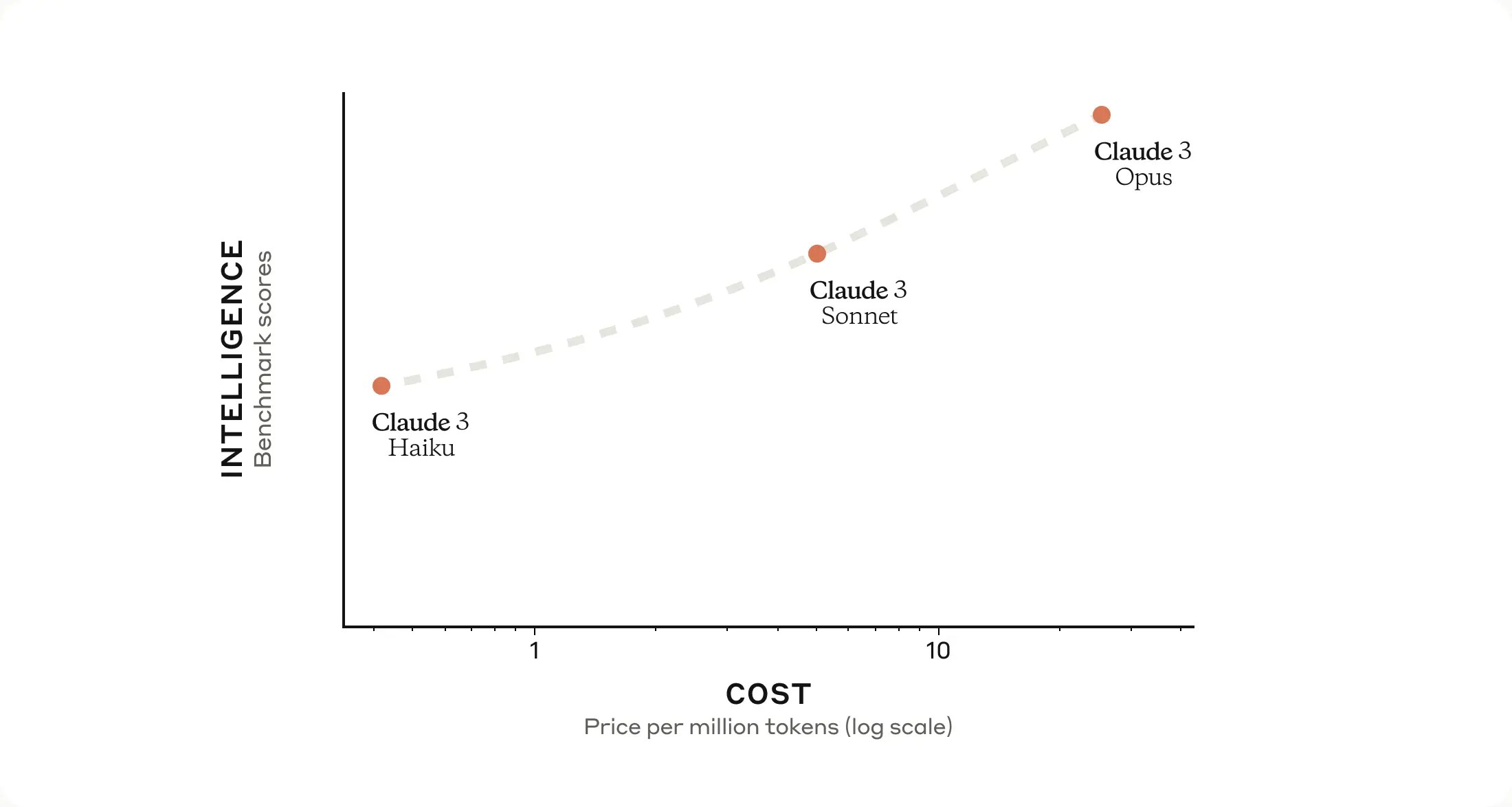
Claude 3, as Anthropic’s new GenAI is called, is a family of models — Claude 3 Haiku, Claude 3 Sonnet, and Claude 3 Opus, Opus being the most powerful. All show “increased capabilities” in analysis and forecasting, Anthropic claims, as well as enhanced performance on specific benchmarks versus models like GPT-4 (but not GPT-4 Turbo) and Google’s Gemini 1.0 Ultra (but not Gemini 1.5 Pro).

Notably, Claude 3 is Anthropic’s first multimodal GenAI, meaning that it can analyze text as well as images — similar to some flavors of GPT-4 and Gemini. Claude 3 can process photos, charts, graphs and technical diagrams, drawing from PDFs, slideshows and other document types.

In a step one better than some GenAI rivals, Claude 3 can analyze multiple images in a single request (up to a maximum of 20). This allows it to compare and contrast images, notes Anthropic.

But there’s limits to Claude 3’s image processing.

Anthropic has disabled the models from identifying people — no doubt wary of the ethical and legal implications. And the company admits that Claude 3 is prone to making mistakes with “low-quality” images (under 200 pixels) and struggles with tasks involving spatial reasoning (e.g. reading an analog clock face) and object counting (Claude 3 can’t give exact counts of objects in images).
Anthropic Claude 3

Image Credits: Anthropic

Claude 3 also won’t generate artwork. The models are strictly image-analyzing — at least for now.

Whether fielding text or images, Anthropic says that customers can generally expect Claude 3 to better follow multi-step instructions, produce structured output in formats like JSON and converse in languages other than English compared to its predecessors,. Claude 3 should also refuse to answer questions less often thanks to a “more nuanced understanding of requests,” Anthropic says. And soon, the models will cite the source of their answers to questions so users can verify them.

“Claude 3 tends to generate more expressive and engaging responses,” Anthropic writes in a support article. “[It’s] easier to prompt and steer compared to our legacy models. Users should find that they can achieve the desired results with shorter and more concise prompts.”

Some of those improvements stem from Claude 3’s expanded context.

A model’s context, or context window, refers to input data (e.g. text) that the model considers before generating output. Models with small context windows tend to “forget” the content of even very recent conversations, leading them to veer off topic — often in problematic ways. As an added upside, large-context models can better grasp the narrative flow of data they take in and generate more contextually rich responses (hypothetically, at least).

Anthropic says that Claude 3 will initially support a 200,000-token context window, equivalent to about 150,000 words, with select customers getting up a 1-milion-token context window (~700,000 words). That’s on par with Google’s newest GenAI model, the above-mentioned Gemini 1.5 Pro, which also offers up to a million-token context window.

Now, just because Claude 3 is an upgrade over what came before it doesn’t mean it’s perfect.

In a technical whitepaper, Anthropic admits that Claude 3 isn’t immune from the issues plaguing other GenAI models, namely bias and hallucinations (i.e. making stuff up). Unlike some GenAI models, Claude 3 can’t search the web; the models can only answer questions using data from before August 2023. And while Claude is multilingual, it’s not as fluent in certain “low-resource” languages versus English.

But Anthropic’s promising frequent updates to Claude 3 in the months to come.

“We don’t believe that model intelligence is anywhere near its limits, and we plan to release [enhancements] to the Claude 3 model family over the next few months,” the company writes in a blog post.

Opus and Sonnet are available now on the web and via Anthropic’s dev console and API, Amazon’s Bedrock platform and Google’s Vertex AI. Haiku will follow later this year.

Here’s the pricing breakdown:

  • Opus: $15 per million input tokens, $75 per million output tokens
  • Sonnet: $3 per million input tokens, $15 per million output tokens
  • Haiku: $0.25 per million input tokens, $1.25 per million output tokens

So that’s Claude 3. But what’s the 30,000-foot view of all this?

Well, as we’ve reported previously, Anthropic’s ambition is to create a next-gen algorithm for “AI self-teaching.” Such an algorithm could be used to build virtual assistants that can answer emails, perform research and generate art, books and more — some of which we’ve already gotten a taste of with the likes of GPT-4 and other large language models.

Anthropic hints at this in the aforementioned blog post, saying that it plans to add features to Claude 3 that enhance its out-of-the-gate capabilities by allowing Claude to interact with other systems, code “interactively” and deliver “advanced agentic capabilities.”

That last bit calls to mind OpenAI’s reported ambitions to build a software agent to automate complex tasks, like transferring data from a document to a spreadsheet or automatically filling out expense reports and entering them in accounting software. OpenAI already offers an API that allows developers to build “agent-like experiences” into their apps, and Anthropic, it seems, is intent on delivering functionality that’s comparable.

Could we see an image generator from Anthropic next? It’d surprise me, frankly. Image generators are the subject of much controversy these days, mainly for copyright- and bias-related reasons. Google was recently forced to disable its image generator after it injected diversity into pictures with a farcical disregard for historical context. And a number of image generator vendors are in legal battles with artists who accuse them of profiting off of their work by training GenAI on that work without providing compensation or even credit.

I’m curious to see the evolution of Anthropic’s technique for training GenAI, “constitutional AI,” which the company claims makes the behavior of its GenAI easier to understand, more predictable and simpler to adjust as needed. Constitutional AI aims to provide a way to align AI with human intentions, having models respond to questions and perform tasks using a simple set of guiding principles. For example, for Claude 3, Anthropic said that it added a principle — informed by crowdsourced feedback — that instructs the models to be understanding of and accessible to people with disabilities.

Whatever Anthropic’s endgame, it’s in it for the long haul. According to a pitch deck leaked in May of last year, the company aims to raise as much as $5 billion over the next 12 months or so — which might just be the baseline it needs to remain competitive with OpenAI. (Training models isn’t cheap, after all.) It’s well on its way, with $2 billion and $4 billion in committed capital and pledges from Google and Amazon, respectively, and well over a billion combined from other backers.

Reimagine Your Space with AI: How to Transform Your Home in 2024

A high-tech interior renovation scene with advanced robots actively reimagining a living space

In today’s fast-paced world, interior design has taken a leap into the future with the integration of artificial intelligence (AI). The power of AI tools in interior design opens up a realm of possibilities, making the process of transforming spaces not just easier but also more exciting and accessible to everyone. Whether you are a homeowner looking to refresh your living space, a professional interior designer seeking inspiration, or someone with no design experience at all, AI interior design tools offer a revolutionary approach to reimagining spaces.

Why Use AI Tools for Interior Design?

Utilizing AI tools for interior design revolutionizes the way spaces are envisioned and executed. These tools offer unparalleled efficiency and precision, allowing for the creation of designs that perfectly match individual preferences and spatial constraints. With AI, designers can easily simulate and visualize spaces in 3D, enabling clients to see and modify their future interiors in real-time. This technology also streamlines the selection of furniture, color schemes, and materials by suggesting options based on trends, durability, and cost-effectiveness. AI-driven analytics can predict user needs and recommend design adjustments, ensuring the space is not only aesthetically pleasing but also functional and sustainable. The integration of AI in interior design significantly reduces the time and costs associated with manual planning and revisions, leading to more innovative, personalized, and adaptable living spaces.

These tools are perfect for you if:

  • You’re a homeowner looking for interior design ideas, tips, inspiration, or tools to redo the existing spaces.
  • You have no design experience and need an easy way to convert rooms for new uses (e.g., turning an attic into a studio space).
  • You’re an interior designer or architect looking for trending ideas related to spatial redesign.
  • You work for a company promoting interior remodeling/renovation services, spatial planning, home decor, furniture arranging, and more.

How to Reimagine Your Space with AI

Let's explore how some leading AI-powered platforms can help you redesign your home.

Using Homestyler to reimagine your space

Homepage of Homestyler - an AI tool that helps you reimagine your space

Homestyler is a professional app and a community for interior designers and homeowners. It offers a long list of pro features, everything from creating 3d models of your own space to advanced floor planning for your clients, etc.

Homestyler also has a neat AI Designer with a user-friendly interface.

Here's how it works:

  1. Visit Homestyler’s website and register for a free account.
    Then, head to AI Designer and upload a photo of your current space.
    Add your image to Homestyler to reimagine your space
    I’ll take a photo of my living room.
  2. On the left, select your preferred design style. Let’s try Japandi.
    This is how you can pick a style option in Homestyler
  3. Lastly, let’s choose the room type. Below, you can also select the amount of designs AI will generate (each image will consume one of your free credits)Pick a room type in Homestyler to reimagine your space
  4. And boom! We’ve got a realistic remake of my room!
    omestyler reimagined my living room in Japandi style

If you’re not satisfied with the result, you can regenerate it several times. Try different styles and let AI create several images at once.

You have four free credits upon registration and can buy an additional 20 credits for $4,99 or choose one of the monthly subscription plans.

Get extra credits for Homestyler AI designer

Using Reimagine Home AI to revamp your space

Homepage of Reimagine Home AI, an AI tool that can help you reimagine your space

Reimagine Home AI goes a bit deeper than Homestyler’s AI Designer.

Here, you can choose from several ways to reimagine your room.

A list of AI tools Reimagine Home AI offers for you easili reimagine your space with AI

Let’s try to change the wall color. Follow these steps:

  1. Choose the option from the list and upload images of your space to create a new project. Pick the space type and let AI know whether it’s furnished or not.
  2. The next step is to pick the wall for a digital repaint. I “masked” the wall, and the blue color shows exactly what part of the wall I chose.
  3. When you’re done masking the wall, it’s time to choose what exactly you will do with the walls:
    – Paint
    – Put wallpaper on
    – Choose a wainscoting
  4. After that, choose the color scheme, I’ll try several different ones.
  5. After choosing the color scheme, it’s time to add the prompt. For example, you can ask AI to pick a lighter color for the wall. That’s exactly what I did before hitting “Generate Design.” Here’s what Reimagine Home AI came up with:

I think Reimagine Home AI is perfect for figuring out what wall color is best for your room. And you’ll need no bucket, no paint, and no brush!

Upon registration, you will get 30 free generations, which is enough to try most of the features and decide on a bigger price plan:

Using Leonardo AI to reimagine your space

Leonardo AI is a free, though extremely robust, AI image generator. It’s a perfect solution to brainstorm your interior design ideas without having an exact room or other space in mind.

Let's say you plan to invest in a new house and want to check possible bedroom furniture arrangements or decor options.

Leonardo AI can produce photorealistic interior visualizations. Using it is pretty easy:

Describe your dream room design in a precise text prompt. This is an example I found on the Internet, and it produces a great result:
“A small living room with a soft polyester blue sofa, soft sunlight through a window, a geometric Scandinavian rug on the floor, Framed abstract art on the walls, a vintage wooden wine crate from “Bordeaux” used as a coffee table, a black grand piano nearby”

However, we can generate multiple AI images and select the best ones. Let’s try another prompt:

“A cozy bedroom featuring a plush queen-sized bed with crisp white linens, gentle morning light filtering through sheer curtains, a shaggy taupe area rug beneath the bed, minimalist black-and-white photography on the walls, a reclaimed oak wood nightstand with a vintage glass lamp, and a comfortable eggshell reading chair in the corner.”

Okay, that's not bad! I'm still not happy with the smoothness of the image. It's a bit out of focus, and the furniture looks a bit crooked.
But what if we used Leonardo’s Diffusion XL model?

Now we have a perfect image, like from a fancy magazine!

The best part is that you can search this image with Google Lens and find and order a similar armchair, for example:

Tips to Maximize AI-Powered Interior Design Tools

Follow these expert strategies to get the most out of leading AI-powered platforms:

  • Give Clear Instructions: Use descriptive words when mentioning styles, colors, furniture, and textures when customizing designs. The more details you provide, the better the output. If you got stuck with your prompts, ChatGPT is still free to use.
  • Try Multiple Prompts: Change keywords, rearrange sentences, or add new details with each test prompt. This helps the AI grasp your preferences accurately.
  • Upload Inspiration Images: Paste example photos showcasing styles and elements you like to ChatGPT and ask it to create a more precise prompt.
  • Focus on One Room: Start by reimagining one room instead of your entire home. Once you grasp the tool, you can apply lessons as you expand room by room.
  • Use Accessories: Include wall decor, rugs, lamps, and accessories in prompts or descriptions to create a cohesive new look.
  • Save Favorites: Shortlist your best AI-generated outputs and save them for future reference as you bring your new vision to reality.

Common Mistakes and How to Avoid Them

When testing the tools, you might get into some difficulties:

The suggestions seemed too outlandish for your taste.

  • This will be solved if you provide more specific instructions about the styles and elements you prefer. It will help AI generate more aligned ideas.

The furniture placement feels impractical.

  • Generate the space piece by piece. This works particularly well within Reimagin Home AI. Mask and regenerate certain areas. Use AI Object Removal to free up some space in your room, then add new objects one by one.

The tool isn't generating enough differentiated ideas.

  • Work on your prompt. Use other AI tools like ChatGPT or Claude to regenerate it. If you use Leonardo AI, press a button with a dice next to the prompt form, and Leonardo will make your prompt better for you.

Can't figure out how to operate the platform.

  • Most tools offer extensive tutorials or community forums to assist beginners. You can opt for expert training sessions or search the internet and YouTube for tutorials.

Frequently Asked Questions (FAQs)

Can AI design my room?

Yes, AI-powered interior design tools can suggest complete room makeovers tailored to your personal taste. However, human creativity, judgment, and technical expertise still play a vital role.

How do you re-imagine space?

Numerous AI tools can help you with that, for example. Reimagine Home AI will let you reimagine space by analyzing photos of your current room, selected design theme, and color preferences. Its algorithms then generate customized concepts showcasing how your room could be transformed to match your desired aesthetic.

Can AI replace interior designers?

AI can simplify the interior design process by brainstorming ideas. However, AI lacks emotional connection with clients, cultural awareness, and attention to detail. It definitely can complement designer skills. However, human designers' personalized touch and understanding of client preferences remain irreplaceable. AI will become a valuable tool but not a wholesale replacement.

Wrap up

Reimagining your home with AI is easier than ever before. As we've seen, AI-powered platforms like Homestyler, Reimagine Home AI, and Leonardo AI allow anyone to redo their space effortlessly. These tools analyze photos of your current room and generate countless fresh design ideas tailored to your taste.

With smart prompts and iterative image generation, you can visualize endless layout and decor options until you find your dream room makeover.

The key is using AI to spark creativity, not replace human designers. Their skills are still vital for feasibility analysis and personalized client connections. AI empowers everyday people to bring their craziest interior design ideas to life.

Try to use these technologies to reimagine your ideal living space. Breathe new life into boring rooms without lifting a finger. Let AI enhance your visualization and streamline remodeling.

The future of effortless, customized home design is here!

Data Science and the Go Programming Language

Sponsored Content

Comments by Tom Miller, Faculty Director of Northwestern University’s MSDS program.

Years ago, as a student of applied statistics at the University of Minnesota, I learned a lesson about programming in academia. At the start of the course, the professor said,

"I don't care what language you use for assignments, as long as you do your own work."

I had experience with Fortran but was teaching myself Pascal, trying to adopt a structured programming style.

Taking the professor at his word, I programmed the first assignment in Pascal while my classmates used Fortran. The first assignment comes due. I walk my paper (a program listing) to the front of the room and hand it to the professor. He looks at it quizzically and asks, "What's this?"

I explain, "It’s Pascal. You told us we could program in any language we like, as long as we do our own work."

To which, the professor says, "Pascal. I don't read Pascal. I only read Fortran."

Lesson learned: Academics are not especially open to new programming languages.

FORTRAN

Fortran was developed by John Backus at IBM and introduced in 1957. When you hear its name, think “formula translation.” Fortran is well-suited for numeric calculations, as needed for scientific and engineering applications. Fortran has seen a resurgence recently, perhaps due to the computational demands of large data sets and supercomputing.

PASCAL

Designed by Nicholas Wirth, a Swiss Computer scientist, and introduced in 1970, Pascal is a derivative of ALGOL. Pascal was aligned with a movement toward structured programming at many universities in the 1970s and 80s. Variations on Pascal have been used for systems programming at Apple and Microsoft.

Data science students at most universities today would have a similar experience if they were to submit assignments in Go, Rust, or any other contemporary language rather than Python or R.

With machine learning applications and AI, Python rules the day. Data scientists might feel content sailing along in a Python boat with life preservers such as Numpy, Pandas, Scikit-learn, and TensorFlow by their sides.

But watch out. Today’s data oceans are choppy. Sharks are approaching.

Recall the words of Chief Brody to Quint in the movie Jaws: "You’re gonna need a bigger boat." I would suggest that a bigger, faster boat be built with Go.

GO (GOLANG)

Go was developed by three Google computer scientists: Robert Griesemer, Rob Pike, and Ken Thompson. It retains the performance advantages of C, while being easier and safer to work with than C. Go was introduced in 2009 and has been the primary systems programming language at Google. For mission-critical systems in many organizations, Go is replacing C/C++, C#, Java, and Python. Go is sometimes called “Golang” to distinguish it from the Go board game and to provide a more reliable term in search engines.

Data Science Careers: The Why of Go

In a presentation entitled “The Why of Go,” Carmen Andoh traced the development of computer languages from 1980 through 2017. She made a convincing argument for using Go in large programming projects. Her argument rings true today.

  • Go is Machine Efficient. It beats languages that are interpreted as well as languages that depend on virtual machines.
  • Python joined the computer scene more than thirty years ago, before the prevalence of multi-core processors. Python is a single-threaded, interpreted language, poorly suited for systems that demand concurrent processing.
  • Data scientists may be writing in Python, but for compute-intensive tasks it is C or C++ that does the work. Python is just the “glue” that holds the pieces of the machine learning boat together.
  • It does not take long to find examples of benchmarks demonstrating the advantages of Go over Python and R, the leading languages in data science.

Sometimes described as “C for the 21st century,” Go is a strongly typed language that compiles directly to machine code. It compiles much faster than C and executes almost as fast as C.

C, C++, AND C#

C was developed by Dennis Ritchie at Bell Labs and introduced in 1972. Because it provides low-level access to memory and maps easily to machine instructions, C has been a popular systems programming language for many years. C has performance advantages over most other programming languages. C++ and C# provide object-oriented extensions to C, while retaining C's structure and performance advantages.

Concurrent processing (never an easy task) is an intrinsic feature of Go

Go offers a rich set of tools for taking advantage of today’s multicore digital computers. Data science needs languages and systems that can handle the demands of today’s data-driven, data-intensive world. Data science needs Go.

Go Is Programmer Efficient. Python is often touted as easy to learn. But I would argue that Go is easier to learn than Python. Go is simplicity by design, a language with only twenty-five keywords. Go is easy to read, easy to use, and easy to maintain over time.

Let’s be happy that the leaders of the Go community are reluctant to add new features. Donald Knuth had the right idea. When he got to version 3.14 of TeX, he declared that there would be no new versions of the language, no new features, only bug fixes. And with each bug fix, he would borrow another digit from π (pi).

A mantra of Go programmers: “Keep it simple. Keep it running.”

Go has a well-defined structure with formatting utilities to ensure a common style across programmers, a style that is sometimes called “idiomatic Go.” Go has automated memory management (garbage collection), protecting programmers from memory leaks and errors. Go is safer than C and C++.

Go core developers have a commitment to backward compatibility, and Go’s module system promotes safety, ensuring that the right packages are incorporated into each build at compile time. Go keeps track of software versions as the software stack grows.

Think of software development as a game of Jenga. We want to access the blocks at the bottom of the stack, while ensuring that the entire stack does not collapse. Go lets us do this.

Go Simplifies the Software Stack. What about the software stack, the infrastructure?

When Python (even bolstered by C or C++) is not up to the task, data scientists turn to other languages and systems. Here is a so-called solution to Python’s performance problems:

Data Science and the Go Programming Language

To implement high-performance solutions, data scientists turn to Spark, which is built on Scala, which depends on the Java Virtual Machine. And to provide easy access, these well-meaning data scientists add PySpark to the mix. Is this the best way to address Python’s performance problems? No.

Consider a simpler software stack. It’s Go, just Go:

Data Science and the Go Programming Language

With code examples from GopherCon conferences in 2021 and 2023, Daniel Whitenack shows how to implement machine learning and artificial intelligence solutions in Go. We can use Go to build integrated, intelligent web applications, including those that call on generative AI and large language models.

Go represents the quintessential systems programming language for today’s multicore, digital computers. Go is the language of the cloud. Go is the language of distributed computing. Data scientists who looked to Python as the “glue language” of the past can now look to Go as the “super glue.”

Go Is Widely Used in Industry. Companies value the safety, simplicity, and performance of Go. They also recognize Go’s strengths as a backend systems programming environment. Go is well-suited for developing web and database servers, application programming interfaces, and microservices. Go is well-suited for implementing scalable, high-performance systems.

Beginning with Google, the birthplace of Go, many companies rely on Go for large, mission-critical systems. If Go is good enough for Google, Netflix, Uber, Dropbox, PayPal, American Express, Capital One, Salesforce, Zillow, and many others, then Go is good enough for the rest of us.

If Go can provide an effective platform for building Docker, Kubernetes, Prometheus, Grafana, Pachyderm, Terraform, CrowdStrike, etcd, CockroachDB, Weaviate, milvus, Aerospike, and a diverse array of distributed systems and cloud-native microservices, then Go can be an effective platform for building data science applications.

Computer science and data science educators should learn from industry. They should add Go to their courses. This is what we are doing at Northwestern.

Three Languages for Data Science at Northwestern

Using Go for data science does not imply that we must give up the good things that R and Python provide. We can be multilingual.

It is not hard to imagine projects for which a data scientist might explore data with R, develop models with Python, and implement systems in Go. Among the three languages for data science, Go is the newest. Go is trending upward and offers substantial job opportunities.

Northwestern’s data science program appreciates the strengths of the three languages for data science across specializations with the program.

  • R, with numerous packages for analytics and modeling, is well-regarded by applied statisticians. It is an excellent choice for scientific programming and applied research. R is especially good for exploring and visualizing data. R is the primary language in most courses in Northwestern’s Analytics and Modeling specialization.
  • Python is currently the most popular computer language in data science. It is especially strong in natural language processing and serves as the primary client to deep learning platforms. Python provides a feature-rich environment for developing models, and Python is the primary language in most courses in Northwestern’s Artificial Intelligence specialization.
  • Go is a systems programming language designed for today's multi-processor computers. It is well-suited for implementing scalable, high-performance systems for data science, including web applications and database servers. Go is the primary language in Northwestern’s Data Engineering specialization, as shown in the Learning Go for Data Science website.

Students in Northwestern University’s online MS in Data Science program build the essential analysis and leadership skills needed to analyze and interpret data to make informed, impactful decisions in a wide range of fields. Classes are led by an accomplished faculty of industry experts. Students develop expertise in their areas of interest by selecting a general data science track or one of five specializations: Analytics and Modeling, Analytics Management, Artificial Intelligence, Data Engineering, and Technology Entrepreneurship. Students learn part-time, at their own pace entirely online. Applications are accepted quarterly.

Data Science and the Go Programming Language

More On This Topic

  • GitHub Copilot and the Rise of AI Language Models in Programming Automation
  • DataLang: A New Programming Language for Data Scientists… Created…
  • Python: The programming language of machine learning
  • What Makes Python An Ideal Programming Language For Startups
  • Why You Need To Learn More Than One Programming Language!
  • Mojo Lang: The New Programming Language

Anthropic Claude 3 Opus Beats OpenAI GPT-4 

Anthropic Launches Claude 2.1, Surpasses GPT-4 Turbo in Context Length

Anthropic today released the Claude 3 model family which comprises Claude 3 Haiku, Claude 3 Sonnet, and Claude 3 Opus.

Opus is the flagship model of the Claude 3 family. Meanwhile, Claude 3 Sonnet is designed for enterprise workloads, and Claude 3 Haiku stands out as the fastest and most compact model, ensuring near-instant responsiveness. It excels at answering simple queries and requests with unmatched speed

Claude 3 Opus (the strongest model) outperforms GPT-4 on common benchmarks like MMLU and HumanEval. Claude 3 capabilities include analysis, forecasting, content creation, code generation, and converting in non-English languages like Spanish, Japanese, and French.

The Claude 3 family initially offers a 200K context window, but all models are capable of processing inputs exceeding 1 million tokens. Opus, in particular, showcases near-perfect recall, surpassing 99% accuracy in the ‘Needle In A Haystack’ evaluation. In contrast Gemini 1.5 has a context window of 1 million tokens.

The Claude 3 models prove their mettle by enabling near-instantaneous results, fueling live customer chats, auto-completions, and real-time data extraction tasks. Haiku stands out as the fastest and most cost-effective in its category, delivering remarkable performance, reading through information-dense research papers in less than three seconds.

The models also have strong vision capabilities for processing formats like photos, charts, and graphs. Anthropic claims these models have a more nuanced understanding of requests and make fewer refusals.

The input cost for Opus is $15 per million tokens, with an output cost of $75 per million tokens. For Sonnet, the input cost is $3 per million tokens, and the output cost is $15 per million tokens. As for Haiku, the input cost is $0.25 per million tokens, and the output cost is $1.25 per million tokens.

Opus and Sonnet are available to use today in API, which is now generally available, enabling developers to sign up and start using these models immediately. Haiku will be available soon. Sonnet is powering the free experience on claude.ai, with Opus available for Claude Pro subscribers.

Sonnet is also available today through Amazon Bedrock and in private preview on Google Cloud’s Vertex AI Model Garden—with Opus and Haiku coming soon to both.

Feels like the Claude 3 release was strategically timed, knowing that OpenAI probably can’t release a better model later today, given the Elon lawsuit.

— Matt Shumer (@mattshumer_) March 4, 2024

It’s time OpenAI released GPT-5. In conversation with Bill Gates, OpenAI Chief Sam Altman spoke at length about GPT-5, emphasising on customisation and personalisation.

“The ability to know about you, your email, your calendar, how you like appointments booked, connected to other outside data sources—all of that. Those will be some of the most important areas of improvement,” said Altman. Furthermore, he claimed that GPT-5 would have much better reasoning capabilities than GPT-4.

The post Anthropic Claude 3 Opus Beats OpenAI GPT-4 appeared first on Analytics India Magazine.

Unlock the Secrets of LLMs in a 60-Minute with Andrej Karpathy

Unlock the Secrets of LLMs in a 60-Minute with Andrej Karpathy
Image by Editor

Have you heard of Andrej Karpathy? He's a renowned computer scientist and AI researcher known for his work on deep learning and neural networks. He played a key role in the development of ChatGPT at OpenAI and was previously the Sr. Director of AI at Tesla. Even before that, he designed and was the primary instructor for the first deep learning class Stanford — CS 231n: Convolutional Neural Networks for Visual Recognition. The class became one of the largest at Stanford and has grown from 150 enrolled in 2015 to 750 students in 2017. I highly recommend anyone interested in deep learning to watch this on YouTube. I will not go into more detail about him, and we will shift our focus toward one of his most popular talks on YouTube which crossed 1.4 million views "Introduction to Large Language Models." This talk is a busy-person introduction to LLMs and is a must-watch for anyone interested in LLMs.

I have provided a concise summary of this talk. If this sparks your interest, then I will highly recommend you go over the slides and YouTube link that will be provided at the end of this article.

Overview of the Talk

This talk provides a comprehensive introduction to LLMs, their capabilities, and the potential risks associated with their use. It has been divided into 3 major parts that are as follows:

Part 1: LLMs

Unlock the Secrets of LLMs in a 60-Minute with Andrej Karpathy
Slides by Andrej Karpathy

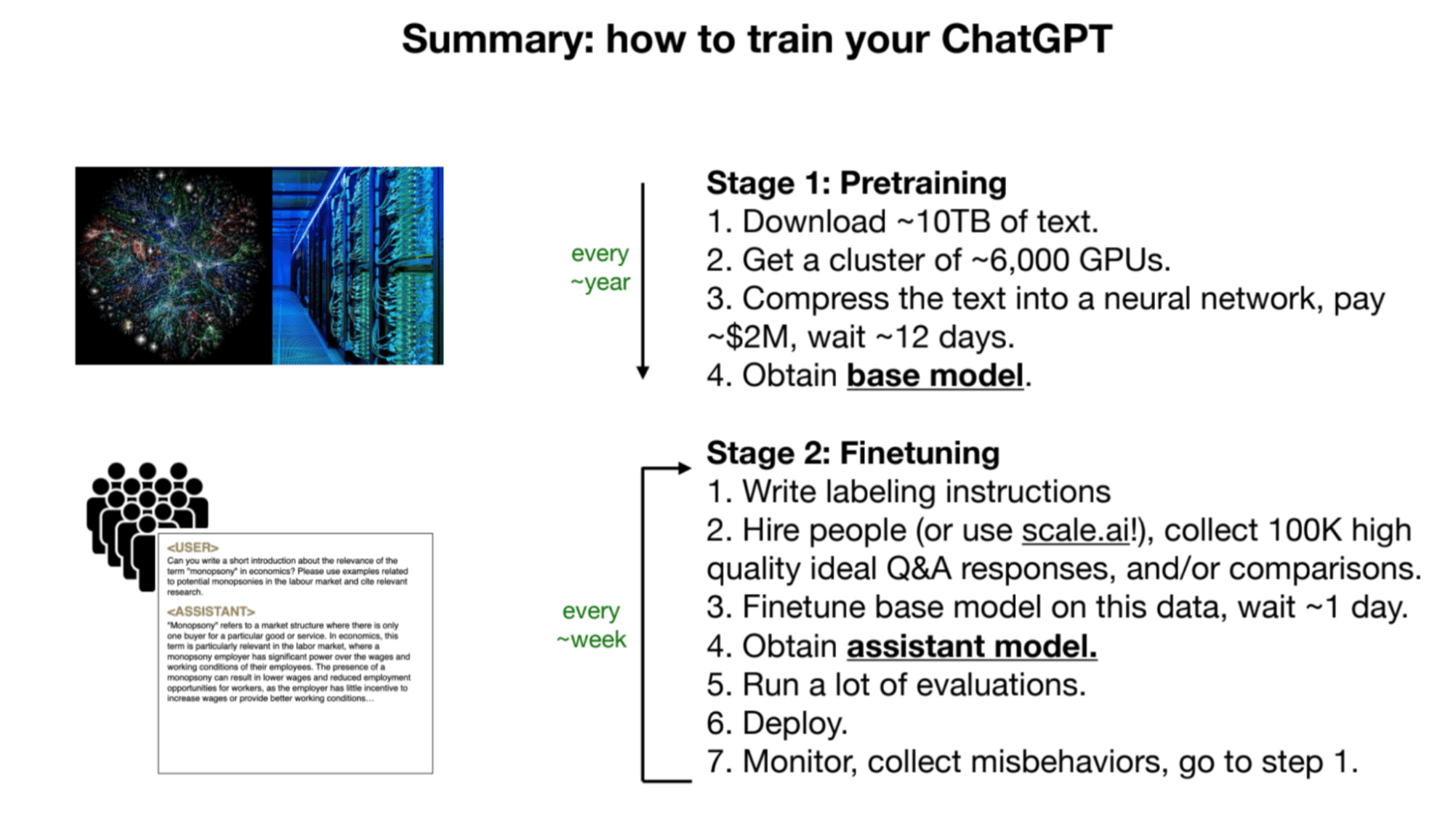
LLMs are trained on a large corpus of text to generate human-like responses. In this part, Andrej discusses the Llama 2-70b model specifically. It is one of the largest LLMs with 70 billion parameters. The model consists of two main components: the parameters file and the run file. The parameters file is a large binary file that contains the weights and biases of the model. These weights and biases are essentially the "knowledge" that the model has learned during training. The run file is a piece of code that is used to load the parameters file and run the model. The training process of the model can be divided into the following two stages:

1. Pretraining

This involves collecting a large chunk of text, about 10 terabytes, from the internet, and then using a GPU cluster to train the model on this data. The result of the training process is a base model that is the lossy compression of the internet. It is capable of generating coherent and relevant text but not directly answering questions.

2. Finetuning

The pre-trained model is further trained on a high-quality dataset to make it more useful. This results in an assistant model. Andrej also mentions a third stage of fine-tuning, which involves using comparison labels. Instead of generating answers from scratch, the model is given multiple candidate answers and asked to choose the best one. This can be easier and more efficient than generating answers, and can further improve the model's performance. This process is called reinforcement learning from human feedback (RLHF).

Part 2: Future of LLMs

Unlock the Secrets of LLMs in a 60-Minute with Andrej Karpathy
Slides by Andrej Karpathy

While discussing the future of large language models and their capabilities, the following key points are discussed:

1. Scaling Law

Model performance correlates with two variables—the number of parameters and the amount of training text. Larger models trained on more data tend to achieve better performance.

2. Usage of Tools

LLMs like ChatGPT can utilize tools such as a browser, calculator, and Python libraries to perform tasks that would otherwise be challenging or impossible for the model alone.

3. System One and System Two Thinking in LLMs

Currently, LLMs predominantly employ system one thinking—fast, instinctive, and pattern-based. However, there is interest in developing LLMs capable of engaging in system two thinking—slower, rational, and requiring conscious effort.

4. LLM OS

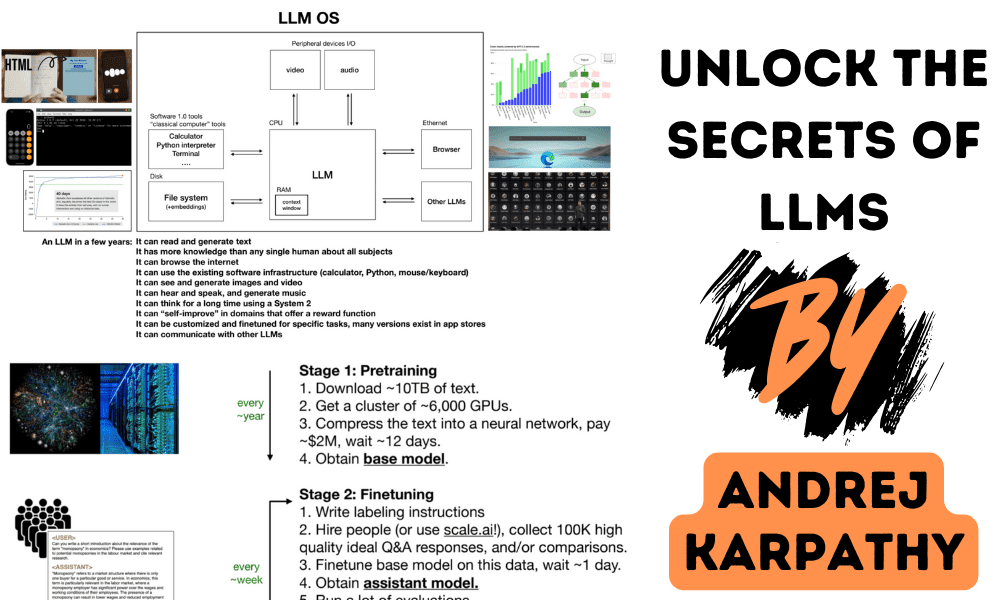
LLMs can be thought of as the kernel process of an emerging operating system. They can read and generate text, have extensive knowledge on various subjects, browse the internet or reference local files, use existing software infrastructure, generate images and videos, hear and speak, and think for extended periods using system 2. The context window of an LLM is analogous to RAM in a computer, and the kernel process tries to page relevant information in and out of its context window to perform tasks.

Part 3: LLMs Security

Unlock the Secrets of LLMs in a 60-Minute with Andrej Karpathy
Slides by Andrej Karpathy

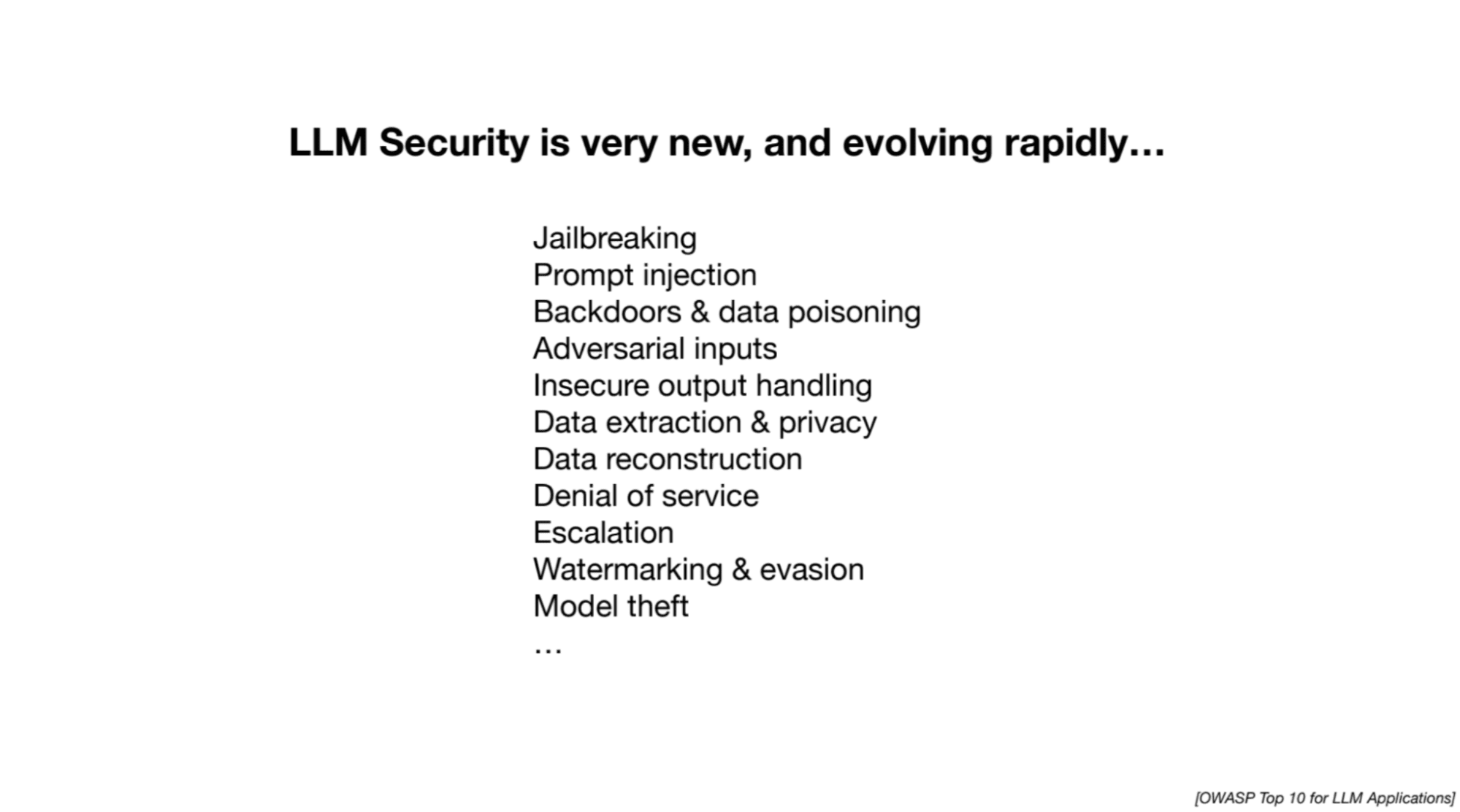
Andrej highlights ongoing research efforts in addressing security challenges associated with LLMs. The following attacks are discussed:

1. Jailbreak

Attempts to bypass safety measures in LLMs to extract harmful or inappropriate information. Examples include role-playing to deceive the model and manipulating responses using optimized sequences of words or images.

2. Prompt Injection

Involves injecting new instructions or prompts into an LLM to manipulate its responses. Attackers can hide instructions within images or web pages, leading to the inclusion of unrelated or harmful content in the model's answers.

3. Data Poisoning /Backdoor Attack/Sleeper Agent Attack

Involves training a large language model on malicious or manipulated data containing trigger phrases. When the model encounters the trigger phrase, it can be manipulated to perform undesirable actions or provide incorrect predictions.

You can watch the comprehensive video on YouTube by clicking below:

Slides: Click here

Conclusion

If you're new to LLMs and looking for resources to kickstart your journey, then this comprehensive list is a great place to start! It contains both foundational and LLM-specific courses that will help you build a solid foundation. Additionally, if you're interested in a more structured learning experience, Maxime Labonne recently launched his LLM course with three different tracks to choose from based on your needs and experience level. Here are the links to both resources for your convenience:

  1. A Comprehensive List of Resources to Master Large Language Models by Kanwal Mehreen
  2. Large Language Model Course by Maxime Labonne

Kanwal Mehreen is an aspiring software developer with a keen interest in data science and applications of AI in medicine. Kanwal was selected as the Google Generation Scholar 2022 for the APAC region. Kanwal loves to share technical knowledge by writing articles on trending topics, and is passionate about improving the representation of women in tech industry.

More On This Topic

  • Unlock the Secrets to Choosing the Perfect Machine Learning Algorithm!
  • Machine Learning Algorithms Explained in Less Than 1 Minute Each
  • KDnuggets News, July 20: Machine Learning Algorithms Explained in…
  • Unlock the Power of AI — A Special Release by KDnuggets and Machine…
  • Unlock Your Potential with This FREE DevOps Crash Course
  • ChatGPT-Powered Data Exploration: Unlock Hidden Insights in Your Dataset

Move over Gemini, open-source AI has video tricks of its own

Google Gemini website on laptop reads, welcome to the Gemini era

Google dazzled the world with its demo this month of its most cutting-edge generative artificial intelligence (AI) model, Gemini 1.5, a follow-up to the first Gemini model, which was released last December. Among other feats, Gemini 1.5 excels at things such as the "needle-in-a-haystack" challenge, where the model must identify a frame of video matching a text description.

However, Google's model — like most AI models from the biggest commercial entities — contains little technical detail about how the software works. The 58-page technical report that Google released about Gemini 1.5 just contains general descriptions of the model and the approach used, without detailing the architecture from which Gemini 1.5 is composed. And, of course, the code is not available.

Also: Meet Gemini 1.5, Google's newest AI model with major upgrades from its predecessor

In that sense, Gemini 1.5 continues a recent trend from Google, OpenAI, and other commercial enterprises — obfuscating the technical details of AI.

That kind of secrecy presents an opportunity for open-source software that can match some of Gemini's abilities while opening up access to its code.

In work published this month by Hao Liu, Wilson Yan, Matei Zaharia, and Pieter Abbeel of the University of California at Berkeley, and described on the project's GitHub site, the scientists adapt Meta's open-source Llama 2 large language model to create a multi-modal model that, like Gemini 1.5, can process not just text but also video and imagery, although not audio (unlike Gemini 1.5).

Also: GPT-4 is getting significantly dumber over time, according to a study

Using the mainstream version of Llama 2, a not particularly large 7-billion-parameter neural net, the authors were able to handle input of up to one million "tokens", which is the text, image, or video fed into the model. This number represents a dramatic increase from the 128,000 handled by the Gemini 1.0 version and OpenAI's GPT-4 Turbo.

Their creation, known as Large World Model (LWM), performs tasks similarly to Gemini 1.5. It can solve a needle-in-a-haystack type of problem, such as answering the request, "What color jacket was the girl on the trampoline wearing?", when fed a one-hour YouTube video:

UC Berkeley's Large World Model can answer a "needle-in-the-haystack" question about a particular moment in video better than Google's Gemini 1.0 or OpenAI's GPT-4 Turbo.

Liu and team haven't yet shown how their results compare to Gemini 1.5. Instead, the team show comparisons with GPT-4 and Gemini 1.0.

As shown in the illustration above, LWM answers the needle-in-haystack question correctly, while the other two fail.

LWM can hold chats about what's going on in a video clip, and give lengthy discussions about the contents of images, which is a process the researchers call "image chat". LWM can also generate images and videos when supplied with text descriptions in the prompt (see both examples, below):

Strikingly, it appears possible that Liu and team were able to achieve results equivalent to Gemini 1.0 with less computing power. The LWM was trained on one slice of a TPU Version 4 "POD", consisting of 256 TPU chips, with two cores apiece, for 58 hours. In the case of Gemini 1.0, the technical report, just like the technical report for 1.5, contains few technical details about the infrastructure for training. All we know is that Google used some amount of TPU Version 4 and Version 5 PODs for a certain amount of time. It is quite possible they used a much larger amount of computing than Liu and team did for training LWM.

So, how is LWM — which is based only on a relatively small, open-source model, running on less computing power — able to achieve similar results to Gemini 1.0? Well, LWM is the product of a different kind of approach to the problem of how to develop a neural network.

Both models start by using a similar kind of neural net, a Transformer. Google added "innovations in training algorithms, dataset, and infrastructure" to the Transformer.

Also: How Google and OpenAI prompted GPT-4 to deliver more timely answers

In the case of LWM, Liu and team trained the model in multiple successive rounds, with increasingly large "context windows", which is the amount of data samples the model works on at each pass. The team started with 32,768 tokens in the context windows, which you can think of as multiple pieces of data. They then worked up to one million tokens.

That approach is called "Ring Attention", and was developed last year by Liu and team. The insight in Ring Attention is that you can train a neural network on samples of data concurrently, rather than sequentially, to parallelize the training, which means getting more done in less time, and utilizing the chips more efficiently.

The architecture of LWM.

"We adopt a training approach […] where our model is trained on progressively longer sequence lengths, starting from 32K tokens and ending at 1M tokens in increasing powers of two," write Liu and team.

"Intuitively, this allows the model to save compute by first learning shorter-range dependencies before moving onto longer sequences. By doing this, we are able to train on orders of magnitude more tokens compared to directly training on the maximum target sequence length."

LWM is trained on sequences of data of increasing length.

The data used to train LWM includes some of the most prominent data sets that have been put into the wild, including Books3, which is at the heart of the controversy over copyright infringement. The researchers also used Video Instruct-100K, a "video conversation dataset" hosted on GitHub.

Google didn't disclose Gemini 1.0's training data, but merely describes it as such: "Gemini models are trained on a dataset that is both multimodal and multilingual. Our pretraining dataset uses data from web documents, books, and code, and includes image, audio, and video data."

Also: AI will unleash the next level of human potential. Here's how

While Google has already moved forward with Gemini 1.5, which can handle as many as 10 million tokens in its input, Liu and team believe Ring Attention can "theoretically extend to an infinite context, bounded only by the number of devices available."

They continue: "We believe that our released model will provide a foundation for future work on developing longer context models, as well as encourage more challenging benchmarks that contain difficult long-range tasks that require higher levels of synthesis, rather than pure fact retrieval."

The code of LWM is posted on the research team's GitHub site.

Artificial Intelligence

5 Courses to Master LLMs

5 Courses to Master LLMs
Image by Editor

Large Language Model or LLM has recently become more popular thanks to products such as ChatGPT and Google Gemini. Decades ago, people never knew what AI was capable of, and currently, everyone tries their best to catch up with the trends. If I look at the job board, many companies now also seek LLMs skills as their prerequisite.

With the competitive advantage LLMs give, it’s a brainer that we should try to at least learn about them. Whether you are a beginner or a data professional, we should aim to master the LLMs to stand out.

In this article, I will discuss five courses to help you master LLM. What are these courses? Let’s get into it.

1. Full Stack LLM Bootcamp

First, we have the Full Stack LLM Bootcamp developed by the fullstackdeeplearning.com. The website offers excellent self-managed deep learning courses, but we would focus on the LLM courses.

Since 2023, the company has run the Bootcamp in person, but it’s also released all the learning material in reading and video format. What is good about these courses is that you can start learning, no matter your knowledge level. However, you still already expect to have some machine learning knowledge, although LLM isn’t necessary.

The course aims to help you catch up to the state-of-the-art LLM and be ready to build and deploy LLM apps. To do that, the courses offer several topics:

  • LLM Foundations
  • Prompt Engineering
  • LLMOps: Deployment and Learning in Production
  • UX for Language User Interfaces
  • Augmented Language Models

The course is easy to follow, so don’t miss this free LLM Bootcamp course to master LLM.

2. LLM University by Cohere

The next course is LLM University by Cohere. Cohere is a company specialising in LLM products and research development, which makes them know what LLM is all about. The company have a great initiative to help people understand LLM by launching a free LLM University course.

LLM University provides courses in natural language processing and large language models. The course aims to improve learners' skills and strengthen the NLP foundation and hands-on approach to applying LLM in real-world situations.

The courses comprise several topics:

  • NLP and ML Fundamentals
  • Combining Endpoints to Build Apps
  • What are Large Language Models?
  • Text Representation with Cohere Endpoints
  • Text Generation with Cohere Endpoints

The courses are suitable for beginners and professionals alike, as by the end of the course, you can launch production-ready LLM apps.

3. Building LLM-Powered Apps Course

The third course we have to master LLM is the Building LLM-Powered Apps Course by Weight & Biases (WB). The company is focused on developing an end-to-end machine learning platform, one of which is the LLM app.

The course offers many self-managed video courses that you can follow to learn how to develop LLM apps. The topic includes:

  • LLM Application Introduction
  • LLM APIs
  • Building the LLM Applications
  • Optimize LLM Application

It’s a more advanced course, so we are expected to know programming language and basic knowledge of LLM. However, the course is easy enough to follow so you can learn immediately.

4.LangChain & Vector Databases in Production

The LangChain & Vector Databases in Production by activeloop is an advanced course to master LLM production applications. Rather than focus only on the LLM, this course will guide you in enhancing the existing LLM so it is ready for any customer-facing application.

To advance in the LLM industry, we need to understand LangChain and Vector Databases, which are integral to the LLM application production. By taking this course, you will understand the following concepts:

  • LangChain and LLM Introduction
  • Prompting
  • Vector Database usage
  • Indexing Organization
  • Combining things with Chain

The courses are great if you already know the basics of LLM, but everyone can still follow them, even if you are a beginner.

5. Large Language Models: Application through Production

The last course is the Large Language Models: Application through Production by Databricks. Databricks is a company that provides an intelligence platform for businesses, which includes building and deploying LLM applications. This course is an industrial standard that would be good if you want to apply for an LLM job.

The course is intended for developers, data scientists, and engineers, but it’s still acceptable to follow even if you are not. Using popular frameworks and SOTA techniques such as HuggingFace, LangChain, Vector Database, Data Embedding, and many others, you would learn advanced techniques for developing and producing LLM applications.

The courses would teach you many LLM-related topics, including:

  • Applications with LLMs
  • Embeddings, Vector Databases and Search
  • Multi-stage Reasoning
  • Fine-tuning and Evaluating LLMs
  • Society and LLMs: Bias and Safety
  • LLMOps

At the end of the course, you will be ready to build advanced LLM applications that businesses surely want to use.

Conclusion

This article discusses five courses designed for the learner to be ready to develop and produce LLM applications. Learn everything from this course, and you will be prepared to apply for LLM jobs.

Cornellius Yudha Wijaya is a data science assistant manager and data writer. While working full-time at Allianz Indonesia, he loves to share Python and Data tips via social media and writing media.

More On This Topic

  • 5 Free Courses to Master Linear Algebra
  • 5 Free Courses to Master Calculus
  • 5 Free Courses to Master Data Science
  • 5 Free Courses to Master Machine Learning
  • 5 Free Courses to Master MLOps
  • 25 Free Courses to Master Data Science, Data Engineering, Machine…

Like 5G, telcos must seek commercial use cases to move GenAI forward

Abstract AI network flow

In driving the adoption of generative artificial intelligence (GenAI), telcos should seek out use cases that actually add value or they could face having to deal with issues ahead.

Noting that AI isn't a new technology for telcos, GSMA Intelligence's head Peter Jarich said GenAI has become much of the lexicon because it democratized the use of such tools and driven widespread interest in them.

Also: 5.5G touted as the network to bring improved enterprise connectivity

The key question now is how telco should tap the new opportunities. He pointed to 5G, which has been the fastest-growing mobile technology but hasn't been as successful in driving profits and revenue for operators. It is the reason so much discussion continues to revolve around the monetization of 5G and leveraging its capabilities to deliver services that are useful.

He further noted that GenAI interest among operators remains low, with 56% still in the testing phase and the number of commercial deployments small.

While there are valid reasons for operators to move slowly — since they run networks that support critical infrastructures and need to consider regulatory repercussions when there is a downtime — the challenge now is to look at how to move them beyond the GenAI testing phase and into commercial launch, he said.

There also has been so much hype around GenAI that telcos need to sieve through the noise and figure out how they should leverage the technology to deliver real value, said Jarich, who was speaking to ZDNET ahead of this week's Mobile World Congress (MWC) in Barcelona, Spain.

Also: Best gadgets I saw at MWC 2024: Smart rings, concept phones, transparent laptops

The biggest obstacles operators face are unclear returns on investment (ROI) and tech maturity. He urged the industry to identify potential GenAI proof of concepts that can generate revenue and establish one to two compelling use cases.

There currently are multiple players clamoring for a share of the market and pushing a broad array of products, including different AI chips and functionalities. Linking GenAI to everything as a marketing tagline can result in disenchanted consumers if these services fail to deliver any actual value, he said.

The industry, hence, needs to be careful about how it wants to pitch GenAI, or risk customers losing trust in the technology, Jarich said. He stressed the need for clear messaging and a basic understanding of the tools available.

Focus on GenAI and the broader AI should be on decreasing operational costs and providing better customer support. He noted that operators will want to use these tools to devise new services that can drive value and build stronger connections with consumers.

There also has been a push among device manufacturers, such as Samsung and Google, to offer AI-powered handsets, he added. With smartphone sales plateauing or on the decline, these market players had to look at ways to entice consumers to buy new models. This had led to the introduction of foldables, for example, he said.

Also: AI's latest trick: Better KPIs for measuring business success

They now are looking to GenAI to do the same, such as improving search and including more useful features, he added.

It will drive the need for open APIs to enable developers to build GenAI tools that leverage 5G capabilities, including low latency, further pushing new use cases for 5G and fueling demand and traffic, he said.

GSMA projects that 5G connections will grow from 1.6 billion to 2.1 billion by the end of 2024.

Jarich noted that use cases can differ for regions and markets, giving local telcos further opportunities to find new revenue. And with most GenAI services running on the cloud, operators can play a differentiating role in facilitating these. For instance, they can provide support for edge computing, which will be important for some GenAI services such as real-time language translation and smaller large language models (LLMs) that can be hosted on the device.

Dedicated foundation model for telcos

Domain-specific LLMs also are being made available to help identify GenAI use cases specific to the needs of a particular sector, such as financial or healthcare.

Also: 3 innovative ways edge computing and 5G are transforming healthcare

Huawei this week launched a telecom foundation model it said carriers can use to improve operational efficiencies and optimize network productivity. Its Telecom Foundation Model covers two key applications: Role-based copilots and scenario-based call agents, said Huawei's board member and president of ICT products and solutions Yang Chaobin, on the sidelines of MWC.

The AI model powers natural language interactions for different roles and scenarios, analyzing complex processes and orchestrating operations to deliver better customer experience, Yang said. These are customized for roles such as network optimization agent, user experience agents, and fault management.

He added that the foundation model also can power autonomous networks, providing three core capabilities for telcos, including service provisioning and network maintenance.

Telcos believe autonomous networks, coupled with technologies such as AI, big data, cloud, and edge computing can deliver services more quickly, at lower costs, and that are simpler to roll out and manage. TM Forum, for instance, runs an Autonomous Networks Project that aims to define fully automated networks for vertical industries, enabling "self-configuration, self-healing, self-optimizing and self-evolving" telecom networks.

Also: How renaissance technologists are connecting the dots between AI and business

Stressing the importance of automation, Yang noted carriers have been faced with growing Opex (operating expenditure), which has climbed to some 70% against the ratio to revenue. Software-defined and autonomous networks can help alleviate these cost pressures, he said.

He added that Huawei's Telecom Foundation Model can power service provisioning use cases, in which administrators can access "accurate multi-modal assessment and quick service provisioning." The AI model's optimization capabilities further facilitate user experience assurance use cases, while its cross-process analysis and dialog-based support can enhance troubleshooting cases, he said.

As data is increasingly leveraged in AI applications, Jarich said data security will be a big focus and operators can play a role in being stewards of users' data. They also will need to ensure their networks can cope with the growing traffic as the adoption of GenAI-generated content and services climbs, he noted.

And with the vast data they already have on their customers, telcos can tap AI to manage bespoke services and better provide services that cater to a user's specific needs, he said. That is the lesson they can take away from their experience with 5G, he added.

Also: What is 5G home internet? Here's what to know before you sign up

With foundation models and GenAI driving "a new level of intelligence," Huawei Cloud CTO Bruno Zhang said businesses increasingly will tap AI-generated content in production and to support software engineering. Building their own foundation models, however, will be challenging as these require "systematic innovation," Zhang said at the Chinese vendor's cloud summit, held alongside MWC.

Huawei hopes to help by offering AI foundation models that power applications as well as its own cloud services, he said. The Chinese tech giant also aims to ease AI adoption by providing the key components, including AI-native storage and AI-powered data.

He noted that Huawei's Pangu LLM, released last year, contains industry-specific models, trained using industry data, and provides industry-specific industry scenarios and tasks, including autonomous driving and weather forecasting.

Based in Singapore, Eileen Yu reported for ZDNET from Mobile World Congress 2024 in Barcelona, Spain, on the invitation of Huawei Technologies.

Artificial Intelligence

2024 Reading List: 5 Essential Reads on Artificial Intelligence

2024 Reading List: 5 Essential Reads on Artificial Intelligence
Image by Author

We’re two months into the new year and you’re probably looking at a new collection of books to add to your reading list. Your library is already filled with self-development books, but how many books about AI have you read?

Learning about the world of AI in the current state as well as the future state is important to anybody's learning in this day and age. It’s better to know the world you’re living in than to be bewildered when AI systems and other tools have been implemented without knowing the real reasons and outcomes behind it.

In this article, I will go through 5 highly recommended books to learn more about AI in the year 2024.

Life 3.0

Link: Life 3.0

Author: Max Tegmark

Author Max Tegmark is a physicist and a machine learning researcher who dives into the 3 different tiers of life since the universe, from the simple form of biology species that can’t change their software, to species who can change their software design, to technological species that can design both its software and hardware.

Learn what category you fit in: the techno-skeptics who believe AGI will not effectively be implemented for another 100 years or the beneficial AI movement camp that believes human AGI is possible in this century.

Superintelligence

Link: Superintelligence: Paths, Dangers, Strategies

Author: Nick Bostrom

Author Nick Bostrom offers us this classic where he elaborates on the distance between a village idiot and Einstein is very small due to the intelligence of AI possibly surpassing both scales of human intelligence.

Understand the cross-over points where AI systems can become smarter alone, and delve into the author's opinion on superintelligence being able to move fast and explosively. Two forms of designing superintelligence machines are mentioned in this book: the current way of teaching computers to imitate human intelligence and whole-brain simulation where the computer simulates the human brain.

The Coming Wave

Link: The Coming Wave

Author: Mustafa Suleyman

Mustafa Suleyman, the co-founder of DeepMind comes with one of the most recent books about AI and mentions recent breakthroughs, such as robots and large language models. The book is divided up into 4 parts: Homo Technologicus, The Next Wave, State of Failure, and Through the Wave. These different chapters talk about the acceleration and movement of technology in human history, where each of these movements come and go like waves and are continuously being improved.

Dive into different aspects and incentives that push the progress of technology such as finances, politics, human ego, human curiosity, change the world and who ends up winning the race.

Power and Progress

Link: Power and Progress

Author: Simon Johnson and Daron Acemoglu

Dive into a book that examines the relationship between technology, prosperity, and societal progress. The majority of society believes or has been fed that technological advancements lead to societal progress. In this book, the authors challenge this statement by emphasizing that technological advancements can cause inequality, where only a small group of individuals and corporations benefit.

We can stand by this statement as we have seen in the past few years, some companies have become millionaires overnight, whilst the lower-income families have seen a further decline in income and also an increase in layoffs.

Are humans underrated? Should we let humans continue to do what they’re good at due to human intelligence and let machines continue to do what they’re good at?

Human Compatible

Link: Human Compatible

Author: Stuart Russell

Author Stuart Russell, the co-author of the 3rd textbook about Artificial Intelligence. Although the title sounds a bit serious, the book is a fun read and dives into how the design of intelligent machines is important to solving human problems, whilst ensuring that they do not cause humans harm.

The first section dives into AI in general, and why it is important to build superintelligent machines that are compatible with human goals. He states in the book “Success would be the biggest event in human history, and perhaps the last event in human history”.

Wrapping it up

If you haven’t already, I would highly recommend you add this to your reading list. You do not have to be an AI or tech professional to want to learn more about the world we live in with technological advancements — you’re just doing the right preparation and learning for it.

If there are any other books you would recommend to the community, please drop them in the comments section below — thank you!

Nisha Arya is a Data Scientist and Freelance Technical Writer. She is particularly interested in providing Data Science career advice or tutorials and theory based knowledge around Data Science. She also wishes to explore the different ways Artificial Intelligence is/can benefit the longevity of human life. A keen learner, seeking to broaden her tech knowledge and writing skills, whilst helping guide others.

More On This Topic

  • ARTIFICIAL INTELLIGENCE (AI), A TEXTBOOK
  • Artificial Intelligence vs Machine Learning in Cybersecurity
  • Demystifying AI: The prejudices of Artificial Intelligence (and…
  • Should You Become a Freelance Artificial Intelligence Engineer?
  • Artificial Intelligence Project Ideas for 2022
  • Artificial Intelligence and the Metaverse

100% FDI in Space to Drive Investments in India

The Union Cabinet has approved amendments to India’s space sector’s FDI policy, permitting up to 100% investment through liberalised entry routes. The amended policy, sanctioned in the past week, facilitates 100% FDI under the automatic route for manufacturing satellite components, systems, and subsystems.

The policy changes align with India’s broader space goals, aiming to capture a more substantial share of the global space market, which currently stands at a modest 2%.

Lt Gen AK Bhatt (Retd.), director-general of ISpA, said, “We are thankful to the government, and it is heartening to note the pace of its forward-looking reforms in the nascent space sector.”

However, this move, targeting increased private sector participation and self-reliance, defines foreign investment limits in the satellite sub-sector. Up to 74% investment is allowed under the automatic route for manufacturing and operating entire satellites, with amounts beyond this needing government approval.

Additionally, launch vehicles and associated systems, including the creation of spaceports, will now allow up to 49% FDI under the automatic route.

Pawan Chandna, CEO of one of the leading private space companies in India, Skyroot Aerospace, welcomed the regulatory clarity, stating, “For Skyroot, being in the launch vehicle domain, 49% FDI in the automatic route and 100% FDI in the government route will help boost investments and open access to capital easier and at par with global standards.

Space Could Drive India’s GDP Growth

While gross and net FDI flows in India’s GDP dwindled to a 16-year low of a mere 1 and 0.6%, Indian space-tech startups witnessed a significant 62% surge in funding in 2023, reaching $62 million by August, a 60% YoY increase.

The success of the Chandrayaan-3 Moon mission and ISRO’s collaboration with private partners has sparked interest among many. In June, Bengaluru-based Pixxel secured $36 million from investors, including Google. AgniKul Cosmos raised $26.7 million in a Series-B round in October. Satsure garnered $15 million in Series A funding in August. Satyukt Analytics received $1.2 million in seed funding in June, while PierSight secured $600,000 in pre-seed funding in September.

Additionally, the global attention on India’s space endeavours has attracted companies like SpaceVIP to launch space-tourism-related services. Industry giants like Boeing and Airbus are also increasing their presence in the country, with Boeing recently inaugurating their R&D centre for aerospace in Bengaluru in the presence of PM Modi.

According to Tracxn, India ranks seventh globally in SpaceTech funding for the year, showcasing remarkable growth from $35 million in 2010-2019 to $112 million in 2022. The consistent expansion underscores the resilience of the Indian space-tech sector amid funding challenges and macroeconomic fluctuations.

Starting in June 2020, PM Modi’s announcement to open the space sector to private enterprises set the stage for a proliferation of innovative businesses. These enterprises, rooted in original research and local talent, attracted substantial investment, with space start-ups securing $120 million in new funding the previous year.

This growth trend shows no signs of slowing down, with annual investment rates doubling or even tripling.

Dr Subba Rao Pavuluri, CMD of Ananth Technologies, emphasised the strategic importance of the space sector’s liberalisation, which allows ISRO to focus on research and development of mega upcoming projects like the manned Gaganyaan mission and next-gen launch vehicles—while the private sector takes on other services.

He added, “Currently, India’s space industry contributes approximately $7 billion to the national GDP and employs over 100,000 skilled professionals across various disciplines.”

FDI Just a Piece of the Puzzle

While CEOs of prominent Indian space startups, including the likes of Skyroot’s Pawan Chandna, foresee enhanced regulatory clarity, attracting investments and easing access to capital, industry experts like Narayan Prasad, COO at Satsearch, an online global marketplace for space and one of the co-founders of Dhruva Space, hold contrary views.

Prasad emphasised that while FDI is a crucial aspect, it is just a small piece of the puzzle. He stated, “Because, in the end, investors are only interested once they see a flourishing market.” He highlighted the importance of demand, stating that the space industry sees demand when governments act as primary customers – a universal rule of thumb in the sector.

He opined that the more important thing to discuss besides demand is how to enable up-and-coming space startups to become self-reliant. “How do we expose demand to these companies to grow? It would be difficult for us to expect foreign investors to be interested when the burden is on our companies to go and find customers outside,” Prasad said.

However, the industry veteran agreed that the move is very liberal even when compared to the likes of the US. “To compare what India has announced against other countries like the US or others, for example, it’s very liberal.

“Even in the area of launch vehicles, I don’t think the US will even want a foreign entity to be a minority shareholder in their launch vehicle companies. So, compared to that, what the government has proposed is much more liberal,” he said.

The post 100% FDI in Space to Drive Investments in India appeared first on Analytics India Magazine.