How BharatGPT’s Hanooman is Changing the Face of AI in India

Seetha Mahalaxmi Healthcare (SML), in collaboration with the BharatGPT group led by IIT-Bombay, recently introduced ‘Hanooman’, a series of Indic AI models with multimodal specialties at the NASSCOM Technology and Leadership Forum held in Mumbai.

SML’s Hanooman is named after the Hindu deity Hanuman. “Hanuman is a great example of responsible power. Despite being the most-powerful entity, he never used his power for selfish needs,” said Vishnu Vardhan, founder of SML and Vizzhy, in an exclusive interview with AIM.

Vardhan said they came up with the name while framing the ethical framework for the model and added that it acts as a guideline to understand how their model should be – for the greater good.

Unleashing the Power of Hanooman

The founder told AIM that the first-four open-source models in the Hanooman series (1.5 billion, 7 billion, 13 billion, and 40 billion parameters) are set to be released soon.

“These will most probably be released by the end of this month. We are quite ready. But we will do a lot of testing,” said Vardhan. He added that Hanooman, being built by researchers, academicians, and professors, needs to undergo thorough testing before being released in the market.

Being multimodal, Hanooman will be able to converse in 11 languages, including Hindi, Tamil, Telugu, Malayalam, and Marathi. “In the future, we plan to extend language support to all 22 official languages of India,” said Vardhan.

“We don’t want it to be like ChatGPT, which suffers from the ‘I’m God and I know everything’ syndrome. We don’t want to simply replicate its success [but be more than that],”said Vardhan, adding that they are currently focusing on specific use cases for Hanooman.

As a healthcare provider, SML is currently focused on addressing the challenges faced by doctors. “We want to make it easy for doctors and people to keep their records and summarise them,” he said, adding that the conversations of doctors will be recorded, and Hanooman will summarise them using automatic speech summarisation.

The other use case, Vardhan mentioned, is helping rural kids with their homework, especially those whose parents can’t assist them. “We believe that the education barrier is a significant challenge in India,” said Vardhan, emphasising that healthcare and education are their primary focus areas. “We are very specifically focused on healthcare and education, and maybe later, banking.”

In the near future, SML also plans to come up with closed-source models for enterprise customers. “We’ll build some highly data-efficient and cost-effective diagnostic solutions, which will be much cheaper than existing models. This will bring down the cost by 100x, and they will be specifically built for you,” said Vardhan.

Not Backed by Reliance Jio Infocomm

“The media has sometimes gotten it totally wrong, like how Jio has invested in Hanooman. It’s an initiative of SML,” said Vardhan. However, he added that they might collaborate with them in the future on the use cases of telecom and retail.

Vardhan said that to build Hanooman, SML hasn’t raised any external funding, and it has been mostly internal funding. “We are totally inspired by what ISRO has done, and we want to do that for India, but it does cost a lot of money,” he said.

“We have 1000 GPUs with us, and our plan is to scale it up to 10,000 in 2024 because we see a lot of requirements coming up,” said Vardhan, adding that they are also receiving support from cloud service providers in India. Vardhan was all praise for Indian hardware players, including Yotta. “They’re bringing 16,000 GPUs and are really enablers, creating the whole ecosystem.”

Vardhan said, as of now, many enterprises and state governments are in touch with them to use Hanooman. “States such as Tamil Nadu, Telangana, and Karnataka have shown interest, and many other state governments have been approaching us because we are working on multilingual projects,” he concluded.

The post How BharatGPT’s Hanooman is Changing the Face of AI in India appeared first on Analytics India Magazine.

OpenAI Enhances ChatGPT’s Voice Modality Feature

OpenAI announced its latest text-to-speech feature where ChatGPT can now read your texts aloud. A user can select a particular text and choose the option of ‘read aloud’ to hear ChatGPT read the response. This comes in handy when ChatGPT responds with lengthy prompts. The said feature is released on iOS, Android and even on the web version.

Source: X

Voice Modality Gains Speed

Akin to Google’s text-to-speech feature in Google Voice Assistant, which is said to soon be powered by generative AI, OpenAI’s latest voice feature adds to the voice functionality that was announced last year. The previous feature allows one to have a hands-free conversation with the AI bot, and even allows the user to select the type of voice.

This update comes at a time when voice features are increasingly being integrated onto multimodal AI models. Apart from ChatGPT, the latest powerful model of Google i.e. Gemini is also multimodal. AI startup Pika Labs is experimenting with audio features on AI-generated videos.

Pika was not the only one. Alibaba’s EMO AI generator (Emote Portrait Alive) that generates expressive portrait videos with audio2video diffusion models was recently released. The company released videos where images were made to talk/sing with expressive facial gestures.

Not a Great Reception

OpenAI’s latest voice announcement wasn’t too exciting for the users, considering how Anthropic launched their latest model Claude-3 which is said to surpass GPT-4 on a number of parameters.

Source: X

Mocking OpenAI’s new product announcement, users are asking for GPT-5. It is likely that OpenAI is gearing up for something bigger.

The post OpenAI Enhances ChatGPT’s Voice Modality Feature appeared first on Analytics India Magazine.

Indian IT Minister Rajeev Chandrasekhar on Google Gemini Fiasco: ‘Saying Sorry is Not Enough!’

In a recent development that has stirred significant attention, Google issued an apology to the Indian government following the backlash over its AI application, Gemini.

The controversy has sparked a broader discussion on the regulation and accountability of AI-based applications in India. Union Minister Rajiv Chandrasekhar expressed dissatisfaction with Google’s apology, emphasising that a mere apology does not suffice in light of major internet platforms’ legal expectations and responsibilities.

The government of India has made it clear that AI-based applications operating within its jurisdiction must be licensed, highlighting the need for accountability and responsibility from companies like Google. Minister Chandrasekhar pointed out that platforms with a significant internet presence cannot simply apologise after violating laws or regulations. He stressed that the law prohibits platforms from allowing their services to be used in ways that output unlawful content, create harm, or violate the law.

Chandrasekhar also criticised Google for deploying an untested platform like Gemini on the public Indian internet without proper disclosures and disclaimers, stating that such actions are inconsistent with the government’s expectations of compliance with the law. He further mentioned that Google’s actions have left the company open to prosecution under IT and criminal laws.

The minister underscored the government’s serious responsibility to ensure the safety and trustworthiness of the Indian internet. He expressed concern over platforms using India as a testing ground for their innovations without adequate safeguards, describing this approach as “unconscionable and unacceptable.”

The controversy surrounding Google’s Gemini application has raised important questions about regulating AI technologies and balancing innovation and legal compliance. As India continues to navigate the complexities of regulating emerging technologies, the government’s stance signals a firm commitment to protecting the interests of its citizens in the digital age.

The post Indian IT Minister Rajeev Chandrasekhar on Google Gemini Fiasco: ‘Saying Sorry is Not Enough!’ appeared first on Analytics India Magazine.

Gupshup Launches LLM-Based Conversation Cloud with SaaS Tools for B2C Interactions

Indian unicorn company Gupshup has launched the Conversation Cloud, a comprehensive generative AI-powered suite of SaaS tools to improve business-to-customer interactions. This platform facilitates rich two-way conversations at scale, enhancing customer engagement on various conversational channels.

The Conversation Cloud comprises three main modules: Converse, Advertise, and Communicate, catering to conversational relationship management throughout the customer lifecycle.

Key Features

Businesses can leverage advanced no-code tools, such as Gupshup Converse, to build personalised customer journeys, employ conversational commerce, and leverage AI bots like ACE LLM for natural language queries.

While Gupshup Advertise enables marketers to acquire and convert customers through WhatsApp and Instagram Ads, resulting in significant cost savings and increased sign-ups, Gupshup Communicate enhances traditional CPaaS with features like automatic message translation, optimised scheduling, and omnichannel failover.

Tech Stack

The generative AI model supporting all of this is ACE LLM, Gupshup’s own finely tuned LLM. It incorporates built-in guardrails and controls. Additionally, it leverages GPT models for template translations in Smart CPaaS, with plans to employ these models for template suggestions.

“Gupshup Conversation Cloud has AI infused into key modules, including the journey builder (Bot Studio) where businesses can build their own custom generative AI bots. Modules like Agent Assist and Campaign Manager have AI co-pilot-like functionality to help marketers and admin,” Beerud Sheth, co-founder and CEO, Gupshup, told AIM in an exclusive interview.

ACE LLM included a series of domain-specific LLMs tailored for functions like marketing, commerce, support, HR & IT, and industries such as banking, retail, and utilities. These models, based on foundation models like Meta’s Llama 2, OpenAI GPT-3.5 Turbo, and others, are finely tuned for specific industries with enterprise-grade safety controls.

Customer Stories

Sheth further shared with us that Wow! Momo has improved its customer experience by facilitating end-to-end food ordering on WhatsApp using Conversation Cloud.

The primary objectives for the leading Indian fast-food chain company included reducing dependence on aggregators, saving on substantial commissions, and transitioning from an app-first to a messaging-first approach.

“It leveraged WhatsApp for end-to-end food discovery, ordering and commerce as well as support. Post the implementation, a whopping 55% of their orders are placed directly- on WhatsApp and in-stores. The company enjoys an impressive 40% repeat order rate,” commented Sheth.

Another beneficiary of Gupshup’s Conversation Cloud, Swiggy, experienced a notable 2.3 times increase in customer engagement. Similar success stories extend to various sectors, including government applications. The Madhya Pradesh Election Office effectively engaged 1.2 million citizens during the 2023 legislative assembly elections using Gupshup’s Conversation Cloud.

Last year, the company unveiled features including audience categorisation, automated retargeting for click-to-chat ads, and integration of ACE LLM for improved interactions in AI-driven chat and voice bots. The updates introduce tools like Campaign Manager, Agent Assist with AI Summarise, Rephrase, Expand, and Full Funnel Analytics.

The post Gupshup Launches LLM-Based Conversation Cloud with SaaS Tools for B2C Interactions appeared first on Analytics India Magazine.

Cloudflare Unveils AI Features to Prevent Security Attacks 

Prominent cloud connectivity company Cloudflare has introduced two new AI-powered security features—Firewall for AI and Defensive AI—to protect organisations against emerging threats in the wake of generative AI. These solutions aim to fortify AI applications, particularly LLMs, against potential abuse, attacks, and tampering.

Firewall for AI

Cloudflare’s Firewall for AI establishes a defense layer, specifically designed to identify and thwart attacks directed at LLMs. These models, interpreting complex human language and data, are susceptible to threats due to their dynamic nature and unpredictable outputs. Recognising the inherent vulnerability, Cloudflare addresses the challenge by integrating security into the AI landscape from the outset.

Key features

  • Rapid Threat Detection: The solution scans and evaluates user prompts submitted to LLMs, swiftly identifying attempts to exploit models and extract data.
  • Automatic Threat Blocking: Deployed globally on Cloudflare’s network, Firewall for AI automatically blocks threats in proximity to end-users to ensure immediate protection without requiring human intervention.
  • Free Default Security: Cloudflare offers free protection through Firewall for AI for any customer running an LLM on Cloudflare’s Workers AI, mitigating concerns like prompt injection and data leakage.

Defensive AI

The San Francisco based company’s Defensive AI introduces a personalised security approach to counteract AI-driven attacks. Threat actors leverage AI capabilities to execute sophisticated phishing scams, code maliciously, and intensify attacks on critical business functions. Defensive AI focuses on providing tailored mitigations, enabling organisations to safeguard critical applications and entire networks by understanding and adapting to their unique traffic patterns.

Key Features

  • API Anomaly Detection: Since APIs constitute a significant portion of web traffic, Cloudflare is developing a solution to prevent attacks targeting applications, account takeovers, and data exfiltration. API Anomaly Detection employs AI to learn and model normal behaviour, identifying deviations indicative of potentially malicious activity.
  • Cloud Email Security: With nine out of ten cyber-attacks originating from phishing scams, the feature employs AI models to analyse different elements of email messages, flagging suspicious content and adapting to the rise of AI-enhanced attacks.
  • Zero Trust Approach with Gateway: The Cloudflare Gateway facilitates the creation of a user behaviour baseline and evaluates accessed resources to identify potential risks. This includes internal and external resources, providing a score for users and resources to flag or filter potentially unauthorised activities.

The company previously introduced a new platform called Workers AI to build cost-effective, full-stack AI applications. This platform, eliminating infrastructure management, caters to businesses of all sizes, allowing seamless deployment of production-ready applications for various use cases, including LLMs, speech-to-text, image classification, and sentiment analysis.

The post Cloudflare Unveils AI Features to Prevent Security Attacks appeared first on Analytics India Magazine.

Anthropic’s Claude 3 chatbot claims to outperform ChatGPT, Gemini

Anthropic's Claude 3 AI

Look out ChatGPT. Another AI chatbot is muscling in on your territory. Released on Monday, the third version of Anthropic's Claude AI is being touted as more skilled and knowledgeable and better at reasoning than OpenAI's ChatGPT and Google's Gemini AI.

Though Claude 3 is a single product, it offers three different models. The Opus and Sonnet models are now in play through the Claude 3 website and API for developers. The faster Haiku model will be available soon, according to Anthropic.

Also: I asked Gemini and GPT-4 to explain deep learning AI, and Gemini won hands down

Among the three models, Opus outscored GPT-3.5, GPT-4, and Google's Gemini in several key areas, based on Anthropic's research. Tested were such skills as common knowledge, undergraduate-level knowledge, graduate-level expert reasoning, basic mathematics, mathematical problem-solving, and coding.

With its more advanced training and knowledge, Claude 3 exhibits "near-human levels of comprehension and fluency on complex tasks," according to Anthropic.

Claude 3 also promises to be an improvement over past flavors of the AI.

The new version boasts much quicker response times, with Sonnet twice as fast as Claude 2 and Claude 2.1 and with greater intelligence, according to the testing. As such, Anthropic promotes this model as ideal for retrieving information or automating sales. Haiku is the fastest of the three, able to read a dense research paper with charts and graphs in under three seconds.

Anthropic also cites Claude 3 as being more accurate and less prone to errors than previous versions. To test this, the company threw a large number of complex and factual questions at the different models. Using the Opus model, Claude 3 managed twice as many correct answers compared with Claude 2.1 and produced fewer incorrect answers, or hallucinations.

Also: ChatGPT vs. Microsoft Copilot vs. Gemini: Which is the best AI chatbot?

In an effort to shy away from providing harmful information, AIs will often refuse to answer questions considered inappropriate. But sometimes they'll mistakenly interpret a harmless prompt as harmful. In Anthropic's testing, Claude 3 was less prone than previous versions to refusing to answer harmless prompts. In this regard, the three Claude 3 models showed a better understanding of requests and were better able to distinguish between harmful and harmless questions.

Anthropic also touts Claude 3 as easier to use, capable of accepting longer prompts, and better able to retain information from previous prompts.

Also: 8 ways to reduce ChatGPT hallucinations

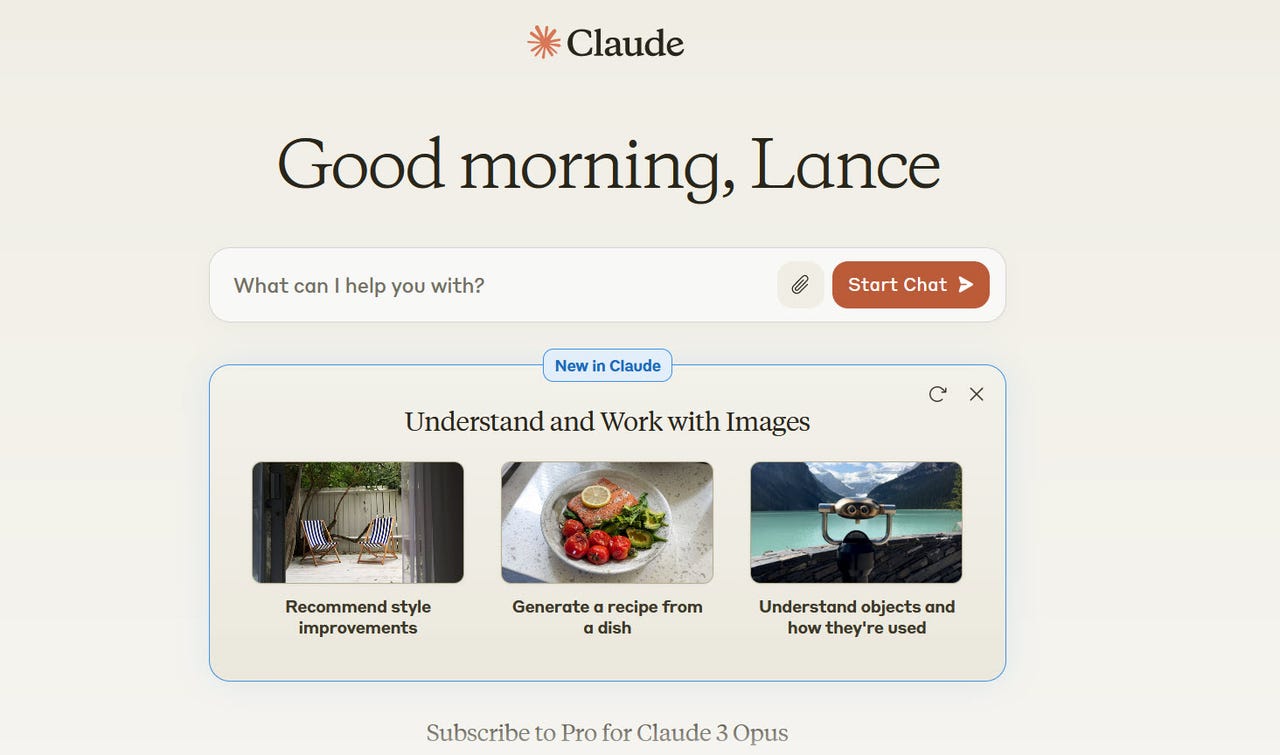
One major improvement to Claude is its ability to accept uploaded files. You can now send it a variety of file types, including images, PDFs, text files, Microsoft Office files, CSV files, and HTML files. In response, Claude will analyze, summarize, and answer questions about the content in a file.

To give Claude 3 a whirl, head to its website. The free flavor of the site uses the Sonnet model to respond to your questions. For $20 a month, Claude Pro uses the more advanced Opus model along with certain perks such as priority access during peak times and early access to new features.

Artificial Intelligence

As AI agents spread, so do the risks, scholars say

Colorful abstract AI in glass form

We've known for some time now that AI models can be made to perform erratically using adversarial examples, or subtly crafted inputs that appear ordinary to humans.

For example, in the case of chatbots that handle both text and image inputs, scholars at Princeton University last year found they could input an image of a panda, subtly altered in ways imperceptible to humans but significant to the chatbot, and cause the chatbot to break its "guardrails."

"An aligned model can be compelled to heed a wide range of harmful instructions that it otherwise tends to refuse," the authors wrote, such as producing hate speech or giving tips for committing murder.

Also: The best AI chatbots

What would happen if such models, as they gain greater powers, interact with one another? Could they spread their malfunctioning between each other, like a virus?

Yes, they can, and "exponentially," is the answer in a report this month from Xiangming Gu and his colleagues at the National University of Singapore and collaborating institutions. In the theoretical paper, Gu and his colleagues describe how they simulated what happens in a "multi-agent" environment of Visual Language Models, or VLAs, that have been given "agent" capabilities.

By injecting a single chatbot with an altered image that can be stored in its memory, an attacker can watch the altered image spread through the automated interactions of the chatbots as they converse.

These agents can tap into databases, such as the increasingly popular "retrieval-augmented generation," or, RAG, which lets a VLA retrieve an image from a database. A popular example is named LLaVA, for "large language and vision assistant," developed by Microsoft with the help of scholars at The University of Wisconsin and Columbia University.

Gu simulated what happens when a single chatbot agent based on LLaVA, called "Agent Smith," injects an altered image into a chat with another LLaVA agent. The image can spread throughout the collection of chatbots, causing them all, after several rounds of chatting, to behave erratically.

"We present infectious jailbreak, a new jailbreaking paradigm developed for multi-agent environments," Gu and team wrote, "in which, analogous to the modeling of infectious diseases, an adversary need only jailbreak a single agent to infect (almost) all other agents exponentially fast."

Also: I asked Gemini and GPT-4 to explain deep learning AI, and Gemini won hands down

Here's how it works: The authors "injected" an image into Agent Smith by asking it to select from a library of images contained in an image album using RAG. They injected the chat history with harmful text, such as questions about how to commit murder. They then prompted the agent to ask another agent a question based on the image. The other agent was tasked with taking the image given to it by Agent Smith, and answering the question posed by Agent Smith.

After some time, the adversarial image prompted one agent to retrieve a harmful statement from the chat history and pose it as a question to the other agent. If the other agent responded with a harmful answer, then the adversarial image had done its job.

Their approach is "infectious" because the same malicious, alerted image is being stored by each answering chatbot, so that the image propagates from one chatbot to the other, like a virus.

Also: The safety of OpenAI's GPT-4 gets lost in translation

Once the mechanics were in place, Gu and his team modeled how fast the tainted image spread among the agents by measuring how many produced a harmful question or answer, such as how to commit murder.

The attack, of course, has an element of chance: once the altered, malicious image was injected into the system, the virus' spread depended on how often each chatbot retrieved the image and also asked a harmful question about that image.

The authors compared their method to known methods of infecting multiple agents, such as a "sequential attack," where each pair of chatbots has to be attacked from a blank slate. Their "infectious" approach is superior: They find that they're able to spread the malicious image amongst the chatbots much faster.

"The sequential jailbreak ideally manages to infect 1/8 of almost all agents cumulatively after 32 chat rounds, exhibiting a linear rate of infection," Gu and his team wrote. "Our method demonstrates efficacy, achieving infection of all agents at an exponential rate, markedly surpassing the baselines."

"…Without any further intervention from the adversary, the infection ratio […] reaches ∼100% exponentially fast after only 27 — 31 chat rounds, and all infected agents exhibit harmful behaviors," according to Gu and his team.

From an attacker's point of view, the infectious route makes attacking systems of agents much easier. "To jailbreak almost all N agents in a multi-agent environment," Gu and his team wrote, "an infectious jailbreak method enables the adversary to incur a fixed cost for jailbreaking (only needing to initially jailbreak a fraction of agents […], and then waiting for a logarithmic amount of time with no further intervention."

Such a risk may seem far-fetched. Most human users are accustomed to working with a single chatbot. But Gu and his team warn that chatbot agents such as LLaVA, armed with memory retrieval, are being integrated into AI-infused infrastructure.

Also: What to know about Mistral AI: The company behind the latest GPT-4 rival

"These MLLM [multi-modal large language model] agents are being integrated into robots or virtual assistants, granted memory banks and the ability to use tools, in line with the growing trend of deploying MLLM agents in manufacturing or daily life," Gu and his team wrote.

There is hope for forestalling the infection, the authors wrote. Because there's an element of chance around whether a given chatbot agent retrieves the adversarial image in a given round of chat, infection can be stymied by reducing the chances that an agent spreads the malicious image.

"If a defense mechanism can more efficiently recover infected agents or lower down infection rate […] then this defense is provably to decrease the infection rate to zero […]" they wrote.

However, they also added, "How to design a practical defense for our infectious jailbreak method remains an open and urgent question."

Artificial Intelligence

Brave’s AI assistant is now available for Android

AI on phone

Leo is Brave's AI-powered assistant and it looks and behaves very much like the other AI tools. With Leo, you can ask questions, translate or summarize pages, research a topic of interest, and more.

Leo was first introduced on the desktop version of the Brave browser back in November 2023. Along with the free version of Leo, there is also Leo Premium, which includes access to faster and more powerful Large Language Models (LLMs) and higher-rate limits.

Also: The best AI chatbots

But for those who work primarily with an Android device, Brave hasn't left you out. By installing the latest version of Brave from the Google Play Store (or upgrading your current version), you'll find the new AI assistant built-in.

Brave's Leo AI is ready to go and free to use with the latest upgrade.

The default LLM for Brave is Mixtral 2x7B but also has access to Claude Instant and Meta's Llama 2 13B. If you want to choose a different LLM, you'll have to pay the premium, which is $15 per month.

As far as privacy is concerned, according to Brave, "As with all of Brave's other features, privacy remains paramount for Brave Leo. Chats with Leo are private and secure. Leo doesn't record chats, or use them for model training, and no account or login is required to use Leo."

Also: I asked Gemini and GPT-4 to explain deep learning AI, and Gemini won hands down

In order to protect users's privacy, Leo uses a reverse proxy, discards all responses from the Brave servers, requires no login, and works with unlinkable tokens (for the Premium version).

To access Leo from Brave, simply open the browser, tap the three-dot menu, and tap Leo. The version of Brave required for Leo (on Android) is 1.63 and can be installed from the Google Play Store.

Artificial Intelligence

AI Optimism vs. Skepticism: Why Are the Knowledge Workers Confused?

Navigate AI's impact on knowledge workers: from optimism to skepticism. Learn, adapt, and thrive in uncertainty

Artificial Intelligence (AI) is one of the most transformative technologies of the present time, with the potential to revolutionize various domains such as education, health, business, and entertainment. However, AI poses significant challenges and risks, such as ethical, social, legal, and economic implications. As a result, there is a wide range of opinions and attitudes towards AI, from optimism to skepticism, among stakeholders, especially the knowledge workers directly or indirectly affected by AI.

Knowledge workers use their specialized skills, expertise, and creativity to generate, process, and communicate information. They include professionals such as teachers, doctors, lawyers, engineers, scientists, and artists. To innovate and solve problems, knowledge workers depend on their cognitive skills and judgment, and they are usually the leaders in their domains. However, with AI's rapid advancement, knowledge workers face new opportunities and challenges, as AI can augment, complement, or even replace some of their functions.

Brief About AI Optimism and Skepticism

AI optimism and skepticism represent two different perspectives on how AI affects and influences human society. On one hand, AI optimists see AI as a positive force that can bring many benefits and opportunities to people, such as improving productivity, efficiency, quality, and innovation in various domains. They are enthusiastic about the future potential of AI and how it can enhance various aspects of life and work.

They also believe that the challenges and risks associated with AI can be addressed and mitigated through proper design, regulation, and education. AI optimists are keen to embrace and apply AI solutions in their fields of interest and expertise.

On the other hand, AI skeptics are more cautious and critical of AI and its impact and value. They are concerned about the negative consequences and harms that AI can cause or exacerbate, such as displacing jobs, eroding privacy, increasing inequality, and threatening security.

In addition, AI skeptics are doubtful about the validity and desirability of AI and its applications. They question AI's reliability, transparency, ethics, and implications for society, law, and the economy. AI skeptics are hesitant to adopt and use AI solutions in their domains of work and activity. These two views reflect the diverse and complex nature of AI and its applications and highlight the need for careful and responsible assessment and implementation of AI.

Why Are Knowledge Workers Confused About AI?

Knowledge workers are confused regarding AI due to exposure to conflicting and contradictory information and uncertainty about its impact on their professional lives. The media tends to sensationalize and polarize AI, either celebrating its breakthroughs, such as disease diagnosis or music composition, or emphasizing its threats, like causing unemployment, bias, or warfare. These extreme depictions create unrealistic expectations and unfounded fears, obscuring the nuanced reality of AI.

The constant evolution of AI research and development introduces discoveries and innovations regularly. However, this progress has limitations and challenges, including data quality, algorithm robustness, explainability, and scalability. Factors such as funding, incentives, agendas, and values complicate understanding, making it challenging for knowledge workers to keep up with and evaluate the latest trends and developments.

Considering the rapid technological developments, the education and training provided to knowledge workers often need to improve in addressing AI’s current and future demands. Outdated curricula and pedagogical approaches hinder acquiring essential skills and knowledge for understanding, using, and creating AI solutions. Moreover, the need for more emphasis on AI’s ethical, social, legal, and economic aspects, along with a failure to promote critical thinking, creativity, and collaboration skills, poses challenges for knowledge workers.

Furthermore, AI policy and regulation must catch up and be more consistent, as they must adequately address AI applications' wide range and impact. This creates uncertainty for knowledge workers about the rights and responsibilities of AI users and creators. AI also poses challenges and conflicts between different local and global norms and expectations. Additionally, knowledge workers lack enough involvement and communication in AI policy and regulation, as they are not transparent and participatory.

AI Optimism and Skepticism Examples

Some examples of AI optimism and skepticism are presented below.

One example of AI optimism is Sephora, a leading beauty retailer that has embraced AI to deliver personalized recommendations and virtual try-ons for its customers. This optimistic application of AI aims to enhance the customer experience by providing tailored suggestions and allowing virtual testing of beauty products. The result has been an observed increase in customer loyalty and satisfaction. Optimists view this as a successful integration of AI, contributing to business outcomes and a more engaging and personalized customer journey.

Another example of AI optimism is Netflix, a prominent streaming service that uses AI algorithms to optimize content delivery. AI helps personalized content recommendations to individual viewers through data-driven insights, aiming to boost customer retention and engagement. The algorithms analyze viewing history, preferences, and user behavior to suggest content that aligns with the viewer’s taste. This optimistic use of AI is perceived as a strategic move to enhance user satisfaction and overall content quality.

BlueDot, a company that claimed to use AI for early detection of the COVID-19 outbreak is another case for AI skepticism. However, skeptics doubted the AI system's contribution, seeing it as dependent on human experts and public data sources. They challenged the originality and value of the AI application, pointing out that other methods and experts were also involved in spotting the outbreak. This skepticism reflects concerns about AI applications' real impact and innovation in critical situations.

How Can Knowledge Workers Adopt a Balanced and Informed Perspective on AI?

A balanced and informed perspective on AI requires proactive and responsible steps from knowledge workers. They must keep learning and updating their skills, as AI is a fast-changing field. They also need to seek reliable sources and understand AI's technical, ethical, and social aspects. This will help them appreciate the benefits and risks of AI applications.

To adopt such a perspective, knowledge workers should learn about AI and experiment and innovate with it. AI can be seen as a tool and a partner that can enhance their work and value. Creative and interactive possibilities that AI offers should be explored.

Evaluating and monitoring the performance of AI applications is also essential for knowledge workers. Results should not be blindly trusted but verified for accuracy and reliability. Assumptions and limitations of AI applications should be challenged, and the benefits and harms they may cause should be identified and addressed.

Effective collaboration and communication with others is another crucial aspect for knowledge workers. Working in teams and networks can offer diverse skills and perspectives. Open communication with colleagues and stakeholders, explaining the reasons for using AI, and listening and responding to feedback can create a transparent and collaborative environment.

Above all, ethics and values should be the foundation of the perspective of knowledge workers. AI applications should be fair, transparent, accountable, and respectful. The ultimate goal and vision of their work with AI should be to create AI applications that align with the betterment of humanity and society.

Conclusion

AI is a powerful and pervasive technology that can profoundly impact knowledge workers and their work. Knowledge workers need clarification about AI because they are exposed to conflicting and contradictory information and opinions about AI and are uncertain about how AI will affect their work and careers.

However, knowledge workers can adopt a balanced and informed perspective on AI by recognizing its benefits and risks and taking proactive and responsible actions to leverage AI effectively and ethically. By doing so, they can survive and thrive in the age of AI and contribute to the advancement and well-being of humanity and society.


Singapore reviews ways to boost digital infrastructures after big outage

singaporeskyline-1316406337

Singapore is assessing how it should beef up its digital infrastructures and better mitigate both physical and cyber risks.

A task force comprising multiple government agencies will oversee the development of the country's Digital Infrastructure Act, which aims to boost the resilience and security of key digital infrastructures and services, according to the Ministry of Communications and Information (MCI).

Also: Singapore looks to accelerate AI development with investment in compute and talent

Singapore's cybersecurity and critical information infrastructures today are governed under the Cybersecurity Act, which is further supplemented by sector-specific regulations, such as the Telecommunications Act. However, it is necessary for the government to "go beyond" the Act to ensure the resilience of other digital infrastructure and services that local businesses and citizens depend on, MCI said.

It pointed to an hours-long outage at an Equinix data center last October that led to a widespread disruption of banking services, even though the site did not experience a cyber attack.

"While the risk of disruptions cannot be eliminated entirely, the task force has been reviewing the evolving risk landscape, studying measures deployed by other countries that are similarly facing these issues, and developing measures suited to Singapore's context," MCI said.

The impending Digital Infrastructure Act is among the measures being developed, with the intent to complement existing regulations that focus on mitigating cyber-related risks. The ministry added that the Cybersecurity Act soon will be expanded to include "foundational digital infrastructures", such as cloud service providers and data centers as well as key entities that hold sensitive data and carry out essential public functions.

The new digital infrastructure bill also will go beyond cybersecurity to encompass other resilience risks, spanning misconfigurations in technical architectures and physical hazards, such as fires, water leaks, and cooling system failures.

Also: Cybersecurity 101: Everything on how to protect your privacy and stay safe online

The task force will identify digital infrastructures and services that, if disrupted, have a "systemic impact" on Singapore's economy and society. These include cloud services that facilitate the availability of widely-used digital services, such as digital identities, ride-hailing, and payments.

The task force also is establishing requirements that regulated entities will be subject to under the Digital Infrastructure Act, which will consider the country's operating landscape and international developments. Jurisdictions such as the European Union (EU) and Australia, for instance, have implemented incident reporting requirements and baseline resilience and security standards with which regulated entities must comply.

These requirements will deepen the Singapore government's situational awareness and understanding of systemic risk when disruptions occur, as well as help prevent disruptions and guide recovery should disruptions occur, MCI said.

Also: The best VPN services: Expert tested and reviewed

It added that industry players and relevant stakeholders will be consulted as the task force, which was established in January, works on its proposals.

"[The task force] is mindful of the need to ensure coherence in requirements and processes, [such as] reporting channels across different regulatory levers," the ministry said. "It will also balance tradeoffs, such as those between risk mitigation and compliance costs, and between tailoring interventions to Singapore's context and accounting for global operations of many providers."

In addition, non-regulatory measures will be developed alongside regulatory measures, including the provision of best practices and guidance to help service providers boost the resilience and security of digital infrastructures.

Security