Kate Middleton’s photo editing controversy is an omen of what’s to come

Kate Middleton’s photo editing controversy is an omen of what’s to come Amanda Silberling 7 hours

After frenzied speculation that a recent photo of Kate Middleton and her children was AI generated, the Duchess of Cambridge herself had to address the controversy.

“Like many amateur photographers, I do occasionally experiment with editing,” Middleton wrote in a statement. “I wanted to express my apologies for any confusion the family photograph we shared yesterday caused.”

Thank you for your kind wishes and continued support over the last two months.

Wishing everyone a Happy Mother's Day. C

📸 The Prince of Wales, 2024 pic.twitter.com/6DywGBpLLQ

— The Prince and Princess of Wales (@KensingtonRoyal) March 10, 2024

There’s something odd about the photo — possibly that you have four people staring directly into your soul and smiling at you. But then there’s the hands. It’s an appropriate amount of hands — eight hands for four people — but they all look a bit off. We can see Kate’s hands, but her arms are hidden behind two children, and one hand looks slightly blurry, while the other is missing a wedding ring. Charlotte’s wrist looks like it’s blended with another missing wrist, and the sleeve of her cardigan blends into another gray cardigan that doesn’t seem to be in the photo. And Louis is just doing something weird with one of his hands that probably has more to do with kids being weird than it has to do with editing. But the longer you look at the photo, the creepier it gets.

To make things more suspicious, the Royal Family’s fans have been speculating about the princess’s recent absence from the public eye. The Royal Family announced in January that Middleton was having a planned abdominal surgery in London; after a few weeks in the hospital, she was discharged, and the family reported she was still recovering but doing well. But it’s been more than a month since Middleton has been home, and she still hasn’t made any public appearances — for a member of the Royal Family, that’s not normal.

As someone who had Instagram in high school, I get it. There’s a world of temptation out there, from VSCO to Facetune to Canva, and it’s so easy to just erase away an inconveniently placed zit … but you might get caught. Princesses: They’re just like us! This was a time when AI felt like science fiction, and you still had to use Photoshop to remove the background of an image. Back then, Royal commentators and fans probably would have pointed out the weirdness of the children’s fingers in the photo, or how there’s an area near Charlotte’s elbow that looks like something went wrong with a content-aware fill. But we wouldn’t have spun up a conspiracy that the entire image was a synthetic psyop created by Buckingham Palace.

Rumors about Middleton’s absence have sparked increasingly dubious explanations. Page Six reported an unfounded speculation that the princess got a Brazilian butt lift, while others joked that Middleton had something to do with that Willy Wonka pop-up gone wrong. One tweet even joked that Middleton might be Bansky. So when official Royal Family accounts published the suspicious-looking photo of Kate and her children, the internet had a field day. The discourse around the photo got so out of hand that the Associated Press pushed a “kill order,” meaning that it asked news outlets to take the picture down.

are we seriously supposed to believe that kate middleton has Adobe Creative Cloud subscription

— paris martineau (@parismartineau) March 11, 2024

It’s not clear what tools the princess used to edit the photo — a tool like Facetune might be able to remove blemishes or toggle the brightness of the photo, but it won’t create a phantom sleeve beneath Charlotte’s elbow. Some retouching tools, like Photoshop’s content-aware fill or a clone brush, might use elements of the photo to create something that wasn’t originally there. But those aren’t the kinds of photo editing tools that people use when they’re trying to make themselves look Instagram-ready — it’s what you use when you’re trying to edit out a random guy in the background of your beach photo.

Even British celebrities like Piers Morgan have weighed in, raising the question of why the Royal Family won’t quash the conspiracy theories by just releasing the unedited photo.

As AI-powered image generation becomes mainstream, we’re losing our grip on reality. In a time when any image can be fake, how can we know what’s actually real? There are some tell-tale signs, like if someone has an abnormal number of fingers, or if someone is wearing an earring on one ear but not the other (though that could also be a style choice — you know it when you see it). But as AI gets better and more widespread, these methods of detection aren’t as reliable. A recent study from the Center for Countering Digital Hate revealed that deepfake images about elections have been rising by 130% per month on average on X (Twitter). Though speculation about a missing princess isn’t going to sway an election, this incident shows that people are finding it more and more challenging to distinguish between fact and fiction.

It’s a good thing that the public was so skeptical about Middleton’s sketchy photo, since she admitted that it was edited. Family photos are always awkward, but at least ours probably won’t spark international debate.

Political deepfakes are spreading like wildfire thanks to GenAI

From Balenciaga Pope to the Great Cascadia Earthquake, AI images are creating a new reality

A Silent Evolution in AI: The Rise of Compound AI Systems Beyond Traditional AI Models

As we navigate the recent artificial intelligence (AI) developments, a subtle but significant transition is underway, moving from the reliance on standalone AI models like large language models (LLMs) to the more nuanced and collaborative compound AI systems like AlphaGeometry and Retrieval Augmented Generation (RAG) system. This evolution has gained momentum in 2023, reflecting a paradigm shift on how AI can handle diverse scenarios not solely through scaling up models but through the strategic assembly of multi-component systems. This approach leverages the combined strengths of different AI technologies to tackle complex problems more efficiently and effectively. In this article, we'll explore the compound AI systems, their advantages, and challenges in designing such systems.

What is Compound AI System (CAS)?

Compound AI System (CAS) is a system that integrates different components, including but not limited to, AI models, retrievers, databases, and external tools to tackle AI tasks effectively. Unlike older AI systems that use just one AI model like the Transformer based LLM, CAS emphasizes integration of multiple tools. Examples of CAS include AlphaGeometry where an LLMs is combined with a traditional symbolic solver to tackle Olympiad problems, and RAG system where an LLM is combined with a retriever and database for answering question related to given documents. Here, it is important to understand the distinction between multimodal AI and CAS. While multimodal AI focuses on processing and integrating data from various modalities—text, images, audio—to make informed predictions or responses like Gemini model, CAS integrates multiple interacting components like language models and search engines to boost performance and adaptability in AI tasks.

Advantages of CAS

CAS offers many advantages over traditional single model-based AI. Some of these advantages are as follows:

  • Enhanced Performance: CAS combine multiple components, each specialized in a particular task. By leveraging the strengths of individual components, these systems achieve better overall performance. For example, combining a language model with a symbolic solver can lead to more accurate results in programming and logical reasoning tasks.
  • Flexibility and Adaptability: Compound systems can adapt to diverse inputs and tasks. Developers can swap or enhance individual components without redesigning the entire system. This flexibility allows for rapid adjustments and improvements.
  • Robustness and Resilience: Diverse components provide redundancy and robustness. If one component fails, others can compensate, ensuring system stability. For instance, a chatbot using retrieval-augmented generation (RAG) can handle missing information gracefully.
  • Interpretable and Explainable: Using multiple components allows us to interpret how each component contributes to the final output, making these systems interpretable and transparent. This transparency is crucial for debugging and trust.
  • Specialization and Efficiency: CAS uses multiple components specializing in specific AI tasks. For example, a CAS designed for medical diagnostics might incorporate a component that excels in analyzing medical images, such as MRI or CT scans, alongside another component specialized in natural language processing to interpret patient histories and notes. This specialization allows each part of the system to operate efficiently within its domain, enhancing the overall effectiveness and accuracy of the diagnostics.
  • Creative Synergy: Combining different components unleashes creativity, leading to innovative capabilities. For instance, a system that merges text generation, visual creation, and music composition can produce cohesive multimedia narratives. This integration enables the system to craft complex, multi-sensory content that would be challenging to achieve with isolated components, showcasing how the synergy between diverse AI technologies can foster new forms of creative expression.

Building CAS: Strategies and Methods

To leverage the benefits of CAS, developers and researchers are exploring various methodologies for their construction. Mentioned below are the two key approaches:

  • Neuro-Symbolic Approach: This strategy combines the strengths of neural networks in pattern recognition and learning with the logical reasoning and structured knowledge processing capabilities of symbolic AI. The goal is to merge the intuitive data processing abilities of neural networks with the structured, logical reasoning of symbolic AI. This combination aims to enhance AI's capabilities in learning, reasoning, and adapting. An example of this approach is Google's AlphaGeometry, which uses neural large language models to predict geometric patterns, while symbolic AI components handle logic and proof generation. This method aims to create AI systems that are both efficient and capable of providing explainable solutions.
  • Language Model Programming: This approach involves using frameworks designed to integrate large language models with other AI models, APIs, and data sources. Such frameworks allow for the seamless combination of calls to AI models with various components, thereby enabling the development of complex applications. Utilizing libraries like LangChain and LlamaIndex, along with agent frameworks such as AutoGPT and BabyAGI, this strategy supports the creation of advanced applications, including RAG systems and conversational agents like WikiChat. This approach focuses on leveraging the extensive capabilities of language models to enrich and diversify AI applications.

Challenges in CAS Development

Developing CAS introduces a series of significant challenges that both developers and researchers must address. The process involves integrating diverse components, such as the construction of a RAG system involves combining a retriever, a vector database, and a language model. The availability of various options for each component makes design of compound AI system a challenging task, demanding careful analysis of potential combinations. This situation is further complicated by the necessity to carefully manage resources like time and money to ensure the development process is as efficient as possible.

Once the design of a compound AI system is set, it typically undergoes a phase of refinement aimed at enhancing overall performance. This phase entails fine-tuning the interplay between the various components to maximize the system's effectiveness. Taking the example of a RAG system, this process could involve adjusting how the retriever, vector database, and LLMs work together to improve information retrieval and generation. Unlike optimizing individual models, which is relatively straightforward, optimizing a system like RAG presents additional challenges. This is particularly true when the system includes components such as search engines, which are less flexible in terms of adjustments. This limitation introduces an added layer of complexity to the optimization process, making it more intricate than optimizing single-component systems.

The Bottom Line

The transition towards Compound AI Systems (CAS) signifies a refined approach in AI development, shifting focus from enhancing standalone models to crafting systems that integrate multiple AI technologies. This evolution, highlighted by innovations like AlphaGeometry and Retrieval Augmented Generation (RAG), marks a progressive stride in making AI more versatile, robust, and capable of addressing complex problems with a nuanced understanding. By leveraging the synergistic potential of diverse AI components, CAS not only pushes the boundaries of what AI can achieve but also introduces a framework for future advancements where collaboration among AI technologies paves the way for smarter, more adaptive solutions.

Python Enum: How To Build Enumerations in Python

Python Enum: How To Build Enumerations in Python
Image by Author

If you’ve programmed in a language like C++ or Java, you’ve likely used enums to create named constants. Enums are helpful when you have a variable that takes one of a fixed number of values—often related such as the days of the week, student grades, order status, and the like.

Python, however, does not have an explicit enum data type. But you can use the enum module in the Python standard library to create enumerations. And this tutorial will teach you how.

Let's get started!

What Are Enums, And Why Should You Use Them?

Enum stands for “enumeration” and consists of a set of predefined named constants. These constants are often related. Common examples include months in a year, days of the week, grades, order and task statuses.

To sum up: An enum is essentially a collection of related constants, where each constant has a meaningful name associated with it.

In Python, you can create enums using the enum module (which we’ll do shortly!).

Why Use Enums

Using enums helps improve code clarity and maintainability. Here's' how:

  • Enums enhance code clarity by replacing magic numbers or strings with meaningful labels. They also make the code more self-documenting as the names of enum members convey their purpose.
  • Enums improve code maintainability by providing a simple way to define and manage related constants.
  • By restricting variable assignments to only valid enum values, enums also ensure type safety.
  • Enums facilitate easy iteration over and comparison of related constants.

Now let’s create our first enumeration in Python.

Creating Enums Using Python’s Enum Class

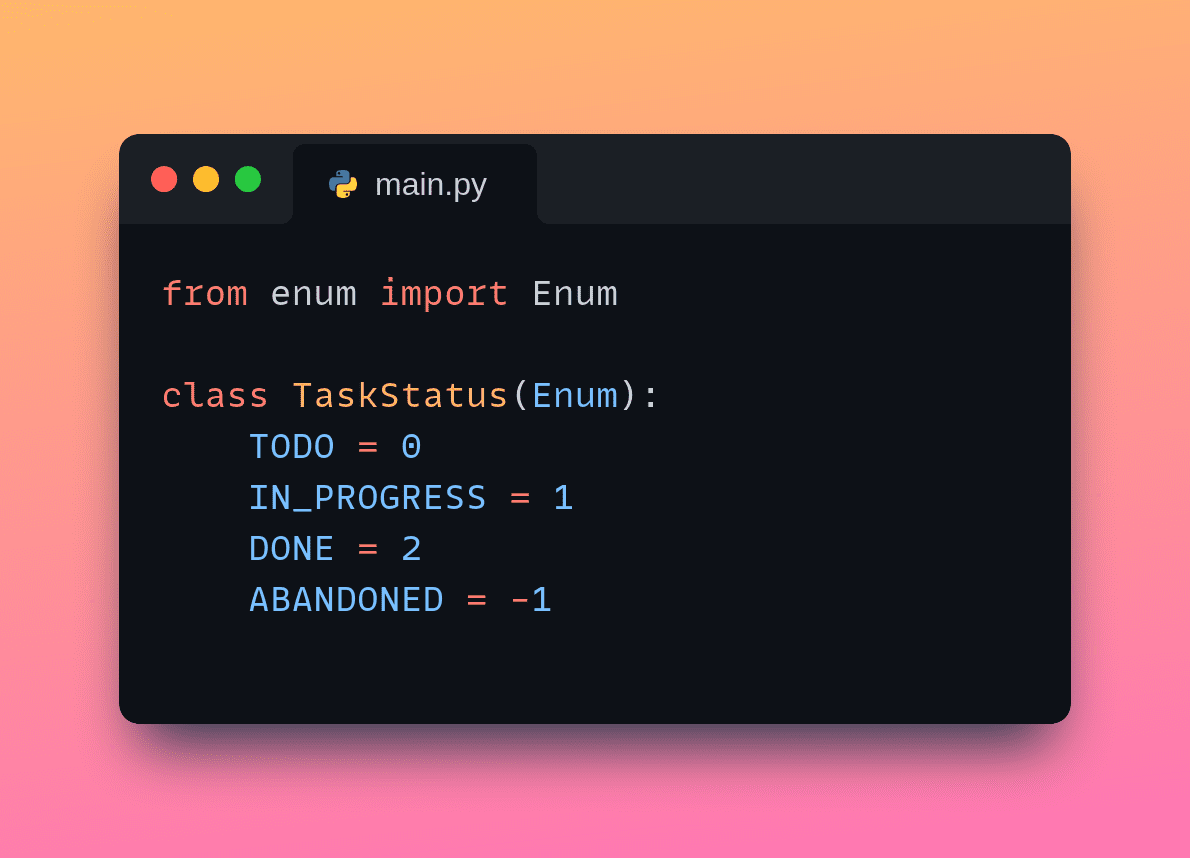
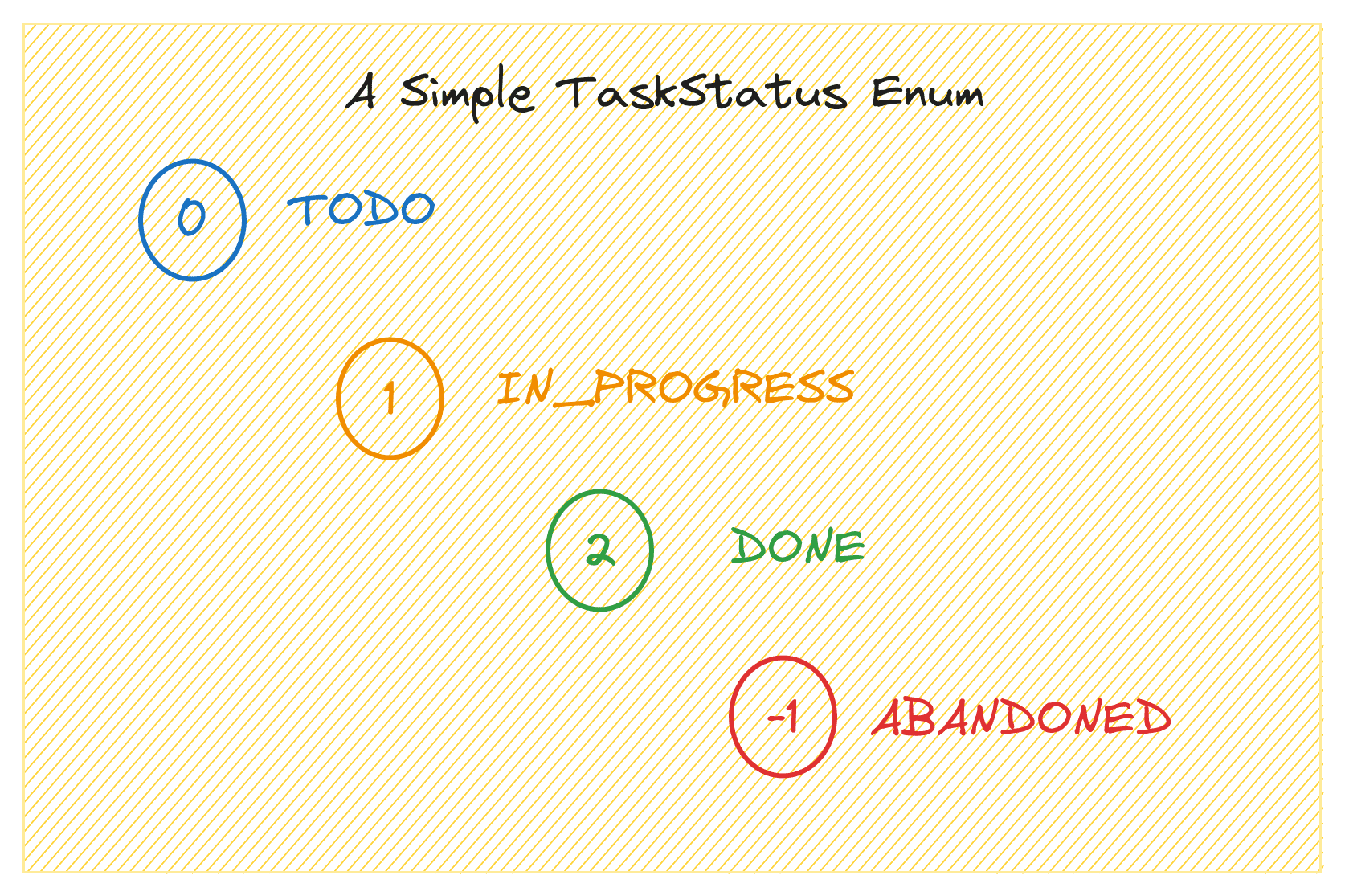
We’ll create a TaskStatus enum that takes the following four names and values:

Python Enum: How To Build Enumerations in Python
Image by Author

First, we import the Enum class from the enum module to create enums.

We then define a new class TaskStatus that inherits from Enum to create an enumeration. Each member is defined with a unique name and an optional value like so:

from enum import Enum  	   class TaskStatus(Enum):      TODO = 0      IN_PROGRESS = 1      DONE = 2      ABANDONED = -1

All enum members we create are instances of the Enum class. You may verify it by calling the isinstance() function as shown:

print(isinstance(TaskStatus.TODO,Enum))
Output >>> True

Let’s print out all the members in the TaskStatus enum by casting it into a list:

print(list(TaskStatus))

You should see the following output:

Output >>>    [<TaskStatus.TODO: 0>, <TaskStatus.IN_PROGRESS: 1>, <TaskStatus.DONE: 2>, <TaskStatus.ABANDONED: -1>]

All enum members have a name and a value. Meaning you can access enum members using their names, like TaskStatus.TODO. Or you access them by value, like TaskStatus(0).

Working with Python Enums

Now that we’ve created a simple TaskStatus enum, let's learn how to perform simple tasks such as iterating over the enum members.

Iterating Over Enums

In Python, you can work with enums pretty much the same way you work with any iterable. For example, you can use the len() function to count the number of enum members:

num_statuses = len(TaskStatus)  print(num_statuses)
Output >>> 4

You can also iterate over enums just the way you would over a Python iterable such as list. In the following for loop, we access both the name and value of each enum member and print them out:

for status in TaskStatus:      print(status.name, status.value)

Here’s the output:

Output >>>     TODO 0  IN_PROGRESS 1  DONE 2  ABANDONED -1

Ordering in Enums

In the example, the status and the corresponding numeric value are as follows:

  • TODO: 0
  • IN_PROGRESS: 1
  • DONE: 2
  • ABANDONED: -1

But you can also use the default ordering by using the auto() helper function. When you do so, if you have ‘n’ members in the enum, the values assigned are 1 through n. But you can pass in a start value, say k, auto(k) for the enumeration to start at k and go up to k + n.

Let’s modify the TaskStatus enum as shown:

from enum import Enum, auto    class TaskStatus(Enum):      TODO = auto()      IN_PROGRESS = auto()      DONE = auto()      ABANDONED = auto()

Now let’s print out the members:

print(list(TaskStatus))

We see that the values are 1 to 4 as expected:

Output >>>    [<TaskStatus.TODO: 1>, <TaskStatus.IN_PROGRESS: 2>, <TaskStatus.DONE: 3>, <TaskStatus.ABANDONED: 4>]

Building on the TaskStatus Enum – A More Helpful Example

Now let's build on the TaskStatus enum that we have. Create a task.py file in your working directory with the following version of the enum:

# task.py    from enum import Enum    class TaskState(Enum):      TODO = 0      IN_PROGRESS = 1      DONE = 2      ABANDONED = -1

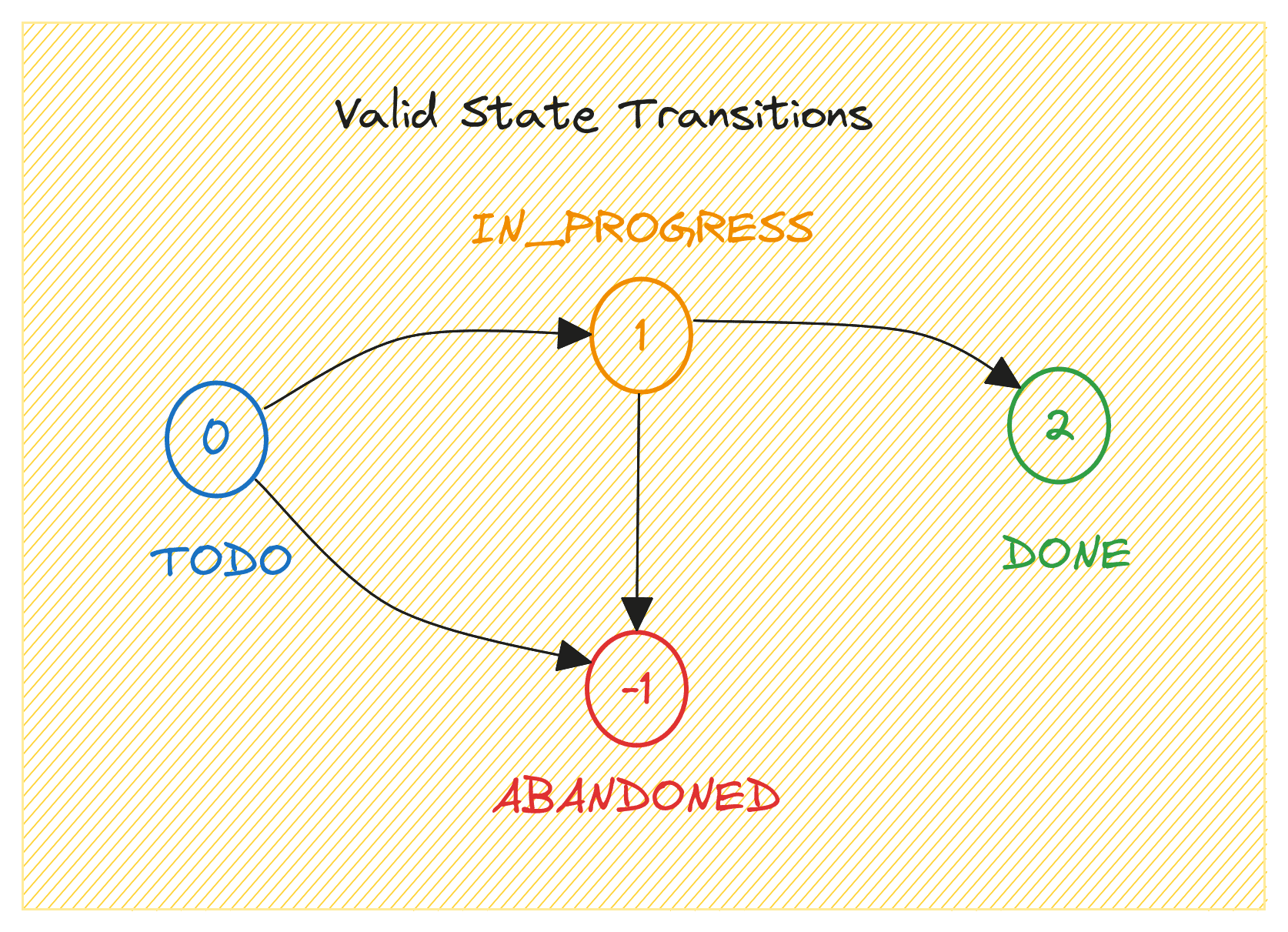
Say we have a task with a name and a current status. And the valid transitions between states are as shown:

Python Enum: How To Build Enumerations in Python
Image by Author

Let’s create a Task class:

class Task:      def __init__(self, name, state):          self.name = name          self.state = state            def update_state(self, new_state):          # Define valid state transitions based on the current state          valid_transitions = {          	TaskState.TODO: [TaskState.IN_PROGRESS, TaskState.ABANDONED],          	TaskState.IN_PROGRESS: [TaskState.DONE, TaskState.ABANDONED],          	TaskState.DONE: [],          	TaskState.ABANDONED: []      	}     	           # Check if the new state is a valid transition from the current state          if new_state in valid_transitions[self.state]:              self.state = new_state          else:              raise ValueError(f"Invalid state transition from {self.state.name} to {new_state.name}")

We have an update_status() method that checks if the transition to the new state is valid given the current status. For invalid transitions, a ValueError exception is raised.

Here’s an Instance of the Task class: the “Write Report” task with status TODO:

# Create a new task with the initial state "To Do"  task = Task("Write Report", TaskState.TODO)    # Print the task details  print(f"Task Name: {task.name}")  print(f"Current State: {task.state.name}")
Output >>>  Task Name: Write Report  Current State: TODO

Updating the status of the task to IN_PROGRESS should work as it’s a valid state transition:

# Update the task state to "In Progress"  task.update_state(TaskState.IN_PROGRESS)  print(f"Updated State: {task.state.name}")
Output >>> Updated State: IN_PROGRESS

And once the task is complete, we can update its status to DONE:

# Update the task state to "DONE"  task.update_state(TaskState.DONE)  print(f"Updated State: {task.state.name}")
Output >>> Updated State: DONE

But if you try to update the status to an invalid one, such as trying to update DONE to TODO, you’ll run into ValueError exception:

# Attempt to update the task state to an invalid state  task.update_state(TaskState.TODO)

Here’s the traceback of the ValueError raised because of invalid state transition from DONE to TODO:

Traceback (most recent call last):    File "/home/balapriya/enums/task.py", line 46, in   	task.update_state(TaskState.TODO)    File "/home/balapriya/enums/task.py", line 30, in update_state  	raise ValueError(f"Invalid state transition from {self.state.name} to {new_state.name}")  ValueError: Invalid state transition from DONE to TODO

Wrapping Up

In this tutorial, we learned how to build enumerations in Python by coding a simple TaskStatus enum. We learned how to access enum members and iterate over them.

Also, we learned how default ordering works if you choose to use the auto() helper function to set the values for enum members. We then tried using the TaskStatus enum in a more helpful example.

You can find the code examples on GitHub. I’ll see you all soon in another Python tutorial. Until then, happy coding!

Bala Priya C is a developer and technical writer from India. She likes working at the intersection of math, programming, data science, and content creation. Her areas of interest and expertise include DevOps, data science, and natural language processing. She enjoys reading, writing, coding, and coffee! Currently, she's working on learning and sharing her knowledge with the developer community by authoring tutorials, how-to guides, opinion pieces, and more.

More On This Topic

  • How To Build A Database Using Python
  • Build a Web Scraper with Python in 5 Minutes
  • It's alive! Build your first robots with Python and some cheap,…
  • Build a Text-to-Speech Converter with Python in 5 Minutes
  • How to Build Data Frameworks with Open Source Tools to Enhance…
  • Build a Serverless News Data Pipeline using ML on AWS Cloud

AI image classification errors could ruin your life. Here’s one way to reduce them

Hand touching abstract AI

Think about how quickly the internet became the key channel for a huge amount of human activity, from commerce to communication and onto collaboration, and you start to get some idea about the transformative role artificial intelligence (AI) will play in our lives during the next decade.

Just like the internet, AI and its core sub-types — machine learning, natural language processing, facial recognition, and deep learning — are predicted to transform human society by embedding themselves in virtually every facet of everyday life.

Also: 5 ways to prepare for the impact of generative AI on the IT profession

Even today, many IT systems and services already tout AI-enabled solutions to business problems. This ubiquity then begs the logical question, what happens if AI fails?

Concerningly, AI's 'hallucinations' — where the technology makes up answers to questions it doesn't know — are already commonplace.

We have also seen algorithms exhibit and amplify gender, racial, ethnic, and class biases that are already baked into society.

Also: Want to work in AI? How to pivot your career in 5 steps

These kinds of issues arise because much of the data that powers AI models is scraped from content on the internet, the majority of which has been produced by dominant power structures.

So, to ensure an AI algorithm is performing appropriately and not making embarrassing gaffes, the models that power emerging technology should be 'trained' with a set of data — and in the case below, images — that act as unbiased benchmarks.

Raising AI the right way

For example, California's early warning system has an image recognition algorithm connected to over a thousand cameras across the state. The model is trained to identify a puff of smoke from a cloud.

Gleich's Reeb graph translates unrecognizable embedded vectors from an algorithm's data set into colored dots, allowing errors of classification to be observed.

From tumors in your lungs to swerving cars on the highway, image recognition software that is schooled to find key indicators from the noise is being deployed in mission-critical, life-saving scenarios.

While the potential positive impact of these kinds of systems is significant, so is the risk from errant AIs. So, how do you ensure that AI image recognition systems don't help to destroy society as we know it?

Also: Six skills you need to become an AI prompt engineer

Having a sound 'training set' of images that provides good benchmarks is important. This training involves ensuring information on each pixel, and how it's tagged and classified under a category, is undertaken with impeccable precision.

This way, when the algorithm skitters around trying to figure out which category a particular image falls under, it can do so by referring to the information on images in the training set.

However, no matter how well-architected the training set, an algorithm will sometimes confront unfamiliar content and come to a juddering halt.

What's more, trying to find out where the impasse has happened in the data set is like trying to locate a needle in, not just a haystack, but an entire barn, given the potential for trillions of units of information that constitute data sets.

The good news is David Gleich, scientist and professor of computer science at Purdue University, and fellow scientists Tamal Dey and Meng Liu, have conjured up a novel solution to this intractable problem.

"The tool we've developed helps you find places where the network is saying, 'Hey, I need more information to do what you've asked,'" says Gleich. "I would advise people to use this tool on any high-stakes neural network decision scenarios or image prediction task."

What's under the hood?

When Gleich conducted his research, he encountered problems with his databases. The database confused X-rays, gene sequences, and apparel with other things.

He says that one neural net had a chronic habit of labeling a car as a cassette player simply because the photos were extracted from online sales listings that contained car stereo equipment.

The problem comes from how the algorithm slots an image in the right category, which hinges on generating a bunch of numbers called 'embedded vectors' that are churned out based on the information on the image.

The AI compares the embedded vectors in the 'training set' with those of other data set images. The image is slotted into a category with a high match probability.

Also: How do you get employees to embrace AI? (You may find this sneaky)

Unfortunately, the embedded vectors are often meaningless. So, when there's a mismatch or error, there's no way to dive into the unrecognizable layers of the algorithm and spot the offending error.

To overcome this hurdle, Gleich and his team employed an ingenious plan. They took a quick detour into the field of topography, which is essentially where technologies like Google Maps find their genesis.

They decided to map the relationship of the vectors on a Reeb graph, a 'compact shape descriptor', and a solution that has been used in shape analysis for 75 years.

The data set was then transformed into color-coded dots representing vectors belonging to one category or another. Closely clustered dots of the same color denoted the same category.

Dots of different colors that overlapped each other instantly denoted that something was awry and — most critically — where the problems could be found.

Also: How renaissance technologists are connecting the dots between AI and business

And just like that, the normally incomprehensible innards of an algorithm along with its problem spots were suddenly as clear as day.

"What we're doing is taking these complicated sets of information coming out of the network and giving people an 'in' into how the network sees the data at a macroscopic level," Gleich said.

"The Reeb map represents the important things — the big groups and how they relate to each other — and that makes it possible to see the errors."

Gleich and his colleagues have gone one step further, making their AI image classification tool available to the public. Code for the tool is available on GitHub, as are use case demonstrations.

Now, anyone has a shot at being able to see the relationships between images in an AI dataset, which the researchers call a "bird's eye view".

People can use the tool to dive down and locate the source of the problem, which is something that neural networks desperately need to function properly, prevent bias, and keep us safe.

Artificial Intelligence

Covariant is building ChatGPT for robots

Covariant is building ChatGPT for robots

The UC Berkeley spinout says its new AI platform can help robots think more like people

Brian Heater @bheater / 9 hours

Covariant this week announced the launch of RFM-1 (Robotics Foundation Model 1). Peter Chen, the cofounder and CEO of the U.C. Berkeley artificial intelligence spinout tells TechCrunch the platform, “is basically a large language model (LLM), but for robot language.”

RFM-1 is the result of, among other things, a massive trove of data collected from the deployment of Covariant’s Brain AI platform. With customer consent, the startup has been building the robot equivalent of an LLM database.

“The vision of RFM-1 is to power the billions of robots to come,” Chen says. “We at Covariant have already deployed lots of robots at warehouses with success. But that is not the limit of where we want to get to. We really want to power robots in manufacturing, food processing, recycling, agriculture, the service industry and even into people’s homes.”

The platform launches as more robotics firms are discussing the future of “general purpose” systems. The sudden onslaught of humanoid robotics firms like Agility, Figure, 1X and Apptronik has played a pivotal role in that conversation. The form factor is particularly suited to adaptability (much like the humans on which it’s modeled), though the robustness of on-board AI/software systems is another question entirely.

For now, Covariant’s software is largely deployed on industrial robotic arms doing a variety of familiar warehouse tasks, including jobs like bin picking. It isn’t currently deployed on humanoids, though the company is promising some level of hardware agnosticism.

“We do like a lot of the work that is happening in the more general purpose robot hardware space,” says Chen. “Coupling the intelligence inflection point with the hardware inflection point is where we will see even more explosion of robot applications. But a lot of those are not fully there yet, especially on the hardware side. It’s very hard to go beyond the stage video. How many people have interacted with a humanoid in person? That tells you the degree of maturity.”

Image Credits: Covariant

Covariant doesn’t, however, shy away from human comparisons when it comes to the role RFM-1 plays in robots’ decision making processes. Per its press material, the platform, “provides robots the human-like ability to reason, representing the first time Generative AI has successfully given commercial robots a deeper understanding of language and the physical world.”

This is one of those realms where we have to be careful with claims, both in terms of comparisons to abstract – or even philosophical – concepts and their actual real-world efficacy over time. “Human-like ability to reason” is a broad-sweeping concept that means a lot of different things to a lot of different people. Here the notion applies to the system’s ability to process real-world data and determine the best course of action to execute the task at hand.

This is a departure from traditional robotic systems that are a programmed to one job repeatedly, ad infinitum. Such single-purpose robots have thrived in highly structured environments, starting with automotive assembly lines. As long as there are minimal changes to the task at hand, a robot arm can do its work over and over again, unimpeded, until it’s time to call it a day and collect the golden pocket watch for its years of loyal service.

Thing can break down quickly, however, with even the smallest deviations. Say the object isn’t placed exactly right on the conveyor belt, or there’s been an adjustment to lighting that impacts on-board cameras. These sorts of differences can have a huge impact on the robot’s ability to execute. Now imagine trying to get that robot to work with a new part, new material or even do a wholly different task. That’s even harder.

This is the point where programmers traditionally step in. The robot must be reprogrammed. More often than not, someone from outside the factory floor enters the picture. This is a big drain of resources and time. If you want to avoid this, one of two things needs to happen. 1. People working on the floor need to learn code or 2. You need a new, more natural method for interacting with the robot.

While it would be great to do the former, it seems unlikely that companies will be willing to invest the money and wait the necessary time. The latter is precisely what Covariant is attempting to do with RFM-1. “ChatGPT for robots” isn’t a perfect analogy, but it’s a reasonable shorthand (especially in light of the founders’ connection to OpenAI).

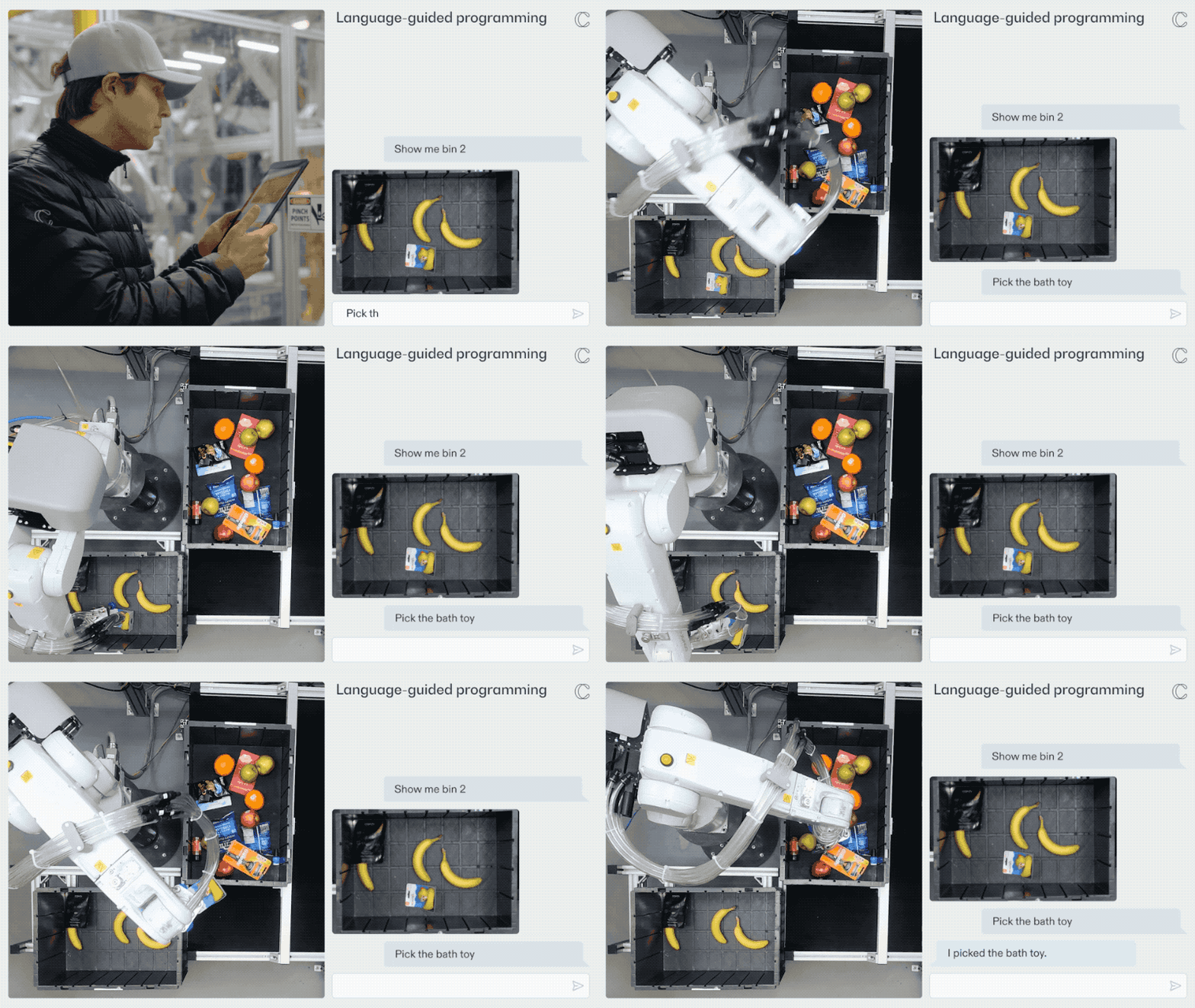
From the customer’s point of view, the platform presents as a text field, much like the current iteration of consumer-facing generative AI. Input a text command like, “pick up the apple” by typing or voice, and the system uses its training data (shape, color, size, etc) to identify the object in front of it that most closely matches that description.

RFM-1 then generates video outcomes – in essence simulations – to determine the best course of action using past training. This last bit is similar to how our brains work out the potential outcomes of an action prior to executing.

During a live demo, the system reacts to inputs like “pickup the red object” and even the more semantically complex, “pick up what you put on your feet before you put on your shoes,” which caused the robot to correctly pick up the apple and a pair of socks, respectively.

A lot of big ideas are tossed around when discussing the system’s promise. At very least, Covariant has an impressive pedigree among its founders. Chen studied AI at Berkeley under Pieter Abbeel, his Covariant cofounder and Chief Scientist. Abbeel also became an early OpenAI employee in 2016, a month after Chen joined the ChatGPT firm. Covariant was founded the following year.

Chen says the company expects the new RFM-1 platform will work with a “majority” of the hardware on which Covariant software is already deployed.

Missing NVIDIA GTC 2024 Would be a Foolish Sin

“In six weeks, I am going to tell everybody about a whole bunch of things we are working on – the next generation of AI,” said NVIDIA chief Jensen Huang, last month at the World Governments Summit 2024, referring to the upcoming GTC 2024, that will be held from March 17 to 21 at San Jose, California.

Showcasing AI Artwork and the Future of Work

The futuristic theme of NVIDIA GTC 2024 will touch upon the amalgamation of AI and art. Turkish-born, globally acclaimed media artist and pioneer in the aesthetics of machine learning, Refik Anadol, will display his art in a large generative AI installation called ‘Large Nature Model’. The art pioneer recently showcased his work at the World Economic Forum in Davos and even had it splattered across the Las Vegas Sphere.

Dear friends, we are excited to be at NVIDIA GTC this year! Our Large Nature model research and Living Archive installation will bring new perspectives to AI research! And we have a massive surprise 🙂 Stay tuned for Jensen Huang’s Keynote! pic.twitter.com/UXpbb3ctsV

— Refik Anadol (@refikanadol) February 28, 2024

A ‘Poster Gallery’ will showcase over 80 research posters across myriad topics focusing on how accelerated computing and AI are transforming the way they work. People will have the opportunity to chat with the authors of these posters.

The event will have close to 1,000 sessions, 300+ exhibits and 20+ technical workshops, with something for everybody. The sessions, led by prominent leaders, cater to 20 industries, including agriculture, aerospace, construction, gaming, retail, semiconductor telecommunications, robotics, and many more.

In addition to the compelling reasons mentioned above, which should have already convinced you to attend the conference, the opportunity to meet NVIDIA’s witty and highly active X user and ML engineer, Bojan Tunguz, should seal this deal for you.

Source: X

Riveting Sessions in the Pipeline

In his keynote, Huang will talk about how NVIDIA’s accelerated computing platform is driving the next wave in AI, cloud technologies and sustainable computing.

The CEO will also host a panel session on ‘Transforming AI’ with some of the emerging AI startup leaders, including Aidan Gomez, co-founder and CEO of Cohere; Ashish Vaswani, co-founder and CEO of Essential AI; Niki Parmar, co-founder of Essential AI; Llion Jones, co-founder and CTO of Sakana AI; Lukasz Kaiser, member of technical staff at OpenAI; and other authors of the paper ‘Attention Is All You Need’.

A must-attend session, indeed!

Another session on ‘Beyond RAG Basics’ by developer advocate engineers of NVIDIA, will discuss the various architectural techniques that can be used to improve the quality of responses by a RAG system. If you wish to know about how agents, copilots and assistants are built, then this cannot be missed at any cost.

The year 2024 is poised to be the one for robotics and NVIDIA’s varied sessions on the subject are sure to pique the interest of many. A session on ‘Using Omniverse to generate first-person experiential data for humanoid robots’ by Geordie Rose, co-founder and CEO of Sanctuary AI, will discuss how NVIDIA Omniverse can be used to create synthetic first-person experience for robots, and even talk about AGI.

There’s also something for people looking to learn about tools in the media and entertainment industry. ‘Lessons on Video Generation Models from Research to Production’, by Anastasis Germanidis,the CTO and co-founder of Runway, will talk about their Gen-1 and Gen-2 video generation models from research to production.

While this is just the tip of the iceberg, an elaborate schedule of all the NVIDIA GTC sessions can be found here. If attending GTC in person is the concern, fret not because all the GTC sessions are virtually available. Make sure to plan well ahead of time.

Wait, there is more…

At last year’s GPU Technology Conference (GTC), NVIDIA unveiled a series of new products, including their new DGX Cloud, inference platforms, systems for the Omniverse platform, AI foundations for building LLMs and more. With the staggering upward trajectory of NVIDIA ever since, it is only obvious that the company’s focus on AI will continue.

Here are some of the forecast launches for GTC 2024.

Next-gen GPUs: NVIDIA’s next-generation GPU, codenamed ‘Blackwell’, is one of the most highly anticipated launches for GTC 2024. B100 and GB200 Blackwell graphics processors for enterprise computing are expected to be released. The B100 GPU is said to almost double the performance of the Hopper H200.

NVIDIA RTX 5000 series, which is expected to be based on the new architecture, Blackwell, is a high-performance graphics card that is said to leverage the latest GDDR7 (Graphics Double Data Rate 7) memory.

Rumours suggest that it will mostly be ready before CES 2025, and a confirmation on this may come during GTC 2024.

GPUs for Mining: The cryptomarket has been heating up in anticipation of NVIDIA’s GTC 2024. Jules Urbach, co-founder and CEO of OTOY, a leading global cloud rendering company, will give his first live talk since pre-COVID at the upcoming event.

In a 2013 keynote speech with Huang, Urbach unveiled the first cloud GPU rendering pipeline. It is possible that dedicated GPUs for mining, similar to NVIDIA Cmp Hx, can be unveiled at GTC 2024, considering how OTOY has been closely associated with the crypto market.

Patryk Pusch, CEO and founder of Gamer Hash, a decentralised computing network, tweeted that a major partnership announcement will happen.

An Unconventional Collab: Samsung Electronics is expected to unveil its 12-layer High Bandwidth Memory 3E (HBM3E) at GTC 2024. HBM3E stacks are set to enhance NVIDIA’s H200 AI GPUs. It integrates 12 DRAM (dynamic random accessory memory) layers, with a density of 288 Gbit or 36 GB per stack.

Soon, everyone will be a gamer: NVIDIA is rumoured to be working on a PC gaming handheld device. With its rival AMD’s dominance in handheld gaming PCs, NVIDIA’s re-entry into this space will differ from previous attempts (such as the NVIDIA Shield Portable), as the new device will be powered by NVIDIA’s GPU. While there is no confirmed release date at this time, it would be delightful if it were mentioned at GTC 2024.

Talking about how everyone will be able to code in the future, Huang also believes that AI and NVIDIA will facilitate an ecosystem that will make everyone a gamer. “Someday, everybody’s going to be a gamer,” he said.

Focus on Sustainability: NVIDIA first announced its plans to build Earth-2 at the GTC 2022 conference. The goal of Earth-2 is to create a digital twin of Earth in Omniverse to predict and monitor climate change and develop strategies to mitigate and adapt to it. The platform has not been released yet, and improvements or modifications may be announced during the upcoming conference.

Focus on Science : NVIDIA has made significant progress on the life sciences domain with the NVIDIA BioNeMo framework. Furthermore, Huang had also remarked about the use of ChatGPT for using generative AI to solve ‘real-world problems’ such as dissolving plastics, reducing carbon emissions, and so much more. It is highly likely that new announcements in this domain will be made.

Robotics Thrives: Robotics is a key theme for the conference with a number of robotics innovators convening to discuss and showcase the use of AI for autonomous machines. Announcements around robotics for daily use will likely be made at the GTC.

Source: NVIDIA Blog

Quantum Madness: Foraying into quantum computing, NVIDIA released CUDA Quantum, a platform for integrating and programming quantum processing units (QPUs), GPUs and CPUs, last year. It is possible that this year’s GTC would see the release of more advanced versions of the quantum-enabling platform to take on the likes of IBM and Google that are making significant strides in the field.

Chipmaker King: NVIDIA had earlier announced its plans to build semiconductor fabrication plants to boost the AI ecosystem in Japan with the help of startups there. The company is also venturing into the custom AI chips market to take on its competitors. It wouldn’t be a surprise if any significant announcement on personalised chips were made during the GTC 2024.

With a futuristic vision, this year’s GTC is sure to not only push AI advancements but also bring AGI into the scene. Huang shared his views on AGI, predicting its achievement within five years under specific conditions (i.e. acing human-level competitive exams). It’s going to be quite exciting!

The post Missing NVIDIA GTC 2024 Would be a Foolish Sin appeared first on Analytics India Magazine.

How to use Copilot Pro AI to finetune your presentations in PowerPoint

copilot-pro

At $20 per month, Microsoft's Copilot Pro works with Microsoft 365 to bring AI-infused assistance to various apps in the suite, including PowerPoint. You can use Copilot's AI skills to create a new presentation, organize your presentation, summarize a presentation, and answer questions about the content of a presentation. Here's how the technology works.

First, you'll need a subscription to Microsoft 365 Personal or Family. Priced at $70 per year, the Personal edition is designed for one person using up to five devices. At $100 per year, the Family edition is aimed at up to six people on as many as five devices. The core apps in the suite include Word, Excel, PowerPoint, Outlook, and OneNote.

Also: How to use Copilot Pro to write, edit, and analyze your Word documents

Second, you'll need a subscription to Copilot Pro. To sign up, head to the Copilot Pro website. Click the Get Copilot Pro button. Confirm the subscription and the payment. The Pro version will take effect the next time you use Copilot on the website, in Windows, or with mobile apps.

How to use Copilot Pro AI for PowerPoint

More how-tos

SuperAGI snags funding from Jan Koum’s Newlands VC to fuel its full-stack AGI ambitions

SuperAGI snags funding from Jan Koum’s Newlands VC to fuel its full-stack AGI ambitions Jagmeet Singh 7 hours

SuperAGI wants to build a full-stack Artificial General Intelligence (AGI) platform based on Large Agentic Models (LAMs) — seen by some as the next stage in development for Large Language Models. Now, with its research picking up traction with some 20,000 developers — including people at Microsoft, Google, Tencent, Tesla and JP Morgan Chase and OpenAI — using the tools its already launched, it’s landed funding from a notable, under-the-radar investor.

Newlands VC, the secretive firm backed by WhatsApp founder Jan Koum, is leading a $10 million Series A for SuperAGI, funding it will use for further research, as well as middleware and software applications that it believes will bring AI closer to working in a wider range of use cases, more reliably.

“People have realized that ChatGPT and LLMs are great [when it comes to] the creation of the content. But when you actually have to take an action, that’s where most of the LLMs fail. So, that’s what we solved for with SuperAGI,” said co-founder and CEO Ishaan Bhola, in an interview. “There are a lot of these agentic frameworks coming on the market, but none of them really work to solve this problem.”

We also understand large companies that are already making headway in AI are also looking at investing in SuperAGI, although it’s holding off on taking strategic backers at this stage.

The money is coming at a funding crossroads for AI startups. Despite generative AI remaining a hot topic, investments in AI startups actually dropped in Q4, according to PitchBook.

Deal count dipped by 19% to 7,238 deals in 2023 from 8,968 deals in 2022. Similarly, the dollar value in AI funding announcements declined to $90.9 billion in 2023 from $96.6 billion in 2022 (2022, to be clear, was an outsized year led by monster rounds for behemoths like OpenAI). Nonetheless, big tech companies including Microsoft and Google parent Alphabet have continued to invest in AI startups to expand their skin in the game. PitchBook recorded investments worth $22.3 billion in AI startups worldwide in Q4.

Very little is known about Newlands VC — this profile in Forbes from November 2023 is really the first light that was really focused on the firm, which is run by ex-Sequoia partner Michael Abramson out of Dallas, Texas. It had been mentioned before that as an investor in enterprise startups in 2023 at least once or twice.

TechCrunch understands that while Newlands has amassed some very sizeable holdings in large public tech companies alongside those enterprise investments, it has also been actively evaluating AI startups. SuperAGI appears to be the fund’s first investment to come out of that.

While AI has been around for many years now, the breakout success of generative AI tools like ChatGPT and Midjourney has catapulted AI technology into public consciousness.

But as many have discovered, LLMs are far from perfect — they can produce inaccurate results for one thing — and so that has led researchers and engineers to find routes for improving this in the ongoing quest for AGI.

While OpenAI, Anthropic and Google are among the wave of larger (and very well-funded) tech companies chasing that windmill, SuperAGI is among the smaller but equally ambitious players hoping to be a part of the race, carving out a unique

The Palo Alto-headquartered startup, which also has a presence in India’s Bengaluru, started its journey in early 2023 by focusing on agentic research and building autonomous agents.

However, as GenAI continued to evolve, the startup turned its attention to agents. Its first product, which is for marketing use cases, is called Contlo and works as an all-in-one campaign and automation tool to let businesses manage all their primary marketing operations using a single solution, which can not only run campaigns over email, SMS or instant messaging apps but also offers personalized customer follow-ups and analytics.

Contlo was initially designed for Indian D2C brands and Shopify customers; but since launch it’s gained traction with over 1,000 new and established brands globally, the startup said.

SuperAGI’s newest app is called Verk, which sounds a little like “work” and that’s what it’s aiming to address. The pitch is that Verk is an AI employee that can work as sales representatives, graphic designers, market researchers, or social media managers (interestingly, this is also the focus of Ema, another AI startup with Indian roots that also recently raised money). Employers can access AI employees using their existing platforms, such as via Slack or the web or iOS or Android devices on the go, without worrying about attrition and onboarding.

Bhola told TechCrunch the startup had initially explored most of the available agentic frameworks but found none of them worked to solve the problem. It later decided to get deeper into the research work and find answers to questions, such as how we use agents to do helpful work like run software or do sales or marketing actions. The startup eventually started creating LAMs in-house to use AI for specific actions.

Bhola co-founded SuperAGI with Mukunda NS after both worked at Sachin Bansal’s fintech startup Navi.

After researching and building its LAMs, SuperAGI open-sourced its infrastructure, including the LAMs, autonomous agents framework and training datasets, to let companies build agentic systems based on their requirements.

Open-sourcing the infrastructure helped the startup gain attention from market giants, including Microsoft, Google, Tencent, Tesla and JP Morgan Chase, as well as AI companies, including OpenAI. The startup’s framework and research have been used to build different apps and has a community of over 20,000 members.

Last year, SuperAGI released SAM-7B as its small agentic model for the open-source community, which it claims to have outperformed larger models, including Microsoft’s Orca-2 (17B) and OpenAI’s GPT-3.5 (175B) on reasoning benchmarks, including ARC-C and GSM8k. SAM-7B was trained on a 97% smaller dataset, yet it surpassed Orca-13B on GSM8k, the startup said. The reason for this achievement, Bhola said, was the different architecture and data training process that SuperAGI has.

SuperAGI also introduced VEagle as its open-source vision model in January this year. It exceeded open-source models, such as Bilva and Llava, on various vision benchmarks. VEagle improves textual understanding and interpretation of images and can take actions on a particular software identical to a human. For instance, the vision model can be used to set up a Google meeting without requiring a user to go through the process or by integrating an API. The model identifies how it needs to work with the user interface using an open-source OCR model YOLO.

“The parameters and more computing capacity that I add are equivalent to intelligence turning out not to be the case,” he said. “We strongly believe that the current LLM architectures are just the beginning, very similar to how when the internet came out, everybody thought this would be the single business model.”

Agentic models usually rely on third-party APIs to perform actions. However, Bhola noted the challenge of working with APIs is that it restricts capabilities the model could do independently. In some cases, the software may limit the agent’s access once the agent starts progressing. VEagle helps in such cases as it circumvents the use of APIs and makes the automation even more robotic.

“We are currently integrating with some other APIs. But at the same time, we are also solving the problem [of software restricting API access] using our vision model,” Bhola added.

SuperAGI generates monetization through its app, while it contributes to the open-source community and offers its infrastructure to a broader audience, including big tech and AI companies. For instance, it works with AutoGPT, Microsoft and OpenAI to create standards for agents and establish new agent benchmarks.

This approach, Bhola said, would eventually help SuperAGI solve AGI and do it in a very full-stack way.

“Whey, we call ourselves full-stack because we have a very core research engine, but we don’t monetize. We have the infrastructure with SuperAGI agents, which is like a middleware, but we monetize the application layer,” he said.

SuperAGI also works with different companies to build apps for their businesses on top of its agentic framework. Currently, over 150 apps are available through this model. These apps work as software agents, cater to various sectors, and address areas, including QA testing and autonomous drone mapping.

However, since SuperAGI has open-sourced its LAM infrastructure and framework, the startup’s agentic technologies could be used in several more applications.

Companies such as Rabbit and T-Mobile recently showed us how LAMs can be useful and are a part of the AI future. However, that could just be the tip of the iceberg.

“Unless AI is able to do real action, it is of no use,” said Bhola. “LLMs will be one of the first primitives, and this abstraction of LAMs will essentially next year and this year will take over the LLMs, and that’s exactly what we’re solving.”

So far, SuperAGI has attracted “north of 1,000+” paid customers across Contlo and Verk apps. The startup looks to expand that number quickly by introducing a marketplace called Verk Store to hire AI employees. It has already started working with EY to build an AI audit employee for small and medium enterprises and lower-mid market companies.

Eventually, SuperAGI wants to be one of the top three AI research companies globally in 2024, Bhola told TechCrunch. The startup intends to remain committed to open-sourcing its developments while using apps to generate revenues.

“Our research, our frameworks, our models will always be open-source versus some of the other companies, which started with the open-source model but gradually became fully closed-source,” the co-founder said.

The all-equity Series A round, which brought SuperAGI’s total funds raised to about $15 million and valued the startup at “sub-$100 million,” also attracted investments from top AI researchers and operators from companies including Meta and Apple. It also saw participation from the startup’s existing investor, Kae Capital.

10 Underrated Women in AI to Watchout For

Recent data shows that women hold approximately 26.7% of technology-related jobs. Despite the critical role technology and artificial intelligence play in shaping our future, the presence of women in these fields, especially in leadership positions, remains abysmally low.

However, despite these challenges, (the few) women in AI are pioneering change, breaking barriers, and paving the way for future generations. Their work not only contributes to technological advancement but also ensures that the development and application of AI is inclusive, equitable, and representative of the diverse society it serves.

While the media constantly covers the tech elites, here is a list of 10 underrated women whose works range from spreading awareness about AI to building them and ensuring its ethical use.

Aishwarya Srinivasan

Aishwarya Srinivasan currently works as a senior AI advocate within the Microsoft for Startups group at Microsoft, supporting startups in developing machine learning solutions. She recently became an angel investor with Hustle Fund and DynamoFL, after founding Illuminate AI, a nonprofit dedicated to mentoring in AI, in March 2021.

Prior to joining Microsoft, she was a data scientist at Google Cloud and an AI & ML innovation leader at IBM Data & AI.

Aishwarya has a postgraduate degree in data science from Columbia University. She has global work experience having engaged with clients and led projects in London, Dubai, Istanbul, and India. She holds a patent awarded in 2018 for developing a reinforcement learning model for machine trading.

Tulsee Doshi

Tulsee Doshi leads Google’s Responsible AI & Human-Centred Technology Organisation. Her work focuses on incorporating ethical considerations into product development and policy, specifically aimed at creating equitable and transparent user experiences. At Google, Doshi manages a team dedicated to improving fairness, safety, and inclusivity across products.

Prior to her current positions, Doshi taught a product leadership course at Product School and led projects at YouTube to enhance inclusive machine learning and creator diversity. She started at Google as an associate product manager, focusing on making Search features more relevant worldwide.

Doshi holds a bachelor’s degree in symbolic systems and a master of science in artificial intelligence from Stanford University. At Stanford’s HCI Lab, she was involved in research on crowdsourcing and expert collaboration technologies, earning a Best Paper Award at UIST 2014.

Ritu Raman

Ritu Raman is the d’Arbeloff assistant professor of mechanical engineering at MIT, where she leads a lab focused on developing adaptive living materials, with current projects centred on engineering biological actuators. This research aims to enhance machine functionality and restore mobility in humans. Raman’s work involves integrating living muscular and neural tissues to create actuators that autonomously adjust to environmental changes.

Her academic background includes a bachelor’s in mechanical engineering with a minor in biomedical engineering from Cornell University, followed by an MS and PhD in mechanical engineering from the University of Illinois at Urbana-Champaign.

Isabelle Guyon

Isabelle Guyon is a director and research scientist at Google, on leave from her role as a professor of artificial intelligence at Université Paris-Saclay (Orsay), specialising in data-centric AI, statistical data analysis, pattern recognition, and machine learning.

Before her current position at Google, Guyon worked as an independent consultant and a researcher at AT&T Bell Laboratories. There, she made significant advancements in neural networks for pen computer interfaces, collaborating with Yann LeCun and Yoshua Bengio. She is the primary inventor of SVM-RFE, a variable selection technique based on SVM, widely cited and used as a benchmark for new feature selection methods.

Guyon holds a PhD degree in physical sciences from the University Pierre and Marie Curie, Paris.

Olga Russakovsky

Olga Russakovsky, Ukrainian-American, completed her PhD in computer vision at Stanford University in 2015, working closely with Fei-Fei Li. Together, they developed ImageNet, a comprehensive image database pivotal for advancements in computer vision. Her research focused on reducing image classification’s dependency on human annotators and addressing human bias in algorithm development.

Following her PhD, Russakovsky continued her research as a postdoctoral fellow at Carnegie Mellon University and is now an associate professor at Princeton University. Her work emphasises the importance of algorithmic fairness in visual recognition systems and has proposed computational solutions to mitigate historical and societal biases.

Additionally, her significant contributions to the field include leading the Imagenet Large Scale Visual Recognition Challenge, with the founding paper cited over 13,000 times.

Devi Parikh

Devi Parikh, who is the senior director of generative AI at Meta, worked on developing Make-A-Video 3D in 2023 and Make-A-Video in 2022 that propelled the text-to-video generation. In the same year, she introduced AudioGen, a novel text-to-audio generation tool, and Make-A-Scene, which allows for more creative control in AI-generated images.

These contributions follow her earlier endeavours to humanise AI research, evident in her 2020 projects ‘Humans of AI: Stories, Not Stats’ and ‘AI Paygrades’, aimed at demystifying the AI research community and promoting transparency in AI industry hiring practices, respectively.

Aude Oliva

Aude Oliva serves as the director in the MIT-IBM Watson AI Lab and director of strategic industry engagement in the MIT Schwarzman College of Computing. Her latest research uses deep learning to enable computers to recognize locations within images based on their composite features, such as identifying a bedroom from the presence of a bed, window, and posters, or a kitchen from a stove, tile, and countertop.

Oliva’s significant contributions include her work on hybrid images. This work supports applications in information privacy, time-lapses, marketing, and brainteasers. Additionally, she explores the psychological perception of images, focusing on memorability, content, and the human visual system’s limitations.

Daphne Koller

Daphne Koller, an Israeli-American computer scientist, co-founded Coursera in 2012. Before Coursera, she worked on probabilistic models with applications in various domains, including computer vision and computational biology. Koller was a Stanford University professor and received the ACM-Infosys Foundation Award in Computing Sciences in 2008, the first recipient of this $150,000 award.

She became a MacArthur Fellow in 2004, recognized for her innovative work in AI. After Stanford, she pursued postdoctoral research at UC Berkeley. Koller has been honoured by being elected to the National Academy of Engineering in 2011, the American Academy of Arts and Sciences in 2014, and the National Academy of Sciences in 2023.

In recent years, Koller left Coursera to focus on new ventures in biotech, founding Insitro in 2018, a drug discovery startup leveraging machine learning and genomics. In 2020, she co-founded Engageli, offering an innovative online learning platform.

Cynthia Rudin

Cynthia Diane Rudin is a professor at Duke University, where she directs the Interpretable Machine Learning Lab. In 2022, she was honoured with the Squirrel AI Award for her contributions to transparent AI systems in critical domains. She also received the Guggenheim Fellowship in the same year and was elected a Fellow of the Association for the Advancement of Artificial Intelligence.

Her research includes developing the Series Finder algorithm for crime series detection and scoring systems for medical diagnosis. Before her tenure at Duke, Rudin was a faculty member at the MIT Sloan School of Management and held research positions at New York University and Columbia University.
She completed her PhD in applied and computational mathematics at Princeton University in 2004 and has been recognised as one of the most impressive professors at MIT by Business Insider in 2015.

Daniela L Rus

Daniela L Rus is the director of the MIT Computer Science and Artificial Intelligence Laboratory (CSAIL) and holds the Andrew and Erna Viterbi Professorship in the Department of Electrical Engineering and Computer Science at MIT.

Rus’s contributions address challenges in machine learning such as data quality, bias, and adaptability of systems, alongside innovations in robotics like soft robotics, modular robots, and autonomous vehicle algorithms. She has developed technologies to assist the physically disabled.

Rus was born in Romania and moved to the United States, earning her bachelor’s degree at the University of Iowa and her PhD at Cornell University. She started her academic career at Dartmouth College before moving to MIT in 2004.

The post 10 Underrated Women in AI to Watchout For appeared first on Analytics India Magazine.

4 Certifications to Become Job-Ready in 30 Days

4 Certifications to Become Job-Ready in 30 Days
Image by Author

Are you on a new journey to start a new career in the data world?

If yes, continue reading this blog. When people are making a transition into a new career, they are often confused about which route to go down. My advice would be to go down the route that will provide you with all the knowledge and skills you need to be job-ready.

Yes, you can get the same outcomes with a university degree or master's, but what if you could do it quicker with a certification?

Certifications that are approved and recognized by industry experts.

Data Analyst Certification

Link: Data Analyst Certification

Rated #1 data analytics certification by Forbes!

If you are looking to become a data analyst, you can get certified in 30 days with this certification. With this certification, you will showcase your knowledge and skills on how you approach business critical questions and provide information to stakeholders.

You will have 30 days to complete this certification, where you will have timed exam(s) and a practical example. To be able to gain this certification, you should be able to:

  • Perform standard data extraction, joining and aggregation tasks.
  • Assess data quality and perform validation tasks.
  • Perform standard cleaning tasks to prepare data for analysis.
  • Calculate metrics to effectively report characteristics of data and relationships between features.

Your timed exam will cover data management, exploratory analysis, and statistical experimentation. The practical exam will cover data management, exploratory analysis and communication.

Data Scientist Certification

Link: Data Scientist Certification

Data Analysts and Data Scientists are similar in certain roles and responsibilities, but they also have their differentiations. If you are looking to become a Data Scientist, this certification will get you the job you want.

In this certification, you will have two timed exams which you can complete in 2 hours and have two attempts at, following a practical exam, which you will need to complete in 30 days. To be successful in this certification, you will need to be able to:

  • Demonstrate that you can collect, analyze and interpret large amounts of data using machine learning and AI.
  • Effectively communicate the results of your analysis to business stakeholders.

Data Engineer Certification

Link: Data Engineer Certification

The demand for Data Engineers is increasing by the day, as companies large and small need people who can manage and make sense of data more than ever.

This is another certification that can be completed in 30 days! You will have two timed exams which you can complete in 2 hours and have two attempts at, following a practical exam. In this practical exam, you will have four hours and two attempts where it will be automatically graded, letting you know your results instantly.

To be successful in this certification, you will need to be able to:

  • Collect and pre-process large amounts of data.
  • Demonstrate that you can get data into a format that is suitable for data users across an organization.

SQL Associate Certification

Link: SQL Associate Certification

Similar to Data Engineers, SQL associates are also highly in demand for their skills of being able to process, assess, and analyze big data.

A certification that needs to be completed in 30 days, consists of one timed exam (SQ101) and one practical exam (SQ501P). For the timed exam, you will have two hours to complete the exam and can attempt it again. For the practical exam, you will have four hours and two attempts.

To be successful in this certification, you will need to be able to:

  • Demonstrate that you are capable of using SQL to extract appropriate data from a database
  • And then use it to answer common data questions.

Wrapping it up

Gaining a certification from an industry-recognised platform enhances your professional credibility and expands your career opportunities. These 4 certifications were built by industry leaders based on the latest market demands.

Once you have got your certification, you will be able to get access to DataCamp's exclusive certification community where you will connect with other professionals and explore content that has been specifically curated for the community.

Nisha Arya is a Data Scientist and Freelance Technical Writer. She is particularly interested in providing Data Science career advice or tutorials and theory based knowledge around Data Science. She also wishes to explore the different ways Artificial Intelligence is/can benefit the longevity of human life. A keen learner, seeking to broaden her tech knowledge and writing skills, whilst helping guide others.

More On This Topic

  • Become an Analytics Engineer in 90 Days
  • I Created An AI App In 3 Days
  • In-demand SAS Certifications for Your Success
  • Popular Certifications to validate your data and analytics skills
  • How to Get Practical Data Science Experience to be Career-Ready
  • Data-Centric AI: Is it Real? For Everyone? Are We Ready?