Limewire, a name synonymous with the early 2000s digital music revolution, began its journey as a peer-to-peer (P2P) file-sharing program. Founded in 2000 by Mark Gorton, Limewire quickly rose to prominence by allowing users to share and download music files, videos, and other digital content directly from their computers without the need for a central server. Built on the Gnutella network, it distinguished itself with a user-friendly interface and a decentralized network that empowered users to connect with each other directly.
During its peak, Limewire became one of the most popular file-sharing applications, tapping into the burgeoning demand for digital music and media. However, its very nature, which facilitated easy sharing of copyrighted material, eventually led to legal challenges. The Recording Industry Association of America (RIAA) and other entities targeted Limewire for enabling copyright infringement on a massive scale. These legal battles culminated in a 2010 court order that shut down the service, marking the end of Limewire's operations as a file-sharing platform.
Flash forward to 2024, and Limewire is now focused on transforming the AI industry by focusing on generative AI tools, and has recently unveiled their AI Image, Video & Music Generation REST APIs.
AI Image, Video & Music Generation REST APIs
LimeWire, historically recognized for its role in file-sharing, has made a remarkable transition into the realm of AI innovation. With the introduction of LimeWire AI Studio, it unveils a comprehensive suite of REST APIs dedicated to generative AI, heralding a new era in its rich history. This strategic move equips developers, enthusiasts, and businesses with state-of-the-art tools for creating AI-generated images, with the exciting promise of extending these capabilities to video and music generation soon.
Offering 300 free monthly API credits, LimeWire AI Studio aims to democratize access to advanced AI technology, making it effortlessly accessible with just a free API key. This initiative reflects LimeWire's commitment to fostering creativity and innovation, providing users with more than ten generative AI models including DALL·E, Stable Diffusion, and Google AI's Imagen. This diversity in models addresses a broad spectrum of creative requirements, from simple image enhancements to complex artistic creations.
LimeWire's focus extends beyond just providing free credits; it stresses the importance of scalability and easy integration. The APIs are built to be highly adaptable, supporting any programming language and ensuring quick setup, thus catering to projects of varying complexities. Currently specializing in image-related tasks such as generation, upscaling, inpainting, and outpainting, LimeWire is gearing up to revolutionize how we create and interact with digital media by soon introducing video and music generation capabilities. This expansion signifies LimeWire's aspiration to be at the cutting edge of digital content creation, seamlessly blending AI technology into the fabric of creative work.
Tools that are offered
The LimeWire AI Studio offers a comprehensive suite of tools designed to revolutionize the way we interact with digital media. Here's a breakdown of the key features available through their generative AI REST APIs:
Text to Image Generation – This powerful tool allows users to generate high-quality images from textual descriptions. By simply inputting a text prompt, users can bring their visions to life, creating anything from fantastical landscapes to detailed objects, all powered by AI's understanding of language and imagery.
Image to Image Generation – Building on the concept of generative AI, this API takes an existing image and transforms it based on user specifications. It enables a form of creative dialogue between the user and the AI, where the initial image serves as inspiration for generating new, altered images that maintain a thematic or stylistic connection to the original.
Background Removal – A highly practical tool, the Background Removal API automatically detects and removes backgrounds from images. This is particularly useful for creating clean, focused visuals for product listings, profile pictures, or any scenario where the subject of the photo needs to stand out without background distractions.
Image Upscaling – This API addresses a common challenge in digital imagery: low resolution and lack of sharpness. By improving the quality of images, the Image Upscaling API enhances clarity and detail, making images suitable for high-resolution displays and professional applications without the need for manual editing.
Image Inpainting – Whether it's restoring old photographs or correcting imperfections, the Image Inpainting API uses AI to reconstruct damaged or missing parts of images. It intelligently fills in gaps with contextually appropriate content, making it an invaluable tool for photo restoration and editing.
Image Outpainting – Expanding the boundaries of creativity, the Image Outpainting API enables users to extend their images beyond their original frames. By generating new pixels around the existing image, it allows for the creation of larger, more comprehensive scenes, adding backgrounds, or extending landscapes and horizons.
Each of these APIs democratizes access to advanced AI capabilities, making it possible for anyone to explore the boundaries of creative expression and digital enhancement. LimeWire also has plans to launch video generation and audio generation in the future.
Summary
LimeWire's evolution from a popular file-sharing platform to a generative AI company marks a significant pivot in its journey. Once known for its peer-to-peer music sharing, LimeWire has reinvented itself to harness the potential of artificial intelligence, now offering a wide range of Image Generation REST APIs. This shift not only underscores LimeWire's adaptability but also its commitment to innovation.
While it currently focuses on image generation, with plans to expand into music and video generation, LimeWire is poised to provide developers and creators with powerful tools for AI-driven content creation. The availability of 300 free monthly API credits makes it accessible to a wide range of users. High volume websites and large enterprises can pay for as many API calls as they need to scale their services. Despite its past controversies, LimeWire's move towards AI represents a forward-thinking approach, aiming to democratize access to generative AI technologies. Users who are interested to learn more should visit LimeWire Developer.
It is the International Brain Awareness Week for 2024, with events across institutes, globally, from March 11 – 17.
This week is a good time to explore the pedestal of the brain, against the astounding rise of machines. AI embodiment was recently featured in Scientific American, AI Chatbot Brains Are Going Inside Robot Bodies. What Could Possibly Go Wrong?
Large language models have made it obvious that the digital world is far more manipulable than the physical world. Editing anything [text, images, videos, and audio] over digital is easier than adjusting things physically, giving digital another advantage aside from its excellent memory. Generally, artificial memory is available in books, walls, sculptures, objects, and so forth, but their physical state is a disadvantage for snappy editing.
This ease, in part, made LLMs become the first non-living thing to have a semblance of intelligence, in the domain of organisms. Though robots have been around for decades and can do regimented tasks, they operate in the physical world, where manipulation is complex and senses—of the organism—have reached for navigation then avoidance, because of extensive sources of inputs.
Any living cell in its environment relates with the external to an intelligent range, with a memory that ensures it avoids irreversible damage. Any organism in its habitat has multiple senses, processed in a manner that seems like it is more than just that one, to ensure that it is aware and makes quick decisions, for prey, against predators, and for other purposes.
Simply, multiple sensory sources make surviving and thriving in the physical world better. While digital sources can detect smoke, capture events, and sounds, and allow for touch—with screens and others, they do so as unitary—digital, missing out anything else that cannot be subsumed into that form [taste, smell] and missing out on what they were not trained on.
By contrast, the human memory can make various sensory detections including balance, jumping, or sliding, and recognize digitally or physically across sensory modes. The memory can navigate new environments because of familiarity, provisioned—conceptually—by collecting common elements of things together while keeping separate what is unique. This makes relays within the collected information—or intelligence, hyper-sophisticated.
Also, the human mind, conceptually, is always distributing, across memory, emotions, and feeling, to ensure that what is good, including socially, is detected early and preserved, since aspects of the physical world are dangerous and would not simply change.
What makes the human brain special?
Other ways to frame this question include: how does the human brain organize and distribute information that makes humans superior to others? What makes the brain energy efficient? Why does the brain learn faster than LLMs? Why does the brain process much more than LLMs?
Conceptually, the mind is the basis of all the information functions of the brain. The mind is the collection of all the electrical and chemical impulses of nerve cells, with their features and interactions, in sets, in the central and peripheral nervous systems.
The interactions of the impulses can be described as the function. The features can be described as qualifiers, modifiers, stipulators or characterizers. These qualifiers as a category is consciousness, the super qualifier. Functions of the brain are graded by qualifiers in every instant, saving energy. It is by the mind that humans bear superiority. Whatever is wrong with the brain has to affect the mind, to affect the individual.
Interactions of electrical and chemical impulses in sets do so into a configuration or formation. It is this configuration that the mind uses to organize information. Simply, chemical impulses, in sets, often have respective rations that represent a function. The striking of electrical impulses on chemical impulses, in sets, results in a brief fusion or meshing, which allows for the formation of the chemical impulses, in that set, to be accessed, leading to the function.
Qualifiers are obtained within each set of impulses, with spaces between sources of the rations as well as side-to-side shifts to vary the concentration of rations. Qualifiers include attention, awareness [or peripheral vision], self or subjective experience, free will, control or intent, non-intent, and so forth are obtained. Qualifiers also include distillation, sequences, thick sets of impulses, thin sets, splits, and a principal spot.
This, conceptually, is how the human mind works.
Would robots or LLMs match the brain?
Some people say LLMs do not have a world model, a mental model or an observation of the world. The problem is that much of what is rewarding in this advanced world is not simply how to wash dishes or how to set the room. Education is offered on valuable knowledge, with a lot of it, possible for dissemination over digital. That knowledge, within the reach of LLMs, and as they get better, gives them an advantage in that domain, like an aquatic organism has, or an arboreal one. Also, the world has converged on digital, providing as much as it can take—there, giving LLMs a boost.
Robots have functions. Some functions of robots have qualifiers that are parallel to those of the human mind. The functions of robots are at least qualified in ways that are different from a table, or even a human-driven automobile. But no robot has a thalamus.
The human brain has clusters of neurons across centers. These clusters are postulated to have sets of impulses. The thalamus has several clusters of neurons, responsible for integrating information. It is theorized that sets of impulses in the thalamus structure, then initially qualify incoming streams of inputs, placing whether they are in attention, awareness, and to what extent they may be subjective or how intent or non-intent might decide. Then distribution is made, before the finalization of functions and modifications in other sets.
This relay [sets of impulses] ensures that the mind can collect so much, and use some, even without registration [by some qualifiers]. This is unlikely for robots in the physical world, aside from what happens in the final destinations—the cortex, hippocampus, amygdala, and others—for inputs.
Emotions are probably more important to pursue than a model of the world, for LLMs and robots. Self-driving cars cannot anticipate that they will get hurt if they crumple, which should ensure that they avoid errors. LLMs cannot know how much deepfakes would hurt people, so they output as prompted. Computer vision cannot crackle, as an emotion, when filming injustice. When a smartphone falls, which may cause the screen to break, the smartphone, with digital intelligence, does not prospect for a safe landing.
Even neurotechnology, for now, does not guarantee that the codes of impulses [or the configuration for some functions] can be copied and replicated elsewhere. LLMs and robots already have a couple of parallel qualifiers, but the human brain may remain unparalleled.
Google is joining collaborative efforts to build large language models (LLMs) that better cater to Southeast Asia's population and cultural mix.
Its research arm will work with AI Singapore to enhance datasets used to train, finetune, and assess AI models in languages specific to the region. Called Project Southeast Asian Languages in One Network Data (SEALD), the initiative aims to "improve cultural context awareness" in LLMs built for the region, said AI Singapore in a statement Monday.
Also: Five ways to use AI responsibly
The government agency added that the collaboration will focus first on Indonesian, Thai, Tamil, Filipino, and Burmese, with the two partners developing translocalization and translation models jointly. They also will develop tools to help scale translocalization capabilities and best practices for tuning datasets. Pre-training guides will be published for Southeast Asian languages.
All datasets and output from Project SEALD will be released in open source, AI Singapore added.
The initiative will further support training efforts for models under SEA-LION (Southeast Asian Languages in One Network), which the Singapore government agency launched last year.
Consisting of open-source LLMs pre-trained for the region's societal nuances, the current iteration of SEA-LION runs on two base models: a three-billion parameter model and a seven-billion parameter model. Its training data comprises 981 billion language tokens. AI Singapore defines these tokens as fragments of words created from breaking down text during tokenization. These fragments include 623 billion English tokens, 128 billion Southeast Asia tokens, and 91 billion Chinese tokens.
Project SEALD is currently working on a use case to improve communications with migrant workers in Singapore, who may converse more fluently in various regional languages than in English. Data collection efforts will reflect unique linguistic traits within this community and provide the foundation to improve engagement between the Singapore government and employers.
Datasets and output from Project SEALD will be integrated with generative AI applications developed by Google Cloud and the Singapore government, under the latter's AI Trailblazers scheme, to support community outreach.
The Project SEALD partners will also work with the industry, including academia and the public sector, across functions, such as data collection and quality checks. These efforts will include collaboration with academia in different Southeast Asian countries to establish methodologies for evaluating and benchmarking generative AI applications across the region.
Also: Want to work in AI? How to pivot your career in 5 steps
AI Singapore also plans to make SEA-LION LLMs available on Google Cloud's Model Garden on Vertex AI, providing access to pre-verified AI models. The regional LLMs will be added to Hugging Face, an open-source repository for AI tools and pre-trained models focused mostly on natural language processing capabilities.
AI Singapore on Monday also announced it inked Memorandums of Understanding and Letters of Intent with various organizations in Indonesia, Malaysia, and Vietnam to develop datasets and applications for regional LLMs.
In addition, the Singapore agency said it is working with partners in Indonesia, Thailand, and the Philippines to build resources on regional language syntax and semantics. These include Thailand's Vidyasirimedhi Institute of Science and Technology and the Philippines' Ateneo Social Computing Science Laboratory.
In 2022, Google Research unveiled a partnership with the Indian Institute of Science to work on Project Vaani, which aims to gather anonymized speech data across 773 districts and build an LLM representing the country's diverse population.
Also: Is prompt engineer displacing data scientist as the 'sexiest job of the 21st century'?
Last week, AI Singapore's director of AI innovation Laurence Liew called for generative AI players to incorporate regional and local data models to ensure their products better reflect a diverse global population. Integrating SEA-LION, for instance, will help generative AI tools generate more accurate responses, Liew said, noting that the regional LLM generated a more accurate prediction compared to a global public platform when asked about a recent Asian election.
He added that most public generative AI tools today are non-Asian focused and might have inherent data bias. LLMs such as SEA-LION are more "culturally sensitive", which he said will ensure generative AI-generated responses better reflect the region's societal mix.
If you want to ask Google’s AI chatbot a question about an upcoming election, you will have to do it from a country where there are no elections taking place. TechCrunch has learned that the search giant has started to restrict queries made Gemini when they relate to elections, in any market globally where elections are taking place.
The search giant confirmed to TechCrunch that it started rolling out the restrictions on Gemini to limit surfacing answers about election-related queries globally. TechCrunch understands that the update is already live in the U.S. and has begun rolling out in India and all major countries where elections are taking place in the coming months.
The shift highlights not only the role that generative AI has been playing, and has the potential to play, in the election process, but also Google’s concern about how the service might get weaponized, as well as produce inaccurate or misleading responses.
The switch in India comes just days after India issued an advisory requiring tech firms to get government permission before launching their new AI models.
Queries regarding political parties, candidates, politicians now return a preset message.
When a query about a particular political party or candidate is asked, Gemini shows a message: “I’m still learning how to answer this question. In the meantime, try Google Search.” In some cases, the tool can still be gamed. TechCrunch found the AI tool did show answers when passing on queries with typos. It’s likely that the responses will continue to be tweaked in a game of prompt engineering whack-a-mole.
Google Gemini restricting answers to election-related queries (left) but not when questions contained typos (right) Image Credits: Jagmeet Singh / TechCrunch
“Out of an abundance of caution on such an important topic, we have begun to roll out restrictions on the types of election-related queries for which Gemini will return responses. We take our responsibility for providing high-quality information for these types of queries seriously, and are continuously working to improve our protections,” Google said in a blog post related to the move in India earlier today.
The update was released just before the announcement of the general elections in India. Earlier this month, New Delhi issued an advisory to tech firms restricting them from releasing their new AI models in the country without government approval. After facing some backlash from global VCs and AI startup founders, the Indian government clarified that the restriction was for “significant” tech companies and not for startups.
The advisory followed a mini-scandal over Gemini and the Indian government last month. The AI tool, responding to a query about whether Indian Prime Minister Narendra Modi was a fascist, responded that Modi had been accused of implementing policies that some had characterized as fascist. India’s deputy IT minister Rajeev Chandrasekhar called it “direct violations” of the IT Rules, 2021.
Last month, Google also suspended Gemini’s ability to generate people’s images after it showed historical inaccuracies. The company then said it would soon re-release an improved version to address the issues.
It is unclear whether Google will unblock Gemini for answering election-related queries after the elections end later this year. We have contacted Google about this and will update this story when the company responds. We are also awaiting a full list of countries where the update is live now, and we will update the post as we learn more and publish as is.
If you ever want to make a career in tech, learning computer science fundamentals is the first step you can take to make the career switch happen. This is a compilation of some of the best university computer science courses that’ll help you learn the following:
Foundations of computer science
Programming with Python
Data structures and algorithms
Essential tools for software engineering
Let’s go over the list of courses.
1. Computer Science 101 – Stanford
Link: Computer Science 101
If you’re looking for a beginner-friendly introduction to computer science, Computer Science 101 one from Stanford university is for you.
In this course, you’ll get to learn the following and much more:
What computers can (and cannot) do
How computer hardware works
How software works
Loops and logic
Abstraction, logic, and bugs
How the Internet works
Computer security
2. An Introduction to Logic for Computer Science – University of Leeds
Link: An Introduction to Logic for Computer Science
Understanding logic is fundamental to problem solving, algorithm design, and much more. An Introduction to Logic for Computer Science from the University of Leeds will help you get up to speed on:
Propositional logic and
Modeling with logic
This course should only take a few hours to complete but teaches you logic fundamentals which are typically part of a conventional CS curriculum.
3. CS50: Introduction to Computer Science – Harvard
Link: CS50's Introduction to Computer Science
CS50's Introduction to Computer Science is taught by Prof. David J Malan and team at Harvard University. This course is super popular among aspiring developers across the world.
You’ll learn the following while also actively working on projects to reinforce learning:
Programming concepts
Algorithmic thinking and problem solving
Data structures in algorithms
Python
SQL
HTML, CSS, and JavaScript
4. Introduction to Computer Science and Programming Using Python – MIT
Link: Introduction to Computer Science and Programming Using Python
Introduction to Computer Science and Programming Using Python from MIT will introduce you to computer science and programming fundamentals using the Python programming language.
So you’ll learn to think computationally and write Python programs to solve problems. Here’s an overview of what you’ll learn:
Notion of computation
Python
Testing and debugging
Algorithmic complexity
Data structures
The Missing Semester of Your CS Education – MIT
Link: The Missing Semester of Your CS Education
The courses we have listed so far will help you learn programming with Python, data structures, and general foundations of CS. However these do not cover the tools that software engineers use tools like bash scripting and other command-line utilities all the time.
And that’s where the Missing Semester of Your CS Education—a free course from MIT—comes in which will help you learn all of these and much more. Here’s an overview of what this course will teach you:
Shell tools and scripting
Vim editor
Data wrangling
Command-line environment
Version control with Git
Debugging and profiling
Meta programming
Security and Cryptography
Wrapping Up
And that’s a wrap. This list of courses has been compiled so as to facilitate exposure to a wide breadth of topics. These courses will be especially helpful if you are planning to take the self-study route to teach yourself computer science and land a job in tech.
Happy learning and coding!
Bala Priya C is a developer and technical writer from India. She likes working at the intersection of math, programming, data science, and content creation. Her areas of interest and expertise include DevOps, data science, and natural language processing. She enjoys reading, writing, coding, and coffee! Currently, she's working on learning and sharing her knowledge with the developer community by authoring tutorials, how-to guides, opinion pieces, and more.
More On This Topic
Learn Probability in Computer Science with Stanford University for FREE
5 Free University Courses to Learn Data Science
5 Free University Courses to Learn Databases and SQL
5 Free University Courses to Learn Python
How our Obsession with Algorithms Broke Computer Vision: And how…
When NVIDIA chief Jensen Huang, spoke about how he used ChatGPT to understand how generative AI can be used for solving real-world problems such as dissolving plastics, reducing carbon emissions and more, little did we know that a European AI startup will use LLMs for DNA and protein sequences to address this very problem, and actual use cases are emerging.
“About 60% of the things that we consume today, whether they’re drugs or food or chemicals, you could be making through biological means. That just felt a lot more impactful than some of the other applications that people were working on,” said Stef van Grieken, co-founder and CEO of Cradle, in an exclusive interaction with AIM.
Engineering Biology with LLMs
Cradle, is a European biotech startup that employs AI to help scientists design and engineer proteins faster and cost-effectively. The AI startup focuses on engineering protein modalities such as enzymes, vaccines, peptides, and antibodies with the help of generative AI.
Akin to a ChatGPT, where you give it an equation and get an answer, or a diffusion model, where you give it a prompt and get a picture, at Cradle, a DNA description or how a molecule looks is inputted and what needs to be done with it is added. For instance, bind to a particular thing on the cell, be stable, or be soluble in water.
“What it does is it generates another set of sequences that you can bring into your laboratory that have a much higher probability of doing that,” said Grieken. “Instead of diffusing a picture, you’re diffusing a molecule.”
Similar to how GPT is trained by infilling, which is when you remove words from sentences and ask the model to fill in, Cradle works on a similar model except that is done for DNA and protein sequences.
With these models, the number of advancements surpassing previous benchmarks and the scale of their enhancement are approximately double that of previous methods.“This means that you reach your target twice as fast over the duration of an R&D project,” said Grieken.
“A lot of the work that companies like Google, Facebook and others are doing is more in machine learning research and development. They’re not trying to build tools that help biologists use these types of methods in a sort of easy fashion,” he said.
Cradle works on proprietary models with inspiration from open-source models such as Transformer-based Bert. “In terms of technology capabilities in biology, such as molecular biology, we’re still much like GPT 0.5,” he said.
Data and Feedback Loops Remain Challenging
The scarcity of data on proteins impedes the speed at which such models are developed, especially, when compared to training GPT models with all the information that is available on the internet. “Training these models on public data is really hard to do. It’s one of the reasons why we have our in-house laboratory to effectively build training sets for these machine learning models to learn faster,” said Grieken.
The slow feedback loops for these models also impedes progress. Grieken compares the process to GPT models, where an instant feedback on the generated results, if it is wrong, bad, or right, can help instantly train the models. “In our case, it takes three months between the thing being generated and results coming back,” he said. Furthermore, the cost of generating results is high and can range between $30 and $1000s per data point.
To Make the World A Better Place
Cradle solves a number of real-world problems associated with medical research, especially when it comes to time, cost and logistics accessibility. Many vaccines are hard to distribute in different parts of the world, owing to cold storage and distribution networks.
“If you can develop certain drugs that work at room temperature, you can bring them to more places in the world, which is helpful, so you can end up with a better product,” said Grieken.
Grieken also believes that if the amount of time and money required to bring out solutions for curing diseases or moving away from petrochemical oil-based products to more bio-based products are reduced, there will be a lot more of these types of products entering the market.
“I have two small daughters. Twenty years from now they will ask me what I did when the Earth caught fire, and the answer, ‘I was working for an advertising company’, is probably not the best one. So, try to make use of my time,” joked Grieken when asked about the inspiration to start Cradle.
Coming from a vast experience in a big-tech company like Google, Grieken recommends that everyone must work for a large tech company for a while and then go build something else once the learnings are gathered.
“I’m incredibly grateful to Google. First of all, they teach you how to do engineering. Secondly, I was fortunate to be at Google around the time when language models started to emerge,” said Grieken, who considers himself to be incredibly lucky to be there in the early days.
Cradle has raised a total funding of $29.7 million, and has two offices in Amsterdam in the Netherlands and Zurich in Switzerland.
The post How this Amsterdam-based AI Startup is Building ‘ChatGPT for Protein Formulas’ appeared first on Analytics India Magazine.
Successfully injecting generative artificial intelligence (AI) into customer service requires a systematic approach.
Improving the customer experience using generative AI solutions is about re-inventing legacy processes and optimizing how data is accessed, analyzed, and applied to make faster, more informed, and better decisions that serve all stakeholders — employees, customers, business partners, and our communities.
Also: Generative AI on its own will not improve the customer experience
The point we want to bring home is that processes must be checked and double-checked before organizations apply generative AI. Mistakes can come back to embarrass the company that builds the generative AI system. In a recent example at Chevrolet, an AI-enabled bot told customers false information that resulted in financial loss. A North American airline, meanwhile, attempted to make the legal argument that its bot was a separate entity whose answers were not the company's responsibility.
In these situations, it's crucial to remember the machine cannot discern between good and bad data or good and bad processes. The machine only sees data and follows the processes and rules created for it.
Organizations should also ensure the data consumed by generative AI is accurate, and that the customer service processes they design can be successful using generative AI. Start small, start where there is measurable value and benefit, start simple, start with clean data, and invite a small number of loyal customers into your design process to ensure you are on a path to success.
Also: AI's latest trick: Better KPIs for measuring business success
During our last post, we said generative AI alone will not improve the customer experience. We provided three key points of advice: data must be trusted, accurate, and available; the customer process must be accurate, intuitive, and fair; and there needs to be measurable value. Now we are shifting gears with a conversation about how organizations can accelerate the adoption of AI technologies, and we will look at some areas where generative AI will have the greatest impact on customer service.
The rise of ChatGPT shone the spotlight on customer engagement by empowering chatbots with generative AI technology. Chatbots have been a part of the self-service toolkit for decades. They failed to revolutionize customer service because they were not intuitive enough to answer questions with a rate of success that satisfied most customers. Now we have bots based on generative and predictive AI, and the expectations are high that these technologies will radically change self-service.
To better understand how generative AI adoption aims to improve customer experience and customer service, I interviewed two of the world's leading experts on customer relationship management (CRM), customer experience (CX), and customer service.
Michael Maoz is senior vice president of innovation strategy at Salesforce. Before joining Salesforce, Maoz was research vice president and distinguished analyst at Gartner, serving as the research leader for the customer service and support strategies area.
Ed Thompson is senior vice president of market strategy at Salesforce. Before joining Salesforce, Thompson was research vice president and distinguished analyst at Gartner, covering CX and CRM strategy and implementation. Maoz and Thompson shared their points of view on what businesses need to consider and implement before applying generative AI solutions to their customer service applications and processes.
What key mistakes are businesses making?
Ed Thompson — At the moment, companies fall into two schools of thought, or two approaches, as regards intelligent bots: they either start by thinking about enhancing the productivity of their agents, or they have as an aim the use of generative AI to reduce the number of customer service agents.
Managers of customer service departments are often skeptical about the promises of generative AI-powered bots as a tool to help with agent productivity. Over the years, promises were made by software suppliers that failed to materialize. By comparison, heads of digital, COOs, and finance heads are not as focused on agent productivity. They tend to be excited about reducing costs using the new generation of generative AI-powered bots.
Also: How renaissance technologists are connecting the dots between AI and business
Where organizations can go wrong is when they take the new generation of intelligent bots, only to make a lot of the same mistakes from the past when it comes to their implementation. Three of those mistakes are:
To build or deploy standalone bots that are not part of an omnichannel solution, so the bots run separately to voice, email, WhatsApp, SMS, portal, and other service channels.
To ignore the fact that the underlying data being used to provide an answer to a question is a mess, with the result that the answer to the customer is incorrect or unhelpful.
Sending the customer into repeat loops they can't escape — an approach that drives down satisfaction scores and drives up escalations.
Generative AI is bringing new concerns such as bias, hallucinations, and toxic answers. But the old concerns remain and may be more serious. Perhaps generative AI will provide the impetus to solve unintegrated and siloed data sources, out-of-date data, poor quality data, incorrect data, and bad service processes and workflow design. My recommendation is to avoid the mistakes of previous bot implementations.
What should you consider before starting an AI initiative?
Michael Maoz — First, fix the knowledge base and clean up the customer data. When we add generative AI to a bad customer self-service process, we have made things worse, only at a greater scale and with more severe consequences than before. A chatbot that gives customers incorrect information without generative AI does so because the underlying knowledge base is incorrect. Once generative AI is added, the company will find that the incorrect information is now given to the customer with perfect confidence by the bot, and not because it is hallucinating.
As a result, the company has more eloquent false information disseminated in a new form. Recently, we visited the website of an NBA basketball team. We asked the bot questions about the coach and we received accurate information about the coach. There was one problem — he was not the current coach, but the former coach who had subsequently moved to coach a different NBA team. The bot did not have information about the current team coach because the knowledge base had not been updated. The result was an entertaining hallucination.
Ed Thompson — There is another alternative to moving forward with generative AI. If most of the knowledge base is old or unreliable, it might be easier and better to scrap it and start over from scratch with reliable content. We estimate that upwards of 40% of businesses will start again from scratch and generate knowledge articles from customer interactions (calls, chats, emails, etc.) using generative AI. For these businesses, it will be quicker and result in a dramatically lowered risk of hallucination from old and contradictory sources of knowledge.
Another 30% of service organizations will have either: good enough knowledge; knowledge that is good enough that they can trust it; knowledge that is good enough that they can fix it; or knowledge they can easily separate good from bad (its age, its location, some form of quality score). In these examples, it is not worth starting from scratch.
Also: The future of generative AI: Here's what technology analysts are saying
The final 30% will find the data is a mess but due to regulations or their industry or politics, they'll be forced to use it and either grind through cleaning it up over many years or give up as the task is too difficult.
Recommendation: Consider rebuilding the knowledge base from scratch.
Michael Maoz — With simpler service transactions, there are already great examples of generative AI handling up to 75% of customer requests. This can be raised to 95% over time. The reason the current results are less than future results revolves around the required education that a large part of the customer base needs to undergo before they trust the technology and are confident enough to give it a try. Not all customers are comfortable with self-service, and many chafe when interacting with software rather than a human. Businesses need to begin educating the customer about the efficacy of AI and the safeguards built into the technology, as well as communicating with the customers on how to use the technology and its benefits to them.
Recommendation: Educate the customer to build trust in the new generative AI technology
Ed Thompson — There is a decade's worth of research to show that, on average, the younger and the wealthier the customer, the more they prefer digital channels over human. Why? It is not because they're technically superior — that's a fallacy. It's because they grew up with them without having to switch, and found that when they tried the human channels they were less useful (i.e. harder to reach, more variable in quality, and slow).
Also: 4 ways to overcome your biggest worries about generative AI
We'll see more of a shift to digital as the older consumers and software users are outnumbered by Gen Z and Millennials over time. In the Popper and Kuhn philosophy of science debates of the 1960s, it was argued that the new theory of science would win out eventually over the old through rational debate and argument. To me, the new theories win because the old theory's supporters eventually lose influence or power or retire or die. But there are examples where older, less wealthy, and non-tech-savvy consumers adopt digital channels in the same proportion as those who are younger and wealthier. One example is WhatsApp. Yes, it is a simple tool and benefits from network effects, but it is also true that younger adopters taught their parents and grandparents how to use it.
Recommendation: Target your education at those least likely to adopt self-service.
Michael Maoz — That is a great point about generational divides and channel preference. Now, let's look at the process design of the digital channels. Given the capabilities of generative AI, early adopters are discovering a hard lesson — unless the process is designed such that the customer can successfully and intuitively solve their issue, the use of AI without the backstop of reaching a human can undercut the customer experience. To accelerate success in onboarding generative AI for customer service, leading companies are bringing the customer into the process design cycle to gain insights and test their responses.
Ed Thompson — I'm continuously amazed when attending forums and conferences and hearing the discussion about channel shift or generative AI or deflection of customers — and there's no discussion about what the customer wants. The discussion is not informed by what the companies' customers want. There is not even much discussion about what devices the customers are using. I'd say 75% of the discussion is inside-out — what does the company want, with only the occasional reference to the impact on the customer that shows that the company sat and watched and listened to the customer.
What is the role of generative AI in the future of work?
Ed Thompson — The future promise of customer service is beyond point solutions that answer simple questions, and lies in generative AI utilized in the flow of processes. That approach entails running the entire sales process, marketing process, or service process, whether in a reactive mode in response to a customer request or proactively as an autonomous agent reaching out to the customer to assist with an emerging issue. The long-term goal is for customer service to disappear as a separate department and instead morph into a personal assistant that is invoked sometimes without the customer asking for assistance and at other times in response to a customer request.
Think of 'customer' including devices and objects such as vehicles, machinery, equipment, and infrastructure that connect through APIs and sensors to a company network. In these scenarios, an elevator, a bridge, or an engine can 'call' for assistance without the knowledge or intervention of a human, and the request is translated into the dispatch of a human agent or software agent or a combination to respond to the request.
Also: Generative AI advancements will force companies to think big and move fast
As an aside, we forget that the customer engagement center, known popularly as the contact center, evolved from just a center that took phone calls — the call center. Only 60 years ago, there wasn't even a call center. It is amazing to think about and, perhaps, we can learn about the future from the past. How did businesses survive in those days? One way may have been through less specialization perhaps. That would mean that folk who sold goods and services also serviced the product as a part of their role.
Michael Maoz — That is a great question. Businesses weren't intentionally focused on customer experience as a differentiator even 40 years ago. They saw product quality and price as critical, and later they saw that the customer experience played an integral role in company growth. The companies sub-optimized what they did, meaning customer service was cut off overall from marketing and sales, and engineering and product development. That strategy worked until competitors latched onto the need to work back from the customer experience — and reengineer products and services to meet the shifting needs of customers.
Ed Thompson — So, the specialization may have come in later, and is only a part of the story. Since post-World War Two, there has been explosive economic growth and the introduction of tens of thousands of new products never before imagined.
Michael Maoz — I guess some historical background helps. In the US in the 1940s, you picked up a telephone receiver and didn't dial. Instead, you waited for a voice to say, "How can I connect you?" No company had its own call center until about the 1960s, and that change represents an enormous shift to scale in addition to what you call specialization.
Also: How Adobe is leveraging generative AI in customer experience upgrades
On the other hand, in the United States, the Sears catalog was a printed book with thousands of items for sale and delivered by mail anywhere in the country. You could buy a pre-fab home, sewing machine, or anything for a kitchen, but it was only through a catalog and there wasn't a concept of after-sales support. You mentioned World War Two. Post-World War Two saw the rise of the suburbs and interstate highways, franchise businesses, and retailers that sold an infinite range of products across the country from local shops. National GDP tripled and consumers purchased goods and services faster than the manufacturers could service them. That process led to new post-sales service businesses and units forming.
Ed Thompson — Returning to my original point, we are where we are, with all of the intermediation and all the complexity of supporting the customer. I agree that the important breakthrough in business came during the 1990s with the work of visionaries such as Martha Rodgers and Don Peppers around the future of one-to-one marketing. That approach fits with your point about 'customer service' disappearing as a separate department, and further out seeing the possibility of each consumer or customer having a personal assistant that understands their needs. We might also see a time in the future when there is an end of mass marketing. Campaign management and mass marketing of emails will likely go away over the next five years. Instead, marketing will use the same idea of the personal assistant to curate the right offer at the right time across the right channel.
How should you approach generative AI?
Michael Maoz — These are non-trivial projects, and we can expect IT and the lines of business (marketing, sales, customer service, billing, logistics) to find new collaborative opportunities. The business unit that wants to deploy generative AI solutions to handle customer service requests must make friends with the generative AI leader to improve the customer experience.
The best companies understand that the core business processes need to be designed from the outside-in, which means from the customer perspective. This approach is hampered by the organizational design where core IT roles are not integrated into customer processes. The IT skills of integrating systems, building automation, migrating data, and creating data visualizations are far from the customer-facing roles of marketing, digital commerce, and sales and service. IT teams have generative AI skills, and marketing, sales, commerce, and customer service have deep insights into how customer-facing processes work best. Creating cross-departmental teams with shared accountability and shared success metrics helps focus generative AI initiatives on what works best for the customer, and on prioritizing the order of generative AI solutions.
Ed Thompson — We could summarize the insights for companies that will win with generative AI as:
There are few to no generative AI skills for 95% of companies to hire. Don't think you can go and get talent using the traditional methods, and you cannot afford to wait for the capability to evolve.
Visionary businesses will decide to upskill their employees whenever possible.
An important place to start, after business process design, will be to put the focus on prompt design and data governance.
Great businesses will ensure that the technical skills are not trapped inside IT.
What is the future of voice in generative AI?
Voice and text are handled differently by the brain, and each has an advantage in customer service. Human fluency in typing or texting is only one-third as fast as voice or image processing. There are reasons to prefer text in many situations, ranging from privacy to precision. There is also the advantage that humans are far less precise when they speak than when they type. For example, a person might speak to a human by saying they want to buy two tickets on the first base line at a baseball game: "I'd like two tickets located on the first base line. Yeah, two tickets, whatever good seats you have, and if not, I'll take third base." They would never write, type, or text as they speak. They would think first and then type once or use visual cues such as a digital map of the stadium that included availability and pricing.
Also: These 3 AI tools made my two-minute how-to video way more fun and engaging
For a voice AI interface, the voice bot would need to figure out that the second mention of two tickets is redundant, and that the alternative location refers to the third base side of the stadium and what constitutes 'good'. The differences are even more dramatic between text and images. Humans process image data thousands of times faster than text data. The current systems for customer service, field service, and commerce — along with many other disciplines — will need generative AI solutions that understand human intent unless the request is simple and unambiguous. Generative AI in complex scenarios might complement standard workflow and predictive AI. I would take this further. The best uses of generative AI that will be truly differentiating, rather than the merely essential/commodity use cases, will be those that mix generative AI with predictive or mix both with more traditional workflow.
Generative AI is powerful but rules apply
Generative AI is an amazing addition to the tools for customer service, both for the human agents and technicians who will be enriched by the knowledge and advice it brings, and also for the customers who will be served quickly and accurately. Businesses focused on customer service and getting it right are those that remember the basics:
The customer should feel no stress.
They should leave the interaction satisfied.
The interaction reinforces that the business understands the customer.
The dialogue is consistent with previous and subsequent interactions — not disconnected from the rest of the relationship.
There is a way to reach a human as necessary.
The customer service experience does not feel like a siloed department, but a reflection of the business overall.
There is a bit of novelty and 'wow' that impresses the customer with the thoughtful process design that makes the technology and engineering all but invisible.
Ed Thompson — "We should think about the timeline within which all this will play out. We are likely looking at a decade-long planning horizon. At the same time, organizations will need to be very flexible with their generative AI planning, as opportunities, priorities, and capabilities will shift as the technology and the organizational competency matures."
Yes, we'll want quick payback on initial pilots and early projects. We'd advise not to plan such that all at once you deploy 20 use cases of generative AI in customer service in the next two years. At Salesforce, we are working with 20 use cases across customer service, and dozens more in each of our other clouds. We can all expect that there will be 50 use cases in customer service in two years.
Getting started
The bottom line is generative AI and the road to autonomous service agents are programs for the long haul. You can expect wins all along the way, and the fun part is that you can bet your career on it.
Generative AI represents a fundamental change in how businesses think about software. We must keep in mind that generative AI goes beyond predictive AI. Rather than deliver an output based on strictly defined rules, generative AI creates new data and new content. Creating these results safely and reliably will depend on clean data and access to that data in near-real time. Integration and reliable APIs will be crucial, as will a dose of trust in data and data governance.
Also: 7 ways to make sure your data is ready for generative AI
In summary, here are a few pieces of advice when building a generative AI competency:
Don't boil the ocean by chasing 100 use cases in parallel. Be laser-focused and try things, but focus on taking three proof of concepts into production with a proven financial payback and not just metrics around 'time saved'.
Don't use generative AI as a hammer for every nail in the many situations where predictive AI will deliver the same result and is already out there and proven.
Don't go recruiting skills. Whenever possible, upskill your people. It is a terrific way to recognize your talent. Look for people who are interested in learning. Make room for them to upskill. Focus on prompt design skills and prompt action/workflow skills for those outside IT and data skills for people inside IT.
Focus on the flow of work. Generative AI is most impactful in the flow of a sales process, a customer support process, a marketing process, an ecommerce process, and a field service process.
Beware of copilot proliferation. One copilot per application that needs to be maintained and supported — imagine 1,000 apps with 1,000 copilots.
Unless you're a mega bank or tech company, focus your model-tuning efforts on two or three industry-specific use cases and use out-of-the-box tech from your existing suppliers for the rest.
Most importantly, focus on data quality, access, and governance. These are the fuel that AI needs, so it requires investment — and likely more investment than the AI investment itself.
Write to us. We love fielding questions and sharing what we know: mmaoz@salesforce.com for Michael and ed.thompson@salesforce.com for Ed
This article was co-authored by Michael Maoz, senior vice president of innovation strategy, Salesforce, and Ed Thompson, senior vice president of market strategy, Salesforce.
Axion Ray’s AI attempts to detect product flaws to prevent recalls Kyle Wiggers 7 hours
Recalls are costly for — and damaging to — any company, no matter the size or market.
For instance, McKinsey estimates that, for businesses manufacturing medical devices, recalls have been as high as $600 million in recent decades. The reputational impact tends to be lasting; customers aren’t quick to forgive. A Harris Interactive poll found that 55% of purchasers would switch brands following a recall, and that 21% would avoid buying any brand made by the manufacturer of the recalled product.
So what’s a business to do? Well, perhaps turn to AI, suggests Daniel First.
First is the CEO of Axion Ray, a company creating an AI-powered platform to predict product failures by taking in signals — from field service reports to sensor readings — and correlating these signals along with geolocation and other data.
It’s big business.
Axion Ray, valued at $100 million, today announced that it raised $17.5 million in a Series A round led by Bessemer Venture Partners with participation from RTX Ventures, Amplo and Inspired Capital. The new tranche brings New Castle, Delaware-based Axion’s total raised to $25 million, which First says will be put toward expanding the platform’s capabilities, entering new industries and growing Axion’s workforce.
The idea for Axion came to First while he was working at McKinsey, he says, in their AI strategy division. There, he saw that AI-powered projects to prevent product issues would often fail because the AI wasn’t sufficiently fine-tuned.
“To be successful, AI solutions that proactively mitigate issues need to be layered within a product, with workflows that different groups can use to collaborate to solve problems, enabled by a scalable AI platform with high precision,” First said. “Without [the right solution], many different groups across the enterprise do siloed analyses about emerging quality issues. This creates duplication and lack of collaboration.”
First started Axion Ray in 2021 to not only provide a way to detect warning signs that a product might be failing, but to give the various teams at an organization — engineering, program, product, production, field quality and customer support — a unified view of the issues and any data associated with them.
“Product quality issues can have an impact on the end user if [the] issues aren’t addressed quickly and efficiently,” First told TechCrunch in an interview. “Manufacturers struggle to proactively manage emerging issues affecting their customers, because field quality teams spend countless hours manually analyzing messy data sources to understand potential emerging problems.”
That, First says, is where Axion Ray can help.
He gives the example of a particular car model’s anti-lock braking system malfunctioning. Axion Ray’s algorithms might initially detect the issue from mechanic field reports, then identify the same or similar issues across call center complaints, reports from car dealership visits and car telemetry readings.
“We use a specialized AI to scan messy, unstructured and disconnected data across various systems to flag emerging recurring product quality issues,” First explained. “We can help a manufacturer understand that updating the hardware and software on a camera, for example, resulted in a spike in certain error codes, telematics aberrations, calls to the call center and returned parts.”
Now that’s a lot of data Axion’s ingesting — and for good reason, First would argue. But how’s Axion handling this= from a privacy perspective?
Axion says that it normally retains data “for the duration of an active account” or as outlined in a customer’s contractual agreement. Product owners concerned about how long data’s being kept might find that nebulous policy worrisome. First asserted, however, that Axion will delete customer data within 30 days of receiving a request.
“We’re committed to responsibly handling customer data,” he added.
With a team of 70 employees and customers in healthcare, consumer electronics, aeronautics, automotive and industrial equipment, including Boeing and Denso, First said he’s feeling confident in Axion’s growth trajectory.
“There are multiple trends that have supported Axion Ray’s expansion,” First said. “Many industries are releasing new technologies — like electric vehicles or other software-rich products — that are introducing unforeseen issues. Manufacturers are also working with new suppliers they have never worked with before. This is resulting in more quality issues than ever. Finally, manufacturers want to upskill their workforce to benefit from AI in driving automation of more manual tasks.”
Added Bessemer Venture Partners’ Kent Bennett via email: “Axion Ray has emerged as a clear market leader in automating workflows for field engineers to identify quality problems faster. The excitement we’ve heard from customers about Axion tells us the company is delivering clear and massive impact. The ROI their AI command center delivers to improve uptime, customer satisfaction and reduce cost has been a catalyst for significant growth within the customer base.”
In a recent blog post titled “Behind the Compute,” Stability AI, unveiled shocking findings regarding the performance of Intel Gaudi 2 accelerators compared to NVIDIA’s H100 in training and inference of its upcoming image generation model Stable Diffusion 3.
Stability AI’s text-to-image model demonstrated promising results in the performance analysis. Utilising the 2B parameter multimodal diffusion transformer (MMDiT) version of the model, Stability AI compared the training speed of Intel Gaudi 2 accelerators with NVIDIA’s A100 and H100.
On 2 nodes configuration, Intel Gaudi 2 system processed 927 training images per second, 1.5 times faster than NVIDIA H100-80GB. Further increasing the batch size to 32 per accelerator in Gaudi 2 resulted in a training rate of 1,254 images/sec.
On 32 Nodes Configuration, the Gaudi 2 cluster processed over 3x more images per second compared to NVIDIA A100-80GB GPUs, despite A100s having a highly optimised software stack.
On inference tests with the Stable Diffusion 3 8B parameter model, Gaudi 2 chips offered similar inference speed to NVIDIA A100 chips using base PyTorch.
However, Stability AI admitted that with TensorRT optimisation, A100 chips produced images 40% faster than Gaudi 2, but Stability AI anticipates Gaudi 2 to outperform A100s with further optimisation. This can be further contented with the upcoming GH200 processors that might be announced at GTC 2024 this month.
Source: Stability AI Blog
Few months back, AMD also claimed that it has surpassed NVIDIA H100 on various performance metrics, but it was later debunked by NVIDIA as it said that AMD also did not include TensorRT optimisation for the test.
Intel has also launched its Gaudi 3 AI accelerator which would make this competition even interesting in the future.
Moreover, Stable Beluga 2.5 70B, Stability AI’s fine-tuned version of LLaMA 2 70B, showcased impressive performance on Intel Gaudi 2 accelerators. Running the PyTorch code out of the box on 256 Gaudi 2 accelerators, Stability AI measured an average throughput of 116,777 tokens/second.
Gaudi 2 demonstrated a 28% faster performance compared to NVIDIA A100 in inference tests with the 70B language model, generating 673 tokens/second per accelerator.
The post Stability AI Claims Intel Gaudi 2 is Faster than NVIDIA H100 appeared first on Analytics India Magazine.
ChatGPT has become the OpenAI product that changes how the world works. Many of the readers here are already using them or at least testing them out. The way it helps us, I don’t think we can return to our old way of working.
One of the innovations OpenAI provides is the GPT Store, where people can develop their custom GPT models and share them with the public. More than 3 million ChatGPT custom GPTs from the builders are open. Indeed, some of it could be useful to improve data scientist activity.
This article will discuss 7 GPTs from the GPT Store that could improve your Data Science workflow. What are these GPTs? Let’s get into it.
As a side note, I would use the Telecom Churn dataset from Kaggle as an example dataset for GPTs to use.
1. Data Analyst by ChatGPT
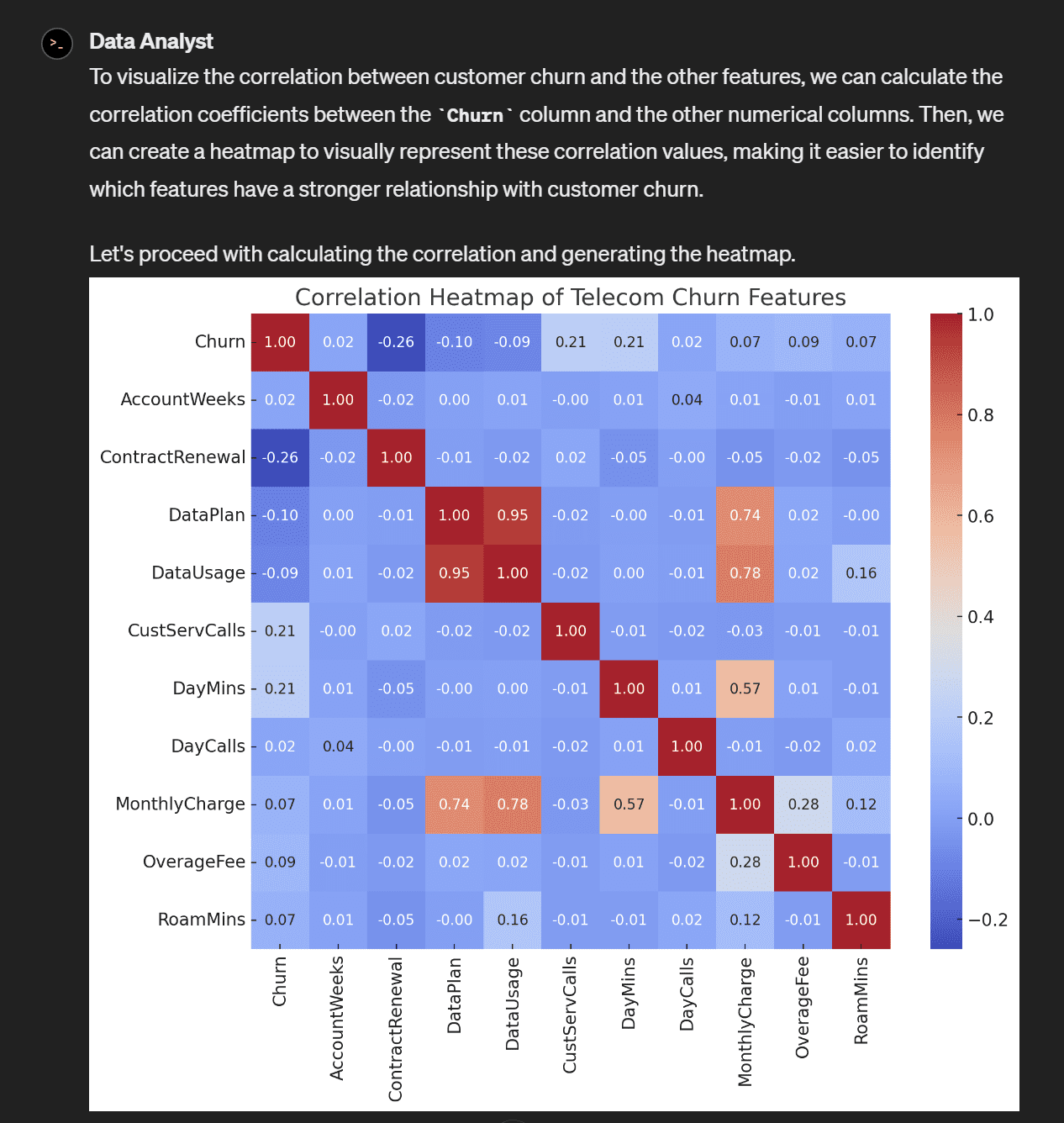
Let’s start with what ChatGPT teams have created for us, the Data Analyst. This is the Custom GPT, trained explicitly to analyze our data and visualize them as we need. By dropping the file, such as CSV files, and providing the prompt to what we need, the Data Analyst GPT could do the job automatically.
For example, I ask the Data Analyst to develop a Churn correlation analysis from the dataset I give them.
Data Analyst performs correlation analysis (Image by Author)
You can ask for further analysis from the Data Analyst GPT. You can also use the GPT to provide the whole code to execute yourself if necessary.
2. Machine Learning by Maryam Eskandari
The next GPT we will discuss is the Machine Learning GPT. This Custom GPT is designed as an assistant for any machine learning and data science activity. The usefulness includes discussing, learning, and developing suitable algorithms for our data projects.
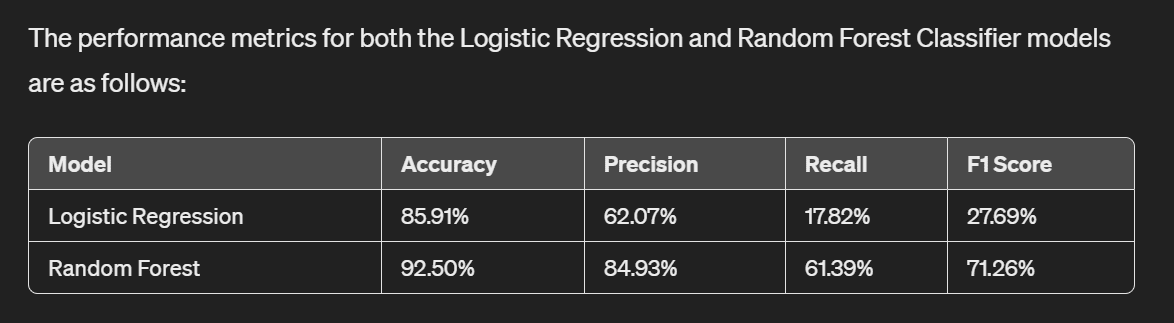
As an example, I ask the Machine Learning GPT to perform model development from our example dataset to predict Churn. Here is the result.
Machine Learning performs Model experiments (Image by Author)
The GPT can provide a great comparison between the models they used. If we continue, we can ask the model to iterate with more models, perform hyperparameter tuning, and ask the GPT to provide the reasons for each action.
3. Machine Learning Engineer by Hustle Playground
Similar to the previous entry, the Machine Learning Engineer GPT provides the users with an assistant to develop the machine learning model. You can put your dataset and ask the GPT to give you the essential steps and the complete code.
What makes the Machine Learning Engineer different is that their GPT specifies the design of models for automating complex tasks, especially for deploying models. The GPT is good for you to discuss how you want to structure your model and how the model deployment in production should be.
4. AutoExpert (Dev) By llmimagineers.com
Speaking of model structuring, GPT is also suitable for helping us structure our code for machine learning modeling. One of the best coding assistants I have found is the AutoExpert. It’s a GPT that is designed to help you as a steadfast pair programmer assistant.
The GPT is developed with additional code generation ability, online access to the latest APIs, and custom commands to save your session state, which you can use for the later session if necessary.
Using this GPT, would help you generate the complex code for any purposes you need during data science activity. It also provides you with the code structure and the script to help you execute them better.
5. ScholarGPT by awesomegpts.ai
Let’s move on from the technical coding part and go for the theoretical one. As we know, data science works are about continuous learning, especially in novel use cases. With the growing research in data science, it’s sometimes hard to find the perfect research that could help our use cases. This is where ScholarGPT comes in.
This GPT would assist you in finding the latest research paper for our use cases. From the simple prompt, it would give us a selection of the latest papers that are related to the problem we want to solve.
For example, the text below is the result from ScholarGPT, where I uploaded our dataset, and I asked them to provide me with a research paper related to predicting churn.
Title: "Transparency in Decision-making: the Role of Explainable Ai (XAI) in Customer Churn Analysis"
Authors: C ÖZKURT
Year: 2024
Summary: This study focuses on predicting lost customers and explaining the reasons behind it using machine learning, specifically scrutinizing customer churn in the telecommunications sector through rigorous analysis.
Link: Read the paper?source?.
The ScholarGPT provides many more research papers for you to choose from, so you can select which applies to your use cases.
6. Whimsical Diagrams by whimsical.com
The next GPT we would discuss is the Whimsical Diagram. For many data science activities, it’s not always about researching and model development. There are many times that we need to visualize our workflow and provide an explanation of how our work would be. This is where Whimsical Diagrams GPT would help you.
This GPT is designed to explain and visualize concepts with flowcharts, mindmaps, and sequence diagrams. Providing the prompt and data source we have could help us deliver visualization that would help our work.
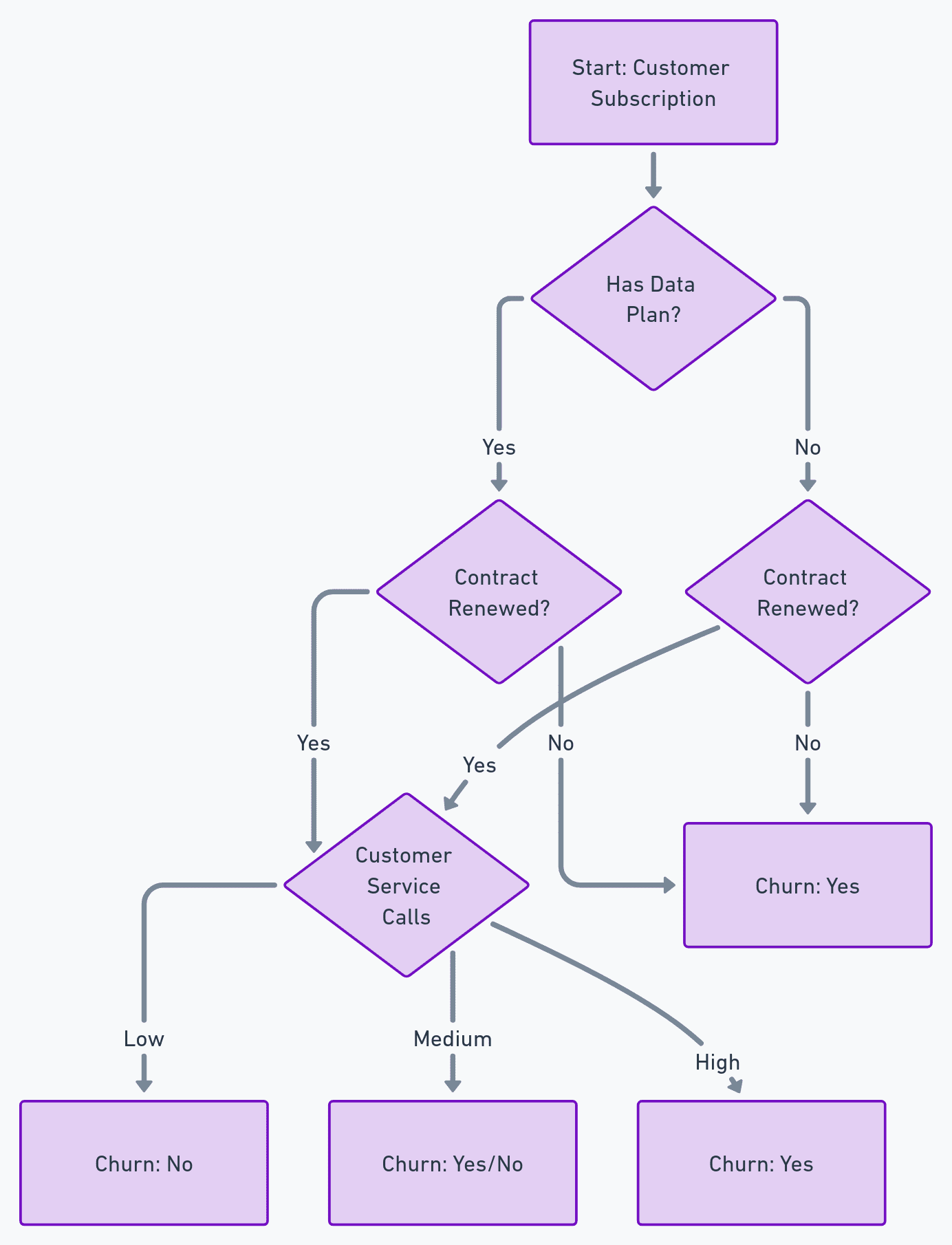
For example, I asked the model to provide me with a suggestion diagram from the Churn dataset, and it suggested visualizing the churn by the features. Below is the image result.
Churn by the features (Image generated by Whimsical Diagram GPT)
You can discuss further with the GPT to find your perfect diagram workflow for the data science works.
7. Canva by canva.com
The last one is the Canva GPT, which could help us assist in communicating our results. As we know, Canva is a service platform that helps design everything from logos to profile photos, banners, and presentations. With the Canva GPT, they can assist us in getting the best design for our analysis.
Data science is all about communicating our results to others, so it’s essential to have valid results that are presented in a way that the audience would understand. With Canva GPT, we can ask for suggestions on what design is suitable. For example, I asked the model to provide me with a design that is perfect for presenting the Churn Statistics.
Churn Statistic Design Selection (Canva GPT)
The GPT would give us the design options, and we could choose which we prefer or give additional prompts to get other designs.
Conclusion
This article discusses seven Custom GPTs available in the GPTs Store that could improve our data science workflow; they are:
Data Analyst by ChatGPT
Machine Learning by Maryam Eskandari
Machine Learning Engineer by Hustle Playground
AutoExpert (Dev) By llmimagineers.com
ScholarGPT by awesomegpts.ai
Whimsical Diagrams by whimsical.com
Canva by canva.com
I hope it helps! Do you have any GPT suggestions that should be on this list? Give them in the comments as well.
Cornellius Yudha Wijaya is a data science assistant manager and data writer. While working full-time at Allianz Indonesia, he loves to share Python and Data tips via social media and writing media.
More On This Topic
Make Your Own GPTs with ChatGPT's GPTs!
How Generative AI Can Help You Improve Your Data Visualization Charts
RAPIDS cuDF to Speed up Your Next Data Science Workflow
Streamline Your Machine Learning Workflow with Scikit-learn Pipelines
Easily Integrate LLMs into Your Scikit-learn Workflow with Scikit-LLM
Personalized AI Made Simple: Your No-Code Guide to Adapting GPTs