
Decoding RAG: Exploring its significance in the realm of generative AI

RAG

In the intricate landscape of Conversational AI, Retrieval-Augmented Generation (RAG) emerges as a technical marvel, seamlessly merging the strengths of generative and retrieval models. At its core, RAG tackles the challenge of precision in responses by introducing a dynamic knowledge retrieval component.

In this technical exploration, we delve into the underpinnings of RAG. Imagine a model that not only generates text but also possesses the ability to fetch information from a designated knowledge source. The fusion of these capabilities elevates the conversational experience to new heights, addressing limitations inherent in standalone generative or retrieval approaches.

Through this blog, we are going to unravel RAG techniques, unveiling their potential to redefine benchmarks in Generative AI. Join us as we navigate the technical intricacies of RAG.

Let’s dive deeper into RAG techniques, which would give an understanding of how they help in retrieving documents.

Decoding RAG: Exploring its significance in the realm of generative AI

RAG 01 – Using RetrievalQA:

RetrievalQA is a simple retrieval QA chain built over load_qa_chain, which retrieves only relevant documents from the vector database using various options:

  1. Embeddings: We can utilize various embeddings from HuggingFaceEmbeddings, HuggingFaceBgeEmbeddings, InstructEmbeddings, etc., based on the use case.
  2. Text Splitters: Various text splitters are available for different text formats, such as HTML, JSON, and recursive splitting by character. These text splitters are used for chunking the data without losing any contextual meaning. To ensure the context is preserved, overlapping is employed while chunking so that no context is lost. We recommend you go through the doc from LangChain.
  3. Chain_type: There are four options: map-reduce, map_rerank, refine, and stuff. The ‘stuff’ option is generally used for large documents, such as those exceeding 1000 tokens.
  4. Vectorstores: Various vector stores are available in the market, including FAISS, Chroma, Pinecone (requires subscription), etc. FAISS and Chroma are open-source and can be maintained locally.
  5. Retrievers: The retrievers are created using any vector store instantiation. They are used to retrieve similar documents using various search options: ‘similarity’ or ‘mmr’. ‘Similarity’ retrieves documents from text chunk vectors that are most similar, while ‘mmr’ (maximum marginal relevance) search optimizes for similarity to the query and diversity among the selected documents.

RAG 02 – MuliqueryRetriever:

In general, we see that distance-based retrieval represents queries in a high-dimensional space but may produce results that are not highly relatable to the question asked. This happens because of semantic irrelevance.

Prompt engineering could help in addressing the irrelevance of results, but it does not always solve such issues. The MultiQueryRetriever is one concept that helps in creating similar queries for the question asked in the prompt. It generates multiple queries with different perspectives using LLM (Large Language Models).

For example:

What does the course say about regression?

Similar Questions:

  1. What is the course’s perspective on regression?
  2. Can you provide information on regression as discussed in the course?
  3. How does the course cover the topic of regression?
  4. What are the course’s teachings on regression?
  5. In relation to the course, what is mentioned about regression?

By using the above questions, LLM will have more context to search through for precise results.

RAG-03 – Vector store-backed retriever:

Vector stores operate on the concept of vectorization, representing data points as vectors or embeddings in a multidimensional space. The information retrieved from the vector store is utilized to properly respond to the user. This is where RAG models/pipelines come into play, defining various patterns on how efficiently information can be retrieved from the vector database.

A vector store-backed retriever is a retriever backed by the vector store. It uses similarity search and MMR to retrieve the documents.

Similar to retrievalQA, we have options to choose the type of search. For example, ‘similarity_score_threshold’, where this parameter is a variable that accepts a score threshold in search_kwargs.

Syntax:
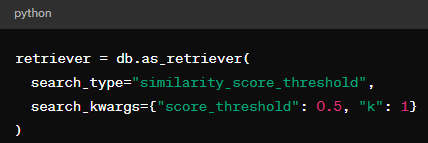
A screen shot of a computer code  Description automatically generated

We can also include the option of top k retrievals, for example, setting k = 1 in search_kwargs.

RAG-04 – Hybrid Search using BM25Retriever:

Hybrid search utilizes both Keyword-style and Vector-style search, leveraging keyword and semantic lookup capabilities.

This approach makes use of an algorithm called BM25, which has been around since the 1970s and 1980s. It incorporates the IDF (Inverse Document Frequency) concept and a ranking function that ranks documents based on the words occurring in the query.

Below is the mathematical formula for the BM25 algorithm:

A black text with a line  Description automatically generated with medium confidence

Langchain provides us with a package that implements the BM25 algorithm under the retrievers section, called BM25Retriever.

As mentioned, we can include any other retriever in combination with BM25Retriever, which produces sparse vectors. Ensembling BM25Retriever with any vector store retriever that produces dense vectors offers embedding lookup.

EnsembleRetriever is used to combine multiple retrievers, which significantly improves vector search and obtains the best-ranked results.

RAG-05 – Contextual Compression

The challenge lies in retrieving the required information buried within documents containing a lot of irrelevant text. These lengthy documents not only lead to expensive LLM calls but also result in weak responses.

Contextual compression offers a solution to this challenge. The technique involves compressing the documents without returning them as they are. Instead, the idea is to compress the documents using the context from the query, ensuring that only relevant information is returned.

To implement contextual compression, we’ll need several components: a base retriever, a vector store retriever, and a document compressor, such as an LLM extractor or LLM chain filter, which takes input from LLM.

The Contextual Compression retriever supplies queries to the base retriever, retrieves the initial documents, and then passes them through the document compressor. The Document Compressor, in turn, takes a list of documents and shortens the content to include only relevant information. If the documents are completely irrelevant to the context, they are dropped altogether.
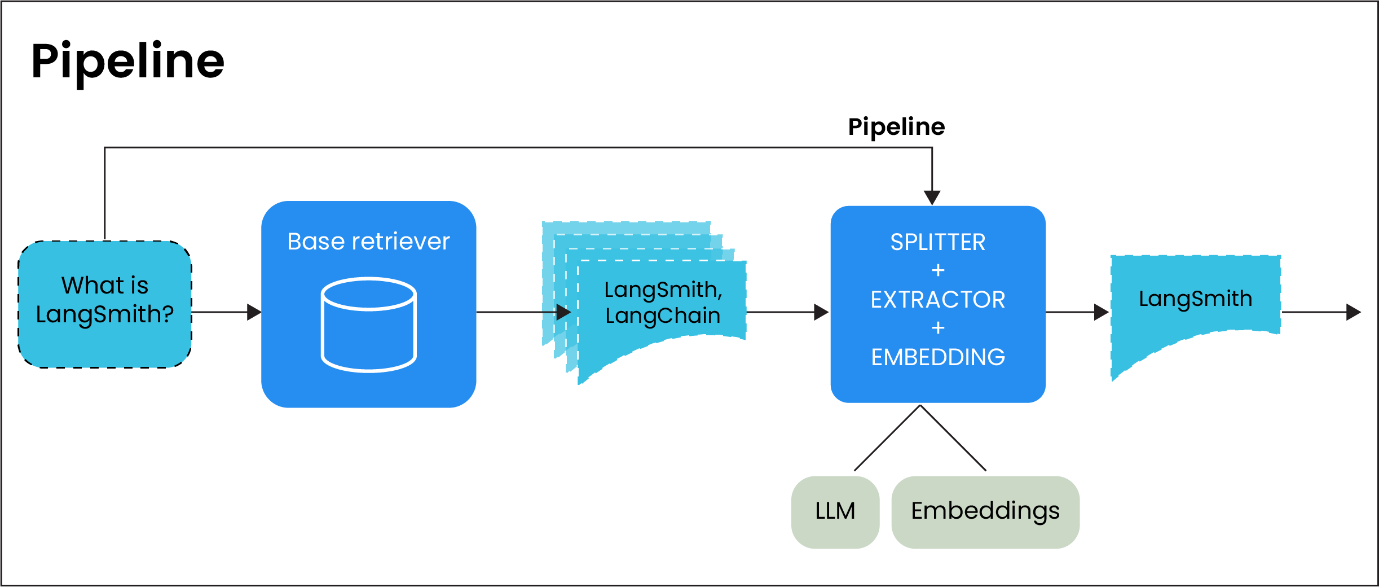
A diagram of a process  Description automatically generated

For example, below is an excerpt of a document retrieved using the vector store retriever:

Query: What is the full form of LIPA?

Answer:

Long Island Power Authority (LIPA) has implemented a new e-Procurement platform called Bonfire. Hard copy proposals will not be accepted. All proposals and accompanying documentation will become the property of LIPA and may not be returned. LIPA expressly reserves the right to utilize any and all ideas submitted in the proposals received unless covered by legal patent or proprietary rights which must be clearly noted in the proposal submitted in response to the RFP. Late proposals will not be accepted, nor will additional time be granted to any individual Contractor. For a quick tutorial on how to upload a submittal, visit: Vendor Registration and Submission

Addenda: If, at any time, LIPA changes, revises, deletes, clarifies, increases, or otherwise modifies

This answer presents a challenge for LLM processing due to its length, incurring additional costs. After applying compression techniques, below is the resulting answer:

Compressed Document:

Long Island Power Authority (LIPA) has implemented a new e-Procurement platform called Bonfire. All proposals and accompanying documentation will become the property of LIPA and may not be returned. LIPA expressly reserves the right to utilize any and all ideas submitted in the proposals received unless covered by legal patent or proprietary rights which must be clearly noted in the proposal submitted in response to the RFP.

We observe a significant improvement in content reduction, retaining only the important information. The remaining content, which does not match the context of the query, is eliminated.

In summary, retrieval-augmented generation synergizes the strengths of retrieval-based and generative models to elevate the precision and relevance of the generated text. By harnessing the accuracy of retrieval-based models for information retrieval and the creative capabilities of generative models, this approach fosters more resilient and contextually grounded language generation systems.

Pienso builds no-code tools for training AI models

Pienso builds no-code tools for training AI models Kyle Wiggers 18 hours

AI might be the “it thing” of the moment. But that doesn’t mean it’s getting easier to deploy.

According to a 2023 S&P Global survey, about half of companies with at least one AI project in production are still at the pilot or proof-of-concept stages. The reasons for the slow ramp-ups vary, but the commonly cited ones are challenges around data management, security and compute resources.

Of businesses responding to the S&P poll, around half said they aren’t ready to implement AI — and won’t be for five years or more.

Fortunately, there’s an increasing number of products from startups and Big Tech vendors alike that aim to tackle these AI deployment roadblocks. (See ML Hub, Kore.ai and Viso, to name a few.) One of the newer entrants is Pienso, a platform that lets users build and deploy models without having to write code.

Birago Jones and Karthik Dinakar founded Pienso in 2016 based on their research at MIT (they’re alumni). The two met a few years back at MIT’s Media Lab as graduate students.

“We teamed up for a class project to build a tool that would help social media platforms moderate and flag bullying content,” Jones, who serves as Pienso’s CEO, told TechCrunch in an interview. “There was just one problem: While the model itself worked the way it was supposed to, it wasn’t trained on the right data, so it wasn’t able to identify harmful content that used teenage slang.”

Jones and Dinakar eventually realized that the solution was to have subject-matter experts — in this case, teenagers — help train the model. They built tools for this purpose, and some years later, Jones and Dinakar teamed up to commercialize these tools.

What resulted was Pienso, which Jones describes as an AI suite built for “non-technical talent” — namely researchers, marketers and customer support teams who have access to large amounts of data for AI training, but lack the necessary resources to structure and analyze it.

“So much of the AI conversation has been dominated by … large language models,” Jones said, “but the reality is that no one model can do everything. To be able to scale to AI’s full potential, where it can manage business processes and interact with customers, you have to be able to train and fine-tune your model. Pienso believes that any domain expert, not just an AI engineer, should be able to do just that.”

Pienso guides users through the process of annotating or labeling training data for pre-tuned open source or custom AI models. (It depends on the model, but AI generally needs labels — like an image of a bird paired with the label “finch” — to learn to perform a task.) The platform, which can be deployed in the cloud or on-premises, integrates with enterprise systems through APIs. But it can also operate without APIs or third-party services, keeping data within a secure environment.

Sky, the U.K. broadcaster, is using Pienso to analyze customer service calls, Jones says, while an unnamed U.S. government agency has tested it to monitor illegal weapons tracking.

“Pienso’s flexible, no-code interface allows teams to train models directly using their own company’s data,” Jones said. “This alleviates the privacy concerns of using … models, and also is more accurate, capturing the nuances of each individual company.”

Companies pay Pienso a yearly license based on the number of AI models they deploy. The greater the number of models, the higher the licensing cost.

“We intentionally designed our pricing to allow customers to test out models beforehand to understand how AI can help them without first having to make a sizable investment,” Jones added. “We wanted to give customers the freedom to experiment with building new models before deploying them.”

It’s a business model that appeals to investors, apparently. Pienso recently raised $10 million in a Series A funding round led by Latimer Ventures with participation from Gideon Capital, SRI, Uncork and Good Growth Capital.

With Pienso raising a total of $17 million, Jones says the new cash will be put toward scaling up Pienso’s sales, marketing and customer success teams, recruiting engineering talent and building new features for the platform.

Said Latimer Ventures’ Luke Cooper in a statement: “We constantly hear about the need to democratize AI, but what makes Pienso stand out is how they’re thinking about the role of a domain expert in this equation. They’re empowering those who understand their data best to get the most insights out of it. It’s fostering a future where we’re building smarter AI models for a specific application, by the people who are most familiar with the problems they are trying to solve.”

How to improve your artificial intelligence job prospects

How to Improve Your Artificial Intelligence Job Prospects?

Artificial Intelligence is one of the biggest technological waves that has hit the world of technology. According to The Enterprisers Project, AI will be offering about 133 million new jobs in the coming years. Dun & Bradstreet also stated that 40 percent of the respondent organizations are offering more jobs because of implementing artificial intelligence technology. With the growing demand for artificial intelligence, several individuals are considering artificial intelligence career option.

Essential steps to boost your AI job prospects

Step 1

One of the essential requirements for an individual, who is looking for a career in the field of AI must good at numbers, i.e. they should polish their math skills. This will help in writing better code.

Step 2

One must strengthen their basics, on the following concepts that play an important part in this field.

  • Linear algebra, probability, and statistics

Mathematics is an integral part of AI. And if an individual wants to make a growing career in it, then they must have good knowledge of these basic concepts. They are vectors, matrices, statistics, and dimensionality. Probability concepts like Bayes Theorem.

  • Programming languages

An individual should be learning programming languages because they play a prominent role in AI. One can enroll in an artificial intelligence certificationto learn programming languages. There are several programming languages, an individual should well-versed at least one among the following:

  • Python
  • Java
  • C
  • R
  • Data structures

Enhance the way to solve problems involving data, create an analysis of data more accurately so one can build their own systems with minimum errors. Learning the various parts of programming languages will be fruitful in getting an understanding of data structures like stacks, linked lists, dictionaries, and many more.

  • Regression

Regression is highly useful for predictions making in real-time applications. It is very crucial to have a good understanding of the concepts of regression.

  • Machine learning models

Gain knowledge on the various ML concepts such as Decision trees, Random Forests, KNN, SVM, etc. Learn the ways to apply these by acquiring knowledge of the algorithms as they are quite useful in solving the problems.

Step 3

If an individual wants to enhance their artificial intelligence career, then they must learn more in-depth concepts, which are a complex part of AI. If one masters these concepts, then they can excel in their career.

  • Neural networks

It is a computer system modeled on the human brain and nervous system, which works by incorporating data through an algorithm it is developed on. The concepts of neural networks are the foundations for developing AI machines, it is better to have a deep understanding of its functionalities.

There are different types of neural networks, which are used in various ways. A few of the common neural networks are:

  • Perceptron
  • Multilayer perceptrons
  • Recurrent neural network
  • Sequence to sequence model
  • Convolutional neural network
  • Feed forward neural network
  • Modular neural network
  • Radial basis functional neural network
  • Long Short-Term Memory (LSTM)
  • Domains of AI

After gaining knowledge about the concepts and various types of neural networks, learn about the different applications of it, and start building one’s own applications. Every application in the AI field demands a different approach, and it is very tough to master all the fields of AI. Start with a specific domain, and then proceed further to the other domains.

  • Big data

Though it is not considered an essential aspect for gaining expertise in AI, understanding the basic concepts of big data will be quite helpful mainly to climb up the AI careerladder.

Step 4

Boost your expertise in the AI space by mastering the following aspects:

  • Optimization techniques

By learning optimization of algorithms is very useful to maximize or minimize the error function. These functions are based on the models internal learnable parameters that play a crucial role in the accuracy and efficiency of results. Learning this will be useful to implement optimization techniques and algorithms to model parameters that are useful to acquire optimum values and accuracy of such parameters.

  • Publish research papers

One of the best ways to establish one’s own credibility in the field of artificial intelligenceis by going a step ahead by reading research papers in this field and publishing research papers. Begin your own research and understand the cases that are developing.

  • Develop algorithms

After completing the process of learning and research, begin working on building algorithms. You might bring a new revolution with the knowledge you have.

Conclusion

Undoubtedly, mastering AI concepts can be a difficult task. But one can achieve it with hard work, continuous practice, consistency and doing the right kind of Ai certificationthat ensures knowledge based on the current industry standards.

Anti-AI sentiment gets big applause at SXSW 2024 as storytellers dub AI cheerleading as ‘terrifying bullsh**’

Anti-AI sentiment gets big applause at SXSW 2024 as storytellers dub AI cheerleading as ‘terrifying bullsh**’ Sarah Perez @sarahintampa / 8 hours

A whiff of anti-AI sentiment got big applause at the SXSW conference in Austin this afternoon. Award-winning writers and directors Daniel Kwan and Daniel Scheinert, collectively known as “DANIELS,” originally premiered their film “Everything Everywhere All at Once” at SXSW in 2022. The movie later went on to win seven Oscars, including Best Picture, Best Director, and Best Screenplay. In a conversation about the future of storytelling, the duo commented on the inevitable rise of AI and how to approach it, calling the technology both “amazing” and “terrifying.”

As Kwan first explained, modern capitalism only worked because we compelled people to work, rather than forced them to do so.

“We had to change the story we told ourselves and say that ‘your value is your job,” he told the audience. “You are only worth what you can do, and we are no longer beings with an inherent worth. And this is why it’s so hard to find fulfillment in this current system. The system works best when you’re not fulfilled,” he said, then paused. “Which brings me back to AI,” Kwan continued to a thunder of applause and cheers.

Remarking that the crowd must love AI, given the hoots and hollering that was being heard, Kwan admitted that many people will call the technology amazing and he agreed.

“It’s magic,” he said. “It’s probably going to solve cancer. It’s probably going to give us a lot of climate solutions. This is a powerful thing,” Kwan continued. “But I’m really terrified of what this new story we’re going to have to tell ourselves in order to accept this new convenience, this new progress. It’s terrifying,” he added as a single solitary voice cheered in the now otherwise quiet crowd.

“So imagine what this technology will do within this current system, within this current incentive structure. This is the same system that brought us climate change, income inequality, and the general lack of gratitude and understanding of our worth and the worth of those around us,” Kwan said.

Plus, he noted, if you are feeling anxious about AI, it’s probably because, deep down, you know you’re next. “Even if the jobs aren’t going to be lost, the value of the job will go down, right? … It will slowly be compounded and normalized until we don’t even realize it,” he said.

Kwan pointed to how social media had already altered our story. A technology meant to connect us ended up making us lonelier than we have ever been. But, with AI, we still have the opportunity to “rewrite the stories and rewrite the systems for tomorrow,” he explained.

Still, he cautioned that didn’t mean we could choose to ignore AI’s progress or even its usefulness.

“I also want to say, we’re not saying ‘don’t use AI.’ I don’t believe in dogmas. I don’t believe in that kind of puritanical lifestyle — it doesn’t work. AI is here. It is going to be rapidly deployed in every aspect of our life,” Kwan said.

Scheinert agreed, adding that, instead, people should think about why they’re using AI.

“Are you trying to use it to create the world you want to live in? Are you trying to use it to increase value in your life and focus on the things that you really care about? Or are you just trying to, like, make some money for the billionaires, you know?” Scheinert asked the audience. “And if someone tells you, there’s no side effect. It’s totally great, ‘get on board’ — I just want to go on the record and say that’s terrifying bullshit. That’s not true. And we should be talking really deeply about how to carefully, carefully deploy this stuff,” he said.

The crowd then erupted into sustained applause.

They, too, had their reservations about AI, it seemed.

Kwan jumped back in to add that people need to look at why it “feels so wrong to use AI,” while also surviving this current environment where AI will basically be everywhere. He also reminded the audience why we create art.

“Why did we write ‘Everything Everywhere All at Once’ the way we did? And the answer is, we did it to save ourselves. Every story … that we make is an act of saving ourselves and our value from a system that wants to devalue us and the people that we care about,” Kwan said.

DSC Weekly 12 March 2024

Announcements

  • Data loss is an inescapable reality in the digital business world. Data backup techniques are conceptually simple, but implementing a robust disaster recovery plan that both protects data from cyberattacks and maintains business continuity during a breach can be difficult. Register for the free Advancing Data Backup Tools and Techniques summit to gain insights from leading experts on the future of data backup solutions to help design a disaster recovery plan that protects your most critical data and mitigates the effects of attacks when they do occur.
  • The cloud ecosystem is larger, more complex and interdependent than ever. As organizations increasingly migrate their data and assets to the cloud, attacks that attempt to break through its growing attack surface are getting more sophisticated. Cloud security strategies are necessary for proper user and device authentication, resource access control and data privacy to ensure that the cloud system remains impenetrable to cyberattacks. Attend the Securing the Cloud Ecosystem summit to hear leading experts discuss effective strategies to secure identity and access management as well as the leading tools and approaches that best secure the extensive cloud ecosystem from insidious attacks.

Top Stories

  • Embodied AI: Would LLMs and robots surpass the human brain?
    March 12, 2024
    by David Stephen
    It is the International Brain Awareness Week for 2024, with events across institutes, globally, from March 11 – 17. This week is a good time to explore the pedestal of the brain, against the astounding rise of machines. AI embodiment was recently featured in Scientific American, AI Chatbot Brains Are Going Inside Robot Bodies.
  • Creating an AI Utility Function: A Classroom Exercise
    March 10, 2024
    by Bill Schmarzo
    During a recent discussion with high school juniors and seniors, my goal was to enhance their awareness and understanding of Big (intrusive) Data and AI by focusing on two main areas. The bottom line is that I wanted to turn them into citizens of data science.
  • How AI is transforming marketing strategies in 2024
    March 6, 2024
    by Pritesh Patel
    As we approach 2024, no brand or customer remains unaffected by AI. Our interactions in the marketplace have altered as a result. It has changed how we communicate. in particular, branding. The curiosity about artificial intelligence’s seemingly limitless possibilities grows constantly as it gathers more data to sharpen its intelligence.
Education_DSC_160x600-2

In-Depth

  • API management tools in facilitating digital transformation
    March 11, 2024
    by Ovais Naseem
    Digital transformation represents a crucial pivot in today’s business world, marking the transition from traditional practices to a more integrated, data-driven approach. API (Application Programming Interface) management tools are central to this transformation, which serve as the backbone for modernizing operations, enriching customer experiences, and catalyzing innovation.
  • How to improve your artificial intelligence job prospects
    March 8, 2024
    by Aileen Scott
    Artificial Intelligence is one of the biggest technological waves that has hit the world of technology. According to The Enterprisers Project, AI will be offering about 133 million new jobs in the coming years. Dun & Bradstreet also stated that 40 percent of the respondent organizations are offering more jobs because of implementing artificial intelligence.
  • Decoding RAG: Exploring its significance in the realm of generative AI
    March 8, 2024
    by Erika Balla
    In the intricate landscape of Conversational AI, Retrieval-Augmented Generation (RAG) emerges as a technical marvel, seamlessly merging the strengths of generative and retrieval models. At its core, RAG tackles the challenge of precision in responses by introducing a dynamic knowledge retrieval component. In this technical exploration, we delve into the underpinnings of RAG.
  • Navigating the horizon: Exploring the future of data
    March 7, 2024
    by Ovais Naseem
    In the digital universe, data reigns supreme. From the early days of punch cards to the current era of cloud computing, the evolution of data has been nothing short of remarkable. Today, as we stand on the cusp of exploring the future of data, it’s crucial to understand its trajectory and the profound impact.
  • DSC Weekly 5 March 2024
    March 5, 2024
    by Scott Thompson
    Read more of the top articles from the Data Science Central community.

How AI firewalls will secure your new business applications

ai-tunnel-getty

AI and cybersecurity have been inextricably linked for many years. The good guys use AI to analyze incoming data packets and help block malicious activity while the bad guys use AI to find and create gaps in their targets' security. AI has contributed to the ever-escalating arms race.

AI has been used to strengthen defense systems by analyzing vast amounts of incoming traffic at machine speed, and identifying known and emergent patterns. As criminals, hackers, and nation-states deploy more and more sophisticated attacks, AI tools are used to block some of those attacks, and aid human defenders by escalating only the most critical or complex attack behaviors.

Also: How AI can improve cybersecurity by harnessing diversity

But attackers also have access to AI systems, and they have become more sophisticated both in finding exploits and in using technologies like AI to force-multiply their cadre of criminal masterminds. That sounds hyperbolic, but the bad guys seem to have no shortage of very talented programmers who — motivated by money, fear, or ideology to cause damage — are using their talents to attack infrastructure.

None of this is new, and it's been an ongoing challenge for years. Here's what is new: There's a new class of targets — the business value AI system (we mostly call them chatbots). In this article, I'll provide some background on how — using firewalls — we've protected business value in the past, and how a new breed of firewall is just now being developed and tested to protect challenges unique to operating and relying on AI chatbots in the commercial arena.

Understanding firewalls

The kinds of attacks and defenses practiced by traditional (yes, it's been long enough that we can call it "traditional") AI-based cybersecurity occurs in the network and transport layers of the network stack. The OSI model is a conceptual framework developed by the International Organization for Standardization for understanding and communicating the various operational layers of a modern network.

The network layer routes packets across networks, while the transport layer manages data transmission, ensuring reliability and flow control between end systems.

Also: Want to work in AI? How to pivot your career in 5 steps

Occurring in layers 3 and 4 respectively of the OSI network model, traditional attacks have been fairly close to the hardware and wiring of the network and fairly far from layer 7, the application layer. It's way up in the application layer that most of the applications we humans rely on daily get to do their thing. Here's another way to think about this: The network infrastructure plumbing lives in the lower layers, but business value lives in layer 7.

The network and transport layers are like the underground chain of interconnecting caverns and passageways connecting buildings in a city, serving as conduits for deliveries and waste disposal, among other things. The application layer is like those pretty storefronts, where the customers do their shopping.

In the digital world, network firewalls have long been on the front lines, defending against layer 3 and 4 attacks. They can scan data as it arrives, determine if there's a payload hidden in a packet, and block activity from locations deemed particularly troubling.

Also: Employees input sensitive data into generative AI tools despite the risks

But there's another kind of firewall that's been around for a while, the web application firewall, or WAF. Its job is to block activity that occurs at the web application level.

A WAF monitors, filters, and blocks malicious HTTP traffic; prevents SQL injection and cross-site scripting (XSS) attacks, injection flaws, broken authentication, and sensitive data exposure; provides custom rule sets for application-specific protections; and mitigates DDoS attacks, among other protections. In other words, it keeps bad people from doing bad things to good web pages.

We're now starting to see AI firewalls that protect level 7 data (the business value) at the AI chatbot level. Before we can discuss how firewalls might protect that data, it's useful to understand how AI chatbots can be attacked.

When bad people attack good AI chatbots

In the past year or so, we have seen the rise of practical, working generative AI. This new variant of AI doesn't just live in ChatGPT. Companies are deploying it everywhere, but especially in customer-facing front ends to user support, self-driven sales assistance, and even in medical diagnostics.

Also: AI is transforming organizations everywhere. How these 6 companies are leading the way

There are four approaches to attacking AI chatbots. Because these AI solutions are so new, these approaches are still mostly theoretical, but expect real-life hackers to go down these paths in the next year or so.

Adversarial attacks: The journal ScienceNews discusses how exploits can attack the ways AI models work. Researchers are constructing phrases or prompts that seem valid to an AI model but are designed to manipulate its responses or cause some kind of error. The goal is to cause the AI model to potentially reveal sensitive information, break security protocols, or respond in a way that could be used to embarrass its operator.

I discussed a very simplistic variation of this sort of attack when a user fed misleading prompts into the unprotected chatbot interface for Chevrolet of Watsonville. Things did not go well.

Indirect prompt injection: More and more chatbots will now read active web pages as part of their conversations with users. Those web pages can contain anything. Normally, when an AI system scrapes a website's content, it is smart enough to distinguish between human-readable text containing knowledge to process, and supporting code and directives for formatting the web page.

Also: We're not ready for the impact of generative AI on elections

But attackers can attempt to embed instructions and formatting into those webpages that fool whatever is reading them, which could manipulate an AI model into divulging personal or sensitive information. This is a potentially huge danger, because AI models rely heavily on data sourced from the wide, wild internet. MIT researchers have explored this problem and have concluded that "AI chatbots are a security disaster."

Data poisoning: This is where — I'm fairly convinced — that developers of large language models (LLMs) are going out of their way to shoot themselves in their virtual feet. Data poisoning is the practice of inserting bad training data into language models during development, essentially the equivalent of taking a geography class about the spherical nature of the planet from the Flat Earth Society. The idea is to push in spurious, erroneous, or purposely misleading data during the formation of the LLM so that it later spouts incorrect information.

My favorite example of this is when Google licensed Stack Overflow's content for its Gemini LLM. Stack Overflow is one of the largest online developer-support forums with more than 100 million developers participating. But as any developer who has used the site for more than five minutes knows, for every one lucid and helpful answer, there are five to 10 ridiculous answers and probably 20 more answers arguing the validity of all the answers.

Also: The best VPN services of 2024: Expert tested

Training Gemini using that data means that not only will Gemini have a trove of unique and valuable answers to all kinds of programming problems, but it will also have an enormous collection of answers that result in terrible results.

Now, imagine if hackers know that Stack Overflow data will be regularly used to train Gemini (and they do because it's been covered by ZDNET and other tech outlets): They can construct questions and answers deliberately designed to mislead Gemini and its users.

Distributed denial of service: If you didn't think a DDoS could be used against an AI chatbot, think again. Every AI query requires an enormous amount of data and compute resources. If a hacker is flooding a chatbot with queries, they could potentially slow down or freeze its responses.

Additionally, many vertical chatbots license AI APIs from vendors like ChatGPT. A high rate of spurious queries could increase the cost for those licensees if they're paying using metered access. If a hacker artificially increases the number of API calls used, the API licensee may exceed their licensed quota or face substantially increased charges from the AI provider.

Defending against AI attacks

Because chatbots are becoming critical components of business value infrastructure, their continued operation is essential. The integrity of the business value provided must also be protected. This has given rise to a new form of firewall, one specifically designed to protect AI infrastructure.

Also: How does ChatGPT actually work?

We're just beginning to see generative AI firewalls like the Firewall for AI service announced by edge network security firm Cloudflare. Cloudflare's firewall sits between the chatbot interface in the application and the LLM itself, intercepting API calls from the application before they reach the LLM (the brain of the AI implementation). The firewall also intercepts responses to the API calls, validating those responses against malicious activity.

Among the protections provided by this new form of firewall is sensitive data detection (SDD). SDD is not new to web application firewalls, but the potential for a chatbot to surface unintended sensitive data is considerable, so enforcing data protection rules between the AI model and the business application adds an important layer of security.

Additionally, this prevents people using the chatbot — for example, employees internal to a company — from sharing sensitive business information with an AI model provided by an external company like OpenAI. This security mode helps prevent information from going into the overall knowledge base of the public model.

Also: Is AI in software engineering reaching an 'Oppenheimer moment'? Here's what you need to know

Cloudflare's AI firewall, once deployed, is also intended to manage model abuses, a form of prompt injection and adversarial attack intended to corrupt the output from the model. Cloudflare specifically calls out this use case:

A common use case we hear from customers of our AI Gateway is that they want to avoid their application generating toxic, offensive, or problematic language. The risks of not controlling the outcome of the model include reputational damage and harm to the end user by providing an unreliable response.

There are other ways that a web application firewall can mitigate attacks, particularly when it comes to a volumetric attack like query bombing, which effectively becomes a special-purpose DDoS. The firewall employs rate-limiting features that slow down the speed and volume of queries, and filter out those that appear to be designed specifically to break the API.

Not entirely ready for prime time

According to Cloudflare, protections against volumetric DDoS-style attacks and sensitive data detection can be deployed now by customers. However, the prompt validation features — basically, the heavily AI-centric features of the AI firewall — are still under development and will enter beta in the coming months.

Also: Generative AI filled us with wonder in 2023 — but all magic comes with a price

Normally, I wouldn't want to talk about a product at this early stage of development, but I think it's important to showcase how AI has entered mainstream business application infrastructure use to the point where it's both a subject of attack, and where substantial work is being done to provide AI-based defenses.

Stay tuned. We'll be keeping track of AI deployments and how they change the contours of the business application world. We'll also be looking at the security issues and how companies can keep those deployments safe.

IT has always been an arms race. AI just brings a new class of arms to deploy and defend.

You can follow my day-to-day project updates on social media. Be sure to subscribe to my weekly update newsletter on Substack, and follow me on Twitter at @DavidGewirtz, on Facebook at Facebook.com/DavidGewirtz, on Instagram at Instagram.com/DavidGewirtz, and on YouTube at YouTube.com/DavidGewirtzTV.

Artificial Intelligence

Nanonets gets Accel’s backing to improve AI-based workflow automation

Nanonets gets Accel’s backing to improve AI-based workflow automation Jagmeet Singh 14 hours

Nanonets, a startup using AI to automate back-office processes, has raised $29 million in a new funding round led by Accel as it seeks to improve the accuracy of automation processes that involve large amounts of unstructured data.

Processing unstructured data from documents like invoices, receipts and purchase orders often involves repetitive tasks and a lot of human resources. Nanonets, which primarily targets the financial services sector, says its AI platform aims to improve the efficiency of these processes and make them cost-effective.

A Y Combinator alum, the startup has built an AI platform through which it offers no-code solutions that, according to the company, can help businesses extract information from documents, emails, tickets, databases and the like, and convert them into actionable insights. The company’s AI platform uses machine learning architectures to analyze unstructured data from uploaded documents and extract useful information. Its no-code AI agents can be plugged into ERP platforms like QuickBooks, Xero, Sage and NetSuite to automate accounts payable processes, optimize supply chains by taking historical data from Square and Tableau, and summarize health reports from patient management systems.

Nanonets claims that while an invoice typically takes 15 minutes to process manually, its automated finance solutions can reduce the time taken to less than a minute. These solutions can work for processes like accounts payable, reconciliation, accounts receivable and expense management.

The startup intends to use the fresh funding for R&D to improve the accuracy of its system and invest in sales and marketing. It has about 100 employees, which includes most of its engineering team that’s based in India. The company also will use the new funding to increase its headcount.

The all-equity Series B round saw participation from Nanonets’ existing investors Elevation Capital and Y Combinator. It brings the startup’s total funding raised to $42 million, including its $10 million Series A round in 2022.

Prathamesh Juvatkar, co-founder and CTO at Nanonets, told TechCrunch that the startup initially used convolutional neural networks (neural network architectures used in computer vision for image classification and object recognition) to examine images and detect featured objects. The startup later considered deploying graph neural networks, but eventually moved to transformers and embraced multimodal architectures after it saw that they were more accurate than existing machine learning technologies.

“Right now, in the back end, we have multiple architectures. Whenever we get a new customer, we train all of these models on the customer data and see which one gets better accuracy,” he said in an interview.

IIT Gandhinagar alumni Juvatkar and Sarthak Jain (CEO) co-founded Nanonets after selling Cubeit, a machine-learning platform that turned web pages into sharable mobile cards, to fashion portal Myntra in 2016.

Unlike many other AI startups that rely on large language models (LLMs) and GPTs, Nanonets prefers transformers to circumvent the issue of hallucinations, which occur when an AI system generates information that is not present in the given documents, but is generated based on the LLM’s knowledge.

Even though the machine learning architectures that Nanonets use are document-agnostic, the startup is targeting the financial services space because about 50%-55% of its customers are from that domain. It has offered a range of integrations to streamline finance operations. However, the company is gradually expanding to “more adjacent processes,” and has also started serving customers in healthcare and manufacturing, Juvatkar said.

Nanonets is not alone in the global market for AI-based workflow automation. The market is crowded with traditional optical character recognition (OCR) platforms as well as startups, such as Rossum AI and Hyperscience. Bigger companies like UiPath also offer workflow automation, but with structured data. Still, Juvatkar said Nanonets takes on the competition by offering a record 90% straight-through processing rate — the percentage of data processed without manual intervention.

“We win deals primarily because of accuracy, user experience and the quality of our integrations,” he said.

Nanonets offers its solutions in three different pricing tiers: Starter, Pro and Enterprise. Of these tiers, Juvatkar told TechCrunch, the Pro and Enterprise are the most significant contributors to the startup’s annual recurring revenue, with an equal split. The startup also offers tools to convert PDFs to Excel spreadsheets, CSV, JSON, XML and text, image to text and image to Excel. These converters have helped gain the attention of businesses that require automation and reach more than 34% of the global Fortune 500 companies over the last two years, the company said. Additionally, the startup has expanded its user base by four times over the previous 12 months, and currently has over 10,000 customers globally.

Nanonets has users across the world, but the U.S. accounts for about 40% of its revenues, followed by Europe, which contributes 30% to 35%, Juvatkar said.

Juvatkar told TechCrunch, without disclosing the numbers, that since the 2022 round, Nanonets’ revenue has consistently increased by three times per year. The startup aims to expand its top line by 2x to 3x this year, too.

Consistent revenue growth is one reason investors have been investing in AI startups despite the slowdown in global markets. Funding to AI startups soared to $21 billion in 2023 from $10 billion in 2022, while the number of deals dropped by 61 to 399 last year, per Tracxn. AI startups in the U.S. receive the most investments, followed by companies in China, U.K., Israel and India.

“We are thrilled to partner with Nanonets in their mission to revolutionize back-office operations with AI. Sarthak and his team have been dedicated to getting to the bottom of customer pain points and have built a powerful solution that fully automates business processes end-to-end. Nanonets stood out to us due to its comprehensive platform and its capability for Straight Through Processing (STP) — these qualities set Nanonets apart in the field of automation and have already demonstrated their positive impact to customers,” said Abhinav Chaturvedi, partner at Accel, in a prepared statement.

Note: This story was updated to reflect a change to Accel’s name following a request for clarification from the firm.

InstantID: Zero-shot Identity-Preserving Generation in Seconds

AI-powered image generation technology has witnessed remarkable growth in the past few years ever since large text to image diffusion models like DALL-E, GLIDE, Stable Diffusion, Imagen, and more burst into the scene. Despite the fact that image generation AI models have unique architecture and training methods, they all share a common focal point: customized and personalized image generation that aims to create images with consistent character ID, subject, and style on the basis of reference images. Owing to their remarkable generative capabilities, modern image generation AI frameworks have found applications in fields including image animation, virtual reality, E-Commerce, AI portraits, and more. However, despite their remarkable generative capabilities, these frameworks all share a common hurdle, a majority of them are unable to generate customized images while preserving the delicate identity details of human objects.

Generating customized images while preserving intricate details is of critical importance especially in human facial identity tasks that require a high standard of fidelity & detail, and nuanced semantics when compared to general object image generation tasks that concentrate primarily on coarse-grained textures and colors. Furthermore, personalized image synthesis frameworks in recent years like LoRA, DreamBooth, Textual Inversion, and more have advanced significantly. However, personalized image generative AI models are still not perfect for deployment in real-world scenarios since they have a high storage requirement, they require multiple reference images, and they often have a lengthy fine-tuning process. On the other hand, although existing ID-embedding based methods require only a single forward reference, they either lack compatibility with publicly available pre-trained models, or they require an excessive fine-tuning process across numerous parameters, or they fail to maintain high face fidelity.

To address these challenges, and further enhance image generation capabilities, in this article, we will be talking about InstantID, a diffusion model based solution for image generation. InstantID is a plug and play module that handles image generation and personalization adeptly across various styles with just a single reference image and also ensures high fidelity. The primary aim of this article is to provide our readers with a thorough understanding of the technical underpinnings and components of the InstantID framework as we will have a detailed look of the model's architecture, training process, and application scenarios. So let’s get started.

InstantID: Zero-Shot Identity-Preserving Image Generation

The emergence of text to image diffusion models has contributed significantly in the advancement of image generation technology. The primary aim of these models is customized and personal generation, and creating images with consistent subject, style, and character ID using one or more reference images. The ability of these frameworks to create consistent images has created potential applications in different industries including image animation, AI portrait generation, E-Commerce, virtual and augmented reality, and much more.

However, despite their remarkable abilities, these frameworks face a fundamental challenge: they often struggle to generate customized images that preserve the intricate details of human subjects accurately. It is worth noting that generating customized images with intrinsic details is a challenging task since human facial identity requires a higher degree of fidelity and detail along with more advanced semantics when compared to general objects or styles that focus primarily on colors or coarse-grained textures. Existing text to image models depend on detailed textual descriptions, and they struggle in achieving strong semantic relevance for customized image generation. Furthermore, some large pre-trained text to image frameworks add spatial conditioning controls to enhance the controllability, facilitating fine-grained structural control using elements like body poses, depth maps, user-drawn sketches, semantic segmentation maps, and more. However, despite these additions and enhancements, these frameworks are able to achieve only partial fidelity of the generated image to the reference image.

To overcome these hurdles, the InstantID framework focuses on instant identity-preserving image synthesis, and attempts to bridge the gap between efficiency and high fidelity by introducing a simple plug and play module that allows the framework to handle image personalization using only a single facial image while maintaining high fidelity. Furthermore, to preserve the facial identity from reference image, the InstantID framework implements a novel face encoder that retains the intricate image details by adding weak spatial and strong semantic conditions that guide the image generation process by incorporating textual prompts, landmark image, and facial image.

There are three distinguishing features that separates the InstantID framework from existing text to image generation frameworks.

  • Compatibility and Pluggability: Instead of training on full parameters of the UNet framework, the InstantID framework focuses on training a lightweight adapter. As a result, the InstantID framework is compatible and pluggable with existing pre-trained models.
  • Tuning-Free: The methodology of the InstantID framework eliminates the requirement for fine-tuning since it needs only a single forward propagation for inference, making the model highly practical and economical for fine-tuning.
  • Superior Performance: The InstantID framework demonstrates high flexibility and fidelity since it is able to deliver state of the art performance using only a single reference image, comparable to training based methods that rely on multiple reference images.

Overall, the contributions of the InstantID framework can be categorized in the following points.

  1. The InstantID framework is an innovative, ID-preserving adaption method for pre-trained text to image diffusion models with the aim to bridge the gap between efficiency and fidelity.
  2. The InstantID framework is compatible and pluggable with custom fine-tuned models using the same diffusion model in its architecture allowing ID preservation in pre-trained models without any additional cost.

InstantID: Methodology and Architecture

As mentioned earlier, the InstantID framework is an efficient lightweight adapter that endows pre-trained text to image diffusion models with ID preservation capabilities effortlessly.

Talking about the architecture, the InstantID framework is built on top of the Stable Diffusion model, renowned for its ability to perform the diffusion process with high computational efficiency in a low-dimensional latent space instead of pixel space with an auto encoder. For an input image, the encoder first maps the image to a latent representation with downsampling factor and latent dimensions. Furthermore, to denoise a normally distributed noise with noisy latent, condition, and current timestep, the diffusion process adopts a denoising UNet component. The condition is an embedding of textual prompts that are generated using a pre-trained CLIP text encoder component.

Furthermore, the InstantID framework also utilizes a ControlNet component that is capable of adding spatial control to a pre-trained diffusion model as its condition, extending way beyond the traditional capabilities of textual prompts. The ControlNet component also integrates the UNet architecture from the Stable Diffusion framework using a trained replication of the UNet component. The replica of the UNet component features zero convolution layers within the middle blocks and the encoder blocks. Despite their similarities, the ControlNet component distinguishes itself from the Stable Diffusion model; they both differ in the latter residual item. The ControlNet component encodes spatial condition information like poses, depth maps, sketches and more by adding the residuals to the UNet Block, and then embeds these residuals into the original network.

The InstantID framework also draws inspiration from IP-Adapter or Image Prompt Adapter that introduces a novel approach to achieve image prompt capabilities running parallel with textual prompts without requiring to modify the original text to image models. The IP-Adapter component also employs a unique decoupled cross-attention strategy that uses additional cross-attention layers to embed the image features while leaving the other parameters unchanged.

Methodology

To give you a brief overview, the InstantID framework aims to generate customized images with different styles or poses using only a single reference ID image with high fidelity. The following figure briefly provides an overview of the InstantID framework.

As it can be observed, the InstantID framework has three essential components:

  1. An ID embedding component that captures robust semantic information of the facial features in the image.
  2. A lightweight adopted module with a decoupled cross-attention component to facilitate the use of an image as a visual prompt.
  3. An IdentityNet component that encodes the detailed features from the reference image using additional spatial control.

ID Embedding

Unlike existing methods like FaceStudio, PhotoMaker, IP-Adapter and more that rely on a pre-trained CLIP image encoder to extract visual prompts, the InstantID framework focuses on enhanced fidelity and stronger semantic details in the ID preservation task. It is worth noting that the inherent limitations of the CLIP component lies primarily in its training process on weakly aligned data meaning the encoded features of the CLIP encoder primarily captures broad and ambiguous semantic information like colors, style, and composition. Although these features can act as general supplement to text embeddings, they are not suitable for precise ID preservation tasks that lay heavy emphasis on strong semantics and high fidelity. Furthermore, recent research in face representation models especially around facial recognition has demonstrated the efficiency of face representation in complex tasks including facial reconstruction and recognition. Building on the same, the InstantID framework aims to leverage a pre-trained face model to detect and extract face ID embeddings from the reference image, guiding the model for image generation.

Image Adapter

The capability of pre-trained text to image diffusion models in image prompting tasks enhances the text prompts significantly, especially for scenarios that cannot be described adequately by the text prompts. The InstantID framework adopts a strategy resembling the one used by the IP-Adapter model for image prompting, that introduces a lightweight adaptive module paired with a decoupled cross-attention component to support images as input prompts. However, contrary to the coarse-aligned CLIP embeddings, the InstantID framework diverges by employing ID embeddings as the image prompts in an attempt to achieve a semantically rich and more nuanced prompt integration.

IdentityNet

Although existing methods are capable of integrating the image prompts with text prompts, the InstantID framework argues that these methods only enhance coarse-grained features with a level of integration that is insufficient for ID-preserving image generation. Furthermore, adding the image and text tokens in cross-attention layers directly tends to weaken the control of text tokens, and an attempt to enhance the image tokens’ strength might result in impairing the abilities of text tokens on editing tasks. To counter these challenges, the InstantID framework opts for ControlNet, an alternative feature embedding method that utilizes spatial information as input for the controllable module, allowing it to maintain consistency with the UNet settings in the diffusion models.

The InstantID framework makes two changes to the traditional ControlNet architecture: for conditional inputs, the InstantID framework opts for 5 facial keypoints instead of fine-grained OpenPose facial keypoints. Second, the InstantID framework uses ID embeddings instead of text prompts as conditions for the cross-attention layers in the ControlNet architecture.

Training and Inference

During the training phase, the InstantID framework optimizes the parameters of the IdentityNet and the Image Adapter while freezing the parameters of the pre-trained diffusion model. The entire InstantID pipeline is trained on image-text pairs that feature human subjects, and employs a training objective similar to the one used in the stable diffusion framework with task specific image conditions. The highlight of the InstantID training method is the separation between the image and text cross-attention layers within the image prompt adapter, a choice allowing the InstantID framework to adjust the weights of these image conditions flexibly and independently, thus ensuring a more targeted and controlled inference and training process.

InstantID : Experiments and Results

The InstantID framework implements the Stable Diffusion and trains it on LAION-Face, a large-scale open-source dataset consisting of over 50 million image-text pairs. Additionally, the InstantID framework collects over 10 million human images with automations generated automatically by the BLIP2 model to further enhance the image generation quality. The InstantID framework focuses primarily on single-person images, and employs a pre-trained face model to detect and extract face ID embeddings from human images, and instead of training the cropped face datasets, trains the original human images. Furthermore, during training, the InstantID framework freezes the pre-trained text to image model, and only updates the parameters of IdentityNet and Image Adapter.

Image Only Generation

InstantID model uses an empty prompt to guide the image generation process using only the reference image, and the results without the prompts are demonstrated in the following image.

‘Empty Prompt’ generation as demonstrated in the above image demonstrates the ability of the InstantID framework to maintain rich semantic facial features like identity, age, and expression robustly. However, it is worth noting that using empty prompts might not be able to replicate the results on other semantics like gender accurately. Furthermore, in the above image, the columns 2 to 4 use an image and a prompt, and as it can be seen, the generated image does not demonstrate any degradation in text control capabilities, and also ensures identity consistency. Finally, the columns 5 to 9 use an image, a prompt and spatial control, demonstrating the compatibility of the model with pre-trained spatial control models allowing the InstantID model to flexibly introduce spatial controls using a pre-trained ControlNet component.

It is also worth noting that the number of reference images has a significant impact on the generated image, as demonstrated in the above image. Although InstantID framework is able to deliver good results using a single reference image, multiple reference images produce a better quality image since the InstantID framework takes the average mean of ID embeddings as image prompt. Moving along, it is essential to compare InstantID framework with previous methods that generate personalized images using a single reference image. The following figure compares the results generated by the InstantID framework and existing state of the art models for single reference customized image generation.

As it can be seen, the InstantID framework is able to preserve facial characteristics thanks to ID embedding inherently carries rich semantic information, such as identity, age, and gender. It would be safe to say that the InstantID framework outperforms existing frameworks in customized image generation since it is able to preserve human identity while maintaining control and stylistic flexibility.

Final Thoughts

In this article, we have talked about InstantID, a diffusion model based solution for image generation. InstantID is a plug and play module that handles image generation and personalization adeptly across various styles with just a single reference image and also ensures high fidelity. The InstantID framework focuses on instant identity-preserving image synthesis, and attempts to bridge the gap between efficiency and high fidelity by introducing a simple plug and play module that allows the framework to handle image personalization using only a single facial image while maintaining high fidelity.

API management tools in facilitating digital transformation

1701406589672

Digital transformation represents a crucial pivot in today’s business world, marking the transition from traditional practices to a more integrated, data-driven approach. API (Application Programming Interface) management tools are central to this transformation, which serve as the backbone for modernizing operations, enriching customer experiences, and catalyzing innovation. These tools orchestrate the seamless interaction between software applications and services, laying the groundwork for a digitally transformed enterprise. This post delves into the expansive role of API management tools in digital transformation, highlighting how they equip organizations to adeptly maneuver through the intricacies of modern digital ecosystems and drive significant business growth.

Fundamentals of API management tools

API management tools control the interface between the digital and core business layers, enabling organizations to design, deploy, secure, and monitor APIs. At their core, these tools offer a suite of functionalities that streamline the lifecycle of APIs—from creation to deprecation. They provide a centralized platform for managing API access, ensuring only authorized users can interact with vital business functions. Security features like authentication, authorization, encryption, and rate limiting are standard, safeguarding data and services from unauthorized access and potential cyber threats. Moreover, API management tools facilitate the analysis of API usage patterns, helping businesses understand how their APIs are utilized and identify opportunities for optimization or innovation. These tools are instrumental in elevating operational efficiency, promoting secure data exchange, and enabling a scalable digital ecosystem by simplifying the management of APIs.

Accelerating integration and connectivity

API management tools are pivotal in accelerating integration and connectivity within the digital landscape. They enable swift and seamless integration of disparate systems, applications, and cloud services, breaking down silos and fostering a unified digital ecosystem. These tools ensure that data flows freely and securely across the organizational landscape by simplifying the process of connecting legacy systems with modern cloud-based applications. This enhanced connectivity is not just about linking different technologies; it’s about creating opportunities for collaboration, innovation, and a seamless customer experience across various touchpoints. As conduits for this connectivity, APIs allow businesses to adapt to market changes rapidly, integrate new technologies, and offer more cohesive and comprehensive services. Ultimately, API management tools empower organizations to build a more interconnected and agile infrastructure, which is crucial for thriving in today’s fast-paced digital economy.

Enhancing security and compliance

API management tools are critical in bolstering security and ensuring compliance within digital ecosystems. They incorporate robust security protocols such as authentication, authorization, and encryption strategies to secure sensitive data and services against unauthorized access and cyber threats. By managing access controls and securely exposing APIs to developers and partners. These tools help maintain the integrity and confidentiality of data transactions. Furthermore, API management solutions are designed to adhere to various regulatory compliance standards. They assist organizations in navigating the intricate terrain of data protection regulations. This includes mechanisms for audit trails and data encryption during transmission and while stored, ensuring adherence to regulations such as GDPR and HIPAA. The emphasis on security and compliance safeguards the organization’s data assets. It builds trust with customers and partners by showcasing a dedication to data privacy and security across all digital engagements.

Driving innovation and development

API management tools are catalysts for innovation and development. They enable organizations to swiftly create, deploy and manage APIs that open new avenues for business growth and service enhancement. These tools facilitate a developer-friendly environment. They provide comprehensive documentation, SDKs, and testing environments that reduce the complexity of integrating with APIs. This accessibility encourages exploration and innovation, allowing developers to experiment with new ideas and rapidly bring new services to market. Moreover, API marketplaces within these management platforms foster a collaborative ecosystem. Here, APIs can be shared or monetized, further accelerating innovation. By streamlining the development process and enabling a culture of collaboration. API management tools help businesses respond to evolving market needs. They pave the way for creating novel solutions that drive digital transformation and competitive advantage.

Optimizing performance and monitoring

API management tools are essential for optimizing performance and ensuring effective monitoring of APIs across digital platforms. These tools offer features like rate limiting to control traffic flow to APIs. They prevent overloads and ensure that services remain responsive under high demand. Caching mechanisms also store frequent responses, significantly reducing latency and backend load by serving data more efficiently. Furthermore, API management platforms provide:

  • Detailed analytics and real-time monitoring capabilities.
  • Allowing organizations to track API usage.
  • Response times.
  • Error rates.

This visibility is crucial for identifying performance bottlenecks and optimizing API efficiency. By leveraging these tools, businesses can ensure their APIs deliver consistent, high-quality performance, enhancing user experiences and maintaining system reliability. Effective performance optimization and monitoring through API management tools are vital to sustaining scalable, agile, and dependable digital services.

Final words

In the journey toward digital transformation, API management tools emerge as indispensable allies. They enable organizations to unlock the full potential of their digital resources. By facilitating seamless integration, bolstering security, driving innovation, and optimizing performance. These tools lay the foundation for a robust digital ecosystem. Embracing API management is not merely about technology adoption. It’s about strategically positioning an organization to thrive in the digital era through enhanced connectivity, security, and agility. As businesses persist in maneuvering through the complexities of digital transformation. The strategic implementation of API management tools will undoubtedly be a cornerstone of their success.

Google Play will show AI-powered FAQs and recent YouTube videos for games

Google Play will show AI-powered FAQs and recent YouTube videos for games Ivan Mehta 8 hours

Google announced a number of new features for Google Play listings for games including AI-powered FAQs, displaying the latest YouTube videos, new immersive ad formats, and support for native PC game publishing. The announcements were made at the Google Games Developer Summit held in San Fransisco.

As part of the announcement, the company is releasing new tools related to Play Store listings to attract more users. Developers can display promotions and the latest YouTube videos directly in their listings — they will be shown to users in the Games tab of the Play Store.

Google is also introducing support for AI-powered FAQs on the game’s information page in English. Currently, these features are rolling out to a limited set of developers. The company had been testing AI-generated FAQ answers on Play Store for non-game-related apps for some time.

Google Play listing

Image Credits: Google

Play Pass and Play Points

To drive more in-app purchases, Google is also now allowing developers to set discounts for users who have the company’s Play Pass subscription. Additionally, the tech giant will launch the subscription service in Korea later this year.

Google Play Pass offers

Image Credits: Google

The company will also now allow game devs to utilize Play Points — points are Play Store’s rewards program and were introduced in 2019 — for exclusive in-app offers. Plus, the Play Points program will expand to Brazil this year. The company noted that the rewards program now has over 220 million members in over 35 markets.

New ad products

Google still earns the majority of its revenue from ads. That’s why the company is introducing new ad offerings for game developers. One of the most noticeable announcements today is the introduction of immersive in-game ads, which Google claims to blend in the game environment across genres. The company is offering this format through its AdMob platform with placement points such as intermission breaks and level progressions.

Immersive ad in a game on Play Store

Image Credits: Google

The company is also pushing tools for developers to push purchases. First, it’s allowing game makers to see who uninstalled the app through a default uninstaller list. Developers can also now target groups like lapsed payers, users who have never purchased before, or players who have not received any push notifications in the last seven days.

Support for PC games

In the last few years, Google has made its Play Games for PC program available in more than 120 countries. The program was first introduced to allow users to play Android games on their computers. Now, the company is set to allow publishers to put native PC games on the Play Store. Google said that titles like “Lineage2M”, “Odin: Valhalla Rising”, “Genshin Impact”, and “Dragonheir: Silent Gods” are already available with “Solo Leveling: Arise” slotted to launch later in the year.

Image Credits: Google