AI Infrastructure Momentum to Drive Data Center Capex by 17% in 2024: Report

A new report from Dell’Oro Group, a source for telco and data centre industries, forecasts a 17% growth in hyperscale cloud capital expenditures (capex) for 2024, driven by accelerated computing and AI infrastructure investments. The enterprise sector is also experiencing a surge in AI infrastructure momentum.

“After a modest 4% growth in 2023, we’re projecting a significant rebound in worldwide data centre capex this year,” said Baron Fung, Sr. Research Director at Dell’Oro Group. “Accelerated computing for generative AI applications is expected to lead data centre investments, with a modest recovery in general-purpose servers and storage demand following a steep correction.”

The report also predicts an 18% growth in server and storage systems revenue in 2024, with a shift in product mix towards AI-optimized servers and server platforms featuring the latest CPUs from Intel, AMD, and ARM.

Additionally, the report forecasts an 8% growth in worldwide server unit shipments by 2028, with over twenty percent of global server deployments expected to be accelerated. Notably, by 2028, the top 4 US-based Cloud Service Providers—Amazon, Google, Meta, and Microsoft—are anticipated to account for half of the global data centre capex, underscoring the significant role of major tech companies in driving data centre investment trends.

These insights underscore the growing importance of AI workloads in shaping the future of data centre infrastructure and the tech industry at large.

The post AI Infrastructure Momentum to Drive Data Center Capex by 17% in 2024: Report appeared first on Analytics India Magazine.

Build An AI Application with Python in 10 Easy Steps

Build An AI Application with Python in 10 Easy Steps

There are good reasons why Machine Learning has become so famous. Many businesses decide to create products by taking advantage of this opportunity.

You must follow some steps to distinguish your application from the average one and choose the best options for your project.

This article will explore fundamental steps and options for creating a successful AI Application with Python and other tools.

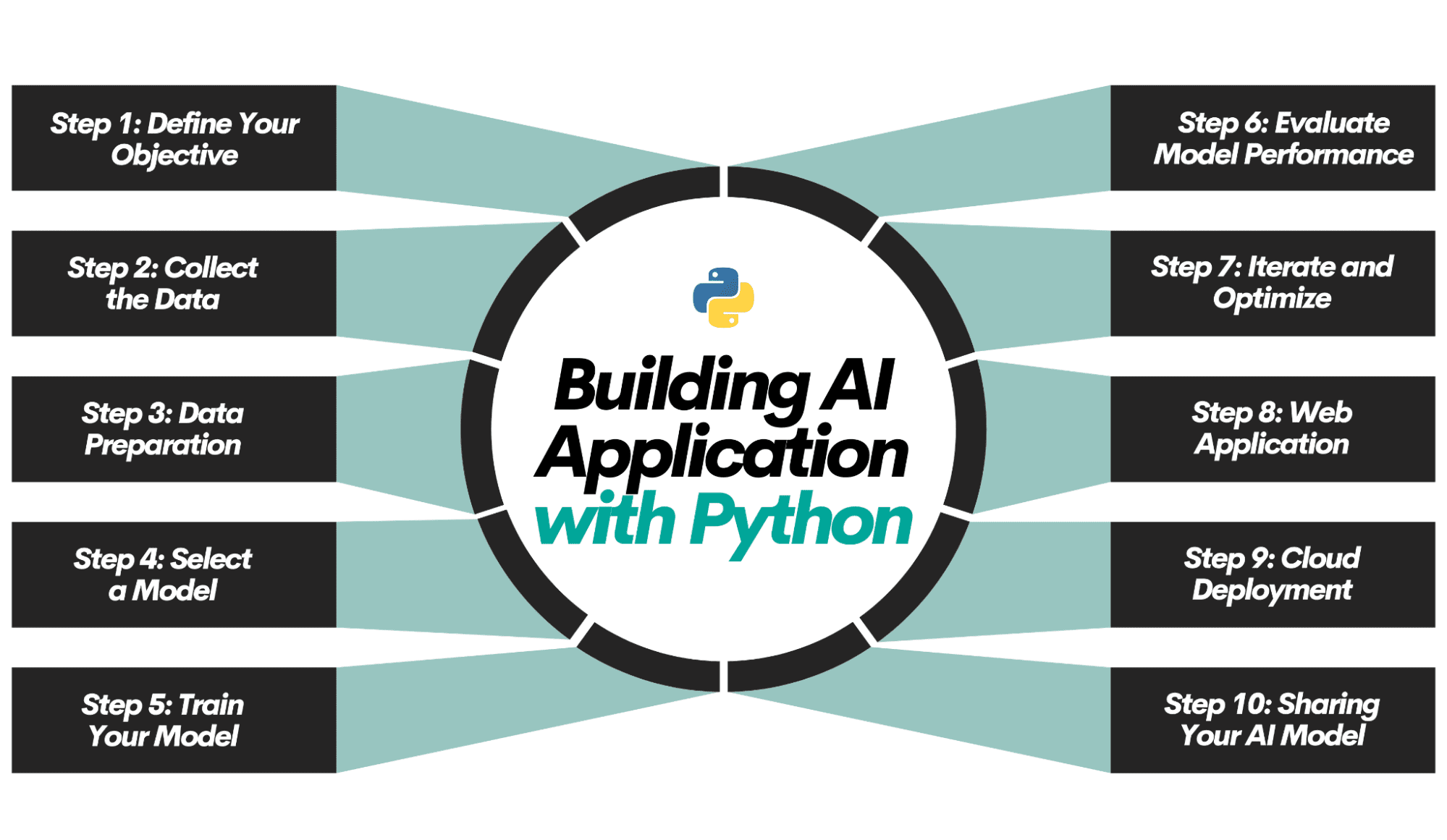
Build An AI Application with Python in 10 Easy Steps Step 1: Define Your Objective

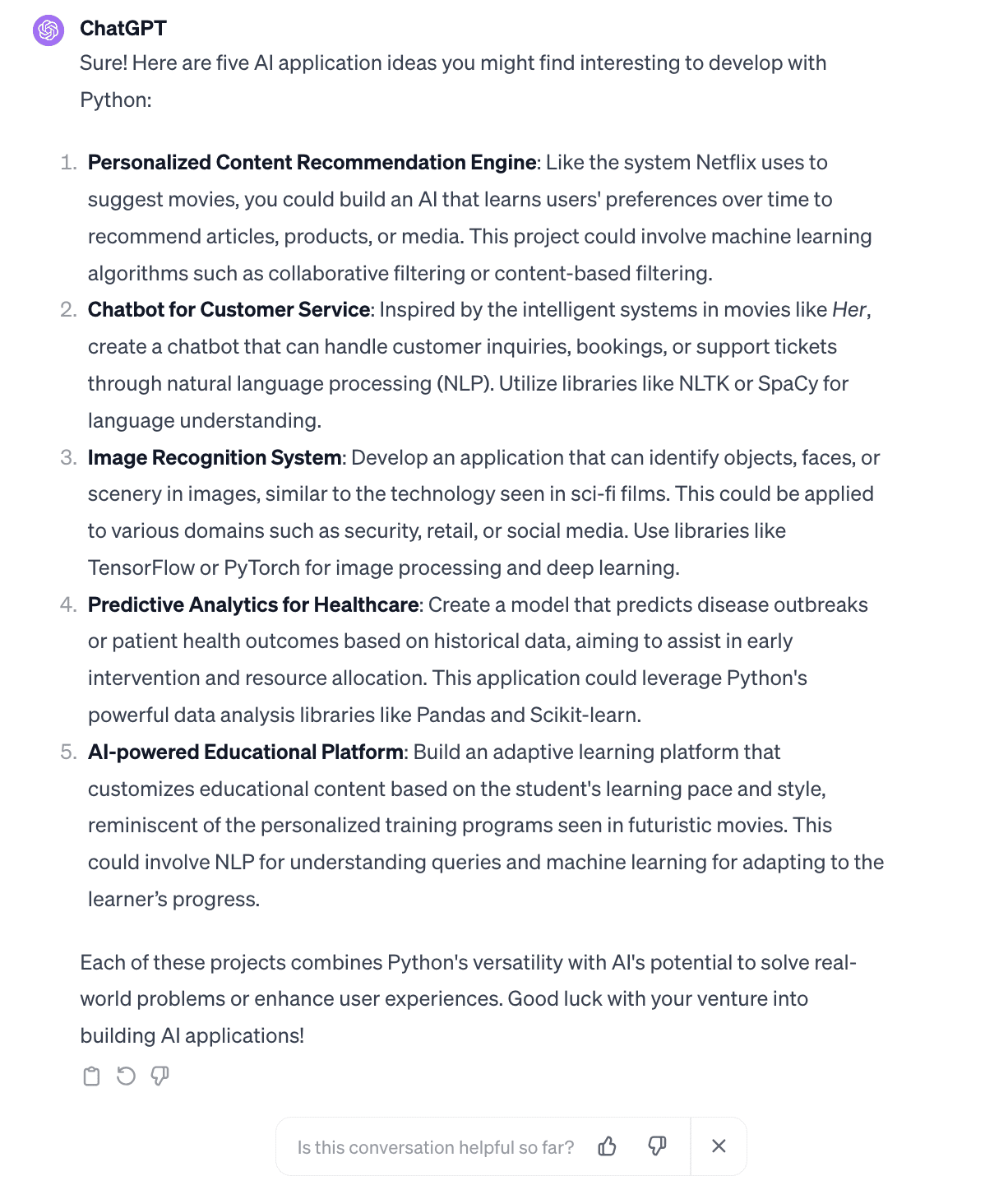
Start by defining the problem you aim to solve with your AI model. This could range from predicting customer behavior to automating a routine task. If you have trouble finding an idea, use ChatGPT or Bard with the following prompt.

Generate 5 ideas about AI Applications that I'll build with Python.

Now, let’s look at ChatGPT’s answer.

Build An AI Application with Python in 10 Easy Steps Step 2: Collect the Data

Now we have options. The next step will be collecting your data. This step includes sourcing datasets from different repos or finding them using different APIs or web scraping. If you are considering using datasets that are clean and processed, you can use the following resources to collect the dataset:

  1. GitHub repositories: It is a platform for developers where millions of developers collaborate on projects.
  2. Kaggle Dataset: A machine learning and data science website that hosts datasets, competitions, and learning resources.
  3. UCL Irvine Dataset: It is a collection of datasets for machine learning research.
  4. Google Dataset Search: It is a search engine for datasets that can be used to search by keyword or location. Here is the link.
  5. AWS Open Data: This program provides access to open data on AWS.

Step 3: Data Preparation

Now you have your goal, and your data is ready. It is time to do your thing. So, the next step will be to prepare your data to apply the model you want. This model can be a machine learning or deep learning model. Either way, there are specific characteristics that your data needs to be:

  1. Clean: This step will be more complicated if you collect data by doing web scraping or using API. You should remove duplicates, irrelevant entries, correct types, handle missing values, and more using methods like imputation or deletion. https://www.stratascratch.com/blog/data-cleaning-101-avoid-these-5-traps-in-your-data/
  2. Formatted Properly: Now, to apply your model, features should be consistent and appropriate. If you have categorical data, they need to be encoded to apply machine learning. Your numerical features should be scaled and normalized to have a better model.
  3. Balanced: Machine Learning needs iteration, which requires steps you must take, like this one. Your dataset should be balanced, which means you have to ensure that the dataset does not favor one class over others to ensure your predictions won't be biased.
  4. Feature Engineered: Sometimes, you should adjust your features to increase your model’s performance. You might remove some features that ruin your model's performance or combine them to improve it. https://www.linkedin.com/posts/stratascratch_feature-selection-for-machine-learning-in-activity-7082376269958418432-iZWb
  5. Split: If you're new to Machine Learning and your model performs exceptionally well, be cautious. In machine learning, some models can be too good to be true, indicating an overfitting issue. To address this, one approach is to split your data into training, testing, and sometimes even validation sets.

https://platform.stratascratch.com/technical/2246-overfitting-problem

Step 4: Select a Model.

Okay, at this step, everything is ready to go. Now, which model you’ll apply? Can you guess which one is the best? Or should you think? Of course, you should have an initial suggestion, but one thing you should do is test different models.

You can choose a model from the following Python libraries:

  1. Sci-kit learn: It is ideal for beginners. You can implement machine learning code with minimal code. Here is the official documentation: https://scikit-learn.org/stable/
  2. Tensorflow: Tensorflow can be great for scalability and deep learning. It allows you to develop complex models. Here is the official documentation: https://www.tensorflow.org/
  3. Keras: It runs on top of TensorFlow, making deep learning more straightforward. Here is the official documentation: https://keras.io/
  4. PyTorch: It is generally preferred for research and development because it is easy to change models on the fly. Here is the official documentation: https://pytorch.org/

Step 5: Train Your Model

Now, it is time to train your model. It involves feeding the data into the model, which allows us to learn from the patterns and adjust its parameters afterward. This step is straightforward.

Step 6: Evaluate Model Performance

You have trained your model, but how can you determine if it is good or bad? Of course, there are various methods for assessing different models. Let's explore a range of model evaluation metrics.

  1. Regression — MAE measures the average magnitude of errors between predicted and actual values without considering their direction. Also, the R2 score can be used.
  2. Classification— Precision, recall, and F1 scores evaluate the classification model's performance.
  3. Clustering: Evaluation metrics here are less straightforward because we usually need true labels to compare with. However, metrics like the Silhouette Score, Davies-Bouldin Index, and Calinski-Harabasz Index are commonly used.

Step 7: Iterate and Optimize

Based on the result, which was collected from Step 6, there are multiple actions you can take. These actions can affect the performance of your models. Let’s see.

  1. Tweaking Hyperparameters: Adjusting the hyperparameters of your model can significantly change its performance. It controls the learning process and structure of the model.
  2. Selecting Different Algorithms: Sometimes, better options might be than your initial model. That's why exploring different algorithms might be a better idea, even if you are already midway through the process.
  3. Adding More Data: More data often leads to a better model. Therefore, adding more data would be a wise choice if you need to improve model performance and have a budget for data collection.
  4. Feature Engineering: Sometimes, the solution to your problem might be out there, waiting for you to discover it. Feature engineering could be the most cost-effective solution.

Step 8: Web Application

Your model is ready, but it needs to have an interface. It is now on the Jupyter Notebook or PyCharm but needs a user-friendly front end. To do that, you need to develop a web application, and here are your options.

  1. Django: It has full features and is scalable but needs to be more beginner-friendly.
  2. Flask: Flask is a beginner-friendly microweb framework.
  3. FastAPI: It is a modern and fast way to build Web applications.

Step 9: Cloud Deployment

Your model could be the best one ever developed. However, you can't be sure if it stays on your local drive. Sharing your model with the world and going live will be good choices for getting feedback, seeing real impacts, and growing it more efficiently.

To do that, here are your options to do that.

1. AWS: AWS offers a larger scale of applications, with multiple options for each action. For example, for databases, they have options you can choose and scale.

  1. Heroku: Heroku is a platform as a service that allows developers to build, run, and operate applications entirely in the cloud.
  2. Pythonanywhere.com: Pythonanywhere is a cloud service for Python-specific applications. It is excellent for beginners.

Step 10: Sharing Your AI Model

There are too many ways of sharing your AI model with the world, but let’s discuss one of the famous and easier ones if you like writing.

  1. Content Marketing: Content marketing involves creating valuable content, such as blog posts or videos, to showcase your AI model's capabilities and attract potential users. To learn more about effective content marketing strategies, check out this.
  2. Community Engagement: Online communities like Reddit allow you to share insights about your AI model, build credibility, and connect with potential users.
  3. Partnership and Collaboration: Partnering with other professionals in the field can help expand the reach of your AI model and access new markets. If you were writing about your app on Medium, try collaborating with the writers who wrote in the same niche.
  4. Paid Advertising and Promotion: Paid advertising channels, like Google Ads or other social media ads, can help increase visibility and attract users to your AI model.

Conclusion

After finishing all the ten steps listed above, it is time to be consistent and maintain your developed application.

In this article, we went through the ten ultimate steps to build & deploy AI Applications with Python.

Nate Rosidi is a data scientist and in product strategy. He's also an adjunct professor teaching analytics, and is the founder of StrataScratch, a platform helping data scientists prepare for their interviews with real interview questions from top companies. Connect with him on Twitter: StrataScratch or LinkedIn.

More On This Topic

  • Writing Your First Distributed Python Application with Ray
  • Creating a Web Application to Extract Topics from Audio with Python
  • Building a Geospatial Application in Python with Google Earth…
  • Easy Synthetic Data in Python with Faker
  • Easy Guide To Data Preprocessing In Python
  • Essential Math for Data Science: Eigenvectors and Application to PCA

There Will Be 10 Million New Coding Jobs in the Next Five Years

There Will Be 10 Million New Coding Jobs in the Next Five Years

In five years, you won’t become redundant, despite the predictions floating around. Ever since ChatGPT was launched, and along came a plethora of code assistant platforms, experts claimed that AI would make programming jobs obsolete, suggesting that everyone will become a coder. While that may be true to some extent, not everyone will end up as a software engineer.

François Chollet, creator of Keras, has made a prediction: “There will be more software engineers (the kind that write code, e.g. Python, C or JavaScript code) in five years than there are today.” He adds that the estimated number of professional software engineers today is 26 million, which would jump to 30-35 million in five years.

Prediction: there will be more software engineers (the kind that write code, e.g. Python or C or JavaScript code) in five years than there are today.
For reference, there's an estimated 26-27M professional software engineers today. In 5 years, it should be between 30M and 35M.

— François Chollet (@fchollet) March 13, 2024

For context, he said that many are currently claiming that people shouldn’t get into computer science because in the future most of the software engineering is going to be done by AI. When Copilot was launched, Microsoft CEO Satya Nadella expressed a similar thought-process when he said that everyone’s a developer. Jensen Huang, too, recently called everybody in the world a programmer.

The world will desperately need software engineers

The latest advancement trending everywhere on the internet is Devin by Cognition Labs. Touted as the first-ever AI software engineer, it has achieved a lot of great benchmarks and is an exponential jump in capabilities, making people debate on social media about the future of programming jobs. Some even call it AGI.

However, the truth is that such AI tools can never replace human intelligence or jobs, only augment them. “Generating working code is only a part of the responsibility,” said VJ’s Insights on a post on X. Though “Yes, if you are someone who *just* writes code, you need to start thinking differently,” he added.

Mark Cuban last year predicted that the highest-paying college major in the world, computer science, will hold very little value for employers in the future. “Twenty years from now, if you are a coder, you might be out of a job,” he said in a podcast.

While it was increasingly looking true that a lot of people would be replaced by AI, the jobs still remain intact.

One of the most important things that OpenAI CEO Sam Altman and Meta AI chief Yann LeCun agree upon is that humans should be trained with AI and use them as copilots. Well, the most-celebrated phrase across 2023 has been, “AI won’t take your job, it’s somebody using AI that will take your job.” And, “you will be 10x more valuable in the coming years”, as Logan Kilpatrick said on X.

Better software, better jobs, more automation

Chollet had also said earlier, “If you could fully automate software engineering (my job), I think that would be great, since I could then move on to higher-leverage things. Making software is a means to an end, not the end.” He adds that software engineering is not just about copy-pasting code, but about developing mental models of problems and their solutions.

The thing is, software engineering is not about copy/pasting code. Software engineering is the development and manipulation of mental models of problems and their solutions. It's thinking and problem solving.
If you had a machine that could craft mental models, you'd have AGI.

— François Chollet (@fchollet) March 12, 2024

“Code is largely worthless, more of a liability than an asset. Problem-solving is where the value is,” Chollet adds in the thread. Some people though disagree that soon AI would be able to do that as well, but Chollet reiterated that it is time to focus on higher-leverage things.

Furthermore, implying that a lot of software engineering jobs would be redundant is dangerous as many students would not know if they should attend college at all.

“We’ll make progress, but we are nowhere close to automating any significant part of an SWE job,” added Santiago in the thread. Automation of code was never about replacing the job of software engineers, but automating the absolute code monkey work that is what 90% of enterprise development consists of.

Besides, AI tools are already on the verge of killing prompt engineering jobs, the ones that were touted as the jobs of the future. Why? Because software engineering is not just about writing or copying code, or giving prompts to AI models, it is much beyond that! The future jobs would probably be called ‘Human Software Engineers’, managing a team of AI engineers.

The post There Will Be 10 Million New Coding Jobs in the Next Five Years appeared first on Analytics India Magazine.

RAG vs Fine-Tuning

RAG vs Fine-Tuning

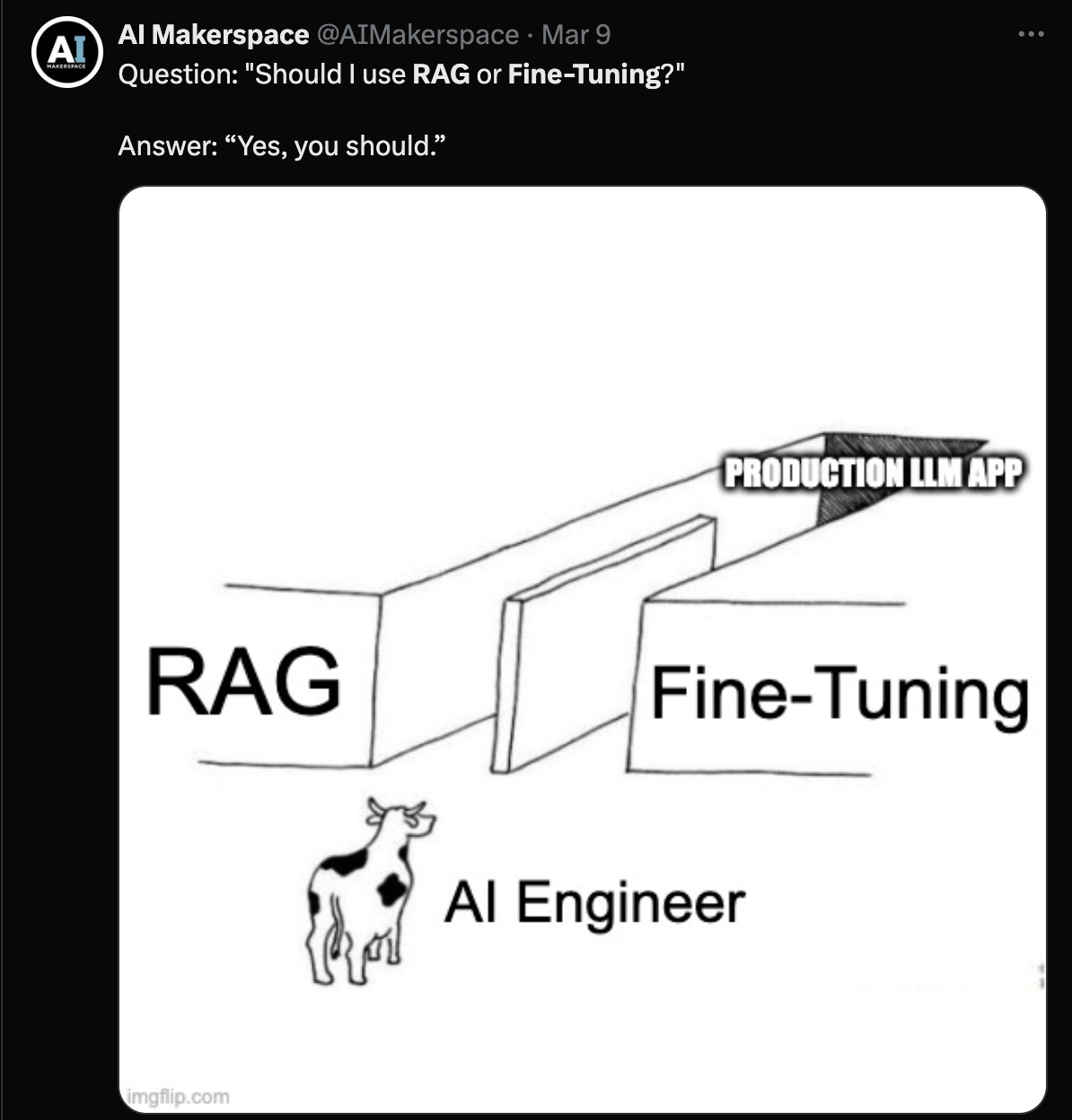
Ever since the technique of retrieval augment generation (RAG) came to the forefront of discussions, people have been wondering about the need to fine-tune AI models on their own data. Since both these methods are meant to improve an LLM’s knowledge with new data, it’s important to know when to use what.

Most people believe that RAG makes more sense when trying to retrieve more information and doing keyword searches, which is true. The problem is that it does not eliminate the need for heavy computing as much as pre-training does, but remains a cheaper alternative.

What do experts say?

Microsoft published a research paper comparing both the techniques during a case study in agriculture. Despite its computational intensity in the retrieval phase, RAG shone in tasks necessitating profound contextual understanding.

Another research paper by Microsoft highlighted that RAG was a more reliable choice regarding knowledge injection, while fine-tuning performed better for brevity and inputting style in the LLM when using synthetic data.

RAG sifts through extensive datasets to extract pertinent context or facts. This contextual repository subsequently informs the sequence-to-sequence model, enhancing the richness and relevance of generated outputs. Despite its computational intensity during the retrieval phase, RAG shines in tasks necessitating profound contextual understanding.

Fine-tuning also demands substantial computational resources, especially when employed on complex models or from scratch.

  • Speed and Latency: RAG experiences slightly higher latency than fine-tuning due to the two-step process but excels in context-heavy tasks. This makes fine-tuning ideal for real-time applications like chatbots.
  • Scalability: The generation component of RAG is scalable; however, the retrieval component may demand substantial computational resources.
  • Performance Metrics: RAG outperforms in accuracy and context richness, particularly for complex tasks requiring external information. Fine-tuning, on the other hand, often exhibits superior performance in specialised tasks, evident through metrics like accuracy and F1 score.

Does RAG actually beat fine-tuning?

Pascal Biese says that fine-tuning is still in the picture, but in terms of efficiency, RAG might be a better choice. “While both methods significantly improved the handling of niche information in question-answering tasks, it was RAG that led the charge, with fine-tuning not far behind,” he said.

Choosing between RAG and fine-tuning hinges on the specific requirements of the application. Factors such as access to external data, the need for behaviour modification, and the dynamics of labelled training data play pivotal roles in this decision-making process. But as experts believe, RAG is outperforming fine-tuning on various LLM applications as the day progresses.

Firstly, access to extensive external knowledge bases leads to more accurate responses. Secondly, incorporating factual external information minimises errors in generated responses, reducing hallucinations and biases. Thirdly, RAG easily adjusts to evolving information, making it ideal for tasks requiring up-to-date knowledge. Additionally, responses traceable to referenced knowledge sources enhance interpretability and transparency, aiding in quality assurance.

Some use cases for RAG systems include accessing current medical documents helping professionals in accurate diagnosis and treatment recommendations. Moreover, RAG models expedite legal document analysis, improving accuracy and efficiency in legal processes, which are some of the use cases.

On the other hand, fine-tuning optimises LLM performance for specific tasks, such as:

  • Pre-train a general-purpose LLM on extensive text and code to learn language patterns.
  • Collect and label a dataset relevant to the desired task.
  • Ensure data quality and consistency by correcting errors and removing duplicates.
  • Modify LLM layers based on task-specific data to optimise performance.
  • Set parameters for fine-tuning to achieve optimal results.
  • Feed reprocessed data to the LLM and train using a backpropagation algorithm.
  • Assess LLM performance on unseen data to ensure desired task completion.
  • Repeat fine-tuning steps to improve performance before deploying the model.

Fine-tuning enhances LLM capabilities for various applications. It improves sentiment analysis by enhancing understanding of text tone and emotion, aiding in accurate analysis of customer feedback. Additionally, it enables LLMs to identify specialised entities in domain-specific text, enhancing data structuring. Moreover, fine-tuning customises content suggestions based on user preferences, fostering engagement.

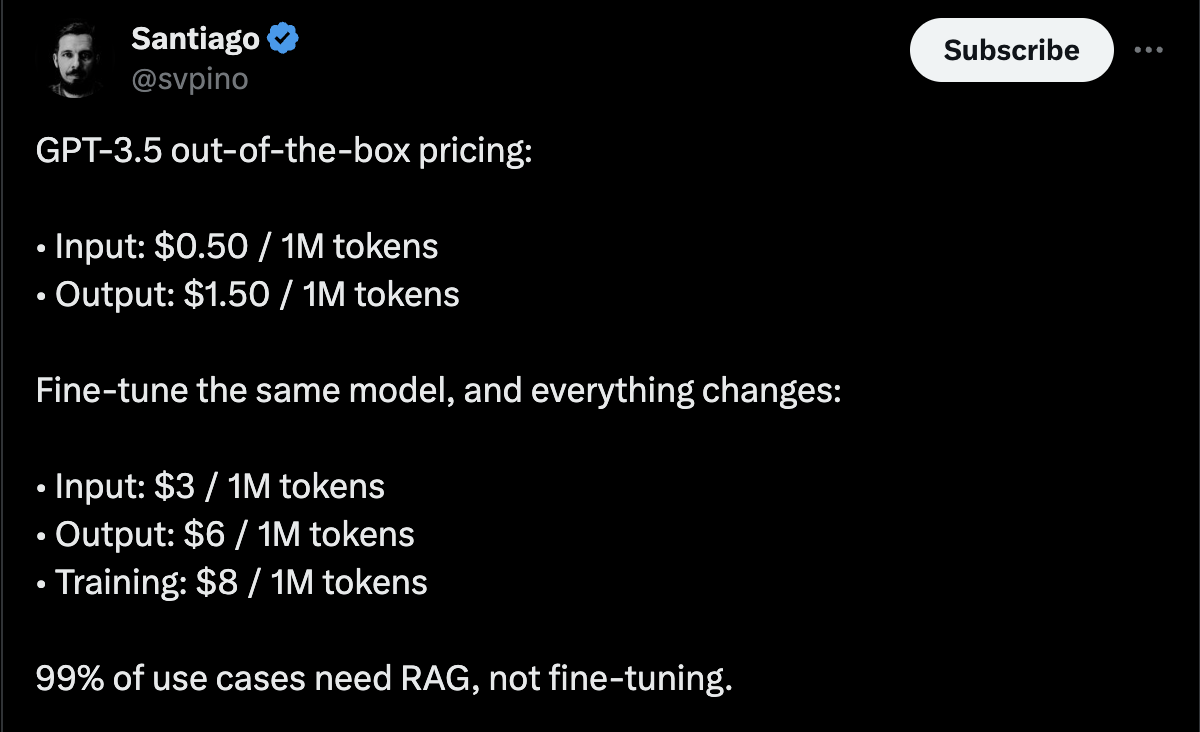
Giving an example of pricing of GPT-3.5, Santiago said, “99% of use cases need RAG, not fine-tuning,” as fine-tuning of the model is more expensive, and both are for different purposes.

The best way forward

A lot of people said that RAG would make fine-tuning obsolete. But it was the same set of people who proclaimed that the launch of LLMs with larger context windows, such as Claude-3, would make RAG obsolete. But both of those are still alive and exist as viable alternatives.

Considerations for choosing between RAG and fine-tuning include dynamic vs static performance, architecture, training data, model customisation, hallucinations, accuracy, transparency, cost, and complexity. Hybrid models, blending the strengths of both methodologies, could pave the way for future advancements. However, their implementation demands overcoming challenges such as computational load and architectural complexity.

While fine-tuning remains a viable option for specific tasks, RAG often offers a more comprehensive solution. With meticulous consideration of nuances and contextual requirements, leveraging RAG augmented by prompt engineering emerges as a promising paradigm.

The post RAG vs Fine-Tuning appeared first on Analytics India Magazine.

Salesforce Anchors Trust in the Generative AI Era

A recent article in Harvard Business Review, titled ‘Why Adopting GenAI is so Difficult’, noted that a wide range of businesses, from large corporations to small enterprises, face challenges in AI integration. It’s not limited to generative AI, but also conventional forms of AI, including rule-based algorithms and machine learning, into their operations.

One of the major reasons for this is the apprehension of using a technology they don’t fully understand. Here it becomes cardinal for enterprises to instil trust in AI among consumers.

While one of the biggest announcements at TrailblazerDX, Salesforce’s developer conference, was Einstein 1 Studio, another prevailing theme of the event was the imperative to establish trust in AI for enterprises.

Numerous Salesforce spokespersons emphasised the significance of cultivating trust in AI among consumers, particularly as Salesforce introduces new AI features into its platform.

Indeed, despite the numerous advantages that LLMs bring, businesses still feel cautious. This hesitation arises from the concern that these models can produce hallucinated and occasionally inaccurate responses and also pose a potential risk of leaking sensitive customer or enterprise data.

Silvio Savarese, Salesforce’s chief scientist, even said that the inability to build consumer “trust could lead to the next AI winter”.

Building Trust in AI

Hence, in an effort to enhance the reliability of LLMs, Salesforce introduced the trust layer last year.

This secure intermediary safeguards user interactions with LLMs by masking personally identifiable information (PII), monitoring output toxicity, ensuring data privacy, preventing the persistence of user data, and prohibiting its use in additional training.

Over time, the CRM company has added different components to improve the trust layer. For example, it is employing another LLM to detect any indications of toxic behaviour, biases, or potentially offensive or harmful content.

Savarese said that they are currently developing a component focused on generating confidence. This component assesses the AI’s certainty in producing a specific output.

“The confidence metric can be employed to consider involving a human in the loop for further verification or evaluation, potentially requiring three to four rounds of scrutiny,” Savarese told AIM during an interaction at the sidelines of TrailblazerDX, held at San Francisco.

He also mentions that another crucial component under development for incorporation into the trust layer is explainability. After the LLM generates the output, the aim is to elucidate how certain outputs are produced, explaining the decision-making process and the steps involved in creating each specific output.

Is it Working?

Despite extensive endeavours to eliminate hallucinations in LLMs, achieving complete success has proven challenging. Nevertheless, enterprises akin to Salesforce have embraced diverse approaches to mitigate or control the levels of hallucinations.

While instilling trust in AI is crucial among consumers, the lingering question is the effectiveness of these efforts. Muralidhar Krishnaprasad, EVP, software engineering at Salesforce, said that in the initial stages of last year, there was considerable fear and uncertainty as people were unfamiliar with LLMs.

“However, the apprehension has somewhat diminished, particularly because stakeholders perceive our trust layers as providing a safeguard, grounding the technology with user data,” Krishnaprasad told AIM.

“Over the past year, there has been a fluctuating trend where confidence has grown, acknowledging the efficacy of the trust layers and ensuring a sense of safety to build further innovations atop the technology,” he added.

Nonetheless, certain regulated industries may still harbour concerns, particularly due to cautious government oversight in these specific areas. But, according to Krishnaprasad, even Salesforce’s public sector clients are showing great interest in AI.

Trusting AI with customer data

Last year, the San Francisco-headquartered company officially launched Data Cloud after announcing it at the previous year’s Dreamforce event.

Data Cloud allows Salesforce customers to bring all their data into one place and harness the power of unified data for enhanced customer insights, personalised engagement, and seamless integration across the Salesforce platform – all with the help of AI.

As customers migrate their data to the cloud, Salesforce must ensure the grounding of LLMs, preventing potential data leaks and mitigating the risk of LLMs generating highly biassed outputs.

Savarese does ensure the absolute safety of bringing customer data to the Salesforce cloud. However, similar to the challenge of hallucinations in LLMs, one cannot entirely rule out the possibility of AI encountering issues in certain instances.

“Salesforce’s business is based on the fact that we take good care of customer data,” he said.

Salesforce also allows customers to use their own data lakes. “In this scenario, we introduce a metadata layer. We don’t host customers’ data but establish a critical layer essential for AI operations. Consequently, the cloud is positioned atop customers’ data lakes.”

Additionally, Savarese emphasises that customer data is strictly excluded from the model training process. The data fed to the models is neither retained nor employed by the model for self-training purposes.

“This framework is a crucial structure not only for our proprietary models but also for third-party vendor models, like the GPT models by OpenAI or the Claude series by Anthropic.”

Einstein 1 Studio

Building trust in AI also becomes crucial with the launch of Salesforce’s new AI offering, the Einstein 1 studio, which has three components. First is Copilot Builder which allows developers to create custom AI actions to accomplish specific business tasks.

“It enables the creation of actions or references to existing actions, which may reside in flow, APEX, etc., and then registers them with the copilot so that the copilot knows what tasks the developers can execute. Additionally, the copilot builder encompasses debugging tools that provide insights into the correctness of the plan,” Krishnaprasad said.

The second component is Prompt Builder, which allows users to build and activate custom prompts in the workflow.

“The prompt builder allows you to create prompts and integrate them with data sourced from CRM or the data cloud. It automatically triggers the LLM, retrieves results, and enables the utilisation of prompts across the platform,” Krishnaprasad explained.

Lastly, the third component of Einstein 1 Studio is Model Builder, where developers can build or import a variety of AI models. Krishnaprasad explained that Model Builder also has three components—one is predictive modelling, where users can create their own predictive models or import existing models from platforms like AWS SageMaker.

“Additionally, users can utilise pre-built models or bring their own LLMs, fine-tuning and customising them for broader usage across the stack. This seamlessly integrates with the Copilot and Prompt Builder functionalities, providing a comprehensive toolset for refining predictive channels,” Krishnaprasad added.

The features are impressive and give Salesforce an edge in the CRM market. Gaurav Kheterpal, CTO, MTX Group, and also a Salesforce Trailblazer, concurs.

“I’ve tested it, and based on what I’ve seen and experimented with using a few small datasets, it appears to perform exceptionally well. Even if the product delivers only half of its claim, it would still be a significant success. Fortunately, they seem well-equipped to handle the surge in demand for generative AI technologies,” he told AIM.

The post Salesforce Anchors Trust in the Generative AI Era appeared first on Analytics India Magazine.

OpenAI’s ChatGPT Now Gets a Humanoid Body

Figure, an AI robotics company that claims to build the world’s first commercially viable autonomous humanoid robot, has made a huge stride by integrating a voice feature to its humanoid, Figure 01; the voice is powered by none other than OpenAI’s ChatGPT.

The video demonstrates the humanoid having conversations with a person and doing tasks as per his instructions. The voice feature is reminiscent of the ‘voice feature’ on ChatGPT, and the robot even stutters in between to give the natural feel of a conversation.With the voice feature, ChatGPT has now got a body.

The neural networks in Figure deliver fast, low-level, dextrous robot actions. The company has said that combining it with OpenAI models, provides high-level visual and language intelligence.

Read: OpenAI Goes After Blue-Collar Jobs

Figure AI, recently raised $675 million in Series B funding, from big tech investors, notably, OpenAI. Microsoft, NVIDIA, Intel Capital, Bezos Expeditions and other VC firms have also invested in this round.

Sam Altman has been extremely optimistic about the future of robotics. “On the physical hardware side, there’s finally, for the first time that I’ve ever seen, really exciting new platforms being built,” he said and added that at some point, they will be able to use their AI models, along with their language and video understanding, to accomplish amazing things with robots.

OpenAI’s collaboration in Figure is not a mere investment, but an effort to develop advanced AI models for humanoid robots too. The software and conversational capabilities are contributed by OpenAI. Now, with a physical embodiment of ChatGPT, Figure becomes the first humanoid manufacturing company to bring a voice to their robots.

Tesla’s Optimus and Boston Dynamics’s Atlas have also not achieved this feat. Also, this probably explains the reason for the recent lawsuit filed by Elon Musk against OpenAI.

Furthermore, with AGI conversations popping up every two weeks, the latest demo of Figure 01 has definitely raised a lot of questions about whether robotics is the path to AGI – a race, every big tech is vested in.

Source: X

The post OpenAI’s ChatGPT Now Gets a Humanoid Body appeared first on Analytics India Magazine.

Meet the Creator of Devin, A Child Prodigy Who is Making Coding Obsolete

Before you have any questions, it’s worth noting that Scott Wu, the brilliance behind Devin – touted as the most capable autonomous coding agent – is a human. The demo video of Devin, released by Cognition Labs, introduces Wu as a ‘Human Software Engineer’, prompting viewers to ponder if he truly is human, especially after watching the childhood videos of him acing math quizzes.

“I first learned to program when I was nine years old and fell in love with the ability to turn my ideas into reality. Teaching AI to code at Cognition Labs has been a dream come true,” said Wu on X, while announcing Devin.

Source: X

Wu, along with its two co-founders Steven Hao, the CTO, and Walden Yan, the chief product officer, founded Cognition in November 2023. The startup calls itself an ‘AI lab focused on reasoning’, and claims that ‘code is just the beginning’.

Child Prodigy

Wu, 27, studied economics at Harvard University, after which he moved to San Francisco to start his own company. However, the story of his rare brilliance began when he was a little child.

As a child, Wu participated in many math competitions, and aced them all with ease. Post the Devin announcement, various people shared their experience of having witnessed Wu as a child math whizz and programming genius.

Source: X

As a competitive programmer, Wu has been winning competitions on the programming platform Codeforces for years. As participants, one can compete in various coding contests, solving algorithmic problems and improving their programming skills on Codeforce.

Wu has gained the title of a ‘legendary grandmaster’ on the platform.

Source: Codeforces

Prior to founding Cognition AI, Wu built another company called Lunchclub, which was backed by Lightspeed, Coatue and a16z. Wu served as its CTO and co-founder. Lunchclub is an AI superconnector that facilitates introductions for 1:1 video meetings.

Building Team with Coding Champions

While Wu’s genius sounds unparalleled, his brother is not far behind. Scott Wu’s older brother Neal Wu, who is also building Cognition Labs, has been participating with Scott in coding competitions since they were teenagers.

The brothers are also math legends winning nationals several times during their school. A partner at Founders Fund, Delian, enthusiastically posted that he witnessed the brothers win nationals when he was in middle school, and said that he was excited about the model.

Neal has worked in a number of big-tech companies including Facebook and Google Brain. He has also worked as a head teaching fellow at Harvard University.

Cognition AI received $21 million from Peter Thiel’s VC firm, Founders Fund. The small founding team boasts 10 IOI gold medals, which is the ‘International Olympiad in Informatics’, a prestigious competitive programming competition for secondary schools students.

The highly-talented team members have previously worked with Google DeepMind, Cursor, ScaleAI, and other tech companies.

The Cognition Labs team, with Scott Wu (back row, 3rd from right) and brother Neal Wu (front row, 2nd from left). Source: Bloomberg

Scott believes that the proficient background of his team gives the startup an edge over its competitors. “It’s almost like this game that we’ve all been playing in our minds for years, and now there’s this chance to code it into an AI system,” he said.

The post Meet the Creator of Devin, A Child Prodigy Who is Making Coding Obsolete appeared first on Analytics India Magazine.
This free tool from Anthropic helps you create better prompts for your AI chatbot

Anthropic Prompt Library

Despite AI chatbots being capable tools, they require human direction to reach their full potential. That's why AI prompting is a vital skill for users to master — and Anthropic has a free tool to make doing so a bit easier.

Anthropic, best known for its Claude chatbot, has a free prompt library, which includes prompts for various use cases, ranging from very technical to lighthearted and fun. All you have to do is click on the use case you are interested in and then copy and paste the prompt into your chatbot of choice.

Also: I tried Copilot Notebook: Microsoft's new AI tool offers two handy prompt features

For example, the library has a prompt called "Corporate clairvoyant" with a description that reads, "Extract insights, identify risks, and distill key information from long corporate reports into a single memo."

Click on the prompt and you're presented with a sample prompt with empty fields. You then copy and paste the prompt into a chatbot and fill in the empty fields. In the use case above, the prompt reads:

Your task is to analyze the following report:
<report>
[Full text of Matterport SEC filing 10-K 2023, not pasted here for brevity]
</report>

Summarize this annual report in a concise and clear manner, and identify key market trends and takeaways. Output your findings as a short memo I can send to my team. The goal of the memo is to ensure my team stays up to date on how financial institutions are faring and qualitatively forecast and identify whether there are any operating and revenue risks to be expected in the coming quarter. Make sure to include all relevant details in your summary and analysis.

Underneath the sample prompt, the library also shows an example output, which helps you visualize what you would receive from Claude if you were to enter that exact prompt into the chatbot, as seen below.:

Even though these tools are geared towards getting the most out of Claude, they can be used across other chatbots as well. The only caveat is that you must ensure the other chatbot you input the prompt into has the same capabilities.

Also: How to write better ChatGPT prompts in 5 steps

For instance, the prompt above relies on the chatbot's capability to access a link, so you would have to make sure that the other chatbot you use can also access links.

When I entered the prompt into ChatGPT, I got a similar result to Claude's example output because of the effectiveness and detail of the prompt:

It is also worth highlighting that some prompts, like "Storytelling sidekick", have a system prompt and a user prompt listed, as seen below:

In Claude, the system prompt helps instruct the chatbots on their task and explains what rules they should follow when answering the user prompt. This approach is similar to ChatGPT's custom instructions. So, if you're using the prompt for those chatbots, enter the system prompt in the fields.

Also: How to use ChatGPT to write code

If you're using a chatbot that doesn't have a field designation, you can enter the system prompt in the text field before entering the user prompt to get the same results.

Viewing the different prompts in the library can also help you understand how to format your prompts and discover what important information will help make your prompt most effective.

Artificial Intelligence

Neo4j Collaborates with Andrew Ng for a Free Course on Knowledge Graphs for RAG

Andrew Ng’s DeepLearning.AI has developed a free short course called Knowledge Graphs for RAG, collaborating with Neo4j, the king of graph databases. The course provides an intermediate-level exploration of knowledge graphs specifically tailored for Retrieval Augmented Generation (RAG).

The one-hour course, led by instructor Andreas Kollegger, who handles developer relations for Generative AI at Neo4j, is free for a limited time.

What will you learn?

Participants will learn to use Neo4j’s Cypher query language to manage and retrieve data stored within knowledge graphs.

Moreover, they will learn the fundamentals of knowledge graph data storage, employing nodes to signify entities and edges to denote interrelations. Practical exercises entail using Cypher to extract data from a sample movie and actor graph. Additionally, attendees will learn to integrate vector indexing for unstructured text data, enabling efficient text retrieval based on similarity metrics.

Through practical exercises, they will develop skills in crafting queries that manipulate text data to furnish more pertinent context for LLMs in RAG applications.

They will also build a question-answering system employing Neo4j and LangChain, enabling interaction with a knowledge graph comprising structured text documents.

This course is recommended for individuals seeking to comprehend knowledge graph mechanics, construct RAG applications, and amplify their data analytics capabilities. It will be an added advantage if you are already familiar with LangChain or have completed the course “LangChain: Chat with Your Data”.

The curriculum throws light on the importance of knowledge graphs in organising intricate data relationships, facilitating intelligent search capabilities, and empowering AI applications to reason across diverse data formats.

Unlike conventional databases, knowledge graphs adeptly capture contextual nuances, enabling the uncovering of intricate insights and connections.

Databases or data structure servers form the backbone of generative AI, powering its capabilities. Amidst this revolution, Neo4j takes a strategic approach, playing the long game – i.e. building trust in generative AI. “We provide fuel for generative AI companies in the form of high-quality, structured graph data,” said Dr Jim Webber, chief data scientist, Neo4j, told AIM at their Annual Graph Summit 2023.

Neo4j said it provides graph data on which large language models can be trained. Over time, knowledge graphs have become vital for organising and accessing enterprise data across industries. Today, Neo4j is pivotal in helping enterprises integrate LLMs to enhance data handling. They’re focusing on two use cases: developing a natural language interface for knowledge graphs and creating knowledge graphs from unstructured data.

The post Neo4j Collaborates with Andrew Ng for a Free Course on Knowledge Graphs for RAG appeared first on Analytics India Magazine.
Google DeepMind Unveils SIMA, a General, Instructable Game-Playing AI Agent

Building on the success of AlphaStar, Google DeepMind has introduced the Scalable Instructable Multiworld Agent (SIMA), a generalist AI agent for 3D virtual settings. The versatile AI system can execute tasks in diverse video game environments based on natural-language instructions, presenting a shift towards a generalized approach in AI gaming research.

Read the full paper here.

Training Method

SIMA has been trained across multiple games, including collaborations with eight game studios, and tested on nine different video games, such as No Man’s Sky by Hello Games and Teardown by Tuxedo Labs. Each game in SIMA’s portfolio opens up a new interactive world, including a range of skills to learn, from simple navigation and menu use to mining resources, flying a spaceship, or crafting a helmet.

Google DeepMind has also partnered with four research environments, including a new environment built with Unity called the Construction Lab. In this environment, agents must build sculptures from building blocks, testing their object manipulation and intuitive understanding of the physical world.

The agent encompasses pre-trained vision models and a central model equipped with memory, which interprets images and language inputs to generate keyboard and mouse actions for gameplay.

SIMA’s performance relies on language

SIMA’s evaluation across 600 basic skills demonstrates proficiency in navigation, object interaction, and menu use, focusing on tasks achievable within short durations. Unlike specialised agents trained for individual games, SIMA performs better by generalising knowledge across multiple environments and shows competence in unseen games.

The agent’s reliance on language proficiency is evident in controlled tests where language inputs significantly influence behaviour. SIMA’s ability to follow instructions is assessed through nearly 1500 unique in-game tasks, with human judges contributing to evaluations.

SIMA’s development aims to pioneer a new breed of generalist AI agents driven by language input, facilitating their utility across diverse tasks both online and in real-world scenarios.

While early-stage, this research lays the groundwork for future enhancements in AI systems. It aims to bridge the gap between virtual environments and practical applications, ultimately fostering more helpful and adaptable AI solutions.

The post Google DeepMind Unveils SIMA, a General, Instructable Game-Playing AI Agent appeared first on Analytics India Magazine.