Mechanics of the future: Meet the specialists assembling AI

mechanics-buildinggettyimages-1186091151

Artificial intelligence and machine learning are bursting at the seams, expanding well beyond the bounds of IT departments and specialties. The future belongs to those professionals — both technical and business — who see and understand how AI will support the progress of the entire business.

In short, technologists need to become business leaders, and business leaders need to become technologists.

Also: 5 ways to prepare for the impact of generative AI on the IT profession

That's the word in a new consensus report that synthesizes the views of leading futurists from around the world, published by Tata Consultancy Services (TCS).

"AI will ultimately drive technology professionals to speak the language of business, and vice versa," prediccted Alexandra Whittington, a TCS futurist and co-author of the report. Technology professionals who "were previously only skilled in technical matters will feel a greater need to develop a baseline understanding of other business functions, from HR to legal, in order to be effective in the future," she added.

(Noteworthy: The study's co-authors employed generative AI to add analysis and draft the study, "with close supervision and collaboration with TCS futurists.")

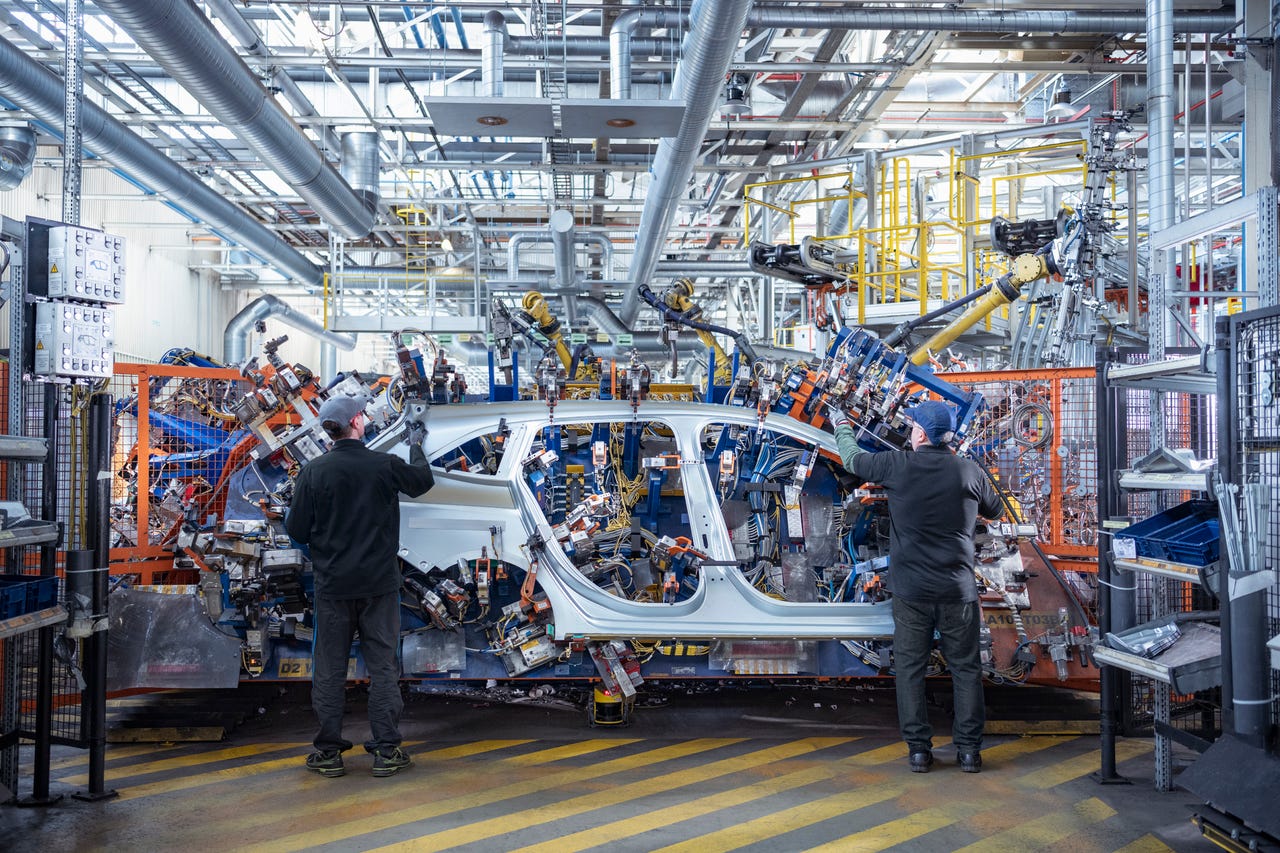
Future technology careers "will focus on cross-discipline knowledge and integration," Ashok Krish, the global head of AI for TCS, said in the report. "Professionals will need to look across a set of technologies holistically and understand how to stitch it all together — like a mechanic who is not an expert at one individual function of a car but knows how everything fits together to make it work and perform optimally."

Thus, the technology and businesspeople assembling AI-based solutions are, in short, "mechanics of the future," Whittington agreed. As AI is adopted, organizations "democratize access to technology, with the need for human oversight and strategic implementation remaining. These mechanics of the future will specialize in the ability to see and understand how the underlying technology is supporting the entirety of the business — how different platforms and systems stitch together."

Also: Workers with AI skills can expect higher salaries — depending on their role

A recent New York Times article echoed this theme. "Technical and data skills that have been highly sought after for decades appear to be among the most exposed to advances in artificial intelligence," Aneesh Raman, workforce expert at LinkedIn, and Maria Flynn, president of Jobs for the Future, wrote. "But other skills, particularly the people skills that we have long undervalued as soft, will very likely remain the most durable. That is a hopeful sign that AI could usher in a world of work that is anchored more, not less, around human ability."

A hybrid blend of technical and business skills is needed by this next generation of tech roles. "Skills like critical thinking, problem-solving, and understanding complex systems" are coming to the forefront, Brian Neuhaus, Americas chief technology officer at Vectra AI, said. "Essential knowledge in network security, system architecture, and computer science fundamentals, along with soft skills such as leadership and project management, remain indispensable."

"AI and ML's ability to drive efficiency and streamline a plethora of job functions and tasks spanning industries holds immense power in revolutionizing the workforce," Neuhaus said. "It is not that skills are being eliminated by AI and ML; rather, the technology is helping to simplify and facilitate current skills and operations so that professionals have more time to focus on other tasks that are imperative to their organization."

Also: Beyond programming: AI spawns a new generation of job roles

Neuhaus continued, "the automation potential of AI and ML in organizations is promising, particularly for repetitive, data-intensive tasks like data entry and skills like basic coding, and aspects of network management. Traditional IT roles risk obsolescence without adaptation to AI/ML integration, so it is not a matter of what skills will be usurped or eliminated by AI/ML, but rather what skills can AI/ML augment to avoid IT and technology roles from becoming outmoded."

Technology executives across industries agree that tech professionals need to think in terms of serving as either consultants, innovators, or leaders to the business. "It's important to think of AI as a way to augment human capabilities — not replace them," Fredrik Nilsson, VP of the Americas at Axis Communications, said. "Real-life AI applications involve working with companies to help them become more productive."

"To stay relevant in any labor market, it's important to always be learning and ensure you are prepared to leverage today's latest tools," Nilsson said. "Just like the advent of computers led to programs such as Microsoft Word and Excel spreadsheets — not to mention tools like CAD — automation and AI have become a part of everyday life. Remaining competitive in the workforce required employees to educate themselves on how to use those programs effectively. AI is no different. A willingness to learn will continue to be the most important skill in almost any industry."

Also: 5 ways to prepare for the impact of generative AI on the IT profession

The roles of engineers aren't going away anytime soon, "but they will most likely spend less time coding and more time on tasks like collaboration and communication," Raman and Flynn said. "We also believe that there will be new categories of jobs that emerge as a result of AI's capabilities — just like we've seen in past moments of technological advancement — and that those jobs will probably be anchored increasingly around people skills."

Artificial Intelligence

LXT’s Report ‘The Path to AI Maturity 2024’: Unmasking the Future of AI Innovation and Corporate Transformation

In an era where artificial intelligence (AI) transcends the boundaries of imagination, shaping the very core of how businesses innovate and compete, LXT's groundbreaking report, “The Path to AI Maturity,” stands as a beacon for corporate leaders and innovators alike. This meticulously crafted executive survey not only charts the accelerated journey of AI integration across industries but also illuminates the transformative shifts towards operational excellence and the rising tide of generative AI technologies.

As we delve into this comprehensive analysis, it becomes evident that the landscape of AI underwent a pivotal transformation following the launch of ChatGPT in November 2022. This momentous event catalyzed an industry-wide metamorphosis. Enterprises are not just adopting AI; they are embedding it into their very DNA, evolving from mere experimenters to architects of a future where AI is not an adjunct but a fundamental driver of innovation, efficiency, and competitive advantage.

Through the lens of LXT's survey—encompassing insights from senior executives of mid-to-large U.S. organizations—we uncover the nuanced realities of AI investment, the strategic imperatives driving AI adoption, and the ethical considerations that underpin its deployment. The report navigates the complexities of achieving AI maturity, underscoring the challenges and benefits of deploying this technology.

5 Levels of AI Maturity

Drawing upon the insights of senior executives from mid-to-large U.S. organizations, the report delves into the evolving landscape of AI maturity, segmented into five critical levels that map the journey of AI adoption and integration:

  1. Level 1: Awareness – Marking the initial curiosity and conversations around AI, where organizations begin to explore the possibilities AI offers.
  2. Level 2: Active – At this stage, companies embark on experimentation and pilot projects, testing AI in real-world applications to gauge its potential.
  3. Level 3: Operational – AI transitions from experimental to production environments, creating value for organizations by enhancing efficiency and effectiveness in at least one workflow.
  4. Level 4: Systemic – AI's presence is amplified across the majority of workflows and operations, inspiring new digital business models and fundamentally changing how businesses operate.
  5. Level 5: Transformational – AI becomes inherent in the business's DNA, driving innovation, decision-making, and strategic initiatives across the organization.

The report reveals that the aftermath of ChatGPT's introduction has significantly accelerated the transition of companies from the “Active” stage to the “Operational” stage of AI maturity. This progression underscores a 24% year-over-year increase in enterprises evolving from “Experimenters” to “Maturing” organizations, highlighting the strategic focus on AI across the U.S. enterprise spectrum.

Another noteworthy leap observed in the report is the considerable increase in companies advancing to the Operational stage, where AI is not just an experimental technology but is actively creating value in production environments. This year, a remarkable 32% of surveyed organizations have reached the operational stage, indicating a robust engagement with AI technologies that directly contribute to organizational efficiency and productivity.

Main Findings

The transformative journey towards AI maturity is captured and reveals a compelling narrative of growth and integration within enterprises. It also reveals the struggles that enterprises face when attempting to integrate AI.

  • A striking 66% of organizations are investing over $1M annually in AI, showcasing a substantial commitment to AI technologies, with half of these investments ranging between $1M and $50M. This financial dedication underscores the growing recognition of AI as a pivotal driver of business innovation and efficiency.
  • Remarkably, 72% of surveyed organizations have ascended to the highest levels of AI maturity, marking a 24% increase from the previous year. Among these, 19% have integrated AI so deeply into their operations and culture that it has become part of the organization's DNA, a testament to the transformative power of AI in redefining business paradigms.
  • In a shift of strategic focus, risk management has emerged as the primary driver for AI implementation, overtaking last year's leading motivator, business agility. This transition highlights the increasing importance of AI in enhancing organizational resilience and navigating uncertainties.
  • Among AI technologies, search engines, speech & voice recognition, and computer vision lead in deployment across industries, illustrating the diverse applications of AI in enhancing user interaction, processing information, and interpreting visual data.
  • In terms of return on investment (ROI), predictive analytics and search engines stand out, followed closely by computer vision and conversational AI. These findings indicate the significant impact of AI in forecasting trends, optimizing search capabilities, and facilitating human-computer interactions.
  • Generative AI has risen in significance, now regarded as more crucial than other AI initiatives by organizations. This reflects the cutting-edge potential of generative AI in creating new content, ideas, and solutions, thereby driving innovation forward.
  • When deploying generative AI, security and privacy concerns, along with the accuracy of output, emerge as the primary bottlenecks, highlighting the challenges in ensuring the trustworthiness and reliability of AI-generated content.
  • The demand for high-quality training data is intensifying, with 66% of respondents anticipating an increase in their training data needs over the next two to five years. This underscores the critical role of data in training more sophisticated and accurate AI models.
  • Finally, AI strategy and training data constitute the largest allocations within AI budgets, signifying the strategic emphasis on laying a robust foundation for AI initiatives through comprehensive planning and quality data resources.

Data Trends

For most enterprises engaged in AI projects, the quality of data holds precedence over its quantity. Over 60% of those surveyed emphasized that data quality crucially impacts the success of AI initiatives, aligning with the growing trend towards data-centric AI. This approach, which prioritizes the careful preparation and management of data, is becoming increasingly recognized for its importance in building effective AI systems.

Regarding the types of data utilized for training AI models, there's been a shift towards a more balanced use of annotated and synthetic data. Unlike previous findings where annotated data was predominantly used, the current landscape shows an equal preference for both data types among enterprises. This adaptability in data sourcing is crucial for training diverse and robust machine learning models.

The demand for quality training data is not only persistent but expected to rise in the coming years. A majority of respondents anticipate an increase in their data requirements within the next two to five years, with a mere 3% predicting a decrease. Particularly, organizations in the early stages of their AI journey — those in the Active and Awareness levels — express a significant need for expanding their training data repositories to fuel their AI advancements

Summary

The year 2023 has firmly established itself as a pivotal moment for artificial intelligence, underscoring its critical importance for businesses across the board. The insights gleaned from this report reveals a rapid acceleration in AI adoption, with a notable 32% of enterprises reaching the Operational stage, where AI not only exists but thrives, creating tangible value. The emergence of generative AI as a key focus, with nearly 70% of organizations emphasizing its significance over other AI endeavors, highlights the increasing reliance on AI as a foundational element for maintaining competitive edge in today's market dynamics.

Investment in AI has been substantial, with 50% of organizations allocating up to $50 million towards AI initiatives, and an additional 13% earmarking budgets ranging from $50 million to $500 million. Significant portions of these investments are directed towards AI strategy (17%), training data (15%), compliance controls (12%), and hardware (12%), signaling a strategic pivot towards quality-driven, data-centric AI development as businesses evolve in their AI maturity journey.

As the AI landscape continues to unfold at a brisk pace, it's imperative for companies to stay abreast of these developments to leverage AI's transformative potential effectively. For those seeking to delve deeper into the findings and navigate the complexities of AI integration, “The Path to AI Maturity” report serves as an invaluable resource.

Andrew Ng Unveils Free Course on Knowledge Graphs for RAG with Neo4j

Andrew Ng’s DeepLearning.AI recently a free short course called Knowledge Graphs for RAG, collaborating with Neo4j, the king of graph databases. The course provides an intermediate-level exploration of knowledge graphs specifically tailored for Retrieval Augmented Generation (RAG).

The one-hour course, led by instructor Andreas Kollegger, who handles developer relations for Generative AI at Neo4j, is free for a limited time.

What will you learn?

Participants will learn to use Neo4j’s Cypher query language to manage and retrieve data stored within knowledge graphs.

Moreover, they will learn the fundamentals of knowledge graph data storage, employing nodes to signify entities and edges to denote interrelations. Practical exercises entail using Cypher to extract data from a sample movie and actor graph. Additionally, attendees will learn to integrate vector indexing for unstructured text data, enabling efficient text retrieval based on similarity metrics.

Through practical exercises, they will develop skills in crafting queries that manipulate text data to furnish more pertinent context for LLMs in RAG applications.

They will also build a question-answering system employing Neo4j and LangChain, enabling interaction with a knowledge graph comprising structured text documents.

This course is recommended for individuals seeking to comprehend knowledge graph mechanics, construct RAG applications, and amplify their data analytics capabilities. It will be an added advantage if you are already familiar with LangChain or have completed the course “LangChain: Chat with Your Data”.

The curriculum throws light on the importance of knowledge graphs in organising intricate data relationships, facilitating intelligent search capabilities, and empowering AI applications to reason across diverse data formats.

Unlike conventional databases, knowledge graphs adeptly capture contextual nuances, enabling the uncovering of intricate insights and connections.

Databases or data structure servers form the backbone of generative AI, powering its capabilities. Amidst this revolution, Neo4j takes a strategic approach, playing the long game – i.e. building trust in generative AI. “We provide fuel for generative AI companies in the form of high-quality, structured graph data,” said Dr Jim Webber, chief data scientist, Neo4j, told AIM at their Annual Graph Summit 2023.

Neo4j said it provides graph data on which large language models can be trained. Over time, knowledge graphs have become vital for organising and accessing enterprise data across industries. Today, Neo4j is pivotal in helping enterprises integrate LLMs to enhance data handling. They’re focusing on two use cases: developing a natural language interface for knowledge graphs and creating knowledge graphs from unstructured data.

The post Andrew Ng Unveils Free Course on Knowledge Graphs for RAG with Neo4j appeared first on Analytics India Magazine.

Statistics for Machine Learning: What you need to know to become a certified expert

Sponsored Content

Statistics for Machine Learning: What you need to know to become a certified expert

What roles and skills are needed in Statistics for Machine Learning?

The most effective professionals in machine learning have a strong base in statistical thinking. Successful candidates understand how statistics and machine learning models are interrelated, and how to apply these concepts to large and complex business data through an interactive modeling approach. Roles that may benefit from this certification are entry level to senior data analysts, and quantitative analysts. This certification provides an important foundation to people preparing to take the Machine Learning Specialist certification exam.

Statistics for Machine Learning: What you need to know to become a certified expert

Here’s how to become a SAS Certified Specialist in Statistics for Machine Learning

SAS Certified Specialist: Statistics for Machine Learning is made up of two associate level certifications.

SAS Certified Associate: Applied Statistics for Machine Learning

This certification is one half of the equation that will help you become a SAS Certified Specialist in Statistics for Machine Learning. You’ll want to master these skills before you take the exam (don’t worry, we can help with this.).

  • Statistics and Machine Learning
  • Fundamental Statistical Concepts
  • Explanatory Modeling Using Linear Regression
  • Predictive Modeling Using Logistic Regression
  • Statistical Foundations of Machine Learning

Not sure if you're ready? Take a SAS training course to sharpen your skills: Statistics You Need to Know for Machine Learning

SAS Certified Associate: Modeling Using SAS Visual Statistics

This credential is the other half of the equation that will earn you a SAS Certified Specialist in Statistics for Machine Learning. You’ll want to master these skills before you take the exam:

  • Build and explore descriptive models.
  • Build and explore predictive models with continuous and categorical targets.
  • Perform model validation.
  • Assess model goodness of fit.
  • Modify and compare models
  • Score models

Not quite ready for an exam? Take this training course to help you prepare: SAS® Visual Statistics in SAS® Viya®: Interactive Model Building

Here's some steps to help you prepare

First, read more details about the SAS Certified Specialist: Statistics for Machine Learning certification. View the Exam Content Guides for both SAS Certified Associate: Applied Statistics for Machine Learning and SAS Certified Associate: Modeling Using SAS Visual Statistics to see exam objectives and details about the most important topics. You’ll also see training courses you can take to sharpen your skills and a free practice exam to test your knowledge before sitting for the exam.

When you’re ready to register, you’ll need to create an account (or access your existing account) through the SAS certification manager. From there you’ll single-sign on to the Pearson VUE registration system (the SAS exam Delivery provide) to schedule your exam.

Once you’ve earned both Associate level certifications, you’ll become a SAS Certified Specialist in Statistics for Machine Learning.

Resources to Prepare for Your Exam

  • Exam Prep Resources
  • Free Practice Exams
  • Explore more SAS Certifications and the SAS Global Certification Program

Why Get SAS Certified? If you’re still on the fence about whether you should earn a SAS certification, learn how this qualification can enhance your professional career and see how other like-minded individuals put their certification to work for them.

More On This Topic

  • Everything you need to become a SAS Certified Machine Learning Engineer
  • Everything you Need to Become a SAS Certified Data Scientist
  • ModelOps: What you need to know to get certified
  • KDnuggets News, April 13: Python Libraries Data Scientists Should…
  • Free Mastery Course: Become a Large Language Model Expert
  • Important Statistics Data Scientists Need to Know

Cerebras Systems and G42 Rushes Ahead in Supercomputer Race with Condor Galaxy 3

The American AI company Cerebras Systems and G42, an Abu Dhabi-based AI holding company, have announced the development of Condor Galaxy 3 (CG-3), the latest addition to their AI supercomputing constellation. It features 64 of Cerebras’ newly launched CS-3 systems, all powered by the cutting-edge Wafer-Scale Engine 3 (WSE-3), CG-3 is set to deliver 8 exaFLOPs of AI computing power. It will be available in Q2 2024.

“The existing Condor Galaxy network has trained some of the leading open-source models in the industry, with tens of thousands of downloads. By doubling the capacity to 16 exaFLOPs, we look forward to seeing the next wave of innovation Condor Galaxy supercomputers can enable,” said Kiril Evtimov, Group CTO of G42.

CS-3 is the latest AI chip with 4 trillion transistors that was also unveiled by Cerebras Systems. The WSE-3 delivers twice the performance at the same power and for the same price as the previous generation part, where the WSE-3 delivers 125 petaflops of peak AI performance per chip.It has been designed for training the industry’s largest AI models.

The latest announcement comes after last November when the company announced the 2nd phase of the supercomputer called Condor Galaxy 2. Condor Galaxy has been powering generative AI models including the Arabic model Jais-30B. The latest CG-3 is only going to further push AI supercomputing innovations.

G42’s Rapid Expansion

While this announcement marks their 3rd supercomputer, the company has been spearheading the AI race with its hardware. Last year, the company partnered with OpenAI. The company also partnered with Microsoft to boost cloud and technology infrastructure in the UAE. G42 is also expanding in India by building a team that is spearheaded by former Xiaomi head Manu Kumar Jain.

The post Cerebras Systems and G42 Rushes Ahead in Supercomputer Race with Condor Galaxy 3 appeared first on Analytics India Magazine.

How work devices may evolve to keep up in the AI era

Microsoft Surface Laptop Go 3

The emergence of the neural processing unit (NPU) may be heralded as a game changer for personal computers (PCs), but finding the right balance in product design remains critical to deliver what consumers want.

Growing workplace demand for artificial intelligence (AI) tools, including generative AI (GenAI), has prompted industry players such as chipmakers and device manufacturers to ensure their products can support this shift.

Also: What is an AI PC? (And should you buy one?)

In particular, PCs will need to keep up as companies move AI workloads from the cloud to client devices. This shift can improve performance by removing the need to send AI workloads to the cloud and back to the user's device. Companies could also bolster data privacy and security by retaining data on the device, rather than moving it to and from the cloud.

Because AI tasks that run locally on a PC are typically executed by the CPU (central processing unit), GPU (graphics processing unit), or both, the device's performance and battery life can degrade, as neither are optimized for processing AI tasks. That's where AI-specific chips, or NPUs, come in.

User requirements remain focused on hybrid work

During the global pandemic, user requirements revolved around the ability to work remotely and support a geographically-dispersed workforce. This drove improvements in built-in camera and videoconferencing capabilities, according to Tom Butler, Lenovo's executive director of commercial portfolio and product management, who heads the hardware maker's commercial notebook portfolio.

This pushed Lenovo to focus its efforts on enhancing camera and video quality as well as building microphones that support noise segmentation. Users also wanted good laptop performance, including long battery life, Butler told ZDNET.

Also: Nvidia makes the case for the AI PC at CES 2024

With workforces around the world still largely remote or hybrid, user requirements have remained focused on performance, battery life, and videoconferencing capabilities. The rise of AI PCs has pushed market players to look at offloading some workloads, such as noise-cancelling and background blurring functions, to NPUs.

Finding the optimal way to distribute workloads is a key objective now that PCs have three core engines on board, Butler noted, adding that all of Lenovo's new commercial laptops ship with NPUs. "We're effectively moving into the AI PC era," he said.

In her keynote speech at SXSW this week, AMD CEO Lisa Su also described AI as an "evolution in the PC game."

"It's the beginning of allowing us to become much more productive," Su said, adding that the AI PC era is already here, with products in the market today. She also said that AMD is working to optimize its chips for AI, including building "better software" for productivity.

Also: For the age of the AI PC, here comes a new test of speed

2024 is the year customers will start asking if their device is AI-capable, Asus COO Joe Hsieh said in an interview with ZDNET.

Like Lenovo, Asus is working to ensure its new products have NPUs or a core chip component for AI workloads.

Asus is also focused on developing the necessary software engine and tools to help users train their own AI models, Hsieh said, noting that most large language models are currently only trained on public data. With personal devices handling AI workloads, Asus believes users will want these applications to use their data rather than public data.

Optimizing hardware and software for AI

Asked what requirements are toughest to balance as demand for AI PCs grows, Butler pointed to the usual tradeoffs between the desire for thinner and lighter devices, alongside longer battery life and better performance.

Boosting performance will inevitably impact battery longevity and vice versa, he said. "With NPUs [now available], though, it allows us to offload some of the workloads that traditionally will tax either the GPU or CPU," he noted. Noise-cancelling capabilities, for instance, can be moved to the NPU. Butler noted that software vendors are looking to see how they can optimize their code to take advantage of NPUs.

Meanwhile, Asus wants to provide tools to help developers choose the right compute resources, according to Albert Chang, Asus' vice president and co-head of the AIoT business group. Application developers should be able to determine whether the CPU, NPU, or integrated GPU needs to power their AI tool, Chang said.

The coming wave of AI PCs

Forrester predicts that 60% of businesses will offer GenAI-powered applications to serve employees and customers in 2024.

Research firms are also anticipating that AI will boost demand for PCs. IDC projects that shipments of AI PCs will climb from 50 million units in 2024 to more than 167 million in 2027, when they will account for almost 60% of overall PC shipments. IDC defines AI PCs as personal computers with system-on-a-chip capabilities built to run GenAI tasks on the device.

Also: Nvidia's new AI chatbot runs locally on your PC, and it's free

IDC also projects 265.4 million PCs will ship worldwide in 2024, up 2% from 2023 and fueled by the introduction of AI PCs. These systems will push shipments to 292.2 million units in 2028, clocking a 2.4% compound annual growth rate between 2024 and 2028. "The presence of on-device AI capabilities is not likely to lead to an increase in the PC installed base, but it will certainly lead to a growth in average selling prices," said Jitesh Ubrani, IDC's research manager for worldwide mobile and consumer device trackers.

Gartner predicts 54.5 million AI PCs will ship by year-end, while the number of GenAI smartphones will reach 240 million. These AI devices will account for 22% of all PCs and 22% of basic and premium smartphones in 2024. The research firm defines AI PCs as those with dedicated AI accelerators or cores, NPUs, accelerated processing units (APUs) or tensor processing units (TPUs), designed to optimize and accelerate AI tasks on the device.

Also: Microsoft confirms next Windows, Surface, and AI event. Here's what to expect

IDC categorizes AI PCs into three groups. The first has PCs with NPUs that clock up to 40 tera operations per second (TOPS) and enable specific AI features in applications running locally on the device. AMD, Intel, Apple, and Qualcomm are among chipmakers that ship such NPUs today.

The second category comprises next-generation AI PCs equipped with NPUs that offer between 40 and 60 TOPS and have an "AI-first" OS that supports "persistent and pervasive" AI capabilities, IDC said. AMD, Intel, and Qualcomm are expected to begin releasing these chips in 2024, while Microsoft is anticipated to unveil updates to Windows 11 to leverage these NPUs.

The final category of advanced AI PCs offer more than 60 TOPS of NPU performance and currently are not in any vendor's announced product pipeline.

Oracle Enhances Cloud Suite with Additional AI Features for Key Business Areas

Oracle at its flagship event Oracle CloudWorld London has announced the integration of new generative AI capabilities into its Oracle Fusion Cloud Applications Suite, a move set to significantly enhance decision-making and user experiences across various business domains.

The suite now includes over 50 generative AI use cases, built on Oracle Cloud Infrastructure (OCI) and designed to respect enterprise data, privacy, and security. These capabilities are embedded within the business workflows of finance, supply chain, HR, sales, marketing, and service, aiming to boost productivity, reduce costs, and improve both employee and customer experiences.

“We have been using AI in our applications for several years and now we are introducing more ways for customers to take advantage of generative AI across the suite,” said Steve Miranda, executive vice president of applications development at Oracle. “With additional embedded capabilities and an expanded extensibility framework, our customers can quickly and easily take advantage of the latest generative AI advancements.”

In the realm of Enterprise Resource Planning (ERP), the suite now includes insight narratives for anomaly and variance detection, management reporting narratives for finance professionals, predictive forecast explanations, and generative AI-powered project program status summaries and project plan generation.

For Supply Chain & Manufacturing (SCM), the suite offers item description generation to aid product specialists and supplier recommendations to streamline procurement processes. Additionally, negotiation summaries are now generated more efficiently with AI assistance.

Human Capital Management (HCM) benefits from job category landing pages for better candidate engagement, job match explanations to assist candidates in finding suitable roles, a candidate assistant for common inquiries, and manager survey generation for timely employee feedback.

Customer Experience (CX) is enhanced with service webchat summaries for call center agents, assisted authoring for sales content to improve productivity, and generative AI for marketing collateral to optimize audience engagement.

Oracle’s approach ensures that no customer data is shared with large language model providers or seen by other customers. Role-based security is also embedded directly into workflows, ensuring that only entitled content is recommended to end users.

The generative AI capabilities are expected to have a profound impact on customers and industries by streamlining operations and enabling more efficient and informed decision-making processes.

The post Oracle Enhances Cloud Suite with Additional AI Features for Key Business Areas appeared first on Analytics India Magazine.

Databricks Invests in Mistral AI

Databricks Invests in Mistral AI

Fostering innovation through open source in generative AI development, Databricks has announced its collaboration with Mistral AI by announcing a strategic partnership and participation in Mistral AI’s Series A funding round.

This partnership signifies a significant step towards democratising AI, as Mistral AI’s open models are now seamlessly integrated within the Databricks Data Intelligence Platform, which includes the integration of Mistral AI’s models, including Mistral 7B and Mixtral 8×7 providing customers with enhanced capabilities for generative AI applications.

Arthur Mensch, Founder and CEO of Mistral AI, expressed his enthusiasm for the alliance, stating, “We are delighted to forge this strategic alliance with Databricks, reaffirming our shared commitment to the portability, openness, and accessibility of generative artificial intelligence for all.”

“Since the start of this year, we have already seen close to 1000 enterprises leverage Mistral models on the Databricks platform, making millions of model inferences,” reads the blog.

Already, numerous enterprises have reported tangible benefits from utilising Mistral AI’s models on the Databricks platform. James Lin, Head of AI/ML Innovation at Experian, noted the superior performance and rapid prototyping facilitated by Mixtral 8x7B, while Luv Luhadia from Celebal Technologies highlighted the enhanced accuracy achieved in their consumer chatbot application.

With Mistral AI’s models now accessible through the Databricks Marketplace, customers can easily discover, deploy, and customise these models to suit their specific needs. The integration also extends to Mosaic AI Model Serving, enabling efficient and secure model deployment and inference across clouds and providers.

Furthermore, customers can leverage the Mosaic AI Playground within the Databricks console for interactive experimentation with Mistral models, enhancing their understanding of model behaviour and performance characteristics.

In other news, a recent report unveiled that SoftBank ventures is also planning to invest in Mistral AI.

The post Databricks Invests in Mistral AI appeared first on Analytics India Magazine.

Semiconductors Could Be Narendra Modi’s Legacy 

narendra modi semiconductor

With the Lok Sabha elections looming on the horizon, Prime Minister Narendra Modi has expressed confidence in his return for a third consecutive term. Whether that becomes a reality or not, remains to be seen but regardless, Modi’s legacy in the past 10 years has been a subject of extensive debate.

While Jawaharlal Nehru is credited for India’s democratic and secular values, Narasimha Rao for spearheading the economic reforms of 1991, and Atal Bihari Vajpayee for establishing India as a nuclear power, many would argue that Modi would be remembered for the Ayodhya Ram Temple.

However, his real contribution towards the nation could be ushering the country into the era of semiconductor manufacturing. On February 29, the government approved the first semiconductor fabrication unit to be established on Indian soil.

India’s past endeavour with semiconductor

This marks a historic day for India because the quest to fabricate semiconductors in the country is more than half-a-century old.

In the 1960s, Fairchild Semiconductors, a prominent semiconductor company of that era, expressed interest in establishing operations in India. However, bureaucratic hurdles and various challenges ultimately compelled them to relocate to Malaysia.

Subsequently, multiple administrations have endeavoured to initiate semiconductor manufacturing in India. Regrettably, none of those yielded positive results until the present moment.

More recently, the Congress government under Manmohan Singh, had also tried to lure chip manufacturers in the country. In 2007, the Singh-led administration released the semiconductor policy with the objective of attracting INR 24,000 crores worth of investments.

Back then, Singh famously said that it is essential to develop semiconductor fabrication capabilities to support the information and communication technology sector in the country.

The government engaged in discussions with major players such as Intel and AMD, with the latter entering into a licensing agreement with SemiIndia, a consortium of technology firms based in Hyderabad.

Nevertheless, none of these discussions yielded tangible outcomes due to bureaucratic hurdles, unfavourable business conditions for foreign companies, and the lack of government support.

Interestingly, then Intel chairman Craig Barrett said that the Indian government was a bit slow in coming out with its semiconductor manufacturing proposal and “missed the window of our period of time that we had to commit our next tranches of manufacturing capacity. That is a fact. That is the story”.

Modi’s Semiconductor Legacy

During his second term, Modi and his ministers significantly pushed to remove the bottlenecks, established the Semiconductor India Mission (ISM) and announced USD 5 billion in incentives for those setting up fabrication units in the country.

In 2022, Modi approved three proposals, most notably the Foxconn-Vedanta joint venture (JV), yet neither of these materialised. However, as things stand, the semiconductor plant in Dholera set by Tata Electronics in partnership with PSMC, could tape out its first chips by 2026.

Given the repeated failures of his predecessors, managing to bring chip manufacturing companies into the country would without doubt be one of Modi’s biggest achievements in his long stint as the Prime Minister of India.

Notably, Micron has already announced investments worth USD 2.75 billion to set up an assembly and test facility in Gujarat.

Moreover, along with the Tata-PSMC plant, the government also approved the CG Power-Renesas outsourced assembly and test (OSAT) facility at Sanand, Gujarat, and the Tata OSAT unit at Morigaon, Assam.

Semiconductor chips power almost all electronic gadgets in the world from computers, smartphones, cars, aeroplanes to military devices. However, only a few countries today have the capability to fabricate these chips.

“Imagine if all advanced strategic (space, defence, and what can affect human lives) technologies are dependent on these chips, and if the countries supplying chips to us suddenly stopped exports to India, what would we do?,” Mayank Shrivastava, a professor at the Indian Institute of Science, had told AIM earlier.

Hence India’s pursuit of semiconductor manufacturing is driven by a strategic imperative to enhance its national security, bolster its economy and foster technological self-reliance.

Semicon industry to kick off in Modi’s 3rd term?

The semiconductor ecosystem could really kick-off during Modi’s potential third term, if he gets re-elected. The government is poised to unveil new fab initiatives, and there are reports indicating that Tower Semiconductor could be next, as the Israeli chip company is actively seeking an investment partner to establish a fabrication unit in India.

According to Union Minister Ashwini Vaishnaw, chips manufactured or packaged in India will not only cater to domestic demand but also address the requirements of foreign countries.

Moreover, chips fabricated in India will also give India’s manufacturing ambitions a significant boost. Over the years, along with semiconductors, the Modi administration has also heavily emphasised the importance of manufacturing electronics locally – be it smartphone components or flatscreen televisions.

India is far away from locally producing the 5 nm or 3 nm nodes chips currently powering some of the most advanced smartphones or laptops. However, the Tata-PSMC fabrication unit will be capable of manufacturing chips at 28nm, 40nm, 55nm, and 110nm nodes, which are used for power management, display drivers, and microcontrollers, among other things.

Achieving the fabrication of 28 nm or 40 nm chips domestically in India would mark a significant milestone. Subsequently, progress towards more advanced nodes like 5 nm or even 3 nm could be pursued over time.

Moreover, under Modi’s leadership, efforts are also being made to modernise the already existing Semiconductor Lab (SCL) in Mohali.

Whether this vision materialises or not is uncertain, but Modi’s initiative to kickstart this endeavour could be remembered by future generations for establishing India’s presence in the semiconductor industry.

The post Semiconductors Could Be Narendra Modi’s Legacy appeared first on Analytics India Magazine.

Getting Started With Go Programing For Data Science

Getting Started With Go Programing For Data Science
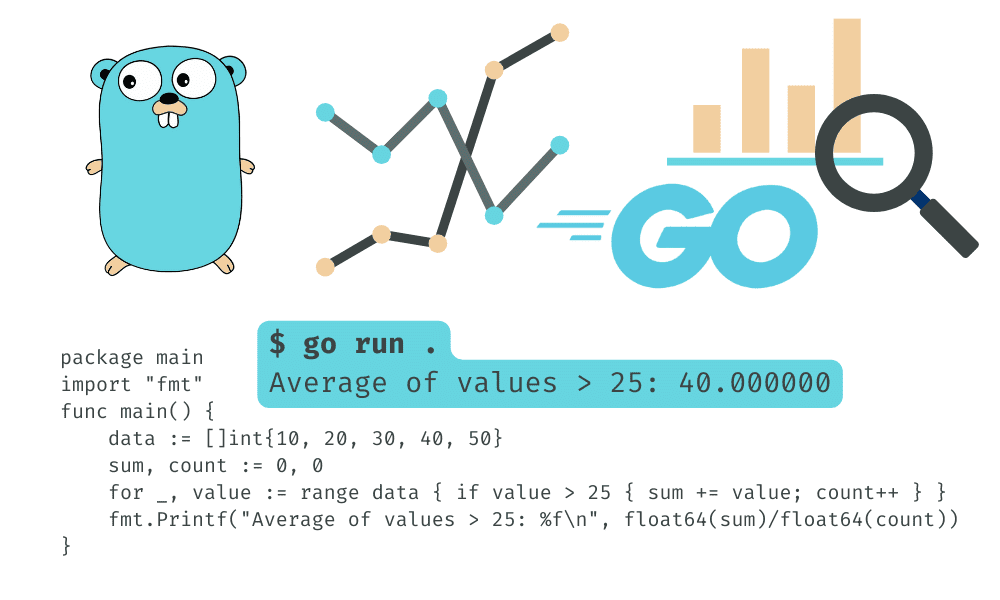
Image by Author

Go programming language has exploded in popularity among developers as a general-purpose language. It's fast, simple, and powerful, perfect for building Web applications, Mobile applications, and System programming. Recently, Go has begun sneaking into the realm of machine learning and data analysis, making it a compelling choice for data science projects.

If you're looking to learn a new language that will help you with data analysis and visualization tasks more efficiently, Go might be the perfect choice for you. In this tutorial, you'll learn the basics of setting up Go, performing data analysis and visualization, and building a simple KNN classifier.

Setting up

Download and install the latest version of Go by going to go.dev. It is that simple.

Getting Started With Go Programing For Data Science

To check if it is successfully install, run the below command:

$ go version  go version go1.22.0 windows/amd64

Next, we will create a project folder and change the directory to the folder.

$ mkdir go-example  $ cd go-example

Initialize the Go module. This command creates a `go.mod file` to track your code's dependencies.

$ go mod init example/kdnuggets  go: creating new go.mod: module example/kdnuggets

Start the IDE or code editor. In our case, we are using VSCode.

code .

Write a simple print command in the main function.

package main    import "fmt"    func main() {      // Print to the console      fmt.Println("Welcome to KDnuggets")  }

Run the go run command in the terminal.

$ go run .  Welcome to KDnuggets

It is quite similar to Python but offers so many features compared to Python. Especially effective package management.

Simple Data Analysis with Go

In this data analysis example, we will download and load the Adult Census Income dataset from Kaggle.

First, import all of the Go packages that we are going to use for analysis. Then, load the CSV file using the `os` command. Convert the raw data into a dataframe using the `gota` data frame package. Finally, we will print the first 2 rows.

package main    import (      "fmt"      "os"      "github.com/go-gota/gota/dataframe"      "github.com/go-gota/gota/series"  )    func main() {        f, err := os.Open("adult.csv")      if err != nil {          fmt.Println(err)          return      }      defer f.Close()        df := dataframe.ReadCSV(f)           fmt.Println(df.Subset([]int{0, 1}))    }  

Before running the code, we have to install all the packages used in the above code. For that, we will run:

$ go mod tidy    go: finding module for package github.com/go-gota/gota/series  go: finding module for package github.com/go-gota/gota/dataframe  go: downloading github.com/go-gota/gota v0.12.0  go: found github.com/go-gota/gota/dataframe in github.com/go-gota/gota v0.12.0  go: found github.com/go-gota/gota/series in github.com/go-gota/gota v0.12.0  go: downloading golang.org/x/net v0.0.0-20210423184538-5f58ad60dda6  go: downloading gonum.org/v1/gonum v0.9.1  go: downloading golang.org/x/exp v0.0.0-20191002040644-a1355ae1e2c3  go: downloading gonum.org/v1/netlib v0.0.0-20190313105609-8cb42192e0e0

After installing all packages, run the code by providing the file name.

The `gota` dataframe is not as easy to read as the `pandas` dataframe, but it allows for reading huge datasets in seconds.

$ go run simple-analysis.go    [2x15] DataFrame        age   workclass fnlwgt education education.num marital.status ...   0: 90    ?         77053  HS-grad   9             Widowed        ...   1: 82    Private   132870 HS-grad   9             Widowed        ...                             ...    Not Showing: occupation , relationship , race , sex ,  capital.gain , capital.loss , hours.per.week , native.country ,  income 

Now, we will write the full code for filtering, calculating the mean, and generating the summary. The code is quite similar to pandas, but you have to read the documentation to understand how each function interacts.

package main    import (  	"fmt"  	"github.com/go-gota/gota/dataframe"  	"github.com/go-gota/gota/series"  	"os"  )    func main() {  	// Loading the CSV file  	f, err := os.Open("adult.csv")  	if err != nil {  		fmt.Println(err)  		return  	}  	defer f.Close()    	df := dataframe.ReadCSV(f)    	// Filter the data: individuals with education level "HS-grad"  	hsGrad := df.Filter(dataframe.F{Colname: "education", Comparator: series.Eq, Comparando: "HS-grad"})  	fmt.Println("nFiltered DataFrame (HS-grad):")  	fmt.Println(hsGrad)    	// calculating the average age of individuals in the dataset  	avgAge := df.Col("age").Mean()  	fmt.Printf("nAverage age: %.2fn", avgAge)    	// Describing the data  	fmt.Println("nGenerate descriptive statistics:")  	description := df.Describe()  	fmt.Println(description)    }  

We displayed the filtered dataset, average age, and a summary of numerical columns.

Filtered DataFrame (HS-grad):  [10501x15] DataFrame        age   workclass        fnlwgt education education.num marital.status     ...   0: 90    ?                77053  HS-grad   9             Widowed            ...   1: 82    Private          132870 HS-grad   9             Widowed            ...   2: 34    Private          216864 HS-grad   9             Divorced           ...   3: 68    Federal-gov      422013 HS-grad   9             Divorced           ...   4: 61    Private          29059  HS-grad   9             Divorced           ...   5: 61    ?                135285 HS-grad   9             Married-civ-spouse ...   6: 60    Self-emp-not-inc 205246 HS-grad   9             Never-married      ...   7: 53    Private          149650 HS-grad   9             Never-married      ...   8: 71    ?                100820 HS-grad   9             Married-civ-spouse ...   9: 71    Private          110380 HS-grad   9             Married-civ-spouse ...      ...   ...              ...    ...       ...           ...                ...                                        ...    Not Showing: occupation , relationship , race , sex ,  capital.gain , capital.loss , hours.per.week , native.country ,  income       Average age: 38.58    Generate descriptive statistics:  [8x16] DataFrame        column   age       workclass   fnlwgt         education    education.num ...   0: mean     38.581647 -           189778.366512  -            10.080679     ...   1: median   37.000000 -           178356.000000  -            10.000000     ...   2: stddev   13.640433 -           105549.977697  -            2.572720      ...   3: min      17.000000 ?           12285.000000   10th         1.000000      ...   4: 25%      28.000000 -           117827.000000  -            9.000000      ...   5: 50%      37.000000 -           178356.000000  -            10.000000     ...   6: 75%      48.000000 -           237051.000000  -            12.000000     ...   7: max      90.000000 Without-pay 1484705.000000 Some-college 16.000000     ...                                  ...    Not Showing: marital.status , occupation , relationship ,  race , sex , capital.gain , capital.loss ,  hours.per.week , native.country , income 

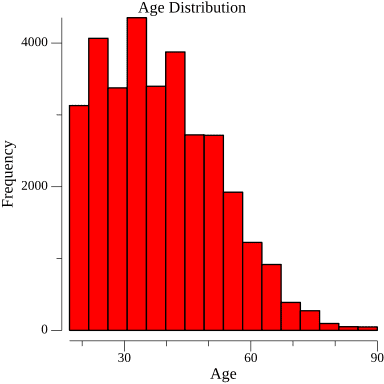
Simple Data Visualization with Go

Python is quite compatible with Jupyter Notebook, so visualizing the graphs and charts is quite easy. You can also set up Go in the Jupyter Notebook, but it won't be as smooth as Python.

In this example, we are

  1. Loading the dataset
  2. Converting it into dataframe
  3. Extracting the `age` column
  4. Creating the plot object
  5. Adding text to the title and x and y labels
  6. Plotting the histogram of `age` columns
  7. Changing the fill color
  8. Saving the plot as a PNG file in the local directory
package main    import (      "fmt"      "image/color"      "log"      "os"      "gonum.org/v1/plot"      "gonum.org/v1/plot/plotter"      "gonum.org/v1/plot/vg"      "github.com/go-gota/gota/dataframe"  )    func main() {      // Sample data: replace this CSV string with the path to your actual data file or another data source.      f, err := os.Open("adult.csv")      if err != nil {          fmt.Println(err)          return      }      defer f.Close()           // Read the data into a DataFrame.      df := dataframe.ReadCSV(f)        // Extract the 'age' column and convert it to a slice of float64s for plotting.      ages := df.Col("age").Float()        // Create a new plot.      p:= plot.New()        p.Title.Text = "Age Distribution"      p.X.Label.Text = "Age"      p.Y.Label.Text = "Frequency"        // Create a histogram of the 'age' column.      h, err := plotter.NewHist(plotter.Values(ages), 16) // 16 bins.      if err != nil {          log.Fatal(err)      }      h.FillColor = color.RGBA{R: 255, A: 255}        p.Add(h)        // Save the plot to a PNG file.      if err := p.Save(4*vg.Inch, 4*vg.Inch, "age_distribution.png"); err != nil {          log.Fatal(err)      }        fmt.Println("Histogram saved as age_distribution.png")  }

Again, before running the code. We have to install the code dependencies.

$ go mod tidy 

After running the code, we will generate the image file, which you can view by going into your project folder.

$ go run simple-viz.go  Histogram saved as age_distribution.png
Getting Started With Go Programing For Data Science Simple Model Training with Go

For training machine learning models, we will download and load Iris Species dataset from Kaggle.

We will be using `golearn` package similar to scikit-learn for:

  1. Loading the CSV dataset
  2. Building the KNN Classification model
  3. Splitting the dataset into training and testing
  4. Fitting the model
  5. Predicting the test dataset value and displaying them
  6. Calculating and printing confusion matrix, accuracy, recall, precision, and f1 score
package main    import (      "fmt"        "github.com/sjwhitworth/golearn/base"      "github.com/sjwhitworth/golearn/evaluation"      "github.com/sjwhitworth/golearn/knn"  )    func main() {      // Load in a dataset, with headers. Header attributes will be stored.      rawData, err := base.ParseCSVToInstances("iris.csv", true)      if err != nil {          panic(err)      }        //Initialises a new KNN classifier      cls := knn.NewKnnClassifier("euclidean", "linear", 2)        //Do a training-test split      trainData, testData := base.InstancesTrainTestSplit(rawData, 0.50)      cls.Fit(trainData)        //Calculates the Euclidean distance and returns the most popular label      predictions, err := cls.Predict(testData)      if err != nil {          panic(err)      }      fmt.Println(predictions)        // Prints precision/recall metrics      confusionMat, err := evaluation.GetConfusionMatrix(testData, predictions)      if err != nil {          panic(fmt.Sprintf("Unable to get confusion matrix: %s", err.Error()))      }      fmt.Println(evaluation.GetSummary(confusionMat))  }

Before running the code, make sure you have a G++ compiler by running the command:

gcc -v

If it is not installed then follow the guide Get Started with C++ and MinGW-w64 in Visual Studio Code.

Install the code dependency by running the tidy command in the terminal.

$ go mod tidy 

Running the code will give you the predictions, confusion matrix, and model evaluation.

$ go run simple-ml.go     Instances with 68 row(s) 1 attribute(s)  Attributes:  *       CategoricalAttribute("Species", [Iris-setosa Iris-versicolor Iris-virginica])    Data:          Iris-setosa          Iris-setosa          Iris-versicolor          Iris-virginica          Iris-virginica          Iris-setosa          Iris-virginica          Iris-setosa          Iris-setosa          Iris-setosa          Iris-virginica          Iris-virginica          Iris-setosa          Iris-setosa          Iris-versicolor          Iris-versicolor          Iris-setosa          Iris-versicolor          Iris-virginica          Iris-setosa          Iris-setosa          Iris-virginica          Iris-virginica          Iris-virginica          Iris-virginica          Iris-versicolor          Iris-virginica          Iris-virginica          Iris-virginica          Iris-versicolor          ...  38 row(s) undisplayed  Reference Class True Positives  False Positives True Negatives  Precision       Recall  F1 Score  --------------- --------------  --------------- --------------  ---------       ------  --------  Iris-setosa     24              0               44              1.0000          1.0000  1.0000  Iris-versicolor 22              0               43              1.0000          0.8800  0.9362  Iris-virginica  19              3               46              0.8636          1.0000  0.9268  Overall accuracy: 0.9559

If you are facing issues running the code, check out my code at GitHub: kingabzpro/go-example-kdn.

Conclusion

The data science packages in the Go language are not maintained well and do not have a large community of developers building tools for data scientists. But, the main advantage of the Go language is its speed and ease of use. There are many other benefits of using the Go language, which may convince people to switch their workflow to it.

In this beginner's tutorial, we have learned how to load a dataset as a dataframe, perform data analysis and visualization, and train a machine learning model.

Abid Ali Awan (@1abidaliawan) is a certified data scientist professional who loves building machine learning models. Currently, he is focusing on content creation and writing technical blogs on machine learning and data science technologies. Abid holds a Master's degree in Technology Management and a bachelor's degree in Telecommunication Engineering. His vision is to build an AI product using a graph neural network for students struggling with mental illness.

More On This Topic

  • Getting Started with Python for Data Science
  • Getting Started Cleaning Data
  • Getting Started with Python Data Structures in 5 Steps
  • Getting Started with Automated Text Summarization
  • Getting Started with PyTorch Lightning
  • Getting Started with SQL Cheatsheet