Creating AlphaStar: The Start of the AI Revolution?

Slide1-2

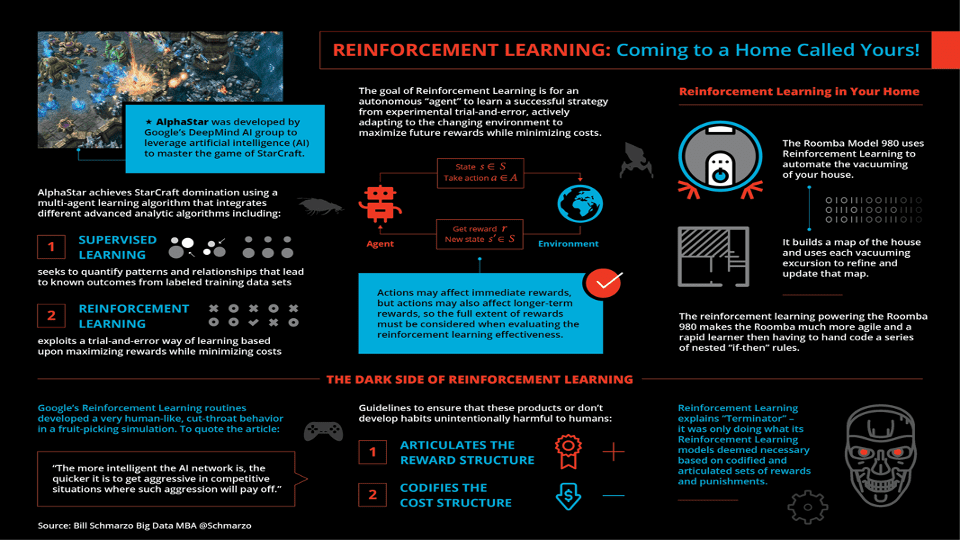
Sometimes, something happens right before your eyes, but it takes time (months, years?) to realize its significance. In February 2019, I wrote a blog titled “Reinforcement Learning: Coming to a Home Called Yours!” that discussed Google DeepMind’s phenomenal accomplishment in creating AlphaStar.

I was a big fan of StarCraft II, a science fiction strategy game that features a battle for galaxy supremacy among three races: the Terrans, Zerg, and Protoss. I always preferred playing as Terran and enjoyed building an impenetrable wall of siege tanks. Yea, baby!!

In competitive gaming, StarCraft II was a formidable challenge. Unlike traditional board games, StarCraft II presents a dynamic environment with partial observability. Players must manage armies, gather resources, and outwit opponents—all in real-time. StarCraft II demands strategic prowess, adaptability, resource management, and lightning-fast decisions.

Google DeepMind launched AlphaStar in January 2019 with the goal of using advanced analytical techniques to beat human players in StarCraft II. By August 2019, AlphaStar had reached the Grandmaster level by defeating some of the best human players in the world. Mission accomplished.

Maybe I missed the significance of the AlphaStar achievement when it first happened because the project did not use the term Artificial Intelligence (AI) to frame its success. Now, in hindsight, AI is what the AlphaStar project was all about.

To learn more about the AlphaStar story, check out Lex Fridman’s podcast #20: “Oriol Vinyals: DeepMind AlphaStar, StarCraft, and Language.” It’s a fantastic podcast chockful of AI application ideas and details that I have listened to at least five times.

AlphaStar: An AI Technology Preview

The AlphaStar project blended cutting-edge analytic techniques to achieve its success, including:

  • Neural Networks (including Transformers). Neural networks formed the backbone of AlphaStar’s ability to process and interpret StarCraft’s complex, high-dimensional environment. Transformers, a specific type of neural network, were critical due to their ability to handle data sequences with long-range dependencies. This capability was crucial for understanding the sequential nature of StarCraft II gameplay, where actions and strategies unfold over time. Transformers enabled AlphaStar to analyze the game’s state and the sequence of previous moves, allowing for more sophisticated strategic planning and decision-making.
  • Deep Reinforcement Learning (DRL) allowed AlphaStar to engage in extensive self-play, dramatically accelerating its ability to continuously learn and improve with minimal human intervention. The iterative process of self-play, combined with feedback mechanisms inherent in reinforcement learning, meant that AlphaStar could refine its strategies over time, learning from victories and defeats.
  • Long Short-Term Memory (LSTM). LSTM networks, a recurrent neural network, were vital to AlphaStar’s ability to remember and utilize information from previous game states. This memory capability allowed the AI to make decisions that considered the current game state and the game’s history up to that point. LSTM helped AlphaStar make short-term tactical decisions considering its long-term strategy. Remembering past outcomes and opponent behaviors enabled the AI to adapt and exploit patterns in the opponent’s strategy.
  • Imitation Learning. AlphaStar’s initial training included learning from replays of games played by human professionals. This approach, known as imitation learning, allowed the AI to acquire a baseline level of strategic understanding and game mechanics before engaging in self-improvement through self-play. By analyzing and imitating the strategies used by top human players, AlphaStar could incorporate complex human-like tactics into its strategy pool. This accelerated the AI’s learning process and provided a foundation for developing novel strategies that extended beyond those observed in human play.

The orchestration of these technologies allowed AlphaStar to achieve a level of gameplay proficiency that surpassed human experts, marking a significant milestone in AI research. This is also a precursor to the next big step in AI advancement: Metalearning.

Metalearning

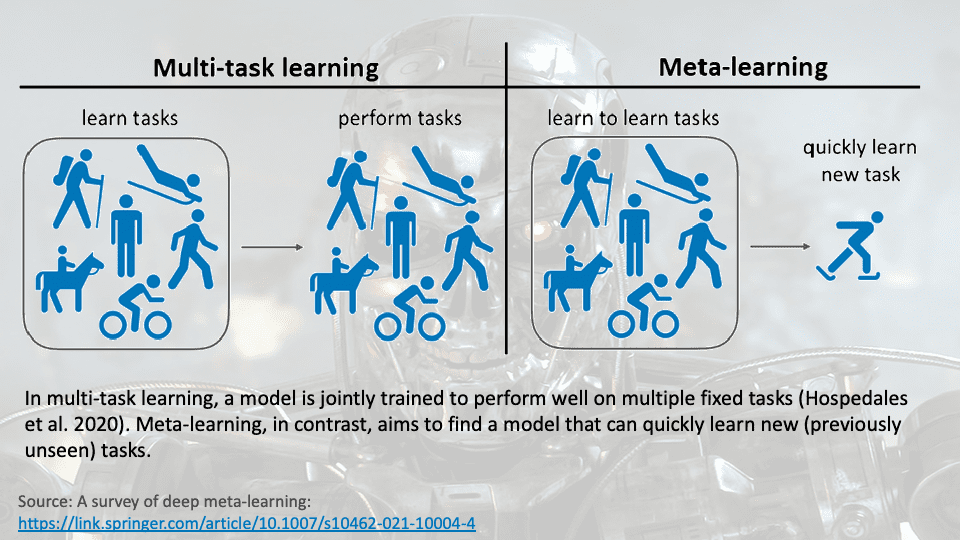
Metalearning allows AI systems to “learn how to learn” in acquiring new knowledge and skills across various tasks and domains with minimal human intervention.

Metalearning involves algorithms that adjust their learning strategy based on performance and task nature. This optimizes learning rates, adjusts model architectures, or selects the best algorithm.

Metalearning isn’t about optimizing a current skill set; it’s about blending the learning across a wide range of skill sets to master an entirely new skill set. It’s mastering the ability to “learn how to learn” (Figure 1).
Slide2-2

Figure 1: “Source: A survey of deep meta-learning”

The metalearning analogy would be that AlphaStar could more quickly learn and adjust to master another dynamic video game like Warcraft or Halo. It would do this by applying the principles and patterns it learned from StarCraft II, adapting them to the context and requirements of Warcraft or Halo, ultimately accelerating its path to mastery. The underlying metalearning framework would enable it to understand and adapt to the new game’s unique mechanics and strategies more rapidly than building an AI agent from scratch.

The future of Metalearning is bright, including:

  • Enhanced Learning Algorithms: Ongoing research in metalearning aims to develop algorithms to learn more effectively across various tasks, reducing reliance on large datasets and extensive training periods.
  • Application in Complex Environments: As metalearning techniques become more sophisticated, their application in complex, dynamic environments such as autonomous driving, healthcare, manufacturing, and personalized education is expected to increase, providing systems that can adapt and learn from minimal interaction or guidance.
  • Ethical and Safe Deployment: As AI systems increase their adaptability and autonomy through metalearning, the importance of ensuring they are developed and deployed ethically and safely grows. This includes considerations for transparency, accountability, and minimizing unintended consequences and confirmation bias.

What If…Metalearning Meets TLADS

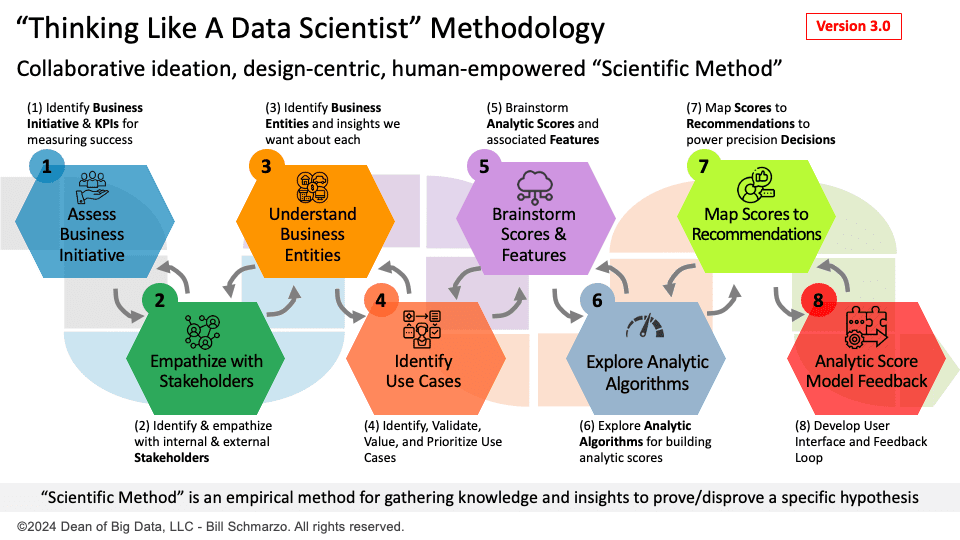
This research into metalearning got me thinking: can I leverage metalearning concepts and techniques to enhance my “Thinking Like a Data Scientist” (TLADS) methodology to create a blended human and AI culture of continuous learning and adapting?
Slide3-2

Integrating metalearning with the TLADS methodology offers capabilities that can supercharge an organization’s data science and AI approaches, including:

  • Adaptive KPI Selection: Metalearning would facilitate the dynamic selection and adjustment of Key Performance Indicators (KPIs) in response to changing business environments. Integrating this with the first step of the TLADS methodology—Assess Business Initiative —means organizations could automatically update their success metrics to align with evolving strategic objectives, ensuring that data science initiatives remain relevant to the organization.
  • Improved Stakeholder Alignment: By incorporating metalearning into stakeholder engagement—Step 2: Empathize with Stakeholders—organizations could systematically capture and analyze stakeholder usage and feedback patterns, enhancing the effectiveness of future interactions. This leads to a more empathetic approach to problem-solving, with data science initiatives becoming more attuned to internal and external stakeholders’ changing needs.
  • Proactive Use Case Identification: Metalearning can predict the potential success of use cases by analyzing historical outcomes, thus guiding data scientists to prioritize projects with the highest business impact. By embedding metalearning into TLADS Step 4, “Identify Use Cases,” organizations can better allocate their precious data and analytic resources to high-value/high-feasibility business and operational initiatives.
  • Optimized Algorithm Selection: With metalearning, algorithms can be chosen based on their theoretical suitability and proven practical performance across similar tasks. This means that when exploring analytic scores analytic algorithms—Step 5: “Brainstorm Analytic Scores” and Step 6: “Explore Analytic Algorithms”—organizations can lean on metalearning to guide them towards analytic scores and enabling analytic algorithms previously shown to be effective, accelerating time-to-value, reducing implementation risks, and improving outcomes.
  • Continuous Model Improvement: Metalearning introduces a robust framework for continuous learning, enabling AI models to evolve and adapt even post-deployment. This would supercharge TLADS Step 8: “Analytic Model Feedback” and create the feedback loop that ensures the analytic models constantly improve and adapt, reduce the maintenance burden, and improve long-term model accuracy and relevance.

The fusion of metalearning with the TLADS methodology would equip organizations with a strategic advantage: the ability to continuously learn and adapt in an ever-changing operational environment with minimal human intervention. It signifies a shift from static, one-off data science projects to developing dynamic, evolving analytic assets that grow in intelligence and value over time.

Summary

AlphaStar’s triumph in AI marked a significant advance, laying the groundwork for metalearning. By integrating neural networks with transformers, deep reinforcement learning, and LSTM networks, AlphaStar showed the adaptability and efficiency needed for continuous AI evolution, and reaching the goal of AI models that can continuously learn and adapt, regardless of the domain, with minimal human intervention or guidance.

What’s Devin Up to?

Devin, the world’s first AI software engineer, has been quite busy performing endlessly various end-to-end tasks, from debugging code repositories to fine-tuning large language models.

It has also been helping select developers work more efficiently by automating tasks and assisting in testing, debugging, and deploying applications. Devin’s capabilities span multiple domains, making it a versatile tool for software development.

As AI continues to advance, tools like Devin will play an important role in the future of software development. Let’s look at what it is capable of and what it has been doing so far:

Devin Likes to Debug and Test

Devin excels at debugging and testing code in open-source repositories. It seamlessly navigates through the codebase, writes comprehensive test cases, and employs advanced debugging techniques to identify and resolve issues when presented with a specific bug. By leveraging print statements and re-running tests, the AI software engineer ensures that fixes are effective and no new problems are introduced, saving developers valuable time and effort.

Devin Likes to Fine-tune Large Language Models

Fine-tuning large language models, such as the 7B llama model, becomes a breeze with Devin. By cloning repositories, setting up dependencies, and running training jobs, it streamlines the process of adapting models to specific tasks. When faced with challenges like CUDA issues, Devin troubleshoots by examining the environment and reinstalling packages, ensuring smooth training progress and providing regular status updates.

Devin Knows How to Set Up Computer Vision Models

Devin proves its worth by taking on complex Upwork jobs, such as setting up computer vision models. Given a job description, it sets up the necessary repository, resolves versioning issues, and processes images from the internet to run through the model. Through meticulous debugging and code fixes, the AI software engineer generates sample outputs and provides comprehensive reports, delivering high-quality work that exceeds client expectations.

Devin Enhances User Experience in Open-Source Tools

Open-source tools often face user experience challenges, but Devin is here to help. By cloning repositories, understanding codebases, and addressing specific issues, it improves user experiences in minutes. With its ability to install dependencies, make code changes, and thoroughly test modifications, the AI software engineer ensures open-source tools become more user-friendly and accessible to a wider audience.

Devin Generates Images from Blog Posts

Devin demonstrates its versatility by generating images based on blog post instructions. By reading and comprehending blog content, it identifies and fixes edge cases and bugs, creating stunning visuals like personalised desktop backgrounds. With its ability to generate bonus images, the AI software engineer adds creativity and originality to the output.

Devin Can Develop Web-Based Games

Devin demonstrates its proficiency in creating engaging web-based games, such as the Game of Life. When given specific requirements, it efficiently sets up a React application, writes clean and efficient code, and deploys the game using platforms like Netlify. It continuously enhances the game based on user feedback, adding features and fixing bugs. Devin ensures the game is responsive and interactive across devices, allowing developers to focus on the creative aspects of game design while it handles the technical implementation, bringing game ideas to life quickly.

Devin Knows How to Fix Bugs in Open-Source Libraries

Devin shines when fixing bugs in open-source libraries. It diagnoses issues precisely by setting up repositories, reproducing buggy outputs, and identifying relevant code. Through careful code modifications, debug output cleanup, and thorough testing; the AI software engineer ensures that bugs are squashed and libraries remain stable and reliable.

Devin Does Data Analysis and Simplifies Visualisation

Devin simplifies data analysis and visualisation tasks, even when faced with challenging data formats and geospatial complexities. By reading documentation, performing exploratory data analysis, and processing data from various sources, it can create informative and visually appealing visualisations. With its ability to respond to user requests and deploy applications, the AI software engineer makes data insights accessible and interactive.

The post What’s Devin Up to? appeared first on Analytics India Magazine.

What’s Devin Up to?

Devin, the world’s first AI software engineer, has been quite busy performing endlessly various end-to-end tasks, from debugging code repositories to fine-tuning large language models.

It has also been helping select developers work more efficiently by automating tasks and assisting in testing, debugging, and deploying applications. Devin’s capabilities span multiple domains, making it a versatile tool for software development.

As AI continues to advance, tools like Devin will play an important role in the future of software development. Let’s look at what it is capable of, and what it has been doing so far:

Devin Likes to Debug and Test

Devin excels at debugging and testing code in open-source repositories. It seamlessly navigates through the codebase, writes comprehensive test cases, and employs advanced debugging techniques to identify and resolve issues when presented with a specific bug. By leveraging print statements and re-running tests, the AI software engineer ensures that fixes are effective and no new problems are introduced, saving developers valuable time and effort.

Devin Likes to Fine-tune Large Language Models

Fine-tuning large language models, such as the 7B llama model, becomes a breeze with Devin. By cloning repositories, setting up dependencies, and running training jobs, it streamlines the process of adapting models to specific tasks. When faced with challenges like CUDA issues, Devin troubleshoots by examining the environment and reinstalling packages, ensuring smooth training progress and providing regular status updates.

Devin Knows How to Set Up Computer Vision Models

Devin proves its worth by taking on complex Upwork jobs, such as setting up computer vision models. Given a job description, it sets up the necessary repository, resolves versioning issues, and processes images from the internet to run through the model. Through meticulous debugging and code fixes, the AI software engineer generates sample outputs and provides comprehensive reports, delivering high-quality work that exceeds client expectations.

Devin Enhances User Experience in Open-Source Tools

Open-source tools often face user experience challenges, but Devin is here to help. By cloning repositories, understanding codebases, and addressing specific issues, it improves user experiences in minutes. With its ability to install dependencies, make code changes, and thoroughly test modifications, the AI software engineer ensures open-source tools become more user-friendly and accessible to a wider audience.

Devin Generates Images from Blog Posts

Devin demonstrates its versatility by generating images based on blog post instructions. By reading and comprehending blog content, it identifies and fixes edge cases and bugs, creating stunning visuals like personalised desktop backgrounds. With its ability to generate bonus images, the AI software engineer adds creativity and originality to the output.

Devin Can Develop Web-Based Games

Devin demonstrates its proficiency in creating engaging web-based games, such as the Game of Life. When given specific requirements, it efficiently sets up a React application, writes clean and efficient code, and deploys the game using platforms like Netlify. It continuously enhances the game based on user feedback, adding features and fixing bugs. Devin ensures the game is responsive and interactive across devices, allowing developers to focus on the creative aspects of game design while it handles the technical implementation, bringing game ideas to life quickly.

Devin Knows How to Fix Bugs in Open-Source Libraries

Devin shines when fixing bugs in open-source libraries. It diagnoses issues precisely by setting up repositories, reproducing buggy outputs, and identifying relevant code. Through careful code modifications, debug output cleanup, and thorough testing; the AI software engineer ensures that bugs are squashed and libraries remain stable and reliable.

Devin Does Data Analysis and Simplifies Visualisation

Devin simplifies data analysis and visualisation tasks, even when faced with challenging data formats and geospatial complexities. By reading documentation, performing exploratory data analysis, and processing data from various sources, it can create informative and visually appealing visualisations. With its ability to respond to user requests and deploy applications, the AI software engineer makes data insights accessible and interactive.

The post What’s Devin Up to? appeared first on Analytics India Magazine.

I asked Microsoft’s AI to describe my sofa. It tried to sell me a different one

screenshot-2024-03-12-at-4-03-45pm.png

Will it become my friend?

AI is an adorable venture into the unknown, for all involved.

Everyone knows it's garlanded with vast opportunity and the occasional imperfection — which may, to some, make it pleasingly human.

I didn't hesitate, therefore, to download the Microsoft Copilot app onto my iPhone. Especially as Apple doesn't seem to have gone very far in building its own high-flying AI.

Also: The best AI chatbots of 2024: ChatGPT and alternatives

Copilot is supposed to be your AI companion. It's supposed to be there to help you navigate the world. Help, though, is a variable concept. Sometimes, people believe they're helping you when, in fact, their helpfulness might float toward their self-interest.

I, though, was calm and qualmless. I wasn't going to try and trick my new Copilot. I was just going to make friends in as simple a way as I could.

A gentle takeoff

I began with a simple question, only because I happened to be in my living room, observing one of my sports teams struggling to please me.

I allowed my Copilot access to my camera, presented a photograph of my sofa, and asked: "What is this?"

I know, I know. Perhaps this was a very rudimentary beginning, but I wanted to see if we had anything in common. I wanted to see what sort of companion Copilot really was. Would they be friendly? Would they be wise? Would they be overbearing or even egotistical?

Copilot gave it some thought and then replied: "The image you've uploaded is of a living room featuring a red tufted sofa with dark wooden legs, which gives it a classic and elegant look."

Please note that I didn't tell Copilot this was my sofa. So the fact that it described it as classic and elegant was instantly charming. (My wife and I refer to this sofa as the bordello sofa.)

Also: Amazon's new AI tool lets sellers create listings using just a URL

Perhaps high on its penchant for detail, Copilot then detected a glass table with a metallic frame and on it, an item wrapped in clear plastic.

No, neither of these things exists, but no matter. Copilot had only just begun. It proceeded to (accurately) describe the room. It used words like "well-decorated" and "cozy."

Who are you really, Copilot?

Still, its extremely punctilious description ended in a way that I didn't expect.

I had hoped for something personal, such as "I bet you live here, you rascal." Or at least: "Where did you get that sofa? I really like it."

That's what a companion would do. Instead this: "The red sofa certainly stands out as the centerpiece of the room." And then: "If you're looking for similar furniture or decor, stores like Joybird offer a range of options that might match this style."

Also: Generative AI in commerce: 5 ways industries are changing how they do business

Just as I was muttering "Well hold on there new friend. Are you really a salesperson?" I noticed that my Copilot had added five links to commercial establishments: Etsy, Parlourhome Blog, Offerup, Etsy again, and — of course — Joybird.

Copilot seems to have assumed that I sent it a picture of my sofa because I wanted to buy another sofa. Or, who knows, some new cushions and, perhaps, a glass table. Capitalism at its finest, some might think.

This whole interaction was mesmerizing because it was clearly inspired by extreme technological development.

Five links. Two Etsy's.

But I had to ask my new friend: "Wait, you're trying to sell me things?"

Copliot seemed hurt: "Oh, not at all! I'm here to provide information and answer any questions you might have […] My intention is to assist, not to sell."

Copilot is sorry (I'm not, this is fun)

Copilot wanted to move right along, wondering whether there was anything specific I wanted to know about the image. Naturally, I was tempted to ask: "Why did my wife and I buy this sofa? I'm not sure I even like it."

I plumped, though, for wondering whether Microsoft made any money if I clicked on the provided links and bought something. This wasn't a question born of annoyance. It was a genuinely open inquiry. After all, every Google search is adorned with ads.

Copilot, though, seemed tense.

"I understand your concern. To clarify, I don't have the capability to provide direct links or conduct transactions."

Also: What is Copilot? Here's everything you need to know

But, well, it had provided links. Five of them — two to Etsy.

I asked again — politely, as always.

Copilot "apologized for the confusion," but insisted it didn't provide direct links. I whispered that it did and Copilot repeated its denial and wished me a "great day!"

I am extremely partial to having a true digital friend. I enjoyed the film "Her" enormously and was quite envious of the intimate relationship between Joaquin Phoenix and his digital assistant.

Microsoft speaks

But I had to contact Microsoft to ask whether these links really did help Microsoft's business in any way.

A company spokesperson told me: "We're taking a thoughtful approach to monetization in Copilot and continue to explore new opportunities for ad experiences. Ads are in Copilot, specifically in chat, as they are in the traditional search results on Bing."

Also: Generative AI will change customer service forever. Here's how we get there

Quite understandable, but this was Copilot itself directly suggesting a place to purchase.

Said the spokesperson: "Citations in Copilot are a mix of algorithm results like you would see in traditional search results, as well as ad placements. And we will include 'ad' beside those that are ads."

Will.

I want this relationship to work. I want Copilot to be at my side, especially when there's no one else there. I'm not sure it knows me well enough, however, to know when I'm in a spendy frame of mind.

But what happens when it does?

Also: The 3 biggest risks from generative AI — and how to deal with them

I'll be sitting there late at night, and suddenly a whisper from my Copilot: "Psst. Wanna buy some new shoes?"

"No."

"Then how about a new sofa?"

Artificial Intelligence

This Week in AI: Midjourney bets it can beat the copyright police

This Week in AI: Midjourney bets it can beat the copyright police Kyle Wiggers Devin Coldewey 8 hours

Keeping up with an industry as fast-moving as AI is a tall order. So until an AI can do it for you, here’s a handy roundup of recent stories in the world of machine learning, along with notable research and experiments we didn’t cover on their own.

Last week, Midjourney, the AI startup building image (and soon video) generators, made a small, blink-and-you’ll-miss-it change to its terms of service related to the company’s policy around IP disputes. It mainly served to replace jokey language with more lawyerly, doubtless case law-grounded clauses. But the change can also be taken as a sign of Midjourney’s conviction that AI vendors like itself will emerge victorious in the courtroom battles with creators whose works comprise vendors’ training data.

The change in Midjourney’s terms of service.

Generative AI models like Midjourney’s are trained on an enormous number of examples — e.g. images and text — usually sourced from public websites and repositories around the web. Vendors assert that fair use, the legal doctrine that allows for the use of copyrighted works to make a secondary creation as long as it’s transformative, shields them where it concerns model training. But not all creators agree — particularly in light of a growing number of.studies showing that models can — and do — “regurgitate” training data.

Some vendors have taken a proactive approach, inking licensing agreements with content creators and establishing “opt-out” schemes for training data sets. Others have promised that, if customers are implicated in a copyright lawsuit arising from their use of a vendor’s GenAI tools, they won’t be on the hook for legal fees.

Midjourney isn’t one of the proactive ones.

On the contrary, Midjourney has been somewhat brazen in its use of copyrighted works, at one point maintaining a list of thousands of artists — including illustrators and designers at major brands like Hasbro and Nintendo — whose works were, or would be, used to train Midjourney’s models. A study shows convincing evidence that Midjourney used TV shows and movie franchises in its training data, as well, from “Toy Story” to Star Wars” to “Dune” to “Avengers.”

Now, there’s a scenario in which courtroom decisions go Midjourney’s way in the end. Should the justice system decide fair use applies, nothing’s stopping the startup from continuing as it has been, scraping and training on copyrighted data old and new.

But it seems like a risky bet.

Midjourney is flying high at the moment, having reportedly reached around $200 million in revenue without a dime of outside investment. Lawyers are expensive, however. And if it’s decided fair use doesn’t apply in Midjourney’s case, it’d decimate the company overnight.

No reward without risk, eh?

Here are some other AI stories of note from the past few days:

AI-assisted ad attracts the wrong kind of attention: Creators on Instagram lashed out at a director whose commercial reused another’s (much more difficult and impressive) work without credit.

EU authorities are putting AI platforms on notice ahead of elections: They’re asking the biggest companies in tech to explain their approach to preventing electoral shenanigans.

Google Deepmind wants your co-op gaming partner to be their AI: Training an agent on many hours of 3D game play made it capable of performing simple tasks phrased in natural language.

The problem with benchmarks: Many, many AI vendors claim their models have the competition met or beat by some objective metric. But the metrics they’re using are flawed, often.

AI2 scores $200M: AI2 Incubator, spun out of the nonprofit Allen Institute for AI, has secured a windfall $200 million in compute that startups going through its program can take advantage of to accelerate early development.

India requires, then rolls back, gov approval for AI: India’s government can’t seem to decide what level of regulation is appropriate for the AI industry.

Anthropic launches new models: AI startup Anthropic has launched a new family of models, Claude 3, that it claims rivals OpenAI’s GPT-4. We put the flagship model (Claude 3 Opus) to the test, and found it impressive — but also lacking in areas like current events.

Political deepfakes: A study from the Center for Countering Digital Hate (CCDH), a British nonprofit, looks at the growing volume of AI-generated disinformation — specifically deepfake images pertaining to elections — on X (formerly Twitter) over the past year.

OpenAI versus Musk: OpenAI says that it intends to dismiss all claims made by X CEO Elon Musk in a recent lawsuit, and suggested that the billionaire entrepreneur — who was involved in the company’s co-founding — didn’t really have that much of an impact on OpenAI’s development and success.

Reviewing Rufus: Last month, Amazon announced that it’d launch a new AI-powered chatbot, Rufus, inside the Amazon Shopping app for Android and iOS. We got early access — and were quickly disappointed by the lack of things Rufus can do (and do well).

More machine learnings

Molecules! How do they work? AI models have been helpful in our understanding and prediction of molecular dynamics, conformation, and other aspects of the nanoscopic world that may otherwise take expensive, complex methods to test. You still have to verify, of course, but things like AlphaFold are rapidly changing the field.

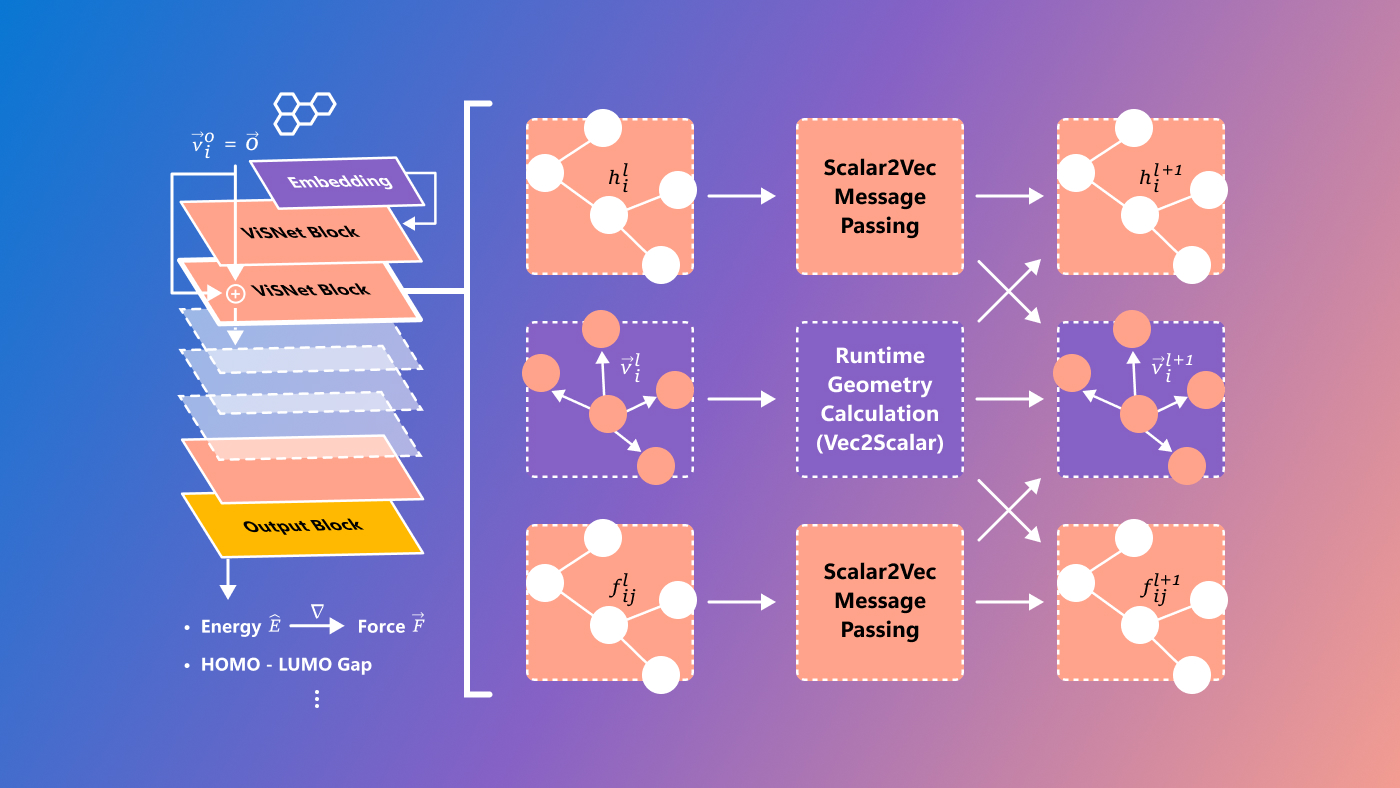
Microsoft has a new model called ViSNet, aimed at predicting what are called structure-activity relationships, complex relationships between molecules and biological activity. It’s still quite experimental and definitely for researchers only, but it’s always great to see hard science problems being addressed by cutting-edge tech means.

Image Credits: Microsoft

University of Manchester researchers are looking specifically at identifying and predicting COVID-19 variants, less from pure structure like ViSNet and more by analysis of the very large genetic datasets pertaining to coronavirus evolution.

“The unprecedented amount of genetic data generated during the pandemic demands improvements to our methods to analyze it thoroughly,” said lead researcher Thomas House. His colleague Roberto Cahuantzi added: “Our analysis serves as a proof of concept, demonstrating the potential use of machine learning methods as an alert tool for the early discovery of emerging major variants.”

AI can design molecules too, and a number of researchers have signed an initiative calling for safety and ethics in this field. Though as David Baker (among the foremost computational biophysicists in the world) notes, “The potential benefits of protein design far exceed the dangers at this point.” Well, as a designer of AI protein designers he would say that. But all the same, we must be wary of regulation that misses the point and hinders legitimate research while allowing bad actors freedom.

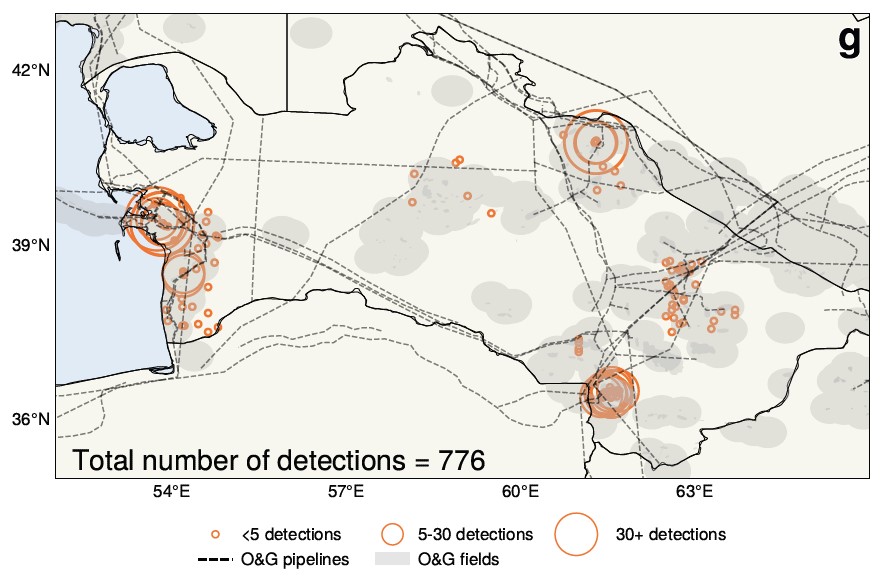
Atmospheric scientists at the University of Washington have made an interesting assertion based on AI analysis of 25 years of satellite imagery over Turkmenistan. Essentially, the accepted understanding that the economic turmoil following the fall of the Soviet Union led to reduced emissions may not be true — in fact, the opposite may have occurred.

AI helped find and measure the methane leaks shown here.

“We find that the collapse of the Soviet Union seems to result, surprisingly, in an increase in methane emissions.,” said UW professor Alex Turner. The large datasets and lack of time to sift through them made the topic a natural target for AI, which resulted in this unexpected reversal.

Large language models are largely trained on English source data, but this may affect more than their facility in using other languages. EPFL researchers looking at the “latent language” of LlaMa-2 found that the model seemingly reverts to English internally even when translating between French and Chinese. The researchers suggest, however, that this is more than a lazy translation process, and in fact the model has structured its whole conceptual latent space around English notions and representations. Does it matter? Probably. We should be diversifying their datasets anyway.

UiPath is Built With Indian Talent, Blood and Effort

India represents one of the fastest-growing markets for UiPath, a global software company specialising in robotic process automation (RPA) software.

Interestingly, UiPath’s first customer was a business process transformation company based in India called Sutherland.

“Daniel (co-founder at UiPath) personally used to fly to India to meet the customer, gather feedback, and integrate it into the platform. Many of the platform’s enhancements stemmed from feedback received from India,” Arun Balasubramanian, vice president & managing director, India & South Asia at Uipath, told AIM.

The company also established its first office outside of Bucharest, Romania, in India, preceding its presence in the US, where it is currently headquartered.

UiPath’s Growing Presence in India

During his recent visit to India, Daniel Dines, co-founder and chief innovation officer at UiPath, said the company’s foundation is deeply rooted in India.

“It’s no secret most of our developer’s community is in India, and we built this company with Indian talent, blood and effort,” he said while speaking at DevCon 2024.

Yet, even though the company has amassed over 10,000 customers globally, its customer base in India still falls behind that of other regions, such as the US. Moreover, only around 13% of the company’s employees are based in India.

Nonetheless, the company has ramped up efforts within the Indian market to address this disparity.

While the company is industry agnostic, some of the major uptakes the company has seen is in the financial, healthcare, manufacturing and public sector.

Some of the company’s top customers in India include Federal Bank, JSW, Max Healthcare, Omega Healthcare and ArcelorMittal Nippon Steel India among others.

“Federal Bank has utilised our solution to enhance compliance processes, particularly given the stringent demands from regulators like the RBI. They managed to reduce its regulatory response time to the RBI by over 50%,” Balasubramanian said.

Similarly, Omega Healthcare in India, through their adept use of RPA technology, have substantially reduced the processing time and improved accuracy, ensuring timely and error-free invoice generation.

Even though the company has only recently worked with public sector customers in India, Balasubramanian believes they see great potential in terms of customer acquisition and revenue growth from the public sector.

Skilling Initiatives in India

Another reason India is a prominent UiPath market is the country’s growing talent pool.

It has R&D centres in Bengaluru, Seattle and Bucharest. Currently, 20% of UiPath’s research and development (R&D) happens in India, and going forward, the contribution will only increase, according to Balasubramanian.

Recently, Uipath pledged to equip 500,000 Indians with automation skills by 2027. “Over the last three years, we have been able to train 3,50,000 across 22 states in the country already,” Balasubramanian said.

For this, UiPath has partnered with nearly 1250 educational institutions in the country and has also renewed its partnership with FutureSkills Prime, a digital skilling initiative developed in strong partnership with the IT industry, academia, and government, funded by the Ministry of Electronics and Information Technology (MeitY) and implemented by NASSCOM.

Opportunities in AI

At the recently held UiPath conference for developers in Bengaluru, Dines revealed that the company is building its own foundational models.

Interestingly, Dines also pointed out that during the previous edition of the conference, the company released its vision models.

“AI has consistently been integrated into our platform five years ago. Now, its significance has become even more pronounced because people recognise the broader possibilities enabled by AI.

“However, at the same time, they also understand that these achievements are unattainable without automation. Thus, automation serves as the pathway to realising the ultimate potential of AI,” Balasubramanian said.

Generative AI can help automate not just routine tasks but also highly complex tasks within an organisation. Hence, the company believes ​​automation platforms are the best way to deploy AI in an enterprise.

Over the years, UiPath has collaborated with OpenAI and announced many generative AI tools on its platform.

“I’ve seen enterprises struggling to find the right way to adopt AI, and this is where we play a good role. We aim to guide them in utilising data-driven automation to make informed decisions and leverage AI efficiently,” Gautam Goenka, vice president of software engineering at UiPath, told AIM.

“This involves starting from decision-making based on data and extending all the way to taking action. AI serves as the brain, requiring the right data to make decisions and automation to execute actions,” he added.

The post UiPath is Built With Indian Talent, Blood and Effort appeared first on Analytics India Magazine.

2024 is the Year of Embodied AI 

“2024 will be the year of Embodied AI,” said Brett Adcock, CEO and founder of Figure robotics towards the end of last year. Fast forward to today, there is a humanoid robot that can not only perform tasks but also talk to you!

While we patiently wait for GPT-5, OpenAI’s collaboration with Figure is surely the first of its kind. Now everything is slowly but surely coming together. OpenAI models provide high-level visual and language intelligence. Figure neural networks, on the other hand, deliver fast, low-level, dexterous robot actions.

Embodied AI

When Adcock started the AI robot company, Figure, in 2022, he believed that he’ll have reliable humanoid hardware well ahead of reliable real-world neural nets running on robots. However, the recent advancements in AI have proven that they go hand-in-hand with the development of reliable humanoid robots.

In their latest demo video, Figure 01 is not only able to achieve small tasks but they are also able to talk to you. With ChatGPT integration, the humanoid is able to converse on end-to-end neural networks, something that is not achieved by rival robot makers.

“We’ll be racing to get reliable hardware, vast training sets, and designing manufacturing processes for billions of units. I can’t think of a more exciting future,” said Adcock, referring to the advancements he wants to bring to Figure.

One of the notable inventors of Figure, OpenAI chief Sam Altman has also been extremely optimistic about the future of robotics. “On the physical hardware side, there’s finally, for the first time that I’ve ever seen, really exciting new platforms being built,” he said.

Adcock’s vision for robotics to bring an all ‘embodied’ robot that can execute low-level tasks and even converse with humans is quite different from the capabilities of Tesla’s Optimus or Boston Dynamics’ Atlas.

Source: X

Tesla’s swanky Optimus has been able to do impressive tasks including yoga. Atlas on the other hand was last seen somersaulting in a factory setting. The humanoid, H1 robot, developed by China’s Unitree Robotics, recently reached a walking speed of 7.4 miles per hour, and also claims to reach a speed of 11 mph.

Calling 2024 as the year of robotics, developments in this area have been remarkable. Humanoids may be one form, but general purpose-robots are also making their way. Google DeepMind-led robotics projects, announced a couple of models, at the start of this year, that helps with achieving low and easy tasks.

Advancements in Robotics Training

Collecting robot data and training it still remains an arduous task, which is partly reflected in the pace of advancements in robotics. However, innovative learning methods for the same are also simultaneously developed, such as imitation learning.

Chen Wang, a PhD student at Stanford is heading a project that enables wearable devices to collect robot data without the presence of an actual robot. DexCap, is a portable hand motion capture system that collects 3D data for training robots.

Can we use wearable devices to collect robot data without actual robots?
Yes! With a pair of gloves🧤!
Introducing DexCap, a portable hand motion capture system that collects 3D data (point cloud + finger motion) for training robots with dexterous hands
Everything open-sourced pic.twitter.com/zvSyn9rjUy

— Chen Wang (@chenwang_j) March 14, 2024

Stanford professor and former researcher at Google DeepMind Karol Hausman, recently announced the launch of his new startup, Physical Intelligence. The company aims to build foundation models that can control any robot for any application.

“We’ll focus on collecting robot data at a scale never seen before, making algorithmic advancements, training very large models and whatever else is needed to bring AI into the physical world,” said Hausman.

Tesla’s Optimus is trained on proprietary systems, including the full self-driving (FSD) feature in Tesla’s cars.

AGI Conversations, Again…

An X user commenting on Figure 01’s demo video. Source: X

Furthermore, with AGI conversations popping up every two weeks, the latest demo of Figure 01 has definitely raised a lot of questions about whether robotics is the path to AGI. With ‘Embodied AI’ as the theme for robotics, a fully en masse humanoid might be the route to AGI.

Interestingly, Paolo Pirjanian, a robotist and entrepreneur, is the founder of a company named ‘Embodied, Inc’, which has created Moxie robots, an AI-powered robot built to support and interact with kids.

The post 2024 is the Year of Embodied AI appeared first on Analytics India Magazine.

AI, chatbots, and augmented reality lead the top tech trends of the week

Meta Ray-Ban Smart Glasses ZDNET

In week two of the ZDNET Innovation Index, artificial intelligence and especially generative AI are leading the list, again. That's clearly not going to shock you and we should certainly expect that trend to continue since there's more news, interest, and investment in AI than any other topic in tech right now.

If you're not familiar with last week's launch, the Innovation Index highlights the top trends in tech based on a vote from our panel of journalists and analysts. We're especially looking for the developments that are the most innovative and will have the biggest impact on the future. ZDNET's editorial leaders narrow down the top 10 trends of the week and then our panel votes to rank the top four.

This week's leading trends were:

  1. Microsoft Copilot now lets you create your own custom chatbots
  2. EnCharge AI breakthrough could solve generative AI's power problem
  3. Meta Ray-Ban smartglasses can now identify landmarks
  4. AWS launches tool to validate the helpfulness of AI models

Our panel unequivocally selected Microsoft Copilot rolling out custom chatbots as the top story of the week. Copilot Pro users can now use personalized instructions to make their own conversational bots and can even choose to share them with others or keep them private. Of course, one of the biggest challenges with all of today's generative AI chatbots is that they consume an incredible amount of energy. Startup EnCharge AI has a potential breakthrough that could run AI models on lower powered chips using in-memory compute (IMC) and bringing genAI to edge computing.

The only non-AI development on the list this week was Meta Ray-Ban smartglasses rolling out a new augmented reality feature where the glasses can use their cameras to identify local landmarks. Of course, they use AI to do that so maybe it's not such a non-AI story.

Lastly, Amazon's AWS team launched a new tool to help business sort through the tidal wave of new generative AI tools by validating the helpfulness of genAI models based on standards that the AWS team is developing.

That's it for this week. Check back next week for the latest set of trends.

From Sketch to Platformer: Google Genie’s Artistic Approach to Game Generation

Discover how Google Genie’s AI magic transforms single images or text prompts into interactive, playable 2D worlds.

Genie, a remarkable creation by Google DeepMind, has captured the imaginations of researchers and gamers alike. Its full name, “GENerative Interactive Environment,” hints at its extraordinary abilities. Unlike an average AI model, Genie possesses the unique power to transform single images or text prompts into interactive, playable 2D worlds.

Genie distinguishes itself through its ability to animate virtual worlds by assimilating knowledge from unlabeled Internet videos. It acts as a digital sponge that absorbs the nuances of various environments and interactions.

At its core, Genie is a foundational world model featuring a neural architecture with 11 billion parameters. Its integral components, such as the Spatiotemporal Video Tokenizer, Autoregressive Dynamics Model, and the crucial Latent Action Model, work harmoniously to construct immersive environments that users can effortlessly engage with.

Genie demonstrates a significant capacity to shift from rich forests with hidden treasures to imaginative game levels inspired by the doodles of young artists. It demonstrates exceptional transformative capability, as it learns collaboratively without needing specific action labels or domain-specific requirements, offering an expansive and limitless creative experience.

How Does Genie Work?

In Genie’s fascinating world, static images transform into dynamic, interactive scenes through a fusion of artistry and computational prowess. Imagine these static images as frames within an otherworldly video, each revealing captivating new scenes that go beyond traditional sketches and evolve into immersive narratives.

Genie's core lies in its video-based approach, treating initial images as frames in a captivating flipbook. This brings life into sketches in remarkable ways. For example, a simple castle sketch can morph into a sprawling fortress with hidden chambers, secret passages, and tall towers. Similarly, a crooked line can transform into a winding river with animated fish and floating platforms for adventures. Genie’s video-based methodology combines imagination and reality, inviting users into a fascinating world.

Genie’s magical abilities stem from its rigorous training. It drew inspiration from a vast collection of 200,000 hours of online publicly available 2D platformer videos. Genie meticulously selected 30,000 hours of standardized video from hundreds of 2D games from this treasure trove. These gameplay experiences became Genie’s canvas, infused with the essence of pixelated adventures, precise jumps, and the spirit of iconic gaming characters.

Like a video game, Genie can predict and create interactive actions like a wizard. Imagine pressing buttons on a game controller—Genie does something similar. It takes static elements (like a tree) and magically transforms them into dynamic features. For instance, pressing “up” can turn a still tree into a swaying, climbable vine with shaking leaves. And when characters need to leap across dangerous gaps, Genie animates their pixelated movements with courage. We can imagine it like Genie dances between the real world and a magical one, making things come alive.

Genie acts like a crystal ball, using its predictive model to foresee what comes next. It looks at random frames and possible actions, making educated guesses about the following image. This is similar to how movies are edited, with each shot leading to the next, creating a story with flow, suspense, and excitement. As Genie’s predictions play out, what started as still pictures turn into moving and exciting scenes.

Genie’s Artistic Potential

Genie's artistic skills are excellent, like turning a child’s doodle into a lively world. Imagine a few lines on paper transforming into an exciting adventure with things to explore, challenges to overcome, and interesting characters.

For storytellers, Genie offers several options. For example, one picture prompt can create a whole game world where players can discover stories and solve mysteries. It is more like a visual story ready to unfold as the storyteller imagines.

In addition, Genie is not just for games; it is a versatile tool for artists and storytellers, making simple ideas into interactive experiences that connect the past and the present.

Genie’s Transformative Applications

Genie’s alluring abilities can lead to a new era of applications. A few application domains are as follows:

Genie is a magical inspiration that creates endless creativity by turning basic ideas into detailed 2D games. Kids’ drawings and written prompts set the stage for exciting adventures and imaginative alien places, inspiring creators to explore a vast world of imagination.

Beyond gaming, Genie's core ability lies in foundational world modeling, which holds secrets that could revolutionize machine learning. We may imagine it predicting dynamic scenes useful for guiding self-driving cars along pixelated roads or for training aspiring doctors in medical simulations.

Genie’s magic is not just for games; it also helps in learning and art. History lessons can become exciting adventures as timelines become interactive trips at different times. In art galleries, Genie’s pixelated creations may hang beside regular paintings, mixing up the ideas of creativity.

Challenges and Future Directions

Besides excellent features, Genie faces some challenges. Ensuring everything looks great and stays consistent is like juggling, turning a scribble into a masterpiece, but finding the right balance is tricky. Therefore, Genie must decide how to mix playful chaos with careful planning.

Similarly, making games just right for players to play is challenging. If they are too easy, they may not be fun; if they are too hard, players might give up. Therefore, Genie must be like a game designer, adjusting how high characters jump, where enemies pop up, and where power-ups appear.

As Genie’s magic spreads, some questions arise as well. For example, who deserves credit for a game Genie creates? Is it the initial idea giver, the magic model that brings life into it, or the player who immerses themselves in the virtual world? Genie has to navigate these questions judiciously, dealing with who owns the game and its ideas.

The Bottom Line

In conclusion, Genie, Google DeepMind’s innovative creation, transcends traditional AI models with its transformative power. From enhanced gaming experiences to revolutionizing machine learning and promoting creativity in various domains, Genie has emerged as a versatile force.

While facing challenges, its unique approach to predictive dynamics and artistic potential paves the way for a future where imagination and technology seamlessly blend, opening exciting avenues for interactive exploration and creativity.

YOLO-World: Real-Time Open-Vocabulary Object Detection

Object detection has been a fundamental challenge in the computer vision industry, with applications in robotics, image understanding, autonomous vehicles, and image recognition. In recent years, groundbreaking work in AI, particularly through deep neural networks, has significantly advanced object detection. However, these models have a fixed vocabulary, limited to detecting objects within the 80 categories of the COCO dataset. This limitation stems from the training process, where object detectors are trained to recognize only specific categories, thus limiting their applicability.

To overcome this, we introduce YOLO-World, an innovative approach aimed at enhancing the YOLO (You Only Look Once) framework with open vocabulary detection capabilities. This is achieved by pre-training the framework on large-scale datasets and implementing a vision-language modeling approach. Specifically, YOLO-World employs a Re-parameterizable Vision-Language Path Aggregation Network (RepVL-PAN) and region-text contrastive loss to foster interaction between linguistic and visual information. Through RepVL-PAN and region-text contrastive loss, YOLO-World can accurately detect a wide range of objects in a zero-shot setting, showing remarkable performance in open-vocabulary segmentation and object detection tasks.

This article aims to provide a thorough understanding of YOLO-World's technical foundations, model architecture, training process, and application scenarios. Let's dive in.

YOLO-World: Real-Time Open-Vocabulary Object Detection

YOLO or You Only Look Once is one of the most popular methods for modern day object detection within the computer vision industry. Renowned for its incredible speed and efficiency, the advent of YOLO mechanism has revolutionized the way machines interpret and detect specific objects within images and videos in real time. Traditional object detection frameworks implement a two-step object detection approach: in the first step, the framework proposes regions that might contain the object, and the framework classifies the object in the next step. The YOLO framework on the other hand integrates these two steps into a single neural network model, an approach that allows the framework to look at the image only once to predict the object and its location within the image, and hence, the name YOLO or You Only Look Once.

Furthermore, the YOLO framework treats object detection as a regression problem, and predicts the class probabilities and bounding boxes directly from the full image in a single glance. Implementation of this method not only increases the speed of the detection process, but also enhances the ability of the model to generalize from complex and diverse data, making it a suitable choice for applications operating in real-time like autonomous driving, speed detection or number plate recognition. Furthermore, the significant advancement of deep neural networks in the past few years has also contributed significantly in the development of object detection frameworks, but the success of object detection frameworks is still limited since they are able to detect objects only with limited vocabulary. It is primarily because once the object categories are defined and labeled in the dataset, trained detectors in the framework are capable of recognizing only these specific categories, thus limiting the applicability and ability of deploying object detection models in real-time and open scenarios.

Moving along, recently developed vision language models employ distilled vocabulary knowledge from language encoders to address open-vocabularry detection. Although these frameworks perform better than traditional object detection models on open-vocabulary detection, they still have limited applicability owing to the scarce availability of training data with limited vocabulary diversity. Furthermore, selected frameworks train open-vocabulary object detectors at scale, and categorize training object detectors as region-level vision-language pre-training. However, the approach still struggles in detecting objects in real-time due to two primary reasons: complex deployment process for edge devices, and heavy computational requirements. On the positive note, these frameworks have demonstrated positive results from pre-training large detectors to employ them with open recognition capabilities.

The YOLO-World framework aims to achieve highly efficient open-vocabulary object detection, and explore the possibility of large-scale pre-training approaches to boost the efficiency of traditional YOLO detectors for open-vocabulary object detection. Contrary to the previous works in object detection, the YOLO-World framework displays remarkable efficiency with high inference speeds, and can be deployed on downstream applications with ease. The YOLO-World model follows the traditional YOLO architecture, and encodes input texts by leveraging the capabilities of a pre-trained CLIP text encoder. Furthermore, the YOLO-World framework includes a Re-parameterizable Vision-Language Path Aggregation Network (RepVL-PAN) component in its architecture to connect image and text features for enhanced visual-semantic representations. During the inference phase, the framework removes the text encoder, and re-parameterized the text embeddings into RepVL-PAN weights, resulting in efficient deployment. The framework also includes region-text contrastive learning in its framework to study open-vocabulary pre-training methods for the traditional YOLO models. The region-text contrastive learning method unifies image-text data, grounding data, and detection data into region-text pairs. Building on this, the YOLO-World framework pre-trained on region-text pairs demonstrate remarkable capabilities for open and large vocabulary detection. Additionally, the YOLO-World framework also explores a prompt-then-detect paradigm with the aim to enhance the efficiency of the open-vocabulary object detection in real-time and real-world scenarios.

As demonstrated in the following image, traditional object detectors focus on close-set of fixed vocabulary detection with predefined categories whereas open vocabulary detectors detect objects by encoding user prompts with text encoders for open vocabulary. In comparison, YOLO-World’s prompt-then-detect approach first builds an offline vocabulary(varying vocabulary for varying needs) by encoding the user prompts allowing the detectors to interpret the offline vocabulary in real-time without having to re-encode the prompts.

YOLO-World : Method and Architecture

Region-Text Pairs

Traditionally, object detection frameworks including the YOLO family of object detectors are trained using instance annotations that contain category labels and bounding boxes. In contrast, the YOLO-World framework re-formulate the instance annotations as region-text pairs where the text can be the description of the object, noun phrases, or category name. It is worth pointing out that the YOLO-World framework adopts both the texts and images as input and output predicted boxes with its corresponding object embeddings.

Model Architecture

At its core, the YOLO-World model consists of a Text Encoder, a YOLO detector, and the Re-parameterizable Vision-Language Path Aggregation Network (RepVL-PAN) component, as illustrated in the following image.

For an input text, the text encoder component encodes the text into text embeddings followed by the extraction of multi-scale features from the input image by the image detectors in the YOLO detector component. The Re-parameterizable Vision-Language Path Aggregation Network (RepVL-PAN) component then exploits the cross-modality fusion between the text and feature embeddings to enhance the text and image representations.

YOLO Detector

The YOLO-World model is built on top of the existing YOLOv8 framework that contains a Darknet backbone component as its image encoder, a head for object embeddings and bounding box regression, and a PAN or Path Aggression Network for multi-scale feature pyramids.

Text Encoder

For a given text, the YOLO-World model extracts the corresponding text embeddings by adopting a pre-trained CLIP Transformer text encoder with a certain number of nouns and embedding dimension. The primary reason why the YOLO-World framework adopts a CLIP text encoder is because it offers better visual-semantic performance for connecting texts with visual objects, significantly outperforming traditional text-only language encoders. However, if the input text is either a caption or a referring expression, the YOLO-World model opts for a simpler n-gram algorithm to extract the phrases. These phrases are then fed to the text encoder.

Text Contrastive Head

Decoupled head is a component utilized by earlier object detection models, and the YOLO-World framework adopts a decoupled head with dual 3×3 convolutions to regress object embeddings and bounding boxes for a fixed number of objects. The YOLO-World framework employs a text contrastive head to obtain the object-text similarity using the L2 normalization approach and text embeddings. Additionally, the YOLO-World model also employs the affine transformation approach with a shifting factor and a learnable scaling factor, with the L2 normalization and affine transformation enhancing the stability of the model during region-text training.

Online Vocabulary Training

During the training phase, the YOLO-World model constructs an online vocabulary for each mosaic sample consisting of 4 images each. The model samples all positive nouns included in the mosaic images, and samples some negative nouns randomly from the corresponding dataset. The vocabulary for each sample consists of a maximum of n nouns, with the default value being 80.

Offline Vocabulary Inference

During inference, the YOLO-World model presents a prompt-then-detect strategy with offline vocabulary to further enhance the efficiency of the model. The user first defines a series of custom prompts that might include categories or even captions. The YOLO-World model then obtains offline vocabulary embeddings by utilizing the text encoder to encode these prompts. As a result, the offline vocabulary for inference helps the model avoid computations for each input, and also allows the model to adjust the vocabulary flexibly according to the requirements.

Re-parameterizable Vision-Language Path Aggression Network (RevVL-PAN)

The following figure illustrates the structure of the proposed Re-parameterizable Vision-Language Path Aggression Network that follows the top-down and bottom-up paths to establish the feature pyramid with multi-scale feature images.

To enhance the interaction between text and image features, the YOLO-World model proposes an Image-Pooling Attention and a Text-guided CSPLayer (Cross-Stage Partial Layers) with the ultimate aim of improving the visual-semantic representations for open vocabulary capabilities. During inference, the YOLO-World model re-parametrize the offline vocabulary embeddings into the weights of the linear or convolutional layers for effective deployment.

As it can be seen in the above figure, the YOLO-World model utilizes the CSPLayer after the top-down or bottom-up fusion, and incorporates text-guidance into multi-scale image features, forming the Text-Guided CSPLayer, thus extending the CSPLayer. For any given image feature and its corresponding text embedding, the model adopts the max-sigmoid attention after the last bottleneck block to aggregate text features into image features. The updated image feature is then concatenated with the cross-stage features, and is presented as the output.

Moving on, the YOLO-World model aggregates image features to update the text embedding by introducing the Image Pooling Attention layer to enhance the text embeddings with image aware information. Instead of using the cross-attention directly on image features, the model leverages max pooling on multi-scale features to obtain 3×3 regions, resulting in 27 patch tokens with the model updating the text embeddings in the next step.

Pre-Training Schemes

The YOLO-World model follows two primary pre-training schemes: Learning from Region-Text Contrastive Loss and Pseudo Labeling with Image-Text Data. For the primary pre-training scheme, the model outputs object predictions along with annotations for a given text and mosaic samples. The YOLO-World framework matches the predictions with ground truth annotations by following and leveraging task-assigned label assignment, and assigns individual positive predictions with a text index that serves as the classification label. On the other hand, the Pseudo Labeling with Image-Text Data pre-training scheme proposes to use an automated labeling approach instead of using image-text pairs to generate region-text pairs. The proposed labeling approach consists of three steps: extract noun phrases, pseudo labeling, and filtering. The first step utilizes the n-gram algorithm to extract noun phrases from the input text, the second step adopts a pre-trained open vocabulary detector to generate pseudo boxes for the given noun phrase for individual images, whereas the third and the final step employs a pre-trained CLIP framework to evaluate the relevance of the region-text and text-image pairs, following which the model filters low-relevance pseudo images and annotations.

YOLO-World : Results

Once the YOLO-World model has been pre-trained, it is evaluated directly on the LVIS dataset in a zero-shot setting, with the LVIS dataset consisting over 1200 categories, significantly more than the pre-training datasets used by existing frameworks for testing their performance on large vocabulary detection. The following figure demonstrates the performance of the YOLO-World framework with some of the existing state of the art object detection frameworks on the LVIS dataset in a zero-shot setting.

As it can be observed, the YOLO-World framework outperforms a majority of existing frameworks in terms of inference speeds, and zero-shot performance, even with frameworks like Grounding DINO, GLIP, and GLIPv2 that incorporate more data. Overall, the results demonstrate that small object detection models like YOLO-World-S with only 13 million parameters can be utilized for pre-training on vision-language tasks with remarkable open-vocabulary capabilities.

Final Thoughts

In this article, we have talked about YOLO-World, an innovative approach that aims to enhance the abilities of the YOLO or You Only Look Once framework with open vocabulary detection capabilities by pre-training the framework on large-scale datasets, and implementing the vision-language modeling approach. To be more specific, the YOLO-World framework proposes to implement a Re-parameterizable Vision Language Path Aggregation Network or RepVL-PAN along with region-text contrastive loss to facilitate an interaction between the linguistic and the visual information. By implementing RepVL-PAN and region-text contrastive loss, the YOLO-World framework is able to accurately and effectively detect a wide range of objects in a zero-shot setting.