HCLTech and CAST Expand Partnership to Offer Customised Chips to OEMs

HCLTech, a leading global technology company, and Computer Aided Software Technologies, Inc. (CAST), a semiconductor intellectual property (IP) cores provider, announced plans to scale their partnership to offer customised chips to enable original equipment manufacturers (OEMs) across industries accelerate their digital transformation and automation journeys.

HCLTech will enhance design verification, emulation and rapid prototyping of its turnkey system-on-chip (SoC) solutions by leveraging silicon-proven IP cores and controllers from CAST.

This will help OEMs in varied industries including automotive, consumer electronics and logistics, to significantly reduce engineering risk and development costs.

“CAST shares our vision for innovative, industry-leading electronic systems design. Their high-quality and well-supported IP cores, coupled with HCLTech’s system integration design expertise, will enable us to deliver superior custom chips to our customers worldwide,” said Vijay Guntur, President, Engineering and R&D Services, HCLTech.

“Like CAST, HCLTech has a decades-long heritage of delivering superior semiconductor SoC solutions to their customers and partners. We look forward to working together with HCLTech and enhancing the reliability, efficiency and user-friendly nature of semiconductor SoCs,” said Nikos Zervas, CEO at CAST.

CAST is a silicon IP provider founded in 1993. CAST’s ASIC and FPGA IP product line includes microcontrollers and processors; compression engines for data, images, and video; interfaces for automotive, aerospace, and other applications; various common peripheral devices; and comprehensive SoC security modules.

The post HCLTech and CAST Expand Partnership to Offer Customised Chips to OEMs appeared first on Analytics India Magazine.

Tata Communications is Building an AI Marketplace For Indian Clientele 

The surge in demand for NVIDIA’s graphics processing units (GPUs) coupled with the supply shortage caused an unprecedented strain on the market. The situation got so dire that Chinese buyers had to resort to sourcing them from the black market as the US government prohibited NVIDIA from directly selling its high-end GPUs to China.

To make GPUs easily accessible in India, Tata Communications partnered with NVIDIA to build a large-scale AI cloud infrastructure for its customers in the private as well as the public sector.

Tata Communications’ partnership with NVIDIA extends beyond the infrastructure layer which entails adhering to their best practices, including the implementation of high-speed low-latency InfiniBand networks.

Formerly known as Videsh Sanchar Nigam Limited (VSNL) – a government of India-owned entity – Tata Communications has undergone significant evolution over the years. It has expanded its service offerings from managed cloud services, microservices, connected solutions to content delivery networks and analytics.

Presently, it aims to lead the AI revolution in India, positioning itself at the forefront of technological advancement.

AI marketplace

Going forward, Tata Communications plans to create a marketplace where enterprises will be able to access a wide array of foundational models and AI tools thus simplifying the process of building and deploying generative AI applications.

“Our partnership with NVIDIA is to create an AI cloud platform but we are not restricting ourselves only to the infrastructure layer,” Rajesh Awasthi, vice president & business head, cloud & hosting services at Tata Communications told AIM.

The marketplace is similar to Bedrock, a fully managed service by Amazon Web Services (AWS) that simplifies the creation and deployment of generative AI applications on the cloud.

“We will establish a platform that will facilitate the entire lifecycle process for customers, encompassing data pipeline creation. Additionally, we will offer managed databases as a service for inferencing deployment needs.

“To manage this entire lifecycle, we will provide the MLOps and LLMOps platform, ensuring ease of use through APIs,” Awasthi added.

The platform, according to the company, could go live in the second half of this year. Interestingly, Tata Group has also partnered with NVIDIA to develop an AI supercomputer utilising the next-generation NVIDIA GH200 Grace Hopper Superchip.

Tata’s AI strategy

Going forward, Tata Communication perceives hundreds of AI use cases to emerge both from the public sector as well as enterprises. Tata Communications operates 44 data centres in India and across the globe and many Point of Presence (PoP) as a part of its content delivery network.

Tata Communications’ strategy is to have a centralised unit, which can be leveraged by its customers for heavier tasks such as training large language models (LLMs) and fine-tuning.

“As a network provider, we believe this is advantageous because we can assist customers with data ingress, training the model, and subsequently egress and deployment near the desired location for inferencing,” Awasthi said.

The inferencing platform, however, could be segregated. According to Awasthi, inferencing will occur in proximity to the customer’s location, utilising Tata Communications’ existing PoP network in the country.

Another one following a similar approach is Akamai, a US-based company which is also transforming its PoPs into miniature data centres. This initiative aims to offer cloud solutions at the edge and compete with the hyperscalers.

“From our standpoint, the inference process is anticipated to be more decentralised, contingent upon the specific use cases. For instance, in scenarios such as smart factory projects, inferencing capabilities may be required within those environments,” Awasthi added.

Catering to the public sector

Tata Communications sees great demand for its AI platform and infrastructure not just from the private sector enterprises, but also from the government of India.

The company does cater to a handful of public sector customers. Notably, it moved the Ministry of Electronics and Information Technology’s (MeitY) workload to the cloud.

“This was in line with what AWS did with the US Department of Defence, where they created a federal cloud. We were the first in India to develop a government community cloud, which currently hosts several mission-critical projects from various ministries and departments of the Government of India,” Awasthi said.

Moreover, projects such as Ayushman Bharat Digital Mission, formulated by the Ministry of Health and Family Welfare, were deployed on Tata Communications’ cloud platform. The Pradhan Mantri Jan Arogya Yojana 1.0, Awasthi points out, was also deployed on our platform four years ago.

Going forward, the Tata Communications AI platform can be leveraged by public sector initiatives like Bhashini, which focuses on the use of AI to break the existing language barrier within the country.

Even though Tata Communications serves a lot of customers in the BFSI sector, “the consumption from government’s critical projects surpasses that of several enterprises, considering the scale at which they deploy citizen services,” Awasthi said.

Part of IndiaAI Mission

In March, the Narendra Modi-led administration announced the IndiaAI Mission, allocating a budget of INR 10,371.92 crore to further the vision of Making AI in India and Making AI Work for India.

As a part of the mission, the government is planning to develop an AI compute infrastructure of 10,000 or more GPUs, built through public-private partnerships.

Previously, NVIDIA CEO Jensen Huang met with the Prime Minister discussing AI and GPUs. According to Awasthi, Tata Communications is also in talks with the government to be part of the proposed public-private partnership.

“Yes, the government has announced that they would want to see the AI infrastructure enabled by NVIDIA because they are the market leader with clear technology advancement and ecosystem supporting them,” he concluded.

The post Tata Communications is Building an AI Marketplace For Indian Clientele appeared first on Analytics India Magazine.


Tata is Building an AI Marketplace For Indian Clientele 

The surge in demand for NVIDIA’s graphics processing units (GPUs) coupled with the supply shortage caused an unprecedented strain on the market. The situation got so dire that Chinese buyers had to resort to sourcing them from the black market as the US government prohibited NVIDIA from directly selling its high-end GPUs to China.

To make GPUs easily accessible in India, Tata Communications partnered with NVIDIA to build a large-scale AI infrastructure for its customers in the private as well as the public sector. The partnership will see both companies work together to develop an AI supercomputer utilising the next-generation NVIDIA GH200 Grace Hopper Superchip.

However, Tata’s partnership with NVIDIA extends beyond the infrastructure layer which entails adhering to their best practices, including the implementation of high-speed low-latency InfiniBand networks.

Formerly known as Videsh Sanchar Nigam Limited (VSNL) – a government of India-owned entity – Tata Communications has undergone significant evolution over the years. It has expanded its service offerings from managed cloud services, microservices, connected solutions to content delivery networks and analytics.

Presently, it aims to lead the AI revolution in India, positioning itself at the forefront of technological advancement.

AI marketplace

Going forward, Tata plans to create a marketplace where enterprises will be able to access a wide array of foundational models and AI tools thus simplifying the process of building and deploying generative AI applications.

“Our partnership with NVIDIA is to create that AI cloud platform but we are not restricting ourselves only to the infrastructure layer,” Rajesh Awasthi, vice president & business head, cloud & hosting services at Tata Communications told AIM.

The marketplace is similar to Bedrock, a fully managed service by Amazon Web Services (AWS) that simplifies the creation and deployment of generative AI applications on the cloud.

“We will establish a platform that will facilitate the entire lifecycle process for customers, encompassing data pipeline creation. Additionally, we will offer managed databases as a service for inferencing deployment needs.

“To manage this entire lifecycle, we will provide the MLOps and LLMOps platform, ensuring ease of use through APIs,” Awasthi added.

The platform, according to the company, could go live in the second half of this year.

Tata’s AI strategy

Going forward, Tata Communication perceives hundreds of AI use cases to emerge both from the public sector as well as enterprises. Tata Communications operates 44 data centres in India and across the globe and many Point of Presence (PoP) as a part of its content delivery network.

Tata’s strategy is to have a centralised unit (AI Supercomputer), which can be leveraged by its customers for heavier tasks such as training large language models (LLMs) and fine-tuning.

“As a network provider, we believe this is advantageous because we can assist customers with data ingress, training the model, and subsequently egress and deployment near the desired location for inferencing,” Awasthi said.

The inferencing platform, however, could be segregated. According to Awasthi, inferencing will occur in proximity to the customer’s location, utilising Tata Communications’ existing PoP network in the country.

Another one following a similar approach is Akamai, a US-based company which is also transforming its PoPs into miniature data centres. This initiative aims to offer cloud solutions at the edge and compete with the hyperscalers.

“From our standpoint, the inference process is anticipated to be more decentralised, contingent upon the specific use cases. For instance, in scenarios such as smart factory projects, inferencing capabilities may be required within those environments,” Awasthi added.

Catering to the public sector

Tata Communication sees great demand for its AI platform and infrastructure not just from the private sector enterprises, but also from the government of India.

The company does cater to a handful of public sector customers. Notably, it moved the Ministry of Electronics and Information Technology’s (MeitY) workload to the cloud.

“This was in line with what AWS did with the US Department of Defence, where they created a federal cloud. We were the first in India to develop a government community cloud, which currently hosts several mission-critical projects from various ministries and departments of the Government of India,” Awasthi said.

Moreover, projects such as Ayushman Bharat Digital Mission, formulated by the Ministry of Health and Family Welfare, were deployed on Tata Communications’ cloud platform. The Pradhan Mantri Jan Arogya Yojana 1.0, Awasthi points out, was also deployed on our platform four years ago.

Going forward, the Tata Communications AI platform can be leveraged by public sector initiatives like Bhashini, which focuses on the use of AI to break the existing language barrier within the country.

Even though Tata serves a lot of customers in the BFSI sector, “the consumption from government’s critical projects surpasses that of several enterprises, considering the scale at which they deploy citizen services,” Awasthi said.

Part of IndiaAI Mission

In March, the Narendra Modi-led administration announced the IndiaAI Mission, allocating a budget of INR 10,371.92 crore to further the vision of Making AI in India and Making AI Work for India.

As a part of the mission, the government is planning to develop an AI compute infrastructure of 10,000 or more GPUs, built through public-private partnerships.

Previously, NVIDIA CEO Jensen Huang met with the Prime Minister discussing AI and GPUs. According to Awasthi, Tata Communications is also in talks with the government to be part of the proposed public-private partnership.

“Yes, the government has announced that they would want to see the AI infrastructure enabled by NVIDIA because they are the market leader with clear technology advancement and ecosystem supporting them,” he concluded.

The post Tata is Building an AI Marketplace For Indian Clientele appeared first on Analytics India Magazine.

Minus Zero and Ashok Leyland Partner to Develop Autonomous Trucking Solutions

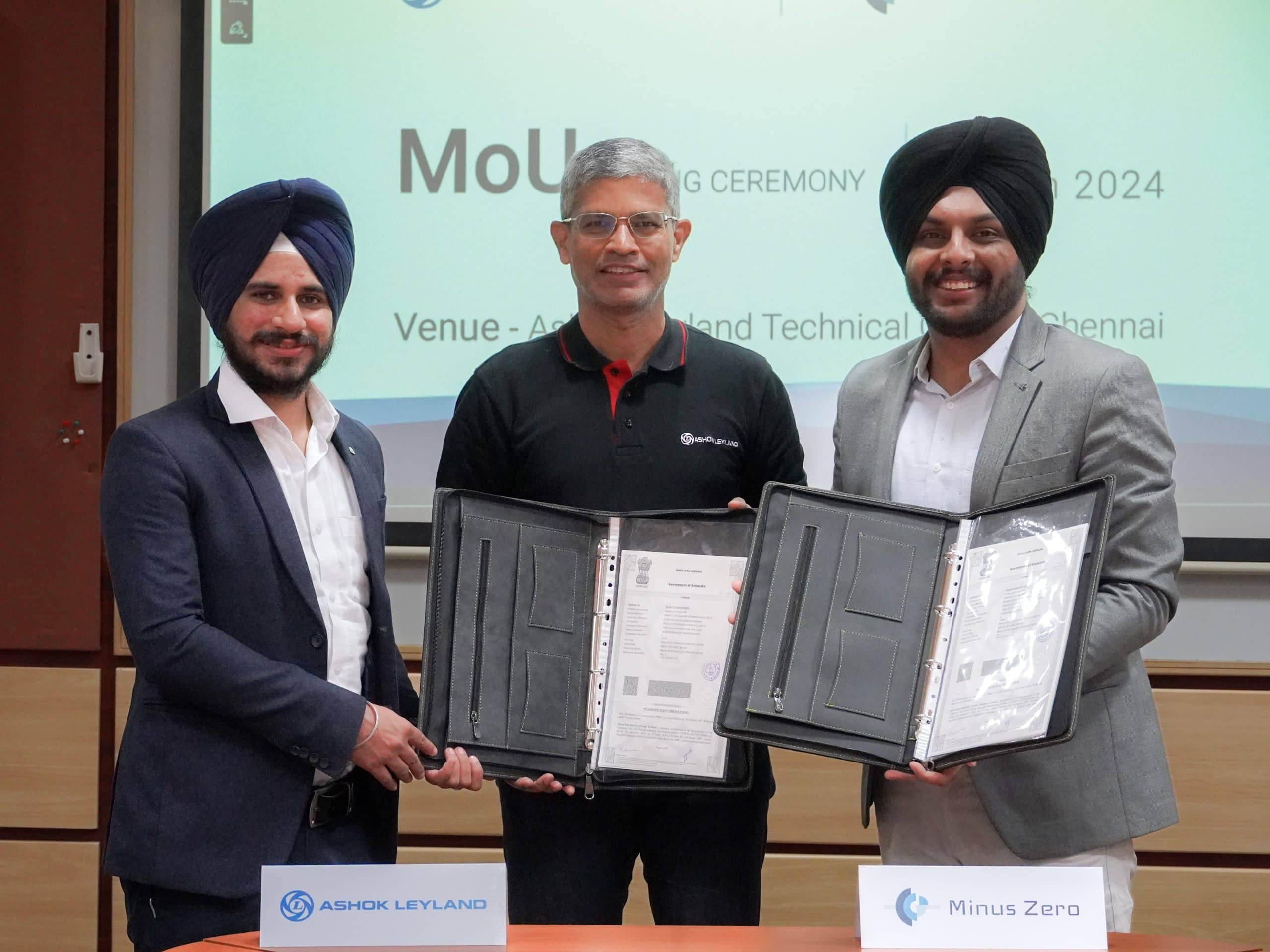
Minus Zero has announced a strategic alliance with Ashok Leyland, the Indian flagship of the Hinduja Group and the country’s leading commercial vehicle manufacturer to develop tailored autonomous trucking solutions for ports, factory operations and corporate campuses.

Future endeavours include expanding into hub-to-hub applications and long-haul trucking, subject to evolving regulatory frameworks surrounding autonomous driving.

At the core of this alliance is the seamless integration of Minus Zero’s industry-first autonomous driving platform leveraging its pioneering nature-inspired AI technology, into Ashok Leyland’s fleet of commercial vehicles.

Leveraging Ashok Leyland’s esteemed product portfolio and safety standards alongside Minus Zero’s expertise in self-driving technology, the collaboration aims for safe and scalable adoption of autonomous driving in commercial vehicles.

Last year, Minus Zero demonstrated the capabilities of its autonomous driving platform in a closed environment through a purpose-built vehicle, zPod.

With global regulations and infrastructure evolving to support autonomous driving, this collaboration can extend to offer joint product offerings to international markets.

“Ashok Leyland has been looking for ways to reduce the cost of logistics in India in line with the Government’s National Logistics Policy. We see a role for autonomous driving in select sectors in achieving this and we have been partnering pioneering startups in this area.

“Minus Zero’s capabilities and plans impressed us, and we are excited to be working with them to develop India-specific solutions, that can be scaled globally. We see spin-off benefits in developing cost-effective active safety solutions to reduce road accidents,” said N Saravanan, chief technology officer, Ashok Leyland.

The post Minus Zero and Ashok Leyland Partner to Develop Autonomous Trucking Solutions appeared first on Analytics India Magazine.

NVIDIA GTC Keynote: Blackwell Architecture Will Accelerate AI Products in Late 2024

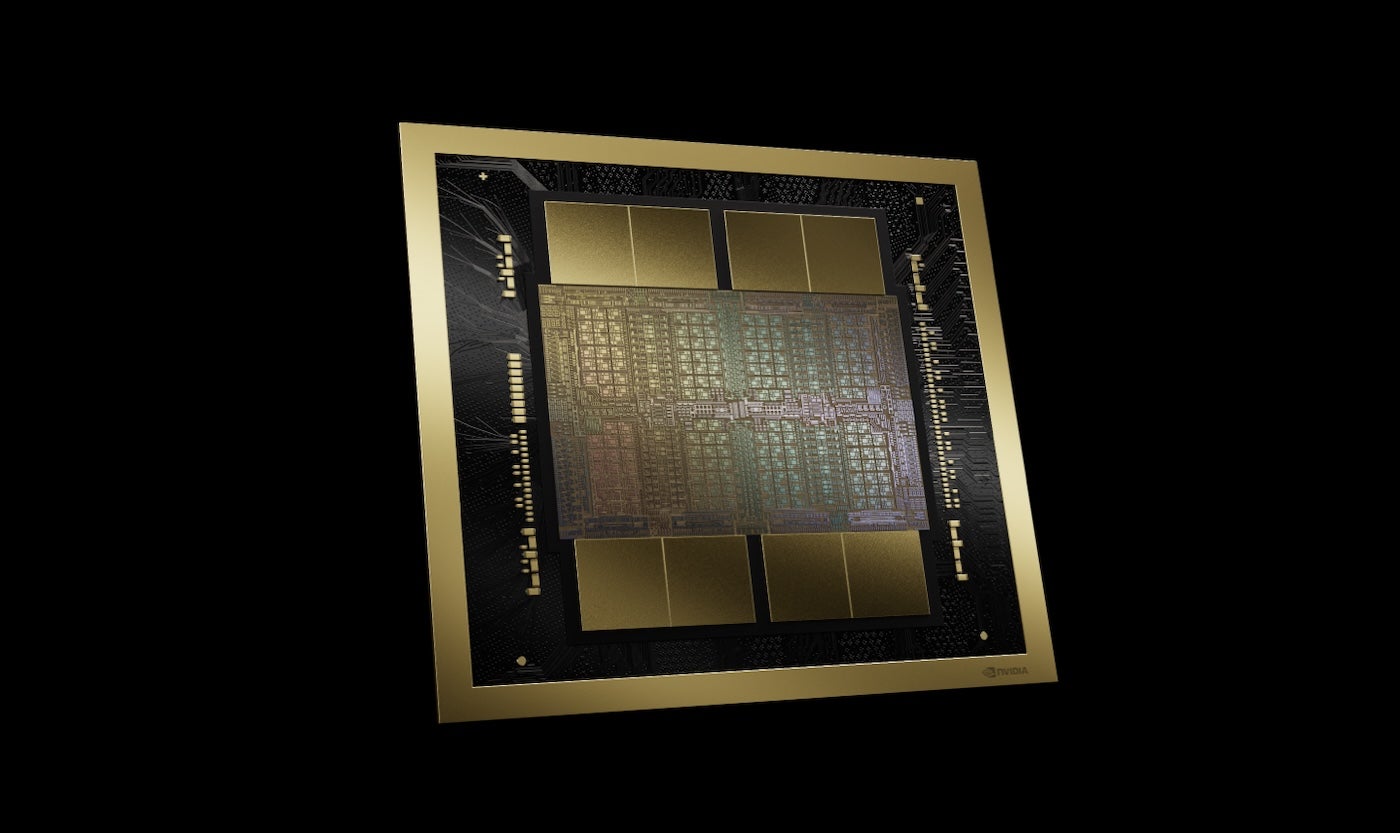
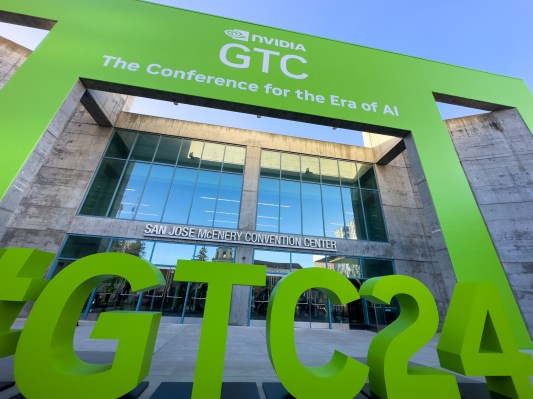
NVIDIA’s newest GPU platform is the Blackwell (Figure A), which companies including AWS, Microsoft and Google plan to adopt for generative AI and other modern computing tasks, NVIDIA CEO Jensen Huang announced during the keynote at the NVIDIA GTC conference on March 18 in San Jose, California.

Figure A

The NVIDIA Blackwell architecture.
The NVIDIA Blackwell architecture. Image: NVIDIA

Blackwell-based products will enter the market from NVIDIA partners worldwide in late 2024. Huang announced a long lineup of additional technologies and services from NVIDIA and its partners, speaking of generative AI as just one facet of accelerated computing.

“When you become accelerated, your infrastructure is CUDA GPUs,” Huang said, referring to CUDA, NVIDIA’s parallel computing platform and programming model. “And when that happens, it’s the same infrastructure as for generative AI.”

Blackwell enables large language model training and inference

The Blackwell GPU platform contains two dies connected by a 10 terabytes per second chip-to-chip interconnect, meaning each side can work essentially as if “the two dies think it’s one chip,” Huang said. It has 208 billion transistors and is manufactured using NVIDIA’s 208 billion 4NP TSMC process. It boasts 8 TB/S memory bandwidth and 20 pentaFLOPS of AI performance.

For enterprise, this means Blackwell can perform training and inference for AI models scaling up to 10 trillion parameters, NVIDIA said.

Blackwell is enhanced by the following technologies:

  • The second generation of the TensorRT-LLM and NeMo Megatron, both from NVIDIA.
  • Frameworks for double the compute and model sizes compared to the first generation transformer engine.
  • Confidential computing with native interface encryption protocols for privacy and security.
  • A dedicated decompression engine for accelerating database queries in data analytics and data science.

Regarding security, Huang said the reliability engine “does a self test, an in-system test, of every bit of memory on the Blackwell chip and all the memory attached to it. It’s as if we shipped the Blackwell chip with its own tester.”

Blackwell-based products will be available from partner cloud service providers, NVIDIA Cloud Partner program companies and select sovereign clouds.

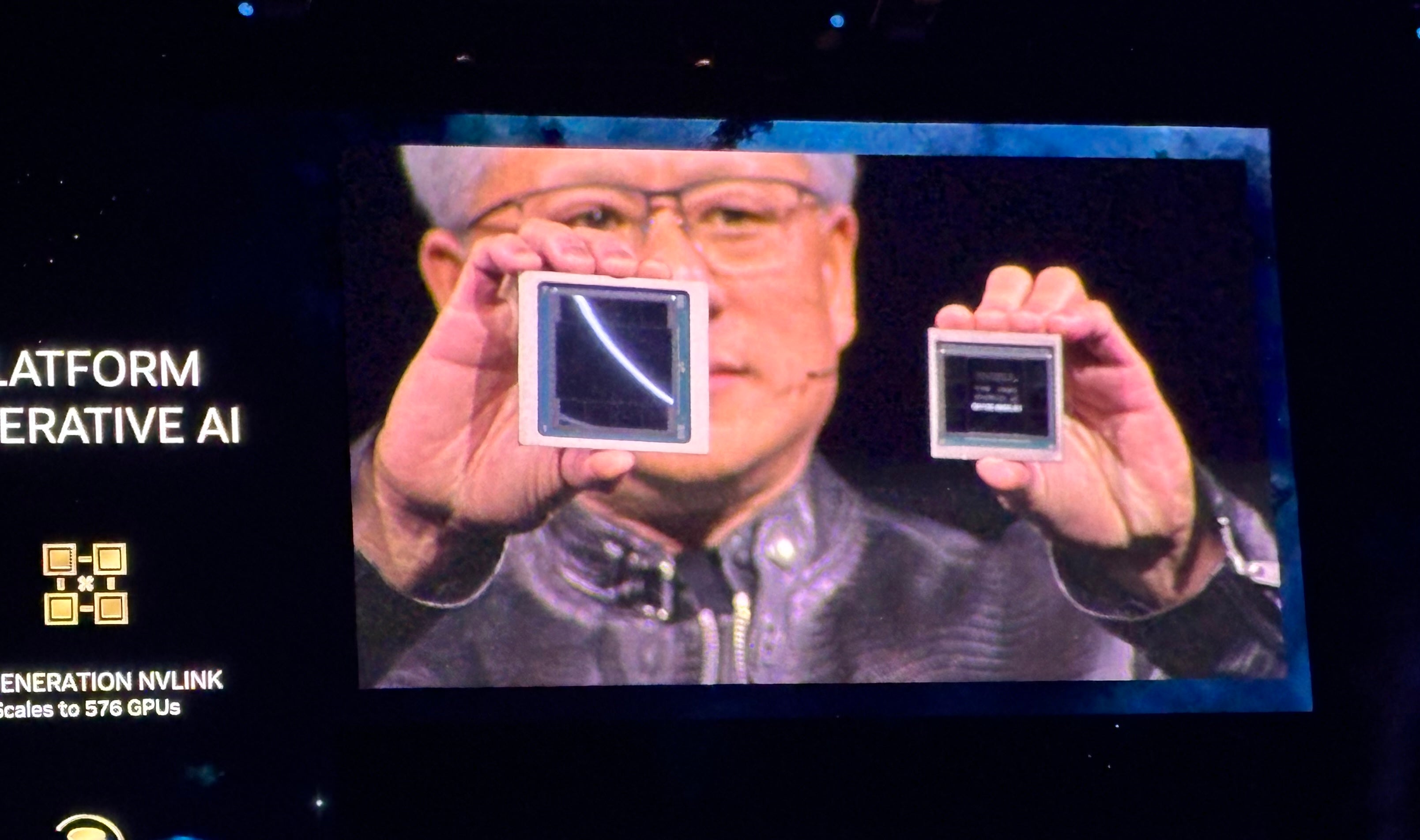
The Blackwell line of GPUs follows the Grace Hopper line of GPUs, which debuted in 2022 (Figure B). NVIDIA says Blackwell will run real-time generative AI on trillion-parameter LLMs at 25x less cost and less energy consumption than the Hopper line.

Figure B

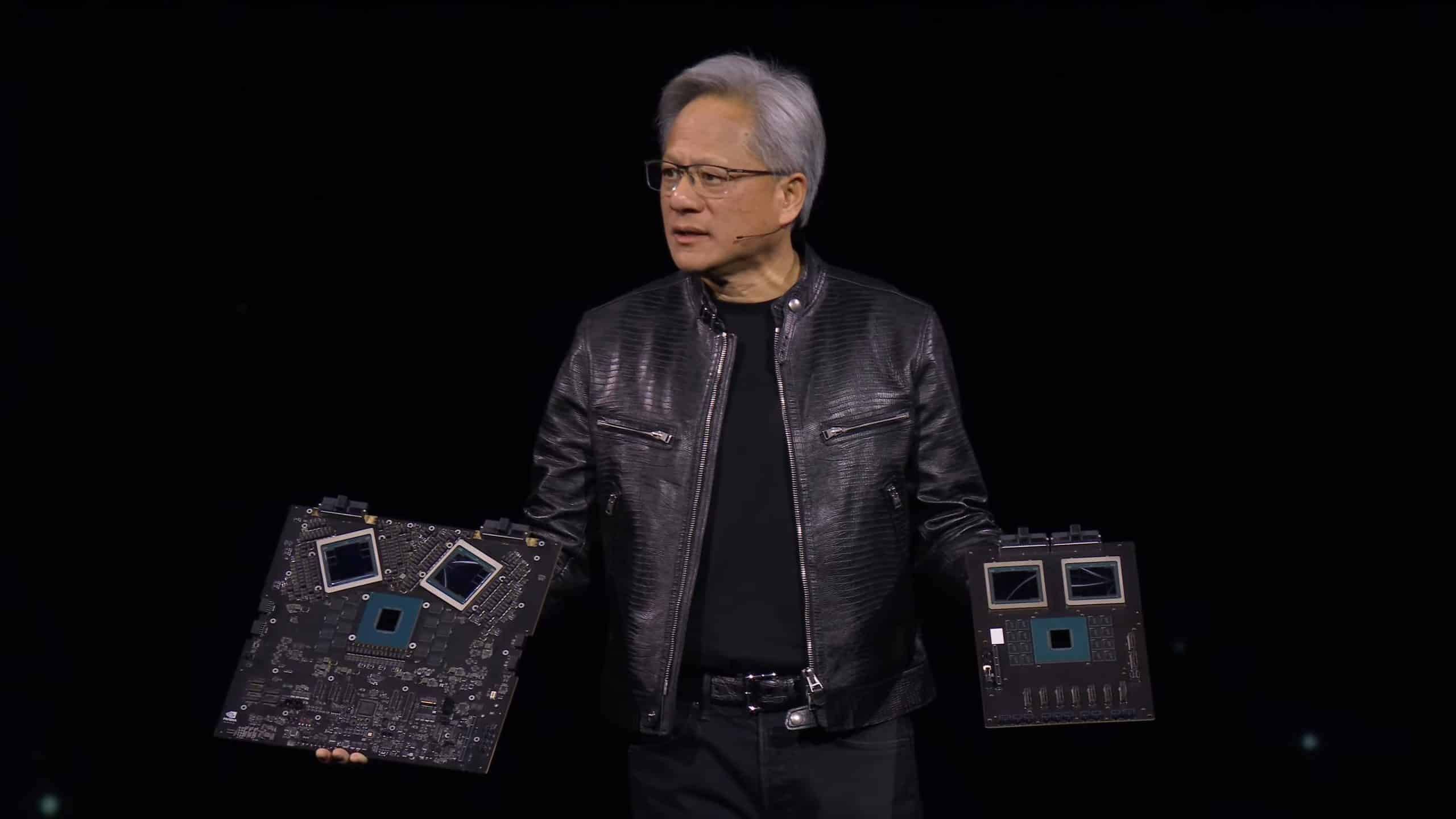
NVIDIA CEO Jensen Huang shows the Blackwell (left) and Hopper (right) GPUs at NVIDIA GTC 2024 in San Jose, California on March 18.
NVIDIA CEO Jensen Huang shows the Blackwell (left) and Hopper (right) GPUs at NVIDIA GTC 2024 in San Jose, California on March 18. Image: Megan Crouse/TechRepublic

NVIDIA GB200 Grace Blackwell Superchip connects multiple Blackwell GPUs

Along with the Blackwell GPUs, the company announced the NVIDIA GB200 Grace Blackwell Superchip, which links two NVIDIA B200 Tensor Core GPUs to the NVIDIA Grace CPU – providing a new, combined platform for LLM inference. The NVIDIA GB200 Grace Blackwell Superchip can be linked with the company’s newly-announced NVIDIA Quantum-X800 InfiniBand and Spectrum-X800 Ethernet platforms for speeds up to 800 GB/S.

The GB200 will be available on NVIDIA DGX Cloud and through AWS, Google Cloud and Oracle Cloud Infrastructure instances later this year.

New server design looks ahead to trillion-parameter AI models

The GB200 is one component of the newly announced GB200 NVL72, a rack-scale server design that packages together 36 Grace CPUs and 72 Blackwell GPUs for 1.8 exaFLOPs of AI performance. NVIDIA is looking ahead to possible use cases for massive, trillion-parameter LLMs, including persistent memory of conversations, complex scientific applications and multimodal models.

The GB200 NVL72 combines the fifth-generation of NVLink connectors (5,000 NVLink cables) and the GB200 Grace Blackwell Superchip for a massive amount of compute power Huang calls “an exoflops AI system in one single rack.”

“That is more than the average bandwidth of the internet … we could basically send everything to everybody,” Huang said.

“Our goal is to continually drive down the cost and energy – they’re directly correlated with each other – of the computing,” Huang said.

Cooling the GB200 NVL72 requires two liters of water per second.

The next generation of NVLink brings accelerated data center architecture

The fifth-generation of NVLink provides 1.8TB/s bidirectional throughput per GPU communication among up to 576 GPUs. This iteration of NVLink is intended to be used for the most powerful complex LLMs available today.

“In the future, data centers are going to be thought of as an AI factory,” Huang said.

Introducing the NVIDIA Inference Microservices

Another element of the possible “AI factory” is the NVIDIA Inference Microservice, or NIM, which Huang described as “a new way for you to receive and package software.”

The NIMs, which NVIDIA uses internally, are containers with which to train and deploy generative AI. NIMs let developers use APIs, NVIDIA CUDA and Kubernetes in one package.

SEE: Python remains the most popular programming language according to the TIOBE Index. (TechRepublic)

Instead of writing code to program an AI, Huang said, developers can “assemble a team of AIs” that work on the process inside the NIM.

“We want to build chatbots – AI copilots – that work alongside our designers,” Huang said.

NIMs are available starting March 18. Developers can experiment with NIMs for no charge and run them through a NVIDIA AI Enterprise 5.0 subscription.

Other major announcements from NVIDIA at GTC 2024

Huang announced a wide range of new products and services across accelerated computing and generative AI during the NVIDIA GTC 2024 keynote.

NVIDIA announced cuPQC, a library used to accelerate post-quantum cryptography. Developers working on post-quantum cryptography can reach out to NVIDIA for updates about availability.

NVIDIA’s X800 series of network switches accelerates AI infrastructure. Specifically, the X800 series contains the NVIDIA Quantum-X800 InfiniBand or NVIDIA Spectrum-X800 Ethernet switches, the NVIDIA Quantum Q3400 switch and the NVIDIA ConnectXR-8 SuperNIC. The X800 switches will be available in 2025.

Major partnerships detailed during the NVIDIA’s keynote include:

  • NVIDIA’s full-stack AI platform will be on Oracle’s Enterprise AI starting March 18.
  • AWS will provide access to NVIDIA Grace Blackwell GPU-based Amazon EC2 instances and NVIDIA DGX Cloud with Blackwell security.
  • NVIDIA will accelerate Google Cloud with the NVIDIA Grace Blackwell AI computing platform and the NVIDIA DGX Cloud service, coming to Google Cloud. Google has not yet confirmed an availability date, although it is likely to be late 2024. In addition, the NVIDIA H100-powered DGX Cloud platform is generally available on Google Cloud as of March 18.
  • Oracle will use the NVIDIA Grace Blackwell in its OCI Supercluster, OCI Compute and NVIDIA DGX Cloud on Oracle Cloud Infrastructure. Some combined Oracle-NVIDIA sovereign AI services are available as of March 18.
  • Microsoft will adopt the NVIDIA Grace Blackwell Superchip to accelerate Azure. Availability can be expected later in 2024.
  • Dell will use NVIDIA’s AI infrastructure and software suite to create Dell AI Factory, an end-to-end AI enterprise solution, available as of March 18 through traditional channels and Dell APEX. At an undisclosed time in the future, Dell will use the NVIDIA Grace Blackwell Superchip as the basis for a rack scale, high-density, liquid-cooled architecture. The Superchip will be compatible with Dell’s PowerEdge servers.
  • SAP will add NVIDIA retrieval-augmented generation capabilities into its Joule copilot. Plus, SAP will use NVIDIA NIMs and other joint services.

“The whole industry is gearing up for Blackwell,” Huang said.

Competitors to NVIDIA’s AI chips

NVIDIA competes primarily with AMD and Intel in regards to providing enterprise AI. Qualcomm, SambaNova, Groq and a wide variety of cloud service providers play in the same space regarding generative AI inference and training.

AWS has its proprietary inference and training platforms: Inferentia and Trainium. As well as partnering with NVIDIA on a wide variety of products, Microsoft has its own AI training and inference chip: the Maia 100 AI Accelerator in Azure.

Disclaimer: NVIDIA paid for my airfare, accommodations and some meals for the NVIDIA GTC event held March 18 – 21 in San Jose, California.

Nvidia enlists humanoid robotics’ biggest names for new AI platform, GR00T

Nvidia enlists humanoid robotics’ biggest names for new AI platform, GR00T Brian Heater @bheater / 10 hours

It’s tough to argue with Nvidia CEO Jensen Huang when he notes, “Building foundation models for general humanoid robots is one of the most exciting problems to solve in AI today.” The humanoid form factor is one of the most hotly contested topics in the world of robotics at the moment, raising venture capital by the boatload, while generating massive skepticism along the way.

Naturally, Nvidia wants a piece. The chip giant has become arguably the most important hardware company in AI and has more recently been making a compelling case for itself as a driver for robotic innovation through initiatives like Isaac and Jetson. This week at its annual GTC developer conference, the company is planting its flag in the humanoid race with Project GR00T, which may or may not be a nod to Marvel’s illeist talking space tree.

The chipmaker refers to the new platform as “a general-purpose foundation model for humanoid robots.” In essence, the company is building an AI platform for the recent spate of entries into the category, including companies like 1X Technologies, Agility Robotics, Apptronik, Boston Dynamics, Figure AI, Fourier Intelligence, Sanctuary AI, Unitree Robotics and XPENG Robotics. That covers nearly every prominent humanoid robot maker at the moment, with a few notable exceptions like Tesla.

Agility gets additional facetime in the announcement, courtesy of a quote from co-founder and Chief Robotics Officer Jonathan Hurst: “We are at an inflection point in history, with human-centric robots like Digit poised to change labor forever. Modern AI will accelerate development, paving the way for robots like Digit to help people in all aspects of daily life. We’re excited to partner with NVIDIA to invest in the computing, simulation tools, machine learning environments and other necessary infrastructure to enable the dream of robots being a part of daily life.”

Sanctuary AI co-founder and CEO Geordie Rose also weighs in: “Embodied AI will not only help address some of humanity’s biggest challenges, but also create innovations which are currently beyond our reach or imagination. Technology this important shouldn’t be built in silos, which is why we prioritize long-term partners like NVIDIA.”

GR00T will support new hardware from Nvidia, as well. Keeping things in the Marvel Cinematic Universe is Jetson Thor, a new computer designed specifically for running simulation workflows, generative AI models and more for the humanoid form factor. I continue to caution people away from casually tossing out terms like “general purpose” when describing these machines, but Nvidia’s keen interest is a validation for the category that will almost certainly accelerate development.

Nvidia notes of the new silicon:

The SoC includes a next-generation GPU based on NVIDIA Blackwell architecture with a transformer engine delivering 800 teraflops of 8-bit floating point AI performance to run multimodal generative AI models like GR00T. With an integrated functional safety processor, a high-performance CPU cluster and 100GB of ethernet bandwidth, it significantly simplifies design and integration efforts.

While general purpose is still years off, democratizing access for third-party developers will go a long ways toward bridging that gap.

This week’s GTC robotics announcements included two more key programs: Isaac Manipulator and Isaac Perceptor. Manipulation has been a foundation aspect of robotics for decades now. Leading the way were the massive industrial robotic arms that have become a fixture of automotive manufacturing. The next generation will be even more dexterous and far more mobile. Naturally, Nvidia wants a piece of the action.

“Isaac Manipulator offers state-of-the-art dexterity and modular AI capabilities for robotic arms, with a robust collection of foundation models and GPU accelerated libraries,” the company writes. “It provides up to an 80x speedup in path planning and zero shot perception increases efficiency and throughput, enabling developers to automate a greater number of new robotic tasks.”

Nvidia already has some big names on board, including, Franka Robotics, PickNik Robotics, READY Robotics, Solomon, Universal Robots and Yaskawa.

AMRs (autonomous mobile robotics are also getting some love, in the form of Perceptor. The program maintains Nvidia’s longstanding focus on vision processing for robotics. This is specifically targeted at “multi-camera, 3D surround-vision capabilities.” ArcBest, BYD and KION Group have already signed up.

The next several years will present a fascinating race for market share between humanoids and mobile manipulators, and Nvidia wants a piece of all of that action.

Nvidia launches a set of microservices for optimized inferencing

Nvidia launches a set of microservices for optimized inferencing Frederic Lardinois @fredericl / 8 hours

At its GTC conference, Nvidia today announced Nvidia NIM, a new software platform designed to streamline the deployment of custom and pre-trained AI models into production environments. NIM takes the software work Nvidia has done around inferencing and optimizing models and makes it easily accessible by combining a given model with an optimized inferencing engine and then packing this into a container, making that accessible as a microservice.

Typically, it would take developers weeks — if not months — to ship similar containers, Nvidia argues — and that is if the company even has any in-house AI talent. With NIM, Nvidia clearly aims to create an ecosystem of AI-ready containers that use its hardware as the foundational layer with these curated microservices as the core software layer for companies that want to speed up their AI roadmap.

NIM currently includes support for models from NVIDIA, A121, Adept, Cohere, Getty Images, and Shutterstock as well as open models from Google, Hugging Face, Meta, Microsoft, Mistral AI and Stability AI. Nvidia is already working with Amazon, Google and Microsoft to make these NIM microservices available on SageMaker, Kubernetes Engine and Azure AI, respectively. They’ll also be integrated into frameworks like Deepset, LangChain and LlamaIndex.

Image Credits: Nvidia

“We believe that the Nvidia GPU is the best place to run inference of these models on […], and we believe that NVIDIA NIM is the best software package, the best runtime, for developers to build on top of so that they can focus on the enterprise applications — and just let Nvidia do the work to produce these models for them in the most efficient, enterprise-grade manner, so that they can just do the rest of their work,” said Manuvir Das, the head of enterprise computing at Nvidia, during a press conference ahead of today’s announcements.”

As for the inference engine, Nvidia will use the Triton Inference Server, TensorRT and TensorRT-LLM. Some of the Nvidia microservices available through NIM will include Riva for customizing speech and translation models, cuOpt for routing optimizations and the Earth-2 model for weather and climate simulations.

The company plans to add additional capabilities over time, including, for example, making the Nvidia RAG LLM operator available as a NIM, which promises to make building generative AI chatbots that can pull in custom data a lot easier.

This wouldn’t be a developer conference without a few customer and partner announcements. Among NIM’s current users are the likes of Box, Cloudera, Cohesity, Datastax, Dropbox
and NetApp.

“Established enterprise platforms are sitting on a goldmine of data that can be transformed into generative AI copilots,” said Jensen Huang, founder and CEO of NVIDIA. “Created with our partner ecosystem, these containerized AI microservices are the building blocks for enterprises in every industry to become AI companies.”

NVIDIA’s GenAI for Healthcare Takes Center Stage at GTC 2024

NVIDIA’s GenAI for Healthcare Takes Center Stage at GTC 2024

Healthcare has always been one of NVIDIA’s big bets. And now, exactly on the one-year anniversary of BioNeMo cloud, the company has introduced a set of over 25 new generative AI-powered microservices to empower healthcare organisations globally across various domains, such as drug discovery, medical technology (MedTech), and digital health, at the much-awaited NVIDIA GTC 2024.

Additionally, BioNeMo now contains new foundational models for various tasks in drug discovery, such as analysing DNA sequences, predicting protein structure changes caused by drug interactions, and identifying cell functions from RNA data.

“Healthcare is inherently complicated. We aim to make it easier for researchers who can fine-tune these models on proprietary data, run AI model inference through web browsers or cloud APIs, and access pre-trained models for drug development,” Kimberly Powell, VP of healthcare, NVIDIA, told AIM in an earlier conversation.

Over 25 Generative AI Microservices

These microservices, accessible on any cloud platform, offer specialised capabilities like imaging, natural language processing, speech recognition, and digital biology simulation.

The suite includes NVIDIA NIM AI models optimised for healthcare applications and industry-standard APIs for easy integration into cloud-native solutions. Additionally, software development kits and tools like Parabricks, MONAI, NeMo, Riva, and Metropolis are now available as NVIDIA CUDA-X microservices to accelerate drug discovery, medical imaging, and genomics analysis workflows.

NVIDIA NIM Healthcare Microservices, a part of this suite, offer optimised inference for various models in imaging, MedTech, drug discovery, and digital health. They include models for generative chemistry, protein structure prediction, molecular interaction analysis, and 3D segmentation. These microservices provide significant speed improvements for tasks like genomic analysis, with over 50 times faster variant calling than traditional methods.

“For the first time in history, we can represent the world of biology and chemistry in a computer, making computer-aided drug discovery possible,” said Powell, during the conference.

Healthcare giants like Amgen, Astellas, DNA Nexus, and Iambic Therapeutics leverage these microservices to improve drug discovery and antibody design using generative AI.

New Foundational Model for Protein Structure Prediction

NVIDIA’s BioNeMo has expanded its capabilities to include new foundation models for various tasks in drug discovery, such as analysing DNA sequences, predicting protein structure changes caused by drug interactions, and identifying cell functions from RNA data.

Among these new foundation models are DNABERT for genomics analysis and scBERT for single-cell RNA sequencing. EquiDock is another model that predicts protein interactions, which is crucial for evaluating the effectiveness of drugs.

These models, along with microservices, are accessible through NVIDIA NIM microservices. Microservices like DiffDock and ESMFold within NVIDIA NIM provide insights into drug candidate structures and protein folding based on amino acid sequences. MolMIM generates drug candidates tailored to user-defined properties and specific protein targets. Soon, these models will also be available on AWS HealthOmics to analyse biological data.

Alphabet has been leading the race of protein prediction all this time with AlphaFold. In November last year, Alphabet-backed Isomorphic Labs and Google DeepMind launched the updated version of AlphaFold 2, which can now predict structures from nearly all molecules in the Protein Data Bank (PDB), including small molecules, proteins, nucleic acids, and molecules with post-translational modifications.

NVIDIA & Johnson & Johnson to Use AI in Surgery

Besides developing over 25 generative AI microservices for healthcare, the company has teamed up with Johnson & Johnson MedTech, a pharmaceutical technology leader, to integrate AI into surgery to improve operating room efficiency and clinical decision-making.

The partnership will let the former deploy AI-powered applications and real-time insights. By leveraging NVIDIA’s IGX and Holoscan platforms, J&J MedTech can process data securely from various devices in the operating room, enhancing surgical outcomes. As a common computing platform, it also facilitates the deployment of third-party models and applications.

J&J MedTech and NVIDIA are working to streamline the development and deployment of AI applications in the operating room. The latter’s Holoscan accelerates creating real-time AI applications for medical use cases, leveraging NVIDIA IGX’s high-speed data streaming capabilities. By analysing device, patient, and surgical data, AI-powered applications can provide valuable insights to surgeons during procedures, potentially reducing cognitive load and enhancing care delivery.

The post NVIDIA’s GenAI for Healthcare Takes Center Stage at GTC 2024 appeared first on Analytics India Magazine.

The evolution of large scale data storage solutions

big-data-solutions

The data storage journey is as old as computing, tracing a path from the earliest days of room-sized machines to today’s cloud-based ecosystems. Large-scale data storage has evolved dramatically to meet the ever-increasing demands of information technology. Understanding this evolution is not just about acknowledging past innovations but appreciating the complexities and challenges that have driven us toward more efficient and expansive storage solutions. This article delves into the transformative history of large-scale data storage solutions, setting the stage for how businesses have adapted to the relentless tide of data growth.

The birth of data storage and early developments

Initially, data storage was rudimentary, tethered to physical limitations, and defined by manual effort. The initial foray into digital data storage revolved around punch cards and paper tapes, where information was painstakingly encoded by hand. However, the quest for efficiency soon led to the development of magnetic tape in the 1950s, which marked the first significant step towards automation in data storage. Magnetic tape and the burgeoning mainframe computers laid the groundwork for the relational databases that emerged in the 1970s. These revolutionary databases provided structured and efficient ways to store, retrieve, and manage data. The concept of data as a corporate asset began to take root, with organizations starting to leverage these early storage solutions to gain operational advantages, setting the stage for the massive scale of data storage that modern enterprises would require.

The shift from on-premises to off-premises solutions

As data storage needs expanded, the limitations of on-premises solutions became evident. The cost and complexity of managing vast amounts of data in-house prompted a significant paradigm shift. The emergence of dedicated data centers provided a glimpse into the future. This offers specialized environments for secure and robust data storage. This evolution continued with the concept of virtualization. Allowing for multiple simulated environments from a single physical hardware system, dramatically improving resource utilization efficiency. The most groundbreaking shift came with the advent of cloud storage services, which introduced unprecedented scalability and flexibility. Businesses now could expand their storage capacity on demand without the hefty investment in physical infrastructure. This transformation alleviated the burden of heavy upfront costs. It provided the agility to access and synchronize data across geographically dispersed locations, paving the way for a new global connectivity and collaboration era.

The advent of modern storage architectures

The data storage landscape underwent a radical change with the introduction of modern storage architectures. Object storage became a standout solution for unstructured data, offering a scalable and customizable approach. It treats data as distinct units, each with its own metadata. This marked a significant shift from file storage, which had difficulties with large volumes of unstructured data. Similarly, block storage lacked the needed flexibility. The Storage Area Networks (SAN) and Network Attached Storage (NAS) provided advanced methods for storing and accessing data over networks. It improves not only capacity but also data transfer speeds and reliability. These architectures became the foundation for modern data warehouses, which required quickly accessing and analyzing large datasets. They enabled modern data strategies and detailed analytics, crucial for guiding business decisions and strategies.

The surge of big data and its storage demands

The advent of big data brought a tidal wave of new storage demands. It challenges traditional data storage architectures with its sheer volume, variety, and velocity. Big data refers to large, complex datasets that conventional data processing software cannot handle. This surge in data comes from sources such as social media, IoT devices, and real-time analytics. It leads to the need for data lakes and other innovative storage solutions. These solutions are designed to efficiently manage large volumes of unstructured data. Unlike traditional databases or storage systems, data lakes allow raw data to be stored in its native format until needed. This approach offers flexibility in data processing and analysis. It also greatly cuts down the time needed to prepare data for business intelligence. The challenges of big data have pushed data storage solutions to evolve into more scalable, flexible, and efficient systems. This evolution ensures that organizations can continue to benefit from their increasing volumes of data.

The impact of regulatory compliance on storage solutions

As data storage technology has evolved, so has the regulatory landscape governing how and where data can be stored and accessed. Regulatory compliance, including standards such as GDPR in Europe and CCPA in California, has significantly influenced storage solutions. These regulations mandate stringent data protection, privacy, and sovereignty measures, compelling organizations to adapt their storage strategies. Compliance demands secure storage solutions and mechanisms like audit trails and data encryption. It also requires the ability to quickly handle requests for data access. Consequently, the need for compliant storage solutions has become critical, driving innovation in secure, regulated, and adaptable data storage technologies.

The future of large-scale data storage

The future and ongoing evolution of data storage is poised at the edge of innovation, with emerging technologies like holographic and DNA data storage heralding a new era of possibilities. These advanced technologies promise exponential increases in storage capacities while reducing the physical footprint of data centers. Additionally, artificial intelligence (AI) and machine learning (ML) will be key in enhancing data storage, management, and retrieval processes. These technologies ensure greater efficiency and improved predictive analytics capabilities. As data becomes more voluminous and crucial, the evolution of storage solutions will continue to be a key concern. Sustainability, security, and scalability will lead technological progress.

Final words

The journey of large-scale data storage showcases the remarkable evolution of technology. It has moved from physical records to advanced, cloud-based systems. Looking ahead, ongoing innovation in storage solutions will be vital to manage the vast data volumes. This innovation will drive efficiency and support informed decision-making across various industries.

NVIDIA Introduces Very Big GPU, BLACKWELL

In a blockbuster announcement at its annual GTC conference, NVIDIA CEO Jensen Huang unveiled the company’s next-generation Blackwell GPU architecture, promising massive performance gains to fuel the AI revolution.

The highlight is the flagship B200 GPU, a behemoth packing 208 billion transistors across two cutting-edge chiplets connected by a blazing 10TB/s link. Huang proclaimed it “the world’s most advanced GPU in production.”

Blackwell introduces several groundbreaking technologies. It features a second-gen Transformer Engine to double AI model sizes with new 4-bit precision. The 5th-gen NVLink interconnect enables up to 576 GPUs to work seamlessly on trillion-parameter models. An AI reliability engine maximises supercomputer uptime for weeks-long training runs.

“When we were told Blackwell’s ambitions were beyond the limits of physics, the engineers said ‘so what?'” Huang said, showcasing a liquid-cooled B200 prototype. “This is what happened.”

Compared to its predecessor Hopper, the B200 promises 2.5x faster FP8 AI performance per GPU, double FP16 throughput with new FP6 format support, and up to 30x faster performance for large language models. Major tech giants like Amazon, Google, Microsoft, and Tesla have already committed to adopting Blackwell.

Huang said training a GPT model with 1.8 trillion parameters [GPT-4] typically takes three to five months using 25,000 amperes. HOPPER architecture would require around 8,000 GPUs, consuming 15 megawatts of power and taking about 90 days (three months). In contrast, BLACKWELL would need just 2,000 GPUs and significantly less power—only four megawatts—for the same duration.

He said that NVIDIA aims to reduce computing costs and energy consumption, thereby facilitating the scaling up of computations necessary for training next-generation models.

To showcase Blackwell’s scale, NVIDIA unveiled the DGX SuperPOD, a next-gen AI supercomputer with up to 576 Blackwell GPUs and 11.5 exaflops of AI compute. Each DGX GB200 system packs 36 Blackwell GPUs coherently linked to Arm-based Grace CPUs.

While focused on AI and data centres initially, Blackwell’s innovations are expected to benefit gaming GPUs too.

With Blackwell raising the bar, NVIDIA has clearly doubled down on its lead in the white-hot AI acceleration market. The race for the next AI breakthrough is on.

The post NVIDIA Introduces Very Big GPU, BLACKWELL appeared first on Analytics India Magazine.