What is the significance of color in data visualization?

color in data visualization

Colors not only make things beautiful around us, but they are also an effective method for describing something. People find psychological associations with color. For example, it is said that red signifies power, love, and anger. Blue denotes calmness and logic. Other shades of primary colors convey different meanings and emotions. When two or more colors are mixed to create a complementary color, it profoundly affects the audience!

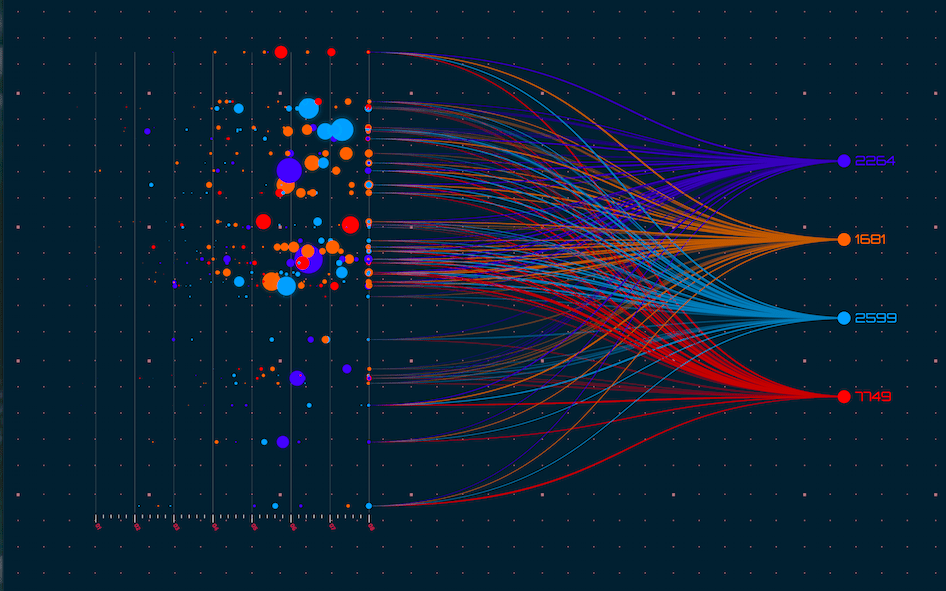
In data visualization, color is important to set the tone and send a meaningful message through visual display. It creates a specific environment to transform visualization into an emotional story.

The role of color in data visualization

Data visualization has many design elements, such as the topic, analysis, comparisons, etc., that use colors to speak to the audience. These hues speak louder than words and communicate efficaciously. The power of color allows businesses to communicate the message in a more engaging way and connect with the audience.

Data visualization is critical for all businesses today. It ensures more visible and clearer patterns. It can also allow you to tell a story and set the stage!

Learn More: The Power of Color Psyсhology in Data Visualization

Evokes emotions

While some colors evoke positivity, some testify to confidence and strength. Some colors foster the idea of friendship, while some communicate anxiety and fear. Because colors connect emotions, it is imperative to be wary of using colors to display information.

Many companies invest in research and development activities to discover the impact of color and the emotion it ignites. Then, they create a visualization using different colors and their connotations. While greens and yellows are kept for innovation, red and purple or other darker and muted colors show negative results in data visualizations.

For example, in 2017-18 in the United States, Justin Davis displayed the worst flu season using dark purple. The title ‘PANDEMIC’ was added in white against the purple background to add more impact. The audience associates some topics and brands with color. These associations attract easier, more memorable, and more accessible information.

Build connections

Colors help to connect with the audience through a host of emotions. The color pattern can create instant recognition and immediate binding with the audience. One of the finest examples of colors creating connection can be seen in how Germans dominated the Luge at the Olympics. Klaus Schulte visualized data by coloring the various categories in the colors of the German flag.

Creates a story

Using color in data analytics allows you to tell a story and engage the audience. You can instantaneously evoke their emotions and attract their attention. Companies must explore different ways of using color in their data visualization techniques and build a powerful story. However, it is important to choose relevant colors. Well-selected colors create a better insight for your viewers and become a more appropriate method to convey your message timely and conveniently. According to Neil Patel, 52% of the time, a bad color choice can lead to the users exiting the website and never returning. So, in data visualization, choosing the right colors is very important. Choose your colors based on various factors, aesthetics, science, etc.

Makes you stand out

The variety of colors eliminates dullness and boredom. Through color, data science professionals can highlight the most important part of your brand message and make your graphs more understandable. Also, when you use contrast colors, you can easily compare two data sets, simplify data, and help the viewers grasp a complex picture.

Influence and give depth

When you want your audience to feel what you want them to feel about your brand, use colors in data visualization. Colors can give depth to your message and often allow the viewers to feel cheerful. You can choose from the three data visualization color palettes: qualitative palettes, sequential palettes, and diverging palettes. The qualitative colors are for categorical variables and not inherently ordered values. A sequential palette is for numeric and inherently ordered values. You can use a diverging palette if there is a numeric variable with a meaningful central value.

Wrapping up

Using color strategically can help you connect with your audience and allow them to understand the meaning behind your message. Colors can evoke feelings of creativity, tranquility, comfort, etc. Also, the importance of choosing the right colors for your data visualization should not be undermined. You cannot throw colors here and there because it will distract your viewers and not evoke the feelings you want. So, use color cautiously to get your message to the point.

Color is an important aspect of data science, but you must also know that you use color only where appropriate. Do not unnecessarily stuff colors in the chart you create. Add color when you want to emphasize a particular finding!


Yotta Receives India’s First Cluster of 4,000 NVIDIA H100 GPUs

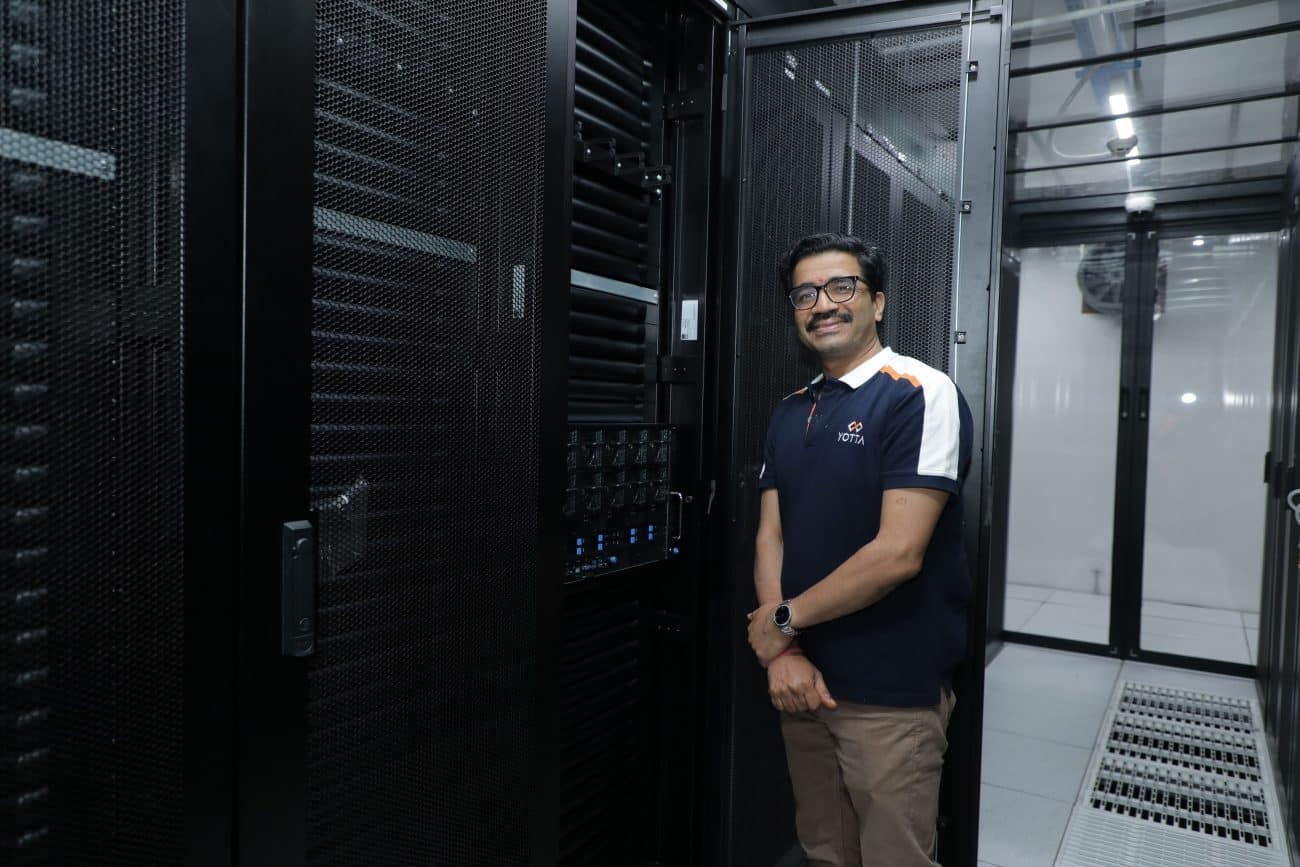
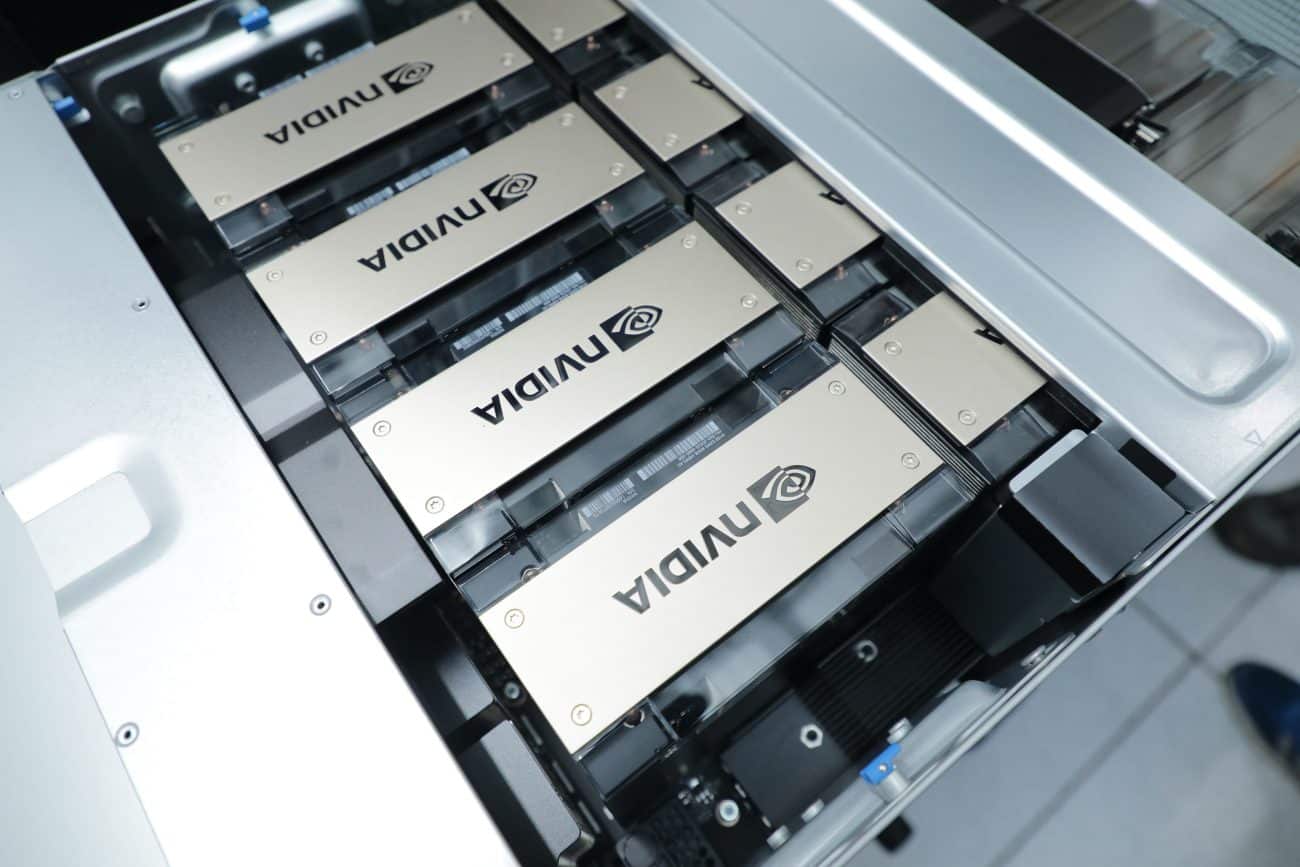
In a landmark moment for India’s artificial intelligence ambitions, Yotta Data Services today announced the arrival of over 4,000 NVIDIA H100 Tensor Core GPUs at its NM1 data centre. The state-of-the-art chips, billed as the world’s fastest AI accelerators, will power Yotta’s upcoming Shakti Cloud platform – set to be the 10th quickest supercomputer globally.

The H100 delivery marks a major milestone in Yotta’s partnership with NVIDIA, establishing it as the company’s first Network Cloud Partner in India and an Elite Partner worldwide. Yotta aims to scale its GPU infrastructure to a staggering 32,768 units by 2025.

“We at Yotta are proud to be at the heart of the AI revolution in India,” said Sunil Gupta, Co-founder, MD & CEO of Yotta Data Services. “With access to the world’s most powerful hardware right here on Indian soil, Yotta will help Indian businesses, governments, startups, and researchers accelerate innovation.”

Democratising AI Access

Beyond raw compute power, Shakti Cloud will offer foundational AI models and applications to help enterprises rapidly develop and deploy their own AI solutions. This full-stack approach aims to democratise access to advanced AI capabilities.

“The delivery of the NVIDIA H100 marks the beginning of a new chapter, not just for Yotta, but for a truly AI-powered digital Bharat,” Gupta added. “Yotta will help achieve excellence as we scale greater heights in the AI revolution.”

Hopper Architecture Leap

Based on NVIDIA’s Hopper architecture, the H100 GPU packs 80 billion transistors – a 6x increase over its A100 predecessor. This quantum leap in performance is ideal for training LLMs powering applications like instant content creation, translation, and medical diagnosis.

Yotta’s Shakti Cloud is poised to be India’s largest and fastest AI-focused supercomputer, offering not just bare-metal GPU infrastructure, but also end-to-end platform and software services. This comprehensive approach aims to empower entrepreneurs to build AI products with unprecedented efficiency.

As the first 4,000 NVIDIA H100 GPUs come online at Yotta’s Navi Mumbai data centre, India’s AI ecosystem looks set for a major boost. And with tens of thousands more chips on the horizon, Yotta is staking its claim as a key enabler of the country’s AI-driven future.

The post Yotta Receives India’s First Cluster of 4,000 NVIDIA H100 GPUs appeared first on Analytics India Magazine.

Getting Started with LLMOps: The Secret Sauce Behind Seamless Interactions

Getting Started with LLMOps: The Secret Sauce Behind Seamless Interactions
Image by Author

Large Language Models (LLMs) are a new type of artificial intelligence that is trained on massive amounts of text data. Their main ability is to generate human-like text in response to a wide range of prompts and requests.

I bet you have already had some experience with popular LLM solutions like ChatGPT or Google Gemini.

But have you ever wondered how these powerful models deliver such lightning-fast responses?

The answer lies in a specialized field called LLMOps.

Before diving in, let’s try to visualize the importance of this field.

Imagine you're having a conversation with a friend. The normal thing you would expect is that when you ask a question, they give you an answer right away, and the dialogue flows effortlessly.

Right?

This smooth exchange is what users expect as well when interacting with Large Language Models (LLMs). Imagine chatting with ChatGPT and having to wait for a of couple minutes every time we send a prompt, nobody would use it at all, at least I wouldn’t for sure.

This is why LLMs are aiming to achieve this conversation flow and effectiveness in their digital solutions with the LLMOps field. This guide aims to be your companion in your first steps in this brand-new domain.

What is LLMOps?

LLMOps, short for Large Language Model Operations, is the behind-the-scenes magic that ensures LLMs function efficiently and reliably. It represents an advancement from the familiar MLOps, specifically designed to address the unique challenges posed by LLMs.

While MLOps focuses on managing the lifecycle of general machine learning models, LLMOps deals specifically with the LLM-specific requirements.

When using models from entities like OpenAI or Anthropic through web interfaces or API, LLMOps work behind the scenes, making these models accessible as services. However, when deploying a model for a specialized application, LLMOps responsibility relies on us.

So think of it like a moderator taking care of a debate’s flow. Just like the moderator keeps the conversation running smoothly and aligned to the debate’s topic, always making sure there are no bad words and trying to avoid fake news, LLMOps ensures that LLMs operate at peak performance, delivering seamless user experiences and checking the safety of the output.

Why is LLMOps Important?

Creating applications with Large Language Models (LLMs) introduces challenges distinct from those seen with conventional machine learning. To navigate these, innovative management tools and methodologies have been crafted, giving rise to the LLMOps framework.

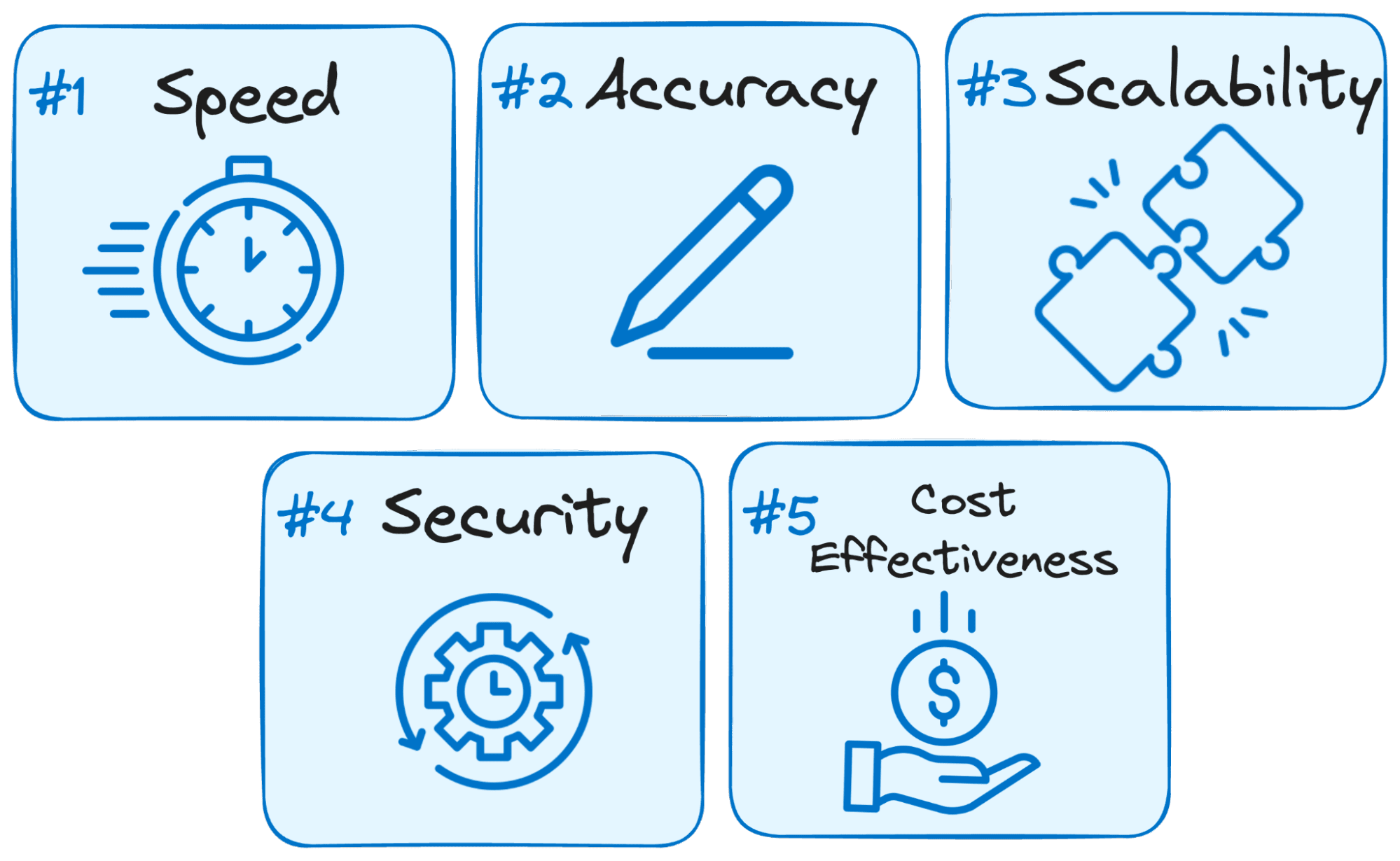
Here's why LLMOps is crucial for the success of any LLM-powered application:

Getting Started with LLMOps: The Secret Sauce Behind Seamless Interactions
Image by Author

  1. Speed is Key: Users expect immediate responses when interacting with LLMs. LLMOps optimizes the process to minimize latency, ensuring you get answers within a reasonable timeframe.
  2. Accuracy Matters: LLMOps implements various checks and controls to guarantee the accuracy and relevance of the LLM's responses.
  3. Scalability for Growth: As your LLM application gains traction, LLMOps helps you scale resources efficiently to handle increasing user loads.
  4. Security is Paramount: LLMOps safeguards the integrity of the LLM system and protects sensitive data by enforcing robust security measures.
  5. Cost-effectiveness: Operating LLMs can be financially demanding due to their significant resource requirements. LLMOps brings into play economical methods to maximize resource utilization efficiently, ensuring peak performance isn't sacrificed.

LLMOps Workflow: Understanding the Magic

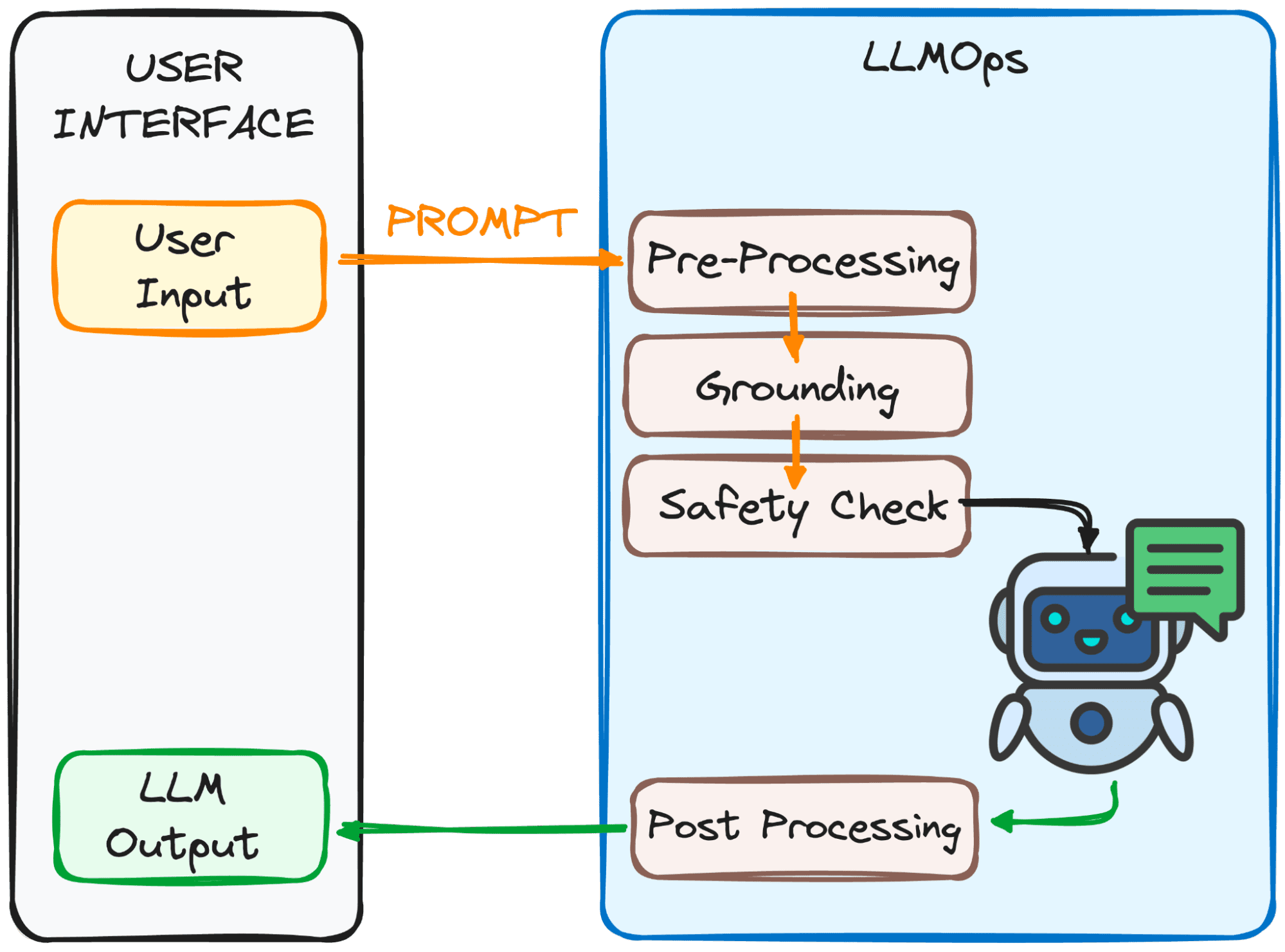
LLMOps makes sure your prompt is ready for the LLM and its response comes back to you as fast as possible. However, this is not easy at all.

This process involves several steps, mainly 4, that can be observed in the image below.

Getting Started with LLMOps: The Secret Sauce Behind Seamless Interactions
Image by Author

The goal of these steps?

To make the prompt clear and understandable for the model.

Here's a breakdown of these steps:

1. Pre-processing

The prompt goes through a first processing step. First, it's broken down into smaller pieces (tokens). Then, any typos or weird characters are cleaned up, and the text is formatted consistently.

Finally, the tokens are embedded into numerical data so the LLM understands.

2. Grounding

Before the model processes our prompt, we need to make sure that the model understands the bigger picture. This might involve referencing past conversations you've had with the LLM or using outside information.

Additionally, the system identifies important things mentioned in the prompt (like names or places) to make the response even more relevant.

3. Safety Check:

Just like having safety rules on set, LLMOps makes sure the prompt is used appropriately. The system checks for things like sensitive information or potentially offensive content.

Only after passing these checks is the prompt ready for the main act — the LLM!

Now we have our prompt ready to be processed by the LLM. However, its output needs to be analyzed and processed as well. So before you see it, there are a few more adjustments performed in the fourth step:

3. Post-Processing

Remember the code the prompt was converted into? The response needs to be translated back into human-readable text. Afterwards, the system polishes the response for grammar, style, and clarity.

All these steps happen seamlessly thanks to LLMOps, the invisible crew member ensuring a smooth LLM experience.

Impressive, right?

Key Components of a Robust LLMOps Infrastructure

Here are some of the essential building blocks of a well-designed LLMOps setup:

  • Choosing the Right LLM: With a vast array of LLM models available, LLMOps helps you select the one that best aligns with your specific needs and resources.
  • Fine-Tuning for Specificity: LLMOps empowers you to fine-tune existing models or train your own, customizing them for your unique use case.
  • Prompt Engineering: LLMOps equips you with techniques to craft effective prompts that guide the LLM toward the desired outcome.
  • Deployment and Monitoring: LLMOps streamlines the deployment process and continuously monitors the LLM's performance, ensuring optimal functionality.
  • Security Safeguards: LLMOps prioritizes data security by implementing robust measures to protect sensitive information.

The Future of LLMs is Powered by LLMOps

As LLM technology continues to evolve, LLMOps will play a critical role in the coming technological developments. Most part of the success of the latest popular solutions like ChatGPT or Google Gemini is their ability to not only answer any requests but also provide a good user experience.

This is why, by ensuring efficient, reliable, and secure operation, LLMOps will pave the way for even more innovative and transformative LLM applications across various industries that will arrive to even more people.

With a solid understanding of LLMOps, you're well-equipped to take advantage of the power of these LLMs and create groundbreaking applications.

Josep Ferrer is an analytics engineer from Barcelona. He graduated in physics engineering and is currently working in the data science field applied to human mobility. He is a part-time content creator focused on data science and technology. Josep writes on all things AI, covering the application of the ongoing explosion in the field.

More On This Topic

  • Collection of Free Courses to Learn Data Science, Data Engineering,…
  • How Semantic Vector Search Transforms Customer Support Interactions
  • GPT-4: 8 Models in One; The Secret is Out
  • HuggingGPT: The Secret Weapon to Solve Complex AI Tasks
  • Behind OpenAI Codex: 5 Fascinating Challenges About Building Codex…
  • Is the Modern Data Stack Leaving You Behind?

Nvidia CEO Jensen Huang unveils next-gen ‘Blackwell’ chip family at GTC

nvidia-2024-huang-and-blackwell-versus-hopper.png

Nvidia co-founder and CEO Jensen Huang held up the new Blackwell GPU chip, left, to compare to its predecessor, H100, "Hopper."

Nvidia CEO Jensen Huang on Monday presided over the AI chipmaker's first technology conference held in person since the COVID-19 pandemic, the GPU Technology Conference, or GTC, in San Jose, California, and unveiled the company's new design for its chips, code-named "Blackwell."

Many consider GTC to be the "Woodstock of AI" or the "Lalapalooza of AI." "I hope your realize, this is not a concert," Huang said following big applause at the outset. He called out the vast collection of partners and customers in attendance.

"Michael Dell is sitting right there," Huang said, noting the Dell founder and CEO was in the audience.

Also: AI startup Cerebras unveils the WSE-3, the largest chip yet for generative AI

Huang emphasized the scale of computing required for training large language models of generative AI, or, GenAI. A model that has trillions of parameters, combined with training data that is trillions of "tokens," or word-parts, would require "30 billion quadrillion floating point operations," or 30 billion petaFLOPS, Huang noted. "If you had a petaFLOP GPU, you would need 30 billion seconds to go compute, to go train that model — 30 billion seconds is approximately 1,000 years."

"I'd like to do it sooner, but it's worth it — that's usually my answer," Huang quipped.

Huang opened his presentation with an overview of the increasing size of AI workloads, noting that the most powerful chips would spend 30 billion seconds, or 1,000 years to train.

Nvidia's H100 GPU, the current state of the art chip, delivers on the order of 2,000 trillion floating-point operations per second, or, 2,000 TFLOPS. A thousand TFLOPS is equal to one petaFLOP, ergo, the H100, and its sibling, H200, can manage only a couple of petaFLOPS, far below the 30 billion to which Huang referred.

Also: Making GenAI more efficient with a new kind of chip

"What we need are bigger GPUs — we need much, much bigger GPUs," he said.

Blackwell, known in the industry as "HopperNext," can perform 20 petaFLOPS per GPU. It is meant to be delivered in an 8-way system, an "HGX" circuit board of the chips.

Using "quantization," a kind of compressed math where each value in a neural network is represented using fewer decimal places, called "FP4," the chip can run as many as 144 petaFLOPs in an HGX system.

The chip has 208 billion transistors, Huang said, using a custom semiconductor manufacturing process at Taiwan Semiconductor Manufacturing known as "4NP." That is more than double the 80 billion in Hopper GPUs.

The Nvidia Blackwell GPU multiplies ten-fold the number of floating-point math operations per second and more than doubles the number of transistors from the predecessor "Hopper" series. Nvidia notes the ability of the chip to run large language models 25 times faster.

Blackwell can run large language models of generative AI with a trillion parameters 25 times faster than prior chips, Huang said.

Also: For the age of the AI PC, here comes a new test of speed

The chip is named after David Harold Blackwell, who, Nvidia relates, was "a mathematician who specialized in game theory and statistics, and the first Black scholar inducted into the National Academy of Sciences."

The Blackwell chip makes use of a new version of Nvidia's high-speed networking link, NVLink, which delivers 1.8 terabytes per second to each GPU. A discrete part of the chip is what Nvidia calls a "RAS engine," to maintain "reliability, availability and serviceability" of the chip. A collection of decompression circuitry improves performance of things such as database queries.

Amazon Web Services, Dell, Google, Meta, Microsoft, OpenAI, Oracle, Tesla, and xAI are among Blackwell's early adopters.

Like its predecessors, two Blackwell GPUs can be combined with one of Nvidia's "Grace" microprocessors to produce a combined chip, called the "GB200 Grace Blackwell Superchip."

Like its predecessor Hopper GPUs, two Blackwell GPUs can be combined with one of Nvidia's "Grace" microprocessors to produce a combined chip, called the "GB200 Grace Blackwell Superchip."

Thirty-six of the Grace and 72 of the GPUs can be combined for a rack-based computer Nvidia calls the "GB200 NVL72" that can perform 1,440 petaFLOPS, getting closer to that billion petaFLOPs Huang cited.

A new system for the chips, the DGX SuperPOD, combines "tens of thousands" of the Grace Blackwell Superchips, boosting the operations per second even more.

Also: Nvidia boosts its 'superchip' Grace-Hopper with faster memory for AI

Alongside Blackwell, Nvidia made several additional announcements:

  • New generative AI algorithms to enhance its existing library of semiconductor design algorithms known as "cuLitho," referring to photolithography used in the semiconductor design process. The GenAI code generates an initial "photomask" for lithography, which can then be refined by traditional methods. It speeds up design of such photomasks by 100%. TSMC and chip-design software maker Synopsys are implementing cuLitho and the new GenAI functions into their technologies.
  • A new line of network switches and network interface cards based on the InfiniBand technology developed by Nvidia's Mellanox operation, the "Quantum-X800 Infiniband," and the ethernet networking standard, the "Spectrum-X800 Ethernet." Both technologies deliver 800 billion bits per second, or 800Gbps. Nvidia says the switches and NICs are "optimized for trillion-parameter GPU computing" to handle the speed of floating-point operations of the chips.
  • A catalog of 25 "micro services," cloud-based application container services software, pre-built for individual applications, including custom AI models, built on top of Nvidia's "NIM" container software suite, which is in turn part of the company's AI Enterprise software offering. The programs are what the company describes as a "standardized path to run custom AI models optimized for Nvidia's CUDA installed base of hundreds of millions of GPUs across clouds, data centers, workstations and PCs." The micro services include a bundle of life sciences-focused, some dedicated to "generative biology" and chemistry and "molecular prediction" tasks, to perform "inference," the generation of predictions, "for a growing collection of models across imaging, medtech, drug discovery, and digital health." The micro services are made available through Dell and other vendors' systems, through public cloud services including AWS, Google Cloud, Microsoft Azure, and Oracle Cloud Infrastructure, and they can be trialed on Nvidia's own cloud service.
  • Earth-2, a separate micro service designed as a "digital twin" simulation of extreme weather conditions, intended to "deliver warnings and updated forecasts in seconds compared to the minutes or hours in traditional CPU-driven modeling." The technology is based on a generative AI model built by Nvidia called "CorrDiff," which can generate "12.5x higher resolution images" of weather patterns "than current numerical models 1,000x faster and 3,000x more energy efficiently." The Weather Company is an initial user of the technology.

A high-res earth image simulation from a "digital twin" simulation of extreme weather conditions, called Earth-2 climate, intended to "deliver warnings and updated forecasts in seconds compared to the minutes or hours in traditional CPU-driven modeling." The technology is based on a generative AI model built by Nvidia called "CorrDiff," which can generate "12.5x higher resolution images" of weather patterns "than current numerical models 1,000x faster and 3,000x more energy efficiently." The Weather Company is an initial user of the technology.

Also: How Apple's AI advances could make or break the iPhone 16

In addition to the product and technology announcements on its own, Nvidia announced a number of initiatives with partners:

  • A collaboration with Oracle for "sovereign AI" to run AI programs locally, "within a country's or organization's secure premises."
  • A new supercomputer for Amazon AWS built from DGX systems running the Blackwell chips, called "Ceiba."
  • A partnership with Google Cloud to extend the JAX programming framework to the Nvidia chips, "widening access to large-scale LLM training among the broader ML community."

More news can be found in the Nvidia newsroom.

You can catch the entire keynote address on replay on YouTube.

Apple Finally Unveils MM1, a Multimodal Model for Text and Image Data 

Apple Antitrust

Apple researchers have developed a family of large multimodal language models called MM1, which can process and generate both text and visual data, according to a research paper presented last week. The study at Apple’s research labs aimed to build performant multimodal large language models (MLLMs) through careful ablation of various architectural components, data sources, and training procedures.

Read the paper here.

The researchers found that image resolution and the capacity of the visual encoder had the highest impact on model performance, while the specific method of combining visual and text data mattered less.

They also discovered that a careful mix of different data types was crucial, with interleaved image-text documents helping with few-shot learning, traditional captioned images boosting zero-shot performance, and including text-only data maintaining strong language understanding capabilities.

Based on these insights, the team developed the MM1 model family, ranging from three billion to 30 billion parameters, including dense and mixture-of-experts variants. After scaling up training, MM1 achieved state-of-the-art results on various multimodal benchmarks during pre-training.

Following further instruction tuning on a curated 1 million example dataset, the final MM1 models demonstrated competitive performance across 12 multimodal tasks, such as visual question answering and captioning. Notably, MM1 could perform multi-image reasoning and few-shot learning, critical capabilities enabled by the team’s careful multimodal pre-training approach.

This paper builds upon previous research into areas like CLIP for learning visual representations from natural language supervision, and autoregressive models like GPT for text generation. However, it is one of the first detailed studies focused specifically on large-scale multimodal pre-training.

The researchers hope their insights will accelerate progress, as Apple is reportedly in talks to integrate Google’s Gemini generative AI models into upcoming iPhone software.

The post Apple Finally Unveils MM1, a Multimodal Model for Text and Image Data appeared first on Analytics India Magazine.

5 Free Books to Master Statistics for Data Science

5 Free Books to Master Statistics for Data Science
Image by Editor

To learn data science, you also need a solid foundation in math. And statistics is one of those essential math skills for data science.

However, learning statistics can be intimidating especially if you’re from a specialization that isn’t math or computer science. To help you get started, we’ve compiled a list of free books that make statistics for data science accessible.

Most of these books take a hands-on approach to statistics concepts, which is what you need to use statistics effectively as a data scientist. So let’s go over these stats books.

1. Introductory Statistics

The Introductory Statistics book is an accessible intro to statistics that covers what a semester-long introductory statistics course in colleges typically covers.

Available for free access on OpenStax and written by a team of contributing expert authors, this book takes an application-first approach to statistics rather than a theory-first approach and includes examples in exercises for each topic.

This book will help you learn the following:

  • Sampling and data
  • Descriptive statistics
  • Topics in Probability and random variables
  • Normal distribution
  • The Central Limit theorem
  • Confidence intervals
  • Hypothesis testing
  • The Chi-Square distribution
  • Linear regression and correlation
  • F distribution and one-way ANOVA

Link: Introductory Statistics 2e

2. Introduction to Modern Statistics

Introduction to Modern Statistics is a free online textbook from the OpenIntro project and is written by authors Mine Çetinkaya-Rundel and Johanna Hardin.

If you want to learn statistics foundations for effective data analysis, then this book is for you. The contents of this book are as follows:

  • Introduction to data
  • Exploratory data analysis
  • Regression modeling
  • Foundations of inference
  • Statistical inference
  • Inferential modeling

Link: Introduction to Modern Statistics

3. Think Stats

Think Stats by Allen B. Downey will help you learn and practice statistics concepts using Python.

So you can apply your Python skills to learn statistics and probability concepts for working with data effectively. As you work through the book, you’ll get to write short Python programs and practice with real datasets to reinforce your understanding of statistics concepts.

The topics covered are as follows:

  • Exploratory data analysis
  • Distribution
  • Probability mass functions
  • Cumulative distribution functions
  • Modeling distributions
  • Probability density functions
  • Relationships between variables
  • Estimation
  • Hypothesis testing
  • Linear least squares
  • Regression
  • Survival analysis
  • Analytic methods

Link: Think Stats 2e

4. Computational and Inferential Thinking

Computational and Inferential Thinking: The Foundations of Data Science by Ani Adhikari, John DeNero, and David Wagner will help you learn statistics foundations for data science.

This book was developed as a companion to the Data 8: Foundations of Data Science course offered at UC Berkeley. The topics covered in this book include:

  • Introduction to data science
  • Programming in Python
  • Data types, Sequences, and Tables
  • Visualization
  • Functions and Tables
  • Randomness
  • Sampling and empirical distribution
  • Hypothesis testing
  • Estimation
  • Regression
  • Classification

Link: Computational and Inferential Thinking: The Foundations of Data Science

5. Probabilistic Programming and Bayesian Methods for Hackers

Probabilistic Programming and Bayesian Methods for Hackers or Bayesian Methods for Hackers is a popular book on Bayesian methods in statistics.

"Bayesian Methods for Hackers": An introduction to Bayesian methods + probabilistic programming with a computation/understanding-first, mathematics-second point of view. All in pure Python 😉

— Source

You’ll become familiar with probability theory and Bayesian inference all while using the PyMC package. The contents of this book are as follows:

  • Introduction to Bayesian methods
  • The PyMC library
  • Markov Chain Monte Carlo
  • The Law of Large Numbers
  • Loss functions
  • Priors

Link: Probabilistic Programming and Bayesian Methods for Hackers

Wrapping Up

I hope you found this round-up of free statistics books helpful. The mix of theory and hands-on practice should help you level up your data science skills and make more informed decisions when working with large real-world datasets.

If you prefer working through free courses or looking to supplement your reading with courses, check out 5 Free Courses to Master Statistics for Data Science.

Bala Priya C is a developer and technical writer from India. She likes working at the intersection of math, programming, data science, and content creation. Her areas of interest and expertise include DevOps, data science, and natural language processing. She enjoys reading, writing, coding, and coffee! Currently, she's working on learning and sharing her knowledge with the developer community by authoring tutorials, how-to guides, opinion pieces, and more. Bala also creates engaging resource overviews and coding tutorials.

More On This Topic

  • 5 Free Books to Master Data Science
  • 25 Free Books to Master SQL, Python, Data Science, Machine…
  • 5 Free Courses to Master Statistics for Data Science
  • 5 Free Books to Master Machine Learning
  • 5 Free Books to Help You Master Python
  • 5 Free Books to Master SQL

Oracle Launches Java 22 and Confirms JavaOne 2025 Return

Java role in ML

Oracle has officially launched Java 22, the latest iteration of the world’s most widely used programming language and development platform. This release introduces significant enhancements aimed at improving Java’s performance, stability, and security, thereby empowering developers to boost productivity and innovate across various organisations.

Java 22 incorporates 12 JDK Enhancement Proposals (JEPs) that bring about language improvements, core libraries and tools capabilities, as well as performance updates. Notable features include enhancements from Project Amber, such as Statements before super(…), Unnamed Variables & Patterns, String Templates (Second Preview), and Implicitly Declared Classes and Instance Main Methods (Second Preview).

Additionally, Project Loom introduces Structured Concurrency (Second Preview) and Scoped Values (Second Preview), while Project Panama presents Foreign Function & Memory API and Vector API (Seventh Incubator). Core Libraries & Tools Features include Class-File API (Preview), Launch Multi-File Source-Code Programs, and Stream Gatherers (Preview). Lastly, performance updates are provided through JEP 423: Region Pinning for G1.

“By delivering enhancements that streamline application development and extend Java’s reach to make it accessible to developers of all proficiency levels, Java 22 will help drive the creation of a wide range of new applications and services for organizations and developers alike.” Georges Saab, senior vice president, Oracle Java Platform.

Furthermore, Oracle announced the return of JavaOne to the San Francisco Bay Area in 2025. This flagship event, scheduled from March 17-20, 2025, in Redwood Shores, California, will provide a platform for attendees to stay updated on the latest Java developments and engage with Oracle’s Java experts and industry leaders.

“Java’s versatility and comprehensive toolset enables it to support the development of production-grade, mission-critical applications at scale, which positions it as a key enabling technology for innovative use cases such as generative AI,” said Arnal Dayaratna, research vice president, software development, IDC.

The post Oracle Launches Java 22 and Confirms JavaOne 2025 Return appeared first on Analytics India Magazine.

Stability AI Releases Stable Video 3D, Generating 3D Videos from Single Images

Stability AI yesterday announced the release of Stable Video 3D (SV3D), a generative AI model that creates 3D videos from a single 2D image. Stability AI, is an open source generative AI firm that develops models for a variety of applications.

The model, based on Stable Video Diffusion, aims to advance 3D technology by delivering improved quality and multi-view consistency compared to previous models like Stable Zero123.

SV3D comes in two variants: SV3D_u, which generates orbital videos from single images without camera conditioning, and SV3D_p, which accommodates both single images and orbital views, allowing for 3D video creation along specified camera paths. “Stable Video 3D leverages its multi-view consistency to optimise 3D Neural Radiance Fields (NeRF) and mesh representations to improve the quality of 3D meshes generated directly from novel views,” Stability AI stated in their blog post.

The model is available for both commercial and non-commercial use. Commercial users require a Stability AI membership starting at $20 per month, while non-commercial users can download the model weights from Hugging Face.

Varun Jampani, lead researcher at Stability AI, said, “Stable Video 3D is a valuable tool for generating 3D assets, especially within the gaming sector. Additionally, it enables the production of 360-degree orbital videos, which are useful in e-commerce, providing a more immersive and interactive shopping experience.”

SV3D’s release follows other recent advancements in AI-generated video, such as OpenAI’s Sora, Runway ML , and Google Dream Fields. However, SV3D differentiates itself by focusing on generating 3D videos from single images rather than relying on text inputs.

As AI continues to evolve, models like Stable Video 3D showcase the potential for transforming 2D content into immersive 3D experiences, with applications spanning gaming, e-commerce, and beyond.

Stability AI has been on a roll, releasing several innovative AI models in recent months. Last month, the company released Stable Diffusion 3, its most capable text-to-image model with improved performance in multi-subject prompts, image quality, and spelling abilities. They also launched Stable Cascade, a text-to-image AI model designed for efficiency on consumer hardware.

The post Stability AI Releases Stable Video 3D, Generating 3D Videos from Single Images appeared first on Analytics India Magazine.

Google Research Introduce PERL, a New Method to Improve RLHF

Google Search is Killing the SEO Experience

Google Research has introduced a new technique called Parameter Efficient Reinforcement Learning (PERL), which aims to make the process of aligning LLMs with human preferences more efficient and accessible.

This research paper published is available here.

The researchers propose using a parameter-efficient method called Low-Rank Adaptation (LoRA) to fine-tune the reward model and reinforcement learning policy in the Reinforcement Learning from Human Feedback (RLHF) process.

In PERL, LoRA, a method that fine-tunes a small number of parameters, is applied to make training more efficient. It’s used in both the reward model and the reinforcement learning (RL) policy of language models by attaching LoRA adapters to specific parts.

During training, only these adapters are updated, leaving the main part of the model unchanged. This approach reduces the amount of data needed to train and speeds up the process, making it possible to train the models with less computational power.

The team conducted extensive experiments on seven datasets, including two novel datasets called ‘Taskmaster Coffee’ and ‘Taskmaster Ticketing,’ which they released as part of this work.

The results showed that PERL performed on par with conventional RLHF while training faster and using less memory. This finding is significant because the computational cost and complexity of the RLHF process have hindered its adoption as an alignment technique for large language models. This advancement could lead to wider adoption of RLHF as an alignment technique, potentially improving the quality and safety of large language models.

The post Google Research Introduce PERL, a New Method to Improve RLHF appeared first on Analytics India Magazine.

Axtria Expands to Hyderabad with its 9th Global Innovation and Capability Centre in India

New Jersey-based prominent cloud software and data analytics firm Axtria has announced its ninth Global Innovation and Capability Centre in Hyderabad, India.

This facility, located at DLF Cyber City, Gachibowli, is the company’s largest office in India. Spanning 76,000 square feet, it’s certified LEED Platinum for its sustainable practices. It’s designed to be differently abled-friendly and has garnered praise for its zero-water waste initiatives.

Jaswinder Chadha, Axtria’s president and CEO, expressed the company’s commitment to India’s talent pool and its mission to drive innovation in the life sciences field. “This expansion reinforces our relentless pursuit of growth and innovation as we strive to serve our clients better and drive positive impact in the life sciences industry,” added Chadha.

Focusing on generative AI strategies, the company aims to recruit nearly 800 professionals globally in the coming months.

Manish Mittal, head of global delivery at Axtria and India country head, highlighted the role of Hyderabad’s tech sector in fostering innovation. “In the past few years, Hyderabad has emerged as a potential tech sector backed by economic and infrastructural transformation, and we are happy to open doors of opportunities to the tech community residing in the city.” added Mittal.

Axtria’s workforce, including engineers and data scientists, is dedicated to developing cutting-edge solutions for the industry. The company’s recent expansions in Noida, Pune, and Hyderabad are expected to create numerous job opportunities.

Axtria collaborates with 16 of the top 20 pharmaceutical companies, offering a range of cloud-based solutions. From brand launches to retirement, Axtria guides its clients through the digital transformation journey. Its suite of products, including Axtria InsightsMAx™, SalesIQ™, CustomerIQ™, MarketingIQ™, and DataMAx™, empowers stakeholders at all levels to make informed decisions and optimise operations.

As a participant in the United Nations Global Compact, Axtria aligns its operations with principles of human rights, labour, environment, and anti-corruption, demonstrating its commitment to societal goals.

The post Axtria Expands to Hyderabad with its 9th Global Innovation and Capability Centre in India appeared first on Analytics India Magazine.