NVIDIA Rewrites Moore’s Law with Blackwell 

At NVIDIA GTC 2024, CEO Jensen Huang, while announcing their ‘very big GPU’, Blackwell, sort of bid adieu to the ‘good old days of Moore’s law’.

Reflecting on the rapid advancement in computing power, Huang said that in just eight years, NVIDIA has increased computational capacity by a thousandfold, a progress that far exceeds the benchmarks set during the heyday of Moore’s Law. However, he rued that even after this remarkable growth, the industry’s accelerating demands are far from being met.

“In the past eight years, we’ve increased computation by 1000 times, and we have two more years to go. So that puts it into perspective [the fact that] the rate at which we’re advancing computing is insane. And it’s still not fast enough,” said Huang.
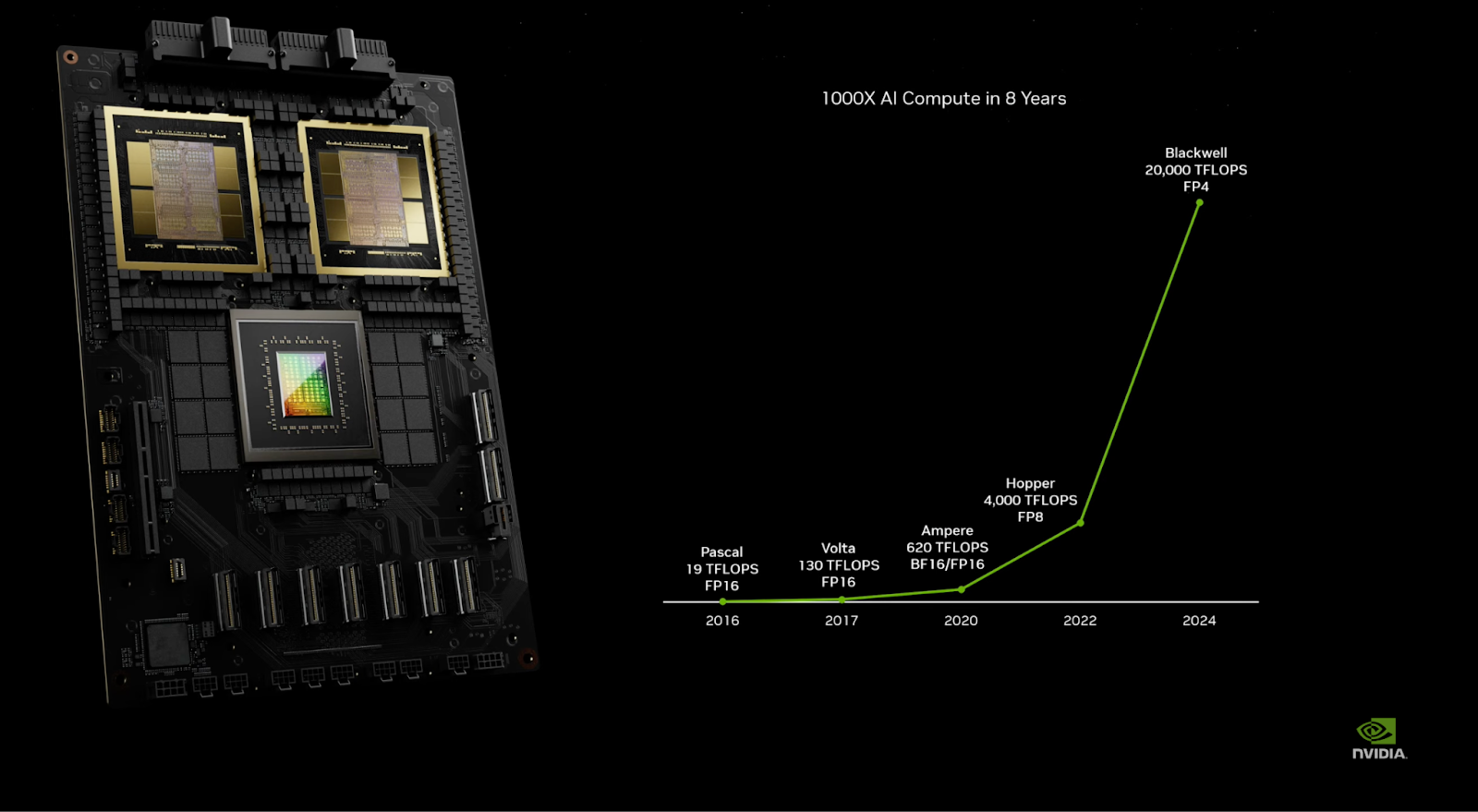
Huang said that the future is generative, which is why we call it ‘generative AI’, marking the start of a brand new industry. He agreed that their approach to computing is fundamentally different from their competitors. “We’ve created a processor specifically for the generative era,” he said, and added, “A critical component of this is what we call ‘content token generation’, which we format as FP4.”

Further, he said that this involves a significant amount of computation – 5x the token generation and 5x the inference capability of Hopper. “That might seem sufficient, but we asked ourselves, why stop there?” pondered Huang, and said that the answer is that it is not enough.

On the contrary, Intel is still hooked on Moore’s Law.

Intel: Moore’s law is not dead.
Nvidia: Moore’s law is dead.
Who’s right? Check the market caps.

— Pedro Domingos (@pmddomingos) March 5, 2024

Right after the announcement, many experts and folks from the ecosystem took to social media to declare that this was the new Moore’s law, or the era of Huang’s Law, as you may call it.

Unleashing Blackwell, the GPU Beast

NVIDIA’s latest GPU architecture is named after David Harold Blackwell, an eminent American statistician and mathematician – who has made significant contributions to various fields, including game theory, probability theory, information theory, and statistics.

NVIDIA’s Blackwell is a game-changing AI platform for trillion-parameter scale generative AI. The B200 GPU delivers 20 petaflops of power, and the GB200 offers 30x LLM inference workload performance, enabling efficiency to reach new heights.

Blackwell features a second-gen Transformer Engine to double AI model sizes with new 4-bit precision. The 5th-gen NVLink interconnect also enables up to 576 GPUs to work seamlessly on trillion-parameter models. An AI reliability engine maximises supercomputer uptime for weeks-long training runs.

The new Tensor Cores and TensorRT-LLM Compiler in the Blackwell platform significantly reduce the operating cost and energy consumption for LLM inference, by up to 25 times compared to its predecessor.

Major tech giants like Amazon, Google, Microsoft, and Tesla have already committed to adopting Blackwell.

Huang said that training a GPT model with 1.8 trillion parameters [GPT-4] typically takes three to five months using 25,000 amperes. The Hopper architecture would require around 8,000 GPUs, consume 15 megawatts of power, and take about 90 days to complete.

In contrast, Blackwell would need just 2,000 GPUs and significantly less power (only four megawatts) for the same duration. He said that NVIDIA aims to reduce computing costs and energy consumption, thereby facilitating the scaling up of computations necessary for training next-generation models.

To showcase Blackwell’s scale, NVIDIA also unveiled the DGX SuperPOD, a next-gen AI supercomputer with up to 576 Blackwell GPUs and 11.5 exaflops of AI compute. Each DGX GB200 system packs 36 Blackwell GPUs coherently linked to Arm-based Grace CPUs.

NVIDIA vs Intel vs AMD

In contrast, Intel recently launched its Ponte Vecchio GPU based on the Xe-HPC architecture under the Data Center Max GPU branding. The company is facing delays with its discrete GPU roadmap for gaming and consumer products, which could impact its future AI training capabilities.

On the other hand, AMD’s latest offering is the Instinct MI300 accelerator series based on its CDNA 3 architecture. The flagship MI300X promises up to 1.6x higher AI inference performance per chip than NVIDIA’s H100. However, for the crucial AI training workloads, the MI300X still trails the H100 in raw performance metrics like FP8 throughput.

In comparison, for AI training performance, the B200 offers up to 2.5x higher FP8 throughput per GPU over the previous Hopper generation. But its real strength lies in inference – the new FP6 numeric format effectively doubles throughput over FP16, enabling up to 30x higher performance for large language model inference compared to Hopper.

Blackwell also packs a massive memory bandwidth of 8TB/s and up to 192GB per B200 GPU.
While Intel and AMD are making progress, NVIDIA’s Blackwell platform raises the bar significantly through architectural innovations tailored to the unique demands of trillion-parameter AI models.

Given that Moore’s law has been declared officially dead, it would be interesting to see how this space evolves in the coming months. “GPU prices will drop once AMD becomes usable,” said Abacus.AI chief Bindu Reddy, sharing interesting predictions on compute for the next five years.

The post NVIDIA Rewrites Moore’s Law with Blackwell appeared first on Analytics India Magazine.

GAI, application sprawl, and the universal need for data-centric architecture

Interview with Dave McComb, President of Semantic Arts

GAI, application sprawl, and the universal need for data-centric architecture

Image by Gerd Altmann from Pixabay

At the beginning of his career, Dave McComb was having fun as an IT consultant at Andersen Consulting — which later became Accenture — building and implementing enterprise application systems. But eventually he realized that IT departments and the consultants helping them were creating a serious problem.

Early on, enterprises each ran only a handful of applications, and the applications were not well connected. Now enterprises are each running thousands of applications, even less well connected. The complexity has become overwhelming.

Borrowing a term from Turing Award winner and Mythical Man Month author Fred Brooks, McComb asserts that, in terms of the typical large enterprise, “Accidental complexity has gone berserk — I think it’s 5,000 percent.”

How do you identify what accidental complexity is in information systems, and separate it from essential complexity? McComb thinks back to the example of the work he and his staff at Semantic Arts did at Schneider Electric, an industrial electronics equipment supplier. There, the key question related to the company’s parts catalog database was which parts were compatible with one another in a specific country, given the different electrical requirements in each.

With the help of Schneider Electric’s project sponsor, knowledge graph consultancy Semantic Arts took the company’s relational database-oriented parts catalog and remodeled it to be transformed as a knowledge graph. (Full disclosure: I do some work for Semantic Arts.)

The result? A complex beast of a database with 700 tables and 7,000 attributes was reduced to 46 essential classes and 36 properties. Additionally, Semantic Arts dealt with the parts compatibility matching challenge, which had been stranded in separate spreadsheets maintained by engineers, by writing rules in SPARQL – SPARQL Protocol and RDF Query Language, a means querying standards-based semantic graphs – that were then stored as a part of the knowledge graph.

The interview we recorded has a number of gems like this story, including thoughts on architectural transformation for GAI. I hope you enjoy listening to it.

Interview podcast with Dave McComb

Keras 3.1.0 Release Introduces Key Updates for Optimised AI Development

François Chollet, the creator of Keras, released version 3.1.0 of the library today. This version fixes key issues and improves upon model slicing and error handling, it also extends support for more complex data handling techniques.

The update introduced features such as int8 quantisation for model optimisation, new backend configuration options, and a MelSpectrogram layer for audio data processing.

Int8 quantisation, a technique that converts a model’s weights and activations from 32-bit floating-point to 8-bit integers, reduces the model’s size and speeds up its processes. This doesn’t cause a significant loss in accuracy but allows them to run more efficiently, especially on devices with limited resources.

Responding to the release a user on X said, “Quantisation was much needed! Hoping for QLoRA in the next version!”

New backend configuration options give developers flexibility to switch computational backends easily, enhancing the tool’s adaptability across different platforms like TensorFlow, or Microsoft Cognitive Toolkit (CNTK), depending on the developers preferences.

In addition, the MelSpectrogram layer is added that transforms raw audio into Mel Spectrogram format that represents audio signals in a way that mimics human ear processing. This is particularly useful for machine learning models in tasks like speech recognition, audio classification, and music analysis.

The update simplifies the development process, enhances model efficiency, and extends the library’s applicability across different computational environments and data types.

The post Keras 3.1.0 Release Introduces Key Updates for Optimised AI Development appeared first on Analytics India Magazine.

What is Suno? The ‘ChatGPT for music’ generates songs in seconds

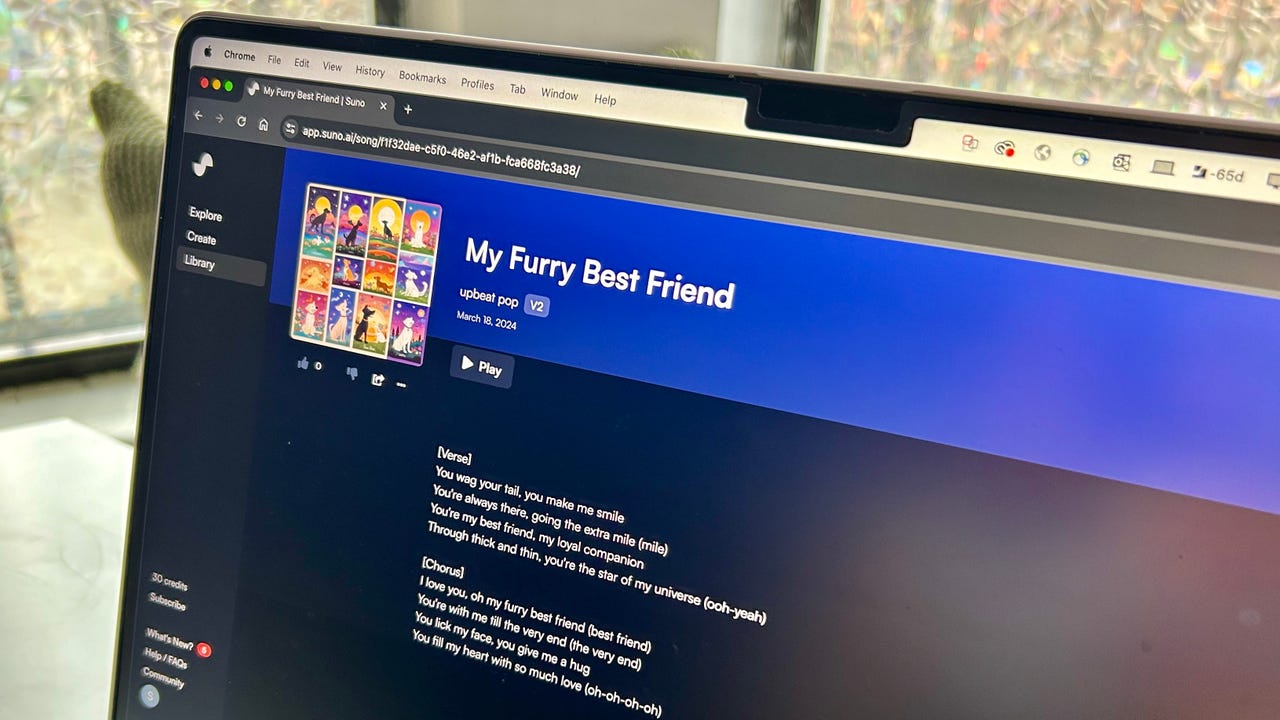
Suno song generator

Several text-to-music generators are now on the market, including offerings from Meta and Google. However, the Suno AI music generator is becoming increasingly popular — likely because it creates original lyrics and vocals, and because it leverages the power of ChatGPT.

So what is Suno and how does it work?

Also: YouTube creators will now have to label certain AI-generated videos upon upload

[Verse]

You wag your tail, you make me smile
You're always there, going the extra mile (mile)
You're my best friend, my loyal companion
Through thick and thin, you're the star of my universe (ooh-yeah)

[Chorus]

I love you, oh my furry best friend (best friend)
You're with me till the very end (the very end)
You lick my face, you give me a hug
You fill my heart with so much love (oh-oh-oh-oh)

Even though the clips are short, you can extend them by clicking on three dots and clicking "Continue from the song." There you have the option to drop your own lyrics and style of music or randomize both.

Also: AI has created areas so grey, you could write a song about it

Free users get 50 credits per day, and a single song generation takes up 10 credits. If you need more credits, you can upgrade to the Pro Plan for $8 per month, which gives users 2,500 credits per month; or the Premier Plan, which gives users access to 10,000 credits per month.

Both subscription plans have other perks such as general commercial terms, optional credit top-ups priority generating queue, and the ability to run 10 jobs at once. If you want to use Suno in Copilot, you can find ZDNET's step-by-step instructions here.

Also: The best AI chatbots of 2024: ChatGPT and alternatives

As a result, if you are a paying subscriber you can use the music for commercial use, such as posting the songs on YouTube, Spotify, or Apple Music. Free users can only post on social media with attribution and are not allowed to use the songs commercially. Regardless of which version you use, if you input your own lyrics, you retain ownership of that.

Are the songs subject to copyright protection? Here's what Suno shares on its website:

"The availability and scope of copyright protection for content generated (in whole or in part) using artificial intelligence is a complex and dynamic area of law, which is rapidly evolving and varies among countries. We encourage you to consult a qualified attorney to advise you about the latest development and the degree of copyright protection available for the output you generate using Suno."

Also: A thorny question: Who owns code, images, and narratives generated by AI?

As AI becomes more pervasive in the music industry, we will continue to see developments in policy that carefully delineate the limitations and allowances of AI. For example, over the summer the Recording Academy addressed how AI-generated music and content would be considered for the Grammy Awards.

Artificial Intelligence

Microsoft hires Inflection founders to run new consumer AI division

Microsoft hires Inflection founders to run new consumer AI division Manish Singh 8 hours

Microsoft has hired Mustafa Suleyman and Karen Simonyan, co-founders of high-profile AI startup Inflection AI, and several of their colleagues as the Satya Nadella-led cloud giant continues its aggressive push to attract top talent.

Suleyman — also a co-founder of DeepMind, which Google bought in 2014 to bolster its own AI efforts — will run Microsoft’s newly formed consumer AI unit, called Microsoft AI, whereas Simonyan is joining the company as a chief scientist in the same new group. Mustafa, whose official title at Microsoft is EVP and CEO of Microsoft AI, will report to chief executive Nadella.

Inflection AI is no stranger to Microsoft. The cloud giant led a $1.3 billion funding round in the startup less than a year ago. At the time of the funding, Inflection AI said it is building the world’s largest AI cluster, featuring 22,000 Nvidia H100 GPUs.

Suleyman will also lead AI products and research for Copilot, Bing and Edge, he wrote in a tweet.

“Several members of the Inflection team have chosen to join Mustafa and Karén at Microsoft,” Nadella wrote in a blog post. “They include some of the most accomplished AI engineers, researchers, and builders in the world. They have designed, led, launched, and co-authored many of the most important contributions in advancing AI over the last five years.”

Inflection AI is one of the most prominent AI startups. It was founded in 2022 by LinkedIn co-founder Reid Hoffman and Suleyman, and had sought to develop AI systems that can engage in open-ended dialogue, answer questions, and assist with a variety of tasks. In a blog post, Inflection AI said that it will shift its focus to the AI studio business, where it builds and tests customer generative AI models. “This renewed emphasis on our API also comes with some important changes in the company,” wrote Inflection AI.

As part of the transition/situation, Inflection AI said it will host Inflection-2.5 on Microsoft Azure, something it said will help to reach “creators everywhere.” It added: “We’ll also be ensuring it comes to other cloud hosting platforms in the near future. The API itself isn’t available today, but will be up and running very soon.”

Microsoft appears to have been working on the new AI unit for some time. Nadella had offered to hire OpenAI co-founders Sam Altman and Greg Brockman — when they temporarily exited the startup in December.

Nadella said today the firm — and the world — is only in its second year of the AI platform shift and Microsoft “must ensure we have the capability and capacity to boldly innovate.”

Mustafa Suleyman Joins as the New CEO of Microsoft AI

Mustafa Suleyman Joins as the New CEO of Microsoft AI

Mustafa Suleyman, former co-founder and head of DeepMind and Inflection AI, has joined Microsoft as the CEO of Microsoft AI. He would be leading the consumer AI products which includes Copilot, Bing, and Edge.

I’m excited to announce that today I’m joining @Microsoft as CEO of Microsoft AI. I’ll be leading all consumer AI products and research, including Copilot, Bing and Edge. My friend and longtime collaborator Karén Simonyan will be Chief Scientist, and several of our amazing…

— Mustafa Suleyman (@mustafasuleyman) March 19, 2024

Along with Suleyman, co-founder of Inflection AI Karén Simonyan will be joining as Chief Scientist, and several others are also joining the team. Simonyan is also the creator of AlphaZero.

He posted on X saying that Inflection AI, the company he co-founded in 2022, is going to be joined by a new CEO. He further mentioned that the API would be now available for developers and businesses to use for wider adoption.

Satya Nadella posted a blog saying that several other team members have also joined Microsoft AI. He further said that, “ Our AI innovation continues to build on our most strategic and important partnership with OpenAI. We will continue to build AI infrastructure inclusive of custom systems and silicon work in support of OpenAI’s foundation model roadmap, and also innovate and build products on top of their foundation models.”

Mikhail Parakhin and his team currently leading Copilot, Bing, and Edge, along with Misha Bileno and the generative AI team will now report to Suleyman, as posted by Nadella.

Suleyman joined Google in 2014 when the search giant acquired DeepMind for $50 million. He was Google’s vice president of product management and policy for AI.

Recently, Inflection AI launched Inflection-2.5, a model that competes with all the world’s leading LLMs, including GPT-4 and Gemini. Inflection-2.5 approaches the performance level of GPT-4 but utilises only 40% of the computing resources for training.

The startup also raised $1.3 billion in their latest round of funding in June 2023 after the launch of their personal chatbot Pi.

The post Mustafa Suleyman Joins as the New CEO of Microsoft AI appeared first on Analytics India Magazine.

The EU’s AI act: A measured approach to innovation and regulation

Screenshot-2024-03-15-20.58.56

AI regulatory measures often stir mixed reactions. We reached a regulatory milestone this week- with the final passing of the AI ACT in the European Union.

The locus of emphasis has shifted elsewhere now – specifically to oversight approaches and appointments from countries and to the AI Office. The AI Act divides machine learning systems into four main categories based on the potential risk to society. High-risk systems are subject to more stringent rules in the EU.

There are various relevant timelines. Member states have to appoint members to the oversight (AI Office) in 12 months. The actual bans on restricted practices will apply from November. The high-risk systems obligations will come into force from May 2025. The high-risk systems will be managed by the national authorities supported by the central AI Office in the European Commission.

It’s important to note what is not there. Specifically, the once mooted proposals for regulating AI at the level of model parameters are absent – which is good for innovation.

There are a number of reasons to be optimistic about the AI act.

Earlier this year, the EU’s Artificial Intelligence Office was announced as the body tasked with enforcing the AI Act. EU members will nominate experts to this committee. The emphasis has thus shifted to the AI office and the nominated members. Many of the issues like the risks of AGI, copyright, etc will be handled by this body, presumably on a case-by-case basis. Specifically its not a blanket restriction on the number of parameters as I understand it. The creation of the AI Office is a reasonable compromise for a number of reasons.

Firstly, vendors themselves will benefit if there is some clarity. This is one of the main positive reasons for the AI act

Secondly, even where we see high-risk cases, we could have technical or process-led solutions such as graph neural networks and humans in the loop. Note that education and recruitment come at high risk in some cases (because of the possibility of algorithms passing judgment on people), In such cases, LLM output can be anchored in some way to enterprise domain knowledge in the form of a knowledge graph with a human in the loop strategy..

The risks to consumers are real as we see from the case of Air Canada who (unsuccessfully) argued that chatbots are responsible for their actions( Air Canada ordered to pay customer who was misled by airline’s chatbot ). The chatbot had apparently ‘made up’ a bereavement policy. In other words, now, if technical solutions exist, these will need to be implemented to avoid hallucination and provide explainable solutions.

As I have said previously, the emphasis now shifts to the AI Office. European AI Office will be the center of AI expertise across the EU with the objective of implementing the AI act, working with AGI, fostering the development and use of trustworthy AI, and nurturing international cooperation.

Some of the areas of remit for the AI office include the following source the European commission

  • Investigating possible infringements of rules, including evaluations to assess model capabilities, and requesting providers to take corrective action
  • Preparing guidance and guidelines, implementing and delegated acts, and other tools to support effective implementation of the AI Act and monitor compliance with the regulation
  • Providing advice on best practices and enabling ready-access to AI sandboxes, real-world testing, and other European support structures for AI uptake
  • Encouraging innovative ecosystems of trustworthy AI to enhance the EU’s competitiveness and economic growth
  • At an institutional level, the AI Office works closely with the European Artificial Intelligence Board formed by Member State representatives and the European Centre for Algorithmic Transparency (ECAT) of the Commission.
  • The AI Office may also partner up with individual experts and organizations. It will also create fora for cooperation of providers of AI models and systems, including general-purpose AI, and similarly for the open-source community, to share best practices and contribute to the development of codes of conduct and codes of practice.
  • The AI Office will also oversee the AI Pact, which allows businesses to engage with the Commission and other stakeholders such as sharing best practices and joining activities. This engagement will start before the AI Act becomes applicable and will allow businesses to plan ahead and prepare for the implementation of the AI Act. All this will be part of the European AI Alliance, a Commission initiative, to establish an open policy dialogue on AI.

Notes

1) Views are mine alone and not associated with any organization I am working with.

2) The above is my understanding – the AI act is still very new and may evolve as the focus shifts to the oversight team.

Image source

https://digital-strategy.ec.europa.eu/en/policies/ai-office

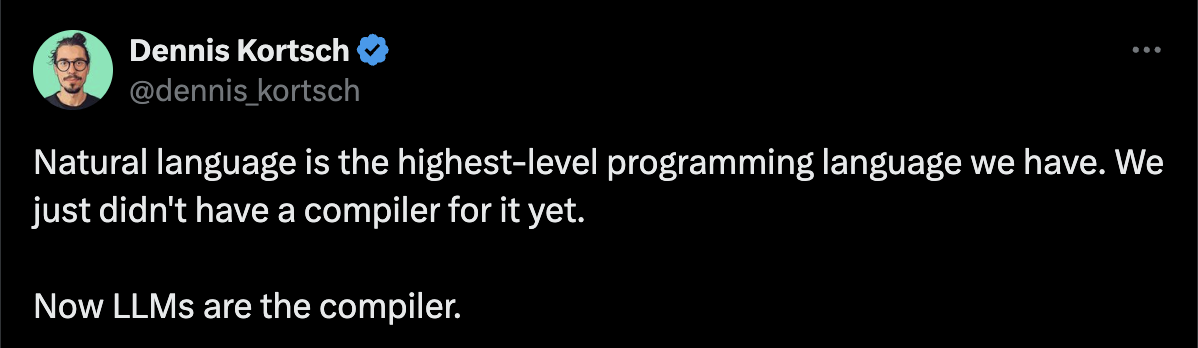
In 5 Years, Coding will be Done in Natural Language

Most Coding Will Be in Done Natural Language in 5 Years

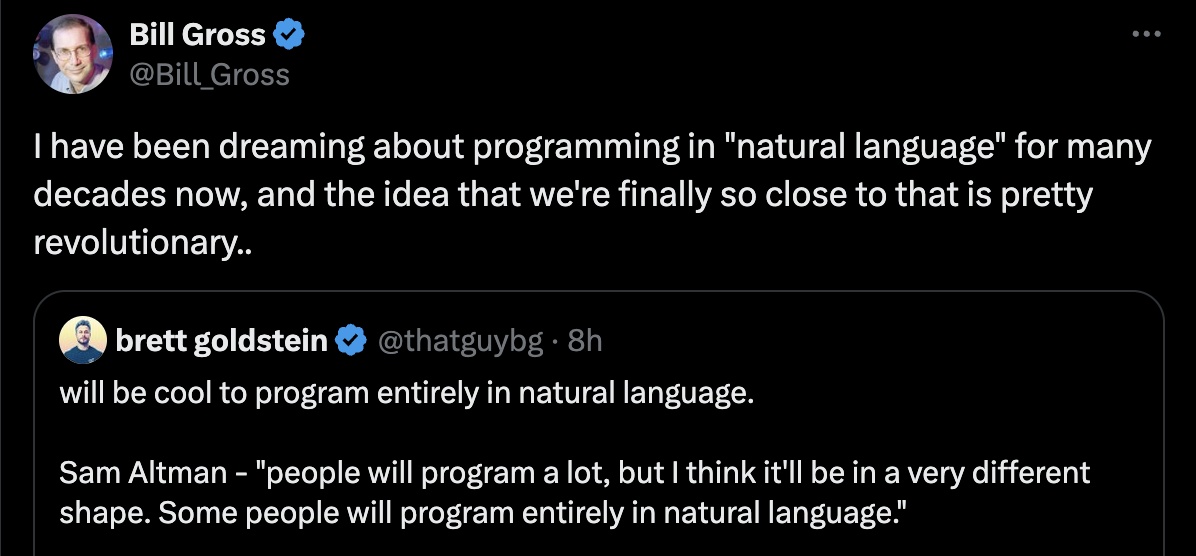
A future where everyone would be a coder is getting closer with each passing year – or month, maybe. In the latest podcast with Lex Fridman, when asked how much programming people would do in the next 5-10 years, OpenAI CEO Sam Altman said, “A lot, but I think it’ll be in a very different shape.”

Altman said that many have already started programming entirely in natural language. “No one programs by writing code…some people do. No one programs the pun cards anymore,” he quipped, adding that it would change the nature and the skillset, not so much the predisposition for who we call programmers in the future.

Recently, there have been discussions on X about how there would be fewer software engineering jobs in the future as most of the code would be written by AI. On the contrary, Fracois Chollet, the creator of Keras, predicted that there would be 10 million more coding jobs in the next five years, the ones that would require the knowledge of programming languages like Python, C, or JavaScript.

Plenty software programs left to write

“The best practitioners of the craft will use multiple tools and they’ll do some work in natural language,” he added. Altman explained that people would be able to focus on the higher level of abstractions, and the puzzle-solving skill set of programming, which Fridman agreed, was the harder part.

This is similar to what Chollet posted on X last week. “If you could fully automate software engineering (my job), I think that would be great, since I could then move on to higher-leverage things. Making software is a means to an end, not the end.” He added that software engineering is not just about copy-pasting code, but about developing mental models of problems and their solutions.

“The way I think about it is not what percent of jobs AI will do, but what percent of tasks will AI do,” Altman explained when asked about the capabilities of GPT-4 and how people fear monger AI replacing jobs, giving examples of how AI would be able to assist in five-minute tasks to five-days tasks. “Because AI is a tool,” he adds, that people should be able to operate at a higher level of abstraction and become way more efficient at the job they do.

Eventually, everyone is likely to be coding in the natural language, but that wouldn’t necessarily make them a software engineer or a programmer. The skills required to be a coder are far more complex than being able to put prompts in an AI tool, copying the code, or merely typing in natural language.

The most recent tool by Cognition Labs, Devin, is also an assistant which requires a programmer to guide it.

What would be the new job requirements then?

NVIDIA’s Jensen Huang believes that everyone would be a programmer one day and Microsoft’s Satya Nadella has been quoted as saying that “everyone’s a developer”. It now gets increasingly clear that the goal was always to make programming as natural as possible, and LLMs have made that possible now.

Soon, there would be a programming language exclusively in our very own English language.

Not to be confused with prompt engineering and writing code, the term natural language programming means that most of the coding would be done by the software in the backend. The programmer would only have to interact with the tool in English, or any other language and never even look at the code.

On the contrary, a few experts believe that English cannot be a programming language because it is filled with misunderstandings. “If they’re going into machines, which will affect the lives of people, we can’t afford that level of comedy,” said Douglas Crockford when talking to AIM.

Would this mean the end of coding? It would probably mean as Darian Moody put on X, “The real 5th generation programming languages actually turned out to be natural language. It’s a lot less upsetting when you think about it like this.” The real skill set in the future would be how to manage teams who program in natural language and the skills in English, instead of Python.

The post In 5 Years, Coding will be Done in Natural Language appeared first on Analytics India Magazine.
Fitbit is about to get some major AI upgrades, powered by Google’s ‘Personal Health’ LLM

Fitbit Charge 6 on wrist

Wearables track important biometric data that can tell you about your personal health, habits, and more. However, interpreting this data takes time, so Google Research and Fitbit are partnering to use artificial intelligence (AI) to make the analysis process easier.

On Tuesday, at The Check Up, Google Health's annual event, Google Research and Fitbit announced they are working together to build a Personal Health Large Language model (LLM) that gives users more insights and recommendations based on their data in the Fitbit mobile app.

Also: The best Fitbit fitness trackers: Expert tested and reviewed

The model will give Fitbit users personalized coaching and actionable insights that help them achieve their fitness and health goals. For example, the LLM could analyze variations in your sleep patterns and suggest recommendations on changes to your workout intensity to improve your sleep quality, Google says in a press release.

The LLM is being built on Google's Gemini models and fine-tuned on "a de-identified, diverse set of health signals from high-quality research case studies." To ensure that the models are capable of profound reasoning from the data, accredited coaches and wellness experts are validating the studies, according to the release.

The model is still being built and Google says it will share more research soon. This model follows another major AI Fitbit update announced last year — Fitbit Labs.

Also: I tried the AI robot massage coming to Equinox. It was surprisingly relaxing

With Fitbit Labs, Premium users will get early access to experimental AI features, including the ability to conversationally ask questions regarding their health data and even have the AI create charts to visualize their data better. Fitbit Labs will be available later this year.

Whoop recently introduced a similar feature, Whoop Coach, a GPT-4-supported conversational chatbot that can deliver personalized recommendations and fitness coaching based on the user's data. I tested the Whoop Coach and was impressed with how integrating your biometric data with a chatbot can help you understand your health information.

Artificial Intelligence

How NVIDIA’s Project GR00T is Accelerating Humanoid Robots 

Thanks to NVIDIA, the era of humanoids becoming a reality is not far. At the highly-anticipated NVIDIA GTC event, with some unexpected showmanship, NVIDIA chief Jensen Huang announced Project GR00T, a general-purpose foundation model for humanoid robots.

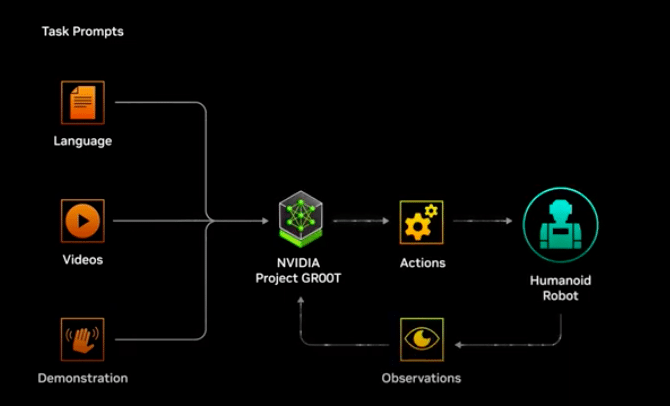
Robots powered by GR00T, short for Generalist Robot 00 Technology, are engineered to understand natural language and mimic human movements by observing actions. This allows them to quickly learn coordination, dexterity, and other skills required to navigate, adapt, and interact effectively in the real world.

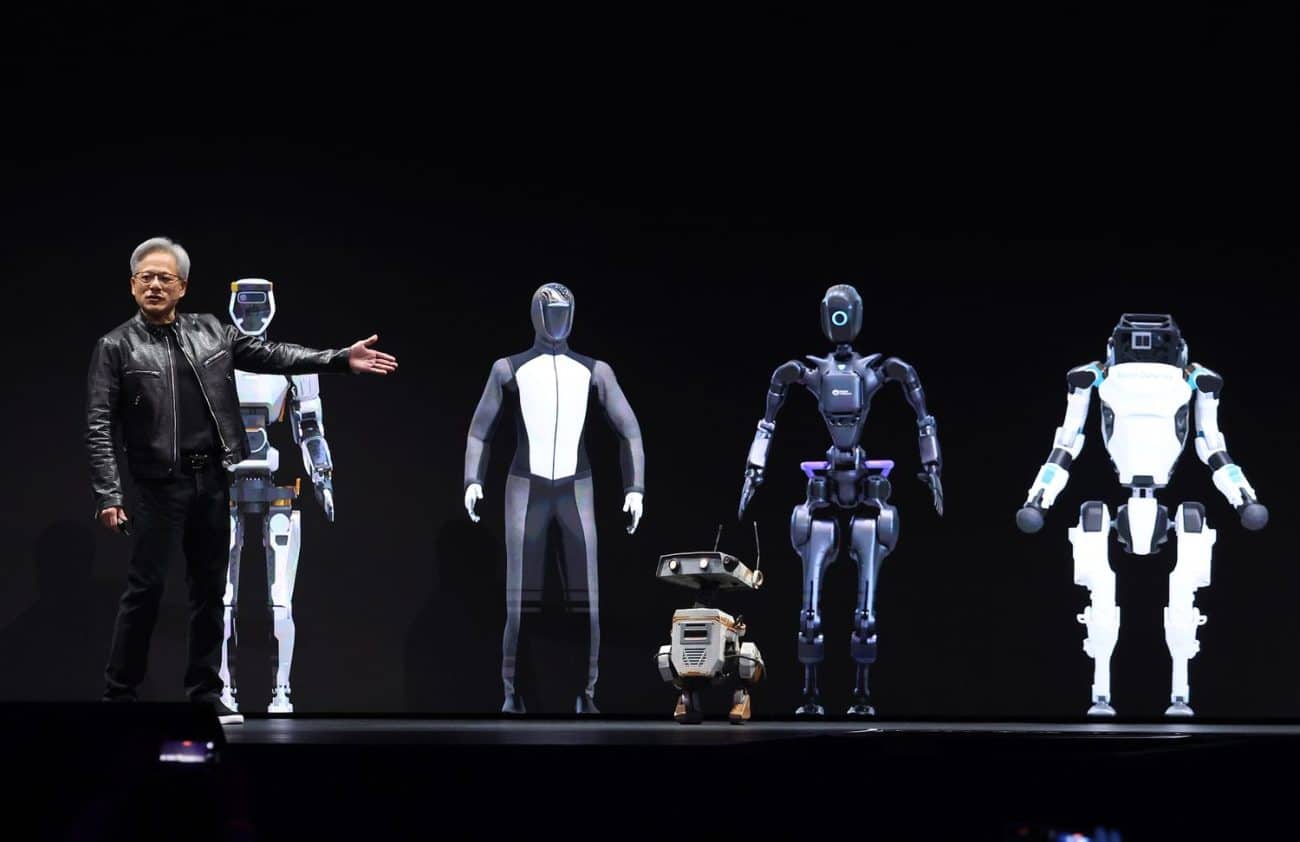
The highlight of the keynote was Huang posing with nine humanoids about the same size as him. While wrapping up his keynote, he was accompanied by Orange and the infamous Green BDX robots from Disney Research, which kept interrupting and disrupting the flow of his keynote presentation. With NVIDIA, Disney is now starting to look more like a robotics company.

“The next generation of robotics will likely be humanoid robotics,” Huang said, calling it easier due to the availability of much more imitation training data for these robots. This is because they are constructed much like humans, according to Huang. “It is very likely that human robotics will be much more useful in our world because we created the world to be something that we can interoperate in and work well in,” he said.

Interestingly, GR00T may be the first foundational model designed specifically for humanoids. It takes multimodal instructions and past interactions as input and produces the next action for the robot to execute. Emphasising its multimodality, Huang said that GR00T learns from human examples, which could be in ‘video or virtual reality form’.

NVIDIA has developed Isaac Lab, a robot learning application to train GR00T on Omniverse Isaac Sim, alongside Osmo, a new compute orchestration service that coordinates workflows across DGX systems for training, and OVX systems for simulation. With these tools, NVIDIA can train GR00T in simulation and transfer zero-shot learning to the real world.

“Today is the beginning of our moonshot to solve embodied AGI in the physical world,” wrote Jim Fan, lead of Embodied AI at NVIDIA, on X.

NVIDIA is partnering with top humanoid robot companies like 1X Technologies, Agility Robotics, Apptronik, Boston Dynamics, Figure AI, Fourier Intelligence, Sanctuary AI, Unitree Robotics, XPENG Robotics, and more. Recently it also invested in Figure AI alongwith Microsoft, OpenAI and others.

A few days ago, the robotics startup Figure shared a video demonstration of its first humanoid engaging in real-time conversations with humans. The robot was powered by an OpenAI model, possibly GPT-5 with Vision, showcasing high-level visual and language intelligence.

In a recent podcast with Lex Fridman, OpenAI chief Sam Altman announced OpenAI’s return to robotics: “I think it’s sort of depressing if we have AGI and the only way to get things done in the physical world is to make a human go do it.”

Unleashing the Power of Thor

Possibly inspired by Marvel and named in line with GR00T, NVIDIA has developed a new computing platform called Jetson Thor, designed specifically for humanoid robots. It is capable of efficiently handling complex tasks and interacting safely and seamlessly with both people and machines.

The platform’s SoC features a new-generation GPU based on NVIDIA’s Blackwell architecture, equipped with a Transformer engine that delivers 800 teraflops of 8-bit floating-point AI performance. This enables the platform to run multimodal generative AI models like GR00T efficiently.

Not just that, NVIDIA has also announced a collection of robotics pretrained models, libraries and reference hardware, called Isaac Manipulator and Isaac Perceptor. The latter will assist humanoids in navigating physical environments autonomously without pre-programmed routes between two points. For example, in a warehouse scenario where a box falls, the humanoid can find its own path without waiting for humans to clear the way.

“With the Isaac Perceptor, we have incredible state-of-the-art vision odometry, 3D reconstruction, and depth perception,” said Huang. On the other hand, the Isaac Manipulator offers advanced dexterity and flexible AI features for robotic arms.

NVIDIA is democratising the robotics field, much like it did for LLMs with its GPUs. The concept of ‘2024 being the year of Embodied AI’ resonated with Figure founder Brett Adcock, who believes that advanced AI capable of complex tasks will likely develop in parallel with, or even slightly ahead of, reliable humanoid robot hardware.

The post How NVIDIA’s Project GR00T is Accelerating Humanoid Robots appeared first on Analytics India Magazine.